EP0269042A2 - Verfahren zur Herstellung von 2-Propenyliden-3-ethylglutarsäurediestern - Google Patents
Verfahren zur Herstellung von 2-Propenyliden-3-ethylglutarsäurediestern Download PDFInfo
- Publication number
- EP0269042A2 EP0269042A2 EP87117208A EP87117208A EP0269042A2 EP 0269042 A2 EP0269042 A2 EP 0269042A2 EP 87117208 A EP87117208 A EP 87117208A EP 87117208 A EP87117208 A EP 87117208A EP 0269042 A2 EP0269042 A2 EP 0269042A2
- Authority
- EP
- European Patent Office
- Prior art keywords
- carbon atoms
- radical
- propenylidene
- alkali
- alcoholates
- Prior art date
- Legal status (The legal status is an assumption and is not a legal conclusion. Google has not performed a legal analysis and makes no representation as to the accuracy of the status listed.)
- Granted
Links
- -1 propenylidene-3 ethyl glutaric acid diesters Chemical class 0.000 title claims abstract description 33
- 238000004519 manufacturing process Methods 0.000 title abstract 2
- 125000004432 carbon atom Chemical group C* 0.000 claims abstract description 25
- 239000003054 catalyst Substances 0.000 claims abstract description 16
- 229910052784 alkaline earth metal Inorganic materials 0.000 claims abstract description 14
- 238000009833 condensation Methods 0.000 claims abstract description 10
- 230000005494 condensation Effects 0.000 claims abstract description 10
- 150000001342 alkaline earth metals Chemical class 0.000 claims abstract description 8
- 150000001408 amides Chemical class 0.000 claims abstract description 5
- 229910052782 aluminium Inorganic materials 0.000 claims abstract description 4
- XAGFODPZIPBFFR-UHFFFAOYSA-N aluminium Chemical compound [Al] XAGFODPZIPBFFR-UHFFFAOYSA-N 0.000 claims abstract description 4
- 150000005840 aryl radicals Chemical class 0.000 claims abstract description 4
- 150000004678 hydrides Chemical class 0.000 claims abstract description 4
- 150000001875 compounds Chemical class 0.000 claims abstract description 3
- 229910052783 alkali metal Inorganic materials 0.000 claims abstract 3
- 150000001340 alkali metals Chemical class 0.000 claims abstract 3
- 238000000034 method Methods 0.000 claims description 11
- 239000007858 starting material Substances 0.000 claims description 8
- 239000003513 alkali Substances 0.000 claims description 7
- 238000002360 preparation method Methods 0.000 claims description 4
- RTAQQCXQSZGOHL-UHFFFAOYSA-N Titanium Chemical compound [Ti] RTAQQCXQSZGOHL-UHFFFAOYSA-N 0.000 claims description 3
- 239000010936 titanium Substances 0.000 claims description 3
- 229910052719 titanium Inorganic materials 0.000 claims description 3
- 150000002148 esters Chemical class 0.000 claims description 2
- 239000002253 acid Substances 0.000 claims 1
- 229910000102 alkali metal hydride Inorganic materials 0.000 claims 1
- 150000008046 alkali metal hydrides Chemical class 0.000 claims 1
- 150000004703 alkoxides Chemical class 0.000 claims 1
- 125000005907 alkyl ester group Chemical group 0.000 claims 1
- UIUWNILCHFBLEQ-NSCUHMNNSA-N trans-pent-3-enoic acid Chemical compound C\C=C\CC(O)=O UIUWNILCHFBLEQ-NSCUHMNNSA-N 0.000 claims 1
- 239000004411 aluminium Substances 0.000 abstract 1
- OKKJLVBELUTLKV-UHFFFAOYSA-N Methanol Chemical compound OC OKKJLVBELUTLKV-UHFFFAOYSA-N 0.000 description 21
- WQDUMFSSJAZKTM-UHFFFAOYSA-N Sodium methoxide Chemical compound [Na+].[O-]C WQDUMFSSJAZKTM-UHFFFAOYSA-N 0.000 description 14
- KJALUUCEMMPKAC-ONEGZZNKSA-N methyl (e)-pent-3-enoate Chemical compound COC(=O)C\C=C\C KJALUUCEMMPKAC-ONEGZZNKSA-N 0.000 description 7
- 239000000203 mixture Substances 0.000 description 7
- MBAHGFJTIVZLFB-SNAWJCMRSA-N methyl (e)-pent-2-enoate Chemical compound CC\C=C\C(=O)OC MBAHGFJTIVZLFB-SNAWJCMRSA-N 0.000 description 5
- HJKKRHMJWMESEF-UHFFFAOYSA-N methyl 3-methoxypentanoate Chemical compound CCC(OC)CC(=O)OC HJKKRHMJWMESEF-UHFFFAOYSA-N 0.000 description 5
- HPFRRADXBVJDQD-UHFFFAOYSA-N dimethyl 3-ethyl-2-prop-2-enylidenepentanedioate Chemical compound COC(=O)CC(CC)C(=CC=C)C(=O)OC HPFRRADXBVJDQD-UHFFFAOYSA-N 0.000 description 4
- 238000004821 distillation Methods 0.000 description 4
- 239000011541 reaction mixture Substances 0.000 description 4
- 239000002904 solvent Substances 0.000 description 4
- 239000007795 chemical reaction product Substances 0.000 description 3
- 238000001816 cooling Methods 0.000 description 3
- QTBSBXVTEAMEQO-UHFFFAOYSA-N Acetic acid Chemical compound CC(O)=O QTBSBXVTEAMEQO-UHFFFAOYSA-N 0.000 description 2
- DGAQECJNVWCQMB-PUAWFVPOSA-M Ilexoside XXIX Chemical compound C[C@@H]1CC[C@@]2(CC[C@@]3(C(=CC[C@H]4[C@]3(CC[C@@H]5[C@@]4(CC[C@@H](C5(C)C)OS(=O)(=O)[O-])C)C)[C@@H]2[C@]1(C)O)C)C(=O)O[C@H]6[C@@H]([C@H]([C@@H]([C@H](O6)CO)O)O)O.[Na+] DGAQECJNVWCQMB-PUAWFVPOSA-M 0.000 description 2
- ZLMJMSJWJFRBEC-UHFFFAOYSA-N Potassium Chemical compound [K] ZLMJMSJWJFRBEC-UHFFFAOYSA-N 0.000 description 2
- KEAYESYHFKHZAL-UHFFFAOYSA-N Sodium Chemical compound [Na] KEAYESYHFKHZAL-UHFFFAOYSA-N 0.000 description 2
- 238000009835 boiling Methods 0.000 description 2
- 150000005690 diesters Chemical class 0.000 description 2
- KSQREAWECOCDDR-UHFFFAOYSA-N dimethyl 3-ethyl-2-prop-1-enylpentanedioate Chemical compound COC(=O)CC(CC)C(C=CC)C(=O)OC KSQREAWECOCDDR-UHFFFAOYSA-N 0.000 description 2
- AGMKVZDPATUSMS-AATRIKPKSA-N ethyl (e)-pent-2-enoate Chemical compound CCOC(=O)\C=C\CC AGMKVZDPATUSMS-AATRIKPKSA-N 0.000 description 2
- 239000011521 glass Substances 0.000 description 2
- ZCSHNCUQKCANBX-UHFFFAOYSA-N lithium diisopropylamide Chemical compound [Li+].CC(C)[N-]C(C)C ZCSHNCUQKCANBX-UHFFFAOYSA-N 0.000 description 2
- MBAHGFJTIVZLFB-PLNGDYQASA-N methyl (z)-pent-2-enoate Chemical compound CC\C=C/C(=O)OC MBAHGFJTIVZLFB-PLNGDYQASA-N 0.000 description 2
- 229910052700 potassium Inorganic materials 0.000 description 2
- 239000011591 potassium Substances 0.000 description 2
- 229910052708 sodium Inorganic materials 0.000 description 2
- 239000011734 sodium Substances 0.000 description 2
- ODZPKZBBUMBTMG-UHFFFAOYSA-N sodium amide Chemical compound [NH2-].[Na+] ODZPKZBBUMBTMG-UHFFFAOYSA-N 0.000 description 2
- 229910000104 sodium hydride Inorganic materials 0.000 description 2
- 239000012312 sodium hydride Substances 0.000 description 2
- YIYBQIKDCADOSF-ONEGZZNKSA-N trans-pent-2-enoic acid Chemical compound CC\C=C\C(O)=O YIYBQIKDCADOSF-ONEGZZNKSA-N 0.000 description 2
- ZFFBIQMNKOJDJE-UHFFFAOYSA-N 2-bromo-1,2-diphenylethanone Chemical compound C=1C=CC=CC=1C(Br)C(=O)C1=CC=CC=C1 ZFFBIQMNKOJDJE-UHFFFAOYSA-N 0.000 description 1
- CSDQQAQKBAQLLE-UHFFFAOYSA-N 4-(4-chlorophenyl)-4,5,6,7-tetrahydrothieno[3,2-c]pyridine Chemical compound C1=CC(Cl)=CC=C1C1C(C=CS2)=C2CCN1 CSDQQAQKBAQLLE-UHFFFAOYSA-N 0.000 description 1
- MZCBOEKNIRCRDW-UHFFFAOYSA-N C(C=C)=C(C(=O)OCC)C(CC(=O)OCC)CC Chemical compound C(C=C)=C(C(=O)OCC)C(CC(=O)OCC)CC MZCBOEKNIRCRDW-UHFFFAOYSA-N 0.000 description 1
- OYPRJOBELJOOCE-UHFFFAOYSA-N Calcium Chemical compound [Ca] OYPRJOBELJOOCE-UHFFFAOYSA-N 0.000 description 1
- 238000005481 NMR spectroscopy Methods 0.000 description 1
- 239000004952 Polyamide Substances 0.000 description 1
- GHVZOJONCUEWAV-UHFFFAOYSA-N [K].CCO Chemical compound [K].CCO GHVZOJONCUEWAV-UHFFFAOYSA-N 0.000 description 1
- 229960000583 acetic acid Drugs 0.000 description 1
- MVUJYSHLYIAMRE-UHFFFAOYSA-N benzyl pent-3-enoate Chemical compound CC=CCC(=O)OCC1=CC=CC=C1 MVUJYSHLYIAMRE-UHFFFAOYSA-N 0.000 description 1
- YHWCPXVTRSHPNY-UHFFFAOYSA-N butan-1-olate;titanium(4+) Chemical compound [Ti+4].CCCC[O-].CCCC[O-].CCCC[O-].CCCC[O-] YHWCPXVTRSHPNY-UHFFFAOYSA-N 0.000 description 1
- 229910052791 calcium Inorganic materials 0.000 description 1
- 239000011575 calcium Substances 0.000 description 1
- 238000006243 chemical reaction Methods 0.000 description 1
- 230000000052 comparative effect Effects 0.000 description 1
- SJYROXINNJQCSO-UHFFFAOYSA-N cyclohexyl pent-3-enoate Chemical compound CC=CCC(=O)OC1CCCCC1 SJYROXINNJQCSO-UHFFFAOYSA-N 0.000 description 1
- 150000001991 dicarboxylic acids Chemical class 0.000 description 1
- XFIDYXRACKPJNE-UHFFFAOYSA-N dodecyl pent-3-enoate Chemical compound CCCCCCCCCCCCOC(=O)CC=CC XFIDYXRACKPJNE-UHFFFAOYSA-N 0.000 description 1
- UMLQAWUDAFCGGS-HWKANZROSA-N ethyl (e)-pent-3-enoate Chemical compound CCOC(=O)C\C=C\C UMLQAWUDAFCGGS-HWKANZROSA-N 0.000 description 1
- 238000004508 fractional distillation Methods 0.000 description 1
- 239000012362 glacial acetic acid Substances 0.000 description 1
- 239000012442 inert solvent Substances 0.000 description 1
- 239000000543 intermediate Substances 0.000 description 1
- 239000007791 liquid phase Substances 0.000 description 1
- XDKQUSKHRIUJEO-UHFFFAOYSA-N magnesium;ethanolate Chemical compound [Mg+2].CC[O-].CC[O-] XDKQUSKHRIUJEO-UHFFFAOYSA-N 0.000 description 1
- 229910052751 metal Inorganic materials 0.000 description 1
- 239000002184 metal Substances 0.000 description 1
- 150000002739 metals Chemical class 0.000 description 1
- MBAHGFJTIVZLFB-UHFFFAOYSA-N methyl pent-2-enoate Chemical compound CCC=CC(=O)OC MBAHGFJTIVZLFB-UHFFFAOYSA-N 0.000 description 1
- HNBDRPTVWVGKBR-UHFFFAOYSA-N n-pentanoic acid methyl ester Natural products CCCCC(=O)OC HNBDRPTVWVGKBR-UHFFFAOYSA-N 0.000 description 1
- 238000006386 neutralization reaction Methods 0.000 description 1
- TVMXDCGIABBOFY-UHFFFAOYSA-N octane Chemical compound CCCCCCCC TVMXDCGIABBOFY-UHFFFAOYSA-N 0.000 description 1
- BHCFBDCHBYEIGM-UHFFFAOYSA-N phenyl pent-2-enoate Chemical compound CCC=CC(=O)OC1=CC=CC=C1 BHCFBDCHBYEIGM-UHFFFAOYSA-N 0.000 description 1
- 229920002647 polyamide Polymers 0.000 description 1
- NTTOTNSKUYCDAV-UHFFFAOYSA-N potassium hydride Chemical compound [KH] NTTOTNSKUYCDAV-UHFFFAOYSA-N 0.000 description 1
- 229910000105 potassium hydride Inorganic materials 0.000 description 1
- KBGJIKKXNIQHQH-UHFFFAOYSA-N potassium;methanidylbenzene Chemical compound [K+].[CH2-]C1=CC=CC=C1 KBGJIKKXNIQHQH-UHFFFAOYSA-N 0.000 description 1
- 239000000047 product Substances 0.000 description 1
- VTOODJNVRSHBLI-SNAWJCMRSA-N propan-2-yl (e)-pent-3-enoate Chemical compound C\C=C\CC(=O)OC(C)C VTOODJNVRSHBLI-SNAWJCMRSA-N 0.000 description 1
- ZMRUPTIKESYGQW-UHFFFAOYSA-N propranolol hydrochloride Chemical compound [H+].[Cl-].C1=CC=C2C(OCC(O)CNC(C)C)=CC=CC2=C1 ZMRUPTIKESYGQW-UHFFFAOYSA-N 0.000 description 1
- CLKSTMGIZFYNEM-UHFFFAOYSA-N propyl 3-propoxypentanoate Chemical compound CCCOC(CC)CC(=O)OCCC CLKSTMGIZFYNEM-UHFFFAOYSA-N 0.000 description 1
- QDRKDTQENPPHOJ-UHFFFAOYSA-N sodium ethoxide Chemical compound [Na+].CC[O-] QDRKDTQENPPHOJ-UHFFFAOYSA-N 0.000 description 1
- OWMHBKYAOYHOQK-UHFFFAOYSA-N sodium;methanidylbenzene Chemical compound [Na+].[CH2-]C1=CC=CC=C1 OWMHBKYAOYHOQK-UHFFFAOYSA-N 0.000 description 1
- 238000003756 stirring Methods 0.000 description 1
- 125000001424 substituent group Chemical group 0.000 description 1
- WOZZOSDBXABUFO-UHFFFAOYSA-N tri(butan-2-yloxy)alumane Chemical compound [Al+3].CCC(C)[O-].CCC(C)[O-].CCC(C)[O-] WOZZOSDBXABUFO-UHFFFAOYSA-N 0.000 description 1
- XLYOFNOQVPJJNP-UHFFFAOYSA-N water Substances O XLYOFNOQVPJJNP-UHFFFAOYSA-N 0.000 description 1
Classifications
-
- C—CHEMISTRY; METALLURGY
- C07—ORGANIC CHEMISTRY
- C07C—ACYCLIC OR CARBOCYCLIC COMPOUNDS
- C07C67/00—Preparation of carboxylic acid esters
- C07C67/465—Preparation of carboxylic acid esters by oligomerisation
-
- C—CHEMISTRY; METALLURGY
- C07—ORGANIC CHEMISTRY
- C07C—ACYCLIC OR CARBOCYCLIC COMPOUNDS
- C07C69/00—Esters of carboxylic acids; Esters of carbonic or haloformic acids
- C07C69/52—Esters of acyclic unsaturated carboxylic acids having the esterified carboxyl group bound to an acyclic carbon atom
- C07C69/593—Dicarboxylic acid esters having only one carbon-to-carbon double bond
Definitions
- diethyl 2-propenylidene-3-ethylglutarate can be obtained by condensing ethyl 2-pentenoate at 110 ° C. in the presence of catalyst systems such as potassium / benzyl potassium or sodium / benzyl sodium receives.
- catalyst systems such as potassium / benzyl potassium or sodium / benzyl sodium receives.
- the process has the disadvantage that the catalysts are difficult to handle in the industrial implementation and, moreover, the desired yields leave something to be desired.
- the technical task was therefore to provide processes for the preparation of 2-propenylidene-3-ethylglutaric acid diesters which run in higher yields and which use catalysts which are easier to handle.
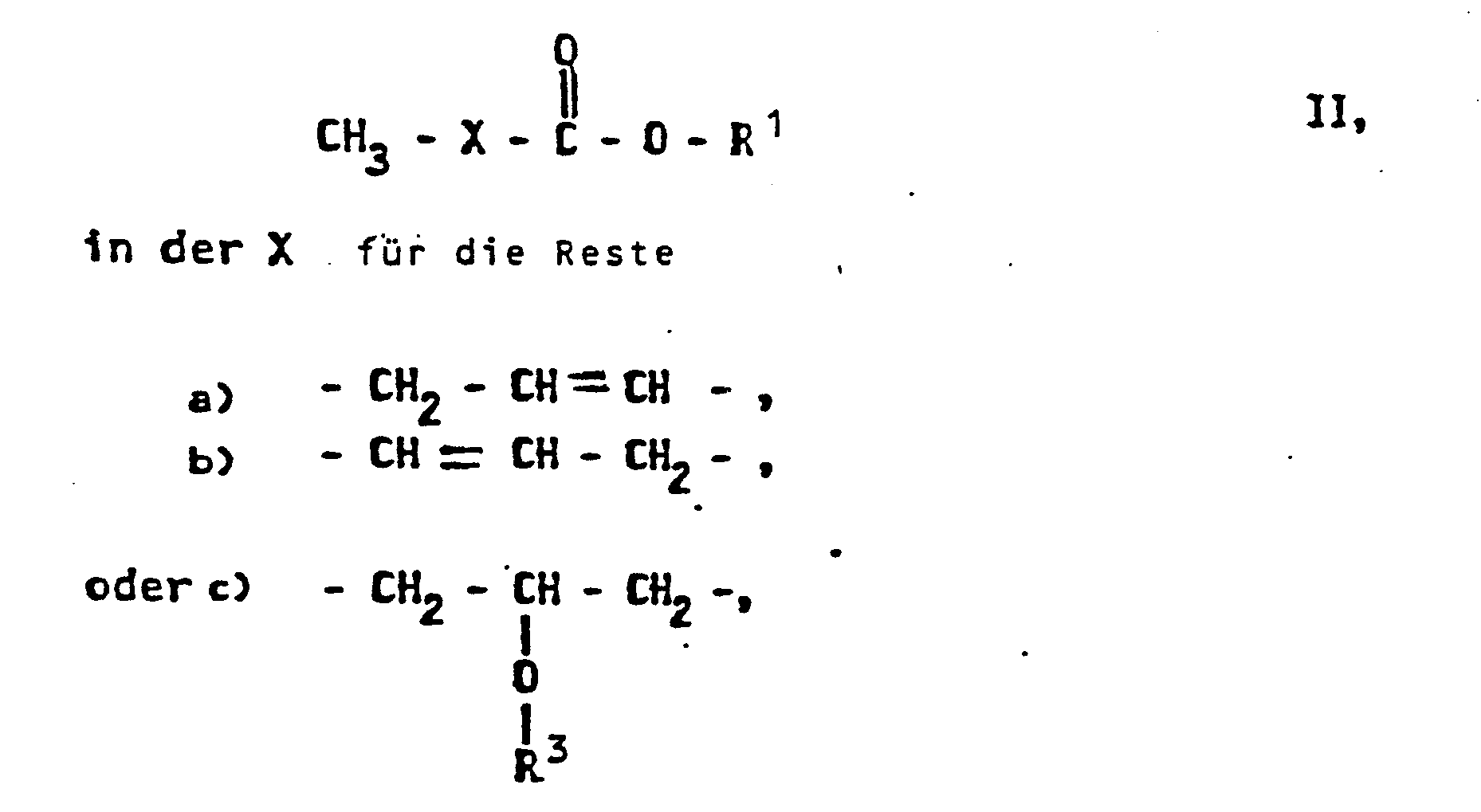
- R1 and R2 may be the same or different and each represents an alkyl radical with 1 to 12 carbon atoms, a cycloalkyl radical with 5 to 7 carbon atoms, an aralkyl radical with 7 to 10 carbon atoms or an aryl radical with 6 to 10 carbon atoms by condensation of compounds of the formula II stands, wherein R3 denotes an alkyl radical having 1 to 12 carbon atoms and R1 has the meaning given above in the presence of catalysts at elevated temperature, characterized in that the condensation in the presence of alcoholates of alkali or alkaline earth metals, aluminum alcoholates, titanium alcoholates or amides or hydrides of alkali or alkaline earth metals or cyclic amidines at a temperature of 100 to 250 ° C.
- the new process has the advantage that less expensive catalysts are used.
- the new process also has the advantage that higher yields of 2-propenylidene-3-ethylglutaric acid diesters are obtained.
- the new process is remarkable in that it gives methyl 2-pentenoate in the presence of methanol and sodium methylate and methyl 3-methoxyvalerate (Arkiv för Kemi, volume 12, pages 239-246 (1958) and in the treatment of methyl 2-pentenoate with lithium diisopropylamide at -70 ° C 3-pentenoic acid methyl ester is formed (E.-P. Krebs, Helv. Chimica Acta, volume 64, pages 1023 ff. (1981).
- the substituent R 1 represents an alkyl radical having 1 to 12 carbon atoms, a cycloalkyl radical having 5 to 7 carbon atoms, an aralkyl radical having 7 or 8 carbon atoms or an aryl radical having 6 to 10 carbon atoms.
- R3 denotes an alkyl radical having 1 to 12 carbon atoms, in particular 1 to 4 carbon atoms. It is understood that the preferred end products correspond to the preferred starting materials.
- R2 has the meaning corresponding to R1 in the end product of formula I thus obtained.
- Suitable starting materials of formula II are e.g. cis or trans-2-pentenoic acid methyl ester, 3-pentenoic acid methyl ester, 3-methoxyvaleric acid methyl ester, 2- and 3-pentenoic acid ethyl ester, 2- and 3-pentenoic acid iso-propyl ester, 2- and 3-pentenoic acid cyclohexyl ester, 3-pentenoic acid benzyl ester, 2-pentenoic acid phenyl ester, Dodecyl 3-pentenoate, n-propyl 3-propyloxyvalerate or mixtures thereof.
- the condensation is carried out in the presence of alcoholates of alkali or alkaline earth metals, aluminum alcoholates, titanium alcoholates.
- Preferred alcoholates are those of alkanols with 1 to 4 carbon atoms, in particular alkali or alkaline earth metals.
- Suitable catalysts are amides or hydrides of metals of the 1st and 2nd group, in particular of sodium and potassium and calcium.
- Suitable catalysts are, for example, sodium methylate, sodium ethylate, potassium ethylate, magnesium ethylate, aluminum butoxide, titanium butoxide, sodium amide, potassium amide, sodium hydride, potassium hydride or calcium hydride.
- Suitable catalysts are also cyclic amidines, in particular bicyclic amidines, such as 1,5 diazabicyclo [4,3,0] non-5, 1,5-diazabicyclo [5,4,0] undecen-7, or 1,4 diazabcyclo [2,2,2] octane.
- the molar ratio of the starting compounds of the formula II to the catalysts is advantageously 1: 0.01 to 0.3, in particular 1: 0.05 to 0.1.
- the condensation is carried out at a temperature of 100 to 250 ° C., in particular 100 to 160 ° C. If cyclic amidines are used as catalysts, temperatures of 150 to 220 ° C. are preferred.
- the condensation is advantageously carried out continuously or discontinuously at atmospheric pressure or under slightly elevated pressure, for example up to 10 bar, in the liquid phase.
- the above-mentioned catalyst is dissolved in the starting compound I using a solvent.
- the solvent is distilled off and the reaction mixture is heated to the aforementioned reaction temperature and held at this temperature, for example for 10 to 120 minutes.
- the catalyst is separated off, for example destroyed by neutralization, and the resulting products are filtered off.
- Unused starting compounds are expediently recycled.
- the 2-propenylidene-3-ethylglutaric acid diesters obtainable by the process of the invention are valuable intermediates, and the hdyrated dicarboxylic acids obtainable therefrom are suitable for the preparation of polyamides.
- Example 2 If the sodium methylate used in Example 1 was replaced by the same molar amounts of sodium amide or sodium hydride and reacted and worked up without the addition of methanol under the conditions of Example 1, the yields given in Table 2 were obtained from dimethyl 2-propenylidene-3-ethylglutarate.
Landscapes
- Chemical & Material Sciences (AREA)
- Organic Chemistry (AREA)
- Organic Low-Molecular-Weight Compounds And Preparation Thereof (AREA)
- Low-Molecular Organic Synthesis Reactions Using Catalysts (AREA)
Abstract
Description
- Aus J. Org. Chem. 46, Seiten 3795 ff. (1981) ist bekannt, daß man 2-Propenyliden-3-ethylglutarsäurediethylester durch Kondensation von 2-Pentensäureethylester bei 110°C in Gegenwart von Katalysatorsystemen wie Kalium/Benzylkalium oder Natrium/Benzylnatrium erhält. Das Verfahren hat jedoch den Nachteil, daß bei der technischen Ausführung die Katalysatoren schwer handhabbar sind und zudem die erzielten Ausbeuten zu wünschen übrig lassen.
- Es war deshalb die technische Aufgabe gestellt, win Verfahren zur Herstellung von 2-Propenyliden-3-ethylglutarsäurediestern zur Verfügung zu stellen, das mit höheren Ausbeuten verläuft und bei dem einfacher handhabbare Katalysatoren verwendet werden.
- Diese Aufgabe wird gelöst in einem Verfahren zur Herstellung von 2-Propenyliden-3-ethylglutarsäurediestern der Formel I

- Das neue Verfahren hat den Vorteil, daß wenig aufwendige Katalysatoren eingesetzt werden. Ferner hat das neue Verfahren den Vorteil, daß man höhere Ausbeuten an 2-Propenyliden-3-ethylglutarsäurediestern erhält. Das neue Verfahren ist insofern bemerkenswert als 2-Pentensäureethylester in Gegenwart von Methanol und Natriummethylat 3-Methoxyvaleriansäuremethylester (Arkiv för Kemi, Band 12, Seiten 239 - 246 (1958) ergibt und bei der Behandlung von 2-Pentensäuremethylester mit Lithiumdiisopropylamid bei -70°C 3-Pentensäuremethylester entsteht (E.-P. Krebs, Helv. Chimica Acta, Band 64, Seiten 1023 ff. (1981).
- In den Ausgangsstoffen der Formel II steht der Substituent R¹ für einen Alkylrest mit 1 bis 12 Kohlenstoffatomen, einen Cycloalkylrest mit 5 bis 7 Kohlenstoffatomen, einen Aralkylrest mit 7 oder 8 Kohlenstoffatomen oder einen Arylrest mit 6 bis 10 Kohlenstoffatomen. Besonders bevorzugt sind Alkylreste mit 1 bis 8 Kohlenstoffatomen, insbesondere 1 bis 4 Kohlenstoffatomen. Ferner bezeichnet in Ausgangsstoffen der Formel II R³ einen Alkylrest mit 1 bis 12 Kohlenstoffatomen, insbesondere 1 bis 4 Kohlenstoffatomen. Es versteht sich, daß die bevorzugten Endprodukte den bevorzugten Ausgangsstoffen entsprechen. Bei der Verwendung von gemischten Estern der Formel II hat R² die R¹ entsprechende Bedeutung in dem so erhaltenen Endprodukt der Formel I.
- Geeignete Ausgangsstoffe der Formel II sind z.B. cis- oder trans-2-Pentensäuremethylester, 3-Pentensäuremethylester, 3-Methoxyvaleriansäuremethylester, 2- und 3-Pentensäureethylester, 2- und 3-Pentensäure-iso-propylester, 2- und 3-Pentensäurecyclohexylester, 3-Pentensäurebenzylester, 2-Pentensäurephenylester, 3-Pentensäuredodecylester, 3-Propyloxyvaleriansäure-n-propylester oder Gemische derselben.
- Die Kondensation wird in Gegenwart von Alkoholaten von Alkali- oder Erdalkalimetallen, Aluminiumalkoholaten, Titanalkoholaten durchgeführt. Bevorzugte Alkoholate sind solche von Alkanolen mit 1 bis 4 Kohlenstoffatomen, insbesondere Alkali- oder Erdalkalimetallen.
- Weitere geeignete Katalysatoren sind Amide oder Hydride von Metallen der 1. und 2. Gruppe, insbesondere von Natrium und Kalium sowie Calcium.
- Geeignete Katalysatoren sind beispielsweise Natriummethylat, Natriumethylat, Kaliumethylat, Magnesiumethylat, Aluminiumbutylat, Titanbutylat, Natriumamid, Kaliumamid, Natriumhydrid, Kaliumhydrid oder Calciumhydrid.
- Ferner sind geeignete Katalysatoren cyclische Amidine, insbesondere bicyclische Amidine, wie 1,5 Diazabicyclo[4,3,0]-nonen-5, 1,5-Diazabicyclo[5,4,0]-undecen-7, oder 1,4 Diazabcyclo[2,2,2]-octan.
- Das Molverhältnis der Ausgangsverbindungen der Formel II zu den Katalysatoren beträgt vorteilhaft 1 : 0,01 bis 0,3, insbesondere 1 : 0,05 bis 0,1. Die Kondensation führt man bei einer Temperatur von 100 bis 250°C, insbesondere von 100 bis 160°C durch. Sofern man cyclische Amidine als Katalysatoren verwendet, sind Temperaturen von 150 bis 220°C bevorzugt.
- Im allgemeinen arbeitet man ohne Mitverwendung von Lösungsmitteln. zur besseren Verteilung des Katalysators ist es jedoch häufig zweckmäßig inerte Lösungmittel mitzuverwenden, insbesondere Alkanole mit 1 bis 4 Kohlenstoffatomen. Solche Lösungsmittel werden vorteilhaft vor oder während der Kondensation durch Destillation abgetrennt.
- Die Kondensation wird kontinuierlich oder diskontinuierlich bei Atmosphärendruck oder unter schwach erhöhtem Druck, z.B. bis zu 10 bar, zweckmäßig in der Flüssigphase durchgeführt. Bei einer diskontinuierlichen Arbeitsweise löst man beispielsweise den obenangegebenen Katalysator unter Mitverwendung eines Lösungsmittels in der Ausgangsverbindung I. Unter Abdestillieren des Lösungsmittels wird das Reaktionsgemisch auf die vorgenannte Reaktionstemperatur erhitzt und bei dieser Temperatur, z.B. für 10 bis 120 Minuten, gehalten. Nach dem Abkühlen wird der Katalysator abgetrennt, z.B. durch Neutralisieren zerstört und die hierbei anfallenden Produkte abfiltriert. die Reaktionsprodukte werden dann durch Destillation gewonnen. Nichtungesetzte Ausgangsverbindungen werden zweckmäßig zurückgeführt.
- Die nach dem Verfahren der Erfindung erhältlichen 2-Propenyliden-3-ethylglutarsäurediester stellen wertvolle Zwischenprodukte dar, die daraus erhältlichen hdyrierten Dicarbonsäuren eignen sich zur Herstellung von Polyamiden.
- Das Verfahren nach der Erfindung sei an folgenden Beispielen veranschaulicht.
- In einem 500-ml-Dreihalskolben mit aufgesetzter Kolonne wurden 228 g 3-Pentensäuremethylester bei Raumtemperatur mit einer Lösung von 5,4 g Natriummethylat in 64 g Methanol vermischt. Unter Rühren und Abdestillieren von Methanol wurde aufgeheizt, bis die Sumpftemperatur im Kolben 130°C erreicht hatte. Anschließend wurde eine Stunde lang bei 130°C nachgerührt. Nach dem Abkühlen wurde das Reaktionsgemisch fraktioniert destilliert. Hierbei wurden 184,1 g eines Gemisches aus 2-Propenyliden- und 2-(1-Propenyl)-3-ethylglutarsäuredimethylester vom Siedepunkt 90 - 102°C/0,3 mbar (Ausbeute 80 % d.Th.) und 28,3 g Destillationsrückstand erhalten.
- Eine Lösung von 0,4 g Natriummethylat in 4,7 g Methanol und 16,9 g 3-Pentensäuremethylester wurde in einem Glasautoklaven 4 Stunden lang auf 135°C erhitzt. Nach dieser Zeit bestand das Reaktionsgemisch zu 60 % aus 2-Propenyliden-3-ethylglutarsäuredimethylester zu 15 % aus 3-Methoxy-valeriansäuremethylester, zu 7 % aus 3-, zu 13 % aus 2-trans- und zu 3 % aus 2-cis-Pentensäuremethylester.
- In einem 500-ml-Dreihalskolben wurden 228 g 3-Pentensäuremethylester bei Raumtemperatur mit einer Lösung von 5,4 g Natriummethylat in 64 g Methanol vermischt, auf 65 bis 70°C erwärmt und 4,75 Stunden bei dieser Temperatur gerührt. Nach dem Abkühlen wurde das Natriummethylat mit Eisessig neutralisiert und das Methanol bei Normaldruck weitgehend abdestilliert. Der Rückstand wurde mit Wasser gewaschen und anschließend fraktionierend destilliert. Hierbei wurden 185,6 g 3-Methoxyvaleriansäuremethylester (63 % d.Th.) vom Siedepunkt 125 bis 126°C/304 mbar erhalten. Außerdem fielen 46 g Pentensäuremethylester-Gemisch (31 % 3-, 8 % 2-cis-, 61 % 2-trans-Pentensäuremethylester) (20 % d.Th.), 20 g 2-Propenyliden--3-ethylglutarsäuredimethylester und 3,2 g Destillationsrückstand an.
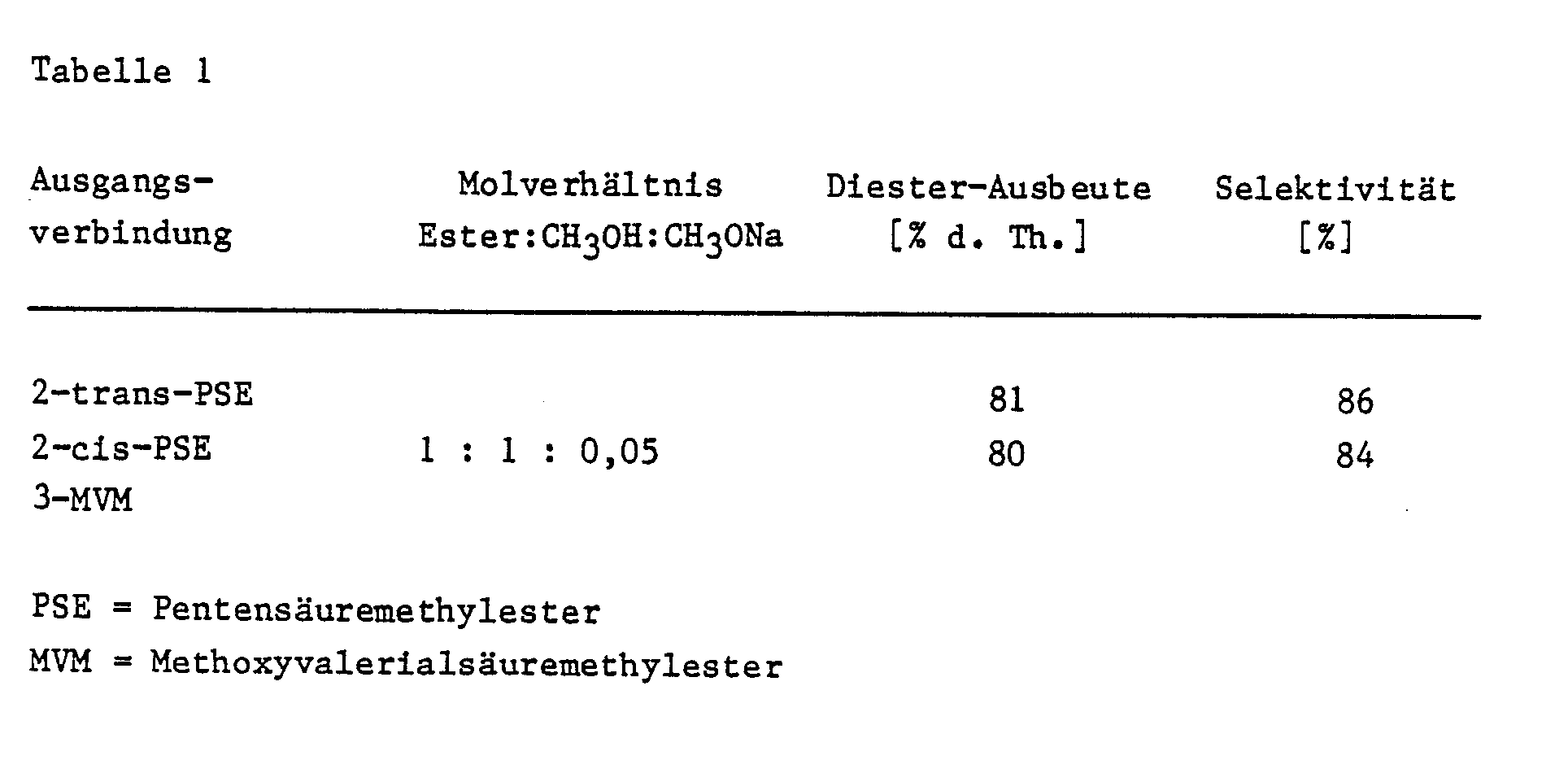
- Wurde nicht 3-Pentensäuremethylester (3-PSE), sondern 2-trans-Pentensäuremethylester (2-trans-PSE), 2-cis-Pentensäuremethylester (2-cis-PSE) oder 3-Methoxyvaleriansäuremethylester (3-MVM) unter den in Beispiel 1 angegebenen Bedingungen eingesetzt, so wurden nach fraktionierender Destillation die in Tabelle 1 angegebenen Ausbeuten an 2-Propenyliden-3-ethylglutarsäuredimethylester erzielt.
- Wurde das in Beispiel 1 verwendete Natriummethylat durch gleiche Molmengen Natriumamid oder Natriumhydrid ersetzt und ohne Zusatz von Methanol unter den Bedingungen von Beispiel 1 umgesetzt und aufgearbeitet, so wurden die in Tabelle 2 angegebenen Ausbeuten aus 2-Propenyliden-3-ethylglutarsäuredimethylester erzielt.

- Eine Lösung von 12,4 g 1,8-Diazabicyclo[4.3.0]nonen-5 (DBN) in 114 g 3-Pentensäuremethylester wurde in einem Glasautoklaven 2,5 Stunden lang auf 180°C erhitzt. Das erhaltene Reaktionsgemisch (1124,3 g) wurde fraktionierend destilliert. Hierbei wurden zunächst 14 g eines Pentenester-Isomerengemisches erhalten, das zu 4 % aus 2-cis-PSE, zu 32 % aus 3-PSE und zu 53 % aus 2-trans-PSE bestand. Anschließend wurden 74,6 g eines Diester-Gemisches isoliert, das laut NMR-Analyse zu 71 % aus 2-Propenyliden und zu 29 % aus 2-(1-Propenyl)-3-ethylglutarsäuredimethylester bestand. Außerdem wurden 34 g Rückstand isoliert. die Diester-Ausbeute betrug 61 % d.Th.
Claims (3)


Applications Claiming Priority (2)
| Application Number | Priority Date | Filing Date | Title |
|---|---|---|---|
| DE19863640594 DE3640594A1 (de) | 1986-11-27 | 1986-11-27 | Verfahren zur herstellung von 2-propenyliden-3-ethylglutarsaeurediestern |
| DE3640594 | 1986-11-27 |
Publications (3)
| Publication Number | Publication Date |
|---|---|
| EP0269042A2 true EP0269042A2 (de) | 1988-06-01 |
| EP0269042A3 EP0269042A3 (en) | 1989-03-15 |
| EP0269042B1 EP0269042B1 (de) | 1991-10-16 |
Family
ID=6314939
Family Applications (1)
| Application Number | Title | Priority Date | Filing Date |
|---|---|---|---|
| EP87117208A Expired - Lifetime EP0269042B1 (de) | 1986-11-27 | 1987-11-23 | Verfahren zur Herstellung von 2-Propenyliden-3-ethylglutarsäurediestern |
Country Status (2)
| Country | Link |
|---|---|
| EP (1) | EP0269042B1 (de) |
| DE (2) | DE3640594A1 (de) |
Cited By (1)
| Publication number | Priority date | Publication date | Assignee | Title |
|---|---|---|---|---|
| CN110204441A (zh) * | 2013-01-11 | 2019-09-06 | 瑟拉斯公司 | 经过双(羟甲基)丙二酸酯的途径获得亚甲基丙二酸酯的方法 |
-
1986
- 1986-11-27 DE DE19863640594 patent/DE3640594A1/de not_active Withdrawn
-
1987
- 1987-11-23 DE DE8787117208T patent/DE3773849D1/de not_active Expired - Lifetime
- 1987-11-23 EP EP87117208A patent/EP0269042B1/de not_active Expired - Lifetime
Non-Patent Citations (2)
| Title |
|---|
| CHEMICAL ABSTRACTS Band 67, Nr. 25, 18. Dezember 1967,Columbus, Ohio, USA, Seite 10965, Spalte 1, Abstract Nr. 116522j; S. KYOICHI et al.: "Dimerization of ethyl crotonate"; & CHIBA DIAGAKU KOGAKUBU KENKYU HOKOKU 1967, 18(33), 1-2 * |
| JOURNAL OF ORGANIC CHEMISTRY Band 46, 1981, American Chemical Society, Seiten 3795-3802; J. SHABTAI et al.: "Base-catalyzed reactions of alpha, beta-unsaturated esters and nitriles. 4, Dimerization of beta-alkyl-substituted acrylates" * |
Cited By (1)
| Publication number | Priority date | Publication date | Assignee | Title |
|---|---|---|---|---|
| CN110204441A (zh) * | 2013-01-11 | 2019-09-06 | 瑟拉斯公司 | 经过双(羟甲基)丙二酸酯的途径获得亚甲基丙二酸酯的方法 |
Also Published As
| Publication number | Publication date |
|---|---|
| DE3773849D1 (de) | 1991-11-21 |
| EP0269042B1 (de) | 1991-10-16 |
| EP0269042A3 (en) | 1989-03-15 |
| DE3640594A1 (de) | 1988-06-01 |
Similar Documents
| Publication | Publication Date | Title |
|---|---|---|
| DE2943098C2 (de) | ||
| EP0238003B1 (de) | Verfahren zur Herstellung von 4-Pentensäureestern | |
| EP0165521B1 (de) | Verfahren zur Herstellung eines Gemisches aus einem gegebenenfalls substituierten Zimtsäureester und einem gegebenenfalls substituierten Beta-Alkoxy-Beta-phenyl-propionsäureester sowie Verfahren zur Herstellung von gegebenenfalls substituierter Zimtsäure | |
| EP0269042B1 (de) | Verfahren zur Herstellung von 2-Propenyliden-3-ethylglutarsäurediestern | |
| EP0186076A2 (de) | Verfahren zur Herstellung von 2,2,4-Trimethyl-1,3-pentandiolmonoisobutyrat | |
| EP0266690B1 (de) | Verfahren zur Herstellung von 2,2-disubstituierten 3-Chlorpropionsäureestern | |
| DE1283849B (de) | Verfahren zur Herstellung von reinen Arylestern von Dicarbonsaeuren | |
| DE69012510T2 (de) | Verfahren zur Herstellung von Optisch aktiven Fluor enthaltenden Estern der 3-Hydroxybuttersäure. | |
| EP1284954B1 (de) | Verfahren zur herstellung von estern ungesättigter carbonsäuren | |
| EP0583694B1 (de) | Verfahren zur Herstellung von Cyanessigsäurealkylestern | |
| DE19647117A1 (de) | Verfahren zur Herstellung gamma,delta-ungesättigten Ketonen durch Caroll-Reaktion in cyclischen Carbonaten oder gamma-Lactonen als Lösungsmittel | |
| EP0269046B1 (de) | Verfahren zur Isomerisierung von 2-Pentensäureestern zu 3-Pentensäureestern | |
| EP0645366A1 (de) | Verfahren zur Herstellung von 3-Hydroxy-2,4,5-trifluorbenzoesäurealkylestern und/oder 3-Alkoxy-2,4,5-trifluorbenzoesäurealkylestern | |
| DE2151493A1 (de) | Verfahren zur Herstellung eines Butyrolaktons | |
| EP0010656A1 (de) | Verfahren zur Herstellung von 4-Acyloxy-2-methyl-crotonaldehyden | |
| EP0269045B1 (de) | Verfahren zur Herstellung von veretherten 3-Hydroxyvaleriansäureestern | |
| EP0061669B1 (de) | Verbessertes Verfahren zur Herstellung von Cyclohexan-1,3-dionen sowie einige neue bicyclische Cyclohexan-1,3-dione | |
| EP0643036B1 (de) | Verfahren zur Herstellung von Pimelinsäureestern | |
| EP0806405A1 (de) | Verfahren zur Herstellung von Hexahydrofarnesylaceton aus 6.7-Dihydro-geraniol sowie neue Zwischenprodukte für dieses Verfahren | |
| DE19944874C1 (de) | Verfahren zur Herstellung von Cyclooctanol | |
| DE1244797B (de) | Verfahren zur Herstellung von Phenylestern carbocyclischer, aromatischer, gegebenenfalls kernsubstituierter Mono- und Polycarbonsaeuren | |
| DE2921220C2 (de) | Verfahren zur Herstellung von 2.3.4.4.-Tetrachlor-3-butensäurealkylestern | |
| DE19905685A1 (de) | Verfahren zur Herstellung von 2,3,5-Trimethylhydrochinondiestern | |
| EP0044514B1 (de) | Verfahren zur Herstellung von Dimethylbenzylcarbinol und Dimethylbenzylcarbinylformiat | |
| AT240839B (de) | Verfahren zur Herstellung von Arylestern aliphatischer oder alicyclischer Mono- oder Polycarbonsäuren |
Legal Events
| Date | Code | Title | Description |
|---|---|---|---|
| PUAI | Public reference made under article 153(3) epc to a published international application that has entered the european phase |
Free format text: ORIGINAL CODE: 0009012 |
|
| AK | Designated contracting states |
Kind code of ref document: A2 Designated state(s): BE DE FR GB IT NL |
|
| PUAL | Search report despatched |
Free format text: ORIGINAL CODE: 0009013 |
|
| AK | Designated contracting states |
Kind code of ref document: A3 Designated state(s): BE DE FR GB IT NL |
|
| 17P | Request for examination filed |
Effective date: 19890209 |
|
| 17Q | First examination report despatched |
Effective date: 19901130 |
|
| GRAA | (expected) grant |
Free format text: ORIGINAL CODE: 0009210 |
|
| AK | Designated contracting states |
Kind code of ref document: B1 Designated state(s): BE DE FR GB IT NL |
|
| ITF | It: translation for a ep patent filed | ||
| REF | Corresponds to: |
Ref document number: 3773849 Country of ref document: DE Date of ref document: 19911121 |
|
| GBT | Gb: translation of ep patent filed (gb section 77(6)(a)/1977) | ||
| ET | Fr: translation filed | ||
| PLBE | No opposition filed within time limit |
Free format text: ORIGINAL CODE: 0009261 |
|
| STAA | Information on the status of an ep patent application or granted ep patent |
Free format text: STATUS: NO OPPOSITION FILED WITHIN TIME LIMIT |
|
| 26N | No opposition filed | ||
| REG | Reference to a national code |
Ref country code: GB Ref legal event code: IF02 |
|
| PGFP | Annual fee paid to national office [announced via postgrant information from national office to epo] |
Ref country code: NL Payment date: 20041103 Year of fee payment: 18 |
|
| PGFP | Annual fee paid to national office [announced via postgrant information from national office to epo] |
Ref country code: FR Payment date: 20041109 Year of fee payment: 18 |
|
| PGFP | Annual fee paid to national office [announced via postgrant information from national office to epo] |
Ref country code: GB Payment date: 20041117 Year of fee payment: 18 |
|
| PGFP | Annual fee paid to national office [announced via postgrant information from national office to epo] |
Ref country code: DE Payment date: 20041118 Year of fee payment: 18 |
|
| PGFP | Annual fee paid to national office [announced via postgrant information from national office to epo] |
Ref country code: BE Payment date: 20050202 Year of fee payment: 18 |
|
| PG25 | Lapsed in a contracting state [announced via postgrant information from national office to epo] |
Ref country code: IT Free format text: LAPSE BECAUSE OF NON-PAYMENT OF DUE FEES;WARNING: LAPSES OF ITALIAN PATENTS WITH EFFECTIVE DATE BEFORE 2007 MAY HAVE OCCURRED AT ANY TIME BEFORE 2007. THE CORRECT EFFECTIVE DATE MAY BE DIFFERENT FROM THE ONE RECORDED. Effective date: 20051123 Ref country code: GB Free format text: LAPSE BECAUSE OF NON-PAYMENT OF DUE FEES Effective date: 20051123 |
|
| PG25 | Lapsed in a contracting state [announced via postgrant information from national office to epo] |
Ref country code: BE Free format text: LAPSE BECAUSE OF NON-PAYMENT OF DUE FEES Effective date: 20051130 |
|
| PG25 | Lapsed in a contracting state [announced via postgrant information from national office to epo] |
Ref country code: DE Free format text: LAPSE BECAUSE OF THE APPLICANT RENOUNCES Effective date: 20051220 |
|
| PG25 | Lapsed in a contracting state [announced via postgrant information from national office to epo] |
Ref country code: NL Free format text: LAPSE BECAUSE OF NON-PAYMENT OF DUE FEES Effective date: 20060601 |
|
| GBPC | Gb: european patent ceased through non-payment of renewal fee |
Effective date: 20051123 |
|
| PG25 | Lapsed in a contracting state [announced via postgrant information from national office to epo] |
Ref country code: FR Free format text: LAPSE BECAUSE OF NON-PAYMENT OF DUE FEES Effective date: 20060731 |
|
| NLV4 | Nl: lapsed or anulled due to non-payment of the annual fee |
Effective date: 20060601 |
|
| REG | Reference to a national code |
Ref country code: FR Ref legal event code: ST Effective date: 20060731 |
|
| BERE | Be: lapsed |
Owner name: *BASF A.G. Effective date: 20051130 |