EP0270751A2 - Elektrolytlösung zur Benutzung in Elektroden zur Messung von Ionen und Verfahren zu deren Herstellung - Google Patents
Elektrolytlösung zur Benutzung in Elektroden zur Messung von Ionen und Verfahren zu deren Herstellung Download PDFInfo
- Publication number
- EP0270751A2 EP0270751A2 EP87113266A EP87113266A EP0270751A2 EP 0270751 A2 EP0270751 A2 EP 0270751A2 EP 87113266 A EP87113266 A EP 87113266A EP 87113266 A EP87113266 A EP 87113266A EP 0270751 A2 EP0270751 A2 EP 0270751A2
- Authority
- EP
- European Patent Office
- Prior art keywords
- solution
- gelatinized
- electrode
- gel
- gelatinizer
- Prior art date
- Legal status (The legal status is an assumption and is not a legal conclusion. Google has not performed a legal analysis and makes no representation as to the accuracy of the status listed.)
- Withdrawn
Links
- 239000008151 electrolyte solution Substances 0.000 title claims abstract description 19
- 238000004519 manufacturing process Methods 0.000 title claims abstract description 7
- 238000000034 method Methods 0.000 title claims abstract description 7
- 150000002500 ions Chemical class 0.000 title description 21
- 239000000243 solution Substances 0.000 claims abstract description 98
- 239000012086 standard solution Substances 0.000 claims abstract description 41
- 238000001704 evaporation Methods 0.000 claims abstract description 29
- 239000003112 inhibitor Substances 0.000 claims abstract description 25
- 239000007853 buffer solution Substances 0.000 claims abstract description 12
- 238000000465 moulding Methods 0.000 claims abstract description 5
- PEDCQBHIVMGVHV-UHFFFAOYSA-N Glycerine Chemical compound OCC(O)CO PEDCQBHIVMGVHV-UHFFFAOYSA-N 0.000 claims description 24
- 239000008274 jelly Substances 0.000 claims description 15
- LYCAIKOWRPUZTN-UHFFFAOYSA-N Ethylene glycol Chemical compound OCCO LYCAIKOWRPUZTN-UHFFFAOYSA-N 0.000 claims description 12
- DNIAPMSPPWPWGF-UHFFFAOYSA-N Propylene glycol Chemical compound CC(O)CO DNIAPMSPPWPWGF-UHFFFAOYSA-N 0.000 claims description 12
- 235000011187 glycerol Nutrition 0.000 claims description 12
- 229920001817 Agar Polymers 0.000 claims description 11
- 241000206672 Gelidium Species 0.000 claims description 11
- 235000010419 agar Nutrition 0.000 claims description 11
- XLYOFNOQVPJJNP-UHFFFAOYSA-N water Substances O XLYOFNOQVPJJNP-UHFFFAOYSA-N 0.000 claims description 10
- MTHSVFCYNBDYFN-UHFFFAOYSA-N diethylene glycol Chemical compound OCCOCCO MTHSVFCYNBDYFN-UHFFFAOYSA-N 0.000 claims description 9
- 235000015110 jellies Nutrition 0.000 claims description 9
- 239000001828 Gelatine Substances 0.000 claims description 7
- 229920000159 gelatin Polymers 0.000 claims description 7
- 235000019322 gelatine Nutrition 0.000 claims description 7
- 239000011347 resin Substances 0.000 claims description 4
- 229920005989 resin Polymers 0.000 claims description 4
- 239000000783 alginic acid Substances 0.000 claims description 3
- 235000010443 alginic acid Nutrition 0.000 claims description 3
- 229960001126 alginic acid Drugs 0.000 claims description 3
- 229920000615 alginic acid Polymers 0.000 claims description 3
- 150000004781 alginic acids Chemical class 0.000 claims description 3
- 239000003292 glue Substances 0.000 claims description 3
- 229920000058 polyacrylate Polymers 0.000 claims description 3
- ZIBGPFATKBEMQZ-UHFFFAOYSA-N triethylene glycol Chemical compound OCCOCCOCCO ZIBGPFATKBEMQZ-UHFFFAOYSA-N 0.000 claims description 3
- 239000003792 electrolyte Substances 0.000 claims description 2
- 159000000000 sodium salts Chemical class 0.000 claims description 2
- 238000009835 boiling Methods 0.000 claims 1
- 238000002844 melting Methods 0.000 claims 1
- 230000008018 melting Effects 0.000 claims 1
- 229960004063 propylene glycol Drugs 0.000 claims 1
- 235000013772 propylene glycol Nutrition 0.000 claims 1
- 229940021013 electrolyte solution Drugs 0.000 abstract description 15
- 230000008859 change Effects 0.000 abstract description 5
- 230000006866 deterioration Effects 0.000 abstract 1
- WCUXLLCKKVVCTQ-UHFFFAOYSA-M Potassium chloride Chemical compound [Cl-].[K+] WCUXLLCKKVVCTQ-UHFFFAOYSA-M 0.000 description 37
- 239000011521 glass Substances 0.000 description 32
- 239000007788 liquid Substances 0.000 description 26
- 238000005259 measurement Methods 0.000 description 24
- 239000007864 aqueous solution Substances 0.000 description 19
- 239000001103 potassium chloride Substances 0.000 description 18
- 235000011164 potassium chloride Nutrition 0.000 description 18
- 238000004321 preservation Methods 0.000 description 16
- 230000008093 supporting effect Effects 0.000 description 16
- 229910021607 Silver chloride Inorganic materials 0.000 description 13
- HKZLPVFGJNLROG-UHFFFAOYSA-M silver monochloride Chemical compound [Cl-].[Ag+] HKZLPVFGJNLROG-UHFFFAOYSA-M 0.000 description 13
- 239000000758 substrate Substances 0.000 description 12
- NBIIXXVUZAFLBC-UHFFFAOYSA-N Phosphoric acid Chemical compound OP(O)(O)=O NBIIXXVUZAFLBC-UHFFFAOYSA-N 0.000 description 10
- 239000012528 membrane Substances 0.000 description 10
- 239000000203 mixture Substances 0.000 description 10
- 239000000853 adhesive Substances 0.000 description 8
- 230000001070 adhesive effect Effects 0.000 description 8
- 238000007650 screen-printing Methods 0.000 description 7
- 239000000126 substance Substances 0.000 description 7
- 238000001139 pH measurement Methods 0.000 description 6
- 229910000147 aluminium phosphate Inorganic materials 0.000 description 5
- 150000001875 compounds Chemical class 0.000 description 5
- BQCADISMDOOEFD-UHFFFAOYSA-N Silver Chemical compound [Ag] BQCADISMDOOEFD-UHFFFAOYSA-N 0.000 description 4
- 238000010276 construction Methods 0.000 description 4
- 238000001035 drying Methods 0.000 description 4
- 239000000463 material Substances 0.000 description 4
- QTBSBXVTEAMEQO-UHFFFAOYSA-N Acetic acid Chemical compound CC(O)=O QTBSBXVTEAMEQO-UHFFFAOYSA-N 0.000 description 3
- UEZVMMHDMIWARA-UHFFFAOYSA-N Metaphosphoric acid Chemical compound OP(=O)=O UEZVMMHDMIWARA-UHFFFAOYSA-N 0.000 description 3
- 239000006087 Silane Coupling Agent Substances 0.000 description 3
- HEMHJVSKTPXQMS-UHFFFAOYSA-M Sodium hydroxide Chemical compound [OH-].[Na+] HEMHJVSKTPXQMS-UHFFFAOYSA-M 0.000 description 3
- 239000005391 art glass Substances 0.000 description 3
- 230000004044 response Effects 0.000 description 3
- 150000003839 salts Chemical class 0.000 description 3
- VEXZGXHMUGYJMC-UHFFFAOYSA-N Hydrochloric acid Chemical compound Cl VEXZGXHMUGYJMC-UHFFFAOYSA-N 0.000 description 2
- NIXOWILDQLNWCW-UHFFFAOYSA-N acrylic acid group Chemical group C(C=C)(=O)O NIXOWILDQLNWCW-UHFFFAOYSA-N 0.000 description 2
- 230000015572 biosynthetic process Effects 0.000 description 2
- 238000005520 cutting process Methods 0.000 description 2
- 239000000499 gel Substances 0.000 description 2
- 238000010438 heat treatment Methods 0.000 description 2
- 239000005020 polyethylene terephthalate Substances 0.000 description 2
- 229920000642 polymer Polymers 0.000 description 2
- 239000004926 polymethyl methacrylate Substances 0.000 description 2
- 238000012545 processing Methods 0.000 description 2
- 229940009188 silver Drugs 0.000 description 2
- 229910052709 silver Inorganic materials 0.000 description 2
- 239000004332 silver Substances 0.000 description 2
- CDBYLPFSWZWCQE-UHFFFAOYSA-L sodium carbonate Substances [Na+].[Na+].[O-]C([O-])=O CDBYLPFSWZWCQE-UHFFFAOYSA-L 0.000 description 2
- 125000006850 spacer group Chemical group 0.000 description 2
- RQALKBLYTUKBFV-UHFFFAOYSA-N 1,4-dioxa-7-thiaspiro[4.4]nonane Chemical compound O1CCOC11CSCC1 RQALKBLYTUKBFV-UHFFFAOYSA-N 0.000 description 1
- VEXZGXHMUGYJMC-UHFFFAOYSA-M Chloride anion Chemical compound [Cl-] VEXZGXHMUGYJMC-UHFFFAOYSA-M 0.000 description 1
- 241001052209 Cylinder Species 0.000 description 1
- 239000004593 Epoxy Substances 0.000 description 1
- DGAQECJNVWCQMB-PUAWFVPOSA-M Ilexoside XXIX Chemical compound C[C@@H]1CC[C@@]2(CC[C@@]3(C(=CC[C@H]4[C@]3(CC[C@@H]5[C@@]4(CC[C@@H](C5(C)C)OS(=O)(=O)[O-])C)C)[C@@H]2[C@]1(C)O)C)C(=O)O[C@H]6[C@@H]([C@H]([C@@H]([C@H](O6)CO)O)O)O.[Na+] DGAQECJNVWCQMB-PUAWFVPOSA-M 0.000 description 1
- XUIMIQQOPSSXEZ-UHFFFAOYSA-N Silicon Chemical compound [Si] XUIMIQQOPSSXEZ-UHFFFAOYSA-N 0.000 description 1
- VMHLLURERBWHNL-UHFFFAOYSA-M Sodium acetate Chemical compound [Na+].CC([O-])=O VMHLLURERBWHNL-UHFFFAOYSA-M 0.000 description 1
- BZHJMEDXRYGGRV-UHFFFAOYSA-N Vinyl chloride Chemical compound ClC=C BZHJMEDXRYGGRV-UHFFFAOYSA-N 0.000 description 1
- 229910021538 borax Inorganic materials 0.000 description 1
- 239000003795 chemical substances by application Substances 0.000 description 1
- 239000011248 coating agent Substances 0.000 description 1
- 238000000576 coating method Methods 0.000 description 1
- 230000000875 corresponding effect Effects 0.000 description 1
- 239000008278 cosmetic cream Substances 0.000 description 1
- 239000013078 crystal Substances 0.000 description 1
- 230000007547 defect Effects 0.000 description 1
- UQGFMSUEHSUPRD-UHFFFAOYSA-N disodium;3,7-dioxido-2,4,6,8,9-pentaoxa-1,3,5,7-tetraborabicyclo[3.3.1]nonane Chemical compound [Na+].[Na+].O1B([O-])OB2OB([O-])OB1O2 UQGFMSUEHSUPRD-UHFFFAOYSA-N 0.000 description 1
- 230000000694 effects Effects 0.000 description 1
- 239000007772 electrode material Substances 0.000 description 1
- 230000004927 fusion Effects 0.000 description 1
- 229910052739 hydrogen Inorganic materials 0.000 description 1
- 239000001257 hydrogen Substances 0.000 description 1
- 238000011835 investigation Methods 0.000 description 1
- WABPQHHGFIMREM-UHFFFAOYSA-N lead(0) Chemical compound [Pb] WABPQHHGFIMREM-UHFFFAOYSA-N 0.000 description 1
- 238000012423 maintenance Methods 0.000 description 1
- 230000007935 neutral effect Effects 0.000 description 1
- 235000011837 pasties Nutrition 0.000 description 1
- -1 polyethylene terephthalate Polymers 0.000 description 1
- 229920000139 polyethylene terephthalate Polymers 0.000 description 1
- IWZKICVEHNUQTL-UHFFFAOYSA-M potassium hydrogen phthalate Chemical compound [K+].OC(=O)C1=CC=CC=C1C([O-])=O IWZKICVEHNUQTL-UHFFFAOYSA-M 0.000 description 1
- 239000000843 powder Substances 0.000 description 1
- 238000002360 preparation method Methods 0.000 description 1
- 229920006395 saturated elastomer Polymers 0.000 description 1
- 239000012047 saturated solution Substances 0.000 description 1
- 150000003376 silicon Chemical class 0.000 description 1
- 229910052710 silicon Inorganic materials 0.000 description 1
- 239000010703 silicon Substances 0.000 description 1
- 229910052708 sodium Inorganic materials 0.000 description 1
- 239000011734 sodium Substances 0.000 description 1
- 239000001632 sodium acetate Substances 0.000 description 1
- 229960004249 sodium acetate Drugs 0.000 description 1
- 235000017281 sodium acetate Nutrition 0.000 description 1
- 229910000029 sodium carbonate Inorganic materials 0.000 description 1
- 235000017550 sodium carbonate Nutrition 0.000 description 1
- 235000011121 sodium hydroxide Nutrition 0.000 description 1
- 239000004328 sodium tetraborate Substances 0.000 description 1
- 235000010339 sodium tetraborate Nutrition 0.000 description 1
- 238000001179 sorption measurement Methods 0.000 description 1
- 239000000057 synthetic resin Substances 0.000 description 1
- 239000010409 thin film Substances 0.000 description 1
- 150000003673 urethanes Chemical class 0.000 description 1
Images



Classifications
-
- G—PHYSICS
- G01—MEASURING; TESTING
- G01N—INVESTIGATING OR ANALYSING MATERIALS BY DETERMINING THEIR CHEMICAL OR PHYSICAL PROPERTIES
- G01N27/00—Investigating or analysing materials by the use of electric, electrochemical, or magnetic means
- G01N27/26—Investigating or analysing materials by the use of electric, electrochemical, or magnetic means by investigating electrochemical variables; by using electrolysis or electrophoresis
- G01N27/28—Electrolytic cell components
- G01N27/30—Electrodes, e.g. test electrodes; Half-cells
-
- G—PHYSICS
- G01—MEASURING; TESTING
- G01N—INVESTIGATING OR ANALYSING MATERIALS BY DETERMINING THEIR CHEMICAL OR PHYSICAL PROPERTIES
- G01N27/00—Investigating or analysing materials by the use of electric, electrochemical, or magnetic means
- G01N27/26—Investigating or analysing materials by the use of electric, electrochemical, or magnetic means by investigating electrochemical variables; by using electrolysis or electrophoresis
- G01N27/28—Electrolytic cell components
- G01N27/30—Electrodes, e.g. test electrodes; Half-cells
- G01N27/307—Disposable laminated or multilayered electrodes
-
- G—PHYSICS
- G01—MEASURING; TESTING
- G01N—INVESTIGATING OR ANALYSING MATERIALS BY DETERMINING THEIR CHEMICAL OR PHYSICAL PROPERTIES
- G01N27/00—Investigating or analysing materials by the use of electric, electrochemical, or magnetic means
- G01N27/26—Investigating or analysing materials by the use of electric, electrochemical, or magnetic means by investigating electrochemical variables; by using electrolysis or electrophoresis
- G01N27/403—Cells and electrode assemblies
- G01N27/4035—Combination of a single ion-sensing electrode and a single reference electrode
-
- G—PHYSICS
- G01—MEASURING; TESTING
- G01N—INVESTIGATING OR ANALYSING MATERIALS BY DETERMINING THEIR CHEMICAL OR PHYSICAL PROPERTIES
- G01N27/00—Investigating or analysing materials by the use of electric, electrochemical, or magnetic means
- G01N27/26—Investigating or analysing materials by the use of electric, electrochemical, or magnetic means by investigating electrochemical variables; by using electrolysis or electrophoresis
- G01N27/416—Systems
- G01N27/4163—Systems checking the operation of, or calibrating, the measuring apparatus
- G01N27/4165—Systems checking the operation of, or calibrating, the measuring apparatus for pH meters
Definitions
- the present invention relates to a gelatinized electrolyte solution which can be very suitably used as a gel-like member as an internal liquid, for the preservation of electrodes or for the calibration of glass electrodes for measuring ions, reference electrodes therefor and the like (here strictlyinafter called generically electrodes for measuring ions) particularly in the case where the electrode for measuring ions is constructed as a small-sized sheet.
- the prior art glass electrodes for measuring pH, pNa and the like as shown in Fig. 1 comprise a supporting pipe formed of an electrically insulating glass, an ion-response glass membrane b responsive to pH, pNa and the like having a semispherical shape formed at a pointed end of said supporting pipe a by the balloon method so as adhere to said pointed end, an internal electrode c comprising for example an Ag wire, the surface of which is coated with AgCl, provided in the supporting pipe a, and an internal solution d comprising for example a 3.3 M-aqueous solution of KCl supersaturated by AgCl with a phosphoric acid-buffer solution added enclosed in said internal electrode c.
- the prior art reference electrodes as shown in Fig. 2 comprise a supporting pipe e formed of electrically insulating glass, a liquid junction member f formed of for example an inorganic sintered porous substance, an organic high molecular porous substance and the like impregnated with KCl put in a hole formed in a pointed end portion of the supporting pipe e, an internal electrode g comprising an Ag wire, the surface of which is coated with AgCl in the same manner as in the above described glass electrode, provided in the supporting pipe e, and an internal solution h comprising for example a 3.3 M-aqueous solution of KCl supersaturated by AgCl with a phosphoric acid-buffer solution added enclosed in said internal electrode g.
- i designates an internal solution-replenishing port having a cap j provided in said supporting pipe e so as to replenish said internal solution h with the consumption of the internal solution h.
- Such prior art glass electrodes and reference electrodes exhibit the disadvantage that they are relatively large-sized and difficult to massproduce, so that they are not only remarkably expensive in the manufacture but also not so handy in the measuring operation, and it is necessary to preserve the glass electrode in pure water and the reference electrode in a 3.3 M-aqueous solution of KCl, which is same as the internal solution, when they are not being used.
- the calibration (for example pH calibration) of said glass electrode is carried out with a standard solution (in short, a phthalic acid-standard solution having a pH of 4, a neutral phosphoric acid-standard solution having a pH of 7 and a sodium borate-standard solution having a pH of 9), wherein not only a relatively large amount of each standard solution is required but also a vessel (beaker and the like) for receiving the standard solution.
- these standard solutions are left unattended in open condition, they are apt to change their concentration, deposit crystals and are deteriorated, so that it is considerably difficult to preserve them for a long time in excellent condition. Accordingly, it is necessary to exchange the standard solutions in a relatively high frequency, which is remarkably troublesome in use and uneconomical.
- the present invention relates to an electrolyte solution for use in electrodes for measuring ions which can solve the above defects of the conventional solutions, which is characterized in that said electrolyte solution, which can be an internal liquid, a buffer solution, a pH-adjusting solution, an ion-adjusting solution, a calibrating standard solution, or combinations thereof, is gelatinized with a gelatinizer and contains a gel-evaporation inhibitor.
- said electrolyte solution which can be an internal liquid, a buffer solution, a pH-adjusting solution, an ion-adjusting solution, a calibrating standard solution, or combinations thereof, is gelatinized with a gelatinizer and contains a gel-evaporation inhibitor.
- a remarkably compact sheet-type electrode for measuring ions superior in operation and maintenance can be provided.
- the possibility of very easily and economically carrying out the preservation of the glass electrode portion and the reference electrode portion of a sheet-type electrode for measuring ions as well as the calibration of the glass electrode portion has been opened.
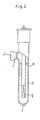
- Fig. 3 which shows a compound electrode for use in the measurement of pH
- reference numeral 1 designativelyes a supporting pipe formed of glass and the like
- reference numeral 2 designates an inside cylinder formed of glass and the like inserted into said supporting pipe 1, and said inside cylinder 2 being provided with a responsive glass membrane 3 formed in an end portion thereof.
- Reference nu meral 4 designates a silver wire coated with silver chloride 5 inserted into the inside cylinder 2 provided with an end portion thereof constructed as an internal electrode for use in the measurement.
- Reference numeral 6 designates a gelatinized internal solution put in the inside cylinder 2 for coating said internal electrode 5 for use in the measurement.
- Reference numeral 7 designates a silver wire coated with silver chloride inserted into the supporting pipe 1 outside of the inside cylinder 2 and provided with an end portion thereof constructed as an internal electrode 8 for use as the reference electrode.
- Reference numeral 9 designates a gelatinized internal solution put in the supporting pipe 1 so as to coat on the end portion of the inside cylinder 2 and the internal electrode 8 for use as a reference electrode and partially exposed out of the supporting pipe 1 to construct a liquid junction 10.
- Said gelatinized internal solutions 6, 9 are formed of a 3.3 M-aqueous solution of KCl (supersaturated by AgCl) and glycerine gelatinized with agar-agar. The gel-evaporation does not occur and the surface of the gelatinized internal solutions 6, 9 is maintained in wet condition even when they are left for a long time unattended in air.
- the liquid junction 10 is formed of a part of the gelatinized internal solution 9 and its surface is maintained in a wet condition, so that the liquid junction 10 can be repeatedly used without cutting off a part thereof.
- the gelatinized internal liquids 6, 9 are not dried, so that the measurement accuracy can be stabilized and it becomes unnecessary to tightly close the closed portion of the outside pipe 1 and the inside cylin der 2, whereby the manufacturing process can be simplified.
- ethylene glycol, diethylene glycol, triethylene glycol and derivatives thereof can be used as the gel-evaporation inhibitor in addition to the above described glycerine.
- gelatine capable of gelatinizing internal liquids as well as the gel-evaporation inhibitor can be used as the gelatinizer and highly hygroscopic resins can be used together with the above described gelatinizers.
- the quantities of the internal solution, the gel-evaporation inhibitor and the gelatinizer added are selected so that the internal solution and the gel-evaporation inhibitor can be gelatinized and the above described gel can be prevented from evaporating to maintain the surface of the gelatinized internal liquids 6, 9, in the wet condition in air.
- compositions were gelatinized to exhibit a handy hardness and maintained its surface in a wet condition when left unattended in air.
- a gel-evaporation inhibitor such as glycerine
- the internal solution such as a 3.3 M-aqueous solution, at a ratio of 50 % by volume or more.
- a compound electrode for use in the measurement of pH is described
- the present invention is applicable also to an ion electrode or a reference electrode.
- reference numeral 12 designates a substrate formed of vinyl chloride and the like provided with a silver electrode 13 formed thereon by screen printing or the like and internal electrodes 14 coated with silver chloride formed thereon at a plurality of places.
- Reference numeral 15 designates a supporting member made of vinyl chloride formed on the substrate 12 excepting the internal electrodes 14 formed by screen printing and the like.
- Reference numeral 16 designates a gelatinized internal solution formed on each of the internal electrodes 14 in a pile which is the same as that in the above described preferred embodiment shown in Fig. 3.
- the gelatinized internal solution 16 is heated to make it pasty and then arranged on each internal electrode 14 by screen printing.
- Reference numeral 17 designates a responsive membrane overlapping each of the gelatinized internal solutions 16 and fixed with an adhesive arranged on a circumference thereof and reference numeral 18 designates a concave measuring portion formed on the front surface side of the supporting member 15 in such a size that it can receive each responsive membrane 17, a sample liquid being poured into said measuring concave portion 18.
- Reference numeral 19 designates a cover of the measuring concave portion 18 fixedly mounted on the supporting member 15 at one end thereof and reference numeral 20 designates an adhesive carried on the surface of the supporting member 15 to which the cover 19 is adhered so as to be able to tightly seal the measuring concave portion 18.
- Reference numeral 21 designates a lead wire for the silver electrode 13.
- the electrode Since the surface of the gelatinized internal solution 16 does not dry in air before it is covered with the responsive membrane 17 in the manufacturing process, the electrode is easy to manufacture and a stabilized measurement can be attained.
- an internal solution is gelatinized and a gel-evaporation inhibitor is added to the internal solution, so that the surface of the gelatinized internal solution does not dry even when leaving the gelatinized internal solution unattended in air of normal temperature for a long time so that it is possible to maintain it in the wet condition.
- A designates a substrate formed of a material having a sufficiently high electrical insu lating property even when impregnated in a solution containing electrolytes, such as polyethylene terephthalate, said substrate A being provided with two pairs of electrodes D, - an inside pair of electrodes D and an outside pair of electrodes D, - on an upper surface thereof formed by subjecting said upper surface of the substrate A to an anchor treatment with a silane-coupling agent and the like and graft processing and then adhering a paste containing electrically conductive substances, such as Ag, on the upper surface of the substrate A by silk screen printing.
- a solution containing electrolytes such as polyethylene terephthalate
- the base end portions positioned at the end edge portion of the substrates A of all electrodes D are used as lead portions C as they are.
- the other nearly circular pointed end portions positioned at nearly central portions of said substrates A of the outside pair of electrodes D, D are formed as internal electrode portions B, B coated with an electrode material such as AgCl while a temperature-compensating electrode portion T, such as a thermistor, is formed all over the space between the other pointed end portions positioned at a nearly central portion of said substrate A of the inside pair of electrodes D, D.
- a support layer F (in this example a polyethylene terephthalate layer) formed of a material having a sufficiently high electrical insulating property similarly to said substrate A and provided with holes E, E at places corresponding to said internal electrode portions B, B is formed on the upper surface of said substrate A by screen printing or thermal fusion using an adhesive (for example a polyolefine series adhesive, a silicon resin series adhesive and the like) capable of securing a sufficiently high electrical insulating property (for example 10 M ⁇ or more) while exposing all of said lead portions C and their circumference.
- an adhesive for example a polyolefine series adhesive, a silicon resin series adhesive and the like
- a sufficiently high electrical insulating property for example 10 M ⁇ or more
- gelatinized electrolyte solutions G formed in an appointed shape (in this example a disc having a diameter of 5 mm and a thickness of about 0.2 mm) from a uniform mixture comprising a basic internal solution (for example a 3.3 M-aqueous solution of KCl supersaturated by AgCl with a phosphoric acid-buffer solution added), a gelatinizer, such as agar-agar or gelatine, and a moisture-evaporation inhibitor, such as glycerine or propylene glycol, is put in said both holes E, E of said support layer F by for example heating it to turn the material into a paste and then using the screen printing method or the like so that its upper surface slightly projects over the upper surface of said support layer F and overlaps on said internal electrode portions B, B.
- a basic internal solution for example a 3.3 M-aqueous solution of KCl supersaturated by AgCl with a phosphoric acid-buffer solution added
- a flat plate-like pH-response glass membrane H produced by subjecting a flat plate-like super-thin glass previously molded so as to have an appointed size to a high-speed surface heating treatment with preheating is adhered to the upper surface of the support layer F along the circumference thereof over the gelatinized member G for use as the internal solution put in one of said holes E, E by the use of the adhesive I having a sufficiently high electrical insulating property (for example a silicon series, epoxy series or urethane series organic high molecular adhesive containing silane coupling agents and the like) so that the lower surface of the flat plate-like pH-response glass membrane H contacts the upper surface of said gelatinized member G for use as the internal solution and the gelatinized member G for use as the internal solution may be sealed up hermetically in said hole E, thereby forming a glass electrode portion P for use in the measurement of pH.
- a liquid junction membrane J formed of an inorganic sintered porous substance, an organic high molecular porous substance and the like impregnated with KCl is adhered to the upper surface of said support layer F along the circumference thereof over the gelatinized solution G for use as the internal solution put in the other hole E so that the lower surface thereof may be contacted with the upper surface of said gelatinized solution G of the internal solution, thereby forming a reference electrode portion R.
- the gelatinized solution G is used as the internal solution in the above described manner, this liquid junction membrane J may be omitted.
- the electrode for use in the measurement of ions constructed in the above described manner has a total thickness of about 0.5 mm and is housed in a casing K formed of a synthetic resin (having a depth of 23 mm, a width of 23 mm and a height of 7 mm in this example) with releasing said glass electrode portion P and reference electrode portion R toward the upper surface side and projecting one end edge portion of the substrate A, on which said lead portions C are formed, outward, whereby forming a tip-like measuring electrode unit U as shown in Fig. 9.
- a synthetic resin having a depth of 23 mm, a width of 23 mm and a height of 7 mm in this example
- This casing K composing the tip-like measuring electrode unit U comprises an upper frame member N forming a concave portion M for pouring a sample liquid thereinto, a bottom cover O for the upper frame member N and an upper cover Q for said concave portion M for pouring a sample liquid mounted on said upper frame member N at one end edge portion thereof so as to be freely swung and opened and closed.
- an engaging projection member V for a body Z of a measuring apparatus which will be mentioned later, extends from an end edge of the upper frame member N of the casing K of the side from which said lead portions C are projected.
- the tip-like measuring unit U including the electrode for use in the measurement of ions having such a construction
- said upper cover Q is opened and one drop or several drops of the sample liquid are poured into said concave portion M for to sufficiently bring the glass electrode P and the reference electrode R positioned in the bottom portion of the concave portion into contact with the sample liquid and then the upper cover Q is closed.
- the tip-like measuring electrode unit U is connectedly inserted into the fitting portion Y of the body Z of the measuring apparatus constructed in a desk elctronic computer type shape through said lead portions C and said engaging projection member as shown in Fig. 10 to measure a pH of the sample liquid.
- Plural kinds of gelatinized solutions are prepared by mixeding a gelatinizer, such as agar-agar or gelatine, and a moisture-evaporation inhibitor, such as glycerine or ethylene glycol, with an aqueous solution comprising an internal solution, a buffer solution, a pH-adjusting solution or the like or a combination thereof to gelatinize, setting the pH of the resulting gelatinized solution and molding the gelatinized solution to an appointed shape as shown in for example Fig.
- a gelatinizer such as agar-agar or gelatine
- a moisture-evaporation inhibitor such as glycerine or ethylene glycol
- the gelatinized solution G 2 (having a pH of 7) is inserted into the concave portion M for pouring the sample liquid of the casing K (in short, placed on the glass electrode portion P and the reference electrode portion Q) and then the upper cover Q is closed, as shown by the dashed line in said Fig. 9.
- the gelatinized solutions G1, G2, G3 are inserted into the concave portion M for pouring the sample liquid (in short, placed on the glass electrode portion P and the reference electrode portion R) in turn also as shown by a dashed line in said Fig.
- gelatinized solutions G1, G2, G3 have the function of a pH calibrating gelatinized member, respectively.
- the gelatinized solution G2 (having a pH of 7) has also the function of a preserving gelatinized member common to the glass electrode portion P and the reference electrode portion R.
- reference numeral 101 designates a rod-like gelatinized standard solution obtained by adding glycerine as a gel-evaporation inhibitor to a calibrating standard solution such as KCl and gelatinizing the mixture with agar-agar.
- Reference numeral 102 designates a travelling vessel into which one end of the gelatinized standard solution is fixedly inserted.
- Reference numeral 103 design severelyates an engaging projection from an outside surface of a circumferential wall of the travelling vessel 102.
- Reference numeral 104 designates an inside cylinder, into which both the travelling vessel 102 and the gelatinized standard solution 101 are slidably inserted, said inside cylinder 104 being provided with a slit 105 in a direction of axis shaft line thereof, and said engaging projection 103 of being slidably inserted into said slit 105.
- Reference numeral 106 designates a clyindrical pick-up member fixedly mounted on a side end portion of a bottom of the inside cylinder 104.
- Reference numeral 107 designates an outside cylinder, into which an engaging pipe 108 is fixedly inserted, and said engaging pipe 108 being provided with a spiral groove 109 formed on an inside circumferential surface thereof.
- Said inside cylinder 104 is rotatably inserted into said engaging pipe 108 and a pointed end of said engaging projection 103 is inserted into said spiral groove 109.
- the outside cylinder 107 is supported by the pick-up member 106 together with the engaging pipe 108 at one end thereof and an engaging projection 110 formed on a periphery of a pointed end portion of said inside cylinder 104 is engaged with the other end of the engaging pipe 108, whereby the outside cylinder 107 is mounted on the inside cylinder 104.
- Reference numeral 111 designates a cap.
- the cap 111 is removed and then the outside cylinder 107 is rotated with fixing the pick-up member 106. Thereupon, the engaging projection 103 is moved along the slit 105 by rotating the spiral groove 109, whereby the gelatinized standard solution 101 is projected out of the outside cylinder 107, as shown by the dashed line, so that the responsive portion of the ion-measuring electrode to the calibrated is brought into contact with the surface of the gelatinized standard solution.
- the gelatinized standard solution When the gelatinized standard solution is preserved or carried about, it is housed in the inside cylinder 104 collectively, as shown by the full line. Accordingly, the gelatinized standard solution 101 is protected by the cap 111, the inside cylinder 104 and the like, so that it can be easily preserved and carried about.
- ethylene glycol diethylene glycol, triethylene glycol, derivatives thereof and the like can be used as the gel-evaporation inhibitor in addition to the above described glycerine.
- gelatinizer for example gelatine, capable of gelatinizing standard solutions and gel-evaporation inhibitors can be used. Also the use of highly hygroscopic resins as or together with the gelatinizer is possible.
- the standard solution, the gel-evaporation inhibitor and the gelatinizer are used in such a quantity that the standard solution and the gel-evaporation inhibitor can be gelatinized, and said gel can be prevented from evaporating, and the surface of the gelatinized standard solution can be maintained in the wet condition in air of ordinal temperature.
- compositions are all gelatinized with a hardness suitable to handle and their surface is maintained in the wet condition in air for normal temperature for a long time.
- the gel-evaporation inhibitor such as glycerine
- the standard solution such as a 3.3 M-aqueous solution of KCl
- the standard solution such as a 3.3 M-aqueous solution of KCl
- Figs. 13, 14 show a second preferred embodiment of a calibrating standard sample according to the present invention.
- reference numeral 121 designates a rod-like gelatinized standard solution which is same as in the above described first preferred embodiment.
- Referen ce numeral 122 designates a travelling member on which an end portion of the gelatinized standard solution 121 is fixedly mounted.
- Reference numeral 123 designates a cylindrical member, the gelatinized standard solution 121 and the travelling member 122 being slidably inserted into said cylindrical member 123, and a projection 124, which is formed on an inside surface of the cylindrical member 123 in the direction of an axis shaft line thereof, being engaged with a concave groove 125 formed in the travelling member 122.
- Reference numeral 126 designates a pick-up member, a screw shaft 127 fixedly projecting from said pick-up member 126 being passed through a bottom wall of the cylindrical member 123, the screw shaft 127 being rotatably and detachably mounted on the cylindrical member 123 by means of an engaging projection 128 provided in the screw shaft 127, the screw shaft 127 being screwed in a threaded hole 129 of the travelling member 122, and the screw shaft 127 being inserted into the gelatinized standard solution 121.
- Reference numeral 130 designates a cap.
- the gelatinized standard solution 121 is driven out of the cylindrical member 123 and enters the cylindrical member 123 again together with the travelling member 122 by the rotation of the screw shaft 127.
- a calibrating standard sample according to the present embodiment is obtained by gelatinizing a calibrating standard solution with a gelatinizer and housed in a cylindrical vessel so as to be taken in and out, so that it can be reduced in volume, whereby its preservation and carrying can be simplified.
- a calibrating standard sample according to the present invention is simple in use.
- a gel-evaporation inhibitor is added to the gelatinized standard solution to prevent it from drying so that its surface may be always maintained in the wet condition, so that a highly accurate calibration can be attained.
- a cylindrical vessel having an optional construction can be used, that is to say the vessel can be simplified in construction.
- the gelatinized standard solution is housed in the cylindrical vessel in the form of rod so as to be taken in and out, it is easy to repeatedly use.
- a gelatinized solution for an electrode for use in the measurement of ions according to the present invention is below described with reference to another preferred embodiment.
- Fig. 15 shows a gelatinized solution 201 for use as an internal solution.
- a high humidity-holding water-containing jelly, concretely speaking, U-jelly (trade name of a commodity developed recently by Showa Denko Co., Ltd) mainly comprising an acrylic polymer is dissolved in an internal solution, comprising for example a 3.3 M-aqueous solution of KCl supersaturated by AgCl with a phosphoric acid-buffer solution added, and then the resulting solution is gelatinized by adding a gelatinizer selected from a group consisting of agar-agar, gelatine, glue, alginic acid and the like.
- the gelatinized product is molded in the appointed shape (in this example, in a disc-like shape for a sheet type electrode for use in the measurement of ions, as shown in the above described Figs. 6 to 8, having a diameter of about 5 mm and a thickness of about 0.1 to 0.2 mm) by cutting, molding and the like.
- this jelly can maintain a sufficient lubricity for a long time without drying out even when it is exposed to air for a long time and the adsorption of water in air and dewing are hardly produced and as a result, it has the characteristic that its surface can be always maintained in a moderate wet condition.
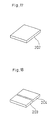
- Fig. 17 shows a gelatinized solution 202 for use in the calibration of pH of an electrode according to another preferred embodiment (however, if a pH is selected at about 7, it can be used also as a gelatinized solution for use in the preservation of an electrode).
- High humidity-holding water-containing jelly (U-jelly) mainly comprising an acrylic polymer like the one of the above described preferred embodiment is dissolved in an appointed aqueous solution comprising a buffer-solution selected from the group consisting of phosphoric acid, hydrochloric acid, acetic acid, potassium hydrogen phthalate, potassium dihydrogen citrate and the like and a pH-adjusting solution selected from the group consisting of aqueous solutions of potassium chloride (KCl), sodium hydroxide, sodium tetraborate, sodium acetate, sodium carbonate and the like at a suitable ratio and then, the resulting solution is gelatinized by adding a gelatinizer selected from the group consisting of agar-agar, gelatine, glue, alginic acid and the like.
- a buffer-solution selected from the group consisting of phosphoric acid, hydrochloric acid, acetic acid, potassium hydrogen phthalate, potassium dihydrogen citrate and the like
- the gelatinized product is molded so as to have an appointed pH (for example pH of 4, pH of 7 and pH of 9) and an appointed shape (in this example, a rectangular member having a depth of about 15 mm, a width of about 15 mm and a height of about 2 mm capable of inserting into a concave portion M for pouring the sample liquid of the casing K constructing the tip-like measuring electrode unit U as shown in the above described Fig. 9).
- an appointed pH for example pH of 4, pH of 7 and pH of 9
- an appointed shape in this example, a rectangular member having a depth of about 15 mm, a width of about 15 mm and a height of about 2 mm capable of inserting into a concave portion M for pouring the sample liquid of the casing K constructing the tip-like measuring electrode unit U as shown in the above described Fig. 9).
- each of the gelatinized solutions 202 are satisfactorily used for the preservation of the electrode for use in the measurement of ions in the tip-like measuring electrode unit U while it is not being used and for the pH-calibration of the glass electrode portion of the electrode for use in the measurement of ions in the same manner as in the gelatinized solutions G1, G2, G3 already described.
- the gelatinized solution having a pH of 7 is used as the member 202 for the preservation of the electrode common to the glass electrode and reference electrode, it is not always necessary that the member 202 has a pH of strictly 7. Besides, there is no harm in that the pH value is not clear.
- the gelatinized solution 202 having a pH adjusted at 7 and molded to a rectangular member having a size of about 15 mm deep, about 15 mm wide and about 2 mm high so as to be inserted into the concave portion M for pouring the sample liquid of the casing K constructing the tip-like measuring electrode unit U as shown in the above described Fig. 9 was used as the gelatinized solution for use in the preservation of an electrode common to the glass electrode and the reference electrode, it may be constructed in two parts as shown in Fig. 18 as a gelatinized solution 203 for use in the preservation of a glass electrode and a gelatinized solution 204 for use in the preservation of a reference electrode.
- the gelatinized solution 203 for use in the preservation of the glass electrode is adjusted to a pH of 7 and the gelatinized solution 204 for use in the preservation of the reference electrode comprises the same composition as the solution 201 for use in the internal solution in the above described preferred embodiment.
- the gelatinized solutions 203, 204 ought to be molded in a size nearly half that of said gelatinized solution 202 (that is to say, to a rectangular shape having a depth of about 15 mm, a width of about 7 mm and a height of about 2 mm), respectively.
- the surface of all of the gelatinized solutions 201, 202, 203 and 204 for use in the measurement of ions according to the above described preferred embodiments can be always maintained in a moderate wet condition (not excessively soft and sticky, moist and neat condition) for a long time on account of the superior vapour-pressure equilibrium condiction holding function of U-jelly added to the gelatinized solutions.
- a small amount of a hygroscopic substance such as glycerine
- a hygroscopic substance such as glycerine
- the electrolyte solutions according to the present invention can be very satisfactorily used as members for use as an internal solution of a glass electrode and a reference electrode for the glass electrode, as members for use in the preservation of electrodes and as members for use in the pH-calibration particularly in the case of a sheet type electrode for the measurement of ions.
Landscapes
- Chemical & Material Sciences (AREA)
- Life Sciences & Earth Sciences (AREA)
- Health & Medical Sciences (AREA)
- Biochemistry (AREA)
- General Physics & Mathematics (AREA)
- Electrochemistry (AREA)
- Physics & Mathematics (AREA)
- Analytical Chemistry (AREA)
- Molecular Biology (AREA)
- General Health & Medical Sciences (AREA)
- Chemical Kinetics & Catalysis (AREA)
- Immunology (AREA)
- Pathology (AREA)
- Investigating Or Analysing Biological Materials (AREA)
- Sampling And Sample Adjustment (AREA)
- Investigating Or Analyzing Non-Biological Materials By The Use Of Chemical Means (AREA)
- Testing Resistance To Weather, Investigating Materials By Mechanical Methods (AREA)
- Measurement And Recording Of Electrical Phenomena And Electrical Characteristics Of The Living Body (AREA)
- Measurement Of The Respiration, Hearing Ability, Form, And Blood Characteristics Of Living Organisms (AREA)
Applications Claiming Priority (2)
| Application Number | Priority Date | Filing Date | Title |
|---|---|---|---|
| JP1986191495U JPS6396453U (de) | 1986-12-11 | 1986-12-11 | |
| JP191495/86U | 1986-12-11 |
Publications (2)
| Publication Number | Publication Date |
|---|---|
| EP0270751A2 true EP0270751A2 (de) | 1988-06-15 |
| EP0270751A3 EP0270751A3 (de) | 1989-10-04 |
Family
ID=16275594
Family Applications (1)
| Application Number | Title | Priority Date | Filing Date |
|---|---|---|---|
| EP87113266A Withdrawn EP0270751A3 (de) | 1986-12-11 | 1987-09-10 | Elektrolytlösung zur Benutzung in Elektroden zur Messung von Ionen und Verfahren zu deren Herstellung |
Country Status (4)
| Country | Link |
|---|---|
| EP (1) | EP0270751A3 (de) |
| JP (2) | JPS6396453U (de) |
| KR (1) | KR900002502B1 (de) |
| CN (1) | CN1009959B (de) |
Cited By (6)
| Publication number | Priority date | Publication date | Assignee | Title |
|---|---|---|---|---|
| EP0271102A3 (de) * | 1986-12-11 | 1990-01-10 | Horiba, Ltd. | Verfahren zur Messung von Ionenkonzentrationen und ähnlichem, Kalibrierblatt und Verfahren zum Kalibrieren des zu diesem Zweck verwendeten Messgeräts |
| EP0271101A3 (en) * | 1986-12-11 | 1990-03-07 | Horiba, Ltd. | Reference electrode |
| WO1990002943A1 (de) * | 1988-09-13 | 1990-03-22 | Ingold Messtechnik Ag | Pastöse zubereitung zur funktionsprüfung und/oder reinigung amperometrischer sensoren |
| EP0450202A1 (de) * | 1988-07-18 | 1991-10-09 | Martin J. Patko | Vorgeeichte elektrochemische Wegwerffühler |
| FR3012610A1 (fr) * | 2013-10-29 | 2015-05-01 | Commissariat Energie Atomique | Electrode a membrane polymerique pour la detection potentiometrique d'au moins un analyte present dans une solution et capteur chimique comprenant une telle electrode |
| US10267764B2 (en) | 2012-04-17 | 2019-04-23 | Endress + Hauser Conducta Gmbh + Co. Kg | Potentiometric sensor apparatus |
Families Citing this family (7)
| Publication number | Priority date | Publication date | Assignee | Title |
|---|---|---|---|---|
| JP2582658Y2 (ja) * | 1992-05-01 | 1998-10-08 | 東亜電波工業株式会社 | 比較電極 |
| US5325853A (en) * | 1992-09-02 | 1994-07-05 | Diametrics Medical, Inc. | Calibration medium containment system |
| US7980324B2 (en) | 2006-02-03 | 2011-07-19 | Black & Decker Inc. | Housing and gearbox for drill or driver |
| JP4857288B2 (ja) * | 2006-11-08 | 2012-01-18 | 株式会社堀場製作所 | ガラス電極等の洗浄保存液 |
| BRPI0622137A2 (pt) | 2006-11-21 | 2014-07-29 | Medimate Holding B V | Método e aparelho para medição de uma concentração de uma espécie carregada em uma amostra e método para produção de um aparelho |
| KR101346468B1 (ko) | 2007-05-18 | 2014-01-02 | 메디메이트 홀딩 비.브이. | 액체 중의 분석물질의 농도를 측정하기 위한 플러그를 갖는 시험 칩, 시험 칩용 하우징 및 플러그용 소켓 |
| JP2013156268A (ja) * | 2013-03-28 | 2013-08-15 | Medimate Holding B V | 液体で満たされてシールされたチャネルを有する測定試料ハンドリング・デバイス |
Family Cites Families (6)
| Publication number | Priority date | Publication date | Assignee | Title |
|---|---|---|---|---|
| US3787309A (en) * | 1972-05-30 | 1974-01-22 | Beckman Instruments Inc | Specific ion electrode and method of making said electrode |
| FR2363798A1 (fr) * | 1976-09-03 | 1978-03-31 | Tacussel Jacques | Electrode specifique a construction modulaire |
| US4233136A (en) * | 1978-07-17 | 1980-11-11 | Nova Biomedical Corporation | Liquid membrane electrode |
| US4340457A (en) * | 1980-01-28 | 1982-07-20 | Kater John A R | Ion selective electrodes |
| EP0133536B1 (de) * | 1983-08-03 | 1988-11-02 | Medtronic, Inc. | Ionenempfindliche Elektrode und Verfahren zu deren Herstellung und ionenselektive Membranen dafür |
| KR900008847B1 (ko) * | 1985-05-27 | 1990-11-30 | 테루모가부시끼가이샤 | 이온센서 및 그 제조방법 |
-
1986
- 1986-12-11 JP JP1986191495U patent/JPS6396453U/ja active Pending
-
1987
- 1987-09-04 KR KR1019870009796A patent/KR900002502B1/ko not_active Expired
- 1987-09-10 EP EP87113266A patent/EP0270751A3/de not_active Withdrawn
- 1987-09-16 CN CN87106356A patent/CN1009959B/zh not_active Expired
-
1991
- 1991-12-29 JP JP3359276A patent/JPH0690173B2/ja not_active Expired - Lifetime
Cited By (7)
| Publication number | Priority date | Publication date | Assignee | Title |
|---|---|---|---|---|
| EP0271102A3 (de) * | 1986-12-11 | 1990-01-10 | Horiba, Ltd. | Verfahren zur Messung von Ionenkonzentrationen und ähnlichem, Kalibrierblatt und Verfahren zum Kalibrieren des zu diesem Zweck verwendeten Messgeräts |
| EP0271101A3 (en) * | 1986-12-11 | 1990-03-07 | Horiba, Ltd. | Reference electrode |
| EP0450202A1 (de) * | 1988-07-18 | 1991-10-09 | Martin J. Patko | Vorgeeichte elektrochemische Wegwerffühler |
| WO1990002943A1 (de) * | 1988-09-13 | 1990-03-22 | Ingold Messtechnik Ag | Pastöse zubereitung zur funktionsprüfung und/oder reinigung amperometrischer sensoren |
| US10267764B2 (en) | 2012-04-17 | 2019-04-23 | Endress + Hauser Conducta Gmbh + Co. Kg | Potentiometric sensor apparatus |
| FR3012610A1 (fr) * | 2013-10-29 | 2015-05-01 | Commissariat Energie Atomique | Electrode a membrane polymerique pour la detection potentiometrique d'au moins un analyte present dans une solution et capteur chimique comprenant une telle electrode |
| WO2015063128A1 (fr) * | 2013-10-29 | 2015-05-07 | Commissariat à l'énergie atomique et aux énergies alternatives | Electrode a membrane polymerique pour la detection potentiometrique d'au moins un analyte present dans une solution et capteur chimique comprenant une telle electrode |
Also Published As
| Publication number | Publication date |
|---|---|
| EP0270751A3 (de) | 1989-10-04 |
| JPH0552799A (ja) | 1993-03-02 |
| CN1009959B (zh) | 1990-10-10 |
| CN87106356A (zh) | 1988-06-22 |
| KR900002502B1 (ko) | 1990-04-16 |
| JPS6396453U (de) | 1988-06-22 |
| KR880008021A (ko) | 1988-08-30 |
| JPH0690173B2 (ja) | 1994-11-14 |
Similar Documents
| Publication | Publication Date | Title |
|---|---|---|
| EP0270751A2 (de) | Elektrolytlösung zur Benutzung in Elektroden zur Messung von Ionen und Verfahren zu deren Herstellung | |
| US4062750A (en) | Thin film electrochemical electrode and cell | |
| KR0152426B1 (ko) | 기준전극 어셈블리 및 그 제조방법 | |
| EP1269172B1 (de) | Elektrodeneinrichtung mit festkörper-bezugssystem | |
| JPS62116252A (ja) | 電気化学分析の方法及び装置 | |
| EP0271101B1 (de) | Referenzelektrode | |
| US5421983A (en) | Anion selective electrodes containing fumed silica | |
| US5248403A (en) | Gelatinized member for use in electrodes measuring ion concentration | |
| JP2003515097A5 (de) | ||
| EP1516176A1 (de) | Ionenaustauschmembranen und gassensoren für gelöste gase | |
| EP0673506B1 (de) | Referenzelektrode | |
| EP0580869A1 (de) | Feuchtigkeitssensor und seine herstellung | |
| Walsh et al. | Solid‐state sodium‐selective sensors based on screen‐printed Ag/AgCl reference electrodes | |
| Knoll et al. | Microfibre matrix-supported ion-selective PVC membranes | |
| US4857166A (en) | Reference electrode | |
| JP2001514760A (ja) | サブミニアチュアスルーホールを備えたワイアリングサブストレートの製造方法 | |
| US5310473A (en) | Removable sample testing member for use in measuring ion concentration | |
| JPH0416216Y2 (de) | ||
| JP3175022B2 (ja) | pH測定装置及びその校正方法 | |
| EP0321737B1 (de) | Miniaturisierte Referenzelektroden | |
| JP3175021B2 (ja) | pH測定電極の電位安定化方法及び装置 | |
| Yehia et al. | Functionalized β-cyclodextrin-based potentiometric membrane for the selective determination of vildagliptin in presence of its in-process impurity | |
| Borchardt et al. | Disposable sodium electrodes | |
| JP2861131B2 (ja) | イオン電極 | |
| JP2007298325A (ja) | 電極チップ及びその製造方法 |
Legal Events
| Date | Code | Title | Description |
|---|---|---|---|
| PUAI | Public reference made under article 153(3) epc to a published international application that has entered the european phase |
Free format text: ORIGINAL CODE: 0009012 |
|
| AK | Designated contracting states |
Kind code of ref document: A2 Designated state(s): AT BE CH DE ES FR GB GR IT LI NL SE |
|
| PUAL | Search report despatched |
Free format text: ORIGINAL CODE: 0009013 |
|
| AK | Designated contracting states |
Kind code of ref document: A3 Designated state(s): AT BE CH DE ES FR GB GR IT LI NL SE |
|
| 17P | Request for examination filed |
Effective date: 19900314 |
|
| 17Q | First examination report despatched |
Effective date: 19910808 |
|
| STAA | Information on the status of an ep patent application or granted ep patent |
Free format text: STATUS: THE APPLICATION IS DEEMED TO BE WITHDRAWN |
|
| 18D | Application deemed to be withdrawn |
Effective date: 19920219 |
|
| RIN1 | Information on inventor provided before grant (corrected) |
Inventor name: KOJIMA, JUNJI Inventor name: MOTOTSUNE, AKEMI Inventor name: TOMITA, KATSUHIKO |