EP0270962A2 - Heterocyclische Verbindungen, Verfahren zu ihrer Herstellung sowie ihre Verwendung - Google Patents
Heterocyclische Verbindungen, Verfahren zu ihrer Herstellung sowie ihre Verwendung Download PDFInfo
- Publication number
- EP0270962A2 EP0270962A2 EP87117650A EP87117650A EP0270962A2 EP 0270962 A2 EP0270962 A2 EP 0270962A2 EP 87117650 A EP87117650 A EP 87117650A EP 87117650 A EP87117650 A EP 87117650A EP 0270962 A2 EP0270962 A2 EP 0270962A2
- Authority
- EP
- European Patent Office
- Prior art keywords
- rings
- heterocyclic compounds
- compounds according
- substituted
- nitro
- Prior art date
- Legal status (The legal status is an assumption and is not a legal conclusion. Google has not performed a legal analysis and makes no representation as to the accuracy of the status listed.)
- Withdrawn
Links
- 0 *=C(c(cccc1)c1C1=Nc(cc2)c3cc2Br)N1C3=O Chemical compound *=C(c(cccc1)c1C1=Nc(cc2)c3cc2Br)N1C3=O 0.000 description 1
Classifications
-
- C—CHEMISTRY; METALLURGY
- C07—ORGANIC CHEMISTRY
- C07D—HETEROCYCLIC COMPOUNDS
- C07D519/00—Heterocyclic compounds containing more than one system of two or more relevant hetero rings condensed among themselves or condensed with a common carbocyclic ring system not provided for in groups C07D453/00 or C07D455/00
-
- C—CHEMISTRY; METALLURGY
- C08—ORGANIC MACROMOLECULAR COMPOUNDS; THEIR PREPARATION OR CHEMICAL WORKING-UP; COMPOSITIONS BASED THEREON
- C08K—Use of inorganic or non-macromolecular organic substances as compounding ingredients
- C08K5/00—Use of organic ingredients
- C08K5/16—Nitrogen-containing compounds
- C08K5/34—Heterocyclic compounds having nitrogen in the ring
- C08K5/3442—Heterocyclic compounds having nitrogen in the ring having two nitrogen atoms in the ring
- C08K5/3462—Six-membered rings
- C08K5/3465—Six-membered rings condensed with carbocyclic rings
-
- C—CHEMISTRY; METALLURGY
- C09—DYES; PAINTS; POLISHES; NATURAL RESINS; ADHESIVES; COMPOSITIONS NOT OTHERWISE PROVIDED FOR; APPLICATIONS OF MATERIALS NOT OTHERWISE PROVIDED FOR
- C09B—ORGANIC DYES OR CLOSELY-RELATED COMPOUNDS FOR PRODUCING DYES, e.g. PIGMENTS; MORDANTS; LAKES
- C09B57/00—Other synthetic dyes of known constitution
Definitions
- the invention relates to heterocyclic compounds of the formula Process for their preparation and their use.
- the rings denoted by X, X ⁇ , T and T ⁇ can be substituted, for example by 1, 2, 3 or 4 substituents from the series Halogen, especially chlorine and bromine; C1-C6 alkyl, especially methyl; optionally substituted aryl, in particular phenyl, which can be substituted, for example, by halogen such as chlorine and bromine C1-C Alkyl-alkyl such as methyl, acylamino such as acetylamino or benzoylamino, nitro, carboxy or carbamoyl; C1-C6 alkoxy, especially methoxy; Acylamino, especially acetylamino and benzoylamino; Carboxy; Nitro or carbamoyl.
- the rings X, X ⁇ , T and T ⁇ can also be expanded to naphthalene systems by substituted fused benzo rings.
- suitable substituents in the benzo rings are halogen such as chlorine and bromine, C1-C6-alkyl such as methyl, C1-C6-alkoxy, especially methoxy, acylamino such as acetylamino or benzoylamino, nitro, carboxy or carbamoyl.
- a in formula (I) represents a divalent organic radical.
- A is preferably chosen so that the compound (I) has pigment properties.
- A further preferably denotes a radical which contains at least one benzene, naphthalene or diphenyl ring, it being possible for these rings to be substituted.
- the radicals can also contain heterocyclic structural units.
- substituents for the benzene, naphthalene or diphenyl rings of the radicals A are halogen, in particular chlorine and bromine, alkyl, in particular C1-C6-alkyl, for example, methyl, nitro, alkoxy, in particular C1-C6-alkoxy, for example methoxy, Acylamino, in particular C1-C6-alkylcarbonylamino, for example acetylamino, or benzoylamino, cyan, carboxy, C1-C6-alkoxycarbonyl, for example methoxycarbonyl.
- A can also be regarded as residues of diamino compounds.
- Symmetrical compounds of the formula are preferred with the above meanings for X, T and A.
- compounds of formula (I) and (II) in which the rings marked by X, X ⁇ and / or T, T ⁇ represent benzene rings, optionally substituted by halogen, methyl, methoxy, acetylamino, benzoylamino, carboxy, carbamoyl or nitro .
- the new compounds of the formula (I) are preferably obtained by reacting compounds of the formulas (III) and (IIIa): with a diamine of the formula H2N-A-NH2 (IV).
- Suitable solvents are alcohols such as methanol, ethanol, amyl alcohol or glycol monoalkyl ether; Aromatics such as chlorobenzene, nitrobenzene, toluene; amidic solvents such as formamide, dimethylformamide, N-methylpyrrolidone; or acids such as formic acid or acetic acid.
- Suitable acids for producing the acidic conditions are inorganic such as hydrochloric acid, sulfuric acid or phosphoric acid or organic acids such as formic acid, acetic acid, chloroacetic acid, dichloroacetic acid, oxalic acid, benzosulfonic acid or p-toluenesulfonic acid.
- T, T ⁇ , X and X ⁇ have the meanings given for formula (I);
- R preferably denotes alkyl, preferably C1-C6-alkyl, especially methyl or aryl, especially phenyl.
- the compounds of the formulas (III) and (IIIa) or (V) and (Va) can be reacted in any ratio to one another. They are preferably identical compounds whose reactions lead to the symmetrical compounds of the formula (II).
- the compounds of the formula (I) are obtained in a form suitable for the pigment application or can be converted into the suitable form by known post-treatment processes, for example by dissolving or swelling in strong inorganic acids such as sulfuric acid and discharging them onto ice.
- the fine distribution can also be achieved by grinding with or without grinding aids such as inorganic salts or sand, if appropriate in the presence of solvents such as toluene, xylene, dichlorobenzene or N-methylpyrrolidone.
- the color strength and transparency of the pigment can be influenced by varying the aftertreatment.
- the colorants of the formula (I) are suitable for a wide variety of pigment applications. They can be used to produce very real pigmented systems, such as mixtures with other substances, preparations, paints, printing inks, colored paper and colored macromolecular substances. When mixed with other substances e.g. those with inorganic white pigments such as titanium dioxide (rutile) or with cement. Preparations are e.g. Flush pastes with organic liquids or doughs and fine doughs with water, dispersing agents and optionally preservatives.
- paint is e.g.
- Printing inks are to be understood as those for paper, textile and tin printing.
- the macromolecular substances can be of natural origin, such as rubber, can be obtained by chemical modification, such as acetyl cellulose, cellulose butyrate or viscose or synthetically produced such as polymers, polyadducts and polycondensates.
- Plastic masses such as polyvinyl chloride, polyvinyl acetate, polyvinyl propionate, polyolefins, for example polyethylene or polyamides, superpolyamides, polymers and copolymers of acrylic esters, methacrylic esters, acrylonitrile, acrylamide, butadiene, styrene and polyurethanes and polycarbonates are mentioned.
- the substances pigmented with the claimed products can be in any form.
- the pigments of the formula (I) are also excellent in waterfastness, oil-fast, acid-fast, lime-fast, alkali-fast, solvent-fast, over-lacquer-fast, over-spray-fast, sublimation-fast, heat-resistant, vulcanization-resistant, very economical and easy to distribute in plastic compositions.
- Example 49 (application example )
- Products based on synthetic and vegetable fatty acids such as coconut oil, castor oil, castor oil, linseed oil etc. come as alkyd resins. in question. Instead of melamine resins, urea resins can be used.
- the pigmented lacquer is applied to paper, glass, plastic or metal foils and baked at 130 ° C for 30 minutes.
- the coatings have very good light and weather resistance as well as good fastness to over-painting.
- Example 50 (application example )
- 0.2 pigment according to Example 1 are mixed with 100 g of polyethylene, polypropylene or polystyrene granules.
- the mixture can either be sprayed directly at 220 to 280 ° C in an injection molding machine or processed into colored bars in an extrusion press or colored skins on the mixing roller mill.
- the rods or skins are optionally granulated and sprayed in an injection molding machine.
- the yellow moldings have very good fastness to light and migration.
- synthetic polyamides from caprolactam or adipic acid and hexamethylenediamine or the condensates from terephthalic acid and ethylene glycol are colored.
Landscapes
- Chemical & Material Sciences (AREA)
- Organic Chemistry (AREA)
- Health & Medical Sciences (AREA)
- Chemical Kinetics & Catalysis (AREA)
- Medicinal Chemistry (AREA)
- Polymers & Plastics (AREA)
- Nitrogen And Oxygen Or Sulfur-Condensed Heterocyclic Ring Systems (AREA)
- Compositions Of Macromolecular Compounds (AREA)
- Inks, Pencil-Leads, Or Crayons (AREA)
- Plural Heterocyclic Compounds (AREA)
Abstract

sowie die Verwendung dieser Verbindungen zum Pigmentieren von organischem Material.
Description
- Die Erfindung betrifft heterocyclische Verbindung der Formel

- In der Formel (I) können die mit X, Xʹ, T und Tʹ bezeichneten Ringe substituiert sein, beispielsweise durch jeweils 1, 2, 3 oder 4 Substituenten aus der Reihe Halogen, insbesondere Chlor und Brom; C₁-C₆-Alkyl, insbesondere Methyl; gegebenenfalls substituiertes Aryl, insbesondere Phenyl, das z.B. durch Halogen wie Chlor und Brom C₁-C₆-Alkyl wie Methyl, Acylamino wie Acetylamino oder Benzoylamino, Nitro, Carboxy oder Carbamoyl substituiert sein kann; C₁-C₆-Alkoxy, insbesondere Methoxy; Acylamino insbesondere Acetylamino und Benzoylamino; Carboxy; Nitro oder Carbamoyl. Die Ringe X, Xʹ, T und Tʹ können darüber hinaus durch eventuell substituierte anellierte Benzoringe zu Naphthalinsystemen erweitert sein. Als Substituierten in den Benzoringen kommen z.B. Halogen wie Chlor und Brom, C₁-C₆-Alkyl wie Methyl, C₁-C₆-Alkoxy, insbesondere Methoxy, Acylamino wie Acetylamino oder Benzoylamino, Nitro, Carboxy oder Carbamoyl in Frage.
- A in Formel (I) steht für einen zweiwertigen organischen Rest.
- Vorzugsweise wird A so gewählt, daß die Verbindung (I) Pigmenteigenschaften aufweist.
- Weiterhin bevorzugt bezeichnet A einen Rest, der mindestens einen Benzol-, Naphthalin- oder Diphenylring enthält, wobei diese Ringe substituiert sein können.
- Beispiele für A und Reste der Formeln
-Ar- und -Ar-G-Ar¹-
wobei
Ar, Ar¹ für Phenylen, Naphthylen oder Biphenylylen stehen, die substituiert sein können und
G ein Brückenglied bezeichnet, vorzugsweise -S-, -O-, -SO₂-, -CO-, -NHCO-, -NHCONH-, CONHCO-, -CONHNHCO-, -NHCO-Ar-CONH- mit der oben angegebenen Definition von Ar, -N=N-, -CH=CH-, -CH=N-, -NHCOCONH-, -CONH-Ar-CONH- mit der oben angegebenen Definition von Ar. - Weiterhin können die Reste auch heterocyclische Struktureinheiten enthalten.
- Speziellere Beispiele für A sind:


- Als Substituenten für die Benzol-, Naphthalin- oder Diphenylringe der Reste A seien beispielsweise Halogen, insbesondere Chlor und Brom, Alkyl, insbesondere C₁-C₆-Alkyl, z.B, Methyl, Nitro, Alkoxy, insbesondere C₁-C₆-Alkoxy, z.B. Methoxy, Acylamino, insbesondere C₁-C₆-Alkylcarbonylamino, z.B. Acetylamino, oder Benzoylamino, Cyan, Carboxy, C₁-C₆-Alkoxycarbonyl, z.B. Methoxycarbonyl, genannt.
- Aufgrund der bevorzugten Herstellungsweise der Verbindungen der Formel (I) kann man A auch als Reste von Diaminoverbindungen ansehen.
- Bevorzugt sind symmetrische Verbindungen der Formel

- Weiterhin bevorzugt sind Verbindungen der Formel (I) und (II), in denen die durch X, Xʹ und/oder T, Tʹ markierten Ringe Benzolringe darstellen, gegebenenfalls substituiert durch Halogen, Methyl, Methoxy, Acetylamino, Benzoylamino, Carboxy, Carbamoyl oder Nitro. Weiterhin bevorzugt sind die Verbindungen der Formel (I) und (II), bei denen A für einen gegebenenfalls durch Halogen, Methyl, Methoxy, Carbonyl, Methoxycarbonyl oder Nitro substituierten Phenylen-, Naphthylen- oder 4,4ʹ-Biphenylylenrest steht.
- Die neuen Verbindungen der Formel (I) werden vorzugsweise erhalten durch Umsetzung von Verbindungen der Formeln (III) und (IIIa):

H₂N-A-NH₂ (IV). - in den Formeln (III) bzw. (IIIa) und (IV) haben X, Xʹ, T, Tʹ und A die zu Formel (I) angegebenen Bedeutungen.
- Dazu arbeitet man zweckmäßig in Wasser oder im organischen Lösungsmittel bei sauren Bedingungen und erhöhter Temperatur, bevorzugt bei 50 bis 180°C. Geeignete Lösungsmittel sind Alkohole wie Methanol, Ethanol, Amylalkohol oder Glykolmonoalkylether; Aromaten wie Chlorbenzol, Nitrobenzol, Toluol; amidische Lösungsmittel wie Formamid, Dimethylformamid, N-Methylpyrrolidon; oder Säuren wie Ameisensäure oder Essigsäure.
- Geeignete Säuren zur Herstellung der sauren Bedingungen sind anorganische wie Salzsäure, Schwefelsäure oder Phosphorsäure bzw. organische wie Ameisensäure, Essigsäure, Chloressigsäure, Dichloressigsäure, Oxalsäure, Benzosulfonsäure oder p-Toluolsulfonsäure.
- Anstelle der Zwischenprodukte der Formeln (III) und (IIIa) können auch deren Acylierungsprodukte der Formeln (V) und (Va) eingesetzt werden:
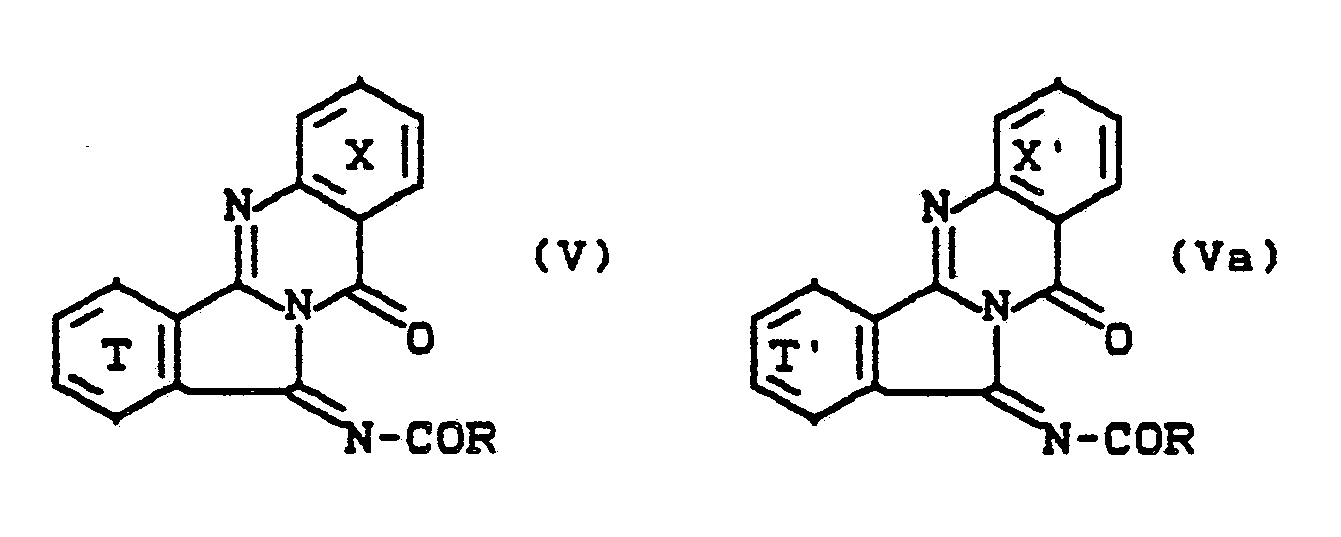
- In den Formeln (V) und (Va) haben T, Tʹ, X und Xʹ die zu Formel (I) angegebenen Bedeutungen; R bezeichnet vorzugsweise Alkyl, vorzugsweise C₁-C₆-Alkyl, insbesondere Methyl oder Aryl, insbesondere Phenyl.
- Die Zwischenprodukte der Formeln (III) bzw. (IIIa) und (V) bzw. (Va) sind literaturbekannt bzw. nach analogen Verfahren herstellbar.
- Die Verbindungen der Formel (III) und (IIIa) bzw. (V) und (Va) können in beliebigem Verhältnis zueinander umgesetzt werden. Vorzugsweise handelt es sich um gleiche Verbindungen, deren Umsetzungen zu den symmetrischen Verbindungen der Formel (II) führen.
- Die Verbindung der Formel (I) fallen in einer für die Pigmentanwendung geeigneten Form an oder können durch an sich bekannte Nachbehandlungsverfahren in die geeignete Form überführt werden, z.B. durch Lösen oder Quellen in starken anorganischen Säuren wie Schwefelsäure und Austragen auf Eis. Die Feinverteilung kann auch durch Mahlen mit oder ohne Mahlhilfsstoffen wie anorganische Salze oder Sand, gegebenenfalls in Anwesenheit von Lösungsmitteln wie Toluol, Xylol, Dichlorbenzol oder N-Methylpyrrolidon erzeilt werden. Farbstärke und Transparenz des Pigments können durch Variation der Nachbehandlung beeinflußt werden.
- Die Farbmittel der Formel (I) eignen sich aufgrund ihrer Licht- und Migrationsechtheit für die verschiedensten Pigmentapplikationen. Sie können zur Herstellung von sehr echt pigmentierten Systemen, wie Mischung mit anderen Stoffen, Zubereitungen, Anstrichmitteln, Druckfarben, gefärbtem Papier und gefärbten makromolekularen Stoffen verwendet werden. Unter Mischung mit anderen Stoffen können z.B. solche mit anorganischen Weißpigmenten wie Titandioxid (Rutil) oder mit Zement verstanden werden. Zubereitungen sind z.B. Flushpasten mit organischen Flüssigkeiten oder Teige und Feinteige mit Wasser, Dispergiermitteln und gegebenenfalls Konservierungsmitteln. Die Bezeichnung Anstrichmittel steht z.B. für physikalisch oder oxidativ trocknende Lacke, Einbrennlacke, Reaktionslacke, Zweikomponentenlacke, Dispersionsfarben für wetterfeste Überzüge und Leimfarben. Unter Druckfarben sind solche für den Papier-, Textilund Blechdruck zu verstehen.
- Die makromolekularen Stoffe können natürlichen Ursprungs sein, wie Kautschuk, durch chemische Modifikation erhalten werden wie Acetylcellulose, Cellulosebutyrat oder Viskose oder synthetisch erzeugt werden wie Polymerisate, Polyadditionsprodukte und Polykondensate. Genannt seien plastische Massen wie Polyvinylchlorid, Polyvinylacetat, Polyvinylpropionat, Polyolefine, z.B. Polyethylen oder Polyamide, Superpolyamide, Polymerisate und Mischpolymerisate aus Acrylestern, Methacrylestern, Acrylnitril, Acrylamid, Butadien, Styrol sowie Polyurethane und Polycarbonate. Die mit den beanspruchten Produkten pigmentierten Stoffe können in beliebiger Form vorliegen.
- Die Pigmente der Formel (I) sind weiterhin ausgezeichnet wasserecht, ölecht, säureecht, kalkecht, alkaliecht, lösungsmittelecht, überlackierecht, überspritzecht, sublimierecht, hitzebeständig, vulkanisierbeständig, sehr ergiebig und in plastischen Massen gut verteilbar.
- In 100 ml Eisessig werden 15 g 12-Imino-isoindolo(1,2-b)chinazolin-10(12H)-on (Formel III, unsubstituiert) mit 3 g p-Phenylendiamin 1 Stunde am Rückflußkühler gekocht. Anschließend wird heiß isoliert, mit Eisessig und Wasser gewaschen und getrocknet. Man erhält 12 g (75 %) einer gelben Verbindung der Formel

Massenspektrum m/e (rel. Intensität): 568 M⁺ (100%), 338 (10), 230 (20), 102 (20).
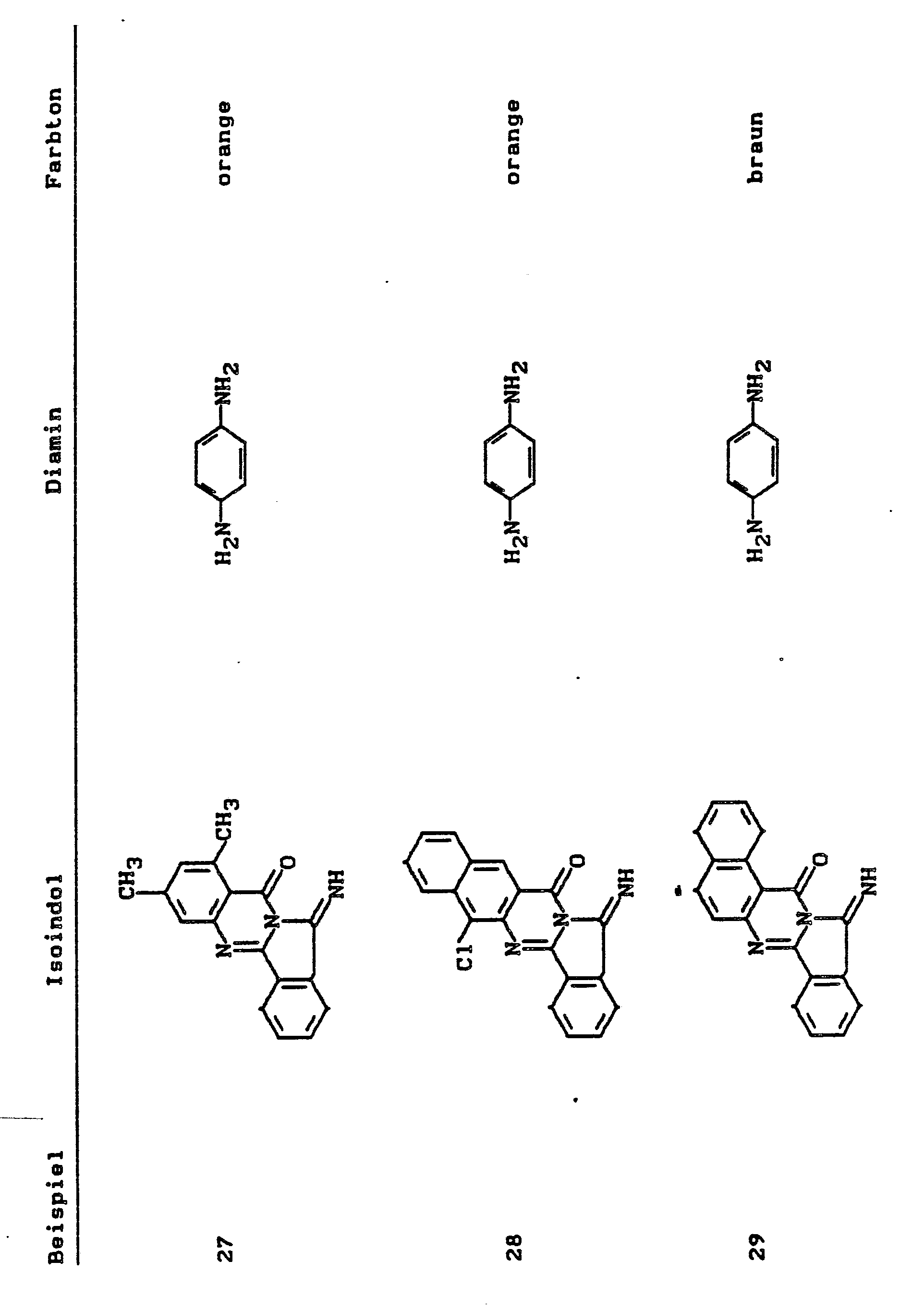
IR-Spektrum (cm⁻¹): 1700, 1620, 1590, 1460, 1320, 1295, 940, 840, 760. - Analog Beispiel 1 erhält man bei Einsatz der in der folgenden Tabelle angegebenen Diamine anstelle von p-Phenylendiamin entsprechende Dimerisierungsprodukte mit den angegebenen Farbtönen.


- Analog Beispiel 1 erhält man mit substituierten Isoindolzwischenprodukten und den in der Tabelle angegebenen Diaminen die entsprechenden dimeren Verbindungen mit den angegebenen Farbtönen.




- In 100 ml Eisessig werden 7,5 g Verbindung (VI) und 8,6 g Verbindung (VII) mit 3 g p-Phenylendiamin 3 Stunden am Rückfluß gekocht. Anschließend wird heiß

- Man erhält 14,5 g einer gelben Verbindung. Elementaranalyse: C: 71,5 %, H: 3,3 %, N: 14,0 %, Cl: 6,0 %
- 8 g feingemahlenes Pigment gemäß Beispiel 1 werden in 92 g eines Einbrennlackes folgender Zusammensetzung dispergiert:
33 % Alkydharz
15 % Melaminharz
5 % Glykolmonomethylether
34 % Xylol
13 % Butanol - Als Alkydharze kommen Produkte auf Basis synthetischer und pflanzlicher Fettsäure wie Kokosöl, Rizinusöl, Rizinenöl, Leinöl u.a. in Frage. Anstelle von Melaminharzen können Harnstoffharze verwendet werden.
- Nach erfolgter Dispergierung wird der pigmentierte Lack auf Papier-, Glas-, Kunststoff- oder Metall-Folien aufgetragen und 30 Minuten bei 130°C eingebrannt. Die Lackierungen besitzen sehr gute Licht- und Wetterbeständigkeit sowie gute Überlackierechtheit.
- 0,2 Pigment nach Beispiel 1 werden mit 100 g Polyethylen-, Polypropylen- oder Polystyrolgranulat gemischt. Die Mischung kann entweder bei 220 bis 280°C direkt in einer Spritzgußmaschine verspritzt oder in einer Strangpresse zu gefärbten Stäben bzw, auf dem Mischwalzwerk zu gefärbten Fellen verarbeitet werden. Die Stäbe bzw. Felle werden gegebenenfalls granuliert und in einer Spritzgußmachine verspritzt.
- Die gelben Formlinge besitzen sehr gute Licht- und Migrationsechtheit. In ähnlicher Weise können bei 280 bis 300°C, gegebenenfalls unter Stickstoffatmosphäre, synthetische Polyamide aus Caprolactam oder Adipinsäure und Hexamethylendiamin oder die Kondensate aus Terephthalsäure und Ethylenglykol gefärbt werden.
- Mit einer Druckfarbe, hergestellt durch Anreiben von 35 g Pigment nach Beispiel 1 und 65 g Leinöl und Zugabe von 1 g Siccativ (Co-Naphthenat, 50 %ig in Testbenzin) werden gelbe Offset-Drucke hoher Brillanz und Farbstärke und sehr gute Licht- und Lackierechtheiten erhalten. Verwendung dieser Druckfarbe in Buch-, Licht-, Stein-oder Stahlstichdruck führt zu gelben Drucken ähnlicher Echtheiten. Verwendet man das Pigment zur Färbung von Blechdrucken oder niedrigviskosen Tiefdrucken oder Drucktinten, erhält man Drucke ähnlicher Echtheiten.
Claims (10)

-Ar- oder -Ar-G -Ar¹-
steht, wobei
Ar, Ar¹ Phenylen, Naphthylen oder Biphenylylen, die substituiert sein können, bezeichnen und
G für ein Brückenglied steht.
G -S-, -O-, -SO₂-, -CO-, -NHCO-, -NHCONH-, -CONHCO-, -CONHNHCO-, -NHCO-Ar-COHN-, -N=N-, -CH=CH-, -CH=N-, -NHCOCONH-, -CONH-Ar-CONH- bezeichnet.

Applications Claiming Priority (2)
| Application Number | Priority Date | Filing Date | Title |
|---|---|---|---|
| DE19863642104 DE3642104A1 (de) | 1986-12-10 | 1986-12-10 | Heterocyclische verbindungen, verfahren zu ihrer herstellung sowie ihre verwendung |
| DE3642104 | 1986-12-10 |
Publications (2)
| Publication Number | Publication Date |
|---|---|
| EP0270962A2 true EP0270962A2 (de) | 1988-06-15 |
| EP0270962A3 EP0270962A3 (de) | 1990-08-29 |
Family
ID=6315834
Family Applications (1)
| Application Number | Title | Priority Date | Filing Date |
|---|---|---|---|
| EP87117650A Withdrawn EP0270962A3 (de) | 1986-12-10 | 1987-11-28 | Heterocyclische Verbindungen, Verfahren zu ihrer Herstellung sowie ihre Verwendung |
Country Status (3)
| Country | Link |
|---|---|
| EP (1) | EP0270962A3 (de) |
| JP (1) | JPS63156791A (de) |
| DE (1) | DE3642104A1 (de) |
Cited By (1)
| Publication number | Priority date | Publication date | Assignee | Title |
|---|---|---|---|---|
| CN111454264A (zh) * | 2020-05-14 | 2020-07-28 | 湖北中医药大学 | 一种Luotonin A系化合物及其制备方法与应用 |
Family Cites Families (2)
| Publication number | Priority date | Publication date | Assignee | Title |
|---|---|---|---|---|
| DE3401574A1 (de) * | 1984-01-18 | 1985-07-25 | Bayer Ag, 5090 Leverkusen | Azinpigmente, verfahren zu ihrer herstellung sowie ihre verwendung |
| DE3503776A1 (de) * | 1985-02-05 | 1986-08-14 | Basf Ag, 6700 Ludwigshafen | Bis-isoindolinpigmente und ihre verwendung |
-
1986
- 1986-12-10 DE DE19863642104 patent/DE3642104A1/de not_active Withdrawn
-
1987
- 1987-11-28 EP EP87117650A patent/EP0270962A3/de not_active Withdrawn
- 1987-12-03 JP JP30466487A patent/JPS63156791A/ja active Pending
Cited By (1)
| Publication number | Priority date | Publication date | Assignee | Title |
|---|---|---|---|---|
| CN111454264A (zh) * | 2020-05-14 | 2020-07-28 | 湖北中医药大学 | 一种Luotonin A系化合物及其制备方法与应用 |
Also Published As
| Publication number | Publication date |
|---|---|
| EP0270962A3 (de) | 1990-08-29 |
| DE3642104A1 (de) | 1988-06-16 |
| JPS63156791A (ja) | 1988-06-29 |
Similar Documents
| Publication | Publication Date | Title |
|---|---|---|
| EP0061426B1 (de) | Verfahren zum Färben von hochmolekularem organischem Material und neue polycyclische Pigmente | |
| DE3937633A1 (de) | Heterocyclische verbindungen und deren verwendung als pigmente und farbstoffe | |
| DE2812635A1 (de) | Heterocyclische verbindungen | |
| EP0151393B1 (de) | Azinpigmente, Verfahren zu ihrer Herstellung sowie ihre Verwendung | |
| EP0190692B1 (de) | Bis-isoindolinpigmente und ihre Verwendung | |
| EP0101954B1 (de) | Isoindolazine, Verfahren zu ihrer Herstellung sowie ihre Verwendung | |
| DE2749734A1 (de) | Monoazopigmente, verfahren zu deren herstellung und verwendung | |
| EP0141325A2 (de) | Rotes Azinpigment | |
| DE2429286C2 (de) | Neue Disazopigmente, Verfahren zu deren Herstellung und deren Verwendung | |
| EP0138761B1 (de) | Verfahren zum Pigmentieren von hochmolekularem organischem Material | |
| DE3642104A1 (de) | Heterocyclische verbindungen, verfahren zu ihrer herstellung sowie ihre verwendung | |
| EP0172512A2 (de) | Azinpigmente | |
| DE3533949A1 (de) | Heterocyclische verbindungen | |
| DE3537625A1 (de) | Metallkomplexpigmente | |
| DE2924142A1 (de) | Bis-isoindolinpigmente, verfahren zu deren herstellung und verwendung | |
| CH627200A5 (en) | Process for preparing new monoazo pigments and use thereof for pigmenting macromolecular organic material | |
| DE2739041A1 (de) | Verfahren zum pigmentieren von hochmolekularem organischem material | |
| EP0403812B1 (de) | Diketopiperazin Derivate, deren Herstellung und deren Vervendung zum Färben von Kunststoffen | |
| DE2812255A1 (de) | Azomethin-pigmente | |
| EP0006154B1 (de) | Monoazopigmente und deren Verwendung zum Pigmentieren von hochmolekularem organischem Material | |
| DE2556430A1 (de) | Neue disazopigmente und verfahren zu deren herstellung und verwendung | |
| EP0043937A2 (de) | Anthrachinonazo-Verbindungen, Verfahren zu ihrer Herstellung sowie ihre Verwendung | |
| DE1569710C (de) | Disazomethin Pigmente , Verfahren zu ihrer Herstellung und ihre Verwendung | |
| EP0349809A2 (de) | Metallkomplex-Pigmente | |
| DE2821347A1 (de) | Azopigmente und verfahren zu deren herstellung |
Legal Events
| Date | Code | Title | Description |
|---|---|---|---|
| PUAI | Public reference made under article 153(3) epc to a published international application that has entered the european phase |
Free format text: ORIGINAL CODE: 0009012 |
|
| 17P | Request for examination filed |
Effective date: 19871128 |
|
| AK | Designated contracting states |
Kind code of ref document: A2 Designated state(s): CH DE FR GB LI |
|
| PUAL | Search report despatched |
Free format text: ORIGINAL CODE: 0009013 |
|
| AK | Designated contracting states |
Kind code of ref document: A3 Designated state(s): CH DE FR GB LI |
|
| 17Q | First examination report despatched |
Effective date: 19920117 |
|
| STAA | Information on the status of an ep patent application or granted ep patent |
Free format text: STATUS: THE APPLICATION IS DEEMED TO BE WITHDRAWN |
|
| 18D | Application deemed to be withdrawn |
Effective date: 19920528 |
|
| RIN1 | Information on inventor provided before grant (corrected) |
Inventor name: MEINHARD, ROLF, DR. |