EP0271043A1 - Accumulateur étanche et procédé de fabrication de son électrode - Google Patents
Accumulateur étanche et procédé de fabrication de son électrode Download PDFInfo
- Publication number
- EP0271043A1 EP0271043A1 EP87118066A EP87118066A EP0271043A1 EP 0271043 A1 EP0271043 A1 EP 0271043A1 EP 87118066 A EP87118066 A EP 87118066A EP 87118066 A EP87118066 A EP 87118066A EP 0271043 A1 EP0271043 A1 EP 0271043A1
- Authority
- EP
- European Patent Office
- Prior art keywords
- hydrogen
- storage battery
- alloy
- electrode
- occlusion
- Prior art date
- Legal status (The legal status is an assumption and is not a legal conclusion. Google has not performed a legal analysis and makes no representation as to the accuracy of the status listed.)
- Granted
Links
Images




Classifications
-
- H—ELECTRICITY
- H01—ELECTRIC ELEMENTS
- H01M—PROCESSES OR MEANS, e.g. BATTERIES, FOR THE DIRECT CONVERSION OF CHEMICAL ENERGY INTO ELECTRICAL ENERGY
- H01M4/00—Electrodes
- H01M4/02—Electrodes composed of, or comprising, active material
- H01M4/36—Selection of substances as active materials, active masses, active liquids
- H01M4/38—Selection of substances as active materials, active masses, active liquids of elements or alloys
- H01M4/383—Hydrogen absorbing alloys
-
- H—ELECTRICITY
- H01—ELECTRIC ELEMENTS
- H01M—PROCESSES OR MEANS, e.g. BATTERIES, FOR THE DIRECT CONVERSION OF CHEMICAL ENERGY INTO ELECTRICAL ENERGY
- H01M10/00—Secondary cells; Manufacture thereof
- H01M10/34—Gastight accumulators
- H01M10/345—Gastight metal hydride accumulators
-
- H—ELECTRICITY
- H01—ELECTRIC ELEMENTS
- H01M—PROCESSES OR MEANS, e.g. BATTERIES, FOR THE DIRECT CONVERSION OF CHEMICAL ENERGY INTO ELECTRICAL ENERGY
- H01M4/00—Electrodes
- H01M4/02—Electrodes composed of, or comprising, active material
- H01M4/24—Electrodes for alkaline accumulators
- H01M4/242—Hydrogen storage electrodes
-
- H—ELECTRICITY
- H01—ELECTRIC ELEMENTS
- H01M—PROCESSES OR MEANS, e.g. BATTERIES, FOR THE DIRECT CONVERSION OF CHEMICAL ENERGY INTO ELECTRICAL ENERGY
- H01M4/00—Electrodes
- H01M4/02—Electrodes composed of, or comprising, active material
- H01M4/64—Carriers or collectors
- H01M4/70—Carriers or collectors characterised by shape or form
- H01M4/80—Porous plates, e.g. sintered carriers
- H01M4/808—Foamed, spongy materials
-
- Y—GENERAL TAGGING OF NEW TECHNOLOGICAL DEVELOPMENTS; GENERAL TAGGING OF CROSS-SECTIONAL TECHNOLOGIES SPANNING OVER SEVERAL SECTIONS OF THE IPC; TECHNICAL SUBJECTS COVERED BY FORMER USPC CROSS-REFERENCE ART COLLECTIONS [XRACs] AND DIGESTS
- Y02—TECHNOLOGIES OR APPLICATIONS FOR MITIGATION OR ADAPTATION AGAINST CLIMATE CHANGE
- Y02E—REDUCTION OF GREENHOUSE GAS [GHG] EMISSIONS, RELATED TO ENERGY GENERATION, TRANSMISSION OR DISTRIBUTION
- Y02E60/00—Enabling technologies; Technologies with a potential or indirect contribution to GHG emissions mitigation
- Y02E60/10—Energy storage using batteries
-
- Y—GENERAL TAGGING OF NEW TECHNOLOGICAL DEVELOPMENTS; GENERAL TAGGING OF CROSS-SECTIONAL TECHNOLOGIES SPANNING OVER SEVERAL SECTIONS OF THE IPC; TECHNICAL SUBJECTS COVERED BY FORMER USPC CROSS-REFERENCE ART COLLECTIONS [XRACs] AND DIGESTS
- Y02—TECHNOLOGIES OR APPLICATIONS FOR MITIGATION OR ADAPTATION AGAINST CLIMATE CHANGE
- Y02P—CLIMATE CHANGE MITIGATION TECHNOLOGIES IN THE PRODUCTION OR PROCESSING OF GOODS
- Y02P70/00—Climate change mitigation technologies in the production process for final industrial or consumer products
- Y02P70/50—Manufacturing or production processes characterised by the final manufactured product
Definitions
- This invention relates to a sealed storage battery and a method for making its electrode, and more particularly, the present invention relates to an alkaline storage battery.
- a lead-acid storage battery and a nickel-cadmium storage battery are predominantly used as a sealed secondary battery.
- the lead-acid storage battery is of low cost, this battery is insufficient from the point of the view of weight density or cycling life-time in the case of being used as electric power supply of a portable apparatus which is used for a long time.
- the nickel-cadmium storage battery is of comparatively high cost, the demand for this battery extremely increases, and more particularly, this battery has become widely applied to the field where high reliability is required because this battery can remove the drawbacks of the lead-acid storage battery.
- a cadmium electrode as the negative electrode has the high utilization factor of an active material, especially large electrode decrease at a high-rate discharge in comparison with a nickel electrode as the positive electrode.
- the negative electrode has the capacitance capable of charge and discharge larger than the positive electrode.
- the porosity of he negative electrode it is necessary for the porosity of he negative electrode to be increased to an optimum value in order that an overcharge, oxygen gas generated from the positive electrode is efficiently absorbed by the negative electrode.
- the negative electrode it is not attainable for the negative electrode to have higher energy density until a rapid improvement is made. Therefore, there is a limit in the improvement of the energy density of the nickel-cadmium storage battery.
- a metallic oxide-hydrogen storage battery has attracted the attention of many people in which battery a hydrogen-occlusion-alloy that can occlude and release electrochemically hydrogen is applied as the material of the negative electrode, in stead of the nickel-cadmium sorage battery.
- this storage battery even if hydrogen is generated from the negative electrode on overcharge, hydrogen is diddipated through discharge or is occluded by the hydrogen-occlusion-alloy of the negative electrode, in so far as hydrogen is not released out of the battery.
- this storage battery has a higher energy density per unit volume than the nickel-cadmium storage battery.
- this atorage battery can be constructed such that the volume of the negative electrode of this storage battery is smaller than that of the cadmium negative elecrode. Therefore, a larger active material as the positive electrode can be appropriated in the residual space of this storage battery, so that a higher energy density is expected. Moreover, the material of the hydrogen-occlusion-alloy obviates the need for a metallic cadmium which is a main component of the cadmium electrode, so that there is little pollution by heavy metal or the like.
- the hydrogen-occlusion-electrode must have a stability in alkaline electrolyte and occlude and release electrochemically hydrogen. Moreover, more important conditions are following conditions (1)-(3).
- an alloy of AB5 which is basic form of CaCu5 type alloy and in which lantharum series metals are mainly used as A and nickel is mainly used as B, has the largest possibility of a practical application noeadays.
- the alloy of AB5 is used as a hydrogen-occlusion-electrode, the electrode is oxidized by oxigen gas generated at the positive electrode on overcharge to decrease the capacity of occluding and releasing hydrogen.
- the method that the surface of the alloy is covered with a metal having the property of corrosion resistance (Japanese patent provisional publication No.61-64069 or No.
- the amount of hydrogen to be occluded and to be released decreases, and the decrease of a discharge voltage and the decrease of the property of the cycling life-time arise. It is necessary to make the electrode having an excellent corrosion resistance in order to avoid the above-mentioned problems.
- the sealed metallic oxide-hydrogen storage battery cannot be obtained which solves above-mentioned problems (1) to (3) and has high capacitance and long life-time.
- self-discharge is large. The improvement of the self-discharge must be done in order that this battery is practically applied. Therefore, the self-discharge of this battery must be improved at least to the level of the sealed nickel-cadmium storage battery which is generally said that the self-discharge is large.
- a nonwoven fabric made of a polyamide is utilized as a separator of the sealed nickel-cadmium storage battery.
- a separator that surfactants are added to the nonwoven fabric of a polyolefin so as to improve the hydrophilic property is used for some batteries to be applied to high temperature survice.
- the nonwoven fabric made of the polyamide is applied as the separator to the sealed nickel-hydrogen storage battery, self-discharge arises extremely. This is because the surface of the negative electrode has a very large activity and strong reducing power in comparison with the cadmium electrode.
- the present invention has been developed in order to remove the above-described drawbacks and contemplates to provide a sealed storage battery having a high capacitance and a long life-time by improving a hydrogen-occlusion-alloy as a negative electrode and an electrode using this alloy in order to construct a sealed metallic oxide-hydrogen storage battery.
- a hydrogen-occlusion-alloy is utilized as a material of a negative electrode, and more particularly, an alloy of AB5 having a cristal structure of CaC5 type is utilized. Moreover, B in the alloy of AB5 is partially replaced by metals except nickel so as to obtain the material having equilibrium dissocation pressure where hydrogen is occluded and released sufficiently in the temperature range of the battery operation.
- a in the alloy of AB5 i.e. lanthanium series metals, is gradually oxidized to change an oxide or hydroxide by repeating charge and discharge in a sealed storage battery system, it is difficult to prevent basically such a phenomenon. Therefore, it is very important to supress oxidizing velocity.
- the present invention corrosion resistance can be risen by the method that the crystallinity of the alloy is improved.
- the pluralization of the alloy of AB5 type causes the cristallinity to decrease.
- the alloy must have dissocation pressure of hydrogen described above. Therefore, in the present invention, the cristallinity of the alloy is improved by the method that the puralized alloy is rapidly cooled, treated with heat, and so on.
- SF(slope factor) -value is adopted as the standard of the cristallinity.
- the increment of a specific surface area namely, numerous irregularities are provided on the surface of the alloy in order that the reducing reaction of oxygen is promptly carried out and corrosion resistance is increased only in the vicinity of the surface of the hydrogen-occlusion-alloy.
- Misch metal Mm
- Ni nickel
- Co cobalt
- Al aluminum
- Mn manganese
- the misch metal is composed of mainly about 40 wt % of cerium, about 30 wt % of Lanthanium, and about 13 wt % of neodymium.
- the mixture is melted by using a high-frequency furnace in the atomosphere of inert gas.
- the mixture is transferred to a container having a cooling apparatus while stirring, and then, the mixture is rapidly cooled.
- the resulting alloy is roughly crushed with a mechaniacal means. After this, the alloy is heated to 1050 °C in the atomosphere of argon gas and is held at 1050 °C for 3 hours, so that a hydrogen-occlusion-alloy is obtained whose SF-value is 2.5 or below. Next, the alloy is crushed again to fine powder whose diameter is 37 ⁇ m or below. The powder is immersed in a dilute nitric acid (1N) for a few minutes, and then, is immersed in a KOH aqueous solution (7N) at 80 °C for 30m minutes. By washing with water and drying, the alloy powder 4 having numerous irregularities in the vicivity of the surface layer whose depth is of approximately 0.01 ⁇ m is obtained.
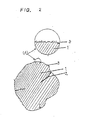
- Fig. 2 shows a sketch cross-sectional drawing of the hydrogen-occlusion-alloy powder obtained by the above-mentioned operation.
- numeral 1 denotes a portion having a high cristallinity in the powder.
- numeral 2 denotes a portion having a poor cristallinity where the alooy does not be composed by the above-mentioned compounding ratio when analyzing in detail.
- Numeral 3 denotes the surface layer of the alloy powder. A portion of (A) of the surface layer is enlarged and is shown in the circle.
- the mixture is melted in the high-frequency furnace which mixture composition is equal to that of the above-mentioned mixture of this invention, and then, is cooled as it is, namely, slow coolings.
- the resulting alloy is mechanically crushed so as to make powder having a diameter of 37 ⁇ m or below.
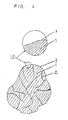
- Fig. 4 shows a sketch cross-sectional drawing of the resulting powder.
- the meaning of the numeral in Fig. 4 is the same in Fig. 2.
- this alloy powder 4 is liable to separation due to the difference of the specific gravity of each element, and has many portion where cristallinity is poor. Comparing Fig. 4 with Fig. 2, the alloy in Fig. 2 differs largely from the all in Fig.
- the alloy in Fig. 2 has a higher cristallinity and mere numerous irregularities on the surface layer.
- the cristallinity of the alloy corresponds to the flattness of equilibrium pressure of hydrogen; namely SF-value, which can be obtained when releasing hydrogen as shown in Fig. 1. Therefore, the cristallinity is generally expressed by SF-value.
- the SF-value of the alloy in Fig. 4 is 2.7 to 3.4 whereas the SF-value of the alloy in Fig. 2 is 1.5 to 2.5.
- a sponge-like nickel porous body that porosity is approximately 93 %, thickness is approximately 0.8 mm, and mean spherical space diameter is 400 ⁇ m is filled with a paste-like mixture of the powder 4 of hydrogen-occlusion-alloy of this embodiment and a 5 wt % aqueous solution of a polyvinyl alcohol, and is dried. The obtained body is pressed, and then is cut, so that the resulting electrode is 0.5 mm thick, 39 mm wide, and 80 mm long, and has a capacitance capable of charge and discharge of 1600 mAh.
- Fig. 3 shows a rough cross-sectional view of this electrode 10.
- numeral 4 denotes alloy powder
- numeral 5 denotes a framework of the sponge-like nickel porous body
- numeral 6 denotes a space portion.
- the battery system in the present invention is shown in Fig. 5.
- the battery comprises a casing, a negative electrode 10, a positive electrode 11, a separator 12, an electrolyte, a sparator means, a sealing plate, a positive lead, a safety valve, a positive terminal, an insulator, and an insulating gasket.
- the negative electrode 10, the separator 12, and the positive electrode 11 are important in this invention.
- Four sheets comprising the separator 30 sandwiched between the positive electrode 11 and the negative electrode 10, and the separator means are wound in the form of a roll.
- the electrolyte is mainly immersed into the separator 12.
- a cylindrical sealed storage battery of AA size is constructed by the resulting electrode 10, a conventional nickel positive electrode 11 of foaming metal type, an electrolyte, and a separator 12 of a nonwoven fabric of a polypropylene introducing sulfonic acid group and has the capacitance of approximately 1000 mAh.
- the cycle test of charge and discharge at 20°C has been carried out. Charge is carried out at 100 mA for 15 hours, discharge is carried out at 200 mA to 1.0 V/cell, and life-time is determined by the point where the capacitance decreases to 80 % of the initial capacitance.
- Hydrogen-occlusion-alloys of this embodiment are ten times made on an experimental basis, and alloys having following SF-value are selected, i.e. 1.5, 2.0, 2.3 and 2.48.
- alloys are also made, but these alloys are different from the above-mentioned alloys only in that these alloys are conventionally cooled as it is, namely, slow cooling.
- the alloys take SF-value 2.3 to 3.4, and alloys having following SF-value are selected, i.e. 2.52, 3.0 and 3.38.
- Fig. 6 shows the result of the cycle test.
- the samples (A ⁇ ) to (D ⁇ ) are obtained without acid and alkali treatment, and each point in Fig.
- the sealed storage battery having a long life-time can be obtained although oxidation is drastic in this battery, by the method that SF-value of the alloy material is 2.5 or below, cobalt is eluted, and lanthanium series metals and nickel are contained relatively at high ratio.
- alloy materials have been described whose basic form is MmNi5 of Ca5Cu5 type.
- alloy materials indicated by MmNi 4.7-5.3 of familiar type also have the crystal structure of CaCu5 type, and show a similar tendency concerning the life-time property.
- the powder is treated in the process of both acid and alkali treatments of this embodiment.
- the improvement of the cycling life-time has been recognized, and the same result has been obtained.
- the battery system is constructed by utilizing a silver oxide as the positive electrode 11 instead of the nickel oxide, and then the cycling life-time is examined.
- the cycling life-time is improved and the silver oxide as well as the nickel oxide is effectual, owing to the fact that SF-value of the alloy material of the negative electrode 10 is 2.5 or below, and irregularity on the surface is formed by both acid and alkali treatments. Therefore, as the positive electrode 11, metal oxides can be used which is utilized as the active material for the possitive electrode 11 of the alkaline storage battery.
- First separator 12 is made of a nonwoven fabric of a polyamide
- second separator 12 is made of a nonwoven fabric of a polypropylene where surfactants are added so as to improve hydrophilic property
- third sepsrator 12 is made of a nonwoven fabric of a polypropylene introducing sulfonic acid group.
- the separator 12 which is made of the nonwoven fabric of the polypropylene introducing sulfonic acid group in order to decrease the self-discharge.
- An alloy is melted by using a high-frequency furnace in the atmosphere of inert gas.
- the alloy has the composition of Mm Ni 3.5 Co 0.8 Al 0.3 Mn 0.4 which composition is the same as that of the hydrogen-occlusion-alloy shown in the first embodiment.
- the alloy obtained by the method of the rapid cooling is heated in the atmosphere of argon gas, and then , without acid and alkali treatments, is crushed to make fine powder whose diameter is 37 ⁇ m or below.
- the resulting powder is mixed with a 5wt% aqueous solution of a polyvinyl alcohol so as to make a paste-like mixture.
- a sponge-like nickel porous body is filled with the paste-like mixture, and is dried in the same manner as the first embodiment.
- the electrode is immersed in a KoH aqueous solution (specific gravity is 1.30) for 12 hours.
- temperature is varied as follows: 30, 45, 50, 60, 80, and 100°C.
- hydrogen-occlusion-electrodes as negative electrodes 10 are obtianed, by washing, drying, and pressing.
- the surface is magnified and observed by a microscope with the alloy powder 4 of the resulting hydrogen-occlusion-alloy being separated. As a result, irregularity in the vicinity of the surface is recognized as shown in Fig. 2, although there is a difference caused by the difference of the immersin temperature.
- the hydrogen-occlusion-electrodes having a length of 80 mm and a width of 39 mm are obtained.
- These electrodes 10 have a capacitance capable of charge and discharge of 1600 mAh or above.
- a cylindrical sealed battery of AA size is constructed by the combination of this electrode 10 and a conventional nickel positive electrode 11 of foaming metal tye, and this battery has a capacitance of approximately 1000 mAh.
- the cycle test of charge and discharge at 20°C has been carried out. The charge is carried out at 100 mA fo 15 hours, and the discharge is carried out at 200 mA to 1.0 V/cell.
- the battery constructing conditions are shown below, and the result of the cycle test of charge and discharge is shown in Fig. 7. As is apparent from Fig.
- the decrease of the capacitance is recognized when the number of cycles reach approximately 30.
- the cycling life-time increases with the increment of the immersion temperature, when the electrode is immersed.
- the battery shows unusual behavior. This is because the weight of the battery decreases.
- the battery is provided with the safety valve which actuates when the pressure in the battery becomes 10 kg/cm2 or above. Therefore, when inner pressure increases, the safety valve actuates to discharege the electrolyte out of the battery, so that the weight of the battery decreases.
- the cycling life-time is represented by the number of cycles of charge-discharge where the capacitance decreases to 80% of the initial capacitance.
- the electrode can be immersed in the alkaline solution for 0.2 to 24 hours, when the battery is obtained which has the property of the cycling life-time more than 200 cycles.
- the electrode 10 can be immersed in the alkaline solution for 1.0 to 12 hours, when the battery is obtained which has the property of the cycling life-time more than 400 cycles.
- the sponge-like nickel porous body is filled with the paste-like mixture of the alloy powder 4 and the 5 wt% aqueous solution of polyvinyl alcohl, is dried, and then, is immersed in the alkaline solution, numerous irregularities in the vicinity of the surface of the alloy is formed so that this method also has an effect on the property of the long life-time of the battery. It has a good effect on the electrode 10 that the alkaline solution is held at 50 to 100°C and is maintained for 0.2 to 24 hours. More preferably, it has a better effect that the alkaline solution is held at 50 to 80°C and is maintained for 1 to 12 hours.
- the alkaline solution with a specific gravity of 1.3 is applied, experiments are additionally made in the same manner using the alkaline solutions with a specific gravity of 1.05 to 1.45. From the result of the experiments, since alkaline solution with a small specific gravity has a few effects, it is necessary for the electrode to be immersed in the alkaline solution for a long time in this case. Therefore, the alkaline solution with a specific gravity of 1.1 or above has a sufficient effect on the electrode 10.
- the other embodiment of the present invention relates the battery system which is capable of the decrease of the self-discharge.
- the alloy to be utilized as the negative electrode 10 is produced in the same manner as first embodiment.
- the composition of the alloy is represented as following formula. Mm Ni 3.95-x Mn x Al 0.3 Co 0.75 .
- the amount of Ni and Mn is varied, namely, value of X is changed as follows: 0, 0.2, 0.3, 0.4, 0.6, and 0.8.
- six kinds of alloys whose compositions are different are obtained. These six kinds of alloys are milled with a ball mill so as to make powder having a diameter of 37 ⁇ m or below.
- the sponge-like nickel body is filled with the paste-like mixture of the alloy powder 4 and the 5 wt% aqueous solution of the polyvinyl alcohol, is dried, and then, the resulting material is immersd in the KOH aqueous solution with a specific gravity of 1.3 at 80 °C for 12 hours, is washed with water, is dried, and then, is pressed so that the negative electrode 10 is obtained.
- first separator 12 is made of the nonwoven fabric of polyamide
- second separator 12 is made of the nonwoven fabric of the polypropylene where surfactants are added so as to improve hydrophilic property
- third separator 12 is the nonwoven fabric of the polypropylene introducing sulfanic acid group.
- the nonwoven fabric of the polypropylene is immersed in 20% solution of fuming sulfuric acid for a given period of time so as to introduce sulfonic acid group to the polypropylene.
- the fabric is immersed in various concentrations of sulfuric acid in order, that is, first step 90%, second step 60%, and third step 30%.
- the residual sulfuric acid is removed by washing with water, and then, the fabric is dried.
- the resulting fabric is used as the sulfonated separator.
- the amount of sulfonic acid gruop to be introduced can be varied by the method of varying the time for immersing in the fuming sulfuric acid.
- the degree of sulfonation is measured with the immersion time being varied from 10 to 90 minutes. From this result, N-value is destributed from 20 to 250. N-value means the number of monomers in the polypropylene to which one sulfonic acid group is introduced.
- the sealed nickel-hydrogen storage batteries of AA size, i.e. (F-1) to (F-13), having a discharge capacitace of approximately 1000 mAh are assembled by combinig these separators 12, the six kinds of the hydrogen-occlusion-electrodes described above, and the conventonal nickel positive electrode 11 of foaming metal type as shown in Table 1.
- the self-discharge is measured as described below.
- the charge is carried out at charging rate of 0.1 CmA to 150% relative to a nominal capacitance of 1000 mAh, and the discharge is continued at 0.2 CmA until the voltage becomes 1.0 V at 20°C. Both the charge and discharge are repeated twenty times on the same condition described above, and then, the charge is carried out in the same manner as described above.
- the batteries are maintained at 45°C for a given period of time after charging.
- the discharge capacitance is measured in such a way that the discharge is carried out at the discharging rate of 0.2 CmA until the voltage becomes 1V at 20°C. From these results, retention capacity is calculated by comparing the resulting discharge capacitance with the discharge capacitance before preservation.
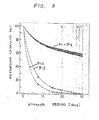
- batteries (F-1) to (F-6) using separators where N-values are 20 to 250 show an excellent effect. Namely, even if batteries are maintained at 45°C for 30 days, the retention capacity is 55 to 60%.
- short phenomenon arises between the positive electrode 11 and the negative electrode 10 in proportion of one to four. This is because the increment of the sulfonic acid group causes the strength of the separator 12 to decrease.
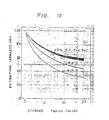
- Fig. 10 shows that the property of the self-discharge is varied, when the component of the alloys is varied with the degree of sulfonation being fixed.
- the retention capacity of the battery (F-7) utilizing alloy without containing Mn is superior to that of the batteries (F-12) and (F-13) shown in Fig. 9, the retention capacity is 40% or below when maintaining for 30 days.
- the retention capacity is 40% or above after maintaining for 30 days.
- x is 0.8 or above in the formula of alloy, equlibrium dissocation pressure of the hydrogen-occlusion-alloy decreases and the discharge capacitance becomes small. As a result, it is difficult to designe of the battery having a high capacitance.
- the nonwoven fabric of the polypropylene having the porosity of 65% is used.
- the strength of the separator 12 decreases and short phenomenon arises.
- the sulfonated polypropylene having the porosity of 40% or below as the separator 12 is used, the penetrating velocity of oxygen generated at the positive electrode 11 on overcharging through the separator 12 decreases, and the electrolyte into the separator 12 increases.
- the absorptivity of oxygen gas on the surface of the negative electrode 10 decreases so that the increment of the pressure in the battery or the leakage of the electrolyte arises.
- the porosity of 40 to 70% is suitable for the sulfonated separator.
- polypropylene resin is used as one example of a polyolefine resin in this embodiment.
- Sulfonation is carried out by fuming sulfuric acid in this embodiment.
- the same result can be obtained by limiting the degree of sulfonation as described above, even if the other sulfonating agents such as heated concentrated sulfuric acid or sulfur trioxide are used. As a result, this technique can be widely used by limiting the degree of sulfonation.
- a sealed storage battery comprises a positive electrode (11) including a metallic oxide as an active material, a negative electrode (10) including hydrogen-occlusion-alloy powder (4) capable of charging and discharging electrochemically hydrogen as an active material, an alkaline electrolyte, and a separator (12) for absorbing and holding the alkaline electrolyte.
- the hydrogen-occlusion-alloy powder (4) has a crystal structure of CaCu5 type, is provided with numerous irregularities on the surface thereof, and has SF-value of 2.5 or below, which SF-value represents a plateau characteristic of equilibrium pressure of hydrogen releasing. The numerous irregularities on the surface of the alloy powder (4) causes oxygen being generated from the positive electrode (11) to be eliminated promptly.
Landscapes
- Chemical & Material Sciences (AREA)
- Chemical Kinetics & Catalysis (AREA)
- Electrochemistry (AREA)
- General Chemical & Material Sciences (AREA)
- Engineering & Computer Science (AREA)
- Manufacturing & Machinery (AREA)
- Battery Electrode And Active Subsutance (AREA)
Applications Claiming Priority (8)
| Application Number | Priority Date | Filing Date | Title |
|---|---|---|---|
| JP291830/86 | 1986-12-08 | ||
| JP291832/86 | 1986-12-08 | ||
| JP61291830A JPH0756800B2 (ja) | 1986-12-08 | 1986-12-08 | 水素吸蔵電極の製造方法 |
| JP61291832A JPH0756801B2 (ja) | 1986-12-08 | 1986-12-08 | 水素吸蔵電極の製造方法 |
| JP210468/87 | 1987-08-25 | ||
| JP62210468A JP2532498B2 (ja) | 1987-08-25 | 1987-08-25 | 水素吸蔵合金電極 |
| JP212089/87 | 1987-08-26 | ||
| JP62212089A JP2733227B2 (ja) | 1987-08-26 | 1987-08-26 | ニッケル・水素蓄電池 |
Publications (2)
| Publication Number | Publication Date |
|---|---|
| EP0271043A1 true EP0271043A1 (fr) | 1988-06-15 |
| EP0271043B1 EP0271043B1 (fr) | 1992-01-22 |
Family
ID=27476499
Family Applications (1)
| Application Number | Title | Priority Date | Filing Date |
|---|---|---|---|
| EP87118066A Expired - Lifetime EP0271043B1 (fr) | 1986-12-08 | 1987-12-07 | Accumulateur étanche et procédé de fabrication de son électrode |
Country Status (3)
| Country | Link |
|---|---|
| US (1) | US4837119A (fr) |
| EP (1) | EP0271043B1 (fr) |
| DE (1) | DE3776300D1 (fr) |
Cited By (20)
| Publication number | Priority date | Publication date | Assignee | Title |
|---|---|---|---|---|
| EP0273625A3 (en) * | 1986-12-29 | 1989-06-14 | Energy Conversion Devices, Inc. | Activated rechargeable hydrogen storage electrode and method |
| EP0386305A1 (fr) * | 1989-02-23 | 1990-09-12 | Matsushita Electric Industrial Co., Ltd. | Accumulateur alcalin et méthode de fabrication de l'électrode négative de celui-ci |
| FR2654262A1 (fr) * | 1989-11-07 | 1991-05-10 | Accumulateurs Fixes | Procede d'habillage d'une electrode a support mousse pour generateur electrochimique et electrode obtenue par ce procede. |
| EP0432342A1 (fr) * | 1989-12-13 | 1991-06-19 | Matsushita Electric Industrial Co., Ltd. | Accumulateur rectangulaire alcalin étanche avec électrode négative comprenant un alliage ayant la capacité d'emmagasinage d'hydrogène |
| EP0451575A1 (fr) * | 1990-03-24 | 1991-10-16 | Japan Storage Battery Company Limited | Electrode absorbant l'hydrogène pour utilisation en batteries secondaires du type nickel-métal hydrure |
| US5250369A (en) * | 1989-02-23 | 1993-10-05 | Matsushita Electric Industrial Co., Ltd. | Alkaline storage battery |
| US5346781A (en) * | 1989-02-23 | 1994-09-13 | Matsushita Electric Industrial Co., Ltd. | Alkaline storage battery |
| US5348823A (en) * | 1989-11-07 | 1994-09-20 | Saft S.A. | Process of preparing an electrode for an electrochemical cell with a porous support and an electrode obtained by said process |
| EP0627779A1 (fr) * | 1993-05-31 | 1994-12-07 | SANYO ELECTRIC Co., Ltd. | Accumulateur scellé alcalin du type nickel/hydrure de métal |
| EP0645833A1 (fr) * | 1993-08-31 | 1995-03-29 | SANYO ELECTRIC Co., Ltd. | Procédé de fabrication d'une électrode en alliage absorbant l'hydrogène |
| EP0650207A1 (fr) * | 1993-10-25 | 1995-04-26 | Furukawa Denchi Kabushiki Kaisha | Méthode de préparation d'hydroxyde de nickel pour électrode de nickel, méthode de fabrication de l'électrode de nickel, et batterie alcaline secondaire incluant cette élctrode de nickel |
| EP0696823A4 (fr) * | 1994-02-25 | 1996-04-24 | Yuasa Battery Co Ltd | Electrode absorbant l'hydrogene et son procede de production |
| US5738953A (en) * | 1995-04-06 | 1998-04-14 | Varta Batterie Aktiengesellschaft | Alkaline metal oxide/metal hydride battery |
| US5738958A (en) * | 1995-07-27 | 1998-04-14 | Varta Batterie Aktiengesellschaft | Alloys for use as active material for the negative electrode of an alkaline, rechargeable nickel-metal hydride battery, and process for its production |
| EP0944124A1 (fr) * | 1998-02-19 | 1999-09-22 | Matsushita Electric Industrial Co., Ltd. | Alliage absorbant l'hydrogène pour batterie, procédé de fabrication de celui-ci et et pile alcaline l'utilisant |
| EP0986119A1 (fr) * | 1998-09-11 | 2000-03-15 | Matsushita Electric Industrial Co., Ltd. | Pile alcaline, eléctrode en alliage absorbant l'hydrogène et procédé de sa fabrication |
| EP1179868A1 (fr) * | 2000-08-10 | 2002-02-13 | Alcatel | Alliage hydrurable |
| EP1111700A3 (fr) * | 1999-11-04 | 2002-10-09 | Matsushita Electric Industrial Co., Ltd. | Accumulateur alcalin |
| RU2214023C2 (ru) * | 2001-07-09 | 2003-10-10 | Уральский электрохимический комбинат | Водородсорбирующий сплав для отрицательного электрода никель-металлгидридного аккумулятора |
| US6777129B2 (en) | 2000-04-27 | 2004-08-17 | Matsushita Electric Industrial Co., Ltd. | Alkaline storage battery |
Families Citing this family (19)
| Publication number | Priority date | Publication date | Assignee | Title |
|---|---|---|---|---|
| JP2926734B2 (ja) * | 1989-02-23 | 1999-07-28 | 松下電器産業株式会社 | 水素吸蔵合金を用いたアルカリ蓄電池 |
| JPH02227966A (ja) * | 1989-02-28 | 1990-09-11 | Matsushita Electric Ind Co Ltd | 密閉形アルカリ蓄電池とその負極の製造法 |
| DE69014183T2 (de) * | 1989-09-18 | 1995-06-22 | Toshiba Battery | Nickel-Metallhydridsekundärzelle. |
| JPH04137368A (ja) * | 1990-09-26 | 1992-05-12 | Matsushita Electric Ind Co Ltd | ニッケル/水素蓄電池とその製造法 |
| US5487961A (en) * | 1992-04-24 | 1996-01-30 | Eveready Battery Company, Inc. | Sintered metal electrode |
| US5468309A (en) * | 1992-09-14 | 1995-11-21 | Matsushita Electric Industrial Co., Ltd. | Hydrogen storage alloy electrodes |
| JP3438142B2 (ja) * | 1992-09-18 | 2003-08-18 | 松下電器産業株式会社 | 中・大容量密閉式金属酸化物・水素蓄電池 |
| US5523182A (en) * | 1992-11-12 | 1996-06-04 | Ovonic Battery Company, Inc. | Enhanced nickel hydroxide positive electrode materials for alkaline rechargeable electrochemical cells |
| JPH06283163A (ja) * | 1993-03-30 | 1994-10-07 | Furukawa Battery Co Ltd:The | 水素吸蔵合金電極の製造方法 |
| US5695530A (en) * | 1994-03-14 | 1997-12-09 | Hong; Kuochih | Method for making high charging efficiency and fast oxygen recombination rechargeable hydride batteries |
| JP3318141B2 (ja) * | 1994-04-04 | 2002-08-26 | 松下電器産業株式会社 | 水素吸蔵合金電極の製造方法 |
| US5744266A (en) * | 1996-02-02 | 1998-04-28 | Matsushita Electric Industrial Co., Ltd. | Batteries and a method of manufacturing positive active material for the batteries |
| JP3214341B2 (ja) * | 1996-03-08 | 2001-10-02 | 松下電器産業株式会社 | 電池用水素吸蔵合金の製造法 |
| US6197448B1 (en) | 1997-05-30 | 2001-03-06 | Duracell Inc. | Hydrogen storage alloy |
| US5865874A (en) * | 1997-06-27 | 1999-02-02 | Duracell Inc. | Hydrogen storage alloy |
| JP3429741B2 (ja) * | 2000-03-24 | 2003-07-22 | 松下電器産業株式会社 | アルカリ蓄電池用ペースト型正極およびニッケル水素蓄電池 |
| JP2002313306A (ja) * | 2001-04-06 | 2002-10-25 | Isao Matsumoto | 電池用セパレータの製造方法、電池用セパレータ及びそれを用いたアルカリ蓄電池 |
| EP1895612A4 (fr) * | 2005-06-21 | 2012-05-30 | Dainippon Ink & Chemicals | Séparateur pour pile à combustible, son procédé de fabrication, et pile à combustible |
| JP6555212B2 (ja) | 2016-08-15 | 2019-08-07 | トヨタ自動車株式会社 | バッテリパックの製造方法 |
Citations (2)
| Publication number | Priority date | Publication date | Assignee | Title |
|---|---|---|---|---|
| EP0170519A2 (fr) * | 1984-07-31 | 1986-02-05 | Kabushiki Kaisha Toshiba | Mèthode de fabrication d'un accumulateur étanche du type oxyde mètallique-hydrogéne |
| GB2162994A (en) * | 1984-08-10 | 1986-02-12 | Sanyo Electric Co | Metal/hydrogen alkaline storage battery |
Family Cites Families (7)
| Publication number | Priority date | Publication date | Assignee | Title |
|---|---|---|---|---|
| JPS59181459A (ja) * | 1983-03-31 | 1984-10-15 | Toshiba Corp | 金属酸化物・水素電池 |
| JPS61101957A (ja) * | 1984-10-24 | 1986-05-20 | Agency Of Ind Science & Technol | 水素吸蔵電極の製造方法 |
| JPS61176063A (ja) * | 1985-01-29 | 1986-08-07 | Matsushita Electric Ind Co Ltd | アルカリ蓄電池の製造法 |
| US4716088A (en) * | 1986-12-29 | 1987-12-29 | Energy Conversion Devices, Inc. | Activated rechargeable hydrogen storage electrode and method |
| US5254500A (en) * | 1991-02-05 | 1993-10-19 | Advanced Micro Devices, Inc. | Method for making an integrally molded semiconductor device heat sink |
| JPH06147075A (ja) * | 1992-11-17 | 1994-05-27 | Nippon Carbureter Co Ltd | エンジンの点火時期制御方法 |
| JPH06164069A (ja) * | 1992-11-25 | 1994-06-10 | Fujitsu Ltd | 半導体レーザ |
-
1987
- 1987-12-07 EP EP87118066A patent/EP0271043B1/fr not_active Expired - Lifetime
- 1987-12-07 DE DE8787118066T patent/DE3776300D1/de not_active Expired - Lifetime
- 1987-12-08 US US07/132,647 patent/US4837119A/en not_active Expired - Lifetime
Patent Citations (2)
| Publication number | Priority date | Publication date | Assignee | Title |
|---|---|---|---|---|
| EP0170519A2 (fr) * | 1984-07-31 | 1986-02-05 | Kabushiki Kaisha Toshiba | Mèthode de fabrication d'un accumulateur étanche du type oxyde mètallique-hydrogéne |
| GB2162994A (en) * | 1984-08-10 | 1986-02-12 | Sanyo Electric Co | Metal/hydrogen alkaline storage battery |
Non-Patent Citations (2)
| Title |
|---|
| CHEMICAL ABSTRACTS, Vol. 106, No. 1, January 5, 1987, Columbus, Ohio, USA FURUKAWA, SANEHIRO et al. "Hydrogen Absorbing Anode" page 151, column 1, Abstract-No. 7 556b & Jpn. Kokai Tokkyo Koho JP 61 168 871 * |
| CHEMICAL ABSTRACTS, Vol. 106, No. 1, January 5, 1987, Columbus, Ohio, USA FURUKAWA, SANEHIRO et al. "Metalhydrogen Alkaline Battery" page 151, column 1, Abstract-No. 7 557c & Jpn. Kokai Tokkyo Koho JP 61 168 870 * |
Cited By (34)
| Publication number | Priority date | Publication date | Assignee | Title |
|---|---|---|---|---|
| EP0273625A3 (en) * | 1986-12-29 | 1989-06-14 | Energy Conversion Devices, Inc. | Activated rechargeable hydrogen storage electrode and method |
| US5034289A (en) * | 1989-02-23 | 1991-07-23 | Matsushita Electric Industrial Co., Ltd. | Alkaline storage battery and method of producing negative electrode thereof |
| EP0386305A1 (fr) * | 1989-02-23 | 1990-09-12 | Matsushita Electric Industrial Co., Ltd. | Accumulateur alcalin et méthode de fabrication de l'électrode négative de celui-ci |
| US5346781A (en) * | 1989-02-23 | 1994-09-13 | Matsushita Electric Industrial Co., Ltd. | Alkaline storage battery |
| US5250369A (en) * | 1989-02-23 | 1993-10-05 | Matsushita Electric Industrial Co., Ltd. | Alkaline storage battery |
| EP0427141A1 (fr) * | 1989-11-07 | 1991-05-15 | SAFT (inscrite au Registre du Commerce sous le numéro 343 588 737) | Procédé d'habillage d'une électrode à support mousse pour générateur électrochimique et électrode obtenue par ce procédé |
| US5348823A (en) * | 1989-11-07 | 1994-09-20 | Saft S.A. | Process of preparing an electrode for an electrochemical cell with a porous support and an electrode obtained by said process |
| FR2654262A1 (fr) * | 1989-11-07 | 1991-05-10 | Accumulateurs Fixes | Procede d'habillage d'une electrode a support mousse pour generateur electrochimique et electrode obtenue par ce procede. |
| EP0432342A1 (fr) * | 1989-12-13 | 1991-06-19 | Matsushita Electric Industrial Co., Ltd. | Accumulateur rectangulaire alcalin étanche avec électrode négative comprenant un alliage ayant la capacité d'emmagasinage d'hydrogène |
| EP0451575A1 (fr) * | 1990-03-24 | 1991-10-16 | Japan Storage Battery Company Limited | Electrode absorbant l'hydrogène pour utilisation en batteries secondaires du type nickel-métal hydrure |
| US5284619A (en) * | 1990-03-24 | 1994-02-08 | Japan Storage Battery Company, Limited | Hydrogen absorbing electrode for use in nickel-metal hydride secondary batteries |
| EP0627779A1 (fr) * | 1993-05-31 | 1994-12-07 | SANYO ELECTRIC Co., Ltd. | Accumulateur scellé alcalin du type nickel/hydrure de métal |
| CN1076888C (zh) * | 1993-05-31 | 2001-12-26 | 三洋电机株式会社 | 密封式镍金属氢化物碱性蓄电池 |
| US5518509A (en) * | 1993-08-31 | 1996-05-21 | Sanyo Electric Co., Ltd. | Method for producing a hydrogen absorbing alloy electrode |
| EP0645833A1 (fr) * | 1993-08-31 | 1995-03-29 | SANYO ELECTRIC Co., Ltd. | Procédé de fabrication d'une électrode en alliage absorbant l'hydrogène |
| US5549992A (en) * | 1993-10-25 | 1996-08-27 | Furukawa Denchi Kabushiki Kaisha | Preparing method for a nickel hydroxide for a nickel electrode, a manufacturing method for the nickel electrode, and an alkaline secondary battery incorporating the nickel electrode therein |
| EP0650207A1 (fr) * | 1993-10-25 | 1995-04-26 | Furukawa Denchi Kabushiki Kaisha | Méthode de préparation d'hydroxyde de nickel pour électrode de nickel, méthode de fabrication de l'électrode de nickel, et batterie alcaline secondaire incluant cette élctrode de nickel |
| EP0696823A4 (fr) * | 1994-02-25 | 1996-04-24 | Yuasa Battery Co Ltd | Electrode absorbant l'hydrogene et son procede de production |
| US5935732A (en) * | 1994-02-25 | 1999-08-10 | Yuasa Corporation | Hydrogen absorbing electrode and its manufacturing method |
| US5738953A (en) * | 1995-04-06 | 1998-04-14 | Varta Batterie Aktiengesellschaft | Alkaline metal oxide/metal hydride battery |
| SG101413A1 (en) * | 1995-04-06 | 2004-01-30 | Treibacher Auermet Prod Gmbh | Alkaline metal oxide/metal hydride battery |
| US5738958A (en) * | 1995-07-27 | 1998-04-14 | Varta Batterie Aktiengesellschaft | Alloys for use as active material for the negative electrode of an alkaline, rechargeable nickel-metal hydride battery, and process for its production |
| EP0944124A1 (fr) * | 1998-02-19 | 1999-09-22 | Matsushita Electric Industrial Co., Ltd. | Alliage absorbant l'hydrogène pour batterie, procédé de fabrication de celui-ci et et pile alcaline l'utilisant |
| US6740450B2 (en) | 1998-02-19 | 2004-05-25 | Matsushita Electric Industrial Co., Ltd. | Hydrogen-absorbing alloy for battery, method for producing the same, and alkaline storage battery using the same |
| EP0986119A1 (fr) * | 1998-09-11 | 2000-03-15 | Matsushita Electric Industrial Co., Ltd. | Pile alcaline, eléctrode en alliage absorbant l'hydrogène et procédé de sa fabrication |
| US6331367B1 (en) | 1998-09-11 | 2001-12-18 | Matsushita Electric Industrial Co., Ltd. | Alkaline storage battery hydrogen-absorbing alloy electrode and method for producing the same |
| US6699617B2 (en) | 1998-09-11 | 2004-03-02 | Matsushita Electric Industrial Co., Ltd. | Alkaline storage battery, hydrogen-absorbing alloy electrode and method for producing the same |
| US6605387B1 (en) | 1999-11-04 | 2003-08-12 | Matsushita Electric Industrial Co., Ltd. | Alkaline storage battery |
| EP1111700A3 (fr) * | 1999-11-04 | 2002-10-09 | Matsushita Electric Industrial Co., Ltd. | Accumulateur alcalin |
| US6777129B2 (en) | 2000-04-27 | 2004-08-17 | Matsushita Electric Industrial Co., Ltd. | Alkaline storage battery |
| US6472102B2 (en) | 2000-08-10 | 2002-10-29 | Alcatel | Hydridable alloy |
| FR2812887A1 (fr) * | 2000-08-10 | 2002-02-15 | Cit Alcatel | Alliage hydrurable |
| EP1179868A1 (fr) * | 2000-08-10 | 2002-02-13 | Alcatel | Alliage hydrurable |
| RU2214023C2 (ru) * | 2001-07-09 | 2003-10-10 | Уральский электрохимический комбинат | Водородсорбирующий сплав для отрицательного электрода никель-металлгидридного аккумулятора |
Also Published As
| Publication number | Publication date |
|---|---|
| EP0271043B1 (fr) | 1992-01-22 |
| DE3776300D1 (de) | 1992-03-05 |
| US4837119A (en) | 1989-06-06 |
Similar Documents
| Publication | Publication Date | Title |
|---|---|---|
| US4837119A (en) | Sealed storage battery and method for making its electrode | |
| EP0504949B1 (fr) | Electrode emmagasinent l'hydrogène | |
| EP0587974B1 (fr) | Batterie étanche du type oxyde métallique-hydrogène | |
| EP0477461B2 (fr) | Accumulateur du type nickel-hydrogène et procédé de fabrication | |
| JPH1074536A (ja) | 密閉型ニッケル−水素蓄電池 | |
| JPS62139255A (ja) | 水素吸蔵電極の製造法 | |
| US5131920A (en) | Method of manufacturing sealed rechargeable batteries | |
| EP0696822B1 (fr) | Accumulateur alcalin étanche | |
| JPH02250260A (ja) | 水素吸蔵電極及びその製造法 | |
| JPS62115657A (ja) | 密閉形ニツケル−水素蓄電池 | |
| JP4497828B2 (ja) | ニッケル−水素蓄電池および組電池 | |
| US6197448B1 (en) | Hydrogen storage alloy | |
| JP2010010097A (ja) | ニッケル水素蓄電池の製造方法 | |
| JP3625655B2 (ja) | 水素吸蔵合金電極及びニッケル水素蓄電池 | |
| JP2679441B2 (ja) | ニッケル・水素蓄電池 | |
| JP2001266860A (ja) | ニッケル−水素蓄電池 | |
| JP3456217B2 (ja) | ニッケル系二次電池 | |
| JP3266153B2 (ja) | 密閉形アルカリ蓄電池の製造方法 | |
| JP3746086B2 (ja) | ニッケル・金属水素化物電池の製造方法 | |
| JP2857148B2 (ja) | 密閉形ニツケル−水素蓄電池の構成法 | |
| JPH03295177A (ja) | 密閉形アルカリ蓄電池 | |
| CN115394991A (zh) | 负极材料及其制备方法、使用了该负极材料的镍氢二次电池 | |
| JP3070081B2 (ja) | 密閉形アルカリ蓄電池 | |
| JPH0582127A (ja) | 密閉形ニツケル−金属水素化物蓄電池 | |
| JPH09180753A (ja) | ニッケル・金属水素化物電池 |
Legal Events
| Date | Code | Title | Description |
|---|---|---|---|
| PUAI | Public reference made under article 153(3) epc to a published international application that has entered the european phase |
Free format text: ORIGINAL CODE: 0009012 |
|
| 17P | Request for examination filed |
Effective date: 19871207 |
|
| AK | Designated contracting states |
Kind code of ref document: A1 Designated state(s): DE FR GB NL |
|
| 17Q | First examination report despatched |
Effective date: 19900213 |
|
| GRAA | (expected) grant |
Free format text: ORIGINAL CODE: 0009210 |
|
| AK | Designated contracting states |
Kind code of ref document: B1 Designated state(s): DE FR GB NL |
|
| REF | Corresponds to: |
Ref document number: 3776300 Country of ref document: DE Date of ref document: 19920305 |
|
| ET | Fr: translation filed | ||
| PLBI | Opposition filed |
Free format text: ORIGINAL CODE: 0009260 |
|
| 26 | Opposition filed |
Opponent name: EVEREADY BATTERY COMPANY Effective date: 19921023 Opponent name: ALCATEL ALSTHOM CIE.GEN. D ELECTRICITE Effective date: 19921015 |
|
| PLAB | Opposition data, opponent's data or that of the opponent's representative modified |
Free format text: ORIGINAL CODE: 0009299OPPO |
|
| NLR1 | Nl: opposition has been filed with the epo |
Opponent name: EVEREADY BATTERY COMPANY. Opponent name: ALCATEL ALSTHOM CIE.GEN.D ELECTRICITE. |
|
| R26 | Opposition filed (corrected) |
Opponent name: ALCATEL ALSTHOM CIE.GEN. D ELECTRICITE * 921023 EV Effective date: 19921015 |
|
| PLAB | Opposition data, opponent's data or that of the opponent's representative modified |
Free format text: ORIGINAL CODE: 0009299OPPO |
|
| R26 | Opposition filed (corrected) |
Opponent name: ALCATEL ALSTHOM CIE.GEN. D ELECTRICITE * 921023 EV Effective date: 19921015 |
|
| NLR1 | Nl: opposition has been filed with the epo |
Opponent name: EVEREADY BATTERY COMPANY Opponent name: ALCATEL ALSTHOM CIE.GEN. D ELECTRICITE |
|
| PGFP | Annual fee paid to national office [announced via postgrant information from national office to epo] |
Ref country code: FR Payment date: 19961211 Year of fee payment: 10 |
|
| PGFP | Annual fee paid to national office [announced via postgrant information from national office to epo] |
Ref country code: DE Payment date: 19961216 Year of fee payment: 10 |
|
| PLBQ | Unpublished change to opponent data |
Free format text: ORIGINAL CODE: EPIDOS OPPO |
|
| PLAB | Opposition data, opponent's data or that of the opponent's representative modified |
Free format text: ORIGINAL CODE: 0009299OPPO |
|
| R26 | Opposition filed (corrected) |
Opponent name: ALCATEL ALSTHOM COMPAGNIE GENERALE D' ELECTRICITE Effective date: 19921015 |
|
| NLR1 | Nl: opposition has been filed with the epo |
Opponent name: EVEREADY BATTERY COMPANY Opponent name: ALCATEL ALSTHOM COMPAGNIE GENERALE D' ELECTRICITE |
|
| PGFP | Annual fee paid to national office [announced via postgrant information from national office to epo] |
Ref country code: GB Payment date: 19971128 Year of fee payment: 11 |
|
| APAC | Appeal dossier modified |
Free format text: ORIGINAL CODE: EPIDOS NOAPO |
|
| RDAG | Patent revoked |
Free format text: ORIGINAL CODE: 0009271 |
|
| STAA | Information on the status of an ep patent application or granted ep patent |
Free format text: STATUS: PATENT REVOKED |
|
| PGFP | Annual fee paid to national office [announced via postgrant information from national office to epo] |
Ref country code: NL Payment date: 19971223 Year of fee payment: 11 |
|
| 27W | Patent revoked |
Effective date: 19971105 |
|
| GBPR | Gb: patent revoked under art. 102 of the ep convention designating the uk as contracting state |
Free format text: 971105 |
|
| NLR2 | Nl: decision of opposition | ||
| APAH | Appeal reference modified |
Free format text: ORIGINAL CODE: EPIDOSCREFNO |