EP0271802A2 - Polyether siloxane graft copolymer - Google Patents
Polyether siloxane graft copolymer Download PDFInfo
- Publication number
- EP0271802A2 EP0271802A2 EP87118122A EP87118122A EP0271802A2 EP 0271802 A2 EP0271802 A2 EP 0271802A2 EP 87118122 A EP87118122 A EP 87118122A EP 87118122 A EP87118122 A EP 87118122A EP 0271802 A2 EP0271802 A2 EP 0271802A2
- Authority
- EP
- European Patent Office
- Prior art keywords
- polyalkylene oxide
- perfluoroalkyl
- graft polymers
- organopolysiloxane block
- substituted allyl
- Prior art date
- Legal status (The legal status is an assumption and is not a legal conclusion. Google has not performed a legal analysis and makes no representation as to the accuracy of the status listed.)
- Granted
Links
- 229920000578 graft copolymer Polymers 0.000 title claims abstract description 46
- 239000004721 Polyphenylene oxide Substances 0.000 title description 5
- 229920000570 polyether Polymers 0.000 title description 5
- KPUWHANPEXNPJT-UHFFFAOYSA-N disiloxane Chemical class [SiH3]O[SiH3] KPUWHANPEXNPJT-UHFFFAOYSA-N 0.000 title description 3
- 238000000576 coating method Methods 0.000 claims abstract description 25
- 239000003795 chemical substances by application Substances 0.000 claims abstract description 22
- 239000011248 coating agent Substances 0.000 claims abstract description 17
- 238000000034 method Methods 0.000 claims abstract description 17
- 238000002360 preparation method Methods 0.000 claims abstract description 10
- 239000002904 solvent Substances 0.000 claims abstract description 10
- 229920000233 poly(alkylene oxides) Polymers 0.000 claims description 35
- 229920001296 polysiloxane Polymers 0.000 claims description 34
- 229920000642 polymer Polymers 0.000 claims description 32
- 125000003903 2-propenyl group Chemical class [H]C([*])([H])C([H])=C([H])[H] 0.000 claims description 24
- 239000003973 paint Substances 0.000 claims description 18
- 239000000178 monomer Substances 0.000 claims description 13
- 239000000843 powder Substances 0.000 claims description 13
- 125000004432 carbon atom Chemical group C* 0.000 claims description 11
- 125000002947 alkylene group Chemical group 0.000 claims description 8
- 125000004435 hydrogen atom Chemical group [H]* 0.000 claims description 6
- 125000004430 oxygen atom Chemical group O* 0.000 claims description 3
- 125000001424 substituent group Chemical group 0.000 claims description 3
- UFHFLCQGNIYNRP-UHFFFAOYSA-N Hydrogen Chemical compound [H][H] UFHFLCQGNIYNRP-UHFFFAOYSA-N 0.000 claims description 2
- 125000001931 aliphatic group Chemical group 0.000 claims description 2
- 229910052801 chlorine Inorganic materials 0.000 claims description 2
- 125000001309 chloro group Chemical group Cl* 0.000 claims description 2
- 125000001153 fluoro group Chemical group F* 0.000 claims description 2
- 239000001257 hydrogen Substances 0.000 claims description 2
- 229910052739 hydrogen Inorganic materials 0.000 claims description 2
- 125000002496 methyl group Chemical group [H]C([H])([H])* 0.000 claims description 2
- 125000005010 perfluoroalkyl group Chemical group 0.000 claims description 2
- 239000004922 lacquer Substances 0.000 abstract description 13
- 150000003254 radicals Chemical class 0.000 description 11
- -1 siloxanes Chemical class 0.000 description 11
- 239000000203 mixture Substances 0.000 description 7
- 238000010526 radical polymerization reaction Methods 0.000 description 7
- YXFVVABEGXRONW-UHFFFAOYSA-N Toluene Chemical compound CC1=CC=CC=C1 YXFVVABEGXRONW-UHFFFAOYSA-N 0.000 description 6
- 230000000694 effects Effects 0.000 description 6
- 238000006243 chemical reaction Methods 0.000 description 4
- 229920001577 copolymer Polymers 0.000 description 4
- 239000000839 emulsion Substances 0.000 description 4
- 238000010422 painting Methods 0.000 description 4
- 229910000831 Steel Inorganic materials 0.000 description 3
- 239000011230 binding agent Substances 0.000 description 3
- 229920000728 polyester Polymers 0.000 description 3
- 239000000243 solution Substances 0.000 description 3
- 239000010959 steel Substances 0.000 description 3
- IJGRMHOSHXDMSA-UHFFFAOYSA-N Atomic nitrogen Chemical compound N#N IJGRMHOSHXDMSA-UHFFFAOYSA-N 0.000 description 2
- 229920000219 Ethylene vinyl alcohol Polymers 0.000 description 2
- 238000003848 UV Light-Curing Methods 0.000 description 2
- XTXRWKRVRITETP-UHFFFAOYSA-N Vinyl acetate Chemical compound CC(=O)OC=C XTXRWKRVRITETP-UHFFFAOYSA-N 0.000 description 2
- 229920000180 alkyd Polymers 0.000 description 2
- 239000007864 aqueous solution Substances 0.000 description 2
- 125000000484 butyl group Chemical group [H]C([*])([H])C([H])([H])C([H])([H])C([H])([H])[H] 0.000 description 2
- 239000008199 coating composition Substances 0.000 description 2
- 230000001427 coherent effect Effects 0.000 description 2
- 239000013065 commercial product Substances 0.000 description 2
- 150000001875 compounds Chemical class 0.000 description 2
- 150000002978 peroxides Chemical class 0.000 description 2
- BASFCYQUMIYNBI-UHFFFAOYSA-N platinum Chemical compound [Pt] BASFCYQUMIYNBI-UHFFFAOYSA-N 0.000 description 2
- 229920001281 polyalkylene Polymers 0.000 description 2
- 229920001225 polyester resin Polymers 0.000 description 2
- 239000004645 polyester resin Substances 0.000 description 2
- 238000006116 polymerization reaction Methods 0.000 description 2
- 239000000047 product Substances 0.000 description 2
- 239000007787 solid Substances 0.000 description 2
- 239000004753 textile Substances 0.000 description 2
- 239000002966 varnish Substances 0.000 description 2
- NJVOHKFLBKQLIZ-UHFFFAOYSA-N (2-ethenylphenyl) prop-2-enoate Chemical compound C=CC(=O)OC1=CC=CC=C1C=C NJVOHKFLBKQLIZ-UHFFFAOYSA-N 0.000 description 1
- PAOHAQSLJSMLAT-UHFFFAOYSA-N 1-butylperoxybutane Chemical compound CCCCOOCCCC PAOHAQSLJSMLAT-UHFFFAOYSA-N 0.000 description 1
- ATVJXMYDOSMEPO-UHFFFAOYSA-N 3-prop-2-enoxyprop-1-ene Chemical class C=CCOCC=C ATVJXMYDOSMEPO-UHFFFAOYSA-N 0.000 description 1
- 239000004342 Benzoyl peroxide Substances 0.000 description 1
- OMPJBNCRMGITSC-UHFFFAOYSA-N Benzoylperoxide Chemical compound C=1C=CC=CC=1C(=O)OOC(=O)C1=CC=CC=C1 OMPJBNCRMGITSC-UHFFFAOYSA-N 0.000 description 1
- ISWSIDIOOBJBQZ-UHFFFAOYSA-N Phenol Chemical compound OC1=CC=CC=C1 ISWSIDIOOBJBQZ-UHFFFAOYSA-N 0.000 description 1
- 239000006096 absorbing agent Substances 0.000 description 1
- 239000000654 additive Substances 0.000 description 1
- 239000000853 adhesive Substances 0.000 description 1
- 230000001070 adhesive effect Effects 0.000 description 1
- 239000003963 antioxidant agent Substances 0.000 description 1
- 239000002216 antistatic agent Substances 0.000 description 1
- 239000007900 aqueous suspension Substances 0.000 description 1
- 235000019400 benzoyl peroxide Nutrition 0.000 description 1
- 239000003139 biocide Substances 0.000 description 1
- 230000015572 biosynthetic process Effects 0.000 description 1
- 229920001400 block copolymer Polymers 0.000 description 1
- 229910052799 carbon Inorganic materials 0.000 description 1
- 239000003054 catalyst Substances 0.000 description 1
- 238000007334 copolymerization reaction Methods 0.000 description 1
- 238000001723 curing Methods 0.000 description 1
- 230000007547 defect Effects 0.000 description 1
- 150000004985 diamines Chemical class 0.000 description 1
- 150000002148 esters Chemical class 0.000 description 1
- 239000005038 ethylene vinyl acetate Substances 0.000 description 1
- 239000000945 filler Substances 0.000 description 1
- 239000006260 foam Substances 0.000 description 1
- 238000009472 formulation Methods 0.000 description 1
- 238000009499 grossing Methods 0.000 description 1
- 229930195733 hydrocarbon Natural products 0.000 description 1
- 150000002430 hydrocarbons Chemical class 0.000 description 1
- 239000003999 initiator Substances 0.000 description 1
- 230000000977 initiatory effect Effects 0.000 description 1
- 239000001023 inorganic pigment Substances 0.000 description 1
- 239000010985 leather Substances 0.000 description 1
- 239000007788 liquid Substances 0.000 description 1
- 239000002184 metal Substances 0.000 description 1
- 229910052751 metal Inorganic materials 0.000 description 1
- 239000010705 motor oil Substances 0.000 description 1
- 229910052757 nitrogen Inorganic materials 0.000 description 1
- 239000012860 organic pigment Substances 0.000 description 1
- 125000005375 organosiloxane group Chemical group 0.000 description 1
- 239000000123 paper Substances 0.000 description 1
- 239000002245 particle Substances 0.000 description 1
- 150000003017 phosphorus Chemical class 0.000 description 1
- 229920003023 plastic Polymers 0.000 description 1
- 239000004033 plastic Substances 0.000 description 1
- 229910052697 platinum Inorganic materials 0.000 description 1
- 229920001200 poly(ethylene-vinyl acetate) Polymers 0.000 description 1
- 230000005855 radiation Effects 0.000 description 1
- 238000007127 saponification reaction Methods 0.000 description 1
- 238000005245 sintering Methods 0.000 description 1
- 239000003381 stabilizer Substances 0.000 description 1
- 239000000758 substrate Substances 0.000 description 1
- 238000003786 synthesis reaction Methods 0.000 description 1
- 239000000454 talc Substances 0.000 description 1
- 229910052623 talc Inorganic materials 0.000 description 1
- XLYOFNOQVPJJNP-UHFFFAOYSA-N water Substances O XLYOFNOQVPJJNP-UHFFFAOYSA-N 0.000 description 1
- 238000009736 wetting Methods 0.000 description 1
Classifications
-
- C—CHEMISTRY; METALLURGY
- C08—ORGANIC MACROMOLECULAR COMPOUNDS; THEIR PREPARATION OR CHEMICAL WORKING-UP; COMPOSITIONS BASED THEREON
- C08F—MACROMOLECULAR COMPOUNDS OBTAINED BY REACTIONS ONLY INVOLVING CARBON-TO-CARBON UNSATURATED BONDS
- C08F283/00—Macromolecular compounds obtained by polymerising monomers on to polymers provided for in subclass C08G
- C08F283/12—Macromolecular compounds obtained by polymerising monomers on to polymers provided for in subclass C08G on to polysiloxanes
- C08F283/122—Macromolecular compounds obtained by polymerising monomers on to polymers provided for in subclass C08G on to polysiloxanes on to saturated polysiloxanes containing hydrolysable groups, e.g. alkoxy-, thio-, hydroxy-
-
- C—CHEMISTRY; METALLURGY
- C08—ORGANIC MACROMOLECULAR COMPOUNDS; THEIR PREPARATION OR CHEMICAL WORKING-UP; COMPOSITIONS BASED THEREON
- C08F—MACROMOLECULAR COMPOUNDS OBTAINED BY REACTIONS ONLY INVOLVING CARBON-TO-CARBON UNSATURATED BONDS
- C08F283/00—Macromolecular compounds obtained by polymerising monomers on to polymers provided for in subclass C08G
- C08F283/06—Macromolecular compounds obtained by polymerising monomers on to polymers provided for in subclass C08G on to polyethers, polyoxymethylenes or polyacetals
-
- C—CHEMISTRY; METALLURGY
- C09—DYES; PAINTS; POLISHES; NATURAL RESINS; ADHESIVES; COMPOSITIONS NOT OTHERWISE PROVIDED FOR; APPLICATIONS OF MATERIALS NOT OTHERWISE PROVIDED FOR
- C09D—COATING COMPOSITIONS, e.g. PAINTS, VARNISHES OR LACQUERS; FILLING PASTES; CHEMICAL PAINT OR INK REMOVERS; INKS; CORRECTING FLUIDS; WOODSTAINS; PASTES OR SOLIDS FOR COLOURING OR PRINTING; USE OF MATERIALS THEREFOR
- C09D7/00—Features of coating compositions, not provided for in group C09D5/00; Processes for incorporating ingredients in coating compositions
- C09D7/40—Additives
- C09D7/47—Levelling agents
-
- Y—GENERAL TAGGING OF NEW TECHNOLOGICAL DEVELOPMENTS; GENERAL TAGGING OF CROSS-SECTIONAL TECHNOLOGIES SPANNING OVER SEVERAL SECTIONS OF THE IPC; TECHNICAL SUBJECTS COVERED BY FORMER USPC CROSS-REFERENCE ART COLLECTIONS [XRACs] AND DIGESTS
- Y10—TECHNICAL SUBJECTS COVERED BY FORMER USPC
- Y10T—TECHNICAL SUBJECTS COVERED BY FORMER US CLASSIFICATION
- Y10T428/00—Stock material or miscellaneous articles
- Y10T428/31504—Composite [nonstructural laminate]
- Y10T428/31652—Of asbestos
- Y10T428/31663—As siloxane, silicone or silane
Definitions
- the invention relates to new graft polymers, a process for their preparation and their use as leveling agents for aqueous, solvent-based and powdered lacquers and coating systems.
- polyalkylene oxide organopolysiloxane block and comb polymers are important aids for a wide variety of technical applications (cf. W. Noll, Chemistry and Technology of Silicone, Verlag Chemie, Weinheim, 2nd edition, 1968, p 322-323 and pp. 493-495).
- such polymers are used in particular as auxiliaries in aqueous or solvent-based paint or coating systems.
- US-A-3 342 766 describes the use of polyalkylene oxide-organopolysiloxane block copolymers in the preparation of aqueous paint binder emulsions, such as, for example, vinyl acetate or styrene-acrylate emulsions. Paints which are based on such emulsions containing polyethersiloxane have an improved surface hardness and an improved flow during painting compared to polyethersiloxane-free paints.
- this polymerization process has the disadvantage that the paint binders contain a certain amount of the leveling agent due to the recipe, as a result of which it is specified in application formulations.
- Leveling agents provide more degrees of freedom for the user, which, when added to the paint or coating agent in very low concentrations, convey the desired improved properties.
- the object of the invention was to provide effective auxiliaries, in particular highly active leveling, wetting and smoothing agents for aqueous and solvent-based paints or coating systems, as well as powder coatings and fluidized bed sintering agents, which significantly improve the paint properties of the corresponding paints or coatings in very low application concentrations.
- the object is achieved by the provision of graft polymers made from polyalkylene oxide organopolysiloxane block and / or comb polymers and perfluoroalkyl-substituted allyl compounds.
- the subject of the invention are Graft polymers consisting of a) 0.1 to 99.9 wt .-% polyalkylene oxide organopolysiloxane block and / or comb polymer units and b) 99.1 to 0.1% by weight of units of polymerized perfluoroalkyl-substituted allyl compounds, wherein structural elements of the following general formula are contained in the graft polymers: wherein X represents a hydrogen atom or a methyl group, Y and Z independently of one another are a hydrogen atom or an alkyl radical having 1 to 18 carbon atoms, Q is a divalent alkyl radical with 1 to 12 carbon atoms, a divalent organic radical of the general formula or one - -O- group, where Y and Z have the meaning given above R represents a hydrogen atom or an alkyl radical having 1 to 8 carbon atoms and m represents an integer from 0 to 6 and in which R f represents a perfluorinated aliphatic,
- graft polymers which have a proportion of polyalkylene oxide organopolysiloxane block and / or comb polymer units of 35 to 95% by weight and a proportion of polymerized perfluoroalkyl-substituted allyl compounds 65 to 5% by weight.
- Graft polymers in which more than 70% by weight of perfluoroalkyl-substituted allyl monomers are monomolecular the alkylene oxide units of the polyalkylene oxide organopolysiloxane block and / or comb polymers are added are particularly preferred.
- graft polymers with the structural elements mentioned, in which the radical R f is a perfluoroalkyl group of the formula CF3 (CF2) n , where n is an integer from 2 to 19.
- the polyalkylene oxide organopolysiloxane block and / or comb polymer units can have any composition and structure.
- a selection thereof, which does not limit the invention, is described, for example, in W. Noll, Chemistry and Technology of Silicone, Verlag Chemie GmbH, Weinheim, 2nd edition, 1968, pp. 321-323 and in the literature citations listed there.
- the polymerized perfluoroalkyl-substituted allyl units consist of units of the general formula wherein the substituents Z, Y, Q and R f have the meaning given above.
- a particularly preferred unit has the following composition: -CH2-CH2-CH2-NH-SO2- (CF2) n CF3, in which n represents an integer from 3 to 19.
- the perfluoroalkyl-substituted allyl units are generally linked to a carbon atom of the polyalkylene oxide chains of the polyalkylene oxide organopolysiloxane block and / or comb polymer units which is ⁇ -position to oxygen atoms.
- the graft polymers according to the invention can be obtained by radical polymerization of perfluoroalkyl-substituted allyl compounds in the presence of polyalkylene oxide organopolysiloxane block and / or comb polymers. It has been found that in the radical polymerization reaction the allyl compound is reacted virtually quantitatively by grafting with the polyalkylene oxide chains of the polyalkylene oxide organopolysiloxane block and / or comb polymers. That this reaction takes place practically quantitatively is surprising since it is known that allyl compounds in polymerize generally only with difficulty and incompletely (cf. G. Henrici-Olive, S. Olive, Verlag Chemie, Weinhein, 1969, p. 69).
- the invention thus also relates to a process for the preparation of the graft polymers according to the invention, which is characterized in that 99.9 to 0.1 in the presence of 0.1 to 99.9% by weight of a polyalkylene oxide organopolysiloxane block and / or comb polymer %
- a perfluoroalkyl-substituted allyl monomer of the general formula are radically polymerized, the substituents Z, Y, Q and R f having the meaning given above.
- An advantageous variant of the process according to the invention consists in carrying out the radical polymerization in such a way that more than 50% by weight of the perfluoroalkyl-substituted allyl monomer is added monomolecularly to the alkylene oxide units of the polyalkylene oxide organopolysiloxane block and / or comb polymers.
- the radical polymerization is preferably carried out in such a way that more than 70% by weight of the perfluoroalkyl-substituted allyl monomer is added monomolecularly to the alkylene oxide units or polyalkylene oxide organopolysiloxane block and / or comb polymers.
- reaction conditions for example the reaction temperature, the free radical generator concentration, or the type of solvent.
- the perfluoroalkyl-substituted allyl used to prepare the graft polymers according to the invention Compounds can be obtained, for example, according to the methods described in GB-A-818 576, US-A-2 519 983, US-A-2 732 398, US-A-3 704 311 and DE-A-20 04 962.
- polyalkylene oxide organopolysiloxane block and / or comb polymers used for the preparation of the graft polymers according to the invention are based on processes customary in technology, as described, for example, in W. Noll, Chemistry and Technology of Silicone, Verlag Chemie, Weinheim, 2nd edition, 1968, p. 321-323.
- such polymers can be obtained by reacting organosiloxanes substituted with diacetoxy end groups with OH-terminated polyalkylene oxides or polyesters containing polyalkylene oxide blocks.
- the synthesis of the block and / or Comb polymers are also possible by adding allyl-terminated polyalkylene oxides or polyalkylene oxide derivatives to organopolysiloxanes containing Si-H groups. This addition is catalyzed in a known manner, mostly with platinum catalysts.
- radical-initiated polymerization of the perfluoroalkylene oxide organopolysiloxane block and / or comb polymers can be started with the help of radical binders, high-energy radiation or thermally.
- Azo and / or peroxide initiators in an order of magnitude of 0.05 to 15% by weight are preferably used as radical formers.
- the azo-di-isobutylonitrile and the azo-di-valeronitrile, their ester and imino ester derivatives are tert as radical formers.
- other commonly used peroxidic or non-peroxidic radical formers such as phenyl-substituted ethane derivatives, can also be used.
- the radical polymerization can be carried out with or without the addition of solvents, in aqueous solution, suspension or emulsion. It is preferably carried out in solution. Hydrocarbons and fluorocarbons are used as solvents.
- the radical polymerization is preferably carried out in the temperature range from 80 to 250 ° C .; however, it can be started and carried out in any other temperature range, the person skilled in the art orienting himself according to the known or else new initiation systems.
- antioxidants based on phenol, diamine or phosphorus derivatives, UV absorbers, biocides or fillers of the customary type, i.e. Chalk, talc, silicas, inorganic and organic pigments etc. can be entered.
- the graft polymers according to the invention are water-soluble or water-insoluble, solid or liquid at room temperature.
- many of the water-soluble graft polymers are also soluble in solvents such as toluene, which opens up interesting application prospects for these products.
- Another object of the invention is the use of the graft polymers according to the invention and the graft polymers which can be obtained by the process according to the invention as leveling agents for aqueous and / or solvent-based lacquers and coating systems, for powder lacquers and fluidized bed coating compositions. Even in very small application concentrations, the graft polymers according to the invention significantly improve the flow properties of the paints and coating systems mentioned.
- the leveling properties In addition to the leveling properties, they also improve the adhesive and scratch resistance of paints.
- the addition of the graft polymers according to the invention is recommended when formulating or preparing the powder coatings.
- graft polymers according to the invention in coating compositions / systems, a wide variety of coatings can advantageously be applied to substrates such as paper, leather, textiles, metal and plastics.
- Table 1 shows the polyether siloxanes used for the examples.
- polyether siloxane is used here as a synonym for the polyalkylene organopolysiloxane block and / or comb polymers.
- Table 2 shows the individual examples and the amount of components used, and Table 3 lists the viscosity and the solubility in water and toluene of the graft polymers obtained according to the examples.
- the graft polymers according to the invention are prepared according to the following general working procedure:
- a 10% aqueous solution of the graft polymers prepared according to Examples 1, 2 and 3 is mixed with the polyester alkyd lacquer in various concentrations. This paint is used to paint a steel sheet contaminated with motor oil.
- the water-wet paint film is baked at 130 ° C for 20 minutes.
- the coatings obtained are compared with corresponding coatings when using commercially available coating additives based on low molecular weight n-butyl acrylate copolymers (for example Modaflow®, from Monsanto, USA) and without using the graft polymers according to the invention.
- the course and the surface structure of the coating are assessed, the surface structure being assessed on the basis of the occurrence of so-called craters and / or the so-called orange peel effect.
- the orange peel effect (the surface of the Painting is like the structure of an orange peel) and the appearance of craters (the surface of the painting shows crater-shaped structures) are (surface defects of the painting.
- leveling agent Without a leveling agent, no coherent lacquer layer is available.
- leveling agents based on low molecular weight n-butyl acrylate copolymers, 0.3 to 0.5% by weight are required in order to ensure a crater-free course of the lacquer layer.
- graft polymers according to the invention When the graft polymers according to the invention are used, a proportion of 0.04% by weight of the graft polymers from Examples 1, 2 and 3 in the lacquer gives coherent and crater-free lacquer layers without an orange peel effect.
- a so-called highsolid clearcoat with a solids content of 72% by weight, type Baryoflex®, commercial product from Chem. Fabrik Aarberg / Switzerland, with the graft polymers according to example 4 according to the invention was used as an example of a UV-curing solution varnish based on bisarylate-modified polyester resins and 5 in an amount of 0.04% by weight. Veneers were varnished with this varnish and UV-hardened. A corresponding lacquer without a leveling agent was used for comparison.
- the paint shows the orange peel effect after curing, which indicates a less than optimal level.
- the graft polymers according to the invention are added, an excellent flow of the lacquer without an orange peel effect and thus a flawless lacquer layer is achieved, while at the same time an improved adhesion and scratch resistance of the lacquer is achieved.
- An ethylene-vinyl alcohol copolymer obtained by saponification of an ethylene-vinyl acetate copolymer with 32% by weight of vinyl acetate and having a particle size of less than 100 ⁇ m was used as the powder coating.
- This powder was mixed with the graft polymer according to Example 3 according to the invention in different amounts.
- the powder was electrostatically sprayed onto steel sheets of 10 x 10 cm edge length and 1 mm thickness and in Heated oven at 200 ° C for 10 minutes.
- the electrostatic powder application was carried out in a commercially available system with a voltage of -30kV and conveying air of 3.5 bar.
- the corresponding powder coating was sprayed with conventional leveling agents based on low molecular weight n-butyl acrylate copolymers as indicated, without the addition of leveling agents and powder coating.
- Powder coatings with the graft polymers according to the invention already provide the graft polymer at a content of 0.03% by weight, a crater-free, outstanding course even over the edges of the steel sheets.
- the layer thickness achieved is on average 80 ⁇ m.
- leveling agent Without a leveling agent, no crater-free coating is obtained.
- leveling agents based on low molecular weight n-butyl acrylate copolymers proper, crater-free flow is only achieved when at least 0.5% by weight, based on the ethylene-vinyl alcohol copolymer, is added.
Landscapes
- Chemical & Material Sciences (AREA)
- Organic Chemistry (AREA)
- Polymers & Plastics (AREA)
- Health & Medical Sciences (AREA)
- Chemical Kinetics & Catalysis (AREA)
- Medicinal Chemistry (AREA)
- Materials Engineering (AREA)
- Wood Science & Technology (AREA)
- Engineering & Computer Science (AREA)
- Life Sciences & Earth Sciences (AREA)
- Silicon Polymers (AREA)
- Macromonomer-Based Addition Polymer (AREA)
- Paints Or Removers (AREA)
- Graft Or Block Polymers (AREA)
Abstract
Die vorliegende Erfindung betrifft neue Pfropfpolymerisate, ein Verfahren zu ihrer Herstellung und ihre Verwendung als Verlaufsmittel für wäßrige, lösungsmittelhaltige und pulverförmige Lacke und Beschichtungssysteme. The present invention relates to new graft polymers, a process for their preparation and their use as leveling agents for aqueous, solvent-based and powdered lacquers and coating systems.
Description
Die Erfindung betrifft neue Pfropfpolymerisate, ein Verfahren zu ihrer Herstellung und ihre Verwendung als Verlaufsmittel für wäßrige, lösungsmittelhaltige und pulverförmige Lacke und Beschichtungssysteme.The invention relates to new graft polymers, a process for their preparation and their use as leveling agents for aqueous, solvent-based and powdered lacquers and coating systems.
Polyalkylenoxidorganopolysiloxan-Block- und -Kammpolymere, im folgenden auch einfach Polyethersiloxane genannt, sind aufgrund ihrer Grenzflächenaktivität wichtige Hilfsmittel für verschiedenste technische Anwendungen (vgl. W. Noll, Chemie und Technologie der Silicone, Verlag Chemie, Weinheim, 2. Auflage, 1968, S. 322-323 und S. 493-495).Due to their interfacial activity, polyalkylene oxide organopolysiloxane block and comb polymers, hereinafter also simply called polyether siloxanes, are important aids for a wide variety of technical applications (cf. W. Noll, Chemistry and Technology of Silicone, Verlag Chemie, Weinheim, 2nd edition, 1968, p 322-323 and pp. 493-495).
Neben ihrer Anwendung als Stabilisatoren für Schaumstoffe, als Dismulgatoren und Antistatikmittel für Textilien u.a., werden solche Polymere insbesondere als Hilfsmittel in wäßrigen oder lösungsmittelhaltigen Lack- oder Beschichtungssystemen eingesetzt.In addition to their use as stabilizers for foams, as demulsifiers and antistatic agents for textiles, among others, such polymers are used in particular as auxiliaries in aqueous or solvent-based paint or coating systems.
Die US-A-3 342 766 beschriebt die Verwendung von Polyalkylenoxid-Organopolysiloxan-Blockcopolymeren bei der Herstellung von wäßrigen Anstrichbinderemulsionen, wie beispielsweise Vinylacetat- oder Styrol-Acrylatemulsionen. Lacke, die auf Basis solcher polyethersiloxanhaltiger Emulsionen hergestellt sind, weisen im Vergleich zu polyethersiloxanfreien Lacken eine verbesserte Oberflächenhärte und einen verbesserten Verlauf beim Anstrich auf.US-A-3 342 766 describes the use of polyalkylene oxide-organopolysiloxane block copolymers in the preparation of aqueous paint binder emulsions, such as, for example, vinyl acetate or styrene-acrylate emulsions. Paints which are based on such emulsions containing polyethersiloxane have an improved surface hardness and an improved flow during painting compared to polyethersiloxane-free paints.
Trotz augenscheinlicher Qualitätsvorteile hat dieses Polymerisationsverfahren den Nachteil, daß die Anstrichbinder rezepturbedingt eine bestimmte Menge des Verlaufsmittels enthalten, wodurch man in Anwendungsrezepturen festgelegt ist. Mehr Freiheitsgrade für den anwender beiten Verlaufmittel, die in sehr geringer Konzentration dem Lack oder Beschichtungsmittel hinzugefügt das gewünschte verbesserte Eigenschaftsbild vermitteln.Despite obvious quality advantages, this polymerization process has the disadvantage that the paint binders contain a certain amount of the leveling agent due to the recipe, as a result of which it is specified in application formulations. Leveling agents provide more degrees of freedom for the user, which, when added to the paint or coating agent in very low concentrations, convey the desired improved properties.
Die Aufgabe der Erfindung bestand darin, wirksame Hilfsmittel, insbesondere hochaktive Verlaufs-, Netz- und Glättemittel für wäßrige und lösungsmittelhaltige Lacke oder Beschichtungssysteme sowie Pulverlacke und Wirbelsinterbeschichtungsmittel bereitzustellen, die in sehr geringen Anwendungskonzentrationen die lacktechnischen eigenschaften der entsprechendenen Anstrich- oder Beschichtungsmittel signifikant verbessern.The object of the invention was to provide effective auxiliaries, in particular highly active leveling, wetting and smoothing agents for aqueous and solvent-based paints or coating systems, as well as powder coatings and fluidized bed sintering agents, which significantly improve the paint properties of the corresponding paints or coatings in very low application concentrations.
Die Aufgabe wird durch die Bereitstellung von Pfropfpolymerisaten aus Polyalkylenoxidorganopolysiloxan-Block und/oder -Kammpolymeren und perfluoralkylsubstituierten Allylverbindungen gelöst.The object is achieved by the provision of graft polymers made from polyalkylene oxide organopolysiloxane block and / or comb polymers and perfluoroalkyl-substituted allyl compounds.
Gegenstand der Erfindung sind
Pfropfpolymerisate bestehend aus
a) 0,1 bis 99,9 Gew.-% Polyalkylenoxidorganopolysiloxan-Block- und/oder Kammpolymereinheiten und
b) 99,1 bis 0,1 Gew.-% Einheiten aus polymerisierten perfluoralkylsubstituierten Allylverbindungen,
wobei in den Pfropfpolymerisaten Strukturelemente der folgenden allgemeinen Formel enthalten sind:

X ein Wasserstoffatom oder eine Methylgruppe,
Y und Z unabhngig voneinander ein Wasserstoffatom oder einen Alkylrest mit 1 bis 18 Kohlenstoffatomen,
Q ein zweiwertiger Alkylrest mit 1 bis 12 Kohlenstoffatomen,
ein zweiwertiger organischer Rest der allgemeinen Formel

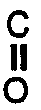
Y und Z die obenstehende Bedeutung haben
R für ein Wasserstoffatom oder einen Alkylrest mit 1 bis 8 Kohlenstoffatomen steht und
m eine ganze Zahl von 0 bis 6 bedeutet und worin
Rf für eine perfluorierten aliphatischen, gegebenenfalls verzweigten Rest mit 1 bis 20 Kohlenstofatomen steht und der Rest außer Fluoratomen höchstens ein Wasserstoff- oder Chloratom auf zwei Kohlenstoffatome enthalten kann, wobei der perfluorierte aliphatische Rest durch Sauerstoffatome unterbrochen sein kann,
RSi für einen Polyalkylenoxidorganopolysiloxan-Block- und/oder Kammpolymerrest steht und
RPo für eine Polyalkylenoxidkete des Polyalkylenoxidorganopolysiloxan-Block-und/oder Kammpolymers steht
und wobei
in den Pfropfpolymerisaten mehr als 50 Gew.-% perfluoralkylsubstituierte Allylmonomere monomolekular an die Alkylenoxideinheiten der Polyalkylenoxidorganopolysiloxan-Block- und/oder Kammpolymeren addiert sind.The subject of the invention are
Graft polymers consisting of
a) 0.1 to 99.9 wt .-% polyalkylene oxide organopolysiloxane block and / or comb polymer units and
b) 99.1 to 0.1% by weight of units of polymerized perfluoroalkyl-substituted allyl compounds,
wherein structural elements of the following general formula are contained in the graft polymers:
X represents a hydrogen atom or a methyl group,
Y and Z independently of one another are a hydrogen atom or an alkyl radical having 1 to 18 carbon atoms,
Q is a divalent alkyl radical with 1 to 12 carbon atoms,
a divalent organic radical of the general formula
Y and Z have the meaning given above
R represents a hydrogen atom or an alkyl radical having 1 to 8 carbon atoms and
m represents an integer from 0 to 6 and in which
R f represents a perfluorinated aliphatic, optionally branched radical having 1 to 20 carbon atoms and the radical, apart from fluorine atoms, can contain at most one hydrogen or chlorine atom on two carbon atoms, the perfluorinated aliphatic radical being interrupted by oxygen atoms,
R Si stands for a polyalkylene oxide organopolysiloxane block and / or comb polymer residue and
R Po stands for a polyalkylene oxide chain of the polyalkylene oxide organopolysiloxane block and / or comb polymer
and where
in the graft polymers more than 50% by weight of perfluoroalkyl-substituted allyl monomers are monomolecularly added to the alkylene oxide units of the polyalkylene oxide organopolysiloxane block and / or comb polymers.
Bevorzugt sind solche Pfropfpolymerisate, die einen Anteil an Polyalkylenoxidorganopolysiloxan-Block- und/oder Kammpolymereinheiten von 35 bis 95 Gew.-% und einen Anteil an polymerisierten perfluoralkylsubstituierten Allylverbindungen 65 bis 5 Gew.-% aufweisen.Preference is given to those graft polymers which have a proportion of polyalkylene oxide organopolysiloxane block and / or comb polymer units of 35 to 95% by weight and a proportion of polymerized perfluoroalkyl-substituted allyl compounds 65 to 5% by weight.
Pfropfpolymerisate, in denen mehr als 70 Gew.-% perfluoralkylsubstituierte Allylmonomere monomolekular an die Alkylenoxideinheiten der Polyalkylenoxidorganopolysiloxan-Block- und/oder Kammpolymeren addiert sind, werden besonders bevorzugt.Graft polymers in which more than 70% by weight of perfluoroalkyl-substituted allyl monomers are monomolecular the alkylene oxide units of the polyalkylene oxide organopolysiloxane block and / or comb polymers are added are particularly preferred.
Besonders bevorzugt sind auch Pfropfpolymerisate mit den genannten Strukturelementen, in denen der Rest Rf für eine Perfluoralkylgruppe der Formel CF₃(CF₂)n steht, wobei n eine ganze Zahl von 2 bis 19 bedeutet.Also particularly preferred are graft polymers with the structural elements mentioned, in which the radical R f is a perfluoroalkyl group of the formula CF₃ (CF₂) n , where n is an integer from 2 to 19.
Die Polyalkylenoxidorganopolysiloxan-Block- und/oder Kammpolymereinheiten können erfindungsgemäß eine beliebige Zusammensetzung und Struktur aufweisen. Eine die Erfindung nicht limitierende Auswahl davon ist beispielsweise in W. Noll, Chemie und Technologie der Silicone, Verlag Chemie GmbH, Weinheim, 2. Auflage, 1968, S. 321-323 und in den dort aufgeführten Literaturzitaten beschrieben.According to the invention, the polyalkylene oxide organopolysiloxane block and / or comb polymer units can have any composition and structure. A selection thereof, which does not limit the invention, is described, for example, in W. Noll, Chemistry and Technology of Silicone, Verlag Chemie GmbH, Weinheim, 2nd edition, 1968, pp. 321-323 and in the literature citations listed there.
Die polymerisierten perfluoralkylsubstituierten Allyleinheiten bestehen erfindungsgemäß aus Einheiten der allgemeinen Formel
Bevorzugt sind dabei solche Einheiten, in denen Q für eine
-

steht.Preference is given to units in which Q is for a
-
stands.
Eine besonders bevorzugte Einheit weist die folgende Zusammensetzung auf:
-CH₂-CH₂-CH₂-NH-SO₂-(CF₂)nCF₃,
wobei
n für eine ganze Zahl von 3 bis 19 steht.A particularly preferred unit has the following composition:
-CH₂-CH₂-CH₂-NH-SO₂- (CF₂) n CF₃,
in which
n represents an integer from 3 to 19.
In den erfindungsgemäßen Pfropfpolymerisaten sind die perfluoralkylsubstituierten Allyleinheiten in der Regel mit einem zu Sauerstoffatomen α-ständigen Kohlenstoffatom der Polyalkylenoxidketten der Polyalkylenoxidorganopolysiloxan-Block- und/oder Kammpolymereinheiten verknüpft.In the graft polymers according to the invention, the perfluoroalkyl-substituted allyl units are generally linked to a carbon atom of the polyalkylene oxide chains of the polyalkylene oxide organopolysiloxane block and / or comb polymer units which is α-position to oxygen atoms.
Die erfindungsgemäßen Pfropfpolymerisate sind durch radikalische Polymerisation von perfluoralkylsubstituierten Allylverbindungen in Gegenwart von Polyalkylenoxidorganopolysiloxan-Block- und/oder Kammpolymeren erhältlich. Es wurde gefunden, daß bei der radikalischen Polymerisationsreaktion die Allylverbindung praktisch quantitativ durch Pfropfreaktion mit den Polyalkylenoxidketten der Polyalkylenoxidorganopolysiloxan-Block- und/oder Kammpolymeren umgesetzt werden. Das diese Reaktion praktisch quantitativ erfolgt, ist überraschend, da bekannt ist, daß Allylverbindungen im allgemeinen nur schwer und unvollständig polymerisieren (vgl. G. Henrici-Olive, S. Olive, Verlag Chemie, Weinhein, 1969, S. 69). Es sind auch Verfahren zur Herstellung von Allylcopolymerisation durch radikalische Polymerisation, beispielsweise nach der US-A-2 894 938 und der US-A-2 940 946, bekannt. Die Nachteile dieser Verfahren sind, daß die Monomerumsätze gering sind, der Radikalbildnerverbrauch hoch ist und die Molekulargewichte der erhaltenen Produkte sehr niedrig sind.The graft polymers according to the invention can be obtained by radical polymerization of perfluoroalkyl-substituted allyl compounds in the presence of polyalkylene oxide organopolysiloxane block and / or comb polymers. It has been found that in the radical polymerization reaction the allyl compound is reacted virtually quantitatively by grafting with the polyalkylene oxide chains of the polyalkylene oxide organopolysiloxane block and / or comb polymers. That this reaction takes place practically quantitatively is surprising since it is known that allyl compounds in polymerize generally only with difficulty and incompletely (cf. G. Henrici-Olive, S. Olive, Verlag Chemie, Weinhein, 1969, p. 69). Processes for the preparation of allyl copolymerization by radical polymerization are also known, for example according to US Pat. No. 2,894,938 and US Pat. No. 2,940,946. The disadvantages of these processes are that the monomer conversions are low, the free radical generator consumption is high and the molecular weights of the products obtained are very low.
Diese beschriebenen Nachteile treten bei der Herstellung der erfindungsgemäßen Pfropfpolymerisate überraschenderweise nicht auf.These disadvantages described surprisingly do not occur in the preparation of the graft polymers according to the invention.
Gegenstand der Erfindung ist somit auch ein Verfahren zur Herstellung der erfindungsgemäßen Pfropfpolymerisate, welches dadurch gekennzeicnet ist, daß in Gegenwart von 0,1 bis 99,9 Gew.-% eines Polyalkylenoxidorganopolysiloxan-Block- und/oder Kammpolymeren 99,9 bis 0,1 Gew.-% eines perfluoralkylsubstituierten Allylmonomeren der allgemeinen Formel

Bevorzugt ist ein Verfahren zur Herstellung der erfindungsgemäßen Pfropfpolymerisate, bei dem in Gegenwart von 35 bis 95 Gew.-% eines Polyalkylenoxidorganopolysiloxan-Block- und/oder Kammpolymeren 65 bis 5 Gew.-% eines perfluoralkylsubstituierten Allylmonomeren der genannten allgemeinen Formel radikalisch polymerisiert werden.Preferred is a process for the preparation of the graft polymers according to the invention, in which in the presence of 35 to 95% by weight of a polyalkylene oxide organopolysiloxane block and / or comb polymer 65 to 5% by weight of a perfluoroalkyl-substituted allyl monomer of the general formula mentioned are radically polymerized.
Eine vorteilhafte Variante des erfindungsgemäßen Verfahrens besteht darin, die radikalische Polymerisation so auszuführen, daß mehr als 50 Gew.% des perfluoralkylsubstituierten Allylmonomeren monomolekular an die Alkylenoxideinheiten der Polyalkylenoxidorganopolysiloxan-Block- und/oder Kammpolymere addiert werden.An advantageous variant of the process according to the invention consists in carrying out the radical polymerization in such a way that more than 50% by weight of the perfluoroalkyl-substituted allyl monomer is added monomolecularly to the alkylene oxide units of the polyalkylene oxide organopolysiloxane block and / or comb polymers.
Vorzugsweise wird die radikalische Polymerisation so ausgeführt, daß mehr als 70 Gew.-% des perfluoralkylsubstituierten Allylmonomeren monomolekular an die Alkylenoxideinheiten oder Polyalkylenoxidorganopolysiloxan-block- und/oder Kammpolymeren addiert werden.The radical polymerization is preferably carried out in such a way that more than 70% by weight of the perfluoroalkyl-substituted allyl monomer is added monomolecularly to the alkylene oxide units or polyalkylene oxide organopolysiloxane block and / or comb polymers.
Dies kann über eine gezielte Auswahl der Reaktionsbedingungen, beispielsweise der Reaktionstemperatur, der Radikalbildnerkonzentration, oder der Art der Lösungsmittel erfolgen.This can be done via a targeted selection of the reaction conditions, for example the reaction temperature, the free radical generator concentration, or the type of solvent.
Die zur Herstellung der erfindungsgemäßen Pfropfpolymerisate eingesetzten perfluoralkylsubstituierten Allyl verbindungen können beispielsweise nach den in den GB-A-818 576, US-A-2 519 983, US-A-2 732 398, US-A-3 704 311 und DE-A-20 04 962 beschriebenen Verfahren erhalten werden.The perfluoroalkyl-substituted allyl used to prepare the graft polymers according to the invention Compounds can be obtained, for example, according to the methods described in GB-A-818 576, US-A-2 519 983, US-A-2 732 398, US-A-3 704 311 and DE-A-20 04 962.
Besonders vorteilhaft können perfluorsubstituierte Allylether-, Allylester- und N-Allylsulfonamidderivate beim erfindungsgemäßen Verfahren eingesetzt werden, wobei N-Allylsulfonamidderivate bevorzugt sind. Besonders bevorzugt sind aus der Gruppe der N-Allylsulfonamidderivate Verbindungen, die die folgende Zusammensetzung aufweisen:
CH₂=CH-CH₂-NH-SO₂-(CF₂)nCF3,
wobei
n für eine ganze Zahl von 3 bis 19 steht.Perfluorosubstituted allyl ether, allyl ester and N-allylsulfonamide derivatives can be used particularly advantageously in the process according to the invention, N-allylsulfonamide derivatives being preferred. From the group of N-allylsulfonamide derivatives, compounds which have the following composition are particularly preferred:
CH₂ = CH-CH₂-NH-SO₂- (CF₂) n CF3,
in which
n represents an integer from 3 to 19.
Die zur Herstellung der erfindungsgemäßen Pfropfpolymerisate eingesetzten Polyalkylenoxidorganopolysiloxan-Block- und/oder Kammpolymere sind nach in der Technik gebräuchlichen Verfahren, wie sie z.B. in W. Noll, Chemie und Technologie der Silicone, Verlag Chemie, Weinheim, 2. Auflage, 1968, S. 321-323, beschrieben sind, erhältlich. Beispielsweise können solche Polymere durch Umsetzung von diacetoxyendgruppensubstituierten organosiloxanen mit OH-terminierten Polyalkylenoxiden oder Polyalkylenoxidblöcken enthaltenden Polyestern erfolgen. Ferner ist die Synthese der Block- und/oder Kammpolymeren auch durch die Addition von allylterminierten Polyalkylenoxiden oder Polyalkylenoxidabkömmlingen an Si-H-Gruppen enthaltende Organopolysiloxane möglich. Diese Addition wird in bekannter Weise, zumeist mit Platinkatalysatoren, katalysiert.The polyalkylene oxide organopolysiloxane block and / or comb polymers used for the preparation of the graft polymers according to the invention are based on processes customary in technology, as described, for example, in W. Noll, Chemistry and Technology of Silicone, Verlag Chemie, Weinheim, 2nd edition, 1968, p. 321-323. For example, such polymers can be obtained by reacting organosiloxanes substituted with diacetoxy end groups with OH-terminated polyalkylene oxides or polyesters containing polyalkylene oxide blocks. Furthermore, the synthesis of the block and / or Comb polymers are also possible by adding allyl-terminated polyalkylene oxides or polyalkylene oxide derivatives to organopolysiloxanes containing Si-H groups. This addition is catalyzed in a known manner, mostly with platinum catalysts.
Die radikalisch initierte Polymerisation der perfluoralkylenoxidorganopolysiloxan-Block- und/oder Kammpolymeren kann mit Hilfe von Radikalbindern, energiereicher Strahlung oder thermisch gestartet werden. Vorzugsweise werden als Radikalbildner Azo- und/oder Peroxidinitiatoren in einer Größenordnung von 0,05 bis 15 Gew.-% eingesetzt.The radical-initiated polymerization of the perfluoroalkylene oxide organopolysiloxane block and / or comb polymers can be started with the help of radical binders, high-energy radiation or thermally. Azo and / or peroxide initiators in an order of magnitude of 0.05 to 15% by weight are preferably used as radical formers.
Beispielsweise seien als Radikalbildner das Azo-di-isobutylonitril der Azo-di-valeronitril, ihre Ester- und Iminoesterderivate, tert. Butylperpivalat, tert. Butylperoctoat, di-tert. Butylperoxid und Benzoylperoxid genannt. Es können aber auch weitere allgemein gebräuchliche peroxidische oder nichtperoxidische Radikalbildner, wie beispiesweise phenylsubstituierte Ethanderivate, eingesetzt werden.For example, the azo-di-isobutylonitrile and the azo-di-valeronitrile, their ester and imino ester derivatives, are tert as radical formers. Butyl perpivalate, tert. Butyl peroctoate, di-tert. Called butyl peroxide and benzoyl peroxide. However, other commonly used peroxidic or non-peroxidic radical formers, such as phenyl-substituted ethane derivatives, can also be used.
Die radikalische Polymerisation ist mit oder ohne Zusatz von Lösungsmitteln, in wäßriger Lösung, Suspension oder Emulsion durchführbar. Vorzugsweise wird sie in Lösung durchgeführt. Als Lösungsmittel werden dabei Kohlenwasserstoffe und Fluorkohlenwasserstoffe eingesetzt.The radical polymerization can be carried out with or without the addition of solvents, in aqueous solution, suspension or emulsion. It is preferably carried out in solution. Hydrocarbons and fluorocarbons are used as solvents.
Vorzugsweise wird die radikalische Polymerisation im Temperaturbereich von 80 bis 250°C durchgeführt; sie kann aber in jedem anderen Temperaturbereich gestartet und durchgeführt werden, wobei sich der Fachmann nach den bekannter oder auch neuen Initierungssystemen orientiert.The radical polymerization is preferably carried out in the temperature range from 80 to 250 ° C .; however, it can be started and carried out in any other temperature range, the person skilled in the art orienting himself according to the known or else new initiation systems.
Falls gewünscht, können in den fertigen Pfropfpolymeransatz Antioxidantien of Basis von Phenol-, Diamin- oder Phosphorderivaten, UV-Absorber, Biocide oder Füllstoffe der gebräuchlichen Art, d.h. Kreide, Talkum, Kieselsäuren, anorganische und organische Pigmente usw. eingetragen werden.If desired, antioxidants based on phenol, diamine or phosphorus derivatives, UV absorbers, biocides or fillers of the customary type, i.e. Chalk, talc, silicas, inorganic and organic pigments etc. can be entered.
Die erfindungsgemäßen Pfropfpolymerisate sind je nach ihrer Zusammensetzung wasserlöslich oder -unlöslich, bei Raumtemperatur fest oder flüssig. Viele der wasserlöslichen Pfropfpolymere sind überraschenderweise auch in Lösungsmitteln wie Toluol löslich, was diesen Produkten interessante Anwendungsperspektiven eröffnet.Depending on their composition, the graft polymers according to the invention are water-soluble or water-insoluble, solid or liquid at room temperature. Surprisingly, many of the water-soluble graft polymers are also soluble in solvents such as toluene, which opens up interesting application prospects for these products.
Ein weiterer Gegenstand der Erfindung ist die Verwendung der erfindungsgemäßen Pfropfpolymerisate und der Pfropfpolymerisate, die nach dem erfindungsgemäßen Verfahren erhältlich sind, als Verlaufsmittel für wäßrige und/oder lösungsmittelhaltige Lacke und Beschichtungssysteme, für Pulverlacke und Wirbelsinterbeschichtungsmittel. Bereits in sehr kleinen Anwendungskonzentrationen verbessern die erfindungsgemäßen Pfropfpolymerisate die Verlaufseigenschaften der genannten Lacke und Beschichtungssysteme signifikant.Another object of the invention is the use of the graft polymers according to the invention and the graft polymers which can be obtained by the process according to the invention as leveling agents for aqueous and / or solvent-based lacquers and coating systems, for powder lacquers and fluidized bed coating compositions. Even in very small application concentrations, the graft polymers according to the invention significantly improve the flow properties of the paints and coating systems mentioned.
Neben den Verlaufseigenschaften verbessern sie zusätzlich auch die Haft- und Kratzfestigkeit von Lacken. Bei der Verwendung als Verlaufsmittel in Pulverlacken empfielt sich die Zugabe der erfindungsgemäßen Pfropfpolymerisate bei der Formulierung bzw. oder Herstellung der Pulverlacke.In addition to the leveling properties, they also improve the adhesive and scratch resistance of paints. When used as a leveling agent in powder coatings, the addition of the graft polymers according to the invention is recommended when formulating or preparing the powder coatings.
Durch Verwendung der erfindungsgemäßen Pfropfpolymerisate in Beschichtungsmitteln/-systemen können verschiedenste Beschichtungen auf Substrate wie Papier, Leder, Textilien, Metall und Kunststoffe in vorteilhafter Weise aufgebracht werden.By using the graft polymers according to the invention in coating compositions / systems, a wide variety of coatings can advantageously be applied to substrates such as paper, leather, textiles, metal and plastics.
Die folgenden Beispiele erläutern die Herstellung der erfindungsgemäßen Pfropfpolymerisate und ihre Verwendung als Verlaufsmittel in Lacken und Beschichtungssystemen.The following examples illustrate the preparation of the graft polymers according to the invention and their use as leveling agents in paints and coating systems.
Wenn nicht anders vermerkt, sind die Mengenangaben als Gewichtsanteile bzw. Gewichtsprozente zu verstehen.Unless otherwise noted, the quantities are to be understood as parts by weight or percentages by weight.
In der Tabelle 1 sind die für die Beispiele eingesetzten Polyethersiloxane dargestellt. (Der Ausdruck Polyethersiloxan wird hier als synonym für die Polyalkylenorganopolysiloxan-Block- und/oder Kammpolymeren verwendet). Die Tabelle 2 gibt die einzelnen Beispiele und die Einsatzmenge der Komponenten wieder und in Tabelle 3 sind die Viskosität und die Löslichkeit in Wasser und Toluol der nach den Beispielen erhaltenen Pfropfpolymerisate zusammengestellt.Table 1 shows the polyether siloxanes used for the examples. (The term polyether siloxane is used here as a synonym for the polyalkylene organopolysiloxane block and / or comb polymers). Table 2 shows the individual examples and the amount of components used, and Table 3 lists the viscosity and the solubility in water and toluene of the graft polymers obtained according to the examples.
Die Herstellung der erfindungsgemäßen Pfropfpolymerisate erfolgt nach folgender allgemeiner Arbeitsvorschrift:The graft polymers according to the invention are prepared according to the following general working procedure:
Unter Stickstoff wird die in den Beispielen (Tabelle 2) angegebene Mischung aus perfluoralkylsubtituierten Allylmonomeren und Polyethersiloxan auf 140°C erhitzt. Die Lösung des Peroxids in Testbenzin (Siepunkt 155 - 185°C) wird innerhalb von 2 Stunden hinzugegeben. Anschließend wird 2 Stunden bei 140°C und 1 Stunde bei 150°C nachgerührt. Danach werden die flüchtigen Anteile im Hochvakuum bei 150°C abgezogen. Der Rückstand wird abgekühlt und wie angegeben (Tabelle 3) charakterisiert.


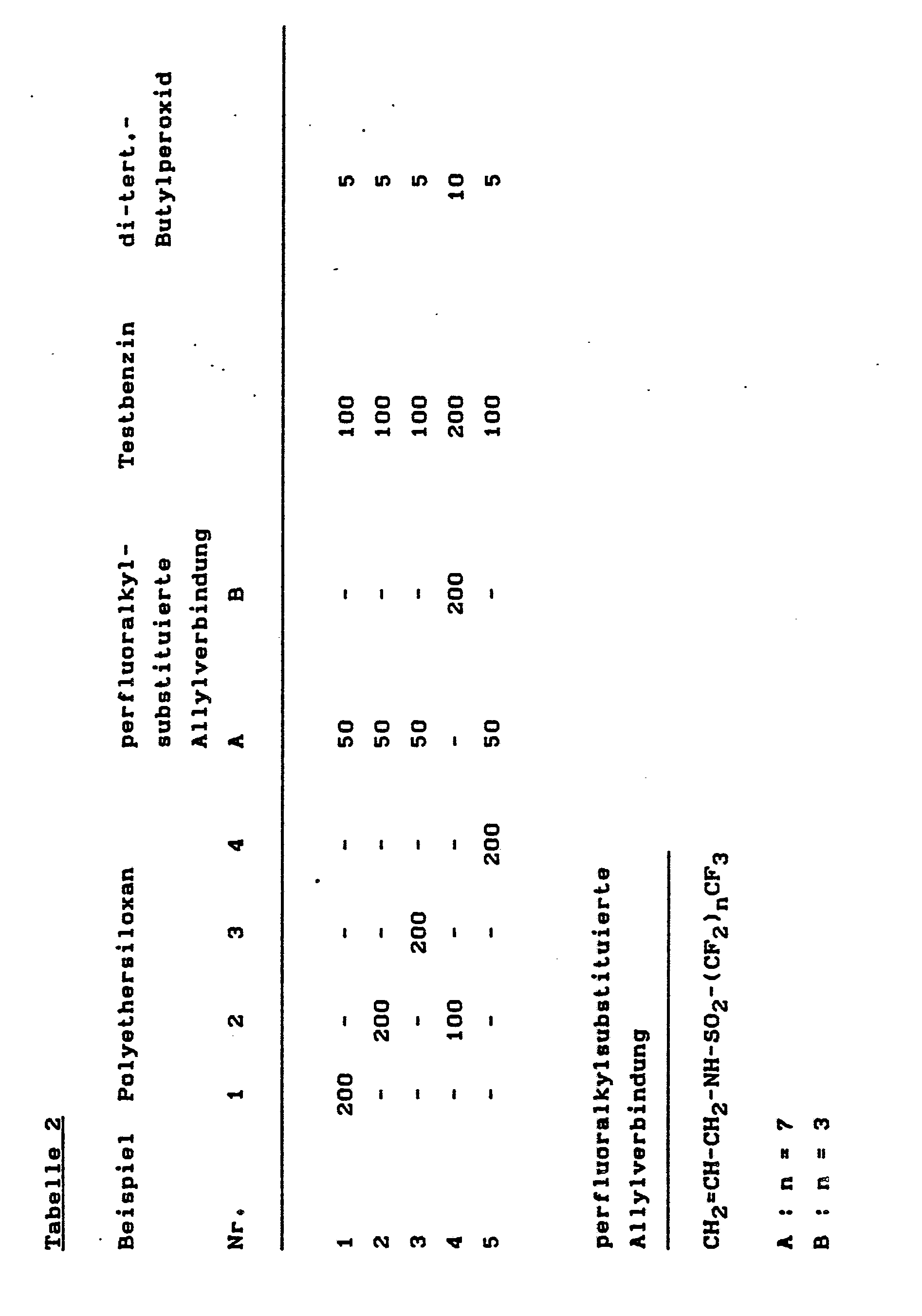

Verwendungsbeispiele der nach der allgemeinen Arbeitsschrift erhaltenen und in Tabelle 2 und 3 charakterisierten Pfropfpolymerisate:Examples of use of the graft polymers obtained according to the general working specification and characterized in Tables 2 and 3:
Eine 10%ige wäßrige Lösung der nach Beispiel 1, 2 und 3 hergestellten Pfropfpolymerisate wird mit dem Polyester-Alkydallack in verschiedenen Konzentrationen abgemischt. Mit diesem Lack wird ein mit Motorenöl verunreinigtes Stahlblech lackiert.A 10% aqueous solution of the graft polymers prepared according to Examples 1, 2 and 3 is mixed with the polyester alkyd lacquer in various concentrations. This paint is used to paint a steel sheet contaminated with motor oil.
Der wasserfeuchte Lackfilm wird 20 Minuten bei 130°C eingebrannt.The water-wet paint film is baked at 130 ° C for 20 minutes.
Die erhaltenen Lackierungen werden mit entsprechenden Lackierungen bei Verwendung handelsüblicher Lackadditive auf Basis niedermolekularer n-butylacrylat-Copolymere (beispielsweise Modaflow ®, Fa. Monsanto, USA) und ohne die Verwendung der erfindungsgemäßen Pfropfpolymerisate verglichen. Beurteilt werden der Verlauf und die Oberflächenstruktur der Lackierung, wobei die Oberflächenstruktur anhand des Auftretens von sogenannten Kratern und/oder des sogenannten Orangenschaleneffektes beurteilt wird. Der Orangenschaleneffekt (die Oberfläche der Lackierung gleicht der Struktur einer Orangenschale) und das Auftreten von Kraten (die Oberfläche der Lackierung zeigt kraterförmige Gebilde) sind (Oberflächenstörungen der Lackierung.The coatings obtained are compared with corresponding coatings when using commercially available coating additives based on low molecular weight n-butyl acrylate copolymers (for example Modaflow®, from Monsanto, USA) and without using the graft polymers according to the invention. The course and the surface structure of the coating are assessed, the surface structure being assessed on the basis of the occurrence of so-called craters and / or the so-called orange peel effect. The orange peel effect (the surface of the Painting is like the structure of an orange peel) and the appearance of craters (the surface of the painting shows crater-shaped structures) are (surface defects of the painting.
Ohne Verlaufsmittel ist keine zusammenhängende Lackschicht erhältlich. Bei der Verwendung handelsüblicher Verlaufsmittel auf Basis niedermolekularer n-Butylacrylat-Copolymere werden 0,3 bis 0,5 Gew.-% benötigt un einen kraterfreien Verlauf der Lackschicht zu gewährleisten.Without a leveling agent, no coherent lacquer layer is available. When using commercially available leveling agents based on low molecular weight n-butyl acrylate copolymers, 0.3 to 0.5% by weight are required in order to ensure a crater-free course of the lacquer layer.
Bei Verwendung der erfindungsgemäßen Pfropfpolymerisate werden bereits mit einem Anteil von 0,04 Gew.-% der Pfropfpolymerisate aus den Beispielen 1, 2 und 3 in dem Lack zusammenhängende und kraterfreie Lackschichten ohne Orangeschaleneffekt erhalten.When the graft polymers according to the invention are used, a proportion of 0.04% by weight of the graft polymers from Examples 1, 2 and 3 in the lacquer gives coherent and crater-free lacquer layers without an orange peel effect.
Als Beispiel für einen UV-härtenden Lösungslack auf Baiss von bisarylatmodifizierten Polyesterharzen wurde ein sogenannter highsolid-Klarlack mit einem Festkörpergehalt von 72 Gew.-%, Typ Baryoflex®, Handelsprodukt der Chem. Fabrik Aarberg/Schweiz, mit den erfindungsgemäßen Pfropfpolymerisaten nach Beispiel 4 und 5 in einer Menge von 0,04 Gew.-% versetzt. Mit diesem Lack wurden Furnierhölzer lackiert und UV-gehärtet. Zum Vergleich wurde ein entsprechender Lack ohne Verlaufsmittel verwendet.A so-called highsolid clearcoat with a solids content of 72% by weight, type Baryoflex®, commercial product from Chem. Fabrik Aarberg / Switzerland, with the graft polymers according to example 4 according to the invention was used as an example of a UV-curing solution varnish based on bisarylate-modified polyester resins and 5 in an amount of 0.04% by weight. Veneers were varnished with this varnish and UV-hardened. A corresponding lacquer without a leveling agent was used for comparison.
Ohne Zusatz der erfindungsgemäßen Verlaufsmittel zeigt die Lackierung nach der Aushärtung den Orangeschaleneffekt, was aus einen nicht optimalen Verlauf hindeutet. Bei Zusatz der erfindungsgemäßen Pfropfpolymerisate wird ein hervorragender Verlauf des Lacks ohne Orangeschaleneffekt und damit eine einwandfreie Lackschicht erzielt, wobei gleichzeitig auch eine verbesserte Haft- und Kratzfestigkeit der Lackierung erreicht wird.Without the addition of the leveling agents according to the invention, the paint shows the orange peel effect after curing, which indicates a less than optimal level. When the graft polymers according to the invention are added, an excellent flow of the lacquer without an orange peel effect and thus a flawless lacquer layer is achieved, while at the same time an improved adhesion and scratch resistance of the lacquer is achieved.
Als Pulverlack wurde ein durch Verseifung eines Ethylen-Vinylacetat-Copolymerisats mit 32 Gew.-% Vinylacetat erhaltenes Ethylen-Vinylalkoholcopolymerisat mit einer Teilchengröße von kleiner 100 µm eingesetzt.An ethylene-vinyl alcohol copolymer obtained by saponification of an ethylene-vinyl acetate copolymer with 32% by weight of vinyl acetate and having a particle size of less than 100 μm was used as the powder coating.
Dieses Pulver wurde mit dem erfindungsgemäßen Pfropfpolymerisat nach Beispiel 3 in unterschiedlichen Mengen versetzt.This powder was mixed with the graft polymer according to Example 3 according to the invention in different amounts.
Das Pulver wurde elektrostatisch auf Stahlbleche von 10 x 10 cm Kantenlänge und 1 mm Dicke versprüht und im Wärmeschrank bei 200°C 10 Minuten nachgeheizt. Der elektrostatische Pulverauftrag erfolgte in einer handelsüblichen Anlage mit einer Spannung von -30kV und Förderluft von 3,5 bar.The powder was electrostatically sprayed onto steel sheets of 10 x 10 cm edge length and 1 mm thickness and in Heated oven at 200 ° C for 10 minutes. The electrostatic powder application was carried out in a commercially available system with a voltage of -30kV and conveying air of 3.5 bar.
Zum Vergleich wurde der entsprechende Pulverlack ohne Zusatz von Verlaufsmittel und Pulverlack mit herkömmlichen Verlaufsmitteln auf Basis niedermolekularer n-Butylacrylat-Copolymere wie angegeben versprüht.For comparison, the corresponding powder coating was sprayed with conventional leveling agents based on low molecular weight n-butyl acrylate copolymers as indicated, without the addition of leveling agents and powder coating.
Pulverlacke mit den erfindungsgemäßen Pfropfpolymerisaten liefern bereits bei einem Gehalt von 0,03 Gew.-% den Pfropfpolymerisat, einen kraterfreien, hervorragen-Verlauf auch über die Kanten der Stahlbleche. Die erzielte Schichtdicke beträgt durchschnittlich 80 µm.Powder coatings with the graft polymers according to the invention already provide the graft polymer at a content of 0.03% by weight, a crater-free, outstanding course even over the edges of the steel sheets. The layer thickness achieved is on average 80 µm.
Ohne Verlaufsmittel wird keine kraterfreie Beschichtung erhalten. Mit Verlaufsmittlen auf Basis von niedermolekularen n-Butylacrylat-Copolymeren wird erst bei einem Zusatz von mindestens 0,5 Gew.-% bezogen auf das Ethylen-Vinylalkoholcopolymerisat ein einwandfreier, kraterfreier Verlauf erreicht.Without a leveling agent, no crater-free coating is obtained. With leveling agents based on low molecular weight n-butyl acrylate copolymers, proper, crater-free flow is only achieved when at least 0.5% by weight, based on the ethylene-vinyl alcohol copolymer, is added.
Claims (9)

X ein Wasserstoffatom oder eine Methylgruppe,
Y und Z unabhängig voneinander ein Wasserstoffatom oder einen Alkylrest mit 1 bis 18 Kohlenstoffatomen,
Q ein zweiwertiger Alkylrest mit 1 bis 12 Kohlenstoffatomen,
ein zweiwertiger organischer Rest der allgemeinen Formel
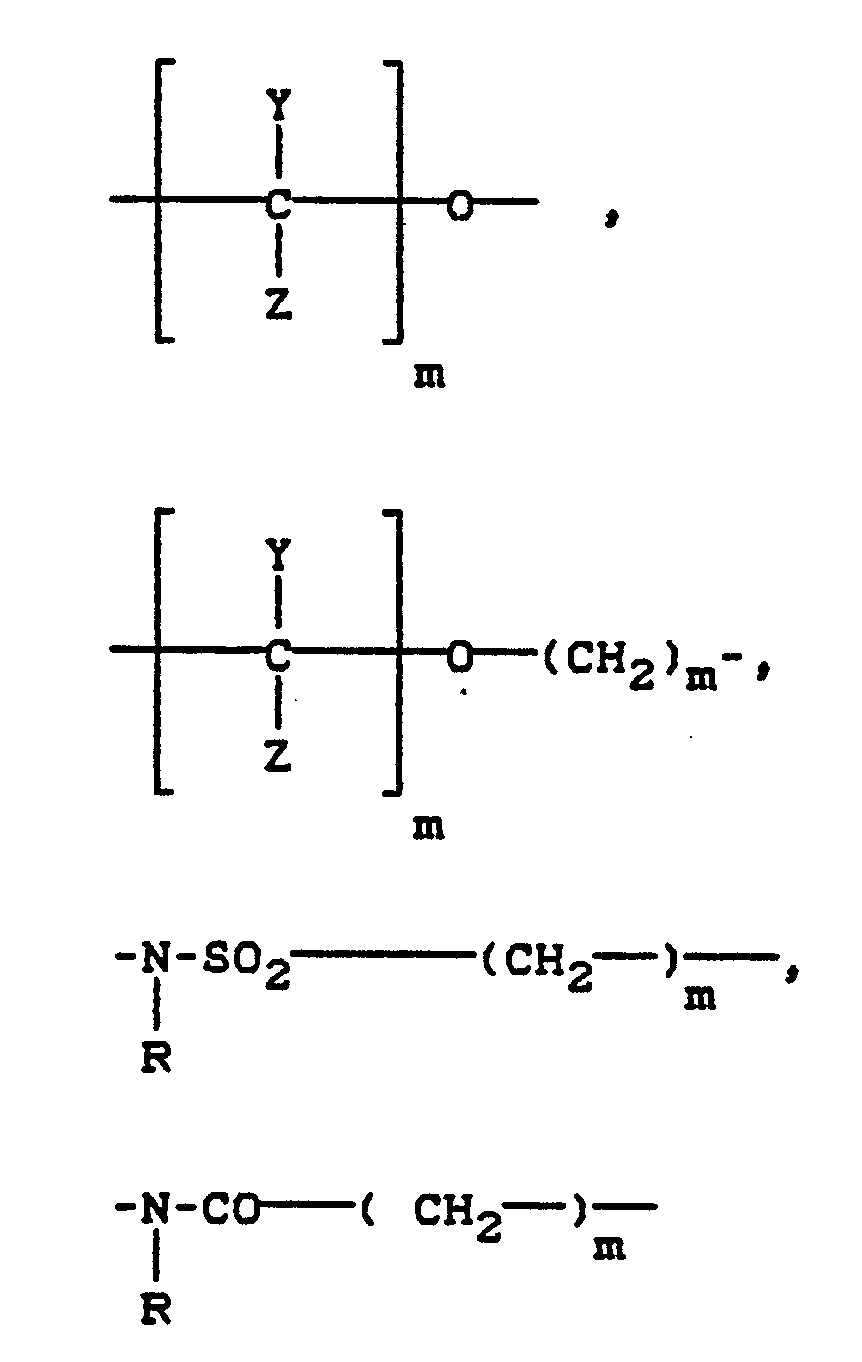

Y und Z die obenstehende Bedeutung haben
R für ein Wasserstoffatom oder einen Alkylrest mit 1 bis 18 Kohlenstoffatomen steht und
m eine ganze Zahl von 0 bis 6 bedeutet und worin
Rf für eine perfluorierten aliphatischen, gegebenenfalls verzweigten Rest mit 1 bis 20 Kohlenstoffatomen steht und der Rest außer Fluoratomen höchstens ein Wasserstoff- oder Chloratom auf zwei Kohlenstoffatome enthalten kann, wobei der perfluorierte aliphatische Rest durch Sauerstoffatome unterbrochen sein kann,
RSi für einen Polyalkylenoxidorganopolysiloxan-Block-und/oder Kammpolymerrest steht und
RPo für eine Polyalkylenoxidkete des Polyalkylenoxidorganopolysiloxan-Block-und/oder Kammpolymers steht
und wobei
in den Pfropfpolymerisaten mehr als 50 Gew.-% perfluoralkylsubstituierte Allyl monomere monomolekular an die Alkylenoxideinheiten der Polyalkylenoxidorganopolysiloxan-Block-und/oder Kammpolymeren addiert sind.
X represents a hydrogen atom or a methyl group,
Y and Z independently of one another are a hydrogen atom or an alkyl radical having 1 to 18 carbon atoms,
Q is a divalent alkyl radical with 1 to 12 carbon atoms,
a divalent organic radical of the general formula
Y and Z have the meaning given above
R represents a hydrogen atom or an alkyl radical having 1 to 18 carbon atoms and
m represents an integer from 0 to 6 and in which
R f represents a perfluorinated aliphatic, optionally branched radical having 1 to 20 carbon atoms and the radical, apart from fluorine atoms, can contain at most one hydrogen or chlorine atom on two carbon atoms, it being possible for the perfluorinated aliphatic radical to be interrupted by oxygen atoms,
R Si stands for a polyalkylene oxide organopolysiloxane block and / or comb polymer residue and
R Po stands for a polyalkylene oxide chain of the polyalkylene oxide organopolysiloxane block and / or comb polymer
and where
in the graft polymers more than 50 wt .-% perfluoroalkyl-substituted allyl monomeric monomolecular are added to the alkylene oxide units of the polyalkylene oxide organopolysiloxane block and / or comb polymers.

Applications Claiming Priority (2)
| Application Number | Priority Date | Filing Date | Title |
|---|---|---|---|
| DE19863643459 DE3643459A1 (en) | 1986-12-19 | 1986-12-19 | POLYETHERSILOXANE - GRAFT POLYMERISATE |
| DE3643459 | 1986-12-19 |
Publications (3)
| Publication Number | Publication Date |
|---|---|
| EP0271802A2 true EP0271802A2 (en) | 1988-06-22 |
| EP0271802A3 EP0271802A3 (en) | 1990-06-27 |
| EP0271802B1 EP0271802B1 (en) | 1992-04-01 |
Family
ID=6316602
Family Applications (1)
| Application Number | Title | Priority Date | Filing Date |
|---|---|---|---|
| EP87118122A Expired - Lifetime EP0271802B1 (en) | 1986-12-19 | 1987-12-08 | Polyether siloxane graft copolymer |
Country Status (6)
| Country | Link |
|---|---|
| US (1) | US4812364A (en) |
| EP (1) | EP0271802B1 (en) |
| JP (1) | JPS63162714A (en) |
| CA (1) | CA1280836C (en) |
| DE (2) | DE3643459A1 (en) |
| DK (1) | DK671287A (en) |
Cited By (1)
| Publication number | Priority date | Publication date | Assignee | Title |
|---|---|---|---|---|
| CN111386300A (en) * | 2017-11-29 | 2020-07-07 | 赢创运营有限公司 | Process for preparing SiOC-linked polyether siloxanes branched in siloxane moieties |
Families Citing this family (5)
| Publication number | Priority date | Publication date | Assignee | Title |
|---|---|---|---|---|
| JP2516451B2 (en) * | 1990-04-04 | 1996-07-24 | 信越化学工業株式会社 | Curable composition and cured product thereof |
| US5348769A (en) * | 1993-03-31 | 1994-09-20 | Osi Specialties, Inc. | Fluorosilicone compositions as wash durable soil and stain repellent finishes |
| US6162877A (en) * | 1998-12-04 | 2000-12-19 | Hercules Incorporated | Hydrophobically modified comb copolymers |
| DE10048258B4 (en) * | 2000-09-29 | 2004-08-19 | Byk-Chemie Gmbh | Leveling agent for surface coatings |
| US7771740B2 (en) * | 2004-07-19 | 2010-08-10 | Boston Scientific Scimed, Inc. | Medical devices containing copolymers with graft copolymer endblocks for drug delivery |
Family Cites Families (7)
| Publication number | Priority date | Publication date | Assignee | Title |
|---|---|---|---|---|
| US3342766A (en) * | 1965-01-12 | 1967-09-19 | Union Carbide Corp | Polymerization process employing siloxane-oxyalkylene block copolymers |
| US4136250A (en) * | 1977-07-20 | 1979-01-23 | Ciba-Geigy Corporation | Polysiloxane hydrogels |
| US4259474A (en) * | 1979-09-25 | 1981-03-31 | Gaf Corporation | Sulfur-containing polyoxyalkylenes |
| DE3151924A1 (en) * | 1981-12-30 | 1983-07-07 | Bayer Ag, 5090 Leverkusen | AQUEOUS POLYSILOXY PREPARATIONS |
| CA1257727A (en) * | 1984-12-18 | 1989-07-18 | Chi-Long Lee | Hydrophilic silicone-organic copolymer elastomers |
| US4737552A (en) * | 1986-06-30 | 1988-04-12 | Dow Corning Corporation | Ceramic materials from polycarbosilanes |
| JPH089656B2 (en) * | 1986-11-05 | 1996-01-31 | 東芝シリコ−ン株式会社 | UV curable silicone composition |
-
1986
- 1986-12-19 DE DE19863643459 patent/DE3643459A1/en not_active Withdrawn
-
1987
- 1987-12-08 DE DE8787118122T patent/DE3777976D1/en not_active Expired - Lifetime
- 1987-12-08 EP EP87118122A patent/EP0271802B1/en not_active Expired - Lifetime
- 1987-12-08 US US07/130,055 patent/US4812364A/en not_active Expired - Fee Related
- 1987-12-10 JP JP62311146A patent/JPS63162714A/en active Pending
- 1987-12-17 CA CA000554591A patent/CA1280836C/en not_active Expired - Lifetime
- 1987-12-18 DK DK671287A patent/DK671287A/en not_active Application Discontinuation
Cited By (2)
| Publication number | Priority date | Publication date | Assignee | Title |
|---|---|---|---|---|
| CN111386300A (en) * | 2017-11-29 | 2020-07-07 | 赢创运营有限公司 | Process for preparing SiOC-linked polyether siloxanes branched in siloxane moieties |
| CN111386300B (en) * | 2017-11-29 | 2022-03-18 | 赢创运营有限公司 | Process for preparing SiOC-linked polyether siloxanes branched in the siloxane moiety |
Also Published As
| Publication number | Publication date |
|---|---|
| DE3643459A1 (en) | 1988-06-23 |
| EP0271802B1 (en) | 1992-04-01 |
| DE3777976D1 (en) | 1992-05-07 |
| US4812364A (en) | 1989-03-14 |
| CA1280836C (en) | 1991-02-26 |
| JPS63162714A (en) | 1988-07-06 |
| DK671287A (en) | 1988-06-20 |
| DK671287D0 (en) | 1987-12-18 |
| EP0271802A3 (en) | 1990-06-27 |
Similar Documents
| Publication | Publication Date | Title |
|---|---|---|
| DE69500835T2 (en) | Stable aqueous dispersion with copolymers containing fluorine and hydroxyl | |
| EP0363723B1 (en) | Procedure for the preparation of a multilayered coating, aqueous coating compositions, water dilutable polyacrylate resins and procedure for the preparation of water dilutable acrylic resins | |
| EP0707608B2 (en) | Aqueous two-component polyurethane coating agent, process for preparing the same and its use in a process for applying a multilayered coating of lacquer | |
| DE69426678T2 (en) | Aqueous coating agent and ink containing ethoxylated acetylenic glycols with low dynamic surface tension | |
| DE3901608C2 (en) | ||
| DE2125064A1 (en) | Polymer materials and dispersions containing them | |
| DE2818102A1 (en) | COATING COMPOSITION | |
| DE68918014T2 (en) | Aqueous dispersions of urethane acrylate polymers and their use in paints. | |
| EP1375605A2 (en) | Use of with polyacrylate modified polysiloxanes as leveling agents in coating compositions | |
| DE69828785T2 (en) | NETWORKABLE SURFACE COATINGS AND METHOD FOR THE PRODUCTION THEREOF | |
| DE2263049A1 (en) | HEAT-RESISTANT ACRYLIC POLYMER POWDER COATING COMPOSITIONS | |
| DE2706308A1 (en) | PROCESS FOR PREPARING POLYMERIZED EMULSIONS OF THE VINYL TYPE | |
| DE3036408A1 (en) | WATER-DISPERSED COATING SIZE | |
| WO2013156486A1 (en) | Polymerizates that can be produced by the emulsion polymerization of functionalized polyurethane nanoparticles and radically curable monomers, a method for the production of said polymerizates, and use of said polymerizates | |
| WO2009033529A1 (en) | Polypropylene oxide-containing polyether and mixtures thereof with poly(meth)acrylates as power coating leveling agents | |
| DE2818094A1 (en) | COATING COMPOSITION | |
| EP0271802B1 (en) | Polyether siloxane graft copolymer | |
| EP0381030A2 (en) | Aqueous polyacryl systems for coating polyvinyl chloride surfaces | |
| DE60021717T2 (en) | NETWORKED ACRYLATE MICROPARTICLES, PROCESS FOR THEIR PREPARATION AND THEIR USE IN COATINGS AND MOLDING MATERIALS | |
| JPS63286473A (en) | Aqueous coating compound composition | |
| DE69104086T2 (en) | Corrosion-protective polysiloxane coating with extended processing time. | |
| EP0521926B1 (en) | Process for producing a multi-layer coating | |
| EP0265807A2 (en) | Use of polyoxyalkylene-polysiloxane block copolymers for improving the scratch hardness and the sliding properties of a painted surface | |
| CH634095A5 (en) | AQUEOUS RESIN DISPERSIONS, IN PARTICULAR AS COATING AGENTS OR VARNISH BINDERS. | |
| EP0022982B1 (en) | Thickening agent for physically drying coatings and process for its preparation |
Legal Events
| Date | Code | Title | Description |
|---|---|---|---|
| PUAI | Public reference made under article 153(3) epc to a published international application that has entered the european phase |
Free format text: ORIGINAL CODE: 0009012 |
|
| 17P | Request for examination filed |
Effective date: 19871208 |
|
| AK | Designated contracting states |
Kind code of ref document: A2 Designated state(s): BE CH DE FR GB IT LI NL SE |
|
| PUAL | Search report despatched |
Free format text: ORIGINAL CODE: 0009013 |
|
| AK | Designated contracting states |
Kind code of ref document: A3 Designated state(s): BE CH DE FR GB IT LI NL SE |
|
| 17Q | First examination report despatched |
Effective date: 19910828 |
|
| GRAA | (expected) grant |
Free format text: ORIGINAL CODE: 0009210 |
|
| AK | Designated contracting states |
Kind code of ref document: B1 Designated state(s): BE CH DE FR GB IT LI NL SE |
|
| ITF | It: translation for a ep patent filed | ||
| REF | Corresponds to: |
Ref document number: 3777976 Country of ref document: DE Date of ref document: 19920507 |
|
| ET | Fr: translation filed | ||
| GBT | Gb: translation of ep patent filed (gb section 77(6)(a)/1977) | ||
| PLBE | No opposition filed within time limit |
Free format text: ORIGINAL CODE: 0009261 |
|
| STAA | Information on the status of an ep patent application or granted ep patent |
Free format text: STATUS: NO OPPOSITION FILED WITHIN TIME LIMIT |
|
| 26N | No opposition filed | ||
| PGFP | Annual fee paid to national office [announced via postgrant information from national office to epo] |
Ref country code: SE Payment date: 19941116 Year of fee payment: 8 |
|
| PGFP | Annual fee paid to national office [announced via postgrant information from national office to epo] |
Ref country code: FR Payment date: 19941128 Year of fee payment: 8 |
|
| PGFP | Annual fee paid to national office [announced via postgrant information from national office to epo] |
Ref country code: GB Payment date: 19941129 Year of fee payment: 8 |
|
| PGFP | Annual fee paid to national office [announced via postgrant information from national office to epo] |
Ref country code: CH Payment date: 19941201 Year of fee payment: 8 |
|
| PGFP | Annual fee paid to national office [announced via postgrant information from national office to epo] |
Ref country code: NL Payment date: 19941231 Year of fee payment: 8 |
|
| EAL | Se: european patent in force in sweden |
Ref document number: 87118122.8 |
|
| PG25 | Lapsed in a contracting state [announced via postgrant information from national office to epo] |
Ref country code: GB Effective date: 19951208 |
|
| PG25 | Lapsed in a contracting state [announced via postgrant information from national office to epo] |
Ref country code: SE Effective date: 19951209 |
|
| PG25 | Lapsed in a contracting state [announced via postgrant information from national office to epo] |
Ref country code: LI Effective date: 19951231 Ref country code: CH Effective date: 19951231 |
|
| PG25 | Lapsed in a contracting state [announced via postgrant information from national office to epo] |
Ref country code: NL Effective date: 19960701 |
|
| GBPC | Gb: european patent ceased through non-payment of renewal fee |
Effective date: 19951208 |
|
| REG | Reference to a national code |
Ref country code: CH Ref legal event code: PL |
|
| PG25 | Lapsed in a contracting state [announced via postgrant information from national office to epo] |
Ref country code: FR Effective date: 19960830 |
|
| NLV4 | Nl: lapsed or anulled due to non-payment of the annual fee |
Effective date: 19960701 |
|
| REG | Reference to a national code |
Ref country code: FR Ref legal event code: ST |
|
| PGFP | Annual fee paid to national office [announced via postgrant information from national office to epo] |
Ref country code: DE Payment date: 19961112 Year of fee payment: 10 |
|
| PGFP | Annual fee paid to national office [announced via postgrant information from national office to epo] |
Ref country code: BE Payment date: 19961210 Year of fee payment: 10 |
|
| PG25 | Lapsed in a contracting state [announced via postgrant information from national office to epo] |
Ref country code: BE Free format text: LAPSE BECAUSE OF NON-PAYMENT OF DUE FEES Effective date: 19971231 |
|
| BERE | Be: lapsed |
Owner name: BAYER A.G. Effective date: 19971231 |
|
| PG25 | Lapsed in a contracting state [announced via postgrant information from national office to epo] |
Ref country code: DE Free format text: LAPSE BECAUSE OF NON-PAYMENT OF DUE FEES Effective date: 19980901 |
|
| PG25 | Lapsed in a contracting state [announced via postgrant information from national office to epo] |
Ref country code: IT Free format text: LAPSE BECAUSE OF NON-PAYMENT OF DUE FEES;WARNING: LAPSES OF ITALIAN PATENTS WITH EFFECTIVE DATE BEFORE 2007 MAY HAVE OCCURRED AT ANY TIME BEFORE 2007. THE CORRECT EFFECTIVE DATE MAY BE DIFFERENT FROM THE ONE RECORDED. Effective date: 20051208 |