EP0271992A2 - Machine dishwashing composition - Google Patents
Machine dishwashing composition Download PDFInfo
- Publication number
- EP0271992A2 EP0271992A2 EP87309962A EP87309962A EP0271992A2 EP 0271992 A2 EP0271992 A2 EP 0271992A2 EP 87309962 A EP87309962 A EP 87309962A EP 87309962 A EP87309962 A EP 87309962A EP 0271992 A2 EP0271992 A2 EP 0271992A2
- Authority
- EP
- European Patent Office
- Prior art keywords
- poly
- alkyl
- detergent
- coating
- weight
- Prior art date
- Legal status (The legal status is an assumption and is not a legal conclusion. Google has not performed a legal analysis and makes no representation as to the accuracy of the status listed.)
- Granted
Links
- 239000000203 mixture Substances 0.000 title claims description 33
- 238000004851 dishwashing Methods 0.000 title description 24
- 238000000576 coating method Methods 0.000 claims abstract description 39
- 239000011248 coating agent Substances 0.000 claims abstract description 32
- 239000003599 detergent Substances 0.000 claims abstract description 31
- 239000000843 powder Substances 0.000 claims abstract description 20
- 239000003795 chemical substances by application Substances 0.000 claims abstract description 8
- 229920005646 polycarboxylate Polymers 0.000 claims abstract description 6
- 239000007844 bleaching agent Substances 0.000 claims description 50
- 239000000460 chlorine Substances 0.000 claims description 42
- 229910052801 chlorine Inorganic materials 0.000 claims description 42
- ZAMOUSCENKQFHK-UHFFFAOYSA-N Chlorine atom Chemical compound [Cl] ZAMOUSCENKQFHK-UHFFFAOYSA-N 0.000 claims description 41
- 239000000463 material Substances 0.000 claims description 40
- 229920000642 polymer Polymers 0.000 claims description 33
- -1 C1-C20 alkyl maleic acid Chemical compound 0.000 claims description 30
- 239000002245 particle Substances 0.000 claims description 29
- 229920001577 copolymer Polymers 0.000 claims description 18
- 150000003839 salts Chemical class 0.000 claims description 14
- 239000000194 fatty acid Substances 0.000 claims description 13
- 235000014113 dietary fatty acids Nutrition 0.000 claims description 12
- 150000002148 esters Chemical class 0.000 claims description 12
- 229930195729 fatty acid Natural products 0.000 claims description 12
- 150000004665 fatty acids Chemical class 0.000 claims description 12
- 239000006260 foam Substances 0.000 claims description 11
- 238000000034 method Methods 0.000 claims description 11
- 230000001590 oxidative effect Effects 0.000 claims description 11
- SMZOUWXMTYCWNB-UHFFFAOYSA-N 2-(2-methoxy-5-methylphenyl)ethanamine Chemical compound COC1=CC=C(C)C=C1CCN SMZOUWXMTYCWNB-UHFFFAOYSA-N 0.000 claims description 9
- NIXOWILDQLNWCW-UHFFFAOYSA-N 2-Propenoic acid Natural products OC(=O)C=C NIXOWILDQLNWCW-UHFFFAOYSA-N 0.000 claims description 9
- 229920002845 Poly(methacrylic acid) Polymers 0.000 claims description 9
- PPBRXRYQALVLMV-UHFFFAOYSA-N Styrene Chemical compound C=CC1=CC=CC=C1 PPBRXRYQALVLMV-UHFFFAOYSA-N 0.000 claims description 9
- XTXRWKRVRITETP-UHFFFAOYSA-N Vinyl acetate Chemical compound CC(=O)OC=C XTXRWKRVRITETP-UHFFFAOYSA-N 0.000 claims description 8
- 239000004615 ingredient Substances 0.000 claims description 8
- 125000003837 (C1-C20) alkyl group Chemical group 0.000 claims description 6
- WKBOTKDWSSQWDR-UHFFFAOYSA-N Bromine atom Chemical group [Br] WKBOTKDWSSQWDR-UHFFFAOYSA-N 0.000 claims description 6
- 238000004140 cleaning Methods 0.000 claims description 6
- 230000036961 partial effect Effects 0.000 claims description 6
- 239000000344 soap Substances 0.000 claims description 5
- 125000000217 alkyl group Chemical group 0.000 claims description 4
- 150000001735 carboxylic acids Chemical class 0.000 claims description 4
- CEJLBZWIKQJOAT-UHFFFAOYSA-N dichloroisocyanuric acid Chemical compound ClN1C(=O)NC(=O)N(Cl)C1=O CEJLBZWIKQJOAT-UHFFFAOYSA-N 0.000 claims description 4
- YYXLGGIKSIZHSF-UHFFFAOYSA-N ethene;furan-2,5-dione Chemical compound C=C.O=C1OC(=O)C=C1 YYXLGGIKSIZHSF-UHFFFAOYSA-N 0.000 claims description 4
- 239000007787 solid Substances 0.000 claims description 4
- 150000004760 silicates Chemical class 0.000 claims description 3
- 239000004094 surface-active agent Substances 0.000 claims description 3
- YRIZYWQGELRKNT-UHFFFAOYSA-N 1,3,5-trichloro-1,3,5-triazinane-2,4,6-trione Chemical compound ClN1C(=O)N(Cl)C(=O)N(Cl)C1=O YRIZYWQGELRKNT-UHFFFAOYSA-N 0.000 claims description 2
- OFOBLEOULBTSOW-UHFFFAOYSA-N Propanedioic acid Natural products OC(=O)CC(O)=O OFOBLEOULBTSOW-UHFFFAOYSA-N 0.000 claims description 2
- 229920002125 Sokalan® Polymers 0.000 claims description 2
- 150000001244 carboxylic acid anhydrides Chemical class 0.000 claims description 2
- 239000003112 inhibitor Substances 0.000 claims description 2
- 239000011976 maleic acid Substances 0.000 claims description 2
- VZCYOOQTPOCHFL-UHFFFAOYSA-N trans-butenedioic acid Natural products OC(=O)C=CC(O)=O VZCYOOQTPOCHFL-UHFFFAOYSA-N 0.000 claims description 2
- NIXOWILDQLNWCW-UHFFFAOYSA-M Acrylate Chemical compound [O-]C(=O)C=C NIXOWILDQLNWCW-UHFFFAOYSA-M 0.000 claims 1
- KZBUYRJDOAKODT-UHFFFAOYSA-N Chlorine Chemical compound ClCl KZBUYRJDOAKODT-UHFFFAOYSA-N 0.000 claims 1
- 229910052783 alkali metal Inorganic materials 0.000 claims 1
- 239000007864 aqueous solution Substances 0.000 claims 1
- 230000000994 depressogenic effect Effects 0.000 claims 1
- 239000006185 dispersion Substances 0.000 claims 1
- 229910052736 halogen Inorganic materials 0.000 abstract description 3
- 150000002367 halogens Chemical class 0.000 abstract description 3
- 238000003860 storage Methods 0.000 description 15
- XLYOFNOQVPJJNP-UHFFFAOYSA-N water Substances O XLYOFNOQVPJJNP-UHFFFAOYSA-N 0.000 description 14
- 239000000243 solution Substances 0.000 description 13
- 238000012360 testing method Methods 0.000 description 13
- 235000002639 sodium chloride Nutrition 0.000 description 12
- DGAQECJNVWCQMB-PUAWFVPOSA-M Ilexoside XXIX Chemical compound C[C@@H]1CC[C@@]2(CC[C@@]3(C(=CC[C@H]4[C@]3(CC[C@@H]5[C@@]4(CC[C@@H](C5(C)C)OS(=O)(=O)[O-])C)C)[C@@H]2[C@]1(C)O)C)C(=O)O[C@H]6[C@@H]([C@H]([C@@H]([C@H](O6)CO)O)O)O.[Na+] DGAQECJNVWCQMB-PUAWFVPOSA-M 0.000 description 8
- 239000002585 base Substances 0.000 description 8
- 125000004432 carbon atom Chemical group C* 0.000 description 8
- WQYVRQLZKVEZGA-UHFFFAOYSA-N hypochlorite Chemical compound Cl[O-] WQYVRQLZKVEZGA-UHFFFAOYSA-N 0.000 description 8
- 239000000126 substance Substances 0.000 description 8
- 229920003171 Poly (ethylene oxide) Polymers 0.000 description 7
- 239000002775 capsule Substances 0.000 description 7
- 238000009472 formulation Methods 0.000 description 7
- 239000000047 product Substances 0.000 description 7
- 239000011734 sodium Substances 0.000 description 7
- 229910052708 sodium Inorganic materials 0.000 description 7
- CSCPPACGZOOCGX-UHFFFAOYSA-N Acetone Chemical compound CC(C)=O CSCPPACGZOOCGX-UHFFFAOYSA-N 0.000 description 6
- CDBYLPFSWZWCQE-UHFFFAOYSA-L Sodium Carbonate Chemical compound [Na+].[Na+].[O-]C([O-])=O CDBYLPFSWZWCQE-UHFFFAOYSA-L 0.000 description 6
- 229940114077 acrylic acid Drugs 0.000 description 6
- 239000002736 nonionic surfactant Substances 0.000 description 6
- 239000002253 acid Chemical class 0.000 description 5
- 239000003513 alkali Substances 0.000 description 5
- GDTBXPJZTBHREO-UHFFFAOYSA-N bromine Substances BrBr GDTBXPJZTBHREO-UHFFFAOYSA-N 0.000 description 5
- 229910052794 bromium Inorganic materials 0.000 description 5
- 150000001875 compounds Chemical class 0.000 description 5
- 230000006866 deterioration Effects 0.000 description 5
- 239000000975 dye Substances 0.000 description 5
- 238000005187 foaming Methods 0.000 description 5
- 229920001519 homopolymer Polymers 0.000 description 5
- 239000002304 perfume Substances 0.000 description 5
- 235000019832 sodium triphosphate Nutrition 0.000 description 5
- 239000002689 soil Substances 0.000 description 5
- 239000001993 wax Substances 0.000 description 5
- IAYPIBMASNFSPL-UHFFFAOYSA-N Ethylene oxide Chemical compound C1CO1 IAYPIBMASNFSPL-UHFFFAOYSA-N 0.000 description 4
- 238000004090 dissolution Methods 0.000 description 4
- 239000000945 filler Substances 0.000 description 4
- 230000002209 hydrophobic effect Effects 0.000 description 4
- 230000003993 interaction Effects 0.000 description 4
- 229920001451 polypropylene glycol Polymers 0.000 description 4
- 238000002360 preparation method Methods 0.000 description 4
- CERQOIWHTDAKMF-UHFFFAOYSA-N Methacrylic acid Chemical compound CC(=C)C(O)=O CERQOIWHTDAKMF-UHFFFAOYSA-N 0.000 description 3
- BPQQTUXANYXVAA-UHFFFAOYSA-N Orthosilicate Chemical compound [O-][Si]([O-])([O-])[O-] BPQQTUXANYXVAA-UHFFFAOYSA-N 0.000 description 3
- GOOHAUXETOMSMM-UHFFFAOYSA-N Propylene oxide Chemical group CC1CO1 GOOHAUXETOMSMM-UHFFFAOYSA-N 0.000 description 3
- 239000004115 Sodium Silicate Substances 0.000 description 3
- PMZURENOXWZQFD-UHFFFAOYSA-L Sodium Sulfate Chemical compound [Na+].[Na+].[O-]S([O-])(=O)=O PMZURENOXWZQFD-UHFFFAOYSA-L 0.000 description 3
- UIIMBOGNXHQVGW-UHFFFAOYSA-M Sodium bicarbonate Chemical compound [Na+].OC([O-])=O UIIMBOGNXHQVGW-UHFFFAOYSA-M 0.000 description 3
- 238000004061 bleaching Methods 0.000 description 3
- 239000011575 calcium Substances 0.000 description 3
- 230000000694 effects Effects 0.000 description 3
- 238000005538 encapsulation Methods 0.000 description 3
- 238000011156 evaluation Methods 0.000 description 3
- 239000012530 fluid Substances 0.000 description 3
- 239000011521 glass Substances 0.000 description 3
- FPYJFEHAWHCUMM-UHFFFAOYSA-N maleic anhydride Chemical compound O=C1OC(=O)C=C1 FPYJFEHAWHCUMM-UHFFFAOYSA-N 0.000 description 3
- 239000007800 oxidant agent Substances 0.000 description 3
- 230000008569 process Effects 0.000 description 3
- 229920006395 saturated elastomer Polymers 0.000 description 3
- 229910000029 sodium carbonate Inorganic materials 0.000 description 3
- 235000017550 sodium carbonate Nutrition 0.000 description 3
- 229910052911 sodium silicate Inorganic materials 0.000 description 3
- 229910052938 sodium sulfate Inorganic materials 0.000 description 3
- 235000011152 sodium sulphate Nutrition 0.000 description 3
- 239000002904 solvent Substances 0.000 description 3
- 238000006467 substitution reaction Methods 0.000 description 3
- DHCDFWKWKRSZHF-UHFFFAOYSA-N sulfurothioic S-acid Chemical compound OS(O)(=O)=S DHCDFWKWKRSZHF-UHFFFAOYSA-N 0.000 description 3
- JNYAEWCLZODPBN-JGWLITMVSA-N (2r,3r,4s)-2-[(1r)-1,2-dihydroxyethyl]oxolane-3,4-diol Chemical compound OC[C@@H](O)[C@H]1OC[C@H](O)[C@H]1O JNYAEWCLZODPBN-JGWLITMVSA-N 0.000 description 2
- BBMCTIGTTCKYKF-UHFFFAOYSA-N 1-heptanol Chemical compound CCCCCCCO BBMCTIGTTCKYKF-UHFFFAOYSA-N 0.000 description 2
- NLXLAEXVIDQMFP-UHFFFAOYSA-N Ammonia chloride Chemical compound [NH4+].[Cl-] NLXLAEXVIDQMFP-UHFFFAOYSA-N 0.000 description 2
- BVKZGUZCCUSVTD-UHFFFAOYSA-M Bicarbonate Chemical compound OC([O-])=O BVKZGUZCCUSVTD-UHFFFAOYSA-M 0.000 description 2
- ZKQDCIXGCQPQNV-UHFFFAOYSA-N Calcium hypochlorite Chemical compound [Ca+2].Cl[O-].Cl[O-] ZKQDCIXGCQPQNV-UHFFFAOYSA-N 0.000 description 2
- 244000060011 Cocos nucifera Species 0.000 description 2
- 235000013162 Cocos nucifera Nutrition 0.000 description 2
- RTZKZFJDLAIYFH-UHFFFAOYSA-N Diethyl ether Chemical compound CCOCC RTZKZFJDLAIYFH-UHFFFAOYSA-N 0.000 description 2
- LRHPLDYGYMQRHN-UHFFFAOYSA-N N-Butanol Chemical compound CCCCO LRHPLDYGYMQRHN-UHFFFAOYSA-N 0.000 description 2
- WCUXLLCKKVVCTQ-UHFFFAOYSA-M Potassium chloride Chemical compound [Cl-].[K+] WCUXLLCKKVVCTQ-UHFFFAOYSA-M 0.000 description 2
- VYPSYNLAJGMNEJ-UHFFFAOYSA-N Silicium dioxide Chemical compound O=[Si]=O VYPSYNLAJGMNEJ-UHFFFAOYSA-N 0.000 description 2
- FAPWRFPIFSIZLT-UHFFFAOYSA-M Sodium chloride Chemical compound [Na+].[Cl-] FAPWRFPIFSIZLT-UHFFFAOYSA-M 0.000 description 2
- 229940048053 acrylate Drugs 0.000 description 2
- 238000013019 agitation Methods 0.000 description 2
- 150000001298 alcohols Chemical class 0.000 description 2
- 125000001931 aliphatic group Chemical group 0.000 description 2
- 230000004888 barrier function Effects 0.000 description 2
- 125000000484 butyl group Chemical group [H]C([*])([H])C([H])([H])C([H])([H])C([H])([H])[H] 0.000 description 2
- 238000006243 chemical reaction Methods 0.000 description 2
- 230000008021 deposition Effects 0.000 description 2
- POULHZVOKOAJMA-UHFFFAOYSA-N dodecanoic acid Chemical compound CCCCCCCCCCCC(O)=O POULHZVOKOAJMA-UHFFFAOYSA-N 0.000 description 2
- 230000032050 esterification Effects 0.000 description 2
- 238000005886 esterification reaction Methods 0.000 description 2
- 229930195733 hydrocarbon Natural products 0.000 description 2
- 125000001165 hydrophobic group Chemical group 0.000 description 2
- JGJLWPGRMCADHB-UHFFFAOYSA-N hypobromite Chemical compound Br[O-] JGJLWPGRMCADHB-UHFFFAOYSA-N 0.000 description 2
- 238000004519 manufacturing process Methods 0.000 description 2
- 230000008018 melting Effects 0.000 description 2
- 238000002844 melting Methods 0.000 description 2
- 159000000001 potassium salts Chemical class 0.000 description 2
- 238000012545 processing Methods 0.000 description 2
- 108090000623 proteins and genes Proteins 0.000 description 2
- 102000004169 proteins and genes Human genes 0.000 description 2
- 235000017557 sodium bicarbonate Nutrition 0.000 description 2
- 229910000030 sodium bicarbonate Inorganic materials 0.000 description 2
- MSFGZHUJTJBYFA-UHFFFAOYSA-M sodium dichloroisocyanurate Chemical compound [Na+].ClN1C(=O)[N-]C(=O)N(Cl)C1=O MSFGZHUJTJBYFA-UHFFFAOYSA-M 0.000 description 2
- NTHWMYGWWRZVTN-UHFFFAOYSA-N sodium silicate Chemical group [Na+].[Na+].[O-][Si]([O-])=O NTHWMYGWWRZVTN-UHFFFAOYSA-N 0.000 description 2
- 230000006641 stabilisation Effects 0.000 description 2
- 238000011105 stabilization Methods 0.000 description 2
- 239000003760 tallow Substances 0.000 description 2
- 238000004448 titration Methods 0.000 description 2
- RYFMWSXOAZQYPI-UHFFFAOYSA-K trisodium phosphate Chemical class [Na+].[Na+].[Na+].[O-]P([O-])([O-])=O RYFMWSXOAZQYPI-UHFFFAOYSA-K 0.000 description 2
- ZORQXIQZAOLNGE-UHFFFAOYSA-N 1,1-difluorocyclohexane Chemical compound FC1(F)CCCCC1 ZORQXIQZAOLNGE-UHFFFAOYSA-N 0.000 description 1
- KEQGZUUPPQEDPF-UHFFFAOYSA-N 1,3-dichloro-5,5-dimethylimidazolidine-2,4-dione Chemical compound CC1(C)N(Cl)C(=O)N(Cl)C1=O KEQGZUUPPQEDPF-UHFFFAOYSA-N 0.000 description 1
- UETRXHVBFZAHHT-UHFFFAOYSA-N 1,3-dichloro-5-(2-methylpropyl)imidazolidine-2,4-dione Chemical compound CC(C)CC1N(Cl)C(=O)N(Cl)C1=O UETRXHVBFZAHHT-UHFFFAOYSA-N 0.000 description 1
- OFTZZDZZNXTWFO-UHFFFAOYSA-N 1,3-dichloro-5-ethyl-5-methylimidazolidine-2,4-dione Chemical compound CCC1(C)N(Cl)C(=O)N(Cl)C1=O OFTZZDZZNXTWFO-UHFFFAOYSA-N 0.000 description 1
- KGRVJHAUYBGFFP-UHFFFAOYSA-N 2,2'-Methylenebis(4-methyl-6-tert-butylphenol) Chemical compound CC(C)(C)C1=CC(C)=CC(CC=2C(=C(C=C(C)C=2)C(C)(C)C)O)=C1O KGRVJHAUYBGFFP-UHFFFAOYSA-N 0.000 description 1
- CFPOJWPDQWJEMO-UHFFFAOYSA-N 2-(1,2-dicarboxyethoxy)butanedioic acid Chemical class OC(=O)CC(C(O)=O)OC(C(O)=O)CC(O)=O CFPOJWPDQWJEMO-UHFFFAOYSA-N 0.000 description 1
- PJVDOKCFHXPXFM-UHFFFAOYSA-N 2-N,4-N,6-N-tribromo-1,3,5-triazine-2,4,6-triamine Chemical compound BrNC1=NC(=NC(=N1)NBr)NBr PJVDOKCFHXPXFM-UHFFFAOYSA-N 0.000 description 1
- KEPNSIARSTUPGS-UHFFFAOYSA-N 2-n,4-n,6-n-trichloro-1,3,5-triazine-2,4,6-triamine Chemical compound ClNC1=NC(NCl)=NC(NCl)=N1 KEPNSIARSTUPGS-UHFFFAOYSA-N 0.000 description 1
- SPUFTPUOEHLZRQ-UHFFFAOYSA-N 3,7,9-tribromo-2,6,8-trioxopurine-1-carbonitrile Chemical compound BrN1C(N(C=2N(C(N(C(C1=2)=O)C#N)=O)Br)Br)=O SPUFTPUOEHLZRQ-UHFFFAOYSA-N 0.000 description 1
- HUFNOZMYOQJBKF-UHFFFAOYSA-N 4,5-dibromo-2,6,8-trioxo-7,9-dihydro-3H-purine-1-carbonitrile Chemical compound BrC12NC(NC1(NC(N(C2=O)C#N)=O)Br)=O HUFNOZMYOQJBKF-UHFFFAOYSA-N 0.000 description 1
- JBNHKYQZNSPSOR-UHFFFAOYSA-N 4-(carboxymethylperoxy)-4-oxobutanoic acid Chemical class OC(=O)CCC(=O)OOCC(O)=O JBNHKYQZNSPSOR-UHFFFAOYSA-N 0.000 description 1
- WLRZLHCGXUHRIG-UHFFFAOYSA-N 5-(2-methylpropyl)imidazolidine-2,4-dione Chemical compound CC(C)CC1NC(=O)NC1=O WLRZLHCGXUHRIG-UHFFFAOYSA-N 0.000 description 1
- XZIIFPSPUDAGJM-UHFFFAOYSA-N 6-chloro-2-n,2-n-diethylpyrimidine-2,4-diamine Chemical compound CCN(CC)C1=NC(N)=CC(Cl)=N1 XZIIFPSPUDAGJM-UHFFFAOYSA-N 0.000 description 1
- RZVAJINKPMORJF-UHFFFAOYSA-N Acetaminophen Chemical compound CC(=O)NC1=CC=C(O)C=C1 RZVAJINKPMORJF-UHFFFAOYSA-N 0.000 description 1
- BTBUEUYNUDRHOZ-UHFFFAOYSA-N Borate Chemical compound [O-]B([O-])[O-] BTBUEUYNUDRHOZ-UHFFFAOYSA-N 0.000 description 1
- OYPRJOBELJOOCE-UHFFFAOYSA-N Calcium Chemical compound [Ca] OYPRJOBELJOOCE-UHFFFAOYSA-N 0.000 description 1
- 239000004215 Carbon black (E152) Substances 0.000 description 1
- BVKZGUZCCUSVTD-UHFFFAOYSA-L Carbonate Chemical compound [O-]C([O-])=O BVKZGUZCCUSVTD-UHFFFAOYSA-L 0.000 description 1
- KRKNYBCHXYNGOX-UHFFFAOYSA-K Citrate Chemical compound [O-]C(=O)CC(O)(CC([O-])=O)C([O-])=O KRKNYBCHXYNGOX-UHFFFAOYSA-K 0.000 description 1
- 235000005979 Citrus limon Nutrition 0.000 description 1
- 244000131522 Citrus pyriformis Species 0.000 description 1
- JPNWZSPUHBHTEV-UHFFFAOYSA-N ClN1C(N(C=2N(C(N(C(C1=2)=O)C#N)=O)Cl)Cl)=O Chemical compound ClN1C(N(C=2N(C(N(C(C1=2)=O)C#N)=O)Cl)Cl)=O JPNWZSPUHBHTEV-UHFFFAOYSA-N 0.000 description 1
- 102000002322 Egg Proteins Human genes 0.000 description 1
- 108010000912 Egg Proteins Proteins 0.000 description 1
- 102000004190 Enzymes Human genes 0.000 description 1
- 108090000790 Enzymes Proteins 0.000 description 1
- LFQSCWFLJHTTHZ-UHFFFAOYSA-N Ethanol Chemical compound CCO LFQSCWFLJHTTHZ-UHFFFAOYSA-N 0.000 description 1
- WSFSSNUMVMOOMR-UHFFFAOYSA-N Formaldehyde Chemical compound O=C WSFSSNUMVMOOMR-UHFFFAOYSA-N 0.000 description 1
- IMQLKJBTEOYOSI-GPIVLXJGSA-N Inositol-hexakisphosphate Chemical class OP(O)(=O)O[C@H]1[C@H](OP(O)(O)=O)[C@@H](OP(O)(O)=O)[C@H](OP(O)(O)=O)[C@H](OP(O)(O)=O)[C@@H]1OP(O)(O)=O IMQLKJBTEOYOSI-GPIVLXJGSA-N 0.000 description 1
- 239000005639 Lauric acid Substances 0.000 description 1
- WHXSMMKQMYFTQS-UHFFFAOYSA-N Lithium Chemical compound [Li] WHXSMMKQMYFTQS-UHFFFAOYSA-N 0.000 description 1
- JLVVSXFLKOJNIY-UHFFFAOYSA-N Magnesium ion Chemical compound [Mg+2] JLVVSXFLKOJNIY-UHFFFAOYSA-N 0.000 description 1
- 101100172132 Mus musculus Eif3a gene Proteins 0.000 description 1
- KKCBUQHMOMHUOY-UHFFFAOYSA-N Na2O Inorganic materials [O-2].[Na+].[Na+] KKCBUQHMOMHUOY-UHFFFAOYSA-N 0.000 description 1
- PKJVCERVKKKCRQ-UHFFFAOYSA-N O.O.O.O.[Ca+2].Br[O-].Br[O-] Chemical compound O.O.O.O.[Ca+2].Br[O-].Br[O-] PKJVCERVKKKCRQ-UHFFFAOYSA-N 0.000 description 1
- HPEIKZAADPKHAH-UHFFFAOYSA-N O.O.[Na].C1=CC=CC=C1.OS(=O)(=O)NCl Chemical compound O.O.[Na].C1=CC=CC=C1.OS(=O)(=O)NCl HPEIKZAADPKHAH-UHFFFAOYSA-N 0.000 description 1
- 241001310492 Pectis angustifolia Species 0.000 description 1
- 239000004698 Polyethylene Substances 0.000 description 1
- 229920000388 Polyphosphate Polymers 0.000 description 1
- ZLMJMSJWJFRBEC-UHFFFAOYSA-N Potassium Chemical compound [K] ZLMJMSJWJFRBEC-UHFFFAOYSA-N 0.000 description 1
- 239000004111 Potassium silicate Substances 0.000 description 1
- 206010037660 Pyrexia Diseases 0.000 description 1
- IYFATESGLOUGBX-YVNJGZBMSA-N Sorbitan monopalmitate Chemical compound CCCCCCCCCCCCCCCC(=O)OC[C@@H](O)[C@H]1OC[C@H](O)[C@H]1O IYFATESGLOUGBX-YVNJGZBMSA-N 0.000 description 1
- HVUMOYIDDBPOLL-XWVZOOPGSA-N Sorbitan monostearate Chemical compound CCCCCCCCCCCCCCCCCC(=O)OC[C@@H](O)[C@H]1OC[C@H](O)[C@H]1O HVUMOYIDDBPOLL-XWVZOOPGSA-N 0.000 description 1
- 239000004147 Sorbitan trioleate Substances 0.000 description 1
- PRXRUNOAOLTIEF-ADSICKODSA-N Sorbitan trioleate Chemical compound CCCCCCCC\C=C/CCCCCCCC(=O)OC[C@@H](OC(=O)CCCCCCC\C=C/CCCCCCCC)[C@H]1OC[C@H](O)[C@H]1OC(=O)CCCCCCC\C=C/CCCCCCCC PRXRUNOAOLTIEF-ADSICKODSA-N 0.000 description 1
- 229920002472 Starch Polymers 0.000 description 1
- 235000021355 Stearic acid Nutrition 0.000 description 1
- CZMRCDWAGMRECN-UGDNZRGBSA-N Sucrose Chemical compound O[C@H]1[C@H](O)[C@@H](CO)O[C@@]1(CO)O[C@@H]1[C@H](O)[C@@H](O)[C@H](O)[C@@H](CO)O1 CZMRCDWAGMRECN-UGDNZRGBSA-N 0.000 description 1
- 229930006000 Sucrose Natural products 0.000 description 1
- XSQUKJJJFZCRTK-UHFFFAOYSA-N Urea Chemical compound NC(N)=O XSQUKJJJFZCRTK-UHFFFAOYSA-N 0.000 description 1
- NCHJGQKLPRTMAO-XWVZOOPGSA-N [(2R)-2-[(2R,3R,4S)-3,4-dihydroxyoxolan-2-yl]-2-hydroxyethyl] 16-methylheptadecanoate Chemical compound CC(C)CCCCCCCCCCCCCCC(=O)OC[C@@H](O)[C@H]1OC[C@H](O)[C@H]1O NCHJGQKLPRTMAO-XWVZOOPGSA-N 0.000 description 1
- IJCWFDPJFXGQBN-RYNSOKOISA-N [(2R)-2-[(2R,3R,4S)-4-hydroxy-3-octadecanoyloxyoxolan-2-yl]-2-octadecanoyloxyethyl] octadecanoate Chemical compound CCCCCCCCCCCCCCCCCC(=O)OC[C@@H](OC(=O)CCCCCCCCCCCCCCCCC)[C@H]1OC[C@H](O)[C@H]1OC(=O)CCCCCCCCCCCCCCCCC IJCWFDPJFXGQBN-RYNSOKOISA-N 0.000 description 1
- NVANJYGRGNEULT-BDZGGURLSA-N [(3s,4r,5r)-4-hexadecanoyloxy-5-[(1r)-1-hexadecanoyloxy-2-hydroxyethyl]oxolan-3-yl] hexadecanoate Chemical compound CCCCCCCCCCCCCCCC(=O)O[C@H](CO)[C@H]1OC[C@H](OC(=O)CCCCCCCCCCCCCCC)[C@H]1OC(=O)CCCCCCCCCCCCCCC NVANJYGRGNEULT-BDZGGURLSA-N 0.000 description 1
- 230000002378 acidificating effect Effects 0.000 description 1
- 230000002730 additional effect Effects 0.000 description 1
- 150000007933 aliphatic carboxylic acids Chemical class 0.000 description 1
- 239000012670 alkaline solution Substances 0.000 description 1
- 150000001336 alkenes Chemical class 0.000 description 1
- 150000001345 alkine derivatives Chemical group 0.000 description 1
- 125000002947 alkylene group Chemical group 0.000 description 1
- 229910052782 aluminium Inorganic materials 0.000 description 1
- XAGFODPZIPBFFR-UHFFFAOYSA-N aluminium Chemical compound [Al] XAGFODPZIPBFFR-UHFFFAOYSA-N 0.000 description 1
- 150000001412 amines Chemical class 0.000 description 1
- 235000019270 ammonium chloride Nutrition 0.000 description 1
- 238000013459 approach Methods 0.000 description 1
- XJHABGPPCLHLLV-UHFFFAOYSA-N benzo[de]isoquinoline-1,3-dione Chemical compound C1=CC(C(=O)NC2=O)=C3C2=CC=CC3=C1 XJHABGPPCLHLLV-UHFFFAOYSA-N 0.000 description 1
- 239000000872 buffer Substances 0.000 description 1
- DQXBYHZEEUGOBF-UHFFFAOYSA-N but-3-enoic acid;ethene Chemical compound C=C.OC(=O)CC=C DQXBYHZEEUGOBF-UHFFFAOYSA-N 0.000 description 1
- XGKYJLTXGVQMSF-UHFFFAOYSA-N calcium dihypochlorite tetrahydrate Chemical compound O.O.O.O.[Ca++].[O-]Cl.[O-]Cl XGKYJLTXGVQMSF-UHFFFAOYSA-N 0.000 description 1
- 229910001424 calcium ion Inorganic materials 0.000 description 1
- 239000004202 carbamide Substances 0.000 description 1
- 230000015556 catabolic process Effects 0.000 description 1
- 150000001768 cations Chemical class 0.000 description 1
- 239000011093 chipboard Substances 0.000 description 1
- 239000012320 chlorinating reagent Substances 0.000 description 1
- 125000001309 chloro group Chemical group Cl* 0.000 description 1
- 235000019864 coconut oil Nutrition 0.000 description 1
- 239000003240 coconut oil Substances 0.000 description 1
- 229910052681 coesite Inorganic materials 0.000 description 1
- 238000009833 condensation Methods 0.000 description 1
- 230000005494 condensation Effects 0.000 description 1
- 230000001143 conditioned effect Effects 0.000 description 1
- 230000003750 conditioning effect Effects 0.000 description 1
- 239000007771 core particle Substances 0.000 description 1
- 230000007797 corrosion Effects 0.000 description 1
- 238000005260 corrosion Methods 0.000 description 1
- 238000005336 cracking Methods 0.000 description 1
- 229910052906 cristobalite Inorganic materials 0.000 description 1
- 238000000354 decomposition reaction Methods 0.000 description 1
- 238000006731 degradation reaction Methods 0.000 description 1
- 230000000593 degrading effect Effects 0.000 description 1
- 230000002939 deleterious effect Effects 0.000 description 1
- 230000001419 dependent effect Effects 0.000 description 1
- 125000000118 dimethyl group Chemical group [H]C([H])([H])* 0.000 description 1
- XPPKVPWEQAFLFU-UHFFFAOYSA-J diphosphate(4-) Chemical compound [O-]P([O-])(=O)OP([O-])([O-])=O XPPKVPWEQAFLFU-UHFFFAOYSA-J 0.000 description 1
- 235000011180 diphosphates Nutrition 0.000 description 1
- 125000003438 dodecyl group Chemical group [H]C([H])([H])C([H])([H])C([H])([H])C([H])([H])C([H])([H])C([H])([H])C([H])([H])C([H])([H])C([H])([H])C([H])([H])C([H])([H])C([H])([H])* 0.000 description 1
- 235000013345 egg yolk Nutrition 0.000 description 1
- 210000002969 egg yolk Anatomy 0.000 description 1
- 238000005516 engineering process Methods 0.000 description 1
- 239000005038 ethylene vinyl acetate Substances 0.000 description 1
- 230000001747 exhibiting effect Effects 0.000 description 1
- 238000002474 experimental method Methods 0.000 description 1
- 238000005562 fading Methods 0.000 description 1
- 239000003925 fat Substances 0.000 description 1
- 235000019197 fats Nutrition 0.000 description 1
- 239000011888 foil Substances 0.000 description 1
- 235000019256 formaldehyde Nutrition 0.000 description 1
- 239000003205 fragrance Substances 0.000 description 1
- 239000013538 functional additive Substances 0.000 description 1
- WOLATMHLPFJRGC-UHFFFAOYSA-N furan-2,5-dione;styrene Chemical compound O=C1OC(=O)C=C1.C=CC1=CC=CC=C1 WOLATMHLPFJRGC-UHFFFAOYSA-N 0.000 description 1
- 150000004676 glycans Chemical class 0.000 description 1
- 125000000623 heterocyclic group Chemical group 0.000 description 1
- 150000001469 hydantoins Chemical class 0.000 description 1
- 229920001600 hydrophobic polymer Polymers 0.000 description 1
- 125000002887 hydroxy group Chemical group [H]O* 0.000 description 1
- QWPPOHNGKGFGJK-UHFFFAOYSA-N hypochlorous acid Chemical compound ClO QWPPOHNGKGFGJK-UHFFFAOYSA-N 0.000 description 1
- 150000002484 inorganic compounds Chemical class 0.000 description 1
- 239000011256 inorganic filler Substances 0.000 description 1
- 229910003475 inorganic filler Inorganic materials 0.000 description 1
- 229910010272 inorganic material Inorganic materials 0.000 description 1
- 230000000670 limiting effect Effects 0.000 description 1
- 229910052744 lithium Inorganic materials 0.000 description 1
- 230000007774 longterm Effects 0.000 description 1
- 239000011777 magnesium Substances 0.000 description 1
- 229910001425 magnesium ion Inorganic materials 0.000 description 1
- 230000005291 magnetic effect Effects 0.000 description 1
- 150000002689 maleic acids Chemical class 0.000 description 1
- 229910052751 metal Inorganic materials 0.000 description 1
- 239000002184 metal Substances 0.000 description 1
- 125000002496 methyl group Chemical group [H]C([H])([H])* 0.000 description 1
- 230000004048 modification Effects 0.000 description 1
- 238000012986 modification Methods 0.000 description 1
- 239000000178 monomer Substances 0.000 description 1
- 125000001421 myristyl group Chemical group [H]C([*])([H])C([H])([H])C([H])([H])C([H])([H])C([H])([H])C([H])([H])C([H])([H])C([H])([H])C([H])([H])C([H])([H])C([H])([H])C([H])([H])C([H])([H])C([H])([H])[H] 0.000 description 1
- 230000007935 neutral effect Effects 0.000 description 1
- QIQXTHQIDYTFRH-UHFFFAOYSA-N octadecanoic acid Chemical compound CCCCCCCCCCCCCCCCCC(O)=O QIQXTHQIDYTFRH-UHFFFAOYSA-N 0.000 description 1
- OQCDKBAXFALNLD-UHFFFAOYSA-N octadecanoic acid Natural products CCCCCCCC(C)CCCCCCCCC(O)=O OQCDKBAXFALNLD-UHFFFAOYSA-N 0.000 description 1
- 239000003921 oil Substances 0.000 description 1
- 235000019198 oils Nutrition 0.000 description 1
- 150000002894 organic compounds Chemical class 0.000 description 1
- 239000012766 organic filler Substances 0.000 description 1
- 239000011368 organic material Substances 0.000 description 1
- 239000003960 organic solvent Substances 0.000 description 1
- 239000012188 paraffin wax Substances 0.000 description 1
- NBIIXXVUZAFLBC-UHFFFAOYSA-K phosphate Chemical compound [O-]P([O-])([O-])=O NBIIXXVUZAFLBC-UHFFFAOYSA-K 0.000 description 1
- XKJCHHZQLQNZHY-UHFFFAOYSA-N phthalimide Chemical compound C1=CC=C2C(=O)NC(=O)C2=C1 XKJCHHZQLQNZHY-UHFFFAOYSA-N 0.000 description 1
- 235000002949 phytic acid Nutrition 0.000 description 1
- 229920001983 poloxamer Polymers 0.000 description 1
- 229920001200 poly(ethylene-vinyl acetate) Polymers 0.000 description 1
- 239000004584 polyacrylic acid Substances 0.000 description 1
- 229920000573 polyethylene Polymers 0.000 description 1
- 238000006116 polymerization reaction Methods 0.000 description 1
- 229920002503 polyoxyethylene-polyoxypropylene Polymers 0.000 description 1
- 239000001205 polyphosphate Substances 0.000 description 1
- 235000011176 polyphosphates Nutrition 0.000 description 1
- 229920001282 polysaccharide Polymers 0.000 description 1
- 239000005017 polysaccharide Substances 0.000 description 1
- 239000011118 polyvinyl acetate Substances 0.000 description 1
- 229920002689 polyvinyl acetate Polymers 0.000 description 1
- 239000011591 potassium Substances 0.000 description 1
- 229910052700 potassium Inorganic materials 0.000 description 1
- 239000001103 potassium chloride Substances 0.000 description 1
- 235000011164 potassium chloride Nutrition 0.000 description 1
- NNHHDJVEYQHLHG-UHFFFAOYSA-N potassium silicate Chemical compound [K+].[K+].[O-][Si]([O-])=O NNHHDJVEYQHLHG-UHFFFAOYSA-N 0.000 description 1
- 229910052913 potassium silicate Inorganic materials 0.000 description 1
- 235000019353 potassium silicate Nutrition 0.000 description 1
- IFIDXBCRSWOUSB-UHFFFAOYSA-M potassium;1,5-dichloro-4,6-dioxo-1,3,5-triazin-2-olate Chemical compound [K+].ClN1C(=O)[N-]C(=O)N(Cl)C1=O IFIDXBCRSWOUSB-UHFFFAOYSA-M 0.000 description 1
- 230000003389 potentiating effect Effects 0.000 description 1
- 239000002244 precipitate Substances 0.000 description 1
- 230000001012 protector Effects 0.000 description 1
- 230000009257 reactivity Effects 0.000 description 1
- 238000011084 recovery Methods 0.000 description 1
- 230000002829 reductive effect Effects 0.000 description 1
- 239000013557 residual solvent Substances 0.000 description 1
- 230000000717 retained effect Effects 0.000 description 1
- 238000011012 sanitization Methods 0.000 description 1
- 150000004671 saturated fatty acids Chemical class 0.000 description 1
- 238000001878 scanning electron micrograph Methods 0.000 description 1
- 230000002000 scavenging effect Effects 0.000 description 1
- 229940071207 sesquicarbonate Drugs 0.000 description 1
- 239000000377 silicon dioxide Substances 0.000 description 1
- 235000012239 silicon dioxide Nutrition 0.000 description 1
- 239000011780 sodium chloride Substances 0.000 description 1
- 239000001509 sodium citrate Substances 0.000 description 1
- NLJMYIDDQXHKNR-UHFFFAOYSA-K sodium citrate Chemical compound O.O.[Na+].[Na+].[Na+].[O-]C(=O)CC(O)(CC([O-])=O)C([O-])=O NLJMYIDDQXHKNR-UHFFFAOYSA-K 0.000 description 1
- 239000001488 sodium phosphate Substances 0.000 description 1
- PYILKOIEIHHYGD-UHFFFAOYSA-M sodium;1,5-dichloro-4,6-dioxo-1,3,5-triazin-2-olate;dihydrate Chemical compound O.O.[Na+].[O-]C1=NC(=O)N(Cl)C(=O)N1Cl PYILKOIEIHHYGD-UHFFFAOYSA-M 0.000 description 1
- 229940035044 sorbitan monolaurate Drugs 0.000 description 1
- 239000001593 sorbitan monooleate Substances 0.000 description 1
- 235000011069 sorbitan monooleate Nutrition 0.000 description 1
- 229940035049 sorbitan monooleate Drugs 0.000 description 1
- 235000011071 sorbitan monopalmitate Nutrition 0.000 description 1
- 239000001570 sorbitan monopalmitate Substances 0.000 description 1
- 229940031953 sorbitan monopalmitate Drugs 0.000 description 1
- 239000001587 sorbitan monostearate Substances 0.000 description 1
- 235000011076 sorbitan monostearate Nutrition 0.000 description 1
- 229940035048 sorbitan monostearate Drugs 0.000 description 1
- 235000019337 sorbitan trioleate Nutrition 0.000 description 1
- 229960000391 sorbitan trioleate Drugs 0.000 description 1
- 239000001589 sorbitan tristearate Substances 0.000 description 1
- 235000011078 sorbitan tristearate Nutrition 0.000 description 1
- 229960004129 sorbitan tristearate Drugs 0.000 description 1
- 239000007921 spray Substances 0.000 description 1
- 238000010561 standard procedure Methods 0.000 description 1
- 239000008107 starch Substances 0.000 description 1
- 235000019698 starch Nutrition 0.000 description 1
- 230000003068 static effect Effects 0.000 description 1
- 239000008117 stearic acid Substances 0.000 description 1
- 238000003756 stirring Methods 0.000 description 1
- 229910052682 stishovite Inorganic materials 0.000 description 1
- KZNICNPSHKQLFF-UHFFFAOYSA-N succinimide Chemical class O=C1CCC(=O)N1 KZNICNPSHKQLFF-UHFFFAOYSA-N 0.000 description 1
- 239000005720 sucrose Substances 0.000 description 1
- 150000003445 sucroses Chemical class 0.000 description 1
- 239000000375 suspending agent Substances 0.000 description 1
- 239000000271 synthetic detergent Substances 0.000 description 1
- 239000008399 tap water Substances 0.000 description 1
- 235000020679 tap water Nutrition 0.000 description 1
- 229920001897 terpolymer Polymers 0.000 description 1
- 238000010998 test method Methods 0.000 description 1
- TUNFSRHWOTWDNC-HKGQFRNVSA-N tetradecanoic acid Chemical compound CCCCCCCCCCCCC[14C](O)=O TUNFSRHWOTWDNC-HKGQFRNVSA-N 0.000 description 1
- NSUYGRHTCQVYET-UHFFFAOYSA-J tetrapotassium;1,5-dichloro-4,6-dioxo-1,3,5-triazin-2-olate;1,3,5-trichloro-1,3,5-triazinane-2,4,6-trione Chemical compound [K+].[K+].[K+].[K+].[O-]C1=NC(=O)N(Cl)C(=O)N1Cl.[O-]C1=NC(=O)N(Cl)C(=O)N1Cl.[O-]C1=NC(=O)N(Cl)C(=O)N1Cl.[O-]C1=NC(=O)N(Cl)C(=O)N1Cl.ClN1C(=O)N(Cl)C(=O)N(Cl)C1=O NSUYGRHTCQVYET-UHFFFAOYSA-J 0.000 description 1
- 229910052905 tridymite Inorganic materials 0.000 description 1
- UNXRWKVEANCORM-UHFFFAOYSA-I triphosphate(5-) Chemical compound [O-]P([O-])(=O)OP([O-])(=O)OP([O-])([O-])=O UNXRWKVEANCORM-UHFFFAOYSA-I 0.000 description 1
- 229910000406 trisodium phosphate Inorganic materials 0.000 description 1
- 235000019801 trisodium phosphate Nutrition 0.000 description 1
- 238000005406 washing Methods 0.000 description 1
Classifications
-
- C—CHEMISTRY; METALLURGY
- C11—ANIMAL OR VEGETABLE OILS, FATS, FATTY SUBSTANCES OR WAXES; FATTY ACIDS THEREFROM; DETERGENTS; CANDLES
- C11D—DETERGENT COMPOSITIONS; USE OF SINGLE SUBSTANCES AS DETERGENTS; SOAP OR SOAP-MAKING; RESIN SOAPS; RECOVERY OF GLYCEROL
- C11D3/00—Other compounding ingredients of detergent compositions covered in group C11D1/00
- C11D3/395—Bleaching agents
- C11D3/3953—Inorganic bleaching agents
-
- C—CHEMISTRY; METALLURGY
- C11—ANIMAL OR VEGETABLE OILS, FATS, FATTY SUBSTANCES OR WAXES; FATTY ACIDS THEREFROM; DETERGENTS; CANDLES
- C11D—DETERGENT COMPOSITIONS; USE OF SINGLE SUBSTANCES AS DETERGENTS; SOAP OR SOAP-MAKING; RESIN SOAPS; RECOVERY OF GLYCEROL
- C11D17/00—Detergent materials or soaps characterised by their shape or physical properties
- C11D17/0039—Coated compositions or coated components in the compositions, (micro)capsules
-
- C—CHEMISTRY; METALLURGY
- C11—ANIMAL OR VEGETABLE OILS, FATS, FATTY SUBSTANCES OR WAXES; FATTY ACIDS THEREFROM; DETERGENTS; CANDLES
- C11D—DETERGENT COMPOSITIONS; USE OF SINGLE SUBSTANCES AS DETERGENTS; SOAP OR SOAP-MAKING; RESIN SOAPS; RECOVERY OF GLYCEROL
- C11D3/00—Other compounding ingredients of detergent compositions covered in group C11D1/00
- C11D3/395—Bleaching agents
- C11D3/3955—Organic bleaching agents
Definitions
- the invention relates to mechanical dishwashing compositions comprising bleach releasing particles.
- bleach An important component of most commercial granular machine dishwashing detergents is bleach.
- the bleach component is a material having at least one reactive chlorine which will generate hypochlorite in solution.
- Chlorine bleach performs several functions including removing stains, sanitizing surfaces and degrading protein soils. Particularly critical is the protein soil on glassware leading to unsightly spots which consumers find objectionable.
- hypochlorite more precisely hypochlorous acid
- Hypochlorite being a strong oxidising agent
- these ingredients include perfumes, dyes, surfactants and bases.
- Free water present in the formulation contributes further to the bleach reactivity with the aforesaid ingredients.
- These interactions lead to a gradual loss of chlorine available for chemical cleaning and a deterioration of the dishwashing performance. Instability is accelerated by storage at high temperature and/or humidity. Under such conditions, there may occur fading of product dye, fragrance deterioration and solubility decrease.
- hypochlorite sources are more stable than others, they all suffer at least some loss in available chlorine on storage.
- U.S. Patent 3,112,274 discloses the use of inorganic salts such as sodium tripolyphosphate, applied in a fluidized bed, to coat polychloroisocyanurate bleach releasing salts.
- the resultant encapsulated salts are said to be protected from decomposition by the attack of moisture, and insulated from reacting with sensitive organic materials.
- a further object of this invention is to provide bleach particles that are sufficiently cleaning aggressive but nevertheless do not significantly interact with detergent co-components such as perfumes, dyes (including coloured speckles) and surfactants.
- a further object of this invention is to provide bleach particles which will generate little or no foam in detergent compositions subjected to conditions of mechanical dishwashing.
- Another object of this invention is to provide bleach particles that substantially retain their available chlorine upon storage but upon dissolution in an aqueous alkaline solution quickly release active bleaching agent yet do not have the potential for detracting from glass appearance.
- a particle for releasing bleach comprising
- An automatic dishwasher detergent composition is also provided by the present invention which comprises, with preferable amounts;
- the storage stability of oxidizing materials such as chlorine bleach used in machine dishwashing compositions can be dramatically improved. Deleterious interactions of the bleach with various formulation components may be prevented by coating the bleach with an appropriate alkali soluble polymer. Both performance and aesthetic appeal is significantly improved by the encapsulation.
- the invention has identified homopolymer and copolymer carboxylic acids, alkyl partial esters thereof and their salt derivatives as being effective encapsulation materials. These polymers advantageously produce little or no foam when subject to machine dishwashing conditions. Furthermore, these coatings are non-reactive toward the oxidizing material when not containing amine, hydroxyl, ether, alkene or alkyne functionality.
- suitable homopolymers of this invention are those of polyacrylic acid and polymethacrylic acid. Molecular weights of these materials may range from about 1,000 to over 200,000. Polyacrylic homopolymers are commercially available from Rohm & Haas and the B. F. Goodrich Company.
- a further property required of the coating material is that it act as a barrier for both moisture and organic ingredients that can react with the bleach. It has been found that with regard to this criteria, the most effective coating materials are not homopolymers but rather copolymers. These copolymers must exhibit a balance between their hydrophilic and hydrophobic components.
- copolymer is also intended to include ter- and higher mixed unit polymers. Copolymers that are especially preferred have at least two types of monomeric units, one that is hydrophilic and the other that is hydrophobic. Relative proportions of these groups in the polymer can then be adjusted to yield the balance between adequate alkali solubility and effective barrier properties.
- proportions generally range from about 100:1 to 1:100, preferably 50:1 to 1:50, more preferably 10:1 to 1:10 and optimally 2:1 to 1:2.
- Particularly effective polymers are those that in addition to the above balance require alkali to dissolve.
- the alkali dissolution characteristic provides an alkali scavenging buffer zone between the bleach and detergent components to further protect the acidic bleach agent.
- the best performing polycarboxylate polymers are those water insoluble at pH 7 but which are solubilized in alkaline media at pH 10 or higher.
- Copolymers of styrene and maleic anhydride and their various derivatives are especially effective. Particularly useful are the C1-C20 alkyl half esters of styrene/maleic anhydride copolymers.
- SMA 1440 a series of 1:1 molar ratio styrene/maleic anhydride copolymers and their partial esters formed by the reaction of styrene/maleic anhydride with an alcohol such as butanol, heptanol or other higher alcohols.
- the degree of esterification and molecular weight are chosen so as to provide adequate stability during storage yet allow the bleach particles to dissolve quickly during the wash cycle.
- Particularly preferred polymers in this class are the butyl half esters having a molecular weight between 1,000 and 10,000, and optimally 1,500 to 5,000.
- Partially esterified polymers of maleic anhydride, acrylic acid, or methacrylic acid and their salt derivatives have also proven to be suitable encapsulating materials.
- the effective partial esters are those water insoluble at pH 7 but water solubilized by aqueous alkaline media at pH 10 or higher.
- Illustrative of these are poly(maleic anhydride/C1-C20 alkyl maleic acid half ester), poly(acrylic acid/C1-C20 alkyl methacrylate), poly(methacrylic acid/C1-C20 alkylacrylate), poly(acrylic acid/C1-C20 alkyl acrylate) and poly(methacrylic acid/C1-C20 alkyl methacrylate).
- These copolymers may be prepared by polymerization of the respective monomer pair or by esterification of pre-formed polymer with C1-C20 alkanol.
- Copolymers of ethylene/maleic anhydride and acid or salt derivatives thereof have also been shown to be suitable encapsulating materials.
- Partially esterified polymers of ethylene/maleic anhydride and their acid or salt derivatives can also form effective coatings within the purview of this invention. It must, however, be noted that these materials are not optimal; they do not exhibit water insolubility at neutral pH in distinction to copolymers such as styrene/maleic anhydride copolymers.
- Polycarboxylate copolymers containing vinyl acetate and/or styrene monomer units may also be suitable within the context of this invention.
- Copolymers, which term may also include terpolymer and higher combinations, can be formed between vinyl acetate, styrene, acrylic acid, and/or methacrylic acid.
- Polyvinyl acetate homopolymer, being insoluble in water, is however not suitable for purposes of this invention.
- suitable reactive chlorine or bromine oxidizing materials are heterocyclic N-bromo and N-chloro imides such as trichlorocyanuric, tribromocyanuric, dibromocyanuric and dichlorocyanuric acids, and salts thereof with water-solubilizing cations such as potassium and sodium.
- N-bromo and N-chloro imides may also be used such as N-brominated and N-chlorinated succinimide, malonimide, phthalimide and naphthalimide.
- Other compounds include the hydantoins, such as 1,3-dibromo and 1,3-dichloro-5,5-dimethylhydantoin; N-monochloro-C,C-dimethylhydantoin; methylene-bis(N-bromo-C,C-dimethylhydantoin); 1,3-dibromo and 1,3-dichloro 5-isobutylhydantoin; 1,3-bromo and 1,3-dichloro 5-methyl-5-ethylhydantoin; 1,3-dibromo and 1,3-dichloro 5,5-isobutylhydantoin; 1,3-dibromo and 1,3-dichloro 5-methyl
- Dry, particulate, water-soluble anhydrous inorganic salts are likewise suitable for use herein such as lithium, sodium or calcium hypochlorite and hypobromite.
- the hypohalite liberating agent may, if desired, be provided in the form of a stable solid complex or hydrate.
- Examples include sodium p-toluene-sulfo-bromoamine trihydrate, sodium benzene-sulfo-chloramine dihydrate, calcium hypobromite tetrahydrate, calcium hypochlorite tetrahydrate, and the like.
- Brominated and chlorinated trisodium phosphate formed by the reaction of the corresponding sodium hypohalite solution with trisodium phosphate (and water if necessary) likewise comprise efficacious materials.
- Sodium dichloroisocyanurate is, however, the preferred bleaching source because of its great water solubility, high chlorine content and dry storage stability. Although it could be used, calcium hypochlorite is more reactive and tends to lose chlorine activity during storage. Coarse grade sodium dichloroioscyanurate is used so that there is a high recovery of proper mesh size particles. This material is commercially available under the trademark Clearon CDB, a product of the FMC Corporation.
- Bleaching agents may be employed in admixtures comprising two or more distinct chlorine donors.
- An example of a commercial mixed system is one available from the Monsanto Chemical Company under the trademark designation "ACL-66" (ACL signifying "available chlorine” and the numerical designation "66", indicating the parts per pound of available chlorine).
- the material comprises a mixture of potassium dichloroisocyanurate (4 parts) and trichloroisocyanurate acid (1 part).
- oxidizing material is present from about 80 to about 95%, more preferably from about 85 to about 95%. With regard to these overall concentrations, when releasing chlorine the oxidizing material should optimally be present in amounts to provide about 0.2 to about 2.0% available chlorine.
- the desired chlorine or bromine level in a wash solution is about 10 to about 200 parts per million available chlorine.
- the range is about 15 to 50 ppm for the most efficient utilization of chlorine containing material.
- reactive chlorine or bromine any oxidant capable of releasing halogen in the form of free elemental chlorine or bromine under conditions normally used for detergent bleaching purposes.
- the hard spherical bleaching particles described are not limited to their utility for mechanical dishwashing purposes. They may also be used on dentures, floors and a variety of other hard or soft surfaces requiring cleaning with a storage degradation protected oxidant.
- Nonionic synthetic detergents can be broadly defined as compounds produced by the condensation of alkylene oxide groups with an organic hydrophobic compound which may be aliphatic or alkyl aromatic in nature.
- the length of the hydrophilic or polyoxyalkylene radical which is condensed with any particulr hydrophobic group can be readily adjusted to yield a water-soluble compound having the desired degree of balance between hydrophilic and hydrophobic elements.
- Illustrative but not limiting examples of the various chemical types as suitable nonionic surfactants include:
- Suitable carboxylic acids include "coconut” fatty acids (derived from coconut oil) which contain an average of about 12 carbon atoms, "tallow” fatty acids (derived from tallow-class fats) which contain an average of about 18 carbon atoms, palimitic acid, myristic acid, stearic acid and lauric acid.
- polyoxyethylene or polyoxypropylene condensates of aliphatic alcohols whether linear- or branched-chain and unsaturated or saturated, containing from about 6 to about 24 carbon atoms and incorporating from about 5 to about 50 ethylene oxide or propylene oxide units.
- Suitable alcohols include "coconut” fatty, “tallow” fatty, lauryl, myristyl and oleyl alcohols.
- Particularly preferred nonionic surfactant compounds in this category are the "Neodol” type products, a registered trademark of the Shell Chemical Company.
- nonionic surfactants having the formula: wherein R is a linear, alkyl hydrocarbon having an average of 6 to 10 carbon atoms, R ⁇ and R ⁇ are each linear alkyl hydrocarbons of about 1 to 4 carbon atoms, x is an integer from 1 to 6, y is an integer from 4 to 15 and z is an integer from 4 to 25.
- R is a linear, alkyl hydrocarbon having an average of 6 to 10 carbon atoms
- R ⁇ and R ⁇ are each linear alkyl hydrocarbons of about 1 to 4 carbon atoms
- x is an integer from 1 to 6
- y is an integer from 4 to 15
- z is an integer from 4 to 25.
- a particularly preferred example of this category is Poly-Tergent SLF-18, a registered trademark of the Olin Corporation, New Haven, Conn.
- Poly-Tergent SLF-18 has a composition of the above formula where R is a C6-C10 linear alkyl mixture, R ⁇ and R ⁇ are methyl,
- the preferred polyoxyethylene derivatives are of sorbitan monolaurate, sorbitan trilaurate, sorbitan monopalmitate, sorbitan tripalmitate, sorbitan monostearate, sorbitan monoisostearate, sorbitan tristearate, sorbitan monooleate, and sorbitan trioleate.
- the polyoxyethylene chains may contain between about 4 and 30 ethylene oxide units, preferably about 20.
- the sorbitan ester derivatives contain 1, 2 or 3 polyoxyethylene chains dependent upon whether they are mono-, di-, or tri-acid esters.
- polyoxyethylene-polyoxypropylene block polymers having the formula: HO(CH2CH2O) a (CH(CH3)CH2O) b (CH2CH2O) c H wherein a, b and c are integers reflecting the respective polyethylene oxide and polypropylene oxide blocks of said polymer.
- the polyoxyethylene component constitutes at least about 40% of the block polymer.
- the material preferably has a molecular weight of between about 2,000 and 10,000, more preferably from about 3,000 to about 6,000. These materials are well known in the art. They are available under the trademark "Pluronics", a product of BASF-Wyandotte Corporation.
- the dishwashing detergents of this invention can contain all manner of detergent builders commonly taught for use in automatic dishwashing compositions.
- the builders can include any of the conventional inorganic and organic water-soluble builder salts.
- Typical of the well known inorganic builders are the sodium and potassium salts of the following: pyrophosphate, tri polyphosphate, orthophosphate, carbonate, bicarbonate, sesquicarbonate and borate.
- Particularly preferred builders can be selected from the group consisting of sodium tripolyphosphate, sodium carbonate, sodium bicarbonate and mixtures thereof.
- sodium tripolyphosphate concentrations will range from about 10% to about 40%; preferably from about 25% to about 40%.
- Sodium carbonate and bicarbonate when present can range from about 10% to about 50%; preferably from about 20% to about 40%.
- Organic detergent builders can also be used in the present invention. They are generally sodium and potassium salts of the following: citrate, nitrolotriacetates, phytates, polyphosphates, oxydisuccinates, oxydiacatates, carboxymethyloxy succinates, tetracarboxylates, starch and oxidized heteropolymeric polysaccharides.
- Sodium citrate is an especially preferred builder. When present it is preferably available from about 1% to about 35% of the total weight of the detergent composition.
- detergent builders are meant to illustrate but not limit the types of builder that can be employed in the present invention.
- compositions of this invention may contain sodium or potassium silicate.
- This material is employed as a cleaning ingredient, source of alkaninity, metal corrosion inhibitor and protector of glaze on china tableware.
- sodium silicate having a ratio of SiO2:Na2O of from about 1.0 to about 3.3, preferably from about 2 to about 3.2.
- Some of the silicate may be in solid form. Silicate may be present at up to about 60%.
- An inert particulate filler material which is water-soluble may also be present. This material should not precipitate calcium or magnesium ions at the filler use level. Suitable for this purpose are organic or inorganic compounds.
- Organic fillers include sucrose, sucrose esters and urea.
- Representative inorganic fillers include sodium sulfate, sodium chloride and potassium chloride.
- a preferred filler is sodium sulfate. Its concentration may range from 0% to 60%, preferably 10% to 20%.
- Minor amounts of various other ajuvants may be present in the detergent powder. These include perfumes, flow control agents, foam depressants, soil suspending agents, antiredeposition agents, anti-tarnish agents, enzymes and other functional additives.
- Low foaming potential is a key requirement for a machine dishwashing composition. Excessive foam reduces the pump pressure in the machine that is essential for good agitation and also leads to deposition of soil on the wash load. Thus, the encapsulating material should not contribute to foaming.
- To evaluate the foaming potential of coating materials a series of tests were carried out as follows. A given weight of the candidate coating agent (as a solid powder) was mixed by hand with 35 gm of a commercial dishwashing powder ("Dishwasher all", ex Lever Brothers Company) and added to the wash cycle dispenser cup of a Kenmore mechanical dishwasher. Foam at the middle and end of the wash cycle was assessed visually.
- test conditions were: 45°C, 120 ppm Ca/Ma 2:1, 10 minute wash cycle.
- the washing machine contained a wash load comprised of 14 dinner plates and 10 glass tumblers (8 oz.). Tests were done both in the presence and absence of an egg yolk soil that is known to contribute to a proteinaceous foam.
- Coarse grade Clearon CDB-56 (ex. FMC) was sieved through a No. 16 mesh and held on No. 320 mesh (0.85 to 1.2mm in diameter).
- 80 gm of the sieved CDB-56 were charged to a lab scale fluid bed coater. The fluidized bed was warmed to 60°C.
- a solution of the polymer (generally 5 to 15 wt.%) in the appropriate solvent was atomized onto the fluidized CDB-56 particles for about two hours at a pump rate of about 2.5 ml/minute. After all the polymer solution was exhausted, the capsules were further fluidized from 15 to 30 minutes to remove residual solvent. The resulting encapsulates were free flowing and appeared to be evenly coated. Scanning electron micrographs showed that the coatings were uniform in thickness and that the polymer adhered well to the bleach surface. There were random cracks in the coating and some air holes in the interior of the particles.
- CDB-56 sodium dichloroisocyanurate dihydrate
- Various CDB-56 (sodium dichloroisocyanurate dihydrate) encapsulates were prepared by the method of Example 2. They were then evaluated for their ability to release the bleach in solution. Two tests were employed. In a Beaker Test, 0.25 gm of capsules were added to 3 liters of a 0.5% solution of commercial machine dishwashing product ("Dishwasher all", ex Lever Brothers Company). The solution was stirred at 45°C by means of a magnetic stir bar. The extent of solution of the particle was assessed visually as a function of time although in some cases the % available chlorine was determined via a standard thiosulfate titration. This test was designed to give a quick indication of how readily the coating actually dissolved.
- a second test known as the Machine Dishwasher Test, involved the following procedure. Bleach capsules (1.25 gm) were gently mixed with 50 gm of Dishwasher "all". This mixture was added directly to the bottom of a Kenmore dishwasher at the beginning of a 10 minute wash cycle. Wash temperature was 50°C while hardness was 120 ppm Ca/Mg 2:1. Samples of wash water were removed at 2 minute intervals. These samples were then analyzed for % available chlorine. To remove any undissolved bleach capsules the samples were filtered through coarse glass frits.
- Example 3 Based on the results of Example 3, a variety of encapsulating polymers were chosen that had optimal release rates. These polymers are identified in Table IV. CDB-56 was then encapsulated with these polymers. Resultant encapsulated bleach particles were then evaluated for storage stability and dishwashing performance. The results of these evaluations are described in Examples 5 and 6.
- Table IV shows that most of the capsules had about 10% coating by weight. They retained their theoretical chlorine content and released well in an alkaline dishwashing detergent solution. These materials had adequate properties for further testing described in Examples 5 and 6. It should be noted that some of these Examples employed an aqueous coating solvent. Accordingly, processing is not limited to organic solvents.
- Example 4 Each of the coated bleach samples prepared in Example 4 were mixed with base powder to yield about 150 gm of a dishwashing detergent containing 1% available chlorine. For each storage condition and time (e.g. 2 months) three samples were prepared with each of three lots of base powder giving a total of 6 samples (150 gm) for each test condition and time.
- the control was an uncoated sample of CDB-56 that was prescreened to the same particle size as the coated samples (pass #10 screen held on #25).
- the samples were placed in a chip board carton sealed and coated with an ethylene-vinyl acetate/wax on aluminum foil. Samples were stored under the following conditions. - Room temperature ambient humidity - 80°F/80% relative humidity - 95°F/50% relative humidity - 90°F to 125°F cycle
- This Example illustrates the improved glassware performance of machine dishwashing compositions containing the encapsulated bleach particles of the present invention.
- Chlorine bleach stability is only one aspect of the benefits derived from coating the chlorine core particles. Now it has been found that the dishwashing composition color and odor are also stabilized by the particles of the present invention.
- Lemon motif commercially available automatic dishwashing base powder before being dosed with chlorine bleach, is typically a vivid yellow powder with a striking lemon scent. After the hot moist powder is dosed with chlorine, however, the powder immediately begins to fade and its odor deteriorates rapidly. These undesirable interactions can be reduced by first conditioning the powder for several hours. Unfortunately, this slows production throughput and, in any event, would not alleviate long term ingredient interaction problems. Experiments with the encapsulated bleach particles of the present invention have been conducted to evaluate their performance when dosed into base powder not previously conditioned.
- Table VII demonstrates that the encapsulated bleach of the present invention substantially retains the crisp signals of the base powder.
Landscapes
- Chemical & Material Sciences (AREA)
- Life Sciences & Earth Sciences (AREA)
- Engineering & Computer Science (AREA)
- Chemical Kinetics & Catalysis (AREA)
- Oil, Petroleum & Natural Gas (AREA)
- Wood Science & Technology (AREA)
- Organic Chemistry (AREA)
- Detergent Compositions (AREA)
Abstract
Description
- The invention relates to mechanical dishwashing compositions comprising bleach releasing particles.
- An important component of most commercial granular machine dishwashing detergents is bleach. Normally, the bleach component is a material having at least one reactive chlorine which will generate hypochlorite in solution. Chlorine bleach performs several functions including removing stains, sanitizing surfaces and degrading protein soils. Particularly critical is the protein soil on glassware leading to unsightly spots which consumers find objectionable.
- Many types of chlorine bleaches are known to the art. They all, however, serve as a source of hypochlorite (more precisely hypochlorous acid) which is the active species. Hypochlorite, being a strong oxidising agent, can interact with various sensitive ingredients of commercial machine dishwashing formulations. These ingredients include perfumes, dyes, surfactants and bases. Free water present in the formulation contributes further to the bleach reactivity with the aforesaid ingredients. These interactions lead to a gradual loss of chlorine available for chemical cleaning and a deterioration of the dishwashing performance. Instability is accelerated by storage at high temperature and/or humidity. Under such conditions, there may occur fading of product dye, fragrance deterioration and solubility decrease.
- Although some hypochlorite sources are more stable than others, they all suffer at least some loss in available chlorine on storage. To minimize the drop in cleaning performance, it is common practice to overdose the bleach. Overdosing is not only costly but does not completely solve the stabilization problem. For instance, as much as 80% of the original chlorine content can be lost yet the bleach may still be potent enough to interact with other parts of the composition. Stabilization of chlorine bleach thus remains an important problem in machine diswashing compositions. Furthermore, it must be noted that the chlorine bleach overdose approach still does not solve the problem of dye and perfume deterioration.
- U.S. Patent 3,112,274 (Morgenthaler et al.) discloses the use of inorganic salts such as sodium tripolyphosphate, applied in a fluidized bed, to coat polychloroisocyanurate bleach releasing salts. The resultant encapsulated salts are said to be protected from decomposition by the attack of moisture, and insulated from reacting with sensitive organic materials.
- Organic coating materials have also been reported as encapsulates for chlorine bleaches formulated for laundry detergents. For instance, U.S. Patent 4,136,052 (Mazzola) surrounds an active chlorinating agent with a first non-reactive coating combination of fatty acid and wax. A second coating is applied thereonto containing fatty acid with a material exhibiting inverse aqueous solubility with respect to temperature. The outer, second coating is more resistent to dissolution in hot than in cold water. Similarly, U.S. Patent 3,908,045 (Alterman et al.) discloses dichloroisocyanurate salts encapsulated with a first coating of a saturated fatty acid surrounded by a second coating of soap.
- From the foregoing, it can be seen that many coating agents have been disclosed in the literature to stabilize chlorine bleach for detergent compositions. The reported organic coatings have included fatty acids, soaps, waxes (e.g. paraffin wax and low molecular weight polyethylenes), and oily substances (e.g. dialkylphthalates). Unfortunately, these and other similar materials are unsuitable for machine dishwashing applications for several reasons.
- Materials such as common fatty acids, which are soluble in an alkaline media, can produce excessive foam under the high agitation characteristic of the mechanical dishwasher. Fatty acids, waxes and oily substances that are insoluble in water can indeed stabilize chlorine bleach as is well known in the art. However, these coating materials release the bleaching agent through melting or cracking during the course of the wash cycle. Their release can therefore be erratic especially considering the short wash times and lower wash temperatures found with present day equipment. Furthermore, oily or waxy materials can act as a sink for oleophilic components in the formulation, e.g., nonionic surfactants and perfume components. Finally, water insoluble oils or waxes by their very nature are prone to deposit on dishes, glassware, or the dishwasher. Deposits are particularly objectionable to consumers.
- Consequently, it is an object of the present invention to provide bleach particles which are sufficiently aggressive to clean dishes and glassware but are storage stable to high temperature, moisture and reactive detergent components.
- A further object of this invention is to provide bleach particles that are sufficiently cleaning aggressive but nevertheless do not significantly interact with detergent co-components such as perfumes, dyes (including coloured speckles) and surfactants.
- A further object of this invention is to provide bleach particles which will generate little or no foam in detergent compositions subjected to conditions of mechanical dishwashing.
- Another object of this invention is to provide bleach particles that substantially retain their available chlorine upon storage but upon dissolution in an aqueous alkaline solution quickly release active bleaching agent yet do not have the potential for detracting from glass appearance.
- A particle for releasing bleach is provided comprising
- (i) a core consisting essentially of an oxidizing material having at least one reactive chlorine or bromine in its molecular structure; and
- (ii) a polycarboxylate coating selected from homo- and co-polymers of carboxylic acids, carboxylic anhydrides, alkyl partial esters thereof and their salt derivatives, said coating being free of soap and fatty acids.
- An automatic dishwasher detergent composition is also provided by the present invention which comprises, with preferable amounts;
- (i) from 0.5 to 15% by weight of the aforesaid bleach particles;
- ( ii) from 5 to 70% of a detergency builder; and
- (iii) from 1 to 20% of a silicate salt.
- According to the present invention, the storage stability of oxidizing materials such as chlorine bleach used in machine dishwashing compositions can be dramatically improved. Deleterious interactions of the bleach with various formulation components may be prevented by coating the bleach with an appropriate alkali soluble polymer. Both performance and aesthetic appeal is significantly improved by the encapsulation.
- Most important to the invention is the choice of coating material. The invention has identified homopolymer and copolymer carboxylic acids, alkyl partial esters thereof and their salt derivatives as being effective encapsulation materials. These polymers advantageously produce little or no foam when subject to machine dishwashing conditions. Furthermore, these coatings are non-reactive toward the oxidizing material when not containing amine, hydroxyl, ether, alkene or alkyne functionality.
- Illustrative of suitable homopolymers of this invention are those of polyacrylic acid and polymethacrylic acid. Molecular weights of these materials may range from about 1,000 to over 200,000. Polyacrylic homopolymers are commercially available from Rohm & Haas and the B. F. Goodrich Company.
- A further property required of the coating material is that it act as a barrier for both moisture and organic ingredients that can react with the bleach. It has been found that with regard to this criteria, the most effective coating materials are not homopolymers but rather copolymers. These copolymers must exhibit a balance between their hydrophilic and hydrophobic components. The term "copolymer" is also intended to include ter- and higher mixed unit polymers. Copolymers that are especially preferred have at least two types of monomeric units, one that is hydrophilic and the other that is hydrophobic. Relative proportions of these groups in the polymer can then be adjusted to yield the balance between adequate alkali solubility and effective barrier properties. These proportions generally range from about 100:1 to 1:100, preferably 50:1 to 1:50, more preferably 10:1 to 1:10 and optimally 2:1 to 1:2. Particularly effective polymers are those that in addition to the above balance require alkali to dissolve. The alkali dissolution characteristic provides an alkali scavenging buffer zone between the bleach and detergent components to further protect the acidic bleach agent. Thus, the best performing polycarboxylate polymers are those water insoluble at pH 7 but which are solubilized in alkaline media at pH 10 or higher.
- There are a number of polymers which meet the foregoing pH requirements. Copolymers of styrene and maleic anhydride and their various derivatives are especially effective. Particularly useful are the C₁-C₂₀ alkyl half esters of styrene/maleic anhydride copolymers. Commercially, there is available from Arco Chemical Company under the mark SMA 1440 a series of 1:1 molar ratio styrene/maleic anhydride copolymers and their partial esters formed by the reaction of styrene/maleic anhydride with an alcohol such as butanol, heptanol or other higher alcohols. The degree of esterification and molecular weight are chosen so as to provide adequate stability during storage yet allow the bleach particles to dissolve quickly during the wash cycle. Particularly preferred polymers in this class are the butyl half esters having a molecular weight between 1,000 and 10,000, and optimally 1,500 to 5,000.
- Partially esterified polymers of maleic anhydride, acrylic acid, or methacrylic acid and their salt derivatives have also proven to be suitable encapsulating materials. The effective partial esters are those water insoluble at pH 7 but water solubilized by aqueous alkaline media at pH 10 or higher. Illustrative of these are poly(maleic anhydride/C₁-C₂₀ alkyl maleic acid half ester), poly(acrylic acid/C₁-C₂₀ alkyl methacrylate), poly(methacrylic acid/C₁-C₂₀ alkylacrylate), poly(acrylic acid/C₁-C₂₀ alkyl acrylate) and poly(methacrylic acid/C₁-C₂₀ alkyl methacrylate). These copolymers may be prepared by polymerization of the respective monomer pair or by esterification of pre-formed polymer with C₁-C₂₀ alkanol.
- Copolymers of ethylene/maleic anhydride and acid or salt derivatives thereof have also been shown to be suitable encapsulating materials. Partially esterified polymers of ethylene/maleic anhydride and their acid or salt derivatives can also form effective coatings within the purview of this invention. It must, however, be noted that these materials are not optimal; they do not exhibit water insolubility at neutral pH in distinction to copolymers such as styrene/maleic anhydride copolymers.
- Polycarboxylate copolymers containing vinyl acetate and/or styrene monomer units may also be suitable within the context of this invention. Copolymers, which term may also include terpolymer and higher combinations, can be formed between vinyl acetate, styrene, acrylic acid, and/or methacrylic acid. Illustrative of these materials are poly(acrylic acid/vinyl acetate), poly(methacrylic acid/vinyl acetate), poly(acrylic acid/C₁-C₂₀ alkyl acrylate/vinyl acetate), poly(methacrylic acid/C₁-C₂₀ alkyl methacrylate/vinyl acetate), poly(styrene/methacrylic acid), and the like. Polyvinyl acetate homopolymer, being insoluble in water, is however not suitable for purposes of this invention.
- Many processes are known in the art for applying uniform coatings on powders. Preparation of the particles of this invention utilized a fluid bed coating process in which a solution of the polymer in a convenient solvent such as acetone or water was sprayed directly on the bleach particles agitated in the fluidized bed. The process is described in more detail in the Examples below.
- It should be emphasized that many techniques are available to apply such coatings and many convenient and safe methods may be used. For example, U.S. Patents 4,136,052; U.S. 3,908,045 and U.S. 4,126,717 all describe processes which may be suitable for the present invention; these patents are herein incorporated by reference.
- A wide variety of commonly used bleaching agents can be employed in the current invention, many of which are disclosed in various patents such as U.S. 4,464,281 and U.S. 3,817,869 and references such as in the ACS monograph entitled "Chlorine - Its Manufacture, Properties and Uses" by Sconce (Rheinhold 1962) and by B. Baum et al., in the "Encyclopedia of Chemical Technology", Vol. 3 (1983); all of which literature is herein incorporated by reference.
- Among suitable reactive chlorine or bromine oxidizing materials are heterocyclic N-bromo and N-chloro imides such as trichlorocyanuric, tribromocyanuric, dibromocyanuric and dichlorocyanuric acids, and salts thereof with water-solubilizing cations such as potassium and sodium.
- Other N-bromo and N-chloro imides may also be used such as N-brominated and N-chlorinated succinimide, malonimide, phthalimide and naphthalimide. Other compounds include the hydantoins, such as 1,3-dibromo and 1,3-dichloro-5,5-dimethylhydantoin; N-monochloro-C,C-dimethylhydantoin; methylene-bis(N-bromo-C,C-dimethylhydantoin); 1,3-dibromo and 1,3-dichloro 5-isobutylhydantoin; 1,3-bromo and 1,3-dichloro 5-methyl-5-ethylhydantoin; 1,3-dibromo and 1,3-dichloro 5,5-isobutylhydantoin; 1,3-dibromo and 1,3-dichloro 5-methyl-5-n-amylhydantoin; and the like. Further useful hypohalite liberating agents comprise tribromomelamine and trichloromelamine.
- Dry, particulate, water-soluble anhydrous inorganic salts are likewise suitable for use herein such as lithium, sodium or calcium hypochlorite and hypobromite.
- The hypohalite liberating agent, may, if desired, be provided in the form of a stable solid complex or hydrate. Examples include sodium p-toluene-sulfo-bromoamine trihydrate, sodium benzene-sulfo-chloramine dihydrate, calcium hypobromite tetrahydrate, calcium hypochlorite tetrahydrate, and the like. Brominated and chlorinated trisodium phosphate formed by the reaction of the corresponding sodium hypohalite solution with trisodium phosphate (and water if necessary) likewise comprise efficacious materials.
- Sodium dichloroisocyanurate is, however, the preferred bleaching source because of its great water solubility, high chlorine content and dry storage stability. Although it could be used, calcium hypochlorite is more reactive and tends to lose chlorine activity during storage. Coarse grade sodium dichloroioscyanurate is used so that there is a high recovery of proper mesh size particles. This material is commercially available under the trademark Clearon CDB, a product of the FMC Corporation.
- Bleaching agents may be employed in admixtures comprising two or more distinct chlorine donors. An example of a commercial mixed system is one available from the Monsanto Chemical Company under the trademark designation "ACL-66" (ACL signifying "available chlorine" and the numerical designation "66", indicating the parts per pound of available chlorine). The material comprises a mixture of potassium dichloroisocyanurate (4 parts) and trichloroisocyanurate acid (1 part).
- Anywhere from about 50 to about 99.5% by weight of the total particle may be active halogen releasing oxidizing material. Preferably oxidizing material is present from about 80 to about 95%, more preferably from about 85 to about 95%. With regard to these overall concentrations, when releasing chlorine the oxidizing material should optimally be present in amounts to provide about 0.2 to about 2.0% available chlorine.
- When utilizing the particles of this invention in a detergent formulation, the desired chlorine or bromine level in a wash solution is about 10 to about 200 parts per million available chlorine. Preferably, the range is about 15 to 50 ppm for the most efficient utilization of chlorine containing material. These levels determine the amount of bleach particles which must be incorporated into a detergent formulation.
- By the term reactive chlorine or bromine is meant any oxidant capable of releasing halogen in the form of free elemental chlorine or bromine under conditions normally used for detergent bleaching purposes. It must also be understood that the hard spherical bleaching particles described are not limited to their utility for mechanical dishwashing purposes. They may also be used on dentures, floors and a variety of other hard or soft surfaces requiring cleaning with a storage degradation protected oxidant.
- Nonionic synthetic detergents can be broadly defined as compounds produced by the condensation of alkylene oxide groups with an organic hydrophobic compound which may be aliphatic or alkyl aromatic in nature. The length of the hydrophilic or polyoxyalkylene radical which is condensed with any particulr hydrophobic group can be readily adjusted to yield a water-soluble compound having the desired degree of balance between hydrophilic and hydrophobic elements. Illustrative but not limiting examples of the various chemical types as suitable nonionic surfactants include:
- (a) polyoxyethylene or polyoxypropylene condensate of aliphatic carboxylic acids, whether linear- or branched-chain and unsaturated or saturated, containing from 8 to about 18 carbon atoms in the aliphatic chain and incorporating from 5 to about 50 ethylene oxide or propylene oxide units. Suitable carboxylic acids include "coconut" fatty acids (derived from coconut oil) which contain an average of about 12 carbon atoms, "tallow" fatty acids (derived from tallow-class fats) which contain an average of about 18 carbon atoms, palimitic acid, myristic acid, stearic acid and lauric acid.
- (b) polyoxyethylene or polyoxypropylene condensates of aliphatic alcohols, whether linear- or branched-chain and unsaturated or saturated, containing from about 6 to about 24 carbon atoms and incorporating from about 5 to about 50 ethylene oxide or propylene oxide units. Suitable alcohols include "coconut" fatty, "tallow" fatty, lauryl, myristyl and oleyl alcohols. Particularly preferred nonionic surfactant compounds in this category are the "Neodol" type products, a registered trademark of the Shell Chemical Company.
- Included within this category are nonionic surfactants having the formula:

- (c) polyoxyethylene or polyoxypropylene condensates of alkyl phenols, whether linear- branched-chain and unsaturated or saturated, containing from 6 to about 12 carbon atoms and incorporating from about 5 to about 25 moles of ethylene oxide or propylene oxide.
- (d) polyoxyethylene derivates of sorbitan mono-, di-, and tri-fatty acid esters wherein the fatty acid component has between 12 and 24 carbon atoms. The preferred polyoxyethylene derivatives are of sorbitan monolaurate, sorbitan trilaurate, sorbitan monopalmitate, sorbitan tripalmitate, sorbitan monostearate, sorbitan monoisostearate, sorbitan tristearate, sorbitan monooleate, and sorbitan trioleate. The polyoxyethylene chains may contain between about 4 and 30 ethylene oxide units, preferably about 20. The sorbitan ester derivatives contain 1, 2 or 3 polyoxyethylene chains dependent upon whether they are mono-, di-, or tri-acid esters.
- (e) polyoxyethylene-polyoxypropylene block polymers having the formula:
HO(CH₂CH₂O)a(CH(CH₃)CH₂O)b(CH₂CH₂O)cH
wherein a, b and c are integers reflecting the respective polyethylene oxide and polypropylene oxide blocks of said polymer. The polyoxyethylene component constitutes at least about 40% of the block polymer. The material preferably has a molecular weight of between about 2,000 and 10,000, more preferably from about 3,000 to about 6,000. These materials are well known in the art. They are available under the trademark "Pluronics", a product of BASF-Wyandotte Corporation. - The dishwashing detergents of this invention can contain all manner of detergent builders commonly taught for use in automatic dishwashing compositions. The builders can include any of the conventional inorganic and organic water-soluble builder salts.
- Typical of the well known inorganic builders are the sodium and potassium salts of the following: pyrophosphate, tri polyphosphate, orthophosphate, carbonate, bicarbonate, sesquicarbonate and borate.
- Particularly preferred builders can be selected from the group consisting of sodium tripolyphosphate, sodium carbonate, sodium bicarbonate and mixtures thereof. When present in these compositions, sodium tripolyphosphate concentrations will range from about 10% to about 40%; preferably from about 25% to about 40%. Sodium carbonate and bicarbonate when present can range from about 10% to about 50%; preferably from about 20% to about 40%.
- Organic detergent builders can also be used in the present invention. They are generally sodium and potassium salts of the following: citrate, nitrolotriacetates, phytates, polyphosphates, oxydisuccinates, oxydiacatates, carboxymethyloxy succinates, tetracarboxylates, starch and oxidized heteropolymeric polysaccharides. Sodium citrate is an especially preferred builder. When present it is preferably available from about 1% to about 35% of the total weight of the detergent composition.
- The foregoing detergent builders are meant to illustrate but not limit the types of builder that can be employed in the present invention.
- The compositions of this invention may contain sodium or potassium silicate. This material is employed as a cleaning ingredient, source of alkaninity, metal corrosion inhibitor and protector of glaze on china tableware. Especially effective is sodium silicate having a ratio of SiO₂:Na₂O of from about 1.0 to about 3.3, preferably from about 2 to about 3.2. Some of the silicate may be in solid form. Silicate may be present at up to about 60%.
- An inert particulate filler material which is water-soluble may also be present. This material should not precipitate calcium or magnesium ions at the filler use level. Suitable for this purpose are organic or inorganic compounds. Organic fillers include sucrose, sucrose esters and urea. Representative inorganic fillers include sodium sulfate, sodium chloride and potassium chloride. A preferred filler is sodium sulfate. Its concentration may range from 0% to 60%, preferably 10% to 20%.
- Minor amounts of various other ajuvants may be present in the detergent powder. These include perfumes, flow control agents, foam depressants, soil suspending agents, antiredeposition agents, anti-tarnish agents, enzymes and other functional additives.
- The following examples will more fully illustrate the embodiments of the invention. All parts, percentages and proportions referred to herein and in the appended claims are by weight unless otherwise indicated.
- Low foaming potential is a key requirement for a machine dishwashing composition. Excessive foam reduces the pump pressure in the machine that is essential for good agitation and also leads to deposition of soil on the wash load. Thus, the encapsulating material should not contribute to foaming. To evaluate the foaming potential of coating materials a series of tests were carried out as follows. A given weight of the candidate coating agent (as a solid powder) was mixed by hand with 35 gm of a commercial dishwashing powder ("Dishwasher all", ex Lever Brothers Company) and added to the wash cycle dispenser cup of a Kenmore mechanical dishwasher. Foam at the middle and end of the wash cycle was assessed visually. The test conditions were: 45°C, 120 ppm Ca/Ma 2:1, 10 minute wash cycle. The washing machine contained a wash load comprised of 14 dinner plates and 10 glass tumblers (8 oz.). Tests were done both in the presence and absence of an egg yolk soil that is known to contribute to a proteinaceous foam.
- Results of the foam evaluation are shown in Table I. Fatty acids having low enough melting point to dissolve during the wash cycle produced excessive foam at concentrations greater than about 0.001% in solution. These materials are therefore unacceptable for mechanical dishwasher compositions. By contrast, the polymers listed in Table I did not contribute significantly to foaming.

- A variety of polymer coated bleach particles have been prepared. Coating materials used in these preparations are described in Table II. Encapsulation was performed in the manner described below.
- Coarse grade Clearon CDB-56 (ex. FMC) was sieved through a No. 16 mesh and held on No. 320 mesh (0.85 to 1.2mm in diameter). For lab scale coating, 80 gm of the sieved CDB-56 were charged to a lab scale fluid bed coater. The fluidized bed was warmed to 60°C. A solution of the polymer (generally 5 to 15 wt.%) in the appropriate solvent was atomized onto the fluidized CDB-56 particles for about two hours at a pump rate of about 2.5 ml/minute. After all the polymer solution was exhausted, the capsules were further fluidized from 15 to 30 minutes to remove residual solvent. The resulting encapsulates were free flowing and appeared to be evenly coated. Scanning electron micrographs showed that the coatings were uniform in thickness and that the polymer adhered well to the bleach surface. There were random cracks in the coating and some air holes in the interior of the particles.

- Various CDB-56 (sodium dichloroisocyanurate dihydrate) encapsulates were prepared by the method of Example 2. They were then evaluated for their ability to release the bleach in solution. Two tests were employed. In a Beaker Test, 0.25 gm of capsules were added to 3 liters of a 0.5% solution of commercial machine dishwashing product ("Dishwasher all", ex Lever Brothers Company). The solution was stirred at 45°C by means of a magnetic stir bar. The extent of solution of the particle was assessed visually as a function of time although in some cases the % available chlorine was determined via a standard thiosulfate titration. This test was designed to give a quick indication of how readily the coating actually dissolved.
- A second test, known as the Machine Dishwasher Test, involved the following procedure. Bleach capsules (1.25 gm) were gently mixed with 50 gm of Dishwasher "all". This mixture was added directly to the bottom of a Kenmore dishwasher at the beginning of a 10 minute wash cycle. Wash temperature was 50°C while hardness was 120 ppm Ca/Mg 2:1. Samples of wash water were removed at 2 minute intervals. These samples were then analyzed for % available chlorine. To remove any undissolved bleach capsules the samples were filtered through coarse glass frits.
- Representative results are shown in Table III. It is seen that for three of the classes of copolymers studied, i.e., SMA, EMA and BMA/MA, there is a drop in release rate above a critical level of substitution of hydrophobic groups in the polymer. This effect seems to be related to the molecular weight of the polymer. For example, with SMA of 2000 molecular weight, 50% butyl substitution yields a polymer having adequate release. However, this level of substitution appears to excessively retard the dissolution rate of a 25,000 molecular weight SMA copolymer. Similar trends are observed for other classes of polymers studied, e.g., EMA and BMA/MA copolymers.

- Based on the results of Example 3, a variety of encapsulating polymers were chosen that had optimal release rates. These polymers are identified in Table IV. CDB-56 was then encapsulated with these polymers. Resultant encapsulated bleach particles were then evaluated for storage stability and dishwashing performance. The results of these evaluations are described in Examples 5 and 6.
- All encapsulates were prepared in a procedure similar to that used with SMA 1440 as described below.
- 1. 123.5 gm of SMA 1440 were dissolved in 750 gm of acetone that contained 0.1 gm of dye to color the coating solution.
- 2. 700 gm of CDB-56 was charged to the funnel of an Aeromatic fluid bed coater that was first treated with a spray of Static Guard (dimethyl ditallow ammonium chloride). The CDB-56 was a coarse grade that was first sieved through a No. 10 screen and held on a No. 25 screen.
- 3. CDB-56 was coated over a 45 minute interval under the following coating conditions: fan capacity = 9; bed temperature = 30°C; resistance to air filter = 30 to 50; large screen; coating delivery rate = 40 ml/minute.
- 4. The coated particles were fluidized for an additional 30 minutes at 30°C to remove residual acetone.
- In this Example, 752.8 gm of capsules were recovered. Some polymer was lost on the walls of the funnel. Compositions and release rates are summarized in Table IV. The particles appeared evently coated.
- Table IV shows that most of the capsules had about 10% coating by weight. They retained their theoretical chlorine content and released well in an alkaline dishwashing detergent solution. These materials had adequate properties for further testing described in Examples 5 and 6. It should be noted that some of these Examples employed an aqueous coating solvent. Accordingly, processing is not limited to organic solvents.
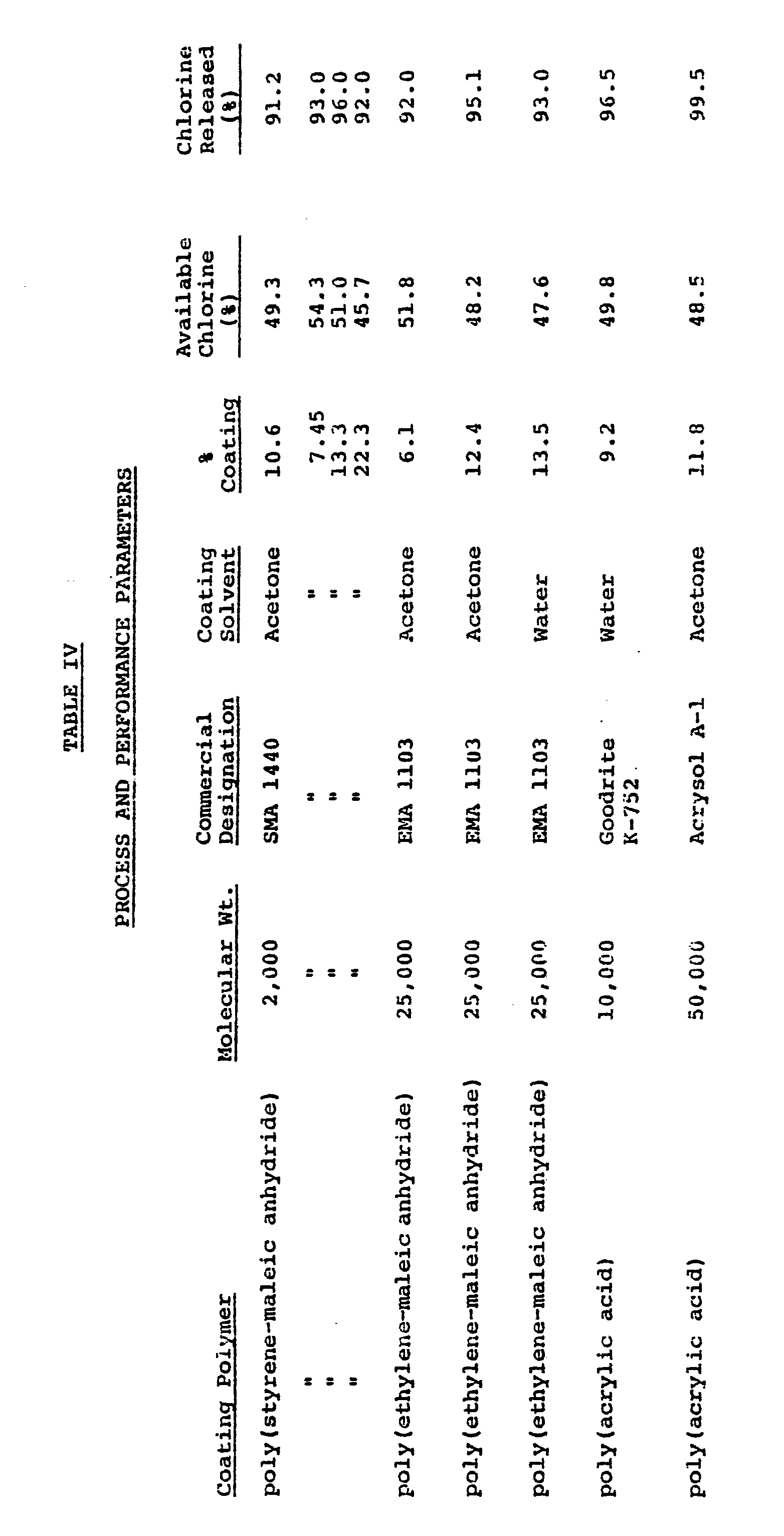
- Three liters of tap water were stirred in a 4 liter water jacketed beaker with a propeller type stirrer until the temperature reached 50°C. Automatic dishwashing base powder (11.1 gm) was added to reach a concentration of 4 gm/l and the powder stirred for 2 minutes at 300 RPM's. Base powder consisted of: 35% sodium tripolyphosphate, 30% sodium carbonate, 7% sodium silicate, 3% nonionic surfactant, 10% sodium sulfate and various minor miscellaneous ingredients. Encapsulated bleach particles were added to yield potentially 65 ppm available chlorine. Every 2 minutes thereafter a 100 gm aliquot was titrated for available chlorine by standard thiosulfate procedure.
- The results reported in Table IV are the available chlorine levels after 4 minutes.
- Each of the coated bleach samples prepared in Example 4 were mixed with base powder to yield about 150 gm of a dishwashing detergent containing 1% available chlorine. For each storage condition and time (e.g. 2 months) three samples were prepared with each of three lots of base powder giving a total of 6 samples (150 gm) for each test condition and time. The control was an uncoated sample of CDB-56 that was prescreened to the same particle size as the coated samples (pass #10 screen held on #25). The samples were placed in a chip board carton sealed and coated with an ethylene-vinyl acetate/wax on aluminum foil. Samples were stored under the following conditions.
- Room temperature ambient humidity
- 80°F/80% relative humidity
- 95°F/50% relative humidity
- 90°F to 125°F cycle - Periodically, samples were removed and analyzed for % available chlorine by a standard thiosulfate titration. Key results are summarized in Table V. Several points should be noted from these results. In general, all of the polymer coatings greatly improved the storage stability of the bleach relative to uncoated CDB-56 irregardless of their degree of hydrophobicity. However, the most hydrophobic polymer, SMA-butyl half ester, provided the broadest protection over the range of storage conditions employed, i.e., humidity and temperature.
- From the results in Table V for SMA, it appears that levels between about 5% and 15% are adequate coating levels. It is possible that still lower levels could be employed particularly if the coating is free of cracks.

- This Example illustrates the improved glassware performance of machine dishwashing compositions containing the encapsulated bleach particles of the present invention.
- Consumers judge performance of machine dishwashing compositions, to a large extent, on how well they leave glassware free of spots and film. Spotting and filming tests were run by the standard methods as reported in CSMA Test Method DCC-05A (12/81 - "Deposition on Glassware durig Mechanical Dishwashing"). Before evaluation, the compositions were aged for six months as part of the study described in Examples 4 and 5. Table VI records spotting performance. Formulations that contain unencapsulated bleach show a significant deterioration in their spotting performance. Premium commercial powders, it should be noted, have spotting performance equal to 1 on this test. Table VI demonstrates that encapsulating the bleach with selected polymers virtually eliminates deterioration of performance as a result of storage. This ensures fresh product characteristics. Overall SMA 1440 was seen to provide the best performance although the other coatings were also useful.

- Chlorine bleach stability is only one aspect of the benefits derived from coating the chlorine core particles. Now it has been found that the dishwashing composition color and odor are also stabilized by the particles of the present invention.
- Lemon motif commercially available automatic dishwashing base powder, before being dosed with chlorine bleach, is typically a vivid yellow powder with a striking lemon scent. After the hot moist powder is dosed with chlorine, however, the powder immediately begins to fade and its odor deteriorates rapidly. These undesirable interactions can be reduced by first conditioning the powder for several hours. Unfortunately, this slows production throughput and, in any event, would not alleviate long term ingredient interaction problems. Experiments with the encapsulated bleach particles of the present invention have been conducted to evaluate their performance when dosed into base powder not previously conditioned.
- Table VII demonstrates that the encapsulated bleach of the present invention substantially retains the crisp signals of the base powder.

- The foregoing description and examples illustrate selected embodiments of the present invention. In light thereof, various modifications will be suggested to one skilled in the art, all of which are within the spirit and purview of this invention.
Claims (9)
Applications Claiming Priority (2)
| Application Number | Priority Date | Filing Date | Title |
|---|---|---|---|
| US06/931,361 US4762637A (en) | 1986-11-14 | 1986-11-14 | Encapsulated bleach particles for machine dishwashing compositions |
| US931361 | 1986-11-14 |
Publications (3)
| Publication Number | Publication Date |
|---|---|
| EP0271992A2 true EP0271992A2 (en) | 1988-06-22 |
| EP0271992A3 EP0271992A3 (en) | 1989-03-08 |
| EP0271992B1 EP0271992B1 (en) | 1991-12-18 |
Family
ID=25460667
Family Applications (1)
| Application Number | Title | Priority Date | Filing Date |
|---|---|---|---|
| EP19870309962 Expired - Lifetime EP0271992B1 (en) | 1986-11-14 | 1987-11-11 | Machine dishwashing composition |
Country Status (9)
| Country | Link |
|---|---|
| US (2) | US4762637A (en) |
| EP (1) | EP0271992B1 (en) |
| JP (1) | JPS63154798A (en) |
| AU (1) | AU596240B2 (en) |
| BR (1) | BR8706135A (en) |
| CA (1) | CA1302834C (en) |
| DE (1) | DE3775364D1 (en) |
| ES (1) | ES2028103T3 (en) |
| ZA (1) | ZA878541B (en) |
Cited By (8)
| Publication number | Priority date | Publication date | Assignee | Title |
|---|---|---|---|---|
| EP0484081A3 (en) * | 1990-10-31 | 1992-09-09 | Unilever Plc | Antifoam ingredient |
| EP0834549A1 (en) * | 1996-10-07 | 1998-04-08 | The Procter & Gamble Company | Cleaning compositions |
| WO2000006686A1 (en) * | 1998-07-29 | 2000-02-10 | The Procter & Gamble Company | Detergent composition having a plasma-induced, water-soluble coating and process for making same |
| WO2000006687A1 (en) * | 1998-07-29 | 2000-02-10 | The Procter & Gamble Company | Particulate compositions having a plasma-induced, graft polymerized, water-soluble coating and process for making same |
| WO2000006685A1 (en) * | 1998-07-29 | 2000-02-10 | The Procter & Gamble Company | Particulate compositions having a plasma-induced, water-soluble coating and process for making same |
| WO2012066344A1 (en) * | 2010-11-19 | 2012-05-24 | Reckitt Benckiser N.V. | Dyed coated bleach materials |
| WO2017186263A1 (en) * | 2016-04-25 | 2017-11-02 | Henkel Ag & Co. Kgaa | Copolymers for improving the rinsing power |
| US20230042815A1 (en) * | 2021-07-29 | 2023-02-09 | Henkel IP & Holding GmbH | Powdered Cleaning Composition Having Improved Dissolution |
Families Citing this family (27)
| Publication number | Priority date | Publication date | Assignee | Title |
|---|---|---|---|---|
| US5160448A (en) * | 1987-12-30 | 1992-11-03 | Lever Brothers Company, Division Of Conopco, Inc. | Gel detergent compositions containing a clay and a cross-linked polycarboxylic polymer |
| US4836948A (en) * | 1987-12-30 | 1989-06-06 | Lever Brothers Company | Viscoelastic gel detergent compositions |
| US4919841A (en) * | 1988-06-06 | 1990-04-24 | Lever Brothers Company | Wax encapsulated actives and emulsion process for their production |
| US5100477A (en) * | 1989-05-15 | 1992-03-31 | Dow Corning Corporation | Decontamination of toxic chemical agents |
| US5126309A (en) * | 1989-05-15 | 1992-06-30 | Dow Corning Corporation | Decontamination of toxic chemical agents |
| US5200236A (en) * | 1989-11-15 | 1993-04-06 | Lever Brothers Company, Division Of Conopco, Inc. | Method for wax encapsulating particles |
| US5230822A (en) * | 1989-11-15 | 1993-07-27 | Lever Brothers Company, Division Of Conopco, Inc. | Wax-encapsulated particles |
| US5258132A (en) * | 1989-11-15 | 1993-11-02 | Lever Brothers Company, Division Of Conopco, Inc. | Wax-encapsulated particles |
| US5358653A (en) * | 1990-06-25 | 1994-10-25 | Ecolab, Inc. | Chlorinated solid rinse aid |
| JPH0823039B2 (en) * | 1990-07-13 | 1996-03-06 | エコラブ・インコーポレイテッド | Solid rinse aid from food grade ingredients |
| US5254283A (en) * | 1991-01-17 | 1993-10-19 | Genencor International, Inc. | Isophthalic polymer coated particles |
| US5114647A (en) * | 1991-02-01 | 1992-05-19 | Olin Corporation | Effervescent tablets having increased disintegration rates |
| US5576281A (en) * | 1993-04-05 | 1996-11-19 | Olin Corporation | Biogradable low foaming surfactants as a rinse aid for autodish applications |
| US5453216A (en) * | 1994-04-28 | 1995-09-26 | Creative Products Resource, Inc. | Delayed-release encapsulated warewashing composition and process of use |
| TW387937B (en) * | 1994-10-14 | 2000-04-21 | Olin Corp | Biodegradable surfactant and blends thereof as a rinse aid |
| GB2299956A (en) * | 1995-04-13 | 1996-10-23 | Procter & Gamble | Detergent compositions for dishwashers |
| US5925181A (en) * | 1996-04-08 | 1999-07-20 | Cook; Phillip Michael | pH-sensitive modified cellulose ester |
| US5929011A (en) * | 1996-10-30 | 1999-07-27 | Sunburst Chemicals, Inc. | Solid cast chlorinated cleaning composition |
| US5811121A (en) * | 1997-01-29 | 1998-09-22 | Eastman Chemical Company | PH-sensitive coatings based on cellulose acetoacetate |
| US6207074B1 (en) * | 1998-02-09 | 2001-03-27 | Chem Lab Products, Inc. | Quick release of chlorine from trichloroisocyanuric acid |
| US6475969B2 (en) | 2000-03-16 | 2002-11-05 | Sunburst Chemicals, Inc. | Solid cast chlorinated composition |
| WO2004046300A1 (en) * | 2002-11-14 | 2004-06-03 | The Procter & Gamble Company | Rinse aid containing encapsulated glasscare active salt |
| DE102005047833A1 (en) * | 2005-10-05 | 2007-04-19 | Basf Ag | Process for the preparation of granular or powdered detergent compositions |
| US20140308162A1 (en) | 2013-04-15 | 2014-10-16 | Ecolab Usa Inc. | Peroxycarboxylic acid based sanitizing rinse additives for use in ware washing |
| US9752105B2 (en) | 2012-09-13 | 2017-09-05 | Ecolab Usa Inc. | Two step method of cleaning, sanitizing, and rinsing a surface |
| WO2017177211A1 (en) * | 2016-04-08 | 2017-10-12 | Battelle Memorial Institute | Encapsulation compositions |
| US11078450B2 (en) | 2016-04-22 | 2021-08-03 | Shikoku Chemicals Corporation | Material containing solid bleaching agent, and detergent composition |
Family Cites Families (32)
| Publication number | Priority date | Publication date | Assignee | Title |
|---|---|---|---|---|
| LU34828A1 (en) * | 1955-12-19 | |||
| BE597383A (en) * | 1959-11-24 | |||
| US3634260A (en) * | 1962-02-09 | 1972-01-11 | Colgate Palmolive Co | Bleaching packets |
| US3380922A (en) * | 1965-09-23 | 1968-04-30 | Purex Corp Ltd | Spray dried products |
| US3579455A (en) * | 1968-08-02 | 1971-05-18 | Grace W R & Co | Machine dishwashing compositions containing sodium polyacrylate |
| BE744162A (en) * | 1969-01-16 | 1970-06-15 | Fuji Photo Film Co Ltd | ENCAPSULATION PROCESS |
| US3576760A (en) * | 1969-06-13 | 1971-04-27 | Nat Patent Dev Corp | Water soluble entrapping |
| US3647523A (en) * | 1969-08-28 | 1972-03-07 | Diamond Shamrock Corp | Coated chlorine-generating materials for treating fluids |
| BE755354A (en) * | 1969-08-29 | 1971-03-01 | Fuji Photo Film Co Ltd | MICROCAPSULE CONTAINING DETERGENT ENZYME AND PROCESS FOR ITS MANUFACTURING |
| LU66925A1 (en) * | 1973-01-29 | 1974-09-25 | ||
| US3666680A (en) * | 1970-03-05 | 1972-05-30 | Purex Corp Ltd | Method of combining optical brighteners with polymers for stability in bleach and encapsulated product |
| DE2101508C3 (en) * | 1971-01-14 | 1979-05-17 | Henkel Kgaa, 4000 Duesseldorf | Dishwashing liquid |
| JPS5247130B2 (en) * | 1972-06-21 | 1977-11-30 | ||
| DE2263939C2 (en) * | 1972-07-03 | 1983-01-13 | Henkel KGaA, 4000 Düsseldorf | Bleach activator tablets suitable for use in laundry detergents containing perhydrates |
| US3887480A (en) * | 1972-09-08 | 1975-06-03 | Economics Lab | Detergent compositions and methods of making and using them |
| US3908045A (en) * | 1973-12-07 | 1975-09-23 | Lever Brothers Ltd | Encapsulation process for particles |
| DE2413561A1 (en) * | 1974-03-21 | 1975-10-02 | Henkel & Cie Gmbh | STORAGE-RESISTANT, EASILY-RELEASE DETERGENT ADDITIVE AND METHOD FOR MANUFACTURING IT |
| US4078099A (en) * | 1976-08-25 | 1978-03-07 | Lever Brothers Company | Encapsulated bleaches and methods for their preparation |
| DE3016170A1 (en) * | 1980-04-26 | 1981-10-29 | Bayer Ag, 5090 Leverkusen | MICROCAPSULES WITH A DEFINED OPENING TEMPERATURE, METHOD FOR THE PRODUCTION AND USE THEREOF |
| US4409117A (en) * | 1980-12-17 | 1983-10-11 | Eka Ab | Detergent compositions stable to chlorine separation, and agents for producing same |
| US4725378A (en) * | 1982-03-22 | 1988-02-16 | The Dow Chemical Company | Systems for delayed release of bleaching agents |
| US4421664A (en) * | 1982-06-18 | 1983-12-20 | Economics Laboratory, Inc. | Compatible enzyme and oxidant bleaches containing cleaning composition |
| US4455249A (en) * | 1982-10-21 | 1984-06-19 | Colgate-Palmolive Company | Stabilized bleach and laundering composition |
| GB8304990D0 (en) * | 1983-02-23 | 1983-03-30 | Procter & Gamble | Detergent ingredients |
| FR2548683B1 (en) * | 1983-07-08 | 1986-02-21 | Charbonnages Ste Chimique | NEW LAUNDRY COMPOSITIONS SUITABLE FOR WASHING DISHWASHER IN A WASHING MACHINE |
| GB8332682D0 (en) * | 1983-12-07 | 1984-01-11 | Procter & Gamble | Laundry additive products |
| US4486327A (en) * | 1983-12-22 | 1984-12-04 | The Procter & Gamble Company | Bodies containing stabilized bleach activators |
| JPS6128597A (en) * | 1984-07-20 | 1986-02-08 | ライオン株式会社 | Laundry aid composition |
| JPS6128441A (en) * | 1984-07-20 | 1986-02-08 | Lion Corp | Preparation of ph-responsive microcapsule |
| US4713079A (en) * | 1985-12-31 | 1987-12-15 | Lever Brothers Company | Particles containing dihalohydantoin bleach in a diluted core |
| US4657784A (en) * | 1986-03-10 | 1987-04-14 | Ecolab Inc. | Process for encapsulating particles with at least two coating layers having different melting points |
| US4759956A (en) * | 1987-05-22 | 1988-07-26 | Lever Brothers Company | Process for encapsulating particles using polymer latex |
-
1986
- 1986-11-14 US US06/931,361 patent/US4762637A/en not_active Expired - Fee Related
-
1987
- 1987-11-10 CA CA000551477A patent/CA1302834C/en not_active Expired - Fee Related
- 1987-11-10 AU AU80974/87A patent/AU596240B2/en not_active Ceased
- 1987-11-11 DE DE8787309962T patent/DE3775364D1/en not_active Expired - Fee Related
- 1987-11-11 ES ES198787309962T patent/ES2028103T3/en not_active Expired - Lifetime
- 1987-11-11 EP EP19870309962 patent/EP0271992B1/en not_active Expired - Lifetime
- 1987-11-13 BR BR8706135A patent/BR8706135A/en unknown
- 1987-11-13 JP JP62287180A patent/JPS63154798A/en active Pending
- 1987-11-13 ZA ZA878541A patent/ZA878541B/en unknown
-
1988
- 1988-05-10 US US07/192,429 patent/US4863632A/en not_active Expired - Lifetime
Cited By (15)
| Publication number | Priority date | Publication date | Assignee | Title |
|---|---|---|---|---|
| EP0484081A3 (en) * | 1990-10-31 | 1992-09-09 | Unilever Plc | Antifoam ingredient |
| EP0834549A1 (en) * | 1996-10-07 | 1998-04-08 | The Procter & Gamble Company | Cleaning compositions |
| US6462012B1 (en) | 1998-07-29 | 2002-10-08 | The Procter & Gamble Company | Detergent composition having a plasma-induced, water soluble coating and process for making same |
| WO2000006687A1 (en) * | 1998-07-29 | 2000-02-10 | The Procter & Gamble Company | Particulate compositions having a plasma-induced, graft polymerized, water-soluble coating and process for making same |
| WO2000006685A1 (en) * | 1998-07-29 | 2000-02-10 | The Procter & Gamble Company | Particulate compositions having a plasma-induced, water-soluble coating and process for making same |
| US6440918B1 (en) | 1998-07-29 | 2002-08-27 | The Procter & Gamble Company | Particulate compositions having a plasma-induced, graft polymerized, water-soluble coating and process for making same |
| WO2000006686A1 (en) * | 1998-07-29 | 2000-02-10 | The Procter & Gamble Company | Detergent composition having a plasma-induced, water-soluble coating and process for making same |
| US6677290B2 (en) | 1998-07-29 | 2004-01-13 | Procter & Gamble Company | Particulate compositions having a plasma-induced, graft polymerized, water-soluble coating and process for making same |
| US6716806B2 (en) | 1998-07-29 | 2004-04-06 | The Procter & Gamble Company | Detergent composition having a plasma-induced, water-soluble coating and process for making same |
| WO2012066344A1 (en) * | 2010-11-19 | 2012-05-24 | Reckitt Benckiser N.V. | Dyed coated bleach materials |
| US9796954B2 (en) | 2010-11-19 | 2017-10-24 | Reckitt Benckiser Finish B.V. | Dyed coated bleach materials |
| US10240113B2 (en) | 2010-11-19 | 2019-03-26 | Reckitt Benckiser Finish B.V. | Dyed coated bleach materials |
| WO2017186263A1 (en) * | 2016-04-25 | 2017-11-02 | Henkel Ag & Co. Kgaa | Copolymers for improving the rinsing power |
| US20230042815A1 (en) * | 2021-07-29 | 2023-02-09 | Henkel IP & Holding GmbH | Powdered Cleaning Composition Having Improved Dissolution |
| US12398349B2 (en) * | 2021-07-29 | 2025-08-26 | Henkel Ag & Co. Kgaa | Powdered cleaning composition having improved dissolution |
Also Published As
| Publication number | Publication date |
|---|---|
| BR8706135A (en) | 1988-06-21 |
| EP0271992A3 (en) | 1989-03-08 |
| EP0271992B1 (en) | 1991-12-18 |
| AU8097487A (en) | 1988-05-19 |
| US4762637A (en) | 1988-08-09 |
| CA1302834C (en) | 1992-06-09 |
| JPS63154798A (en) | 1988-06-28 |
| DE3775364D1 (en) | 1992-01-30 |
| ZA878541B (en) | 1989-07-26 |
| ES2028103T3 (en) | 1992-07-01 |
| AU596240B2 (en) | 1990-04-26 |
| US4863632A (en) | 1989-09-05 |
Similar Documents
| Publication | Publication Date | Title |
|---|---|---|
| EP0271992B1 (en) | Machine dishwashing composition | |
| US5141664A (en) | Clear detergent gel compositions having opaque particles dispersed therein | |
| US5229027A (en) | Aqueous liquid automatic dishwashing detergent composition comprising hypochlorite bleach and an iodate or iodide hypochlorite bleach stabilizer | |
| CA1151808A (en) | Liquid, thickened chlorine bleaching composition | |
| US4532063A (en) | Dissolvable bleach sheet | |
| EP0292314B1 (en) | Process for encapsulating particles using polymer latex | |
| US5185096A (en) | Aqueous liquid automatic dishwashing detergent composition comprising hypochlorite bleach and bleach stabilizer | |
| US4129423A (en) | Stable liquid abrasive composition suitable for removing manganese-ion derived discolorations from hard surfaces | |
| CA1307369C (en) | Thixotropic clay aqueous suspensions containing polyacrylic acid polymer or copolymer stabilizers | |
| CA2066871C (en) | Wax-encapsulated particles and method for making same | |
| US3701735A (en) | Automatic dishwashing compositions | |
| CA1095802A (en) | Cleansing composition | |
| CA1259543A (en) | Method for forming solid detergent compositions | |
| CA1305641C (en) | Thixotropic clay aqueous suspensions containing long chain saturated fatty acid stabilizers | |
| US5094771A (en) | Nonaqueous liquid automatic dishwasher detergent composition | |
| US4973419A (en) | Hydrated alkali metal phosphate and silicated salt compositions | |
| EP0323209B1 (en) | Detergent compositions | |
| JPS62295998A (en) | Concentrated non-phosphorus type pasty detergent composition | |
| CA2084172A1 (en) | Process for preparing powdered detergent compositions | |
| US5108641A (en) | Aqueous liquid automatic dishwasher detergent composition containing dual bleach system | |
| US5205954A (en) | Automatic dishwasher powder detergent composition | |
| US3494868A (en) | Dishwashing composition and method of using same | |
| JPH07103399B2 (en) | Solid casting composition for cleaning equipment | |
| EP0436971B1 (en) | Wax encapsulated bleach particles and method for making same | |
| CA1131095A (en) | Dishwashing composition and method of making the same |
Legal Events
| Date | Code | Title | Description |
|---|---|---|---|
| PUAI | Public reference made under article 153(3) epc to a published international application that has entered the european phase |
Free format text: ORIGINAL CODE: 0009012 |
|
| AK | Designated contracting states |
Kind code of ref document: A2 Designated state(s): CH DE ES FR GB IT LI NL SE |
|
| PUAL | Search report despatched |
Free format text: ORIGINAL CODE: 0009013 |
|
| AK | Designated contracting states |
Kind code of ref document: A3 Designated state(s): CH DE ES FR GB IT LI NL SE |
|
| 17P | Request for examination filed |
Effective date: 19890221 |
|
| 17Q | First examination report despatched |
Effective date: 19900502 |
|
| GRAA | (expected) grant |
Free format text: ORIGINAL CODE: 0009210 |
|
| AK | Designated contracting states |
Kind code of ref document: B1 Designated state(s): CH DE ES FR GB IT LI NL SE |
|
| REF | Corresponds to: |
Ref document number: 3775364 Country of ref document: DE Date of ref document: 19920130 |
|
| ET | Fr: translation filed | ||
| ITF | It: translation for a ep patent filed | ||
| REG | Reference to a national code |
Ref country code: ES Ref legal event code: FG2A Ref document number: 2028103 Country of ref document: ES Kind code of ref document: T3 |
|
| PLBE | No opposition filed within time limit |
Free format text: ORIGINAL CODE: 0009261 |
|
| STAA | Information on the status of an ep patent application or granted ep patent |
Free format text: STATUS: NO OPPOSITION FILED WITHIN TIME LIMIT |
|
| PG25 | Lapsed in a contracting state [announced via postgrant information from national office to epo] |
Ref country code: GB Effective date: 19921111 |
|
| PG25 | Lapsed in a contracting state [announced via postgrant information from national office to epo] |
Ref country code: SE Effective date: 19921112 Ref country code: ES Free format text: LAPSE BECAUSE OF THE APPLICANT RENOUNCES Effective date: 19921112 |
|
| PG25 | Lapsed in a contracting state [announced via postgrant information from national office to epo] |
Ref country code: LI Effective date: 19921130 Ref country code: CH Effective date: 19921130 |
|
| RAP4 | Party data changed (patent owner data changed or rights of a patent transferred) |
Owner name: UNILEVER N.V. Owner name: UNILEVER PLC |
|
| 26N | No opposition filed | ||
| PG25 | Lapsed in a contracting state [announced via postgrant information from national office to epo] |
Ref country code: NL Effective date: 19930601 |
|
| GBPC | Gb: european patent ceased through non-payment of renewal fee |
Effective date: 19921111 |
|
| NLV4 | Nl: lapsed or anulled due to non-payment of the annual fee | ||
| PG25 | Lapsed in a contracting state [announced via postgrant information from national office to epo] |
Ref country code: FR Effective date: 19930730 |
|
| REG | Reference to a national code |
Ref country code: CH Ref legal event code: PL |
|
| PG25 | Lapsed in a contracting state [announced via postgrant information from national office to epo] |
Ref country code: DE Effective date: 19930803 |
|
| REG | Reference to a national code |
Ref country code: FR Ref legal event code: ST |
|
| EUG | Se: european patent has lapsed |
Ref document number: 87309962.6 Effective date: 19930610 |
|
| REG | Reference to a national code |
Ref country code: ES Ref legal event code: FD2A Effective date: 20010402 |
|
| PG25 | Lapsed in a contracting state [announced via postgrant information from national office to epo] |
Ref country code: IT Free format text: LAPSE BECAUSE OF NON-PAYMENT OF DUE FEES;WARNING: LAPSES OF ITALIAN PATENTS WITH EFFECTIVE DATE BEFORE 2007 MAY HAVE OCCURRED AT ANY TIME BEFORE 2007. THE CORRECT EFFECTIVE DATE MAY BE DIFFERENT FROM THE ONE RECORDED. Effective date: 20051111 |