EP0272060A2 - Récupération hydrométallurgique de métaux et de soufre élémentaire à partir de sulfures métalliques - Google Patents
Récupération hydrométallurgique de métaux et de soufre élémentaire à partir de sulfures métalliques Download PDFInfo
- Publication number
- EP0272060A2 EP0272060A2 EP87310905A EP87310905A EP0272060A2 EP 0272060 A2 EP0272060 A2 EP 0272060A2 EP 87310905 A EP87310905 A EP 87310905A EP 87310905 A EP87310905 A EP 87310905A EP 0272060 A2 EP0272060 A2 EP 0272060A2
- Authority
- EP
- European Patent Office
- Prior art keywords
- stage
- solution
- leach
- zinc
- gas
- Prior art date
- Legal status (The legal status is an assumption and is not a legal conclusion. Google has not performed a legal analysis and makes no representation as to the accuracy of the status listed.)
- Withdrawn
Links
Images
Classifications
-
- C—CHEMISTRY; METALLURGY
- C22—METALLURGY; FERROUS OR NON-FERROUS ALLOYS; TREATMENT OF ALLOYS OR NON-FERROUS METALS
- C22B—PRODUCTION AND REFINING OF METALS; PRETREATMENT OF RAW MATERIALS
- C22B11/00—Obtaining noble metals
- C22B11/04—Obtaining noble metals by wet processes
-
- C—CHEMISTRY; METALLURGY
- C22—METALLURGY; FERROUS OR NON-FERROUS ALLOYS; TREATMENT OF ALLOYS OR NON-FERROUS METALS
- C22B—PRODUCTION AND REFINING OF METALS; PRETREATMENT OF RAW MATERIALS
- C22B13/00—Obtaining lead
- C22B13/04—Obtaining lead by wet processes
-
- C—CHEMISTRY; METALLURGY
- C22—METALLURGY; FERROUS OR NON-FERROUS ALLOYS; TREATMENT OF ALLOYS OR NON-FERROUS METALS
- C22B—PRODUCTION AND REFINING OF METALS; PRETREATMENT OF RAW MATERIALS
- C22B19/00—Obtaining zinc or zinc oxide
- C22B19/20—Obtaining zinc otherwise than by distilling
- C22B19/22—Obtaining zinc otherwise than by distilling with leaching with acids
-
- C—CHEMISTRY; METALLURGY
- C22—METALLURGY; FERROUS OR NON-FERROUS ALLOYS; TREATMENT OF ALLOYS OR NON-FERROUS METALS
- C22B—PRODUCTION AND REFINING OF METALS; PRETREATMENT OF RAW MATERIALS
- C22B3/00—Extraction of metal compounds from ores or concentrates by wet processes
- C22B3/04—Extraction of metal compounds from ores or concentrates by wet processes by leaching
- C22B3/06—Extraction of metal compounds from ores or concentrates by wet processes by leaching in inorganic acid solutions, e.g. with acids generated in situ; in inorganic salt solutions other than ammonium salt solutions
- C22B3/08—Sulfuric acid, other sulfurated acids or salts thereof
-
- Y—GENERAL TAGGING OF NEW TECHNOLOGICAL DEVELOPMENTS; GENERAL TAGGING OF CROSS-SECTIONAL TECHNOLOGIES SPANNING OVER SEVERAL SECTIONS OF THE IPC; TECHNICAL SUBJECTS COVERED BY FORMER USPC CROSS-REFERENCE ART COLLECTIONS [XRACs] AND DIGESTS
- Y02—TECHNOLOGIES OR APPLICATIONS FOR MITIGATION OR ADAPTATION AGAINST CLIMATE CHANGE
- Y02P—CLIMATE CHANGE MITIGATION TECHNOLOGIES IN THE PRODUCTION OR PROCESSING OF GOODS
- Y02P10/00—Technologies related to metal processing
- Y02P10/20—Recycling
Definitions
- This invention relates to the oxidative leaching of metal sulphides, for example zinc sulphide concentrate, in sulphuric acid solution in the presence of an oxidizing agent comprising oxides of nitrogen.
- the invention employs nitric/sulphuric acid mixtures.
- this invention relates to the recovery of the oxidant, NO/NO2, and substantially complete removal of residual oxides of nitrogen (principally nitrate) from solution.
- the conventional route for processing metal sulphides containing ores or concentrates of zinc and other valuable metals involves roasting, leaching, solution purification and electrowinning.
- sulphur present as sulphide in the ore or concentrate is converted to sulphur dioxide and for both economic and environmental reasons this is normally converted into sulphuric acid.
- the solid product from the roasting operation termed calcine, is then leached in a dilute sulphuric acid solution, termed spent electrolyte, which is recycled from the electrowinning step.
- the solution passes to electrolytic cells where zinc metal is electrowon and sulphuric acid is regenerated as spent electrolyte which is recycled back to react with further calcine.
- a further disadvantage to conventional processing is that the roasting operation, particularly in fluid bed roasters, is dependent on a supply of reasonably high grade ores or concentrates. Such materials are becoming increasingly less plentiful and this trend is expected to continue as higher grade ore deposits become worked out. As the feed stock and quality decreases more problems are experienced in the roasting operation and in achieving high recoveries of contained metals. For example, roasting of zinc concentrates containing more than 5% of copper plus lead plus silica in a fluidized bed roaster is extremely difficult due to bed agglomeration.
- Direct leaching of metal sulphide ores or concentrate has a number of advantages over conventional processing routes particularly when used in combination with conventional processing.
- Oxidative direct leaching is a process by which, in the presence of a suitable oxidizing agent, simple metal sulphides will dissolve in mineral acids to yield a metal salt solution and elemental sulphur.
- the nitric/sulphuric acid system has been proposed as one method of direct leaching.
- use is made of the reaction of MS and NO2 via reactions such as: MS + NO2 + H2SO4 ⁇ MSO4 + NO + S0 + H2O 3MS + 2HNO3 + 3H2SO4 ⁇ 3MSO4 + 3S0 + 2NO + 4H2O MS + 2HNO3 + H2SO4 ⁇ MSO4 + S0 + 2NO2 + 2H2O where M metal e.g. Cu, Zn).
- the NO liberated can then be oxidized with O2 for reuse and reabsorbed to form HNO3 is so required.
- the reaction is catalytic which respect to the oxidant.
- ferrous ions react with NO3 - according to the equation: 3Fe2+ + NO3 ⁇ + 4H+ ⁇ 3Fe3+ + NO + 2H2O.
- a significant drawback to the typical pressure leach treatment of zinc concentrates is the ease with which iron in many finely divided concentrates dissolves in the autoclave and then rapidly precipitates as a jarosite.
- the presence of alkali metal or ammonium ions in the spent electrolyte used as repulp liquor for the autoclave feed also facilitates the precipitation of jarositic materials. The result is severe contamination of the lead/silver residue remaining after dissolution of the zinc.
- An object of the present invention is to overcome the technical difficulties encountered in existing processes, to avoid the use of high pressure autoclaves with their associated high capital cost and to achieve a cost effective procedure through recycling and regeneration of the oxidant. Further objects of the present invention in its preferred aspects are:
- the first stage leach solution, containing a high concentration of NO3 ⁇ ions is reaced with an excess of fresh concentrates in the second stage so that NO gas is generated according to the following equation: 3ZnS + 2NO3 ⁇ + 8H+ ⁇ 3Zn2+ + 3S0 + 4H2O + 2NO ⁇
- the evolved NO gas is then mixed with oxygen or an oxygen containing gas to convert it into NO2 gas for recycle to the first stage leach.
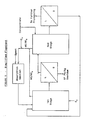
- a preferred leaching and gas recirculation flowsheet is outlined in the drawing Figure 1.
- acidic spent electrolyte as the carrier for recycled NO2 is very convenient because the spent electrolyte, generated during recovery of zinc by electrolysis, has to be added to the first stage leach reactors to act as the leachant for the zinc sulphide concentrate.
- the process of the present invention is not restricted to commercial grade oxygen.
- it may be preferably to use air rather than commercial grade oxygen, in which case prior compression of the NO x gases and air before scrubbing of the resultant NO2 gas in the spray towers would be advantageous. In this case operating the absorption towers above atmospheric pressure would probably be necessary.
- the residual first stage leach solids will contain both elemental sulphur and a lead/silver residue. Separation of these two components must be achieved to provide marketable products. It is shown in Examples 9(a) and 9(b) the both flotation and hydrocyclone classification can be used to separate and recover the two fractions while a high grade elemental sulphur may be generated by melting and filtering the sulphur concentrate. The purity of the elemental sulphur so produced is equal to or of higher purity than elemental sulphur produced via the pressure leaching route.
- nitrate levels of ⁇ 1 g/L are produced.
- nitrate levels of less than about 1 mg/L are necessary. We have found that this can be achieved by use of a suitable reducing agent.
- nitrate may be reduced by certain metals or alloys, but in neutral or acidic solution, reduction normally only proceeds as far as the nitrite ion, and this observation has been used for analysis of nitrate ions in waste water (J.H. Margeson, J.C. Suggs, M.R. Midgett, Anal. Chem. 1980, 52, 1955-157 - Reduction of Nitrate to Nitrite with Cadmium).
- the addition of metallic zinc results in substantially complete reduction of nitrate, nitrogen and ammonia being the principal products.
- zinc dust or finely divided cementates containing zinc or copper-activated cadmium are very effective reductants, zinc dross or zinc prills can also be used and would represent a cheaper alternative.
- the use of various reductants is illustrated in Example 8.
- Ammonium ions are present in the Risdon zinc plant circuit solutions since ammonia is deliberately added in another section of the main plant to precipitate jarosite. However, sodium ions could be readily substituted for ammonium ions for this purpose, and this is common practice in many zinc plants around the world.
- the results of pilot plant testwork employing ammonia-free solutions are included in Example 10. In this example it was shown that zinc extractions in excess of 95% may be achieved and that an acceptable grade of lead residue and elemental sulphur may be generated by further processing of the leach residue. A residual nitrate level in product leach solution of no more than 1.0 g/L was obtained. Electrolysis of the leach solution after purification by conventional means and removal of nitrate yielded a current efficiency of 91%. In other examples zinc extractions greater than 99.5% have been achieved.
- At least three conceptual flowsheets are possible depending on the form in which iron is to be precipitated. These are, precipitation of iron as goethite, hematite or jarosite, using well known procedures, but the present invention is not limited to these particular circuits.
- Another advantage of these two circuits is that the opportunity exists for inclusion, if required, of an arsenic removal step, ahead of the iron precipitation step using well known procedures.
- a third stage leach is unnecessary and it is preferable to include a preneutralization stage in which zinc oxide calcine or an alternative neutralizing agent is used to neutralize excess acidity ahead of the jarosite precipitation stage.
- the nitrate reduction stage is incorporated after the iron removal stage. It is envisaged that the process of the present invention would be most suited to expansion of, or incorporation into an existing roast-leach-electrowin operation in which case the existing zinc dust purification sections of the main electrolytic zinc plant circuit can be used as the nitrate reducing step.
- the process of the present invention is particularly applicable to the leaching of high grade zinc sulphide concentrate, with treatment of the resultant leach solution in an electrolytic zinc plant circuit, in no way is the process limited to this particular arrangement and raw materials.
- the process can with advantage be used for the treatment of bulk concentrates, and it should also be applicable to fine grained complex ores.
- the operating conditions, the fineness of the raw materials and the subsequent treatment of the leach solutions to recover metal values have to be modified to suit the particular raw materials and to maximise the extraction and recovery of dissolved valuable metals.
- the process of the present invention is concerned with recovering valuable metals from metal sulphide containing ores or concentrates with the simultaneous production of elemental sulphur and a high grade residue containing enhanced levels of valuable metal such as lead, silver and gold characterized by leaching counter currently in at least two stages the metal sulphide containing material in a dilute sulphuric acid solution in the presence of an oxidizing agent containing oxides of nitrogen and an oxygen containing gas at a temperature not exceeding the boiling point of the solution at atmospheric pressure, recovering any evolved gases by scrubbing said gases with tank house spent electrolyte preferably at atmospheric pressure and passing the dilute nitric acid/sulphuric acid solution so produced to the first stage leach, separating undissolved residue and elemental sulphur from the first stage leach solution and contacting said first stage leach solution with fresh concentrate, semibatchwise, at a temperature not exceeding the boiling point at atmospheric pressure thereby producing a leach solution containing a low concentration of nitrate ions, and after
- the oxidant used in the process consists of nitrogen dioxide gas, nitric acid, a mixture of nitric oxide and oxygen containing gas or a salt of nitric acid or any combination of the aforesaid oxidants.
- the process of the present invention is concerned with the leaching of zinc sulphide concentrate, in electrolytic zinc plant spent electrolyte containing dilute nitric acid formed by scrubbing nitrogen dioxide gas generated by oxidizing oxides of nitrogen gas evolved from the leach reactors with commercial grade oxygen gas, any losses of nitric acid being made up by the addition of a nitrate salt such as sodium nitrate, precipitating and separating dissolved iron as a jarosite compound thereby producing a leach solution which is treated with zinc dust to reduce nitrate levels to acceptably low levels such that the dissolved zinc can be recovered electrolytically at a high current efficiency in a conventional electrolytic zinc plant circuit, while at the same time producing a high grade lead/silver containing residue and elemental sulphur, also of high grade, both of which can be sold or further processed.
- a nitrate salt such as sodium nitrate
- the concentrate used throughout these examples is as received zinc concentrate, generated at the Elura mine of the Electrolytic Zinc Company of Australasia Limited (E.Z.).
- This example illustrates the zinc extraction and metal recoveries obtainable from direct leaching of zinc concentrate with HNO3/H2SO4 solution in the first stage leach.
- This example illustrates typical changes in solution composition which occur in a first stage leach of partially leached zinc sulphide concentrates using 4 stirred tank reactors in series, with injection of commercial oxygen gas beneath the impellers.
- composition of the starting solution was: H2SO4* 202.4 g/L Zn 45 g/L Fe3+ ⁇ 5 mg/L NO3 ⁇ 742 43 g/L * includes HNO3
- This example demonstrates the second stage leach in which solution from Example 2 was contacted with fresh concentrate in a batch reactor.
- the concentrate was added to the reactor over a period of 10 minutes and after a further 80 minutes reaction the partially leached solids were separated from the solution and returned to the first stage.
- the NO/NO2 gas mixture evolved from the second stage leach was reacted with O2 to convert all the oxides of nitrogen completely into NO2, which was then absorbed into spent electrolyte.
- This example demonstrates the second stage leach when operated in a continuous manner.
- Example 3 demonstrates the third stage leach.
- the solution from Example 3 was contacted with fresh zinc concentrate to convert the ferric iron to ferrous iron according to the following equation: ZnS + 2Fe3+ ⁇ S° + Zn2+ + 2Fe2+.
- This example illustrates negligible reduction in the nitrate level, a small drop in sulphiric acid concentration and major reduction of ferric to ferrous iron.
- Nitric oxide and oxygen gas were used as the oxidant which was sparged into the first stage reaction vessel - a 5 litre stirred tank reactor.
- the first stage was operated at 85°C for 4 hours using solids recycled from the second stage.
- the second stage leach was operated at 95°C using stockpiled first stage leach filtrate to which was added steadily over a period of 30 minutes 150 g/L of fresh zinc concentrate.
- the second batch leach was then continued for a further 1 hour before the solids were separated off by filtration.
- Off-gas produced in the leach reactors was simulated by using pure NO gas from a cylinder. Commercial grade oxygen gas was also used.
- the experimental set-up consisted of a gas premixing vessel (5 L) connected to two void spray towers connected in series (20 L and 11 L capacity, respectively). Constant volumes of spent electrolyte (5 L and 3 L, respectively) were recirculated separately over each tower at a rate of 30-50 L/min. The temperature of gas in the premixing vessel was 70°C. The temperature of the spent electrolyte was 30°C.
- Oxygen gas (5.5 L/min) and NO gas (7.5 L/min) were premixed and were scrubbed in the two towers over a period of 1 hour to give a nitrate level of 238.1 g/L. This level is comparable, within an experimental error of ⁇ 5%, to the theoretical nitrate ion concentration of 227.8 g/L which would be obtained if there was complete absorption.
- the leach solution after removal of iron and other impurities such as arsenic, must be further purified prior to electrolysis for recovery of zinc. Apart from nitrate ion, other minor metallic impurities such as Cu and Cd must also be eliminated.
- the purification was carried out in 3 x 6 L continuously operated stirred tank reactors at a temperature of 80°C and solution flow rate of 18 L/h.
- the impure solution contained CU2+ (320 mg/L), Cd2+ (215 mg/L), Zn2+ (150 g/L) and NO3 ⁇ (0.953 g/L) and additional sulphuric acid was added to raise the acidity to 7.0 g H2SO4/L.
- Zinc dust was metered into the first reactor with the solution at a rate of 150 g Zn/hour corresponding to an 8:1 mole ratio of zinc to nitrate ion. After equilibration and filtration the product solution gave the following analysis: 0.6 mg Cu/L, 200 mg Cd/L and ⁇ 5 mg NO3 ⁇ /L (which is below the lower limit of detection using a U.V. absorption analytical method).
- impure solution containing 420 mg Cu/L, 210 mg Cd/L, 1.21 g NO3 ⁇ /L and 7.0 g H2SO4/L was pre-heated to 80°C and continuously pumped at 4 L/h through a heated 4 L plastic column rector containing 10 kg of zinc prills. Over a 48 hour period filtered solution of the following composition was obtained: 2 mg Cu/L, 3.4 mg Cd/L and ⁇ 5 mg NO3 ⁇ /L (which is below the detection limit for NO3 ⁇ using a U.V. absorption analytical method).
- the initial solution composition was: Cu 225 mg/L, Cd 300 mg/L, Co 35 mg/L, Zn 120 g/L, NO3 ⁇ 300 mg/L (doped with NaNO3).
- Cadmium metal filings were cleaned with zinc plant spent electrolyte, washed with water than stirred in a 10% CuSO4 solution until the cadmium blackened. Addition of this alloy (3.5 g/L) to plant cell feed solution doped with NaNO3 (300 mg NO3 ⁇ /L) and reaction for 1 hour at 85°C resulted in removal of 98.4% of the NO3 ⁇ with formation of only a trace of NO2 ⁇ .
- Nitrogen gas has in fact been detected in the gas phase and it has been found that treatment of an acidic nitrate-doped zinc sulphate solution with zinc dust results in approximately 50% of the nitrate forming NH4+ ions and 50% forming N2 (gas).
- This example illustrates the separation and recovery of elemental sulphur and lead/silver residue fractions from the 1st stage residual solids by flotation.
- Washed and dried 1st stage residual solids (225 g) were suspended in water (1.5 litres) in a 2 litre laboratory flotation cell. Flotation was carried out without reagents at a pH of 5, using an input air flow at the cell of 0.5 L/min. The overflow from the cell, the elemental sulphur concentrate, was collected and dried. After flotation was complete, the pulp remaining in the cell was collected, filtered and was dried to afford the lead/silver residue. A portion of the elemental sulphur concentrate was melted at 140° and was filtered under vacuum. The filtrate, consisting of purified elemental sulphur was collected and was allowed to cool and solidify. The following analytical results were achieved:
- This example illustrates the separation and recovery of elemental sulphur and lead/silver residue fractions from the 1st stage solids by hydrocyclone classification.
- Washed and dried lst stage solids (160 g) were suspended in water with a little detergent added, and this pulp was introduced into a bank of 5 hydrocyclones connected in series.
- a portion of the element sulphur concentrate, corresponding to a particle size range of approximately 20 to 30 ⁇ m was melted at 140° and was filtered under vacuum.
- the filtrate, consisting of purified elemental sulphur was collected and was allowed to cool and solidify.
- the following analytical results were achieved:
- a small scale pilot plant was constructed and operated to test two of the three leaching stages and gas recirculation/absorption steps.
- the equipment was sized to process 3.2 kg of zinc concentrate/h at a spent electrolyte flow rate of 20 L/h.
- the two leaching stages and gas absorption stage are briefly described as follows:
- Vessels of 250 L capacity were provided for interstage pulp/solution storage and 2 x 10 m3 vessels were used for storage of product solution and feed spent electrolyte.
- Vessels in the first and second stages were provided with gas vents and ducting to the absorption towers and each vessel was made air-tight and equipped with water seals about the impeller shafts.
- the majority of the pilot plant vessels were constructed in FRP with 316 L stainless steel internals. Reactors were fitted with coils through which steam or cooling water could be circulated.
- the absorption towers were operated counter-currently with respect to spent electrolyte and gas flow.
- a small fan on the vent gas maintained a small negative pressure on the towers.
- Flows of gas from each reactor were monitored and the oxygen input adjusted as required to maintain maximum oxidation of nitric oxide.
- Liquid-solid separation between the first and second stages was achieved with a 0.10m3 capacity plate and frame filter press and after the second stage with a 0.3 m diameter "Enviroclear" thickener.
- Pulps and solids were metered to the reactors using equipment designed to prevent any loss of gas from the system.
- Representative product solution from the pilot plant was then blended in a ratio of 1:2 with impure Risdon plant solution and purified in a series of steps to remove iron, nitrate, copper, cadmium, cobalt and nickel before being subject to small scale electrolysis tests for recovery of zinc metal.
- Ferrous and ferric ion were first removed from solution by addition of calcine at 75°C with aeration to give a pH25o of 5.5 and a total iron level in solution of 10 mg/L.
Landscapes
- Chemical & Material Sciences (AREA)
- Engineering & Computer Science (AREA)
- Organic Chemistry (AREA)
- Materials Engineering (AREA)
- Mechanical Engineering (AREA)
- Metallurgy (AREA)
- Manufacturing & Machinery (AREA)
- Inorganic Chemistry (AREA)
- Life Sciences & Earth Sciences (AREA)
- Environmental & Geological Engineering (AREA)
- General Life Sciences & Earth Sciences (AREA)
- Geochemistry & Mineralogy (AREA)
- Geology (AREA)
- Manufacture And Refinement Of Metals (AREA)
- Electrolytic Production Of Metals (AREA)
Applications Claiming Priority (2)
| Application Number | Priority Date | Filing Date | Title |
|---|---|---|---|
| AU9568/86 | 1986-12-18 | ||
| AUPH956886 | 1986-12-18 |
Publications (2)
| Publication Number | Publication Date |
|---|---|
| EP0272060A2 true EP0272060A2 (fr) | 1988-06-22 |
| EP0272060A3 EP0272060A3 (fr) | 1990-08-01 |
Family
ID=3771960
Family Applications (1)
| Application Number | Title | Priority Date | Filing Date |
|---|---|---|---|
| EP87310905A Withdrawn EP0272060A3 (fr) | 1986-12-18 | 1987-12-11 | Récupération hydrométallurgique de métaux et de soufre élémentaire à partir de sulfures métalliques |
Country Status (3)
| Country | Link |
|---|---|
| EP (1) | EP0272060A3 (fr) |
| JP (1) | JPS63166935A (fr) |
| FI (1) | FI875580L (fr) |
Cited By (8)
| Publication number | Priority date | Publication date | Assignee | Title |
|---|---|---|---|---|
| WO1994017216A1 (fr) * | 1993-01-27 | 1994-08-04 | R & O Mining Processing Ltd. | Recuperation hydrometallurgique de metaux a partir de minerais complexes |
| US5482534A (en) * | 1991-10-25 | 1996-01-09 | Sasox Processing Pty. Limited | Extraction or recovery of non-ferrous metal values from arsenic-containing materials |
| US5711922A (en) * | 1994-08-15 | 1998-01-27 | R & O Mining Processing Ltd | Preferential hydrometallurgical conversion of zinc sulfide to sulfate from zinc sulfide containing ores and concentrates |
| EP0840808B1 (fr) * | 1995-07-25 | 2001-04-25 | Protium Metals Inc. | Procede de purification de l'or |
| RU2363654C2 (ru) * | 2006-05-26 | 2009-08-10 | Энджитек Текнолоджиз С.п.А. | Способ извлечения элементарной серы из полученных в гидрометаллургических процессах отходов |
| WO2013068645A1 (fr) * | 2011-11-08 | 2013-05-16 | Outotec Oyj | Procédé de lixiviation d'un concentré de métal sulfuré |
| US9926206B2 (en) * | 2012-01-31 | 2018-03-27 | Deepgreen Engineering, Pte. Ltd. | Treatment of manganese-containing materials |
| WO2024098097A1 (fr) * | 2022-11-07 | 2024-05-16 | EnviroGold Global Pty Ltd | Procédé amélioré de récupération de métaux à partir de minerais réfractaires |
Family Cites Families (8)
| Publication number | Priority date | Publication date | Assignee | Title |
|---|---|---|---|---|
| DE86543C (fr) * | ||||
| US3793429A (en) * | 1972-02-18 | 1974-02-19 | Kennecott Copper Corp | Nitric acid process for recovering metal values from sulfide ore materials containing iron sulfides |
| BE783549A (fr) * | 1972-05-16 | 1972-09-18 | Mines Fond Zinc Vieille | Procede de purification de solutions de sulfate de zinc provenant de lalixiviation des minerais de zinc. |
| DE2733727C3 (de) * | 1977-07-26 | 1981-02-05 | Nippon Mining Co., Ltd., Tokio | Verfahren zum Laugen von Sulfiderzen, Metallsulfiden, Anodenschlämmen sowie Zwischen- und Nebenprodukten metallurgischer Verfahren |
| US4132758A (en) * | 1977-11-30 | 1979-01-02 | Kennecott Copper Corporation | Copper leaching employing nitrogen dioxide as oxidant |
| AU536376B2 (en) * | 1981-11-23 | 1984-05-03 | Electrolytic Zinc Company Of Australasia Limited | Purification of zinc sulphate solutions |
| CA1219132A (fr) * | 1983-01-18 | 1987-03-17 | Morris J.V. Beattie | Traitement hydrometallurgique d'arsenopyrite |
| DE3406085A1 (de) * | 1984-02-20 | 1985-08-22 | Linde Ag, 6200 Wiesbaden | Verfahren zur entfernung von stickoxiden aus gasen |
-
1987
- 1987-12-11 EP EP87310905A patent/EP0272060A3/fr not_active Withdrawn
- 1987-12-17 FI FI875580A patent/FI875580L/fi not_active Application Discontinuation
- 1987-12-18 JP JP62321144A patent/JPS63166935A/ja active Pending
Cited By (12)
| Publication number | Priority date | Publication date | Assignee | Title |
|---|---|---|---|---|
| US5482534A (en) * | 1991-10-25 | 1996-01-09 | Sasox Processing Pty. Limited | Extraction or recovery of non-ferrous metal values from arsenic-containing materials |
| WO1994017216A1 (fr) * | 1993-01-27 | 1994-08-04 | R & O Mining Processing Ltd. | Recuperation hydrometallurgique de metaux a partir de minerais complexes |
| US5484579A (en) * | 1993-01-27 | 1996-01-16 | R & O Mining Processing Ltd. | Hydrometallurical recovery of copper and zinc from complex sulfide ores |
| US5711922A (en) * | 1994-08-15 | 1998-01-27 | R & O Mining Processing Ltd | Preferential hydrometallurgical conversion of zinc sulfide to sulfate from zinc sulfide containing ores and concentrates |
| EP0840808B1 (fr) * | 1995-07-25 | 2001-04-25 | Protium Metals Inc. | Procede de purification de l'or |
| RU2363654C2 (ru) * | 2006-05-26 | 2009-08-10 | Энджитек Текнолоджиз С.п.А. | Способ извлечения элементарной серы из полученных в гидрометаллургических процессах отходов |
| WO2013068645A1 (fr) * | 2011-11-08 | 2013-05-16 | Outotec Oyj | Procédé de lixiviation d'un concentré de métal sulfuré |
| AU2012335482B2 (en) * | 2011-11-08 | 2015-11-12 | Metso Finland Oy | Method for leaching a sulphidic metal concentrate |
| US9359657B2 (en) | 2011-11-08 | 2016-06-07 | Outotec Oyj | Method for leaching a sulphidic metal concentrate |
| EA024294B1 (ru) * | 2011-11-08 | 2016-09-30 | Ототек Оюй | Способ выщелачивания металлсодержащего сульфидного концентрата |
| US9926206B2 (en) * | 2012-01-31 | 2018-03-27 | Deepgreen Engineering, Pte. Ltd. | Treatment of manganese-containing materials |
| WO2024098097A1 (fr) * | 2022-11-07 | 2024-05-16 | EnviroGold Global Pty Ltd | Procédé amélioré de récupération de métaux à partir de minerais réfractaires |
Also Published As
| Publication number | Publication date |
|---|---|
| EP0272060A3 (fr) | 1990-08-01 |
| FI875580A0 (fi) | 1987-12-17 |
| FI875580A7 (fi) | 1988-06-19 |
| FI875580L (fi) | 1988-06-19 |
| JPS63166935A (ja) | 1988-07-11 |
Similar Documents
| Publication | Publication Date | Title |
|---|---|---|
| US5484579A (en) | Hydrometallurical recovery of copper and zinc from complex sulfide ores | |
| US3976743A (en) | Treatment of zinc plant residue | |
| US4440569A (en) | Recovery of zinc from zinc-containing sulphidic material | |
| US4619814A (en) | Process for the recovery of non-ferrous metals from sulphide ores and concentrates | |
| EP0081310A2 (fr) | Extraction de sulfure métallique | |
| AU725971B2 (en) | Method for leaching zinc concentrate in atmospheric conditions | |
| US4415540A (en) | Recovery of non-ferrous metals by thermal treatment of solutions containing non-ferrous and iron sulphates | |
| CA1119817A (fr) | Methode de separation du cuivre metallique | |
| US4572771A (en) | Zinc recovery from steel plant dusts and other zinciferous materials | |
| US2822263A (en) | Method of extracting copper values from copper bearing mineral sulphides | |
| WO1998014623A1 (fr) | Extraction hydrometallurgique de cuivre, de zinc et de cobalt a partir de minerais contenant du dioxyde de manganese | |
| US4443253A (en) | Recovery of zinc from zinc containing sulphidic materials | |
| CA1110077A (fr) | Methode de lixiviation du cuivre a l'oxyde d'azote | |
| CA1110076A (fr) | Lessivage de metaux a partir de concentres a l'aide de bioxyde d'azote dans des acides | |
| US4224122A (en) | Recovery of non-ferrous metals by thermal treatment of solutions containing non-ferrous and iron sulphates | |
| AU2003233283B2 (en) | Chloride assisted hydrometallurgical extraction of metals | |
| JP2006509103A (ja) | スラグの処理方法 | |
| JPS63166935A (ja) | 金属硫化物からの金属および元素硫黄の湿式冶金法による採取 | |
| US4030917A (en) | Hydrometallurgical processing of metal sulfides | |
| US4197117A (en) | Recovery of copper by ferrous ion precipitation | |
| GB1570583A (en) | Cobalt stripping process | |
| WO1995023240A1 (fr) | Procede d'extraction de l'uranium | |
| WO1988001654A1 (fr) | Procede de traitement de minerais, de concentres ou de residus de plomb-zinc | |
| US20030223928A1 (en) | Hydrometallurgical process for recovery of cobalt | |
| KR930006088B1 (ko) | 금속황화물로부터 금속과 황원소를 습식야금학적으로 회수하는 방법 |
Legal Events
| Date | Code | Title | Description |
|---|---|---|---|
| PUAI | Public reference made under article 153(3) epc to a published international application that has entered the european phase |
Free format text: ORIGINAL CODE: 0009012 |
|
| AK | Designated contracting states |
Kind code of ref document: A2 Designated state(s): BE DE FR IT NL |
|
| PUAL | Search report despatched |
Free format text: ORIGINAL CODE: 0009013 |
|
| AK | Designated contracting states |
Kind code of ref document: A3 Designated state(s): BE DE FR IT NL |
|
| 17P | Request for examination filed |
Effective date: 19901221 |
|
| 17Q | First examination report despatched |
Effective date: 19910808 |
|
| STAA | Information on the status of an ep patent application or granted ep patent |
Free format text: STATUS: THE APPLICATION IS DEEMED TO BE WITHDRAWN |
|
| 18D | Application deemed to be withdrawn |
Effective date: 19911219 |