EP0272067A2 - Verfahren und Vorrichtung zum Stauchschmieden langer Abschnitte von Metallstangen - Google Patents
Verfahren und Vorrichtung zum Stauchschmieden langer Abschnitte von Metallstangen Download PDFInfo
- Publication number
- EP0272067A2 EP0272067A2 EP87310959A EP87310959A EP0272067A2 EP 0272067 A2 EP0272067 A2 EP 0272067A2 EP 87310959 A EP87310959 A EP 87310959A EP 87310959 A EP87310959 A EP 87310959A EP 0272067 A2 EP0272067 A2 EP 0272067A2
- Authority
- EP
- European Patent Office
- Prior art keywords
- section
- cavity
- bar stock
- forging
- long stand
- Prior art date
- Legal status (The legal status is an assumption and is not a legal conclusion. Google has not performed a legal analysis and makes no representation as to the accuracy of the status listed.)
- Withdrawn
Links
Images


Classifications
-
- B—PERFORMING OPERATIONS; TRANSPORTING
- B21—MECHANICAL METAL-WORKING WITHOUT ESSENTIALLY REMOVING MATERIAL; PUNCHING METAL
- B21K—MAKING FORGED OR PRESSED METAL PRODUCTS, e.g. HORSE-SHOES, RIVETS, BOLTS OR WHEELS
- B21K1/00—Making machine elements
- B21K1/76—Making machine elements elements not mentioned in one of the preceding groups
-
- B—PERFORMING OPERATIONS; TRANSPORTING
- B21—MECHANICAL METAL-WORKING WITHOUT ESSENTIALLY REMOVING MATERIAL; PUNCHING METAL
- B21J—FORGING; HAMMERING; PRESSING METAL; RIVETING; FORGE FURNACES
- B21J1/00—Preparing metal stock or similar ancillary operations prior, during or post forging, e.g. heating or cooling
- B21J1/06—Heating or cooling methods or arrangements specially adapted for performing forging or pressing operations
-
- B—PERFORMING OPERATIONS; TRANSPORTING
- B21—MECHANICAL METAL-WORKING WITHOUT ESSENTIALLY REMOVING MATERIAL; PUNCHING METAL
- B21J—FORGING; HAMMERING; PRESSING METAL; RIVETING; FORGE FURNACES
- B21J5/00—Methods for forging, hammering, or pressing; Special equipment or accessories therefor
- B21J5/06—Methods for forging, hammering, or pressing; Special equipment or accessories therefor for performing particular operations
- B21J5/08—Upsetting
-
- B—PERFORMING OPERATIONS; TRANSPORTING
- B21—MECHANICAL METAL-WORKING WITHOUT ESSENTIALLY REMOVING MATERIAL; PUNCHING METAL
- B21J—FORGING; HAMMERING; PRESSING METAL; RIVETING; FORGE FURNACES
- B21J9/00—Forging presses
- B21J9/02—Special design or construction
- B21J9/06—Swaging presses; Upsetting presses
Definitions
- This invention relates to upset forging of solid malleable metal bar stock and more particularly to upset forging of long stands of such bar stock to gather a large volume of the bar stock into a complex shaped element in a single pass.
- Metal bar is commonly forged to form various shapes on the end of the bar or somewhere along the bar length to provide one type or another of mechanical function for the produced shaped.
- bolt heads are commonly forged on end of bolts and the like.
- Collars or cylindrical rings are also commonly forged in rod sections for purposes of coupling.
- the rod end connection must meet particular specifications according to the American Petroleum Institute which are exacting in their limits.
- Various types of heading dies are used to forge the end connection on the sucker rod.
- One example is the sliding type of die and another type is a cone-shaped heading die.
- a large volume of metal is upset forged. Hence it is commonly understood that a long stand of metal bar must be upset to produce the end connection.
- the end connection consists of a back shoulder, a wrench flat, a front shoulder and a threaded cylindrical end.
- sliding dies may be used when it is desired to upset forge a long stand of material, such as disclosed in United States patent 2,442,142.
- an enlarged portion with an annular ring is formed intermediate the length of the rod by upset forging using a die which slides along with the punch in forming the annular ring.
- sliding dies are limited in terms of the complexity of shape that may be formed along the rod.
- United States patent 3,396,567 is directed to a heading tool for upsetting the end of a rod to develop various desired shapes.
- One of the problems this patent sets out to overcome is avoiding the many problems associated with a non-uniform heating of the end of the rod to be upset forged.
- the patent discloses a type of heating using an induction heating coil or resistive heating electrode to develop a uniformly heated end section of the rod which significantly enhances the development by upset forging of the end shape.
- a process for upset forging a long stand of solid malleable metal bar stock in a single pass to gather a large volume of the bar stock into a complex shaped element comprises:
- a process for upset forging a long stand of steel bar stock in two passes into an end connection for a sucker rod.
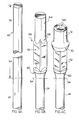
- the end connection consists of a back shoulder, a wrench flat, a front shoulder and a cylindrical tip which is subsequently threaded.
- the process comprises for the first pass:
- apparatus for upset forging of a long stand of solid malleable metal bar stock in a single pass to gather a large volume of a long stand of bar stock into a complex shaped element.
- the apparatus comprises:
- apparatus for upset forging of a long stand of solid malleable metal bar stock in two passes into an end connection for a sucker rod.
- the end connection consists of a back shoulder, a wrench flat, a front shoulder and a cylindrical tip which is subsequently threaded.
- the apparatus comprises:
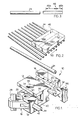
- the heading tool for the forging apparatus is shown in Figure 1.
- the hot upset forging machine has a frame (not shown) to which the gripper dies carrying the die cavities is connected and also to which the ram for the die punches is mounted.
- the forging apparatus 10 has opposing die blocks 12 and 14. Die block 14 is stationary and is mounted to the frame of the apparatus, whereas die block 12 is mounted on a toggle mechanism 16 for reciprocal movement in the direction of arrow 18 towards and away from the die block 14.
- the opposing die blocks have formed therein a first cavity 20 and a second cavity 22.
- the opposing die blocks have mirror images of the cavities such that when they mate they form the complete first and second die cavities within which the rod 24 is upset forged.
- the toggle mechanism 16 which provides for the reciprocal movement in the direction of arrow 18, includes a first link arm 26 which is secured to pivot axle 28 which, in turn, is connected to the frame of the apparatus.
- the other end of arm 26 is pivotally connected to pin 30 of U-shaped clevis 32.
- a second arm 34 has its first end pivoted to pin 30 and its second end pivoted to pin 36.
- the second pin 36 is securely mounted in the die block 12 between opposing ledge portions 38 and 40.
- rod 42 which is secured to the clevis 32, is moved in the direction of arrow 44, whereby the toggle mechanism 16 pushes the die block 12 towards die block 14 to effectively grip the rod 24 when it is positioned in the respective cavity in a manner to be discussed with respect to Figures 6 through 9.
- the upset forging of a long stand of the metal bar 24, the long stand is selectively heated to two different temperatures.
- the bar 24 has a long stand portion 46 which consists of an intermediate section 46a and an end section 46b.
- the intermediate section 46a is heated to an upper forging temperature
- the end section 46b is heated to a lower forging temperature.
- the temperature ranges for the upper and lower forging temperatures will vary considerably depending on the type of metal used. Should an acceptable grade of steel be chosen, such as, 0.40% carbon steel, the upper forging temperature may be in the range of 1090°C to 1245°C and the lower forging temperature may be in the range of 850°C to 985°C.
- Preferred temperatures are approximately 1200°C for the upper forging temperature and approximately 980°C for the lower forging temperature.
- a furnace 48 has two heating zones 48a and 48b.
- Heating zone 48a is at a sufficiently higher temperature than zone 48b to achieve the desired differentiation in temperatures of the intermediate section 46a and 46b to provide the selective heating of the long stand 46 for purposes of forging in the forging apparatus 10 of Figure 1.
- the furnace 48 may be gas fired, electric induction, or the like which will accomplish the desired heating of the long stand 46 to the desired temperatures for a predetermined residence time for the rods 24 traveling through the heating zone in the direction of arrow 50.
- the heating zones 48a and 48b are divided by partition 52 to define heating widths corresponding to the length 46a of the intermediate section and length 46b of the end section of the long stand of the bar 24.
- a transition zone 66 is provided between the wrench flat 62 and the cylindrical portion 64.
- the back shoulder 60 includes a transition into the wrench flat 62 by way of the bulging lobes 68.
- the ratio of the length of the stand between lines 54 and 56 to the diameter of the bar is usually in the range of 16.
- the front shoulder 70 and the cylindrical tip 72 are formed.
- the cylindrical tip is subsequently threaded to complete the end connection.
- the front shoulder 70 and the cylindrical end portions 72 are upset forged from a portion of the wrench flat 62, the transition portion 66 and the cylindrical portion 64 in the manner to be discussed with respect to the second die cavity as shown in Figure 5 and discussed with respect to Figures 8 and 9.
- die cavities are shown in Figure 5 which form in two passes the end connection for the sucker rod as shown in Figure 4c.
- the right half 14 of the opposing die blocks is shown with the first cavity section 20 positioned above the second cavity section 22. It is appreciated that, when the die blocks 12 and 14 are brought together by actuation of the toggle mechanism 16, the complete cavities are formed where the corresponding cavities in the die block 12 are mirror images of the cavities in the die block 14.
- the die block 14 has a body portion 74 which has secured therein the plate sections which define the respective halves of the first and second die cavities.
- the respective half of die cavity 20 is defined in plates 76 and 78. Plates 76 and 78 are secured to the die block body portion 74 by Allan screws or the like (not shown) to mount securely the plate portions in place. The plates are secured adjacent each other at the joint 80 with respective portions of the cavity 20 machined therein.
- the one half section of cavity 20 includes a bar supporting section 82 which intimately contacts the bar stock.
- a major upsetting section 84 is adjacent the bar stock supporting section 82. Adjacent the major upsetting section is a secondary upsetting section 86.
- the bar supporting section 82 includes a lead-in portion 88 for the rod as it is positioned in the first die cavity 20.
- the secondary upsetting section also includes a lead-in portion 90 for the forging punch 92.
- the forging punch 92 is secured to the body portion 94 of the ram 96 which is also shown in Figure 1.
- the punch 92 is removably mounted in the body portion 94.
- a bolt 98 is threaded into the body portion to engage the punch 92 and secure it in position within the body portion 94.
- the punch 92 moves along an axis 100.
- the punch is arranged such that the axis 100 is coincident with the central axis 101 of the secondary upsetting section 86.
- the punch 92 is free to reciprocate within the secondary upsetting section 86.
- Both the major upsetting section and the secondary upsetting section are symmetrical about axis 101.
- half of the second die cavity 22 is secured to the body portion 74 of the die block 14.
- the half section of the second die cavity is defined within plates 102 and 104 which abut each other at joint 106.
- the cavity defined in the plates 102 and 104 consists of a bar supporting section 108 which merges into a major upsetting section 110.
- the major upsetting section 110 merges into a secondary upsetting section 112.
- the bar supporting section 108 includes a lead-in portion 114 for positioning of the upset forged bar, as removed from the first cavity.
- the secondary upsetting section 112 includes a lead-in portion 116 for the second punch 118 which is mounted in the body 94 of the ram 96.
- the punch 118 is secured in the body 94 by way of threaded bolt 120.
- the punch 118 moves along central axis 122.
- Axis 122 is coincident with the central axis 123 of the secondary upsetting section 112 of the die cavity. Hence, the punch 118 is free to move along the axis 122 of the secondary upsetting section 112.
- the first die cavity in the major upsetting section includes a first wall portion 124 which defines the shape for the back shoulder 60 of the sucker rod shown in Figure 4b.
- the wrench flat 62 of the sucker rod end connection is defined by faces 126 in the major upsetting section 84.
- the transition zone 66 is defined by cavity faces 128.
- the remaining cylindrical portion 129 of the upset forged sucker rod of Figure 4b defines the bore 87 of the secondary upsetting section 86.
- the back shoulder 60 is located against wall section 130 of the second cavity.
- the wrench flats 62 are located against the wall section 132 of the major upsetting section 110 which is defined by intersecting faces of wall portion 132.
- the front shoulder is defined by wall section 134 of the major upsetting section of the cavity and the remaining cylindrical tip 72 is defined by wall section 135 of the secondary upsetting section 112.
- the long stand 46 of the bar stock is located in the cavity defined by clamped opposing mating sections of the die blocks 12 and 14.
- the rod 24 is positioned in the rod supporting section 82 with the reference line 54 of the long stand 46 located at the entrance to the major upsetting section 84.
- the long stand is selectively heated to provide an intermediate section 46a at a forging temperature higher than the end section 46b.
- the majority of the intermediate section is located in the major upsetting section of the die cavity.
- the remaining minor length of the intermediate section 46a and all of the end section 46b lies in the secondary upsetting cavity 86.
- the punch 92 may either remain in the position shown, or the ram 96 advanced to locate the end 136 of the punch within the secondary upsetting section 86. With the punch positioned within section 86, end 136 may act as a stop to locate the base line 54 of the long stand 46 at the entrance to the major upsetting section 84 of the cavity.
- This arrangement assists in the manual operation of the forging apparatus.
- a line may be scored on the rod 24 which can be picked up by an electronic eye to locate accurately the long stand 46 in the proper position in the major and secondary upsetting sections of the die cavity.
- the forging apparatus is provided with a device for gripping the rod 24 to hold it stationary relative to the die cavity during the upset forging operation. This ensures that the reference line 54 remains approximately in the position shown in Figure 6 adjacent the entrance to the major upsetting cavity 84.
- the bar supporting section 82 is sized such that when the die blocks are together, the cavity cross-sectional diameter is approximately equal to the nominal diameter of the bar 24. Hence when the toggle mechanism 16 closes the die blocks, the bar 24 is firmly gripped along the length of the bar supporting section 82 to hold the bar stationary during the forging operation.
- Figure 7 shows the long stand 46 of the bar stock upset forged to fill the major upsetting section 84 and the remainder of a secondary upsetting section 86.
- the punch 92 in causing such upset, has moved the distance shown.
- Figure 7 is not to scale, in this particular embodiment for upset forging a long stand of bar stock to form an end connection of a sucker rod in a single pass, the ratio of the length of the long stand bar stock to the cross-sectional diameter of the bar is approximately 16 to 18 depending upon the diameter of the stock.
- Normally sucker rod forgings involve rod diameters of 1.5 cm up to 3.5 cm which results in upsetting in a single pass bar stock length in the range of approximately 240 cm or more for smaller stock and approximately 570 cm or more for larger stock.
- the major upset cavity 84 may have a slight taper at least in the region of the wrench flat 62 defined by faces 126.
- the cavity of the major upset section 84 may increase slightly in cross-sectional dimension in moving along the flats 126 towards the portion 124 which defines the back shoulder 60.
- the taper may be of very slight, such as one-half of a degree slope relative to the axis 101 over the length of the wrench flats which is not sufficiently significant to show up on the views of Figures 6 and 7.
- a similar taper may be provided in the circular shaped bore 87. The bore may increase in diameter in moving from the lead-in portion 90 towards the entrance of the major upset section 84. This taper may be approximately one-half of a degree slope relative to axis 101.
- Various types of friction reducing material may be used in the bore 87 of the secondary upset cavity 86. It is appreciated that the walls of the cavity may be lined with a synthetic or metallic material which withstands the high forging temperatures, yet at the same time provides a degree of lubricity in reducing friction to allow movement of the lengthy portion 46b of the long stand along the secondary cavity as the metal is upset. According to a preferred embodiment of this invention, a lubricant may be applied to the cavity walls of the secondary section 86. The lubricant may be of the type which is used in high temperature forging normally for the purposes as a parting agent in allowing the metal to be freed from the die.
- Such high temperature lubricants usually include a mixture of graphite and grease and other components such as calcium fluoride.
- a commercially available type of lubricant is that sold under the trade mark FEL-PRO C-102 by Fel-Pro Incorporated of Skokee, Illinois.
- the FEL-PRO lubricant may be applied to the cavity walls by way of a brush or the like during manual operation of the equipment.
- a spray device may be moved between the die cavity blocks 12 and 14 when they are open and direct a spray of the lubricant onto the cavity walls of the secondary upset chamber 86 of the first die cavity.
- section 46a of the long stand continues to upset at a rate greater than portion 46b where portion 46b is the last to completely upset in filling of the remaining portion of the secondary upsetting section 86.
- the friction reducing material in the cavity portion 86 ensures that the portion 46b as it commences upsetting and engages the walls of cavity 86 continues to move along the secondary portion to ensure that all of section 46a is upset and fills major section 84 before complete upset of portion 46b to fill the remainder of secondary upsetting cavity section 86.
- the slight taper in the bore of the major and secondary cavity portions 84 and 86 assists in such movement of section 46b along the cavity portions by virtue of progressively filling the regions.
- significantly long stands of bar stock are then upset where the ratio of the length of the bar stock is in the range of 16 to 18 depending upon the bar stock diameter in forming end connections for sucker rods. It is appreciated, however, that the invention is equally applicable to smaller ratios such as 8 or greater. Upsetting volumes of metal at ratios less than 8 can also be accomplished by this invention; however, at the smaller ratios, selective heating of the end portion and friction reducing material is usually not required.
- the ram 96 is withdrawn to remove the punch 92 either completely from the cavity 86 or to the stop position where the end 136 remains slightly within the cavity 86.
- the die blocks are then opened to permit removal of the rod end portion the rod upset forged by the single pass.
- the end portion resembles the shape shown in Figure 4b.
- the end portion consists of a relatively complex shape consisting of a rounded shoulder 60, the flats 62 and the enlarged cylindrical end portion 64.
- a variety of complex shapes can be formed which could not be formed with existing technology. With the more complex shape for the end connection of a sucker rod, two passes are required.
- the die block 14 has the upset long stand 46c positioned therein, where the reference line 54 is at the entrance to the major upsetting section 110.
- the bar 24 is positioned in the bar supporting section 108 which is of a diameter when the die blocks are closed to grip the bar stock 24 and hold the reference line at the entrance to the major upsetting section 110.
- the shoulder portion 130 of the major upset section 110 is essentially the same shape as the corresponding portion of the major upsetting section 84 of the first die cavity. Hence the back shoulder 60 and wrench flat 62 of the upset long stand 46c are snugly received by the cavity walls of this portion of the major upset section 110.
- the remainder of the major upset section 110 includes portion 134 which defines the front shoulder.
- the transition zone 66 and the cylindrical portion 64 are spaced from the cavity walls of portion 134 of the major upset section 110 and the secondary upset section 112.
- the second punch 118 moves along the axis 122 and has a specifically shaped end 138 which forms a recess portion 140 in the end of cylindrical tip 72 as shown in Figure 4c.
- the transition zone 66 and cylindrical portion 64 of the long stand 46c are upset forged into the remaining spaces of the major and secondary upsetting sections of the second cavity. It is appreciated that the mating relationship of the back shoulder and wrench flats may be used in locating the upset long stand 46c in the second cavity. However, to assist such location the ram 96 may position the end 138 of the punch 118 in the secondary cavity 112 at a position which locates the reference line 54 at the entrance to the major upsetting section 110.
- Friction reducing materials are optional in the secondary upsetting portion of the cavity 112 as is selective heating of the cylindrical portion 64. If in the second pass, extreme upsetting is required, then selective heating and friction reducing materials may be used.
- reheating may not be required since the upset section 46c can be immediately withdrawn from the first cavity, positioned in the second cavity, the die blocks closed and the ram moved to upset the end section 64 in the transition section 66 of the long stand within a matter of seconds.
- such complex shape for the sucker rod end connection could only be formed in multiple passes usually five or six.
- the long stand of metal is upset in a single pass to produce shape 46c which is then readily modified in the second pass to provide the remaining front shoulder and cylindrical tip.
- a significant advantage of the invention is that in forming the sucker rod end connection in two passes, symmetrical uniform grain flow lines are established in the end connection thereby avoiding any surface imperfections and discontinuity in the grain flow lines.
- a sucker rod end connection developed by a five pass forging technique produces several discontinuities 144 in the grain flow lines 146. Such discontinuities occur in the back shoulder 148 and in the front shoulder 150.
- sucker rod end connection manufacture such discontinuities and notches in the surface develop stress points which significantly weaken the connection and results in significantly reduced lifespans in the field.
- Techniques have been developed at forging plants to remove such notches developed by laps in the forging operation to remove such stress points in the connection.
- an operator can spend as much time removing the surface imperfections as is spent in forming the sucker end connection.
- the imperfections in the surface add considerably to the overall cost of manufacture due to the labor intensive inspection of each end connection and time required to modify the end connection in removing the imperfections.
- the die cavities may be formed from various grades of high alloy steels commonly used in die cavity manufacture.
- the high speed steels are commonly used which have sufficient hardness to resist abrasion and the effects of heat used in the forging operation.
- the die cavity design is such to resemble standard types of existing forms of gripper dies, such as already used in five pass and six pass forging of sucker rod end connections, the only difference being in the design for the first and second die cavities of this invention.
Landscapes
- Engineering & Computer Science (AREA)
- Mechanical Engineering (AREA)
- Forging (AREA)
Applications Claiming Priority (2)
| Application Number | Priority Date | Filing Date | Title |
|---|---|---|---|
| CA525761 | 1986-12-18 | ||
| CA525761 | 1986-12-18 |
Publications (2)
| Publication Number | Publication Date |
|---|---|
| EP0272067A2 true EP0272067A2 (de) | 1988-06-22 |
| EP0272067A3 EP0272067A3 (de) | 1990-05-09 |
Family
ID=4134586
Family Applications (1)
| Application Number | Title | Priority Date | Filing Date |
|---|---|---|---|
| EP87310959A Withdrawn EP0272067A3 (de) | 1986-12-18 | 1987-12-14 | Verfahren und Vorrichtung zum Stauchschmieden langer Abschnitte von Metallstangen |
Country Status (3)
| Country | Link |
|---|---|
| US (1) | US4838062A (de) |
| EP (1) | EP0272067A3 (de) |
| JP (1) | JPS63252632A (de) |
Cited By (6)
| Publication number | Priority date | Publication date | Assignee | Title |
|---|---|---|---|---|
| EP0359386A3 (de) * | 1988-09-12 | 1990-11-14 | General Motors Corporation | Verfahren und Vorrichtung zum Pressformen komplizierter metalischer Formen wie z.B. Steuerventilteilen |
| EP1846628A4 (de) * | 2005-02-08 | 2009-03-04 | Sugar Steel Engineering Pty Lt | Verfahren und vorrichtung zur herstellung von metallarmierung |
| CN103801643A (zh) * | 2012-11-14 | 2014-05-21 | 杨光 | 凹模镦粗加热工艺 |
| EP2969302A4 (de) * | 2013-03-11 | 2016-11-30 | Fci Holdings Delaware Inc | System und verfahren zur herstellung von grubenausbaubolzen |
| CN110695304A (zh) * | 2019-10-17 | 2020-01-17 | 浙江凯名瑞汽车部件有限公司 | 用于汽车的球壳、球壳锻件和该球壳锻件的加工方法 |
| EP3915695A1 (de) * | 2020-05-28 | 2021-12-01 | Hilti Aktiengesellschaft | Verfahren zur herstellung eines profilstabs |
Families Citing this family (28)
| Publication number | Priority date | Publication date | Assignee | Title |
|---|---|---|---|---|
| US5544413A (en) * | 1994-06-10 | 1996-08-13 | Omni Forge, Inc. | Method and apparatus for manfacturing a flashless metal connecting rod |
| US6290439B1 (en) | 1994-12-30 | 2001-09-18 | Black & Decker, Inc. | Method and apparatus for forming parts from a continuous stock material and associated forge |
| US5700113A (en) * | 1994-12-30 | 1997-12-23 | Black & Decker Inc. | Spade-type boring bit and an associated method and apparatus for forming metallic parts |
| US5842267A (en) * | 1994-12-30 | 1998-12-01 | Black & Decker, Inc. | Method and apparatus for forming parts of a predetermined shape from a continuous stock material |
| JP3478014B2 (ja) * | 1996-08-29 | 2003-12-10 | トヨタ自動車株式会社 | 軸伸びボルトの成形方法及び軸伸びボルト |
| US5890388A (en) * | 1997-07-30 | 1999-04-06 | Centre Bridge Investments | Method and apparatus for forming structural members |
| NO310226B1 (no) | 1998-02-03 | 2001-06-11 | Kongsberg Automotive Asa | Fremgangsmåte og verktöy for tildannelse av et forstörret endeparti av en stang |
| US6397652B1 (en) * | 2000-03-22 | 2002-06-04 | The Sollami Company | Tool body and method of manufacture |
| US6572127B2 (en) | 2001-05-18 | 2003-06-03 | Maclean-Fogg Company | Link assembly for a vehicle suspension system |
| US20050079032A1 (en) * | 2001-05-18 | 2005-04-14 | Jiri Pazdirek | Link assembly for a vehicle suspension system |
| WO2005053875A1 (en) * | 2003-12-04 | 2005-06-16 | Bishop Innovation Limited | Steering rack manufacture |
| US7574797B2 (en) * | 2004-07-22 | 2009-08-18 | Ford Global Technologies, Llc | Throttle body and method of assembly |
| CN1989352B (zh) * | 2004-09-08 | 2011-08-17 | Ntn株式会社 | 用于液体润滑轴承设备的轴构件及其制造方法 |
| US7360387B2 (en) * | 2005-01-31 | 2008-04-22 | Showa Denko K.K. | Upsetting method and upsetting apparatus |
| US9132567B2 (en) * | 2007-03-23 | 2015-09-15 | Dayton Progress Corporation | Tools with a thermo-mechanically modified working region and methods of forming such tools |
| US8968495B2 (en) * | 2007-03-23 | 2015-03-03 | Dayton Progress Corporation | Methods of thermo-mechanically processing tool steel and tools made from thermo-mechanically processed tool steels |
| DE102009022957A1 (de) * | 2009-05-28 | 2010-12-02 | Wafios Ag | Kopfstauchvorrichtung |
| CN102166611B (zh) * | 2011-01-25 | 2013-03-27 | 南京中盛铁路车辆配件有限公司 | 铁路货车制动拉杆的长棒料连续墩粗装置及其墩粗方法 |
| JP5915937B2 (ja) * | 2011-06-20 | 2016-05-11 | 日立金属株式会社 | 鍛造材の製造方法 |
| DE102011106942A1 (de) | 2011-07-08 | 2013-01-10 | Wafios Ag | Biegevorrichtung für stabförmige Werkstücke |
| US10309445B2 (en) * | 2014-08-19 | 2019-06-04 | Ellwood National Investment Corp. | Net shaped forgings for power generation/transfer shafts |
| EP3037189B1 (de) * | 2014-12-23 | 2018-11-07 | Ellwood National Investment Corp. | Präzisionsschmieden für flüssigkeitsteile |
| CN109877266A (zh) * | 2019-04-10 | 2019-06-14 | 中铁宝桥集团有限公司 | 一种非对称断面钢轨镦粗装置 |
| US11285524B2 (en) * | 2020-06-17 | 2022-03-29 | National Oilwell Varco, L.P. | Wear resistant tubular members and systems and methods for producing the same |
| CN113102669B (zh) * | 2021-03-29 | 2023-06-23 | 杭州汽轮铸锻有限公司 | 20Cr13镦粗加热装置及镦粗加热工艺 |
| CN114589284B (zh) * | 2022-05-10 | 2022-07-29 | 中北大学 | 合金棒料的一火次开坯模具、方法及镦挤镦大变形方法 |
| CN115229103B (zh) * | 2022-06-28 | 2023-06-23 | 苏州虹逸重工科技有限公司 | 一种卧式双头镦锻汽车半轴自动化伺服数控锻造生产线 |
| CN117161289A (zh) * | 2023-07-18 | 2023-12-05 | 宜昌中南精密钢管有限公司 | 一种卧式钢管镦粗分体式成型装置及方法 |
Family Cites Families (16)
| Publication number | Priority date | Publication date | Assignee | Title |
|---|---|---|---|---|
| US245691A (en) * | 1881-08-16 | alker | ||
| US1041999A (en) * | 1911-11-25 | 1912-10-22 | John M Hansen | Manufacture of railroad-axles. |
| US1416635A (en) * | 1917-03-06 | 1922-05-16 | Sullivan Machinery Co | Forging machine |
| US2142239A (en) * | 1937-09-23 | 1939-01-03 | Internat Detachable Bits & Equ | Method of forming detachable drill bit shanks |
| US2442142A (en) * | 1945-01-10 | 1948-05-25 | American Brake Shoe Co | Upset forging apparatus |
| US2581774A (en) * | 1947-09-15 | 1952-01-08 | Harry F Stone | Method and apparatus for producing valve stems |
| US2507817A (en) * | 1947-12-09 | 1950-05-16 | Ropp Irwin | Method and apparatus for heating and forging elongated metal blanks |
| DE1258240B (de) * | 1964-12-04 | 1968-01-04 | Hasenclever A G Maschf | Verfahren zum Warmstauchen von insbesondere stabfoermigen Werkstuecken |
| US3381513A (en) * | 1965-06-11 | 1968-05-07 | Auto Bolt And Nut Company | Rod heading and trimming method and machine |
| US4100781A (en) * | 1977-03-02 | 1978-07-18 | Lear Siegler, Inc. | Axle spindle forming method |
| FR2382288A1 (fr) * | 1977-03-03 | 1978-09-29 | Sofomec | Procede de forgeage a froid d'axes de pedaliers, les moyens de mise en oeuvre et les axes executes selon ce procede |
| JPS55126340A (en) * | 1979-03-19 | 1980-09-30 | Diesel Kiki Co Ltd | Working method of cam shaft |
| JPS56119640A (en) * | 1980-02-27 | 1981-09-19 | Diesel Kiki Co Ltd | Method for heating blank material forming plural projections along axial direction of cam shaft or the like |
| FR2487232A1 (fr) * | 1980-07-22 | 1982-01-29 | Promecsa | Procede de fabrication des essieux-axes |
| JPS5825837A (ja) * | 1981-08-07 | 1983-02-16 | Nissan Motor Co Ltd | 塊状部を有する鍛造品の製造方法 |
| DE3145292C2 (de) * | 1981-11-14 | 1986-09-04 | Uhde Gmbh, 4600 Dortmund | Röhrenspaltofen zur indirekten Erhitzung von spaltbaren Medien |
-
1987
- 1987-12-14 EP EP87310959A patent/EP0272067A3/de not_active Withdrawn
- 1987-12-15 US US07/133,340 patent/US4838062A/en not_active Expired - Fee Related
- 1987-12-18 JP JP62319127A patent/JPS63252632A/ja active Pending
Cited By (8)
| Publication number | Priority date | Publication date | Assignee | Title |
|---|---|---|---|---|
| EP0359386A3 (de) * | 1988-09-12 | 1990-11-14 | General Motors Corporation | Verfahren und Vorrichtung zum Pressformen komplizierter metalischer Formen wie z.B. Steuerventilteilen |
| EP1846628A4 (de) * | 2005-02-08 | 2009-03-04 | Sugar Steel Engineering Pty Lt | Verfahren und vorrichtung zur herstellung von metallarmierung |
| CN103801643A (zh) * | 2012-11-14 | 2014-05-21 | 杨光 | 凹模镦粗加热工艺 |
| EP2969302A4 (de) * | 2013-03-11 | 2016-11-30 | Fci Holdings Delaware Inc | System und verfahren zur herstellung von grubenausbaubolzen |
| CN110695304A (zh) * | 2019-10-17 | 2020-01-17 | 浙江凯名瑞汽车部件有限公司 | 用于汽车的球壳、球壳锻件和该球壳锻件的加工方法 |
| CN110695304B (zh) * | 2019-10-17 | 2021-01-05 | 浙江凯名瑞汽车部件股份有限公司 | 用于汽车的球壳锻件的加工方法 |
| EP3915695A1 (de) * | 2020-05-28 | 2021-12-01 | Hilti Aktiengesellschaft | Verfahren zur herstellung eines profilstabs |
| WO2021239510A1 (en) * | 2020-05-28 | 2021-12-02 | Hilti Aktiengesellschaft | Method for manufacturing a profiled rod |
Also Published As
| Publication number | Publication date |
|---|---|
| EP0272067A3 (de) | 1990-05-09 |
| JPS63252632A (ja) | 1988-10-19 |
| US4838062A (en) | 1989-06-13 |
Similar Documents
| Publication | Publication Date | Title |
|---|---|---|
| US4838062A (en) | Process for upset forging of long stands of metal bar stock | |
| RU2323061C2 (ru) | Способы холодного прессования для получения металлических деталей с глухими или сквозными отверстиями и установка для осуществления указанных способов | |
| US4747431A (en) | Integral joint forming of work-hardenable high alloy tubing | |
| EP0610509B1 (de) | Verfahren zum herstellen von hohlen schmiedestücken durch radialschmieden von kontinuierlichen rohlingen | |
| US1946117A (en) | Method of and apparatus for extruding valves and multiflanged pipe fittings | |
| US3996737A (en) | Method of manufacturing elevator links and a cast elevator link blank for use in the method | |
| CS256356B2 (en) | Method of metallic shafts' cranks forging and equipment for realization of this method | |
| EP0121531B1 (de) | Werkzeug und verfahren zur herstellung hohler gegenstände | |
| EP0101146A1 (de) | Verfahren und Vorrichtung zum Tiefziehen dickwandiger Hülsen | |
| PL135377B1 (en) | Method of obtaining preforged crank arm of welded crankshaft and apparatus therefor | |
| RU2041761C1 (ru) | Способ изготовления стержневых изделий с фланцем на торце и буртом в средней части и устройство для его осуществления | |
| DE4104707A1 (de) | Verfahren und vorrichtung zum anstauchen von flanschartigen verdickungen an rohren | |
| EP3028787B1 (de) | Schmiedevorrichtung und methode | |
| US1101813A (en) | Process of forging. | |
| US2749610A (en) | Method and machine for making shackles | |
| US4559802A (en) | Method for drawing heavy wall shells | |
| SU1375391A1 (ru) | Способ изготовлени металлических полых ступенчатых изделий из трубных заготовок | |
| CN1199809A (zh) | 整体(镦挤)空心抽油杆生产工艺 | |
| JPS6137341A (ja) | 異形断面形状を有する閉塞鍛造用荒地素材の製造装置 | |
| SU1207606A1 (ru) | Способ изготовлени стержневых изделий с утолщени ми на концевой и в средней част х | |
| SU1400746A1 (ru) | Инструмент дл прот жки полых цилиндрических поковок | |
| US2438884A (en) | Method of forming engine mountings | |
| Douglas | Hot Upset Forging | |
| US3831422A (en) | Method of producing two pipe connections from a single forging | |
| US2007649A (en) | Manufacture of headers or return bends |
Legal Events
| Date | Code | Title | Description |
|---|---|---|---|
| PUAI | Public reference made under article 153(3) epc to a published international application that has entered the european phase |
Free format text: ORIGINAL CODE: 0009012 |
|
| AK | Designated contracting states |
Kind code of ref document: A2 Designated state(s): AT BE CH DE ES FR GB GR IT LI LU NL SE |
|
| PUAL | Search report despatched |
Free format text: ORIGINAL CODE: 0009013 |
|
| AK | Designated contracting states |
Kind code of ref document: A3 Designated state(s): AT BE CH DE ES FR GB GR IT LI LU NL SE |
|
| STAA | Information on the status of an ep patent application or granted ep patent |
Free format text: STATUS: THE APPLICATION IS DEEMED TO BE WITHDRAWN |
|
| 18D | Application deemed to be withdrawn |
Effective date: 19901110 |
|
| RIN1 | Information on inventor provided before grant (corrected) |
Inventor name: PRENN, OTTO E. |