EP0272535A2 - Polymere Emulgatoren auf Basis aminotelecheler Vinyloligomere II - Google Patents
Polymere Emulgatoren auf Basis aminotelecheler Vinyloligomere II Download PDFInfo
- Publication number
- EP0272535A2 EP0272535A2 EP87118114A EP87118114A EP0272535A2 EP 0272535 A2 EP0272535 A2 EP 0272535A2 EP 87118114 A EP87118114 A EP 87118114A EP 87118114 A EP87118114 A EP 87118114A EP 0272535 A2 EP0272535 A2 EP 0272535A2
- Authority
- EP
- European Patent Office
- Prior art keywords
- parts
- aminotelechelic
- acid
- vinyl
- weight
- Prior art date
- Legal status (The legal status is an assumption and is not a legal conclusion. Google has not performed a legal analysis and makes no representation as to the accuracy of the status listed.)
- Granted
Links
- 125000000391 vinyl group Chemical group [H]C([*])=C([H])[H] 0.000 title claims abstract description 14
- 229920002554 vinyl polymer Polymers 0.000 title claims abstract description 12
- 239000003995 emulsifying agent Substances 0.000 title claims abstract description 8
- 239000001257 hydrogen Substances 0.000 claims abstract description 7
- 229910052739 hydrogen Inorganic materials 0.000 claims abstract description 7
- 125000004435 hydrogen atom Chemical class [H]* 0.000 claims abstract description 6
- BCFOOQRXUXKJCL-UHFFFAOYSA-N 4-amino-4-oxo-2-sulfobutanoic acid Chemical class NC(=O)CC(C(O)=O)S(O)(=O)=O BCFOOQRXUXKJCL-UHFFFAOYSA-N 0.000 claims abstract description 4
- 150000003839 salts Chemical class 0.000 claims abstract description 4
- QGZKDVFQNNGYKY-UHFFFAOYSA-O Ammonium Chemical compound [NH4+] QGZKDVFQNNGYKY-UHFFFAOYSA-O 0.000 claims abstract description 3
- 229910052783 alkali metal Inorganic materials 0.000 claims abstract description 3
- 150000001340 alkali metals Chemical class 0.000 claims abstract description 3
- 150000001875 compounds Chemical class 0.000 claims abstract description 3
- 230000002209 hydrophobic effect Effects 0.000 claims abstract description 3
- 235000021190 leftovers Nutrition 0.000 claims abstract description 3
- 239000004094 surface-active agent Substances 0.000 claims abstract description 3
- RRHGJUQNOFWUDK-UHFFFAOYSA-N Isoprene Chemical compound CC(=C)C=C RRHGJUQNOFWUDK-UHFFFAOYSA-N 0.000 claims description 10
- DGAQECJNVWCQMB-PUAWFVPOSA-M Ilexoside XXIX Chemical group C[C@@H]1CC[C@@]2(CC[C@@]3(C(=CC[C@H]4[C@]3(CC[C@@H]5[C@@]4(CC[C@@H](C5(C)C)OS(=O)(=O)[O-])C)C)[C@@H]2[C@]1(C)O)C)C(=O)O[C@H]6[C@@H]([C@H]([C@@H]([C@H](O6)CO)O)O)O.[Na+] DGAQECJNVWCQMB-PUAWFVPOSA-M 0.000 claims description 2
- 229910052708 sodium Inorganic materials 0.000 claims description 2
- 239000011734 sodium Substances 0.000 claims description 2
- YXFVVABEGXRONW-UHFFFAOYSA-N Toluene Chemical compound CC1=CC=CC=C1 YXFVVABEGXRONW-UHFFFAOYSA-N 0.000 description 30
- IJGRMHOSHXDMSA-UHFFFAOYSA-N Atomic nitrogen Chemical compound N#N IJGRMHOSHXDMSA-UHFFFAOYSA-N 0.000 description 14
- PPBRXRYQALVLMV-UHFFFAOYSA-N Styrene Chemical compound C=CC1=CC=CC=C1 PPBRXRYQALVLMV-UHFFFAOYSA-N 0.000 description 14
- XLYOFNOQVPJJNP-UHFFFAOYSA-N water Substances O XLYOFNOQVPJJNP-UHFFFAOYSA-N 0.000 description 14
- 239000000243 solution Substances 0.000 description 13
- KAKZBPTYRLMSJV-UHFFFAOYSA-N Butadiene Chemical group C=CC=C KAKZBPTYRLMSJV-UHFFFAOYSA-N 0.000 description 12
- 238000001704 evaporation Methods 0.000 description 11
- 230000008020 evaporation Effects 0.000 description 11
- FPYJFEHAWHCUMM-UHFFFAOYSA-N maleic anhydride Chemical compound O=C1OC(=O)C=C1 FPYJFEHAWHCUMM-UHFFFAOYSA-N 0.000 description 10
- 238000004519 manufacturing process Methods 0.000 description 9
- 150000002825 nitriles Chemical class 0.000 description 9
- 239000000203 mixture Substances 0.000 description 8
- 239000002253 acid Substances 0.000 description 7
- 229910052757 nitrogen Inorganic materials 0.000 description 7
- 229920002857 polybutadiene Polymers 0.000 description 7
- 239000005062 Polybutadiene Substances 0.000 description 6
- 238000005984 hydrogenation reaction Methods 0.000 description 6
- 239000003999 initiator Substances 0.000 description 6
- 229920000126 latex Polymers 0.000 description 6
- 239000000178 monomer Substances 0.000 description 6
- GEHJYWRUCIMESM-UHFFFAOYSA-L sodium sulfite Chemical compound [Na+].[Na+].[O-]S([O-])=O GEHJYWRUCIMESM-UHFFFAOYSA-L 0.000 description 6
- 239000002585 base Substances 0.000 description 5
- 238000006116 polymerization reaction Methods 0.000 description 5
- 238000002360 preparation method Methods 0.000 description 5
- NLHHRLWOUZZQLW-UHFFFAOYSA-N Acrylonitrile Chemical compound C=CC#N NLHHRLWOUZZQLW-UHFFFAOYSA-N 0.000 description 4
- LFQSCWFLJHTTHZ-UHFFFAOYSA-N Ethanol Chemical compound CCO LFQSCWFLJHTTHZ-UHFFFAOYSA-N 0.000 description 4
- KFZMGEQAYNKOFK-UHFFFAOYSA-N Isopropanol Chemical compound CC(C)O KFZMGEQAYNKOFK-UHFFFAOYSA-N 0.000 description 4
- 239000007864 aqueous solution Substances 0.000 description 4
- 238000006243 chemical reaction Methods 0.000 description 4
- 239000007795 chemical reaction product Substances 0.000 description 4
- 239000004816 latex Substances 0.000 description 4
- QTBSBXVTEAMEQO-UHFFFAOYSA-N Acetic acid Chemical compound CC(O)=O QTBSBXVTEAMEQO-UHFFFAOYSA-N 0.000 description 3
- QGZKDVFQNNGYKY-UHFFFAOYSA-N Ammonia Chemical compound N QGZKDVFQNNGYKY-UHFFFAOYSA-N 0.000 description 3
- PQUCIEFHOVEZAU-UHFFFAOYSA-N Diammonium sulfite Chemical compound [NH4+].[NH4+].[O-]S([O-])=O PQUCIEFHOVEZAU-UHFFFAOYSA-N 0.000 description 3
- YMWUJEATGCHHMB-UHFFFAOYSA-N Dichloromethane Chemical compound ClCCl YMWUJEATGCHHMB-UHFFFAOYSA-N 0.000 description 3
- XEKOWRVHYACXOJ-UHFFFAOYSA-N Ethyl acetate Chemical compound CCOC(C)=O XEKOWRVHYACXOJ-UHFFFAOYSA-N 0.000 description 3
- CERQOIWHTDAKMF-UHFFFAOYSA-N Methacrylic acid Chemical compound CC(=C)C(O)=O CERQOIWHTDAKMF-UHFFFAOYSA-N 0.000 description 3
- HEMHJVSKTPXQMS-UHFFFAOYSA-M Sodium hydroxide Chemical compound [OH-].[Na+] HEMHJVSKTPXQMS-UHFFFAOYSA-M 0.000 description 3
- 239000003513 alkali Substances 0.000 description 3
- 125000004432 carbon atom Chemical group C* 0.000 description 3
- 238000009903 catalytic hydrogenation reaction Methods 0.000 description 3
- 229910017052 cobalt Inorganic materials 0.000 description 3
- 239000010941 cobalt Substances 0.000 description 3
- GUTLYIVDDKVIGB-UHFFFAOYSA-N cobalt atom Chemical compound [Co] GUTLYIVDDKVIGB-UHFFFAOYSA-N 0.000 description 3
- 239000000839 emulsion Substances 0.000 description 3
- 238000001914 filtration Methods 0.000 description 3
- 238000010438 heat treatment Methods 0.000 description 3
- 229920001195 polyisoprene Polymers 0.000 description 3
- -1 polypropylenes Polymers 0.000 description 3
- 235000010265 sodium sulphite Nutrition 0.000 description 3
- 239000002904 solvent Substances 0.000 description 3
- CSCPPACGZOOCGX-UHFFFAOYSA-N Acetone Chemical compound CC(C)=O CSCPPACGZOOCGX-UHFFFAOYSA-N 0.000 description 2
- VGGSQFUCUMXWEO-UHFFFAOYSA-N Ethene Chemical compound C=C VGGSQFUCUMXWEO-UHFFFAOYSA-N 0.000 description 2
- 239000005977 Ethylene Substances 0.000 description 2
- 239000005909 Kieselgur Substances 0.000 description 2
- CSNNHWWHGAXBCP-UHFFFAOYSA-L Magnesium sulfate Chemical compound [Mg+2].[O-][S+2]([O-])([O-])[O-] CSNNHWWHGAXBCP-UHFFFAOYSA-L 0.000 description 2
- QQONPFPTGQHPMA-UHFFFAOYSA-N Propene Chemical compound CC=C QQONPFPTGQHPMA-UHFFFAOYSA-N 0.000 description 2
- VYPSYNLAJGMNEJ-UHFFFAOYSA-N Silicium dioxide Chemical compound O=[Si]=O VYPSYNLAJGMNEJ-UHFFFAOYSA-N 0.000 description 2
- NINIDFKCEFEMDL-UHFFFAOYSA-N Sulfur Chemical compound [S] NINIDFKCEFEMDL-UHFFFAOYSA-N 0.000 description 2
- WYURNTSHIVDZCO-UHFFFAOYSA-N Tetrahydrofuran Chemical compound C1CCOC1 WYURNTSHIVDZCO-UHFFFAOYSA-N 0.000 description 2
- 125000003158 alcohol group Chemical group 0.000 description 2
- 125000001931 aliphatic group Chemical group 0.000 description 2
- 150000001732 carboxylic acid derivatives Chemical group 0.000 description 2
- MVPPADPHJFYWMZ-UHFFFAOYSA-N chlorobenzene Chemical compound ClC1=CC=CC=C1 MVPPADPHJFYWMZ-UHFFFAOYSA-N 0.000 description 2
- YACLQRRMGMJLJV-UHFFFAOYSA-N chloroprene Chemical group ClC(=C)C=C YACLQRRMGMJLJV-UHFFFAOYSA-N 0.000 description 2
- 238000007334 copolymerization reaction Methods 0.000 description 2
- 239000008367 deionised water Substances 0.000 description 2
- 229910021641 deionized water Inorganic materials 0.000 description 2
- 125000004494 ethyl ester group Chemical group 0.000 description 2
- 229920000578 graft copolymer Polymers 0.000 description 2
- 238000000034 method Methods 0.000 description 2
- 125000002560 nitrile group Chemical group 0.000 description 2
- 125000002924 primary amino group Chemical group [H]N([H])* 0.000 description 2
- 239000000047 product Substances 0.000 description 2
- 229910052717 sulfur Inorganic materials 0.000 description 2
- 239000011593 sulfur Substances 0.000 description 2
- 229920001567 vinyl ester resin Polymers 0.000 description 2
- WSLDOOZREJYCGB-UHFFFAOYSA-N 1,2-Dichloroethane Chemical compound ClCCCl WSLDOOZREJYCGB-UHFFFAOYSA-N 0.000 description 1
- OZAIFHULBGXAKX-UHFFFAOYSA-N 2,2'-azo-bis-isobutyronitrile Substances N#CC(C)(C)N=NC(C)(C)C#N OZAIFHULBGXAKX-UHFFFAOYSA-N 0.000 description 1
- YAJYJWXEWKRTPO-UHFFFAOYSA-N 2,3,3,4,4,5-hexamethylhexane-2-thiol Chemical compound CC(C)C(C)(C)C(C)(C)C(C)(C)S YAJYJWXEWKRTPO-UHFFFAOYSA-N 0.000 description 1
- JAHNSTQSQJOJLO-UHFFFAOYSA-N 2-(3-fluorophenyl)-1h-imidazole Chemical compound FC1=CC=CC(C=2NC=CN=2)=C1 JAHNSTQSQJOJLO-UHFFFAOYSA-N 0.000 description 1
- OEPOKWHJYJXUGD-UHFFFAOYSA-N 2-(3-phenylmethoxyphenyl)-1,3-thiazole-4-carbaldehyde Chemical compound O=CC1=CSC(C=2C=C(OCC=3C=CC=CC=3)C=CC=2)=N1 OEPOKWHJYJXUGD-UHFFFAOYSA-N 0.000 description 1
- QENRKQYUEGJNNZ-UHFFFAOYSA-N 2-methyl-1-(prop-2-enoylamino)propane-1-sulfonic acid Chemical compound CC(C)C(S(O)(=O)=O)NC(=O)C=C QENRKQYUEGJNNZ-UHFFFAOYSA-N 0.000 description 1
- XEEYSDHEOQHCDA-UHFFFAOYSA-N 2-methylprop-2-ene-1-sulfonic acid Chemical compound CC(=C)CS(O)(=O)=O XEEYSDHEOQHCDA-UHFFFAOYSA-N 0.000 description 1
- CXMYWOCYTPKBPP-UHFFFAOYSA-N 3-(3-hydroxypropylamino)propan-1-ol Chemical compound OCCCNCCCO CXMYWOCYTPKBPP-UHFFFAOYSA-N 0.000 description 1
- BTXXTMOWISPQSJ-UHFFFAOYSA-N 4,4,4-trifluorobutan-2-one Chemical compound CC(=O)CC(F)(F)F BTXXTMOWISPQSJ-UHFFFAOYSA-N 0.000 description 1
- IRLPACMLTUPBCL-KQYNXXCUSA-N 5'-adenylyl sulfate Chemical compound C1=NC=2C(N)=NC=NC=2N1[C@@H]1O[C@H](COP(O)(=O)OS(O)(=O)=O)[C@@H](O)[C@H]1O IRLPACMLTUPBCL-KQYNXXCUSA-N 0.000 description 1
- BQACOLQNOUYJCE-FYZZASKESA-N Abietic acid Natural products CC(C)C1=CC2=CC[C@]3(C)[C@](C)(CCC[C@@]3(C)C(=O)O)[C@H]2CC1 BQACOLQNOUYJCE-FYZZASKESA-N 0.000 description 1
- RSWGJHLUYNHPMX-UHFFFAOYSA-N Abietic-Saeure Natural products C12CCC(C(C)C)=CC2=CCC2C1(C)CCCC2(C)C(O)=O RSWGJHLUYNHPMX-UHFFFAOYSA-N 0.000 description 1
- QTBSBXVTEAMEQO-UHFFFAOYSA-M Acetate Chemical compound CC([O-])=O QTBSBXVTEAMEQO-UHFFFAOYSA-M 0.000 description 1
- HRPVXLWXLXDGHG-UHFFFAOYSA-N Acrylamide Chemical compound NC(=O)C=C HRPVXLWXLXDGHG-UHFFFAOYSA-N 0.000 description 1
- LELOWRISYMNNSU-UHFFFAOYSA-N Hydrocyanic acid Natural products N#C LELOWRISYMNNSU-UHFFFAOYSA-N 0.000 description 1
- UFHFLCQGNIYNRP-UHFFFAOYSA-N Hydrogen Chemical compound [H][H] UFHFLCQGNIYNRP-UHFFFAOYSA-N 0.000 description 1
- GYCMBHHDWRMZGG-UHFFFAOYSA-N Methylacrylonitrile Chemical compound CC(=C)C#N GYCMBHHDWRMZGG-UHFFFAOYSA-N 0.000 description 1
- DFPAKSUCGFBDDF-UHFFFAOYSA-N Nicotinamide Chemical group NC(=O)C1=CC=CN=C1 DFPAKSUCGFBDDF-UHFFFAOYSA-N 0.000 description 1
- 229920000459 Nitrile rubber Polymers 0.000 description 1
- CTQNGGLPUBDAKN-UHFFFAOYSA-N O-Xylene Chemical compound CC1=CC=CC=C1C CTQNGGLPUBDAKN-UHFFFAOYSA-N 0.000 description 1
- 239000004743 Polypropylene Substances 0.000 description 1
- ZLMJMSJWJFRBEC-UHFFFAOYSA-N Potassium Chemical compound [K] ZLMJMSJWJFRBEC-UHFFFAOYSA-N 0.000 description 1
- OFOBLEOULBTSOW-UHFFFAOYSA-N Propanedioic acid Natural products OC(=O)CC(O)=O OFOBLEOULBTSOW-UHFFFAOYSA-N 0.000 description 1
- 239000007868 Raney catalyst Substances 0.000 description 1
- NPXOKRUENSOPAO-UHFFFAOYSA-N Raney nickel Chemical compound [Al].[Ni] NPXOKRUENSOPAO-UHFFFAOYSA-N 0.000 description 1
- 229910000564 Raney nickel Inorganic materials 0.000 description 1
- DWAQJAXMDSEUJJ-UHFFFAOYSA-M Sodium bisulfite Chemical compound [Na+].OS([O-])=O DWAQJAXMDSEUJJ-UHFFFAOYSA-M 0.000 description 1
- GSEJCLTVZPLZKY-UHFFFAOYSA-N Triethanolamine Chemical compound OCCN(CCO)CCO GSEJCLTVZPLZKY-UHFFFAOYSA-N 0.000 description 1
- BZHJMEDXRYGGRV-UHFFFAOYSA-N Vinyl chloride Chemical compound ClC=C BZHJMEDXRYGGRV-UHFFFAOYSA-N 0.000 description 1
- 150000001338 aliphatic hydrocarbons Chemical class 0.000 description 1
- XYLMUPLGERFSHI-UHFFFAOYSA-N alpha-Methylstyrene Chemical compound CC(=C)C1=CC=CC=C1 XYLMUPLGERFSHI-UHFFFAOYSA-N 0.000 description 1
- 150000001412 amines Chemical class 0.000 description 1
- 150000004945 aromatic hydrocarbons Chemical class 0.000 description 1
- 125000003118 aryl group Chemical group 0.000 description 1
- QVGXLLKOCUKJST-UHFFFAOYSA-N atomic oxygen Chemical compound [O] QVGXLLKOCUKJST-UHFFFAOYSA-N 0.000 description 1
- 230000015572 biosynthetic process Effects 0.000 description 1
- DQXBYHZEEUGOBF-UHFFFAOYSA-N but-3-enoic acid;ethene Chemical compound C=C.OC(=O)CC=C DQXBYHZEEUGOBF-UHFFFAOYSA-N 0.000 description 1
- NTXGQCSETZTARF-UHFFFAOYSA-N buta-1,3-diene;prop-2-enenitrile Chemical compound C=CC=C.C=CC#N NTXGQCSETZTARF-UHFFFAOYSA-N 0.000 description 1
- MTAZNLWOLGHBHU-UHFFFAOYSA-N butadiene-styrene rubber Chemical compound C=CC=C.C=CC1=CC=CC=C1 MTAZNLWOLGHBHU-UHFFFAOYSA-N 0.000 description 1
- CQEYYJKEWSMYFG-UHFFFAOYSA-N butyl acrylate Chemical compound CCCCOC(=O)C=C CQEYYJKEWSMYFG-UHFFFAOYSA-N 0.000 description 1
- 239000003054 catalyst Substances 0.000 description 1
- 229920001577 copolymer Polymers 0.000 description 1
- 125000004093 cyano group Chemical group *C#N 0.000 description 1
- 150000004985 diamines Chemical class 0.000 description 1
- 238000010790 dilution Methods 0.000 description 1
- 239000012895 dilution Substances 0.000 description 1
- 238000007720 emulsion polymerization reaction Methods 0.000 description 1
- 150000002148 esters Chemical class 0.000 description 1
- MTQJEPDPRQNPFK-UHFFFAOYSA-N ethane-1,2-diamine;n-octadecyloctadecan-1-amine Chemical compound NCCN.CCCCCCCCCCCCCCCCCCNCCCCCCCCCCCCCCCCCC MTQJEPDPRQNPFK-UHFFFAOYSA-N 0.000 description 1
- FWDBOZPQNFPOLF-UHFFFAOYSA-N ethenyl(triethoxy)silane Chemical compound CCO[Si](OCC)(OCC)C=C FWDBOZPQNFPOLF-UHFFFAOYSA-N 0.000 description 1
- GCSJLQSCSDMKTP-UHFFFAOYSA-N ethenyl(trimethyl)silane Chemical compound C[Si](C)(C)C=C GCSJLQSCSDMKTP-UHFFFAOYSA-N 0.000 description 1
- 150000002170 ethers Chemical class 0.000 description 1
- 239000005038 ethylene vinyl acetate Substances 0.000 description 1
- 239000013505 freshwater Substances 0.000 description 1
- 238000010559 graft polymerization reaction Methods 0.000 description 1
- 238000002329 infrared spectrum Methods 0.000 description 1
- 238000001746 injection moulding Methods 0.000 description 1
- 150000002576 ketones Chemical class 0.000 description 1
- 239000007788 liquid Substances 0.000 description 1
- 229910052943 magnesium sulfate Inorganic materials 0.000 description 1
- 235000019341 magnesium sulphate Nutrition 0.000 description 1
- VZCYOOQTPOCHFL-UPHRSURJSA-N maleic acid Chemical compound OC(=O)\C=C/C(O)=O VZCYOOQTPOCHFL-UPHRSURJSA-N 0.000 description 1
- 239000011976 maleic acid Substances 0.000 description 1
- 150000004702 methyl esters Chemical class 0.000 description 1
- LVHBHZANLOWSRM-UHFFFAOYSA-N methylenebutanedioic acid Natural products OC(=O)CC(=C)C(O)=O LVHBHZANLOWSRM-UHFFFAOYSA-N 0.000 description 1
- 229910000069 nitrogen hydride Inorganic materials 0.000 description 1
- 229910052760 oxygen Inorganic materials 0.000 description 1
- 239000001301 oxygen Substances 0.000 description 1
- 229920001200 poly(ethylene-vinyl acetate) Polymers 0.000 description 1
- 229920000642 polymer Polymers 0.000 description 1
- 230000000379 polymerizing effect Effects 0.000 description 1
- 229920001155 polypropylene Polymers 0.000 description 1
- 229910052700 potassium Inorganic materials 0.000 description 1
- 239000011591 potassium Substances 0.000 description 1
- USHAGKDGDHPEEY-UHFFFAOYSA-L potassium persulfate Chemical compound [K+].[K+].[O-]S(=O)(=O)OOS([O-])(=O)=O USHAGKDGDHPEEY-UHFFFAOYSA-L 0.000 description 1
- 239000000843 powder Substances 0.000 description 1
- 239000002243 precursor Substances 0.000 description 1
- SCUZVMOVTVSBLE-UHFFFAOYSA-N prop-2-enenitrile;styrene Chemical compound C=CC#N.C=CC1=CC=CC=C1 SCUZVMOVTVSBLE-UHFFFAOYSA-N 0.000 description 1
- 230000001105 regulatory effect Effects 0.000 description 1
- 229920005989 resin Polymers 0.000 description 1
- 239000011347 resin Substances 0.000 description 1
- 125000000467 secondary amino group Chemical group [H]N([*:1])[*:2] 0.000 description 1
- 229920002545 silicone oil Polymers 0.000 description 1
- 235000010267 sodium hydrogen sulphite Nutrition 0.000 description 1
- 159000000000 sodium salts Chemical class 0.000 description 1
- 239000007787 solid Substances 0.000 description 1
- 230000006641 stabilisation Effects 0.000 description 1
- 238000011105 stabilization Methods 0.000 description 1
- 229920000638 styrene acrylonitrile Polymers 0.000 description 1
- 150000003440 styrenes Chemical group 0.000 description 1
- 125000001302 tertiary amino group Chemical group 0.000 description 1
- YLQBMQCUIZJEEH-UHFFFAOYSA-N tetrahydrofuran Natural products C=1C=COC=1 YLQBMQCUIZJEEH-UHFFFAOYSA-N 0.000 description 1
- 229920001169 thermoplastic Polymers 0.000 description 1
- 239000004416 thermosoftening plastic Substances 0.000 description 1
- VZCYOOQTPOCHFL-UHFFFAOYSA-N trans-butenedioic acid Natural products OC(=O)C=CC(O)=O VZCYOOQTPOCHFL-UHFFFAOYSA-N 0.000 description 1
- GETQZCLCWQTVFV-UHFFFAOYSA-N trimethylamine Chemical compound CN(C)C GETQZCLCWQTVFV-UHFFFAOYSA-N 0.000 description 1
- ZTWTYVWXUKTLCP-UHFFFAOYSA-N vinylphosphonic acid Chemical compound OP(O)(=O)C=C ZTWTYVWXUKTLCP-UHFFFAOYSA-N 0.000 description 1
- NLVXSWCKKBEXTG-UHFFFAOYSA-N vinylsulfonic acid Chemical compound OS(=O)(=O)C=C NLVXSWCKKBEXTG-UHFFFAOYSA-N 0.000 description 1
- 239000008096 xylene Substances 0.000 description 1
Classifications
-
- C—CHEMISTRY; METALLURGY
- C08—ORGANIC MACROMOLECULAR COMPOUNDS; THEIR PREPARATION OR CHEMICAL WORKING-UP; COMPOSITIONS BASED THEREON
- C08F—MACROMOLECULAR COMPOUNDS OBTAINED BY REACTIONS ONLY INVOLVING CARBON-TO-CARBON UNSATURATED BONDS
- C08F8/00—Chemical modification by after-treatment
- C08F8/44—Preparation of metal salts or ammonium salts
-
- C—CHEMISTRY; METALLURGY
- C08—ORGANIC MACROMOLECULAR COMPOUNDS; THEIR PREPARATION OR CHEMICAL WORKING-UP; COMPOSITIONS BASED THEREON
- C08F—MACROMOLECULAR COMPOUNDS OBTAINED BY REACTIONS ONLY INVOLVING CARBON-TO-CARBON UNSATURATED BONDS
- C08F8/00—Chemical modification by after-treatment
- C08F8/46—Reaction with unsaturated dicarboxylic acids or anhydrides thereof, e.g. maleinisation
Definitions
- the invention relates to sulfosuccinamic acids and their salts of the general formula in the X for the rest of a hydrophobic, optionally branched vinyl oligomer with an average molecular weight n of 200-5000, preferably 300-3000, of the leftovers R1 and R2 one for hydrogen, the other for -SO3M, n for a number from 1.4-3.0, preferably 1.6-2.3 M represents hydrogen, an alkali metal, an ammonium-C1-C4-alkylammonium or C2-C3-hydroxyalkyl-ammonium group.
- Another object of the invention is the use of the compounds of formula I as surfactants and emulsifiers in aqueous systems.
- Examples of the X-based vinyl oligomers are: Oligobutadienes and oligoisoprenes and the corresponding products with partially or fully hydrogenated double bonds, oligomers from ethylene, propene, styrene, vinyl esters with 2-4 C atoms in the carboxylic acid part, (cyclo) aliphatic esters of (meth) acrylic acid with 1-12 C- Atoms in the alcohol residue, triethoxyvinylsilane or trimethylvinylsilane.
- M examples include sodium, potassium, ammonium, mono-, di- or trimethylammonium, mono-, di- or tri- (hydroxyethyl) ammonium and mono- or di- (hydroxypropyl) ammonium.
- aminotelechelic vinyl oligomers The production of such aminotelechelic vinyl oligomers is known. It is carried out by polymerizing vinyl monomers using large amounts of nitrile-containing aliphatic azo initiators, whereby vinyl oligomers with terminal nitrile groups are formed which are converted into primary amino groups by catalytic hydrogenation of the nitrile end groups into the aminotelechelic vinyl oligomers of the formula II.
- nitrile telechelic oligobutadienes or oligoisoprene are preferably produced continuously in a flooded stirred autoclave at pressures below 25 bar.
- the molecular weight of the oligomers can be adjusted via the ratio of azodinitrile initiator to monomer.
- azodinitrile initiators examples include: 2,2 ⁇ -azo-bis-isobutyronitrile (AIBN), 2,2 ⁇ -azo-bis-2-methylbutyronitrile, 1,1 ⁇ - Azo-dicyclopentane-carbonitrile, 1,1 ⁇ -azodicyclohexane carbonitrile, 2,2 ⁇ -azo-bis-cyclopentylpropionitrile, 1,1 ⁇ -azo-dicamphercarbonitrile, 2,2 ⁇ -azo-bis- ( ⁇ - ⁇ -dimethylvaleronitrile), 2,2 ⁇ - Azo-bis-2-phenylpropionitrile, 2,2 ⁇ -azo-bis-2-benzyl-propionitrile and 2,2 ⁇ -azo-bis-2- (4-methoxyphenyl) propionitrile.
- AIBN 2,2 ⁇ -azo-bis-isobutyronitrile
- 2,2 ⁇ -azo-bis-2-methylbutyronitrile 1,1 ⁇ - Azo-dicyclopentane-carbonitrile
- Preferred initiators are AIBN, 2,2 ⁇ -azo-bis-2-methylbutyronitrile and 2,2 ⁇ -azo-bis- ( ⁇ , ⁇ -dimethylvaleronitrile).
- the preferred polymerization temperatures are 90-130 ° C and the average residence times are 1-6 hours.
- nitrile-telechelic oligobutadienes and oligoisoprenes can also be produced batchwise using a feed process.
- the nitrile end groups are hydrogenated in a manner known per se by catalytic hydrogenation of the in a solvent such as e.g. Toluene dissolved oligomers.
- Raney cobalt for example, is suitable for the selective hydrogenation of the nitrile groups, it being possible to suppress the formation of secondary and tertiary amino groups by adding NH3.
- the H2 pressure is preferably 100-200 bar and the hydrogenation temperature 100-200 ° C. With very long hydrogenation times or when adding Raney nickel to the Raney cobalt the hydrogenation of the CC double bonds of the oligobutadienes or oligoisoprenes is also successful.
- aminotelechelic oligostyrols aminotelechelic oligoethylenes, aminotelechelic oligoacrylic acid ethyl esters, an aminotelechelic oligomethacrylic acid methyl ester, an aminotelechelic oligomethacrylic acid ethyl ester and an aminotelechelic oligovinyl acetate are described in the examples of DOS 2 151 848.
- the production of the nitrile telechelic precursors is carried out according to the methods of DOS 2 030 589.
- the production of dienitrile telechelic oligostyrenes has been described in detail by Konter, Bömer, Köhler and Heitz in Makromol, Chem. 182 (1981) 2619-2632.
- Suitable solvents for the reaction of the aminotelechelic vinyl oligomers of the formula II with maleic anhydride are, for example, aliphatic or aromatic hydrocarbons, in particular toluene and xylene, aliphatic or aromatic halogenated hydrocarbons, such as e.g. Methylene chloride, ethylene chloride or chlorobenzene, esters or ketones, e.g. Ethyl acetate or acetone, and ethers such as e.g. Tetrahydrofuran.
- aminotelechelic vinyl oligomers are preferably dissolved in the solvents and the maleic anhydride is added to these solutions at the chosen reaction temperature.
- the quantitative ratio of the components is chosen so that for each amine equivalent of the aminotelechelic vinyl oligomers there is at least one equivalent of maleic anhydride; if necessary, a slight excess of maleic anhydride can be used.
- the amount of alkali or ammonium sulfite is selected so that 0.95-1.05 moles of alkali or ammonium sulfite are used per mole of maleic anhydride used.
- the polymeric emulsifiers are used in amounts of 0.2 to 20% by weight, preferably 1 to 10% by weight, based on the amount of monomer.
- the polymeric emulsifiers according to the invention are preferably used for the polymerization of butadiene, isoprene and Chloroprene, as well as for the copolymerization of butadiene-styrene, butadiene-acrylonitrile, ethylene-vinyl acetate, ethylene-vinyl chloride, styrene, butyl acrylate and styrene-acrylonitrile.
- polybutadiene latices which are particularly suitable as graft bases for the production of impact-resistant thermoplastics of the ABS type
- those polymeric emulsifiers are used (particularly) whose rest X consists of polybutadiene, polyisoprene or polyisoprene or polybutadiene, the double bonds of which are partially or fully hydrogenated are exist.
- a 6 1 stirred autoclave with a pressure control valve is completely filled with toluene and heated to an internal temperature of 120 ° C. At this temperature, the amounts of liquid butadiene or isoprene given in the table and a toluene solution containing 40 g of azoisobutyronitrile (AIBN) per liter are pumped in every hour.
- AIBN azoisobutyronitrile
- the pressure control valve is set to 16-18 bar. After a start-up phase of 8 hours, the solution emerging from the autoclave is freed of the residual monomer and evaporated in vacuo.
- the evaporation residue obtained by heating in vacuo at 100 ° C. for three hours had a nitrogen content of 2.4% and a sulfur content of 5.2%.
- the evaporation residue obtained by heating in vacuo at 100 ° C. for three hours had a nitrogen content of 2.2% and a sulfur content of 5.6%.
- the contents of the autoclave are heated to an internal temperature of 54 ° C and kept constant at this temperature until the pressure has dropped from approx. 7 bar to approx. 1.5 bar.
- the top of the autoclave is slowly released, the escaping butadiene is disposed of, the latex is drained off and then demonomerized; by distilling off about 10% of the water contained in the latex and at the same time supplemented with fresh water.
- polybutadiene the polybutadiene latex from Example 14 or 16 which had been adjusted to a solids content of 25% by weight after dilution with water
- polybutadiene latex 50 parts by weight of polybutadiene (the polybutadiene latex from Example 14 or 16 which had been adjusted to a solids content of 25% by weight after dilution with water)
- polybutadiene latex 50 parts by weight of polybutadiene (the polybutadiene latex from Example 14 or 16 which had been adjusted to a solids content of 25% by weight after dilution with water) are heated to 65 ° C. under nitrogen, after which 0.5 part by weight of potassium persulfate (dissolved in 15 parts by weight of water) are added.
- a mixture of 36 parts by weight of styrene and 14 parts by weight of acrylonitrile and 2 parts by weight of the sodium salt of disproportionated abietic acid (dissolved in 25 parts by weight of water) are then metered in over the course of 4 hours, during
- the latex is coagulated in a magnesium sulfate / acetic acid solution and the resulting powder is dried at 70 ° C. in vacuo.
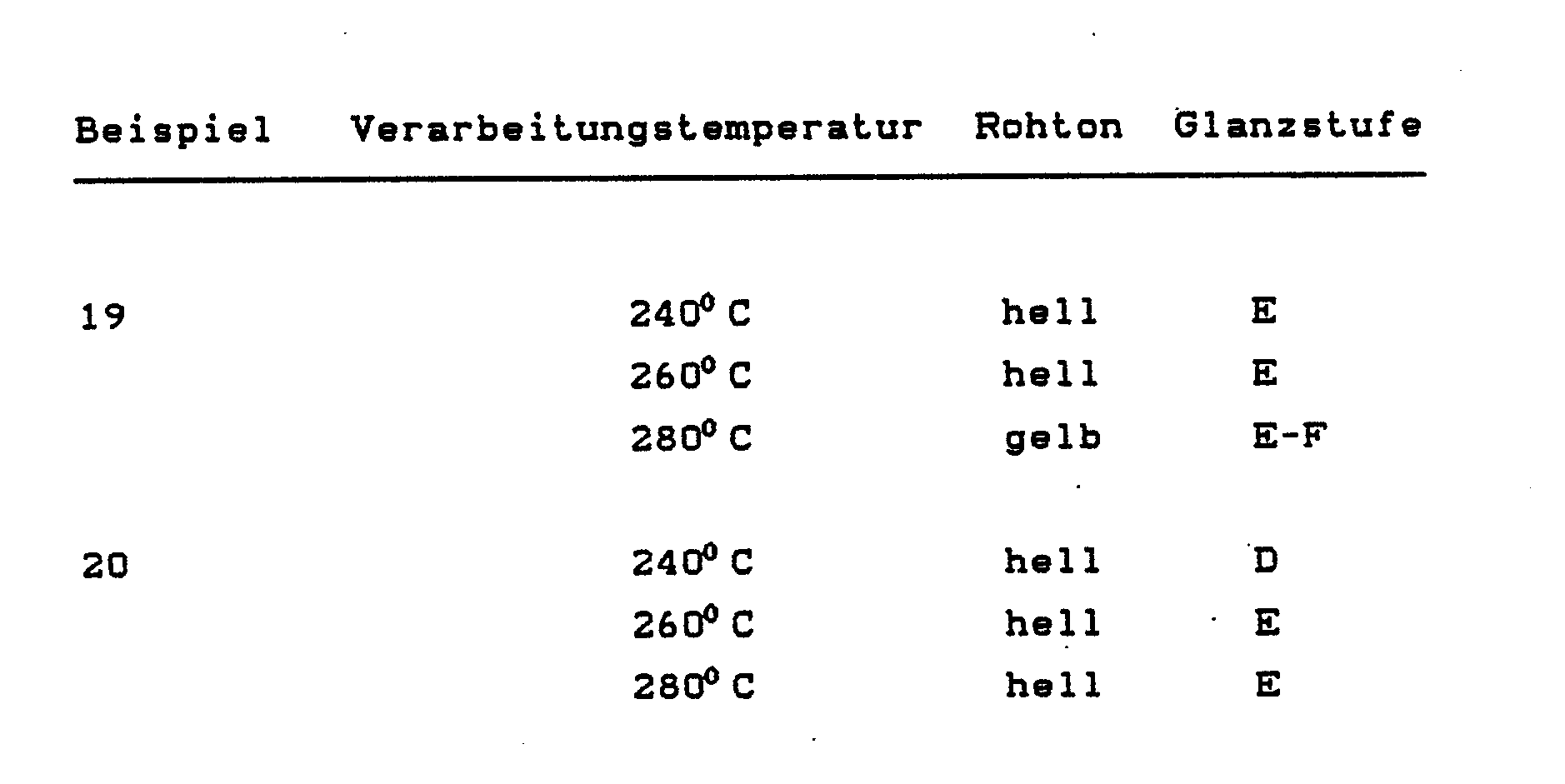
- 40 parts by weight of the graft polymer described in Examples 17 and 18 were mixed with 60 parts by weight of a styrene / acrylonitrile resin (72:28, M w about 115,000; M w / M n - 1 ⁇ 2), 2nd Parts by weight of ethylenediamine bisstearylamide and 0.1 parts by weight of a silicone oil are mixed in an internal kneader and then processed by injection molding into sheets with the dimensions 40x60x2.
- the panels were assessed with regard to raw tone and surface gloss, the gloss assessment being carried out on the AH scale in accordance with DE-AS 2 420 358.
Landscapes
- Chemical & Material Sciences (AREA)
- General Chemical & Material Sciences (AREA)
- Health & Medical Sciences (AREA)
- Chemical Kinetics & Catalysis (AREA)
- Medicinal Chemistry (AREA)
- Polymers & Plastics (AREA)
- Organic Chemistry (AREA)
- Addition Polymer Or Copolymer, Post-Treatments, Or Chemical Modifications (AREA)
- Organic Low-Molecular-Weight Compounds And Preparation Thereof (AREA)
- Emulsifying, Dispersing, Foam-Producing Or Wetting Agents (AREA)
- Polymerisation Methods In General (AREA)
- Graft Or Block Polymers (AREA)
Abstract

X für den Rest eines hydrophoben, gegebenenfalls verzweigten Vinyloligomers mit einem mittleren Molekulargewicht

von den Resten
R¹ und R² der eine für Wasserstoff, der andere für -SO₃M,
n für eine Zahl von 1,4-3,0, vorzugsweise 1,6-2,3
M für Wasserstoff, ein Alkalimetall, eine Ammonium-, C₁-C₄-Alkylammonium- oder C₂-C₃-Hydroxyalkylammonium-Gruppe stehen.
Description
- Gegenstand der Erfindung sind Sulfosuccinamidsäuren und ihre Salze der allgemeinen Formel

X für den Rest eines hydrophoben, gegebenenfalls verzweigten Vinyloligomers mit einem mittleren Molekulargewicht n von 200-5000, vorzugsweise 300-3000,
von den Resten
R¹ und R² der eine für Wasserstoff, der andere für -SO₃M,
n für eine Zahl von 1,4-3,0, vorzugsweise 1,6-2,3
M für Wasserstoff, ein Alkalimetall, eine Ammonium-C₁-C₄-Alkylammonium- oder C₂-C₃-Hydroxyalkyl-ammonium-Gruppe stehen. - Ein weiterer Gegenstand der Erfindung ist die Verwendung der Verbindungen der Formel I als Tenside und Emulgatoren in wäßrigen Systemen.
- Beispiele für die X zugrunde liegenden Vinyloligomere sind:
Oligobutadiene und Oligoisoprene sowie die entsprechenden Produkte mit teilweise oder vollständig hydrierten Doppelbindungen, Oligomere aus Ethylen, Propen, Styrol, Vinylestern mit 2-4 C-Atomen im Carbonsäureteil, (cyclo)-aliphatische Ester der (Meth)acrylsäure mit 1-12 C-Atomen im Alkoholrest, Triethoxyvinylsilan oder Trimethylvinylsilan. - Beispiel für M sind Natrium, Kalium, Ammonium, Mono-, Di- oder Trimethylammonium, Mono-, Di- oder Tri-(hydroxyethyl)-ammonium und Mono- oder Di-(hydroxypropyl)-ammonium.
- Die Herstellung solcher aminotelecheler Vinyloligomere ist bekannt. Sie erfolgt durch Polymerisation von Vinylmonomeren unter Verwendung großer Mengen nitrilhaltiger aliphatischer Azoinitiatoren, wobei Vinyloligomere mit endständigen Nitrilgruppen entstehen, die durch katalytische Hydrierung der Nitrilendgruppen zu primären Aminogruppen in die aminotelechelen Vinyloligomere der Formel II überführt werden.
- Beispielsweise beschreibt die US-P 2 561 068 u.a. die Herstellung von Polybutadienen, Polyisoprenen und Polypropylenen mit niedrigem Molekulargewicht und ungefähr zwei Nitrilendgruppen durch Batchpolymerisation der entsprechenden Monomere unter Verwendung großer Mengen nitrilhaltiger aliphatischer Azoinitiatoren.
- Die katalytische Hydrierung der Nitrilendgruppen solcher Produkte zu primären Aminoendgruppen ist in US-P 2 647 146 beschrieben. Aus der wachsartigen Konsistenz des im Beispiel 2 dieser Anmeldung hergestellten Diamins kann auf eine zumindest teilweise Hydrierung der Doppelbindungen des Oligobutadiens geschlossen werden.
- Die Herstellung der nitriltelechelen Oligobutadiene oder Oligoisoprene erfolgt vorzugsweise kontinuierlich in einem gefluteten Rührautoklaven bei Drucken unter 25 bar. Das Molekulargewicht der Oligomeren kann über das Verhältnis Azodinitril-Initiator zu Monomer eingestellt werden. Als Azodinitril-Initiatoren können beispielsweise eingesetzt werden: 2,2ʹ-Azo-bis-isobutyronitril (AIBN), 2,2ʹ-Azo-bis-2-methylbutyronitril, 1,1ʹ- Azo-dicyclopentan-carbonitril, 1,1ʹ-Azodicyclohexancarbonitril, 2,2ʹ-Azo-bis-cyclopentylpropionitril, 1,1ʹ-Azo-dicamphercarbonitril, 2,2ʹ-Azo-bis-(α-γ-dimethylvaleronitril), 2,2ʹ-Azo-bis-2-phenylpropionitril, 2,2ʹ-Azo-bis-2-benzyl-propionitril und 2,2ʹ-Azo-bis-2-(4-methoxyphenyl)-propionitril.
- Bevorzugte Initiatoren sind AIBN, 2,2ʹ-Azo-bis-2-methylbutyronitril und 2,2ʹ-Azo-bis-(α,γ-dimethylvaleronitril).
- Bei Verwendung von AIBN als Initiator liegen die bevorzugten Polymerisationstemperaturen bei 90-130°C und die mittleren Verweilzeiten bei 1-6 Stunden.
- Selbstverständlich können geeignete nitriltelechele Oligobutadiene und Oligoisoprene auch diskontinuierlich nach einem Zulaufverfahren hergestellt werden. Die Hydrierung der Nitrilendgruppen erfolgt in an sich bekannter Weise durch katalytische Hydrierung des in einem Lösungsmittel wie z.B. Toluol gelösten Oligomeren. Zur selektiven Hydrierung der Nitrilgruppen ist beispielsweise Raney-Cobalt geeignet, wobei durch einen Zusatzvon NH₃ die Bildung von sekundären und tertiären Aminogruppen zurückgedrängt werden kann.
- Der H₂-Druck beträgt vorzugsweise 100-200 bar und die Hydriertemperatur 100-200°C. Bei sehr langen Hydrierzeiten oder bei Zusatz von Raney-Nickel zum Raney-Cobalt gelingt auch die Hydrierung der C-C-Doppelbindungen der Oligobutadiene bzw. Oligoisoprene.
- Die Herstellung aminotelecheler Oligostyrole, aminotelecheler Oligoethylene, aminotelecheler Oligoacrylsäureethylester, eines aminotelechelen Oligomethacrylsäuremethylesters, eines aminotelechelen Oligomethacrylsäureethylesters sowie eines aminotelechelen Oligovinylacetats ist in den Beispielen der DOS 2 151 848 beschrieben. Die Herstellung der nitriltelechelen Vorprodukte erfolgt dabei nach den Verfahren der DOS 2 030 589. Außerdem wurde die Herstellung von dienitriltelechelen Oligostyrolen ausführlich von Konter, Bömer, Köhler und Heitz in Makromol, Chem. 182 (1981) 2619-2632 beschrieben.
- Geeignete Lösungsmittel für die Umsetzung der aminotelechelen Vinyloligomere der Formel II mit Maleinsäureanhydrid sind beispielsweise aliphatische oder aromatische Kohlenwasserstoffe, insbesondere Toluol und Xylol, aliphatische oder aromatische Halogenkohlenwasserstoffe, wie z.B. Methlenchlorid, Ethylenchlorid oder Chlorbenzol, Ester oder Ketone, wie z.B. Ethylacetat oder Aceton, und Ether, wie z.B. Tetrahydrofuran.
- Vorzugsweise werden die aminotelechelen Vinyloligomere in den Lösungsmitteln gelöst und das Maleinsäureanhydrid diesen Lösungen bei der gewählten Reaktionstemperatur zugesetzt.
- Das Mengenverhältnis der Komponenten wird so gewählt, daß auf jedes Amin-Äquivalent der aminotelechelen Vinyloligomere mindestens ein Äquivalent Maleinsäureanhydrid entfällt, gegebenenfalls kann Maleinsäureanhydrid in geringem Überschuß eingesetzt werden.
- Bei der Reaktion der Maleinsäureanhydrid-Umsetzungsprodukte mit Alkali- oder Ammoniumsulfit wird die Menge an Alkali- oder Ammoniumsulfit so gewählt, daß pro Mol eingesetztes Maleinsäureanhydrid 0,95-1,05 Mol Alkali- oder Ammoniumsulfit zur Anwendung gelangen.
- Die polymeren Emulgatoren werden in Mengen von 0,2 bis 20 Gew.-%, vorzugsweise 1 bis 10 Gew.-%, bezogen auf die Monomermenge eingesetzt.
- Sie eignen sich beispielsweise für die Emulsionspolymerisation von Butadien, Isopren, Chloropren, Styrol und im aromatischen Kern substituierten Styrolen, α-Methylstyrol, (Meth)acrylsäureestern mit 1 - 20 C-Atomen im Alkoholrest, Vinylestern mit 2 - 10 C-Atomen im Carbonsäurerest, Ethylen, Vinylchlorid, Vinylidenchlorid, Acrylnitril und Methacrylnitril sowie für die Emulsionscopolymerisation geeigneter Kombinationen der vorgenannten Monomeren. Zur zusätzlichen Stabilisierung der Emulsionen können ferner untergeordnete Mengen (ca. 0,1 bis 10 Gew.-%) von (Meth)acrylsäure, (Meth)acrylamid, Maleinsäure, Itaconsäure, Vinylsulfonsäure, Methallylsulfonsäure, Vinylphosphonsäure oder Acrylamido-2-methylpropansulfonsäure (AMPS) eingebaut werden. Vorzugsweise werden die erfindungsgemäßen polymeren Emulgatoren eingesetzt zur Polymerisation von Butadien, Isopren und Chloropren, sowie zur Copolymerisation von Butadien-Styrol, Butadien-Acrylnitril, Ethylen-Vinylacetat, Ethylen-Vinylchlorid, Styrol, Butylacrylat und Styrol-Acrylnitril.
- Zur Herstellung von Polybutadienlatices, die als Pfropfgrundlagen für die Herstellung schlagfester Thermoplaste vom ABS-Typ besonders geeignet sind, werden solche polymeren Emulgatoren (besonders) bevorzugt eingesetzt, deren Rest X aus Polybutadien, Polyisopren bzw. Polyisopren oder Polybutadien, dessen Doppelbindungen teilweise oder vollständig hydriert sind, bestehen.
- Ein 6 1-Rührautoklav mit Druckhalteventil wird mit Toluol vollständig gefüllt und auf 120°C Innentemperatur erwärmt. Bei dieser Temperatur werden stündlich die in der Tabelle angegebenen Mengen flüssiges Butadien bzw. Isopren sowie eine Toluollösung, die 40 g Azoisobuttersäurenitril (AIBN) pro Liter enthält, zugepumpt.
- Das Druckhalteventil wird auf 16-18 bar eingestellt. Nach einer Anfahrphase von 8 Stunden wird die aus dem Autoklaven austretende Lösung vom Restmonomer befreit und im Vakuum eingedampft.

- In einem 4 ℓ-Autoklaven werden jeweils 750 g dinitriltelecheles Oligomer, 2000 ml Toluol, 375 ml flüssiges Ammoniak und 75 g Raney-Cobalt vorgelegt und bei 200°C und 100 bar Wasserstoffdruck 10 Stunden hydriert.
- Nach dem Abfiltrieren des Katalysators wird das Toluol im Vakuum entfernt.

- 360 Tle. eines aminotelechelen Oligobutadiens, hergestellt nach Herstellungsbeispiel 5 (Basen-Stickstoff 3,2 %,n 740) wurden in 350 Tln. Toluol gelöst und bei 50-60° C portionsweise mit 87 Tln. Maleinsäureanhydrid versetzt und bei 60-70° C eine Stunde gerührt. Nach dem Abdestillieren des Toluols unter Vakuum erhielt man 447 Tle. eines viskosen, dunkelbraunen Rückstands, der eine Säurezahl von 114 mg KOH/g besaß. Das IR-Spektrum zeigte das Vorliegen einer Säureamidgruppe. Der Eindampfrückstand wurde bei 60-70°C mit einer Lösung von 113 Tln. Natriumsulfit in 810 Tln. Wasser versetzt und 7 Stunden bei gleicher Temperatur gerührt. Die entstandene wäßrige Lösung bei gleicher Temperatur gerührt. Die entstandene wäßrige Lösung wurde durch Filtration unter Zusatz von Kieselgur geklärt. Man erhielt eine klare bräunliche Lösung mit einem Trockengehalt von 40 %, die sich in Wasser klar löste.

- Der durch dreistündiges Erhitzen im Vakuum bei 100° C erhaltene Eindampfrückstand besaß einen Stickstoffgehalt von 2,4 % und einen Schwefelgehalt von 5,2 %.
- 120 Tle. eines aminotelechelen Oligobutadiens, hergestellt nach Herstellungsbeispiel 6 (Basen-Stickstoff 1,49 %,n 1870) wurden wie in Beispiel 9 beschrieben, in Toluol mit 14 Tln. Maleinsäureanhydrid umgesetzt. Die Säurezahl des Umsetzungsproduktes nach dem Eindampfen betrug 59,7 mg KOH/g. Der Eindampfrückstand wurde mit 90 Tln. Isopropanol gelöst, bei 50-60°C mit einer Lösung von 18,9 Tln. Natriumsulfit in 100 Tln. Wasser versetzt und 3 Stunden bei 60-70° C gerührt. Anschließend wurde durch Eindampfen im Vakuum das Isopropanol entfernt. Man erhielt eine viskose, weißliche Emulsion mit einem Trockengehalt von 45 %, die in Wasser opalescirende Lösungen lieferte.

- 120 Tle. eines aminotelechelen Oligoisoprens, hergestellt nach Herstellungsbeispiel 8 (Basen-Stickstoff 1,55 %n 1800) wurden, wie in Beispiel 9 beschrieben, in Toluol mit 14,7 Tln. Maleinsäueanhydrid umgesetzt. Die Säurezahl des Umsetzungsproduktes nach dem Eindampfen betrug 63,1 mg KOH/g. Der Eindampfrückstand wurde mit 60 Tln. Ethanol und 60 Tln. 10 %iger Natronlauge gelöst und dann bei 50-60° C mit 43 Tln. einer 36,3 %igen wäßrigen Natriumhydrogensulfit-Lösung versetzt. Nach Zusatz von 100 Tln. Wasser wurde 3 Stunden bei 70-80° C gerührt. Anschließend wurde durch Eindampfen im Vakuum vom Ethanol befreit. Man erhielt eine weiße Paste mit einem Trockengehalt von 73 %, die in Wasser emulsionsartige Lösungen lieferte.

- 360 Tle. eines aminotelechelen Oligoisoprens, hergestellt nach Herstellungsbeispiel 7 (Basen-Stickstoff 3,5 %,n 760) wurden wie in Beispiel 9 beschrieben, mit 96,9 Tln. Maleinsäureanhydrid umgesetzt. Die Säuerzahl des Umsetzungsproduktes nach dem Eindampfen betrug 115 mg KOH/g. Der Eindampfrückstand wurde mit einer Lösung von 132 Tln. Natriumsulfit in 690 Tln. Wasser versetzt und bei 60-70° C 7 Stunden gerührt. Die entstandene wäßrige Lösung wurde durch Filtration unter Zusatz von Kieselgur geklärt. Man erhielt eine bräunliche, klare Lösung mit einem Trockengehalt von 45 %, die sich in Wasser klar löste.

- Der durch dreistündiges Erhitzen im Vakuum bei 100° C erhaltene Eindampfrückstand besaß einen Stickstoffgehalt von 2,2 % und einen Schwefelgehalt von 5,6 %.
- In einen 6 ℓ-Autoklav mit Blattrührer (150 UPM) und Außenmantelheizung mit geregelter Innentemperatur werden unter Ausschluß von Luftsauerstoff eingebracht:
Entionisiertes Wasser 1850 g
Polymeremulgator, 10 %ige wäßrige Lösung 640 g
tert.-Dodecylmercaptan 5 g
4,4ʹ-Azo-bis-(4-Cyanopentansaures Kalium) 5 g
gelöst in entionisiertem Wasser 80 g
Butadien 1600 g - Der Autoklaveninhalt wird auf eine Innentemperatur von 54° C aufgeheizt und bei dieser Temperatur konstant gehalten, bis der Druck von ca. 7 bar auf ca. 1,5 bar abgefallen ist. Der Autoklav wird oben langsam entspannt, das entweichende Butadien entsorgt, der Latex abgelassen und anschließend entmonomerisiert; indem man ca. 10 % des im Latex enthaltenen Wassers abdestilliert und gleichzeitig durch frisches Wasser ergänzt.

- 50 Gew.-Teile Polybutadien (der nach Verdünnung mit Wasser auf einen Feststoffgehalt von 25 Gew.-% eingestellte Polybutadienlatex aus Beispiel 14 bzw. 16) werden unter Stickstoff auf 65° C erwärmt, wonach 0,5 Gew.-Teile Kaliumpersulfat (gelöst in 15 Gew.-Teilen Wasser) zugegeben werden. Anschließend werden ein Gemisch aus 36 Gew.-Teilen Styrol und 14 Gew.-Teilen Acrylnitril sowie 2 Gew.-Teile des Natriumsalzes der disproportionierten Abietinsäure (gelöst in 25 Gew.-Teilen Wasser) innerhalb 4 Stunden zudosiert, wobei die Pfropfreaktion erfolgt.

- Der Latex wird in einer Magnesiumsulfat/Essigsäure-Lösung koaguliert und das resultierende Pulver bei 70° C im Vakuum getrocknet.
- 40 Gew.-Teile des unter Beispiel 17 bzw. 18 beschriebenen Pfropfpolymerisats wurden mit 60 Gew.-Teilen eines Styrol/Acrylnitril-Harzes (72:28, Mw ca. 115.000; Mw/Mn - 1 ≦ 2), 2 Gew.-Teilen Ethylendiaminbisstearylamid und 0,1 Gew.-Teilen eines Silikonöls in einem Innenkneter vermischt und anschließend durch Spritzguß zu Platten mit den Maßen 40x60x2 verarbeitet. Die Platten wurden hinsichtlich Rohton und Oberflächenglanz beurteilt, wobei die Glanzbeurteilung nach der Skala A-H gemäß DE-AS 2 420 358 erfolgte.
Claims (3)

X für den Rest eines hydrophoben, gegebenenfalls verzweigten Vinyloligomers mit einem mittleren Molekulargewicht

von den Resten
R¹ und R² der eine für Wasserstoff, der andere für -SO₃M,
n für eine Zahl von 1,4-3,0,
M für Wasserstoff, ein Alkalimetall, eine Ammonium-, C₁-C₄-Alkylammonium- oder C₂-C₃-Hydroxyalkyl-ammonium-Gruppe stehen.
Applications Claiming Priority (2)
| Application Number | Priority Date | Filing Date | Title |
|---|---|---|---|
| DE19863643818 DE3643818A1 (de) | 1986-12-20 | 1986-12-20 | Polymere emulgatoren auf basis aminotelecheler vinyloligomere ii |
| DE3643818 | 1986-12-20 |
Publications (3)
| Publication Number | Publication Date |
|---|---|
| EP0272535A2 true EP0272535A2 (de) | 1988-06-29 |
| EP0272535A3 EP0272535A3 (en) | 1990-09-12 |
| EP0272535B1 EP0272535B1 (de) | 1993-02-17 |
Family
ID=6316816
Family Applications (1)
| Application Number | Title | Priority Date | Filing Date |
|---|---|---|---|
| EP87118114A Expired - Lifetime EP0272535B1 (de) | 1986-12-20 | 1987-12-08 | Polymere Emulgatoren auf Basis aminotelecheler Vinyloligomere II |
Country Status (4)
| Country | Link |
|---|---|
| US (1) | US4920181A (de) |
| EP (1) | EP0272535B1 (de) |
| JP (1) | JPS63170350A (de) |
| DE (2) | DE3643818A1 (de) |
Cited By (2)
| Publication number | Priority date | Publication date | Assignee | Title |
|---|---|---|---|---|
| FR2742760A1 (fr) * | 1995-12-22 | 1997-06-27 | Atochem Elf Sa | Oligomeres de 1,3 diene partiellement hydrogenes aminotelecheliques et procede de preparation de ces composes |
| US9527229B2 (en) | 2009-11-23 | 2016-12-27 | Horeth Kunststoffverarbeitung Gmbh | Method and device for producing molded trim parts |
Families Citing this family (2)
| Publication number | Priority date | Publication date | Assignee | Title |
|---|---|---|---|---|
| DE4421556A1 (de) * | 1994-06-20 | 1995-12-21 | Bayer Ag | Polyisobutylene mit Asparaginsäureesterendgruppen |
| US7789150B2 (en) * | 2005-09-09 | 2010-09-07 | Halliburton Energy Services Inc. | Latex compositions comprising pozzolan and/or cement kiln dust and methods of use |
Family Cites Families (8)
| Publication number | Priority date | Publication date | Assignee | Title |
|---|---|---|---|---|
| US2647146A (en) * | 1949-07-01 | 1953-07-28 | Du Pont | Process for the preparation of diprimary diamines |
| FR1495086A (fr) * | 1966-09-12 | 1967-09-15 | North American Aviation Inc | Liant polymère pour combustible solide pour fusées |
| US3795647A (en) * | 1972-03-07 | 1974-03-05 | Doverstrand Ltd | Agglomerating latices of diene polymers |
| GB1347196A (en) * | 1972-05-05 | 1974-02-27 | Polysar Ltd | Latex compositions |
| GB1578319A (en) * | 1975-12-24 | 1980-11-05 | Rewo Chemicals Ltd | Surface-active agent compositions and processes for manufacturing and using them |
| GB1506653A (en) * | 1976-11-15 | 1978-04-05 | Lankro Chem Ltd | Aqueous polymer compositions |
| NL7714317A (nl) * | 1976-12-31 | 1978-07-04 | Hoechst Ag | Avivagemiddel en werkwijze voor het aviveren van textielmateriaal. |
| US4490308A (en) * | 1983-06-30 | 1984-12-25 | Nalco Chemical Company | New water-soluble sulfonated monomers |
-
1986
- 1986-12-20 DE DE19863643818 patent/DE3643818A1/de not_active Withdrawn
-
1987
- 1987-12-08 DE DE8787118114T patent/DE3784229D1/de not_active Expired - Fee Related
- 1987-12-08 EP EP87118114A patent/EP0272535B1/de not_active Expired - Lifetime
- 1987-12-14 JP JP62314305A patent/JPS63170350A/ja active Pending
- 1987-12-16 US US07/133,551 patent/US4920181A/en not_active Expired - Fee Related
Cited By (4)
| Publication number | Priority date | Publication date | Assignee | Title |
|---|---|---|---|---|
| FR2742760A1 (fr) * | 1995-12-22 | 1997-06-27 | Atochem Elf Sa | Oligomeres de 1,3 diene partiellement hydrogenes aminotelecheliques et procede de preparation de ces composes |
| EP0780400A3 (de) * | 1995-12-22 | 1997-07-16 | Elf Atochem S.A. | Partiell hydrierte aminotelechele Oligomere von 1,3-Dienen und Methode zur Herstellung derselben |
| CN1064692C (zh) * | 1995-12-22 | 2001-04-18 | 埃勒夫阿托化学有限公司 | 部分氢化的氨基远螯的1,3-二烯齐聚物和这些化合物的制备方法 |
| US9527229B2 (en) | 2009-11-23 | 2016-12-27 | Horeth Kunststoffverarbeitung Gmbh | Method and device for producing molded trim parts |
Also Published As
| Publication number | Publication date |
|---|---|
| DE3643818A1 (de) | 1988-06-30 |
| EP0272535B1 (de) | 1993-02-17 |
| DE3784229D1 (de) | 1993-03-25 |
| US4920181A (en) | 1990-04-24 |
| JPS63170350A (ja) | 1988-07-14 |
| EP0272535A3 (en) | 1990-09-12 |
Similar Documents
| Publication | Publication Date | Title |
|---|---|---|
| EP0268916B1 (de) | Bifunktionelle Emulgatoren auf Basis von Perhydrobisphenolen und Carbonsäureanhydriden | |
| DE923333C (de) | Polymerisationsverfahren | |
| DE1745507C2 (de) | Wasserlösliche Oligomere mit endständigem Alkylsulfid | |
| EP0237792A1 (de) | Telechele Polymere | |
| EP0272535B1 (de) | Polymere Emulgatoren auf Basis aminotelecheler Vinyloligomere II | |
| EP0195328B1 (de) | Aminobernsteinsäurederivate und ihre Verwendung als Emulgatoren für Polymerdispersionen | |
| EP0065136B1 (de) | Oberflächenaktive Azoverbindungen und ihre Verwendung | |
| EP0032978A1 (de) | Polychloropren-Klebstoff mit verbesserter Topfzeit und seine Herstellung | |
| EP0275451B1 (de) | Polymere Emulgatoren auf Basis aminotelecheler Oligomere I | |
| DE2729628C2 (de) | ||
| DE69115159T2 (de) | Verfahren zur Herstellung von Stossresistenten Thermoplastischen Harzen mit Hochglänzender Oberfläche. | |
| EP0234416B1 (de) | Zitronensäurederivate als Emulgatoren für die Emulsationspolymerisation | |
| EP0065661B1 (de) | Oberflächenaktive Azoverbindungen und ihre Verwendung | |
| DE2549650C2 (de) | Verfahren zur Herstellung eines Latex eines Chloroprenpolymeren | |
| DE3610638C2 (de) | Radikalinitiierte polymerisation eines polymerisierbaren ethylenisch ungesaettigten monomeren in gegenwart von wasserstoffperoxid | |
| DE68906251T2 (de) | Verfahren zur herstellung von addukten von butadienoligomeren. | |
| DE3621444A1 (de) | Verfahren zur herstellung von copolymerisaten einer vinylcyanidverbindung und einer aromatischen vinylverbindung | |
| DE2549150A1 (de) | Lagerfaehige polychloropren-klebstoffe sowie ein verfahren zu ihrer herstellung | |
| EP0167772B1 (de) | Verfahren zur Herstellung hochmolekularer Thermoplastharze | |
| EP0001810A1 (de) | Verfahren zur Herstellung eines Vinylester-Copolymers | |
| DE3936885C2 (de) | Schwefelhaltige Phosphonate, Verfahren zu ihrer Herstellung und ihre Verwendung zum Desaktivieren von Radikalen | |
| DE2062311C2 (de) | Verfahren zur kontinuierlichen Herstellung von Pfropfpolymerisaten aus Styrol und/oder Acrylnitril auf kautschukartige Polymerisate in wäßriger Emulsion | |
| EP0381973B1 (de) | Verfahren zur Herstellung von Nitrilgruppen enthaltenden Copolymerisaten auf Basis von Ethylen | |
| DE954197C (de) | Verfahren zur Herstellung von hochmolekularen, wasserloeslichen Produkten aus Methacrylsaeureamid oder dessen Mischungen mit ungesaettigten Carbonsaeureamiden | |
| EP0003986A2 (de) | Verfahren zur kontinuierlichen Herstellung von Copolymerisaten aus Alpha-Methylstyrol und Acrylnitril in einer Reaktionszone |
Legal Events
| Date | Code | Title | Description |
|---|---|---|---|
| PUAI | Public reference made under article 153(3) epc to a published international application that has entered the european phase |
Free format text: ORIGINAL CODE: 0009012 |
|
| 17P | Request for examination filed |
Effective date: 19871208 |
|
| AK | Designated contracting states |
Kind code of ref document: A2 Designated state(s): DE FR GB IT |
|
| PUAL | Search report despatched |
Free format text: ORIGINAL CODE: 0009013 |
|
| AK | Designated contracting states |
Kind code of ref document: A3 Designated state(s): DE FR GB IT |
|
| 17Q | First examination report despatched |
Effective date: 19911009 |
|
| GRAA | (expected) grant |
Free format text: ORIGINAL CODE: 0009210 |
|
| AK | Designated contracting states |
Kind code of ref document: B1 Designated state(s): DE FR GB IT |
|
| PG25 | Lapsed in a contracting state [announced via postgrant information from national office to epo] |
Ref country code: IT Free format text: LAPSE BECAUSE OF FAILURE TO SUBMIT A TRANSLATION OF THE DESCRIPTION OR TO PAY THE FEE WITHIN THE PRE;WARNING: LAPSES OF ITALIAN PATENTS WITH EFFECTIVE DATE BEFORE 2007 MAY HAVE OCCURRED AT ANY TIME BEFORE 2007. THE CORRECT EFFECTIVE DATE MAY BE DIFFERENT FROM THE ONE RECORDED.SCRIBED TIME-LIMIT Effective date: 19930217 Ref country code: GB Effective date: 19930217 Ref country code: FR Effective date: 19930217 |
|
| REF | Corresponds to: |
Ref document number: 3784229 Country of ref document: DE Date of ref document: 19930325 |
|
| EN | Fr: translation not filed | ||
| GBV | Gb: ep patent (uk) treated as always having been void in accordance with gb section 77(7)/1977 [no translation filed] |
Effective date: 19930217 |
|
| PLBE | No opposition filed within time limit |
Free format text: ORIGINAL CODE: 0009261 |
|
| STAA | Information on the status of an ep patent application or granted ep patent |
Free format text: STATUS: NO OPPOSITION FILED WITHIN TIME LIMIT |
|
| 26N | No opposition filed | ||
| PGFP | Annual fee paid to national office [announced via postgrant information from national office to epo] |
Ref country code: DE Payment date: 19951114 Year of fee payment: 9 |
|
| PG25 | Lapsed in a contracting state [announced via postgrant information from national office to epo] |
Ref country code: DE Effective date: 19970902 |