EP0272573B1 - Matériau de reproduction photographique couleur avec un coupleur libérant un composé photographiquement actif - Google Patents
Matériau de reproduction photographique couleur avec un coupleur libérant un composé photographiquement actif Download PDFInfo
- Publication number
- EP0272573B1 EP0272573B1 EP87118470A EP87118470A EP0272573B1 EP 0272573 B1 EP0272573 B1 EP 0272573B1 EP 87118470 A EP87118470 A EP 87118470A EP 87118470 A EP87118470 A EP 87118470A EP 0272573 B1 EP0272573 B1 EP 0272573B1
- Authority
- EP
- European Patent Office
- Prior art keywords
- coupler
- silver halide
- recording material
- alkyl
- halide emulsion
- Prior art date
- Legal status (The legal status is an assumption and is not a legal conclusion. Google has not performed a legal analysis and makes no representation as to the accuracy of the status listed.)
- Expired - Lifetime
Links
- 150000001875 compounds Chemical class 0.000 title claims description 57
- 239000000463 material Substances 0.000 title claims description 34
- -1 silver halide Chemical class 0.000 claims description 81
- 229910052709 silver Inorganic materials 0.000 claims description 54
- 239000004332 silver Substances 0.000 claims description 54
- 239000000839 emulsion Substances 0.000 claims description 48
- 238000011161 development Methods 0.000 claims description 31
- 125000000217 alkyl group Chemical group 0.000 claims description 30
- 230000008878 coupling Effects 0.000 claims description 18
- 238000010168 coupling process Methods 0.000 claims description 18
- 238000005859 coupling reaction Methods 0.000 claims description 18
- 125000003118 aryl group Chemical group 0.000 claims description 17
- 150000003254 radicals Chemical class 0.000 claims description 15
- 125000000623 heterocyclic group Chemical group 0.000 claims description 14
- 125000003277 amino group Chemical group 0.000 claims description 12
- 125000004432 carbon atom Chemical group C* 0.000 claims description 11
- 230000003647 oxidation Effects 0.000 claims description 10
- 238000007254 oxidation reaction Methods 0.000 claims description 10
- 125000003710 aryl alkyl group Chemical group 0.000 claims description 9
- 125000002496 methyl group Chemical group [H]C([H])([H])* 0.000 claims description 9
- 125000002252 acyl group Chemical group 0.000 claims description 8
- 229910052736 halogen Inorganic materials 0.000 claims description 8
- 150000002367 halogens Chemical group 0.000 claims description 8
- 230000036961 partial effect Effects 0.000 claims description 8
- 125000004442 acylamino group Chemical group 0.000 claims description 7
- 125000003545 alkoxy group Chemical group 0.000 claims description 6
- 125000004093 cyano group Chemical group *C#N 0.000 claims description 6
- 125000004122 cyclic group Chemical group 0.000 claims description 6
- 125000001997 phenyl group Chemical group [H]C1=C([H])C([H])=C(*)C([H])=C1[H] 0.000 claims description 6
- 125000003342 alkenyl group Chemical group 0.000 claims description 5
- 125000004414 alkyl thio group Chemical group 0.000 claims description 5
- 125000000753 cycloalkyl group Chemical group 0.000 claims description 5
- 125000001424 substituent group Chemical group 0.000 claims description 5
- 125000000304 alkynyl group Chemical group 0.000 claims description 4
- 238000006243 chemical reaction Methods 0.000 claims description 4
- 229910052740 iodine Inorganic materials 0.000 claims description 4
- 125000005110 aryl thio group Chemical group 0.000 claims description 3
- 125000004104 aryloxy group Chemical group 0.000 claims description 3
- 125000003262 carboxylic acid ester group Chemical group [H]C([H])([*:2])OC(=O)C([H])([H])[*:1] 0.000 claims description 3
- 125000000449 nitro group Chemical group [O-][N+](*)=O 0.000 claims description 3
- ISWSIDIOOBJBQZ-UHFFFAOYSA-N phenol group Chemical group C1(=CC=CC=C1)O ISWSIDIOOBJBQZ-UHFFFAOYSA-N 0.000 claims description 3
- 150000005840 aryl radicals Chemical class 0.000 claims description 2
- 229910052739 hydrogen Inorganic materials 0.000 claims description 2
- 239000001257 hydrogen Substances 0.000 claims description 2
- 125000004435 hydrogen atom Chemical group [H]* 0.000 claims description 2
- 125000001425 triazolyl group Chemical group 0.000 claims 2
- 150000001733 carboxylic acid esters Chemical group 0.000 claims 1
- 239000010410 layer Substances 0.000 description 105
- 229920000159 gelatin Polymers 0.000 description 25
- 235000019322 gelatine Nutrition 0.000 description 25
- 230000000694 effects Effects 0.000 description 22
- OKKJLVBELUTLKV-UHFFFAOYSA-N Methanol Chemical compound OC OKKJLVBELUTLKV-UHFFFAOYSA-N 0.000 description 15
- 0 CC1=C(*)N=N*1 Chemical compound CC1=C(*)N=N*1 0.000 description 14
- 108010010803 Gelatin Proteins 0.000 description 14
- 239000008273 gelatin Substances 0.000 description 14
- 235000011852 gelatine desserts Nutrition 0.000 description 14
- 239000000047 product Substances 0.000 description 13
- 230000003595 spectral effect Effects 0.000 description 13
- YXFVVABEGXRONW-UHFFFAOYSA-N Toluene Chemical compound CC1=CC=CC=C1 YXFVVABEGXRONW-UHFFFAOYSA-N 0.000 description 12
- 239000003112 inhibitor Substances 0.000 description 12
- SQGYOTSLMSWVJD-UHFFFAOYSA-N silver(1+) nitrate Chemical compound [Ag+].[O-]N(=O)=O SQGYOTSLMSWVJD-UHFFFAOYSA-N 0.000 description 12
- 239000001828 Gelatine Substances 0.000 description 11
- 239000003795 chemical substances by application Substances 0.000 description 11
- 230000035945 sensitivity Effects 0.000 description 10
- XEKOWRVHYACXOJ-UHFFFAOYSA-N Ethyl acetate Chemical compound CCOC(C)=O XEKOWRVHYACXOJ-UHFFFAOYSA-N 0.000 description 9
- 101710134784 Agnoprotein Proteins 0.000 description 8
- 239000000975 dye Substances 0.000 description 8
- 239000000203 mixture Substances 0.000 description 8
- WEVYAHXRMPXWCK-UHFFFAOYSA-N Acetonitrile Chemical compound CC#N WEVYAHXRMPXWCK-UHFFFAOYSA-N 0.000 description 6
- 239000011230 binding agent Substances 0.000 description 6
- OIPQUBBCOVJSNS-UHFFFAOYSA-L bromo(iodo)silver Chemical compound Br[Ag]I OIPQUBBCOVJSNS-UHFFFAOYSA-L 0.000 description 6
- 150000003852 triazoles Chemical group 0.000 description 6
- XMBWDFGMSWQBCA-UHFFFAOYSA-N hydrogen iodide Chemical compound I XMBWDFGMSWQBCA-UHFFFAOYSA-N 0.000 description 5
- 238000002360 preparation method Methods 0.000 description 5
- 238000011160 research Methods 0.000 description 5
- 125000001399 1,2,3-triazolyl group Chemical group N1N=NC(=C1)* 0.000 description 4
- QTBSBXVTEAMEQO-UHFFFAOYSA-N Acetic acid Chemical compound CC(O)=O QTBSBXVTEAMEQO-UHFFFAOYSA-N 0.000 description 4
- XEEYBQQBJWHFJM-UHFFFAOYSA-N Iron Chemical compound [Fe] XEEYBQQBJWHFJM-UHFFFAOYSA-N 0.000 description 4
- 230000008901 benefit Effects 0.000 description 4
- 238000004061 bleaching Methods 0.000 description 4
- 238000005266 casting Methods 0.000 description 4
- 239000000084 colloidal system Substances 0.000 description 4
- WRIRWRKPLXCTFD-UHFFFAOYSA-N malonamide Chemical class NC(=O)CC(N)=O WRIRWRKPLXCTFD-UHFFFAOYSA-N 0.000 description 4
- 239000002904 solvent Substances 0.000 description 4
- KJHVWJFIEFFKGN-UHFFFAOYSA-N 4-butylsulfanyl-2h-triazole Chemical compound CCCCSC=1C=NNN=1 KJHVWJFIEFFKGN-UHFFFAOYSA-N 0.000 description 3
- CSCPPACGZOOCGX-UHFFFAOYSA-N Acetone Chemical compound CC(C)=O CSCPPACGZOOCGX-UHFFFAOYSA-N 0.000 description 3
- YMWUJEATGCHHMB-UHFFFAOYSA-N Dichloromethane Chemical compound ClCCl YMWUJEATGCHHMB-UHFFFAOYSA-N 0.000 description 3
- ZMXDDKWLCZADIW-UHFFFAOYSA-N N,N-Dimethylformamide Chemical compound CN(C)C=O ZMXDDKWLCZADIW-UHFFFAOYSA-N 0.000 description 3
- KWYUFKZDYYNOTN-UHFFFAOYSA-M Potassium hydroxide Chemical compound [OH-].[K+] KWYUFKZDYYNOTN-UHFFFAOYSA-M 0.000 description 3
- BQCADISMDOOEFD-UHFFFAOYSA-N Silver Chemical compound [Ag] BQCADISMDOOEFD-UHFFFAOYSA-N 0.000 description 3
- ZMANZCXQSJIPKH-UHFFFAOYSA-N Triethylamine Chemical compound CCN(CC)CC ZMANZCXQSJIPKH-UHFFFAOYSA-N 0.000 description 3
- 239000002253 acid Substances 0.000 description 3
- 239000000654 additive Substances 0.000 description 3
- 229910052794 bromium Inorganic materials 0.000 description 3
- 125000000484 butyl group Chemical group [H]C([*])([H])C([H])([H])C([H])([H])C([H])([H])[H] 0.000 description 3
- 238000009833 condensation Methods 0.000 description 3
- 230000005494 condensation Effects 0.000 description 3
- 125000001495 ethyl group Chemical group [H]C([H])([H])C([H])([H])* 0.000 description 3
- 238000000034 method Methods 0.000 description 3
- 239000004848 polyfunctional curative Substances 0.000 description 3
- 230000008569 process Effects 0.000 description 3
- 238000012545 processing Methods 0.000 description 3
- XLYOFNOQVPJJNP-UHFFFAOYSA-N water Substances O XLYOFNOQVPJJNP-UHFFFAOYSA-N 0.000 description 3
- 125000001376 1,2,4-triazolyl group Chemical group N1N=C(N=C1)* 0.000 description 2
- ZRHUHDUEXWHZMA-UHFFFAOYSA-N 1,4-dihydropyrazol-5-one Chemical compound O=C1CC=NN1 ZRHUHDUEXWHZMA-UHFFFAOYSA-N 0.000 description 2
- MPPPKRYCTPRNTB-UHFFFAOYSA-N 1-bromobutane Chemical compound CCCCBr MPPPKRYCTPRNTB-UHFFFAOYSA-N 0.000 description 2
- 241001479434 Agfa Species 0.000 description 2
- WKBOTKDWSSQWDR-UHFFFAOYSA-N Bromine atom Chemical compound [Br] WKBOTKDWSSQWDR-UHFFFAOYSA-N 0.000 description 2
- ZAMOUSCENKQFHK-UHFFFAOYSA-N Chlorine atom Chemical compound [Cl] ZAMOUSCENKQFHK-UHFFFAOYSA-N 0.000 description 2
- VYPSYNLAJGMNEJ-UHFFFAOYSA-N Silicium dioxide Chemical compound O=[Si]=O VYPSYNLAJGMNEJ-UHFFFAOYSA-N 0.000 description 2
- PMZURENOXWZQFD-UHFFFAOYSA-L Sodium Sulfate Chemical compound [Na+].[Na+].[O-]S([O-])(=O)=O PMZURENOXWZQFD-UHFFFAOYSA-L 0.000 description 2
- 229960000583 acetic acid Drugs 0.000 description 2
- 125000002777 acetyl group Chemical group [H]C([H])([H])C(*)=O 0.000 description 2
- 150000007513 acids Chemical class 0.000 description 2
- 230000029936 alkylation Effects 0.000 description 2
- 238000005804 alkylation reaction Methods 0.000 description 2
- IOJUPLGTWVMSFF-UHFFFAOYSA-N benzothiazole Chemical compound C1=CC=C2SC=NC2=C1 IOJUPLGTWVMSFF-UHFFFAOYSA-N 0.000 description 2
- 239000007844 bleaching agent Substances 0.000 description 2
- 230000009034 developmental inhibition Effects 0.000 description 2
- DOIRQSBPFJWKBE-UHFFFAOYSA-N dibutyl phthalate Chemical compound CCCCOC(=O)C1=CC=CC=C1C(=O)OCCCC DOIRQSBPFJWKBE-UHFFFAOYSA-N 0.000 description 2
- 238000009792 diffusion process Methods 0.000 description 2
- 150000002148 esters Chemical class 0.000 description 2
- 238000001914 filtration Methods 0.000 description 2
- 125000002485 formyl group Chemical group [H]C(*)=O 0.000 description 2
- 239000012362 glacial acetic acid Substances 0.000 description 2
- 125000005843 halogen group Chemical group 0.000 description 2
- 239000005457 ice water Substances 0.000 description 2
- 230000006872 improvement Effects 0.000 description 2
- 125000000956 methoxy group Chemical group [H]C([H])([H])O* 0.000 description 2
- 125000002816 methylsulfanyl group Chemical group [H]C([H])([H])S[*] 0.000 description 2
- AJDUTMFFZHIJEM-UHFFFAOYSA-N n-(9,10-dioxoanthracen-1-yl)-4-[4-[[4-[4-[(9,10-dioxoanthracen-1-yl)carbamoyl]phenyl]phenyl]diazenyl]phenyl]benzamide Chemical compound O=C1C2=CC=CC=C2C(=O)C2=C1C=CC=C2NC(=O)C(C=C1)=CC=C1C(C=C1)=CC=C1N=NC(C=C1)=CC=C1C(C=C1)=CC=C1C(=O)NC1=CC=CC2=C1C(=O)C1=CC=CC=C1C2=O AJDUTMFFZHIJEM-UHFFFAOYSA-N 0.000 description 2
- 125000001624 naphthyl group Chemical group 0.000 description 2
- 125000004433 nitrogen atom Chemical group N* 0.000 description 2
- 239000012074 organic phase Substances 0.000 description 2
- 239000003960 organic solvent Substances 0.000 description 2
- 125000000951 phenoxy group Chemical group [H]C1=C([H])C([H])=C(O*)C([H])=C1[H] 0.000 description 2
- 125000003356 phenylsulfanyl group Chemical group [*]SC1=C([H])C([H])=C([H])C([H])=C1[H] 0.000 description 2
- BWHMMNNQKKPAPP-UHFFFAOYSA-L potassium carbonate Chemical compound [K+].[K+].[O-]C([O-])=O BWHMMNNQKKPAPP-UHFFFAOYSA-L 0.000 description 2
- 125000002924 primary amino group Chemical group [H]N([H])* 0.000 description 2
- GZTPJDLYPMPRDF-UHFFFAOYSA-N pyrrolo[3,2-c]pyrazole Chemical class N1=NC2=CC=NC2=C1 GZTPJDLYPMPRDF-UHFFFAOYSA-N 0.000 description 2
- 150000003839 salts Chemical class 0.000 description 2
- 238000000926 separation method Methods 0.000 description 2
- 239000000741 silica gel Substances 0.000 description 2
- 229910002027 silica gel Inorganic materials 0.000 description 2
- 239000011734 sodium Substances 0.000 description 2
- 229910052938 sodium sulfate Inorganic materials 0.000 description 2
- 235000011152 sodium sulphate Nutrition 0.000 description 2
- 239000000979 synthetic dye Substances 0.000 description 2
- 239000000080 wetting agent Substances 0.000 description 2
- 239000001043 yellow dye Substances 0.000 description 2
- KKFDJZZADQONDE-UHFFFAOYSA-N (hydridonitrato)hydroxidocarbon(.) Chemical compound O[C]=N KKFDJZZADQONDE-UHFFFAOYSA-N 0.000 description 1
- KYVBNYUBXIEUFW-UHFFFAOYSA-N 1,1,3,3-tetramethylguanidine Chemical compound CN(C)C(=N)N(C)C KYVBNYUBXIEUFW-UHFFFAOYSA-N 0.000 description 1
- JYEUMXHLPRZUAT-UHFFFAOYSA-N 1,2,3-triazine Chemical compound C1=CN=NN=C1 JYEUMXHLPRZUAT-UHFFFAOYSA-N 0.000 description 1
- CBCKQZAAMUWICA-UHFFFAOYSA-N 1,4-phenylenediamine Chemical compound NC1=CC=C(N)C=C1 CBCKQZAAMUWICA-UHFFFAOYSA-N 0.000 description 1
- LLCOQBODWBFTDD-UHFFFAOYSA-N 1h-triazol-1-ium-4-thiolate Chemical compound SC1=CNN=N1 LLCOQBODWBFTDD-UHFFFAOYSA-N 0.000 description 1
- YQTCQNIPQMJNTI-UHFFFAOYSA-N 2,2-dimethylpropan-1-one Chemical compound CC(C)(C)[C]=O YQTCQNIPQMJNTI-UHFFFAOYSA-N 0.000 description 1
- RSZXXBTXZJGELH-UHFFFAOYSA-N 2,3,4-tri(propan-2-yl)naphthalene-1-sulfonic acid Chemical compound C1=CC=CC2=C(C(C)C)C(C(C)C)=C(C(C)C)C(S(O)(=O)=O)=C21 RSZXXBTXZJGELH-UHFFFAOYSA-N 0.000 description 1
- QTLHLXYADXCVCF-UHFFFAOYSA-N 2-(4-amino-n-ethyl-3-methylanilino)ethanol Chemical compound OCCN(CC)C1=CC=C(N)C(C)=C1 QTLHLXYADXCVCF-UHFFFAOYSA-N 0.000 description 1
- URDCARMUOSMFFI-UHFFFAOYSA-N 2-[2-[bis(carboxymethyl)amino]ethyl-(2-hydroxyethyl)amino]acetic acid Chemical compound OCCN(CC(O)=O)CCN(CC(O)=O)CC(O)=O URDCARMUOSMFFI-UHFFFAOYSA-N 0.000 description 1
- JKFYKCYQEWQPTM-UHFFFAOYSA-N 2-azaniumyl-2-(4-fluorophenyl)acetate Chemical compound OC(=O)C(N)C1=CC=C(F)C=C1 JKFYKCYQEWQPTM-UHFFFAOYSA-N 0.000 description 1
- 125000004974 2-butenyl group Chemical group C(C=CC)* 0.000 description 1
- 125000003903 2-propenyl group Chemical group [H]C([*])([H])C([H])=C([H])[H] 0.000 description 1
- XRZDIHADHZSFBB-UHFFFAOYSA-N 3-oxo-n,3-diphenylpropanamide Chemical class C=1C=CC=CC=1NC(=O)CC(=O)C1=CC=CC=C1 XRZDIHADHZSFBB-UHFFFAOYSA-N 0.000 description 1
- KLZPWDKBXDRJRC-UHFFFAOYSA-N 3-sulfanyltriazole-4-carboxylic acid Chemical class SN1N=NC=C1C(=O)O KLZPWDKBXDRJRC-UHFFFAOYSA-N 0.000 description 1
- QNGVNLMMEQUVQK-UHFFFAOYSA-N 4-n,4-n-diethylbenzene-1,4-diamine Chemical compound CCN(CC)C1=CC=C(N)C=C1 QNGVNLMMEQUVQK-UHFFFAOYSA-N 0.000 description 1
- INVVMIXYILXINW-UHFFFAOYSA-N 5-methyl-1h-[1,2,4]triazolo[1,5-a]pyrimidin-7-one Chemical compound CC1=CC(=O)N2NC=NC2=N1 INVVMIXYILXINW-UHFFFAOYSA-N 0.000 description 1
- VCFOEWURSYAGKP-UHFFFAOYSA-N 5-methyl-2h-triazole-4-carboxylic acid Chemical compound CC1=NNN=C1C(O)=O VCFOEWURSYAGKP-UHFFFAOYSA-N 0.000 description 1
- XVMSFILGAMDHEY-UHFFFAOYSA-N 6-(4-aminophenyl)sulfonylpyridin-3-amine Chemical compound C1=CC(N)=CC=C1S(=O)(=O)C1=CC=C(N)C=N1 XVMSFILGAMDHEY-UHFFFAOYSA-N 0.000 description 1
- 241000191966 Anas gracilis Species 0.000 description 1
- NOWKCMXCCJGMRR-UHFFFAOYSA-N Aziridine Chemical compound C1CN1 NOWKCMXCCJGMRR-UHFFFAOYSA-N 0.000 description 1
- LSNNMFCWUKXFEE-UHFFFAOYSA-M Bisulfite Chemical compound OS([O-])=O LSNNMFCWUKXFEE-UHFFFAOYSA-M 0.000 description 1
- ADSJSBPYEBZYGQ-UHFFFAOYSA-N CC(CC1)[O]=CC(CCC(C2)C2C(F)(F)F)=C1[ClH]C Chemical compound CC(CC1)[O]=CC(CCC(C2)C2C(F)(F)F)=C1[ClH]C ADSJSBPYEBZYGQ-UHFFFAOYSA-N 0.000 description 1
- 229920002284 Cellulose triacetate Polymers 0.000 description 1
- 241000251730 Chondrichthyes Species 0.000 description 1
- SNRUBQQJIBEYMU-UHFFFAOYSA-N Dodecane Natural products CCCCCCCCCCCC SNRUBQQJIBEYMU-UHFFFAOYSA-N 0.000 description 1
- KCXVZYZYPLLWCC-UHFFFAOYSA-N EDTA Chemical compound OC(=O)CN(CC(O)=O)CCN(CC(O)=O)CC(O)=O KCXVZYZYPLLWCC-UHFFFAOYSA-N 0.000 description 1
- 239000004593 Epoxy Substances 0.000 description 1
- UFHFLCQGNIYNRP-UHFFFAOYSA-N Hydrogen Chemical compound [H][H] UFHFLCQGNIYNRP-UHFFFAOYSA-N 0.000 description 1
- DGAQECJNVWCQMB-PUAWFVPOSA-M Ilexoside XXIX Chemical compound C[C@@H]1CC[C@@]2(CC[C@@]3(C(=CC[C@H]4[C@]3(CC[C@@H]5[C@@]4(CC[C@@H](C5(C)C)OS(=O)(=O)[O-])C)C)[C@@H]2[C@]1(C)O)C)C(=O)O[C@H]6[C@@H]([C@H]([C@@H]([C@H](O6)CO)O)O)O.[Na+] DGAQECJNVWCQMB-PUAWFVPOSA-M 0.000 description 1
- XLBBOSZIFBBOPE-UHFFFAOYSA-N O.O.[Na].S=c1cn[nH][nH]1 Chemical compound O.O.[Na].S=c1cn[nH][nH]1 XLBBOSZIFBBOPE-UHFFFAOYSA-N 0.000 description 1
- 229910021607 Silver chloride Inorganic materials 0.000 description 1
- 229910021612 Silver iodide Inorganic materials 0.000 description 1
- YSMRWXYRXBRSND-UHFFFAOYSA-N TOTP Chemical compound CC1=CC=CC=C1OP(=O)(OC=1C(=CC=CC=1)C)OC1=CC=CC=C1C YSMRWXYRXBRSND-UHFFFAOYSA-N 0.000 description 1
- FZWLAAWBMGSTSO-UHFFFAOYSA-N Thiazole Chemical compound C1=CSC=N1 FZWLAAWBMGSTSO-UHFFFAOYSA-N 0.000 description 1
- NNLVGZFZQQXQNW-ADJNRHBOSA-N [(2r,3r,4s,5r,6s)-4,5-diacetyloxy-3-[(2s,3r,4s,5r,6r)-3,4,5-triacetyloxy-6-(acetyloxymethyl)oxan-2-yl]oxy-6-[(2r,3r,4s,5r,6s)-4,5,6-triacetyloxy-2-(acetyloxymethyl)oxan-3-yl]oxyoxan-2-yl]methyl acetate Chemical compound O([C@@H]1O[C@@H]([C@H]([C@H](OC(C)=O)[C@H]1OC(C)=O)O[C@H]1[C@@H]([C@@H](OC(C)=O)[C@H](OC(C)=O)[C@@H](COC(C)=O)O1)OC(C)=O)COC(=O)C)[C@@H]1[C@@H](COC(C)=O)O[C@@H](OC(C)=O)[C@H](OC(C)=O)[C@H]1OC(C)=O NNLVGZFZQQXQNW-ADJNRHBOSA-N 0.000 description 1
- CIUQDSCDWFSTQR-UHFFFAOYSA-N [C]1=CC=CC=C1 Chemical compound [C]1=CC=CC=C1 CIUQDSCDWFSTQR-UHFFFAOYSA-N 0.000 description 1
- 239000006096 absorbing agent Substances 0.000 description 1
- 125000003647 acryloyl group Chemical group O=C([*])C([H])=C([H])[H] 0.000 description 1
- 230000002411 adverse Effects 0.000 description 1
- 150000001298 alcohols Chemical class 0.000 description 1
- 150000007933 aliphatic carboxylic acids Chemical class 0.000 description 1
- 125000005108 alkenylthio group Chemical group 0.000 description 1
- 125000006193 alkinyl group Chemical group 0.000 description 1
- 125000004453 alkoxycarbonyl group Chemical group 0.000 description 1
- 125000004466 alkoxycarbonylamino group Chemical group 0.000 description 1
- 125000004397 aminosulfonyl group Chemical group NS(=O)(=O)* 0.000 description 1
- 150000003931 anilides Chemical class 0.000 description 1
- 239000003963 antioxidant agent Substances 0.000 description 1
- 150000001491 aromatic compounds Chemical class 0.000 description 1
- 125000004429 atom Chemical group 0.000 description 1
- WPYMKLBDIGXBTP-UHFFFAOYSA-N benzoic acid Chemical compound OC(=O)C1=CC=CC=C1 WPYMKLBDIGXBTP-UHFFFAOYSA-N 0.000 description 1
- 125000003354 benzotriazolyl group Chemical class N1N=NC2=C1C=CC=C2* 0.000 description 1
- 125000001797 benzyl group Chemical group [H]C1=C([H])C([H])=C(C([H])=C1[H])C([H])([H])* 0.000 description 1
- 238000009835 boiling Methods 0.000 description 1
- GDTBXPJZTBHREO-UHFFFAOYSA-N bromine Substances BrBr GDTBXPJZTBHREO-UHFFFAOYSA-N 0.000 description 1
- GMVOLSQGEVRKSQ-UHFFFAOYSA-N butyl 5-methyl-2h-triazole-4-carboxylate Chemical compound CCCCOC(=O)C1=NNN=C1C GMVOLSQGEVRKSQ-UHFFFAOYSA-N 0.000 description 1
- 125000003917 carbamoyl group Chemical group [H]N([H])C(*)=O 0.000 description 1
- 125000002837 carbocyclic group Chemical group 0.000 description 1
- KXDHJXZQYSOELW-UHFFFAOYSA-N carbonic acid monoamide Natural products NC(O)=O KXDHJXZQYSOELW-UHFFFAOYSA-N 0.000 description 1
- 150000001727 carbonic acid monoesters Chemical class 0.000 description 1
- 238000006555 catalytic reaction Methods 0.000 description 1
- 229910052801 chlorine Inorganic materials 0.000 description 1
- 239000000460 chlorine Substances 0.000 description 1
- 239000011248 coating agent Substances 0.000 description 1
- 238000000576 coating method Methods 0.000 description 1
- 150000001868 cobalt Chemical class 0.000 description 1
- 238000004040 coloring Methods 0.000 description 1
- 238000004440 column chromatography Methods 0.000 description 1
- 230000000295 complement effect Effects 0.000 description 1
- 239000000470 constituent Substances 0.000 description 1
- 239000012043 crude product Substances 0.000 description 1
- 239000013078 crystal Substances 0.000 description 1
- 238000002425 crystallisation Methods 0.000 description 1
- 230000008025 crystallization Effects 0.000 description 1
- 125000000113 cyclohexyl group Chemical group [H]C1([H])C([H])([H])C([H])([H])C([H])(*)C([H])([H])C1([H])[H] 0.000 description 1
- 239000002270 dispersing agent Substances 0.000 description 1
- 238000006073 displacement reaction Methods 0.000 description 1
- AFOSIXZFDONLBT-UHFFFAOYSA-N divinyl sulfone Chemical compound C=CS(=O)(=O)C=C AFOSIXZFDONLBT-UHFFFAOYSA-N 0.000 description 1
- 125000003438 dodecyl group Chemical group [H]C([H])([H])C([H])([H])C([H])([H])C([H])([H])C([H])([H])C([H])([H])C([H])([H])C([H])([H])C([H])([H])C([H])([H])C([H])([H])C([H])([H])* 0.000 description 1
- 238000001035 drying Methods 0.000 description 1
- 230000008030 elimination Effects 0.000 description 1
- 238000003379 elimination reaction Methods 0.000 description 1
- 230000002349 favourable effect Effects 0.000 description 1
- 125000002541 furyl group Chemical group 0.000 description 1
- ACGUYXCXAPNIKK-UHFFFAOYSA-N hexachlorophene Chemical compound OC1=C(Cl)C=C(Cl)C(Cl)=C1CC1=C(O)C(Cl)=CC(Cl)=C1Cl ACGUYXCXAPNIKK-UHFFFAOYSA-N 0.000 description 1
- 125000004051 hexyl group Chemical group [H]C([H])([H])C([H])([H])C([H])([H])C([H])([H])C([H])([H])C([H])([H])* 0.000 description 1
- BRWIZMBXBAOCCF-UHFFFAOYSA-N hydrazinecarbothioamide Chemical compound NNC(N)=S BRWIZMBXBAOCCF-UHFFFAOYSA-N 0.000 description 1
- 230000002209 hydrophobic effect Effects 0.000 description 1
- 125000002887 hydroxy group Chemical group [H]O* 0.000 description 1
- 125000005027 hydroxyaryl group Chemical group 0.000 description 1
- LOCAIGRSOJUCTB-UHFFFAOYSA-N indazol-3-one Chemical compound C1=CC=C2C(=O)N=NC2=C1 LOCAIGRSOJUCTB-UHFFFAOYSA-N 0.000 description 1
- 230000002401 inhibitory effect Effects 0.000 description 1
- 230000003993 interaction Effects 0.000 description 1
- 229910052742 iron Inorganic materials 0.000 description 1
- 125000001449 isopropyl group Chemical group [H]C([H])([H])C([H])(*)C([H])([H])[H] 0.000 description 1
- 238000004519 manufacturing process Methods 0.000 description 1
- 238000002844 melting Methods 0.000 description 1
- 230000008018 melting Effects 0.000 description 1
- UIAFUZFURUTFNX-UHFFFAOYSA-N methyl 5-methyl-2h-triazole-4-carboxylate Chemical compound COC(=O)C=1N=NNC=1C UIAFUZFURUTFNX-UHFFFAOYSA-N 0.000 description 1
- LNOPIUAQISRISI-UHFFFAOYSA-N n'-hydroxy-2-propan-2-ylsulfonylethanimidamide Chemical compound CC(C)S(=O)(=O)CC(N)=NO LNOPIUAQISRISI-UHFFFAOYSA-N 0.000 description 1
- 229910052757 nitrogen Inorganic materials 0.000 description 1
- 230000000269 nucleophilic effect Effects 0.000 description 1
- 125000002347 octyl group Chemical group [H]C([*])([H])C([H])([H])C([H])([H])C([H])([H])C([H])([H])C([H])([H])C([H])([H])C([H])([H])[H] 0.000 description 1
- 125000004430 oxygen atom Chemical group O* 0.000 description 1
- 125000001147 pentyl group Chemical group C(CCCC)* 0.000 description 1
- JRKICGRDRMAZLK-UHFFFAOYSA-L persulfate group Chemical group S(=O)(=O)([O-])OOS(=O)(=O)[O-] JRKICGRDRMAZLK-UHFFFAOYSA-L 0.000 description 1
- LEVJVKGPFAQPOI-UHFFFAOYSA-N phenylmethanone Chemical compound O=[C]C1=CC=CC=C1 LEVJVKGPFAQPOI-UHFFFAOYSA-N 0.000 description 1
- 125000005544 phthalimido group Chemical group 0.000 description 1
- 239000004014 plasticizer Substances 0.000 description 1
- 229910000027 potassium carbonate Inorganic materials 0.000 description 1
- 235000011181 potassium carbonates Nutrition 0.000 description 1
- 235000011118 potassium hydroxide Nutrition 0.000 description 1
- 125000001436 propyl group Chemical group [H]C([*])([H])C([H])([H])C([H])([H])[H] 0.000 description 1
- 125000002568 propynyl group Chemical group [*]C#CC([H])([H])[H] 0.000 description 1
- 230000001681 protective effect Effects 0.000 description 1
- 108090000623 proteins and genes Proteins 0.000 description 1
- 102000004169 proteins and genes Human genes 0.000 description 1
- 239000001047 purple dye Substances 0.000 description 1
- 125000003226 pyrazolyl group Chemical group 0.000 description 1
- UGZVCHWAXABBHR-UHFFFAOYSA-O pyridin-1-ium-1-carboxamide Chemical class NC(=O)[N+]1=CC=CC=C1 UGZVCHWAXABBHR-UHFFFAOYSA-O 0.000 description 1
- 125000004076 pyridyl group Chemical group 0.000 description 1
- 239000011541 reaction mixture Substances 0.000 description 1
- 230000002829 reductive effect Effects 0.000 description 1
- 238000010992 reflux Methods 0.000 description 1
- 230000027756 respiratory electron transport chain Effects 0.000 description 1
- 125000002914 sec-butyl group Chemical group [H]C([H])([H])C([H])([H])C([H])(*)C([H])([H])[H] 0.000 description 1
- 230000001235 sensitizing effect Effects 0.000 description 1
- ADZWSOLPGZMUMY-UHFFFAOYSA-M silver bromide Chemical compound [Ag]Br ADZWSOLPGZMUMY-UHFFFAOYSA-M 0.000 description 1
- 229940045105 silver iodide Drugs 0.000 description 1
- HKZLPVFGJNLROG-UHFFFAOYSA-M silver monochloride Chemical compound [Cl-].[Ag+] HKZLPVFGJNLROG-UHFFFAOYSA-M 0.000 description 1
- 239000002356 single layer Substances 0.000 description 1
- 229910052708 sodium Inorganic materials 0.000 description 1
- RPACBEVZENYWOL-XFULWGLBSA-M sodium;(2r)-2-[6-(4-chlorophenoxy)hexyl]oxirane-2-carboxylate Chemical compound [Na+].C=1C=C(Cl)C=CC=1OCCCCCC[C@]1(C(=O)[O-])CO1 RPACBEVZENYWOL-XFULWGLBSA-M 0.000 description 1
- 239000011877 solvent mixture Substances 0.000 description 1
- 239000003381 stabilizer Substances 0.000 description 1
- 238000003756 stirring Methods 0.000 description 1
- 239000000126 substance Substances 0.000 description 1
- SEEPANYCNGTZFQ-UHFFFAOYSA-N sulfadiazine Chemical compound C1=CC(N)=CC=C1S(=O)(=O)NC1=NC=CC=N1 SEEPANYCNGTZFQ-UHFFFAOYSA-N 0.000 description 1
- 125000000999 tert-butyl group Chemical group [H]C([H])([H])C(*)(C([H])([H])[H])C([H])([H])[H] 0.000 description 1
- 125000000335 thiazolyl group Chemical group 0.000 description 1
- 125000001544 thienyl group Chemical group 0.000 description 1
- KJAMZCVTJDTESW-UHFFFAOYSA-N tiracizine Chemical compound C1CC2=CC=CC=C2N(C(=O)CN(C)C)C2=CC(NC(=O)OCC)=CC=C21 KJAMZCVTJDTESW-UHFFFAOYSA-N 0.000 description 1
- 238000005809 transesterification reaction Methods 0.000 description 1
- 238000005406 washing Methods 0.000 description 1
- 238000009736 wetting Methods 0.000 description 1
Classifications
-
- C—CHEMISTRY; METALLURGY
- C07—ORGANIC CHEMISTRY
- C07D—HETEROCYCLIC COMPOUNDS
- C07D249/00—Heterocyclic compounds containing five-membered rings having three nitrogen atoms as the only ring hetero atoms
- C07D249/02—Heterocyclic compounds containing five-membered rings having three nitrogen atoms as the only ring hetero atoms not condensed with other rings
- C07D249/04—1,2,3-Triazoles; Hydrogenated 1,2,3-triazoles
-
- G—PHYSICS
- G03—PHOTOGRAPHY; CINEMATOGRAPHY; ANALOGOUS TECHNIQUES USING WAVES OTHER THAN OPTICAL WAVES; ELECTROGRAPHY; HOLOGRAPHY
- G03C—PHOTOSENSITIVE MATERIALS FOR PHOTOGRAPHIC PURPOSES; PHOTOGRAPHIC PROCESSES, e.g. CINE, X-RAY, COLOUR, STEREO-PHOTOGRAPHIC PROCESSES; AUXILIARY PROCESSES IN PHOTOGRAPHY
- G03C7/00—Multicolour photographic processes or agents therefor; Regeneration of such processing agents; Photosensitive materials for multicolour processes
- G03C7/30—Colour processes using colour-coupling substances; Materials therefor; Preparing or processing such materials
- G03C7/305—Substances liberating photographically active agents, e.g. development-inhibiting releasing couplers
- G03C7/30541—Substances liberating photographically active agents, e.g. development-inhibiting releasing couplers characterised by the released group
- G03C7/30558—Heterocyclic group
Definitions
- the invention relates to a color photographic recording material having at least one light-sensitive silver halide emulsion layer which contains a coupler which, during color development, contains a photographically active group, e.g. releases a development inhibitor.
- DIR development inhibitor releasing
- the DIR compounds can be those which, with the elimination of an inhibitor residue, react with the oxidation product of a color developer to form a dye (DIR coupler), or those which release the inhibitor without simultaneously forming a dye. The latter are also referred to as DIR connections in the narrower sense.
- DIR couplers are known, for example, from US-A-3 148 062, US-A-3 227 554, US-A-3 615 506, US-A-3 617 291 and DE-A-2 414 006.
- the diffusible, photographically active compounds that are released during development can also be, for example, a dye, a coupler, a hardening agent, a silver halide solvent, a fogging agent, a development accelerator, a developer compound, a bleaching inhibitor, a bleaching accelerator Trade mordants or a sensitizer.
- Development inhibitors released are usually heterocyclic mercapto compounds or derivatives of benzotriazole.
- DIR compounds With regard to the essentially colorless coupling of DIR compounds, reference is made, for example, to US Pat. No. 3,632,345, DE-A-23 59 295 and DE-A-25 40 959.
- DIR compounds By using DIR compounds, a large number of photographic, the Effects influencing image quality are brought about. Such effects are, for example, the lowering of the gradation, the achievement of a finer grain of color, the improvement of the sharpness through the so-called edge effect and the improvement of the color purity and the color brilliance through so-called interimage effects.
- the colorless coupling DIR compounds have the advantage over the color coupling DIR couplers that they can be used universally, so that the same connection can be used in all light-sensitive layers of a color photographic recording material regardless of the color to be produced.
- DIR couplers on the other hand, can usually only be used in part of the light-sensitive layers because of the color they produce, unless the color secondary density attributable to them is tolerable in the other layers.
- This advantage of the DIR compounds is offset by the disadvantage that they are generally less reactive than the DIR couplers. In practice, it has therefore mostly been limited to using DIR couplers and, if necessary, two or more different ones in the same recording material, different DIR couplers being assigned to the differently spectrally sensitized layers in accordance with the color produced from the latter.
- the photographically active compound be released rapidly from the coupler upon development, particularly when the photographically active compound is to influence the further course of development. It is therefore very desirable if the couplers in question are very active.
- the group of the photographically active compound bound to the coupling point of the coupler is of particular importance as a so-called escape group.
- DE-A-28 42 063 describes DIR couplers which are derived from yellow couplers and contain a 3-alkylthio-1,2,4-triazolyl radical as a cleavable inhibitor radical.
- the DIR couplers described therein are used in a blue-sensitive silver halide emulsion layer, the color gradation in this layer can be considerably reduced, but the effect on adjacent silver halide layers, in particular on an adjacent green and / or red-sensitive silver halide emulsion layer, is comparatively small.
- the known DIR couplers can therefore only produce minor interimage effects.
- DE-A-34 27 235 describes DIR couplers which are also derived from yellow couplers and which contain a removable 3-alkylthio-5-furyl-1,2,4-triazole radical. These couplers show a satisfactory long-distance effect in the sense of an interimage effect when they are used in the blue-sensitive layer. We can also be used successfully in green-sensitive layers; however, a higher concentration is then required in order to achieve a sufficient interimage effect, which results in a yellow secondary density which is too high to be compensated for. These compounds are almost ineffective in red-sensitive layers.
- DE-A-26 55 871 describes a malonamide derivative which carries a 1,2,4-triazole ring which is substituted in a certain way in the coupling point; however, the DIR coupler effect of this compound is rather low.
- the invention has for its object to provide a color photographic recording material containing couplers with a 1,2,3-triazole ring bound to the coupling point, from which the 1,2,3-triazo ring is released as a photographically active compound during development.
- the rest of a coupler represented by A in Formula I can be the rest of a coupler which gives a cyan, purple or yellow dye upon color development, or the rest of a coupler which gives essentially colorless or only slightly colored products. It is essentially known coupler remains.
- Color couplers are known in large numbers and described in a large number of patents. Examples include the publications “Farbkuppler” by W. PELZ in “Mitanderen aus der Anlagen Anlagenslaboratorien der Agfa, Leverkusen / Ober", volume 111, page 111 (1961) and by K. VENKATARAMAN in "The Chemistry of Synthetic Dyes", Vol 4, 341 to 387, Academic Press (1971). Teal couplers generally have a phenolic or naphtholic structure.
- Purple couplers are derived from 5-pyrazolone or various pyrazoloazoles. Examples are described, for example, in DE-A-25 36 191, DE-A-27 03 589 and DE-A-2813 522, GB-A-1 247 493.
- Yellow couplers are derived, for example, from a-acylacetanilides such as pivaloyl- or benzoylacetanilides, or malonamides. Examples are described, for example, in US-A-2,875,057, US-A-3,265,506, US-A-4,359,521, DE-A-2,655,871. Couplers which provide essentially colorless products and at the same time are photographically effective Release connection are described, for example, in US-A-3,632,345, US-A-3,928,041, US-A-3,958,993, US-A-3,961,659, US-A-4,052,213, US-A -4 088 491.
- An aromatic radical represented by R 6 or R 7 in formula Ia can be an aryl group, for example> phenyl or a heterocyclic group, for example thiazole, benzothiazole, thienyl or pyridyl.
- the groups mentioned can be substituted, for example by alkyl, alkoxy, halogen, alkoxycarbonyl, carbamoyl, sulfamoyl or acylamino. It is preferred if one of the radicals R 6 and R 7 or both are phenyl, in the latter case both phenyl radicals can be substituted differently.
- a link represented by formula I or la by TIME is a group which, after being split off from the coupling point of the coupler when it is coupled with the oxidation product of the silver halide developing agent, is capable, in a subsequent reaction, of a photographically active radical bonded thereto, in the present case a triazole of the formula II release.
- the group TIME is also referred to as a time control element, because in the presence of such a group the photographically active residue attached to it is released in many cases with a delay and can take effect.
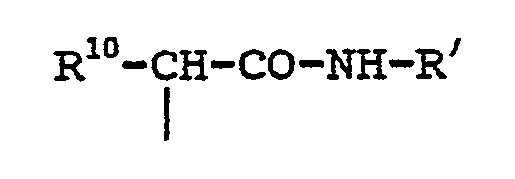
- Timing elements are, for example, a group the O atom being bound to the coupling point of the coupler and the C atom being bound to an N atom of a photographically active compound (for example DE-A-27 03 145), a group which, after being split off from the coupler, is subject to an intramolecular nucleophilic displacement reaction and thereby releases the photographically active compound (eg DE-A-28 55 697), a group in which, after separation from the coupler, electron transfer can take place along a conjugate system, whereby the photographically active compound is released (eg DE-A-31 05 026), or a group in which X (for example -0-) is bonded to the coupling point of the coupler and the C atom is bound to an atom of the photographically active compound and in which R is, for example, aryl (for example EP-A-0 127 063).
- a photographically active compound for example DE-A-27 03 145
- An alkyl radical represented in formula I or Ia by R 1 , R 2 , R 3 , R 4 or R 7 or present in these substituents can be straight-chain or branched, substituted or unsubstituted and contain up to 20 C atoms; Examples are methyl, ethyl, propyl, isopropyl, butyl, s-butyl, t-butyl, pentyl, hexyl, octyl, dodecyl.
- the alkyl radicals can be substituted, for example by hydroxyl, halogen, alkoxy, alkylthio, alkenylthio, acylamino or a cyclic imido group.
- An alkyl radical represented by R1, R2 or an alkyl radical present as a substituent, for example on a phenyl radical represented by R 1 or R 2 preferably contains up to 4 carbon atoms and is in particular a methyl group.
- a cycloalkyl radical represented by R 3 is, for example, cyclohexyl; an aralkyl radical (R 3 , R 4 ) is, for example, benzyl; an alkenyl radical is, for example, allyl or 2-butenyl; an alkynyl radical is, for example, propynyl.
- An optionally substituted amino group represented by R ⁇ or R 2 is an amino group which may be mono- or disubstituted, for example by alkyl, aralkyl, aryl, amino or acyl, and includes cyclic amino groups.
- a cyclic amino group completed, for example, by R 4 and R 5 is, for example, a piperidino, morpholino, pyrrolino or pyrazolyl group.
- An acyl radical which may be present, for example, in one of the radicals represented by R 2 and R 4 , for example in an acylamino group, is derived from an aliphatic or aromatic carboxylic acid re or sulfonic acid, a carbamic acid, a sulfamic acid or a carbonic acid monoester.
- An acylamino group represented by R 1 or R 2 includes, for example, the following groups: ureido, thioureido, alkoxycarbonylamino and thioacylamino.
- a heterocyclic group represented by R1 or R 2 is, for example, a furyl, thiazolyl or 1,2,4-triazolyl group.
- Such a heterocyclic group can carry further substituents, for example alkyl, alkoxy, acyl, alkylthio (-S-R3).
- the advantageous properties of the couplers according to the invention are presumably due to the fact that the 1,2,3-triazole ring is apparently not only a good leaving group (escape group), so that the couplers are very reactive, but apparently there is also a certain tendency towards the silver halide grain adsorb and thereby influence the processes taking place during the development of the silver halide.
- the groups determining the effectiveness of the photographically active compound apparently come into particularly favorable contact with the surface of the silver halide grain. It is therefore preferred according to the invention if the photographically active compound is one which influences the development of the silver halide, for example a development accelerator, a fogging agent, a bleaching accelerator or particularly preferably a development inhibitor.
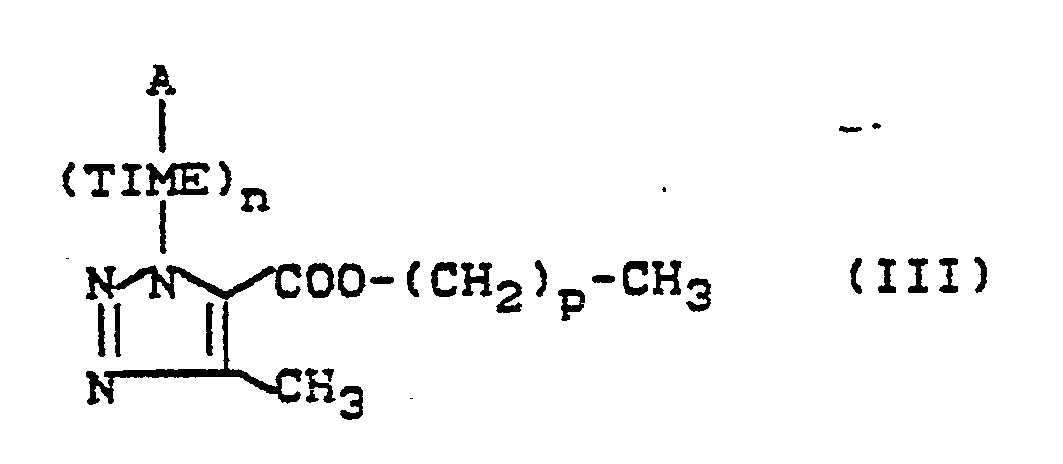
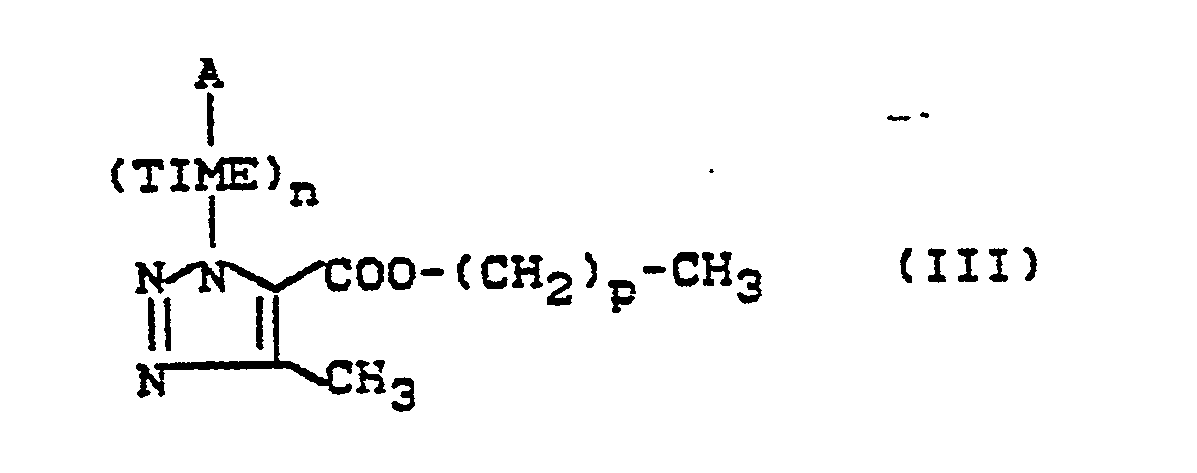
- At least one of the radicals R 1 and R 2 in the formulas I and Ia is -S-R3, -COORB or a heterocyclic group, where R3 is alkyl with preferably up to 7 C atoms, cycloalkyl, aralkyl, alkenyl or alkynyl, and R 8 represents alkyl having 2 to 10 C atoms or aryl.
- reaction is advantageously carried out in an organic solvent such as dimethylformamide, acetonitrile or acetone in the presence of a base such as triethylamine or caustic potash.
- organic solvent such as dimethylformamide, acetonitrile or acetone
- a base such as triethylamine or caustic potash.
- the inhibitors INH-1 to INH-18 were prepared from 4-methyl-1H-1,2,3-triazole-5-carboxylic acid methyl ester (described in Klein et al., J. Heterocyclic Chem. 13, 589 (1976)) by transesterification with the corresponding alcohols under Na alcoholate catalysis at 60 to 100 ° C.
- the inhibitors INH-19 to INH-28, INH-37 to INH-39 and INH-50 to INH-55 are produced by reacting the corresponding triazole carboxylic acid chlorides with the hydroxyaryl compounds with the addition of pyridine in toluene at room temperature.
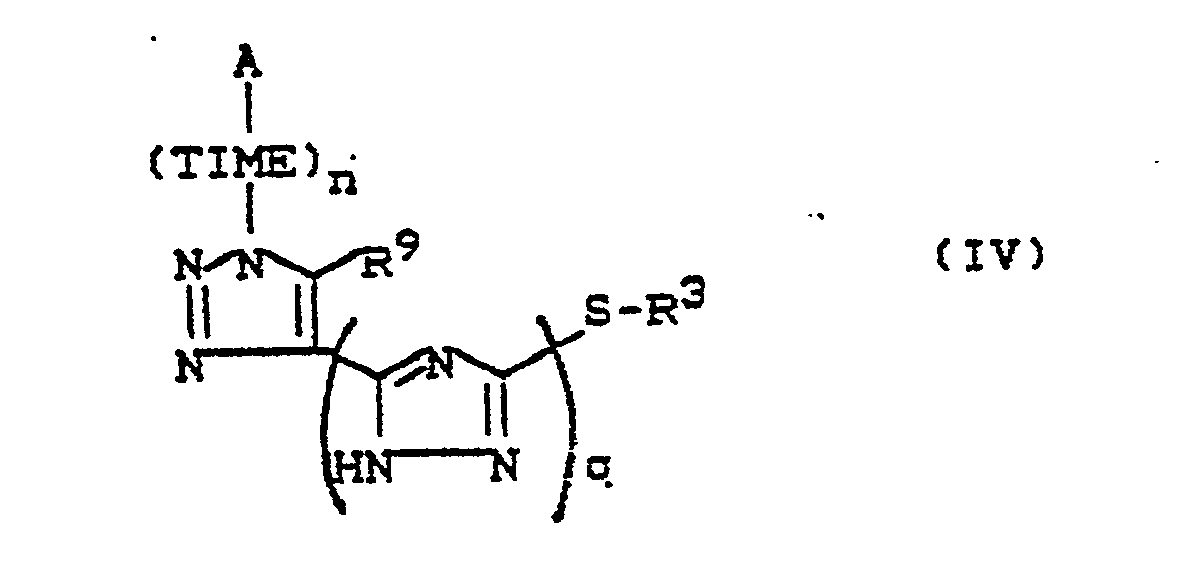
- the compounds INH-29 to INH-32 were prepared by alkylation of the SH compound obtained by sodium alcoholate-catalyzed condensation of 4-methyl-1H-1,2,3-triazole-5-carboxylic acid riethyl ester with thiosemicarbazide.
- the compounds INH-56 to INH-59 are prepared by alkylation of 4-mercapto-1,2,3-triazole, e.g. in the case of compound INH-56 with butyl bromide.
- the compounds of the present invention are suitable for use as couplers in color photographic, in particular multilayer, recording materials.
- yellow couplers they are preferably used in or associated with a light-sensitive silver halide emulsion layer with a predominant sensitivity for the blue spectral range of visible light.
- the particular advantage of the couplers according to the invention namely a comparatively low development inhibition in the layer to which such a compound is assigned, in addition to a comparatively high development inhibition in adjacent unassigned layers, naturally applies particularly when it is a multi-layer color photographic recording material which, in addition to a predominantly blue-sensitive silver halide emulsion layer, contains further light-sensitive silver halide emulsion layers with predominant sensitivity for the green or red spectral range of the visible light.
- the couplers according to the invention are preferably assigned to a green-sensitive layer as purple couplers or to a red-sensitive layer as cyan-green couplers. Couplers which give only a little color during development can be assigned to a blue-sensitive, a green-sensitive or a red-sensitive layer or also several of these layers without fear of color falsification.
- the couplers according to the invention can also be used as color couplers in comparatively small amounts in order to produce the desired effects, in particular the interimage effects.
- the DIR couplers according to the invention can thus advantageously also be used as yellow couplers in purple layers as well as in blue-green layers. The same applies to the purple couplers and the cyan couplers.
- the diffusion-resistant DIR couplers of the present invention can optionally be incorporated together with other couplers in a known manner into the casting solution of the silver halide emulsion layers or other colloid layers.
- oil-soluble or hydrophobic couplers can be added to a hydrophilic colloid solution, preferably from a solution in a suitable coupler solvent (oil former), optionally in the presence of a wetting or dispersing agent.
- the hydrophilic casting solution can of course contain other conventional additives in addition to the binder.
- the solution of the coupler need not be directly dispersed in the casting solution for the silver halide emulsion layer or other water permeable layer; Rather, it can also be advantageously first dispersed in an aqueous, non-photosensitive solution of a hydrophilic colloid, whereupon the mixture obtained, after removal of the low-boiling organic solvents used, may be mixed with the coating solution for the photosensitive silver halide emulsion layer or another water-permeable layer before application.
- Suitable light-sensitive silver halide emulsions are emulsions of silver chloride, silver bromide or mixtures thereof, possibly with a low silver iodide content of up to 10 mol% in one of the commonly used hydrophilic binders.
- Gelatin is preferably used as a binder for the photographic layers. However, this can be replaced in whole or in part by other natural or synthetic binders.
- the emulsions can be chemically and spectrally sensitized in the usual way, and the emulsion layers as well as other non-light-sensitive layers can be hardened in the usual way with known hardening agents.
- Color photographic recording materials usually contain at least one silver halide emulsion layer for recording light from the three spectral ranges red, green and blue.
- the light-sensitive layers are spectrally sensitized in a known manner by means of suitable sensitizing dyes.
- Blue-sensitive silver halide emulsion layers do not necessarily have to contain a spectral sensitizer, since in many cases the intrinsic sensitivity of the silver halide is sufficient for the recording of blue light.
- Each of the said photosensitive layers can consist of a single layer or in a known manner, e.g. in the case of the so-called double-layer arrangement, also comprise two or more silver halide emulsion partial layers (DE-C-1 121 470).
- Red-sensitive silver halide emulsion layers are usually arranged closer to the support than green-sensitive silver halide emulsion layers and these are in turn closer than blue-sensitive layers, a yellow filter layer which is not sensitive to light generally being located between green-sensitive layers and blue-sensitive layers.
- a layer which is not sensitive to light is generally arranged between layers of different spectral sensitivity and can contain means for preventing the incorrect diffusion of developer oxidation products.
- silver halide emulsion layers of the same spectral sensitivity can be immediately adjacent to one another or arranged in such a way that a light-sensitive layer with a different spectral sensitivity is located between them (DE-A-1 958 709, DE-A-2 530 645, DE-A -2 622 922).
- Color photographic recording materials for the production of multicolored images usually contain, in spatial and spectral assignment to the silver halide emulsion layers of different spectral sensitivity, coloring compounds, in particular color couplers, for producing the different partial color images cyan, purple and yellow:
- Spatial assignment is understood to mean that the color coupler is in such a spatial relationship with the silver halide emulsion layer that an interaction between them is possible which allows an image-wise match between the silver image formed during development and the color image generated from the color coupler. This is usually achieved by the fact that the color coupler is contained in the silver halide emulsion layer itself or in a possibly non-light-sensitive binder layer adjacent to it.
- Spectral assignment is understood to mean that the spectral sensitivity of each of the light-sensitive silver halide emulsion layers and the color of the partial color image generated from the spatially assigned color coupler are in a specific relationship to one another, with each of the spectral sensitivities (red, green, blue) having a different color of the relevant partial color image (e.g. teal, purple, yellow) is assigned.
- One or more color couplers can be assigned to each of the differently spectrally sensitized silver halide emulsion layers. If there are several silver halide emulsion layers of the same spectral sensitivity, each of them can contain a color coupler, which color couplers need not necessarily be identical. They should only result in at least approximately the same color during color development, normally a color that is complementary to the color of the light, for which the silver halide emulsion layers in question are predominantly sensitive.
- red-sensitive silver halide emulsion layers are therefore assigned at least one non-diffusing color coupler for producing the blue-green partial color image, usually a coupler of the phenol or a-naphthol type.
- Advantageous cyan couplers are described, for example, in EP-A-0 028 099, EP-A-0 067 689, EP-A-0 175 573 and EP-A-0 184 057.
- Green-sensitive silver halide emulsion layers are at least one non-diffusing color coupler for producing the purple partial color image assigned, color couplers of the 5-pyrazolone, indazolone or pyrazoloazole type usually being used.
- blue-sensitive silver halide emulsion layers are assigned at least one non-diffusing color coupler for producing the yellow partial color image, usually a color coupler with an open-chain ketomethylene grouping.
- Color couplers of this type are known in large numbers and are described in a large number of patents. Examples include the publications “Color Coupler” by W. PELZ in “Messages from the Research Laboratories of Agfa, Leverkusen / Kunststoff", Volume 111, page 111 (1961) and by K. VENKATARAMAN in "The Chemistry of Synthetic Dyes", Vol 4, 341 to 387, Acedemic Press (1971).
- the color couplers can be both conventional 4-equivalent couplers and 2-equivalent couplers, in which a smaller amount of silver halide is required to produce the color.
- 2-equivalent couplers are derived from the 4-equivalent couplers in that they contain a substituent in the coupling point, which is split off during the coupling.
- the 2-equivalent couplers include both those that are practically colorless and those that have an intense inherent color that disappears when the color is coupled or is replaced by the color of the image dye produced.
- the latter couplers can also be present in the light-sensitive silver halide emulsion layers and serve there as mask couplers to compensate for the undesired secondary densities of the image dyes.
- the known white couplers are also to be counted among the 2-equivalent couplers, but they do not give any dye on reaction with color developer oxidation products.
- the 2-equivalent couplers include the known DIR couplers, which are couplers that contain a detachable residue in the coupling point, which is released as a diffusing development inhibitor when reacted with color developer oxidation products.
- Other photographically active compounds e.g. Development accelerators or fogging agents can be released from such couplers during development.
- the color photographic recording material additionally contains at least one 2-equivalent yellow coupler of the formula I, this coupler not only in the yellow layer, but also in the purple layer and / or also in the blue-green layer and also in a non-light-sensitive layer adjacent to one of the layers mentioned may be included.
- the color photographic recording material of the present invention can contain further additives, for example antioxidants, dye-stabilizing agents and agents for influencing the mechanical and electrostatic properties.
- further additives for example antioxidants, dye-stabilizing agents and agents for influencing the mechanical and electrostatic properties.
- UV-absorbing compounds in one or more of the layers contained in the recording material, preferably in one of the upper layers use. Suitable UV absorbers are described for example in US-A-3 253 921, DE-C-2 036 719 and EP-A-0 057 160.
- hydrophilic film-forming agents are suitable as protective colloid or binder for the layers of the recording material, e.g. Protein, especially gelatin. Casting aids and plasticizers can be used. Reference is made to the compounds specified in Research Disclosure No. 17,643 in Sections IX, XI and XII.
- the layers of the photographic material can be hardened in the usual manner, for example with hardeners of the epoxy type, the heterocyclic ethylene imine and the acryloyl type. Furthermore, it is also possible to harden the layers according to the process of DE-A-22 18 009 in order to obtain color photographic materials which are suitable for high-temperature processing. It is also possible to harden the photographic layers with hardeners of the diazine, triazine or 1,2-dihydroquinino series or with hardeners of the vinyl sulfone type. Further suitable hardening agents are known from DE-A-24 39 551, DE-A-22 25 230, DE-A-23 17 672 and from Research Disclosure 17 643, Section XI given above.
- the color photographic recording material according to the invention is developed with a color developer compound.
- All developer compounds which have the ability to react in the form of their oxidation product with color couplers to form azomethine dyes can be used as the color developer compound.
- Suitable color developer compounds are aromatic compounds of the p-phenylenediamine type containing at least one primary amino group, for example N, N-dialkyl-p-phenylenediamines, such as N, N-diethyl-p-phenylenediamine, 1- (N-ethyl-N-methylsulfonamidoethyl) -3 -methyl-p-phenylenediamine, 1 - (N-ethyl-N-hydroxyethyl-3-methyl-p-phenylenediamine and 1- (N-ethyl-N-methoxyethyl) -3-methyl-p-phenylenediamine.
- N, N-dialkyl-p-phenylenediamines such as N, N-diethyl-p-phenylenediamine, 1- (N-ethyl-N-methylsulfonamidoethyl) -3 -methyl-p-phenylenediamine, 1 - (
- the material is usually bleached and fixed. Bleaching and fixing can be carried out separately or together.
- the usual compounds can be used as bleaching agents, for example Fe3 + salts and Fe 3 + complex salts such as ferricyanides, dichromates, water-soluble cobalt complexes, etc.
- Particularly preferred are iron III complexes of aminopolycarboxylic acids, in particular, for example, ethylenediaminetetraacetic acid, N-hydroxyethylethylenediamine triacetic acid, alkyliminodicarboxylic acids and alkyliminodicarboxylic acids Phosphonic acids.
- Persulphates are also suitable as bleaching agents.
- the compounds C-1, M-1, MC-1, MC-2, Y-1 and the DIR couplers were used as emulsions, with 1 part of gelatin and 2 parts of tricresyl phosphate in the case of the compounds based on part of the compound used M-1 and MC-2 or di-n-butyl phthalate in all other cases, and 0.1 part Na salt of triisopropylnaphthalene sulfonic acid were used as wetting agents.
Landscapes
- Chemical & Material Sciences (AREA)
- Organic Chemistry (AREA)
- Physics & Mathematics (AREA)
- General Physics & Mathematics (AREA)
- Silver Salt Photography Or Processing Solution Therefor (AREA)
Claims (9)




Applications Claiming Priority (4)
| Application Number | Priority Date | Filing Date | Title |
|---|---|---|---|
| DE19863644416 DE3644416A1 (de) | 1986-12-24 | 1986-12-24 | Farbfotografisches aufzeichnungsmaterial mit einem kuppler, der eine fotografische wirksame verbindung freisetzt |
| DE3644416 | 1986-12-24 | ||
| DE19863644405 DE3644405A1 (de) | 1986-12-24 | 1986-12-24 | Farbfotografisches aufzeichnungsmaterial mit einem gelb-dir-kuppler |
| DE3644405 | 1986-12-24 |
Publications (3)
| Publication Number | Publication Date |
|---|---|
| EP0272573A2 EP0272573A2 (fr) | 1988-06-29 |
| EP0272573A3 EP0272573A3 (en) | 1989-01-11 |
| EP0272573B1 true EP0272573B1 (fr) | 1990-06-06 |
Family
ID=25850852
Family Applications (1)
| Application Number | Title | Priority Date | Filing Date |
|---|---|---|---|
| EP87118470A Expired - Lifetime EP0272573B1 (fr) | 1986-12-24 | 1987-12-14 | Matériau de reproduction photographique couleur avec un coupleur libérant un composé photographiquement actif |
Country Status (3)
| Country | Link |
|---|---|
| EP (1) | EP0272573B1 (fr) |
| JP (1) | JP2683001B2 (fr) |
| DE (1) | DE3763117D1 (fr) |
Families Citing this family (6)
| Publication number | Priority date | Publication date | Assignee | Title |
|---|---|---|---|---|
| JPH0833628B2 (ja) | 1987-12-15 | 1996-03-29 | 富士写真フイルム株式会社 | ハロゲン化銀カラー写真感光材料 |
| DE3918394A1 (de) * | 1989-06-06 | 1990-12-13 | Agfa Gevaert Ag | Farbfotografisches aufzeichnungsmaterial mit einem dir-kuppler |
| US5006448A (en) * | 1989-06-15 | 1991-04-09 | Eastman Kodak Company | Photographic material and process |
| US5135839A (en) * | 1990-11-13 | 1992-08-04 | Eastman Kodak Company | Silver halide material with dir and bleach accelerator releasing couplers |
| US5385815A (en) | 1992-07-01 | 1995-01-31 | Eastman Kodak Company | Photographic elements containing loaded ultraviolet absorbing polymer latex |
| JPH08101477A (ja) | 1994-08-01 | 1996-04-16 | Eastman Kodak Co | 水性写真用コーティング組成物 |
Family Cites Families (4)
| Publication number | Priority date | Publication date | Assignee | Title |
|---|---|---|---|---|
| DE2329587C2 (de) * | 1973-06-09 | 1984-06-20 | Agfa-Gevaert Ag, 5090 Leverkusen | Farbphotographisches Aufzeichnungsmaterial |
| US4049458A (en) * | 1974-06-05 | 1977-09-20 | Agfa-Gevaert, A.G. | Photographic silver halide material containing 2-equivalent yellow couplers |
| JPS5269624A (en) * | 1975-12-09 | 1977-06-09 | Fuji Photo Film Co Ltd | Photographic coupler |
| JPS59131934A (ja) * | 1983-01-19 | 1984-07-28 | Fuji Photo Film Co Ltd | ハロゲン化銀カラ−写真感光材料 |
-
1987
- 1987-12-14 DE DE8787118470T patent/DE3763117D1/de not_active Expired - Fee Related
- 1987-12-14 EP EP87118470A patent/EP0272573B1/fr not_active Expired - Lifetime
- 1987-12-22 JP JP62323048A patent/JP2683001B2/ja not_active Expired - Fee Related
Also Published As
| Publication number | Publication date |
|---|---|
| DE3763117D1 (de) | 1990-07-12 |
| JPS63169644A (ja) | 1988-07-13 |
| EP0272573A3 (en) | 1989-01-11 |
| JP2683001B2 (ja) | 1997-11-26 |
| EP0272573A2 (fr) | 1988-06-29 |
Similar Documents
| Publication | Publication Date | Title |
|---|---|---|
| EP0169458B1 (fr) | Matériau d'enregistrement photographique couleur avec un coupleur DIR jaune | |
| DE2359295A1 (de) | Entwicklungsinhibitoren entbindende verbindungen, unter verwendung solcher verbindungen arbeitende entwicklungsverfahren fuer lichtempfindliche photographische silberhalogenidaufzeichnungsmaterialien und diese verbindungen enthaltende lichtempfindliche photographische silberhalogenidaufzeichnungsmaterialien | |
| DE3633364C3 (de) | Farbfotografisches Aufzeichnungsmaterial mit einem Farbkuppler vom Pyrazoloazol-Typ | |
| DE3319428A1 (de) | Fotografisches aufzeichnungsmaterial mit einer vorlaeuferverbindung einer fotografisch wirksamen verbindung | |
| EP0401612B1 (fr) | Produit photographique pour la reproduction couleur avec un coupleur DIR | |
| EP0287833B1 (fr) | Matériau d'enregistrement pour la photographie en couleurs avec un agent de copulation libérant un composé photographiquement actif | |
| EP0415056B1 (fr) | Matériau d'enregistrement pour photographie en couleurs à un coupleur libérant un composé photographiquement actif | |
| EP0272573B1 (fr) | Matériau de reproduction photographique couleur avec un coupleur libérant un composé photographiquement actif | |
| DE3630564A1 (de) | Farbfotografisches aufzeichnungsmaterial mit einem gelb-dir-kuppler | |
| EP0401613B1 (fr) | Produit photographique de reproduction couleur avec un coupleur DIR | |
| DE3626219A1 (de) | Farbfotografisches aufzeichnungsmaterial mit einem gelb-dir-kuppler | |
| EP0421221B1 (fr) | Produit pour la reproduction photographique couleur contenant un coupleur DIR | |
| DE3636824A1 (de) | Farbfotografisches aufzeichnungsmaterial mit einem gelb-dir-kuppler | |
| DE3624544A1 (de) | Farbfotografisches aufzeichnungsmaterial mit einem farbkuppler vom pyrazoloazol-typ | |
| DE3644416A1 (de) | Farbfotografisches aufzeichnungsmaterial mit einem kuppler, der eine fotografische wirksame verbindung freisetzt | |
| DE3835202A1 (de) | Farbfotografisches aufzeichnungsmaterial | |
| DE3819051A1 (de) | Farbfotografisches aufzeichnungsmaterial | |
| EP0217255B1 (fr) | Matériau d'enregistrement photographique couleur avec des coupleurs formateurs de couleur faciles à disperser | |
| EP0745898A1 (fr) | Procédé de préparation d'une image photographique en couleur en utilisant un composé capable de réagir avec des amines primaires aromatiques | |
| DE3644405A1 (de) | Farbfotografisches aufzeichnungsmaterial mit einem gelb-dir-kuppler | |
| DE2724488A1 (de) | Antifarbschleiermittel und sie enthaltende photoempfindliche farbelemente | |
| DE3712446A1 (de) | Farbfotografisches aufzeichnungsmaterial mit einem gelb-dir-kuppler | |
| DE4014936A1 (de) | Farbfotografisches aufzeichnungsmaterial mit einem dir-kuppler | |
| DE3624103A1 (de) | Farbfotografisches aufzeichnungsmaterial mit 2-aequivalentpurpurkupplern | |
| DE3706202A1 (de) | Farbfotografisches aufzeichnungsmaterial |
Legal Events
| Date | Code | Title | Description |
|---|---|---|---|
| PUAI | Public reference made under article 153(3) epc to a published international application that has entered the european phase |
Free format text: ORIGINAL CODE: 0009012 |
|
| 17P | Request for examination filed |
Effective date: 19871214 |
|
| AK | Designated contracting states |
Kind code of ref document: A2 Designated state(s): BE DE FR GB NL |
|
| PUAL | Search report despatched |
Free format text: ORIGINAL CODE: 0009013 |
|
| AK | Designated contracting states |
Kind code of ref document: A3 Designated state(s): BE DE FR GB NL |
|
| 17Q | First examination report despatched |
Effective date: 19890529 |
|
| GRAA | (expected) grant |
Free format text: ORIGINAL CODE: 0009210 |
|
| AK | Designated contracting states |
Kind code of ref document: B1 Designated state(s): BE DE FR GB NL |
|
| REF | Corresponds to: |
Ref document number: 3763117 Country of ref document: DE Date of ref document: 19900712 |
|
| ET | Fr: translation filed | ||
| GBT | Gb: translation of ep patent filed (gb section 77(6)(a)/1977) | ||
| PLBE | No opposition filed within time limit |
Free format text: ORIGINAL CODE: 0009261 |
|
| STAA | Information on the status of an ep patent application or granted ep patent |
Free format text: STATUS: NO OPPOSITION FILED WITHIN TIME LIMIT |
|
| 26N | No opposition filed | ||
| PGFP | Annual fee paid to national office [announced via postgrant information from national office to epo] |
Ref country code: BE Payment date: 19941214 Year of fee payment: 8 |
|
| PGFP | Annual fee paid to national office [announced via postgrant information from national office to epo] |
Ref country code: FR Payment date: 19941216 Year of fee payment: 8 |
|
| PGFP | Annual fee paid to national office [announced via postgrant information from national office to epo] |
Ref country code: NL Payment date: 19941231 Year of fee payment: 8 |
|
| PG25 | Lapsed in a contracting state [announced via postgrant information from national office to epo] |
Ref country code: BE Effective date: 19951231 |
|
| BERE | Be: lapsed |
Owner name: AGFA-GEVAERT A.G. Effective date: 19951231 |
|
| PG25 | Lapsed in a contracting state [announced via postgrant information from national office to epo] |
Ref country code: NL Effective date: 19960701 |
|
| PG25 | Lapsed in a contracting state [announced via postgrant information from national office to epo] |
Ref country code: FR Effective date: 19960830 |
|
| NLV4 | Nl: lapsed or anulled due to non-payment of the annual fee |
Effective date: 19960701 |
|
| REG | Reference to a national code |
Ref country code: FR Ref legal event code: ST |
|
| REG | Reference to a national code |
Ref country code: GB Ref legal event code: 746 Effective date: 19990610 |
|
| PGFP | Annual fee paid to national office [announced via postgrant information from national office to epo] |
Ref country code: DE Payment date: 20001027 Year of fee payment: 14 |
|
| PGFP | Annual fee paid to national office [announced via postgrant information from national office to epo] |
Ref country code: GB Payment date: 20001108 Year of fee payment: 14 |
|
| PG25 | Lapsed in a contracting state [announced via postgrant information from national office to epo] |
Ref country code: GB Free format text: LAPSE BECAUSE OF NON-PAYMENT OF DUE FEES Effective date: 20011214 |
|
| REG | Reference to a national code |
Ref country code: GB Ref legal event code: IF02 |
|
| PG25 | Lapsed in a contracting state [announced via postgrant information from national office to epo] |
Ref country code: DE Free format text: LAPSE BECAUSE OF NON-PAYMENT OF DUE FEES Effective date: 20020702 |
|
| GBPC | Gb: european patent ceased through non-payment of renewal fee |
Effective date: 20011214 |