EP0273508B2 - Abgasreinigungsverfahren - Google Patents
Abgasreinigungsverfahren Download PDFInfo
- Publication number
- EP0273508B2 EP0273508B2 EP87202492A EP87202492A EP0273508B2 EP 0273508 B2 EP0273508 B2 EP 0273508B2 EP 87202492 A EP87202492 A EP 87202492A EP 87202492 A EP87202492 A EP 87202492A EP 0273508 B2 EP0273508 B2 EP 0273508B2
- Authority
- EP
- European Patent Office
- Prior art keywords
- sorbents
- process according
- gas stream
- dust
- pollutants
- Prior art date
- Legal status (The legal status is an assumption and is not a legal conclusion. Google has not performed a legal analysis and makes no representation as to the accuracy of the status listed.)
- Expired - Lifetime
Links
- 239000002912 waste gas Substances 0.000 title claims 6
- 238000000746 purification Methods 0.000 title 1
- 239000007789 gas Substances 0.000 claims description 38
- 239000002594 sorbent Substances 0.000 claims description 21
- 238000000034 method Methods 0.000 claims description 20
- 239000003344 environmental pollutant Substances 0.000 claims description 14
- 231100000719 pollutant Toxicity 0.000 claims description 14
- 239000000428 dust Substances 0.000 claims description 13
- 238000000926 separation method Methods 0.000 claims description 5
- 239000011521 glass Substances 0.000 claims description 4
- 239000000126 substance Substances 0.000 claims description 4
- 238000002844 melting Methods 0.000 claims description 3
- 230000008018 melting Effects 0.000 claims description 3
- 239000000843 powder Substances 0.000 claims description 3
- 230000003197 catalytic effect Effects 0.000 claims description 2
- CDBYLPFSWZWCQE-UHFFFAOYSA-L Sodium Carbonate Chemical compound [Na+].[Na+].[O-]C([O-])=O CDBYLPFSWZWCQE-UHFFFAOYSA-L 0.000 claims 4
- HEMHJVSKTPXQMS-UHFFFAOYSA-M Sodium hydroxide Chemical compound [OH-].[Na+] HEMHJVSKTPXQMS-UHFFFAOYSA-M 0.000 claims 3
- 239000000725 suspension Substances 0.000 claims 3
- IJGRMHOSHXDMSA-UHFFFAOYSA-N Atomic nitrogen Chemical compound N#N IJGRMHOSHXDMSA-UHFFFAOYSA-N 0.000 claims 2
- AXCZMVOFGPJBDE-UHFFFAOYSA-L calcium dihydroxide Chemical compound [OH-].[OH-].[Ca+2] AXCZMVOFGPJBDE-UHFFFAOYSA-L 0.000 claims 2
- 239000000920 calcium hydroxide Substances 0.000 claims 2
- 229910001861 calcium hydroxide Inorganic materials 0.000 claims 2
- 229910000029 sodium carbonate Inorganic materials 0.000 claims 2
- XLYOFNOQVPJJNP-UHFFFAOYSA-N water Substances O XLYOFNOQVPJJNP-UHFFFAOYSA-N 0.000 claims 2
- 229910052757 nitrogen Inorganic materials 0.000 claims 1
- MWUXSHHQAYIFBG-UHFFFAOYSA-N nitrogen oxide Inorganic materials O=[N] MWUXSHHQAYIFBG-UHFFFAOYSA-N 0.000 description 9
- 238000006243 chemical reaction Methods 0.000 description 7
- 238000001035 drying Methods 0.000 description 6
- 239000002002 slurry Substances 0.000 description 5
- 239000007788 liquid Substances 0.000 description 3
- 239000007787 solid Substances 0.000 description 3
- 238000004140 cleaning Methods 0.000 description 2
- 239000000203 mixture Substances 0.000 description 2
- 238000005406 washing Methods 0.000 description 2
- 238000010521 absorption reaction Methods 0.000 description 1
- 238000009825 accumulation Methods 0.000 description 1
- 239000003054 catalyst Substances 0.000 description 1
- 238000000605 extraction Methods 0.000 description 1
- 239000004744 fabric Substances 0.000 description 1
- 230000002349 favourable effect Effects 0.000 description 1
- 239000000446 fuel Substances 0.000 description 1
- 239000002245 particle Substances 0.000 description 1
- 238000002360 preparation method Methods 0.000 description 1
- 239000002994 raw material Substances 0.000 description 1
- 239000000376 reactant Substances 0.000 description 1
- 239000007921 spray Substances 0.000 description 1
- 239000002351 wastewater Substances 0.000 description 1
- 238000004065 wastewater treatment Methods 0.000 description 1
Images
Classifications
-
- F—MECHANICAL ENGINEERING; LIGHTING; HEATING; WEAPONS; BLASTING
- F23—COMBUSTION APPARATUS; COMBUSTION PROCESSES
- F23J—REMOVAL OR TREATMENT OF COMBUSTION PRODUCTS OR COMBUSTION RESIDUES; FLUES
- F23J15/00—Arrangements of devices for treating smoke or fumes
- F23J15/02—Arrangements of devices for treating smoke or fumes of purifiers, e.g. for removing noxious material
-
- B—PERFORMING OPERATIONS; TRANSPORTING
- B01—PHYSICAL OR CHEMICAL PROCESSES OR APPARATUS IN GENERAL
- B01D—SEPARATION
- B01D53/00—Separation of gases or vapours; Recovering vapours of volatile solvents from gases; Chemical or biological purification of waste gases, e.g. engine exhaust gases, smoke, fumes, flue gases, aerosols
- B01D53/34—Chemical or biological purification of waste gases
Definitions
- the invention relates to a method for cleaning the gases produced during the melting of glass, which in addition to dust also contain gaseous pollutants such as S0 2 , S0 3 , HCI, HF and nitrogen oxides, by adding sorbents in the gas stream and dry separation of the pollutants loaded sorbents along with the dust.
- gaseous pollutants such as S0 2 , S0 3 , HCI, HF and nitrogen oxides
- Such exhaust gases occur, for example, when melting glass. They contain, depending on the nature and composition of raw materials and fuels used per Nm 3200-1000 mg dust, 500 to 3000 mg of S0 2 and S0 3 with a SOA level of from 5 to 10%, about 100 mg HCI, 20 to 50 mg HF and 1500 to 3000 mg nitrogen oxides.
- cloth filters and electrostatic separators are available to separate the dust.
- the gaseous pollutants can be separated off by adding sorbents and reactants, if necessary with the aid of catalysts. When adding the sorbents, a distinction is made between dry, wet and quasi-dry processes.
- powdered sorbents are added to the gas stream and, after reaction with or accumulation of pollutants, are usually separated from the gas stream together with the dust. Often, the separated substances are reintroduced into the gas flow in order to achieve better utilization of the sorbents on the one hand and on the other hand to maintain a higher solid concentration in the gas flow, which increases the probability of solid particles and harmful gas molecules coming together.
- Dry processes have the advantage that the exhaust gas temperature is practically unaffected.
- the sorbents are introduced into the gas stream as a solution or slurry, which on the one hand achieves better conversion and separation of pollutants, but on the other hand inevitably cools the exhaust gas stream very much. This entails considerable heat losses and in many cases measures have to be taken to heat the exhaust gas flow to the permissible minimum chimney temperature after cleaning.
- the wet processes require a complex preparation of the washing liquid.
- the quasi-dry processes represent a combination of the dry and wet processes.
- the sorbents as in the wet processes, they are added as a solution or slurry, but the amount of liquid is dimensioned such that it completely evaporates in the exhaust gas stream and the sorbents can be separated with the dust after the absorption of pollutants. This saves the treatment of the washing liquid, but has to accept a sharp drop in the temperature of the exhaust gases with corresponding heat losses.
- the exhaust gases to be cleaned have a temperature of 350 to 450 ° C and that 70 to 90% of the total sorbents required are introduced as dry powder in the gas stream, that the gas stream is subsequently swirled and that 10 to 30% of the total sorbents required are introduced as a solution or slurry into the swirled gas stream.
- the process according to the invention has the particular advantage that the addition of sorbents as a solution or slurry lowers the exhaust gas temperature by no more than 15 ° C., preferably no more than 10 ° C.
- a cleaned exhaust gas is generated by the method according to the invention. which contains no more than 400 mg S0 2 , 5 mg S0 3 , 30 mg HCl and 5 mg HF per Nm 3 .
- the mixture of dust and sorbents loaded with pollutants in the electrostatic dust separator (4) can be partially returned via line (8) to the reaction vessel (1) in order to achieve a higher solids concentration and to make better use of the sorbents.
- the process according to the invention has the advantage that all pollutants can be separated from the exhaust gas except for the permissible residual contents without the need for wet chemical treatment of waste water and without having to accept large heat losses.
- the exhaust gases normally occurring at 350 to 450 ° C are only cooled by 10 to 15 ° C, so that a subsequent catalytic removal of the nitrogen oxides can be carried out without additional measures in a temperature range which is favorable for this.
Landscapes
- Engineering & Computer Science (AREA)
- Chemical & Material Sciences (AREA)
- Health & Medical Sciences (AREA)
- Biomedical Technology (AREA)
- Environmental & Geological Engineering (AREA)
- Analytical Chemistry (AREA)
- General Chemical & Material Sciences (AREA)
- Oil, Petroleum & Natural Gas (AREA)
- Chemical Kinetics & Catalysis (AREA)
- Mechanical Engineering (AREA)
- General Engineering & Computer Science (AREA)
- Treating Waste Gases (AREA)
Description
- Die Erfindung bezieht sich auf ein Verfahren zur Reinigung der beim Schmelzen von Glas entstehenden Abgase, die neben Staub auch gasförmige Schadstoffe wie S02, S03, HCI, HF und Stickoxide enthalten, durch Zugabe von Sorbentien in den Gasstrom und trockene Abscheidung der mit Schadstoffen beladenen Sorbentien zusammen mit dem Staub.
- Derartige Abgase fallen beispielsweise beim Glasschmelzen an. Sie enthalten je nach Art und Zusammensetzung der verwendeten Roh- und Brennstoffe pro Nm3 200 bis 1000 mg Staub, 500 bis 3000 mg S02 und S03 mit einem SOa-Anteilvon 5 bis 10 %, etwa 100 mg HCI, 20 bis 50 mg HF und 1500 bis 3000 mg Stickoxide. Für die Abtrennung des Staubes stehen unter anderem Tuchfilter und elektrostatische Abscheider zur Verfügung. Die Abtrennung der gasförmigen Schadstoffe kann mittels Zugabe von Sorbentien und Reaktionsstoffen ggf. unter Zuhilfenahme von Katalysatoren erfolgen. Bei der Zugabe der Sorbentien unterscheidet man trockene, nasse und quasi-trokkene Verfahren.
- Bei den trockenen Verfahren werden pulverförmige Sorbentien dem Gasstrom zugesetzt und nach Reaktion mit den oder Anlagerung von Schadstoffen meist zusammen mit dem Staub wieder aus dem Gasstrom abgetrennt. Häufig werden die abgetrennten Stoffe erneut in den Gasstrom eingebracht um einerseits eine bessere Ausnutzung der Sorbentien zu erreichen und andererseits eine höhere Feststoffkonzentration im Gasstrom aufrecht zu erhalten, wodurch die Wahrscheinlichkeit des Zusammentreffens von Feststoffpartikeln und Schadgasmolekülen erhöht wird.
- Trockene Verfahren haben den Vorteil, daß die Abgastemperatur praktisch nicht beeinflußt wird.
- Bei den nassen Verfahren werden die Sorbentien als Lösung oder Aufschlämmung in den Gasstrom eingebracht, womit einerseits zwar eine bessere Umsetzung und Schadstoffabtrennung erreicht wird, andererseits aber der Abgasstrom zwangsläufig sehr stark abgekühlt wird. Damit sind erhebliche Wärmeverluste verbunden und es müssen vielfach sogar Maßnahmen getroffen werden, den Abgasstrom nach der Reinigung wieder auf die zulässige Mindest-Kamintemperatur aufzuheizen. Außerdem erfordern die nassen Verfahren eine aufwendige Aufbereitung der Waschflüssigkeit.
- Die quasi-trockenen Verfahren stellen eine Kombination der trockenen und nassen Verfahren dar. Bei ihnen werden die Sorbentien, wie bei den nassen Verfahren, als Lösung oder Aufschlämmung zugegeben, es wird aber die Flüssigkeitsmenge so bemessen, daß sie im Abgasstrom vollständig verdampft und die Sorbentien nach Schadstoffaufnahme mit den Stäuben trocken abgeschieden werden können. Hier spart man die Aufbereitung der Waschflüssigkeit, muß aber eine starke Temperaturabsenkung der Abgase mit entsprechenden Wärmeverlusten hinnehmen.
- Bei Abgasen von Glaswannen mit den Eingangs genannten Schadstoffgehalten kommen nasse Verfahren aus verschiedenen Gründen nicht in Betracht. Auf Ablehnung stößt in der Praxis insbesondere die Notwendigkeit der Abwasseraufbereitung, die vielfach als besondere chemische Fabrik bezeichnet wird, deren Betriebskosten und Schwierigkeiten man nicht überblicken kann. Mit trockenen Verfahren kann man zwar eine befriedigende Abscheidung der Stäube, des S02 und S03 sowie des HF erreichen, nicht aber des HCI. Bei quasi-trockenen Verfahren ist es in gewisser Beziehung umgekehrt, weil hier bis auf HF alle anderen Schadstoffe mit vertretbarem Aufwand auf die vorgeschriebenen Restkonzentrationen aus dem Abgas abgetrennt werden können. Es besteht somit die Aufgabe, für solche Abgase ein Verfahren vorzuschlagen, das die geschilderten Nachteile nicht aufweist und mit dem die gesetzlich vorgeschriebenen Grenzwerte für die Schadstoffe im gereinigten Abgas bei wirtschaftlich vertretbarem Aufwand eingehalten werden können.
- Diese Aufgabe wird erfindungsgemäß dadurch gelöst, daß die zu reinigenden Abgase eine Temperatur von 350 bis 450 ° C aufweisen und daß 70 bis 90% der insgesamt benötigten Sorbentien als trockenes Pulver in den Gasstrom eingebracht werden, daß der Gasstrom anschließend verwirbelt wird und daß 10 bis 30 % der insgesamt benötigten Sorbentien als Lösung oder Aufschlämmung in den verwirbelten Gasstrom eingebracht werden. Das erfindungsgemäße Verfahren bietet insbesondere den Vorteil, daß durch die Zugabe von Sorbentien als Lösung oder Aufschlämmung die Abgastemperatur um nicht mehr als 15 ° C, vorzugsweise um nicht mehr als 10°C, erniedrigt wird. Nach dem erfindungsgemäßen Verfahren wird beispielsweise ein gereinigtes Abgas erzeugt. das je Nm3 nicht mehr als 400 mg S02, 5 mg S03, 30 mg HCI und 5 mg HF enthält.
- Weitere Ausgestaltungen des erfindungsgemäßen Verfahrens sind den Unteransprüchen 2 bis 8 zu entnehmen.
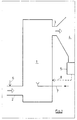
- Fig. 1 zeigt an einem Beispiel schematisch den erfindungsgemäßen Verfahrensablauf. Dargestellt ist ein Reaktionsbehälter (1), der Einbauten zur Verwirbelung des Gasstroms enthalten kann und in seinen Abmessungen auf die vorgesehene Dauer der Abgasbehandlung abgestimmt ist, wobei der Querschnitt die Gasgeschwindigkeit bestimmt und die Höhe, die Aufenthaltsdauer bzw. Behandlungszeit. Dieser Reaktor wird über die Leitung (2) mit dem zu reinigenden Gas beschickt, wobei die Leitung tangential an den Reaktionsbehälter herangeführt sein kann, um schon so einen gewisse Verwirbelung des Gasstroms zu erzeugen. Nach der Behandlung strömt das Gas durch die Leitung (3) in einen elektrostatischen Staubabscheider (4) , von dem nur der Eingangsbereich und ein Teil der Staubabzugsvorrichtung (5) dargestellt ist.
- 70 bis 90 % der insgesamt benötigten Sorbentien werden bereits vor dem Reaktionsbehälter (1) trocken über die Leitung (6) in den ankommenden Abgasstrom eingebracht; die restlichen 10 bis 30 % werden als Lösung oder Aufschlämmung über das Sprühsystem (7) in den Reaktionsbehälter (1) eingesprüht. Gegebenenfalls kann das im elektrostatischen Staubabscheider (4) anfallende Gemisch aus Staub und schadstoffbeladenen Sorbentien teilweise über die Leitung (8) in den Reaktionsbehälter (1) zurückgeführt werden, um darin eine höhere Feststoffkonzentration zu erreichen und die Sorbentien besser auszunutzen.
- Das erfindungsgemäße Verfahren hat den Vorteil, das alle Schadstoffe bis auf die zulässigen Restgehalte aus dem Abgas abgetrennt werden können, ohne daß eine naßchemische Aufbereitung von Abwässern erforderlich wird und ohne daß große Wärmeverluste in Kauf genommen werden müssen. Die normalerweise mit 350 bis 450 °C anfallenden Abgase werden nur um 10 bis 15 ° C abgekühlt, so daß eine anschließende katalytische Beseitigung der Stickoxide ohne zusätzliche Maßnahmen in einem dafür günstigen Temperaturbereich durchgeführt werden kann.
Claims (8)
Applications Claiming Priority (2)
| Application Number | Priority Date | Filing Date | Title |
|---|---|---|---|
| DE19863644102 DE3644102A1 (de) | 1986-12-23 | 1986-12-23 | Abgasreinigungsverfahren |
| DE3644102 | 1986-12-23 |
Publications (3)
| Publication Number | Publication Date |
|---|---|
| EP0273508A1 EP0273508A1 (de) | 1988-07-06 |
| EP0273508B1 EP0273508B1 (de) | 1991-11-27 |
| EP0273508B2 true EP0273508B2 (de) | 1994-08-31 |
Family
ID=6317002
Family Applications (1)
| Application Number | Title | Priority Date | Filing Date |
|---|---|---|---|
| EP87202492A Expired - Lifetime EP0273508B2 (de) | 1986-12-23 | 1987-12-12 | Abgasreinigungsverfahren |
Country Status (6)
| Country | Link |
|---|---|
| US (1) | US4908195A (de) |
| EP (1) | EP0273508B2 (de) |
| JP (1) | JP2537650B2 (de) |
| KR (1) | KR960010380B1 (de) |
| DE (2) | DE3644102A1 (de) |
| ES (1) | ES2028058T5 (de) |
Families Citing this family (16)
| Publication number | Priority date | Publication date | Assignee | Title |
|---|---|---|---|---|
| JPH0326317A (ja) * | 1989-06-23 | 1991-02-04 | Furukawa Co Ltd | 焼却炉の排ガス処理方法 |
| US5118480A (en) * | 1990-06-25 | 1992-06-02 | General Electric Environmental Services, Incorporated | Method for removing hcl and hf from coal derived fuel gas |
| SE9100584D0 (sv) * | 1991-02-28 | 1991-02-28 | Flaekt Ab | Saett att rena processgaser som innehaaller gasformiga foeroreningar |
| DE4112750A1 (de) * | 1991-04-19 | 1992-10-22 | Balcke Duerr Ag | Verfahren und vorrichtung zur erhoehung der abscheideleistung von rauchgas-entschwefelungs-anlagen |
| US5480624A (en) * | 1991-08-22 | 1996-01-02 | A. Ahlstrom Corporation | Method for purification of waste gases |
| USH1539H (en) * | 1993-11-12 | 1996-06-04 | Shell Oil Company | Method of reducing hydrogen chloride in synthesis gas |
| US5470556A (en) * | 1993-12-22 | 1995-11-28 | Shell Oil Company | Method for reduction of sulfur trioxide in flue gases |
| FR2724328B1 (fr) * | 1994-09-09 | 1997-01-10 | Solvay | Composition reactive et procede pour l'epuration d'un gaz contenant de l'oxyde nitrique |
| DE4433246A1 (de) * | 1994-09-19 | 1996-03-21 | Hoechst Ag | Verfahren zur Herstellung eines reversiblen Adsorbens |
| SE511110C2 (sv) | 1997-12-15 | 1999-08-09 | Avonni Ab | Korrosionsskydd vid vattenbehandlingsanordning i ett slutet ledningssystem |
| ID30297A (id) * | 2000-05-17 | 2001-11-22 | Asahi Glass Co Ltd | Metode untuk mengolah suatu gas |
| KR20020071673A (ko) * | 2001-03-07 | 2002-09-13 | 천봉우 | 무진 장치 |
| US20040062697A1 (en) * | 2002-10-01 | 2004-04-01 | Airborne Pollution Control Inc. | Flue gas purification method |
| DE102008016519B4 (de) * | 2008-03-31 | 2014-09-18 | Technische Werke Ludwigshafen Ag | Verfahren zur Reinigung von Rauchgas in einer Müllverbrennungsanlage sowie eine Vorrichtung zur Durchführung des Verfahrens |
| JP5029923B2 (ja) * | 2009-03-30 | 2012-09-19 | Jfeエンジニアリング株式会社 | 排ガス処理方法 |
| DE102009035714A1 (de) * | 2009-07-31 | 2011-02-03 | Brewa Wte Gmbh | Verfahren zum Entfernen von Schadstoff aus Rauchgas sowie Verbrennungsanlage |
Family Cites Families (22)
| Publication number | Priority date | Publication date | Assignee | Title |
|---|---|---|---|---|
| US3880618A (en) * | 1973-03-02 | 1975-04-29 | Donald H Mccrea | Simultaneously removing sulfur and nitrogen oxides from gases |
| US4620856A (en) * | 1974-10-31 | 1986-11-04 | Industrial Resources, Inc. | Air pollution control process and apparatus |
| AT363918B (de) * | 1975-05-06 | 1981-09-10 | Hoelter Heinz | Verfahren und vorrichtung zur gasreinigung |
| JPS52789A (en) * | 1975-06-24 | 1977-01-06 | Hitachi Metals Ltd | Oxide catalysts for removing nitrogen |
| DE2725436A1 (de) * | 1977-06-04 | 1978-12-21 | Heinz Hoelter | Verfahren zur heissgasentstaubung und entschwefelung mittels gewebefilter |
| US4273750A (en) * | 1979-04-24 | 1981-06-16 | Energy And Pollution Controls, Inc. | Flue gas desulfurization apparatus and method |
| JPS5660626A (en) * | 1979-10-22 | 1981-05-25 | Hitachi Plant Eng & Constr Co Ltd | Process for treating hydrogen-chloride-containing waste gas |
| BR8103078A (pt) * | 1980-05-24 | 1982-02-09 | Hoelter H | Processo e dispositivo para a eliminacao de anidrido sulfuroso e outras substancias nocivas de gas de fumaca |
| US4309393A (en) * | 1980-10-14 | 1982-01-05 | Domtar Inc. | Fluidized bed sulfur dioxide removal |
| DE3136914A1 (de) * | 1981-09-17 | 1983-03-31 | Hölter, Heinz, Dipl.-Ing., 4390 Gladbeck | "verfahren zur rauchgasreinigung hinter kraftwerken mit gleichzeitiger herstellung von gips im trockenprozess" |
| DK450781A (da) * | 1981-10-12 | 1983-04-13 | Niro Atomizer As | Fremgangsmaade til fjernelse af nitrogenoxider og svovloxider fra spildgasser |
| JPS58146423A (ja) * | 1982-02-26 | 1983-09-01 | Nippon Kokan Kk <Nkk> | 排ガス中の塩化水素除去装置 |
| US4472364A (en) * | 1982-06-23 | 1984-09-18 | Rockwell International Corporation | Process for removal of sulfur oxides from hot gases |
| DE3232077C2 (de) * | 1982-08-28 | 1986-10-23 | Rheinisch-Westfälisches Elektrizitätswerk AG, 4300 Essen | Verfahren und Vorrichtung zur Entfernung von Schwefeldioxid und anderen Schadstoffen aus Rauchgasen |
| DE3235020A1 (de) * | 1982-09-22 | 1984-03-22 | Hölter, Heinz, Dipl.-Ing., 4390 Gladbeck | Chemisorptionsverfahren zur absoprtion von vorzugsweise schwefeldioxid hinter kraftwerken und muellverbrennungsanlagen und dergleichen |
| DE3235559A1 (de) * | 1982-09-25 | 1984-05-24 | Metallgesellschaft Ag, 6000 Frankfurt | Verfahren zur entfernung von schwefeloxiden aus rauchgas |
| DE3408705A1 (de) * | 1983-03-07 | 1984-10-11 | Mitsubishi Jukogyo K.K., Tokio/Tokyo | Verfahren zur behandlung von abgas |
| DE3313496A1 (de) * | 1983-04-14 | 1984-10-18 | Hölter, Heinz, Dipl.-Ing., 4390 Gladbeck | Halbtrockenes rauchgasentschwefelungsverfahren vorzugsweise fuer fossilkraftwerke |
| US4588569A (en) * | 1985-02-21 | 1986-05-13 | Intermountain Research & Development Corporation | Dry injection flue gas desulfurization process using absorptive soda ash sorbent |
| US4600568A (en) * | 1985-03-22 | 1986-07-15 | Conoco Inc. | Flue gas desulfurization process |
| DE3516419A1 (de) * | 1985-05-07 | 1986-11-13 | Jahn, Stephan, 8013 Haar | Verfahren und anlage zur reinigung von rauchgas |
| US4804521A (en) * | 1986-11-07 | 1989-02-14 | Board Of Regents, The University Of Texas System | Process for removing sulfur from sulfur-containing gases |
-
1986
- 1986-12-23 DE DE19863644102 patent/DE3644102A1/de not_active Withdrawn
-
1987
- 1987-12-12 EP EP87202492A patent/EP0273508B2/de not_active Expired - Lifetime
- 1987-12-12 ES ES87202492T patent/ES2028058T5/es not_active Expired - Lifetime
- 1987-12-12 DE DE8787202492T patent/DE3774856D1/de not_active Expired - Lifetime
- 1987-12-22 KR KR1019870014724A patent/KR960010380B1/ko not_active Expired - Fee Related
- 1987-12-23 JP JP62326607A patent/JP2537650B2/ja not_active Expired - Lifetime
-
1989
- 1989-04-03 US US07/333,746 patent/US4908195A/en not_active Expired - Fee Related
Also Published As
| Publication number | Publication date |
|---|---|
| JPS63171621A (ja) | 1988-07-15 |
| DE3644102A1 (de) | 1988-07-07 |
| EP0273508A1 (de) | 1988-07-06 |
| EP0273508B1 (de) | 1991-11-27 |
| KR880007114A (ko) | 1988-08-26 |
| ES2028058T5 (es) | 1995-08-16 |
| DE3774856D1 (de) | 1992-01-09 |
| JP2537650B2 (ja) | 1996-09-25 |
| ES2028058T3 (es) | 1992-07-01 |
| US4908195A (en) | 1990-03-13 |
| KR960010380B1 (ko) | 1996-07-31 |
Similar Documents
| Publication | Publication Date | Title |
|---|---|---|
| EP0273508B1 (de) | Abgasreinigungsverfahren | |
| DE69520593T2 (de) | Methode zur abtrennung von stoffen aus einem gasförmigen medium durch trockene adsorption | |
| DE60033486T2 (de) | Verfahren und Vorrichtung zur Behandlung von Perfluorverbindungen enthaltenden Gasen | |
| DE2462681C2 (de) | Verfahren zum Abscheiden von Stickstoffoxiden aus Abgas | |
| DE3028193C2 (de) | Verfahren und Vorrichtung zur pyrolytischen Zersetzung von Halogene und/oder Phosphor enthaltenden organischen Substanzen | |
| EP0105547A1 (de) | Verfahren zur Abtrennung von Schadstoffen aus Abgasen | |
| US4915920A (en) | Dry method of purifying flue gas | |
| DE3014934A1 (de) | Verfahren zur entfernung von schwefeloxiden und stickstoffoxiden aus abgasen | |
| DE3629688C2 (de) | Verfahren zur Reinigung von Rauch- und anderen Industrieabgasen | |
| DE69221615T2 (de) | Verfahren zur reinigung von kondensierbaren organischen verunreinigungen enthaltenden gasen | |
| DE69007139T2 (de) | Rauchgasreinigungsverfahren. | |
| EP0453005B1 (de) | Abgas-Reinigungsverfahren | |
| EP0546314B1 (de) | Verfahren zum Entfernen von halogenierten organischen Verbindungen aus Abgasen | |
| DE2331156B2 (de) | Vorrichtung zum Beseitigen von in Abgasen enthaltenen gasförmigen Schadstoffen | |
| EP0101556B1 (de) | Vorrichtung zur Reinigung radioaktiver Abgase | |
| EP0393402B2 (de) | Verfahren zur Reinigung von schwermetallhaltigem Abgas mit hohem Chloridgehalt | |
| DE3235020C2 (de) | ||
| DD293503A5 (de) | Verfahren zur reinigung von abgas mit hohem chloridgehalt | |
| DE2818473A1 (de) | Verfahren und vorrichtung zur entfernung von nitrosen gasen aus abluft und abgasen | |
| DE3426796C2 (de) | Verfahren zur Abscheidung von SO&darr;2&darr;,SO&darr;3&darr;,NO&darr;x&darr; sowie von Stäuben aus Abgasen | |
| DE618517C (de) | Verfahren und Vorrichtung zum Reinigen von schwefeldioxydhaltigen Gasen, insbesondere schwefeldioxydhaltigen Feuerungsabgasen | |
| EP0565533B1 (de) | VERFAHREN ZUR SELEKTIVEN HF-ABTRENNUNG AUS EINEM HF UND HCl UND GEGEBENENFALLS ANDERE KOMPONENTEN ENTHALTENDEN GAS | |
| EP0243368B1 (de) | Verfahren zur reduzierung der emissionswerte von industriellen abgasen und industrieller abluft | |
| EP0562328A2 (de) | Verfahren zur Prozesswasserkonzentrierung und Abgasreinigung | |
| EP0268094A2 (de) | Verfahren und Vorrichtung zur Reinigung von Rauchgasen |
Legal Events
| Date | Code | Title | Description |
|---|---|---|---|
| PUAI | Public reference made under article 153(3) epc to a published international application that has entered the european phase |
Free format text: ORIGINAL CODE: 0009012 |
|
| AK | Designated contracting states |
Kind code of ref document: A1 Designated state(s): BE DE ES FR GB IT NL |
|
| 17P | Request for examination filed |
Effective date: 19880914 |
|
| 17Q | First examination report despatched |
Effective date: 19900725 |
|
| GRAA | (expected) grant |
Free format text: ORIGINAL CODE: 0009210 |
|
| AK | Designated contracting states |
Kind code of ref document: B1 Designated state(s): BE DE ES FR GB IT NL |
|
| REF | Corresponds to: |
Ref document number: 3774856 Country of ref document: DE Date of ref document: 19920109 |
|
| ET | Fr: translation filed | ||
| ITF | It: translation for a ep patent filed | ||
| GBT | Gb: translation of ep patent filed (gb section 77(6)(a)/1977) | ||
| PLBI | Opposition filed |
Free format text: ORIGINAL CODE: 0009260 |
|
| 26 | Opposition filed |
Opponent name: A. AHLSTROEM CORPORATION Effective date: 19920827 |
|
| NLR1 | Nl: opposition has been filed with the epo |
Opponent name: A. AHLSTROEM CORPORATION |
|
| PUAA | Information related to the publication of a b2 document modified |
Free format text: ORIGINAL CODE: 0009299PMAP |
|
| PUAH | Patent maintained in amended form |
Free format text: ORIGINAL CODE: 0009272 |
|
| STAA | Information on the status of an ep patent application or granted ep patent |
Free format text: STATUS: PATENT MAINTAINED AS AMENDED |
|
| NLR4 | Nl: receipt of corrected translation in the netherlands language at the initiative of the proprietor of the patent | ||
| 27A | Patent maintained in amended form |
Effective date: 19940831 |
|
| AK | Designated contracting states |
Kind code of ref document: B2 Designated state(s): NL |
|
| R27A | Patent maintained in amended form (corrected) |
Effective date: 19940831 |
|
| NLR2 | Nl: decision of opposition | ||
| NLXE | Nl: other communications concerning ep-patents (part 3 heading xe) |
Free format text: PAT.BUL.14/94 PATENT NUMBER 0273508 SHOULD BE DELETED |
|
| NLR3 | Nl: receipt of modified translations in the netherlands language after an opposition procedure | ||
| GBTA | Gb: translation of amended ep patent filed (gb section 77(6)(b)/1977) |
Effective date: 19941019 |
|
| ET3 | Fr: translation filed ** decision concerning opposition | ||
| ITF | It: translation for a ep patent filed | ||
| REG | Reference to a national code |
Ref country code: ES Ref legal event code: DC2A Kind code of ref document: T5 Effective date: 19950816 |
|
| PGFP | Annual fee paid to national office [announced via postgrant information from national office to epo] |
Ref country code: ES Payment date: 19961230 Year of fee payment: 10 |
|
| PGFP | Annual fee paid to national office [announced via postgrant information from national office to epo] |
Ref country code: DE Payment date: 19971128 Year of fee payment: 11 |
|
| PGFP | Annual fee paid to national office [announced via postgrant information from national office to epo] |
Ref country code: NL Payment date: 19971130 Year of fee payment: 11 |
|
| PGFP | Annual fee paid to national office [announced via postgrant information from national office to epo] |
Ref country code: BE Payment date: 19971208 Year of fee payment: 11 |
|
| PG25 | Lapsed in a contracting state [announced via postgrant information from national office to epo] |
Ref country code: ES Free format text: LAPSE BECAUSE OF THE APPLICANT RENOUNCES Effective date: 19981214 |
|
| PG25 | Lapsed in a contracting state [announced via postgrant information from national office to epo] |
Ref country code: BE Free format text: LAPSE BECAUSE OF NON-PAYMENT OF DUE FEES Effective date: 19981231 |
|
| PG25 | Lapsed in a contracting state [announced via postgrant information from national office to epo] |
Ref country code: DE Free format text: LAPSE BECAUSE OF THE APPLICANT RENOUNCES Effective date: 19990322 |
|
| BERE | Be: lapsed |
Owner name: METALLGESELLSCHAFT A.G. Effective date: 19981231 |
|
| PG25 | Lapsed in a contracting state [announced via postgrant information from national office to epo] |
Ref country code: NL Free format text: LAPSE BECAUSE OF NON-PAYMENT OF DUE FEES Effective date: 19990701 |
|
| NLV4 | Nl: lapsed or anulled due to non-payment of the annual fee |
Effective date: 19990701 |
|
| PGFP | Annual fee paid to national office [announced via postgrant information from national office to epo] |
Ref country code: GB Payment date: 20001115 Year of fee payment: 14 |
|
| PGFP | Annual fee paid to national office [announced via postgrant information from national office to epo] |
Ref country code: FR Payment date: 20001204 Year of fee payment: 14 |
|
| REG | Reference to a national code |
Ref country code: ES Ref legal event code: FD2A Effective date: 20010402 |
|
| PG25 | Lapsed in a contracting state [announced via postgrant information from national office to epo] |
Ref country code: GB Free format text: LAPSE BECAUSE OF NON-PAYMENT OF DUE FEES Effective date: 20011212 |
|
| REG | Reference to a national code |
Ref country code: GB Ref legal event code: IF02 |
|
| GBPC | Gb: european patent ceased through non-payment of renewal fee |
Effective date: 20011212 |
|
| PG25 | Lapsed in a contracting state [announced via postgrant information from national office to epo] |
Ref country code: FR Free format text: LAPSE BECAUSE OF NON-PAYMENT OF DUE FEES Effective date: 20020830 |
|
| REG | Reference to a national code |
Ref country code: FR Ref legal event code: ST |
|
| PG25 | Lapsed in a contracting state [announced via postgrant information from national office to epo] |
Ref country code: IT Free format text: LAPSE BECAUSE OF NON-PAYMENT OF DUE FEES Effective date: 20051212 |