EP0273630A2 - Leitungsempfänger - Google Patents
Leitungsempfänger Download PDFInfo
- Publication number
- EP0273630A2 EP0273630A2 EP87310978A EP87310978A EP0273630A2 EP 0273630 A2 EP0273630 A2 EP 0273630A2 EP 87310978 A EP87310978 A EP 87310978A EP 87310978 A EP87310978 A EP 87310978A EP 0273630 A2 EP0273630 A2 EP 0273630A2
- Authority
- EP
- European Patent Office
- Prior art keywords
- emitter
- transistor
- voltage
- transistors
- collector
- Prior art date
- Legal status (The legal status is an assumption and is not a legal conclusion. Google has not performed a legal analysis and makes no representation as to the accuracy of the status listed.)
- Withdrawn
Links
- 238000012358 sourcing Methods 0.000 claims description 10
- 238000002347 injection Methods 0.000 claims description 4
- 239000007924 injection Substances 0.000 claims description 4
- 230000035945 sensitivity Effects 0.000 abstract description 7
- 238000005516 engineering process Methods 0.000 abstract description 3
- 238000001514 detection method Methods 0.000 abstract 1
- 238000004458 analytical method Methods 0.000 description 8
- 238000004891 communication Methods 0.000 description 8
- 238000010586 diagram Methods 0.000 description 8
- 238000012360 testing method Methods 0.000 description 8
- 239000004179 indigotine Substances 0.000 description 6
- 239000004233 Indanthrene blue RS Substances 0.000 description 5
- 230000000694 effects Effects 0.000 description 4
- 238000002405 diagnostic procedure Methods 0.000 description 3
- 238000013461 design Methods 0.000 description 2
- 239000010409 thin film Substances 0.000 description 2
- 230000003321 amplification Effects 0.000 description 1
- 230000003139 buffering effect Effects 0.000 description 1
- 239000003990 capacitor Substances 0.000 description 1
- 239000010408 film Substances 0.000 description 1
- 238000007667 floating Methods 0.000 description 1
- 230000000977 initiatory effect Effects 0.000 description 1
- 238000000034 method Methods 0.000 description 1
- 238000003199 nucleic acid amplification method Methods 0.000 description 1
- 230000000737 periodic effect Effects 0.000 description 1
- 230000000630 rising effect Effects 0.000 description 1
- 229920006395 saturated elastomer Polymers 0.000 description 1
- 239000000758 substrate Substances 0.000 description 1
- 238000012876 topography Methods 0.000 description 1
- 238000012546 transfer Methods 0.000 description 1
Images



Classifications
-
- H—ELECTRICITY
- H03—ELECTRONIC CIRCUITRY
- H03F—AMPLIFIERS
- H03F3/00—Amplifiers with only discharge tubes or only semiconductor devices as amplifying elements
- H03F3/45—Differential amplifiers
- H03F3/45071—Differential amplifiers with semiconductor devices only
- H03F3/45479—Differential amplifiers with semiconductor devices only characterised by the way of common mode signal rejection
Definitions
- the present invention is directed to line receivers and in particular to line receivers which have high common mode rejection ratios particularly useful in receiving signals in a noisy electrical environment.
- One application for such receivers is where they are connected in parallel along the length of the communication but for interrogation by a master host system.
- receivers - which are commonly referred to as line receivers - should therefore be relatively immune to electrical noise while having a high sensitivity with respect to the desired signals for reception.
- receivers should further have a high common mode rejection ratio; that is, the ability to reject amplification of electrical potentials which are common to both sides of the input terminals. It is also desirable to have built-in hysteresis so as not the change the receiver's output state unless the differential input signal exceeds a predetermined value.
- a relatively low frequency response in relationship to the signal's frequency is also desirable so that electrical noise can be filtered to an acceptable low value. Furthermore when many receivers and transmitters share a common bus, it is further desirable that the receivers each have a high input impedance so as not to unduly load the bus and therefore the operation of transmitters on the bus.
- the present line receiver achieves these design goals by providing circuitry with high sensitivity, high common mode rejection, built-in adjustable hysteresis, low frequency response in relationship to the signal frequency and a high input impedance.
- FIG. 1 The typical design of a simple differential amplifier found in the prior art is shown in Figure 1.
- input lines 20 and 21 have an input voltage impressed across the bases of two matched transistors, wherein the transistors may be of the npn or pnp type (npn type shown).
- This type of amplifier is known as a balanced differential and therefore each transistor "sees" the input signal. It is readily apparent that with such an amplifier a differential signal causes an increase in the forward bias of one transistor's base (such as that for npn transistor 23) and a matched decrease in the forward bias of the other transistor's base (base of transistor 24). If the two transistors are matched and are operating in their linear mode (that is, they are neither saturated nor cutoff), the increase in the emitter current of one transistor will equal the decrease in the mitter current for the other transistor and thus the total current through resistor R E remains constant.
- the collector currents for the two transistors will vary in a similar manner causing a potential difference across output lines 26 and 27 due to the voltage drops across resistors R C1 and R C2 .
- These output signals can then be further amplified with a differential amplifier circuit similar to that shown in Figure 1 but using transistors of the opposite type (in this case of the pnp type).
- operational amplifiers of the npn type can be used if output lines 26 and 27 are buffered with emitter followers.
- CMRR common mode rejection ratio
- Table 1 lists prior art patents which are relevant to the present invention.
- U.S. Patent 4,376,529, Dobkin discloses a differential amplifier having an input stage capable of operating in excess of the power supply voltage. It is possible for this circuit to operate from a single power supply and to function with common mode potentials outside the span of the power supply potential.
- the circuit employs an input stage with a pair of common base connected transistors so that the emitters comprise the circuit input terminals.
- the transistor collectors are coupled to a current mirror that acts as a collector bias current control and provides the signal output from the stage.
- the circuit must be configured to the situation where the input common range can be above the positive terminal of a single power supply in which case the input transistors are of the pnp type or where the input common mode can be more negative than the negative supply terminal, in which case npn type transistors are used.
- a current mirror is employed in the circuitry, this circuitry does not disclose or suggest the use of current sourcing and sinking mirrors in combination with input resistors such that the common mode potential can both exceed the supply voltage (V cc ) or be less than the supply negative potential; i.e., ground.
- This circuit also does not disclose or suggest the use of hysteresis circuitry for positively identifying non-common mode input signals nor the high input impedance achieved with the present invention. It is therefore submitted that this reference neither discloses nor suggests the present invention.
- Reissue Patent 30,587, Schade, Jr. discloses a differential amplifier circuit with common emitter electrode connections to a low voltage power supply terminal and at their collector electrodes through respective current sinks to a point of reference potential.
- This reference discloses current sinks and current sources in an overall integrated circuit differential amplifier, including operational transconductance amplifiers (OTA'S). It is particularly directed to such amplifiers where the power supply voltage magnitudes are very low such as equal to approximately twice the forward-bias base emitter voltage (V be ) of a bipolar transistor.
- Prior art amplifiers operating at such low voltages have the problem of not being able to readily track input signals with amplitudes either greater than the power supply positive voltage or less than the power supply negative voltage if relatively high operational speed is to be maintained.
- An improved line receiver has high sensitivity, high common mode rejection, built-in adjustable hysteresis, low frequency response in relation to signal frequency and very high input impedance, if desired.
- the circuit includes an emitter-coupled differential amplifier using a common current source with load resistors.
- High input common mode rejection for input voltages much higher than the power supply voltage (C cc ) or much below ground is accomplished through the use of current summing nodes with the addition of sinking current mirrors and sourcing current mirrors.
- Input resistors provide the necessary high AC impedance as well as the means through which current summing at the base nodes is translated into voltage drops which increase the common mode rejection range of the circuit.
- a resistor connected between V cc and the emitters of a pair of transistors form a voltage hysteresis generator by having the transistors' respective collector outputs connected to the base inputs of the differential amplifier circuit. The resistance value of this resistor adjusts the amount of hysteresis for insuring desired turn-ON and turn-OFF of the respective transistors of the differential amplifier.
- the circuit can be fabricated using integrated circuit technology; including the input resistors which can be fabricated using this film technology. Alternatively, these resistors can be implemented by placement in electrically floating tanks formed within the integrated circuit.
- the circuit disclosed is particularly for use as part of a communication device fabricated in an integrated circuit for allowing a plurality of such devices to be placed across a two-wire bus which in turn is connected to a central station. The central station through presentation of proper communication signals can interrogate each receiver (and thereby external devices connected thereto). The individual receiver circuits do not load down the two-wire bus so as to prevent such communication, even if up to 256 such receivers are placed on the bus in the preferred embodiment.
- the communication circuit can be connected to a programmable testing circuit used in conjunction with emergency lighting and related equipment so as to be able to interrogate the status of such equipment as well as to invoke predetermined test to be performed by such emergency lighting and related equipment and thereby ascertain their operational status. Details of such emergency lighting testing equipment can be found in co-pending U.S. Application Serial No. 06/696,262, filed 1/30/85, for Emergency Lighting Supervisory System.
- Another object of the present invention is to provide a line receiver of the above description having adjustable hysteresis so as to insure fast, snap-action arrival at the fully ON state of one of the differential amplifier transistors upon the difference input signal exceeding a predetermined amount.
- An additional object of the present invention is to provide a line receiver of the above description further having high input impedance including high alternating current input impedance so as to allow multiple receivers of this type to be connected in parallel across a two-wire bus while not electrically loading the bus beyond a predetermined amount.
- a still further object of the present invention is to provide a line receiver of the above description in which high AC input impedance is achieved through use of input resistors which absorb the majority of common mode signals, thereby enabling the receiver to operate even though the common mode signals may be higher than the supply voltage or be less than its reference value (ground).
- a still further object of the present invention is to provide a line receiver of the above description which can be interfaced to emitter-coupled logic (ECL) and can also be interfaced to transistor-transistor logic TTL, integrated injection logic (I2L) and integrated Schottky logic (ISL) type logic circuitry with the use of one or more additional output modules.
- ECL emitter-coupled logic
- I2L integrated injection logic
- ISL integrated Schottky logic
- FIG. 2 A generalized schematic diagram of a line receiver 30 according to the present invention is shown in Figure 2.
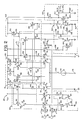
- Figure 3 is a schematic diagram of the same line receiver circuitry as implemented on an integrated circuit chip.
- the particular chip on which this line receiver has been implemented is identified by part number DC 5007 as fabricated by Exar Integrated Systems Inc., 750 Palomar Avenue, Sunnyvale, California 94088, United States of America.
- This particular integrated circuit incorporates a complete communications chip as shown by the function block diagram of Figure 5.
- the receiver incorporates a pair of input terminals 32 and 33 for receipt of data represented by the voltage difference between these terminals.
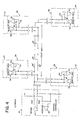
- a plurality of line receivers 30 are connected in parallel to a two-wire bus 35 as shown in Figure 4.
- Each line receiver can be part of a remote unit 36.
- the remote units further include individual transmitters 38 so that a central controller 40 can interrogate any of the remote units through unique addresses associated with each unit.
- the central controller further includes a transmitter driver 41 and a receiver 42 similar or identical to transmitters 38 and receivers 30.
- one typical use for the improved line receiver according to the present invention is to interface with a plurality of self-diagnostic testing units connected to emergency lighting equipment so that the central controller 40 can interrogate any remote unit.
- the remote unit included a parallel data interface 37 which responds if its address is selected. This interface is shown in Figure 5.
- the self-testing emergency lighting equipment 151 can correspond to that identified in copending U.S. application no. 06/696266 filed January 30, 1985, by the present assignee for an Emergency Lighting Supervisory System, hereby incorporated by reference.
- circuitry of self-testing emergency lighting system 151 attached to read/write line 149 can be interrogated with parallel data transferred via read/write lines 149 from the emergency lighting equipment 151, through interface 37, to remote unit 36, and then by lines 35 ⁇ and 35 ⁇ to central controller 40.
- Such interrogation can include periodic diagnostic test to the lighting equipment with the results transferred to central controller 40.
- the improved line receiver 30 comprises an emitter-coupled differential amplifier 44 comprising transistors 46 and 47, with their emitters connected to a constant current source 49 and their respective collectors connected to load resistors 52 and 53.
- a differential amplifier is well known in the art and has a small signal gain of 2g m R L , where g m equals the current passing through constant current amplifier 49 (I) divided by V T which in turn is equal to the collector current times q, the unit electron charge, divided by Boltzmann constant (k) times T, where T is the absolute temperature, and where R L is equal to resistor 52 or resistor 53.
- I constant current amplifier
- V T the collector current times q
- Boltzmann constant (k) times T where T is the absolute temperature
- R L is equal to resistor 52 or resistor 53.
- Such a differential amplifier also has a large signal voltage swing of I x R L at the collectors of transistors 46 and 47.
- the voltage common to the lines 35 ⁇ and 35 ⁇ can vary over many volts and therefore can exceed the power-supply voltage V cc associated with the line receiver and can be less than the ground potential 56 associated with each remote unit 36.
- the ground potential for each remote unit is, of course, indepentent from that of the other remote units as well as the central controller 40.
- a differential amplifier such as transistors 46 and 47 in combination with resistors 52 and 53 shown in Figure 2
- a differential amplifier would have zero common mode voltage gain if the transistors and other components were perfectly matched and had exactly symmetrical electrical characteristics.
- components including transistor gains, resistance values, length of component leads, and other factors including layout of the components cause this symmetry to diverge, thereby resulting in different gains for a common voltage input to the differential amplifier.
- Such symmetry and matching is similarly less than ideal if the circuit is implemented on an integrated circuit chip.
- node 62 associated with input 32 and node 63 associated with input 33 are formed into current summing nodes with the addition of current sinking mirrors 65 and 67 and current sourcing mirrors 69 and 71.
- Transistors 73, 74, 75 and 76 act as emitter-followers so as to present a high-impedance to input base nodes 62 and 63.
- Input resistors 78 and 79 provide receiver 30 with the necessary alternating current high-impedance characteristic, as well as a means by which current summing at base nodes 62 and 63 is translated into a voltage drop across corresponding resistors 78 and 79, thereby increasing the common mode rejection range of the circuit.
- Figure 3 illustrates similar circuitry for an integrated circuit implementation of the line receiver. As seen there, the relative areas of the transistors collectors can be varied to achieve proper operation of the line receiver as described below.
- V cc power-supply voltage
- the base to emitter voltages (V be ) at transistors 85 and 86 of current sinking mirror 65 and transistors 87 and 88 of sourcing current mirror 69 can be assumed constant and thus the small signal, delta_V, causes an increase to the collector current for transistor 85 (identified by arrow 90) equal to the value of the small signal (i.e., delta_V) divided by the resistance of resistor 92.
- the increase in the collector current for transistor 85 is reflected as an increase in the collector current 94 for transistor 86 by approximately: (1) delta_I c_trans_86 ⁇ (A trans_86 X delta_V)/(A trans_85 X R92); where A trans_86 and A trans_85 represent the emitter areas for transistors 86 and 85 respectively.
- the increase in voltage delta_V as seen by transistor 75 causes a decrease in the current flow through transistor 87; and repeating the analysis above, the voltage change, delta_V at node 62 causes a decrease in the collector current 96 for transistor 88 equal to approximately: (2) delta_I c_trans_88 ⁇ -(A trans_88 X delta_V)/(A trans_87 X R84).
- equation 3a Since the change in base currents is relatively small as compared to the changes in collector current for path 94 and 96, equation 3a becomes: (3b) delta_I R78 ⁇ ((A trans_86 )/(A trans_85 X R92) + (A trans_88 )/(A trans_87 X R84)) X delta_V.
- equation 4 becomes: (5) delta_V+ + 3 X delta_V.
- Equation 5 represents the interrelationship between a change in voltage at terminal 32 to a corresponding change in voltage at node 62.
- the change in voltage at node 62 that is the input transistor base node
- the ratio between input voltage change at terminal 32 to input voltage change at node 62 can be adjusted to achieve virtually any delta_V+ to delta_V ratio.
- the ratio of delta_V- to delta_V63 can be changed by adjusting the resistor values for resistors 79, 106 and 110.
- the input voltage can be substantially above V cc as well as below ground (reference element 56) without causing either of these transistors to be overdriven.
- common mode rejection exceeding plus or minus 100 volts can be obtained in an integrated circuit implementation of the invention if thin film resistors are used to fabricate resistors 78 and 79.
- Such common mode voltages are achievable even when using transistor - transistor logic (TTL) having levels of approximately 2 volts if additional gain stages (not shown) are added to the circuitry shown in Figure 2.
- TTL transistor - transistor logic
- the thin film resistors used for input resistors 78 and 79 isolate the voltage drop from the rest of the integrated circuits substrate.
- these resistors can be fabricated in electrically isolated tubs on the integrated circuit so as to allow the resistor body voltage to rise substantially above (V cc + V BE ), a voltage at which the p-n junction between the resistor body and the tub turns ON (thus clamping the resistor body voltage from rising further) should the tub be biased at V cc , as in most other cases of resistor implementations.
- modules 120 and 122 form an overall input voltage hysteresis generator to insure that unless the voltage difference between input terminals 32 and 33 exceeds an amount as determined by the hysteresis circuitry, the output voltage on line 144 in output module 125 will remain in its previous state. This in turn ensures that small voltage noise at terminals 32 and 33 will not be erroneously interpreted as a change in state for digital information received over bus 35 ( Figure 4) when the receiver is used as part of a remote interface unit 36. This characteristic is especially important where digital information is being received over a bus which may be subject to spurious electrical interference (noise) that could otherwise be misinterpreted as a change in state for a particular bit of information.
- spurious electrical interference noise
- resistor 128 of module 120 acts as a current source which together with transistors 98 and 99 form an input voltage hysteresis generator.
- the voltage drop across resistor 128 is approximately equal to the current flow (I h reference path 129) through resistor 52 times the value of resistor 52, or equal to the current flow through resistor 53 times its resistance value.
- transistor 46 is turned ON then the voltage drop across resistor 52 (i.e., I h X R52) causes the emitter of transistor 130 to have a voltage equal to I h X R52 lower than the emitter voltage of transistor 132; wherein it is noted that these emitter voltages are respectively applied to the bases of transistors 98 and 99. Consequently, pnp transistor 98 is turned ON while transistor 99 is turned OFF in a situation where transistor 46 is turned ON, and vice-versa when transistor 47 is turned ON. Due to the differential amplifier circuitry of emitter coupled differential amplifier 44, either transistor 46 or 47 can be turned ON, but not both simultaneously.
- This voltage drop thus causes an increase in the voltage at node 62 for the same value of voltage at terminal V+, and thus it can be seen that if transistor 46 is previously in the OFF state and a voltage is applied between terminals 32 and 33 (positive in nature at between terminals 32 to 33) then as transistor 46 begins to conduct due to a positive base to emitter voltage, a current is supplied by transistor 98.
- This current is a result of current flow through resistor 52 which occurs when transistor 46 begins to conduct (i.e., current flow through the collector to emitter junction of transistor 46).
- the current flow through transistor 98 also raises the potential of node 62 and thus increases the base to emitter potential of transistor 46, thereby turning transistor 46 ON still harder which in turn causes increased collector current flow through transistor 46.
- This positive feedback thereby ensures fast arrival at a final, fully ON state for transistor 46 once it begins to conduct (that is, as it goes from an OFF state into its linear mode operation).
- transistor 47 is turned OFF. It is therefore readily apparent that this result in turn causes transistor 99 to be turned OFF (due to the fact, as explained above, that the emitter voltage of transistor 130 is lower than the emitter voltage of transistor voltage 132 by an amount equal to I h X R52) and consequently, the collector current flow 135 for transistor 99 is approximately equal to 0 which therefore does not have an effect at current summing node 63. Consequently as transistor 47 starts to turn OFF due to a reduction in the voltage at terminal 33, a point is reached where the reduction in current flow through the collector of transistor 47 (and therefore through resistor 53) causes a reduction in the current flow through the collector of transistor 99 which previously was insuring the fully ON state of transistor 47. Thus as transistor 47 begins to come out of the initial fully ON state it is forced further and further out of the fully ON state until complete turn-OFF of the transistor 47 results and complete turn-ON of transistor 46 occurs.
- transistors 46 and 47 are only reversed when the voltage across terminals 32 and 33 reverses polarity by an amount which is sufficient to overcome the positive feedback current keeping either transistor 46 or 47 turned ON as a result of current flow through resistor 128 as it passes to transistor 46 or 46 via transistor 98 or 99.
- transistor 46 (or 47) OFF a voltage change exceeding the increase in voltage at node 62 (or 63) due to current flow through the collector of transistor (98 or 99) must be made in order to start turning transistor 46 (or 47) OFF and transistor 47 (or 46) ON.
- Current mirror module 124 in combination with output module 125 provide the circuitry for interfacing the emitter outputs 131 and 133 of the transistors 130 and 132, so as to be able to interface with TTL, I2L, and ISL types of logic circuitry.
- Transistors 130 and 132 as emitter followers, are always turned ON and their function is to shift the collector voltages of transistors 46 and 47 down by one V BE .
- the emitter outputs 131 and 133 represent the same voltage logic swing (v1) as between transistors 46 and 47, which as explained above, have opposite states with respect to each other; i.e., when transistor 46 is ON, transistor 47 is OFF, and vice versa.
- transistors 136 and 138 are a matched npn pair and when fabricated on an integrated circuit, such as shown in Figure 3, they have substantially identical topographies and orientation, being located side by side in close proximity on the chip.
- resistors 140 and 148 have the same value which thereby implied that the emitter areas of transistors 136 and 138 (their A E ) are equal. If their emitter areas are different, then resistors 140 and 148 must match the ratio of the transistor emitter areas.
- emitter-coupled logic (ECL) circuitry if emitter-coupled logic (ECL) circuitry is to be driven, then the emitter outputs (nodes) 131 and 133 are pulled down by current sources so as to drive ECL gates differentially (such as across emitter outputs 131 and 133) or single-endedly (such as output 131 or 133 singlely).
- ECL emitter-coupled logic
- TTL transistor-transistor logic
- I2L integrated injection logic
- ISL integrated Schottky logic
- transistors 136 and 138 of current mirror 124 will (assuming these transistors have a high beta) have collector currents equal to each other, and therefore the currents flowing through resistors 140 and 148 will be equal.
- resistor 148 (that is, the current flow through resistor 148 is equal to the voltage drop across that resistor divided by the value of the resistance, where the voltage drop across resistor 148 is equal to the emitter voltage at emitter node 133 minus the base to emitter voltage of transistor 138).
- I b142 (V E130 - V BE142 )/R140 - (V E132 - V BE138 )/R148.
- resistors 140 and 148 are identical in geometry and orientation and are placed in close proximity on the integrated circuit chip so that they are closely matched to each other, the values of resistors R140 and R148 are equal to each other. Of course, in a discrete component implementation of the invention, the values can also be made equal to each other.
- the base emitter junction voltage for transistors 138 and 142 would be substantially equal to each other (this would also be true for a discrete component implementation such as shown in Figure 2), thereby yielding (21) V BE142 + V BE138 .
- Equation (23) thereby ensures that transistor 142 is turned ON when the emitter voltage of transistor 130 is greater than the emitter voltage of transistor 132 by voltage v1 (that is, when transistor 47 is ON and transistor 46 is OFF).
- transistor 136 has the same collector current.
- transistor 142 has no base drive and is therefore turned OFF (the possibility of v1 being insufficiently large enough to cause the above occurrences wherein transistor 142 could remain marginally ON would not be present in the implementation and values as set forth in Figure 3.)
- transistor 142 is turned OFF.
- collector output of transistor 142 represents the voltage logic swing of transistor 46 and 47.
- Output module 125 thus current amplifies this voltage logic swing at collector output 144.
- Figure 3 shows additional output circuitry 152 connected to the collector output 144 of transistor 142. This additional circuitry provides additional buffering and drive compatibility to drive I2L or ISL devices.
- Capacitor 150 can be used as a low-pass filter to absorb high-frequency electrical noise that may appear at inputs 32 and 33 so as to prevent its distribution to the interconnected circuitry on output line 144.
- Current source 49 can be fabricated by various circuit techniques well known in the art such as shown in Figure 4.18 of the General Electric Transistor Manual (Copyright 1964).
- Figure 3 shows a current source as implemented on an integrated circuit chip.
- Darlington stages can be used to replace switching transistor pairs 46 and 47 and the emitter follower input transistors 73, 74, 75 and 76.
- a line receiver circuit which has a high common mode rejection ratio and which can accept input voltages which exceed V cc or ground by several orders of magnitudes.
- the circuit also has high sensitivity with built-in hysteresis to insure accurate switching of the receiver's output for effective reception of digital information.
- the present invention also has high input impedance thereby allowing a plurality of receivers to be connected in parallel to a bus such as associated with a central controlling system used to interrogate a plurality of remote units which may be used for diagnostic testing of emergency lighting equipment.
Landscapes
- Engineering & Computer Science (AREA)
- Power Engineering (AREA)
- Amplifiers (AREA)
- Logic Circuits (AREA)
- Dc Digital Transmission (AREA)
Applications Claiming Priority (2)
| Application Number | Priority Date | Filing Date | Title |
|---|---|---|---|
| US948313 | 1986-12-31 | ||
| US06/948,313 US4742309A (en) | 1986-12-31 | 1986-12-31 | Line receiver |
Publications (2)
| Publication Number | Publication Date |
|---|---|
| EP0273630A2 true EP0273630A2 (de) | 1988-07-06 |
| EP0273630A3 EP0273630A3 (de) | 1989-03-22 |
Family
ID=25487638
Family Applications (1)
| Application Number | Title | Priority Date | Filing Date |
|---|---|---|---|
| EP87310978A Withdrawn EP0273630A3 (de) | 1986-12-31 | 1987-12-14 | Leitungsempfänger |
Country Status (3)
| Country | Link |
|---|---|
| US (1) | US4742309A (de) |
| EP (1) | EP0273630A3 (de) |
| CA (1) | CA1278831C (de) |
Cited By (1)
| Publication number | Priority date | Publication date | Assignee | Title |
|---|---|---|---|---|
| DE102023201380A1 (de) | 2023-02-17 | 2024-09-05 | Robert Bosch Gesellschaft mit beschränkter Haftung | Modifizierung eines Fahrerdrehmomentsignals zur Optimierung eines Anfahrverhaltens eines Pedelecs |
Families Citing this family (11)
| Publication number | Priority date | Publication date | Assignee | Title |
|---|---|---|---|---|
| DE3811950A1 (de) * | 1988-04-11 | 1989-10-19 | Telefunken Electronic Gmbh | Schaltungsanordnung zur arbeitspunkteinstellung eines transistors |
| US4918398A (en) * | 1989-02-10 | 1990-04-17 | North American Philips Corporation, Signetics Division | Differential amplifier using voltage level shifting to achieve rail-to-rail input capability at very low power supply voltage |
| DE3937814A1 (de) * | 1989-11-14 | 1991-05-23 | Ant Nachrichtentech | Verfahren zur uebertragung von daten sowie anordnung |
| US5043674A (en) * | 1990-04-30 | 1991-08-27 | International Business Machines Corporation | Differential receiver with high common-mode range |
| US5204880A (en) * | 1991-04-23 | 1993-04-20 | Level One Communications, Inc. | Differential line driver employing predistortion |
| US5294893A (en) * | 1992-10-30 | 1994-03-15 | Sgs-Thomson Microelectronics, Inc. | Differential output amplifier input stage with rail-to-rail common mode input range |
| US5568561A (en) * | 1993-04-22 | 1996-10-22 | Whitlock; William E. | Differential line receiver with common-mode AC bootstrapping |
| US5504782A (en) * | 1994-07-29 | 1996-04-02 | Motorola Inc. | Current mode transmitter and receiver for reduced RFI |
| JP2882316B2 (ja) * | 1995-08-29 | 1999-04-12 | 株式会社デンソー | データ通信装置 |
| US6058144A (en) * | 1998-04-03 | 2000-05-02 | Nortel Networks Corporation | Multi-GB/S data pulse receiver |
| US6272185B1 (en) * | 1998-05-04 | 2001-08-07 | Nortel Networks Limited | Method and apparatus for performing data pulse detection |
Family Cites Families (8)
| Publication number | Priority date | Publication date | Assignee | Title |
|---|---|---|---|---|
| US29700A (en) * | 1860-08-21 | Stopping and starting railroad-cars | ||
| NL6816602A (de) * | 1968-11-20 | 1970-05-22 | ||
| NL7407953A (nl) | 1974-06-14 | 1975-12-16 | Philips Nv | Spanningstroomomzetter. |
| US4463319A (en) * | 1982-08-02 | 1984-07-31 | General Motors Corporation | Operational amplifier circuit |
| US4634993A (en) * | 1985-08-23 | 1987-01-06 | Burr-Brown Corporation | High gain, low drift operational amplifier for sample and hold circuit |
| US4636743A (en) * | 1985-10-01 | 1987-01-13 | Harris Corporation | Front end stage of an operational amplifier |
| US4636744A (en) * | 1985-10-01 | 1987-01-13 | Harris Corporation | Front end of an operational amplifier |
| CA1260080A (en) * | 1986-09-10 | 1989-09-26 | Akira Yukawa | Operational amplifier circuit having wide operating range |
-
1986
- 1986-12-31 US US06/948,313 patent/US4742309A/en not_active Expired - Fee Related
-
1987
- 1987-12-14 EP EP87310978A patent/EP0273630A3/de not_active Withdrawn
- 1987-12-23 CA CA000555345A patent/CA1278831C/en not_active Expired - Lifetime
Cited By (1)
| Publication number | Priority date | Publication date | Assignee | Title |
|---|---|---|---|---|
| DE102023201380A1 (de) | 2023-02-17 | 2024-09-05 | Robert Bosch Gesellschaft mit beschränkter Haftung | Modifizierung eines Fahrerdrehmomentsignals zur Optimierung eines Anfahrverhaltens eines Pedelecs |
Also Published As
| Publication number | Publication date |
|---|---|
| CA1278831C (en) | 1991-01-08 |
| EP0273630A3 (de) | 1989-03-22 |
| US4742309A (en) | 1988-05-03 |
Similar Documents
| Publication | Publication Date | Title |
|---|---|---|
| GB2069269A (en) | Supply voltage driver | |
| JPH04229708A (ja) | 差動増幅回路 | |
| US4742309A (en) | Line receiver | |
| US3673508A (en) | Solid state operational amplifier | |
| US6166569A (en) | Test interface circuits with waveform synthesizers having reduced spurious signals | |
| GB2120486A (en) | High input impedance circuits | |
| US3509364A (en) | Video amplifier particularly adapted for integrated circuit fabrication | |
| US3546484A (en) | Two-state switchover amplifier system with plural current sources | |
| US4835455A (en) | Reference voltage generator | |
| US4378529A (en) | Differential amplifier input stage capable of operating in excess of power supply voltage | |
| US3936731A (en) | Amplifier with fast recovery after input signal overswing | |
| JP2528091B2 (ja) | 集積回路 | |
| US6191635B1 (en) | Level shifting circuit having a fixed output common mode level | |
| JPS63275212A (ja) | 電圧変換回路 | |
| GB2121255A (en) | Comparator circuit | |
| US6008696A (en) | Low noise amplifier with actively terminated input | |
| US5021744A (en) | Differential amplifier with differential or single-ended output | |
| US3573496A (en) | Dc sense amplifier | |
| EP0508711A1 (de) | Transistorverstärker mit direkter Kopplung | |
| US3694763A (en) | Differential current sense amplifier | |
| JP2665072B2 (ja) | 増幅回路 | |
| US3470486A (en) | Differential amplifier single ending circuit | |
| US3496480A (en) | Transistorized differential amplifier utilizing components easy to fabricate using thin film circuitry techniques | |
| SU1656669A1 (ru) | Усилитель | |
| JP3470835B2 (ja) | 演算増幅器 |
Legal Events
| Date | Code | Title | Description |
|---|---|---|---|
| PUAI | Public reference made under article 153(3) epc to a published international application that has entered the european phase |
Free format text: ORIGINAL CODE: 0009012 |
|
| AK | Designated contracting states |
Kind code of ref document: A2 Designated state(s): AT BE CH DE ES FR GB GR IT LI LU NL SE |
|
| PUAL | Search report despatched |
Free format text: ORIGINAL CODE: 0009013 |
|
| AK | Designated contracting states |
Kind code of ref document: A3 Designated state(s): AT BE CH DE ES FR GB GR IT LI LU NL SE |
|
| 17P | Request for examination filed |
Effective date: 19890619 |
|
| STAA | Information on the status of an ep patent application or granted ep patent |
Free format text: STATUS: THE APPLICATION IS DEEMED TO BE WITHDRAWN |
|
| 18D | Application deemed to be withdrawn |
Effective date: 19910702 |
|
| R18D | Application deemed to be withdrawn (corrected) |
Effective date: 19910703 |