EP0273768B1 - Verfahren zur Quantifizierung thermisch dissipativer Mechanismen in biologischen Stoffen - Google Patents
Verfahren zur Quantifizierung thermisch dissipativer Mechanismen in biologischen Stoffen Download PDFInfo
- Publication number
- EP0273768B1 EP0273768B1 EP87311516A EP87311516A EP0273768B1 EP 0273768 B1 EP0273768 B1 EP 0273768B1 EP 87311516 A EP87311516 A EP 87311516A EP 87311516 A EP87311516 A EP 87311516A EP 0273768 B1 EP0273768 B1 EP 0273768B1
- Authority
- EP
- European Patent Office
- Prior art keywords
- medium
- diffusivity
- thermal conductivity
- temperature
- perfusion
- Prior art date
- Legal status (The legal status is an assumption and is not a legal conclusion. Google has not performed a legal analysis and makes no representation as to the accuracy of the status listed.)
- Expired - Lifetime
Links
- 238000000034 method Methods 0.000 title claims description 58
- 239000012620 biological material Substances 0.000 title description 9
- 230000007246 mechanism Effects 0.000 title description 2
- 239000011324 bead Substances 0.000 claims description 83
- 230000010412 perfusion Effects 0.000 claims description 79
- 238000010438 heat treatment Methods 0.000 claims description 71
- 239000000523 sample Substances 0.000 claims description 33
- 238000012546 transfer Methods 0.000 claims description 31
- 230000008859 change Effects 0.000 claims description 26
- 238000001816 cooling Methods 0.000 claims description 24
- 230000000694 effects Effects 0.000 claims description 21
- 239000012530 fluid Substances 0.000 claims description 11
- 230000001052 transient effect Effects 0.000 claims description 9
- 230000008569 process Effects 0.000 claims description 6
- 238000012544 monitoring process Methods 0.000 claims description 4
- 230000003213 activating effect Effects 0.000 claims 3
- 230000009849 deactivation Effects 0.000 claims 2
- 230000002123 temporal effect Effects 0.000 claims 2
- 238000013213 extrapolation Methods 0.000 claims 1
- 238000005259 measurement Methods 0.000 description 29
- 210000001519 tissue Anatomy 0.000 description 26
- 238000002474 experimental method Methods 0.000 description 15
- 238000004422 calculation algorithm Methods 0.000 description 9
- 238000004364 calculation method Methods 0.000 description 9
- 239000000463 material Substances 0.000 description 6
- 230000017531 blood circulation Effects 0.000 description 5
- 238000013178 mathematical model Methods 0.000 description 5
- 238000013459 approach Methods 0.000 description 4
- 239000008280 blood Substances 0.000 description 4
- 210000004369 blood Anatomy 0.000 description 4
- 241001465754 Metazoa Species 0.000 description 3
- 206010028980 Neoplasm Diseases 0.000 description 3
- 230000014509 gene expression Effects 0.000 description 3
- 238000012545 processing Methods 0.000 description 3
- 238000004458 analytical method Methods 0.000 description 2
- 201000011510 cancer Diseases 0.000 description 2
- 238000009795 derivation Methods 0.000 description 2
- 230000003993 interaction Effects 0.000 description 2
- 230000009467 reduction Effects 0.000 description 2
- 230000004044 response Effects 0.000 description 2
- 239000006244 Medium Thermal Substances 0.000 description 1
- 230000009471 action Effects 0.000 description 1
- 230000000295 complement effect Effects 0.000 description 1
- 238000002681 cryosurgery Methods 0.000 description 1
- 238000007405 data analysis Methods 0.000 description 1
- 230000001419 dependent effect Effects 0.000 description 1
- 238000009792 diffusion process Methods 0.000 description 1
- 238000009826 distribution Methods 0.000 description 1
- 238000004980 dosimetry Methods 0.000 description 1
- 229940079593 drug Drugs 0.000 description 1
- 239000003814 drug Substances 0.000 description 1
- 230000007613 environmental effect Effects 0.000 description 1
- 238000009472 formulation Methods 0.000 description 1
- 230000020169 heat generation Effects 0.000 description 1
- 210000002989 hepatic vein Anatomy 0.000 description 1
- 230000006872 improvement Effects 0.000 description 1
- 238000001727 in vivo Methods 0.000 description 1
- 230000000977 initiatory effect Effects 0.000 description 1
- 230000002452 interceptive effect Effects 0.000 description 1
- 210000004185 liver Anatomy 0.000 description 1
- 230000008338 local blood flow Effects 0.000 description 1
- 238000012423 maintenance Methods 0.000 description 1
- 238000000691 measurement method Methods 0.000 description 1
- 230000002503 metabolic effect Effects 0.000 description 1
- 239000000203 mixture Substances 0.000 description 1
- 239000000082 organ preservation Substances 0.000 description 1
- 230000036961 partial effect Effects 0.000 description 1
- 230000000737 periodic effect Effects 0.000 description 1
- 238000002360 preparation method Methods 0.000 description 1
- 238000011002 quantification Methods 0.000 description 1
- 239000002331 radioactive microsphere Substances 0.000 description 1
- 238000011160 research Methods 0.000 description 1
- 238000012552 review Methods 0.000 description 1
- 230000000630 rising effect Effects 0.000 description 1
- 210000002027 skeletal muscle Anatomy 0.000 description 1
- 230000001225 therapeutic effect Effects 0.000 description 1
- 238000002560 therapeutic procedure Methods 0.000 description 1
- 230000036962 time dependent Effects 0.000 description 1
Images

Classifications
-
- G—PHYSICS
- G01—MEASURING; TESTING
- G01N—INVESTIGATING OR ANALYSING MATERIALS BY DETERMINING THEIR CHEMICAL OR PHYSICAL PROPERTIES
- G01N25/00—Investigating or analyzing materials by the use of thermal means
- G01N25/18—Investigating or analyzing materials by the use of thermal means by investigating thermal conductivity
Definitions
- This invention relates generally to techniques for determining the thermal properties of materials, as well as other properties related to or derived from such thermal properties, and, more particularly, to methods for determining primarily the thermal conductivity and thermal diffusivity of materials, in the presence or in the absence of fluid flow therein, and the monitoring and quantification of the flow rates of fluids flowing therein, i.e., perfusion in such materials as living tissues.
- biomaterials are capable of heat transfers by virtue of a temperature gradient, such heat transfer capability being especially important in living biomaterials because the state of life thereof, for example, may depend on the maintenance of a specific temperature level.
- Heat transfer by conduction is usually most important in determining the heat transfer within the biological medium and such heat transfer is best characterized in the steady-state by the thermal conductivity, k, of the medium and in the non-steady state by its thermal diffusivity, ⁇ . Since there is no presently known method of determining k and ⁇ of a biomaterial from a knowledge of some other fundamental property or properties thereof, it is necessary to devise appropriate processes and apparatus to measure k and ⁇ in some appropriate manner.
- thermophysical properties of such materials and, in particular, information concerning the thermal conductivities, thermal diffusivities and the flow rates of fluids (perfusion) through the biological medium, which information permits the determination of temperature distributions and heat transfer rates. It is particularly important, for example, to monitor the flow rate of blood through tissue so that flow disturbances can be monitored and corrective action taken in cases where maldistribution of blood flow in a patient would have unfavorable and possibly fatal consequences.
- a particular thermal model is developed and a particular implementation of the solution of the heat conduction equations utilizing a thermistor probe is described for providing a realistic representation of the thermal properties of the thermistor bead and the surrounding medium so as to produce an accurate measurement of such properties as thermal conductivity and thermal diffusivity from which other thermal properties and states of flow can be derived.
- the thermistor bead of the probe is treated as a distributed thermal mass and the heat conduction equation is solved for both the interior of the bead as well as the region of the medium surrounding it.
- the thermistor bead is placed in a medium and the bead and the region of the medium surrounding it assume an initial equilibrium, or reference, temperature.
- the temperature of the bead is raised to a predetermined level above the equilibrium temperature by applying electrical energy to the bead which thereupon thermally dissipates in the bead and its surrounding medium, thereby raising the temperature of the surrounding medium. If the temperature rise in the bead is to be maintained at the desired level, the electrical energy must be dissipated at a rate which is sufficient to maintain the temperature at the desired level and the electrical power required for such purpose depends on the heat transfer characteristics of the surrounding medium.
- the characteristics of the medium are such as to enhance the heat transfer, a greater amount of electrical power will be needed to maintain the desired temperature increment between the reference temperature and the temperature at the desired predetermined level, while, if the characteristics thereof are such as to impede heat transfer, less electrical power will be needed to maintain the temperature increment.
- the heat transfer capability of the medium depends upon the intrinsic thermal conductivity of the medium, the local blood flow rate in the medium and the specific heat of the blood therein, such characteristics contributing to a property which, for convenience, can be referred to as the "effective thermal conductivity" of the medium.
- Such term can be defined as a measure of the rate at which heat is being removed from the bead by (or transported through) a medium in the presence of fluid flow in the medium.
- Intrinsic thermal conductivity can be defined as a measure of the rate at which heat can be removed from the bead for a given temperature gradient by (or transported through) a medium in the absence of any fluid flow therein (e.g., a biologic medium in which no blood flow is present).
- the initial reference temperature of the bead and medium is determined and power is applied thereto to raise the mean temperature of the bead to a fixed predetermined level and is maintained at a desired, constant level above the reference temperature.
- a data processor is used to calculate both the thermal conductivity and the thermal diffusivity of the medium in accordance with expressions derived from solutions to the transient heat diffusion equations both for the interior of the bead and for the surrounding region of the medium, arrived at by using a thermal model which takes into account the distributed thermal mass of the thermistor bead and the thermal characteristics of the surrounding medium.
- the flow rate of a fluid which moves through the medium can be calculated in accordance with an expression also derived from solutions to the heat conduction equations which specifically include blood flow (perfusion) as a variable in such a thermal model representation.
- the intrinsic thermal conductivity and thermal diffusivity must be determined under no flow conditions (i.e., in the absence of fluid flow).
- a method for determining, under flow conditions, the perfusicn in a medium having a fluid flowing in the medium comprising: locating a thermal probe in the medium; applying power to the probe to create a temperature difference between the probe and the medium, thereby to heat the medium; and monitoring the power supplied to the probe and the temperature change of the probe characterised by calculating the intrinsic thermal conductivity and/or diffusivity of the medium as a function of the changes in temperature and power at a first time when the thermal transfer effects of flow in the medium are low and the conductivity of the medium dominates as a factor effecting thermal transfer; and calculating the perfusion as a function of the intrinsic conductivity and/or diffusivity calculated in the previous step and the changes in temperature and power at a second time subsequent to the said first time when the thermal transfer effects of flow upon the probe are greater than the thermal transfer effects of flow upon the probe during the first time period.
- the invention utilizes a technique for determining thermal conductivity and thermal diffusivity, as well as the perfusion characteristics of a perfused medium, in a manner which does not require any measurements under no flow conditions. Moreover, such technique is not restricted to maintaining the bead volume mean temperature at a value at which the change thereof from a reference temperature (i.e., ⁇ T) is kept substantially constant. Further, the technique permits measurements to be made under effectively transient conditions, i.e., at times which are short relative to the time required for the system to reach steady state.
- the temperature change produced in the medium is permitted to vary in any arbitrarily selected manner with time. Both the power required to heat the medium and the resulting temperature change is recorded. At least one selected intrinsic thermal property of the medium, e.g., the intrinsic thermal conductivity and/or thermal diffusivity thereof, is calculated using data obtained at a first time period. The perfusion of the medium is separately calculated using data obtained at a second time period and such at least one calculated intrinsic thermal property, the effects of the flow of the medium during the second time period being greater than the effects of the flow of the medium during the first time period.
- At least one selected intrinsic thermal property of the medium e.g., the intrinsic thermal conductivity and/or thermal diffusivity thereof, is calculated using data obtained at a first time period.
- the perfusion of the medium is separately calculated using data obtained at a second time period and such at least one calculated intrinsic thermal property, the effects of the flow of the medium during the second time period being greater than the effects of the flow of the medium during the first time period.
- equations are derived for a thermal model which requires at least one series of experimental measurements under flow conditions, such data obtained at selected times which can occur during a temperature change of a medium from a first unperturbed temperature to a second temperature as well as during a relaxation of the temperature of the medium from the second temperature back to an unperturbed value.
- the data utilized include measurements made at at least two selected time periods in the overall temperature changing cycle, such equations can be used in an interactive data processing operation so as to converge relatively rapidly to a final solution for the conductivity, diffusivity and perfusion values that are desired.
- the medium can be heated from an unperturbed temperature value to a second higher temperature value and then permitted to decay, i.e.
- Measurements can be made which include at least two selected time periods, one during the heating portion of the cycle, for example, and one during the cooling portion thereof, for example. In such embodiment the effects of the medium flow on the measurements involved are greater during the cooling portion than during the heating portion of the cycle. In another embodiment, to improve the accuracy thereof, measurements can be made which include three separate selected time periods (e.g. two during the heating portion and one during the cooling portion) to provide the ability to simultaneously quantify thermal properties and perfusion over a wide range of perfusion levels and particularly at low perfusion levels.
- Such measurements do not depend on maintaining the volume mean temperature of the medium so as to provide a constant ⁇ T with time and, in a heating/cooling cycle, power can be applied in any appropriate manner which produces any arbitrarily selected change in the volume mean temperature of the medium as a function of time.
- Equation (2) is derived from the full, bioheat transfer equation for heat transfer in perfused biological tissue. This equation is described more fully in the publication "Heat Transfer Mechanisms and Thermal Dosimetry" by H.F. Bowman, Jour. Nat. Cancer Inst., Monograph 61, Vol. 60, 1981, pp. 437-445.
- Equation (2) it is assumed that tissue metabolic heat generation and perfusion do not change materially over the duration of the transient measurement procedure.
- the temperature, T is the temperature elevation (or depression) produced by the measurement procedure and the applied power, ⁇ + ⁇ (t) is such as to produce the required tissue heating (or cooling), as measured from the non-perturbed, initial probe-tissue equilibrium state.
- Exemplary solutions to the above coupled, perfused conduction equations in accordance with the invention may be considered with reference to a bead which has a spherical configuration.
- Other solutions can be determined by those in the art for other configurations, such as a cylindrical bead, an ellipsoidal bead, etc,.
- a spherical bead having a radius a the following experimental procedure, or protocol, can be considered:
- the above expressions for the applied heating power P(t) may be presented in the form of ⁇ + ⁇ (t), which terms represent, respectively, the constant (or steady-state) power term and a transient power term used to maintain the temperature elevation ⁇ T.
- a function f(t) is derived which is a characteristic transient function determining either (1) the heating power for providing a constant temperature increment, (2) the temperature, when heating at a constant power, (3) the temperature during the delay following the shut-off of heating power at either a constant power or a constant temperature increment, or (4) the temperature for any arbitrary heating procedure. While derived solutions are valid for bead and medium heating according to any arbitrary experimental, or measurement, protocol, the above solutions are specifically presented for the cases of heating at constant temperature increment, at constant power, and for the subsequent cooling following power shut-off for a spherical bead. In each of the cases considered above it is confirmed that the characteristic function for the problem, whether for power required during bead heating or temperature during the decay, is given by the function f(t).
- the above mathematical model describes the heat transfer processes occurring both within the tissue and those occurring between the tissue and the thermistor probe, and is not limited to the requirement that the thermistor probe be heated to a constant temperature increment, as with the prior Bowman patent.
- the solution derived here considers the effect of finite bead size and bead properties during both bead heating and cooling, for both steady-state and transient heat transfer, as well as the effects of tissue thermal conductivity, thermal diffusivity and perfusion.
- a heating experiment can be performed in which bead heating power is applied for a selected time period so as to maintain the volume mean temperature of the bead at a constant increment above its initial baseline value.
- Second, the same experimental procedure can be performed in which temperature data is collected as well during the temperature decay time following power shut-off. In each case three tissue properties are to be determined, i.e., tissue thermal conductivity, tissue thermal diffusivity, and perfusion.
- tissue thermal conductivity i.e., tissue thermal conductivity, tissue thermal diffusivity, and perfusion.
- FIG. 1 The times at which the above experimental algorithms can be implemented are illustrated in an exemplary manner in FIG. 1 wherein graphical representations are presented of the volume mean temperature V b of the bead (probe) and of the heating power P applied thereto, both as functions of time.
- the power P is applied at t o in a manner such that the bead volume mean temperature V b rapidly reaches a selected level V b2 and is maintained at such level for a selected time period until t 1 , for example, at which time the power is reduced to zero (shut-off) and the temperature V b decays toward zero in a general manner as shown.
- Approximation algorithms can be used with data derived from measurements taken at different times during the overall heating/cooling cycle as, for example, early in the heating portion thereof with the time range or time window, illustrated by "A" in FIG. 1, later in the heating portion at "B", and during the cooling portion at "C".
- Data taken during time window “A” is dominated by tissue conduction and the effects of the flow of the medium are relatively low.
- Data taken during time window "B", occurring later in time as heating continues, is influenced to a greater extent by perfusion, i.e., the effects of the flow of the medium are greater than at time window "A".
- One exemplary data analysis algorithm usable at time windows "A" and "B” consists of the following steps:
- Another exemplary alternative algorithm usable at time windows "A" and "B” consists of the following steps:
- this analysis technique may also be applied to measurements obtained during an experiment wherein the temperature is raised to an appropriate level and held there for a very short time period (and even held only for an instant of time) and then allowed to relax to a final unperturbed value, the measurements desired also being taken at any suitably selected separate times during the overall time cycle.
- the medium in some instances may be subject to a general overall change in temperature due to other environmental causes (e.g. the overall temperature of the medium may be rising due to other causes at a steady rate during the overall recommended time period).
- the final unperturbed temperature to which the medium relaxes after initial heating (or cooling) may be somewhat different from the initial unperturbed temperature at the initiation of heating (or cooling).
Landscapes
- Physics & Mathematics (AREA)
- Health & Medical Sciences (AREA)
- Life Sciences & Earth Sciences (AREA)
- Chemical & Material Sciences (AREA)
- Analytical Chemistry (AREA)
- Biochemistry (AREA)
- General Health & Medical Sciences (AREA)
- General Physics & Mathematics (AREA)
- Immunology (AREA)
- Pathology (AREA)
- Investigating Or Analyzing Materials Using Thermal Means (AREA)
Claims (19)
- Verfahren, um unter Durchflussbedingungen die Perfusion in einem Medium mit einem Fluid zu ermitteln, das in dem Medium fließt, wobei das Verfahren folgendes umfasst: Positionieren einer Wärmesonde in dem Medium, Zuführen von Energie zu der Sonde, um eine Temperaturdifferenz zwischen der Sonde und dem Medium zu erzeugen, um auf diese Weise das Medium zu erhitzen, und Überwachen der der Sonde zugeführten Energie und der Temperaturänderung der Sonde,
gekennzeichnet durch Errechnen der intrinsischen Wärmeleitfähigkeit und/oder -diffusivität des Mediums in Abhängigkeit von den Änderungen von Temperatur und Energie in einem ersten Zeitraum, wenn die Wärmeübertragungsauswirkungen von Durchfluss im Medium gering sind und die Leitfähigkeit des Mediums als die Wärmeübertragung beeinflussender Faktor dominiert; und
Errechnen der Perfusion in Abhängigkeit von der im vorherigen Schritt errechneten intrinsischen Leitfähigkeit und/oder Diffusivität und den Änderungen von Temperatur und Energie in einer zweiten Zeitperiode nach der genannten ersten Zeitperiode, wenn die Wärmeübertragungsauswirkungen von Durchfluss auf die Sonde größer sind als die Wärmeübertragungsauswirkungen von Durchfluss auf die Sonde während der ersten Zeitperiode. - Verfahren nach Anspruch 1, bei dem die intrinsische Wärmeleitfähigkeit und/oder -diffusivität des Mediums durch Extrapolation auf den Zeitpunkt errechnet werden, zu dem die Temperatur des Mediums erstmalig veranlasst wurde, sich von einer Reihe von effektiven Wärmeleitfähigkeits- und/oder - diffusivitätswerten zu ändern [*1], die für eine Mehrzahl von Zeitfenstern in der ersten Periode errechnet wurden.
- Verfahren nach Anspruch 1 oder 2, bei dem die intrinsische Wärmeleitfähigkeit und/oder -diffusivität anhand der errechneten Perfusion neu berechnet und der Prozess wiederholt wird, so dass er im Wesentlichen unveränderten Werten zustrebt.
- Verfahren nach einem der vorherigen Ansprüche, bei dem die Temperatur der Sonde relativ zum Medium zuerst veranlasst wird, sich von einem Anfangswert auf einen zweiten Wert zu ändern, und danach vom zweiten Wert auf einen Endwert entspannen gelassen wird.
- Verfahren nach Anspruch 4, bei dem die beiden separaten Zeitperioden beide auftreten, nachdem der zweite Wert erreicht wurde und bevor die Entspannung auf den Endwert beginnt.
- Verfahren nach Anspruch 4, bei dem die genannte erste Zeitperiode vor Entspannungsbeginn und die genannte zweite Zeitperiode nach Entspannungsbeginn auftritt.
- Verfahren nach einem der Ansprüche 4 bis 6, bei dem die Änderung vom Anfangswert auf den zweiten Wert durch Eintauchen eines Kühlmittels in das Medium bewirkt wird.
- Verfahren nach einem der Ansprüche 4 bis 6, bei dem die Sonde im Wesentlichen ein sphärisches Heizmittel ist, die Temperaturänderung der Sonde vom Anfangswert auf den zweiten Wert durch Zuführen von Energie zu dem Heizmittel bewirkt wird und die Entspannung auf den Endwert durch Abschalten der Energiezufuhr zum Heizmittel bewirkt wird, wobei die intrinsische Wärmeleitfähigkeit und -diffusivität und die Perfusion anhand der folgenden Gleichungwobei folgendes gilt: P(t) ist die angewendete Energie, a ist der Radius des sphärischen Heizmittels, km und αm sind jeweils die intrinsische Wärmeleitfähigkeit und Wärmediffusivität des genannten Mediums, γ ist das Verhältnis kb/km, kb ist die intrinsische Wärmeleitfähigkeit des sphärischen Heizmittels, λ ist gleich √(wcf/km), wobei w Perfusion und cf die spezifische Wärme des Perfusionsmittels sind, Vb ist die mittlere Perlvolumentemperatur beim Kühlen, ΔT ist die volumengemittelte Konstanttemperatur während der Heizphase, theat ist die Zeitdauer, für die die Erhitzung erfolgt, und f(t) repräsentiert die temporale Form der transienten Energie, die dem genannten Heizmittel in Abhängigkeit von der Zeit zugeführt wird.(A) für die Heizperiode und die nachfolgende Gleichung (B) für die Kühlperiode berechnet werden:Vb (t) = Δ T


- Verfahren nach einem der Ansprüche 4 bis 6, bei dem die Sonde ein im Wesentlichen sphärisches Heizmittel ist, die Temperaturänderung der Sonde vom Anfangswert auf den zweiten Wert durch Zuführen von Energie zu dem Heizmittel bewirkt wird, wobei die intrinsische Wärmeleitfähigkeit und -diffusivität und die Perfusion mit der folgenden Gleichung (C) für die Heizperiode und die folgende Gleichung (D) für die Kühlperiode errechnet werden:
P = P 0
undP = 0 wobei folgendes gilt: P0 ist die konstante Energie, die während der Heizphase zugeführt wird, a ist der Radius des sphärischen Heizmittels, km und αm sind jeweils die intrinsische Wärmeleitfähigkeit und Wärmediffusivität des genannten Mediums, γ ist das Verhältnis kb/km, kb ist die intrinsische Wärmeleitfähigkeit des sphärischen Heizmittels, λ ist gleich √(wcf/km), wobei w Perfusion und cf die spezifische Wärme des Perfusionsmittels sind, Vb ist die mittlere Perlvolumentemperatur während des Kühlens, theat ist die Zeitdauer, für die die Erhitzung erfolgt, und f(t) repräsentiert die temporale Form der transienten Energie, die dem genannten Heizmittel in Abhängigkeit von der Zeit zugeführt wird.
- Verfahren nach einem der vorherigen Ansprüche, bei dem die Sonde eine Thermistorperle ist.
- Verfahren nach Anspruch 1, bei dem:(a) der Schritt des Zuführens von Energie eine Änderung der Temperatur des genannten Mediums von einer ersten ungestörten Temperatur auf eine zweite Temperatur erzeugt, die sich während einer Gesamtzeitperiode von der genannten ersten Temperatur unterscheidet;(b) der Schritt des Errechnens der intrinsischen Wärmeleitfähigkeit und/oder -diffusivität die folgenden Schritte umfasst:(1) Errechnen der effektiven Wärmeleitfähigkeits- und - diffusivitätswerte des genannten Mediums während einer Mehrzahl von gewählten Zeitperioden innerhalb der genannten Gesamtzeitperiode, wobei die gewählten Zeitperioden Intervalle sind, wenn die Wärmeübertragungsauswirkungen von Durchfluss im Medium gering sind und die Leitfähigkeit des Mediums als die Wärmeübertragung beeinflussender Faktor dominiert; und(2) Extrapolieren der in Schritt (b) (1) errechneten effektiven Wärmeleitfähigkeits- und -diffusivitätswerte auf die Wärmeleitfähigkeits- und -diffusivitätswerte auf einen gewählten Zeitpunkt t0, wenn die Temperatur des genannten Mediums erstmalig veranlasst wird, sich zu ändern, um die extrapolierten Werte der intrinsischen Wärmeleitfähigkeit und -diffusivität des genannten Mediums zu ermitteln;(c) wobei der Schritt des Errechnens der Perfusion ferner die folgenden Schritte umfasst:(1) Errechnen der Perfusion des genannten Mediums während einer gewählten Zeitperiode der genannten Gesamtzeitperiode, wenn die Wärmeübertragungsauswirkungen von Durchfluss auf die Sonde größer sind als die Wärmeübertragungsauswirkungen von Durchfluss auf die Sonde während der genannten Mehrzahl von gewählten Zeitperioden anhand der genannten extrapolierten intrinsischen Wärmeleitfähigkeit und -diffusivität;(2) Neuberechnen der effektiven Wärmeleitfähigkeits- und - diffusivitätswerte des genannten Mediums während der genannten Mehrzahl von Zeitperioden mit Hilfe der genannten errechneten Perfusion;(3) erneutes Extrapolieren der in Schritt (c) (2) errechneten Wärmeleitfähigkeits- und -diffusivitätswerte auf die intrinsischen Wärmeleitfähigkeits- und -diffusivitätswerte zum gewählten Zeitpunkt t0;(4) Neuberechnen der Perfusion des genannten Mediums während der genannten gewählten Zeitperiode mit Hilfe der in Schritt (c) (3) neu extrapolierten intrinsischen Wärmeleitfähigkeits- und - diffusivitätswerte; und(5) Wiederholen der Schritte (c) (2) bis (c) (4), bis die neu berechneten intrinsischen Wärmeleitfähigkeits- und - diffusivitätswerte und der neu berechnete Perfusionswert im Wesentlichen unveränderten Werten zustreben.
- Verfahren nach Anspruch 2, 3 oder 11, bei dem die in dem genannten Medium erzeugte Temperaturänderung konstant ist und bei dem ferner die Wärmeleitfähigkeit und -diffusivität gemäß der folgenden Gleichung errechnet werden:wobei P(t), km, ΔT, γ, λ, a, αm und f(t) dieselben Bedeutungen haben wie in den Ansprüchen 8 und 9.

- Verfahren nach Anspruch 2, 3 oder 11, bei dem die in dem genannten Medium erzeugte Temperaturänderung konstant ist und bei dem ferner die Perfusion gemäß der folgenden Gleichung errechnet wird:wobei P(t), Km, ΔT, γ, λ, a, αm und f (t) dieselben Bedeutungen haben wie in den Ansprüchen 8 und 9.
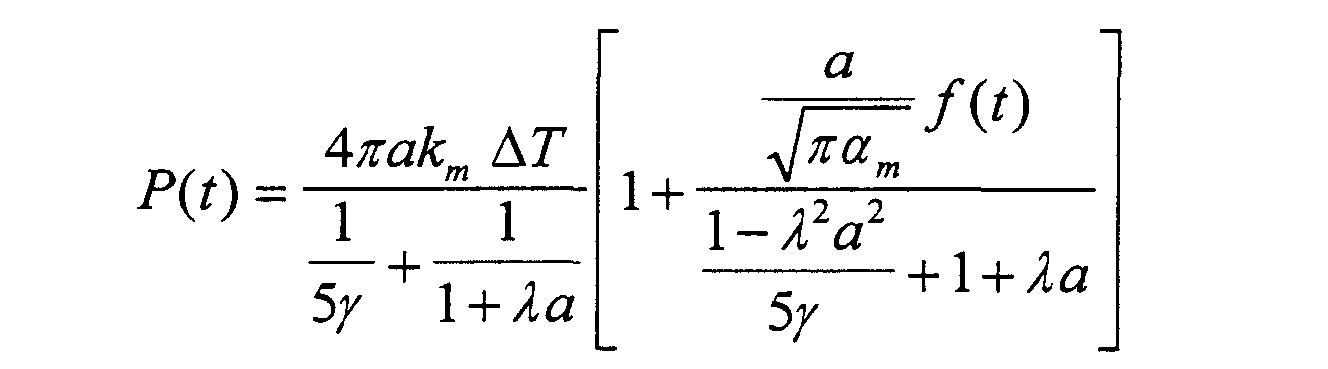
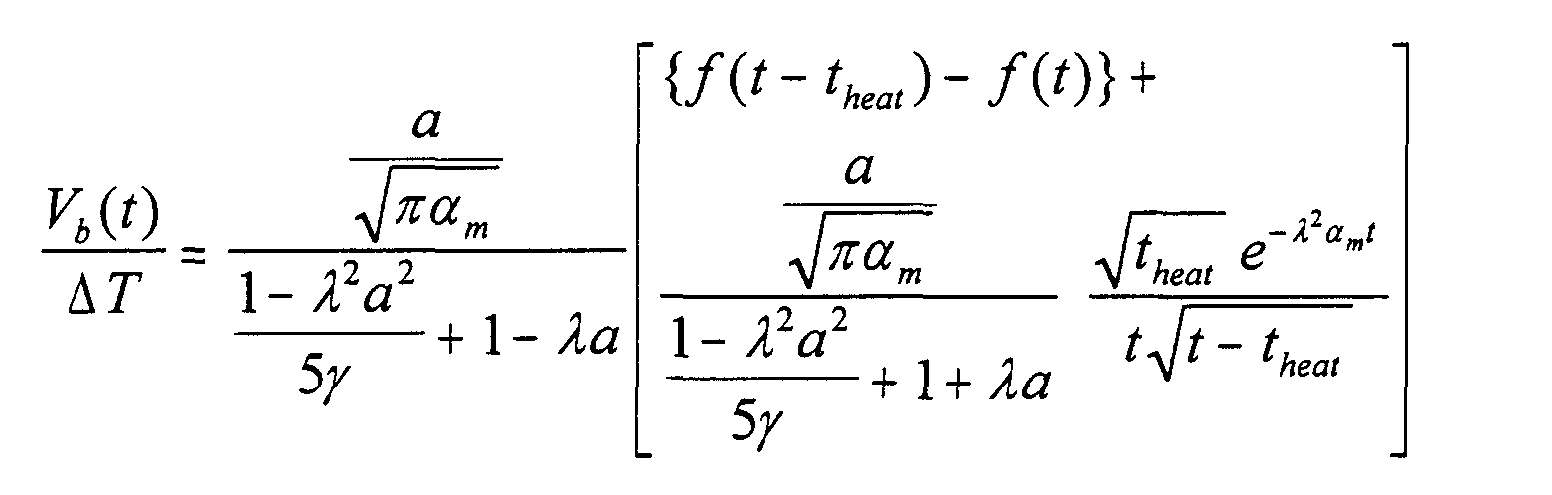
- Verfahren nach Anspruch 2, 3 oder 11, bei dem die in dem genannten Medium erzeugte Temperaturänderung konstant ist und bei dem ferner die Perfusion gemäß der folgenden Gleichung für eine Zeitperiode errechnet wird, die auf die Deaktivierung des Temperaturänderungsmittels folgt:wobei Vb, ΔT, γ, λ, a, αm, t, theat und f(t) dieselben Bedeutungen haben wie in den Ansprüchen 8 und 9.
- Verfahren nach Anspruch 2, 3 oder 11, bei dem die Temperaturänderung in dem genannten Medium durch Aktivieren einer Energiequelle erzeugt wird, um eine Änderung der Energie zu erzeugen, die konstant ist, und wobei ferner die Wärmeleitfähigkeit und - diffusivität gemäß der folgenden Gleichung errechnet werden:wobei Vb, P0, km, γ, λ, a, αm und f(t) dieselben Bedeutungen haben wie in den Ansprüchen 8 und 9.

- Verfahren nach Anspruch 2, 3 oder 11, bei dem die Temperaturänderung in dem genannten Medium durch Aktivieren einer Energiequelle erzeugt wird, um eine Energieänderung zu erzeugen, die konstant ist, und wobei ferner die Perfusion gemäß der folgenden Gleichung errechnet wird:
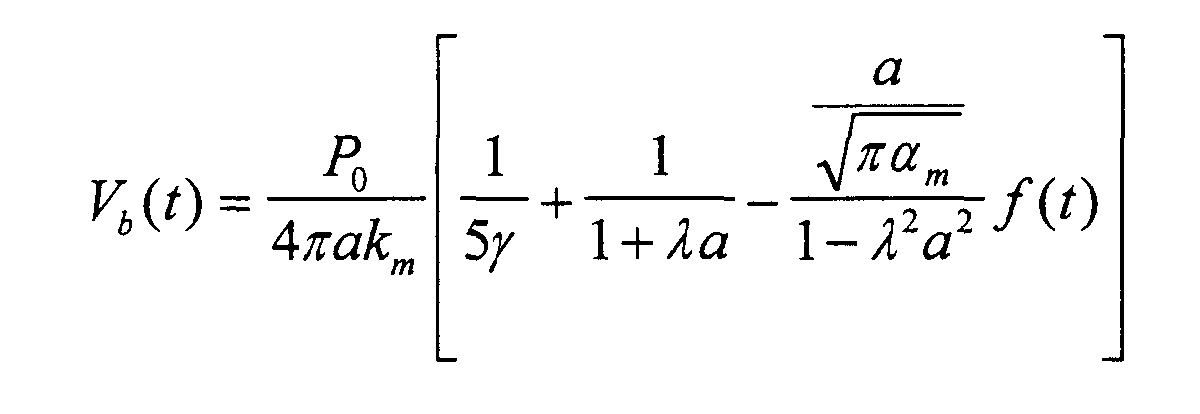
- Verfahren nach Anspruch 2, 3 oder 11, wobei die Temperaturänderung in dem genannten Medium durch Aktivieren einer Energiequelle erzeugt wird, um eine Energieänderung zu erzeugen, die konstant ist, und wobei ferner die Perfusion gemäß der folgenden Gleichung für eine Zeitperiode errechnet wird, die auf die Deaktivierung der Energiequelle folgt:wobei Vb, P0, km, γ, λ, a, αm, theat und f(t) dieselben Bedeutungen haben wie in den Ansprüchen 8 und 9.

- Verfahren nach Anspruch 1, bei dem die erste Zeitperiode dann auftritt, wenn die Auswirkungen von Fluiddurchfluss relativ gering sind, und wobei der Schritt des Berechnens der intrinsischen Wärmeleitfähigkeit und/oder -diffusivität die folgenden Schritte umfasst:Errechnen einer Mehrzahl von Wärmeleitfähigkeits- und/oder Wärmediffusivitätswerten während einer Mehrzahl von Zeitfenstern mit einem angenommenen Perfusionswert; undExtrapolieren der im vorherigen Schritt erhaltenen Werte auf den Zeitpunkt, zu dem die Erhitzung beginnt, um die nicht perfundierte, intrinsische Wärmeleitfähigkeit und/oder -diffusivität näherungsweise zu berechnen.
- Verfahren nach Anspruch 18, bei dem der angenommene Perfusionswert im Wesentlichen null ist.
Applications Claiming Priority (2)
| Application Number | Priority Date | Filing Date | Title |
|---|---|---|---|
| US948316 | 1986-12-31 | ||
| US06/948,316 US4852027A (en) | 1986-12-31 | 1986-12-31 | Method to quantify thermal dissipative mechanisms in biomaterials |
Publications (3)
| Publication Number | Publication Date |
|---|---|
| EP0273768A2 EP0273768A2 (de) | 1988-07-06 |
| EP0273768A3 EP0273768A3 (de) | 1990-03-28 |
| EP0273768B1 true EP0273768B1 (de) | 2002-04-17 |
Family
ID=25487644
Family Applications (1)
| Application Number | Title | Priority Date | Filing Date |
|---|---|---|---|
| EP87311516A Expired - Lifetime EP0273768B1 (de) | 1986-12-31 | 1987-12-30 | Verfahren zur Quantifizierung thermisch dissipativer Mechanismen in biologischen Stoffen |
Country Status (4)
| Country | Link |
|---|---|
| US (1) | US4852027A (de) |
| EP (1) | EP0273768B1 (de) |
| CA (1) | CA1315568C (de) |
| DE (1) | DE3752350T2 (de) |
Families Citing this family (14)
| Publication number | Priority date | Publication date | Assignee | Title |
|---|---|---|---|---|
| US5258929A (en) * | 1988-01-18 | 1993-11-02 | Ishikawajima-Harima Heavy Industries Co., Ltd. | Method for measuring thermal conductivity |
| US5031125A (en) * | 1989-04-06 | 1991-07-09 | Rikagaku Kenkyusho | Apparatus for measuring electron temperature |
| DE4408836C1 (de) * | 1994-03-16 | 1995-05-04 | Felten & Guilleaume Energie | Sensor zur Messung des spezifischen Wärmewiderstandes |
| FI113405B (fi) * | 1994-11-02 | 2004-04-15 | Jarmo Juhani Enala | Reaaliaikainen mittausmenetelmä |
| US5654507A (en) * | 1996-07-03 | 1997-08-05 | Board Of Trustees Operating Michigan State University | Pulse width modulated constant temperature anemometer |
| US6757412B1 (en) | 1998-10-21 | 2004-06-29 | Computerzied Thermal Imaging, Inc. | System and method for helping to determine the condition of tissue |
| US6312391B1 (en) | 2000-02-16 | 2001-11-06 | Urologix, Inc. | Thermodynamic modeling of tissue treatment procedure |
| US6632183B2 (en) | 2001-02-12 | 2003-10-14 | Thermal Technologies, Inc. | Perfusion sensitive biopsy extractor |
| US6659640B2 (en) * | 2001-04-26 | 2003-12-09 | The United States Of America As Represented By The Secretary Of The Navy | Fiber optic temperature measurement system and method |
| US6488677B1 (en) | 2001-05-10 | 2002-12-03 | Thermal Technologies, Inc. | System for quantifying edema |
| WO2003086169A2 (en) * | 2002-04-05 | 2003-10-23 | Thermal Technologies, Inc. | System for assessing endothelial function |
| CA2523385C (en) * | 2002-04-05 | 2014-04-01 | Thermal Technologies, Inc. | System for quantifying blood flow in tissue with periodic updating of tissue baseline conditions |
| US9655684B2 (en) * | 2011-09-30 | 2017-05-23 | Konica Minolta Laboratory U.S.A., Inc. | Catheter guidance system |
| US10052064B2 (en) | 2013-04-04 | 2018-08-21 | Thermal Technologies, Inc. | Edema monitor |
Family Cites Families (5)
| Publication number | Priority date | Publication date | Assignee | Title |
|---|---|---|---|---|
| US30317A (en) * | 1860-10-09 | Improvement in galvanic plates for medical use | ||
| USRE30317E (en) | 1972-11-15 | 1980-07-01 | Hellige Gmbh | Method and apparatus for determining the perfusion efficiency factor of animal tissue |
| US4059982A (en) * | 1975-08-29 | 1977-11-29 | Massachusetts Institute Of Technology | Apparatus for the measurement of thermal properties of biomaterials |
| YU42759B (en) * | 1982-03-18 | 1988-12-31 | Ljubljana Avtomontaza | Heat power gauge |
| US4522512A (en) * | 1982-05-05 | 1985-06-11 | The United States Of America As Represented By The Secretary Of The Army | Thermal conductivity measurement method |
-
1986
- 1986-12-31 US US06/948,316 patent/US4852027A/en not_active Expired - Lifetime
-
1987
- 1987-12-30 DE DE3752350T patent/DE3752350T2/de not_active Expired - Fee Related
- 1987-12-30 CA CA000555602A patent/CA1315568C/en not_active Expired - Fee Related
- 1987-12-30 EP EP87311516A patent/EP0273768B1/de not_active Expired - Lifetime
Also Published As
| Publication number | Publication date |
|---|---|
| DE3752350T2 (de) | 2002-11-28 |
| DE3752350D1 (de) | 2002-05-23 |
| US4852027A (en) | 1989-07-25 |
| CA1315568C (en) | 1993-04-06 |
| EP0273768A3 (de) | 1990-03-28 |
| EP0273768A2 (de) | 1988-07-06 |
Similar Documents
| Publication | Publication Date | Title |
|---|---|---|
| Balasubramaniam et al. | Thermal conductivity and thermal diffusivity of biomaterials: A simultaneous measurement technique | |
| Liu et al. | Estimation of blood perfusion using phase shift in temperature response to sinusoidal heating at the skin surface | |
| Roemer et al. | Obtaining local SAR and blood perfusion data from temperature measurements: steady state and transient techniques compared | |
| Kundu | Exact analysis for propagation of heat in a biological tissue subject to different surface conditions for therapeutic applications | |
| Valvano et al. | The simultaneous measurement of thermal conductivity, thermal diffusivity, and perfusion in small volumes of tissue | |
| US4859078A (en) | Apparatus for the non-invasive measurement of thermal properties and perfusion rates of biomaterials | |
| Hoffmann et al. | Cryosurgery of normal and tumor tissue in the dorsal skin flap chamber: part I—thermal response | |
| Deng et al. | Analytical study on bioheat transfer problems with spatial or transient heating on skin surface or inside biological bodies | |
| Arkin et al. | Thermal pulse decay method for simultaneous measurement of local thermal conductivity and blood perfusion: a theoretical analysis | |
| Baish et al. | Heat transport mechanisms in vascular tissues: a model comparison | |
| Shomali et al. | Lagging heat models in thermodynamics and bioheat transfer: a critical review | |
| Zhang et al. | Numerical simulation for heat transfer in prostate cancer cryosurgery | |
| Valvano | Tissue thermal properties and perfusion | |
| US4852027A (en) | Method to quantify thermal dissipative mechanisms in biomaterials | |
| Kolios et al. | Experimental evaluation of two simple thermal models using transient temperature analysis | |
| US6488677B1 (en) | System for quantifying edema | |
| Shih et al. | The impact of thermal wave characteristics on thermal dose distribution during thermal therapy: a numerical study | |
| Valvano | Bioheat transfer | |
| De Vita et al. | Investigation of the heat sink effect during microwave ablation in hepatic tissue: Experimental and numerical analysis | |
| Haemmerich | Mathematical modeling of heat transfer in biological tissues (bioheat transfer) | |
| Valvano et al. | Analysis of the Weinbaum-Jiji model of blood flow in the Canine Kidney cortex for self-heated thermistors | |
| Clegg et al. | Reconstruction of experimental hyperthermia temperature distributions: application of state and parameter estimation | |
| Radai et al. | Evaluation of the impedance technique for cryosurgery in a theoretical model of the head | |
| Majchrzak et al. | Numerical analysis of biological tissue heating using the dual-phase lag equation with temperature-dependent parameters | |
| Yue et al. | Noninvasive method for simultaneously measuring the thermophysical properties and blood perfusion in cylindrically shaped living tissues |
Legal Events
| Date | Code | Title | Description |
|---|---|---|---|
| PUAI | Public reference made under article 153(3) epc to a published international application that has entered the european phase |
Free format text: ORIGINAL CODE: 0009012 |
|
| AK | Designated contracting states |
Kind code of ref document: A2 Designated state(s): DE FR GB |
|
| PUAL | Search report despatched |
Free format text: ORIGINAL CODE: 0009013 |
|
| AK | Designated contracting states |
Kind code of ref document: A3 Designated state(s): DE FR GB |
|
| 17P | Request for examination filed |
Effective date: 19900913 |
|
| 17Q | First examination report despatched |
Effective date: 19920109 |
|
| APAB | Appeal dossier modified |
Free format text: ORIGINAL CODE: EPIDOS NOAPE |
|
| APAB | Appeal dossier modified |
Free format text: ORIGINAL CODE: EPIDOS NOAPE |
|
| APAD | Appeal reference recorded |
Free format text: ORIGINAL CODE: EPIDOS REFNE |
|
| APCB | Communication from the board of appeal sent |
Free format text: ORIGINAL CODE: EPIDOS OBAPE |
|
| APCB | Communication from the board of appeal sent |
Free format text: ORIGINAL CODE: EPIDOS OBAPE |
|
| APCB | Communication from the board of appeal sent |
Free format text: ORIGINAL CODE: EPIDOS OBAPE |
|
| APAB | Appeal dossier modified |
Free format text: ORIGINAL CODE: EPIDOS NOAPE |
|
| GRAG | Despatch of communication of intention to grant |
Free format text: ORIGINAL CODE: EPIDOS AGRA |
|
| GRAH | Despatch of communication of intention to grant a patent |
Free format text: ORIGINAL CODE: EPIDOS IGRA |
|
| GRAH | Despatch of communication of intention to grant a patent |
Free format text: ORIGINAL CODE: EPIDOS IGRA |
|
| REG | Reference to a national code |
Ref country code: GB Ref legal event code: IF02 |
|
| GRAA | (expected) grant |
Free format text: ORIGINAL CODE: 0009210 |
|
| AK | Designated contracting states |
Kind code of ref document: B1 Designated state(s): DE FR GB |
|
| REF | Corresponds to: |
Ref document number: 3752350 Country of ref document: DE Date of ref document: 20020523 |
|
| ET | Fr: translation filed | ||
| PLBE | No opposition filed within time limit |
Free format text: ORIGINAL CODE: 0009261 |
|
| STAA | Information on the status of an ep patent application or granted ep patent |
Free format text: STATUS: NO OPPOSITION FILED WITHIN TIME LIMIT |
|
| 26N | No opposition filed |
Effective date: 20030120 |
|
| PGFP | Annual fee paid to national office [announced via postgrant information from national office to epo] |
Ref country code: GB Payment date: 20050616 Year of fee payment: 18 |
|
| PGFP | Annual fee paid to national office [announced via postgrant information from national office to epo] |
Ref country code: FR Payment date: 20050628 Year of fee payment: 18 |
|
| PGFP | Annual fee paid to national office [announced via postgrant information from national office to epo] |
Ref country code: DE Payment date: 20050630 Year of fee payment: 18 |
|
| APAH | Appeal reference modified |
Free format text: ORIGINAL CODE: EPIDOSCREFNO |
|
| PG25 | Lapsed in a contracting state [announced via postgrant information from national office to epo] |
Ref country code: GB Free format text: LAPSE BECAUSE OF NON-PAYMENT OF DUE FEES Effective date: 20051230 |
|
| PG25 | Lapsed in a contracting state [announced via postgrant information from national office to epo] |
Ref country code: DE Free format text: LAPSE BECAUSE OF NON-PAYMENT OF DUE FEES Effective date: 20060701 |
|
| GBPC | Gb: european patent ceased through non-payment of renewal fee |
Effective date: 20051230 |
|
| PG25 | Lapsed in a contracting state [announced via postgrant information from national office to epo] |
Ref country code: FR Free format text: LAPSE BECAUSE OF NON-PAYMENT OF DUE FEES Effective date: 20060831 |
|
| REG | Reference to a national code |
Ref country code: FR Ref legal event code: ST Effective date: 20060831 |