EP0274499B1 - Speiseröhren-sonde mit mess- oder stimulationselektroden - Google Patents
Speiseröhren-sonde mit mess- oder stimulationselektroden Download PDFInfo
- Publication number
- EP0274499B1 EP0274499B1 EP87904406A EP87904406A EP0274499B1 EP 0274499 B1 EP0274499 B1 EP 0274499B1 EP 87904406 A EP87904406 A EP 87904406A EP 87904406 A EP87904406 A EP 87904406A EP 0274499 B1 EP0274499 B1 EP 0274499B1
- Authority
- EP
- European Patent Office
- Prior art keywords
- electrodes
- electrode
- retaining medium
- dipole probe
- probe
- Prior art date
- Legal status (The legal status is an assumption and is not a legal conclusion. Google has not performed a legal analysis and makes no representation as to the accuracy of the status listed.)
- Expired - Lifetime
Links
- 239000000523 sample Substances 0.000 title claims abstract description 45
- 230000004936 stimulating effect Effects 0.000 title description 2
- 230000037406 food intake Effects 0.000 claims abstract description 13
- 108010010803 Gelatin Proteins 0.000 claims abstract description 6
- 229920000159 gelatin Polymers 0.000 claims abstract description 6
- 239000008273 gelatin Substances 0.000 claims abstract description 6
- 235000019322 gelatine Nutrition 0.000 claims abstract description 6
- 235000011852 gelatine desserts Nutrition 0.000 claims abstract description 6
- 239000000560 biocompatible material Substances 0.000 claims abstract description 5
- 230000000638 stimulation Effects 0.000 claims description 8
- 239000002775 capsule Substances 0.000 claims description 5
- 230000000747 cardiac effect Effects 0.000 claims description 5
- 239000002195 soluble material Substances 0.000 claims description 4
- 239000011248 coating agent Substances 0.000 claims description 3
- 238000000576 coating method Methods 0.000 claims description 3
- BASFCYQUMIYNBI-UHFFFAOYSA-N platinum Chemical compound [Pt] BASFCYQUMIYNBI-UHFFFAOYSA-N 0.000 claims description 2
- 239000010970 precious metal Substances 0.000 claims description 2
- 239000007779 soft material Substances 0.000 claims 1
- 230000000694 effects Effects 0.000 abstract description 6
- 210000002784 stomach Anatomy 0.000 abstract description 5
- 238000012544 monitoring process Methods 0.000 description 4
- 230000001746 atrial effect Effects 0.000 description 3
- 230000000661 pacemaking effect Effects 0.000 description 2
- 230000002861 ventricular Effects 0.000 description 2
- 208000019505 Deglutition disease Diseases 0.000 description 1
- 206010029458 Nodal arrhythmia Diseases 0.000 description 1
- 208000008058 Reciprocating Tachycardia Diseases 0.000 description 1
- 206010049447 Tachyarrhythmia Diseases 0.000 description 1
- 208000001871 Tachycardia Diseases 0.000 description 1
- 239000004809 Teflon Substances 0.000 description 1
- 229920006362 Teflon® Polymers 0.000 description 1
- 230000004913 activation Effects 0.000 description 1
- 239000000853 adhesive Substances 0.000 description 1
- 230000001070 adhesive effect Effects 0.000 description 1
- 206010003119 arrhythmia Diseases 0.000 description 1
- 230000006793 arrhythmia Effects 0.000 description 1
- 230000002763 arrhythmic effect Effects 0.000 description 1
- 230000005540 biological transmission Effects 0.000 description 1
- 230000001419 dependent effect Effects 0.000 description 1
- 230000001066 destructive effect Effects 0.000 description 1
- 238000003745 diagnosis Methods 0.000 description 1
- 201000010099 disease Diseases 0.000 description 1
- 208000037265 diseases, disorders, signs and symptoms Diseases 0.000 description 1
- 230000001667 episodic effect Effects 0.000 description 1
- 208000019622 heart disease Diseases 0.000 description 1
- 230000001660 hyperkinetic effect Effects 0.000 description 1
- 230000006698 induction Effects 0.000 description 1
- 210000005246 left atrium Anatomy 0.000 description 1
- 239000000463 material Substances 0.000 description 1
- 238000000034 method Methods 0.000 description 1
- 210000004400 mucous membrane Anatomy 0.000 description 1
- 230000003387 muscular Effects 0.000 description 1
- 230000001314 paroxysmal effect Effects 0.000 description 1
- 239000006187 pill Substances 0.000 description 1
- 238000009877 rendering Methods 0.000 description 1
- 230000029058 respiratory gaseous exchange Effects 0.000 description 1
- 229920000260 silastic Polymers 0.000 description 1
- 239000007787 solid Substances 0.000 description 1
- 230000009747 swallowing Effects 0.000 description 1
- 230000002123 temporal effect Effects 0.000 description 1
- 238000003466 welding Methods 0.000 description 1
Images
Classifications
-
- A—HUMAN NECESSITIES
- A61—MEDICAL OR VETERINARY SCIENCE; HYGIENE
- A61B—DIAGNOSIS; SURGERY; IDENTIFICATION
- A61B5/00—Measuring for diagnostic purposes; Identification of persons
- A61B5/07—Endoradiosondes
- A61B5/073—Intestinal transmitters
-
- A—HUMAN NECESSITIES
- A61—MEDICAL OR VETERINARY SCIENCE; HYGIENE
- A61B—DIAGNOSIS; SURGERY; IDENTIFICATION
- A61B5/00—Measuring for diagnostic purposes; Identification of persons
- A61B5/24—Detecting, measuring or recording bioelectric or biomagnetic signals of the body or parts thereof
- A61B5/25—Bioelectric electrodes therefor
- A61B5/279—Bioelectric electrodes therefor specially adapted for particular uses
- A61B5/28—Bioelectric electrodes therefor specially adapted for particular uses for electrocardiography [ECG]
- A61B5/283—Invasive
- A61B5/285—Endotracheal, oesophageal or gastric probes
-
- A—HUMAN NECESSITIES
- A61—MEDICAL OR VETERINARY SCIENCE; HYGIENE
- A61B—DIAGNOSIS; SURGERY; IDENTIFICATION
- A61B5/00—Measuring for diagnostic purposes; Identification of persons
- A61B5/42—Detecting, measuring or recording for evaluating the gastrointestinal, the endocrine or the exocrine systems
- A61B5/4222—Evaluating particular parts, e.g. particular organs
- A61B5/4233—Evaluating particular parts, e.g. particular organs oesophagus
-
- A—HUMAN NECESSITIES
- A61—MEDICAL OR VETERINARY SCIENCE; HYGIENE
- A61B—DIAGNOSIS; SURGERY; IDENTIFICATION
- A61B5/00—Measuring for diagnostic purposes; Identification of persons
- A61B5/68—Arrangements of detecting, measuring or recording means, e.g. sensors, in relation to patient
- A61B5/6846—Arrangements of detecting, measuring or recording means, e.g. sensors, in relation to patient specially adapted to be brought in contact with an internal body part, i.e. invasive
- A61B5/6847—Arrangements of detecting, measuring or recording means, e.g. sensors, in relation to patient specially adapted to be brought in contact with an internal body part, i.e. invasive mounted on an invasive device
- A61B5/6852—Catheters
-
- A—HUMAN NECESSITIES
- A61—MEDICAL OR VETERINARY SCIENCE; HYGIENE
- A61N—ELECTROTHERAPY; MAGNETOTHERAPY; RADIATION THERAPY; ULTRASOUND THERAPY
- A61N1/00—Electrotherapy; Circuits therefor
- A61N1/02—Details
- A61N1/04—Electrodes
- A61N1/05—Electrodes for implantation or insertion into the body, e.g. heart electrode
- A61N1/0517—Esophageal electrodes
Definitions
- the invention relates to a dipole probe designed for transoesophageal recording and/or stimulation of the heart, that can be inserted through the mouth of the patient.
- the facility of effecting a recording by the transoesophageal route during dynamic monitoring (Holter) for continuous periods of up to 24 hours can prove indispensable for a correct diagnosis.
- the method in question is not invasive, and can be employed on the great number of patients without causing undue discomfort.
- the probes in current use consist in two electrodes mechanically interconnected by means of a retaining medium constituting the body of the probe; the electrical connection is effected by way of two wires issuing from the probe, likewise axially, and passing through the patient's mouth. Damage or discomfort that could arise during the act of swallowing is avoided by enveloping the probe in a soluble capsule which, on arrival in or near the stomach, duly dissolves and frees the electrodes. Certain drawbacks remain nonetheless, amongst which are the size and shape of the capsule, often such as to make swallowing difficult for some patients and almost impossible for others.
- a further drawback occurs when the capsule fails to arrive fully in the stomach, in which instance some considerable time can lapse before it dissolves in the oesophagus, and a lengthy wait is necessary before the electrophysiological tests can begin.
- the object of the invention is that of overcoming the drawbacks mentioned above.
- a first advantage of the probe disclosed consists essentially in the fact that it is easily swallowed and withdrawn, as the electrodes have rounded outer surfaces, devoid of projecting edges, corners etc., and exhibit compact dimensions.
- Another advantage of the probe disclosed consists in a complete absence of discomfort, which is known to be obtainable in electrodes of the type embodied without an external coating of gastrically soluble material.
- a further advantage of the invention is that of its greater effectiveness, achieved by adoption of a rounded shape that ensures optimum contact with the oesophagus walls.
- Yet another advantage of the invention is the low stimulation threshold obtained, notwithstanding the longitudinal dimensions of the packaged probe are markedly compact. This is achieved by ensuring that the two electrodes are held close together during ingestion by no other constraint than the soluble retaining medium; the only additional connection envisaged is a spring, which in any event expands once the probe has been swallowed and the medium dissolved.
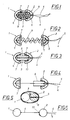
- the orally ingested dipole electrode probe for transoesophageal cardiac recording and/or stimulation consists substantially in two electrodes 1 and 2 connected one to the other by a retaining medium, denoted 3.
- a retaining medium denoted 3.
- dipole is taken to signify two electric poles, even though the number of single elements making up the electrodes may be more than two, according to the recording and/or stimulation requirements encountered. Reference is thus made to two electrodes throughout the specification, in the interests of simplicity.
- One of the two electrodes 1 or 2, for instance that denoted 2, as in the drawings, is provided with an axial bore 8 affording passage to two signal leads 4 and 5 that connect with the respective electrodes 1 and 2, the lead denoted 4 also passing through the retaining medium 3 in order to reach the relative electrode 1.
- the electrodes 1 and 2 are embodied with a rounded outer surfaces in order that no sharp corners or points will be presented.
- the external profile of the electrodes 1 and 2 might be spherical (as in figs 5 and 6) or elliptical (as in figs 1...4); other profiles could equally well be adopted, e.g. lenticular.
- the electrodes 1 and 2 are dished, the inside of each one affording a circumferential seat 7 in which to anchor the retaining medium 3.
- the retaining medium is fashioned in a gastrically soluble gelatin, and proportioned with a maximum transverse dimension smaller than the corresponding dimension exhibited by each electrode 1 and 2.
- the gelatin retaining medium is prevented from filling the space encompassed by the electrodes 1 and 2, to no useful purpose, by association of a further component with the internal surface 6 of at least one electrode, and more precisely, a tubular element 9 fashioned in biocompatible material such as Teflon, Silastic, Derlin or the like, which would be welded or glued in position.
- the tubular element 9 takes the form of a tightly compressed coil spring which is held in its bunched position by the retaining medium 3 until ingestion.
- Each end of the spring 9 is anchored to the relative electrode 1 and 2 by welding, or using an adhesive or other similar expedient.
- the spring 9 will hasten break-up of the retaining medium 3; the result is that the dipole probe can reach the oesophagus or the stomach and be rendered operational (see fig 2) in a much shorter time than is the case with conventional embodiments, where one has to wait for a complete break-up of the soluble gelatin to come about without any auxiliary impetus being applied.
- the spring 9 will be fashioned in a biocompatible material such as those aforementioned.
- the tubular element 9 is a simple tube fashioned in a material that is biocompatible, and soft.
- the tubular element 9 is anchored to one only of the electrodes 1 or 2, say, the electrode 2 through which the signal leads 4 and 5 are routed; following ingestion, in fact, this electrode will be positioned uppermost, and the unattached end of the tubular element 9 will become the trailing end when the probe is withdrawn following the test.
- the signal lead 4 connected to the electrode 1 without the bore is provided with a stop 10 consisting, quite simply, in a knot tied in the lead 4 itself at a point either between the two electrodes 1 and 2 or externally of the probe.
- a stop 10 consisting, quite simply, in a knot tied in the lead 4 itself at a point either between the two electrodes 1 and 2 or externally of the probe.
- the length of the extended spring 9, in the first embodiment, or the distance separating the farthest electrode 1 and the knot 10 in the second, will be dependent upon the spacing of the electrodes 1 and 2 required in operation.
- the electrodes 1 and 2 are embodied as two balls, the one entirely solid, the other provided with an axial bore 8 affording passage to the two signal leads 4 and 5.
- the electrodes are held together for the purposes of ingestion by an enveloping retaining medium 3, namely a gastrically soluble capsule.
- break-up of the retaining medium 3 is hastened by the weight of the farthest electrode 1, the lead 4 from which is provided with a stop 10 identical or similar to that illustrated in figs 3 and 4.
- the embodiment of the electrodes 1 and 2 especially small and totally devoid of any projecting edges or corners, facilitates withdrawal still further.
- the electrodes 1 and 2 might be faced externally with a layer of precious metal, or activated by coating with platinum black.
Landscapes
- Health & Medical Sciences (AREA)
- Life Sciences & Earth Sciences (AREA)
- Animal Behavior & Ethology (AREA)
- General Health & Medical Sciences (AREA)
- Biomedical Technology (AREA)
- Veterinary Medicine (AREA)
- Heart & Thoracic Surgery (AREA)
- Public Health (AREA)
- Engineering & Computer Science (AREA)
- Molecular Biology (AREA)
- Surgery (AREA)
- Physics & Mathematics (AREA)
- Biophysics (AREA)
- Pathology (AREA)
- Medical Informatics (AREA)
- Cardiology (AREA)
- Radiology & Medical Imaging (AREA)
- Nuclear Medicine, Radiotherapy & Molecular Imaging (AREA)
- Endocrinology (AREA)
- Gastroenterology & Hepatology (AREA)
- Physiology (AREA)
- Pulmonology (AREA)
- Electrotherapy Devices (AREA)
- Measurement And Recording Of Electrical Phenomena And Electrical Characteristics Of The Living Body (AREA)
- Finger-Pressure Massage (AREA)
Claims (13)
- Eine durch den Mund einführbare zweipolige Speiseröhrensonde mit Herzmess- oder -stimulationselektroden, enthaltend wenigstens zwei leitende Elemente, hergestellt aus einem bioverträglichen Material und Elektroden (1, 2) bildend, welche abgerundete äussere Oberflächen aufweisen, also vollkommen frei von scharfen Ecken und Kanten; ein Haltemittel (3), durch das die Elektroden mechanisch miteinander verbunden sind; und wenigstens ein Paar von an die Elektroden angeschlossenen Signalleitern (4, 5), die durch eine Zugangsbohrung (8) geführt werden,
dadurch gekennzeichnet, dass die genannte Bohrung (8) in wenigstens eine Elektrode eingearbeitet ist, und dass die Elektroden (1, 2) vor ihrem Einführen durch das Haltmittel (3), das aus einem gastrisch lösbaren Material hergestellt ist, dicht zusammengehalten werden. - Zweipolige Sonde nach Patentanspruch 1, dadurch gekennzeichnet, dass die Elektroden (1, 2) zwei in der Zahl sind und eine schalenartige Form aufweisen, und die einen internen umlaufenden Sitz (7) bieten, in welchem ein Haltemittel (3) aus gastrisch lösbarer Gelatine verankert wird, und dadurch, dass das lösbare Haltemittel ein rohrförmiges Element (9) umschliesst, das aus einem bioverträglichen Material hergestellt und mit der internen Oberfläche (6) von wenigstens einer der beiden Elektroden (1, 2) verbunden ist.
- Zweipolige Sonde nach Patentanspruch 2, dadurch gekennzeichnet, dass das Haltemittel (3) mit einem maximalen Aussendurchmesser ausgelegt ist, der geringer ist als der maximale Aussendurchmesser der Elektroden (1, 2).
- Zweipolige Sonde nach Patentanspruch 2, dadurch gekennzeichnet, dass die äussere Form der einzelnen Elektrode wenigstens zu einem Teil kugelförmig ist oder im wesentlichen ellipsen- oder linsenförmig.
- Zweipolige Sonde nach Patentanspruch 2, dadurch gekennzeichnet, dass das rohrförmige Element (9) mit jedem Ende an der internen Oberfläche (6) der beiden Elektroden (1, 2) befestigt ist und aus einer Schneckenfeder besteht, die rohrförmig zusammengedrückt gehalten wird, und deren einzelne Windungen in gegenseitigem Kontakt miteinander liegen, und zwar durch die Wirkung des Haltemittels (3), durch welches sie umschlossen wird.
- Zweipolige Sonde nach Patentanspruch 2, enthaltend ein rohrförmiges Element (9), hergestellt aus einem weichen Material und mit einem Ende an der internen Oberfläche (6) von nur einer Elektrode (1, 2) befestigt, dadurch gekennzeichnet, dass der Signalleiter (4), der an die Elektrode (1) angeschlossen wird, durch die nicht die Leiter (4, 5) geführt werden, mit einem Stopper (10) versehen ist, der zur Bestimmung des Abstandes dient, welchen die beiden Elektroden (1, 2) voneinander haben sollen, sobald sich das Haltemittel (3) aufgelöst hat oder wenigstens aufgebrochen ist und der Leiter (4) sich vollständig ausgedehnt hat.
- Zweipolige Sonde nach Patentanspruch 6, dadurch gekennzeichnet, dass das rohrförmige Element (9) mit einem Ende an der Elektrode (2) befestigt ist, durch welche die Signalleiter (4, 5) geführt werden.
- Zweipolige Sonde nach Patentanspruch 6, dadurch gekennzeichnet, dass das rohrförmige Element (9) mit einem Ende an der Elektrode (1) befestigt ist, durch welche nicht die Signalleiter (4, 5) geführt werden.
- Zweipolige Sonde nach Patentanspruch 1, dadurch gekennzeichnet, dass die Elektroden (1, 2) ballförmig ausgebildet sind und von einem Haltemittel (3) umschlossen werden, das ala eine Kapsel aus gastrisch lösbarem Material ausgelegt ist, und dadurch, dass der an die Elektrode (1), durch die nicht die Leiter (4, 5) geführt werden, angeschlossene Leiter (4), mit einem Stopper (10) versehen ist, der dazu dient, den Abstand zu bestimmen, durch den die beiden Elektroden (1, 2) getrennt werden, wenn das Haltemittel (3) aufgelöst oder wenigstens aufgebrochen ist und der Leiter (4) selbst sich vollkommen gedehnt hat.
- Zeipolige Sonde nach Patentanspruch 6 oder 9, dadurch gekennzeichnet, dass der Stopper (10) aus einem Knoten in dem Signalleiter (4) besteht, der an die Elektrode (1) angeschlossen ist, durch die nicht die Leiter (4, 5) geführt werden, und zwar an einem bestimmten Punkt zwischen den Elektroden (1, 2).
- Zweipolige Sonde nach Patentanspruch 6 oder 9, dadurch gekennzeichnet, dass der Stopper (10) aus einem Knoten in dem Signalleiter (4) besteht, der an die Elektrode (1) angeschlossen ist, durch die nicht die Leiter (4, 5) geführt werden, und zwar an einem bestimmten Punkt, der nicht zwischen den beiden Elektroden (1, 2) liegt.
- Zweipolige Sonde nach Patentanspruch 1, dadurch gekennzeichnet, dass die äussere Oberfläche der Elektroden (1, 2) mit einer Schicht aus Edelmetall versehen oder aktiviert ist.
- Zweipolige Sonde nach Patentanspruch 1, dadurch gekennzeichnet, dass die äussere Oberfläche der Elektroden (1, 2) durch das Aufbringen einer Schicht aus Platinschwarz aktiviert ist.
Priority Applications (1)
| Application Number | Priority Date | Filing Date | Title |
|---|---|---|---|
| AT87904406T ATE77223T1 (de) | 1986-07-11 | 1987-07-03 | Speiseroehren-sonde mit mess- oder stimulationselektroden. |
Applications Claiming Priority (2)
| Application Number | Priority Date | Filing Date | Title |
|---|---|---|---|
| IT03462/86A IT1200173B (it) | 1986-07-11 | 1986-07-11 | Elettrodo a dipolo per la registrazione e/o la stimolazione cardiaca transesofagea con assunzione per via orale |
| IT346286 | 1986-07-11 |
Publications (2)
| Publication Number | Publication Date |
|---|---|
| EP0274499A1 EP0274499A1 (de) | 1988-07-20 |
| EP0274499B1 true EP0274499B1 (de) | 1992-06-17 |
Family
ID=11107825
Family Applications (1)
| Application Number | Title | Priority Date | Filing Date |
|---|---|---|---|
| EP87904406A Expired - Lifetime EP0274499B1 (de) | 1986-07-11 | 1987-07-03 | Speiseröhren-sonde mit mess- oder stimulationselektroden |
Country Status (5)
| Country | Link |
|---|---|
| EP (1) | EP0274499B1 (de) |
| AT (1) | ATE77223T1 (de) |
| DE (1) | DE3779895T2 (de) |
| IT (1) | IT1200173B (de) |
| WO (1) | WO1988000449A1 (de) |
Cited By (1)
| Publication number | Priority date | Publication date | Assignee | Title |
|---|---|---|---|---|
| DE102007036243A1 (de) * | 2007-08-02 | 2009-02-05 | Siemens Ag | Endoskopiesystem |
Families Citing this family (8)
| Publication number | Priority date | Publication date | Assignee | Title |
|---|---|---|---|---|
| RU2075980C1 (ru) * | 1996-01-18 | 1997-03-27 | Акционерное общество открытого типа "Завод "Компонент" | Электростимулятор желудочно-кишечного тракта |
| RU2089239C1 (ru) * | 1996-02-27 | 1997-09-10 | Владимир Николаевич Дирин | Биологический электростимулятор внутренних органов (варианты) |
| ES2501142T3 (es) | 2001-07-12 | 2014-10-01 | Given Imaging Ltd. | Dispositivo para examinar una cavidad interna corporal |
| US7585283B2 (en) | 2001-07-12 | 2009-09-08 | Given Imaging Ltd. | Device and method for examining a body lumen |
| JP5060721B2 (ja) * | 2004-11-12 | 2012-10-31 | ギブン イメージング リミテッド | 体内腔を検査する装置 |
| US7962214B2 (en) * | 2007-04-26 | 2011-06-14 | Cyberonics, Inc. | Non-surgical device and methods for trans-esophageal vagus nerve stimulation |
| EP2515759A4 (de) | 2009-12-23 | 2015-01-21 | Given Imaging Inc | Verfahren zur bewertung einer verstopfung mithilfe einer einnehmbaren kapsel |
| WO2013143600A1 (en) * | 2012-03-30 | 2013-10-03 | Ethicon Endo-Surgery, Inc. | Devices and methods for the treatment of metabolic disorders. |
Family Cites Families (5)
| Publication number | Priority date | Publication date | Assignee | Title |
|---|---|---|---|---|
| DE2043105A1 (de) * | 1970-08-31 | 1972-03-09 | Erbel F | Sonde zur elektromyographischen Untersuchung |
| US3933612A (en) * | 1971-06-30 | 1976-01-20 | Corning Glass Works | Glass electrode structure for radio capsule |
| FR2237648A1 (en) * | 1973-07-16 | 1975-02-14 | Zacouto Fred | Suppositories for introduction into digestive tract - contg. vibrators or medicaments |
| GB2039219B (en) * | 1978-03-22 | 1982-10-06 | Pawelec J | Device for study of the alimentary canal |
| DK238080A (da) * | 1980-06-03 | 1981-12-04 | P Pless | Spiseroers-stimulationssonde til elektrisk stimulation af hjertet |
-
1986
- 1986-07-11 IT IT03462/86A patent/IT1200173B/it active
-
1987
- 1987-07-03 EP EP87904406A patent/EP0274499B1/de not_active Expired - Lifetime
- 1987-07-03 DE DE8787904406T patent/DE3779895T2/de not_active Expired - Lifetime
- 1987-07-03 WO PCT/IT1987/000068 patent/WO1988000449A1/en not_active Ceased
- 1987-07-03 AT AT87904406T patent/ATE77223T1/de not_active IP Right Cessation
Cited By (2)
| Publication number | Priority date | Publication date | Assignee | Title |
|---|---|---|---|---|
| DE102007036243A1 (de) * | 2007-08-02 | 2009-02-05 | Siemens Ag | Endoskopiesystem |
| DE102007036243B4 (de) * | 2007-08-02 | 2016-04-07 | Siemens Aktiengesellschaft | Endoskopiesystem |
Also Published As
| Publication number | Publication date |
|---|---|
| DE3779895D1 (de) | 1992-07-23 |
| WO1988000449A1 (en) | 1988-01-28 |
| EP0274499A1 (de) | 1988-07-20 |
| IT1200173B (it) | 1989-01-05 |
| IT8603462A0 (it) | 1986-07-11 |
| ATE77223T1 (de) | 1992-07-15 |
| DE3779895T2 (de) | 1992-12-24 |
Similar Documents
| Publication | Publication Date | Title |
|---|---|---|
| US5261418A (en) | Cardiac lead with tensiometric element for providing signals corresponding to heart contractions | |
| US4481953A (en) | Endocardial lead having helically wound ribbon electrode | |
| US4444195A (en) | Cardiac lead having multiple ring electrodes | |
| US6980866B2 (en) | Apparatus for sensing cardiac contractile function | |
| US5271392A (en) | Method and apparatus for administering cardiac electrotherapy dependent on mechanical and electrical cardiac activity | |
| JP4267203B2 (ja) | 無外乱電子筋運動記録プローブ | |
| US4699147A (en) | Intraventricular multielectrode cardial mapping probe and method for using same | |
| JP4733686B2 (ja) | 埋込可能型装置における無線ecg | |
| US5571159A (en) | Temporary atrial defibrillation catheter and method | |
| JPS60249972A (ja) | 血管内用多重電極単一カテーテル | |
| JPS61164566A (ja) | ペースメーカー・リード線 | |
| EP0606688A2 (de) | Vorrichtung und Verfahren zur Befestigung von Herzleitungen | |
| US8958889B2 (en) | MRI compatible lead coil | |
| US20080183225A1 (en) | Orientation-independent implantable electrode arrays | |
| Ciccone et al. | A prospective randomized study of the clinical efficacy and safety of transvenous cardioversion for termination of ventricular tachycardia. | |
| WO1988000449A1 (en) | Oesophageal probe provided with measuring or stimulating electrodes | |
| WO2018213548A1 (en) | Antenna for implantable medical devices | |
| YAMADA | Body surface isopotential map: past, present and future | |
| Hombach et al. | The applicability of the signal averaging technique in clinical cardiology | |
| Fenici et al. | Biomagnetically localizable multipurpose catheter and method for MCG guided intracardiac electrophysiology, biopsy and ablation of cardiac arrhythmias | |
| JPH05317431A (ja) | 永続的な心臓刺激用の改良3極電気カテーテル | |
| Musselman et al. | Permanent pacemaker implantation with transvenous electrode placement in a dog with complete atrioventricular heart block, congestive heart failure and Stokes‐Adams syndrome | |
| US20080234591A1 (en) | Methods and apparatus for patient notification of physiologic events and device function | |
| US7957819B1 (en) | Disposable low profile transvenous electrode system for sequentially pacing the heart's right atrium and right ventricle (AV) | |
| Chung et al. | Transesophageal recording and pacing techniques for evaluation of patients with preexcitation |
Legal Events
| Date | Code | Title | Description |
|---|---|---|---|
| PUAI | Public reference made under article 153(3) epc to a published international application that has entered the european phase |
Free format text: ORIGINAL CODE: 0009012 |
|
| AK | Designated contracting states |
Kind code of ref document: A1 Designated state(s): AT DE FR GB SE |
|
| 17P | Request for examination filed |
Effective date: 19880701 |
|
| 17Q | First examination report despatched |
Effective date: 19910211 |
|
| RBV | Designated contracting states (corrected) |
Designated state(s): AT DE FR SE |
|
| RAP3 | Party data changed (applicant data changed or rights of an application transferred) |
Owner name: C.B. BIOELETTRONICA S.R.L. |
|
| GRAA | (expected) grant |
Free format text: ORIGINAL CODE: 0009210 |
|
| AK | Designated contracting states |
Kind code of ref document: B1 Designated state(s): AT DE FR SE |
|
| PG25 | Lapsed in a contracting state [announced via postgrant information from national office to epo] |
Ref country code: SE Effective date: 19920617 |
|
| REF | Corresponds to: |
Ref document number: 77223 Country of ref document: AT Date of ref document: 19920715 Kind code of ref document: T |
|
| PGFP | Annual fee paid to national office [announced via postgrant information from national office to epo] |
Ref country code: AT Payment date: 19920714 Year of fee payment: 6 |
|
| REF | Corresponds to: |
Ref document number: 3779895 Country of ref document: DE Date of ref document: 19920723 |
|
| ET | Fr: translation filed | ||
| PLBE | No opposition filed within time limit |
Free format text: ORIGINAL CODE: 0009261 |
|
| STAA | Information on the status of an ep patent application or granted ep patent |
Free format text: STATUS: NO OPPOSITION FILED WITHIN TIME LIMIT |
|
| 26N | No opposition filed | ||
| PG25 | Lapsed in a contracting state [announced via postgrant information from national office to epo] |
Ref country code: AT Effective date: 19930703 |
|
| PGFP | Annual fee paid to national office [announced via postgrant information from national office to epo] |
Ref country code: FR Payment date: 19950711 Year of fee payment: 9 |
|
| PG25 | Lapsed in a contracting state [announced via postgrant information from national office to epo] |
Ref country code: FR Effective date: 19970328 |
|
| REG | Reference to a national code |
Ref country code: FR Ref legal event code: ST |
|
| PGFP | Annual fee paid to national office [announced via postgrant information from national office to epo] |
Ref country code: DE Payment date: 19970718 Year of fee payment: 11 |
|
| PG25 | Lapsed in a contracting state [announced via postgrant information from national office to epo] |
Ref country code: DE Free format text: LAPSE BECAUSE OF NON-PAYMENT OF DUE FEES Effective date: 19990501 |