EP0277456A2 - Procédé de moulage de résines à haute température prédurcies - Google Patents
Procédé de moulage de résines à haute température prédurcies Download PDFInfo
- Publication number
- EP0277456A2 EP0277456A2 EP87630172A EP87630172A EP0277456A2 EP 0277456 A2 EP0277456 A2 EP 0277456A2 EP 87630172 A EP87630172 A EP 87630172A EP 87630172 A EP87630172 A EP 87630172A EP 0277456 A2 EP0277456 A2 EP 0277456A2
- Authority
- EP
- European Patent Office
- Prior art keywords
- molding
- medium
- high temperature
- pressure
- composite
- Prior art date
- Legal status (The legal status is an assumption and is not a legal conclusion. Google has not performed a legal analysis and makes no representation as to the accuracy of the status listed.)
- Granted
Links
Images
Classifications
-
- B—PERFORMING OPERATIONS; TRANSPORTING
- B29—WORKING OF PLASTICS; WORKING OF SUBSTANCES IN A PLASTIC STATE IN GENERAL
- B29B—PREPARATION OR PRETREATMENT OF THE MATERIAL TO BE SHAPED; MAKING GRANULES OR PREFORMS; RECOVERY OF PLASTICS OR OTHER CONSTITUENTS OF WASTE MATERIAL CONTAINING PLASTICS
- B29B15/00—Pretreatment of the material to be shaped, not covered by groups B29B7/00 - B29B13/00
- B29B15/08—Pretreatment of the material to be shaped, not covered by groups B29B7/00 - B29B13/00 of reinforcements or fillers
- B29B15/10—Coating or impregnating independently of the moulding or shaping step
- B29B15/12—Coating or impregnating independently of the moulding or shaping step of reinforcements of indefinite length
-
- B—PERFORMING OPERATIONS; TRANSPORTING
- B29—WORKING OF PLASTICS; WORKING OF SUBSTANCES IN A PLASTIC STATE IN GENERAL
- B29C—SHAPING OR JOINING OF PLASTICS; SHAPING OF MATERIAL IN A PLASTIC STATE, NOT OTHERWISE PROVIDED FOR; AFTER-TREATMENT OF THE SHAPED PRODUCTS, e.g. REPAIRING
- B29C70/00—Shaping composites, i.e. plastics material comprising reinforcements, fillers or preformed parts, e.g. inserts
- B29C70/04—Shaping composites, i.e. plastics material comprising reinforcements, fillers or preformed parts, e.g. inserts comprising reinforcements only, e.g. self-reinforcing plastics
- B29C70/28—Shaping operations therefor
- B29C70/40—Shaping or impregnating by compression not applied
- B29C70/42—Shaping or impregnating by compression not applied for producing articles of definite length, i.e. discrete articles
- B29C70/44—Shaping or impregnating by compression not applied for producing articles of definite length, i.e. discrete articles using isostatic pressure, e.g. pressure difference-moulding, vacuum bag-moulding, autoclave-moulding or expanding rubber-moulding
-
- B—PERFORMING OPERATIONS; TRANSPORTING
- B29—WORKING OF PLASTICS; WORKING OF SUBSTANCES IN A PLASTIC STATE IN GENERAL
- B29C—SHAPING OR JOINING OF PLASTICS; SHAPING OF MATERIAL IN A PLASTIC STATE, NOT OTHERWISE PROVIDED FOR; AFTER-TREATMENT OF THE SHAPED PRODUCTS, e.g. REPAIRING
- B29C43/00—Compression moulding, i.e. applying external pressure to flow the moulding material; Apparatus therefor
- B29C43/02—Compression moulding, i.e. applying external pressure to flow the moulding material; Apparatus therefor of articles of definite length, i.e. discrete articles
- B29C43/10—Isostatic pressing, i.e. using non-rigid pressure-exerting members against rigid parts or dies
-
- C—CHEMISTRY; METALLURGY
- C08—ORGANIC MACROMOLECULAR COMPOUNDS; THEIR PREPARATION OR CHEMICAL WORKING-UP; COMPOSITIONS BASED THEREON
- C08J—WORKING-UP; GENERAL PROCESSES OF COMPOUNDING; AFTER-TREATMENT NOT COVERED BY SUBCLASSES C08B, C08C, C08F, C08G or C08H
- C08J5/00—Manufacture of articles or shaped materials containing macromolecular substances
- C08J5/24—Impregnating materials with prepolymers which can be polymerised in situ, e.g. manufacture of prepregs
-
- B—PERFORMING OPERATIONS; TRANSPORTING
- B29—WORKING OF PLASTICS; WORKING OF SUBSTANCES IN A PLASTIC STATE IN GENERAL
- B29C—SHAPING OR JOINING OF PLASTICS; SHAPING OF MATERIAL IN A PLASTIC STATE, NOT OTHERWISE PROVIDED FOR; AFTER-TREATMENT OF THE SHAPED PRODUCTS, e.g. REPAIRING
- B29C43/00—Compression moulding, i.e. applying external pressure to flow the moulding material; Apparatus therefor
- B29C43/02—Compression moulding, i.e. applying external pressure to flow the moulding material; Apparatus therefor of articles of definite length, i.e. discrete articles
- B29C43/10—Isostatic pressing, i.e. using non-rigid pressure-exerting members against rigid parts or dies
- B29C43/12—Isostatic pressing, i.e. using non-rigid pressure-exerting members against rigid parts or dies using bags surrounding the moulding material or using membranes contacting the moulding material
-
- B—PERFORMING OPERATIONS; TRANSPORTING
- B29—WORKING OF PLASTICS; WORKING OF SUBSTANCES IN A PLASTIC STATE IN GENERAL
- B29C—SHAPING OR JOINING OF PLASTICS; SHAPING OF MATERIAL IN A PLASTIC STATE, NOT OTHERWISE PROVIDED FOR; AFTER-TREATMENT OF THE SHAPED PRODUCTS, e.g. REPAIRING
- B29C43/00—Compression moulding, i.e. applying external pressure to flow the moulding material; Apparatus therefor
- B29C43/32—Component parts, details or accessories; Auxiliary operations
- B29C43/52—Heating or cooling
-
- B—PERFORMING OPERATIONS; TRANSPORTING
- B29—WORKING OF PLASTICS; WORKING OF SUBSTANCES IN A PLASTIC STATE IN GENERAL
- B29K—INDEXING SCHEME ASSOCIATED WITH SUBCLASSES B29B, B29C OR B29D, RELATING TO MOULDING MATERIALS OR TO MATERIALS FOR MOULDS, REINFORCEMENTS, FILLERS OR PREFORMED PARTS, e.g. INSERTS
- B29K2079/00—Use of polymers having nitrogen, with or without oxygen or carbon only, in the main chain, not provided for in groups B29K2061/00 - B29K2077/00, as moulding material
Definitions
- the field of art to which this invention pertains is methods for molding composites.
- thermoplastic resins soften and even flow with the application of sufficient heat.
- fiber damage can be reduced by the addition of heat sufficient to cause the resin to flow.
- thermosetting resins generally do not flow with the application of heat pressure. This characteristic greatly reduces the feasibility of making fiber reinforced composites with precured resins since the fibers can be damaged with the application of pressure.
- Fiber damage is also a function of the molding process. For example, fiber damage can occur when articles are molded in matched metal dies (compression molding). Material trapped between the mold forces is often unable to flow out easily, resulting in crushed fibers. Careful placement of the molding compound in the mold can help the distribution, but is impractical for complicated shapes. Only a slight misplacement of material can cause a defective area containing crushed fibers or resin starvation (excessive squeeze-out).
- This invention is directed to a method for molding composite prepregs using high temperature substantially cured thermosetting resins that reduces fiber damage.
- Fiber plies are impregnated with solutions of high temperature substantially cured thermosetting resins and the plies are stacked to form a prepreg.
- a solid flowable particulate silicone rubber is caused to apply pressure to the prepreg to form a composite.
- This invention makes a significant advance in the field of molding high temperature resin composites by providing methods of molding that reduce fiber damage, shorten molding time and result in denser parts.
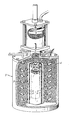
- the Figure illustrates a perspective view cutaway of an apparatus for performing the molding method of the present invention by controlling the temperature and pressure of the pressurizing polymer medium.
- thermosetting resins it is preferred to use high temperature thermosetting resins in this invention because they can withstand high temperature use without melting and they tend to coalesce under high temperatures and pressures.
- thermoplastic resins are not as applicable because high temperature use can cause them to melt and flow.
- high temperature thermosetting resins is meant those thermosetting resins that have a Tg of greater than about 232°C (450°F).
- those thermoplastic resins that behave as a thermosetting resin i.e., in the classical sense
- Avimid-N "thermoplastic" polyimide DuPont de Nemours, Wilmington, Delaware
- the resins comprise aromatic nitrogen containing polymers, such as polyimides (PI), polybenzimidazoles (PBI), polyphenylenequinoxalines (PPQ) and bismaleimides (BMI).
- PI polyimides
- PBI polybenzimidazoles
- PPQ polyphenylenequinoxalines
- BMI bismaleimides
- Exemplary resin include PMR-15TM polyimide (NASA Lewis), LarcTM 160 polyimide (NASA Langley) and CelazoleTM polybenzimidazole (Celanese, Charlotte, North Carolina).
- the resins are substantially cured.
- the volatile content is preferably less than about 5% because the resins (e.g., PMR-15) may not coalesce as effectively, if they are completely cured.
- a greater volatile content can result in blisters and bubbles in the finished composite.
- substantially cured means that the polymer will not melt or flow although it may soften when exposed to elevated temperatures.
- substantially cured also refers to the fact that the polymers are nearly insoluble in common solvents such as acetone, methylethyl ketone, isopropyl alcohol and lower alcohols. However, the polymers are soluble in solvents such as dimethylacetamide (DMAC), dimethyl sulfoxide (DMSO), normal methyl pyrrolidone (NMP) or concentrated sulfuric acid.
- DMAC dimethylacetamide
- DMSO dimethyl sulfoxide
- NMP normal methyl pyrrolidone
- any fiber may be used in the practice of this invention.
- the fiber has high strength, high modulus and high temperature properties because the high temperature resins are used in advanced composites.
- the fiber comprises graphite, quartz, ceramic or glass.
- Exemplary fibers are Thornel T-300TM fiber, available from Amoco Performance Products, Inc. (Ridgefield, CT) and NextelTM fiber, available from 3M (Minneapolis, MN).
- any solvent may be used as a carrier to impregnate the resin into the fiber layup that can dissolve the substantially cured thermosetting resins described above.
- the more common solvent such as the lower alcohols are not capable of dissolving the above-described high temperature thermosetting resins.
- the solvent should not damage the high temperature thermosetting resin to be dissolved or the fibers to be impregnated.
- An exemplary list of functional solvents is dimethylacetamide, dimethyl sulfoxide, normal methyl pyrrolidone.
- the particular medium useful in the present invention is a critical component to the apparatus. Its responsiveness to temperature and pressure coupled with its flowability and solid nature enable it to be useful with the present invention. These properties cause the medium to produce an advantageous, substantially uniform, controllable pressure on the surface of the article precursor. And while this material is described in terms of a polymeric medium, other materials (such as a polymer molten metal mixture) which would have all the characteristics and produce similar results could be substituted. Although a single type of pressurizing medium can be used, two different types of media are preferentially used in a dual media system.
- the lower cost low temperature medium By utilizing two types of medium (a high temperature medium close to the precured resin impregnated fabric composite and a low temperature medium outside of the high temperature medium) the lower cost low temperature medium can be utilized. If the low temperature medium were placed near the precured resin impregnated composite the higher localized temperatures would effectively degrade the polymer medium. However, the higher temperature medium will function as a pressurizing medium throughout the high temperature steps.
- a dual medium system is disclosed in commonly assigned copending U.S. application Serial No. 907,947 filed September 10, 1986 entitled “Method for Molding Using a Dual Solid Flowable Polymer System", the disclosure of which is hereby incorporated by reference.
- the high temperature medium is disclosed in commonly assigned copending application serial No.
- the polymer is an unfilled silicone rubber particulate of -4 +30 U.S. mesh sieve size (4.7-0.42 millimeters (mm)), which when pressurized, is sufficiently self-complaint to coalesce as an essentially void-free medium at a pressure of the order of 69 kPa (10 psi).
- a silicone rubber is used as the pressurizing polymer.
- the rubber is an improvement on the tupe which is described in U.S. Pat. No. 3,843,601 to Bruner. See also U.S. Pat. No. 4,011,929 to Jeram et al. The disclosures of both patents are hereby incorporated by reference.
- the preferred materials are dimethylsilicones that have vinyl groups. They may be produced by conventional commercial procedures, including production from polysiloxanes using various vulcanizing techniques. A preferred material which has been used thus far is the experimental unfilled silicone rubber material designated as X5-8017, formerly No. 6360 81 (more simply 8017 hereinafter), by the Dow Corning Corporation (Midland, Michigan).
- silicone rubbers While the preferred materials are silicone rubbers, other polymer materials having the desired characteristics can be used. Most silicone rubbers are temperature limited for long term use, e.g., typically up to about 288°C (550°F). Fillers and other adulterants (such as the metal particulates described below) can be included with and within the medium, provided the essential behavior properties are maintained.
- the preferred 8017 silicone rubber is characterized by low strength and high friability.
- “high friability” is meant there is such low strength that moderate size solids tend to disintegrate into smaller particulates when subjected to modest mechanical forces, even rubbing between the fingers.
- the 8017 material has a Shore A hardness of less than 1 (Shore 00 hardness of 50-55) and compressive strength of the order of 70 kPa when measured on a 2.5. centimeters (cm) square by 1.27 cm thick specimen, and upon a compression deformation of about 40%, it shears into smaller particles. This behavior is contrasted with that of more conventional rubbers which have higher strength, greater resistance to deformation and greater elongation to failure.
- the polymer has a Shore A hardness of less than about 15, typically less than 8, and desirably less than 1; the compressive strength is less than 1 MPa, and desirably less than 0.2 MPa.
- the ability of the inventive medium to flow under molding pressure is believed to be especially reflective of the properties of a good medium. This characteristic allows redistribution of the medium both within and to and from the vessel; it enables control of the absolute level and variability of the pressure. And tests show it is that which distinguishes the materials of the present media from those which have been used heretofore, for example, in a pressure pad molding technique.
- the flowability property can inferentially be seen to be analogous to viscosity. But there is no evident standard test known for measuring this property of importance to the invention and therefore a test apparatus was created as described above comprised of a cylinder having a downwardly movable piston to test the polymer portion of the medium. The cylinder is filled with the rubber or other medium being tested.
- a replaceable pipe extends from the side of the cylinder and discharges rubber onto a weighing scale, the weight being recorded as a function of time and the pressure applied to the rubber as measured by a transducer.
- the pipe is a smooth stainless steel tube of 1.1 cm inside diameter and nominally 32-64 RMS (root mean square) surface finish.
- the pipe length is chosen as desired, with 7.6 cm and 15.2 cm being preferred.
- the medium will have flowability, i.e. mass transport can occur when molding pressures are applied.
- the preferred medium when tested in the apparatus described above using 10.3 MPa and a 15.2 cm pipe, has a flow rate of at least 0.6 gram per second (g/s), typically 6 g/s, and desirably 25 g/s. Further description of the low temperature polymer portion of the dual medium system is given below.
- a particulate elastomer is typically used in the practice of the invention. When the 8017 polymer is used as particulate solids, prior to the application of pressure the particulates are spaced apart at the article precursor surface. But when pressure is applied, the particles self-comply and coalesce into a continuous void-free body.
- the 8017 material has a true density of 0.97 g/cc, an apparent bulk density of 0.5 g/cc as a -30 mesh size powder, and it is compressed to a coalesced translucent material with a density of 0.94-0.97 g/cc by the application of about 70 kPa.
- the preferred material when used in particulate form, will be self-compliant and will tend to coalesce as an apparent void-free body below a pressure of 350 kPa, preferably 240 kPa; more preferably about 69 kPa.
- Tests run on the granular 8017 material showed a maximum variation in pressure of as low as 2% at about 6.9 MPa nominal pressure; other useful materials produced pressure uniform within 10%.
- the typical high temperature polymer medium is an unfilled vinylmethylsiloxane-dimethylsiloxane copolymer (VMS-DMS) particulate of -4 + 30 U.S. mesh sieve size (4.7-0.42 mm), which when pressurized, is sufficiently self-compliant to coalesce as an essentially void-free medium at a pressure of the order of 0.103 to 0.138 (15 to 20 psi).
- VMS-DMS unfilled vinylmethylsiloxane-dimethylsiloxane copolymer
- a high vinyl content VMS-DMS containing rubber is used as the high temperature pressurizing medium.
- the rubber is an improvement on the low temperature medium identified above.
- high vinyl content is meant about 10% to about 100% vinylmethylsiloxane.
- Exemplary VMS-DMS compositions are described in U.S. Pat. No. 4,581,391 assigned to the U.S.A., the disclosure of which is hereby incorporated by reference.
- These vinyl siloxanes may be produced by conventional commercial procedures. It is especially preferred that a vinyl siloxane having about 40% to about 60% vinyl groups is used because they remain elastomeric at higher temperatures (e.g., about 454°C to about 482°C).
- a preferred material which has been used thus far is the experimental unfilled vinyl siloxane material designated as No. 8026 by the Dow Corning Corporation (Midland, Michigan).
- VMS-DMS rubbers elastomers
- VMS-DMS rubbers elastomers
- methylphenysiloxane (MPS) vinylmethylsiloxane containing thermal stabilizers and silphenylene have excellent high temperature and flow properties.
- Fillers and other adulterants can be included with and within the medium, provided the essential behavior properties (e.g., flowable) are maintained.
- the preferred high temperature medium (vinyl siloxane rubber) is characterized by low strength and high friability.
- the preferred 8026 material has a Shore A hardness of less than 15 and compressive strength of the order of 3 MPa when measured on a 2.5 cm square by 1.27 cm thick specimen, and upon a compression deformation of about 40 percent it shears into smaller particles.
- the preferred polymer 8026 (like the low temperature medium) useful with the present invention when forced through a small orifice, or through a 1.1 cm diameter pipe as described below, has a tendency to disintegrate into smaller particulate.
- a nominal 30 mesh size powder having about 50 weight percent retained on a 40 mesh screen will change to one having only about 25 weight percent retained on a 40 mesh screen.
- the polymer has a Shore A hardness of less than about 15, and desirably less than 10; the compressive strength is less than 0.345 MPa (50 psi), and desirably less than 0.207 MPa (30 psi).
- the high temperature medium is characterized by it's ability to flow.
- the medium will have flowability, i.e., mass transport can occur when molding pressures are applied.
- the preferred medium when tested in the apparatus described above using 10.3 MPa and a 15.2 cm pipe, has a flow rate of at least 0.6 g/s, typically 6 g/s, and desirably 25 g/s.
- the high temperature medium particles self-comply and coalesce into a continuous void-free body. Because of this and their inherent resilience, a substantially uniform hydraulic-like pressure is applied to the article precursor surface. Tests show that the 8026 material will tend to coalesce upon the application of moderate compressive pressure, of the order of 125-150 kPa; at this point the interfacial boundaries between the particles are so essentially conformed that the compressed rubber becomes translucent instead of opaque.
- the 8026 material has a true density of 0.97 g/cc, an apparent bulk density of 0.5 g/cc as a -30 mesh size powder, and it is compressed to a coalesced translucent material with a density of 0.90-0.97 g/cc by the application of about 150 kPa (21.8 psi). (Further compression of captured material, in the range 150 kPa (21.8 psi) to 13.8 MPa (2000 psi), shows it to have about 0.4% volume change per 10 MPa (1450 psi).) Under the above-described coalesced condition, there is believed to be little void, or gas (except absorbed gas) contained in the interstices between the particulates.
- the preferred material when used in particulate form, will be self-compliant and will tend to coalesce as an apparent void-free body below a pressure of 250 kPa, preferably 150 kPa; more preferably about 100 kPa.
- the high temperature medium (unlike the low temperature medium) is capable of flowing at temperatures and pressures in excess of about 316°C (600°F) and 0.689 MPa (100 psi), respectively.
- capable of flowing is meant providing essentially uniform isostatic pressure (within about 10%). This facilitates molding at the higher temperatures that carbon-carbon composites require.
- the vinyl silanes having about 40% to about 60% vinyl groups are capable of flowing at temperatures below room temperature to about 538°C (1000°F) at pressures of about 0.689 MPa (100 psi) to about 20.682 MPa (3000 psi). It is believed that pressures up to 20,000 psi can be used.
- the medium is substantially thermally stable for use at temperatures in excess of about 316°C (600°F).
- substantially thermally stable is meant the medium remains sufficiently flexible (elastic) to transmit molding pressure to an article during its entire cure cycle.
- the polymer can still function as a load transfer medium. It is critical that at these temperatures, the polymer must be chemically stable such that it will not revert (depolymerize) resulting in oily residue as these oils are very intrusive and can contaminate the article being molded (e.g., resin containing composite).
- These polymers may give off small smounts of decomposition products which may be removed by a suitable gas vent in the pressure vessel. This property facilitates processing (molding) at the higher temperatures that carbon-carbon composites require. Mediums that are not stable above these temperatures do not work in the present invention as they revert to oily monomers or decompose.
- portions of the polymer may be transformed (e.g., pyrolyzed) to a hardened state and even upon being ground are not flowable. The pyrolyzed polymer, however, will transmit molding pressure to an article if sufficient unpyrolyzed material remains to back it up.
- the vinyl silanes having about 40% to about 60% vinyl groups are capable of transmitting molding pressure at temperatures up to about 649°C (1200°F) at pressures of about 0.682 MPa (100 psi) to about 20.68 MPa (3000 psi). It is also believed that pressures as high as about 137.88 MPa (20,000 psi) will work.
- Silicone rubbers other than 8026 have been used up to the date of this application, and it is within contemplation that there are still other organic polymers and other materials which are either known or can be developed which will carry out the essential features of the invention. To characterize the desirable properties associated with the good molding results, comparative tests have been run on various rubbers, in molding trials on actual composite articles, in the flow test apparatus described, and in standard appartus.
- the low and high temperature media have only been characterized according to the properties of some currently available materials; the data are insufficient to establish that the totality of measured properties in combination are necessary. On the contrary, to a significant extent it is believed there is a redundancy and that they independently characterize the invention.
- High temperature thermosetting resin composites may be made using precured high temperature thermosetting resins as follows. Although this detailed procedure is particularly adapted to precured polybenzimidazoles, it applies to thermosetting resins in general.
- the high temperture thermosetting resin is dissolved in a suitable solvent (described above) to about 15% to about 25% solids. Below about 15% solids, the resin is too diluted and above about 25%, the viscosity is too high.
- the resin solution is typically kept hot (e.g., about 100°C) in order to lower the viscosity and aid penetration of the fiber fabric.
- the fiber fabric is impregnated with the resin solution to obtain a resin content of about 25% to about 45% after drying.
- the impregnated fabric is air dried in order to remove the solvent after the coating operation because the solvent would increase volatiles during molding operations. Then a water rinse is used to remove any residual solvent (at the surface of the resin) and stabilization ingredients (e.g. lithium chloride used for stabilization of resin solutions) as otherwise the residual solvent and stabilization ingredients may contaminate the article being molded.
- stabilization ingredients e.g. lithium chloride used for stabilization of resin solutions
- the impregnation, drying and rinsing steps are repeated until the desired resin content is obtained. Typically, this may take two or three cycles.
- the prepreg is dried at about 93°C (200°F) to about 121°C (250°F) for about two hours in a circulating air oven in order to remove residual solvent.
- the dried prepreg is cut into suitable patterns to form the desired article to be molded.
- the patterns are then placed onto a suitable heated form (mandrel) and taped into place. It is preferred to debulk the prepreg by a vacuum bag or shrink tape in order to minimize the amount of compaction which occurs during the subsequent molding operation.
- Figure 1 illustrates the pressure vessel partly broken away and partly in section.
- the mold form and prepreg are placed in a pressure vessel 3 (e.g., stainless steel, alloy steel) and surrounded with a polymer medium (medium) 6, optionally containing metal particles to increase the thermal conductivity of the medium as disclosed in commonly assigned copending U.S. application Serial No. 907,943 filed September 10, 1986 entitled "Solid Flowable Polymer Medium with Metal Additives and Method of Molding Using the Same", the disclosure of which is hereby incorporated by reference. It is preferable to have a barrier layer 28 between the medium and the article to avoid contamination of the composite and medium. Unlike a vacuum bag, this layer does not have to be air tight.
- An exemplary material is conventional aluminum foil.
- the barrier layer can cover a glass fabric breather layer which is in communication with a vacuum line 40 via gas vent 30. This may be used to remove volatiles from the article.
- two polymer media are used in a coaxial system separated by another barrier layer 50 (e.g., aluminum foil) with the higher temperature medium 51 disposed next to the composite.
- another barrier layer 50 e.g., aluminum foil
- the medium may be in contact with more or less of the composite precursor as is desired.
- the surface area of the composite precursor 1 not in contact with the medium is disposed (e.g., in contact) next to the tool 7 in order to provide (or maintain) a particular shape to the article 1.
- a pressurizer (e.g., mechanical piston) 9 can apply the requisite, uniformly distributed medium pressure to the article precursor. However, the pressure is preferably accomplished via the thermal expansion of the low temperature polymer medium 6. Such things as conventional pressure transducers 12 can be inserted in various places within the pressure vessel 3 to detect the requisite pressure. While any pressure can be used with the present invention, typically pressures up to 20.67 MPa (3000 psi) are required for molding precured composite materials. However, it is believed pressures up to 138 MPa (20,000 psi) could be used.
- Resistance heaters 15 and preferably induction heating means 18 are used to consolidate the composite to be molded 1.
- a fluid heating/cooling means 31 is used to change the pressure via the large thermal expansion of the pressurizing medium.
- the temperature used to expand the pressurizing medium is much less than that used to cure the article precursor. Regulation of this pressure increase can be achieved through a relief valve 21, piston 9 and/or fluid heating/cooling means 31.
- tubing 31 can be used alternately to heat or cool the medium depending on whether hot or cold fluids are passed through the tubing to control the pressure independently of the temperature in the cure region.
- heat is applied to the pressurization medium to obtain a pressure of about 0.17 MPa (25 psi) to about 0.34 MPa (50 psi) in the vessel. Then, heat is applied to the article through the tooling to cause it to be heated above its Tg (e.g., about 468°C (875°F) to about 482°C (900°F)). Then the pressure is increased to about 10.34 MPa (1500 psi) to about 17.24 MPa (2500 psi) at the rate of about 0.14 MPa to 0.17 MPa (20 to 40 psi) per minute. That pressure is then held for about 15 minutes to about 45 minutes to allow the laminate to stabilize.
- Tg e.g., about 468°C (875°F) to about 482°C (900°F)
- the composite is then cooled at the same pressure before removal from the vessel. Since the resin was substantially cured prior to placement in the pressurization vessel, the molding operation is used primarily to consolidate the composite. Specifically, the high temperatures and high pressures are applied to consolidate the individual layers into a laminate. Exposure to temperatures above the Tg of the resin at high pressures causes the resin to bond the coalesce, forming a dense strong structure.
- CelazoleTM polybenzimidazole resin (Celanese, Charlotte, North Carolina) was dissolved in dimethylacetamide to a concentration of 25% at a temperature of 100°C.
- Thornell T-300TM 24 by 24 weave, 3K roving
- woven graphite fabric available from Textile Products, Inc. (Anaheim, CA) was impregnated with the above solution and air dried for 16 hours.
- the fabric was rinsed with water and then reimpregnated, dried and rinsed two more times, yielding a resin content of about 28% after drying.
- the fabric was dried in a circulating air oven at 121°C (250°F) for two hours, cut into patterns, placed onto a mandrel and taped in place.
- the resulting shaped prepregs were debulked by application of 5 layers of MylarTM polyester shrink tape DuPont De Nemours (Wilmington, Delaware).
- the debulked prepreg was coated with at TeflonTM layer DuPont De Nemours (Wilmington, Delaware) coated glass fabric and then three layers of conventional aluminum foil.
- Conventional masking tape was used to hold the foil in place on the mandrel.
- the mandrel and attached prepreg were installed into the pressure vessel for molding.
- the vessel was filled with a combination of two flowable silicone pressurizing media.
- the high temperature 8026 silicone medium pressurizing media was applied around the tooling and article for a thickness of 3.8 cm (1.5 inches).
- a layer of conventional aluminum foil was applied over the high temperature 8026 silicone medium to separate it from the subsequent lower temperature 8017 silicone pressurizing media which filled the remainder of the vessel. Heat was applied to the pressurization medium to obtain a pressure of about 0.34 MPa (50 psi) in the vessel. Heat was then applied to the article through the tooling to cause it to be heated to 468°C (875°F). At that time, the pressure was increased to about 13.8 MPa (2000 psi) at the rate of about 0.2 MPa (30 psi) per minute. The pressure was held at 13.8 MPa (2000 psi) for 15 minutes and then the part was cooled under full pressure before removal from the vessel.
- This method may be used to mold a variety of intricately shaped articles that can withstand high temperatures. It is particularly adapted for making a wide variety of aerospace composites such as ramjet, jet engine and rocket components.
- This invention makes a significant advance in the field of molding high temperature resin composites. It facilitates the molding of complicated shapes by reducing the problem of hard mold surfaces in matched metal dies.
- Use of the soft molding medium on at least one surface of the part reduces crushing of fibers.
- the elimination of volatiles in the prepreg permits rapid cure cycles since temperatures may be ramped up without resulting in bubbles and blisters as volatiles escape from the prepreg.
- it can eliminate exotherms in resins which may destroy a composite article.
- the process shortens the molding time (e.g., by over half) and eliminates working with hazardous monomers and intermediates. Because of the lack of volatiles, it inherently results in a denser stronger part.
Landscapes
- Engineering & Computer Science (AREA)
- Mechanical Engineering (AREA)
- Chemical & Material Sciences (AREA)
- Composite Materials (AREA)
- Materials Engineering (AREA)
- Health & Medical Sciences (AREA)
- Manufacturing & Machinery (AREA)
- Chemical Kinetics & Catalysis (AREA)
- Medicinal Chemistry (AREA)
- Polymers & Plastics (AREA)
- Organic Chemistry (AREA)
- Casting Or Compression Moulding Of Plastics Or The Like (AREA)
- Reinforced Plastic Materials (AREA)
- Moulding By Coating Moulds (AREA)
- Laminated Bodies (AREA)
Applications Claiming Priority (2)
| Application Number | Priority Date | Filing Date | Title |
|---|---|---|---|
| US07/010,238 US4769197A (en) | 1987-02-02 | 1987-02-02 | Method for molding precured high temperature resins |
| US10238 | 1987-02-02 |
Publications (3)
| Publication Number | Publication Date |
|---|---|
| EP0277456A2 true EP0277456A2 (fr) | 1988-08-10 |
| EP0277456A3 EP0277456A3 (en) | 1988-10-19 |
| EP0277456B1 EP0277456B1 (fr) | 1991-05-08 |
Family
ID=21744724
Family Applications (1)
| Application Number | Title | Priority Date | Filing Date |
|---|---|---|---|
| EP87630172A Expired - Lifetime EP0277456B1 (fr) | 1987-02-02 | 1987-09-01 | Procédé de moulage de résines à haute température prédurcies |
Country Status (8)
| Country | Link |
|---|---|
| US (1) | US4769197A (fr) |
| EP (1) | EP0277456B1 (fr) |
| JP (1) | JP2524170B2 (fr) |
| KR (1) | KR950012395B1 (fr) |
| CN (1) | CN1004997B (fr) |
| CA (1) | CA1274666A (fr) |
| DE (2) | DE277456T1 (fr) |
| IL (1) | IL83831A (fr) |
Cited By (1)
| Publication number | Priority date | Publication date | Assignee | Title |
|---|---|---|---|---|
| EP2468483A1 (fr) * | 2010-12-21 | 2012-06-27 | United Technologies Corporation | Procédé de réduction de volume d'une préforme de fibre |
Families Citing this family (36)
| Publication number | Priority date | Publication date | Assignee | Title |
|---|---|---|---|---|
| US5051224A (en) * | 1988-01-21 | 1991-09-24 | Dow Corning Corporation | Method for molding composite articles |
| SE468665B (sv) * | 1988-07-04 | 1993-03-01 | Saab Scania Ab | Foerfarande foer framstaellning av integrala artiklar |
| US5417792A (en) * | 1989-08-31 | 1995-05-23 | United Technologies Corporation | Method for fabricating thermoplastic high temperature polymer graphite fiber composites |
| US5178964A (en) * | 1989-08-31 | 1993-01-12 | United Technologies Corporation | Fabricating crosslinked polyimide high temperature composites and resins |
| US5484277A (en) * | 1989-12-26 | 1996-01-16 | Mcdonnell Douglas Corporation | Mandreless molding system |
| US5198173A (en) * | 1990-12-13 | 1993-03-30 | E. I. Du Pont De Nemours And Company | Process for preparing advanced composite structures |
| US5131834A (en) * | 1990-12-21 | 1992-07-21 | Northrop Corporation | Silicone gel isostatic pressurizing bag and method of use and manufacture |
| US5645219A (en) * | 1993-08-03 | 1997-07-08 | Thiokol Corporation | Addition-polymerization resin systems for fiber-reinforced nozzle ablative components |
| US7098275B2 (en) * | 2001-06-27 | 2006-08-29 | Inglefield Charles F | Heat resistant material for molds and other articles |
| US6638572B1 (en) | 2001-06-27 | 2003-10-28 | Charles F. Inglefield | Heat resistant material for molds and other articles |
| SE0302751L (sv) * | 2003-10-20 | 2005-04-17 | Pontus Bergmark | Autoklav för kompositmaterial |
| US20060017197A1 (en) * | 2004-07-20 | 2006-01-26 | Christensen Donald J | Coring of compression-molded phenolic |
| US8790485B2 (en) | 2005-02-25 | 2014-07-29 | Bell Helicopter Textron Inc. | Single vacuum debulk composite panel repair |
| CN100362052C (zh) * | 2005-12-29 | 2008-01-16 | 上海交通大学 | 稀土改性玻璃纤维/聚酰亚胺复合材料的制备方法 |
| KR101496934B1 (ko) | 2006-11-15 | 2015-03-03 | 유니버시티 오브 워싱톤 스루 이츠 센터 포 커머셜리제이션 | 전기 이중층 캐패시턴스 장치 |
| PL2109530T3 (pl) * | 2007-02-16 | 2013-11-29 | Dsm Ip Assets Bv | Sposób uzyskiwania wyrobu formowanego z odpornością balistyczną |
| CN105226284B (zh) | 2009-07-01 | 2017-11-28 | 巴斯夫欧洲公司 | 超纯合成碳材料 |
| WO2012045002A1 (fr) | 2010-09-30 | 2012-04-05 | Energ2 Technologies, Inc. | Agrégation améliorée de particules d'accumulation d'énergie |
| US8916075B2 (en) | 2010-10-28 | 2014-12-23 | Hamilton Sundstrand Space Systems International, Inc. | Method of making a reinforced resin structure |
| US20120262127A1 (en) | 2011-04-15 | 2012-10-18 | Energ2 Technologies, Inc. | Flow ultracapacitor |
| CN103947017B (zh) | 2011-06-03 | 2017-11-17 | 巴斯福股份公司 | 用于混合能量存储装置中的碳‑铅共混物 |
| WO2013120011A1 (fr) | 2012-02-09 | 2013-08-15 | Energ2 Technologies, Inc. | Préparation de résines polymères et de matériaux carbonés |
| CN110112377A (zh) | 2013-03-14 | 2019-08-09 | 14族科技公司 | 包含锂合金化的电化学改性剂的复合碳材料 |
| US10195583B2 (en) | 2013-11-05 | 2019-02-05 | Group 14 Technologies, Inc. | Carbon-based compositions with highly efficient volumetric gas sorption |
| KR102663138B1 (ko) | 2014-03-14 | 2024-05-03 | 그룹14 테크놀로지스, 인코포레이티드 | 용매의 부재하의 졸-겔 중합을 위한 신규한 방법 및 그러한 방법으로부터의 가변형 탄소 구조의 생성 |
| US20190097222A1 (en) | 2015-08-14 | 2019-03-28 | Energ2 Technologies, Inc. | Composites of porous nano-featured silicon materials and carbon materials |
| CN119419246A (zh) | 2015-08-28 | 2025-02-11 | 14集团技术公司 | 具有极其持久的锂嵌入的新型材料及其制造方法 |
| EP3593369A4 (fr) | 2017-03-09 | 2021-03-03 | Group14 Technologies, Inc. | Décomposition de précurseurs contenant du silicium sur des matériaux d'échafaudage poreux |
| CN107472513A (zh) * | 2017-08-21 | 2017-12-15 | 滁州万际航空器产业研究院有限公司 | 一种用于无人直升机的空心桨叶及其制造方法 |
| CN111585136B (zh) * | 2020-06-30 | 2021-06-04 | 中国电子科技集团公司第五十四研究所 | 一种基于非刚性材料模具的电子连接器灌封方法 |
| JP2023537954A (ja) | 2020-08-10 | 2023-09-06 | グループ14・テクノロジーズ・インコーポレイテッド | 振動熱補助化学気相浸透 |
| EP4146595A1 (fr) | 2020-08-18 | 2023-03-15 | Group14 Technologies, Inc. | Fabrication de matériaux composites silicium-carbone |
| US11335903B2 (en) | 2020-08-18 | 2022-05-17 | Group14 Technologies, Inc. | Highly efficient manufacturing of silicon-carbon composites materials comprising ultra low z |
| US11174167B1 (en) | 2020-08-18 | 2021-11-16 | Group14 Technologies, Inc. | Silicon carbon composites comprising ultra low Z |
| US11639292B2 (en) | 2020-08-18 | 2023-05-02 | Group14 Technologies, Inc. | Particulate composite materials |
| CN116457309B (zh) | 2020-09-30 | 2025-02-14 | 14集团技术公司 | 控制硅-碳复合材料的氧含量和反应性的钝化方法 |
Family Cites Families (10)
| Publication number | Priority date | Publication date | Assignee | Title |
|---|---|---|---|---|
| GB401276A (en) * | 1932-05-06 | 1933-11-06 | British Thomson Houston Co Ltd | Improvements in and relating to methods of moulding articles |
| DE1792209A1 (de) * | 1968-08-03 | 1971-10-28 | Agrob Ag | Verfahren zum isolstatischen Pressen trockener Pulver |
| US3666600A (en) * | 1969-03-10 | 1972-05-30 | North American Rockwell | Apparatus for forming layup laminate |
| DE2134168B2 (de) * | 1971-07-09 | 1977-02-17 | Holzwerk Becker Kg, 6728 Germersheim | Verfahren zum profilieren einer unter pressdruck formbaren materialbahn und pressbett zu dessen durchfuehrung |
| US3772418A (en) * | 1971-10-29 | 1973-11-13 | Nasa | Molding process for imidazopyrrolone polymers |
| US4058581A (en) * | 1972-07-24 | 1977-11-15 | Exxon Research & Engineering Co. | Method of making thermoplastic resin composite |
| US3966864A (en) * | 1973-02-21 | 1976-06-29 | Technochemie Gmbh Verfahrenstechnik Of Heidelberg | Filament-wound reinforced plastic articles and process of making and using same |
| US4409048A (en) * | 1975-03-10 | 1983-10-11 | Hitco | High temperature consolidation process |
| US4012415A (en) * | 1976-01-29 | 1977-03-15 | Morton-Norwich Products, Inc. | 2-[5-(3,4-Dimethoxyphenyl)-2-furyl]imidazole hydrochloride |
| US4499048A (en) * | 1983-02-23 | 1985-02-12 | Metal Alloys, Inc. | Method of consolidating a metallic body |
-
1987
- 1987-02-02 US US07/010,238 patent/US4769197A/en not_active Expired - Fee Related
- 1987-09-01 DE DE198787630172T patent/DE277456T1/de active Pending
- 1987-09-01 EP EP87630172A patent/EP0277456B1/fr not_active Expired - Lifetime
- 1987-09-01 DE DE8787630172T patent/DE3769971D1/de not_active Expired - Lifetime
- 1987-09-08 CN CN87106780.3A patent/CN1004997B/zh not_active Expired
- 1987-09-08 IL IL83831A patent/IL83831A/xx not_active IP Right Cessation
- 1987-09-08 JP JP62225138A patent/JP2524170B2/ja not_active Expired - Lifetime
- 1987-09-08 KR KR1019870009896A patent/KR950012395B1/ko not_active Expired - Fee Related
- 1987-09-15 CA CA000546920A patent/CA1274666A/fr not_active Expired - Lifetime
Cited By (1)
| Publication number | Priority date | Publication date | Assignee | Title |
|---|---|---|---|---|
| EP2468483A1 (fr) * | 2010-12-21 | 2012-06-27 | United Technologies Corporation | Procédé de réduction de volume d'une préforme de fibre |
Also Published As
| Publication number | Publication date |
|---|---|
| DE277456T1 (de) | 1988-11-24 |
| JP2524170B2 (ja) | 1996-08-14 |
| CA1274666A (fr) | 1990-10-02 |
| EP0277456A3 (en) | 1988-10-19 |
| US4769197A (en) | 1988-09-06 |
| EP0277456B1 (fr) | 1991-05-08 |
| CN87106780A (zh) | 1988-08-17 |
| CN1004997B (zh) | 1989-08-16 |
| IL83831A0 (en) | 1988-02-29 |
| DE3769971D1 (de) | 1991-06-13 |
| KR950012395B1 (ko) | 1995-10-17 |
| JPS63189209A (ja) | 1988-08-04 |
| KR880009751A (ko) | 1988-10-04 |
| IL83831A (en) | 1991-01-31 |
Similar Documents
| Publication | Publication Date | Title |
|---|---|---|
| US4769197A (en) | Method for molding precured high temperature resins | |
| EP0233134B1 (fr) | Méthode et appareil pour le moulage utilisant un polymère solide et fluide | |
| US4755341A (en) | Method of vacuum bagging using a solid flowable polymer | |
| US5306448A (en) | Method for resin transfer molding | |
| US4940563A (en) | Molding method and apparatus using a solid flowable, polymer medium | |
| US4704240A (en) | Method of fabricating tubular composite structures | |
| US5009823A (en) | Method of molding a carbon-carbon composite | |
| US5009687A (en) | Method of molding a composite article using softened glass as a pressure transmitting medium | |
| US4879073A (en) | Process of high pressure curing with ultraviolet radiation | |
| Martin et al. | Frictional resistance of thermoset prepregs and its influence on honeycomb composite processing | |
| US4983341A (en) | Method of using breather materials for high pressure molding | |
| EP0260215B1 (fr) | Emploi d'une milieu solide, fluide à base d'un polymère et des additifs métalliques dans un procédé de moulage | |
| US4795600A (en) | Method for molding articles using barrier coatings | |
| US5320700A (en) | Process for molding utilizing compression sleeve | |
| CA1299334C (fr) | Procede de moulage utilisant deux polymeres solides fluidifiables | |
| US4983345A (en) | Method of high temperature molding using a thermal barrier | |
| EP0260217B1 (fr) | Procédé de moulage d'une matière composite carbone-carbone | |
| CA1287435C (fr) | Produit solide et coulant a base de polymere pour le moulage | |
| US4894190A (en) | Staged pultrusion molding of composites | |
| US4772437A (en) | Method of molding using a solid flowable polymer medium with U.V. detectable additive | |
| US4880688A (en) | Breather materials for high pressure molding | |
| US4772521A (en) | Solid flowable polymer medium with metal additives and method of molding using same | |
| US5073443A (en) | Thermal barrier for high temperature molding |
Legal Events
| Date | Code | Title | Description |
|---|---|---|---|
| PUAI | Public reference made under article 153(3) epc to a published international application that has entered the european phase |
Free format text: ORIGINAL CODE: 0009012 |
|
| AK | Designated contracting states |
Kind code of ref document: A2 Designated state(s): DE FR GB IT SE |
|
| ITCL | It: translation for ep claims filed |
Representative=s name: RICCARDI SERGIO & CO. |
|
| PUAL | Search report despatched |
Free format text: ORIGINAL CODE: 0009013 |
|
| EL | Fr: translation of claims filed | ||
| AK | Designated contracting states |
Kind code of ref document: A3 Designated state(s): DE FR GB IT SE |
|
| DET | De: translation of patent claims | ||
| 17P | Request for examination filed |
Effective date: 19881214 |
|
| 17Q | First examination report despatched |
Effective date: 19900105 |
|
| GRAA | (expected) grant |
Free format text: ORIGINAL CODE: 0009210 |
|
| AK | Designated contracting states |
Kind code of ref document: B1 Designated state(s): DE FR GB IT SE |
|
| ET | Fr: translation filed | ||
| REF | Corresponds to: |
Ref document number: 3769971 Country of ref document: DE Date of ref document: 19910613 |
|
| ITF | It: translation for a ep patent filed | ||
| PLBE | No opposition filed within time limit |
Free format text: ORIGINAL CODE: 0009261 |
|
| STAA | Information on the status of an ep patent application or granted ep patent |
Free format text: STATUS: NO OPPOSITION FILED WITHIN TIME LIMIT |
|
| 26N | No opposition filed | ||
| EAL | Se: european patent in force in sweden |
Ref document number: 87630172.2 |
|
| PGFP | Annual fee paid to national office [announced via postgrant information from national office to epo] |
Ref country code: FR Payment date: 19960808 Year of fee payment: 10 |
|
| PGFP | Annual fee paid to national office [announced via postgrant information from national office to epo] |
Ref country code: SE Payment date: 19960814 Year of fee payment: 10 |
|
| PGFP | Annual fee paid to national office [announced via postgrant information from national office to epo] |
Ref country code: GB Payment date: 19960820 Year of fee payment: 10 |
|
| PGFP | Annual fee paid to national office [announced via postgrant information from national office to epo] |
Ref country code: DE Payment date: 19960826 Year of fee payment: 10 |
|
| PG25 | Lapsed in a contracting state [announced via postgrant information from national office to epo] |
Ref country code: GB Free format text: LAPSE BECAUSE OF NON-PAYMENT OF DUE FEES Effective date: 19970901 |
|
| PG25 | Lapsed in a contracting state [announced via postgrant information from national office to epo] |
Ref country code: SE Free format text: LAPSE BECAUSE OF NON-PAYMENT OF DUE FEES Effective date: 19970902 |
|
| PG25 | Lapsed in a contracting state [announced via postgrant information from national office to epo] |
Ref country code: FR Free format text: THE PATENT HAS BEEN ANNULLED BY A DECISION OF A NATIONAL AUTHORITY Effective date: 19970930 |
|
| GBPC | Gb: european patent ceased through non-payment of renewal fee |
Effective date: 19970901 |
|
| PG25 | Lapsed in a contracting state [announced via postgrant information from national office to epo] |
Ref country code: DE Free format text: LAPSE BECAUSE OF NON-PAYMENT OF DUE FEES Effective date: 19980603 |
|
| EUG | Se: european patent has lapsed |
Ref document number: 87630172.2 |
|
| REG | Reference to a national code |
Ref country code: FR Ref legal event code: ST |
|
| PG25 | Lapsed in a contracting state [announced via postgrant information from national office to epo] |
Ref country code: IT Free format text: LAPSE BECAUSE OF NON-PAYMENT OF DUE FEES;WARNING: LAPSES OF ITALIAN PATENTS WITH EFFECTIVE DATE BEFORE 2007 MAY HAVE OCCURRED AT ANY TIME BEFORE 2007. THE CORRECT EFFECTIVE DATE MAY BE DIFFERENT FROM THE ONE RECORDED. Effective date: 20050901 |