EP0277787A2 - Überdruckhammer - Google Patents
Überdruckhammer Download PDFInfo
- Publication number
- EP0277787A2 EP0277787A2 EP19880300806 EP88300806A EP0277787A2 EP 0277787 A2 EP0277787 A2 EP 0277787A2 EP 19880300806 EP19880300806 EP 19880300806 EP 88300806 A EP88300806 A EP 88300806A EP 0277787 A2 EP0277787 A2 EP 0277787A2
- Authority
- EP
- European Patent Office
- Prior art keywords
- chamber
- ambient
- air
- air pressure
- adjustable
- Prior art date
- Legal status (The legal status is an assumption and is not a legal conclusion. Google has not performed a legal analysis and makes no representation as to the accuracy of the status listed.)
- Granted
Links
Images



Classifications
-
- A—HUMAN NECESSITIES
- A61—MEDICAL OR VETERINARY SCIENCE; HYGIENE
- A61G—TRANSPORT, PERSONAL CONVEYANCES, OR ACCOMMODATION SPECIALLY ADAPTED FOR PATIENTS OR DISABLED PERSONS; OPERATING TABLES OR CHAIRS; CHAIRS FOR DENTISTRY; FUNERAL DEVICES
- A61G10/00—Treatment rooms or enclosures for medical purposes
- A61G10/02—Treatment rooms or enclosures for medical purposes with artificial climate; with means to maintain a desired pressure, e.g. for germ-free rooms
- A61G10/023—Rooms for the treatment of patients at over- or under-pressure or at a variable pressure
- A61G10/026—Rooms for the treatment of patients at over- or under-pressure or at a variable pressure for hyperbaric oxygen therapy
-
- A—HUMAN NECESSITIES
- A63—SPORTS; GAMES; AMUSEMENTS
- A63B—APPARATUS FOR PHYSICAL TRAINING, GYMNASTICS, SWIMMING, CLIMBING, OR FENCING; BALL GAMES; TRAINING EQUIPMENT
- A63B2208/00—Characteristics or parameters related to the user or player
- A63B2208/05—Characteristics or parameters related to the user or player the user being at least partly surrounded by a pressure different from the atmospheric pressure
- A63B2208/053—Characteristics or parameters related to the user or player the user being at least partly surrounded by a pressure different from the atmospheric pressure higher pressure
-
- A—HUMAN NECESSITIES
- A63—SPORTS; GAMES; AMUSEMENTS
- A63B—APPARATUS FOR PHYSICAL TRAINING, GYMNASTICS, SWIMMING, CLIMBING, OR FENCING; BALL GAMES; TRAINING EQUIPMENT
- A63B2208/00—Characteristics or parameters related to the user or player
- A63B2208/05—Characteristics or parameters related to the user or player the user being at least partly surrounded by a pressure different from the atmospheric pressure
- A63B2208/056—Characteristics or parameters related to the user or player the user being at least partly surrounded by a pressure different from the atmospheric pressure lower pressure
Definitions
- hyperbaric is used herein to mean a pressure greater than ambient, over and above the range of pressure variation encountered in the course of normal fluctuations in atmospheric pressure caused by changes in the weather.
- mountain sickness It is well-known that humans ascending to altitude may experience a variety of symptoms collectively known as “mountain sickness.”
- the symptoms of mountain sickness are especially prevalent with people coming from sea level to ski at ski resorts 2000 meters and higher above sea level. In general, these symptoms are not severe and after a few days of nausea and headache the symptoms go away. Nevertheless, some individuals are dreadfully sick even at these low altitudes, and it would be beneficial to get them to a higher barometric pressure as soon as possible.
- mountain sickness which includes the following diseases: acute mountain sickness, high altitude pulmonary edema, Monge's disease and Brisket disease, are of major concern of mountaineers.
- the problems for mountaineers are of course very much greater than for the recreational skier.
- the latitudes may be very much greater, approaching 10,000 meters, and the physical condition of the climbers themselves is greatly weakened not only from the altitude but from the long-term exposure to extreme elements. All life supporting systems must be carried by foot and be contained in backpacks.
- a climber becomes severely ill because of the altitude the only treatment is to get him or her to as low an elevation as possible as soon as possible. This is often not done because weather and terrain conditions may trap the climbers for days, if not weeks.
- a second problem that mountaineers experience at altitude is the inability to maintain a regular sleep cycle. This problem is more severe for some climbers than others, but it is a problem for every high altitude climber.
- the present invention provides a unique device, a portable hyperbaric chamber, adapted in various ways to provide a temporary environment of elevated pressure.
- the device is described with respect to specific adaptations thereof, in order to demonstrate certain new uses, not heretofore available.
- the device serves as an exercise environment, permitting an improved endurance training regimen.
- the device is adapted for the emergency treatment of "mountain sickness" or acute pulmonary edema.
- the disclosed uses are novel, no previous device being available to perform the functions of the device of the present invention.
- the present invention provides in one embodiment a novel and unobvious method of endurance conditioning and apparatus for carrying out such a method which is consistent with the foregoing observations.
- This embodiment of the invention is based on the premise that, contrary to the widely held view that endurance training at altitude is beneficial to athletic performance, the opposite is in fact the case: athletic performance in endurance-type events is improved at all altitudes by undertaking the training exercises at an atmospheric pressure equal to, or even greater than, the normal pressure at sea level.
- the benefit of training at such pressures is obtainable by persons living at altitude, provided the training exercises are carried out at sea level or greater than sea level pressures.
- the invention includes the design and construction of a hyperbaric chamber that would allow an athlete living at altitude to train at or below sea level, either in his or her own home or in an athletic club.
- Another embodiment of the invention described herein provides a unique solution to the alleviation of mountain sickness, pulmonary edema and sleep cycle disruption due to altitude by providing a portable hyperbaric chamber which can be folded or collapsed and carried in a backpack, to be deployed as needed to simulate a lower altitude for a climber suffering mountain sickness without moving the climber to a lower altitude.
- Hyperbaric chambers of the prior art have been heavy, rigid structures, permanently installed. Any structure of rectilinear design must be constructed of extremely strong and heavy materials, even to maintain 10 pounds per square inch pressure greater than ambient. Structures with such design are permanently installed. Cylindrical chambers large enough to admit a human being and allow movement within the chamber have been disclosed (see, e.g., Wallace et al . U.S. Patent 4,196,656), but such structures are not truly portable, which term is used herein to mean capable of being dismantled, packaged and carried by an individual person. Air-supported structures, tennis domes, radomes and the like are distinguished from the devices of the present invention by the fact that only a minuscule increment of pressure is needed to maintain such structures in an inflated condition.
- a pressure differential of only 70 mm water pressure is all that is required to maintain the rigidity of a radar dome of 15 meter diameter in winds up to 240 mph.
- 70 mm of water is approximately 0.1 lb/sq. inch, an amount within the range of normal atmospheric fluctuations due to weather conditions and not hyperbaric as herein defined. Examples of air-supported, but nonhyperbaric structures are shown by Dent, R.M., Principles of Pneumatic Architecture (1972), John Wiley & Sons, Inc., New York; by Riordan, U.S. Patent 4,103,369; and by Jones III, U.S. Patent 3,801,093.
- the device of the present invention is designed to provide a portable, compact hyperbaric enclosure for temporary use by a human being or other terrestrial mammal for a beneficial health-related effect.
- Embodiments of the device are adapted to achieve specific beneficial effects, including, as exemplified herein, relief from altitude sickness, pulmonary edema, rapid decompression, and improved endurance conditioning for athletes training at altitude.
- the shapes and sizes of such embodiments vary according to their specific use. For example, an embodiment designed to provide a hyperbaric environment for a climber suffering from altitude sickness need not be much larger than a sleeping bag, while a device for exercise training must be large enough to permit a range of movements or to contain a desired exercise device such as an exercise bicycle, rowing machine or the like.
- All embodiments nevertheless present common features of construction such as spherical or near-spherical sides along at least one axis of symmetry, construction of flexible, nonbreathable material, means for achieving and maintaining air (or other gas mixture) pressure inside the chamber adjustable from 0-10 lbs. per square inch greater than ambient, and means for ingress and egress which can be closed to prevent air loss.
- Alternative devices have means for achieving and maintaining air or other gas mixture pressure inside the chamber from 0.2 psi to 10 psi greater than ambient and in preferred embodiments the pressure is achieved and maintained in the range from 0.2 psi to 4 psi above ambient.
- the embodiment used for exercise training is referred to herein as the exercisor.
- One embodiment of the exercisor is an eight foot in diameter spherical chamber, made of a nonbreathable fabric that can be inflated to hyperbaric pressure using air pumping means such as a portable air compressor.
- the air can be continuously circulated in the sphere by simultaneously controlling the internal pressure by means of an inlet valve and an exhaust valve.
- within the exercisor there can be any desired stationary exercising units such as a bike or a treadmill.
- the entire sphere can be designed to be portable, aesthetically pleasing, and to include windows to avoid any closed-in feeling.
- instruments could be added to the exercisor such as a barometer, and devices to measure heart rate, breathing rate or body temperature.
- the exercisor is then used for endurance conditioning by carrying out the exercise routines which comprise the athlete's training regimen within the exercisor at sea level barometric pressure or greater. Maximum benefit will be obtained by exercising daily within the exercisor for a period sufficient to elicit maximum cardiopulmonary performance.
- the athlete achieves the equivalent benefit of training at sea level, even though the majority of his or her waking hours is lived at a higher elevation. Even better performance can be achieved by carrying out the exercise program at a barometric pressure greater than sea level.
- hyperbaric mountain bubble An embodiment used for alleviating mountain sickness and pulmonary edema will be referred to herein as a hyperbaric mountain bubble.
- a hyperbaric mountain bubble is constructed of a flexible, nonbreathable fabric capable of retaining air at a pressure of from about 0.2 psi to about 10 psi gage, large enough to enclose a human being.
- the bubble has means for ingress and egress which may be closed to provide an essentially air-tight seal.
- Means for inflating the bubble and achieving an elevated pressure of from about 0.2 psi to about 10 psi gage and valve means for controlling air pressure are provided.
- means for scavenging excess moisture and carbon dioxide from the interior may be provided, although such devices need not be integral to the bubble.
- the bubble is constructed in a spherical, semispherical or "sausage" shape (cylindrical with hemispherical ends).
- the bubble may be fully self-supporting or it may have flexible wands or other means for extending the structure to an ambient pressure-inflated condition before being pressurized.
- the bubble can be used for any condition of mountain sickness, sleep cycle disruption or pulmonary edema, where a decreased altitude (or increased ambient air pressure) is desired. Each pound per square inch of pressure above ambient corresponds approximately to a decrease of 2,000 feet altitude.
- the affected individual is placed within the bubble, the entrance sealed and the bubble is then pressurized to the desired pressure, which will vary, depending on the elevation and severity of symptoms. Frequently it is found that a descent of 2,000-4,000 feet provides relief; therefore, 1-2 pounds per square inch gage of hyperbaric pressure will be adequate in many cases.
- Essential features of the bubble for its intended use are that it be lightweight, portable, compactly foldable when not in use, and above all, capable of retaining an internal air pressure of at least greater than 0.2 psi gage and preferably up to 4-5 psi gage, although embodiments capable of retaining up to 10 psi gage are described herein.
- the exercisor embodiment is intended to achieve the following goals: to provide a portable structure of light weight, capable of maintaining in its interior an elevated pressure of up to 10 lbs./sq. in. above ambient, to provide sufficient interior volume to permit a human being to carry out fitness training using stationary equipment, to provide a design capable of being executed at a cost commensurate with other items of exercise equipment, and to provide an exercise method for athletes desiring maximal endurance conditioning.
- the invention is advantageous compared to designs incorporating pressurized helmets, pressure suits and the like, since such devices are cumbersome, awkward and heavy, and interfere with normal freedom of movement required for effective exercise.
- the mountain bubble embodiment achieves the following goals: to provide a portable structure of light weight capable of maintaining in its interior an elevated pressure of up to 10 psi above ambient, to provide sufficient interior volume to permit a human being to sleep within a sleeping bag, to provide a design capable of being executed at a cost commensurate with other mountain survival equipment, to provide a living space for mountaineers suffering from high altitude sickness or who have altitude-related sleeping problems.
- the various embodiments herein described, as well as other embodiments constructed according to the teachings herein, have many structural features in common.
- the devices are portable, which is defined as not intended for permanent installation, but capable of being collapsed, disassembled and moved from one location to another.
- the mountain bubble described herein is designed to be light and compact enough to be carried in a backpack as normal emergency equipment of a high altitude expedition. Alternatively, it can be carried in an ambulance as part of standard equipment for emergency treatment of pulmonary edema at any altitude.
- the material of the embodiments is flexible, defined as having flexibility characteristics similar to fabric, vinyl or leather.
- the material is nonbreathable, defined herein as substantially gas impermeable, at least with respect to the major gaseous components of the atmosphere.
- the devices of the invention are designed to maintain pressure from 0-10 psi above ambient. For purposes of defining pressures greater than ambient, it will be understood that any such pressure is measured above the normal background of atmospheric pressure fluctuations due to weather.
- Alternative devices of the invention are designed to maintain pressures from 0.2 psi to 10 psi above ambient, and preferred embodiments maintain pressures from 0.2 psi to 4 psi above ambient.
- the internal atmospheric composition can be controlled by means known to the art.
- known expedients for scavenging CO2 and humidity may be employed, the capacity of such means being provided according to the intended use of the devices.
- the mountain bubble, enclosing a resting individual can contain such CO2 and humidity control as required using portable canisters of scavenging materials known in the art.
- the exercisor devices require larger capacities according to the needs of an exercising person. Alternatively, the exercisor can be provided with a sufficient flow of input air or gas mixture that the device is essentially continuously purged of excess CO2 and humidity. Inasmuch as such means are peripheral to the basic devices, substitutions may be made as desired without the necessity of making major changes to the device itself, all within the scope of ordinary skill as presently known or later devised, according to the desired and intended function of the device.
- Temperature can be controlled, where needed, by conventional means external to the devices themselves. For example, a patient in the mountain bubble can be kept warm in a sleeping bag. In the exercisor, cooling is the more likely requirement accomplished, for example, by passing input air over the cooling coils of an air conditioning unit.
- the devices can be constructed of pre-cut panels of flexible, air-impermeable material, preferably vinyl or Kevlar (Trademark, DuPont Corporation, Wilmington, Delaware), sewed with overlapping, flat-felled seams, sealed with heat-activated tape or preferably electrowelded.
- Safety may be enhanced by providing an outer shell of lightweight, strong but air-impermeable fabric, such as rip-stop nylon.
- the inner, air-impermeable shell is sized slightly larger than the outer shell, the internal pressure will actually be supported by the outer shell. If a leak or hole should occur in the inner shell, there will not be an explosive decompression or bursting of the inner shell, but only such leakage as occurs through the hole.
- the inner shell may be constructed of latex or rubber, using, for example, a weather balloon, fitted out with the necessary inlets, outlets and means for ingress and egress, as described herein.
- a weather balloon fitted out with the necessary inlets, outlets and means for ingress and egress, as described herein.
- Various examples of those expedients are presented in the examples, and others, as may occur to those skilled in the art, can be used to enhance safety and longevity of the device under field conditions. It is understood in the art that the tensile strength required of the shell material increases directly as the diameter of the chamber. For example, a chamber or bubble of twice the diameter must withstand twice the tensile force at any given pressure. Larger structures therefore warrant greater safety precautions to prevent structural damage.
- a window can be provided using a segment of clear vinyl, for example, in order to admit light and reduce feelings of claustrophobia.
- the shape and placement of windows is a matter of choice available to those skilled in the art.
- Fail-safe means for fastening the closure of ingress and egress means can also be provided.
- the mountain bubble can be closed with lacing of Velcro-type strips to reinforce the air-tight zipper.
- Such reinforcement can be designed to be operable from inside or outside, depending upon intended use.
- the exercisor can be designed with reinforcements internally operable for the convenience of the person using the exercisor.
- the mountain bubble can be equipped with a reinforcement operable from outside (or from either side) to allow the patient to be assisted by others.
- An exercisor embodying the features of the present invention has been constructed entirely from off-the-shelf parts.
- the basic material itself was 10-oz. polyester-based vinyl laminate with transparent 10 mil plastic boat windows.
- the entire sphere was sewn with 69 weight nylon thread and the seams were sealed with a paraffin wax-base solvent sealer. Access into the sphere was through a waterproof, airtight zipper such as is commonly used for underwater drysuits, manufactured by Talon Corporation, Meadeville, Pennsylvania.
- the sphere was pressurized by means of a commercial rotary van compressor that was oil free.
- the prototype exercisor was constructed using a Gast rotary compressor model #1022 that can deliver 10 cfm free air at 9 psi and maintain a positive pressure of 10 psi differential. This provided a great deal more pressure than was necessary to simulate sea level since, for example, in Denver (5,280 feet) only a 2 psi differential is required.
- the sphere was constructed by sewing together the panels shown in Fig. 1, using flat felled seams. Such seams are made by sewing together the panels to be joined face-to-face, then folding the free borders of the joined pieces under and top stitching to create an air-tight, stress-absorbing seam. All seams were formed in this manner, beginning in sequence from the panel adjacent to one side of the zipper tape, and proceeding to join each panel in turn, ultimately joining the last panel to the opposite side of the zipper tape. It is anticipated that radio-frequency welding, rather than sewing, will yield more air-tight seams.
- the floor was attached, beginning at the airtight zipper tape, sewing around the sphere, easing the floor in by lining up corresponding floor and panel sections as the sewing proceeds around the perimeter of the base. After completing the sewing, all seams were treated with a paraffin wax-baseis described supra er to further reduce air leakage.
- Means for ingress and egress are to be provided. Such means must be capable of closure to maintain internal pressure. Examples of such means include a waterproof airtight zipper of the type used in underwater drysuits as described supra .
- Other means include a nonflexible flap panel similar to a "doggie door,” designed to lay against an o-ring surrounding the opening to maintain a seal under pressure.
- the flap panel is preferably molded with a surface curvature conforming to the curvature of the exercisor wall. The actual radius of curvature changes slightly as the pressure is changed, so that the curvature of the flap panel is preferably set to correspond to the exercisor wall curvature that exists near the desired operating pressure.
- a flap door can be used in the outer shell.
- the opening for the door in the outer shell is provided with a frame to maintain shape and provide a frame for the door to rest against when closed.
- Other types of closure as known to those skilled in the art, will be suitable.
- a flat platform or floor is preferably provided for the exercisor, since the bottom of the device will be rounded at operating pressures. Legs supporting the platform can be attached through holes let in the device, the holes being sealed around the platform legs by means of o-rings or other suitable sealing means. Although the bottom of the mountain bubble is similarly rounded at operating pressures, a comfortable surface for the patient to lie upon can be provided with padding, so no special means for providing a flat bottom are needed.
- the bubble can be free-standing, supported by its own rigidity when pressurized, or it can be supported with flexible wands, attached to the inner walls of a conventional tent or provided with inflatable ribs, all according to expedients known in the art of tent design.
- the problem to be overcome is that the pumping means must be compact and lightweight and therefore likely to be of limited capacity. It is therefore desirable to provide a separate way of initially filling the bubble essentially full to ambient pressure.
- One expedient is to provide a bubble that is dimensioned to fit within a conventional mountain tent, with ties, Velcro fasteners (Trademark Velcro Industries, NV, Willamstad, Curacao, Netherlands Antilles) or the like to attach the bubble walls to the tent walls, thereby opening the bubble and filling it with air at ambient pressure.
- Another embodiment includes flexible wands of, e.g., aluminum or fiberglass which can be inserted in tubes or channels to hold the bubble erect, as in conventional mountain tent design. Such a bubble could be used either free-standing or inside a conventional tent.
- Another expedient is to provide an inflatable shell around the bubble itself. The outer shell could be pressurized, for example, by hot air provided by a cooking stove. In the latter embodiment, an added advantage of interior warmth and insulation is provided by the outer layer.
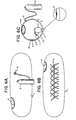
- FIG. 6 A preferred embodiment of the mountain bubble is shown in Fig. 6.
- the bubble is cylindrical or sausage-shaped, long enough to allow a human subject to lie full length within it, as well as a sleeping bag or blankets for warmth. The diameter is sufficient to provide some air space above the patient.
- a suitable breathing atmosphere is provided by a portable closed circuit oxygen scuba respiration system such as that manufactured by Rexnord Breathing Systems, Malvern, Pennsylvania, which can be carried inside the bubble. Construction of the mountain bubble follows principles as described for the exercisor, with flexible air-impermeable walls of nylon-supported Kevlar scrim, sealed with an overlapping, preferably heat-activated tape seam and provided with an airtight zipper for ingress and egress while the bubble is depressurized.
- the material is virtually transparent, allowing full visibility of the subject inside the mountain bubble.
- An outer shall insulating material is optionally provided for added warmth.
- the outer shell is preferably closed by a Velcro strip, preferably reinforced by laces or straps.
- the bubble can be pressurized by a source of compressed air, such as a tank, or, for greatest portability, by a hand- or foot-operated pump. In either case, it is preferred to have a demand valve incorporated into the side wall of the bubble, adjustable over a range of pressures, to provide the pressure needed for alleviating the patient's symptoms.
- the structural components are chosen, according to principles known in the art, to construct a bubble capable of maintaining pressures adjustable in the range from 0 to 10 psi greater than ambient, or preferably from 0.2 to 10 psi greater than ambient.
- a most preferred embodiment of lighter weight components will be capable of maintaining pressures adjustable from 0.2 to 4 psi greater than ambient.
- Fig. 1-A hyperbaric exercisor having an outer shell (1) of air permeable nylon fabric and an inner shell (2) of air-impermeable vinyl is shown.
- the inner shell (2) is sized slightly larger than the outer shell (1) so that pressure stress is primarily borne by the stronger outer shell (1).
- the inner shell (2) is constructed of individual panels joined along seams (15).
- An airtight zipper (4) in the inner shell provides means of ingress and egress.
- a flap panel (3) provides a means of ingress and egress through the outer shell.
- the flap panel (3) opens inwardly through the zipper (4) when the latter is unzipped.
- a frame (16) is constructed around the flap panel opening to provide a rigid structure for the flap panel (3) to rest against when shut and the exercisor is under pressure.
- An alternate viewing port (5) is provided.
- a platform (6) is supported by four legs (7) which extend through the outer and inner shells (1) and (2).
- the openings for the legs (7) are sealed by o-rings (8).
- the exercisor is pressurized by an air compressor (9) which delivers air into the exercisor.
- Excessive internal CO2 and H2O are removed by a chemical scavenger (10), through which internal air is circulated by a small blower (11).
- An exit port (12) allows venting of excess pressure, optionally through a differential pressure valve (not shown).
- Oxygen content of internal air is replenished from a tank of compressed O2 (13), whose flow rate is regulated by an inlet valve (14) in a panel of the exercisor.
- the exercisor can be pressurized by substituting compressed air instead of O2 in tank (13).
- FIGS 2, 3 and 4 show front, back and top views, respectively, of the exercisor drawn to reduced scale. Detachable components such as compressor pump or compressed gas tank are not shown in these views.
- the remaining 14 cuts are made symmetrically, taken in reverse order, omitting numbers 1 and 2. Each length is evenly spaced with a separation of 7.6 cm.
- the panel is symmetric in two dimensions so the remaining three arcs can be made from the same measurements.
- the bottom two sections (15.2 cm) are cut off to allow for a flat base. These dimensions are valid for a 2.45 meter (8 foot) diameter sphere.
- the diameter of the entire chamber is 2.44 meters or 8 feet.
- the base is a circular piece of vinyl with a diameter of 1.22 meters (4 feet).
- the sphere was constructed by sewing together the panels shown in Fig. 1, using flat felled seams. Such seams are made by sewing together the panels to be joined face-to-face, then folding the free borders of the joined pieces under and top stitching to create an air-tight, stress-absorbing seam. All seams were formed in this manner, beginning in sequence from the panel adjacent to one side of the zipper tape, and proceeding to join each panel in turn, ultimately joining the last panel to the opposite side of the zipper tape. It is anticipated that radio-frequency welding, rather than sewing, will yield more air-tight seams.
- the floor was attached, beginning at the zipper tape, sewing around the sphere, easing the floor in by lining up corresponding floor and panel sections as the sewing proceeds around the perimeter of the base. After completing the sewing, all seams were treated with a paraffin wax-base solvent sealer to further reduce air leakage.
- Figure 5 shows the mountain bubble in exterior views a) and b).
- Visible exterior features include the exterior wall (1), window constructed of clear Kevlar supported nylon membrane (4), Velcro outer closure (5), compressed air tank (8) for achieving and maintaining internal pressure connected to the interior of the bubble by a demand valve (9) adjustable to maintain a predetermined internal pressure.
- the compressed air tank (8) can be substituted by an optional pump operable by hand, foot or other power source.
- Fig. 6c the bubble is shown in cross-section showing a patient (10), lying supine within the bubble.
- the bubble is constructed with an interior, air-impermeable zipper (6) in the inner wall, and a Velcro closure (5) in the outer wall.
- the outer closure is reinforceable by exterior straps or laces (2), shown in Fig. 5b.
- a regulated air supply for the patient (10) is provided by a closed circuit oxygen scuba rebreather (11) of a type such as sold by Rexmord.
- the bubble In use the bubble is unfolded, the closures (5) and (7) are opened, the subject is placed inside the bubble, the closed circuit rebreather (11) is attached and adjusted, the air tight zipper (6) and outer closure (5) are closed and the bubble is gradually inflated by means of the compressed air source (8) or optional pump to the desired pressure.
- the compressed air source (8) or optional pump For mild cases, relief of symptoms can be obtained by a pressure increment equivalent to an altitude decrease of 2,000 to 4,000 feet. Therefore, inflation to 1 to 2 pounds psi above ambient may provide relief, although higher pressures will be required in more severe cases. Care should be taken to pressurize the bubble slowly enough to allow the patient to adjust air pressure in the middle ear, as is well-known in the art. The internal pressure is then maintained or adjusted upwards or downward as the patient's condition dictates.
- Figure 7 is a pattern, to scale, of a hyperbaric mountain bubble. All dimensions are given in inches.
- Two pieces of 400 denier nylon supported Kevlar scrim (DuPont) cut to the pattern shown in the figure are used to construct the bubble. The material is virtually transparent, allowing the subject inside the bubble to be fully visible.
- the two pieces are joined together along the straight side (1), using a heat-activated tape such as Scotchweld No. 588 (Trademark, 3M Corporation, Minneapolis, Minnesota).
- the pieces are formed into a cylinder such that sides (b) and (b ⁇ ) are contiguous and the ends are closed by overlapping the scalloped edges (a ⁇ ) and fastening with heat activated tape.
- seams formed by joining edges (b) and (b ⁇ ) are in part sealed with the same tape, and in part with an air-proof zipper such as manufactured by talon Corporation.
- the heat activated tape is also used to seal any inlet or exhaust parts.
- the finished length of the bag is about 80 inches and the circumference is 74 inches.
Landscapes
- Health & Medical Sciences (AREA)
- Public Health (AREA)
- Pulmonology (AREA)
- Life Sciences & Earth Sciences (AREA)
- Animal Behavior & Ethology (AREA)
- General Health & Medical Sciences (AREA)
- Emergency Medicine (AREA)
- Veterinary Medicine (AREA)
- Accommodation For Nursing Or Treatment Tables (AREA)
- Drilling And Exploitation, And Mining Machines And Methods (AREA)
- Respiratory Apparatuses And Protective Means (AREA)
- Physical Deposition Of Substances That Are Components Of Semiconductor Devices (AREA)
- Transition And Organic Metals Composition Catalysts For Addition Polymerization (AREA)
- Crystals, And After-Treatments Of Crystals (AREA)
Priority Applications (1)
| Application Number | Priority Date | Filing Date | Title |
|---|---|---|---|
| AT88300806T ATE88080T1 (de) | 1987-02-02 | 1988-02-01 | Ueberdruckhammer. |
Applications Claiming Priority (2)
| Application Number | Priority Date | Filing Date | Title |
|---|---|---|---|
| US10046 | 1987-02-02 | ||
| US07/010,046 US4974829A (en) | 1985-06-10 | 1987-02-02 | Hyperbaric chamber |
Publications (3)
| Publication Number | Publication Date |
|---|---|
| EP0277787A2 true EP0277787A2 (de) | 1988-08-10 |
| EP0277787A3 EP0277787A3 (en) | 1990-06-13 |
| EP0277787B1 EP0277787B1 (de) | 1993-04-14 |
Family
ID=21743535
Family Applications (1)
| Application Number | Title | Priority Date | Filing Date |
|---|---|---|---|
| EP88300806A Expired - Lifetime EP0277787B1 (de) | 1987-02-02 | 1988-02-01 | Überdruckhammer |
Country Status (6)
| Country | Link |
|---|---|
| US (1) | US4974829A (de) |
| EP (1) | EP0277787B1 (de) |
| JP (1) | JPS63302847A (de) |
| AT (1) | ATE88080T1 (de) |
| CA (1) | CA1305012C (de) |
| DE (1) | DE3880165T2 (de) |
Cited By (8)
| Publication number | Priority date | Publication date | Assignee | Title |
|---|---|---|---|---|
| WO1990012556A1 (en) * | 1989-04-21 | 1990-11-01 | Portable Hyperbarics, Inc. | Improved hyperbaric chamber |
| FR2673845A1 (fr) * | 1991-03-13 | 1992-09-18 | Drecq Daniel | Dispositif autonome de generation d'air comprime et caisson de recompression l'incorporant. |
| WO1995013044A1 (en) * | 1993-11-09 | 1995-05-18 | Aga Ab | Method and apparatus for controlling the atmosphere of an essentially closed space |
| US6565624B2 (en) | 2000-09-06 | 2003-05-20 | Colorado Altitude Training Llc | Altitude simulation method and system |
| DE10257155A1 (de) * | 2002-12-02 | 2004-06-17 | Volker Spiegel | Aufenthaltsraum und Verfahren zum Einstellen der Raumatmosphäre |
| EP1711669A4 (de) * | 2003-07-31 | 2009-07-01 | Edward V Roscioli | Bunkersystem und zugeordnete vorrichtungen |
| EP2514988A1 (de) | 2002-10-18 | 2012-10-24 | Mitsubishi Denki Kabushiki Kaisha | Bremsmechanismus für Zugmaschine |
| CN104536251A (zh) * | 2014-12-05 | 2015-04-22 | 无锡羿飞科技有限公司 | 基于升降设备的软质球幕升球收球系统及方法 |
Families Citing this family (64)
| Publication number | Priority date | Publication date | Assignee | Title |
|---|---|---|---|---|
| US5398678A (en) * | 1985-06-10 | 1995-03-21 | Portable Hyperbarics, Inc. | Hyperbaric chamber and exercise environment |
| US5360001A (en) * | 1985-06-10 | 1994-11-01 | Lance Brill | Hyperbaric chamber closure means |
| US5133339A (en) * | 1991-04-15 | 1992-07-28 | Whalen Robert T | Exercise method and apparatus utilizing differential air pressure |
| US5263476A (en) * | 1991-07-08 | 1993-11-23 | Henson-Thiery Corporation | Enclosure system for burn victims |
| US5101819A (en) * | 1991-07-11 | 1992-04-07 | Lane John C | Method for inducing hypoxia at low simulated altitudes |
| SE468775B (sv) * | 1991-11-15 | 1993-03-15 | Ventilatorverken Ab | Ventilationsfoerfarande foer taelt eller liknande, t ex mobila sjukvaardsenheter, samt medel haerfoer |
| US5327904A (en) * | 1992-01-17 | 1994-07-12 | Hannum James E | Hyperbaric oxygen chamber, method, and door assembly therefor |
| US5467764A (en) * | 1992-02-19 | 1995-11-21 | Hyperbaric Mountain Technologies, Inc. | Hypobaric sleeping chamber |
| US5462505A (en) * | 1993-10-12 | 1995-10-31 | Blair; Rodney L. | Portable inflatable structure |
| CA2158312C (en) * | 1994-03-31 | 1999-04-06 | John Kenneth Murphy | Inflatable enclosure |
| US6349510B1 (en) * | 1995-11-03 | 2002-02-26 | Gfrc Shelters | Equipment shelter facilities |
| US5678543A (en) * | 1995-11-16 | 1997-10-21 | Portable Hyperbarics, Inc. | Hyperbaric chamber |
| US6247472B1 (en) | 1996-08-02 | 2001-06-19 | Thomas Stillman Moseley | Method and apparatus for using readily available heat to compress air for supply to a collapsible and portable hyperbaric chamber |
| WO1999006115A1 (en) * | 1997-07-31 | 1999-02-11 | Hypoxico Inc. | Hypoxic tent system |
| US6438900B1 (en) * | 1998-02-12 | 2002-08-27 | George Page | Storage chamber |
| US5984337A (en) * | 1998-04-10 | 1999-11-16 | Dubin; Sol | Motorcycle erector device |
| US6016803A (en) | 1998-07-21 | 2000-01-25 | Volberg; Walter | Self-contained hyperbaric chamber |
| US6497231B1 (en) | 2000-03-24 | 2002-12-24 | White Perry La'monte | Hyperbaric oxygen chamber |
| JP2002177346A (ja) * | 2000-12-19 | 2002-06-25 | Daikin Ind Ltd | Icuユニット |
| US7263995B2 (en) * | 2001-02-28 | 2007-09-04 | Hyperbaric Technology, Inc. | Hyperbaric oxygen therapy system controls |
| US20050096319A1 (en) * | 2003-02-21 | 2005-05-05 | Balzarini Jan M.R. | Identification of compounds that inhibit replication of human immunodeficiency virus |
| US7520277B1 (en) | 2003-04-01 | 2009-04-21 | Daniel Grady | CPAP enclosure for the treatment of sleep apnea |
| CA2425239A1 (en) * | 2003-04-11 | 2004-10-11 | Leisure Activities Unlimited | Double entrance for use in an inflatable enclosure |
| JP4099764B2 (ja) * | 2003-05-21 | 2008-06-11 | 英雅 山本 | 重症急性呼吸器症候群患者治療用具 |
| US7503322B2 (en) * | 2003-09-12 | 2009-03-17 | Harris Michael F | Methods for the treatment of HIV and other viruses |
| US20050109381A1 (en) * | 2003-10-06 | 2005-05-26 | Kevin Mosteller | Collapsible, transportable, composite shelter and hyperbaric chamber |
| US9410342B2 (en) | 2003-11-15 | 2016-08-09 | Outdoor Advantage Connection LLC | Climate controlled portable dwelling and method of use |
| US7926483B2 (en) * | 2005-08-04 | 2011-04-19 | Sir Issac Newton Enterprises LLC | System for controlling pressure in defined environment and associated method |
| US7591795B2 (en) * | 2005-09-28 | 2009-09-22 | Alterg, Inc. | System, method and apparatus for applying air pressure on a portion of the body of an individual |
| US7634999B2 (en) * | 2006-07-07 | 2009-12-22 | Hyperbaric Technologies, Inc. | Hyperbaric chamber |
| US8025056B2 (en) | 2006-07-07 | 2011-09-27 | Hyperbaric Technologies, Inc. | Hyperbaric chamber |
| US7588517B2 (en) * | 2006-09-08 | 2009-09-15 | Dale Richardson | Physical fitness system |
| GB0623730D0 (en) * | 2006-11-28 | 2007-01-10 | Pufferfish Ltd | Three-dimensional display |
| AU2008311865A1 (en) | 2007-10-15 | 2009-04-23 | Alterg, Inc. | Systems, methods and apparatus for differential air pressure devices |
| WO2014153201A1 (en) | 2013-03-14 | 2014-09-25 | Alterg, Inc. | Method of gait evaluation and training with differential pressure system |
| US10342461B2 (en) | 2007-10-15 | 2019-07-09 | Alterg, Inc. | Method of gait evaluation and training with differential pressure system |
| US20090120517A1 (en) * | 2007-11-12 | 2009-05-14 | Thomas Joseph Whitney | Self regulating valve to obtain low differential air pressure control |
| FR2934914B1 (fr) * | 2008-08-08 | 2010-09-17 | Cap Enfants | Systeme d'eveil musical pour jeunes enfants. |
| AU2010249092A1 (en) | 2009-05-15 | 2011-11-24 | Alterg, Inc. | Differential air pressure systems |
| JP5431884B2 (ja) * | 2009-11-18 | 2014-03-05 | 株式会社フューテック | 高気圧保持装置 |
| US20110226252A1 (en) * | 2010-03-22 | 2011-09-22 | Tom Milne | Hyperbaric therapy device |
| WO2012055003A1 (en) * | 2010-10-27 | 2012-05-03 | Groupe Medical Gaumond Inc. | Portable chamber for hyperbaric and/or hypoxic treatment |
| WO2012129125A2 (en) | 2011-03-18 | 2012-09-27 | Alterg, Inc. | Differential air pressure systems and methods of using and calibrating such systems for mobility impaired users |
| AU2011202180A1 (en) | 2011-05-11 | 2012-11-29 | Gregory Michael Mcmahon | Physical Exercise Training Techniques |
| JP5888900B2 (ja) * | 2011-08-11 | 2016-03-22 | 昭和電機株式会社 | 運動装置 |
| KR101357536B1 (ko) | 2011-12-08 | 2014-01-29 | 주식회사 한국해양스포츠개발원 | 휴대용 수중 재압 챔버 |
| US20130160767A1 (en) * | 2011-12-26 | 2013-06-27 | Vera Abella | Exercise machine including oxygen dispenser |
| US9622931B2 (en) * | 2013-06-14 | 2017-04-18 | Bruce Elgin McKeeman | Portable hyperbaric chamber with a vertical mounting system |
| US10058471B2 (en) * | 2014-02-21 | 2018-08-28 | William M. Vaughan | System and method of using hyperbaric oxygen therapy for treating concussive symptoms and musculoskeletal injuries and for pre-treatment to prevent damage from injuries |
| NZ730091A (en) * | 2014-08-11 | 2022-09-30 | Stratosphere Atc Llc | Exercise apparatus simulating mild to high altitude environments |
| KR101592188B1 (ko) * | 2014-10-29 | 2016-02-05 | (주)아이벡스메디칼시스템즈 | 휴대 가능한 접이식 고압산소 챔버 |
| CN104460211B (zh) * | 2014-12-05 | 2016-04-13 | 无锡视美乐科技股份有限公司 | 基于充气柱的软质球幕升球收球系统及方法 |
| WO2018211474A1 (en) | 2017-05-19 | 2018-11-22 | Trudell Medical International | Positive expiratory pressure device |
| USD1010028S1 (en) | 2017-06-22 | 2024-01-02 | Boost Treadmills, LLC | Unweighting exercise treadmill |
| WO2019079655A1 (en) | 2017-10-18 | 2019-04-25 | Alterg, Inc. | SYSTEM FOR COLLECTING AND ANALYZING APPROPRIATE DATA AND METHODS OF OPERATING DRIVING SYSTEMS WITH RELIEF |
| US11654327B2 (en) | 2017-10-31 | 2023-05-23 | Alterg, Inc. | System for unweighting a user and related methods of exercise |
| CN108330983B (zh) * | 2018-01-09 | 2020-10-27 | 浙江蓝域智能科技有限公司 | 一种建筑施工用的深基坑安全保护装置 |
| USD874064S1 (en) | 2018-05-18 | 2020-01-28 | Trudell Medical International | Mask |
| USD903097S1 (en) | 2018-05-18 | 2020-11-24 | Trudell Medical International | Mask |
| USD893806S1 (en) | 2018-11-09 | 2020-08-18 | Trudell Medical Internationl | Mask and shroud |
| US11872433B2 (en) | 2020-12-01 | 2024-01-16 | Boost Treadmills, LLC | Unweighting enclosure, system and method for an exercise device |
| GB2605374B (en) * | 2021-03-29 | 2024-08-28 | Trident Dynamics Ltd | A Hyperbaric Chamber |
| US11883713B2 (en) | 2021-10-12 | 2024-01-30 | Boost Treadmills, LLC | DAP system control and related devices and methods |
| US12370387B2 (en) * | 2022-01-19 | 2025-07-29 | Bruce Elgin McKeeman | Portable and compact hyperbaric chamber |
Family Cites Families (29)
| Publication number | Priority date | Publication date | Assignee | Title |
|---|---|---|---|---|
| US1294188A (en) * | 1915-05-25 | 1919-02-11 | Draegerwerk Ag | Pressure-chamber for removing divers' diseases. |
| FR854923A (fr) * | 1939-05-17 | 1940-04-27 | Dispositif de protection contre les gaz, plus spécialement pour enfants | |
| US2401230A (en) * | 1943-12-11 | 1946-05-28 | Goodrich Co B F | Inflatable protective container |
| DE853635C (de) * | 1949-09-16 | 1952-10-27 | Rolf Dr-Ing Schroedter | Klima-Kammer |
| US2731055A (en) * | 1951-08-21 | 1956-01-17 | Firestone Tire & Rubber Co | Nonmetallic enclosure |
| US2723840A (en) * | 1952-07-29 | 1955-11-15 | G H Bishop Company | Steam hydrator |
| DE970939C (de) * | 1953-03-07 | 1958-11-13 | Draegerwerk Ag | Behaelter aus gasdichtem Stoff zur Aufnahme von Kindern |
| US3299429A (en) * | 1963-08-05 | 1967-01-17 | Decibel Prod | Vertical array of folded dipoles adjustably mounted on support mast |
| US3387412A (en) * | 1966-07-05 | 1968-06-11 | John P. Kwake | Closure for inflatable structure |
| US3602221A (en) * | 1969-09-25 | 1971-08-31 | Eric V Bleicken | Portable recompression chamber |
| US3729002A (en) * | 1971-04-01 | 1973-04-24 | D Miller | Emergency inflatable recompression unit |
| US3801043A (en) * | 1972-03-24 | 1974-04-02 | Int Tapetronics Corp | Compact cassette tape transport with direct capstan and torque motor drives |
| JPS494075U (de) * | 1972-04-19 | 1974-01-14 | ||
| US3877427A (en) * | 1972-05-25 | 1975-04-15 | Semen Mikhailovich Alexeev | Oxygen compressive chamber |
| JPS4952487A (de) * | 1972-08-23 | 1974-05-21 | ||
| SU889007A1 (ru) * | 1975-06-19 | 1981-12-15 | Всесоюзный Научно-Исследовательский Институт Физической Культуры | Способ реабилитации работоспособности мышц организма |
| US4106504A (en) * | 1976-12-06 | 1978-08-15 | The United States Of America As Represented By The Secretary Of The Navy | Portable recompression chamber with air scrubber |
| US4103369A (en) * | 1977-02-28 | 1978-08-01 | Riordan David B | Inflatable structure |
| US4186735A (en) * | 1977-04-21 | 1980-02-05 | Flood Michael G | Breathing apparatus |
| US4196656A (en) * | 1977-10-20 | 1980-04-08 | Taylor Diving & Salvage Co., Inc. | Method and apparatus for transporting and housing tunnel workers active in high pressure environments |
| DE3004156C2 (de) * | 1980-02-05 | 1982-11-25 | Becker, Hermann, 8162 Schliersee | Transportable Vorrichtung zum Mildern der Auswirkungen von Krankheit, die durch eine dem menschlichen Organismus schadende Umgebung hervorgerufen wird |
| US4294242A (en) * | 1980-03-31 | 1981-10-13 | Kinergetics, Inc. | Survival system |
| JPS6111478Y2 (de) * | 1980-05-30 | 1986-04-11 | ||
| DE3109658C2 (de) * | 1981-03-13 | 1984-04-05 | Drägerwerk AG, 2400 Lübeck | Elektrisch steuerbares Atemschutzgerät nach dem Kreislaufprinzip |
| CA1151633A (en) * | 1981-05-27 | 1983-08-09 | Clive D. R. Macgregor | Absorption of carbon dioxide |
| US4440162A (en) * | 1981-06-23 | 1984-04-03 | Her Majesty The Queen In Right Of Canada | Soda lime half life indicator |
| US4509513A (en) * | 1982-09-29 | 1985-04-09 | Lasley Robert A | Portable and collapsible hyperbaric chamber assembly |
| FR2542025B1 (fr) * | 1983-03-02 | 1985-06-21 | Travaux Elect Meca Cie Indle | Structure gonflable a usage d'abri |
| US4627431A (en) * | 1985-03-12 | 1986-12-09 | E. I. Du Pont De Nemours And Company | Protective hood with CO2 absorbent |
-
1987
- 1987-02-02 US US07/010,046 patent/US4974829A/en not_active Expired - Lifetime
-
1988
- 1988-02-01 EP EP88300806A patent/EP0277787B1/de not_active Expired - Lifetime
- 1988-02-01 DE DE8888300806T patent/DE3880165T2/de not_active Expired - Fee Related
- 1988-02-01 AT AT88300806T patent/ATE88080T1/de active
- 1988-02-02 JP JP63022660A patent/JPS63302847A/ja active Granted
- 1988-02-02 CA CA000557926A patent/CA1305012C/en not_active Expired - Lifetime
Cited By (14)
| Publication number | Priority date | Publication date | Assignee | Title |
|---|---|---|---|---|
| WO1990012556A1 (en) * | 1989-04-21 | 1990-11-01 | Portable Hyperbarics, Inc. | Improved hyperbaric chamber |
| FR2673845A1 (fr) * | 1991-03-13 | 1992-09-18 | Drecq Daniel | Dispositif autonome de generation d'air comprime et caisson de recompression l'incorporant. |
| WO1995013044A1 (en) * | 1993-11-09 | 1995-05-18 | Aga Ab | Method and apparatus for controlling the atmosphere of an essentially closed space |
| US5860857A (en) * | 1993-11-09 | 1999-01-19 | Aga Aktiebolag | Method and apparatus for controlling the atmosphere of an essentially closed space |
| US6827760B2 (en) | 2000-09-06 | 2004-12-07 | Colorado Altitude Training Llc | Method and system for providing a desired atmosphere within an enclosure |
| US6565624B2 (en) | 2000-09-06 | 2003-05-20 | Colorado Altitude Training Llc | Altitude simulation method and system |
| US7018443B2 (en) | 2000-09-06 | 2006-03-28 | Colorado Altitude Training Llc | Method and system for reducing body weight in an enclosed atmospheric environment |
| EP2514988A1 (de) | 2002-10-18 | 2012-10-24 | Mitsubishi Denki Kabushiki Kaisha | Bremsmechanismus für Zugmaschine |
| EP2551545A1 (de) | 2002-10-18 | 2013-01-30 | Mitsubishi Denki Kabushiki Kaisha | Bremsmechanismus für Hebezug |
| DE10257155A1 (de) * | 2002-12-02 | 2004-06-17 | Volker Spiegel | Aufenthaltsraum und Verfahren zum Einstellen der Raumatmosphäre |
| US7841929B2 (en) | 2002-12-02 | 2010-11-30 | Volker Spiegel | Recreation room and method for controlling the atmosphere in the room |
| US9636565B2 (en) | 2002-12-02 | 2017-05-02 | Volker Spiegel | Recreation room and method of adjusting the room atmosphere |
| EP1711669A4 (de) * | 2003-07-31 | 2009-07-01 | Edward V Roscioli | Bunkersystem und zugeordnete vorrichtungen |
| CN104536251A (zh) * | 2014-12-05 | 2015-04-22 | 无锡羿飞科技有限公司 | 基于升降设备的软质球幕升球收球系统及方法 |
Also Published As
| Publication number | Publication date |
|---|---|
| CA1305012C (en) | 1992-07-14 |
| EP0277787B1 (de) | 1993-04-14 |
| US4974829A (en) | 1990-12-04 |
| EP0277787A3 (en) | 1990-06-13 |
| DE3880165D1 (de) | 1993-05-19 |
| JPS63302847A (ja) | 1988-12-09 |
| DE3880165T2 (de) | 1993-07-29 |
| JPH0420354B2 (de) | 1992-04-02 |
| ATE88080T1 (de) | 1993-04-15 |
Similar Documents
| Publication | Publication Date | Title |
|---|---|---|
| US4974829A (en) | Hyperbaric chamber | |
| US5109837A (en) | Hyperbaric chamber | |
| US5398678A (en) | Hyperbaric chamber and exercise environment | |
| US5360001A (en) | Hyperbaric chamber closure means | |
| USRE36958E (en) | Hypobaric sleeping chamber | |
| US8297282B2 (en) | Hyperbaric exercise facility, hyperbaric dome, catastrophe or civil defense shelter | |
| US5964222A (en) | Hypoxic tent system | |
| US5007893A (en) | Combination anti-g and pressure suit | |
| CA2715278C (en) | Hyperbaric chamber | |
| US5645056A (en) | Variable volumetric inflatable pump | |
| CA2656846A1 (en) | Hyperbaric chamber | |
| US11717634B2 (en) | Therapeutic oxygen breathing apparatus and exercise system | |
| US20240173186A1 (en) | Foldable inflatable hyperbaric chamber | |
| ES3035339T3 (en) | Therapeutic oxygen breathing apparatus and exercise system | |
| US20080047061A1 (en) | Systems and methods for providing an insulated sleeping chamber | |
| RU64509U1 (ru) | Устройство для транспортировки больного в режиме гипербарических параметров дыхательной смеси | |
| CN211634067U (zh) | 一种便携式多功能增压帐篷 | |
| Gamow et al. | Methods of gas-balance control to be used with a portable hyperbaric chamber in the treatment of high altitude illness | |
| GB2593663A (en) | Deployable shelter with adaptable floor | |
| JPH0242992B2 (de) | ||
| WO1999006115A1 (en) | Hypoxic tent system | |
| CN104759046B (zh) | 无动力应急救生舱 | |
| CN108248795A (zh) | 一种游泳及潜水组合装置 | |
| CN217186783U (zh) | 一种新型便携充气式茧包担架 | |
| WO2004109041A1 (en) | Inflatable hermetically sealable shelter |
Legal Events
| Date | Code | Title | Description |
|---|---|---|---|
| PUAI | Public reference made under article 153(3) epc to a published international application that has entered the european phase |
Free format text: ORIGINAL CODE: 0009012 |
|
| AK | Designated contracting states |
Kind code of ref document: A2 Designated state(s): AT BE CH DE ES FR GB GR IT LI LU NL SE |
|
| RAP1 | Party data changed (applicant data changed or rights of an application transferred) |
Owner name: E.I. DU PONT DE NEMOURS AND COMPANY |
|
| RIN1 | Information on inventor provided before grant (corrected) |
Inventor name: GEER, GEOFFREY A. Inventor name: RUSTEM, IGOR GAMOW |
|
| PUAL | Search report despatched |
Free format text: ORIGINAL CODE: 0009013 |
|
| AK | Designated contracting states |
Kind code of ref document: A3 Designated state(s): AT BE CH DE ES FR GB GR IT LI LU NL SE |
|
| 17P | Request for examination filed |
Effective date: 19900511 |
|
| 17Q | First examination report despatched |
Effective date: 19910228 |
|
| RAP1 | Party data changed (applicant data changed or rights of an application transferred) |
Owner name: PORTABLE HYPERBARICS, INC. |
|
| GRAA | (expected) grant |
Free format text: ORIGINAL CODE: 0009210 |
|
| AK | Designated contracting states |
Kind code of ref document: B1 Designated state(s): AT BE CH DE ES FR GB GR IT LI LU NL SE |
|
| PG25 | Lapsed in a contracting state [announced via postgrant information from national office to epo] |
Ref country code: IT Free format text: LAPSE BECAUSE OF FAILURE TO SUBMIT A TRANSLATION OF THE DESCRIPTION OR TO PAY THE FEE WITHIN THE PRE;WARNING: LAPSES OF ITALIAN PATENTS WITH EFFECTIVE DATE BEFORE 2007 MAY HAVE OCCURRED AT ANY TIME BEFORE 2007. THE CORRECT EFFECTIVE DATE MAY BE DIFFERENT FROM THE ONE RECORDED.SCRIBED TIME-LIMIT Effective date: 19930414 Ref country code: SE Effective date: 19930414 Ref country code: GR Free format text: LAPSE BECAUSE OF FAILURE TO SUBMIT A TRANSLATION OF THE DESCRIPTION OR TO PAY THE FEE WITHIN THE PRESCRIBED TIME-LIMIT Effective date: 19930414 Ref country code: AT Effective date: 19930414 Ref country code: BE Effective date: 19930414 Ref country code: ES Free format text: THE PATENT HAS BEEN ANNULLED BY A DECISION OF A NATIONAL AUTHORITY Effective date: 19930414 Ref country code: NL Effective date: 19930414 |
|
| REF | Corresponds to: |
Ref document number: 88080 Country of ref document: AT Date of ref document: 19930415 Kind code of ref document: T |
|
| RIN1 | Information on inventor provided before grant (corrected) |
Inventor name: GEER, GEOFFREY A. Inventor name: GAMOW, R. IGOR |
|
| REF | Corresponds to: |
Ref document number: 3880165 Country of ref document: DE Date of ref document: 19930519 |
|
| ET | Fr: translation filed | ||
| NLV1 | Nl: lapsed or annulled due to failure to fulfill the requirements of art. 29p and 29m of the patents act | ||
| PLBE | No opposition filed within time limit |
Free format text: ORIGINAL CODE: 0009261 |
|
| STAA | Information on the status of an ep patent application or granted ep patent |
Free format text: STATUS: NO OPPOSITION FILED WITHIN TIME LIMIT |
|
| PG25 | Lapsed in a contracting state [announced via postgrant information from national office to epo] |
Ref country code: LU Free format text: LAPSE BECAUSE OF NON-PAYMENT OF DUE FEES Effective date: 19940228 |
|
| 26N | No opposition filed | ||
| REG | Reference to a national code |
Ref country code: GB Ref legal event code: IF02 |
|
| PGFP | Annual fee paid to national office [announced via postgrant information from national office to epo] |
Ref country code: GB Payment date: 20060109 Year of fee payment: 19 |
|
| PGFP | Annual fee paid to national office [announced via postgrant information from national office to epo] |
Ref country code: FR Payment date: 20060202 Year of fee payment: 19 |
|
| PGFP | Annual fee paid to national office [announced via postgrant information from national office to epo] |
Ref country code: DE Payment date: 20060228 Year of fee payment: 19 |
|
| PGFP | Annual fee paid to national office [announced via postgrant information from national office to epo] |
Ref country code: CH Payment date: 20060308 Year of fee payment: 19 |
|
| PG25 | Lapsed in a contracting state [announced via postgrant information from national office to epo] |
Ref country code: CH Free format text: LAPSE BECAUSE OF NON-PAYMENT OF DUE FEES Effective date: 20070228 Ref country code: LI Free format text: LAPSE BECAUSE OF NON-PAYMENT OF DUE FEES Effective date: 20070228 |
|
| REG | Reference to a national code |
Ref country code: CH Ref legal event code: PL |
|
| GBPC | Gb: european patent ceased through non-payment of renewal fee |
Effective date: 20070201 |
|
| REG | Reference to a national code |
Ref country code: FR Ref legal event code: ST Effective date: 20071030 |
|
| PG25 | Lapsed in a contracting state [announced via postgrant information from national office to epo] |
Ref country code: DE Free format text: LAPSE BECAUSE OF NON-PAYMENT OF DUE FEES Effective date: 20070901 |
|
| PG25 | Lapsed in a contracting state [announced via postgrant information from national office to epo] |
Ref country code: GB Free format text: LAPSE BECAUSE OF NON-PAYMENT OF DUE FEES Effective date: 20070201 Ref country code: FR Free format text: LAPSE BECAUSE OF NON-PAYMENT OF DUE FEES Effective date: 20070228 |