EP0277811A2 - Optisch durchsichtiges Yttriumoxid - Google Patents
Optisch durchsichtiges Yttriumoxid Download PDFInfo
- Publication number
- EP0277811A2 EP0277811A2 EP88300874A EP88300874A EP0277811A2 EP 0277811 A2 EP0277811 A2 EP 0277811A2 EP 88300874 A EP88300874 A EP 88300874A EP 88300874 A EP88300874 A EP 88300874A EP 0277811 A2 EP0277811 A2 EP 0277811A2
- Authority
- EP
- European Patent Office
- Prior art keywords
- yttrium oxide
- range
- temperature
- powder
- microns
- Prior art date
- Legal status (The legal status is an assumption and is not a legal conclusion. Google has not performed a legal analysis and makes no representation as to the accuracy of the status listed.)
- Withdrawn
Links
- SIWVEOZUMHYXCS-UHFFFAOYSA-N oxo(oxoyttriooxy)yttrium Chemical compound O=[Y]O[Y]=O SIWVEOZUMHYXCS-UHFFFAOYSA-N 0.000 title claims abstract description 51
- 239000000843 powder Substances 0.000 claims abstract description 40
- 238000000034 method Methods 0.000 claims description 23
- 239000000463 material Substances 0.000 claims description 16
- 239000002245 particle Substances 0.000 claims description 13
- 238000005245 sintering Methods 0.000 claims description 13
- 238000010438 heat treatment Methods 0.000 claims description 9
- XKRFYHLGVUSROY-UHFFFAOYSA-N Argon Chemical compound [Ar] XKRFYHLGVUSROY-UHFFFAOYSA-N 0.000 claims description 8
- 238000000137 annealing Methods 0.000 claims description 8
- 238000010521 absorption reaction Methods 0.000 claims description 6
- 239000011230 binding agent Substances 0.000 claims description 6
- WFKWXMTUELFFGS-UHFFFAOYSA-N tungsten Chemical compound [W] WFKWXMTUELFFGS-UHFFFAOYSA-N 0.000 claims description 6
- 229910052721 tungsten Inorganic materials 0.000 claims description 6
- 239000010937 tungsten Substances 0.000 claims description 6
- 230000005540 biological transmission Effects 0.000 claims description 5
- 229910052799 carbon Inorganic materials 0.000 claims description 5
- 239000007789 gas Substances 0.000 claims description 5
- 238000002834 transmittance Methods 0.000 claims description 5
- 229910052786 argon Inorganic materials 0.000 claims description 4
- 238000004519 manufacturing process Methods 0.000 claims description 4
- 238000001694 spray drying Methods 0.000 claims description 3
- UFHFLCQGNIYNRP-UHFFFAOYSA-N Hydrogen Chemical compound [H][H] UFHFLCQGNIYNRP-UHFFFAOYSA-N 0.000 claims description 2
- 239000001257 hydrogen Substances 0.000 claims description 2
- 229910052739 hydrogen Inorganic materials 0.000 claims description 2
- 239000000203 mixture Substances 0.000 claims description 2
- 239000002019 doping agent Substances 0.000 abstract description 4
- 239000011224 oxide ceramic Substances 0.000 abstract 1
- 229910052574 oxide ceramic Inorganic materials 0.000 abstract 1
- 230000003287 optical effect Effects 0.000 description 17
- OKTJSMMVPCPJKN-UHFFFAOYSA-N Carbon Chemical compound [C] OKTJSMMVPCPJKN-UHFFFAOYSA-N 0.000 description 7
- 238000000280 densification Methods 0.000 description 7
- QVGXLLKOCUKJST-UHFFFAOYSA-N atomic oxygen Chemical compound [O] QVGXLLKOCUKJST-UHFFFAOYSA-N 0.000 description 6
- 239000001301 oxygen Substances 0.000 description 6
- 229910052760 oxygen Inorganic materials 0.000 description 6
- 230000035939 shock Effects 0.000 description 5
- 229910002804 graphite Inorganic materials 0.000 description 4
- 239000010439 graphite Substances 0.000 description 4
- QTBSBXVTEAMEQO-UHFFFAOYSA-N Acetic acid Chemical compound CC(O)=O QTBSBXVTEAMEQO-UHFFFAOYSA-N 0.000 description 3
- 239000000654 additive Substances 0.000 description 3
- 239000002270 dispersing agent Substances 0.000 description 3
- 238000003384 imaging method Methods 0.000 description 3
- 238000002329 infrared spectrum Methods 0.000 description 3
- 238000012634 optical imaging Methods 0.000 description 3
- 238000003825 pressing Methods 0.000 description 3
- 239000002002 slurry Substances 0.000 description 3
- 238000001429 visible spectrum Methods 0.000 description 3
- 229920006311 Urethane elastomer Polymers 0.000 description 2
- 229910052782 aluminium Inorganic materials 0.000 description 2
- XAGFODPZIPBFFR-UHFFFAOYSA-N aluminium Chemical compound [Al] XAGFODPZIPBFFR-UHFFFAOYSA-N 0.000 description 2
- 238000011109 contamination Methods 0.000 description 2
- 238000010348 incorporation Methods 0.000 description 2
- 229920000126 latex Polymers 0.000 description 2
- 239000012528 membrane Substances 0.000 description 2
- 238000003801 milling Methods 0.000 description 2
- 239000007921 spray Substances 0.000 description 2
- 241001279686 Allium moly Species 0.000 description 1
- 239000004698 Polyethylene Substances 0.000 description 1
- 239000004809 Teflon Substances 0.000 description 1
- 229920006362 Teflon® Polymers 0.000 description 1
- PNEYBMLMFCGWSK-UHFFFAOYSA-N aluminium oxide Inorganic materials [O-2].[O-2].[O-2].[Al+3].[Al+3] PNEYBMLMFCGWSK-UHFFFAOYSA-N 0.000 description 1
- 238000000498 ball milling Methods 0.000 description 1
- 230000015556 catabolic process Effects 0.000 description 1
- 239000000919 ceramic Substances 0.000 description 1
- 238000006243 chemical reaction Methods 0.000 description 1
- 239000003638 chemical reducing agent Substances 0.000 description 1
- 239000011248 coating agent Substances 0.000 description 1
- 238000000576 coating method Methods 0.000 description 1
- 238000009694 cold isostatic pressing Methods 0.000 description 1
- 238000007796 conventional method Methods 0.000 description 1
- 239000013078 crystal Substances 0.000 description 1
- 238000006731 degradation reaction Methods 0.000 description 1
- 229910003460 diamond Inorganic materials 0.000 description 1
- 239000010432 diamond Substances 0.000 description 1
- 229920001971 elastomer Polymers 0.000 description 1
- 238000000227 grinding Methods 0.000 description 1
- 229910052751 metal Inorganic materials 0.000 description 1
- 239000002184 metal Substances 0.000 description 1
- RVTZCBVAJQQJTK-UHFFFAOYSA-N oxygen(2-);zirconium(4+) Chemical compound [O-2].[O-2].[Zr+4] RVTZCBVAJQQJTK-UHFFFAOYSA-N 0.000 description 1
- -1 polyethylene Polymers 0.000 description 1
- 229920000573 polyethylene Polymers 0.000 description 1
- XLYOFNOQVPJJNP-UHFFFAOYSA-N water Chemical compound O XLYOFNOQVPJJNP-UHFFFAOYSA-N 0.000 description 1
- 229910001928 zirconium oxide Inorganic materials 0.000 description 1
Images

Classifications
-
- C—CHEMISTRY; METALLURGY
- C04—CEMENTS; CONCRETE; ARTIFICIAL STONE; CERAMICS; REFRACTORIES
- C04B—LIME, MAGNESIA; SLAG; CEMENTS; COMPOSITIONS THEREOF, e.g. MORTARS, CONCRETE OR LIKE BUILDING MATERIALS; ARTIFICIAL STONE; CERAMICS; REFRACTORIES; TREATMENT OF NATURAL STONE
- C04B35/00—Shaped ceramic products characterised by their composition; Ceramics compositions; Processing powders of inorganic compounds preparatory to the manufacturing of ceramic products
- C04B35/50—Shaped ceramic products characterised by their composition; Ceramics compositions; Processing powders of inorganic compounds preparatory to the manufacturing of ceramic products based on rare-earth compounds
- C04B35/505—Shaped ceramic products characterised by their composition; Ceramics compositions; Processing powders of inorganic compounds preparatory to the manufacturing of ceramic products based on rare-earth compounds based on yttrium oxide
-
- H—ELECTRICITY
- H01—ELECTRIC ELEMENTS
- H01J—ELECTRIC DISCHARGE TUBES OR DISCHARGE LAMPS
- H01J61/00—Gas-discharge or vapour-discharge lamps
- H01J61/02—Details
- H01J61/30—Vessels; Containers
- H01J61/302—Vessels; Containers characterised by the material of the vessel
Definitions
- This invention relates generally to optical materials and more particularly to a method of forming bodies of optically transparent yttrium oxide.
- Optical imaging systems such as those found on an infrared heat seeking missile, generally have one or more optical elements such as windows or domes which are mounted on the external portion of the missile. These external elements are provided to isolate the remaining optics of the imaging system from the external environment through which the missile is flown. These external elements, therefore, must have a particularly high degree of resistance to environmental exposures and must have sufficient strength to protect the remaining components in the imaging system during operation of the imaging system in addition to have the aforementioned substantial transparency in the visible and/or infrared spectrums.
- Each of these materials generally has a high degree of strength and is theoretically capable of having a relatively high degree of infrared transparency, particularly within the wavelength range of approximately 2 microns to 5 microns.
- the optical element be transparent to wavelengths beyond 5 microns.
- a dome mounted on the front portion of such a missile will reach elevated temperatures.
- a "hot" dome made of materials which do not transmit to long wavelengths beyond 5 microns, for example, may produce undesirable emissions resulting in increased system noise in the optical imaging system shielded by the dome.
- a hot dome Associated with such a "hot" dome is a requirement that the material of the dome withstand the thermal induced stresses created from the aerodynamic heating of the surface thereof.
- Some techniques for producing Y2O3 domes involve sintering to substantially full density a Y2O3 body. In these techniques, sintering aids such as La are added up to 10% by weight to achieve the high density. The addition of these sintering aids has one draw back.
- the sintering aids in a material such as Y2O3 will reduce its thermal conductivity. Thus, reduced thermal conductivity will provide a concominant reduction in thermal shock resistance of a dome. A hot dome, therefore, is suceptible to damage due to the reduction in thermal shock resistance.
- a method of forming a transparent yttrium oxide body comprises the steps of: providing a powder comprising of yttrium oxide and consolidating said powder into a body of a predetermined size and shape.
- the consolidated body is densified at an elevated temperature.
- this temperature is in the range of 1700-1900°C more preferable in the range of 1800°C to 1900°C for period of time sufficient to densify the body to at least a closed porosity state.
- a closed porosity state for such a body is at least 91% and preferably 94% to 96% of the theoretical density of the yttrium oxide.
- the sintered, closed porosity body is then further densified to substantially 100% of theoretical density by subjecting said body to an elevated pressure preferably in the range of 25,000-30,000 psi for a period of time of typically 1/2-10 hours at elevated temperature preferable in the range of 1700-1900°C.
- the substantially fully densified body is then annealed in an atmosphere of air to restore the oxygen lost from the body during exposure to the elevated pressure and temperature environment.
- the yttrium oxide body is substantially 100% yttrium oxide (at least 99.9% yttrium oxide), the body will have a high thermal conductivity and, hence, a high thermal shock resistance since this yttrium oxide body has substantial optical transparency beyond about 5 microns, the increased system noise, generally attributed to aerodynamic heating of the body when used as a dome on a very fast missile, for example, is substantially reduced.
- a method of forming a transparent yttrium oxide dome comprises the steps of providing a powder of yttrium oxide having an average particle size of between 1 and 2.0 ⁇ m and having a maximum agglomerated particle size of 10 ⁇ m, with the yttrium oxide powder being substantially 99.99% yttrium oxide.
- the yttrium oxide powder is then consolidated into a dome of predetermined size and shape by cold isostatic pressing the powder in a pressing mold including a teflon-coating aluminum mandrel and a latex rubber or urethane rubber membrane to define the shape of the dome.
- the powder is inserted into the mold and the assembly is placed in an isostatic press and compacted at a pressure in the range of 25,000-30,000 psi.
- the compacted dome is then fired for a predetermined period of time at a temperature in the range of 1350-1450°C until the dome is approximately 75% of theoretical maximum density. This step is used primarily to drive off the binder vehicle and dispersant. However, some densification of the compacted dome does occur during exposure to the elevated temperature environment.
- the consolidated, dense dome is then densified to approximately 95% of theoretical density or to provide the dome having a closed porosity state by sintering the body in a vacuum furnace at a temperature in the range of 1700-1900°C.
- the sintered densified dome is subjected to an elevated argon gas pressure of 25,000-30,000 psi and elevated temperature in the range of 1700-1900°C for a sufficient period of time to provide the dome having a density which is substantially equal to 100% of the theoretical density for yttrium oxide.
- oxygen is lost from the body.
- the fully dense dome may be annealed to a clear, transparent state and hence to a stoichiometric composition by placing the dome in an atmosphere of air to restore the oxygen to the body.
- this anneal step occurs at a temperature in the range of 1400-1800°C with 1450°C being a preferred temperature and with a dwell time at the maximum temperature of between 30 to 60 minutes or more depending on the size and thickness of the sample.
- transparent yttrium oxide is provided having a high thermal shock resistance, high optical transparency, typically in excessive of 70% between 3.0 and 5.0 microns for a 2.8 millimeter thick sample, at least 60% transparency at wavelengths between 5 and 7 microns, and a relatively low coefficient of absorption of less than about 0.1 cm ⁇ 1 over the optical wavelength band of 3 to 5 microns is provided.
- a preferred embodiment of the invention further provides a body consisting essentially of at least 99.9% pure polycrystalline cubic yttrium oxide having an average grain size of about 150 microns, a thermal conductivity characteristic of at least 15 W/M-°K at 0°C and at least 7 W/M-°K over the temperature range of 0°C to 300°C, and a density of at least 99.9% of theoretical density, a sample of said body having an in-line transmission of at least 80% over a wavelength range of at least 2.5 to 6.8 microns with said sample having a thickness of 0.04 inches.
- a powder comprising substantially 99.9% pure yttrium oxide, preferably 99.99% Y2O3, having an average particle size of 1.0 ⁇ m - 2.0 ⁇ m and having a maximum agglomerated particle size of 10.0 ⁇ m is provided.
- Yttrium oxide powder having the above-mentioned specifications is provided as follows:
- Yttrium oxide powder is obtained from Union Moly Corp. White Plains, N.Y. having a surface area in the range of 20 to 45 m2/g and an average particle agglomerate size of 1 to 3 micrometers. This powder is typically 99.99% pure yttrium oxide.
- the powder is de-agglomerated, by ball milling in a polyethylene jug or a rubber lined milling jar, for example, for a period of 5 to 24 hours using ceramic grinding media such as zirconium oxide or yttrium oxide.
- the slurry is passed through a 400 mesh sieve to remove any large agglomerates and provide a de-agglomerated powder having an average particle size between 1 and 2.0 micrometers and a maximum agglomerated particle size of 10 micrometers.
- the powder may be further de-agglomerated by passing the slurry through an ultrasonic horn to spray dry the powder.
- An organic binder vehicle such as poly-vinylpyrolidone (typically PVP40/PVP10 in ratio of 4:1) up to 3% by weight is added to the de-agglomerated powder before spray drying.
- a small amount of a dispersant such as acetic acid is also added to the powder.
- the de-agglomerate powder having the organic binder and dispersant is then passed through a spray drier which dries the slurry at a rate of 1 liter/hr.
- the spray drying process step is generally used for fabricating a nonplanar shaped body such as a hemispherical dome. It is generally easier to have a free flowing powder to fill a nonplanar mold such as that used for the hemispherical dome to insure a uniform density of the powder in the mold.
- the powder is inserted into a pressing mold which will provide a rough body having substantially the desired shape.
- the pressing mold for a hemispherical dome may include a teflon-coated aluminum mandrel to form the dome concave surface and a latex rubber or urethane rubber membrane to define the convex surface of the dome.
- the mold is filled with powder through a hole provided in the top portion of the mold and the hole sealed and air evacuated from the mold.
- the assembly is then placed in an isostatic press and compacted at an elevated pressure. Typically, an elevated pressure in the range of about 25,000-30,000 psi is used.
- the rough dome After the rough dome has been removed from the mold, it is placed within a furnace having an air atmosphere at a temperature in the range of 1350-1450°C to burnout the binder vehicle previously provided in the mold.
- the body is kept at the elevated temperature for a period of time of up to 90 minutes.
- the fired body has a density of approximately 75% of theoretical density and has shrunk in size about 10 to 12 percent.
- the green dome is densified to a density of approximately 95% of theoretical density or to provide a body having a substantially closed porosity state, that is having a density greater than about 91%.
- This is accomplished by placing the body in a high vacuum tungsten furnace, which is disposed at a temperature in the range of 1700-1900°C.
- a tungsten furnace is used to reduce contamination of the Y2O3 body.
- a graphite type furnace may cause severe loss of oxygen from the Y2O3 body as well as incorporation of carbon into the body.
- This type of furnace is used to reduce the reduction of Y2O3 by chemical reaction with a reducing agent such as carbon present in graphite type furnaces which are conventionally used during the sintering process.
- the body is maintained at the elevated temperature typically for a time of 60 minutes or less.
- the body is enclosed or shielded by a Y2O3 container.
- the sintered body is then densified to substantially 100% of theoretical density by subjecting the body to an elevated pressure in the range of 1700-1900°C and an argon gas pressure of 25,000-30,000 psi for a period of time of 5 to 10 hours or until substantially 100% of theoretical density for the body is achieved. Relatively, short soaks at the maximum temperature as required, so long as the cycle time is about 5 to 10 hours, at a minimum.
- the body is shield by a Y2O3 enclosure when placed within the high temperature graphite furnace used for this final densification step. After this densification treatment, the dome is fully dense (99.9+% of theoretical density) and may have a nonstoichiometric surface which gives the body a dark appearance.
- the aforementioned dark body resulting from the reduction of the material by the non-oxygen containing atmosphere during the final densification step may be annealed to clear transparency by placing the dome in a furnace having an atmosphere of air to restore oxygen to the body.
- the body is subjected to a temperature of 1450°C up to about 1800°C with a dwell time of about 30 to 60 minutes in accordance with the size and thickness of the sample.
- the dome is provided to a substantially clear, transparent state and may be ground and polished using conventional techniques to provide a predetermined surface finish and tolerance.
- the body may be ground using fixed abrasive diamond tooling, and a predetermined surface finish may be provided using alumina powder and high speed lapping media.
- An alternative annealing cycle would be to place the body in an atmosphere of water vapor and hydrogen and expose the body to a heat treatment in the temperature range of 1400°C up to about 1800°C with a dwell time at the higher temperature of typically 30 mins.
- a drawback to this particular annealing cycle is the possibility of incorporation of H2 and concominant therewith undesirable optical absorption bands.
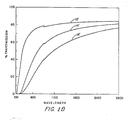
- FIGS. 1A and 1B graphs of in-line transmittance uncorrected for surface reflection losses verses wavelength for samples having three different thickness are shown.
- Table 1 the process parameters for the three samples shown in FIGS. 1A and 1B, as well as, for other samples of the material fabricated in accordance with the present invention.
- Curve 12 is for a sample having a thickness of 0.040 inches
- Curve 14 is for a sample having a thickness of 0.250 inches
- Curve 16 is for a sample having a thickness of 0.375 inches (FIG. 1A).
- the samples had an optical transparency of at least 73% over the wavelength range of 2.5 to 6 microns and at least 60% optical transparency beyond 6.5 microns (FIG. 1A).
- Curve 12' (FIG. 1B) which corresponds to Curve 12 in FIG. 1A shows a percent transmittance of at least 80% between 1.1 and 2.6 microns and at least 70% from 0.6 to 1.1 microns.
- the thicker samples also show significant transparency from 0.6 microns to 6.0 microns in the infrared.
- the yttrium oxide bodies fabricated in accordance with the present invention are substantially pure, that is comprise substantially 99.9% yttrium oxide, the body comprised of yttrium oxide material has a high thermal conductivity and concominant therewith, the yttrium oxide body will have a high thermal shock resistance, compared to yttrium oxide bodies having dopant additives.
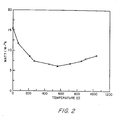
- the thermal conductivity as a function of temperature, as measured for samples of Y2O3 fabricated in accordance with the present invention is shown in Fig.2.
- the Y2O3 is stoichiometric and has a cubic crystal structure.
- the body is sintered only to achieve a closed porosity state (between about 91% to 96% of theoretical density) and accordingly, relatively short periods of time and lower temperatures are used than those required by previous methods which attempted to produce fully dense sintered bodies, the requirement for using a dopant additives to provide fully sintered bodies has been eliminated.
- the use of a W (tungsten) heating element furnace during the sintering cycle is seen as aiding the ability to sinter the material to the closed porosity state without any dopant additives. Furthermore, the W furnace aids in preventing contamination to the Y2O3 by the carbon reducing generally associated with graphite heating elements.
- the yttrium oxide bodies fabricated in accordance with the present techniques are densified at significantly lower temperatures and shorter duration exposure to environments which are believed to increase degradation to the material and increase grain growth.
- material fabricated in accordance with the present invention has an average grain size of about 150 microns or less.
- the calculated coefficient of absorption for material fabricated in accordance with the present invention is less than about 0.1 cm ⁇ 1. This value was derived using the formula below and data in FIG. 1A, Curves 12 and 16, at a wavelength of 4.0 microns.
Landscapes
- Engineering & Computer Science (AREA)
- Chemical & Material Sciences (AREA)
- Ceramic Engineering (AREA)
- Manufacturing & Machinery (AREA)
- Materials Engineering (AREA)
- Structural Engineering (AREA)
- Organic Chemistry (AREA)
- Compositions Of Oxide Ceramics (AREA)
- Glass Compositions (AREA)
Applications Claiming Priority (2)
| Application Number | Priority Date | Filing Date | Title |
|---|---|---|---|
| US07/010,247 US4761390A (en) | 1987-02-02 | 1987-02-02 | Optically transparent yttrium oxide |
| US10247 | 1998-01-21 |
Publications (2)
| Publication Number | Publication Date |
|---|---|
| EP0277811A2 true EP0277811A2 (de) | 1988-08-10 |
| EP0277811A3 EP0277811A3 (de) | 1989-07-12 |
Family
ID=21744793
Family Applications (1)
| Application Number | Title | Priority Date | Filing Date |
|---|---|---|---|
| EP88300874A Withdrawn EP0277811A3 (de) | 1987-02-02 | 1988-02-02 | Optisch durchsichtiges Yttriumoxid |
Country Status (4)
| Country | Link |
|---|---|
| US (1) | US4761390A (de) |
| EP (1) | EP0277811A3 (de) |
| JP (1) | JPS63201061A (de) |
| CA (1) | CA1303825C (de) |
Cited By (7)
| Publication number | Priority date | Publication date | Assignee | Title |
|---|---|---|---|---|
| EP0370824A1 (de) * | 1988-11-25 | 1990-05-30 | Raytheon Company | Verfahren zur Herstellung von optisch transparentem Yttriumoxid |
| EP0385510A1 (de) * | 1989-03-03 | 1990-09-05 | Sumitomo Electric Industries, Ltd. | Verfahren zur Herstellung eines Lichtdurchlässigen, gesinterten Yttriumoxidkörper |
| EP0419847A1 (de) * | 1989-09-25 | 1991-04-03 | General Electric Company | Herstellung sehr einheitlicher polykristalliner Keramik durch Vorsinterung, heissisostatisches Pressen und Sintern der erhaltenen Keramik |
| WO2003004437A1 (en) * | 2001-07-05 | 2003-01-16 | Konoshima Chemical Co., Ltd. | Translucent rare earth oxide sintered article and method for production thereof |
| JP2006089338A (ja) * | 2004-09-24 | 2006-04-06 | Kyocera Corp | 耐食性部材とその製造方法、およびこれを用いた半導体・液晶製造装置用部材 |
| EP1867617A1 (de) * | 2006-06-14 | 2007-12-19 | Schott AG | Optokeramik, daraus hergestellte optische Elemente sowie Abbildungsoptik |
| EP1867618A1 (de) * | 2006-06-14 | 2007-12-19 | Schott AG | Optische Elemente sowie Abbildungsoptik |
Families Citing this family (14)
| Publication number | Priority date | Publication date | Assignee | Title |
|---|---|---|---|---|
| FR2616769B1 (fr) * | 1987-06-17 | 1990-11-30 | Rhone Poulenc Chimie | Procede d'obtention d'un oxyde de terre rare et produit obtenu |
| EP0332393B1 (de) * | 1988-03-09 | 1994-06-22 | Sumitomo Electric Industries, Ltd. | Verfahren zur Herstellung eines lichtdurchlässigen Körpers aus gesintertem Spinell |
| DE3811902A1 (de) * | 1988-04-09 | 1989-10-19 | Winkelstroeter Dentaurum | Verfahren zur herstellung von formkoerpern aus transparentem, polykristallinem aluminiumoxid |
| FR2661904B1 (fr) * | 1990-05-11 | 1993-10-15 | Ceramiques Composites | Composition pour ceramiques et ses procedes d'obtention. |
| CA2088238C (en) * | 1992-01-30 | 1998-08-18 | Masato Oku | Method of manufacturing optical fiber preform |
| US6136736A (en) * | 1993-06-01 | 2000-10-24 | General Electric Company | Doped silica glass |
| US5631522A (en) * | 1995-05-09 | 1997-05-20 | General Electric Company | Low sodium permeability glass |
| CH688297B5 (fr) | 1994-12-16 | 1998-01-30 | Rado Montres Sa | Elément de fermeture transparent et inrayable d'une boîte de montre et boîte de montre munie d'un tel élément. |
| US6796869B1 (en) * | 2000-12-28 | 2004-09-28 | General Electric Company | Ceramic arc tube by annealing |
| JP2003025240A (ja) * | 2001-07-13 | 2003-01-29 | Hitachi Ltd | 特殊締付、緩め工具 |
| JP3974152B2 (ja) * | 2006-01-26 | 2007-09-12 | Towa株式会社 | 低密着性材料、樹脂成形型及び防汚性材料 |
| EP2123615A4 (de) * | 2007-01-17 | 2012-05-09 | Toto Ltd | Keramikelement und korrosionsbeständiges element |
| RU2014123398A (ru) * | 2011-11-10 | 2015-12-20 | Керамтек-Этек Гмбх | Способ изготовления прозрачного керамического предмета при помощи гранулирования в псевдоожиженном слое |
| US9012823B2 (en) * | 2012-07-31 | 2015-04-21 | Raytheon Company | Vehicle having a nanocomposite optical ceramic dome |
Family Cites Families (11)
| Publication number | Priority date | Publication date | Assignee | Title |
|---|---|---|---|---|
| US3545987A (en) * | 1966-09-28 | 1970-12-08 | Gen Electric | Transparent yttria-based ceramics and method for producing same |
| JPS4939885B1 (de) * | 1968-08-19 | 1974-10-29 | ||
| JPS4841681B1 (de) * | 1969-11-21 | 1973-12-07 | ||
| US3640887A (en) * | 1970-04-06 | 1972-02-08 | Gen Electric | Transparent zirconia- hafnia- and thoria-rare earth ceramics |
| US3878280A (en) * | 1970-05-05 | 1975-04-15 | Us Army | Method for production of transparent yttrium oxide |
| JPS536645B2 (de) * | 1972-08-25 | 1978-03-10 | ||
| SU500206A1 (ru) * | 1973-10-18 | 1976-01-25 | Ордена Трудового Красного Знамени Институт Проблем Материаловедения Ан Усср | Высокоогнеупорный электроизол ционный материал |
| SU531795A1 (ru) * | 1975-03-31 | 1976-10-15 | Московский Ордена Ленина И Ордена Трудового Красного Знамени Химикотехнологический Институт Им.Д.И.Менделеева | Способ изготовлени изделий из прозрачной керамики |
| US4098612A (en) * | 1977-07-11 | 1978-07-04 | Gte Laboratories Incorporated | Transparent yttria ceramics and method for producing same |
| US4174973A (en) * | 1979-01-29 | 1979-11-20 | Gte Laboratories Incorporated | Transparent yttria ceramics containing magnesia or magnesium aluminate |
| US4571312A (en) * | 1982-06-18 | 1986-02-18 | General Electric Company | Preparation of yttria-gadolinia ceramic scintillators by sintering and gas hot isostatic pressing |
-
1987
- 1987-02-02 US US07/010,247 patent/US4761390A/en not_active Expired - Lifetime
-
1988
- 1988-01-25 CA CA000557289A patent/CA1303825C/en not_active Expired - Fee Related
- 1988-02-02 JP JP63022676A patent/JPS63201061A/ja active Granted
- 1988-02-02 EP EP88300874A patent/EP0277811A3/de not_active Withdrawn
Cited By (12)
| Publication number | Priority date | Publication date | Assignee | Title |
|---|---|---|---|---|
| EP0370824A1 (de) * | 1988-11-25 | 1990-05-30 | Raytheon Company | Verfahren zur Herstellung von optisch transparentem Yttriumoxid |
| US5004712A (en) * | 1988-11-25 | 1991-04-02 | Raytheon Company | Method of producing optically transparent yttrium oxide |
| EP0385510A1 (de) * | 1989-03-03 | 1990-09-05 | Sumitomo Electric Industries, Ltd. | Verfahren zur Herstellung eines Lichtdurchlässigen, gesinterten Yttriumoxidkörper |
| US5075267A (en) * | 1989-03-03 | 1991-12-24 | Sumitomo Electric Industries, Ltd. | Light transmitting yttria sintered body and its preparation |
| EP0419847A1 (de) * | 1989-09-25 | 1991-04-03 | General Electric Company | Herstellung sehr einheitlicher polykristalliner Keramik durch Vorsinterung, heissisostatisches Pressen und Sintern der erhaltenen Keramik |
| WO2003004437A1 (en) * | 2001-07-05 | 2003-01-16 | Konoshima Chemical Co., Ltd. | Translucent rare earth oxide sintered article and method for production thereof |
| US6825144B2 (en) | 2001-07-05 | 2004-11-30 | Konoshima Chemical Co., Ltd. | Translucent rare earth oxide sintered article and method for production thereof |
| JP2006089338A (ja) * | 2004-09-24 | 2006-04-06 | Kyocera Corp | 耐食性部材とその製造方法、およびこれを用いた半導体・液晶製造装置用部材 |
| EP1867617A1 (de) * | 2006-06-14 | 2007-12-19 | Schott AG | Optokeramik, daraus hergestellte optische Elemente sowie Abbildungsoptik |
| EP1867618A1 (de) * | 2006-06-14 | 2007-12-19 | Schott AG | Optische Elemente sowie Abbildungsoptik |
| US7700510B2 (en) | 2006-06-14 | 2010-04-20 | Schott Ag | Opto-ceramics made from In2O3 or oxides Y, Lu, Sc, Yb, In, Gd, and La, optical elements made therefrom, and mapping optics including the optical elements |
| US7751123B2 (en) | 2006-06-14 | 2010-07-06 | Schott Ag | Optical elements made from ceramics comprising one or more oxides of Y, Sc, in and/or lanthanide elements and mapping optics including the optical elements |
Also Published As
| Publication number | Publication date |
|---|---|
| EP0277811A3 (de) | 1989-07-12 |
| US4761390A (en) | 1988-08-02 |
| CA1303825C (en) | 1992-06-23 |
| JPH0555465B2 (de) | 1993-08-17 |
| JPS63201061A (ja) | 1988-08-19 |
Similar Documents
| Publication | Publication Date | Title |
|---|---|---|
| US4761390A (en) | Optically transparent yttrium oxide | |
| US5004712A (en) | Method of producing optically transparent yttrium oxide | |
| US5244849A (en) | Method for producing transparent polycrystalline body with high ultraviolet transmittance | |
| JP2638669B2 (ja) | セラミック体とその製造方法 | |
| JP4304733B2 (ja) | 多結晶硫化亜鉛光学部品及びその製造方法 | |
| US4273587A (en) | Polycrystalline transparent spinel sintered body and a method for producing the same | |
| JPH06206769A (ja) | 希土類−オキシスルフィドの高密度シンチレーションセラミックの製法及びレントゲンコンピューター断層撮影用セラミック体 | |
| US5001093A (en) | Transparent polycrystalline body with high ultraviolet transmittance | |
| EP0470501B1 (de) | Wärmeleitender gefärbter Aluminiumnitrid-Sinterkörper und Verfahren zu seiner Herstellung | |
| US5770534A (en) | Ceramic composition for absorbing electromagnetic waves and method for manufacturing the same | |
| EP0385510B1 (de) | Verfahren zur Herstellung eines Lichtdurchlässigen, gesinterten Yttriumoxidkörper | |
| US4587067A (en) | Method of manufacturing low thermal expansion modified cordierite ceramics | |
| JP2002234774A (ja) | セラミックス光学部品及びその製造方法 | |
| JPH06211573A (ja) | 透明なy2o3焼結体の製造方法 | |
| US20140364299A1 (en) | Transparent Polycrystalline Ceramic Material | |
| EP0577427B1 (de) | Infrarot übertragender Bariumfluoridkörper und Verfahren zu seiner Herstellung | |
| US4179486A (en) | Method of protecting Si3 N4 ceramic alloy during heating | |
| US3525597A (en) | Transparent zirconia and process for making same | |
| US5502015A (en) | Infrared transmitting barium fluoride sintered body | |
| JP3000685B2 (ja) | 透光性イットリア焼結体及びその製造方法 | |
| EP0447390B1 (de) | Transparenter polykristalliner gegenstand mit erhöhter ultraviolettdurchlässigkeit, verfahren zur herstellung und anwendung | |
| Kim et al. | Farbication of Optically Transparent Lead Magnesium Niobate Polycrystalline Ceramics Using Hot Isostatic Pressing | |
| JP5983525B2 (ja) | 透光性金属酸化物焼結体の製造方法 | |
| CN116178010B (zh) | 一种热光伏系统用波长选择性辐射体及其制备方法 | |
| JPH03257071A (ja) | 遮光性窒化アルミニウム焼結体及びその製造方法 |
Legal Events
| Date | Code | Title | Description |
|---|---|---|---|
| PUAI | Public reference made under article 153(3) epc to a published international application that has entered the european phase |
Free format text: ORIGINAL CODE: 0009012 |
|
| AK | Designated contracting states |
Kind code of ref document: A2 Designated state(s): DE FR GB |
|
| 17P | Request for examination filed |
Effective date: 19880930 |
|
| PUAL | Search report despatched |
Free format text: ORIGINAL CODE: 0009013 |
|
| AK | Designated contracting states |
Kind code of ref document: A3 Designated state(s): DE FR GB |
|
| 17Q | First examination report despatched |
Effective date: 19910820 |
|
| STAA | Information on the status of an ep patent application or granted ep patent |
Free format text: STATUS: THE APPLICATION IS DEEMED TO BE WITHDRAWN |
|
| 18D | Application deemed to be withdrawn |
Effective date: 19940315 |