EP0278024A1 - Device and process for objectively determining and quantitatively measuring the level of interest of test subjects for picture material and parts thereof - Google Patents
Device and process for objectively determining and quantitatively measuring the level of interest of test subjects for picture material and parts thereof Download PDFInfo
- Publication number
- EP0278024A1 EP0278024A1 EP87101762A EP87101762A EP0278024A1 EP 0278024 A1 EP0278024 A1 EP 0278024A1 EP 87101762 A EP87101762 A EP 87101762A EP 87101762 A EP87101762 A EP 87101762A EP 0278024 A1 EP0278024 A1 EP 0278024A1
- Authority
- EP
- European Patent Office
- Prior art keywords
- image
- test
- image material
- computer
- light
- Prior art date
- Legal status (The legal status is an assumption and is not a legal conclusion. Google has not performed a legal analysis and makes no representation as to the accuracy of the status listed.)
- Granted
Links
Images

Classifications
-
- G—PHYSICS
- G09—EDUCATION; CRYPTOGRAPHY; DISPLAY; ADVERTISING; SEALS
- G09B—EDUCATIONAL OR DEMONSTRATION APPLIANCES; APPLIANCES FOR TEACHING, OR COMMUNICATING WITH, THE BLIND, DEAF OR MUTE; MODELS; PLANETARIA; GLOBES; MAPS; DIAGRAMS
- G09B19/00—Teaching not covered by other main groups of this subclass
Definitions
- the present invention relates to a method for objectively ascertaining or quantitatively measuring the level of interest of test persons in submitted image material and its parts, and a device for carrying out this method.
- this method can be used in advertising effectiveness research on advertising materials such as advertisements, images of packs and the like.
- the method and the device are not limited to this, but can also be used in the field of medicine (neurology and psychology) and in the broad area of research into the world of work.
- the present invention is therefore based on the object of improving the known, more or less subjective methods in such a way that one can speak of an objective determination or quantitative measurement of the level of interest of test persons in submitted image material and its parts.
- the aim is to achieve a new quality of results determination and thus of the results themselves, which enables an excellent assessment of analog real conditions.
- the aim of the invention is therefore to provide a method and a device for carrying out the method, with which knowledge can be obtained which serves to check theoretical assumptions of perception psychology by documenting actual perception processes on real objects. This task or the goal are achieved by the in claim 1 characterized method or solved by the device characterized in more detail in claim 10.
- the method according to the invention thus allows not only short-term presentations, such as the existing electrical tachistoscopes, but an actual quantitative measurement of what the test person or the viewer is interested in, what he has looked at in the image material and which parts or elements thereof for him or are of interest to him and which are not, so that this can then be related to the concept behind the design.
- the method according to the invention delivers the following results: conclusions can be drawn about the interest, understanding and attention of test subjects, so that after evaluation has been carried out, corrections can be made to the real advertisement to be placed or the poster actually set up, in order to achieve even higher and better awareness and recognizability for the desired detail or a certain image area or motif.
- a situation is thus created in which visual material, such as advertisements and the like, is presented as a test object to a test person in a precisely defined time, so that they can "perceive" the image information, ie the visual material is illuminated for an extremely short time, so that only one extremely fleeting impression is produced.
- the image material is then darkened in such a way that the test person can no longer extract any further information from the submitted image.
- this test person is now given the possibility, using a movable light source or lighting device, of generating a light cone in order to illuminate those parts or partial aspects of the image which are "of interest” to them. In this way it becomes possible to physically grasp the individual interest or level of interest and thus quantify.
- the time for improved illumination of the desired partial image areas is so short that the test person can only illuminate the coordinate points that are important to them with prominent content.
- the test person executes at a slower speed compared to the very fast, fleeting eye, ie exactly what otherwise happens when "viewing" an advertisement or a poster.
- a plurality of coordinates of the projected light cone surfaces and their duration of stay are digitally recorded by a light-sensitive scanning device or a suitable camera.
- the digitized coordinate and time data are stored in a computer with an interface and can be selected according to the selection criteria.
- This computer or computer can output the stored information numerically and graphically per individual viewer as well as about all viewers or test subjects of an advertisement, as a result of which the focal points of observation, the course of the gaze between them and the length of stay in the main focal points can be reproduced.
- the method and device according to the invention shows that any direct or indirect influence by the test leader or evaluating person is excluded on the basis of the exactly collected data, so that the statistical evaluation according to the invention can be considered objectively unaffected. It should be clear that, on the basis of the ascertained and stored digital data, the statistician or computer scientist as a specialist can readily process and process this data material in order to achieve certain specific statements.
- the system or device for performing the method according to the invention is generally designated 10. It consists of a device 12 for holding and positioning image material 14, which rotates in a plane perpendicular to the axis of the scanning device / camera 18 in front of a test person, not shown, in an interval control by means of a motor 15 on an endless conveyor.
- the image material 14 comprises a so-called test block of twelve displays, in which the test display is contained at a specific point. This test block is presented to each test person absolutely identically. This not only enables an exact recording of what the Test subjects, but also how the viewing and viewing of one ad differs from the other or the rest.
- the number of consecutive ads in the test block is in no way critical, but can be chosen in any frame.
- the displays of the image material 14 are the usual magazine formats. Larger and smaller formats are, however, also conceivable, for example when researching the advertising effectiveness of packs or posters.
- the amount of light falling on the display is regulated for short-term illumination by the lighting devices 16 so that the viewer perceives the display only very imperfectly, but - for rough orientation - in its entirety. Short-term illumination over a period of 0.25 seconds has proven to be particularly suitable. Following this "perception", the image material 14 or the display is darkened by the lighting device 16 in such a way that the metered light intensity is no longer sufficient for the test person to continue recording the image information.
- the test person can then use a movable lighting device 18, in particular a light beam, to illuminate the desired partial image area of the display in an improved manner within the predetermined fixed interval time per image of about 5-7 seconds, i.e. to view the information that interested him or her must also find in order to understand the image information as a whole as a whole.
- the diameter of the light cone has proven to be favorable for displays of approximately 3 cm.
- the lighting device 18 has a handle 19. Both the lighting device 16 and 18 are connected via corresponding lines to a relay control 30 for regulating the lighting and its intensity.
- the Relay control 30 and also motor 15 are connected via interface 25 to computer 24, which controls the entire process.
- the display image with the light spot moving on it - corresponding to the eye-moving light spot - is recorded by a camera / light-sensitive scanner 20 connected to the relay control 30 and the computer 24.
- the camera 20 has or is connected to a digitizing device 22 in order to record the digital acquisition of a plurality of coordinates of the projected light cone surfaces and their duration of stay, as well as the path between the points under consideration.
- the camera (20) is commercially available and can be from the Bosch brand, for example.
- the digitizing device (22) can also be part of the computer (24). The digitizing device converts the video signals from the camera into digital ones and checks the level. It determines how many light points are registered per scanning process.
- the computer 24 with an interface 25 with a screen 28 connected to it and the printers 26 and 27, which are devices from Compaq, Philips, Star, Sekonic, are also commercially available.
- the statistical evaluation of the stored and selected data can then be carried out by numerical and / or graphic printing or by reproduction on the screen 28, the main points of observation, the course of the gaze between them and the length of stay in the main points of observation being determined.
- the computer 24 can output this information numerically and / or graphically per test person as well as about all test persons in an advertisement.
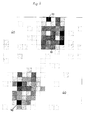
- FIG. 2 for example, such focal points of observation of 27 test persons are shown for an advertisement image, the heavily hatched squares 40 being the actual difficulties represent dots, while the less hatched squares 50 are of less interest to the test subjects and the white areas 60 were not illuminated and were therefore not noticed by the test subjects.
- This objective graphic evaluation shows five observation focal points 40 in the upper right area and in the lower left area of the display, and in the surrounding area there are also such quadrants with interest, which is, however, somewhat smaller (50), while in the upper left and lower right half the Practical white areas 60 indicate that the large number of test subjects saw and felt uninteresting text and / or motif information.
- the person skilled in the art can easily change the size of the quadrants and their number by modifying the stored parameters in order to arrive at coarse, clearer on the one hand and detailed representations on the other hand. It is also conceivable that the quadrants are represented in a circular shape. The diameter of the circles or the edge length of the quadrants can be selected depending on the coordinate density. Certain values can be specified to what density the observations should still be recorded.
- the representation of the gaze course of individual, several or all test subjects poses no problem.
- Fixed points represent the focal points of observation, whereby the order in which the test subjects looked at these focal points is determined. From this, a frequency distribution per focus can easily be displayed. The maximum of this distribution then indicates at which point in time this focus was observed. A number can then be assigned to each focus so that the chronological, graphical linking of these focal points results in a representative gaze course for all test subjects.
- the length of stay in the main points of observation can be shown separately and / or graphically for the individual test subjects based on the determined times or for all of them.
Landscapes
- Business, Economics & Management (AREA)
- Engineering & Computer Science (AREA)
- Entrepreneurship & Innovation (AREA)
- Physics & Mathematics (AREA)
- Educational Administration (AREA)
- Educational Technology (AREA)
- General Physics & Mathematics (AREA)
- Theoretical Computer Science (AREA)
- Illuminated Signs And Luminous Advertising (AREA)
- Investigating Materials By The Use Of Optical Means Adapted For Particular Applications (AREA)
Abstract
Description
Die vorliegende Erfindung betrifft ein Verfahren zum objektiven Ermitteln bzw. quantitativen Messen des Interessenniveaus von Testpersonen an vorgelegtem Bildmaterial und dessen Teilen, sowie eine Vorrichtung zur Durchführung dieses Verfahrens. Insbesondere läßt sich dieses Verfahren bei der Werbewirksamkeitsforschung über Werbematerialien wie Anzeigen, Abbildungen von Packungen und dergleichen anwenden. Es versteht sich jedoch, daß das Verfahren und die Vorrichtung hierauf nicht beschränkt sind, sondern sich auch im Bereich der Medizin (Neurologie und Psychologie) sowie im breiten Bereich der Erforschung der Arbeitswelt anwenden läßt.The present invention relates to a method for objectively ascertaining or quantitatively measuring the level of interest of test persons in submitted image material and its parts, and a device for carrying out this method. In particular, this method can be used in advertising effectiveness research on advertising materials such as advertisements, images of packs and the like. However, it goes without saying that the method and the device are not limited to this, but can also be used in the field of medicine (neurology and psychology) and in the broad area of research into the world of work.
Im Stand der Technik sind verschiedene Verfahren und Vorrichtungen bekannt, die entweder aufgrund ihrer Einfachheit nur sehr unzureichende Aussagen über die Wahrnehmungen von Testpersonen zulassen, oder trotz ihrer Aufwendigkeit noch einen hohen Grad subjektiver Auswertungskriterien enthalten. Das Tachistoskop ermöglicht es z.B., einer Testperson Bilder bzw. Dias nur für eine extrem kurze Zeitspanne zu zeigen, die dann nachfolgend gesteigert wird, um so das Entstehen gewisser Wahrnehmungen zu analysieren. Dieses Verfahren beabsichtigt deutlich zu machen, wo Ursachen für unzureichende oder fehlerhafte Wahrnehmungen liegen. Im Marketingbereich kann man so die Wirkung von Anzeigen, Plakaten, Schaufenstergestaltungen, Inseraten, Prospekten, Verpackungsgestaltungen, Produktwahrnehmungen innerhalb eines Angebotssortiments durch Befragung von Testpersonen analysieren. Der subjektive Charakter dieses Verfahrens steht hier stark im Vordergrund.Various methods and devices are known in the prior art which either allow only very inadequate statements about the perceptions of test persons due to their simplicity, or, despite their complexity, still contain a high degree of subjective evaluation criteria. The tachistoscope makes it possible, for example, to show pictures or slides to a test person only for an extremely short period of time, which is then increased in order to analyze the development of certain perceptions. This procedure intends to make clear where the causes of inadequate or incorrect perceptions lie. In the marketing area, the effects of advertisements, posters, shop window designs, advertisements, brochures, packaging designs, product perceptions within an assortment can be analyzed by interviewing test persons. The subjective character of this procedure is very important here.
Der vorliegenden Erfindung liegt deshalb die Aufgabe zugrunde, die bekannten, mehr oder wenig subjektiven Verfahren derart zu verbessern, daß man von einer objektiven Ermittlung bzw. quantitativem Messen des Interessenniveaus von Testpersonen an vorgelegtem Bildmaterial und dessen Teilen sprechen kann. Es soll also eine neue Qualität der Ergebnisermittlung und somit der Ergebnisse selbst erreicht werden, die eine ausgezeichnete Einschätzung analoger Realverhältnisse ermöglicht. Ziel der Erfindung ist es also, ein Verfahren und eine Vorrichtung zur Durchführung des Verfahrens zu schaffen, mit denen Erkenntnisse gewonnen werden können, die der Überprüfung theoretischer Annahmen der Wahrnehmungspsychologie durch Dokumentierung tatsächlicher Wahrnehmungsvorgänge an realen Objekten dienen.
Diese Aufgabe bzw. das Ziel werden durch das im Anspruch 1 gekennzeichnete Verfahren bzw. durch die im Anspruch 10 näher gekennzeichnete Vorrichtung gelöst.The present invention is therefore based on the object of improving the known, more or less subjective methods in such a way that one can speak of an objective determination or quantitative measurement of the level of interest of test persons in submitted image material and its parts. The aim is to achieve a new quality of results determination and thus of the results themselves, which enables an excellent assessment of analog real conditions. The aim of the invention is therefore to provide a method and a device for carrying out the method, with which knowledge can be obtained which serves to check theoretical assumptions of perception psychology by documenting actual perception processes on real objects.
This task or the goal are achieved by the in claim 1 characterized method or solved by the device characterized in more detail in
Das erfindungsgemäße Verfahren erlaubt also nicht nur kurzzeitige Darbietungen, wie die vorhandenen elektrischen Tachistoskope, sondern eine tatsächliche quantitative Messung dessen, was die Testperson bzw. den Betrachter im einzelnen interessiert, was er sich am Bildmaterial angesehen hat und welche Teile bzw. Elemente davon für sie bzw. für ihn von Interesse sind und welche nicht, so daß dieses dann zu der hinter der Gestaltung stehenden Konzeption in Verbindung gesetzt werden kann. Das erfindungsgemässe Verfahren liefert folgende Ergebnisse:
es lassen sich Rückschlüsse ziehen auf das Interesse, das Verständnis und die Aufmerksamkeit von Testpersonen, so daß nach erfolgter Auswertung ggf. Korrekturen an der real zu schaltenden Anzeige bzw. dem tatsächlich aufgestellten Plakat vorgenommen werden können, um eine noch höhere und bessere Aufmerksamkeit und Erkennbarkeit für das gewünschte Detail bzw. eine bestimmte Bildfläche oder Motiv zu erreichen. Erfindungsgemäß schafft man also eine Situation, in der Bildmaterial, wie Anzeigen und dergleichen, als Testobjekt einer Testperson in einer exakt festgelegten Zeit dargeboten wird, so daß sie die Bildinformation "wahrnehmen" kann, d.h. das Bildmaterial wird extrem kurzfristig ausgeleuchtet, so daß nur ein äußerst flüchtiger Eindruck hervorgerufen wird. Anschließend wird das Bildmaterial derart abgedunkelt, daß die Testperson dem vorgelegten Bild keine weitere Information mehr entnehmen kann. Nunmehr wird erfindungsgemäß dieser Testperson mit Hilfe einer beweglichen Lichtquelle bzw. Beleuchtungsvorrichtung die Möglichkeit gegeben, einen Lichtkegel zu erzeugen, um solche Teile bzw. Teilaspekte des vorgelegten Bildes auszuleuchten, die sie "interessieren". Auf diese Art und Weise wird es möglich, das individuelle Interesse bzw. Interessenniveau physikalisch zu erfassen und somit zu quantifizieren. Die Zeit zum verbesserten Ausleuchten gewünschter partieller Bildflächen ist dabei so kurz bemessen, daß die Testperson nur die für sie wichtigen Koordinatenpunkte mit prominentem Inhalt anleuchten kann. Die Testperson führt hier mit verlangsamter Geschwindigkeit gegenüber dem sehr schnellen, flüchtigen Auge, also genau das aus, was auch sonst beim "normalen" Betrachten einer Anzeige oder eines Plakates geschieht. Gleichzeitig zu diesem Vorgang erfolgt hierzu die digitale Erfassung einer Vielzahl von Koordinaten der projizierten Lichtkegelflächen und ihrer Aufenthaltsdauer durch ein lichtempfindliches Abtastgerät bzw. eine dafür geeignete Kamera. Die digitalisierten Koordinaten- und Zeitdaten werden in einem Computer mit Interface gespeichert und können je nach Auswahlkriterien selektiert werden. Dieser Computer bzw. Rechner kann die gespeicherte Information pro einzelnem Betrachter als auch über alle Betrachter bzw. Testpersonen einer Anzeige zahlenmäßig und grafisch ausgeben, wodurch Beobachtungsschwerpunkte, der Blickverlauf zwischen diesen und die Aufenthaltsdauer in den Beobachtungsschwerpunkten wiedergegeben werden kann. Durch die erfindungsgemäße Registrierung des von der Testperson geführten Lichtkegels wird also die Wirkung visueller Objekte quantitativ messbar, wie die Informationsaufnahme durch die Testperson objektiv deutlich macht, ohne daß Mängel in Kauf genommen werden müssen, die durch subjektive, anschließende Fragestellungen auftreten, die auch das Erinnerungsvermögen der Testpersonen als kritischen Faktor mit einschließen.The method according to the invention thus allows not only short-term presentations, such as the existing electrical tachistoscopes, but an actual quantitative measurement of what the test person or the viewer is interested in, what he has looked at in the image material and which parts or elements thereof for him or are of interest to him and which are not, so that this can then be related to the concept behind the design. The method according to the invention delivers the following results:
conclusions can be drawn about the interest, understanding and attention of test subjects, so that after evaluation has been carried out, corrections can be made to the real advertisement to be placed or the poster actually set up, in order to achieve even higher and better awareness and recognizability for the desired detail or a certain image area or motif. According to the invention, a situation is thus created in which visual material, such as advertisements and the like, is presented as a test object to a test person in a precisely defined time, so that they can "perceive" the image information, ie the visual material is illuminated for an extremely short time, so that only one extremely fleeting impression is produced. The image material is then darkened in such a way that the test person can no longer extract any further information from the submitted image. According to the invention, this test person is now given the possibility, using a movable light source or lighting device, of generating a light cone in order to illuminate those parts or partial aspects of the image which are "of interest" to them. In this way it becomes possible to physically grasp the individual interest or level of interest and thus quantify. The time for improved illumination of the desired partial image areas is so short that the test person can only illuminate the coordinate points that are important to them with prominent content. Here, the test person executes at a slower speed compared to the very fast, fleeting eye, ie exactly what otherwise happens when "viewing" an advertisement or a poster. At the same time as this process, a plurality of coordinates of the projected light cone surfaces and their duration of stay are digitally recorded by a light-sensitive scanning device or a suitable camera. The digitized coordinate and time data are stored in a computer with an interface and can be selected according to the selection criteria. This computer or computer can output the stored information numerically and graphically per individual viewer as well as about all viewers or test subjects of an advertisement, as a result of which the focal points of observation, the course of the gaze between them and the length of stay in the main focal points can be reproduced. By registering the light cone guided by the test person according to the invention, the effect of visual objects can thus be measured quantitatively, as the test person's information acquisition makes objectively clear, without having to accept defects that arise as a result of subjective, subsequent questions that also include memory of the test subjects as a critical factor.
Weitere Vorteile und Merkmale des erfindungsgemäßen Verfahrens sind in den Unteransprüchen beschrieben, die sich auf besonders vorteilhafte Maße, insbesondere Zeit- und oder Längenangaben beziehen.Further advantages and features of the method according to the invention are described in the subclaims, which relate to particularly advantageous dimensions, in particular times and or lengths.
Das erfindungsgemäße Verfahren und Vorrichtung zeigt, daß auf der Basis der exakt erhobenen Daten jede direkte oder indirekte Einflußnahme durch Versuchsleiter oder auswertende Personen ausgeschlossen ist, so daß die statistische Auswertung erfindungsgemäß als objektiv unbeeinflusst gelten kann. Es dürfte einleuchten, daß anhand der ermittelten und gespeicherten digitalen Daten der Statistiker bzw. Informatiker als Fachmann ohne weiteres dieses Datenmaterial be- und verarbeiten können, um bestimmte spezifische Aussagen zu erzielen.The method and device according to the invention shows that any direct or indirect influence by the test leader or evaluating person is excluded on the basis of the exactly collected data, so that the statistical evaluation according to the invention can be considered objectively unaffected. It should be clear that, on the basis of the ascertained and stored digital data, the statistician or computer scientist as a specialist can readily process and process this data material in order to achieve certain specific statements.
Im folgenden wird ein bevorzugtes Ausführungsbeispiel der vorliegenden Erfindung anhand der Zeichnung näher erläutert.A preferred exemplary embodiment of the present invention is explained in more detail below with reference to the drawing.
Es zeigt:
- Fig. 1 eine schematische Ansicht der erfindungsgemäßen Vorrichtung zur Durchführung des erfindungsgemäßen Verfahrens; und
- Fig. 2 eine grafische Darstellung der Beobachtungsschwerpunkte eines Bildes durch eine Vielzahl von Testpersonen.
- Fig. 1 is a schematic view of the device according to the invention for performing the method according to the invention; and
- 2 shows a graphical representation of the focal points of observation of an image by a large number of test persons.
In Fig. 1 ist die Anlage bzw. Vorrichtung zur Durchführung des erfindungsgemäßen Verfahrens allgemein mit 10 bezeichnet. Sie besteht aus einer Vorrichtung 12 zum Halten und Positionieren von Bildmaterial 14, das in einer Ebene senkrecht zur Achse des Abtastgerätes/der Kamera 18 vor einer nicht gezeigten Testperson in Intervallsteuerung mittels eines Motors 15 auf einem Endlosförderer umläuft. Das Bildmaterial 14 umfaßt im vorliegenden Fall einen sog. Testblock von zwölf Anzeigen, bei dem an bestimmter Stelle die Testanzeige enthalten ist. Dieser Testblock wird jeder Testperson im einzelnen absolut identisch vorgeführt. Das ermöglicht nicht nur eine exakte Erfassung dessen, was die Testpersonen gesehen haben, sondern auch, wie sich das Sehen und Betrachten einer Anzeige von der anderen oder den übrigen unterscheidet. Die Anzahl der im Testblock aufeinanderfolgenden Anzeigen ist in keiner Weise kritisch, sondern kann im beliebigen Rahmen gewählt werden. Ebenfalls können gleichzeitig mehrere Testanzeigen auf ihre Werbewirksamkeit innerhalb einer Serie untersucht werden. Vorteilhafterweise handelt es sich bei den Anzeigen des Bildmaterials 14 um übliche Zeitschriftenformate. Größere und kleinere Formate sind jedoch ebenfalls denkbar, beispielsweise bei der Erforschung der Werbewirksamkeit von Packungen oder Plakaten. Die auf die Anzeige fallende Lichtmenge wird dabei zur kurzfristigen Ausleuchtung durch die Beleuchtungsvorrichtungen 16 so reguliert, daß der Betrachter die Anzeige nur sehr unvollkommen, aber - zur groben Orientierung - in seiner Gesamheit wahrnimmt. Als besonders geeignet hat sich hier die kurzfristige Ausleuchtung über einen Zeitraum von 0,25 Sekunden erwiesen. Im Anschluß an diese "Wahrnehmung" wird das Bildmaterial 14 bzw. die Anzeige mittels der Beleuchtungsvorrichtung 16 derart abgedunkelt, daß die dosierte Lichtstärke für die Testperson zur weiteren Aufnahme der Bildinformation nicht mehr ausreicht. Die Testperson kann dann jedoch manuell mit Hilfe einer beweglichen Beleuchtungsvorrichtung 18, insbesondere eines Lichtstrahls, innerhalb der vorgegebenen festen Intervallzeit pro Bild von ca.5 -7 Sekunden gewünschte, partielle Bildfläche der Anzeige verbessert ausleuchten, also die Information betrachten, die sie interessiert hat oder auch auffinden muß, um die Bildinformation überhaupt als Ganzes inhaltlich zu verstehen. Der Durchmesser des Lichtkegels hat sich bei Anzeigen zu etwa 3 cm als günstig erwiesen. Zur besseren Handhabung weist die Beleuchtungsvorrichtung 18 einen Handgriff 19 auf. Sowohl die Beleuchtungsvorrichtung 16 als auch 18 sind über entsprechende Leitungen mit einer Relaissteuerung 30 zur Regelung der Beleuchtung und ihrer Stärke verbunden. Die Relaissteuerung 30 und auch der Motor 15 sind über die Schnittstelle 25 mit dem Computer 24 verbunden, der den gesamten Verfahrensablauf steuert. Das Anzeigenbild mit dem darauf sich - entsprechend dem Auge- bewegenden Lichtpunkt wird durch eine mit der Relaissteuerung 30 und dem Computer 24 verbundene Kamera/lichtempfindliches Abtastgerät 20 aufgenommen. Die Kamera 20 weist eine Digitalisiervorrichtung 22 auf oder ist mit einer solchen verbunden, um die digitale Erfassung einer Vielzahl von Koordinaten der projizierten Lichtkegelflächen und ihrer Aufenthaltsdauer sowie den Weg zwischen den betrachteten Punkten aufzunehmen. Die Kamera (20) ist handelsüblich und kann beispielsweise der Marke Bosch sein.
Die Digitalisiervorrichtung (22) kann auch Bestandteil des Computers (24) sein.
Die Digitalisiervorrichtung setzt die Videosignale der Kamera in digitale um und prüft den Pegel. Sie stellt fest, wieviel Lichtpunkte pro Abtastvorgang registriert werden.In Fig. 1, the system or device for performing the method according to the invention is generally designated 10. It consists of a
The digitizing device (22) can also be part of the computer (24).
The digitizing device converts the video signals from the camera into digital ones and checks the level. It determines how many light points are registered per scanning process.
Handelsüblich ist auch der Computer 24 mit Schnittstelle 25 mit daran angeschlossenem Bildschirm 28 sowie den Druckern 26 und 27, bei denen es sich um Geräte der Firmen Compaq, Philips, Star, Sekonic handelt. Die statistische Auswertung der gespeicherten und selektierten Daten kann dann durch zahlenmäßiges und/oder grafisches Ausdrucken oder durch Wiedergabe auf dem Bildschirm 28 erfolgen, wobei Beobachtungsschwerpunkte, der Blickverlauf zwischen diesen und die Aufenthaltsdauer in den Beobachtungsschwerpunkten ermittelt werden. Der Rechner 24 kann diese Information pro Testperson als auch über alle Testpersonen einer Anzeige zahlenmäßig und/oder grafisch ausgeben.The
In Fig. 2 sind z.B. solche Beobachtungsschwerpunkte von 27 Testpersonen für ein Anzeigenbild dargestellt, wobei die stark schraffierten Quadrate 40 die eigentlichen Schwer punkte darstellen, während die schwächer schraffierten Quadrate 50 von geringerem Interesse bei den Testpersonen sind und die weißen Flächen 60 nicht ausgeleuchtet wurden und somit von den Testpersonen als nicht aufmerksamkeitserregend empfunden wurden.
Diese objektive grafische Auswertung zeigt also im oberen rechten Bereich und im linken unteren Bereich der Anzeige fünf Beobachtungsschwerpunkte 40 sowie im Umfeld darum auch noch solche Quadranten mit Interesse, das jedoch etwas geringer ist (50), während in der linken oberen und rechten unteren Bildhälfte die praktisch weißen Flächen 60 andeuten, daß hier die Vielzahl der Testpersonen uninteressante Text- und/oder Motivangaben gesehen und empfunden haben. Es versteht sich, daß der Computerfachmann ohne weiteres durch Modifizierung der gespeicherten Parameter die Größe der Quadranten und ihre Anzahl verändern kann, um zu groben, übersichtlicheren einerseits und detaillierten Darstellungen andererseits zu gelangen. Auch ist es denkbar, daß die Quadranten in Kreisform abgebildet werden. Der Durchmesser der Kreise bzw. die Kantenläge der Quadranten kann in Abhängigkeit von der Koordinatendichte gewählt werden. Dabei können bestimmte Werte vorgegeben werden, bis zu welcher Dichte die Beobachtungen noch erfaßt werden sollen.In FIG. 2, for example, such focal points of observation of 27 test persons are shown for an advertisement image, the heavily hatched
This objective graphic evaluation shows five observation
Im übrigen bereitet die Darstellung des Blickverlaufs einzelner, mehrerer oder aller Testpersonen kein Problem. Fixpunkte stellen die Beobachtungsschwerpunkte dar, wobei die Reihenfolge festgestellt wird, in welcher die Testpersonen diese Schwerpunkte angeschaut haben. Hieraus kann ohne weiteres eine Häufigkeitsverteilung pro Schwerpunkt dargestellt werden. Das Maximum dieser Verteilung sagt dann aus, an welcher Stelle im zeitlichen Ablauf dieser Schwerpunkt beobachtet wurde. Jedem Schwerpunkt kann dann eine Ziffer zugeordnet werden, so daß dann die chronologische, grafische Verknüpfung dieser Schwerpunkte einen repräsentativen Blickverlauf für alle Testpersonen ergibt. Ferner dürfte es einleuchten, daß auch die Aufenthaltsdauer in den Beobachtungsschwerpunkten anhand der ermittelten Zeitangaben sich für die einzelnen Testpersonen getrennt oder auch für alle gemeinsam zahlenmäßig und/oder grafisch darstellen läßt.In addition, the representation of the gaze course of individual, several or all test subjects poses no problem. Fixed points represent the focal points of observation, whereby the order in which the test subjects looked at these focal points is determined. From this, a frequency distribution per focus can easily be displayed. The maximum of this distribution then indicates at which point in time this focus was observed. A number can then be assigned to each focus so that the chronological, graphical linking of these focal points results in a representative gaze course for all test subjects. Furthermore, it should be clear that the length of stay in the main points of observation can be shown separately and / or graphically for the individual test subjects based on the determined times or for all of them.
Claims (10)
Priority Applications (2)
| Application Number | Priority Date | Filing Date | Title |
|---|---|---|---|
| DE8787101762T DE3771205D1 (en) | 1987-02-09 | 1987-02-09 | METHOD AND DEVICE FOR OBJECTIVE DETERMINATION, OR QUANTITATIVE MEASUREMENTS OF THE INTEREST LEVEL OF TEST PEOPLE ON THE PRESENT IMAGE MATERIAL AND SHARE IT. |
| EP19870101762 EP0278024B1 (en) | 1987-02-09 | 1987-02-09 | Device and process for objectively determining and quantitatively measuring the level of interest of test subjects for picture material and parts thereof |
Applications Claiming Priority (1)
| Application Number | Priority Date | Filing Date | Title |
|---|---|---|---|
| EP19870101762 EP0278024B1 (en) | 1987-02-09 | 1987-02-09 | Device and process for objectively determining and quantitatively measuring the level of interest of test subjects for picture material and parts thereof |
Publications (2)
| Publication Number | Publication Date |
|---|---|
| EP0278024A1 true EP0278024A1 (en) | 1988-08-17 |
| EP0278024B1 EP0278024B1 (en) | 1991-07-03 |
Family
ID=8196736
Family Applications (1)
| Application Number | Title | Priority Date | Filing Date |
|---|---|---|---|
| EP19870101762 Expired - Lifetime EP0278024B1 (en) | 1987-02-09 | 1987-02-09 | Device and process for objectively determining and quantitatively measuring the level of interest of test subjects for picture material and parts thereof |
Country Status (2)
| Country | Link |
|---|---|
| EP (1) | EP0278024B1 (en) |
| DE (1) | DE3771205D1 (en) |
Cited By (1)
| Publication number | Priority date | Publication date | Assignee | Title |
|---|---|---|---|---|
| US8249931B2 (en) | 1999-12-17 | 2012-08-21 | Promovu, Inc. | System for selectively communicating promotional information to a person |
Citations (2)
| Publication number | Priority date | Publication date | Assignee | Title |
|---|---|---|---|---|
| CH130039A (en) * | 1927-01-29 | 1928-11-15 | Adolf Sulger | Advertising machine. |
| FR2448757A1 (en) * | 1979-02-08 | 1980-09-05 | Centre Nat Etd Spatiales | Device reproducing sighting of unidentified flying object - enables witness simultaneously to view original scene and superimposed adjustable reproduction of object |
-
1987
- 1987-02-09 DE DE8787101762T patent/DE3771205D1/en not_active Expired - Fee Related
- 1987-02-09 EP EP19870101762 patent/EP0278024B1/en not_active Expired - Lifetime
Patent Citations (2)
| Publication number | Priority date | Publication date | Assignee | Title |
|---|---|---|---|---|
| CH130039A (en) * | 1927-01-29 | 1928-11-15 | Adolf Sulger | Advertising machine. |
| FR2448757A1 (en) * | 1979-02-08 | 1980-09-05 | Centre Nat Etd Spatiales | Device reproducing sighting of unidentified flying object - enables witness simultaneously to view original scene and superimposed adjustable reproduction of object |
Non-Patent Citations (2)
| Title |
|---|
| ELEKTOR, Band 3, Nr. 10, Oktober 1977, Elektor Publishers Ltd., GB; "Subliminal perception tester" * |
| MEDICAL & BIOLOGICAL ENGINEERING & COMPUTING, Band 22, Nr. 4, Juli 1984, Seiten 353-360, IFMBE, Stevenage, Herts, GB; J.P.J. DE VALK et al.: "Analysis of eye fixations during the diagnostic interpretation of chest radiographs" * |
Cited By (2)
| Publication number | Priority date | Publication date | Assignee | Title |
|---|---|---|---|---|
| US8249931B2 (en) | 1999-12-17 | 2012-08-21 | Promovu, Inc. | System for selectively communicating promotional information to a person |
| US8458032B2 (en) | 1999-12-17 | 2013-06-04 | Promovu, Inc. | System for selectively communicating promotional information to a person |
Also Published As
| Publication number | Publication date |
|---|---|
| DE3771205D1 (en) | 1991-08-08 |
| EP0278024B1 (en) | 1991-07-03 |
Similar Documents
| Publication | Publication Date | Title |
|---|---|---|
| DE19544178B4 (en) | Apparatus for scanning digitizing image templates and method for their operation | |
| DE4403496B4 (en) | Method and device for processing answers to test questions | |
| DE602004008681T2 (en) | Microscope system and procedure | |
| EP1056046B1 (en) | Radiographic image processing method | |
| DE3020687C2 (en) | ||
| DE10034606A1 (en) | Method for providing manufacturing-related data in a series production of manufacturing objects, in particular motor vehicles | |
| EP1263545B1 (en) | Method and device for guiding a laser beam over an object | |
| DE10007705A1 (en) | Method for matching spectacles to potential wearer via Internet, in which wearer records images of themselves wearing reference marker, using digital camera connected to computer and these are transmitted to server | |
| DE2507174A1 (en) | METHOD AND DEVICE FOR GENERATING DIGITAL REPRAESENTATIONS OF AN OBJECT | |
| DE69116543T2 (en) | ARRANGEMENT FOR INTELLIGENCE TEST | |
| EP0278024B1 (en) | Device and process for objectively determining and quantitatively measuring the level of interest of test subjects for picture material and parts thereof | |
| DE8104761U1 (en) | Eye test to test binocular reading ability | |
| EP1983450A2 (en) | Method and device for detecting and providing information about a picture | |
| DE2208063A1 (en) | Microfilm card projection device | |
| EP1300108B1 (en) | Method for obtaining, evaluating and analyzing sequences of vision | |
| DE3603920C2 (en) | ||
| WO1986005374A1 (en) | Process and device for the optical presentation of eyeglass frames | |
| DE19647341C1 (en) | Process and arrangement for the projection and reception of visual and audiovisual messages and their analysis for determining the reach and the behavior of the buyer | |
| DE102017009153A1 (en) | Arrangement and method for inspection of moving plate-shaped objects | |
| DE19538004A1 (en) | Procedure for the rough classification of objects | |
| DE2322773C3 (en) | Display device of a micro image reader | |
| CH679082A5 (en) | ||
| DE10224948A1 (en) | Device and method for examining images | |
| DE2443410B2 (en) | Device for counting microbiological colonies | |
| EP0710883B1 (en) | Method for adding an information carrier to a completed order produced by a photofinisher |
Legal Events
| Date | Code | Title | Description |
|---|---|---|---|
| PUAI | Public reference made under article 153(3) epc to a published international application that has entered the european phase |
Free format text: ORIGINAL CODE: 0009012 |
|
| AK | Designated contracting states |
Kind code of ref document: A1 Designated state(s): AT BE CH DE ES FR GB GR IT LI LU NL SE |
|
| RBV | Designated contracting states (corrected) |
Designated state(s): DE FR GB |
|
| RBV | Designated contracting states (corrected) |
Designated state(s): DE FR GB |
|
| 17P | Request for examination filed |
Effective date: 19880907 |
|
| 17Q | First examination report despatched |
Effective date: 19901130 |
|
| GRAA | (expected) grant |
Free format text: ORIGINAL CODE: 0009210 |
|
| AK | Designated contracting states |
Kind code of ref document: B1 Designated state(s): DE FR GB |
|
| REF | Corresponds to: |
Ref document number: 3771205 Country of ref document: DE Date of ref document: 19910808 |
|
| GBT | Gb: translation of ep patent filed (gb section 77(6)(a)/1977) | ||
| ET | Fr: translation filed | ||
| PLBE | No opposition filed within time limit |
Free format text: ORIGINAL CODE: 0009261 |
|
| STAA | Information on the status of an ep patent application or granted ep patent |
Free format text: STATUS: NO OPPOSITION FILED WITHIN TIME LIMIT |
|
| 26N | No opposition filed | ||
| REG | Reference to a national code |
Ref country code: GB Ref legal event code: IF02 |
|
| PGFP | Annual fee paid to national office [announced via postgrant information from national office to epo] |
Ref country code: DE Payment date: 20030113 Year of fee payment: 17 |
|
| PGFP | Annual fee paid to national office [announced via postgrant information from national office to epo] |
Ref country code: GB Payment date: 20030116 Year of fee payment: 17 |
|
| PGFP | Annual fee paid to national office [announced via postgrant information from national office to epo] |
Ref country code: FR Payment date: 20030218 Year of fee payment: 17 |
|
| PG25 | Lapsed in a contracting state [announced via postgrant information from national office to epo] |
Ref country code: GB Free format text: LAPSE BECAUSE OF NON-PAYMENT OF DUE FEES Effective date: 20040209 |
|
| PG25 | Lapsed in a contracting state [announced via postgrant information from national office to epo] |
Ref country code: DE Free format text: LAPSE BECAUSE OF NON-PAYMENT OF DUE FEES Effective date: 20040901 |
|
| GBPC | Gb: european patent ceased through non-payment of renewal fee |
Effective date: 20040209 |
|
| PG25 | Lapsed in a contracting state [announced via postgrant information from national office to epo] |
Ref country code: FR Free format text: LAPSE BECAUSE OF NON-PAYMENT OF DUE FEES Effective date: 20041029 |
|
| REG | Reference to a national code |
Ref country code: FR Ref legal event code: ST |