EP0278248A2 - Verbundwerkstoff für die Schwingungsdämpfung und Körperschalldämpfung - Google Patents
Verbundwerkstoff für die Schwingungsdämpfung und Körperschalldämpfung Download PDFInfo
- Publication number
- EP0278248A2 EP0278248A2 EP88100437A EP88100437A EP0278248A2 EP 0278248 A2 EP0278248 A2 EP 0278248A2 EP 88100437 A EP88100437 A EP 88100437A EP 88100437 A EP88100437 A EP 88100437A EP 0278248 A2 EP0278248 A2 EP 0278248A2
- Authority
- EP
- European Patent Office
- Prior art keywords
- damping
- composite material
- layers
- material according
- intermediate layer
- Prior art date
- Legal status (The legal status is an assumption and is not a legal conclusion. Google has not performed a legal analysis and makes no representation as to the accuracy of the status listed.)
- Granted
Links
Images
Classifications
-
- B—PERFORMING OPERATIONS; TRANSPORTING
- B32—LAYERED PRODUCTS
- B32B—LAYERED PRODUCTS, i.e. PRODUCTS BUILT-UP OF STRATA OF FLAT OR NON-FLAT, e.g. CELLULAR OR HONEYCOMB, FORM
- B32B15/00—Layered products comprising a layer of metal
- B32B15/04—Layered products comprising a layer of metal comprising metal as the main or only constituent of a layer, which is next to another layer of the same or of a different material
- B32B15/08—Layered products comprising a layer of metal comprising metal as the main or only constituent of a layer, which is next to another layer of the same or of a different material of synthetic resin
-
- B—PERFORMING OPERATIONS; TRANSPORTING
- B32—LAYERED PRODUCTS
- B32B—LAYERED PRODUCTS, i.e. PRODUCTS BUILT-UP OF STRATA OF FLAT OR NON-FLAT, e.g. CELLULAR OR HONEYCOMB, FORM
- B32B15/00—Layered products comprising a layer of metal
- B32B15/18—Layered products comprising a layer of metal comprising iron or steel
-
- F—MECHANICAL ENGINEERING; LIGHTING; HEATING; WEAPONS; BLASTING
- F16—ENGINEERING ELEMENTS AND UNITS; GENERAL MEASURES FOR PRODUCING AND MAINTAINING EFFECTIVE FUNCTIONING OF MACHINES OR INSTALLATIONS; THERMAL INSULATION IN GENERAL
- F16F—SPRINGS; SHOCK-ABSORBERS; MEANS FOR DAMPING VIBRATION
- F16F1/00—Springs
- F16F1/36—Springs made of rubber or other material having high internal friction, e.g. thermoplastic elastomers
- F16F1/40—Springs made of rubber or other material having high internal friction, e.g. thermoplastic elastomers consisting of a stack of similar elements separated by non-elastic intermediate layers
-
- G—PHYSICS
- G10—MUSICAL INSTRUMENTS; ACOUSTICS
- G10K—SOUND-PRODUCING DEVICES; METHODS OR DEVICES FOR PROTECTING AGAINST, OR FOR DAMPING, NOISE OR OTHER ACOUSTIC WAVES IN GENERAL; ACOUSTICS NOT OTHERWISE PROVIDED FOR
- G10K11/00—Methods or devices for transmitting, conducting or directing sound in general; Methods or devices for protecting against, or for damping, noise or other acoustic waves in general
- G10K11/16—Methods or devices for protecting against, or for damping, noise or other acoustic waves in general
- G10K11/162—Selection of materials
- G10K11/168—Plural layers of different materials, e.g. sandwiches
-
- B—PERFORMING OPERATIONS; TRANSPORTING
- B32—LAYERED PRODUCTS
- B32B—LAYERED PRODUCTS, i.e. PRODUCTS BUILT-UP OF STRATA OF FLAT OR NON-FLAT, e.g. CELLULAR OR HONEYCOMB, FORM
- B32B2307/00—Properties of the layers or laminate
- B32B2307/10—Properties of the layers or laminate having particular acoustical properties
- B32B2307/102—Insulating
-
- B—PERFORMING OPERATIONS; TRANSPORTING
- B32—LAYERED PRODUCTS
- B32B—LAYERED PRODUCTS, i.e. PRODUCTS BUILT-UP OF STRATA OF FLAT OR NON-FLAT, e.g. CELLULAR OR HONEYCOMB, FORM
- B32B2307/00—Properties of the layers or laminate
- B32B2307/50—Properties of the layers or laminate having particular mechanical properties
- B32B2307/56—Damping, energy absorption
-
- B—PERFORMING OPERATIONS; TRANSPORTING
- B32—LAYERED PRODUCTS
- B32B—LAYERED PRODUCTS, i.e. PRODUCTS BUILT-UP OF STRATA OF FLAT OR NON-FLAT, e.g. CELLULAR OR HONEYCOMB, FORM
- B32B2311/00—Metals, their alloys or their compounds
- B32B2311/30—Iron, e.g. steel
-
- Y—GENERAL TAGGING OF NEW TECHNOLOGICAL DEVELOPMENTS; GENERAL TAGGING OF CROSS-SECTIONAL TECHNOLOGIES SPANNING OVER SEVERAL SECTIONS OF THE IPC; TECHNICAL SUBJECTS COVERED BY FORMER USPC CROSS-REFERENCE ART COLLECTIONS [XRACs] AND DIGESTS
- Y10—TECHNICAL SUBJECTS COVERED BY FORMER USPC
- Y10T—TECHNICAL SUBJECTS COVERED BY FORMER US CLASSIFICATION
- Y10T428/00—Stock material or miscellaneous articles
- Y10T428/24—Structurally defined web or sheet [e.g., overall dimension, etc.]
- Y10T428/24942—Structurally defined web or sheet [e.g., overall dimension, etc.] including components having same physical characteristic in differing degree
-
- Y—GENERAL TAGGING OF NEW TECHNOLOGICAL DEVELOPMENTS; GENERAL TAGGING OF CROSS-SECTIONAL TECHNOLOGIES SPANNING OVER SEVERAL SECTIONS OF THE IPC; TECHNICAL SUBJECTS COVERED BY FORMER USPC CROSS-REFERENCE ART COLLECTIONS [XRACs] AND DIGESTS
- Y10—TECHNICAL SUBJECTS COVERED BY FORMER USPC
- Y10T—TECHNICAL SUBJECTS COVERED BY FORMER US CLASSIFICATION
- Y10T428/00—Stock material or miscellaneous articles
- Y10T428/24—Structurally defined web or sheet [e.g., overall dimension, etc.]
- Y10T428/24942—Structurally defined web or sheet [e.g., overall dimension, etc.] including components having same physical characteristic in differing degree
- Y10T428/2495—Thickness [relative or absolute]
-
- Y—GENERAL TAGGING OF NEW TECHNOLOGICAL DEVELOPMENTS; GENERAL TAGGING OF CROSS-SECTIONAL TECHNOLOGIES SPANNING OVER SEVERAL SECTIONS OF THE IPC; TECHNICAL SUBJECTS COVERED BY FORMER USPC CROSS-REFERENCE ART COLLECTIONS [XRACs] AND DIGESTS
- Y10—TECHNICAL SUBJECTS COVERED BY FORMER USPC
- Y10T—TECHNICAL SUBJECTS COVERED BY FORMER US CLASSIFICATION
- Y10T428/00—Stock material or miscellaneous articles
- Y10T428/31504—Composite [nonstructural laminate]
- Y10T428/31678—Of metal
Definitions
- the invention relates to a composite material for vibration damping and structure-borne noise damping, in which layers of hard material are connected to one another by a viscoelastic intermediate layer.
- the most suitable plastics also only cover a maximum temperature range of 50 ° C, in which they dampen sufficiently.
- a workable mixture can be produced at all, it behaves like a new, quasi-homogeneous substance with its own damping maximum in its own temperature range T m between the T m values of the starting plastics and with its own, but not fundamentally larger, width of the working areas when measuring the loss factor T u ... T o .
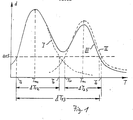
- Composite material III corresponds to the subject of the invention. It behaves like composite I at low temperature.
- the two steel sheets 2 and 3 act there like a thick sheet, because the intermediate layer K 23 indicated there by dashed lines is very hard and not very elastic at this temperature. The damping is brought about by the intermediate layer K 12.
- the associated damping curve is designated I in FIG. 1.
- composite III behaves like composite II.
- the intermediate layer K 23 is now sufficiently viscoelastic and causes sufficient damping of the steel sheets 2 and 3.
- the sheet 1 is attached to this damping system due to the almost fluid and now non-damping intermediate layer K 12 coupled with its mass, whereby it is sufficiently damped.
- the damping of the composite material II is shown in FIG. 1 as curve II against the temperature.
- curve III represents the damping of composite III.
- the materials produced according to this invention are particularly interesting in the embodiment in which the plastics K 12 and K 23 are selected so that they bring favorable damping behavior for adjacent temperature ranges ⁇ T12 and ⁇ T23, as shown in Fig. 1. Then there is a very wide working range, essentially corresponding to the sum ⁇ T12 + ⁇ T23. Embodiments are also possible in which the areas ⁇ T12 and ⁇ T23 are so far apart that the damping characteristic of the material is characterized by two discrete working areas.
- the invention can also be carried out with more than 3 steel sheets or other relatively hard layers and more than 2 plastic layers.
- the intermediate layers are usually considerably thinner than the layers made of hard material.
- the five-layer or multi-layer composite material according to the invention now has a significantly lower bending stiffness B than the three-layer composite material or even than with the same mass Single layer material e.g. B. sheet on; this is especially true in the upper temperature range.
- a higher coincidence cut-off frequency f g and thus a lower airborne sound radiation dimension ⁇ than in the case of equally heavy three-layer composite material or single-layer material.
- a slight damping d is sufficient, especially in the upper temperature range. This is advantageous in that, as experience has shown, especially in the upper temperature range. B. at 70 to 130 ° C, the damping d of the known visco-elastic plastics are below the values of corresponding visco-elastic plastics for the lower temperature range.
- the composite material according to the invention has - as already explained above. It is therefore also suitable for airborne sound insulation measures, e.g. B. Noise encapsulation of machines. Its effect is enhanced when combined with additional airborne sound absorption measures such as. B. the application of sound absorbing coverings.
Landscapes
- Engineering & Computer Science (AREA)
- General Engineering & Computer Science (AREA)
- Architecture (AREA)
- Mechanical Engineering (AREA)
- Physics & Mathematics (AREA)
- Acoustics & Sound (AREA)
- Multimedia (AREA)
- Laminated Bodies (AREA)
- Vibration Prevention Devices (AREA)
- Golf Clubs (AREA)
- Vehicle Interior And Exterior Ornaments, Soundproofing, And Insulation (AREA)
- Soundproofing, Sound Blocking, And Sound Damping (AREA)
Abstract
Description
- Die Erfindung betrifft einen Verbundwerkstoff für die Schwingungsdämpfung und Körperschalldämpfung, bei der Schichten aus hartem Werkstoff durch eine viskoelastische Zwischenschicht miteinander verbunden sind.
- Aus der EP 167 455 ist bekannt, daß die schwingungsdämpfenden Eigenschaften eines Verbundwerkstoffes nur für einen bestimmten Temperaturbereich ausreichend wirksam sind und daß dieser Bereich zu höheren oder niedrigeren Temperaturen verschoben werden kann, wenn als Zwischenschicht zwischen den Metallblechen ein Werkstoff mit bei höheren Temperaturen oder bei niedrigeren Temperaturen liegenden Erweichungsbereich gewählt wird. Der Werkstoff für die Zwischenschicht besteht meist aus Kunststoff oder ähnlichen Stoffen, denen oft auch staubförmige oder faserige Füllstoffe hinzugefügt werden.
- Diese bekannten Verbundwerkstoffe versagen bei Anwendungsfällen, bei denen sowohl sehr niedrige als auch sehr hohe Betriebstemperaturen auftreten.
- Es umfassen auch die am besten geeigneten Kunststoffe nur einen Temperaturbereich von maximal 50 °C, in dem sie ausreichend dämpfen.
- Für Ölwannen von Kraftfahrzeugen wäre aber z. B. ein Bereich von 0 °C bis 130 °C erwünscht.
- Es wurde versucht, einen größeren Arbeitsbereich der Verbundwerkstoffe dadurch zu erreichen, daß verschiedene Kunststoffe mit verschiedenen Arbeitsbereichen gemischt wurden und die Mischung als dämpfende Schicht eingesetzt wurde.
- Dies bringt nicht den gewünschten Erfolg. Sofern überhaupt eine verarbeitbare Mischung hergestellt werden kann, verhält sich diese bei der Verlustfaktormessung wie ein neuer, quasi-homogener Stoff mit eigenem Dämpfungsmaximum in eigener Temperaturlage Tm zwischen den Tm-Werten der Ausgangskunststoffe und mit eigener, jedoch nicht grundsätzliche größerer Breite des Arbeitsbereiche Tu...To.
- Als ungeeignet erweist sich auch der Weg, zwei oder mehrere Kunststoff übereinander geschichtet, etwa als Verbund- bzw. Mehrlagen-Folie - zu verwenden. Ein Grund für das Scheitern dieser Idee kann z. B. sein, daß, wenn zumindest bei höherer Temperatur Mischbarkeit vorliegt, beim Aufschmelzen einer der Einzelschichten sich eine Mischung nach dem vorgenannten Beispiel ergibt, so daß das gewünschte Ziel wiederum nicht erreicht ist. Aber auch im an sich günstigeren Fall, wenn selbst bei höheren Einsatztemperaturen eine Mischung der Verbundschichten nicht eintritt, bleibt der Erfolg insofern aus, als im oberen Temperaturbereich die von der entspreechenden Kunststoffschicht erwartete Dämpfung nicht erreicht wird, weil dann die für die unteren Temperaturen eingesetzte Masse bereits eine so niedrige Viskosität hat, daß sie die für die Umwandlung der Schwingungsenergie in Wärmeenergie notwendige Schubkrafteinleitung in die andere Kunststoffschicht - obgleich diese sich im richtigen rheologischen Zustand befindet - nicht leisten kann.
- Es ist auch meistens nicht möglich, eine über einen sehr großen Temperaturbereich sich erstreckende Dämpfung dadurch zu erreichen, daß zwei Verbundwerkstoffe mit verschiedenen Dämpfungsbereichen gekoppelt werden, um eine Addition beider Bereiche zu erhalten. Eine solche Kopplung wäre z. B. bei einer Maschinenverkleidung denkbar. Es könnte z. B. die Maschinenverkleidung doppelt ausgeführt werden mit einer inneren Verkleidung, die für hohe Temperaturen geeignet ist und einer äußeren Verkleidung, die bei niedrigen Temperaturen dämpft. Eine solche Kombination wäre darüber hinaus wegen der doppelten Ausführung der Maschinenverkleidung schwierig herzustellen.
- Es müßten zwischen beiden Verkleidungen Abstandhalter eingebaut werden, die die Wirkung der Schalldämpfung vermindern. Eine solche Lösung wäre nicht möglich bei PKW-Bodenblechen, Ölwannen und Zylinderkopfhauben. Diese müssen aus Gründen des fehlenden Platzes, der Wärmeleitung und der Herstellung durch z. B. Tiefziehen einwandig ausgeführt werden.
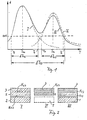
- Es ist deshalb die Aufgabe der vorliegenden Erfindung, einen Verbundwerkstoff zu erhalten, dessen Dämfpungsbereich einen sehr breiten Temperaturbereich oder auch mehrere Temperaturbereiche bei sehr hohen Dämpfungseigenschaften beinhaltet, der wenig Platz beansprucht und der leicht verarbeitbar ist. Diese Aufgabe wird entsprechend dem kennzeichnenden Teil des Anspruches 1 gelöst. Weiterbildungen sind in den Unteransprüchen 2 bis 9 enthalten. Ein Anwendungsbeispiel wird anhand der Fig. 1 und 2 beschrieben.
- Die Fig. 1 enthält die Verlustfaktorkurven in Abhängigkeit von der Temperatur T der in Fig. 2 dargestellten Verbundwerkstoffe I, II und III. Der Verbundwerkstoff III entspricht dem Gegenstand der Erfindung. Er verhält sich bei niedriger Temperatur wie der Verbundwerkstoff I.
- Die beiden Stahlbleche 2 und 3 wirken dort wie ein dickes Blech, weil die dort gestrichelt angedeutete Zwischenschicht K 23 bei dieser Temperatur sehr hart und wenig elastisch ist. Die Dämpfung wird durch die Zwischenschicht K 12 bewirkt.
- Die zugehörige Dämpfungskurve ist in Fig. 1 mit I bezeichnet. Bei erhöhter Temperatur verhält sich die Verbundwerkstoff III wie der Verbundwerkstoff II. Dort ist jetzt die Zwischenschicht K 23 ausreichend viskoelastisch und bewirkt eine ausreichende Dämpfung der Stahlbleche 2 und 3. Das Blech 1 ist an dieses dämpfende System durch die fast flüssige und jetzt nicht dämpfende Zwischenschicht K 12 mit seiner Masse angekoppelt, wodurch es ausreichend mit gedämpft wird. Die Dämpfung des Verbundwerkstoffes II ist in der Fig. 1 als Kurve II über der Temperatur eingezeichnet.
- In der Fig. 1 stellt die Kurve III die Dämpfung des Verbundwerkstoffes III dar.
- Die nach dieser Erfindung hergestellten Werkstoffe sind vor allem in der Ausführungsform interessant, bei der die Kunststoffe K 12 und K 23 so ausgewählt sind, daß sie günstiges Dämpfungsverhalten für benachbarte Temperaturbereich Δ T₁₂ und Δ T₂₃, wie in Fig. 1 dargestellt, einbringen. Dann ergibt sich ein sehr breiter Arbeitsbereich, im wesentlichen entsprechend der Summe Δ T₁₂ + Δ T₂₃. Es sind aber auchh Ausführungsformen möglich, bei denen die Bereiche Δ T₁₂ und Δ T₂₃ so weit auseinanderliegen, daß die Dämpfungscharakteristik des Werkstoffs durch zwei diskrete Arbeitsbereiche gekennzeichnet ist.
- Der Gefahr, daß bei Erreichen des oberen Temperatur-Arbeitsbereiches Δ T₂₃ der für den unteren Temperatur-Arbeitsbereich Δ T₁₂ eingesetzte Kunststoff K 12 wegen starker Verminderung der Viskosität an den Rändern der Verbundtafel austropft, kann - sofern überhaupt notwendig - leicht durch konstruktive Maßnahmen wie z. B. Umbördelungen, Falze, Rollnähte, Schweißpunktfolgen oder Versiegelungen begegnet werden.
- Die Erfindung ist auch mit mehr als 3 Stahlblechen oder anderen relativ harten Schichten und mehr als 2 Kunststoffschichten ausführbar. Es sind z. B. auch 4 Stahlbleche möglich, die von 3 Kunststoffschichten aneinandergehalten werden. Die Zwischenschichten sind in der Regel erheblich dünner als die Schichten aus hartem Werkstoff.
- Wenn der erfindungsgemäße Verbundwerkstoff z. B. zum Kapseln von Maschinen eingesetzt wird, so tritt noch ein weiterer Vorteil durch eine gegenüber herkömmlichem Verbundwerkstoff verminderte Abstrahlung von Schall an die Umgebungsluft auf.
- Der erfindungsgemäße fünf- oder mehrschichtige Verbundwerkstoff weist nun bei gleicher Masse eine deutlich kleinere Biegesteifigkeit B als dreischichtiger Verbundwerkstoff oder gar als Einschichtmaterial z. B. Feinblech auf; dies gilt besonders im oberen Temperaturbereich. Demzufolge ergibt sich eine höhere Koinzidenzgrenzfrequenz fg und damit ein niedrigerers Luftschall-Abstrahlmaß δ als bei gleichschweren dreischichtigem Verbundwerkstoff oder Einschichtmaterial. Um also die gleiche Luftschallpegelminderung wie z. B. bei dreischichtigem Verbundwerkstoff zu erreichen, genügt bei fünf- oder mehrschichtigem Verbundwerkstoff bereits eine geringete Dämpfung d, insbesondere im oberen Tempraturbereich. Dies ist insofern von Vorteil, als erfahrungsgemäß gerade im oberen Temperaturbereich z. B. bei 70 bis 130 °C die Dämpfung d der bekannten viskoelastischen Kunststoffe unter den Werten entsprechender viskoelastischer Kunststoffe für den unteren Temperaturbereich liegen.
- Schließlich sei noch auf einen weiteren Vorzug des erfindungsgemäßen Verbundwerkstoffes hingewiesen. Auch bei Luftschall-Dämmungsmäßnahmen kommt es neben hoher Masse µ auf eine möglichst große Koinzidenzgrenzfrequenz fg an, um Koinzidenzeinbrüche des Schalldämmmaßes R innerhalb des akustisch bedeutsamen Frequenzbereiches von etwa 100 - 3.200 Hz zu vermeiden. Gerade diese Eigenschaft weist aber der erfindungsgemäße fünf- oder mehrschichtige Verbundwerkstoff auf - wie vorangehend bereits erläutert. Er eignet sich daher auch für Luftschall-Dämmungsmäßnahmen, z. B. Lärmschutzkapselungen von Maschinen. Seine Wirkung wird noch verstärkt bei der Kombination mit zusätzlichen Luftschall-Dämpfungsmaßnahmen wie z. B. der Anbringung schallschluckender Beläge.
Claims (9)
Priority Applications (1)
| Application Number | Priority Date | Filing Date | Title |
|---|---|---|---|
| AT88100437T ATE81711T1 (de) | 1987-02-13 | 1988-01-14 | Verbundwerkstoff fuer die schwingungsdaempfung und koerperschalldaempfung. |
Applications Claiming Priority (2)
| Application Number | Priority Date | Filing Date | Title |
|---|---|---|---|
| DE19873704506 DE3704506A1 (de) | 1987-02-13 | 1987-02-13 | Verbundwerkstoff fuer die schwingungsdaempfung und koerperschalldaempfung |
| DE3704506 | 1987-02-13 |
Publications (3)
| Publication Number | Publication Date |
|---|---|
| EP0278248A2 true EP0278248A2 (de) | 1988-08-17 |
| EP0278248A3 EP0278248A3 (en) | 1990-01-17 |
| EP0278248B1 EP0278248B1 (de) | 1992-10-21 |
Family
ID=6320900
Family Applications (1)
| Application Number | Title | Priority Date | Filing Date |
|---|---|---|---|
| EP19880100437 Expired - Lifetime EP0278248B1 (de) | 1987-02-13 | 1988-01-14 | Verbundwerkstoff für die Schwingungsdämpfung und Körperschalldämpfung |
Country Status (6)
| Country | Link |
|---|---|
| US (1) | US4942080A (de) |
| EP (1) | EP0278248B1 (de) |
| JP (1) | JPS63203328A (de) |
| AT (1) | ATE81711T1 (de) |
| DE (2) | DE3704506A1 (de) |
| ES (1) | ES2003319T3 (de) |
Cited By (3)
| Publication number | Priority date | Publication date | Assignee | Title |
|---|---|---|---|---|
| WO1995027975A1 (de) * | 1994-04-06 | 1995-10-19 | Z^¿Db A.S. | Schwingungs- und schalldämpfer |
| EP1034920A1 (de) * | 1999-03-10 | 2000-09-13 | CWW-GERKO Akustik GmbH & Co. KG | Schallschutzkapselung |
| FR3071193A1 (fr) * | 2017-09-20 | 2019-03-22 | Alstom Transport Technologies | Dispositif absorbeur de bruit pour roue de vehicule ferroviaire et roue de vehicule ferroviaire associee |
Families Citing this family (11)
| Publication number | Priority date | Publication date | Assignee | Title |
|---|---|---|---|---|
| DE19640771C1 (de) * | 1996-10-02 | 1998-06-18 | Inst Verbundwerkstoffe Gmbh | Verfahren zur aktiven Einstellung und Regelung von Dämpfungseigenschaften von Kunststoffen durch lokale Wärmeeinbringung |
| WO1998021034A1 (en) | 1996-11-15 | 1998-05-22 | Brigham Young University | Damped composite structures with fiber wave patterns and method and apparatus for making same |
| DE19825083A1 (de) | 1998-06-05 | 1999-12-09 | Basf Ag | Verbundelemente enthaltend kompakte Polyisocyanat-Polyadditionsprodukte |
| DE19914420A1 (de) | 1999-03-30 | 2000-10-05 | Basf Ag | Verbundelemente enthaltend Polyisocyanat-Polyadditionsprodukte |
| DE19953240A1 (de) | 1999-11-04 | 2001-05-10 | Basf Ag | Verbundelemente |
| JP2002082671A (ja) | 2000-09-06 | 2002-03-22 | Nichias Corp | 吸音構造体 |
| US6726957B2 (en) | 2002-08-13 | 2004-04-27 | Van Etten Holdings, Inc. | Thermal insulating and acoustic absorption coating |
| DE112006001022T5 (de) * | 2005-04-26 | 2008-04-17 | Shiloh Industries, Inc., Valley City | Schalldämpfendes Material auf Acrylatbasis und Herstellungsverfahren für dasselbe |
| US7919174B2 (en) * | 2007-07-20 | 2011-04-05 | GM Global Technology Operations LLC | Tailored core laminated sheet metal |
| DE102010042847A1 (de) | 2010-10-25 | 2012-04-26 | Universität Stuttgart | Verbundwerkstoff und Verfahren zum Herstellen eines Verbundwerkstoffs |
| CN103210666B (zh) * | 2010-11-11 | 2016-05-18 | Gn瑞声达A/S | 用于听力设备受话器的悬架、以及制造听力设备的方法、和听力设备 |
Family Cites Families (10)
| Publication number | Priority date | Publication date | Assignee | Title |
|---|---|---|---|---|
| US3058704A (en) * | 1958-01-16 | 1962-10-16 | Johnson & Johnson | Laminated adhesive sheeting for aircraft |
| DE1182862B (de) * | 1962-11-03 | 1964-12-03 | Gruenzweig & Hartmann A G | Element zur kombinierten Koerperschall- und Schwingungsisolierung |
| US4223073A (en) * | 1978-10-30 | 1980-09-16 | Minnesota Mining And Manufacturing Company | High-temperature damping composite |
| US4599261A (en) * | 1984-02-06 | 1986-07-08 | Shell Oil Company | High heat, sound damping metal-polymer laminate |
| JPS6110446A (ja) * | 1984-06-26 | 1986-01-17 | 三井化学株式会社 | 複合積層体 |
| JPS6112334A (ja) * | 1984-06-29 | 1986-01-20 | 川崎製鉄株式会社 | 複合型制振積層体 |
| CA1265426A (en) * | 1984-10-11 | 1990-02-06 | Shuji Kitamura | Vibration-damping material |
| JPS61130041A (ja) * | 1984-11-28 | 1986-06-17 | ポリプラスチックス株式会社 | 寸法安定性の良好な成形品の製造方法 |
| US4756970A (en) * | 1985-02-11 | 1988-07-12 | The Goodyear Tire & Rubber Company | Metallic cable |
| EP0262929B1 (de) * | 1986-10-01 | 1995-01-18 | Mitsui Petrochemical Industries, Ltd. | Amorphe Polyester-Zusammensetzungen und ihre Verwendungen |
-
1987
- 1987-02-13 DE DE19873704506 patent/DE3704506A1/de not_active Ceased
-
1988
- 1988-01-14 EP EP19880100437 patent/EP0278248B1/de not_active Expired - Lifetime
- 1988-01-14 AT AT88100437T patent/ATE81711T1/de not_active IP Right Cessation
- 1988-01-14 DE DE8888100437T patent/DE3875352D1/de not_active Expired - Fee Related
- 1988-01-14 ES ES88100437T patent/ES2003319T3/es not_active Expired - Lifetime
- 1988-02-10 JP JP63027832A patent/JPS63203328A/ja active Pending
-
1989
- 1989-03-06 US US07/318,838 patent/US4942080A/en not_active Expired - Fee Related
Cited By (6)
| Publication number | Priority date | Publication date | Assignee | Title |
|---|---|---|---|---|
| WO1995027975A1 (de) * | 1994-04-06 | 1995-10-19 | Z^¿Db A.S. | Schwingungs- und schalldämpfer |
| AT406098B (de) * | 1994-04-06 | 2000-02-25 | Zdb A S | Schwingungs- und schalldämpfer |
| EP1034920A1 (de) * | 1999-03-10 | 2000-09-13 | CWW-GERKO Akustik GmbH & Co. KG | Schallschutzkapselung |
| FR3071193A1 (fr) * | 2017-09-20 | 2019-03-22 | Alstom Transport Technologies | Dispositif absorbeur de bruit pour roue de vehicule ferroviaire et roue de vehicule ferroviaire associee |
| EP3459760A1 (de) * | 2017-09-20 | 2019-03-27 | ALSTOM Transport Technologies | Lärmabsorptionsvorrichtung für das rad eines schienenfahrzeugs, und entsprechendes schienenfahrzeugrad |
| US10933688B2 (en) | 2017-09-20 | 2021-03-02 | Alstom Transport Technologies | Noise-absorbing device for railway vehicle wheel and associated railway vehicle wheel |
Also Published As
| Publication number | Publication date |
|---|---|
| EP0278248A3 (en) | 1990-01-17 |
| DE3704506A1 (de) | 1988-08-25 |
| EP0278248B1 (de) | 1992-10-21 |
| JPS63203328A (ja) | 1988-08-23 |
| US4942080A (en) | 1990-07-17 |
| DE3875352D1 (de) | 1992-11-26 |
| ES2003319T3 (es) | 1993-04-16 |
| ES2003319A4 (es) | 1988-11-01 |
| ATE81711T1 (de) | 1992-11-15 |
Similar Documents
| Publication | Publication Date | Title |
|---|---|---|
| DE68925053T2 (de) | Schwingungdämmstoffe und ihre Anwendung für Schalldämmstrukturen | |
| EP0278248B1 (de) | Verbundwerkstoff für die Schwingungsdämpfung und Körperschalldämpfung | |
| DE69606568T2 (de) | Beschränktes schwingungsdämpfendes Material | |
| DE3117368C2 (de) | ||
| DE69500914T2 (de) | Verbundstoffstruktur für Dämpfung und entsprechendes Verfahren | |
| DE102012022713B3 (de) | Paneel und Verfahren zur Herstellung eines Paneels | |
| DE3601204A1 (de) | Geraeuschdaemmende verkleidung fuer den motorraum von kraftfahrzeugen | |
| DE102012207365A1 (de) | Mehrschichtiges Bauteil und Verfahren zur Herstellung desselben | |
| DE3834054C2 (de) | ||
| EP2963199A1 (de) | Schalldämmende platte | |
| EP1597442B2 (de) | Zweischalige trennwand mit einer f llung aus mineralwolle | |
| DE19749054C2 (de) | Metallische Flachichtung | |
| DE2604704A1 (de) | Fassadenplatte mit witterungsbestaendiger oberflaechenschicht und verfahren zu ihrer herstellung | |
| EP1428953A1 (de) | Raumbegrenzungs-Paneel | |
| DE2122731A1 (de) | Schwingungsdämpfer- Verbundaufbau | |
| DE102014218379A1 (de) | LWRT-Schichtverbundkörper, Fahrzeugbauteil aus solchem und Fahrzeug mit einem solchen Fahrzeugbauteil | |
| DE3322375A1 (de) | Schall- und waermedaemmende platte und verfahren zu ihrer herstellung | |
| DD157228A1 (de) | Verkleidungselement zur sekundaeren laermreduzierung | |
| DE20203808U1 (de) | Dämmende Außenverkleidung für Fahrzeuge mit Faservliesen | |
| DE2231334B2 (de) | Schalldammende Schicht | |
| DE60315416T2 (de) | Dichtungs- und schalldämpfungsplatte für automobile | |
| DE4334815C2 (de) | Bauteil zur Geräuschdämmung | |
| DE10112156B4 (de) | Leichtbauplatte | |
| EP2429863B1 (de) | Schallabsorbierendes hitzeschild | |
| DE2342557A1 (de) | Verwendung von aus superplastischen legierungen bestehenden blechen |
Legal Events
| Date | Code | Title | Description |
|---|---|---|---|
| PUAI | Public reference made under article 153(3) epc to a published international application that has entered the european phase |
Free format text: ORIGINAL CODE: 0009012 |
|
| AK | Designated contracting states |
Kind code of ref document: A2 Designated state(s): AT BE CH DE ES FR GB IT LI LU NL SE |
|
| GBC | Gb: translation of claims filed (gb section 78(7)/1977) | ||
| ITCL | It: translation for ep claims filed |
Representative=s name: RICCARDI SERGIO & CO. |
|
| TCNL | Nl: translation of patent claims filed | ||
| EL | Fr: translation of claims filed | ||
| PUAL | Search report despatched |
Free format text: ORIGINAL CODE: 0009013 |
|
| AK | Designated contracting states |
Kind code of ref document: A3 Designated state(s): AT BE CH DE ES FR GB IT LI LU NL SE |
|
| 17P | Request for examination filed |
Effective date: 19900302 |
|
| 17Q | First examination report despatched |
Effective date: 19920326 |
|
| GRAA | (expected) grant |
Free format text: ORIGINAL CODE: 0009210 |
|
| AK | Designated contracting states |
Kind code of ref document: B1 Designated state(s): AT BE CH DE ES FR GB IT LI LU NL SE |
|
| REF | Corresponds to: |
Ref document number: 81711 Country of ref document: AT Date of ref document: 19921115 Kind code of ref document: T |
|
| GBT | Gb: translation of ep patent filed (gb section 77(6)(a)/1977) | ||
| REF | Corresponds to: |
Ref document number: 3875352 Country of ref document: DE Date of ref document: 19921126 |
|
| ET | Fr: translation filed | ||
| ITF | It: translation for a ep patent filed | ||
| REG | Reference to a national code |
Ref country code: ES Ref legal event code: FG2A Ref document number: 2003319 Country of ref document: ES Kind code of ref document: T3 |
|
| PLBE | No opposition filed within time limit |
Free format text: ORIGINAL CODE: 0009261 |
|
| STAA | Information on the status of an ep patent application or granted ep patent |
Free format text: STATUS: NO OPPOSITION FILED WITHIN TIME LIMIT |
|
| 26N | No opposition filed | ||
| PGFP | Annual fee paid to national office [announced via postgrant information from national office to epo] |
Ref country code: DE Payment date: 19931211 Year of fee payment: 7 |
|
| PGFP | Annual fee paid to national office [announced via postgrant information from national office to epo] |
Ref country code: GB Payment date: 19931213 Year of fee payment: 7 Ref country code: CH Payment date: 19931213 Year of fee payment: 7 |
|
| PGFP | Annual fee paid to national office [announced via postgrant information from national office to epo] |
Ref country code: BE Payment date: 19931214 Year of fee payment: 7 |
|
| PGFP | Annual fee paid to national office [announced via postgrant information from national office to epo] |
Ref country code: LU Payment date: 19931216 Year of fee payment: 7 |
|
| PGFP | Annual fee paid to national office [announced via postgrant information from national office to epo] |
Ref country code: FR Payment date: 19931221 Year of fee payment: 7 |
|
| PGFP | Annual fee paid to national office [announced via postgrant information from national office to epo] |
Ref country code: SE Payment date: 19931222 Year of fee payment: 7 |
|
| PGFP | Annual fee paid to national office [announced via postgrant information from national office to epo] |
Ref country code: AT Payment date: 19931228 Year of fee payment: 7 |
|
| PGFP | Annual fee paid to national office [announced via postgrant information from national office to epo] |
Ref country code: ES Payment date: 19940120 Year of fee payment: 7 |
|
| EPTA | Lu: last paid annual fee | ||
| PGFP | Annual fee paid to national office [announced via postgrant information from national office to epo] |
Ref country code: NL Payment date: 19940131 Year of fee payment: 7 |
|
| PG25 | Lapsed in a contracting state [announced via postgrant information from national office to epo] |
Ref country code: LU Free format text: LAPSE BECAUSE OF NON-PAYMENT OF DUE FEES Effective date: 19950114 Ref country code: GB Effective date: 19950114 Ref country code: AT Effective date: 19950114 |
|
| PG25 | Lapsed in a contracting state [announced via postgrant information from national office to epo] |
Ref country code: SE Effective date: 19950115 |
|
| PG25 | Lapsed in a contracting state [announced via postgrant information from national office to epo] |
Ref country code: ES Free format text: LAPSE BECAUSE OF NON-PAYMENT OF DUE FEES Effective date: 19950116 |
|
| EAL | Se: european patent in force in sweden |
Ref document number: 88100437.8 |
|
| PG25 | Lapsed in a contracting state [announced via postgrant information from national office to epo] |
Ref country code: LI Effective date: 19950131 Ref country code: CH Effective date: 19950131 Ref country code: BE Effective date: 19950131 |
|
| BERE | Be: lapsed |
Owner name: HOESCH STAHL A.G. Effective date: 19950131 |
|
| PG25 | Lapsed in a contracting state [announced via postgrant information from national office to epo] |
Ref country code: NL Effective date: 19950801 |
|
| GBPC | Gb: european patent ceased through non-payment of renewal fee |
Effective date: 19950114 |
|
| PG25 | Lapsed in a contracting state [announced via postgrant information from national office to epo] |
Ref country code: FR Effective date: 19950929 |
|
| REG | Reference to a national code |
Ref country code: CH Ref legal event code: PL |
|
| NLV4 | Nl: lapsed or anulled due to non-payment of the annual fee |
Effective date: 19950801 |
|
| PG25 | Lapsed in a contracting state [announced via postgrant information from national office to epo] |
Ref country code: DE Effective date: 19951003 |
|
| EUG | Se: european patent has lapsed |
Ref document number: 88100437.8 |
|
| REG | Reference to a national code |
Ref country code: FR Ref legal event code: ST |
|
| REG | Reference to a national code |
Ref country code: ES Ref legal event code: FD2A Effective date: 19990301 |
|
| PG25 | Lapsed in a contracting state [announced via postgrant information from national office to epo] |
Ref country code: IT Free format text: LAPSE BECAUSE OF NON-PAYMENT OF DUE FEES Effective date: 20050114 |