EP0278550B1 - Verfahren und Vorrichtung zum Schneiden von Käselaiben und durch dieses Verfahren erhaltene Schnitten - Google Patents
Verfahren und Vorrichtung zum Schneiden von Käselaiben und durch dieses Verfahren erhaltene Schnitten Download PDFInfo
- Publication number
- EP0278550B1 EP0278550B1 EP88200083A EP88200083A EP0278550B1 EP 0278550 B1 EP0278550 B1 EP 0278550B1 EP 88200083 A EP88200083 A EP 88200083A EP 88200083 A EP88200083 A EP 88200083A EP 0278550 B1 EP0278550 B1 EP 0278550B1
- Authority
- EP
- European Patent Office
- Prior art keywords
- cheese
- cylindrical
- cut
- wedge
- slices
- Prior art date
- Legal status (The legal status is an assumption and is not a legal conclusion. Google has not performed a legal analysis and makes no representation as to the accuracy of the status listed.)
- Expired - Lifetime
Links
- 235000013351 cheese Nutrition 0.000 title claims abstract description 96
- 238000000034 method Methods 0.000 title claims abstract description 21
- 238000005520 cutting process Methods 0.000 claims abstract description 18
- 235000006770 Malva sylvestris Nutrition 0.000 claims abstract description 11
- 240000002129 Malva sylvestris Species 0.000 claims abstract description 10
- 238000006073 displacement reaction Methods 0.000 claims abstract description 3
- 239000000463 material Substances 0.000 claims description 2
- 238000003825 pressing Methods 0.000 claims description 2
- 238000004806 packaging method and process Methods 0.000 claims 1
- 230000005070 ripening Effects 0.000 description 4
- 241000283690 Bos taurus Species 0.000 description 3
- 150000003839 salts Chemical class 0.000 description 3
- QVGXLLKOCUKJST-UHFFFAOYSA-N atomic oxygen Chemical compound [O] QVGXLLKOCUKJST-UHFFFAOYSA-N 0.000 description 2
- 239000000203 mixture Substances 0.000 description 2
- 239000001301 oxygen Substances 0.000 description 2
- 229910052760 oxygen Inorganic materials 0.000 description 2
- 239000007787 solid Substances 0.000 description 2
- 239000002699 waste material Substances 0.000 description 2
- 244000038561 Modiola caroliniana Species 0.000 description 1
- 241000277284 Salvelinus fontinalis Species 0.000 description 1
- 238000009937 brining Methods 0.000 description 1
- 238000009826 distribution Methods 0.000 description 1
- 239000003925 fat Substances 0.000 description 1
- 239000007789 gas Substances 0.000 description 1
- 238000004519 manufacturing process Methods 0.000 description 1
- 235000013622 meat product Nutrition 0.000 description 1
- 239000008267 milk Substances 0.000 description 1
- 210000004080 milk Anatomy 0.000 description 1
- 235000013336 milk Nutrition 0.000 description 1
- 102000004169 proteins and genes Human genes 0.000 description 1
- 108090000623 proteins and genes Proteins 0.000 description 1
- 239000002994 raw material Substances 0.000 description 1
- 235000008983 soft cheese Nutrition 0.000 description 1
- 238000005303 weighing Methods 0.000 description 1
Images

Classifications
-
- B—PERFORMING OPERATIONS; TRANSPORTING
- B26—HAND CUTTING TOOLS; CUTTING; SEVERING
- B26D—CUTTING; DETAILS COMMON TO MACHINES FOR PERFORATING, PUNCHING, CUTTING-OUT, STAMPING-OUT OR SEVERING
- B26D7/00—Details of apparatus for cutting, cutting-out, stamping-out, punching, perforating, or severing by means other than cutting
- B26D7/06—Arrangements for feeding or delivering work of other than sheet, web, or filamentary form
-
- B—PERFORMING OPERATIONS; TRANSPORTING
- B26—HAND CUTTING TOOLS; CUTTING; SEVERING
- B26D—CUTTING; DETAILS COMMON TO MACHINES FOR PERFORATING, PUNCHING, CUTTING-OUT, STAMPING-OUT OR SEVERING
- B26D3/00—Cutting work characterised by the nature of the cut made; Apparatus therefor
- B26D3/24—Cutting work characterised by the nature of the cut made; Apparatus therefor to obtain segments other than slices, e.g. cutting pies
Definitions
- Cheeses are prepared in many forms, usually, however, in a round form. This may be a more or less true sphere, slightly flattened on two sides, such as Edam type cheese, or a flat slice of round circumference, such as Gouda type cheese.
- This regular form is chosen traditionally for ease of handling, but also to obtain as uniform a salt distribution and ripening as possible.
- Angular forms give a higher salt content in the portions near the sharp edges during brining, and also the supply of oxygen and the like gases in the ripening period is stronger near a sharp edge than near a flat or curved surface. Salt and oxygen in that case can reach such a spot from two sides simultaneously.
- a Gouda type cheese mostly has not a true cylindrical form but one in which the cheese is a solid of revolution that is bounded by two flat planes perpendicular to the axis of symmetry.
- a round cheese means a cheese having the form of a solid of revolution, such as an Edam type or Gouda type cheese.
- Cheese used as a sandwich filling is cut into flat slices, starting from a flat or wedge-shaped piece.
- a cheese plane, a blade or a slicer is used for slicing the cheese twice in a plane parallel to a boundary face of the piece of cheese.
- the cheese slices have a uniform thickness of only a few millimeters. An apparatus for thus slicing cheese is described in US-A-2,618,061.
- EP-A-0052409 describes the production of a round cheese having a central opening of round cross section.
- the purpose of this particular method of producing a cheese of deviant form is, on the one hand, to make a cheese that can be easily divided into wedge-shaped pieces and, on the other hand, the quicker ripening that could be achieved due to the central opening.
- This cheese could be cut into slices at the retailer's without slicing loss. As explained above, when the conventional parallel-slicing method is used, it is not possible to slice without loss.
- a drawback of this method of producing cheeses of deviant form is that such a cheese requires special moulds and that the filling of the moulds and the subsequent ripening are standardized less well than with conventional cheese moulds.
- the cheese obtained has a considerably larger rind surface and an appreciably lower weight than a conventional cheese having the same outside dimensions, so that rind losses are higher than with a conventional cheese of the same diameter.
- FR-A-425,236 discloses a process for cutting round cheeses into wedge-shaped portions, wherein a cylindrical portion is cut from the centre of the cheese and the resulting annular piece of cheese is divided into wedge-shaped portions by making cuts extending radially through the central axis of the cheese.
- the cuts are made simultaneously by means of a cutting frame wherein a series of radial cutting wires are provided.
- the number of wedge-shaped portions that can be cut from a cheese is restricted by the number of wires that can be juxtaposed in the centre of the frame. This method moreover is only suitable for soft cheeses having a low cutting resistance. With cheeses having hard rinds, the forces to be exerted on the cutting frame become too high.
- the method according to the present invention is characterized to that end in that the cheese, after cutting away the cylindrical central portion, is divided into at least two pieces, which are each pressed with the face of the cylindrical opening against a semi-cylindrical guide and are rotated around said guide stepwise through a fixed, adjustable angle, while, after each angular displacement, a wedge-shaped slice having a maximum thickness of 5 mm is cut off.
- the cylindrical pieces can be marketed in that form, possibly cut into round slices, perpendicular to the axis of symmetry.
- the remaining ring can subsequently be divided by radial and axial cuts into thin, wedge-shaped slices which are all identical, both in form and in composition.
- the slice cut need not be of zero dimension at the thin end, so that even at the thin end still sufficiently thick sandwich filling is obtained.
- the ratio between the diameter of the cut-out cylinder and the outer circumference of the cheese determines the thickness ratio between the inner and outer edge of the cheese slice. If a smaller difference in thickness is desired, a larger inner cylinder is chosen. Since the quality of the inner cylinder in general is the most uniform one, this inner piece has a good commercial value, in contrast with the edge pieces, which remain in the conventional cheese slicing method. These edge pieces in general can only serve as raw material for process cheese.
- the cutting away of the central cylindrical cheese portion has the advantage that a guide can be provided in the resulting hole, so that the piece of cheese can be driven for rotation around said cylindrical guide.
- the slicing member movable in a plane through the central axis of said cylinder can thus cut off wedge-shaped slices of the desired thickness when the piece of cheese, after each cut, is rotated further through a small angle.
- EP-A-0093217 discloses a method and an apparatus for cutting round cheeses, wherein a cheese is placed on a table drivable stepwise in circumferential direction through a fixed, adjustable angle. During rotation of the table, a series of circular cuts are made in the cheese by means of a stationary cutting frame having a series of cutting edges provided perpendicular to the direction of rotation and the table. After the cheese has rotated through a given angle, a radial cut is made by means of a knife movable perpendicularly to the plane of the table to produce sectorial pieces of cheese, which are subdivided per sector into elongate blocks. The central portion of the cheese is then crumbled to a waste product that is unfit for use, or at least unmarketable.
- the wedge-shaped slices cut according to the present invention may be stacked and packaged, slightly staggered relatively to each other, to a packet of some slices. These packets are easily stackable when the wedge-shaped slices are placed alternately in opposite directions, so that each packet gets a uniform height.
- the present invention also relates to apparatus for slicing cheese, comprising a slicing member movable in a fixed plane.
- a slicing member movable in a fixed plane.
- such an apparatus is provided with a semi-cylindrical guide whose planar surface is located in the plane of movement of the slicing member.
- the apparatus further comprises means for pressing a piece of cheese against the guide, as well as means for rotating the cheese after each cut through a desired angle.
- Such an apparatus is distinct over conventional slicing apparatuses for cheese, meat products and like products substantially in the manner in which the material to be sliced is conducted towards the cutting plane.
- the present invention is not limited to natural cheeses of round form but also process cheese products and imitation cheeses, prepared from fats and/or proteins other than those from milk, can be cut in that manner.
- the slices are cut in general not thinner than 1-0.5 mm. If the central cylinder is cut away to half the diameter of the cheese, the slice at the thick end becomes 2-1 mm in thickness. The cylinder then comprises 1/4 part of the cheese. If the cylinder is chosen at 1/3 of the diameter, the thickness of the slice ranges from 1-0.5 mm to 3-1.5 mm, while the central cylinder forms 1/9 part of the cheese, etc.
- the yield of cheese slices is 96% of the cheese, so that there remain 4% for the central cylindrical pieces. Since these central cylindrical pieces are quite fit for sale, the percentage of waste in the slicing method according to the present invention is 0%.
- the wedge-shaped pieces are conventionally cut to slices which are equally thick throughout the loss in a 25 cm diameter cheese is usually 0.5-1%.
- the half-cheese 1 shown in Fig. 1 having a semi-cylindrical hole rests on a semi-cylindrical guide 2, while at the round side of the cheese, guide means 3, e.g. rolls or a hold-down belt, fix the piece of cheese.
- guide means e.g. rolls or a hold-down belt
- these guide means are preferably constructed in such a manner that even a very thin piece to be divided with the last cut into two slices remains suitably gripped.
- a blade 4 rotatable in a horizontal plane slices a wedge-shaped slice 5 from the one end of the piece of cheese, after which a mechanism 6 for driving the cheese causes this to rotate through a desired angle, so that the next slice is given the correct thickness.
- the cut slices can be collected on a support 7, e.g. a small conveyor belt or weighing device, according to the manner in which the slices are to be further used.
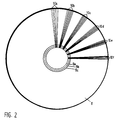
- Fig. 2 shows a number of possibilities of how the round cheese can be divided.
- Cylindrical cuts 9a, b, c show how a larger or a smaller quantity of cheese can be previously removed from the centre.
- Radially and axially extending cuts 10a-f indicate how slices of different thickness can be cut. This varying thickness is realized by displacing the cheese 1 (Fig. 1) with the mechanism 6 after each cut through a larger or smaller angle in the direction of rotation.
- a cheese having a diameter of 250 mm may e.g. be cut into 785 slices of a length of 62.5 mm and a thickness with a minimum of about 0.5 and a maximum of about 1 mm.
- 160 slices can be chosen having a thickness of maximally about 5 mm and minimally about 2.5 mm. The accurate adjustment of the angle through which the cheese is rotated between two cuts enables the operator to realize a fixed weight per slice in case not all cheeses have the same form.
Landscapes
- Life Sciences & Earth Sciences (AREA)
- Forests & Forestry (AREA)
- Engineering & Computer Science (AREA)
- Mechanical Engineering (AREA)
- Dairy Products (AREA)
Claims (4)
Priority Applications (1)
| Application Number | Priority Date | Filing Date | Title |
|---|---|---|---|
| AT88200083T ATE62440T1 (de) | 1987-01-20 | 1988-01-19 | Verfahren und vorrichtung zum schneiden von kaeselaiben und durch dieses verfahren erhaltene schnitten. |
Applications Claiming Priority (2)
| Application Number | Priority Date | Filing Date | Title |
|---|---|---|---|
| NL8700126A NL8700126A (nl) | 1987-01-20 | 1987-01-20 | Werkwijze en inrichting voor het snijden van kaas in plakken, alsmede plakken verkregen onder toepassing van deze werkwijze. |
| NL8700126 | 1987-01-20 |
Publications (2)
| Publication Number | Publication Date |
|---|---|
| EP0278550A1 EP0278550A1 (de) | 1988-08-17 |
| EP0278550B1 true EP0278550B1 (de) | 1991-04-10 |
Family
ID=19849440
Family Applications (1)
| Application Number | Title | Priority Date | Filing Date |
|---|---|---|---|
| EP88200083A Expired - Lifetime EP0278550B1 (de) | 1987-01-20 | 1988-01-19 | Verfahren und Vorrichtung zum Schneiden von Käselaiben und durch dieses Verfahren erhaltene Schnitten |
Country Status (6)
| Country | Link |
|---|---|
| EP (1) | EP0278550B1 (de) |
| AT (1) | ATE62440T1 (de) |
| DE (1) | DE3862310D1 (de) |
| ES (1) | ES2021422B3 (de) |
| GR (1) | GR3002234T3 (de) |
| NL (1) | NL8700126A (de) |
Families Citing this family (6)
| Publication number | Priority date | Publication date | Assignee | Title |
|---|---|---|---|---|
| FR2643303B3 (fr) * | 1989-02-21 | 1991-10-11 | Mecasonic Sa | Procede de decoupage en secteurs de produits circulaires, notamment alimentaires |
| FR2645065B1 (fr) * | 1989-03-29 | 1995-01-13 | Caves Producteurs Reunis | Procede pour trancher en secteurs un produit alimentaire, notamment du type fromage et le dispositif de mise en oeuvre |
| DE19804622A1 (de) * | 1998-02-05 | 1999-08-12 | Alpma Alpenland Masch | Verfahren und Vorrichtung zum Schneiden und Vereinzeln von Segmenten aus einem runden Gegenstand |
| FR2939349B1 (fr) * | 2008-12-05 | 2012-07-06 | Ermatec | Machine de decoupe de produit agro alimentaire |
| ITLI20080014A1 (it) * | 2008-12-15 | 2010-06-16 | Fabrizio Fanelli | Nuovo sistema produttivo nel settore caseario. |
| NL2003091C2 (en) | 2009-06-26 | 2010-06-16 | Westland Kaas Groep B V | Piece of cheese cut from a block, such as a wheel, brick, or ball, and method of and apparatus for preparing the same. |
Family Cites Families (6)
| Publication number | Priority date | Publication date | Assignee | Title |
|---|---|---|---|---|
| FR425236A (fr) * | 1911-01-25 | 1911-06-06 | Carl Klautschke | Appareil à couper le fromage |
| US2618061A (en) * | 1950-03-16 | 1952-11-18 | Beattie Arthur | Manually operated slicing machine |
| US4064990A (en) * | 1976-06-03 | 1977-12-27 | Fox Valley Corporation | Package for wrapping paper |
| US4306474A (en) * | 1980-05-02 | 1981-12-22 | Leesona Corporation | Trim press with oscillating canopy sheet feed |
| NL8006283A (nl) * | 1980-11-18 | 1982-06-16 | Jacob Pieter Huisman | Halfharde of harde kaas met open cilindrische vorm, alsmede werkwijze ter bereiding daarvan. |
| ATE20711T1 (de) * | 1982-04-29 | 1986-08-15 | Urbain Delteil | Verfahren und vorrichtung zum zerschneiden von runden kaese, insbesondere von emmentaler kaese. |
-
1987
- 1987-01-20 NL NL8700126A patent/NL8700126A/nl not_active Application Discontinuation
-
1988
- 1988-01-19 ES ES88200083T patent/ES2021422B3/es not_active Expired - Lifetime
- 1988-01-19 DE DE8888200083T patent/DE3862310D1/de not_active Expired - Lifetime
- 1988-01-19 AT AT88200083T patent/ATE62440T1/de not_active IP Right Cessation
- 1988-01-19 EP EP88200083A patent/EP0278550B1/de not_active Expired - Lifetime
-
1991
- 1991-07-03 GR GR90401150T patent/GR3002234T3/el unknown
Also Published As
| Publication number | Publication date |
|---|---|
| NL8700126A (nl) | 1988-08-16 |
| ES2021422B3 (es) | 1991-11-01 |
| EP0278550A1 (de) | 1988-08-17 |
| DE3862310D1 (de) | 1991-05-16 |
| ATE62440T1 (de) | 1991-04-15 |
| GR3002234T3 (en) | 1992-12-30 |
Similar Documents
| Publication | Publication Date | Title |
|---|---|---|
| EP0322220B1 (de) | Verfahren zur Herstellung eines Nahrungsmittels | |
| AU593552B2 (en) | Technique for producing thin, slice-like portions of cheese | |
| KR950012605B1 (ko) | 바아형 빵을 연속 제조하는 방법 및 장치 | |
| US6477943B2 (en) | Food product and apparatus for making the food product | |
| US4979419A (en) | Apparatus and method for treating baked goods | |
| CA1092887A (en) | Pizza pie and pie making methods | |
| EP0278550B1 (de) | Verfahren und Vorrichtung zum Schneiden von Käselaiben und durch dieses Verfahren erhaltene Schnitten | |
| US20090004357A1 (en) | Methods and Apparatus to Mechanically Reduce Food Products into Irregular Shapes and Sizes | |
| US4813317A (en) | Rotary slicing machine | |
| JPH10179065A (ja) | 麺類の機械製麺法 | |
| EP2352380B1 (de) | Verfahren zur automatisierten massenherstellung von gefrorenen dünnen kebabscheiben | |
| JPH04226890A (ja) | 多重裁断面ブレードを備えた食品スライス装置 | |
| US5765768A (en) | Plate for use on the outlet of a food grinder for making sheets of food | |
| JP2012501640A (ja) | 切断装置 | |
| US4129068A (en) | Citrus slicing apparatus | |
| CA2017643A1 (en) | Firm textured mozzarella/cheddar product | |
| EP0779032A1 (de) | Verfahren und Vorrichtung zur Herstellung von essbaren Partikelmaterial enthaltendem Käse | |
| CN112265034B (zh) | 一种食品加工用素鸡制作装置 | |
| EP0650327B1 (de) | Verbesserungen in oder in beziehung zu keksen | |
| US20020162433A1 (en) | Method and apparatus for separating fleurettes from long-stemmed vegetables having flowery heads | |
| EP0297743A2 (de) | Verfahren und Vorrichtung zum Texturisieren | |
| EP0091981A1 (de) | Verfahren und Vorrichtung zum Zerkleinern von Material | |
| US3917868A (en) | Method of pre-slicing a muffin for easy separation | |
| CN223802636U (zh) | 一种用于食品机械生产的切刀装置 | |
| JP2510112B2 (ja) | あんぱん等の製造方法 |
Legal Events
| Date | Code | Title | Description |
|---|---|---|---|
| PUAI | Public reference made under article 153(3) epc to a published international application that has entered the european phase |
Free format text: ORIGINAL CODE: 0009012 |
|
| AK | Designated contracting states |
Kind code of ref document: A1 Designated state(s): AT BE CH DE ES FR GB GR IT LI LU NL SE |
|
| 17P | Request for examination filed |
Effective date: 19890207 |
|
| 17Q | First examination report despatched |
Effective date: 19890630 |
|
| GRAA | (expected) grant |
Free format text: ORIGINAL CODE: 0009210 |
|
| AK | Designated contracting states |
Kind code of ref document: B1 Designated state(s): AT BE CH DE ES FR GB GR IT LI LU NL SE |
|
| REF | Corresponds to: |
Ref document number: 62440 Country of ref document: AT Date of ref document: 19910415 Kind code of ref document: T |
|
| REF | Corresponds to: |
Ref document number: 3862310 Country of ref document: DE Date of ref document: 19910516 |
|
| ITF | It: translation for a ep patent filed | ||
| ET | Fr: translation filed | ||
| PLBE | No opposition filed within time limit |
Free format text: ORIGINAL CODE: 0009261 |
|
| STAA | Information on the status of an ep patent application or granted ep patent |
Free format text: STATUS: NO OPPOSITION FILED WITHIN TIME LIMIT |
|
| 26N | No opposition filed | ||
| REG | Reference to a national code |
Ref country code: GR Ref legal event code: FG4A Free format text: 3002234 |
|
| PGFP | Annual fee paid to national office [announced via postgrant information from national office to epo] |
Ref country code: LU Payment date: 19930129 Year of fee payment: 6 |
|
| PGFP | Annual fee paid to national office [announced via postgrant information from national office to epo] |
Ref country code: AT Payment date: 19930131 Year of fee payment: 6 |
|
| PGFP | Annual fee paid to national office [announced via postgrant information from national office to epo] |
Ref country code: GR Payment date: 19930201 Year of fee payment: 6 |
|
| PGFP | Annual fee paid to national office [announced via postgrant information from national office to epo] |
Ref country code: GB Payment date: 19930202 Year of fee payment: 6 |
|
| PGFP | Annual fee paid to national office [announced via postgrant information from national office to epo] |
Ref country code: CH Payment date: 19930205 Year of fee payment: 6 |
|
| EPTA | Lu: last paid annual fee | ||
| PG25 | Lapsed in a contracting state [announced via postgrant information from national office to epo] |
Ref country code: LU Free format text: LAPSE BECAUSE OF NON-PAYMENT OF DUE FEES Effective date: 19940119 Ref country code: GB Effective date: 19940119 Ref country code: AT Effective date: 19940119 |
|
| PG25 | Lapsed in a contracting state [announced via postgrant information from national office to epo] |
Ref country code: LI Effective date: 19940131 Ref country code: CH Effective date: 19940131 |
|
| PG25 | Lapsed in a contracting state [announced via postgrant information from national office to epo] |
Ref country code: GR Free format text: THE PATENT HAS BEEN ANNULLED BY A DECISION OF A NATIONAL AUTHORITY Effective date: 19940731 |
|
| GBPC | Gb: european patent ceased through non-payment of renewal fee |
Effective date: 19940119 |
|
| REG | Reference to a national code |
Ref country code: CH Ref legal event code: PL |
|
| REG | Reference to a national code |
Ref country code: GR Ref legal event code: MM2A Free format text: 3002234 |
|
| EAL | Se: european patent in force in sweden |
Ref document number: 88200083.9 |
|
| PGFP | Annual fee paid to national office [announced via postgrant information from national office to epo] |
Ref country code: FR Payment date: 19991130 Year of fee payment: 13 |
|
| PGFP | Annual fee paid to national office [announced via postgrant information from national office to epo] |
Ref country code: SE Payment date: 19991206 Year of fee payment: 13 |
|
| PGFP | Annual fee paid to national office [announced via postgrant information from national office to epo] |
Ref country code: BE Payment date: 19991214 Year of fee payment: 13 |
|
| PGFP | Annual fee paid to national office [announced via postgrant information from national office to epo] |
Ref country code: DE Payment date: 19991230 Year of fee payment: 13 |
|
| PGFP | Annual fee paid to national office [announced via postgrant information from national office to epo] |
Ref country code: ES Payment date: 20000103 Year of fee payment: 13 |
|
| PGFP | Annual fee paid to national office [announced via postgrant information from national office to epo] |
Ref country code: NL Payment date: 20000131 Year of fee payment: 13 |
|
| PG25 | Lapsed in a contracting state [announced via postgrant information from national office to epo] |
Ref country code: SE Free format text: LAPSE BECAUSE OF NON-PAYMENT OF DUE FEES Effective date: 20010120 Ref country code: ES Free format text: LAPSE BECAUSE OF NON-PAYMENT OF DUE FEES Effective date: 20010120 |
|
| PG25 | Lapsed in a contracting state [announced via postgrant information from national office to epo] |
Ref country code: BE Free format text: LAPSE BECAUSE OF NON-PAYMENT OF DUE FEES Effective date: 20010131 |
|
| BERE | Be: lapsed |
Owner name: DMV-CAMPINA B.V. Effective date: 20010131 |
|
| PG25 | Lapsed in a contracting state [announced via postgrant information from national office to epo] |
Ref country code: NL Free format text: LAPSE BECAUSE OF NON-PAYMENT OF DUE FEES Effective date: 20010801 |
|
| EUG | Se: european patent has lapsed |
Ref document number: 88200083.9 |
|
| PG25 | Lapsed in a contracting state [announced via postgrant information from national office to epo] |
Ref country code: FR Free format text: LAPSE BECAUSE OF NON-PAYMENT OF DUE FEES Effective date: 20010928 |
|
| NLV4 | Nl: lapsed or anulled due to non-payment of the annual fee |
Effective date: 20010801 |
|
| PG25 | Lapsed in a contracting state [announced via postgrant information from national office to epo] |
Ref country code: DE Free format text: LAPSE BECAUSE OF NON-PAYMENT OF DUE FEES Effective date: 20011101 |
|
| REG | Reference to a national code |
Ref country code: FR Ref legal event code: ST |
|
| REG | Reference to a national code |
Ref country code: ES Ref legal event code: FD2A Effective date: 20020916 |
|
| PG25 | Lapsed in a contracting state [announced via postgrant information from national office to epo] |
Ref country code: IT Free format text: LAPSE BECAUSE OF NON-PAYMENT OF DUE FEES Effective date: 20050119 |