EP0278629B1 - Amorphe Werkstoffe - Google Patents
Amorphe Werkstoffe Download PDFInfo
- Publication number
- EP0278629B1 EP0278629B1 EP19880300655 EP88300655A EP0278629B1 EP 0278629 B1 EP0278629 B1 EP 0278629B1 EP 19880300655 EP19880300655 EP 19880300655 EP 88300655 A EP88300655 A EP 88300655A EP 0278629 B1 EP0278629 B1 EP 0278629B1
- Authority
- EP
- European Patent Office
- Prior art keywords
- amorphous
- polymer
- metal
- film
- present
- Prior art date
- Legal status (The legal status is an assumption and is not a legal conclusion. Google has not performed a legal analysis and makes no representation as to the accuracy of the status listed.)
- Expired - Lifetime
Links
Images



Classifications
-
- C—CHEMISTRY; METALLURGY
- C23—COATING METALLIC MATERIAL; COATING MATERIAL WITH METALLIC MATERIAL; CHEMICAL SURFACE TREATMENT; DIFFUSION TREATMENT OF METALLIC MATERIAL; COATING BY VACUUM EVAPORATION, BY SPUTTERING, BY ION IMPLANTATION OR BY CHEMICAL VAPOUR DEPOSITION, IN GENERAL; INHIBITING CORROSION OF METALLIC MATERIAL OR INCRUSTATION IN GENERAL
- C23C—COATING METALLIC MATERIAL; COATING MATERIAL WITH METALLIC MATERIAL; SURFACE TREATMENT OF METALLIC MATERIAL BY DIFFUSION INTO THE SURFACE, BY CHEMICAL CONVERSION OR SUBSTITUTION; COATING BY VACUUM EVAPORATION, BY SPUTTERING, BY ION IMPLANTATION OR BY CHEMICAL VAPOUR DEPOSITION, IN GENERAL
- C23C14/00—Coating by vacuum evaporation, by sputtering or by ion implantation of the coating forming material
- C23C14/06—Coating by vacuum evaporation, by sputtering or by ion implantation of the coating forming material characterised by the coating material
-
- C—CHEMISTRY; METALLURGY
- C23—COATING METALLIC MATERIAL; COATING MATERIAL WITH METALLIC MATERIAL; CHEMICAL SURFACE TREATMENT; DIFFUSION TREATMENT OF METALLIC MATERIAL; COATING BY VACUUM EVAPORATION, BY SPUTTERING, BY ION IMPLANTATION OR BY CHEMICAL VAPOUR DEPOSITION, IN GENERAL; INHIBITING CORROSION OF METALLIC MATERIAL OR INCRUSTATION IN GENERAL
- C23C—COATING METALLIC MATERIAL; COATING MATERIAL WITH METALLIC MATERIAL; SURFACE TREATMENT OF METALLIC MATERIAL BY DIFFUSION INTO THE SURFACE, BY CHEMICAL CONVERSION OR SUBSTITUTION; COATING BY VACUUM EVAPORATION, BY SPUTTERING, BY ION IMPLANTATION OR BY CHEMICAL VAPOUR DEPOSITION, IN GENERAL
- C23C14/00—Coating by vacuum evaporation, by sputtering or by ion implantation of the coating forming material
- C23C14/06—Coating by vacuum evaporation, by sputtering or by ion implantation of the coating forming material characterised by the coating material
- C23C14/0623—Sulfides, selenides or tellurides
-
- C—CHEMISTRY; METALLURGY
- C23—COATING METALLIC MATERIAL; COATING MATERIAL WITH METALLIC MATERIAL; CHEMICAL SURFACE TREATMENT; DIFFUSION TREATMENT OF METALLIC MATERIAL; COATING BY VACUUM EVAPORATION, BY SPUTTERING, BY ION IMPLANTATION OR BY CHEMICAL VAPOUR DEPOSITION, IN GENERAL; INHIBITING CORROSION OF METALLIC MATERIAL OR INCRUSTATION IN GENERAL
- C23C—COATING METALLIC MATERIAL; COATING MATERIAL WITH METALLIC MATERIAL; SURFACE TREATMENT OF METALLIC MATERIAL BY DIFFUSION INTO THE SURFACE, BY CHEMICAL CONVERSION OR SUBSTITUTION; COATING BY VACUUM EVAPORATION, BY SPUTTERING, BY ION IMPLANTATION OR BY CHEMICAL VAPOUR DEPOSITION, IN GENERAL
- C23C30/00—Coating with metallic material characterised only by the composition of the metallic material, i.e. not characterised by the coating process
Definitions
- the present invention relates to an amorphous material and, more particularly, to a novel amorphous material comprising a ferromagnetic metal and a polymer.
- Ordinary metals have crystalline structure where atoms are arranged regularly and systematically, but any metal becomes amorphous with disordered atomic arrangement when molten at high temperatures. When metals in the amorphous state are cooled in the usual manner, they return to the original crystalline state. However, some metals, when quenched, solidify in the amorphous state; these are amorphous metals.
- amorphous metals are now utilized in various fields.
- amorphous Si film is used as a solar cell.
- Amorphous FeSiB soft magnetic film and Co-Zr system amorphous soft magnetic film are being developed as magnetic cores for power transformers and magnetic film materials for magnetic heads for magnetic recording, respectively, and are in practical use.
- An elemental metal becomes amorphous only with difficulty and hence, amorphous films of metal are obtained by mixing, in the molten state, the elemental metal with a metalloid element such as C, B, P, Si or Ge or with a metal such as Zr, Ta or Hf, and then quenching the mixture.
- a metalloid element such as C, B, P, Si or Ge or with a metal such as Zr, Ta or Hf
- the characteristics of the thus obtained metal amorphous films vary greatly depending on concentration of the added metalloid element or metal such as Zr, Ta or Hf.
- alloys have improved corrosion resistance and mechanical strength, as compared with crystalline metals, but in the case of, for example, Co-Cr magnetic material, addition of materials for amorphization such as above mentioned metalloid elements or Zr, Ta or Hf cannot provide sufficient amorphous state and/or give enough corrosion resistance.
- the object of the present invention is to provide a novel amorphous material free from the above mentioned defects of the conventional amorphous films and more readily mass-produceable.
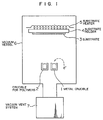
- Figs. 1 and 5 are diagrammatical views of examples of a batch type and continuous type vacuum deposition apparatus used for production of amorphous films of the present invention.
- Figs. 2 (a) and (b) are electron diffraction photographs of the amorphous film of the present invention obtained in Example 1 and a simple film of a control example.
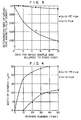
- Fig. 3 is a characteristic graph which shows the change in degree of deterioration of the saturation magnetic flux density with time (days) for which the samples were left in a high temperature and humidity atmosphere.
- Fig. 4 is a characteristic graph which shows the change in width of a scratch on the surface of samples depending on the number of passes of a diamond needle.
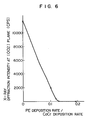
- Fig. 6 is a characteristic graph which shows the change of the X-ray diffraction peak of Co.Cr in the (002) plane when the ratio of vapor deposition rate of polyethylene to that of Co.Cr was changed from 0 to 0.19
- Fig. 7 is a characteristic graph which shows the corresponding change in coercive force in the plane.
- Japanese Patent Examined Publication (Kokoku) No. 3137/82 discloses the production of a magnetic recording medium having a magnetic recording layer formed by simultaneous deposition of a ferromagnetic substance and a polymer on a support by the vapor deposition method.
- the object of the invention disclosed in that patent publication is to solve the defects of the conventional non-binder type ferromagnetic metal films, namely, generation of saw tooth magnetization transfer areas and occurrence of noise and reduction of recording magnetization caused by eddy currents.
- ferromagnetic particles are embedded in the polymer and properly dispersed therein, they behave as single magnetic domain particles and the magnetic characteristics are improved to solve the conventional defects.
- the polymer in that invention functions merely as an insulating material and does not provide amorphous materials as in the present invention.
- a magnetic layer is formed which comprises alternately laminated metal layers and polymer layers and it is impossible to produce a state, as in the present invention, wherein the polymer molecules are relatively uniformly dispersed at intervals very close to each other in the metal.
- an amorphous material comprising a ferromagnetic metal and a polymer which is contained in the metal has not been disclosed in any literature and is novel.
- amorphous material used here includes not only completely amorphous materials, but also materials containing partially crystalline portions in amorphous substance and materials which are crystallite aggregates which cannot be detected by X-ray diffraction.
- a polymer may render amorphous a ferromagnetic metal. Metal becomes amorphous only with difficulty on vacuum deposition of simple metal alone without using polymer.
- the amorphous material of the present invention can be formed as a film on a substance and further can also be used as a mixture prepared by scraping the film from substrate as a powder and mixing it with an appropriate liquid or solid material such as vehicle or binder. In the latter case, the material can be made into shaped products of various forms at a desired time and place by optional means such as coating, spraying or molding.
- the novel amorphous materials of the present invention can be used not only as magnetic materials, solar cells and magnetic cores of power transformers, but also as hydrogen adsorption and desorption metals.
- the amorphous hydrogen adsorption and desorption metals made according to the present invention can be used for construction of power storage systems (i.e., a system for storing hydrogen produced by surplus power in hydrogen adsorption and desorption metal and taking out the hydrogen and converting it to electricity when necessary) or high performance power sources which utilize change in hydrogen pressure, or high efficiency heat storage systems which utilize emission and adsorption of heat at the time of adsorption and desorption of hydrogen.
- the amorphous material of the present invention can be employed for other uses (e.g., amorphous devices, solid image-taking elements) and besides for various uses (e.g., super-conductive materials) in which amorphous materials can suitably be used.
- various ferromagnetic metals can be very easily made amorphous by simultaneous vacuum deposition of a metal and a polymer.
- the method for producing amorphous material according to the present invention is constitutionally simpler than any conventional method and apparatus per se used therefore is very simple and the practice and operation are also easy.
- the amorphous material of the present invention can also be produced by simultaneous sputtering of ferromagnetic metal and polymer.
- Metals usable for production of the amorphous material of the present invention are the ferromagnetic metals of the 2nd, 3rd, 4th, 5th and 6th Periods in the Periodic Table. These may be used in the form of the simple substance, alloy or compound.
- Polymers usable for the production of amorphous materials of the present invention are linear or network polymers having 10-100, preferably 30-500, more preferably 70-200 carbon atoms.
- polyethylene polyethylene terephthalate, polypropylene, polystyrene, polytetrafluoroethylene, polybutadiene, polycarbonate, polyamide, polyimide, polyurethane, polyvinyl chloride, polyvinyl acetate and silicone polymer.
- the mixing ratio of metal and polymer is generally such that polymer is at least 5 vol%, preferably at least 10 vol%, more preferably 12-40 vol%.
- amount of polymer is less than 5 vol% the metal cannot be made amorphous.
- more than 40 vol% the metal particle are significantly separated from each other due to the polymer and magnetic characteristics gradually become harder. This is not desired.
- amorphous film was prepared by simultaneous vacuum deposition of Co.Cr and polyethylene using a batch type vacuum deposition apparatus as shown in Fig. 1 under the following conditions.
- 1 and 2 are crucibles for metal and polymer, respectively, 3 is a substrate, 4 is a substrate holder, 5 is a heater for heating the substrate, 6 is a vacuum vessel and 7 is a vacuum vent system.
- Co.Cr was vapor deposited by electron gun heating and polyethylene was deposited by resistance heating. Thickness of the deposited film was 0.16 ⁇ m. Concentration of Cr for Co in the deposited film was 16 wt%.
- a Co.Cr simple film was prepared under the same conditions as above except that a degree of vacuum of 1 ⁇ 2x133.322x10 ⁇ 6 Pa (1 ⁇ 2 x 10 ⁇ 6 Torr) was employed.
- Electron diffraction patterns of the Co.Cr + polyethylene film of the present invention and the control Co.Cr simple film are shown in Fig. 2 (a) and (b), respectively.
- the Co.Cr. + polyethylene film of the present invention was amorphous while the control Co.Cr simple film remained crystalline.
- the amorphous Co.Cr + polyethylene film of the present invention had soft magnetic properties.
- Corrosion resistance was determined by allowing the films to stand in a high temperature and high humidity atmosphere of 60°C and 90%RH for 10 days and measuring deterioration rate (Bs'/Bso) of saturation magnetic flux density.
- Bso is a saturation magnetic flux density before exposure to the high temperature and high humidity atmosphere
- Bs' is a saturation magnetic flux density after exposure to said atmosphere.
- the saturation magnetic flux density was measured by a vibrating sample magnometer. The results are shown in Fig. 3.
- the Co.Cr + polyethylene film of the present invention was hardly corroded even when it was exposed to high temperature and high humidity atmosphere for a long time as compared with the control Co.Cr simple film and thus it will be seen that the film of the present invention is superior in corrosion resistance.
- width of the scratch on the Co.Cr + polyethylene film of the present invention was narrower than that of the scratch on the control Co.Cr simple film and thus is superior in mechanical endurance.
- Amorphous films were prepared by simultaneous vapor deposition of metal and polymer by the continuous type vapor deposition apparatus as shown in Fig. 5 under the following conditions.
- 8 is a crucible for metal
- 9 is crucible for polymer
- 10 is a substrate film
- 11 is a can roller
- 12 is a delivery roller
- 13 is an windup roll
- 14 is a mask.
- the metal was vapor deposited by electron gun heating and the polymer was vapor deposited by resistance heating. Thickness of the deposited film was 10 ⁇ m.
- the polyimide film was a continuous film of 100 m and the amorphous film was deposited along the whole length of the film. Thus, there were obtained two samples of a film of 100 m long having an amorphous film comprising Fe-PE and a film of 100 m long having an amorphous film comprising Co-PE.
- the values of coercive force and anisotropic magnetic field are those measured in the plane.
- the values shown in the Table are averages of those obtained on the 100 specimens.
- the Co-PE amorphous and Fe-PE amorphous film of the present invention both showed soft magnetic properties. These properties were very stable along the length of 100 m, namely, ⁇ 5% for Bs, ⁇ 20% for Hc and ⁇ 15% for Hk.
- Upper limit of vapor deposition rate in the Co-PE system is preferably such that which satisfies PE deposition rate/Co deposition rate ⁇ 0.4. When it exceeds 0.4, Co particles are remotely separated from each other by PE and magnetic properties become harder, resulting in unfavorable effects.
- the ratio of vapor deposition rate of polyethylene to that of Co ⁇ Cr is desirably at least 0.1 from the point of magnetic properties and at least 0.05 from the point of crystal state according to X-ray diffraction.
- novel amorphous material consisting of a ferromagnetic metal and 5 to 40 vol% of a polymer is obtained.
- the novel amorphous material of the present invention can be shaped not only to a film, but also to products of various forms and thus can be employed for a wide variety of uses as compared with conventional amorphous materials composed of only metals.
- the amorphous material of the present invention can be produced by a novel method which comprises simultaneous vacuum deposition of a metal or metalloid and a polymer at a specific ratio of deposition rate. According to the present method, useful amorphous materials can be mass-produced easily, in high yields and at markedly low costs as compared with the conventional various methods for production of amorphous metals.
Landscapes
- Chemical & Material Sciences (AREA)
- Chemical Kinetics & Catalysis (AREA)
- Engineering & Computer Science (AREA)
- Materials Engineering (AREA)
- Mechanical Engineering (AREA)
- Metallurgy (AREA)
- Organic Chemistry (AREA)
- Thin Magnetic Films (AREA)
- Physical Vapour Deposition (AREA)
- Photovoltaic Devices (AREA)
- Silicon Compounds (AREA)
Claims (9)
- Amorphes Material, das aus einem Metall und 5 bis 40 Vol.-% eines Polymers besteht, wobei das Polymer im Metall verteilt ist und das Metall unter den ferromagnetischen Metallen der zweiten, dritten, vierten, fünften und sechsten Perioden im Periodischen System gewählt ist.
- Material nach Anspruch 1, wobei das Polymer 10-1000 Kohlenstoffatome enthält.
- Material nach Anspruch 2, wobei das Polymer 30-500 Kohlenstoffatome enthält.
- Material nach irgendeinem der Ansprüche 1 bis 3, das 5 bis 40 Vol.-% des Polymers aufweist.
- Material nach irgendeinem der Ansprüche 1 bis 4, wobei das Polymer unter Polyethylen, Polyethylenterephthalat, Polypropylen, Polystyrol, Polytetrafluorethylen, Polybutadien, Polykarbonat, Polyamid, Polyimid, Polyurethan, Polyvinylchlorid, Polyvinylacetat und Siliconpolymer und Mischungen davon gewählt ist.
- Material nach irgendeinem der Ansprüche 1 bis 5, wobei das ferromagnetische Metall unter Fe, Co, Fe-Legierung und Co-Legierung und Mischungen davon gewählt ist.
- Verfahren zur Herstellung eines amorphen Materials nach Anspruch 1, welches Verfahren eine gleichzeitige Vakuumabscheidung oder -zerstäubung des Metalls und des Polymers vorsieht.
- Verfahren nach Anspruch 7, wobei das ferromagnetische Metall in der Form eines einfachen Stoffes, einer Legierung oder einer Verbindung ist.
- Verfahren nach Anspruch 7 oder Anspruch 8 zur Herstellung eines Materials nach irgendeinem der Ansprüche 2 bis 6.
Applications Claiming Priority (2)
| Application Number | Priority Date | Filing Date | Title |
|---|---|---|---|
| JP18631/87 | 1987-01-30 | ||
| JP1863187A JPS63186844A (ja) | 1987-01-30 | 1987-01-30 | 非晶質性材料 |
Publications (2)
| Publication Number | Publication Date |
|---|---|
| EP0278629A1 EP0278629A1 (de) | 1988-08-17 |
| EP0278629B1 true EP0278629B1 (de) | 1993-05-12 |
Family
ID=11976964
Family Applications (1)
| Application Number | Title | Priority Date | Filing Date |
|---|---|---|---|
| EP19880300655 Expired - Lifetime EP0278629B1 (de) | 1987-01-30 | 1988-01-27 | Amorphe Werkstoffe |
Country Status (3)
| Country | Link |
|---|---|
| EP (1) | EP0278629B1 (de) |
| JP (1) | JPS63186844A (de) |
| DE (1) | DE3880852T2 (de) |
Families Citing this family (10)
| Publication number | Priority date | Publication date | Assignee | Title |
|---|---|---|---|---|
| EP0826434B1 (de) * | 1996-07-31 | 2004-06-16 | Istituto Nazionale Di Fisica Nucleare | Verfahren und Vorrichtung zur Herstellung von dünnen Filmen aus Polymeren oder Verbundmaterialien auf verschiedenen Substraten |
| GB9712483D0 (en) | 1997-06-17 | 1997-08-20 | Kathirgamanathan Poopathy | Fabrication of light emitting devices from chelates of transition metals, lanthanides and actinides |
| GB9823761D0 (en) | 1998-11-02 | 1998-12-23 | South Bank Univ Entpr Ltd | Novel electroluminescent materials |
| GB9826405D0 (en) * | 1998-12-02 | 1999-01-27 | South Bank Univ Entpr Ltd | Method for forming films or layers |
| GB9826407D0 (en) | 1998-12-02 | 1999-01-27 | South Bank Univ Entpr Ltd | Novel electroluminescent materials |
| GB9901971D0 (en) | 1999-02-01 | 1999-03-17 | South Bank Univ Entpr Ltd | Electroluminescent material |
| GB0109755D0 (en) | 2001-04-20 | 2001-06-13 | Elam T Ltd | Devices incorporating mixed metal organic complexes |
| TWI303533B (en) | 2001-06-15 | 2008-11-21 | Oled T Ltd | Electroluminescent devices |
| GB0116644D0 (en) | 2001-07-09 | 2001-08-29 | Elam T Ltd | Electroluminescent materials and devices |
| US7303824B2 (en) | 2001-08-04 | 2007-12-04 | Oled-T Limited | Electroluminescent device |
Family Cites Families (1)
| Publication number | Priority date | Publication date | Assignee | Title |
|---|---|---|---|---|
| JPS573137B2 (de) * | 1974-03-13 | 1982-01-20 |
-
1987
- 1987-01-30 JP JP1863187A patent/JPS63186844A/ja active Pending
-
1988
- 1988-01-27 EP EP19880300655 patent/EP0278629B1/de not_active Expired - Lifetime
- 1988-01-27 DE DE19883880852 patent/DE3880852T2/de not_active Expired - Fee Related
Also Published As
| Publication number | Publication date |
|---|---|
| JPS63186844A (ja) | 1988-08-02 |
| EP0278629A1 (de) | 1988-08-17 |
| DE3880852T2 (de) | 1993-12-23 |
| DE3880852D1 (de) | 1993-06-17 |
Similar Documents
| Publication | Publication Date | Title |
|---|---|---|
| Chaudhari et al. | Structure and properties of metallic glasses | |
| EP0265246B1 (de) | Magnetische Eisenoxydfilme und ihre Herstellung | |
| EP0278629B1 (de) | Amorphe Werkstoffe | |
| WO1996026305A1 (en) | Method for producing uniaxial tetragonal thin films of ternary intermetallic compounds | |
| Sugita et al. | Co-Cr perpendicular recording medium by vacuum deposition | |
| US4663193A (en) | Process for manufacturing magnetic recording medium | |
| US5154983A (en) | Magnetic alloy | |
| JPS6329330B2 (de) | ||
| US4645690A (en) | Method of manufacturing a magnetic media | |
| US5059337A (en) | Soft magnetic materials comprising 9 to 15 atomic percent carbon atoms | |
| EP0187169B1 (de) | Verfahren zur Herstellung von magnetischen Aufzeichnungsträgern und die Träger | |
| Masui et al. | Formation of amorphous Al-transition metal (TM: Fe, Co, Ni) binary alloy films by RF-sputtering | |
| Nakagawa et al. | Low temperature deposition of c-axis oriented Sr-ferrite thin films prepared by facing targets sputtering with mixture gas of Ar and Kr | |
| US4840845A (en) | Magnetic recording medium having perpendicular magnetic anisotropy | |
| EP0262224B1 (de) | Magnetisches aufnahmemedium | |
| JPH0234536A (ja) | 非晶質性材料 | |
| JPH053048B2 (de) | ||
| JPS6330691B2 (de) | ||
| JPS61184726A (ja) | 磁気記録媒体の製造方法 | |
| JPH0337724B2 (de) | ||
| Gomi et al. | Preparation of homogeneous Mn‐X‐Bi (X= Cu, Ni) thin films by rf sputtering | |
| JPH0311531B2 (de) | ||
| JPS61278033A (ja) | 磁気記録媒体の製造方法 | |
| JPS6250449A (ja) | 非晶質合金及びその製造法 | |
| JPS6367326B2 (de) |
Legal Events
| Date | Code | Title | Description |
|---|---|---|---|
| PUAI | Public reference made under article 153(3) epc to a published international application that has entered the european phase |
Free format text: ORIGINAL CODE: 0009012 |
|
| AK | Designated contracting states |
Kind code of ref document: A1 Designated state(s): DE GB |
|
| 17P | Request for examination filed |
Effective date: 19881216 |
|
| 17Q | First examination report despatched |
Effective date: 19900409 |
|
| GRAA | (expected) grant |
Free format text: ORIGINAL CODE: 0009210 |
|
| AK | Designated contracting states |
Kind code of ref document: B1 Designated state(s): DE GB |
|
| REF | Corresponds to: |
Ref document number: 3880852 Country of ref document: DE Date of ref document: 19930617 |
|
| REG | Reference to a national code |
Ref country code: GB Ref legal event code: IF02 |
|
| PGFP | Annual fee paid to national office [announced via postgrant information from national office to epo] |
Ref country code: GB Payment date: 20060125 Year of fee payment: 19 |
|
| PGFP | Annual fee paid to national office [announced via postgrant information from national office to epo] |
Ref country code: DE Payment date: 20060321 Year of fee payment: 19 |
|
| PG25 | Lapsed in a contracting state [announced via postgrant information from national office to epo] |
Ref country code: DE Free format text: LAPSE BECAUSE OF NON-PAYMENT OF DUE FEES Effective date: 20070801 |
|
| GBPC | Gb: european patent ceased through non-payment of renewal fee |
Effective date: 20070127 |
|
| PG25 | Lapsed in a contracting state [announced via postgrant information from national office to epo] |
Ref country code: GB Free format text: LAPSE BECAUSE OF NON-PAYMENT OF DUE FEES Effective date: 20070127 |
|
| PLBE | No opposition filed within time limit |
Free format text: ORIGINAL CODE: 0009261 |
|
| STAA | Information on the status of an ep patent application or granted ep patent |
Free format text: STATUS: NO OPPOSITION FILED WITHIN TIME LIMIT |