EP0279626A2 - Plattenförmige Magnetit- und Maghemitpartikeln und Verfahren zu deren Herstellung - Google Patents
Plattenförmige Magnetit- und Maghemitpartikeln und Verfahren zu deren Herstellung Download PDFInfo
- Publication number
- EP0279626A2 EP0279626A2 EP88301270A EP88301270A EP0279626A2 EP 0279626 A2 EP0279626 A2 EP 0279626A2 EP 88301270 A EP88301270 A EP 88301270A EP 88301270 A EP88301270 A EP 88301270A EP 0279626 A2 EP0279626 A2 EP 0279626A2
- Authority
- EP
- European Patent Office
- Prior art keywords
- particles
- plate
- magnetite
- aqueous solution
- feco3
- Prior art date
- Legal status (The legal status is an assumption and is not a legal conclusion. Google has not performed a legal analysis and makes no representation as to the accuracy of the status listed.)
- Granted
Links
- 239000002245 particle Substances 0.000 title claims abstract description 173
- SZVJSHCCFOBDDC-UHFFFAOYSA-N iron(II,III) oxide Inorganic materials O=[Fe]O[Fe]O[Fe]=O SZVJSHCCFOBDDC-UHFFFAOYSA-N 0.000 title claims abstract description 61
- JEIPFZHSYJVQDO-UHFFFAOYSA-N iron(III) oxide Inorganic materials O=[Fe]O[Fe]=O JEIPFZHSYJVQDO-UHFFFAOYSA-N 0.000 title claims abstract description 38
- 238000000034 method Methods 0.000 title claims description 38
- 230000008569 process Effects 0.000 title claims description 20
- 239000007864 aqueous solution Substances 0.000 claims description 47
- 239000000243 solution Substances 0.000 claims description 32
- 229910000015 iron(II) carbonate Inorganic materials 0.000 claims description 28
- BAUYGSIQEAFULO-UHFFFAOYSA-L iron(2+) sulfate (anhydrous) Chemical compound [Fe+2].[O-]S([O-])(=O)=O BAUYGSIQEAFULO-UHFFFAOYSA-L 0.000 claims description 27
- 239000003513 alkali Substances 0.000 claims description 25
- BVKZGUZCCUSVTD-UHFFFAOYSA-L Carbonate Chemical compound [O-]C([O-])=O BVKZGUZCCUSVTD-UHFFFAOYSA-L 0.000 claims description 22
- 238000010438 heat treatment Methods 0.000 claims description 16
- 230000005291 magnetic effect Effects 0.000 claims description 16
- 150000003839 salts Chemical class 0.000 claims description 13
- 239000002253 acid Substances 0.000 claims description 11
- 125000001931 aliphatic group Chemical group 0.000 claims description 10
- 239000003973 paint Substances 0.000 claims description 10
- 238000007254 oxidation reaction Methods 0.000 claims description 8
- 239000006096 absorbing agent Substances 0.000 claims description 2
- 239000007789 gas Substances 0.000 description 21
- 229910052595 hematite Inorganic materials 0.000 description 17
- 239000011019 hematite Substances 0.000 description 17
- LIKBJVNGSGBSGK-UHFFFAOYSA-N iron(3+);oxygen(2-) Chemical compound [O-2].[O-2].[O-2].[Fe+3].[Fe+3] LIKBJVNGSGBSGK-UHFFFAOYSA-N 0.000 description 17
- XEEYBQQBJWHFJM-UHFFFAOYSA-N iron Substances [Fe] XEEYBQQBJWHFJM-UHFFFAOYSA-N 0.000 description 14
- 230000001590 oxidative effect Effects 0.000 description 14
- 238000006243 chemical reaction Methods 0.000 description 13
- 230000000052 comparative effect Effects 0.000 description 12
- 229910052598 goethite Inorganic materials 0.000 description 12
- AEIXRCIKZIZYPM-UHFFFAOYSA-M hydroxy(oxo)iron Chemical compound [O][Fe]O AEIXRCIKZIZYPM-UHFFFAOYSA-M 0.000 description 12
- 238000002156 mixing Methods 0.000 description 11
- 238000002441 X-ray diffraction Methods 0.000 description 9
- CDBYLPFSWZWCQE-UHFFFAOYSA-L Sodium Carbonate Chemical compound [Na+].[Na+].[O-]C([O-])=O CDBYLPFSWZWCQE-UHFFFAOYSA-L 0.000 description 8
- 238000000576 coating method Methods 0.000 description 8
- 239000011248 coating agent Substances 0.000 description 7
- UQSXHKLRYXJYBZ-UHFFFAOYSA-N Iron oxide Chemical compound [Fe]=O UQSXHKLRYXJYBZ-UHFFFAOYSA-N 0.000 description 6
- 229960004887 ferric hydroxide Drugs 0.000 description 6
- IEECXTSVVFWGSE-UHFFFAOYSA-M iron(3+);oxygen(2-);hydroxide Chemical compound [OH-].[O-2].[Fe+3] IEECXTSVVFWGSE-UHFFFAOYSA-M 0.000 description 6
- 239000000463 material Substances 0.000 description 6
- 238000012856 packing Methods 0.000 description 6
- XLYOFNOQVPJJNP-UHFFFAOYSA-N water Substances O XLYOFNOQVPJJNP-UHFFFAOYSA-N 0.000 description 6
- 238000003917 TEM image Methods 0.000 description 5
- 238000000635 electron micrograph Methods 0.000 description 5
- 239000010419 fine particle Substances 0.000 description 5
- 239000011148 porous material Substances 0.000 description 5
- 239000011347 resin Substances 0.000 description 5
- 229920005989 resin Polymers 0.000 description 5
- NLJMYIDDQXHKNR-UHFFFAOYSA-K sodium citrate Chemical compound O.O.[Na+].[Na+].[Na+].[O-]C(=O)CC(O)(CC([O-])=O)C([O-])=O NLJMYIDDQXHKNR-UHFFFAOYSA-K 0.000 description 5
- 230000032683 aging Effects 0.000 description 4
- 239000011790 ferrous sulphate Substances 0.000 description 4
- 235000003891 ferrous sulphate Nutrition 0.000 description 4
- 229910000359 iron(II) sulfate Inorganic materials 0.000 description 4
- 239000006247 magnetic powder Substances 0.000 description 4
- 230000005415 magnetization Effects 0.000 description 4
- 238000004519 manufacturing process Methods 0.000 description 4
- 229910000029 sodium carbonate Inorganic materials 0.000 description 4
- 235000017550 sodium carbonate Nutrition 0.000 description 4
- 239000000725 suspension Substances 0.000 description 4
- 230000005540 biological transmission Effects 0.000 description 3
- KRKNYBCHXYNGOX-UHFFFAOYSA-N citric acid Chemical compound OC(=O)CC(O)(C(O)=O)CC(O)=O KRKNYBCHXYNGOX-UHFFFAOYSA-N 0.000 description 3
- 230000000694 effects Effects 0.000 description 3
- 230000003647 oxidation Effects 0.000 description 3
- 239000000843 powder Substances 0.000 description 3
- 239000012266 salt solution Substances 0.000 description 3
- VEXZGXHMUGYJMC-UHFFFAOYSA-N Hydrochloric acid Chemical compound Cl VEXZGXHMUGYJMC-UHFFFAOYSA-N 0.000 description 2
- PXHVJJICTQNCMI-UHFFFAOYSA-N Nickel Chemical compound [Ni] PXHVJJICTQNCMI-UHFFFAOYSA-N 0.000 description 2
- FEWJPZIEWOKRBE-UHFFFAOYSA-N Tartaric acid Natural products [H+].[H+].[O-]C(=O)C(O)C(O)C([O-])=O FEWJPZIEWOKRBE-UHFFFAOYSA-N 0.000 description 2
- 239000000654 additive Substances 0.000 description 2
- 230000000996 additive effect Effects 0.000 description 2
- 239000012736 aqueous medium Substances 0.000 description 2
- 239000002585 base Substances 0.000 description 2
- 239000003086 colorant Substances 0.000 description 2
- 229910021506 iron(II) hydroxide Inorganic materials 0.000 description 2
- NCNCGGDMXMBVIA-UHFFFAOYSA-L iron(ii) hydroxide Chemical compound [OH-].[OH-].[Fe+2] NCNCGGDMXMBVIA-UHFFFAOYSA-L 0.000 description 2
- 239000000203 mixture Substances 0.000 description 2
- 239000007800 oxidant agent Substances 0.000 description 2
- 239000004033 plastic Substances 0.000 description 2
- BWHMMNNQKKPAPP-UHFFFAOYSA-L potassium carbonate Chemical compound [K+].[K+].[O-]C([O-])=O BWHMMNNQKKPAPP-UHFFFAOYSA-L 0.000 description 2
- 239000012488 sample solution Substances 0.000 description 2
- 238000001878 scanning electron micrograph Methods 0.000 description 2
- 239000011975 tartaric acid Substances 0.000 description 2
- 235000002906 tartaric acid Nutrition 0.000 description 2
- ATRRKUHOCOJYRX-UHFFFAOYSA-N Ammonium bicarbonate Chemical compound [NH4+].OC([O-])=O ATRRKUHOCOJYRX-UHFFFAOYSA-N 0.000 description 1
- IJGRMHOSHXDMSA-UHFFFAOYSA-N Atomic nitrogen Chemical compound N#N IJGRMHOSHXDMSA-UHFFFAOYSA-N 0.000 description 1
- 238000004438 BET method Methods 0.000 description 1
- FEWJPZIEWOKRBE-JCYAYHJZSA-N Dextrotartaric acid Chemical compound OC(=O)[C@H](O)[C@@H](O)C(O)=O FEWJPZIEWOKRBE-JCYAYHJZSA-N 0.000 description 1
- 239000011358 absorbing material Substances 0.000 description 1
- 238000010521 absorption reaction Methods 0.000 description 1
- 150000007513 acids Chemical class 0.000 description 1
- 230000002776 aggregation Effects 0.000 description 1
- 238000004220 aggregation Methods 0.000 description 1
- 239000001099 ammonium carbonate Substances 0.000 description 1
- 235000012501 ammonium carbonate Nutrition 0.000 description 1
- QVGXLLKOCUKJST-UHFFFAOYSA-N atomic oxygen Chemical compound [O] QVGXLLKOCUKJST-UHFFFAOYSA-N 0.000 description 1
- NGPGDYLVALNKEG-UHFFFAOYSA-N azanium;azane;2,3,4-trihydroxy-4-oxobutanoate Chemical compound [NH4+].[NH4+].[O-]C(=O)C(O)C(O)C([O-])=O NGPGDYLVALNKEG-UHFFFAOYSA-N 0.000 description 1
- 239000011230 binding agent Substances 0.000 description 1
- 238000007664 blowing Methods 0.000 description 1
- 239000001058 brown pigment Substances 0.000 description 1
- 150000004649 carbonic acid derivatives Chemical class 0.000 description 1
- 230000008859 change Effects 0.000 description 1
- 150000001875 compounds Chemical class 0.000 description 1
- 238000007796 conventional method Methods 0.000 description 1
- 239000013078 crystal Substances 0.000 description 1
- 230000018044 dehydration Effects 0.000 description 1
- 238000006297 dehydration reaction Methods 0.000 description 1
- JCCYXJAEFHYHPP-OLXYHTOASA-L dilithium;(2r,3r)-2,3-dihydroxybutanedioate Chemical compound [Li+].[Li+].[O-]C(=O)[C@H](O)[C@@H](O)C([O-])=O JCCYXJAEFHYHPP-OLXYHTOASA-L 0.000 description 1
- 229910001873 dinitrogen Inorganic materials 0.000 description 1
- 239000006185 dispersion Substances 0.000 description 1
- 238000005516 engineering process Methods 0.000 description 1
- 230000005294 ferromagnetic effect Effects 0.000 description 1
- 229960002089 ferrous chloride Drugs 0.000 description 1
- 238000011049 filling Methods 0.000 description 1
- 230000004907 flux Effects 0.000 description 1
- 230000006872 improvement Effects 0.000 description 1
- 239000011261 inert gas Substances 0.000 description 1
- 229910052742 iron Inorganic materials 0.000 description 1
- NMCUIPGRVMDVDB-UHFFFAOYSA-L iron dichloride Chemical compound Cl[Fe]Cl NMCUIPGRVMDVDB-UHFFFAOYSA-L 0.000 description 1
- YOBAEOGBNPPUQV-UHFFFAOYSA-N iron;trihydrate Chemical compound O.O.O.[Fe].[Fe] YOBAEOGBNPPUQV-UHFFFAOYSA-N 0.000 description 1
- 229940071264 lithium citrate Drugs 0.000 description 1
- WJSIUCDMWSDDCE-UHFFFAOYSA-K lithium citrate (anhydrous) Chemical compound [Li+].[Li+].[Li+].[O-]C(=O)CC(O)(CC([O-])=O)C([O-])=O WJSIUCDMWSDDCE-UHFFFAOYSA-K 0.000 description 1
- 239000000696 magnetic material Substances 0.000 description 1
- 239000006249 magnetic particle Substances 0.000 description 1
- 229910052751 metal Inorganic materials 0.000 description 1
- 239000002184 metal Substances 0.000 description 1
- 150000002739 metals Chemical class 0.000 description 1
- 239000011259 mixed solution Substances 0.000 description 1
- 229910052759 nickel Inorganic materials 0.000 description 1
- 239000001301 oxygen Substances 0.000 description 1
- 229910052760 oxygen Inorganic materials 0.000 description 1
- 239000000049 pigment Substances 0.000 description 1
- AVTYONGGKAJVTE-OLXYHTOASA-L potassium L-tartrate Chemical compound [K+].[K+].[O-]C(=O)[C@H](O)[C@@H](O)C([O-])=O AVTYONGGKAJVTE-OLXYHTOASA-L 0.000 description 1
- 229910000027 potassium carbonate Inorganic materials 0.000 description 1
- 235000011181 potassium carbonates Nutrition 0.000 description 1
- 239000001508 potassium citrate Substances 0.000 description 1
- 229960002635 potassium citrate Drugs 0.000 description 1
- QEEAPRPFLLJWCF-UHFFFAOYSA-K potassium citrate (anhydrous) Chemical compound [K+].[K+].[K+].[O-]C(=O)CC(O)(CC([O-])=O)C([O-])=O QEEAPRPFLLJWCF-UHFFFAOYSA-K 0.000 description 1
- 235000011082 potassium citrates Nutrition 0.000 description 1
- -1 potassium ferricyanide Chemical compound 0.000 description 1
- 239000001472 potassium tartrate Substances 0.000 description 1
- 229940111695 potassium tartrate Drugs 0.000 description 1
- 235000011005 potassium tartrates Nutrition 0.000 description 1
- 238000002360 preparation method Methods 0.000 description 1
- 230000009467 reduction Effects 0.000 description 1
- 239000000523 sample Substances 0.000 description 1
- 238000005070 sampling Methods 0.000 description 1
- 238000005245 sintering Methods 0.000 description 1
- HELHAJAZNSDZJO-OLXYHTOASA-L sodium L-tartrate Chemical compound [Na+].[Na+].[O-]C(=O)[C@H](O)[C@@H](O)C([O-])=O HELHAJAZNSDZJO-OLXYHTOASA-L 0.000 description 1
- 239000001509 sodium citrate Substances 0.000 description 1
- 229960001790 sodium citrate Drugs 0.000 description 1
- 239000001433 sodium tartrate Substances 0.000 description 1
- 229960002167 sodium tartrate Drugs 0.000 description 1
- 235000011004 sodium tartrates Nutrition 0.000 description 1
- 238000003756 stirring Methods 0.000 description 1
- 235000013759 synthetic iron oxide Nutrition 0.000 description 1
- YWYZEGXAUVWDED-UHFFFAOYSA-N triammonium citrate Chemical compound [NH4+].[NH4+].[NH4+].[O-]C(=O)CC(O)(CC([O-])=O)C([O-])=O YWYZEGXAUVWDED-UHFFFAOYSA-N 0.000 description 1
- 229910003145 α-Fe2O3 Inorganic materials 0.000 description 1
Images





Classifications
-
- G—PHYSICS
- G11—INFORMATION STORAGE
- G11B—INFORMATION STORAGE BASED ON RELATIVE MOVEMENT BETWEEN RECORD CARRIER AND TRANSDUCER
- G11B5/00—Recording by magnetisation or demagnetisation of a record carrier; Reproducing by magnetic means; Record carriers therefor
- G11B5/62—Record carriers characterised by the selection of the material
- G11B5/68—Record carriers characterised by the selection of the material comprising one or more layers of magnetisable material homogeneously mixed with a bonding agent
- G11B5/70—Record carriers characterised by the selection of the material comprising one or more layers of magnetisable material homogeneously mixed with a bonding agent on a base layer
- G11B5/706—Record carriers characterised by the selection of the material comprising one or more layers of magnetisable material homogeneously mixed with a bonding agent on a base layer characterised by the composition of the magnetic material
- G11B5/70626—Record carriers characterised by the selection of the material comprising one or more layers of magnetisable material homogeneously mixed with a bonding agent on a base layer characterised by the composition of the magnetic material containing non-metallic substances
- G11B5/70642—Record carriers characterised by the selection of the material comprising one or more layers of magnetisable material homogeneously mixed with a bonding agent on a base layer characterised by the composition of the magnetic material containing non-metallic substances iron oxides
- G11B5/70678—Ferrites
- G11B5/70684—Ferro-ferrioxydes
- G11B5/70689—Magnetite
Definitions
- Magnetite particles and maghemite particles are generally used as electromagnetic wave absorbing material, electromagnetic wave shielding material or their base. Electromagnetic wave absorption or shielding is effected by coating an apparatus, etc., which is the source of generation of electromagnetic waves, with a coating material prepared by dispersing and mixing magnetite particles or maghemite particles in a vehicle.
- Magnetite and maghemite particles are also widely used as a magnetic material for magnetic recording.
- Magnetic recording media such as magnetic tapes and magnetic discs are produced by coating the tapes or discs with a magnetic paint obtained by mixing magnetic particles such as magnetite and maghemite particles with a vehicle.
- magnetite particles being black while maghemite particles assuming a brown color
- these particles are commonly used as a pigment for paint in preparation of paint by mixing said particles with a vehicle.
- These particles are also used as a colorant by mixing them in rubber or plastic materials.
- magnetite particles and maghemite particles are now used in the various fields of industry. In whatever field they may be used, it is the common requirements for these magnetite and maghemite particles to have the following characteristics: easy to work into a paint; capable of being filled to a high density in vehicles or resins; readily and well dispersible and orientable; and capable of effectuating a high degree of contact between the particles.
- magnetite and maghemite particles must be a plate-like fine particles.
- 266311/86 discloses that "Use of fine plate-like ferromagnetic powder of cobalt-containing iron oxide having a particle size of not more than 1 ⁇ m would make it possible to provide magnetic recording media having good dispersibility and filling characteristics of powder and excellent surface smoothness.”
- the following methods are known for producing the plate-like magnetite particles: the method in which an alkaline suspension containing ferric hydroxide or goethite is autoclaved to produce plate-like hematite particles from the aqueous solution and these plate-like hematite particles are reduced under heating in a reducing gas; and the method in which by rapidly oxidizing ferrous hydroxide contained in an alkaline suspension with a strong oxidizing agent, or by reacting a ferric salt and an alkali in an aqueous medium in the presence of a specific additive to form ferric hydroxide, then this ferric hydroxide is autoclaved, plate-like goethite particles are produced from the aqueous solution and these plate-like goethite particles are dehydrated by heating and then reduced under heating in a reducing gas.
- the method for producing plate-like maghemite particles there are known the method in which an alkaline suspension containing ferric hydroxide or goethite is autoclaved to produce the plate-like hematite particles from the aqueous solution, and these plate-like hematite particles are reduced under heating in a reducing gas and then oxidized under heating; and the method in which by rapidly oxidizing ferrous hydroxide contained in an alkaline suspension with a strong oxidizing agent, or by reacting a ferric salt and an alkali in an aqueous medium in the presence of a specific additive to form ferric hydroxide, then this ferric hydroxide is autoclaved, plate-like goethite particles are produced from the aqueous solution, and these plate-like goethite particles are dehydrated by heating, then reduced under heating in a reducing gas and oxidized under heating.
- Plate-like magnetite particles and plate-like maghemite particles capable of high packing density and having excellent dispersibility and orientability are most ardently required at present.
- magnetite and maghemite particles In production of such magnetite and maghemite particles according to the known methods as mentioned above, there tends to take place sintering of or between the particles due to the rapid growth of unit particles when the plate-like hematite particles produced from the aqueous solution are reduced under heating in a reducing gas. Consequently, it becomes difficult to disperse the particles in a vehicle or resin, resulting in a reduced packing density and poor orientability.
- the step of heating and oxidizing plate-like magnetite particles to form plate-like maghemite particles there takes place no growth of unit particles and accordingly no sinter of or between the particles occurs.
- the obtained plate-like magnetite and maghemite particles have many pores on the particle surface and in the inside of particle as a result of dehydration in the goethite crystal particles when they are heated.
- the magnetically polarized surface portions attract other fine particles, causing aggregation of many particles to form aggregates of fairly large sizes. This makes it difficult to effect desired dispersion, resulting in a reduced packing density and poor orientability.
- poreless and non-sintered plate-like magnetite particles having an average diameter of plate surface of 0.03 to 0.50 ⁇ m, an aspect ratio (plate surface diameter: thickness, hereinafter referred as "aspect ratio") of 2:1 to 10:1 and a specific surface area of 7 to 30 m2/g.
- poreless and non-sintered plate-like maghemite particles having an average diameter of plate surface of 0.03 to 0.50 ⁇ m, an aspect ratio of 2:1 to 10:1 and a specific surface area of 7 to 30 m2/g.
- a process for producing poreless and non-sintered plate-like magnetite particles which comprises mixing an aqueous solution of a ferrous salt and an aqueous solution of an alkali carbonate to form an aqueous solution containing FeCO3 and passing an O2-containing gas through said FeCO3-containing solution for oxidizing FeCO3 to form plate-like magnetite particles, wherein said mixing is carried out by reacting said ferrous salt and said alkali carbonate at a molar ratio defined by the following formula: and said oxidation is carried out by previously adding an aliphatic oxycarboxylic acid or a salt thereof in an amount of 0.01 to 2.0 mol% based on Fe to either of said aqueous solution of ferrous salt, said aqueous solution of alkali carbonate or said FeCO3-containing aqueous solution before passing said oxygen-containing gas therethrough.
- a process for producing poreless and non-sintered plate-like maghemite particles which comprises mixing an aqueous solution of a ferrous salt and an aqueous solution of an alkali carbonate to form an aqueous solution containing FeCO3; passing an O2-containing gas through said FeCO3-containing solution for oxidizing FeCO3 to form plate-like magnetite particles, wherein said mixing is carried out by reacting said ferrous salt and said alkali carbonate at a molar ratio defined by the following formula: and said oxidation is carried out by previously adding an aliphatic oxycarboxylic acid or a salt thereof in an amount of 0.01 to 2.0 mol% based on Fe to either of said aqueous solution of ferrous salt, said aqueous solution of alkali carbonate or said FecO3-containing solution before passing said O2-containing gas therethrough; and oxidizing said plate-like magnetite particles by heating them at a temperature of 240
- FIG. 1 and FIG. 3 are the electron microphotographs of the plate-like magnetite particles obtained in Example 1 and Example 8, respectively.
- FIG. 5 and FIG. 7 are the electron microphotographs of the mixtures of plate-like magnetite particles and spindle-like hematite particles obtained in Comparative Example 1 and Comparative Example 2, respectively.
- FIG. 9 is an electron microphotograph of a mixture of plate-like magnetite particles, granular hematite particles and acicular goethite particles obtained in Comparative Example 3.
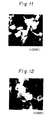
- FIG. 11 and FIG. 12 are the electron microphotographs of plate-like maghemite particles obtained in Example II and Example 18, respectively.
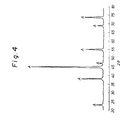
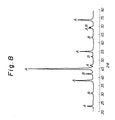
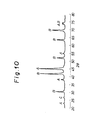
- FIG. 2, FIG. 4, FIG. 6, FIG. 8 and FIG. 10 are the X-ray diffraction patterns of the particles obtained in Example 1, Example 8, Comparative Example 1, Comparative Example 2 and Comparative Example 3, respectively.
- the present invention relates to the poreless and non-sintered plate-like magnetite particles having an average diameter of plate surface of 0.03 to 0.50 ⁇ m, an aspect ratio of 2:1 to 10:1 and a specific surface area of 7 to 30 m2/g; the poreless and non-sintered plate-like maghemite particles having an average diameter of plate surface of 0.03 to 0.50 ⁇ m, an aspect ratio of 2:1 to 10:1 and a specific surface area of 7 to 30 m2/g; a process for producing the poreless and non-sintered plate-like magnetite particles comprising mixing an aqueous solution of a ferrous salt and an aqueous solution of an alkali carbonate to form an aqueous solution containing FeCO3 and passing an O2-containing gas through the FeCO3-containing solution for oxidizing FeCO3 to form plate-like magnetite particles, wherein the mixing is carried out by reacting the ferrous salt and the alkali carbonate at a molar ratio defined by the following formula (I
- an aqueous solution containing FeCO3 is prepared by mixing an aqueous solution of a ferrous salt and an aqueous solution of an alkali carbonate, the reaction is carried out by reacting a ferrous salt and an alkali carbonate at a molar ratio defined by the following formula (I) : and that an aliphatic oxycarboxylic acid or a salt thereof is previously added in an amount of 0.01 to 2.0 mol%, preferably 0.1 to 1.0 mol% based on Fe to either of the aqueous solution of ferrous salt, the aqueous solution of alkali carbonate or the FecO3-containing solution before oxidizing by passing an O2-containing gas therethrough, and then an O2-containing gas is passed through the FeCO3-containing solution for oxidizing FeCO3 thereby producing the plate-like magnetite particles directly from said solution.
- aqueous solutions of ferrous salt usable in the present invention are an aqueous solution of ferrous sulfate and an aqueous solution of ferrous chloride.
- the alkali carbonates usable in the present invention include sodium carbonate, potassium carbonate, ammonium carbonate and the like, which may be used either singly or in combination.
- the reaction for oxidizing FeCO3 is carried out in the present invention at a temperature in the range of 75 to 100°C, preferably 80 to 100°C.
- the molar ratio of alkali carbonate to ferrous salt used in the reaction in the present invention is defined as follows:
- the lower limit of ferrous salt concentration in the FeCO3-containing solution is preferably around 0.1 mol/l.
- an aliphatic oxycarboxylic acid or a salt thereof is used.
- Typical examples of aliphatic oxycarboxylic acids usable in the present invention include citric acid and tartaric acid, and the salts thereof usable in the present invention include sodium citrate, potassium citrate, lithium citrate, ammonium citrate, sodium tartrate, potassium tartrate, lithium tartrate and ammonium tartrate.
- the amount of aliphatic oxycarboxylic acid or the salt thereof used in the present invention is in the range of 0.01 to 2.0 mol%, preferably 0.1 to 1.0 mol% based on Fe.
- granular hematite particles and/or acicular goethite particles may be caused to exist in the plate-like magnetite particles.
- over 2.0 mol% although the magnetite particles are produced, the magnetite particles are greatly reduced in saturation magnetization.
- the aliphatic oxycarboxylic acid or the salt thereof used in the present invention exerts an influence to the type and form of the produced particles under the synergism with the alkali carbonate. Therefore, the acid or the salt thereof needs to be added before the reaction for producing the plate-like magnetite particles is started. It may be added to either of the ferrous salt solution, the alkali carbonate solution or the FeCO3-containing solution before oxidizing by passing an O2-containing gas therethrough.
- An aqueous solution of a ferrous salt and an aqueous solution of an alkali carbonate are mixed under the conditions mentioned above to obtain an aqueous solution containing FeCO3 and then an O2-containing gas is passed through the FeCO3-containing solution at a temperature of 75 to 100°C, preferably 80 to 100°C to produce the plate-like magnetite particles of the present invention.
- this reaction temperature is below 75°C, spindle-like hematite particles and/or acicular goethite may be caused to exist in the plate-like magnetite particles.
- the reaction temperature exceeds 100°C, use of a specific apparatus such as autoclave is necessitated for attaining the object of the present invention, resulting in poor economy.
- Air is preferably used as the O2-containing gas, but a mixed gas having O2 diluted with an inert gas such as N2 is also usable.
- the FeCO3-containing solution is first subjected to an aging treatment by blowing a non-oxidizing gas such as nitrogen gas into the solution at 50 to 100°C, preferably 80 to 100°C and preferably for 15 to 40 minutes, while stirring it if necessary, and then the O2-containing gas is passed through the solution to oxidize FeCO3, there can be obtained the plate-like magnetite particles having a large aspect ratio (plate surface diameter: thickness).
- a non-oxidizing gas such as nitrogen gas
- the plate-like magnetite particles obtained in the manner described above are oxidized in the air under heating at a temperature of 200 to 400°C by a conventional method, thereby producing the plate-like maghemite particles of the present invention.
- the plate-like magnetite particles of the present invention are the fine particles having an average diameter of plate surface of 0.03 to 0.50 ⁇ m, preferably 0.05 to 0.40 ⁇ m, an aspect ratio plate surface diameter: thickness of 2:1 to 10:1, preferably 3:1 to 8:1. These particles are also poreless and non-sintered as produced directly from an aqueous solution.
- the plate-like magnetite particles of the present invention although the particles are fine as specified above, are small in specific surface area, which is 7 to 30 m2/g, preferably 8.0 to 25.0 m2/g, owing to poreless structure thereof. Also, as the particles are plate-like, poreless and non-sintered, the particles can be easily worked into a paint, have good dispersibility and orientability and can be filled to a high density in a vehicle or resin.
- the plate-like maghemite particles provided according to the present invention are also the fine particles having an average diameter of plate surface of 0.03 to 0.50 ⁇ m, preferably 0.05 to 0.40 ⁇ m, an aspect ratio plate surface diameter/thickness) of 2:1 to 10:1, preferably 3:1 to 8:1. These particles are poreless as they are obtained from the magnetite particles produced directly from an aqueous solution and are also non-sintered as no heating reduction treatment is involved in the producing process therefor.
- the plate-like maghemite particles of the present invention are also small in specific surface area (7 to 30 m2/g, preferably 8 to 25 m2/g) owing to the poreless structure thereof, and as the particles are plate-like, poreless and non-sintered, the maghemite particles of the present invention are easy to work into a paint, have good dispersibility and orientability and can be filled to a high density in a vehicle or resin.
- the plate-like magnetite and maghemite particles according to the present invention find particularly useful applications to electromagnetic wave absorbers, electromagnetic wave shields, magnetic recording media, black or brown pigment for paints and colorant for rubber and plastic products or as the base material therefor.
- the average diameter of plate surface and the aspect ratio (plate surface diameter : thickness) of the particles were shown by the average of the values determined from the electron microphotographs. Specific surface area was measured according to the BET method. Magnetic properties were determined in a magnetic field of 10 kOe by using a vibrating sample magnetometer Model VSMP-1 (made by TOEI KOGYO KK).
- the end point of oxidization reaction was judged by sampling out a part of the reaction solution, acidifying the sample solution with hydrochloric acid and then putting a portion of potassium ferricyanide solution into the sample solution to see whether a blue color reaction of Fe2+ would take place or not.
- the produced particles were filtered, washed with water, dried and disaggregated in the usual ways.
- the produced particles were determined to have an average diameter of 0.39 ⁇ m by transmission electron microscopical observation. As seen from the scanning electron microphotographs (30,000 ⁇ magnification) shown in FIG. 1, the produced particles were plate-like with an aspect ratio (plate surface diameter : thickness) of 8 : 1 and had no pores both on the surface and in the particles.
- Peak A represents magnetite, which indicates that the particles are composed of magnetite alone.
- Plate-like magnetite particles were obtained by following the same procedure as Example 1 except for change of the kind, concentration and amount of the ferrous salt solution, the kind, concentration of the alkali carbonate solution, CO3/Fe molar ratio, the kind and amount of the aliphatic oxycarboxylic acid or the salt thereof, the order of addition of the ferrous salt solution and the alkali carbonate solution, the Fe concentration and reaction temperature in the FeCO3 producing step, the temperature and time of the aging step, and the reaction temperature and time of the oxidization reaction step.
- a transmission electron microphotograph (50,000 ⁇ magnification) of the particles obtained in Example 8 is shown in FIG. 3, and an X-ray diffraction pattern thereof is shown in FIG. 4.
- the produced particles were filtered, washed with water, dried and disaggregated in the usual ways.
- the obtained particles comprised plate-like particles and spindle-like particles mingled with each other.
- Example 1 The procedure of Example 1 was followed without adding trisodium citrate dihydrate to produce the particles from the aqueous solution.
- the produced particles were filtered, washed with water, dried and disaggregated in the ordinary ways.
- the obtained particles comprised plate-like particles, spindle-like particles and acicular particles mingled with each other as seen from a transmission electron microphotograph (30,000 ⁇ magnification) shown in FIG. 9.
- the X-ray diffraction pattern (FIG. 10) of the particles showed the peaks of magnetite (A), hematite (B) and goethite (C).
- Example 1 The procedure of Example 1 was followed except for adding 9.9 g (corresponding to 3.0 mol% based on Fe) of trisodium citrate dihydrate to produce the particles from the aqueous reaction solution, and the produced particles were filtered, washed with water, dried and disaggregated as in the previous examples.
- Example 1 The procedure of Example 1 was followed with both the aging temperature and the oxidization temperature adjusted to 70°C to produce the particles from the aqueous reaction solution. The produced particles were filtered, washed with water, dried and disaggregated in the usual ways.
- Example 1 70 g of plate-like magnetite particles obtained in Example 1 were heated in the air at 300°C for 30 minutes to obtain the maghemite particles.
- maghemite particles were determined to have an average diameter of 0.39 ⁇ m by transmission electron microscopical observation. Also, as seen from a scanning electron microphotograph (30,000 ⁇ magnification) shown in FIG. 11, these particles were all plate-like with an aspect ratio of 8 : 1 and had no pores both on the surface and in the inside.
- Plate-like maghemite particles were obtained by following the same procedure as Example 11 except that the kind of plate-like magnetite particles and the oxidization temperature were changed.
- a transmission electron microphotograph (18,000 ⁇ magnification) of the particles obtained in Example 18 is shown in FIG. 12.
Landscapes
- Compounds Of Iron (AREA)
Applications Claiming Priority (6)
| Application Number | Priority Date | Filing Date | Title |
|---|---|---|---|
| JP3414187A JPH0651575B2 (ja) | 1987-02-16 | 1987-02-16 | 板状マグネタイト粒子粉末及びその製造方法 |
| JP34141/87 | 1987-02-16 | ||
| JP62332467A JP2583087B2 (ja) | 1987-12-29 | 1987-12-29 | 板状マグネタイト粒子粉末の製造法 |
| JP332467/87 | 1987-12-29 | ||
| JP33246887A JP2612461B2 (ja) | 1987-12-29 | 1987-12-29 | 板状マグヘマイト粒子粉末及びその製造法 |
| JP332468/87 | 1987-12-29 |
Publications (3)
| Publication Number | Publication Date |
|---|---|
| EP0279626A2 true EP0279626A2 (de) | 1988-08-24 |
| EP0279626A3 EP0279626A3 (en) | 1989-02-15 |
| EP0279626B1 EP0279626B1 (de) | 1990-09-19 |
Family
ID=27288334
Family Applications (1)
| Application Number | Title | Priority Date | Filing Date |
|---|---|---|---|
| EP88301270A Expired - Lifetime EP0279626B1 (de) | 1987-02-16 | 1988-02-16 | Plattenförmige Magnetit- und Maghemitpartikeln und Verfahren zu deren Herstellung |
Country Status (3)
| Country | Link |
|---|---|
| US (1) | US4865834A (de) |
| EP (1) | EP0279626B1 (de) |
| DE (1) | DE3860614D1 (de) |
Cited By (3)
| Publication number | Priority date | Publication date | Assignee | Title |
|---|---|---|---|---|
| EP0401000A3 (de) * | 1989-05-31 | 1991-04-10 | Toda Kogyo Corp. | Plattenförmige Magnetitteilchen und Verfahren zu ihrer Erzeugung |
| EP0422755A1 (de) * | 1989-10-11 | 1991-04-17 | Toda Kogyo Corp. | Plättchenförmige Maghämitteilchen und Verfahren zu deren Herstellung |
| EP1340717A3 (de) * | 2002-03-01 | 2004-02-04 | Bayer Chemicals AG | Verfahren zur Herstellung von Magnetitteilchen und deren Verwendung |
Families Citing this family (8)
| Publication number | Priority date | Publication date | Assignee | Title |
|---|---|---|---|---|
| JPH0247209A (ja) * | 1988-08-04 | 1990-02-16 | Sakai Chem Ind Co Ltd | 板状バリウムフエライト微粉末の製造方法 |
| US5496966A (en) * | 1991-06-12 | 1996-03-05 | Bellsouth Corporation | Method for controlling indoor electromagnetic signal propagation |
| JP3148311B2 (ja) * | 1991-10-30 | 2001-03-19 | 戸田工業株式会社 | 磁性トナー用磁性粒子粉末 |
| US5994611A (en) * | 1995-09-18 | 1999-11-30 | Toda Kogyo Corporation | Method of incinerating plastic products containing ferric oxide hydroxide particles |
| DE69502192T2 (de) * | 1995-09-18 | 1998-08-13 | Toda Kogyo Corp., Hiroshima | Aus Kunststoff hergestelltes Produkt |
| US8211225B2 (en) * | 2008-04-09 | 2012-07-03 | Sun Chemical Corp. | Magnetic pigments and process of enhancing magnetic properties |
| KR102328254B1 (ko) * | 2017-11-08 | 2021-11-18 | 주식회사 엘지에너지솔루션 | 마그헤마이트를 포함하는 리튬-황 전지용 양극 및 이를 구비한 리튬-황 전지 |
| GB201821211D0 (en) * | 2018-12-24 | 2019-02-06 | Lussey David | New composition of matter |
Family Cites Families (7)
| Publication number | Priority date | Publication date | Assignee | Title |
|---|---|---|---|---|
| US4136158A (en) * | 1976-11-01 | 1979-01-23 | Toda Kogyo Corp. | Production of acicular magnetic iron oxides |
| US4202871A (en) * | 1977-11-14 | 1980-05-13 | Sakai Chemical Industry Co., Ltd. | Production of acicular ferric oxide |
| DE2904491A1 (de) * | 1979-02-07 | 1980-08-21 | Bayer Ag | Plaettchenfoermige eisenoxidpigmente und verfahren zu deren herstellung sowie deren verwendung |
| US4382822A (en) * | 1979-09-14 | 1983-05-10 | Pfizer Inc. | Synthetic rhombohedral magnetite pigment |
| DE3224325A1 (de) * | 1982-06-30 | 1984-01-05 | Basf Ag, 6700 Ludwigshafen | Verfahren zur herstellung von nadelfoermigen, ferrimagnetischen eisenoxiden |
| US4597958A (en) * | 1984-09-17 | 1986-07-01 | Mitsui Mining & Smelting Co., Ltd. | Method of producing hydrated iron oxide |
| JPH06114138A (ja) * | 1992-10-01 | 1994-04-26 | Ain:Kk | 練習用ゴルフクラブのスイート スポット表示機構 |
-
1988
- 1988-02-16 EP EP88301270A patent/EP0279626B1/de not_active Expired - Lifetime
- 1988-02-16 US US07/156,508 patent/US4865834A/en not_active Expired - Fee Related
- 1988-02-16 DE DE8888301270T patent/DE3860614D1/de not_active Expired - Lifetime
Cited By (5)
| Publication number | Priority date | Publication date | Assignee | Title |
|---|---|---|---|---|
| EP0401000A3 (de) * | 1989-05-31 | 1991-04-10 | Toda Kogyo Corp. | Plattenförmige Magnetitteilchen und Verfahren zu ihrer Erzeugung |
| EP0422755A1 (de) * | 1989-10-11 | 1991-04-17 | Toda Kogyo Corp. | Plättchenförmige Maghämitteilchen und Verfahren zu deren Herstellung |
| US5093100A (en) * | 1989-10-11 | 1992-03-03 | Toda Kogyo Corp. | Plate-like magnetite particles, plate-like maghemite particles and processes of producing the same |
| EP1340717A3 (de) * | 2002-03-01 | 2004-02-04 | Bayer Chemicals AG | Verfahren zur Herstellung von Magnetitteilchen und deren Verwendung |
| US6849196B2 (en) | 2002-03-01 | 2005-02-01 | Bayer Aktiengesellschaft | Process for the preparation of magnetite particles and their use |
Also Published As
| Publication number | Publication date |
|---|---|
| DE3860614D1 (de) | 1990-10-25 |
| EP0279626A3 (en) | 1989-02-15 |
| US4865834A (en) | 1989-09-12 |
| EP0279626B1 (de) | 1990-09-19 |
Similar Documents
| Publication | Publication Date | Title |
|---|---|---|
| US5645652A (en) | Spindle-shaped magnetic iron-based alloy particles containing cobalt and iron as the main ingredients and process for producing the same | |
| EP0279626B1 (de) | Plattenförmige Magnetit- und Maghemitpartikeln und Verfahren zu deren Herstellung | |
| EP0422755B1 (de) | Plättchenförmige Maghämitteilchen und Verfahren zu deren Herstellung | |
| US4584242A (en) | Plate-like barium ferrite particles for magnetic recording and process for producing the same | |
| US6048412A (en) | Spindle-shaped goethite particles, spindle-shaped hematite particles and spindle-shaped magnetic iron based alloy particles | |
| US5188898A (en) | Ferromagnetic metal particles and preparation process thereof | |
| US5411801A (en) | Plate-like magnetite particles and process for producing the same | |
| US5911905A (en) | Processes for producing hydrated iron oxide and ferromagnetic iron oxide | |
| DE69123732T2 (de) | Verfahren zur Herstellung von nadelförmigen Goethit-Teilchen und nadelförmigen magnetischen Eisenoxid-Teilchen | |
| US4437881A (en) | Acicular ferromagnetic alloy particles and process for producing said particles | |
| KR100445590B1 (ko) | 코발트 피복된 침상의 자성 산화철 입자 | |
| US4495164A (en) | Process for producing acicular magnetite or acicular maghemite | |
| JP2583087B2 (ja) | 板状マグネタイト粒子粉末の製造法 | |
| EP0515748B1 (de) | Verfahren zur Herstellung von nadelförmigen Goethit-Teilchen und nadelförmigen magnetischen Eisenoxid-Teilchen | |
| JP2612461B2 (ja) | 板状マグヘマイト粒子粉末及びその製造法 | |
| US5989516A (en) | Spindle-shaped geothite particles | |
| EP0583621B1 (de) | Verfahren zur Herstellung von nadelförmigen Gamma-Eisen (III) oxihydroxid Teilchen | |
| JP2704559B2 (ja) | 板状マグネタイト粒子粉末及びその製造法 | |
| JP3166809B2 (ja) | 針状磁性酸化鉄粒子粉末の製造法 | |
| JP2970699B2 (ja) | 針状磁性酸化鉄粒子粉末の製造法 | |
| JPH0651575B2 (ja) | 板状マグネタイト粒子粉末及びその製造方法 | |
| JP3055308B2 (ja) | 針状磁性酸化鉄粒子粉末の製造法 | |
| JP3087808B2 (ja) | 磁気記録用磁性粒子粉末の製造法 | |
| JP3141907B2 (ja) | 紡錘状を呈した鉄を主成分とする金属磁性粒子粉末の製造法 | |
| JPH08208235A (ja) | 偏平状マグネタイト微粒子粉末の製造法 |
Legal Events
| Date | Code | Title | Description |
|---|---|---|---|
| PUAI | Public reference made under article 153(3) epc to a published international application that has entered the european phase |
Free format text: ORIGINAL CODE: 0009012 |
|
| AK | Designated contracting states |
Kind code of ref document: A2 Designated state(s): DE FR GB NL |
|
| PUAL | Search report despatched |
Free format text: ORIGINAL CODE: 0009013 |
|
| AK | Designated contracting states |
Kind code of ref document: A3 Designated state(s): DE FR GB NL |
|
| 17P | Request for examination filed |
Effective date: 19890803 |
|
| 17Q | First examination report despatched |
Effective date: 19891113 |
|
| GRAA | (expected) grant |
Free format text: ORIGINAL CODE: 0009210 |
|
| AK | Designated contracting states |
Kind code of ref document: B1 Designated state(s): DE FR GB NL |
|
| ET | Fr: translation filed | ||
| REF | Corresponds to: |
Ref document number: 3860614 Country of ref document: DE Date of ref document: 19901025 |
|
| PLBE | No opposition filed within time limit |
Free format text: ORIGINAL CODE: 0009261 |
|
| STAA | Information on the status of an ep patent application or granted ep patent |
Free format text: STATUS: NO OPPOSITION FILED WITHIN TIME LIMIT |
|
| 26N | No opposition filed | ||
| PGFP | Annual fee paid to national office [announced via postgrant information from national office to epo] |
Ref country code: DE Payment date: 19991231 Year of fee payment: 13 |
|
| PGFP | Annual fee paid to national office [announced via postgrant information from national office to epo] |
Ref country code: FR Payment date: 20000210 Year of fee payment: 13 |
|
| PGFP | Annual fee paid to national office [announced via postgrant information from national office to epo] |
Ref country code: GB Payment date: 20000216 Year of fee payment: 13 |
|
| PGFP | Annual fee paid to national office [announced via postgrant information from national office to epo] |
Ref country code: NL Payment date: 20000228 Year of fee payment: 13 |
|
| PG25 | Lapsed in a contracting state [announced via postgrant information from national office to epo] |
Ref country code: GB Free format text: LAPSE BECAUSE OF NON-PAYMENT OF DUE FEES Effective date: 20010216 |
|
| PG25 | Lapsed in a contracting state [announced via postgrant information from national office to epo] |
Ref country code: NL Free format text: LAPSE BECAUSE OF NON-PAYMENT OF DUE FEES Effective date: 20010901 |
|
| GBPC | Gb: european patent ceased through non-payment of renewal fee |
Effective date: 20010216 |
|
| PG25 | Lapsed in a contracting state [announced via postgrant information from national office to epo] |
Ref country code: FR Free format text: LAPSE BECAUSE OF NON-PAYMENT OF DUE FEES Effective date: 20011031 |
|
| NLV4 | Nl: lapsed or anulled due to non-payment of the annual fee |
Effective date: 20010901 |
|
| REG | Reference to a national code |
Ref country code: FR Ref legal event code: ST |
|
| PG25 | Lapsed in a contracting state [announced via postgrant information from national office to epo] |
Ref country code: DE Free format text: LAPSE BECAUSE OF NON-PAYMENT OF DUE FEES Effective date: 20011201 |