EP0279901A2 - Trapezförmiges Gummipflaster zum Reparieren von gebrochenen Metallverstärkungsgeweben von schlauchlosen oder mit Schlauch ausgestatteten Luftreifen - Google Patents
Trapezförmiges Gummipflaster zum Reparieren von gebrochenen Metallverstärkungsgeweben von schlauchlosen oder mit Schlauch ausgestatteten Luftreifen Download PDFInfo
- Publication number
- EP0279901A2 EP0279901A2 EP87114126A EP87114126A EP0279901A2 EP 0279901 A2 EP0279901 A2 EP 0279901A2 EP 87114126 A EP87114126 A EP 87114126A EP 87114126 A EP87114126 A EP 87114126A EP 0279901 A2 EP0279901 A2 EP 0279901A2
- Authority
- EP
- European Patent Office
- Prior art keywords
- rubber
- patch
- cords
- tire
- plies
- Prior art date
- Legal status (The legal status is an assumption and is not a legal conclusion. Google has not performed a legal analysis and makes no representation as to the accuracy of the status listed.)
- Withdrawn
Links
Images


Classifications
-
- B—PERFORMING OPERATIONS; TRANSPORTING
- B29—WORKING OF PLASTICS; WORKING OF SUBSTANCES IN A PLASTIC STATE IN GENERAL
- B29C—SHAPING OR JOINING OF PLASTICS; SHAPING OF MATERIAL IN A PLASTIC STATE, NOT OTHERWISE PROVIDED FOR; AFTER-TREATMENT OF THE SHAPED PRODUCTS, e.g. REPAIRING
- B29C73/00—Repairing of articles made from plastics or substances in a plastic state, e.g. of articles shaped or produced by using techniques covered by this subclass or subclass B29D
- B29C73/04—Repairing of articles made from plastics or substances in a plastic state, e.g. of articles shaped or produced by using techniques covered by this subclass or subclass B29D using preformed elements
- B29C73/10—Repairing of articles made from plastics or substances in a plastic state, e.g. of articles shaped or produced by using techniques covered by this subclass or subclass B29D using preformed elements using patches sealing on the surface of the article
-
- B—PERFORMING OPERATIONS; TRANSPORTING
- B29—WORKING OF PLASTICS; WORKING OF SUBSTANCES IN A PLASTIC STATE IN GENERAL
- B29K—INDEXING SCHEME ASSOCIATED WITH SUBCLASSES B29B, B29C OR B29D, RELATING TO MOULDING MATERIALS OR TO MATERIALS FOR MOULDS, REINFORCEMENTS, FILLERS OR PREFORMED PARTS, e.g. INSERTS
- B29K2105/00—Condition, form or state of moulded material or of the material to be shaped
- B29K2105/06—Condition, form or state of moulded material or of the material to be shaped containing reinforcements, fillers or inserts
- B29K2105/08—Condition, form or state of moulded material or of the material to be shaped containing reinforcements, fillers or inserts of continuous length, e.g. cords, rovings, mats, fabrics, strands or yarns
- B29K2105/10—Cords, strands or rovings, e.g. oriented cords, strands or rovings
- B29K2105/101—Oriented
-
- B—PERFORMING OPERATIONS; TRANSPORTING
- B29—WORKING OF PLASTICS; WORKING OF SUBSTANCES IN A PLASTIC STATE IN GENERAL
- B29L—INDEXING SCHEME ASSOCIATED WITH SUBCLASS B29C, RELATING TO PARTICULAR ARTICLES
- B29L2030/00—Pneumatic or solid tyres or parts thereof
Definitions
- the present invention has for object a patch-rubber to repair either tubeless or tube-type tires having a radial-ply structure, which have undergone injuries i.e. breaks of one or more metallic cords in their sidewalls; said patch-rubber may be applied either to tires which need only to be repaired or to those which will undergo a retreading process.
- the patch-rubbers used nowadays to patch radial-ply tires having undergone injuries i.e. breaks of the metallic radial cords embedded in the radial plies constituting their sidewalls, are rectangularly shaped and constituted by a plurality of superposed plies of rubber coated parallel cords, whereby said parallel cords, forming the fabrics of each ply, are always arranged parallel to the longitudinal axis of the patch-rubber i.e. parallel to the largest dimension thereof.
- plies comprising a fabric formed by parallel metallic cords are mixed up with plies of the above mentioned type, i.e. comprising a fabric formed by parallel cords made of a synthetic fibre.
- the cords either metallic or made of a synthetic fibre, are arranged, as mentioned, parallel to the longitudinal axis of the patch-rubber i.e. parallel to the largest dimension thereof.
- the first type of known patch-rubbers referred to above is not suitable to patch breaks of several metallic cords, since the cords made of a synthetic fibre neither have the strength, nor the elasticity, nor the coefficient of elongation shown by the metallic cords of the tire and would provide for bulges on the surface of the tire, when submitted to a pressure from the inside thereof.
- the second type of known patch-rubbers i.e. those formed by superposing plies with a fabric of nylon cords to plies with a fabric of metallic cords, stiffen the boundaries of the repaired section, since said fabrics, mutually parallel to each other and parallel to the longitudinal axis of the patch-rubber, not only provide for patch-rubbers having a reduced flexibility, but, having regard to the rectangular shape of the patch-rubbers themselves, said fabrics will be superposed and overlap both the broken and the unbroken metallic cords of the tire, providing hence for a stiffening of the uninjured flexible zones of the tire sidewalls.
- cords of the known patch-rubber are parallel to each other and to the longitudinal axis, i.e. to the largest dimension thereof and it is impossible to carry out the correct application of the patch-rubber, they may not match the radial disposition of the metallic cords embedded into the tire sidewalls, said cords being convergent i.e. less spaced from each other in the zone of the bead and more spaced in the zone of the tread.
- connection or bonding, between the edges of the patch-rubber and said internal surface or liner of the tire may hardly be performed and requires the previous grinding or buffing of said edges: a badly performed overlapping and bonding does not ensure a good tightness to the air under pressure inside the tire if this latter is of the tubeless type.
- the window shaped apertures in the sidewalls of the tire to be repaired by the use of patch-rubbers of the above mentioned mixed type, i.e. formed by plies with synthetic fabrics and plies made of metallic cords, constitute cavities which shall be filled up to restore the uniformity of the external surface of the side-wall, and since the plug of new crude rubber to fill up these cavities, even after having been vulcanized, does not always show chemical and physical features and proprieties equal to those of the rubber forming the sidewalls of the tire, i.e.
- a bulge may appear, during both the vulcanization by repairing and retreading, on the external surface of the tire, in correspondence of the repaired region, by the effect of the mentioned air pressure contained inside the tire; said bulge being provoked by a settling of both the patch-rubber and the filling rubber plug, which provokes moreover, as a consequence, the build-up of an hole of the internal surface or liner of the tire itself.
- Said permanent flection stress provides equally for the compound-batch forming the intrados of said patch-rubbers to be compressed, causing, during the loaded use, increased flection stresses which may provide for stretching the metallic cords and, since such compression and stretching stresses alternate, even serious injuries to the compound-batch may arise.
- the invention solves the problem of overcomming the mentioned drawbacks connected with the patch-rubbers of the prior art, and this by means of a patch-rubber provided of metallic cords embedded therein, having the same radial disposition and orientation shown by the radial metallic cords of the tire; said patch-rubber comprising means which allows indeed the perfect application of said patch-rubber to those zones of the tire sidewalls where a break of said radial metallic cords has took place, in such a way as to replace the broken metallic cords with those embedded in the patch-rubber and in such a way as to prevent the metallic cords of the patch-rubber to overlap those, not damaged, of the tire.
- the invention also solves the problem of decreasing the flection and stretching stresses in the compound-batches, in the metallic cords, and in the cords made of synthetic or natural fibres which constitute the patch-rubber according to the invention; this by means of such a patch-rubber, as defined in the claims, which may be stretched only during the loaded use of the tire; said patch-rubber comprising a plurality of plies including cords made of natural or synthetic fibres arranged in such a way that they are submitted to stresses only by a component of the stretching stresses, when in use.
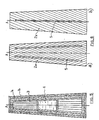
- the patch-rubber according to the invention in its simplest embodiment, is constituted of two layers and two plies.
- the first layer 1a which is intended to form the internal surface or liner of the tire, is made of a sheet of elastic rubber susceptible to withstand to the pressure of the air contained inside the tire itself, when in use.
- Said first layer 1a has a surface 1a/1, having the function of a free surface, which is knurled so as to avoid grinding thereof, to make the rolling operation easier and consequently the restoring of the internal surface or liner of the tire with crude elastic rubber and to allow the retightening and a better cooling of the repaired zones.
- a second layer 1b which is made of a rubber having a lower elasticity so as to avoid a sudden transition from a very elastic layer to a less elastic one, like the third ply 2, disclosed herebelow.
- Said third ply 2 is a layer of rubber coated parallel cords 2a made of e.g. a synthetic fibre, so oriented as to form an angle greater then 0° in respect to the longitudinal or symmetry axis A, which coincides with the longitudinal or symmetry axis A of the patch-rubber, according to a technique already claimed in the Italian Patent Application No. 2101/A87, whose priority is claimed by the present application.
- the forth ply 3, superposed to the mentioned ply 2, is constituted by a sheet of rubber in which is embedded a plurality of metallic cords 3a which are of the same nature and type as those which constitute the metallic radial cords of the tire and which are arranged in such a way as to converge, like those of the tire, towards a common center point.
- said metallic cords 3a to be concentrated i.e. less spaced from each other, in correspondence of the bead, and spreaded, i.e. more spaced from each other, in corraspondence of the tread.
- a trapezoidally shaped rubber dowel 4 On said forth ply 3 there is applied a trapezoidally shaped rubber dowel 4, whose surface of contact with said forth ply 3 is a trapezium whose minor and major bases have respectively a length f1 and f2, f2 being greater then f1, equal to the corresponding transversal dimensions of said forth ply 3 and an height f3 of the same magnitude as the radial dimension (see Fig. 3) of the zone of inflection of the tire, i.e. that zone of sidewalls from which the broken metallic cords have to be cut-out and taken away, which is obviously variable with the dimensions of the tire itself.
- Said rubber dowel 4 has its lateral faces 4a and 4b knurled and slightly inclined in respect to the perpendicular N to the surface of said ply 3 of the patch-rubber to make it easier, as explained herebelow, the insertion of an adhesive rubber compound dissolved in a solvent i.e. of a cement, to allow the bonding between the edges of said rubber dowel 4 and the edges FA and FB (see Fig. 2) of the trapezoidally shaped window aperture F, cut-out in the sidewalls of the tire.
- a solvent i.e. of a cement
- the dimensions f1, f2 and f3 of said rubber dowel 4 may assume various values related to the predetermined dimensions of the patch-rubbers i.e. related to the various dimensions of the tires, whose efficiency has to be restored and/or renewed.
- the area in correspondence of the internal surface or liner of the tire and the shape of the window aperture to be cut-out from the sidewalls of the tire, in that zone in which a break of the metallic cords there embedded has took place, have to be equal to those of the contacting area between the rubber dowel 4 and the underlying forth ply 3.
- the longitudinal and the transversal dimensions, i.e. the length and the width of both the first and second layers 1a, 1b and of the third ply 2 excede those of the forth ply 3 in such a way as to make it easier the restoring of the superficial uniformity and the tightening to the air of the window aperture F allalong the perimeter shared by said forth ply 3 and by the internal surface or liner of the tire; this being of the highest importance with tires of the tubeless type.
- the first layer 1a protrudes allaround the surface of the second layer 1b so as to form a free strip having a width l1.
- said second layer 1b protrudes allaround the surface of the third ply 2 so as to form a free strip having a width l2.
- said third ply 2 protrudes allaround the surface of the forth ply 3 so as to form a free strip having a width l3.
- Said respective widths l1, l2 and l3 of said respective protruding free strips may be, by way of example, 6mm. and even more, if a better and better tightening and smoothing of the repaired zone and of the surfaces thereof is desired.
- the above disclosed embodiment of the patch-rubber according to the invention may be implemented by superposing to the third ply 2 a further ply having the same structure and features as said ply 2, whereby however the nylon cords, forming the fabric of said further ply are so oriented as to form with the common longitudinal or symmetry axis A, an angle similar to that formed by the cords embedded in the underlying third ply 2, but on the opposite side of said longitudinal or symmetry axis A.
- the cords forming the fabric of said plies 2, with a synthetic fabric embedded therein may further be interrupted by means of cutsin like those shown in Figs. 6a and 6b, i.e. either by means of a cut-in 5 lying in coincidence with the longitudinal or symmetry axis A of the patch-rubber (Fig. 6b) or by means of a plurality of cutsin 5, radially oriented like the radial cords of the tire and matching the direction thereof (see Fig. 6b).
- the metallic cords 3a which extend, vertically on the drawings, from the major base to the minor base of the trapezoidally shaped ply 3 of the patch-rubber, travel, without any interruption, under the rubber dowel 4 only and do not protrude laterally outside the contacting surface which is common to said rubber dowel 4 and to said forth ply 3.
- the trapezoidally shaped window aperture F is cutout in such a way that its lateral edges FB (Fig.2) follow the radial orientation of the metallic cords embedded in the tire sidewalls and allow, hence, the juxtaposition and superposition of the metallic cords 3a embedded in the forth ply 3 of the patch-rubber only to the extremities CP1 of the metallic cords embedded in the tire sidewalls, the broken sections of said metallic cords having been taken away, thereby allowing the metallic cords 3a embedded into said forth ply 3 of the patch-rubber to replace only said taken away broken sections.
- the metallic cords 3a embedded into the forth ply 3 of the patch-rubber are of the same type and structure as those embedded in the tire sidewalls of the tire to be repaired, i.e. not only they are made in the same way and of the same material, but show moreover the same curvature so as to prevent, after vulcanization of the so bent patch-rubber, internal tensions and stresses from arising.
- the radial section of a tire may be constrained to bend about thousand times in a minute.
- both the dowel and the other plies may undergo more injuries and an increased wear, both in the radial direction and in a direction orthogonal to the latter, if the patch/rubber is foundamentally falt-shaped, because, in this latter case, after the patch-rubber has been put in use, the metallic cords and the compound-batches thereof are submitted to stresses in order to adapt themselves and to match the curvature of the tire sidewalls, even in the no load condition.
- the prebending of the patch-rubber acts in such a way that, in the repaired zone, the same flexibility is provided as in the uninjured zone, thereby overheatings are prevented from arising.
- the said flexibility may be further increased by means of the cuts-in 5 shown in Figs. 6a and 6b.
- the patch-rubber according to the invention ready for use, is previously vulcanized.
- the bonding materials consist in adhesive rubber compounds dissolved in a solvent, i.e. cements, and in adhesive rubber sheets which shall respectively be payed or applied onto the bonding surface Sa (see Fig. 1b) of the patch-rubber and into the triangularly shaped groove FR (see Fig. 1b) formed by the knurled edges 4a and 4b of the rubber dowel 4 and by the edges FA and FB of the window aperture F.
- the patch-rubber After having filled up said triangularly shaped groove FR with the cement and the adhesive rubber sheets, and after having applied the cement and the adhesive rubber sheets onto the bonding surface Sa, by means of a first rolling operation on the free surface 1a/1, the patch-rubber is brought into a perfect adherence onto the internal surface or liner of the tire, while by means of a second rolling operation, the rubber, filling up the triangularly shaped groove FR is compressed and brought to a level; the external surface of the tire being thereby made to be uniform and smooth.
- the vulcanization of the bonding surfaces is further effected so that the patch-rubber will be permanently and perfectly bonded to the tire thereby avoiding it undergoes to any deformation.
- the temperature to which the vulcanization is effected depends on the type of cement and filling up adhesive rubber sheets used to perform the bonding.
- the patch-rubber, as well as the rubber dowel, may take any suitable dimensions in accordance to the dimensions of the tires to be repaired therewith and to the extensions of the breaks they show.
- the diameter of the steel cords 3a embedded into the forth ply 3 may vary according to the dimensions and the use, i.e. the kind of vehicle, for which the tire to be repaired is intended for.
- the patch-rubber according to the invention may be constituted only by the ply 3 having the metallic radial cords 3a embed ded therein, said ply 3 being superposed to the elastic rubber layer 1, and by the rubber dowel 4, as indicated on Fig. 4.
- the longitudinal dimensions, along the symmetry axis A, of the patch-rubber according to the invention shall always be such as to allow said patch-rubber to extend, when put in use in the tire, from the bead until about the middle of the tread thereof.
- the cords 2a forming the fabrics embedded into the plies 2 may be made, if necessary also with natural fibres.
- the rubber dowel 4 is realised with an homogeneous compound-batch having the same chemical and physical features as the compound-batch constituting the sidewalls of the tire.
- the patch-rubber according to the invention may be reduced to a very large rubber dowel 4, superposed to a ply 3 having metallic radial cords embedded therein and showing the same width as said rubber dowel 4 (see Fig. 5).
- the supply of the stocks may be made thereby easier and unproblematic.
- the prebending of the patch-rubber according to the invention makes the use thereof easier and suitable also for tires of the hollow sidewalls type, because it is submitted to reduced stresses.
- the rubber dowel may be previously vulcanized on its own and successively applied and connected to the ply 3 in which the metallic radial cords 3a are embedded.
Landscapes
- Engineering & Computer Science (AREA)
- Mechanical Engineering (AREA)
- Tires In General (AREA)
Applications Claiming Priority (2)
| Application Number | Priority Date | Filing Date | Title |
|---|---|---|---|
| IT8702101A IT1213622B (it) | 1987-01-21 | 1987-01-21 | Toppa trapezoidale per riparare rotture delle corde matalliche sui fianchi dei copertoni dei pneumatici radiali senza camera d'aria |
| IT210187 | 1987-01-21 |
Publications (2)
| Publication Number | Publication Date |
|---|---|
| EP0279901A2 true EP0279901A2 (de) | 1988-08-31 |
| EP0279901A3 EP0279901A3 (de) | 1988-12-28 |
Family
ID=11102245
Family Applications (1)
| Application Number | Title | Priority Date | Filing Date |
|---|---|---|---|
| EP87114126A Withdrawn EP0279901A3 (de) | 1987-01-21 | 1987-09-28 | Trapezförmiges Gummipflaster zum Reparieren von gebrochenen Metallverstärkungsgeweben von schlauchlosen oder mit Schlauch ausgestatteten Luftreifen |
Country Status (2)
| Country | Link |
|---|---|
| EP (1) | EP0279901A3 (de) |
| IT (1) | IT1213622B (de) |
Cited By (6)
| Publication number | Priority date | Publication date | Assignee | Title |
|---|---|---|---|---|
| WO2009157941A1 (en) * | 2008-06-27 | 2009-12-30 | Michelin Recherche Et Technique S.A. | Integrated tire section repair |
| EP2323838A4 (de) * | 2008-09-10 | 2012-09-26 | Michelin Rech Tech | Integrierter verstärkungsflicken |
| CN103167947A (zh) * | 2010-10-22 | 2013-06-19 | 株式会社普利司通 | 子午线轮胎的修补方法、修补后的子午线轮胎和补片橡胶 |
| CN102076511B (zh) * | 2008-06-27 | 2013-12-11 | 米其林研究和技术股份有限公司 | 用于轮胎修复的损坏增强件的端部准备 |
| US8720510B2 (en) | 2008-06-27 | 2014-05-13 | Michelin Recherche Et Technique S.A. | Patch having reinforcements with staggered ends |
| US10035313B2 (en) | 2007-11-29 | 2018-07-31 | Compagnie Generale Des Etablissements Michelin | Tire repair patch |
Families Citing this family (1)
| Publication number | Priority date | Publication date | Assignee | Title |
|---|---|---|---|---|
| CN111409396A (zh) * | 2020-04-17 | 2020-07-14 | 正新橡胶(中国)有限公司 | 一种降噪轮胎 |
Family Cites Families (6)
| Publication number | Priority date | Publication date | Assignee | Title |
|---|---|---|---|---|
| FR1211507A (fr) * | 1958-08-06 | 1960-03-16 | Mft Fr Pneumatiques Michelin | Perfectionnement à la réparation des enveloppes de pneumatiques |
| FR1342202A (fr) * | 1962-09-15 | 1963-11-08 | Michelin & Cie | Perfectionnements à la réparation des enveloppes de pneumatiques |
| US3190338A (en) * | 1962-10-15 | 1965-06-22 | Goodyear Tire & Rubber | Repaired tire and making same |
| US3306332A (en) * | 1965-03-29 | 1967-02-28 | Gen Tire & Rubber Co | Repairing of radial cord tires |
| FR1548676A (de) * | 1967-10-27 | 1968-12-06 | ||
| US4285382A (en) * | 1980-07-10 | 1981-08-25 | Dirocco Jobbie | Tire repair patch |
-
1987
- 1987-01-21 IT IT8702101A patent/IT1213622B/it active
- 1987-09-28 EP EP87114126A patent/EP0279901A3/de not_active Withdrawn
Cited By (10)
| Publication number | Priority date | Publication date | Assignee | Title |
|---|---|---|---|---|
| US10035313B2 (en) | 2007-11-29 | 2018-07-31 | Compagnie Generale Des Etablissements Michelin | Tire repair patch |
| WO2009157941A1 (en) * | 2008-06-27 | 2009-12-30 | Michelin Recherche Et Technique S.A. | Integrated tire section repair |
| EP2296865A4 (de) * | 2008-06-27 | 2013-05-29 | Michelin Rech Tech | Integrierte reifenabschnittsreparatur |
| CN102076511B (zh) * | 2008-06-27 | 2013-12-11 | 米其林研究和技术股份有限公司 | 用于轮胎修复的损坏增强件的端部准备 |
| US8714219B2 (en) | 2008-06-27 | 2014-05-06 | Michelin Recherche Et Technique S.A. | Integrated tire section repair |
| US8720510B2 (en) | 2008-06-27 | 2014-05-13 | Michelin Recherche Et Technique S.A. | Patch having reinforcements with staggered ends |
| US8784588B2 (en) | 2008-06-27 | 2014-07-22 | Michelin Recherche Et Technique S.A. | Damaged reinforcement ending preparation for tire repairs |
| EP2323838A4 (de) * | 2008-09-10 | 2012-09-26 | Michelin Rech Tech | Integrierter verstärkungsflicken |
| CN103167947A (zh) * | 2010-10-22 | 2013-06-19 | 株式会社普利司通 | 子午线轮胎的修补方法、修补后的子午线轮胎和补片橡胶 |
| US10046529B2 (en) | 2010-10-22 | 2018-08-14 | Bridgestone Corporation | Method for repairing radial tire, repaired radial tire, and patch rubber |
Also Published As
| Publication number | Publication date |
|---|---|
| EP0279901A3 (de) | 1988-12-28 |
| IT1213622B (it) | 1989-12-29 |
| IT8702101A0 (it) | 1987-01-21 |
Similar Documents
| Publication | Publication Date | Title |
|---|---|---|
| US3960628A (en) | Steel-belted radial ply tires with 0° textile cap band | |
| EP0407134B1 (de) | Verfahren zur Herstellung von Radialluftreifen | |
| EP0384558B1 (de) | Luftreifen | |
| US4094354A (en) | Breaker reinforcing tape for belted pneumatic tires, and tires made therefrom | |
| CA1335560C (en) | Method to improve the endurance and reliability of patch-rubbers and of tires repaired or retreaded by means of the same patch-rubbers | |
| US4201260A (en) | Method for making a radial ply tire in a single building stage | |
| KR960021570A (ko) | 모타 차륜용 고횡만곡(高橫灣曲) 타이어 | |
| JPH09323504A (ja) | エラストマ製品用の補強プライ及びその製造方法 | |
| US7431063B2 (en) | Method for producing a belt structure for a vehicle tyre and vehicle tyre including the belt structure | |
| JPS63263103A (ja) | 空気入りタイヤ | |
| EP0279901A2 (de) | Trapezförmiges Gummipflaster zum Reparieren von gebrochenen Metallverstärkungsgeweben von schlauchlosen oder mit Schlauch ausgestatteten Luftreifen | |
| US6045735A (en) | Method of manufacturing a transmission belt | |
| US4202394A (en) | Recapped pneumatic tire | |
| IE52539B1 (en) | A pneumatic tyre,particularly for aircraft,having a crown reinforcement with extensible edges,and preparation thereof | |
| US3149658A (en) | Tire splice | |
| US4135565A (en) | Recapped pneumatic tire | |
| US4098315A (en) | Belted pneumatic tires with zero degree breaker reinforcement, and method of building such tires | |
| US4375231A (en) | Tire repair construction and method | |
| JP2783826B2 (ja) | 空気入りタイヤ | |
| US3080907A (en) | Tire repair unit | |
| US6491081B2 (en) | Method of manufacturing radial tire having wound band | |
| US4218277A (en) | Tire retreading method including adding reinforcing belt | |
| JP2878346B2 (ja) | 空気入りラジアルタイヤ | |
| NL8100050A (nl) | Werkwijze voor het vervaardigen van radiaal banden. | |
| JPH04161328A (ja) | ラジアルタイヤの製造方法 |
Legal Events
| Date | Code | Title | Description |
|---|---|---|---|
| PUAI | Public reference made under article 153(3) epc to a published international application that has entered the european phase |
Free format text: ORIGINAL CODE: 0009012 |
|
| AK | Designated contracting states |
Kind code of ref document: A2 Designated state(s): AT BE CH DE ES FR GB GR IT LI LU NL SE |
|
| PUAL | Search report despatched |
Free format text: ORIGINAL CODE: 0009013 |
|
| 17P | Request for examination filed |
Effective date: 19880922 |
|
| AK | Designated contracting states |
Kind code of ref document: A3 Designated state(s): AT BE CH DE ES FR GB GR IT LI LU NL SE |
|
| 17Q | First examination report despatched |
Effective date: 19901009 |
|
| STAA | Information on the status of an ep patent application or granted ep patent |
Free format text: STATUS: THE APPLICATION HAS BEEN WITHDRAWN |
|
| 18W | Application withdrawn |
Withdrawal date: 19920813 |
|
| RIN1 | Information on inventor provided before grant (corrected) |
Inventor name: FERRARA, GIUSEPPE |