EP0280195A2 - Schlaggerät mit einer Haltevorrichtung des Meissels - Google Patents
Schlaggerät mit einer Haltevorrichtung des Meissels Download PDFInfo
- Publication number
- EP0280195A2 EP0280195A2 EP88102374A EP88102374A EP0280195A2 EP 0280195 A2 EP0280195 A2 EP 0280195A2 EP 88102374 A EP88102374 A EP 88102374A EP 88102374 A EP88102374 A EP 88102374A EP 0280195 A2 EP0280195 A2 EP 0280195A2
- Authority
- EP
- European Patent Office
- Prior art keywords
- holder
- housing
- tool
- chisel
- percussion apparatus
- Prior art date
- Legal status (The legal status is an assumption and is not a legal conclusion. Google has not performed a legal analysis and makes no representation as to the accuracy of the status listed.)
- Ceased
Links
Images



Classifications
-
- B—PERFORMING OPERATIONS; TRANSPORTING
- B25—HAND TOOLS; PORTABLE POWER-DRIVEN TOOLS; MANIPULATORS
- B25D—PERCUSSIVE TOOLS
- B25D17/00—Details of, or accessories for, portable power-driven percussive tools
-
- B—PERFORMING OPERATIONS; TRANSPORTING
- B25—HAND TOOLS; PORTABLE POWER-DRIVEN TOOLS; MANIPULATORS
- B25D—PERCUSSIVE TOOLS
- B25D11/00—Portable percussive tools with electromotor or other motor drive
- B25D11/06—Means for driving the impulse member
- B25D11/12—Means for driving the impulse member comprising a crank mechanism
- B25D11/125—Means for driving the impulse member comprising a crank mechanism with a fluid cushion between the crank drive and the striking body
-
- B—PERFORMING OPERATIONS; TRANSPORTING
- B25—HAND TOOLS; PORTABLE POWER-DRIVEN TOOLS; MANIPULATORS
- B25D—PERCUSSIVE TOOLS
- B25D17/00—Details of, or accessories for, portable power-driven percussive tools
- B25D17/08—Means for retaining and guiding the tool bit, e.g. chucks allowing axial oscillation of the tool bit
-
- B—PERFORMING OPERATIONS; TRANSPORTING
- B25—HAND TOOLS; PORTABLE POWER-DRIVEN TOOLS; MANIPULATORS
- B25D—PERCUSSIVE TOOLS
- B25D17/00—Details of, or accessories for, portable power-driven percussive tools
- B25D17/24—Damping the reaction force
Definitions
- This invention relates to a percussion apparatus which is used for example at construction sites to break solid bodies such as concrete bodies and hardened asphalt bodies.
- a percussion apparatus or concrete breaker comprises a vertically extending tubular housing having an integral tool holding portion at the lower end thereof, a working tool or chisel supported at the housing tool holding portion and movable axially of the housing within a limited range, and a hammer pneumatically or mechanically reciprocated axially within the housing to repetitively hit the head.
- the chisel is pressed against a workpiece, and repetitively hit by the hammer until the workpiece is cracked.
- the impact force applied to the chisel balances with the reaction force from the workpiece, so that the chisel assumes a balanced axial position relative to the tool holding portion of the housing.
- the reaction force from the workpiece abruptly disappears to allow the chisel to advance to its lower limit of movement although the chisel is prevented from falling off the tool holding portion by a stopper provided either on the chisel or on the tool holding portion. If the chisel is idly hit by the hammer in this condition, all impact energy is transmitted to the tool holding portion which is integral with the housing.
- U.S. Patent No. 4,103,747 to Finney discloses a percussion apparatus in which idle hitting by a hammer of a chisel is avoided when the chisel is not pressed against a workpiece. More specifically, the percussion apparatus of this patent comprises a tool guide mounted on the lower end of a vertically extending tubular housing, and the chisel is slidably fitted in the tool guide so as to be movable vertically between an upper position in which the head of the chisel projects above the top surface of the tool guide and a lower position in which the chisel head is located below the tool guide top surface.
- the chisel head When the chisel is pressed against the workpiece, the chisel head is raised above the tool guide top surface to be hit by the hammer for intended workpiece breaking. Upon crack formation in the workpiece for example, the chisel head is lowered below the tool guide top surface by the weight of the chisel, so that the hammer will no longer hit the chisel head.
- the chisel be oscillated at its lower limit position in order to facilitate taking the arrested chisel out of the sticky workpiece.
- the chisel in its lower limit position is made to be hit by the hammer for oscillation, a large impact is transmitted to the tool guide or holder, so that the tool guide must be strong enough to endure the impact. Therefore, such an arrangement leads to a weight increase of the apparatus and fails to give a solution to the problem.
- Japanese Laid-open Patent Application No. 61-100380 of the same applicant proposes another percussion apparatus which comprises a vertically extending housing in which a hammer is vertically reciprocated, a tubular end cap removably mounted to the lower end of the housing and having a bottom wall formed with a central hole, and a slider (tool holder) slidably fitted in the central hole of the end cap and having an axial bore coaxial with the housing.
- the slider further has an outward annular flange in slidable contact with the tubular wall of the end cap.
- An annular elastic member is interposed between the slider flange and the cap bottom wall.
- a chisel extends through the axial bore into the housing to be hit by the reciprocating hammer.
- the chisel is formed at an intermediate portion with an annular stopper flange located above the annular flange of the slider.
- a compression spring is disposed within the end cap between the chisel flange and the lower end of the housing to press the chisel flange downward into abutment with the slider flange.
- the hammer is capable of hitting the chisel head even when the chisel assumes its lower limit position in which the chisel flange is held in abutment with the slider.
- the chisel thus hit causes compression and subsequent restoration of the elastic member by way of the chisel flange and the slider.
- the chisel oscillates to facilitate removal thereof from a sticky workpiece while the impact is buffered by the elastic member.
- the chisel flange is larger in diameter than the axial bore of the slider, the chisel cannot be removed from the end cap without removing the end cap from the lower end of the housing, consequently requiring a considerable time for replacement of the chisel. Further, the mounting of the chisel must be conducted by inserting it into the axial bore of the slider from above the end cap which has been removed from the housing. Thus, it is not possible to mount a chisel having a chisel tip whose size is larger than the shank diameter of the chisel.
- an object of the invention to provide a percussion apparatus which, while retaining the advantages of the above laid-open Japanese application, facilitates replacement of working tools (or chisels) and enables the use of various working tools whose tip size may be larger than the shank diameter of the tool.
- a percussion apparatus comprising: a tubular housing providing a generally vertical axis; a working tool having a shank which is supported at the lower end of the housing so as to be movable axially thereof within a limited range, the working tool further having a head located within the housing; hammer means driven to reciprocate axially within the housing to repetitively hit the head of the working tool when the tool assumes any axial position within said limited range; an end cap having a tubular wall removably mounted to the lower end of the housing, the end cap further having a bottom wall formed with a hole coaxial with the housing; a tool holder slidably fitted in the hole of the cap bottom wall and formed with an axial bore coaxial with the housing for receiving the shank of the tool, the holder having an outward annular flange disposed within the end cap; a lower elastic member disposed below the annular flange of the holder to be compressed thereby when the holder is slidably moved downward relative to the end
- the shank of the tool is formed with a cutout bounded by an upper stopper surface and a lower stopper surface; and the tool holding device comprises a lateral mounting bore formed in said lower portion of the holder and extending perpendicularly to the axial bore of the holder in partially overlapping relation, and a stopper pin inserted into the lateral mounting bore to partially protrude into the cutout of the tool shank, the stopper pin being engageable with the upper and lower stopper surfaces.
- the stopper pin is formed with a recess which becomes flush with the axial bore when the pin is rotated. In this way, the selection between the first and second conditions can be made simply by rotating the stopper pin.
- the stopper pin is provided at one end with a lever for facilitating rotation thereof.
- a percussion apparatus generally designated by reference numeral 1 includes a vertically extending cylindrical housing 2, and an engine 3 mounted on the top of the cylindrical housing 2.
- the engine 3 may be a known two-cycle gasoline engine available in the market.
- the engine may be replaced by an electric or pneumatic motor although the latter requires electric wiring or pneumatic tubing to pose a limitation on portability of the percussion apparatus.
- the housing 2 has a cylindrical main portion 4 within which a stationary cylinder 5 is disposed.
- An upper portion of the cylinder 5 internally defines an upper cylinder chamber 7a communicating with a crank room 6 thereabove, whereas a lower portion of the cylinder internally defines a lower cylinder chamber 7b.
- a movable cylinder 8 Disposed within the stationary cylinder 5 is a movable cylinder 8 connected to a known crank mechanism 11 which includes a rotary disk 9 accommodated within the crank room 6, and a connecting rod 10.
- the movable cylinder 8 slidably reciprocates within the stationary cylinder 5 axially thereof as the disk 9 rotates.
- the disk 9 is driven into rotation by the engine 3 via known reduction gears (not shown) at a predetermined rotational speed of about 1,000rpm for example.
- the stationary cylinder 5 is formed with upper ventilation ports 15 and lower ventilation ports 16. These ventilation ports communicate with an annular space 17 formed between the housing main portion 4 and the stationary cylinder 5 in a manner such that air flows into and escapes from the upper and lower cylinder chambers 7a, 7b through the ports as the movable cylinder 8 is reciprocated. In this way, air compression and negative pressure generation within the upper and lower cylinder chambers 7a, 7b can be limited to enable high speed reciprocation of the movable cylinder 8.
- a free piston 12 is slidably mounted in the movable cylinder 8 for reciprocation axially thereof.
- the piston is integrally formed at its lower end with a reduced extension serving as a hammer rod 13 which extends downward through an opening 14 formed in the bottom wall of the movable cylinder 8.
- the hammer rod 13 is adapted to powerfully hit a working tool or chisel 18 when the piston 12 is moved downward, as will be hereinafter described in detail.
- O-rings 19 are mounted on the outer circumferential surface of the free piston 12 to provide air tightness between the free piston 12 and the movable cylinder 8. Further, air tightness between the opening 14 and the hammer rod 13 is provided by O-rings 20 fitted on the circumferential surface of the opening 14.
- the internal space of the movable cylinder 8 is divided by the piston 12 into hermetically sealed upper and lower pressure chambers 21, 22 respectively above and below the piston.
- the cylindrical wall of the movable cylinder 8 is formed with upper pressure control ports 23a which allow entry of air into the upper pressure chamber 21 to prevent negative pressure generation therein when the piston 12 descends past these ports, thereby avoiding hinderance to downward movement of the piston.
- the cylindrical wall of the movable cylinder 8 is formed with lower pressure control ports 23b which allow entry of air into the lower pressure chamber 22 to prevent negative pressure generation therein when the piston ascends past the ports 23b, thereby avoiding hinderance to upward movement of the piston.
- the pressure control ports 23a, 23b communicate with the annular space 17 through intermediate ventilation ports 5a formed in the stationary cylinder 5.
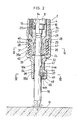
- the cylindrical housing 2 is integrally formed at its lower end with a reduced boss portion 25 in which is slidably inserted the shank 18a of the chisel 18, as better illustrated in Figures 2 and 3. More specifically, a bush 26 having a through-bore 24 coaxial with the housing 2 is fitted in the boss portion 25, and the chisel shank 18a is slidably received in the bush 26.
- An end cap 28 is removably fitted on the lower end of the housing main portion 4. More specifically, the end cap 28 has a cylindrical wall 31 formed at the upper end thereof with internal threads 29 for screwing engagement with external threads 27 formed on the lower end of the housing main portion 4.
- the end cap 28 also has a bottom wall 33 formed with a central hole 32 coaxial with the housing 2. The central hole 32 is larger in diameter than the boss portion 25 of the housing 2.
- the housing boss portion 25 is hexagonal in outer cross section (see Figure 3) and extends downward to a position substantially corresponding to the bottom wall 33 of the end cap 28.
- a tool holder 34 which has an upper cylindrical portion 35a slidably fitted on the boss portion 25 of the housing 2, and a reduced lower portion 35b formed with an axial bore 36 coaxial with the housing 2 for receiving the shank 18a of the chisel 18.
- the upper portion 35a of the tool holder 34 is hexagonal in inner cross section for closely fitting on the housing boss portion 25, but circular in outer cross section for closely fitting in the central hole 32 of the end cap 28, as illustrated in Figures 2 and 3.
- the upper portion 35a of the tool holder is formed with an outward annular flange 38 slidably contacting the inner circumferential surface of the cap cylindrical wall 31.
- the annular space formed between the cap cylindrical wall 31 and the housing boss portion 25 is divided by the outward flange 38 into an upper annular chamber 40 and a lower annular chamber 41.
- These annular chambers 40, 41 are respectively occupied by annular elastic members 42, 43 made of fluorine-containing rubber for example.
- the reduced lower portion 35b of the tool holder 34 is located outside the end cap 28 and formed at its lower extremity with an enlarged mounting portion 45 which is arranged eccentrically relative to the axial bore 36 for mounting a tool holding device 37.
- This tool holding device 37 functions to selectively provide a holding mode in which the chisel 18 is prevented from falling off the holder 34 while being allowed to move axially within a limited range, and a releasing mode in which the chisel is allowed to be removed completely from the holder.
- the shank 18a of the chisel 18 is formed with a cutout 44 which is bounded by an upper stopper surface 44a and a lower stopper surface 44b.
- the cutout 44 has a specified vertical length to allow axial displacement of the chisel 18.
- the tool holding device 37 includes a stopper pin 46 inserted into a lateral mounting bore 30 which is formed in the eccentric mounting portion 45 of the tool holder 34 in partially overlapping relation to the axial bore 36 perpendicularly thereto.
- the stopper pin 46 is formed with an arcuate recess 48 which is complementary to the cutout 44 of the chisel shank 18a. In other words, the arcuate recess 48 becomes flush with the circumferential surface of the axial bore 36 when the stopper pin 46 is suitably rotated.
- the stopper pin 46 Normally, the stopper pin 46 partially projects into the axial bore 36 (see Figures 2 and 4), so that the chisel 18 is prevented from falling off the tool holder 34 by the stopper pin coming into contact with the upper stopper surface 44a while being allowed to move axially within a limited stroke defined by the two stopper surfaces 44a, 44b.
- the stopper pin 46 when the stopper pin 46 is rotated to render the arcuate recess 48 flush with the axial bore 36, the stopper pin 46 no longer interferes with the stopper surfaces 44a, 44b, thereby enabling removal and replacement of the chisel 18.
- the stopper pin 46 is provided at one end thereof with a lever 47 to facilitate rotation. Further, the stopper pin 46 is formed with an annular groove 49 at a position adjacent to the lever 47, and the groove 49 in turn is formed with a diametrically opposite pair of locking recesses 52. A ball 51 biased by a spring 50 is engageable into selected one of the locking recesses 52, the spring 50 being accommodated in a bottomed hole 39 extending perpendicularly to the lateral bore 30.
- one of the two locking recesses 52 corresponds to a rotational position of the stopper pin 46 in which it projects into the axial bore 36, whereas the other locking recess corresponds to another rotational position in which the arcuate recess 48 becomes flush with the axial bore 36.
- the stopper pin 46 can be properly adjusted in rotational position by a click imparted by the ball 51 and the locking recesses 52.
- the stopper pin 46 may be made removable from and insertable into the lateral bore 30 to provide the intended locking and unlocking function for the chisel 18. In this case, the stopper pin needs not be provided with the arcuate recess 48.
- the eccentric mounting portion 45 of the tool holder 34 must have a diameter which is slightly smaller than that of the central hole 32 of the end cap 28. Such diameter is necessary to enable mounting of the tool holder 34, as described below.
- the tool holder 34 is prevented from rotating relative to the housing 2 because the holder upper portion 35a which is hexagonal in inner cross section ( Figure 3) is fitted on the housing boss portion 25 which is also hexagonal in outer cross section. Further, the chisel 18 is also prevented from rotating relative to the holder 34, namely relative to the housing 2, because the stopper pin 46 comes into contact with the flat recess surface 44 of the chisel ( Figure 4).
- the holder 34 and the housing boss portion 25 may be cylindrical in inner and outer cross sections, respectively, to allow rotation of the chisel 18 relative to the housing 2.
- the end cap 28, the tool holder 34 and the chisel 18 are mounted in the following manner.
- the lower elastic member 42 is placed into the end cap 28.
- the tool holder 34 is inserted into the end cap 28 from above until the outward annular flange 38 rests on the lower elastic member 42.
- the eccentric mounting portion 45 can pass through the central hole 32 of the end cap 28 because the mounting portion 45 is slightly smaller in diameter than the central hole 32.
- the upper elastic member 43 is placed onto the outward flange 38 of the holder 34, and the end cap 28 is screwed to the threaded portion 27 of the housing 2.
- the shank 18a of the chisel 18 is inserted from below into the axial bore 36 of the holder 2 and into the bush 26, and the stopper pin 46 is inserted into the lateral bore 30 to prevent the chisel from falling off.
- the lever 47 is pivoted so that the arcuate recess 48 becomes flush with the axial bore 36, and the chisel 18 is removed. Subsequently, a new chisel 18 ⁇ such as illustrated in Figure 8 is inserted into the axial bore 36, and the lever 47 is pivoted to its initial position. In this way, replacement of chisels can be conducted very quickly without prior removal of the end cap 28 or the tool holder 34.
- the chisel 18 ⁇ may be provided with a flattened tip portion 18b ⁇ which has a width larger than the diameter of the chisel shank 18a ⁇ .
- the mounting of such a chisel is possible without having to remove the end cap 28 because the chisel can be inserted into the tool holder 34 from below.
- the percussion apparatus operates in the following manner.
- the engine 3 With the chisel 18 held against a workpiece G such as concrete or asphalt paved road, the engine 3 is started and increased in speed by operating a throttle lever (not shown).
- the engine is connectable to the rotary disk 9 through a centrifugal clutch (not shown) which functions to transmit the engine output to the disk 9 only when the engine speed increases to a predetermined value.
- the movable cylinder 8 is caused by the crank mechanism 11 to reciprocated vertically.
- the lower pressure chamber 22 is compressed due to an inertial delay in upward movement of the free piston 12. Such compression of the lower pressure chamber 22 continues until the movable cylinder 8 approaches the upper dead point, and immediately thereafter the piston 12 starts moving rapidly upward relative to the movable cylinder 8 by the elastic expansion of the compressed lower pressure chamber 22.
- the upper pressure chamber 21 is then compressed to a maximum extent by the kinetic energy of the upwardly moving piston 12 and the downwardly moving cylinder 8.
- the piston 12 is rapidly accelerated downward by an extremely strong expansive force of the maximally compressed upper pressure chamber 21.
- the hammer rod 13 of the piston 12 hits the shank head of the chisel 18 when the piston 12 is accelerated to a maximum speed, thereby driving the chisel 18 into the workpiece G .
- the maximum speed of the downwardly moving piston 12 may reach several tens of meters per second.
- the chisel 18 is illustrated as firmly engaging in the workpiece G , and the upper stopper surface 44a of the chisel is held in engagement with the stopper pin 46 because of a manual lifting force applied to the housing 2.
- the resulting impact force is transmitted to the tool holder 34 by way of the upper stopper surface 44a and the stopper pin 46, thereby slightly depressing the holder relative to the end cap 28 or the housing 2.
- the depressed holder axially compresses the lower annular elastic member 42 which thereafter restores elastically to return the holder to its initial position.
- the chisel 18 moves with the holder due to the engagement between the upper stopper surface 44a and the stopper pin 46. This means that the chisel 18 oscillates axially with strong forces as long as the piston 12 reciprocates. Such oscillation serves to release the chisel out of firm engagement with the workpiece G even if the latter is very sticky. Therefore, it is possible to pull out the chisel from the workpiece only with a manual force required to support the percussion apparatus.
- the tool take-out operation described above it is only the tool holder 34 that is moved by the chisel 18.
- the holder 34 is far smaller in weight, providing a small inertial mass. Therefore, the holder can be easily moved when an impact is applied thereto through the chisel, so that the holder will be subjected only to a minimum tensile stress and need not have a large impact strength.
- the holder 34 is integral with the housing 2 to provide a large inertial mass, on the other hand, the holder (or the tool holding portion of the housing) will subjected to a large tensile stress upon impact, so that the housing as a whole must be strong enough to result in an unacceptable increase in overall weight of the percussion apparatus.
- the advantage of the independently movable holder 34 is extremely significant.
- the lower annular chamber 41 of the end cap 28 is substantially a closed space which is variable in length only in the vertical direction and completely occupied by the lower annular elastic member 42. Therefore, the lower elastic member 42 is deformed uniformly as a whole upon axial compression, so that it will not be damaged in a short time due to fatigue through local deformation.
- the percussion apparatus provides a facilitated tool take-out operation, ready maintenace and tool replacement, is simple in construction and light in overall weight, in addition to providing effective workpiece breaking.
- Figures 6 and 7 show a second embodiment of the invention in which a suspension spring 54 is arranged on the annular outward flange 38 of the tool holder 34 to press it downward when the chisel 18 ⁇ is pressed against the workpiece G.
- the spring constant of the spring 54 is selected in view of the overall weight of the percussion apparatus and a force applied by the operator so that the chisel 18 ⁇ projects into the lower cylinder chamber 7b by a suitable amount when the chisel is pressed against the workpiece.
- the suspension spring 54 because of its energy absorption, serves to prevent vibration from being transmitted to the housing 2. Further, the spring 54 buffers upward reaction forces which the tool holder 34 receives from the workpiece G through the chisel 18 ⁇ , so that the outward flange 38 of the holder 34 will not collide vigorously with the housing 2. Thus, the housing 2 and the holder 34 need not have a large impact strength, thereby contributing to weight reduction.
- the shank 18a ⁇ of the chisel 18 ⁇ has an intermediate portion 18c ⁇ which is hexagonal in cross section for fitting in the axial bore 36 ⁇ of the tool holder 34 which is also hexagonal in cross section.
- the stopper pin 46 has a recess 48 ⁇ which is complementary to the hexagonal intermediate portion 18c ⁇ of the chisel.
- the invention is not limited to the illustrated embodiments and may be modified in various ways.
- the tool holder 34 may not be provided with an eccentric enlarged mounting portion 45 if the lower portion 35a has an enough wall thickness for mounting of the tool holding device 37.
- both of the upper and lower elastic members may be in the form of a coil spring.
Landscapes
- Engineering & Computer Science (AREA)
- Mechanical Engineering (AREA)
- Percussive Tools And Related Accessories (AREA)
Applications Claiming Priority (4)
| Application Number | Priority Date | Filing Date | Title |
|---|---|---|---|
| JP3839787 | 1987-02-21 | ||
| JP38397/87 | 1987-02-21 | ||
| JP162036/87 | 1987-06-29 | ||
| JP62162036A JPH0763944B2 (ja) | 1987-02-21 | 1987-06-29 | ブレ−カ |
Publications (2)
| Publication Number | Publication Date |
|---|---|
| EP0280195A2 true EP0280195A2 (de) | 1988-08-31 |
| EP0280195A3 EP0280195A3 (de) | 1990-03-28 |
Family
ID=26377645
Family Applications (1)
| Application Number | Title | Priority Date | Filing Date |
|---|---|---|---|
| EP88102374A Ceased EP0280195A3 (de) | 1987-02-21 | 1988-02-18 | Schlaggerät mit einer Haltevorrichtung des Meissels |
Country Status (4)
| Country | Link |
|---|---|
| EP (1) | EP0280195A3 (de) |
| JP (1) | JPH0763944B2 (de) |
| KR (1) | KR920001602B1 (de) |
| AU (1) | AU598102B2 (de) |
Cited By (6)
| Publication number | Priority date | Publication date | Assignee | Title |
|---|---|---|---|---|
| DE3905248A1 (de) * | 1989-02-21 | 1990-08-23 | Eco Air Drucklufttechnik Gmbh | Haltekappensicherung fuer drucklufthaemmer |
| EP0656823A4 (de) * | 1992-08-31 | 1995-09-13 | Rocktec Ltd | Meisseleinheit für gesteinbrechanlage. |
| EP1815946A1 (de) | 2006-02-01 | 2007-08-08 | Makita Corporation | Angetriebenes Schlagwerkzeug |
| EP1604785A3 (de) * | 2004-06-08 | 2009-09-16 | Hitachi Koki Co., Ltd. | Schlagwerkzeug |
| WO2019079560A1 (en) * | 2017-10-20 | 2019-04-25 | Milwaukee Electric Tool Corporation | PERCUSSION TOOL |
| US10926393B2 (en) | 2018-01-26 | 2021-02-23 | Milwaukee Electric Tool Corporation | Percussion tool |
Families Citing this family (3)
| Publication number | Priority date | Publication date | Assignee | Title |
|---|---|---|---|---|
| JP2013144346A (ja) * | 2012-01-16 | 2013-07-25 | Hitachi Koki Co Ltd | 打撃工具 |
| JP2015175507A (ja) | 2014-03-18 | 2015-10-05 | 株式会社神戸製鋼所 | チタン溶接管、及びチタン溶接管の製造方法 |
| JP2024030739A (ja) * | 2022-08-25 | 2024-03-07 | 株式会社マキタ | 打撃工具 |
Family Cites Families (13)
| Publication number | Priority date | Publication date | Assignee | Title |
|---|---|---|---|---|
| GB399773A (en) * | 1932-09-12 | 1933-10-12 | Frank Hills | Improvements in or relating to pneumatic hammers and similar percussive tools |
| CH211989A (de) * | 1938-09-29 | 1940-10-31 | Bosch Gmbh Robert | Werkzeughalter für Schlaggeräte. |
| US2298719A (en) * | 1940-12-12 | 1942-10-13 | Chicago Pneumatic Tool Co | Implement retainer |
| US2432331A (en) * | 1945-04-02 | 1947-12-09 | Joy Mfg Co | Working implement retainer |
| GB618546A (en) * | 1946-10-04 | 1949-02-23 | John Wilbur Tierney | Improvements in or relating to fluid pressure operated engines, such as pneumatic picks or concrete breakers |
| FR1090212A (fr) * | 1953-11-04 | 1955-03-29 | Kango Electric Hammers Ltd | Outil à percussion commandé mécaniquement |
| US2823040A (en) * | 1955-10-03 | 1958-02-11 | Chicago Pneumatic Tool Co | Tool retainer for pneumatic hammer |
| US3179185A (en) * | 1962-06-14 | 1965-04-20 | Chicago Pneumatic Tool Co | Demolition tool with shock attenuating means |
| IT964292B (it) * | 1971-09-13 | 1974-01-21 | Kango Electric Hammers Ltd | Perfezionamenti relativi a macchi ne utensili portatili di percussio ne |
| DE2551125C2 (de) * | 1975-11-14 | 1987-04-23 | Robert Bosch Gmbh, 7000 Stuttgart | Einrichtung an Handwerkzeugmaschinen zur Drehmomentübertragung |
| US4103747A (en) * | 1977-01-14 | 1978-08-01 | Finney James L | Buffer spring for an impact tool |
| DE2844110A1 (de) * | 1978-10-10 | 1980-04-24 | Bosch Gmbh Robert | Handwerkzeugmaschine, insbesondere meisselhammer |
| AU550165B2 (en) * | 1982-03-01 | 1986-03-06 | Allied Steel and Tractor Products Inc. | Synchronous vibratory impact hammer |
-
1987
- 1987-06-29 JP JP62162036A patent/JPH0763944B2/ja not_active Expired - Lifetime
-
1988
- 1988-02-17 AU AU11920/88A patent/AU598102B2/en not_active Ceased
- 1988-02-18 EP EP88102374A patent/EP0280195A3/de not_active Ceased
- 1988-02-20 KR KR1019880001836A patent/KR920001602B1/ko not_active Expired
Cited By (17)
| Publication number | Priority date | Publication date | Assignee | Title |
|---|---|---|---|---|
| DE3905248A1 (de) * | 1989-02-21 | 1990-08-23 | Eco Air Drucklufttechnik Gmbh | Haltekappensicherung fuer drucklufthaemmer |
| EP0656823A4 (de) * | 1992-08-31 | 1995-09-13 | Rocktec Ltd | Meisseleinheit für gesteinbrechanlage. |
| EP1604785A3 (de) * | 2004-06-08 | 2009-09-16 | Hitachi Koki Co., Ltd. | Schlagwerkzeug |
| US7819203B2 (en) | 2004-06-08 | 2010-10-26 | Hitachi Koki Co., Ltd. | Striking tool |
| EP1815946A1 (de) | 2006-02-01 | 2007-08-08 | Makita Corporation | Angetriebenes Schlagwerkzeug |
| US7523791B2 (en) | 2006-02-01 | 2009-04-28 | Makita Corporation | Impact power tool |
| EP2392433A1 (de) * | 2006-02-01 | 2011-12-07 | Makita Corporation | Angetriebenes Schlagwerkzeug |
| US10814468B2 (en) | 2017-10-20 | 2020-10-27 | Milwaukee Electric Tool Corporation | Percussion tool |
| WO2019079560A1 (en) * | 2017-10-20 | 2019-04-25 | Milwaukee Electric Tool Corporation | PERCUSSION TOOL |
| US11633843B2 (en) | 2017-10-20 | 2023-04-25 | Milwaukee Electric Tool Corporation | Percussion tool |
| US10926393B2 (en) | 2018-01-26 | 2021-02-23 | Milwaukee Electric Tool Corporation | Percussion tool |
| US11059155B2 (en) | 2018-01-26 | 2021-07-13 | Milwaukee Electric Tool Corporation | Percussion tool |
| US11141850B2 (en) | 2018-01-26 | 2021-10-12 | Milwaukee Electric Tool Corporation | Percussion tool |
| US11203105B2 (en) | 2018-01-26 | 2021-12-21 | Milwaukee Electric Tool Corporation | Percussion tool |
| US11759935B2 (en) | 2018-01-26 | 2023-09-19 | Milwaukee Electric Tool Corporation | Percussion tool |
| US11865687B2 (en) | 2018-01-26 | 2024-01-09 | Milwaukee Electric Tool Corporation | Percussion tool |
| US12472613B2 (en) | 2018-01-26 | 2025-11-18 | Milwaukee Electric Tool Corporation | Percussion tool |
Also Published As
| Publication number | Publication date |
|---|---|
| KR880009739A (ko) | 1988-10-04 |
| JPS642878A (en) | 1989-01-06 |
| AU598102B2 (en) | 1990-06-14 |
| AU1192088A (en) | 1988-08-25 |
| KR920001602B1 (ko) | 1992-02-20 |
| JPH0763944B2 (ja) | 1995-07-12 |
| EP0280195A3 (de) | 1990-03-28 |
Similar Documents
| Publication | Publication Date | Title |
|---|---|---|
| RU2268818C2 (ru) | Механизированный инструмент | |
| CN101203358B (zh) | 配有空载运转控制装置的冲击锤 | |
| JP3424870B2 (ja) | 打撃工具の空打ち防止装置 | |
| US6913088B2 (en) | Hammer drill and /or percussion hammer with no-load operation control that depends on application pressure | |
| US4476941A (en) | Motor-driven hand-held percussion tool | |
| RU2520242C2 (ru) | Ударный инструмент | |
| EP0280195A2 (de) | Schlaggerät mit einer Haltevorrichtung des Meissels | |
| EP0295563B1 (de) | Rotierende Schlagvorrichtung | |
| JPS59156678A (ja) | 穿孔ハンマ | |
| CN100354073C (zh) | 发动机式破碎装置 | |
| US4168751A (en) | Driver tool | |
| SE8903620L (sv) | Anordning vid handhaallna slagverktyg | |
| US6808026B2 (en) | Pneumatic percussive tool with a short working drive piston | |
| JPH012878A (ja) | ブレ−カ | |
| JPH0829503B2 (ja) | ブレ−カ | |
| KR880000194B1 (ko) | 파쇄기 | |
| SU1546242A1 (ru) | Ударный гайковерт | |
| JPS61100380A (ja) | ブレ−カ | |
| SU1174250A2 (ru) | Ручна машина ударно-вращательного действи | |
| SU1118522A1 (ru) | Ударный гайковерт | |
| SU1533849A1 (ru) | Ударный гайковерт | |
| SU875014A1 (ru) | Пневматический ударный механизм | |
| JP4178900B2 (ja) | 衝撃工具 | |
| WO2024257166A1 (ja) | 携帯式撃打作業機 | |
| JPH0234751B2 (de) |
Legal Events
| Date | Code | Title | Description |
|---|---|---|---|
| PUAI | Public reference made under article 153(3) epc to a published international application that has entered the european phase |
Free format text: ORIGINAL CODE: 0009012 |
|
| AK | Designated contracting states |
Kind code of ref document: A2 Designated state(s): BE CH DE FR GB IT LI NL SE |
|
| PUAL | Search report despatched |
Free format text: ORIGINAL CODE: 0009013 |
|
| AK | Designated contracting states |
Kind code of ref document: A3 Designated state(s): BE CH DE FR GB IT LI NL SE |
|
| 17P | Request for examination filed |
Effective date: 19900410 |
|
| 17Q | First examination report despatched |
Effective date: 19910328 |
|
| STAA | Information on the status of an ep patent application or granted ep patent |
Free format text: STATUS: THE APPLICATION HAS BEEN REFUSED |
|
| 18R | Application refused |
Effective date: 19930503 |