EP0280234A2 - Verfahren und Vorrichtung zur Verbesserung der Behandlung einer Fasersuspension und zur Kontrolle des Fliessens einer Fasersuspension - Google Patents
Verfahren und Vorrichtung zur Verbesserung der Behandlung einer Fasersuspension und zur Kontrolle des Fliessens einer Fasersuspension Download PDFInfo
- Publication number
- EP0280234A2 EP0280234A2 EP88102569A EP88102569A EP0280234A2 EP 0280234 A2 EP0280234 A2 EP 0280234A2 EP 88102569 A EP88102569 A EP 88102569A EP 88102569 A EP88102569 A EP 88102569A EP 0280234 A2 EP0280234 A2 EP 0280234A2
- Authority
- EP
- European Patent Office
- Prior art keywords
- valve
- flow
- fibre suspension
- pulp
- opening
- Prior art date
- Legal status (The legal status is an assumption and is not a legal conclusion. Google has not performed a legal analysis and makes no representation as to the accuracy of the status listed.)
- Granted
Links
Images




Classifications
-
- D—TEXTILES; PAPER
- D21—PAPER-MAKING; PRODUCTION OF CELLULOSE
- D21C—PRODUCTION OF CELLULOSE BY REMOVING NON-CELLULOSE SUBSTANCES FROM CELLULOSE-CONTAINING MATERIALS; REGENERATION OF PULPING LIQUORS; APPARATUS THEREFOR
- D21C9/00—After-treatment of cellulose pulp, e.g. of wood pulp, or cotton linters ; Treatment of dilute or dewatered pulp or process improvement taking place after obtaining the raw cellulosic material and not provided for elsewhere
-
- B—PERFORMING OPERATIONS; TRANSPORTING
- B01—PHYSICAL OR CHEMICAL PROCESSES OR APPARATUS IN GENERAL
- B01F—MIXING, e.g. DISSOLVING, EMULSIFYING OR DISPERSING
- B01F23/00—Mixing according to the phases to be mixed, e.g. dispersing or emulsifying
- B01F23/50—Mixing liquids with solids
- B01F23/53—Mixing liquids with solids using driven stirrers
-
- B—PERFORMING OPERATIONS; TRANSPORTING
- B01—PHYSICAL OR CHEMICAL PROCESSES OR APPARATUS IN GENERAL
- B01F—MIXING, e.g. DISSOLVING, EMULSIFYING OR DISPERSING
- B01F25/00—Flow mixers; Mixers for falling materials, e.g. solid particles
- B01F25/30—Injector mixers
- B01F25/31—Injector mixers in conduits or tubes through which the main component flows
- B01F25/314—Injector mixers in conduits or tubes through which the main component flows wherein additional components are introduced at the circumference of the conduit
- B01F25/3141—Injector mixers in conduits or tubes through which the main component flows wherein additional components are introduced at the circumference of the conduit with additional mixing means other than injector mixers
-
- B—PERFORMING OPERATIONS; TRANSPORTING
- B01—PHYSICAL OR CHEMICAL PROCESSES OR APPARATUS IN GENERAL
- B01F—MIXING, e.g. DISSOLVING, EMULSIFYING OR DISPERSING
- B01F27/00—Mixers with rotary stirring devices in fixed receptacles; Kneaders
- B01F27/05—Stirrers
- B01F27/11—Stirrers characterised by the configuration of the stirrers
- B01F27/112—Stirrers characterised by the configuration of the stirrers with arms, paddles, vanes or blades
- B01F27/1126—Stirrers characterised by the configuration of the stirrers with arms, paddles, vanes or blades the stirrer being a bent rod supported at one end only
-
- B—PERFORMING OPERATIONS; TRANSPORTING
- B01—PHYSICAL OR CHEMICAL PROCESSES OR APPARATUS IN GENERAL
- B01F—MIXING, e.g. DISSOLVING, EMULSIFYING OR DISPERSING
- B01F27/00—Mixers with rotary stirring devices in fixed receptacles; Kneaders
- B01F27/50—Pipe mixers, i.e. mixers wherein the materials to be mixed flow continuously through pipes, e.g. column mixers
-
- B—PERFORMING OPERATIONS; TRANSPORTING
- B01—PHYSICAL OR CHEMICAL PROCESSES OR APPARATUS IN GENERAL
- B01F—MIXING, e.g. DISSOLVING, EMULSIFYING OR DISPERSING
- B01F27/00—Mixers with rotary stirring devices in fixed receptacles; Kneaders
- B01F27/05—Stirrers
- B01F27/11—Stirrers characterised by the configuration of the stirrers
- B01F27/112—Stirrers characterised by the configuration of the stirrers with arms, paddles, vanes or blades
- B01F27/1123—Stirrers characterised by the configuration of the stirrers with arms, paddles, vanes or blades sickle-shaped, i.e. curved in at least one direction
Definitions
- the present invention relates to a method and an apparatus for improving the control and treatment of fibre suspension flow.
- the method and apparatus according to the invention are particularly suitable to be used for mixing chemicals and controlling the pumping of high consistency pulp in the pulp and paper industry.
- High consistency pulp is still generally pumped by a displacement pump and a screw pump. This was up till now the only way to pump high consistency pulp.
- no control valve is used on the discharge side.
- high consistency pulp is stiff and the pumps produce a pulsational pressure. If there is a throttle point on the discharge side, it produces strong pressure pulses in the tube system which can break structures.
- a displacement pump works even when there is no pulp in the suction side or so little pulp that it would only partly fill the compartments of the pump. The pump can work so that it pumps forward everything that comes from the suction side to the compartments.
- High consistency pulp (consistency 8 - 20 %) forms very stiff material; it can be so stiff that one can stand with ordinary shoes on the pulp and not sink into the pulp.
- the reason for it is that fibres with size of a few millimetres form a strong three-dimensional fibre network.
- the fibres are rather rigid and when they rest on each other they form a strong structure.
- High consistency pulp can, however, be changed into a flowing state by breaking the fibre network by bringing shear forces to the suspension. This is called fluidization of high consistency pulp.
- Normally fluidization is effected by some kind of powerful rotor. For example, in a high consistency pump the rotor effects the fluidization in the suction duct of the pump. Fluidization is a reversible process, and as soon as the rotor stops or the pulp is no longer in the range of the rotor, the fibre network forms again and the suspension becomes again solid material.
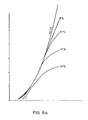
- Fig. 6b shows in principle the reduction of the capacity of the present valves when the consistency grows.
- Fig. 6b is a graph showing the capacity of a valve provided with a fluidizator. The reliability of the valve and the adjustability improve particularly with small spread angles.
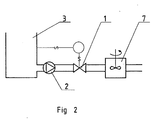
- a pump cannot be used as a mixer for several reasons. Such can be, for example, material problems or the fact that the amount or the quality of chemicals are such that the chemical cannot be added into the pump. Accordingly one has to use a separate mixer according to Fig. 2. There are cases in which part of the chemicals can be fed to the pump and the rest to the mixer or all chemicals to the mixer depending on the situation.
- the mixer consists of a case with an inlet opening and an outlet opening and protrusions on the inner surface, of a rotor which has protrusions on the outer surface, and of a feed duct for chemicals which opens to the mixing zone between the rotor and the case.
- the said mixer although very practical and reliable, is, however, rather complicated to produce of special material.
- a further object of the present invention is to eliminate the need of a separate mixer by means of a new kind of valve and to utilize the mixing properties of the valve as well as to lower the total resistance of the system and reduce the need of space.
- the FI-application 850307 discloses a method and an apparatus for dividing and uniting the flows of high-consistency fibre suspensions, wherein the apparatus consists of a vortex chamber to which several inlet and/or outlet openings lead and in which there is a rotor creating a vortex flow.
- the inventive idea of the present application includes also the fact that there are valves in the outlet ducts up to which the vortex flow should extend in order to make the apparatus work in the desired way.
- the object of the present invention is to eliminate or minimize the defects of the arrangements according to the above-mentioned publications by the method and apparatus in accordance with the invention.
- the above object is solved according to the invention by a method of controlling and treating a fibre suspension flow wherein the fibre suspension is controlled by throttling the cross-sectional area of the flow, characterized in that the fibre suspension is fluidized in that in close proximity to the throttle point, fibre suspension flow material is subjected to shear forces, by means of which the bonds between the fibres of the suspension are broken and the formation of fibre bundles at the throttle point is hindered, whereby the fibre suspension flows in a liquid state through the adjustable throttle point.
- an apparatus for controlling a fibre suspension flow which apparatus comprises a valve body having an inlet and outlet opening therein, a valve opening and a valve element with drive mechanism used for closing the opening, characterized in that in close proximity to the valve element a fluidizing element is arranged which acts to eliminate fibre net work and flocks of fibre suspension.
- the present invention is characterized in that the pulp is fluidized in the mixing valve i.e. the point of control to which pulp chemicals can be added.
- the valve is characterized in that it comprises a fluidizator and control plate or control ball.
- valve functions even at small spread angles evenly and without clogging, with no need for over spreading even at the starting point.
- valve mixer The valve and the mixer made of special materials are replaced by a valve mixer.
- FIG. 1 In the systems according to the prior art (Fig. 1) the aim has been to place the valve in a small pipe close to the discharge side of the pump. Thus a high flow rate is achieved at the valve, which makes the valve operate better and prevents the clogging.
- a valve according to the invention and the arrangement using it can be placed anywhere in the piping.
- valve The construction of the valve is such that it works regardless of the rate of inlet flow.
- the arrangement utilizing the invention enables mixing of chemicals without the pump being the only place where the they can be added. In many cases in bleaching processes, part of the chemicals can be added in the pump and the rest in the control valve. No separate mixer is needed. Thus the arrangement according to the prior art (Fig. 2) is essentially simplified.
- a significant advantage of the present invention resides in the great possibilities for adjustment of the volumetric flow. Because it is possible to fluidize the high consistency pulp just in front of the valve element, the valve opening can be throttled to its minimum and yet the pulp flow continues, in other words it is possible to reach low flow amounts even at high consistencies.
- Fig. 1a there is a so called principle of level control, in which the output of the pump 2 is adjusted by the valve 1 so that the level of the pulp in the pulp container 3 remains constant.
- Fig. 1b there is a so called principle of flow control, in which the pump 2 is attached to the pulp container 3 and thereafter there is a flow indicator 5 arranged in the flow passage through which a pulp flow passes, which flow is kept constant by the valve 6.
- the valve is disposed considerably far from the pump and in any case so far that high consistency pulp has time to form rigid fibre networks and the flow time to change into plug flow.
- the subsequent pressing of the pulp through the valve involves a great loss of pressure.
- a valve cannot be brought so near the pump to avoid the pulp having begun to solidify, because the formation of the fibre network begins already in the pump itself just after the fluidization zone of the pump.
- Fig. 2 shows an arrangement according to the prior art, for example, for mixing bleaching chemicals to the suspension.
- the arrangement comprises a pulp tank 3, a pump 2, a level control valve 1 and a mixer 7 following the valve 1 in the direction of pulp flow, which mixer can be similar to, for example, the fluidizing mixer shown in the patent application FI 850854.
- Drawbacks of the arrangement are a considerable overall loss of pressure of the devices especially with high consistency pulps and the costs of devices made of special materials.
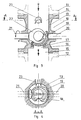
- a valve 10 comprises in general a valve body attached to pipe connections 11 and 12 or equivalents and inlet and outlet openings 14 and 15 in it.
- a valve opening 16 In the body 13 there is a valve opening 16 and the sealing surface thereof has a seat insert 17.
- the position of the calotte valve 19 is controlled by a control spindle 20 protruding from the the valve body 13.
- a coaxial shaft 21 protrudes from the valve body 13 in the opposite direction in relation to the spindle 20, and a fluidizing element 22 is attached to the head of shaft 21 inside the valve body 13 on the side of the coved surface of the calotte valve 19.
- the above described main components are preferably situated in the following way in relation to the direction of the pulp flow: firstly the fluidizing element 22, then the calotte valve 19, and then the valve opening 16.
- the valve in the opposite disposition with the fluidizing element behind the valve element in the direction of flow so as to hinder the fibres which might stick around the valve opening.
- the directions of the shafts of the rotor and the valve can differ from each other or one of the shafts can be within the other.
- the rotor can naturally also be arranged in connection with a shaft of another separate apparatus. For example, a screen, a thickener, a knotter or equivalent is appropriate.
- Fig. 3 and 4 also disclose a most preferable application field for the valve arrangement according to the invention.
- An inlet opening 23 for chemicals has been added to the valve body 13 in the direction of flow upstream of the other components and through which opening, for example, bleaching chemicals may be readily added into the pulp flow. Then by the same fluidization operation, by which the pulp is brought into a liquid form and as such flows through the valve, a very efficient mixing of the chemicals into the pulp is effected.
- the inlet opening for chemicals can also alternatively be located in the fluidization region.
- a valve element according to the invention functions in the following way.
- the pulp is subjected by the fluidizing element operating inside the valve body to such a considerable amount of shear forces that the bonds between the fibres forming a solid network of a pulp plug, loosen and the pulp flows like a fluid through the valve.
- the loss of pressure caused by the valve is consequently only a fraction of what it would be without fluidization.
- the most difficult situation is when the flow channel defined by the valve element 19 and the valve opening 16 is very small, in other words the volumetric flow is small.
- the fibres stick very easily on the fringes of the flow channel and gather forming in a short time a plug which closes the valve.
- the fluidizing element it causes a pulse at the flow channel against the normal direction of flow, in other words it tends to draw off the fibre bundles formed on the edge of the opening and to return them to the rest of the pulp. If a rotating rotor is involved, the fibre bundles can be loosened also by the total effect of the structure of the valve element and the rotational direction of the rotor.
- Fig. 5 discloses further preferred equipment arrangement, in which the valve 10 can also be used also as a mixer, if so required.
- a pump 2 is connected to a pulp tank 3 and the pump is followed by a valve apparatus 10 situated at an applicable place and, according to the embodiment in the figure is controlled by a level detector.
- the arrangement in Fig. 5 can well be compared to the arrangement in Fig. 2, because in both cases the same measures are involved: control of the pump and mixing of chemicals.
- the equipment in Fig. 5 is much simpler and an additional advantage is achieved by the higher outlet pressure compared to that of Fig. 2.
- the valve according to the invention can be employed, for example, in an apparatus in which pulp is led from the MC-pump to the thickener which requires a certain counter pressure to function in the desired way. Consequently, the consistency of the pulp flow being throttled can easily be more than 15 %, even 20 %, whereby to ensure the flow (in other words hindrance of the clogging of the throttle point) fluidization of pulp is required immediately before the valve.
- the valve is to be situated preferably exactly at the outlet opening of the thickener, because at the same time as the valve throttles the flow, it also enables the discharge of the pulp from the thickener.
- the valve can also be used in connection with other components treating high consistency pulp.
- Fig. 6a represents the behaviour of a conventional valve at high consistency pulps.
- the test consistencies were 8, 10, 13 and 15 %.
- the horizontal axis shows the spread angle of the valve and the vertical axis the mass flow passing through the valve.
- Fig. 6b represents correspondingly the behaviour of the valve according to the invention at high consistencies. It is seen in the same coordinates that at small spread angles the 15 % pulp does not differ from water, so the adjustability is as good as that of water. At larger spread angles the 15 % pulp requires a little larger spread angle than water, but the curve does not bend horizontal as occurred with the valves according to the prior art.
- Fig. 7 discloses comparative curves of the capacity (y-axis) of the valve in the function of the pressure difference prevailing across the valve.
- the curves show the Q pulp /Q water relation of the volumetric flows, which with the valves in accordance with the prior art (broken line curves) is already at the consistency of 10 % weak. In other words a big pressure difference is required for the efficiency of the flow to reach a profitable value. At the consistency of 15 % the pressure difference required is even bigger.
- unbroken curve a considerably better efficiency is achieved and the maximum value achieved with considerably smaller pressure difference is, less than half of the corresponding pressure difference of a valve in accordance with the prior art.
- valve and the fluidizing element are arranged in one and the same body, but, for example, for technical reasons in manufacture, it can be advantageous to construct the valve and the fluidizing element as separate components to be attached to each other. Furthermore, it is possible to reduce the pressure loss by arranging the form and function of the fluidizator and the valve element, in other words the rotational direction of the fluidizator, so that the pulp is subjected by the fluidizator to a kinetic component towards the valve opening.
- the material being used does not need to be high consistency pulp, but the mixing is applicable also to diluted pulps or mere fluids.
- the substances or chemicals to be mixed can be either gaseous, liquids or solids.
Landscapes
- Chemical & Material Sciences (AREA)
- Chemical Kinetics & Catalysis (AREA)
- Dispersion Chemistry (AREA)
- Life Sciences & Earth Sciences (AREA)
- Engineering & Computer Science (AREA)
- Wood Science & Technology (AREA)
- Paper (AREA)
- Chemical Or Physical Treatment Of Fibers (AREA)
- Manufacture, Treatment Of Glass Fibers (AREA)
- Preliminary Treatment Of Fibers (AREA)
- Taps Or Cocks (AREA)
- Yarns And Mechanical Finishing Of Yarns Or Ropes (AREA)
- Inorganic Fibers (AREA)
- Endoscopes (AREA)
- Pyrrole Compounds (AREA)
Priority Applications (1)
| Application Number | Priority Date | Filing Date | Title |
|---|---|---|---|
| EP93114759A EP0578284B1 (de) | 1987-02-23 | 1988-02-22 | Rührwerk zur Verbesserung der Verarbeitung von Fasernsuspension |
Applications Claiming Priority (2)
| Application Number | Priority Date | Filing Date | Title |
|---|---|---|---|
| FI870747A FI82499C (fi) | 1987-02-23 | 1987-02-23 | Anordning foer foerbaettring av reglering och behandling av fibersuspensionsstroemning. |
| FI870747 | 1987-02-23 |
Related Child Applications (2)
| Application Number | Title | Priority Date | Filing Date |
|---|---|---|---|
| EP93114759.9 Division-Into | 1988-02-22 | ||
| EP93114759A Division EP0578284B1 (de) | 1987-02-23 | 1988-02-22 | Rührwerk zur Verbesserung der Verarbeitung von Fasernsuspension |
Publications (3)
| Publication Number | Publication Date |
|---|---|
| EP0280234A2 true EP0280234A2 (de) | 1988-08-31 |
| EP0280234A3 EP0280234A3 (de) | 1991-01-09 |
| EP0280234B1 EP0280234B1 (de) | 1994-05-18 |
Family
ID=8523990
Family Applications (2)
| Application Number | Title | Priority Date | Filing Date |
|---|---|---|---|
| EP88102569A Expired - Lifetime EP0280234B1 (de) | 1987-02-23 | 1988-02-22 | Verfahren und Vorrichtung zur Verbesserung der Behandlung einer Fasersuspension und zur Kontrolle des Fliessens einer Fasersuspension |
| EP93114759A Expired - Lifetime EP0578284B1 (de) | 1987-02-23 | 1988-02-22 | Rührwerk zur Verbesserung der Verarbeitung von Fasernsuspension |
Family Applications After (1)
| Application Number | Title | Priority Date | Filing Date |
|---|---|---|---|
| EP93114759A Expired - Lifetime EP0578284B1 (de) | 1987-02-23 | 1988-02-22 | Rührwerk zur Verbesserung der Verarbeitung von Fasernsuspension |
Country Status (7)
| Country | Link |
|---|---|
| EP (2) | EP0280234B1 (de) |
| JP (1) | JPS63288288A (de) |
| AT (2) | ATE185704T1 (de) |
| CA (1) | CA1313325C (de) |
| DE (3) | DE280234T1 (de) |
| FI (1) | FI82499C (de) |
| NO (1) | NO178468B (de) |
Cited By (2)
| Publication number | Priority date | Publication date | Assignee | Title |
|---|---|---|---|---|
| US8177937B2 (en) | 2008-07-03 | 2012-05-15 | Metso Paper, Inc. | Method and an apparatus for controlling a flow of pulp suspension |
| WO2014068211A2 (fr) | 2012-11-05 | 2014-05-08 | S.P.C.M. Sa | Dispositif pour l'injection puis le melange de polymere dans une canalisation transportant une suspension de particules solides et procede mettant en oeuvre le dispositif |
Families Citing this family (1)
| Publication number | Priority date | Publication date | Assignee | Title |
|---|---|---|---|---|
| AT403063B (de) * | 1995-04-12 | 1997-11-25 | Andritz Patentverwaltung | Vorrichtung zum einmischen von chemikalien in eine faserstoffsuspension |
Family Cites Families (6)
| Publication number | Priority date | Publication date | Assignee | Title |
|---|---|---|---|---|
| DE1066544B (de) * | 1956-12-18 | 1959-10-08 | Aschaffenburger Zellstoffwerke | Vorrichtung zum Mischen von Fluessigkeiten untereinander oder mit Gasen oder von Stoffgemischen mit verschiedenen Konsistenzen in einem feststehenden, rohrfoermigen Gehaeuse mit einer in diesem umlaufenden Ruehrwelle |
| US4030969A (en) * | 1972-06-13 | 1977-06-21 | Defibrator Ab | Method of dispersing a bleaching agent into a stream of fibrous cellulosic pulp material in a throttling nozzle |
| US4199266A (en) * | 1977-08-31 | 1980-04-22 | Giusti Raolo B | Processing vessels |
| DE3033240A1 (de) * | 1980-09-04 | 1982-04-01 | Wolfgang 4200 Oberhausen Riese | Segment- kugelhahn fuer silo-fahrzeuge |
| JPS6031554U (ja) * | 1983-08-09 | 1985-03-04 | 株式会社 不二工機製作所 | 弁 |
| US4662394A (en) * | 1985-10-25 | 1987-05-05 | Johnston Pump/General Valve, Inc. | Tight shut-off valve with flow control element |
-
1987
- 1987-02-23 FI FI870747A patent/FI82499C/fi not_active IP Right Cessation
-
1988
- 1988-02-22 AT AT93114759T patent/ATE185704T1/de not_active IP Right Cessation
- 1988-02-22 AT AT88102569T patent/ATE105884T1/de not_active IP Right Cessation
- 1988-02-22 EP EP88102569A patent/EP0280234B1/de not_active Expired - Lifetime
- 1988-02-22 NO NO880758A patent/NO178468B/no unknown
- 1988-02-22 DE DE198888102569T patent/DE280234T1/de active Pending
- 1988-02-22 EP EP93114759A patent/EP0578284B1/de not_active Expired - Lifetime
- 1988-02-22 CA CA000559428A patent/CA1313325C/en not_active Expired - Lifetime
- 1988-02-22 DE DE3889559T patent/DE3889559T2/de not_active Expired - Lifetime
- 1988-02-22 DE DE3856373T patent/DE3856373T2/de not_active Expired - Lifetime
- 1988-02-23 JP JP63038762A patent/JPS63288288A/ja active Granted
Cited By (4)
| Publication number | Priority date | Publication date | Assignee | Title |
|---|---|---|---|---|
| US8177937B2 (en) | 2008-07-03 | 2012-05-15 | Metso Paper, Inc. | Method and an apparatus for controlling a flow of pulp suspension |
| WO2014068211A2 (fr) | 2012-11-05 | 2014-05-08 | S.P.C.M. Sa | Dispositif pour l'injection puis le melange de polymere dans une canalisation transportant une suspension de particules solides et procede mettant en oeuvre le dispositif |
| FR2997635A1 (fr) * | 2012-11-05 | 2014-05-09 | Spcm Sa | Dispositif pour l'injection puis le melange de polymere dans une canalisation transportant une suspension de particules solides et procede mettant en œuvre le dispositif |
| WO2014068211A3 (fr) * | 2012-11-05 | 2014-06-26 | S.P.C.M. Sa | Dispositif pour l'injection puis le melange de polymere dans une canalisation transportant une suspension de particules solides et procede mettant en oeuvre le dispositif |
Also Published As
| Publication number | Publication date |
|---|---|
| EP0578284A2 (de) | 1994-01-12 |
| DE280234T1 (de) | 1989-06-22 |
| EP0280234B1 (de) | 1994-05-18 |
| FI82499B (fi) | 1990-11-30 |
| DE3856373T2 (de) | 2000-03-23 |
| DE3856373D1 (de) | 1999-11-25 |
| FI82499C (fi) | 1992-07-14 |
| ATE105884T1 (de) | 1994-06-15 |
| JPH0240790B2 (de) | 1990-09-13 |
| FI870747A7 (fi) | 1988-08-24 |
| NO178468B (no) | 1995-12-27 |
| EP0280234A3 (de) | 1991-01-09 |
| FI870747A0 (fi) | 1987-02-23 |
| DE3889559T2 (de) | 1994-09-29 |
| DE3889559D1 (de) | 1994-06-23 |
| CA1313325C (en) | 1993-02-02 |
| ATE185704T1 (de) | 1999-11-15 |
| EP0578284B1 (de) | 1999-10-20 |
| EP0578284A3 (en) | 1997-03-12 |
| NO880758L (no) | 1989-08-23 |
| NO880758D0 (no) | 1988-02-22 |
| JPS63288288A (ja) | 1988-11-25 |
Similar Documents
| Publication | Publication Date | Title |
|---|---|---|
| RU2013476C1 (ru) | Способ нагнетания волокнистой суспензии высокой консистенции и устройство для его осуществления | |
| JP4871724B2 (ja) | 液体の流れに化学物質を供給するための方法および装置 | |
| EP2622225B1 (de) | Zentrifugalpumpe | |
| JP4310426B2 (ja) | 加圧遠心ポンプの気体の混入構造 | |
| RU2079353C1 (ru) | Способ перемешивания твердых и жидких веществ (варианты) и устройство для его осуществления | |
| US5279709A (en) | Method and apparatus for improving the control and treatment of fiber suspension flow | |
| DE69102606T2 (de) | Verfahren und Apparat zur Freisetzung von Gas aus einem Flüssigkeit/Feststoff-Gemisch. | |
| US5236285A (en) | High pressure feeder | |
| EP0280234A2 (de) | Verfahren und Vorrichtung zur Verbesserung der Behandlung einer Fasersuspension und zur Kontrolle des Fliessens einer Fasersuspension | |
| CA1316386C (en) | High-consistency pulp tower and method of discharging pulp from the tower | |
| JPS631506A (ja) | ミキサ− | |
| CN113600088A (zh) | 混合系统和混合方法 | |
| CN215963320U (zh) | 混合系统 | |
| EP0300251B1 (de) | Verfahren und Vorrichtung zum Pumpen hochviskoser Pulpe | |
| US5690478A (en) | Solid material pump | |
| JP2008535641A (ja) | ガス状または液状の流体を媒体中に供給する方法および装置 | |
| WO2003014572A1 (en) | Pulp pump | |
| NO309011B1 (no) | Innretning for styring av en strøm med en fibersuspensjon | |
| CN223195294U (zh) | 一种空气奶油预混合输出机构 | |
| US5770072A (en) | Multiple inlet valve with means to isolate each inlet individually and direct a reverse flow therethrough | |
| EP0233859A1 (de) | Selbstansaugende Kreiselpumpe zum Aufbereiten und Fördern von mit hohem Faseranteil durchsetzten Flüssigkeiten | |
| AT392216B (de) | Vorrichtung zur abscheidung von gas | |
| JP7495357B2 (ja) | パルプ製造における空気ディフューザ用の洗浄ノズル組立体 | |
| DE10296521T5 (de) | Pumpvorrichtung | |
| CA2217724A1 (en) | Pump for conveying a moist pulp |
Legal Events
| Date | Code | Title | Description |
|---|---|---|---|
| PUAI | Public reference made under article 153(3) epc to a published international application that has entered the european phase |
Free format text: ORIGINAL CODE: 0009012 |
|
| 17P | Request for examination filed |
Effective date: 19880222 |
|
| AK | Designated contracting states |
Kind code of ref document: A2 Designated state(s): AT DE FR GB IT SE |
|
| TCAT | At: translation of patent claims filed | ||
| EL | Fr: translation of claims filed | ||
| DET | De: translation of patent claims | ||
| RAP1 | Party data changed (applicant data changed or rights of an application transferred) |
Owner name: A. AHLSTROM CORPORATION |
|
| PUAL | Search report despatched |
Free format text: ORIGINAL CODE: 0009013 |
|
| AK | Designated contracting states |
Kind code of ref document: A3 Designated state(s): AT DE FR GB IT SE |
|
| 17Q | First examination report despatched |
Effective date: 19910830 |
|
| GRAA | (expected) grant |
Free format text: ORIGINAL CODE: 0009210 |
|
| AK | Designated contracting states |
Kind code of ref document: B1 Designated state(s): AT DE FR GB IT SE |
|
| PG25 | Lapsed in a contracting state [announced via postgrant information from national office to epo] |
Ref country code: IT Free format text: LAPSE BECAUSE OF FAILURE TO SUBMIT A TRANSLATION OF THE DESCRIPTION OR TO PAY THE FEE WITHIN THE PRE;WARNING: LAPSES OF ITALIAN PATENTS WITH EFFECTIVE DATE BEFORE 2007 MAY HAVE OCCURRED AT ANY TIME BEFORE 2007. THE CORRECT EFFECTIVE DATE MAY BE DIFFERENT FROM THE ONE RECORDED.SCRIBED TIME-LIMIT Effective date: 19940518 |
|
| REF | Corresponds to: |
Ref document number: 105884 Country of ref document: AT Date of ref document: 19940615 Kind code of ref document: T |
|
| REF | Corresponds to: |
Ref document number: 3889559 Country of ref document: DE Date of ref document: 19940623 |
|
| ET | Fr: translation filed | ||
| EAL | Se: european patent in force in sweden |
Ref document number: 88102569.6 |
|
| PLBE | No opposition filed within time limit |
Free format text: ORIGINAL CODE: 0009261 |
|
| STAA | Information on the status of an ep patent application or granted ep patent |
Free format text: STATUS: NO OPPOSITION FILED WITHIN TIME LIMIT |
|
| 26N | No opposition filed | ||
| REG | Reference to a national code |
Ref country code: GB Ref legal event code: 732E |
|
| REG | Reference to a national code |
Ref country code: FR Ref legal event code: TP |
|
| REG | Reference to a national code |
Ref country code: GB Ref legal event code: IF02 |
|
| PGFP | Annual fee paid to national office [announced via postgrant information from national office to epo] |
Ref country code: AT Payment date: 20070109 Year of fee payment: 20 |
|
| PGFP | Annual fee paid to national office [announced via postgrant information from national office to epo] |
Ref country code: GB Payment date: 20070115 Year of fee payment: 20 |
|
| PGFP | Annual fee paid to national office [announced via postgrant information from national office to epo] |
Ref country code: SE Payment date: 20070117 Year of fee payment: 20 |
|
| PGFP | Annual fee paid to national office [announced via postgrant information from national office to epo] |
Ref country code: DE Payment date: 20070118 Year of fee payment: 20 |
|
| REG | Reference to a national code |
Ref country code: GB Ref legal event code: PE20 |
|
| EUG | Se: european patent has lapsed | ||
| PGFP | Annual fee paid to national office [announced via postgrant information from national office to epo] |
Ref country code: FR Payment date: 20070111 Year of fee payment: 20 |
|
| PG25 | Lapsed in a contracting state [announced via postgrant information from national office to epo] |
Ref country code: GB Free format text: LAPSE BECAUSE OF EXPIRATION OF PROTECTION Effective date: 20080221 |