EP0280292A2 - Verfahren zur Herstellung einer Schicht aus supraleitendem Oxidmaterial - Google Patents
Verfahren zur Herstellung einer Schicht aus supraleitendem Oxidmaterial Download PDFInfo
- Publication number
- EP0280292A2 EP0280292A2 EP88102805A EP88102805A EP0280292A2 EP 0280292 A2 EP0280292 A2 EP 0280292A2 EP 88102805 A EP88102805 A EP 88102805A EP 88102805 A EP88102805 A EP 88102805A EP 0280292 A2 EP0280292 A2 EP 0280292A2
- Authority
- EP
- European Patent Office
- Prior art keywords
- solution
- compound
- single sort
- oxide superconductive
- preparing
- Prior art date
- Legal status (The legal status is an assumption and is not a legal conclusion. Google has not performed a legal analysis and makes no representation as to the accuracy of the status listed.)
- Granted
Links
Images



Classifications
-
- C—CHEMISTRY; METALLURGY
- C04—CEMENTS; CONCRETE; ARTIFICIAL STONE; CERAMICS; REFRACTORIES
- C04B—LIME, MAGNESIA; SLAG; CEMENTS; COMPOSITIONS THEREOF, e.g. MORTARS, CONCRETE OR LIKE BUILDING MATERIALS; ARTIFICIAL STONE; CERAMICS; REFRACTORIES; TREATMENT OF NATURAL STONE
- C04B41/00—After-treatment of mortars, concrete, artificial stone or ceramics; Treatment of natural stone
- C04B41/009—After-treatment of mortars, concrete, artificial stone or ceramics; Treatment of natural stone characterised by the material treated
-
- C—CHEMISTRY; METALLURGY
- C01—INORGANIC CHEMISTRY
- C01G—COMPOUNDS CONTAINING METALS NOT COVERED BY SUBCLASSES C01D OR C01F
- C01G3/00—Compounds of copper
- C01G3/006—Compounds containing copper, with or without oxygen or hydrogen, and containing two or more other elements
-
- C—CHEMISTRY; METALLURGY
- C04—CEMENTS; CONCRETE; ARTIFICIAL STONE; CERAMICS; REFRACTORIES
- C04B—LIME, MAGNESIA; SLAG; CEMENTS; COMPOSITIONS THEREOF, e.g. MORTARS, CONCRETE OR LIKE BUILDING MATERIALS; ARTIFICIAL STONE; CERAMICS; REFRACTORIES; TREATMENT OF NATURAL STONE
- C04B35/00—Shaped ceramic products characterised by their composition; Ceramics compositions; Processing powders of inorganic compounds preparatory to the manufacturing of ceramic products
- C04B35/01—Shaped ceramic products characterised by their composition; Ceramics compositions; Processing powders of inorganic compounds preparatory to the manufacturing of ceramic products based on oxide ceramics
- C04B35/45—Shaped ceramic products characterised by their composition; Ceramics compositions; Processing powders of inorganic compounds preparatory to the manufacturing of ceramic products based on oxide ceramics based on copper oxide or solid solutions thereof with other oxides
-
- C—CHEMISTRY; METALLURGY
- C04—CEMENTS; CONCRETE; ARTIFICIAL STONE; CERAMICS; REFRACTORIES
- C04B—LIME, MAGNESIA; SLAG; CEMENTS; COMPOSITIONS THEREOF, e.g. MORTARS, CONCRETE OR LIKE BUILDING MATERIALS; ARTIFICIAL STONE; CERAMICS; REFRACTORIES; TREATMENT OF NATURAL STONE
- C04B35/00—Shaped ceramic products characterised by their composition; Ceramics compositions; Processing powders of inorganic compounds preparatory to the manufacturing of ceramic products
- C04B35/01—Shaped ceramic products characterised by their composition; Ceramics compositions; Processing powders of inorganic compounds preparatory to the manufacturing of ceramic products based on oxide ceramics
- C04B35/45—Shaped ceramic products characterised by their composition; Ceramics compositions; Processing powders of inorganic compounds preparatory to the manufacturing of ceramic products based on oxide ceramics based on copper oxide or solid solutions thereof with other oxides
- C04B35/4504—Shaped ceramic products characterised by their composition; Ceramics compositions; Processing powders of inorganic compounds preparatory to the manufacturing of ceramic products based on oxide ceramics based on copper oxide or solid solutions thereof with other oxides containing rare earth oxides
-
- C—CHEMISTRY; METALLURGY
- C04—CEMENTS; CONCRETE; ARTIFICIAL STONE; CERAMICS; REFRACTORIES
- C04B—LIME, MAGNESIA; SLAG; CEMENTS; COMPOSITIONS THEREOF, e.g. MORTARS, CONCRETE OR LIKE BUILDING MATERIALS; ARTIFICIAL STONE; CERAMICS; REFRACTORIES; TREATMENT OF NATURAL STONE
- C04B35/00—Shaped ceramic products characterised by their composition; Ceramics compositions; Processing powders of inorganic compounds preparatory to the manufacturing of ceramic products
- C04B35/01—Shaped ceramic products characterised by their composition; Ceramics compositions; Processing powders of inorganic compounds preparatory to the manufacturing of ceramic products based on oxide ceramics
- C04B35/45—Shaped ceramic products characterised by their composition; Ceramics compositions; Processing powders of inorganic compounds preparatory to the manufacturing of ceramic products based on oxide ceramics based on copper oxide or solid solutions thereof with other oxides
- C04B35/4504—Shaped ceramic products characterised by their composition; Ceramics compositions; Processing powders of inorganic compounds preparatory to the manufacturing of ceramic products based on oxide ceramics based on copper oxide or solid solutions thereof with other oxides containing rare earth oxides
- C04B35/4508—Type 1-2-3
-
- C—CHEMISTRY; METALLURGY
- C04—CEMENTS; CONCRETE; ARTIFICIAL STONE; CERAMICS; REFRACTORIES
- C04B—LIME, MAGNESIA; SLAG; CEMENTS; COMPOSITIONS THEREOF, e.g. MORTARS, CONCRETE OR LIKE BUILDING MATERIALS; ARTIFICIAL STONE; CERAMICS; REFRACTORIES; TREATMENT OF NATURAL STONE
- C04B41/00—After-treatment of mortars, concrete, artificial stone or ceramics; Treatment of natural stone
- C04B41/45—Coating or impregnating, e.g. injection in masonry, partial coating of green or fired ceramics, organic coating compositions for adhering together two concrete elements
- C04B41/50—Coating or impregnating, e.g. injection in masonry, partial coating of green or fired ceramics, organic coating compositions for adhering together two concrete elements with inorganic materials
- C04B41/5072—Coating or impregnating, e.g. injection in masonry, partial coating of green or fired ceramics, organic coating compositions for adhering together two concrete elements with inorganic materials with oxides or hydroxides not covered by C04B41/5025
- C04B41/5074—Copper oxide or solid solutions thereof
-
- C—CHEMISTRY; METALLURGY
- C04—CEMENTS; CONCRETE; ARTIFICIAL STONE; CERAMICS; REFRACTORIES
- C04B—LIME, MAGNESIA; SLAG; CEMENTS; COMPOSITIONS THEREOF, e.g. MORTARS, CONCRETE OR LIKE BUILDING MATERIALS; ARTIFICIAL STONE; CERAMICS; REFRACTORIES; TREATMENT OF NATURAL STONE
- C04B41/00—After-treatment of mortars, concrete, artificial stone or ceramics; Treatment of natural stone
- C04B41/45—Coating or impregnating, e.g. injection in masonry, partial coating of green or fired ceramics, organic coating compositions for adhering together two concrete elements
- C04B41/52—Multiple coating or impregnating multiple coating or impregnating with the same composition or with compositions only differing in the concentration of the constituents, is classified as single coating or impregnation
-
- C—CHEMISTRY; METALLURGY
- C04—CEMENTS; CONCRETE; ARTIFICIAL STONE; CERAMICS; REFRACTORIES
- C04B—LIME, MAGNESIA; SLAG; CEMENTS; COMPOSITIONS THEREOF, e.g. MORTARS, CONCRETE OR LIKE BUILDING MATERIALS; ARTIFICIAL STONE; CERAMICS; REFRACTORIES; TREATMENT OF NATURAL STONE
- C04B41/00—After-treatment of mortars, concrete, artificial stone or ceramics; Treatment of natural stone
- C04B41/80—After-treatment of mortars, concrete, artificial stone or ceramics; Treatment of natural stone of only ceramics
- C04B41/81—Coating or impregnation
- C04B41/85—Coating or impregnation with inorganic materials
-
- C—CHEMISTRY; METALLURGY
- C04—CEMENTS; CONCRETE; ARTIFICIAL STONE; CERAMICS; REFRACTORIES
- C04B—LIME, MAGNESIA; SLAG; CEMENTS; COMPOSITIONS THEREOF, e.g. MORTARS, CONCRETE OR LIKE BUILDING MATERIALS; ARTIFICIAL STONE; CERAMICS; REFRACTORIES; TREATMENT OF NATURAL STONE
- C04B41/00—After-treatment of mortars, concrete, artificial stone or ceramics; Treatment of natural stone
- C04B41/80—After-treatment of mortars, concrete, artificial stone or ceramics; Treatment of natural stone of only ceramics
- C04B41/81—Coating or impregnation
- C04B41/89—Coating or impregnation for obtaining at least two superposed coatings having different compositions
-
- H—ELECTRICITY
- H10—SEMICONDUCTOR DEVICES; ELECTRIC SOLID-STATE DEVICES NOT OTHERWISE PROVIDED FOR
- H10N—ELECTRIC SOLID-STATE DEVICES NOT OTHERWISE PROVIDED FOR
- H10N60/00—Superconducting devices
- H10N60/01—Manufacture or treatment
- H10N60/0268—Manufacture or treatment of devices comprising copper oxide
- H10N60/0296—Processes for depositing or forming copper oxide superconductor layers
- H10N60/0324—Processes for depositing or forming copper oxide superconductor layers from a solution
-
- H—ELECTRICITY
- H10—SEMICONDUCTOR DEVICES; ELECTRIC SOLID-STATE DEVICES NOT OTHERWISE PROVIDED FOR
- H10N—ELECTRIC SOLID-STATE DEVICES NOT OTHERWISE PROVIDED FOR
- H10N60/00—Superconducting devices
- H10N60/01—Manufacture or treatment
- H10N60/0268—Manufacture or treatment of devices comprising copper oxide
- H10N60/0296—Processes for depositing or forming copper oxide superconductor layers
- H10N60/0548—Processes for depositing or forming copper oxide superconductor layers by deposition and subsequent treatment, e.g. oxidation of pre-deposited material
-
- H—ELECTRICITY
- H10—SEMICONDUCTOR DEVICES; ELECTRIC SOLID-STATE DEVICES NOT OTHERWISE PROVIDED FOR
- H10N—ELECTRIC SOLID-STATE DEVICES NOT OTHERWISE PROVIDED FOR
- H10N60/00—Superconducting devices
- H10N60/01—Manufacture or treatment
- H10N60/0268—Manufacture or treatment of devices comprising copper oxide
- H10N60/0801—Manufacture or treatment of filaments or composite wires
-
- H—ELECTRICITY
- H10—SEMICONDUCTOR DEVICES; ELECTRIC SOLID-STATE DEVICES NOT OTHERWISE PROVIDED FOR
- H10W—GENERIC PACKAGES, INTERCONNECTIONS, CONNECTORS OR OTHER CONSTRUCTIONAL DETAILS OF DEVICES COVERED BY CLASS H10
- H10W20/00—Interconnections in chips, wafers or substrates
- H10W20/40—Interconnections external to wafers or substrates, e.g. back-end-of-line [BEOL] metallisations or vias connecting to gate electrodes
- H10W20/41—Interconnections external to wafers or substrates, e.g. back-end-of-line [BEOL] metallisations or vias connecting to gate electrodes characterised by their conductive parts
- H10W20/44—Conductive materials thereof
- H10W20/4484—Superconducting materials
-
- C—CHEMISTRY; METALLURGY
- C01—INORGANIC CHEMISTRY
- C01P—INDEXING SCHEME RELATING TO STRUCTURAL AND PHYSICAL ASPECTS OF SOLID INORGANIC COMPOUNDS
- C01P2002/00—Crystal-structural characteristics
- C01P2002/30—Three-dimensional structures
- C01P2002/34—Three-dimensional structures perovskite-type (ABO3)
-
- H—ELECTRICITY
- H10—SEMICONDUCTOR DEVICES; ELECTRIC SOLID-STATE DEVICES NOT OTHERWISE PROVIDED FOR
- H10W—GENERIC PACKAGES, INTERCONNECTIONS, CONNECTORS OR OTHER CONSTRUCTIONAL DETAILS OF DEVICES COVERED BY CLASS H10
- H10W72/00—Interconnections or connectors in packages
- H10W72/50—Bond wires
- H10W72/531—Shapes of wire connectors
- H10W72/536—Shapes of wire connectors the connected ends being ball-shaped
-
- H—ELECTRICITY
- H10—SEMICONDUCTOR DEVICES; ELECTRIC SOLID-STATE DEVICES NOT OTHERWISE PROVIDED FOR
- H10W—GENERIC PACKAGES, INTERCONNECTIONS, CONNECTORS OR OTHER CONSTRUCTIONAL DETAILS OF DEVICES COVERED BY CLASS H10
- H10W72/00—Interconnections or connectors in packages
- H10W72/50—Bond wires
- H10W72/551—Materials of bond wires
- H10W72/552—Materials of bond wires comprising metals or metalloids, e.g. silver
- H10W72/5522—Materials of bond wires comprising metals or metalloids, e.g. silver comprising gold [Au]
Definitions
- the present invention relates to an oxide superconductive material and a method of manufacturing the same, and more particularly, it relates to an oxide superconductive material being in layer perovskite structure for providing a superconductor having a high critical temperature, an elongated body prepared by the said material to be applied to a wire or the like and a base material formed with a thin film of the said material, and a method of manufacturing the same.
- Ceramics oxide materials have recently been watched as superconductive materials having higher critical temperatures. Such ceramics oxide superconductive materials are generally prepared by compression-molding raw materials of ceramics powder by press working and thereafter sintering the same. Study has been made to process such superconductive materials into elongated bodies, to utilize the same as electric transmission media etc.
- Elongated bodies having the aforementioned superconductive materials are manufactured by:
- an oxide superconductive material generally has a high melting point and hence, within the aforementioned methods, the vapor phase method (a) requires specific equipments such as a plasma generator and an apparatus for heating raw materials, and film formation is performed under a high-temperature atmosphere. According to the vapor phase method, further, high cleanliness is required on the surface of a base material to be provided with a thin film, and hence the surface must be polished in a high degree as pretreatment.
- the final configuration of an oxide superconductive material obtained by the powder sintering method (b) depends on the configuration of a molding jig in bulk mixing of raw material particles, and hence it has been difficult to obtain an elongated body, for example. Further, the oxide superconductive material obtained by this method is heterogenous in composition because of residual unreacted parts of powder particles.
- an elongated body of a generally studied superconductive material has no flexibility, and hence disconnection may be caused when the same is wound up by a reel having a small radius of curvature etc.
- manufacturing steps have been complicated.
- the present invention has been proposed to solve the aforementioned problems, and an object thereof is to provide a method of manufacturing an oxide superconductive material showing a high critical temperature, which is homogenous in composition with no unreacted parts and capable of easily obtaining an elongated body.
- Another object of the present invention is to provide a method of forming a thin film of an oxide superconductive material showing a high critical temperature, which can be manufactured under a lower temperature to easily obtain a thin film, on the surface of a base material.
- water is added to a solution obtained by dissolving a mixture containing at least a single sort of compound within an alkoxide, a carboxylate and an acetylacetonato of a single element selected from a group of elements belonging to the groups Ia, IIa and IIIa of the periodic table and at least a single sort of compound within an alkoxide, a carboxylate and an acetylacetonato of a single element selected from a group of elements belonging to the groups Ib, IIb and IIIb of the periodic table in an appropriate organic solvent to hydrolyze the same.
- water is added to solutions of the respective compounds to separately hydrolyze the same, thereby to mix the hydrolyzed substances. Thereafter the mixture is shaped into an elongated body or applied onto a base material and heated, thereby to obtain an elongated body or a thin film of an oxide superconductive material containing the said elements.
- a method of obtaining oxide ceramics powder from a liquid phase as a method of obtaining oxide ceramics.
- Such a method includes a method of obtaining oxide ceramics by hydrolyzing starting materials of compounds of elements for forming the target oxide ceramics, i.e., a method employing the sol-gel method.
- a method employing the sol-gel method According to this method, viscosity is increased with progress of hydrolysis, and hence the oxide ceramics can be spun into fiber or applied onto a base material similarly to the case of organic high polymer, by selecting appropriate hydrolytic stages.
- an elongated body or a thin film of an oxide superconductive material can be obtained by application of the sol-gel method.
- the present invention is based on such view of the inventors.
- first prepared are alkoxides, carboxylates or acetylacetonatos as compounds of respective elements for forming a target oxide superconductive material.
- prepared is a mixture containing an alkoxide, a carboxylate or an acetylacetonato of at least a single sort of element selected from a group of elements belonging to the groups Ia, IIa and IIIa of the periodic table and an alkoxide, a carboxylate or an acetylacetonato of an element selected from a group of elements belonging to the groups Ib, IIb and IIIb of the periodic table.
- compounds of at least two sorts of elements are respectively prepared as alkoxides, carboxylates or acetylacetonatos of the elements belonging to the groups Ia, IIa and IIIa of the periodic table.
- the elements belonging to the group Ia of the periodic table are Li, Na, K, Rb, Cs and Fr.
- the elements belonging to the group IIa of the periodic table are Be, Mg, Ca, Sr, Ba and Ra.
- the elements belonging to the group IIIa of the periodic table are Sc, Y, La, Ce, Pr, Nd, Pm, Sm, Eu, Gd, Tb, Dy, Ho, Er, Tm, Yb, Lu, Ac, Th, Pa, U, Np, Pu, Am, Cm, Bk, Cf, Es, Fm, Md, No and Lr.
- the elements belonging to the group Ib of the periodic table are Cu, Ag and Au.
- the elements belonging to the group IIb of the periodic table are Zn, Cd and Hg.
- the elements belonging to the group IIIb of the periodic table are B, Al, Ga, In and Tl.
- the mixture of alkoxides, carboxylates and/or acetylacetonatos prepared in the aforementioned manner is dissolved in an organic solvent, and water is added to the solution to hydrolyze the same. Further, dehydration/condensation reaction is caused if necessary. Thus, a sol or gel solution is obtained. Then the solution is shaped into fiber by spinning or the like, or applied to the surface of a base material to form a film. At this time, it is preferable to adjust viscosity which is increased with progress of hydrolysis.
- the fibrous substance thus obtained or the film formed on the surface of the base material is heated, thereby to obtain a fine wire or a thin film of an oxide superconductive material containing respective elements contained in the compounds, which are starting materials.
- Solutions containing the alkoxides, carboxylates or acetylacetonatos of the respective elements may be separately hydrolyzed to be thereafter mixed with each other. Alternatively, such solutions may be mixed with each other to be thereafter hydrolyzed, as hereinabove described.
- the mixed solution may be gradually dried to form a cake, which in turn is heated to a temperature of about 700 to 800°C to obtain a bulky oxide superconductive material.
- a heating step may be performed under a state decompressed from the atmospheric pressure, and under such decompression, heating is performed at a temperature lower than the aforementioned preferable temperature under the atmospheric pressure, i.e., about 300 to 800°C.
- the heating step may be performed by first heating the solution in the atmosphere and thereafter re-heating the same in an oxygen atmosphere, thereby to increase the critical temperature of the oxide superconductive material thus obtained.
- the method according to the present invention including the step of mixing the solutions containing raw materials, can be performed under a low temperature of less than 1000°C, as compared with reaction for heating/melting the raw materials to/at a temperature exceeding 1000°C. Further, since liquids are mixed with each other to improve dispersibility of the raw materials, a homogenous oxide superconductive material can be obtained as a final product.
- spinning or application can be performed by adjusting viscosity of the solution after hydrolysis, whereby an elongated body, for example, can be obtained.
- a method of manufacturing a superconductive elongated body according to the present invention comprises a step of adding water to a solution containing the aforementioned compounds to cause hydrolysis and dehydration/condensation reaction thereby to generate a gel, a step of heating the gel to cause solation thereof, a step of elongating the substance thus heated to solate, a step of causing gelation of the elongated substance and a step of heating the gelating elongated substance.
- cooling may be positively performed to prompt such transition.
- the step of elongating the substance heated to solate and the step of causing gelation of the elongated substance may be simultaneously performed.
- the gelating elongated substance is preferably heated under an oxygen atmosphere in order to improve superconductivity of the elongated body to be obtained. It is also preferable to perform such heating under a state decompressed from the atmospheric pressure, thereby to reduce the heating temperature in this step. Thus, returning of the gel to the sol can be suppressed.
- a solution is converted from a sol into a gel with progress of dehydration/condensation reaction.
- the solidified gel is converted into a sol by heating, and the sol is converted into a gel by cooling.
- a substance once gelating is heated for solation, and the solating substance is then elongated by providing a hole in a lower portion of a heating vessel and drawing out the solating substance through the hole. Then, the elongated sol is cooled to be converted into a gel.
- the elongated body can be easily varied in sectional configuration to be in the form of a fine wire, a tape etc. including a deformed configuration by devising the sectional configuration of a portion for passing the solating substance. Further, the elongated body can be varied in sectional area in a wide range by arbitrarily selecting the size of the sectional area of the portion for passing the solating substance.
- the mixed solution may be applied to at least a part of the surface of a base material, and application to the entire surface is not required so far as a superconductive layer continuous in the longitudinal direction can be formed. It is preferable to perform such application of the solution to the surface of the base material and heating/firing at least twice so that no cracking is caused in the superconductive layer after firing.
- the superconductive layer obtained by heating/firing in the present invention is excellent in adhesion to the base material and has high rupture strength, while no cracking or disconnection is caused when the same is bent in prescribed curvature.
- the oxide superconductive material obtained by the present invention is oxide ceramics supposed to have layer perovskite structure, for example, such as Y-Ba-Cu-O oxide, Y-Sr-Cu-O oxide, La-Ba-Cu-O oxide, La-Sr-Cu-O oxide, etc. Such elements may be partially replaced by other elements.
- the base material employed in the present invention is prepared by zirconia having flexibility, alumina, magnesium oxide, strontium titanate, YSZ (yttrium stabilized zirconia), etc. Within these, known are those containing several % of oxide yttrium for improving flexibility.
- the base material is in the form of a tape or a round wire, for example.
- thickness thereof is preferably within a range of 30 to 500 ⁇ m, while the diameter is preferably within a range of 30 to 500 ⁇ m in the case of a base material being in the form of a round wire.
- a flexible tape-like base material of ceramics is prepared by a zirconia tape having characteristics such as surface roughness Ra of about 0.3 ⁇ m, R max of about 2 ⁇ m and rupture strength at 25°C of 11000 kg/cm2 or an alumina tape having characteristics such as surface roughness Ra of about 0.3 ⁇ m, R max of about 3 ⁇ m and rupture strength of 3300 kg/cm2, for example.
- the superconductive elongated body after formation of the superconductive layer is preferably not more than 500 ⁇ m, and more preferably, not more than 55 ⁇ m in thickness.
- the superconductive elongated body after formation of the superconductive layer is preferably not more than 500 ⁇ m, and more preferably, not more than 55 ⁇ m in diameter.
- a superconductivity stabilizing material When a superconductivity stabilizing material is employed as the base material, a thin film of an oxide superconductive material formed on the surface thereof provides a superconductor showing a high critical temperature. As the result, the conductor coated with the superconductive material thus obtained shows a stable superconductive state through function of the superconductivity stabilizing material.
- Such superconductivity stabilizing material is preferably prepared by Cu, Al etc.
- a layer of a superconductivity stabilizing material and a layer of an oxide superconductive material may be alternately formed to provide a conductor coated with a superconductive material being in multilayer structure.
- the superconductivity stabilizing material is prepared by an elongated one, obtained is a conductor coated with a superconductive material in the form of a wire material such as a round wire having a circular sectional configuration of multilayer structure or a rectangular wire having a different sectional configuration.
- a superconductive material such as a round wire having a circular sectional configuration of multilayer structure or a rectangular wire having a different sectional configuration.
- the present invention is widely applicable in the field of superconductive wires etc.
- the inventive method requires no specific equipments such as a heating apparatus for the base material and the film materials as compared with the vapor phase method, and can be performed under a low temperature. Further, cleanliness is not strictly required on the surface to be provided with a film, while no polishing in a high degree is required as pretreatment for the surface.
- the present invention further provides a method of forming a thin film of the aforementioned oxide superconductive material on a substrate having semiconductor devices as an interconnection film, through application of the sol-gel method.
- the substrate may not be heated to a high temperature of at least 1000°C as compared with formation of a film of ceramics by a vapor phase thin film growth method, whereby an interconnection part for an electronic device such as an LSI can be formed without damaging the semiconductor devices built in the substrate.
- application of a solution onto a substrate having semiconductor devices is preferably performed by a printing process such as screen printing. Further, heating after such application is preferably performed under a state decompressed from the atmospheric pressure, thereby to reduce the heating temperature in such a step.
- such an oxide material showing superconductivity forms the interconnection part for the electronic device such as an IC, whereby interconnection resistance and floating capacitance can be reduced under a superconductive state, while the time constant is reduced.
- a superconductive elongated body which is optimum for forming a long-distance transmission line or a coil for a high current density magnet, being capable of most effectively utilizing characteristics of the superconductive material, can be easily obtained to enable industrial production.
- the superconductive layer is formed on at least a part of the surface of a flexible base material, thereby to obtain a highly practical superconductive elongated body having flexibility, which can be wound up by a reel.
- interconnection resistance can be easily reduced through characteristics of the superconductive material, whereby the operating speed of an electronic device such as an IC or an LSI can be increased beyond the limit with increase in speed of semiconductor devices.
- steps of manufacturing an oxide superconductive material according to the present invention are as follows:
- raw material compounds are first prepared by alkoxides, carboxylates or acetylacetonatos of respective metal elements for composing an oxide superconductive material. Then the raw material compounds are dissolved in an organic solvent, to prepare a solution. Then water is added to this solution, to cause hydrolysis and dehydration/condensation reaction. Thereafter the solution caused to solate or gelate by such reaction is heated to obtain an oxide superconductive material. At this time, an elongated oxide superconductive material is obtained by shaping the solating or gelating solution into an elongated body and heating/firing the same. Alternatively, a thin film of the oxide superconductive material is formed on the surface of a base material by applying the solating or gelating solution on the surface of the base material and heating/firing the same.
- Diethylene glycol monomethylether solutions of Ba(O-i-C3H7)2, La(O-i-C3H7)3 and Sr(O-i-C3H7)2 were prepared as alkoxides of Ba, La and Sr respectively.
- the alkoxides were mixed with each other, and a chloroform solution containing copper acetylacetonato was added to the mixture.
- a small amount of acetylacetone was further added to the mixture to stir/mix the same while performing reflux at a temperature of 50°C. Thereafter water diluted by alcohol was added to the mixed solution to cause hydrolysis.
- Small amounts of acetic acid and monomethyl formamide were added to the mixed solution as deflocculants at this time, to cause no precipitation.
- a sol solution thus obtained was introduced into a quartz beaker, which was then entirely wrapped in an aluminum foil member to be shaded. Several holes of 1 mm ⁇ in diameter were defined in parts of the aluminum foil member shading the beaker, which was then left to gradually dry the sol solution. After being left for 20 days, the substance was heated to a temperature of 900°C at a temperature-up speed of 0.2°C/min. under the atmospheric pressure, to obtain La-Ba-Sr-Cu-O oxide ceramics being in the form of a column having layer perovskite structure of 3 cm ⁇ in diameter and 1 cm in height.
- the critical temperature of the substance was measured by a four-terminal resistance method, to find that reduction in electric resistance started at a temperature of 40 K and a superconductive state was attained at a temperature of 16 K.
- Alkoxide solutions of Ba, La and Sr were prepared in a similar manner to Example 1.
- a chloroform solution containing copper acetylacetonato was added to a mixture of the alkoxide solutions.
- Small amounts of acetylacetone and octyl alcohol were added to the substance to stir/mix the same while performing reflux at a temperature of 50°C. Thereafter hydrolysis was caused similarly to Example 1.
- a copper wire of 2.6 mm ⁇ in diameter was dipped in a sol solution thus obtained through a dipping method and raised up at a speed of 0.2 to 0.25 mm/min. to be coated with the solution.
- the coated copper wire was fired in a vacuum at a temperature of 850°C for 10 minutes and thereafter heated in an oxygen atmosphere at a temperature of 400°C for one hour, to obtain a copper wire covered by a coating film having layer perovskite structure.
- the critical temperature of the copper wire was measured by the four-terminal resistance method, to confirm that reduction in electric resistance started at a temperature of 41 K and a superconductive state was attained at a temperature of 20 K, to provide a superconductor of high performance.
- Diethylene glycol monomethylether solutions of Ba(O-i-C3H7)2, La(O-i-C3H7)3 and Sr(O-i-C3H7)2 were prepared as alkoxides of Ba, La and Sr.
- a chloroform solution containing copper acetylacetonato was added to a mixture of the alkoxide solutions.
- a small amount of acetylacetone was added to the substance to stir/mix the same while performing reflux at a temperature of 50°C. Thereafter water diluted by alcohol was added to the mixed solution to cause hydrolysis.
- the amount of water added to each alkoxide was in correspondence to 1.2 equivalent in mole ratio.
- the substance was stirred under a temperature of 50°C further for two hours, and thereafter stood to be cooled to the room temperature.
- a sol solution thus obtained was left until its viscosity reached 20 poises, and thereafter spun into gel fiber at the room temperature.
- This gel fiber was heated to a temperature of 800°C, to obtain fiber of La-Ba-Sr-Cu-O oxide.
- the critical temperature of this fiber was measured to find that reduction in electric resistance started at a temperature of 40 K and a superconductive state was attained at a temperature of 32 K.
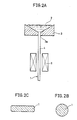
- Fig. 2A is a schematic structural diagram conceptually showing an apparatus for illustrating the aforementioned Example.
- the apparatus is formed by a crucible 3 for receiving a sol solution 2 and a heating furnace 5.
- a hole 3a is defined in a central portion of the crucible 3, to pass the sol solution 2.
- the sol solution 2 prepared in the aforementioned manner was introduced into the crucible 3. Then the sol solution 2 was spun through the hole 3a of the crucible 3, to draw out a gelating fiber member 4.
- the gelating fiber member 4 was then introduced into the heating furnace 5 located in a lower position, to be heated up to 800°C.
- a linear body being in the form of a round wire, was downwardly drawn out from the heating furnace 5 to provide a superconductive elongated body 1 of La-Ba-Sr-Cu-O oxide.
- Fig. 2B shows the section of the superconductive elongated body 1 in the form of a round wire thus obtained.
- the superconductive elongated body 1 prepared in this Example was in the form of a round wire, a tape-like superconductive elongated body 1 may be prepared as shown in Fig. 2C.
- 1-octanol solutions of La(O-i-t-C7H15)3, Ba(O-i-C8H17)2 and Sr(O-i-C8H17)2 were prepared as alkoxides of La, Ba and Sr respectively.
- a butanol solution containing Cu[OCOCH(C2H5)C4H9]2 was added to a substance obtained by adding a small amount of linolic acid to a mixed solution thereof as a thickener.
- a small amount of acetylacetone was further added to the substance to stir/mix the same while performing reflux at a temperature of 50°C. Thereafter water diluted by alcohol was added to the mixed solution to cause hydrolysis.
- the amount of water added to each alkoxide was in correspondence to 1.2 equivalent in mole ratio.
- the substance was stirred under a temperature of 50°C further for two hours, and stood to be cooled to the room temperature.
- a sol solution thus obtained was left until its viscosity reached 20 poises, and thereafter spun into gel fiber at the room temperature as shown in Fig. 2A.
- This gel fiber was heated in the atmosphere at a temperature of 920°C for two hours, and thereafter annealed at a cooling speed of 1°C/min. to obtain a fine wire of La-Ba-Sr-Cu-O oxide.
- the critical temperature of this fiber was measured to find that reduction in electric resistance started at a temperature of 46 K and a superconductive state was attained at a temperature of 25 K.
- 1-octanol solutions of Y(O-i-t-C7H15)3 and Sr(O-i-C8H17)2 were prepared as alkoxides of Y and Sr respectively.
- a butanol solution containing Cu[OCOCH(C2H5)C4H9]2 was added to a substance obtained by adding a small amount of linolic acid to a mixed solution thereof as a thickener.
- a small amount of acetylacetone was further added to the substance to stir/mix the same while performing reflux at a temperature of 50°C. Thereafter water diluted by alcohol was added to the mixed solution to cause hydrolysis.
- the amount of water added to each alkoxide was in correspondence to 1.2 equivalent in mole ratio.
- the substance was stirred under a temperature of 50°C further for two hours, and stood to be cooled to the room temperature.
- a sol solution thus obtained was left until its viscosity reached 20 poises, and spun into gel fiber at the room temperature as shown in Fig. 2A.
- This gel fiber was heated in the atmosphere at a temperature of 920°C for two hours and thereafter annealed at a cooling speed of 1°C/min., to obtain a fine wire of Y-Sr-Cu-O oxide.
- the critical temperature of this fiber was measured to find that reduction in electric resistance started at a temperature of 41 K and a superconductive state was attained at a temperature of 18 K.
- This gel was introduced into a beaker having a hole of 2 mm ⁇ in diameter in its lower portion and heated, whereby a substance transited to a sol state flowed out through the hole and cooled to be immediately solidified for gelation.
- This substance was heated to a temperature of 850°C at a temperature-up speed of 5°C/min. under a state gradually decompressed from the atmospheric pressure to 0.1 mmHg and fired at the said temperature for two hours. Thereafter the pressure was returned to the atmospheric pressure, and then the substance was cooled to the room temperature at a cooling speed of 1°C/min.
- Fiber of 0.5 mm ⁇ in diameter was thus obtained.
- Superconductivity of this fiber was examined by measuring the critical temperature thereof, to find that reduction in electric resistance started at a temperature of 86 K and a superconductive state was attained at a temperature of 79 K.
- 1-octanol solutions of La(O-i-t-C7H15)3, Ba(O-i-C8H17)2 and Sr(O-i-C8H17)2 were prepared as alkoxides of La, Ba and Sr respectively.
- a butanol solution containing Cu[OCOCH(C2H5)C4H9]2 was added to a substance obtained by adding a small amount of linolic acid to a mixed solution thereof as a thickener.
- a small amount of acetylacetone was further added to the substance to stir/mix the same while performing reflux at a temperature of 50°C. Thereafter water diluted by alcohol was added to the mixed solution to cause hydrolysis.
- the amount of water added to each alkoxide was in correspondence to 0.2 equivalent in mole ratio.
- the substance was further stirred at the room temperature for 10 minutes, and acetic acid was added to the same as a deflocculant to cause no precipitation.
- a copper wire of 2.6 mm ⁇ in diameter was dipped in the sol solution through the dipping method and raised up at a speed of 1 cm/min., to be coated with the solution.
- the coated copper wire was fired in the vacuum at a temperature of 850°C for 10 minutes and then heated in an oxygen atmosphere at a temperature of 400°C for one hour, to obtain a copper wire coated with a film of La-Ba-Sr-Cu-O oxide having layer perovskite structure.
- the critical temperature of this copper wire coated with the oxide superconductive material was measured to find that reduction in electric resistance started at a temperature of 42 K and a superconductive state was attained at a temperature of 38 K.
- Fig. 3A is a partially fragmented sectional view showing an example of an IC employing compound semiconductor GaAs, including an interconnection part formed by a method of interconnecting semiconductor devices according to the present invention.
- an insulating film 22 is formed on a p-type substrate 21.
- a source 23 is formed on a surface layer part of the p-type substrate 21 as an n+-type region, and a source electrode 24 is formed on the source 23.
- a drain 25 is formed on a surface layer part of the p-type substrate 21 as an n+-type region, and a drain electrode 26 is formed on the drain 25.
- a gate electrode 27 is formed between the source electrode 4 and the drain electrode 26, and a gate oxide film 28 is formed under the same.
- An Au lead wire 29 is interconnected with the drain electrode 26 through a bonding pad 30.
- the drain electrode 26 is connected with the bonding pad 30 through an interconnection layer 31, which is prepared by a superconductive oxide ceramics layer formed by an interconnection method according to the present
- the interconnection layer 31 is formed by Y 1.0 Ba 2.0 Cu 3.0 O x , being superconductive oxide ceramics, and hence its operating speed is improved to about 1000 times as compared with an IC of the same structure employing general metal interconnection.
- a diethylene glycol monomethylether solution containing a compound being in composition of barium isopropoxide [Ba(O-i-C3H7)2] : yttrium ethoxide [Y(OC2H5)3] : copper tertiary butoxide [Cu(O-t-C4H9)2] 2:1:3 was stirred in a constant humidity/constant temperature bath of 60 % in humidity and 30°C in temperature for five days, to cause hydrolysis and dehydration/condensation reaction. This solution was employed to print an interconnection pattern by screen printing. Then the pattern was heated in the atmosphere at a temperature of 300°C for 10 minutes as shown in Fig.
- An isopropanol solution was prepared by adding 1 mole of yttrium-tri-3-ethyl-pentoxide: 2 moles of barium-tri-3-ethyl-pentoxide: and 3 moles of copper-tri-3-ethyl-3-pentoxide: as a solution containing alkoxides of respective metal elements for composing an oxide superconductive material. Further, a small amount of acetylacetone was added to the substance to stir/mix the same while performing reflux at the room temperature. Thereafter water diluted by alcohol to 1 percent by weight in concentration was added to the mixed solution to cause hydrolysis. The amount of water added to each alkoxide was in correspondence to 0.2 equivalent in mole ratio. Thereafter the substance was stirred at a temperature of 40°C for four hours, and stood to be cooled to the room temperature.
- This sol solution was employed to manufacture a superconductive ceramics elongated body in accordance with the inventive method through an apparatus as shown in Fig. 4A.
- Fig. 4A is a schematic structural diagram showing an apparatus for illustrating this Example of the present invention.
- the apparatus as shown in Fig. 4A is formed by a crucible 3 for receiving a sol solution 2 and a heating furnace 5.
- a hole 3a is defined in a central portion of the crucible 3, to pass a ceramics elongated base material 10.
- the sol solution 2 prepared in the aforementioned manner was introduced into the crucible 3.
- a ceramics elongated base material 10 being prepared by a zirconia tape of 50 ⁇ m in thickness and 3 mm in width, was introduced into the crucible 3 from above to be passed through the sol solution, which was kept at a temperature of 40°C, at a speed of 2.0 cm/min., and drawn out through the hole 3a of the crucible 3.
- the ceramics elongated base material 10 thus drawn out from the hole 3a of the crucible 3 was provided on its surface with a gelating film 4 formed by the sol solution.
- the gelating film 4 was about 15 ⁇ m in thickness.
- the ceramics elongated base material 10 provided with the gelating film 4 was then introduced into the heating furnace 5 located in a lower position, to be heated to 800°C. Then the ceramics elongated base material 10 was downwardly drawn out from the heating furnace 5, to provide a superconductive elongated body 1 formed on its surface with a superconductive layer 11 of Y-Ba-Cu-O oxide, being in the form of a tape-like linear body.
- the superconductive layer of the superconductive elongated body thus obtained through an X-ray diffraction method, it has been proved that the superconductive layer was in layer perovskite structure, which is typical crystal structure of a high-temperature superconductive oxide.
- This superconductive elongated body presented a superconductive state at a temperature in excess of the boiling point of 77 K of liquid nitrogen.
- Fig. 4B is a sectional view showing the tape-like superconductive elongated body 1 thus obtained.
- the superconductive layer 11 is formed on the outer peripheral surface of the tape-like ceramics elongated base material 10.
- a superconductive elongated body 1 which is formed with a superconductive layer 11 on the surface of a ceramics elongated base material 10 being in the form of a round wire, may be manufactured as shown in Fig. 4C.
- a sol solution was prepared in a similar manner to Example 9.
- a zirconia tape similar to that in Example 9 was dipped in the sol solution as a tape-like ceramics elongated base material, to form a coating layer of about 15 ⁇ m in thickness.
- the ceramics elongated base material was taken out from the solution and heated to 800°C, to form a superconductive layer of Y-Ba-Cu-O oxide on its surface. Such dipping and heating were repeated several times, to finally obtain a superconductive ceramics elongated body provided with a superconductive layer of 5 ⁇ m in thickness.
- the superconductive ceramics elongated body thus obtained presented a superconductive state at a temperature in excess of the boiling point of 77 K of liquid nitrogen, while no cracking or disconnection was caused even if the same was bent to about 30 cm in radius of curvature.
- the solution was stirred for 15 minutes in a constant humidity/constant temperature bath of 30°C in temperature and 20 % in relative humidity, to cause hydrolysis and dehydration/condensation reaction. Concentration of the raw material compound with respect to the solution was 18.5 wt.%.
- a substrate of polycrystal YSZ yttria stabilized zirconia
- the coated substrate was fired in the atmosphere at a temperature of 850°C for one hour, and then annealed to the room temperature at a cooling speed of 1°C/min.
- the substrate was further fired in an oxygen atmosphere of 1 atm at a temperature of 700°C for one hour, to be then annealed to the room temperature at a cooling speed of 1°C/min.
- a superconductive layer of Y-Ba-Cu-O oxide was formed on the surface of the substrate. Thickness of the superconductive layer was about 0.5 to 1.0 ⁇ m.
- the critical temperature of this superconductive layer was measured by the four-terminal resistance method, to confirm that reduction in electric resistance started at a temperature of 87 K and a superconductive state was attained at a temperature of 50 K, to form a superconductor presenting a high critical temperature.
- the sol solution was dripped on a substrate of polycrystal YSZ (Yttria stabilized zirconia) of 50 mm ⁇ 50 mm ⁇ 0.5 mm while rotating the same at 500 r.p.m. by a spin coating method, to perform coating in the atmosphere.
- the coated substrate was fired in the atmosphere at a temperature of 850°C for one hour, and then annealed to the room temperature at a cooling speed of 1°C/min. Thereafter the substrate was further fired in an oxygen atmosphere of 1 atm at a temperature of 700°C for two hours, and then annealed to the room temperature at a cooling speed of 1°C/min.
- a superconductive layer of Y-Ba-Cu-O oxide was formed on the surface of the substrate. Thickness of the superconductive layer was about 0.5 to 1.0 ⁇ m.
- the critical temperature of this superconductive layer was measured by the four-terminal resistance method, to confirm that reduction in electric resistance started at a temperature of 85 K and a superconductive state was attained at a temperature of 68 K, to provide a superconductor presenting a high critical temperature.
- Yttrium-3-ethyl-3-pentoxide and barium-3-ethyl-3-pentoxide were prepared as alkoxides of yttrium and barium, being metal elements for composing an oxide superconductive material. Copper-2-ethylhexanoate, being carboxylate of copper, was added to these alkoxides to prepare a raw material compound.
- a solvent prepared by mixing t-heptanol and p-xylene in the ratio of 1:5 was added to the raw material compound, to prepare a solution containing the raw material compound.
- the solution thus obtained was stirred in a constant humidity/constant temperature bath of 30°C in temperature and 20 % in relative humidity for 30 minutes, to cause hydrolysis and dehydration/condensation reaction. Concentration of the raw material compound with respect to the solution was 18.5 wt.%.
- the sol solution thus obtained was left until its kinematic viscosity was 50 cSt.
- the sol solution was dripped on a substrate of monocrystal MgO of 10 mm ⁇ 10 mm ⁇ 1.0 mm while rotating the same at 350 r.p.m. by the spin coating method, thereby to perform coating in the atmosphere.
- the coated substrate was fired in an argon gas atmosphere at a temperature of 920°C for one hour, and then annealed to the room temperature at a cooling speed of 1°C/min.
- the substrate was further fired in an oxygen atmosphere of 1 atm at a temperature of 600°C for five hours, and then annealed to the room temperature at a cooling speed of 1°C/min.
- a superconductive layer of Y-Ba-Cu-O oxide was formed on the surface of the substrate.
- Film thickness of the superconductive layer was about 0.5 to 1.0 ⁇ m.
- the critical temperature of the superconductive layer was measured by the four-terminal resistance method, to confirm that reduction in electric resistance started at a temperature of 95 K and a superconductive state was attained at a temperature of 70 K, to form a superconductor having a high critical temperature.
- Yttrium-2-ethylhexanoate, barium-2-ethylhexanoate and copper-2-ethylhexanoate for yttrium, barium and copper were mixed as carboxylates of metal elements for composing an oxide superconductive material to prepare a raw material compound.
- Octanol was added to the raw material compound as a solvent, to prepare a solution containing the raw material compound.
- a substrate of polycrystal YSZ yttria stabilized zirconia
- 30 mm ⁇ 30 mm ⁇ 0.5 mm was dipped in the sol solution by the dipping method and then raised up at a speed of 1.3 cm/min., to perform coating in the atmosphere.
- the coated substrate was fired in the atmosphere at a temperature of 500°C for one hour, and then annealed to the room temperature at a cooling speed of 1°C/min. Thereafter the substrate was further fired in an oxygen atmosphere of 1 atm at a temperature of 800°C for three hours, and then annealed to the room temperature at a cooling speed of 1°C/min.
- a superconductive layer of Y-Ba-Cu-O oxide was formed on the surface of the substrate.
- Film thickness of the superconductive layer was about 0.5 to 1.0 ⁇ m.
- the critical temperature of this superconductive layer was measured through the four-terminal resistance method, to confirm that reduction in electric resistance started at a temperature of 65 K and a superconductive state was attained at a temperature of 30 K, to provide a superconductor having a high critical temperature.
- the solutions of yttrium-3-ethyl-3-pentoxide and copper-2-ethylhexanoate were respectively stirred in a constant temperature/constant humidity bath of 30°C in temperature and 20 % in relative humidity to cause hydrolysis and dehydration/condensation reaction, and thereafter softly mixed with each other.
- the hydrolyzed solution of barium-3-ethyl-3-pentoxide was dripped in the mixed solution at a speed of about 5 cc/min. After such dripping, the solution, in which particulate substances were observed, was heated at 50°C for 10 minutes to obtain a completely transparent viscous solution. Relative viscosity of this solution was 54 cSt at the room temperature.
- the sol solution was dripped on a substrate of polycrystal YSZ (yttria stabilized zirconia) of 50 mm ⁇ 50 mm ⁇ 0.5 mm through the spin coating method while rotating the substrate at 500 r.p.m., to perform coating in the atmosphere.
- the coated substrate was fired in the atmosphere at a temperature of 850°C for one hour, and then annealed to the room temperature at a cooling speed of 1°C/min.
- a superconductive layer of Y-Ba-Cu-O oxide was formed on the surface of the substrate.
- This superconductive layer was 1.8 to 3.2 ⁇ m in thickness.
- the critical temperature of the superconductive layer was measured by the four terminal method, to find that reduction in resistance started at a temperature of 84 K, and a complete superconductive state was attained at a temperature of 65 K.
Landscapes
- Chemical & Material Sciences (AREA)
- Engineering & Computer Science (AREA)
- Ceramic Engineering (AREA)
- Organic Chemistry (AREA)
- Materials Engineering (AREA)
- Structural Engineering (AREA)
- Manufacturing & Machinery (AREA)
- Inorganic Chemistry (AREA)
- Inorganic Compounds Of Heavy Metals (AREA)
- Superconductors And Manufacturing Methods Therefor (AREA)
- Superconductor Devices And Manufacturing Methods Thereof (AREA)
- Compositions Of Oxide Ceramics (AREA)
- Oxygen, Ozone, And Oxides In General (AREA)
Applications Claiming Priority (14)
| Application Number | Priority Date | Filing Date | Title |
|---|---|---|---|
| JP4426587 | 1987-02-26 | ||
| JP4426487 | 1987-02-26 | ||
| JP44265/87 | 1987-02-26 | ||
| JP44264/87 | 1987-02-26 | ||
| JP51140/87 | 1987-03-05 | ||
| JP5114087 | 1987-03-05 | ||
| JP7542787 | 1987-03-27 | ||
| JP75427/87 | 1987-03-27 | ||
| JP91723/87 | 1987-04-14 | ||
| JP9172387 | 1987-04-14 | ||
| JP11979287 | 1987-05-16 | ||
| JP119792/87 | 1987-05-16 | ||
| JP207743/87 | 1987-08-20 | ||
| JP20774387 | 1987-08-20 |
Publications (3)
| Publication Number | Publication Date |
|---|---|
| EP0280292A2 true EP0280292A2 (de) | 1988-08-31 |
| EP0280292A3 EP0280292A3 (de) | 1991-01-02 |
| EP0280292B1 EP0280292B1 (de) | 1995-07-26 |
Family
ID=27564594
Family Applications (1)
| Application Number | Title | Priority Date | Filing Date |
|---|---|---|---|
| EP88102805A Expired - Lifetime EP0280292B1 (de) | 1987-02-26 | 1988-02-25 | Verfahren zur Herstellung einer Schicht aus supraleitendem Oxidmaterial |
Country Status (4)
| Country | Link |
|---|---|
| EP (1) | EP0280292B1 (de) |
| JP (1) | JP2700207B2 (de) |
| CA (1) | CA1288644C (de) |
| DE (1) | DE3854208T2 (de) |
Cited By (23)
| Publication number | Priority date | Publication date | Assignee | Title |
|---|---|---|---|---|
| EP0292967A3 (de) * | 1987-05-29 | 1989-10-25 | Toray Industries, Inc. | Verfahren zum Herstellen von supraleitenden Dünnschichten und Lösungen für deren Herstellung |
| EP0340401A1 (de) * | 1988-05-02 | 1989-11-08 | W.R. Grace & Co.-Conn. | Trockene Monocarboxylatmischungen |
| EP0312284A3 (de) * | 1987-10-13 | 1990-04-25 | Dow Corning Corporation | Verfahren zur Herstellung supraleitender Werkstoffe, die Kupferoxid enthalten |
| EP0301591A3 (en) * | 1987-07-31 | 1990-05-16 | Mitsubishi Kinzoku Kabushiki Kaisha | Composition and process for preparing compound metal oxides |
| EP0283024A3 (en) * | 1987-03-20 | 1990-06-20 | Sumitomo Electric Industries Limited | Method of manufacturing a ceramic superconductor |
| EP0384784A3 (de) * | 1989-02-24 | 1990-12-12 | E.I. Du Pont De Nemours And Company | Prozess zur Herstellung supraleitender Fäden hoher Dichte |
| EP0284088A3 (en) * | 1987-03-25 | 1990-12-19 | Sumitomo Electric Industries Limited | Process for producing superconducting thick film |
| EP0291009A3 (de) * | 1987-05-15 | 1990-12-27 | Ppg Industries, Inc. | Bildung von supraleitenden Keramikoxiden durch chemische Polymerisation |
| EP0300561A3 (en) * | 1987-07-20 | 1990-12-27 | N.V. Philips' Gloeilampenfabrieken | Method for producing superconducting oxides and thin films of such oxides |
| EP0405352A1 (de) * | 1989-06-30 | 1991-01-02 | Alcatel | Verfahren zur Herstellung eines supraleitfähigen keramischen Formkörpers |
| EP0392661A3 (de) * | 1989-04-14 | 1991-01-09 | General Atomics | Substrat für keramische Supraleiter mit verbesserter Barriere |
| EP0431782A1 (de) * | 1989-12-04 | 1991-06-12 | Minnesota Mining And Manufacturing Company | Mit einem Supraleiter beschichtete, flexible Fasern |
| EP0431813A1 (de) * | 1989-11-28 | 1991-06-12 | General Atomics | Verfahren zur Herstellung von seltene Erde, Barium, Cuprate als Vorstufen zu keramischen Materialien enthaltende Pasten und daraus erhaltene supraleitende Materialien |
| GB2204033B (en) * | 1987-05-01 | 1991-07-10 | Gen Electric Plc | A method of forming superconductive ceramic material |
| EP0433006A3 (en) * | 1989-12-11 | 1991-09-04 | Kabushiki-Gaisha Arubakku Kohporehtosentah | Method of producing superconductor of metal oxides |
| EP0401014A3 (de) * | 1989-06-01 | 1991-09-25 | E.I. Du Pont De Nemours And Company | Verfahren zur Herstellung von supraleitenden Fasern |
| EP0380318A3 (de) * | 1989-01-25 | 1991-10-30 | University Of Arkansas | Verfahren zur Herstellung von supraleitenden Drähten |
| US5087609A (en) * | 1990-09-24 | 1992-02-11 | Akzo Nv | Formation of high temperature superconductor thin films by sol-gel techniques |
| EP0476879A3 (en) * | 1990-09-21 | 1992-08-05 | General Atomics | Apparatus and method for manufacturing an improved ceramic superconductor coated metal fiber |
| US5294599A (en) * | 1987-06-17 | 1994-03-15 | Nippon Telegraph And Telephone Corporation | Processes for preparing oxide powders and superconducting oxides |
| EP0304061B1 (de) * | 1987-08-20 | 1997-10-29 | Sumitomo Electric Industries, Ltd. | Länglicher Formkörper aus supraleitender Keramik und Verfahren zu seiner Herstellung |
| EP1892319A1 (de) * | 2006-08-24 | 2008-02-27 | Nexans | Tauchbeschichtungsvorrichtung zum kontinuierlichen beschichten von langestrecktem Gut |
| EP2828220A2 (de) * | 2012-03-21 | 2015-01-28 | Basf Se | Verfahren zur herstellung von nanoteilchen mittels einer nicht-wässrige mikroemulsion sowei deren verwendung bei der herstellung von hochtemperatursupraleitern |
Families Citing this family (2)
| Publication number | Priority date | Publication date | Assignee | Title |
|---|---|---|---|---|
| JPH01294522A (ja) * | 1987-05-29 | 1989-11-28 | Toray Ind Inc | 超伝導薄膜の形成方法 |
| KR100839865B1 (ko) | 2006-08-29 | 2008-06-19 | 한정식 | 손톱깎이 |
Family Cites Families (3)
| Publication number | Priority date | Publication date | Assignee | Title |
|---|---|---|---|---|
| US4419125A (en) * | 1982-10-22 | 1983-12-06 | Westinghouse Electric Corp. | Method for the preparation of brittle superconducting material in ultrafine particle form |
| US4485094A (en) * | 1983-01-28 | 1984-11-27 | Westinghouse Electric Corp. | Method of making ABO3 of the cubic perovskite structure |
| EP0160456B1 (de) * | 1984-04-19 | 1996-07-17 | Hitachi, Ltd. | Supraleitende Anordnung |
-
1988
- 1988-02-24 CA CA000559736A patent/CA1288644C/en not_active Expired - Lifetime
- 1988-02-25 EP EP88102805A patent/EP0280292B1/de not_active Expired - Lifetime
- 1988-02-25 DE DE3854208T patent/DE3854208T2/de not_active Expired - Fee Related
- 1988-02-26 JP JP63045601A patent/JP2700207B2/ja not_active Expired - Lifetime
Cited By (24)
| Publication number | Priority date | Publication date | Assignee | Title |
|---|---|---|---|---|
| EP0283024A3 (en) * | 1987-03-20 | 1990-06-20 | Sumitomo Electric Industries Limited | Method of manufacturing a ceramic superconductor |
| EP0284088A3 (en) * | 1987-03-25 | 1990-12-19 | Sumitomo Electric Industries Limited | Process for producing superconducting thick film |
| GB2204033B (en) * | 1987-05-01 | 1991-07-10 | Gen Electric Plc | A method of forming superconductive ceramic material |
| EP0291009A3 (de) * | 1987-05-15 | 1990-12-27 | Ppg Industries, Inc. | Bildung von supraleitenden Keramikoxiden durch chemische Polymerisation |
| EP0292967A3 (de) * | 1987-05-29 | 1989-10-25 | Toray Industries, Inc. | Verfahren zum Herstellen von supraleitenden Dünnschichten und Lösungen für deren Herstellung |
| US5294599A (en) * | 1987-06-17 | 1994-03-15 | Nippon Telegraph And Telephone Corporation | Processes for preparing oxide powders and superconducting oxides |
| EP0300561A3 (en) * | 1987-07-20 | 1990-12-27 | N.V. Philips' Gloeilampenfabrieken | Method for producing superconducting oxides and thin films of such oxides |
| EP0301591A3 (en) * | 1987-07-31 | 1990-05-16 | Mitsubishi Kinzoku Kabushiki Kaisha | Composition and process for preparing compound metal oxides |
| EP0304061B1 (de) * | 1987-08-20 | 1997-10-29 | Sumitomo Electric Industries, Ltd. | Länglicher Formkörper aus supraleitender Keramik und Verfahren zu seiner Herstellung |
| EP0312284A3 (de) * | 1987-10-13 | 1990-04-25 | Dow Corning Corporation | Verfahren zur Herstellung supraleitender Werkstoffe, die Kupferoxid enthalten |
| EP0340401A1 (de) * | 1988-05-02 | 1989-11-08 | W.R. Grace & Co.-Conn. | Trockene Monocarboxylatmischungen |
| EP0380318A3 (de) * | 1989-01-25 | 1991-10-30 | University Of Arkansas | Verfahren zur Herstellung von supraleitenden Drähten |
| EP0384784A3 (de) * | 1989-02-24 | 1990-12-12 | E.I. Du Pont De Nemours And Company | Prozess zur Herstellung supraleitender Fäden hoher Dichte |
| EP0392661A3 (de) * | 1989-04-14 | 1991-01-09 | General Atomics | Substrat für keramische Supraleiter mit verbesserter Barriere |
| EP0401014A3 (de) * | 1989-06-01 | 1991-09-25 | E.I. Du Pont De Nemours And Company | Verfahren zur Herstellung von supraleitenden Fasern |
| FR2649093A1 (fr) * | 1989-06-30 | 1991-01-04 | Comp Generale Electricite | Procede de mise en forme d'une ceramique supraconductrice |
| EP0405352A1 (de) * | 1989-06-30 | 1991-01-02 | Alcatel | Verfahren zur Herstellung eines supraleitfähigen keramischen Formkörpers |
| EP0431813A1 (de) * | 1989-11-28 | 1991-06-12 | General Atomics | Verfahren zur Herstellung von seltene Erde, Barium, Cuprate als Vorstufen zu keramischen Materialien enthaltende Pasten und daraus erhaltene supraleitende Materialien |
| EP0431782A1 (de) * | 1989-12-04 | 1991-06-12 | Minnesota Mining And Manufacturing Company | Mit einem Supraleiter beschichtete, flexible Fasern |
| EP0433006A3 (en) * | 1989-12-11 | 1991-09-04 | Kabushiki-Gaisha Arubakku Kohporehtosentah | Method of producing superconductor of metal oxides |
| EP0476879A3 (en) * | 1990-09-21 | 1992-08-05 | General Atomics | Apparatus and method for manufacturing an improved ceramic superconductor coated metal fiber |
| US5087609A (en) * | 1990-09-24 | 1992-02-11 | Akzo Nv | Formation of high temperature superconductor thin films by sol-gel techniques |
| EP1892319A1 (de) * | 2006-08-24 | 2008-02-27 | Nexans | Tauchbeschichtungsvorrichtung zum kontinuierlichen beschichten von langestrecktem Gut |
| EP2828220A2 (de) * | 2012-03-21 | 2015-01-28 | Basf Se | Verfahren zur herstellung von nanoteilchen mittels einer nicht-wässrige mikroemulsion sowei deren verwendung bei der herstellung von hochtemperatursupraleitern |
Also Published As
| Publication number | Publication date |
|---|---|
| DE3854208T2 (de) | 1996-03-21 |
| JPH01145305A (ja) | 1989-06-07 |
| JP2700207B2 (ja) | 1998-01-19 |
| DE3854208D1 (de) | 1995-08-31 |
| EP0280292A3 (de) | 1991-01-02 |
| EP0280292B1 (de) | 1995-07-26 |
| CA1288644C (en) | 1991-09-10 |
Similar Documents
| Publication | Publication Date | Title |
|---|---|---|
| EP0280292B1 (de) | Verfahren zur Herstellung einer Schicht aus supraleitendem Oxidmaterial | |
| McIntyre et al. | Metalorganic deposition of high‐J c Ba2YCu3O7− x thin films from trifluoroacetate precursors onto (100) SrTiO3 | |
| CN1993497B (zh) | 用于制造高织构的带形高温超导体的方法 | |
| US5849670A (en) | Thallium group superconducting wire | |
| US4994433A (en) | Preparation of thin film superconducting oxides | |
| US4897378A (en) | Preparation of thin film superconducting oxides | |
| EP0304061B1 (de) | Länglicher Formkörper aus supraleitender Keramik und Verfahren zu seiner Herstellung | |
| EP0300561B1 (de) | Verfahren zur Herstellung von supraleitenden Oxiden und dünne Schichten aus diesen Oxiden | |
| US4950643A (en) | Metalorganic deposition process for preparing heavy pnictide superconducting oxide films | |
| CA1315461C (en) | Formation of superconductive ceramic oxides by chemical polymerization | |
| US20040171494A1 (en) | Vacuum processing for fabrication of superconducting films fabricated by metal-organic processing | |
| Kullberg et al. | A sol-gel method for preparing oriented YBa2Cu3O7-delta films on silver substrates | |
| US5294599A (en) | Processes for preparing oxide powders and superconducting oxides | |
| Yang et al. | Influence of dip-coating temperature upon film thickness in chemical solution deposition | |
| Masuda et al. | Preparation of YBa2Cu3O7-x (YBCO) Superconductive Film Using Sol-Gel Method | |
| US5026684A (en) | Process for preparing ceramic superconductive substances | |
| CN1258618C (zh) | 一种在金属基底上形成织构外延膜的方法 | |
| KR910003213B1 (ko) | 화학적 중합에 의한 초전도 세라믹 산화물의 형성 방법 | |
| US6559103B1 (en) | Method for producing superconducting oxide compounds | |
| Admaiai et al. | Synthesis of bulk and film YBa2Cu3O7− x high-temperature superconductor by the sol-gel method | |
| Pak et al. | Solution‐Condensed YBa2Cu3O7− x Superconductor Thin Films from Thermosetting Metal‐Organic Precursors | |
| US4997808A (en) | Superconductive ceramic oxide combination | |
| US5153172A (en) | Method for in-situ prevention of stable barium carbonate formation in high Tc ceramic superconductor including the use of iodine or an iodine containing compound | |
| EP0587198A1 (de) | Schichtstruktur mit einem Supraleitenden Oxid | |
| EP0431813A1 (de) | Verfahren zur Herstellung von seltene Erde, Barium, Cuprate als Vorstufen zu keramischen Materialien enthaltende Pasten und daraus erhaltene supraleitende Materialien |
Legal Events
| Date | Code | Title | Description |
|---|---|---|---|
| PUAI | Public reference made under article 153(3) epc to a published international application that has entered the european phase |
Free format text: ORIGINAL CODE: 0009012 |
|
| AK | Designated contracting states |
Kind code of ref document: A2 Designated state(s): DE FR GB |
|
| PUAL | Search report despatched |
Free format text: ORIGINAL CODE: 0009013 |
|
| AK | Designated contracting states |
Kind code of ref document: A3 Designated state(s): DE FR GB |
|
| 17P | Request for examination filed |
Effective date: 19901220 |
|
| 17Q | First examination report despatched |
Effective date: 19930622 |
|
| GRAA | (expected) grant |
Free format text: ORIGINAL CODE: 0009210 |
|
| AK | Designated contracting states |
Kind code of ref document: B1 Designated state(s): DE FR GB |
|
| REF | Corresponds to: |
Ref document number: 3854208 Country of ref document: DE Date of ref document: 19950831 |
|
| ET | Fr: translation filed | ||
| PLBE | No opposition filed within time limit |
Free format text: ORIGINAL CODE: 0009261 |
|
| STAA | Information on the status of an ep patent application or granted ep patent |
Free format text: STATUS: NO OPPOSITION FILED WITHIN TIME LIMIT |
|
| REG | Reference to a national code |
Ref country code: GB Ref legal event code: 746 Effective date: 19960530 |
|
| 26N | No opposition filed | ||
| REG | Reference to a national code |
Ref country code: FR Ref legal event code: D6 |
|
| PGFP | Annual fee paid to national office [announced via postgrant information from national office to epo] |
Ref country code: DE Payment date: 19991231 Year of fee payment: 13 |
|
| PGFP | Annual fee paid to national office [announced via postgrant information from national office to epo] |
Ref country code: FR Payment date: 20000210 Year of fee payment: 13 |
|
| PGFP | Annual fee paid to national office [announced via postgrant information from national office to epo] |
Ref country code: GB Payment date: 20000223 Year of fee payment: 13 |
|
| PG25 | Lapsed in a contracting state [announced via postgrant information from national office to epo] |
Ref country code: GB Free format text: LAPSE BECAUSE OF NON-PAYMENT OF DUE FEES Effective date: 20010225 |
|
| GBPC | Gb: european patent ceased through non-payment of renewal fee |
Effective date: 20010225 |
|
| PG25 | Lapsed in a contracting state [announced via postgrant information from national office to epo] |
Ref country code: FR Free format text: LAPSE BECAUSE OF NON-PAYMENT OF DUE FEES Effective date: 20011031 |
|
| REG | Reference to a national code |
Ref country code: FR Ref legal event code: ST |
|
| PG25 | Lapsed in a contracting state [announced via postgrant information from national office to epo] |
Ref country code: DE Free format text: LAPSE BECAUSE OF NON-PAYMENT OF DUE FEES Effective date: 20011201 |