EP0280294A2 - Testrohrstrang für Tiefbohrungen - Google Patents
Testrohrstrang für Tiefbohrungen Download PDFInfo
- Publication number
- EP0280294A2 EP0280294A2 EP88102813A EP88102813A EP0280294A2 EP 0280294 A2 EP0280294 A2 EP 0280294A2 EP 88102813 A EP88102813 A EP 88102813A EP 88102813 A EP88102813 A EP 88102813A EP 0280294 A2 EP0280294 A2 EP 0280294A2
- Authority
- EP
- European Patent Office
- Prior art keywords
- test tube
- stator
- test
- tube string
- operating position
- Prior art date
- Legal status (The legal status is an assumption and is not a legal conclusion. Google has not performed a legal analysis and makes no representation as to the accuracy of the status listed.)
- Granted
Links
Images
Classifications
-
- E—FIXED CONSTRUCTIONS
- E21—EARTH OR ROCK DRILLING; MINING
- E21B—EARTH OR ROCK DRILLING; OBTAINING OIL, GAS, WATER, SOLUBLE OR MELTABLE MATERIALS OR A SLURRY OF MINERALS FROM WELLS
- E21B49/00—Testing the nature of borehole walls; Formation testing; Methods or apparatus for obtaining samples of soil or well fluids, specially adapted to earth drilling or wells
- E21B49/08—Obtaining fluid samples or testing fluids, in boreholes or wells
- E21B49/087—Well testing, e.g. testing for reservoir productivity or formation parameters
- E21B49/088—Well testing, e.g. testing for reservoir productivity or formation parameters combined with sampling
-
- E—FIXED CONSTRUCTIONS
- E21—EARTH OR ROCK DRILLING; MINING
- E21B—EARTH OR ROCK DRILLING; OBTAINING OIL, GAS, WATER, SOLUBLE OR MELTABLE MATERIALS OR A SLURRY OF MINERALS FROM WELLS
- E21B23/00—Apparatus for displacing, setting, locking, releasing or removing tools, packers or the like in boreholes or wells
- E21B23/02—Apparatus for displacing, setting, locking, releasing or removing tools, packers or the like in boreholes or wells for locking the tools or the like in landing nipples or in recesses between adjacent sections of tubing
-
- E—FIXED CONSTRUCTIONS
- E21—EARTH OR ROCK DRILLING; MINING
- E21B—EARTH OR ROCK DRILLING; OBTAINING OIL, GAS, WATER, SOLUBLE OR MELTABLE MATERIALS OR A SLURRY OF MINERALS FROM WELLS
- E21B43/00—Methods or apparatus for obtaining oil, gas, water, soluble or meltable materials or a slurry of minerals from wells
- E21B43/11—Perforators; Permeators
- E21B43/116—Gun or shaped-charge perforators
-
- E—FIXED CONSTRUCTIONS
- E21—EARTH OR ROCK DRILLING; MINING
- E21B—EARTH OR ROCK DRILLING; OBTAINING OIL, GAS, WATER, SOLUBLE OR MELTABLE MATERIALS OR A SLURRY OF MINERALS FROM WELLS
- E21B47/00—Survey of boreholes or wells
- E21B47/06—Measuring temperature or pressure
-
- E—FIXED CONSTRUCTIONS
- E21—EARTH OR ROCK DRILLING; MINING
- E21B—EARTH OR ROCK DRILLING; OBTAINING OIL, GAS, WATER, SOLUBLE OR MELTABLE MATERIALS OR A SLURRY OF MINERALS FROM WELLS
- E21B49/00—Testing the nature of borehole walls; Formation testing; Methods or apparatus for obtaining samples of soil or well fluids, specially adapted to earth drilling or wells
- E21B49/08—Obtaining fluid samples or testing fluids, in boreholes or wells
- E21B49/084—Obtaining fluid samples or testing fluids, in boreholes or wells with means for conveying samples through pipe to surface
-
- F—MECHANICAL ENGINEERING; LIGHTING; HEATING; WEAPONS; BLASTING
- F04—POSITIVE - DISPLACEMENT MACHINES FOR LIQUIDS; PUMPS FOR LIQUIDS OR ELASTIC FLUIDS
- F04C—ROTARY-PISTON, OR OSCILLATING-PISTON, POSITIVE-DISPLACEMENT MACHINES FOR LIQUIDS; ROTARY-PISTON, OR OSCILLATING-PISTON, POSITIVE-DISPLACEMENT PUMPS
- F04C13/00—Adaptations of machines or pumps for special use, e.g. for extremely high pressures
- F04C13/008—Pumps for submersible use, i.e. down-hole pumping
-
- F—MECHANICAL ENGINEERING; LIGHTING; HEATING; WEAPONS; BLASTING
- F04—POSITIVE - DISPLACEMENT MACHINES FOR LIQUIDS; PUMPS FOR LIQUIDS OR ELASTIC FLUIDS
- F04C—ROTARY-PISTON, OR OSCILLATING-PISTON, POSITIVE-DISPLACEMENT MACHINES FOR LIQUIDS; ROTARY-PISTON, OR OSCILLATING-PISTON, POSITIVE-DISPLACEMENT PUMPS
- F04C2/00—Rotary-piston machines or pumps
- F04C2/08—Rotary-piston machines or pumps of intermeshing-engagement type, i.e. with engagement of co-operating members similar to that of toothed gearing
- F04C2/10—Rotary-piston machines or pumps of intermeshing-engagement type, i.e. with engagement of co-operating members similar to that of toothed gearing of internal-axis type with the outer member having more teeth or tooth-equivalents, e.g. rollers, than the inner member
- F04C2/107—Rotary-piston machines or pumps of intermeshing-engagement type, i.e. with engagement of co-operating members similar to that of toothed gearing of internal-axis type with the outer member having more teeth or tooth-equivalents, e.g. rollers, than the inner member with helical teeth
- F04C2/1071—Rotary-piston machines or pumps of intermeshing-engagement type, i.e. with engagement of co-operating members similar to that of toothed gearing of internal-axis type with the outer member having more teeth or tooth-equivalents, e.g. rollers, than the inner member with helical teeth the inner and outer member having a different number of threads and one of the two being made of elastic materials, e.g. Moineau type
- F04C2/1073—Rotary-piston machines or pumps of intermeshing-engagement type, i.e. with engagement of co-operating members similar to that of toothed gearing of internal-axis type with the outer member having more teeth or tooth-equivalents, e.g. rollers, than the inner member with helical teeth the inner and outer member having a different number of threads and one of the two being made of elastic materials, e.g. Moineau type where one member is stationary while the other member rotates and orbits
Definitions
- the invention relates to a test pipe string for examining underground deposits of pumpable media drilled through a deep bore in an embodiment in accordance with the preamble of claim 1.
- Test tube strands of the type mentioned are used in particular for the investigation of deposits with respect to formation intrinsic pressures, from which conclusions can be drawn regarding possible production quantities. With the help of the test pipe string inserted into the borehole, it is possible to close the borehole and to measure the course of the formation pressure building up and to transmit the measured values to the earth's surface. If interesting funding expectations result from the measurement results, samples of the medium are taken for examination, and test funding may be carried out over several hours.
- delivery pumps consisting of a stator and a rotor, in particular Moineau pumps, are used, which either form a permanent part of the test conveyor line or are installed in the latter if necessary. In the latter case, it is necessary to catch up the entire test tube string from the bore and to install a feed pump in it, after which the test tube string has to be retracted before the sampling or. the test funding operation can be carried out.
- test tube strings with a permanently installed feed pump do not require the aforementioned work before sampling or test operation is carried out, but test feed strings with a permanently installed feed pump are very costly, which increases the costs of the deposit investigation undesirably in all cases in which the deposits already increase after the Show pressure measurement results as uninteresting.
- the bearing seals of a delivery pump that is permanently installed in the test pipe string which avoid pressure equalization from annulus to delivery area, fail at high pressure loads, which leads to pressure equalization between the delivery and annulus areas of the bore and requires extensive repair work.
- the invention is based on the object of creating a simple, reliable and inexpensive test tube string which, if necessary, can be retrofitted to carry out sampling or test funding without removing the test tube string.
- the invention solves the problem on the basis of a test pipe string according to the preamble of claim 1 with the features specified in the characterizing part of the claim. With regard to essential further refinements, reference is made to claims 2 to 8.
- test pipe string is simple and inexpensive and can be used for test purposes at high pressure loads without any risk of sealing. If it turns out that a sampling or a test conveyor operation is expedient, the test conveyor train can be quickly and easily added to one which can now carry out a conveyor operation. This is done by retracting the rotor or the rotor / stator unit by means of the drive linkage for the rotor from the surface of the earth, it being possible for the test conveyor train to remain in its installed position.
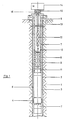
- Fig. 1 illustrates a test tubing string T according to the invention in a test position in a borehole 1 that cased, i.e. is provided with a lining 2 or casing.
- the test pipe string T delimits an annulus 3 with the lining 2 of the borehole 1, which is closed near the lower end by a packer 4 and at the upper end by a pressure-tight connection of the lining 2 and the test pipe string T at 5.
- the test tube string T comprises a test section 6, which has a perforation area 7 near its lower end and comprises measuring devices (not shown) as are customary and known for such test tube strands.
- the packer 4 is located directly above the perforation area 7 of the test section 6.
- the stator 8 of a feed pump which is designed as a Moineau pump, is located above the test section 6.
- the housing 9 of the stator 8 is inserted as part of the test tube string T therein and is screwed to the string areas adjacent to the top and bottom sides at 10 and 11, respectively.
- the rotor 12 of the feed pump is attached to the lower end of a special drive linkage 13, by means of which it can be lowered from the head of the borehole 1 into the test pipe string T already installed in the borehole 1, 2 for test purposes, into an operating position in which it is in a Conveyor operating position is within the stator 8 of the feed pump. 1 shows the rotor 12 when it is lowered into the operating position shortly before the stator 8 is reached.
- the drive linkage 13 is driven by a drive motor M which, in the operating position of the parts for a sampling or test conveyor operation, closes the upper end of the test tube string T with its housing 14 and has a sealed bearing at 15 for its drive shaft 16 connected to the drive linkage 13.
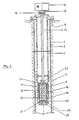
- stator 8 and the rotor 12 form a pump unit P that can be moved into and pulled out of the test tube string T into the operating position by means of the drive rod 13, and the housing 9 of the stator 8 is in the operating position of the pump unit P. in the test tube string T sealed against this and secured against twisting.
- test tube string T is provided with a support tube section 17 which is provided on the inside with an anti-rotation profile 18, e.g. a polygonal profile, a multi-spline profile or the like is provided, and the housing 9 of the stator 8 has a corresponding counter profile 19 on its outside.
- an anti-rotation profile 18 e.g. a polygonal profile, a multi-spline profile or the like is provided, and the housing 9 of the stator 8 has a corresponding counter profile 19 on its outside.
- the support tube section 17 is provided in a region below the anti-rotation profile 18 with a constriction region 20 and carries in this a circumferential seal 21 which is in sealing engagement with the profile-free lower end of the housing 9 of the stator 8 in the operating position of the pump unit P.
- the rotor 12 which is axially displaceable to a limited extent in its stator 8 is provided with a stop 22 and 23 at a distance above and below its working part.
- the housing 9 of the stator 8 also has an upper stop 24 and a lower stop 25, and when the pump unit P is moved into the test tube string or when it is pulled up, the stops 22, 23 alternately take along with the stops 24 and 25. or support intervention.
- stator 8 While when the pump unit P is retracted, the stator 8 initially rests on the stop 23 of the rotor 12 via its stop 25, if necessary and in the event of resistance from the upper stop 22, the rotor 12 can have a downward pressure force on the stator 8 via the stop 24 of the stator 8 exercise.
- the stops 22, 23 also secure the stator 8 against undesired displacement during operation, it being understood, however, that during operation the stops 22, 23 are out of engagement with the stops 24, 25 of the stator 8.
Landscapes
- Engineering & Computer Science (AREA)
- Life Sciences & Earth Sciences (AREA)
- Geology (AREA)
- Mining & Mineral Resources (AREA)
- Physics & Mathematics (AREA)
- Geochemistry & Mineralogy (AREA)
- Environmental & Geological Engineering (AREA)
- Fluid Mechanics (AREA)
- General Life Sciences & Earth Sciences (AREA)
- Mechanical Engineering (AREA)
- General Engineering & Computer Science (AREA)
- Geophysics (AREA)
- Structures Of Non-Positive Displacement Pumps (AREA)
- Lubricants (AREA)
- Earth Drilling (AREA)
- Investigation Of Foundation Soil And Reinforcement Of Foundation Soil By Compacting Or Drainage (AREA)
Abstract
Description
- Die Erfindung bezieht sich auf einen Testrohrstrang zur Untersuchung von untertägigen, durch eine Tiefbohrung erbohrten Lagerstätten von pumpfähigen Medien in einer Ausbildung gemäß dem Oberbegriff des Anspruchs 1.
- Testrohrstränge der genannten Art finden insbesondere zur Untersuchung von Lagerstätten in bezug auf Formationseigendrücke Anwendung, aus denen Schlußfolgerungen auf mögliche Fördermengen gezogen werden können. Mit Hilfe des in die Bohrung eingefahrenen Testrohrstranges ist es möglich, die Bohrung zu verschließen und den Verlauf des sich aufbauenden Formationsdruckes zu messen und die Meßwerte an die Erdoberfläche zu übertragen. Resultieren aus den Meßergebnissen interessante Fördererwartungen, so werden Proben des Mediums zur Untersuchung entnommen, gegebenenfalls Testförderungen über mehrere Stunden durchgeführt. Für eine solche Probenentnahme und für einen Testförderbetrieb finden aus einem Stator und einem Rotor bestehende Förderpumpen, insbesondere Moineau-Pumpen,Anwendung, die entweder ständiger Bestandteil des Testförderstranges bilden oder aber im Bedarfsfalle in diesen eingebaut werden. Im letzteren Fall ist es erforderlich, den gesamten Testrohrstrang aus der Bohrung aufzuholen und in diesen eine Förderpumpe einzubauen, wonach der Testrohrstrang wieder einzufahren ist, bevor der Probeentnahme-bzw. der Testförderbetrieb vorgenommen werden kann.
- Testrohrstränge mit ständig eingebauter Förderpumpe bedürfen zwar nicht der vorgennanten Arbeiten vor Durchführung von Probeentnahme- oder Testförderbetrieb, jedoch sind Testförderstränge mit ständig eingebauter Förderpumpe sehr kostenaufwendig, wodurch sich die Kosten der Lagerstättenuntersuchung unerwünschte in allen jenen Fällen erhöhen, in denen sich die Lagerstätten schon nach den Druckmeßergebnissen als uninteressant darstellen. Hinzu kommt, daß die Lagerdichtungen einer ständig in den Testrohrstrang eingebauten Förderpumpe, die einen Druckausgleich von Ringraum zu Förderraum vermeiden, bei hohen Druckbelastungen versagen, was zum Druckausgleich zwischen Förder- und Ringraum der Bohrung führt und aufwendige Instandsetzungsarbeiten erfordert.
- Der Erfindung liegt die Aufabe zugrunde, einen einfachen, betriebssicheren sowie kostengünstigen Testrohrstrang zu schaffen, der im Bedarfsfalle zur Durchführung von Probeentnahmen oder Testförderungen ohne Ausbau des Testrohrstranges nachrüstbar ist.
- Die Erfindung löst die Aufgabe ausgehend von einem Testrohrstrang nach dem Oberbegriff des Anspruchs 1 mit den im kennzeichnenden Teil des Anspruchs angegebenen Merkmalen. Hinsichtlich wesentlicher weiterer Ausgestaltungen wird auf die Ansprüche 2 bis 8 verwiesen.
- Der Testrohrstrang nach der Erfindung ist in seiner Grundausführung einfach und preisgünstig und ohne Dichtungsgefährdung bei hohen Druckbelastungen zu Testzwecken einsetzbar. Stellt sich heraus, daß eine Probeentnahme oder ein Testförderbetrieb zweckmäßig ist, kann der Testförderstrang schnell und einfach zu einem solchen ergänzt werden, der nunmehr einen Förderbetrieb durchführen kann. Dies erfolgt durch Einfahren des Rotors oder der Rotor/Stator-Einheit mittels des Antriebsgestänges für den Rotor von der Erdoberfläche aus, wobei der Testförderstrang in seiner eingebauten Lage verbleiben kann.
- Weitere Einzelheiten und Vorteile ergeben sich aus der Beschreibung und der Zeichnung, in der zwei Ausführungsbeispiele des Gegenstands der Erfindung schematisch näher veranschaulicht sind. Im einzelnen zeigen:
- Fig. 1 einen in eine Tiefbohrung eingesetzten Testrohrstrang nach der Erfindung in einer vereinfachten, teils als Ansicht, teils als Schnitt wiedergegebenen Darstellung, und
- Fig. 2 eine abgebrochene Darstellung ähnlich Fig. 1 zur Veranschaulichung einer abgewandelten Ausführungsform nach der Erfindung.
- Fig. 1 veranschaulicht einen Testrohrstrang T erfindungsgemäßer Ausbildung in einer Teststellung in einem Bohrloch 1, das verrohrt, d.h. mit einer Auskleidung 2 bzw. Futterrohr versehen ist. Der Testrohrstrang T begrenzt mit der Auskleidung 2 des Bohrloches 1 einen Ringraum 3, der nahe dem unteren Ende durch einen Packer 4 und am oberen Ende durch eine druckdichte Verbindung von Auskleidung 2 und Testrohrstrang T bei 5 abgeschlossen ist.
- Der Testrohrstrang T umfaßt im Bereich seines unteren Endes eine Testsektion 6, die nahe ihrem unteren Ende einen Perforationsbereich 7 aufweist und Meßgeräte (nicht dargestellt) umfaßt, wie sie für solche Testrohrstränge üblich und bekannt sind. Der Packer 4 befindet sich unmittelbar oberhalb des Perforationsbereiches 7 der Testsektion 6.
- Oberhalb der Testsektion 6 befindet sich der Stator 8 einer Förderpumpe, die als Moineau-Pumpe ausgebildet ist. Bei dem Beispiel gemäß Fig. 1 ist dabei das Gehäuse 9 des Stators 8 als Teil des Testrohrstranges T in diesen eingesetzt und mit ober- und unterseitig angrenzenden Strangbereichen bei 10 bzw. 11 verschraubt.
- Der Rotor 12 der Förderpumpe ist am unteren Ende eines besonderen Antriebsgestänges 13 befestigt, mittels dem er vom Kopf des Bohrloches 1 her in den zu Testzwecken bereits in das Bohrloch 1,2 eingebauten Testrohrstrang T in eine Betriebsstellung absenkbar ist, in der er sich in einer Förderbetriebsstellung innerhalb des Stators 8 der Förderpumpe befindet. Die Fig. 1 zeigt den Rotor 12 bei dessen Absenken in die Betriebsstellung kurz vor Erreichen des Stators 8.
- Das Antriebsgestänge 13 wird von einem Antriebsmotor M angetrieben, der in Betriebsstellung der Teile für einen Probenahme- oder Testförderbetrieb mit seinem Gehäuse 14 das obere Ende des Testrohrstranges T verschließt und eine abgedichtete Lagerung bei 15 für seine mit dem Antriebsgestänge 13 verbundene Antriebswelle 16 aufweist.
- Bei der Ausgestaltung nach Fig. 2 bilden der Stator 8 und der Rotor 12 eine gemeinschaftlich mittels des Antriebsgestänges 13 in den Testrohrstrang T in die Betriebsstellung einfahrbare und aus dieser aufziehbare Pumpeneinheit P, und in der Betriebsstellung der Pumpeneinheit P ist das Gehäuse 9 des Stators 8 im Testrohrstrang T diesem gegenüber abgedichtet und gegen Verdrehen gesichert.
- Zur Abdichtung und zur Verdrehsicherung können alle bekannten und hierfür geeigneten Mittel Anwendung finden. Bei dem dargestellten Beispiel ist in Höhe der vorgesehenen Betriebsstellung der Testrohrstrang T mit einem Stützrohrabschnitt 17 versehen, der innenseitig mit einem Verdrehsicherungsprofil 18, z.B. einem Mehrkantprofil, einem Vielkeilprofil od.dgl.,versehen ist,und das Gehäuse 9 des Stators 8 weist an seiner Außenseite ein entsprechendes Gegenprofil 19 auf.
- Der Stützrohrabschnitt 17 ist in einem Bereich unterhalb des Verdrehsicherungsprofils 18 mit einem Verengungsbereich 20 versehen und trägt in diesem eine umlaufende Dichtung 21, die in Betriebsstellung der Pumpeneinheit P mit dem profilfreien unteren Ende des Gehäuses 9 des Stators 8 in Dichtungseingriff steht.
- Für das gemeinschaftliche Einfahren von Stator 8 und Rotor 12 der Pumpeneinheit P ist vorgesehen, daß der Rotor 12, der in seinem Stator 8 begrenzt axial verschieblich ist, im Abstand oberhalb und unterhalb seines Arbeitsteils mit je einem Anschlag 22 bzw. 23 versehen ist. Auch das Gehäuse 9 des Stators 8 weist einen oberen Anschlag 24 sowie einen unteren Anschlag 25 auf, und beim Einfahren der Pumpeneinheit P in den Testrohrstrang bzw. bei dessen Aufziehen gelangen die Anschläge 22,23 wechselweise mit den Anschlägen 24 bzw. 25 in Mitnahme- bzw. Stützeingriff. Während beim Einfahren der Pumpeneinheit P der Stator 8 zunächst über seinen Anschlag 25 auf dem Anschlag 23 des Rotors 12 ruht, kann im Bedarfsfalle und bei Widerständen durch den oberen Anschlag 22 der Rotor 12 über den Anschlag 24 des Stators 8 auf diesem eine abwärts gerichtete Druckkraft ausüben.
- Die Anschläge 22,23 sichern auch im Betrieb den Stator 8 gegen unerwünschte Verlagerungen, wobei sich jedoch versteht, daß im Betrieb die Anschläge 22,23 außer Eingriff von den Anschlägen 24,25 des Stators 8 gelegen sind.
Claims (8)
Priority Applications (1)
| Application Number | Priority Date | Filing Date | Title |
|---|---|---|---|
| AT88102813T ATE79661T1 (de) | 1987-02-27 | 1988-02-25 | Testrohrstrang fuer tiefbohrungen. |
Applications Claiming Priority (2)
| Application Number | Priority Date | Filing Date | Title |
|---|---|---|---|
| DE3706378A DE3706378C1 (de) | 1987-02-27 | 1987-02-27 | Testrohrstrang fuer Tiefbohrungen |
| DE3706378 | 1987-02-27 |
Publications (3)
| Publication Number | Publication Date |
|---|---|
| EP0280294A2 true EP0280294A2 (de) | 1988-08-31 |
| EP0280294A3 EP0280294A3 (en) | 1989-10-04 |
| EP0280294B1 EP0280294B1 (de) | 1992-08-19 |
Family
ID=6321930
Family Applications (1)
| Application Number | Title | Priority Date | Filing Date |
|---|---|---|---|
| EP88102813A Expired - Lifetime EP0280294B1 (de) | 1987-02-27 | 1988-02-25 | Testrohrstrang für Tiefbohrungen |
Country Status (3)
| Country | Link |
|---|---|
| EP (1) | EP0280294B1 (de) |
| AT (1) | ATE79661T1 (de) |
| DE (1) | DE3706378C1 (de) |
Cited By (3)
| Publication number | Priority date | Publication date | Assignee | Title |
|---|---|---|---|---|
| EP0482912A1 (de) * | 1990-10-23 | 1992-04-29 | Halliburton Company | Pumpe in Bohrloch zur Untersuchung einer Formation |
| WO1995030090A1 (en) * | 1994-04-29 | 1995-11-09 | Houttuin B.V. | An installation and a method for pumping up fluid from the earth's crust |
| US10612542B2 (en) | 2010-11-19 | 2020-04-07 | Smith International, Inc. | Apparatus and method for controlling or limiting rotor orbit in moving cavity motors and pumps |
Families Citing this family (2)
| Publication number | Priority date | Publication date | Assignee | Title |
|---|---|---|---|---|
| GB201019614D0 (en) | 2010-11-19 | 2010-12-29 | Eatec Ltd | Apparatus and method for controlling or limiting rotor orbit in moving cavity motors and pumps |
| RU2605475C2 (ru) * | 2012-05-24 | 2016-12-20 | Шлюмбергер Текнолоджи Б.В. | Устройство и способ регулирования или ограничения орбиты ротора в винтовых двигателях или насосах |
Family Cites Families (4)
| Publication number | Priority date | Publication date | Assignee | Title |
|---|---|---|---|---|
| US2267459A (en) * | 1939-01-09 | 1941-12-23 | Fmc Corp | Deep well pump |
| US3677665A (en) * | 1971-05-07 | 1972-07-18 | Husky Oil Ltd | Submersible pump assembly |
| US4372379A (en) * | 1981-10-06 | 1983-02-08 | Corod Manufacturing Ltd. | Rotary drive assembly for downhole rotary pump |
| DE3345233C2 (de) * | 1983-12-14 | 1985-10-31 | Joh. Heinrich Bornemann GmbH & Co KG, 3063 Obernkirchen | Exzenterschneckenpumpe zum Fördern von Flüssigkeiten aus Bohrlöchern, insbesondere aus Erdöl-Bohrlöchern |
-
1987
- 1987-02-27 DE DE3706378A patent/DE3706378C1/de not_active Expired
-
1988
- 1988-02-25 EP EP88102813A patent/EP0280294B1/de not_active Expired - Lifetime
- 1988-02-25 AT AT88102813T patent/ATE79661T1/de not_active IP Right Cessation
Cited By (3)
| Publication number | Priority date | Publication date | Assignee | Title |
|---|---|---|---|---|
| EP0482912A1 (de) * | 1990-10-23 | 1992-04-29 | Halliburton Company | Pumpe in Bohrloch zur Untersuchung einer Formation |
| WO1995030090A1 (en) * | 1994-04-29 | 1995-11-09 | Houttuin B.V. | An installation and a method for pumping up fluid from the earth's crust |
| US10612542B2 (en) | 2010-11-19 | 2020-04-07 | Smith International, Inc. | Apparatus and method for controlling or limiting rotor orbit in moving cavity motors and pumps |
Also Published As
| Publication number | Publication date |
|---|---|
| EP0280294A3 (en) | 1989-10-04 |
| ATE79661T1 (de) | 1992-09-15 |
| DE3706378C1 (de) | 1988-08-18 |
| EP0280294B1 (de) | 1992-08-19 |
Similar Documents
| Publication | Publication Date | Title |
|---|---|---|
| DE69807202T2 (de) | Verfahren und gerät zur bohrlochüberwachung | |
| DE60305733T2 (de) | Bohren eines bohrlochs | |
| DE69636665T2 (de) | Vorrichtung und Verfahren zur Frühbewertung und Unterhalt einer Bohrung | |
| DE60132115T2 (de) | Absenkungsvorrichtung und -verfahren zur in-situ-analyse von formationsfluiden | |
| DE69529370T2 (de) | Verfahren und Vorrichtung zum Untersuchen oder Warten von Bohrlöchern | |
| DE69603833T2 (de) | Bohr- und fördereinrichtung für mehrfachförderbohrungen | |
| DE69310058T2 (de) | Verfahren zur Perforierung eines neuen Horizontes | |
| EP0768446B1 (de) | Verfahren und Bohrgerät zum Abteufen von Bohrungen in unterirdische Formationen | |
| DE60128771T2 (de) | Probenkammer mit Totraumspülung | |
| DE3784382T2 (de) | Ventil zur dichtheitspruefung eines steigrohres. | |
| DE3614537C2 (de) | ||
| DE2840014C2 (de) | ||
| EP0392544A2 (de) | Bohrwerkzeug | |
| DE102007036410A1 (de) | Fluidprobennahmesystem und Bohrlochwerkzeug | |
| DE2747748A1 (de) | Verfahren zur ermittlung von messwerten der eine tiefbohrung umgebenden formationen | |
| EP0380909A2 (de) | Verfahren und Kernbohrwerkzeug zum Abteufen von Bohrungen in unterirdische Gesteinsformationen | |
| DE60026249T2 (de) | Vorrichtung und Verfahren zum Testen und Bohren eines Bohrloches | |
| DE102005030559A1 (de) | Vorrichtung und Verfahren zum Charakterisieren einer unterirdischen Formation und Vorrichtung und Verfahren zum Perforieren eines verrohrten Bohrlochs | |
| DE3009553A1 (de) | Ventil zur verwendung in einem pruefstrang zur untersuchung von formationen in einem bohrloch | |
| DE102006023260A1 (de) | Vorrichtung und Verfahren zum Erhalten von Bohrlochproben | |
| DE69928780T2 (de) | Verfahren und vorrichtung zum formationstesten | |
| DE3229151C2 (de) | ||
| EP0280294B1 (de) | Testrohrstrang für Tiefbohrungen | |
| DE2913896B2 (de) | Rohranordnung zum Messen von Bohrlochbedingungen beilaufender Förderung | |
| WO2005071224A2 (de) | MEßEINRICHTUNG UND BOHRVORRICHTUNG FÜR TIEFBOHRUNGEN |
Legal Events
| Date | Code | Title | Description |
|---|---|---|---|
| PUAI | Public reference made under article 153(3) epc to a published international application that has entered the european phase |
Free format text: ORIGINAL CODE: 0009012 |
|
| AK | Designated contracting states |
Kind code of ref document: A2 Designated state(s): AT BE FR GB NL |
|
| PUAL | Search report despatched |
Free format text: ORIGINAL CODE: 0009013 |
|
| AK | Designated contracting states |
Kind code of ref document: A3 Designated state(s): AT BE FR GB NL |
|
| 17P | Request for examination filed |
Effective date: 19900105 |
|
| 17Q | First examination report despatched |
Effective date: 19910404 |
|
| GRAA | (expected) grant |
Free format text: ORIGINAL CODE: 0009210 |
|
| AK | Designated contracting states |
Kind code of ref document: B1 Designated state(s): AT BE FR GB NL |
|
| REF | Corresponds to: |
Ref document number: 79661 Country of ref document: AT Date of ref document: 19920915 Kind code of ref document: T |
|
| ET | Fr: translation filed | ||
| GBT | Gb: translation of ep patent filed (gb section 77(6)(a)/1977) | ||
| RAP2 | Party data changed (patent owner data changed or rights of a patent transferred) |
Owner name: EASTMAN TELECO COMPANY |
|
| NLT2 | Nl: modifications (of names), taken from the european patent patent bulletin |
Owner name: EASTMAN TELECO COMPANY TE HOUSTON, TEXAS, VER. ST. |
|
| PLBE | No opposition filed within time limit |
Free format text: ORIGINAL CODE: 0009261 |
|
| STAA | Information on the status of an ep patent application or granted ep patent |
Free format text: STATUS: NO OPPOSITION FILED WITHIN TIME LIMIT |
|
| 26N | No opposition filed | ||
| PGFP | Annual fee paid to national office [announced via postgrant information from national office to epo] |
Ref country code: FR Payment date: 19940111 Year of fee payment: 7 |
|
| PGFP | Annual fee paid to national office [announced via postgrant information from national office to epo] |
Ref country code: AT Payment date: 19940117 Year of fee payment: 7 |
|
| PGFP | Annual fee paid to national office [announced via postgrant information from national office to epo] |
Ref country code: BE Payment date: 19940125 Year of fee payment: 7 |
|
| PGFP | Annual fee paid to national office [announced via postgrant information from national office to epo] |
Ref country code: GB Payment date: 19940128 Year of fee payment: 7 |
|
| PGFP | Annual fee paid to national office [announced via postgrant information from national office to epo] |
Ref country code: NL Payment date: 19940228 Year of fee payment: 7 |
|
| PG25 | Lapsed in a contracting state [announced via postgrant information from national office to epo] |
Ref country code: GB Effective date: 19950225 Ref country code: AT Effective date: 19950225 |
|
| PG25 | Lapsed in a contracting state [announced via postgrant information from national office to epo] |
Ref country code: BE Effective date: 19950228 |
|
| BERE | Be: lapsed |
Owner name: EASTMAN CHRISTENSEN CY Effective date: 19950228 |
|
| PG25 | Lapsed in a contracting state [announced via postgrant information from national office to epo] |
Ref country code: NL Effective date: 19950901 |
|
| GBPC | Gb: european patent ceased through non-payment of renewal fee |
Effective date: 19950225 |
|
| PG25 | Lapsed in a contracting state [announced via postgrant information from national office to epo] |
Ref country code: FR Effective date: 19951031 |
|
| NLV4 | Nl: lapsed or anulled due to non-payment of the annual fee |
Effective date: 19950901 |
|
| REG | Reference to a national code |
Ref country code: FR Ref legal event code: ST |