EP0280372A1 - Procédé pour la fabrication d'aimants en alliage de métal de transition et/de terre rare - Google Patents
Procédé pour la fabrication d'aimants en alliage de métal de transition et/de terre rare Download PDFInfo
- Publication number
- EP0280372A1 EP0280372A1 EP19880200306 EP88200306A EP0280372A1 EP 0280372 A1 EP0280372 A1 EP 0280372A1 EP 19880200306 EP19880200306 EP 19880200306 EP 88200306 A EP88200306 A EP 88200306A EP 0280372 A1 EP0280372 A1 EP 0280372A1
- Authority
- EP
- European Patent Office
- Prior art keywords
- hydrogen
- alloy
- atmosphere
- rare earth
- percent
- Prior art date
- Legal status (The legal status is an assumption and is not a legal conclusion. Google has not performed a legal analysis and makes no representation as to the accuracy of the status listed.)
- Granted
Links
Images
Classifications
-
- H—ELECTRICITY
- H01—ELECTRIC ELEMENTS
- H01F—MAGNETS; INDUCTANCES; TRANSFORMERS; SELECTION OF MATERIALS FOR THEIR MAGNETIC PROPERTIES
- H01F1/00—Magnets or magnetic bodies characterised by the magnetic materials therefor; Selection of materials for their magnetic properties
- H01F1/01—Magnets or magnetic bodies characterised by the magnetic materials therefor; Selection of materials for their magnetic properties of inorganic materials
- H01F1/03—Magnets or magnetic bodies characterised by the magnetic materials therefor; Selection of materials for their magnetic properties of inorganic materials characterised by their coercivity
- H01F1/032—Magnets or magnetic bodies characterised by the magnetic materials therefor; Selection of materials for their magnetic properties of inorganic materials characterised by their coercivity of hard-magnetic materials
- H01F1/04—Magnets or magnetic bodies characterised by the magnetic materials therefor; Selection of materials for their magnetic properties of inorganic materials characterised by their coercivity of hard-magnetic materials metals or alloys
- H01F1/047—Alloys characterised by their composition
- H01F1/053—Alloys characterised by their composition containing rare earth metals
- H01F1/055—Alloys characterised by their composition containing rare earth metals and magnetic transition metals, e.g. SmCo5
- H01F1/057—Alloys characterised by their composition containing rare earth metals and magnetic transition metals, e.g. SmCo5 and IIIa elements, e.g. Nd2Fe14B
- H01F1/0571—Alloys characterised by their composition containing rare earth metals and magnetic transition metals, e.g. SmCo5 and IIIa elements, e.g. Nd2Fe14B in the form of particles, e.g. rapid quenched powders or ribbon flakes
- H01F1/0575—Alloys characterised by their composition containing rare earth metals and magnetic transition metals, e.g. SmCo5 and IIIa elements, e.g. Nd2Fe14B in the form of particles, e.g. rapid quenched powders or ribbon flakes pressed, sintered or bonded together
- H01F1/0577—Alloys characterised by their composition containing rare earth metals and magnetic transition metals, e.g. SmCo5 and IIIa elements, e.g. Nd2Fe14B in the form of particles, e.g. rapid quenched powders or ribbon flakes pressed, sintered or bonded together sintered
-
- H—ELECTRICITY
- H01—ELECTRIC ELEMENTS
- H01F—MAGNETS; INDUCTANCES; TRANSFORMERS; SELECTION OF MATERIALS FOR THEIR MAGNETIC PROPERTIES
- H01F1/00—Magnets or magnetic bodies characterised by the magnetic materials therefor; Selection of materials for their magnetic properties
- H01F1/01—Magnets or magnetic bodies characterised by the magnetic materials therefor; Selection of materials for their magnetic properties of inorganic materials
- H01F1/03—Magnets or magnetic bodies characterised by the magnetic materials therefor; Selection of materials for their magnetic properties of inorganic materials characterised by their coercivity
- H01F1/032—Magnets or magnetic bodies characterised by the magnetic materials therefor; Selection of materials for their magnetic properties of inorganic materials characterised by their coercivity of hard-magnetic materials
- H01F1/04—Magnets or magnetic bodies characterised by the magnetic materials therefor; Selection of materials for their magnetic properties of inorganic materials characterised by their coercivity of hard-magnetic materials metals or alloys
- H01F1/047—Alloys characterised by their composition
- H01F1/053—Alloys characterised by their composition containing rare earth metals
- H01F1/055—Alloys characterised by their composition containing rare earth metals and magnetic transition metals, e.g. SmCo5
- H01F1/057—Alloys characterised by their composition containing rare earth metals and magnetic transition metals, e.g. SmCo5 and IIIa elements, e.g. Nd2Fe14B
- H01F1/0571—Alloys characterised by their composition containing rare earth metals and magnetic transition metals, e.g. SmCo5 and IIIa elements, e.g. Nd2Fe14B in the form of particles, e.g. rapid quenched powders or ribbon flakes
- H01F1/0573—Alloys characterised by their composition containing rare earth metals and magnetic transition metals, e.g. SmCo5 and IIIa elements, e.g. Nd2Fe14B in the form of particles, e.g. rapid quenched powders or ribbon flakes obtained by reduction or by hydrogen decrepitation or embrittlement
Definitions
- the invention relates to a method of manufacturing a magnet from a magnetic material the main phase of which comprises an intermetallic compound of the rare earth transition metal type which also includes boron, comprising the steps of:-
- Magnetic materials based on intermetallic compounds of certain rare earth metals with transition metals may be formed into permanent magnets having coercive fields of considerable magnitude, namely of several hundred kA/m.
- One method of manufacture includes alloying the constituent materials in an inert atmosphere or in vacuo. The alloy is then comminuted into particles whose average size lies in the range 0.3 to 80um and is preferably less than about 10um, which are aligned in a magnetic field while being formed into a magnet body by compacting under a pressure of about 10kN/cm2. The alignment of the particles is fixed and the particles are bonded together by sintering in an inert atmosphere or in vacuo at a temperature in the range of approximately 800 to 1200 degrees C.
- Nd-Fe-B One form of Nd-Fe-B magnet has been manufactured with a coercivity of approximately 800kA/m (10kOe) and an energy product (B.H) of approximately 240kJ/m3 (30 MGS.Oe).
- Nd-Fe-B will be used herein generally to refer to commercially useful neodymium ion boron magnet alloys whether partially substituted or not.
- the manufacture of an Nd-Fe-B magnet commences with the formation of the bulk alloy suitably by induction melting followed by casting, and the resultant bulk ingot is then broken up and comminuted to a fine powder. Initially comminution was effected by firstly stamp milling to a coarse powder of, for example, 35-mesh sieve followed by fine pulverisation in a ball mill for about 3 hours to the required size of, for example, 3 to 10um. This process is slow and cumbersome and it has recently been proposed by I. R.
- L1 that fairly large pieces of alloy of about 1 to 2 cm3 can be rapidly broken down into a relatively fine powder of particle size less than 1mm by hydrogen decrepitation using pure hydrogen at room temperature. This can be carried out in a stainless steel hydrogenation vessel and takes the form of an exothermic reaction resulting in the formation of hydrides of the alloy phases.
- the resultant powder is then further reduced in size by milling in an attritor mill under cyclohexane for about 25 minutes, as described by P. J. McGuiness et al, J of Materials Science 21 (1986), 4107-4110.
- the resultant powder can be jet milled using nitrogen as a propellant.
- the invention is based on the realisation that the process of manufacture could be greatly simplified from the industrial point of view by using for the decrepitation process an explosion-suppressant atmosphere formed by mixing hydrogen with a chemically substantially non-reactive gas, meaning that the gas does not react significantly either with hydrogen or with the constituents of the alloy under the conditions present during decrepitation, and realising that such a gas could preferably be nitrogen or that an inert gas could be used, and that the atmosphere can be advantageously constituted so that any excess hydrogen can be safely burnt off after passing through the apparatus.
- this object has been realised by a method of the kind specified, characterised in that in step (b) the bulk alloy material is comminuted to form a powder by a process of hydrogen decrepitation in an explosion suppressant atmosphere comprising a gaseous mixture of hydrogen and a chemically substantially non-reactive gas.
- the intermetallic compound can be an Nd-Fe-B alloy and the chemically non-reactive gas is preferably nitrogen.
- an inert gas such as argon can be employed, and the explosion-suppressant atmosphere can comprise a proportion of hydrogen in the range of 5 percent to 30 percent by volume.
- the alloy powder after decrepitation is subjected to further comminution by jet milling using a chemically substantially non-reactive propellant gas such as nitrogen or an inert gas, suitably argon, to reduce the powder to the desired size range of 0.3 to 80um and preferably to less than about 10um.
- a chemically substantially non-reactive propellant gas such as nitrogen or an inert gas, suitably argon
- the process of comminution by hydrogen decrepitation results in the formation of hydrides of the various phases of the alloy which are reasonably stable in air and this effectively reduces oxygen degradation of the magnetic properties of the alloy thus providing some form of passivation during the processes of handling, magnetic alignment and pressing prior to sintering the magnet body.
- the alloy hydride powder can be magnetically aligned during pressing in a manner similar to that for a magnet body formed of conventionally milled alloy powder. Hydrogen desorption takes place during the initial heating phase of the in-vacuo sintering process and helps to maintain the non-oxidising atmosphere during sintering and subsequent annealing.
- the sintering temperature for the alloy hydride powder can be up to 100 C degrees lower than that for the conventionally milled powder, and to lie in the range 980 to 1080 degrees C.
- the step of comminution of the bulk alloy by the process of hydrogen decrepitation has certain advantages over the conventional crushing and milling processes hitherto employed in that hydrogen decrepitation is rapid and effective, does not involve the use of heavy machinery in an inert environment, and overcomes a problem caused by hard local regions in the alloy resulting from the presence of free iron in the melt, and which have tended to damage the comminution machinery surfaces or cause the machinery to jam.
- the powder produced by hydrogen decrepitation does not include the additional undesired distribution of very finely powdered alloy produced by milling, and is generally of a fairly uniform size and flaky constitution enabling a further reduction in particle size to be readily effected.
- the very friable nature of the hydrogen decrepitated powder enables the capacity of a given jet mill to be greatly increased and almost doubled.
- the decrepitated alloy powder is in the form of a hydride, it has been found to be relatively non-reactive to the oxygen in dry air and is therefore easier to handle in subsequent process steps.
- hydrogen decrepitation of magnet alloys of the kind specified had to take place in an atmosphere consisting only of hydrogen of high purity, and this meant that elaborate safety precautions had to be taken to minimise the possibility of an explosion, thus adding significantly to the cost of production. Consequently, the method in accordance with the invention advantageously enables the beneficial process of hydrogen decrepitation to be employed in the manufacture of magnets of the kind specified with greater safety and at less cost than hitherto.
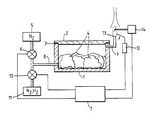
- the lid 2 is then secured and the vessel 1 is purged with pure dry nitrogen gas from a source 5 via a supply valve 6 opened by a controller 7, and an inlet pipe 8.
- the air contained in the vessel 1 is thereby displaced and is vented via an outlet pipe 9 to the atmosphere.
- the controller 7 closes the nitrogen supply valve 6 and opens a further supply valve 10 connected to a source 11 in the form of a container, suitably one or more gas storage cylinders, in which an explosion suppressant atmosphere comprising a gaseous mixture of hydrogen and a chemically substantially non-reactive gas, suitably nitrogen, is contained under pressure.
- a gaseous mixture of hydrogen and a chemically substantially non-reactive gas suitably nitrogen
- the mixture comprises 75 percent by volume of nitrogen gas and 25 percent by volume of hydrogen gas and this is then passed via the inlet 8 into the vessel 1 to displace the pure nitrogen and to initiate, via the hydrogen component thereof, the hydriding reaction and consequent decrepitation of the pieces 4 of bulk Nd-Fe-B alloy.
- the controller 7 also, possibly after short delay, initiates the operation of an ignition device 12 which periodically applies a spark in the vicinity of the open end 13 of the venting tube 9 so as to ignite the hydrogen component of the gaseous mixture when it emerges into the atmosphere.
- a thermocouple device 14 senses the presence of flame and this is signalled to the controller 7 which then turns off the ignition device.
- the controller 7 continually monitors the presence of flame at the vent 13 via the thermocouple 14 and is arranged to turn off the supply valve 10 if the flame signal from the thermocouple 14 disappears at any time.
- the controller 7 also turns off the valve when starting up if a flame signal fails to appear within a given time from initiating the flow of the gaseous mixture.
- the flow rate of the gaseous mixture via the supply valve 10, is regulated so that the decrepitation reaction in the hydrogenation vessel 1 proceeds relatively quickly while ensuring that the temperature of none of the alloy pieces 4 approaches 300 degrees C at which temperature disproportionation of the alloy can occur with the generation of very finely divided iron.
- the controller 7 closes the supply valve 10 to stop the supply of gaseous mixture and opens the supply valve 6 to cause the vessel 1 to be purged with pure nitrogen gas to remove the gaseous mixture therefrom after which the flame at the end 13 of the vent will extinguish.
- the lid 2 is then opened and the powdered alloy removed for subsequent processing.
- the alloy powder After the process of premilling by hydrogen decrepitation, the alloy powder will have a particle size of less than about 1mm across and will have a flake-like structure.
- the premilled powder can then be milled in conventional manner in an attritor mill under cyclohexane and dried prior to forming the magnet bodies, or it can be jet milled.
- cyclohexane is inflammable necessitating elaborate precautions and it is therefore preferable that the further comminution of the alloy powder should be carried out by the process of jet milling using a chemically non-reactive propellant gas, preferably nitrogen, although an inert gas such as argon can alternatively be employed.
- a high velocity stream of propellant gas is directed into a vessel containing the alloy powder so that the particles are subjected to mutual collisions with one another and with the wall of the vessel and are reduced to the desired size in the range of 0.3 to 80um.
- the hydrided alloy powder is then formed into a magnet body by feeding the powder into a suitably shaped pressing chamber in a pressing tool, through which a magnetic aligning field is applied while the powder is compacted under a pressure of about 10kN/cm2.
- the hydride powder can be pressed and magnetically aligned in a manner similar to the ordinary milled powder but has the advantage of being less reactive in the presence of oxygen in dry air, although it is advisable to maintain it in a substantially oxygen-free non-reactive or inert atmosphere to avoid any oxygen uptake, including at the pressing stage.
- the magnetic alignment process can conventionally employ electromagnets but preferably can use high energy permanent magnets, suitably Nd-Fe-B magnets as described and claimed in U.K. Patent Application Number 8625099.
- An advantage of premilling by hydrogen decrepitation is that no demagnetising field is required after the magnet bodies have been aligned and pressed.
- the magnet bodies After pressing, the magnet bodies are transferred to a vacuum furnace and heated in vacuo, initially to desorb the hydrogen, and then to sinter the magnet body at a temperature in the range 980 to 1080 degrees C and preferably at about 1040 degrees C, the sintering temperature being maintained for about one hour after which the magnet body is annealed by allowing it to cool slowly.
- the sintered magnet body is then machined to shape, if necessary, and magnetised in a strong magnetic field of, for example, about 2400kA/m.
- the constitution of the explosion suppressant atmosphere containing hydrogen used for decrepitation in accordance with the invention can if desired, be different from that of the specified gaseous mixture, and the proportion of hydrogen can be selected in the range 5 percent to 30 percent by volume. It is preferable from the point of view of safety in the factory and therefore of realising the full advantages of the invention, that the explosion suppressant atmosphere containing hydrogen should be supplied already mixed in containers in order to form the source 11.
Landscapes
- Chemical & Material Sciences (AREA)
- Crystallography & Structural Chemistry (AREA)
- Inorganic Chemistry (AREA)
- Engineering & Computer Science (AREA)
- Power Engineering (AREA)
- Hard Magnetic Materials (AREA)
- Powder Metallurgy (AREA)
- Manufacture Of Metal Powder And Suspensions Thereof (AREA)
- Permanent Field Magnets Of Synchronous Machinery (AREA)
- Superconductors And Manufacturing Methods Therefor (AREA)
Priority Applications (1)
| Application Number | Priority Date | Filing Date | Title |
|---|---|---|---|
| AT88200306T ATE94682T1 (de) | 1987-02-27 | 1988-02-22 | Verfahren zur erzeugung von seltenerd¨bergangsmetall-legierungsmagneten. |
Applications Claiming Priority (2)
| Application Number | Priority Date | Filing Date | Title |
|---|---|---|---|
| GB8704713 | 1987-02-27 | ||
| GB8704713A GB2201426B (en) | 1987-02-27 | 1987-02-27 | Improved method for the manufacture of rare earth transition metal alloy magnets |
Publications (2)
| Publication Number | Publication Date |
|---|---|
| EP0280372A1 true EP0280372A1 (fr) | 1988-08-31 |
| EP0280372B1 EP0280372B1 (fr) | 1993-09-15 |
Family
ID=10613089
Family Applications (1)
| Application Number | Title | Priority Date | Filing Date |
|---|---|---|---|
| EP88200306A Revoked EP0280372B1 (fr) | 1987-02-27 | 1988-02-22 | Procédé pour la fabrication d'aimants en alliage de métal de transition et/de terre rare |
Country Status (6)
| Country | Link |
|---|---|
| US (1) | US4853045A (fr) |
| EP (1) | EP0280372B1 (fr) |
| JP (1) | JPS63227002A (fr) |
| AT (1) | ATE94682T1 (fr) |
| DE (1) | DE3884011T2 (fr) |
| GB (1) | GB2201426B (fr) |
Cited By (6)
| Publication number | Priority date | Publication date | Assignee | Title |
|---|---|---|---|---|
| FR2655355A1 (fr) * | 1989-12-01 | 1991-06-07 | Aimants Ugimag Sa | Alliage pour aimant permanent type fe nd b, aimant permanent fritte et procede d'obtention. |
| EP0416595A3 (en) * | 1989-09-06 | 1991-12-11 | Sps Technologies, Inc. | Process for making nd-fe-b type magnets utilizing a hydrogen and oxygen treatment |
| EP0468903A1 (fr) * | 1990-07-25 | 1992-01-29 | Ugimag S.A. | Méthode d'obtention sous forme divisée d'un matériau magnétique de type terre rare - métaux de transition bore pour des aimants résistant à la corrosion |
| FR2698999A1 (fr) * | 1992-12-08 | 1994-06-10 | Ugimag Sa | Poudre magnétique de type Fe-TR-B et aimants frittés correspondants et leur méthode de préparation. |
| EP0601943A1 (fr) * | 1992-12-08 | 1994-06-15 | Ugimag S.A. | Poudre magnétique de type Fe-TR-B et aimants frittés correspondants et leur méthode de préparation |
| EP0633581A1 (fr) * | 1993-07-06 | 1995-01-11 | Sumitomo Special Metal Co., Ltd. | Matériaux R-Fe-B pour aimants permanents et leurs procédé de fabrication |
Families Citing this family (22)
| Publication number | Priority date | Publication date | Assignee | Title |
|---|---|---|---|---|
| US5538565A (en) * | 1985-08-13 | 1996-07-23 | Seiko Epson Corporation | Rare earth cast alloy permanent magnets and methods of preparation |
| US6136099A (en) * | 1985-08-13 | 2000-10-24 | Seiko Epson Corporation | Rare earth-iron series permanent magnets and method of preparation |
| US5026438A (en) * | 1988-07-14 | 1991-06-25 | General Motors Corporation | Method of making self-aligning anisotropic powder for magnets |
| US5114502A (en) * | 1989-06-13 | 1992-05-19 | Sps Technologies, Inc. | Magnetic materials and process for producing the same |
| US5244510A (en) * | 1989-06-13 | 1993-09-14 | Yakov Bogatin | Magnetic materials and process for producing the same |
| US5122203A (en) * | 1989-06-13 | 1992-06-16 | Sps Technologies, Inc. | Magnetic materials |
| US5266128A (en) * | 1989-06-13 | 1993-11-30 | Sps Technologies, Inc. | Magnetic materials and process for producing the same |
| US5143560A (en) * | 1990-04-20 | 1992-09-01 | Hitachi Metals, Inc., Ltd. | Method for forming Fe-B-R-T alloy powder by hydrogen decrepitation of die-upset billets |
| US5091020A (en) * | 1990-11-20 | 1992-02-25 | Crucible Materials Corporation | Method and particle mixture for making rare earth element, iron and boron permanent sintered magnets |
| EP1073069A1 (fr) * | 1993-11-02 | 2001-01-31 | TDK Corporation | Préparation d'un aimant permanent |
| US5454998A (en) * | 1994-02-04 | 1995-10-03 | Ybm Technologies, Inc. | Method for producing permanent magnet |
| JPH11329811A (ja) * | 1998-05-18 | 1999-11-30 | Sumitomo Special Metals Co Ltd | R−Fe−B系磁石用原料粉末並びにR−Fe−B系磁石の製造方法 |
| CN1191903C (zh) * | 2001-06-29 | 2005-03-09 | 株式会社新王磁材 | 对稀土合金进行氢化处理的装置和利用该装置制造稀土烧结磁体的方法 |
| DE10134259A1 (de) * | 2001-07-18 | 2003-02-06 | Zf Lemfoerder Metallwaren Ag | Kugelgelenk mit integriertem Winkelsensor |
| JP4477820B2 (ja) * | 2002-10-03 | 2010-06-09 | 本田技研工業株式会社 | 燃料電池の排出ガス処理装置 |
| KR100524827B1 (ko) * | 2003-04-02 | 2005-11-01 | 자화전자 주식회사 | 희토류자석 제조의 고이방화 종축 성형방법 및 그 장치 |
| CN100408231C (zh) * | 2005-12-23 | 2008-08-06 | 上海大学 | 各向异性钕铁硼粘结磁体的成型方法及其装置 |
| US8572830B2 (en) | 2011-03-14 | 2013-11-05 | Apple Inc. | Method and apparatus for producing magnetic attachment system |
| CN104681268B (zh) * | 2013-11-28 | 2018-02-23 | 湖南稀土金属材料研究院 | 一种提高烧结钕铁硼磁体矫顽力的处理方法 |
| CN105185498B (zh) * | 2015-08-28 | 2017-09-01 | 包头天和磁材技术有限责任公司 | 稀土永磁材料及其制造方法 |
| KR102093491B1 (ko) * | 2017-11-28 | 2020-03-25 | 주식회사 엘지화학 | 소결 자석의 제조 방법 및 소결 자석 |
| CN115383122B (zh) * | 2022-08-25 | 2023-07-14 | 太原科技大学 | 一种2:17型烧结钐钴永磁体的氢碎制备方法 |
Citations (2)
| Publication number | Priority date | Publication date | Assignee | Title |
|---|---|---|---|---|
| EP0215168A1 (fr) * | 1984-04-09 | 1987-03-25 | Crucible Materials Corporation | Procédé de fabrication d'aimants permanents contenant des éléments de terres rares |
| EP0101552B1 (fr) * | 1982-08-21 | 1989-08-09 | Sumitomo Special Metals Co., Ltd. | Matériaux magnétiques, aimants permanents et procédés pour leur production |
Family Cites Families (8)
| Publication number | Priority date | Publication date | Assignee | Title |
|---|---|---|---|---|
| CH551077A (de) * | 1970-11-13 | 1974-06-28 | Bbc Brown Boveri & Cie | Verfahren zur herstellung von feinpartikel-dauermagneten. |
| GB1554384A (en) * | 1977-04-15 | 1979-10-17 | Magnetic Polymers Ltd | Rare earth metal alloy magnets |
| JPS6063304A (ja) * | 1983-09-17 | 1985-04-11 | Sumitomo Special Metals Co Ltd | 希土類・ボロン・鉄系永久磁石用合金粉末の製造方法 |
| JPS60119701A (ja) * | 1983-12-01 | 1985-06-27 | Sumitomo Special Metals Co Ltd | 希土類・ボロン・鉄系永久磁石用合金粉末の製造方法 |
| FR2566758B1 (fr) * | 1984-06-29 | 1990-01-12 | Centre Nat Rech Scient | Nouveaux hydrures de terre rare/fer/bore et terre rare/cobalt/bore magnetiques, leur procede de fabrication et de fabrication des produits deshydrures pulverulents correspondants, leurs applications |
| JPS61139603A (ja) * | 1984-12-12 | 1986-06-26 | Namiki Precision Jewel Co Ltd | 永久磁石合金の製造方法 |
| JPS61199005A (ja) * | 1985-02-28 | 1986-09-03 | Daido Steel Co Ltd | 磁性粉末の製造方法 |
| JPH0663304A (ja) * | 1992-08-19 | 1994-03-08 | Tsukada Fuainesu:Kk | 真空蒸留装置 |
-
1987
- 1987-02-27 GB GB8704713A patent/GB2201426B/en not_active Expired - Lifetime
-
1988
- 1988-02-22 EP EP88200306A patent/EP0280372B1/fr not_active Revoked
- 1988-02-22 DE DE88200306T patent/DE3884011T2/de not_active Revoked
- 1988-02-22 AT AT88200306T patent/ATE94682T1/de not_active IP Right Cessation
- 1988-02-24 US US07/159,820 patent/US4853045A/en not_active Expired - Fee Related
- 1988-02-25 JP JP63040898A patent/JPS63227002A/ja active Pending
Patent Citations (2)
| Publication number | Priority date | Publication date | Assignee | Title |
|---|---|---|---|---|
| EP0101552B1 (fr) * | 1982-08-21 | 1989-08-09 | Sumitomo Special Metals Co., Ltd. | Matériaux magnétiques, aimants permanents et procédés pour leur production |
| EP0215168A1 (fr) * | 1984-04-09 | 1987-03-25 | Crucible Materials Corporation | Procédé de fabrication d'aimants permanents contenant des éléments de terres rares |
Cited By (11)
| Publication number | Priority date | Publication date | Assignee | Title |
|---|---|---|---|---|
| EP0416595A3 (en) * | 1989-09-06 | 1991-12-11 | Sps Technologies, Inc. | Process for making nd-fe-b type magnets utilizing a hydrogen and oxygen treatment |
| US5129964A (en) * | 1989-09-06 | 1992-07-14 | Sps Technologies, Inc. | Process for making nd-b-fe type magnets utilizing a hydrogen and oxygen treatment |
| US5286307A (en) * | 1989-09-06 | 1994-02-15 | Sps Technologies, Inc. | Process for making Nd-B-Fe type magnets utilizing a hydrogen and oxygen treatment |
| FR2655355A1 (fr) * | 1989-12-01 | 1991-06-07 | Aimants Ugimag Sa | Alliage pour aimant permanent type fe nd b, aimant permanent fritte et procede d'obtention. |
| EP0432060A1 (fr) * | 1989-12-01 | 1991-06-12 | Ugimag S.A. | Alliage pour aimant permanent type Fe Nd B, aimant permanent fritté et procédé d'obtention |
| EP0468903A1 (fr) * | 1990-07-25 | 1992-01-29 | Ugimag S.A. | Méthode d'obtention sous forme divisée d'un matériau magnétique de type terre rare - métaux de transition bore pour des aimants résistant à la corrosion |
| FR2665295A1 (fr) * | 1990-07-25 | 1992-01-31 | Aimants Ugimag Sa | Methode d'obtention sous forme divisee d'un materiau magnetique de type terre-rare - metaux de transition - bore pour des aimants resistant a la corrosion. |
| FR2698999A1 (fr) * | 1992-12-08 | 1994-06-10 | Ugimag Sa | Poudre magnétique de type Fe-TR-B et aimants frittés correspondants et leur méthode de préparation. |
| EP0601943A1 (fr) * | 1992-12-08 | 1994-06-15 | Ugimag S.A. | Poudre magnétique de type Fe-TR-B et aimants frittés correspondants et leur méthode de préparation |
| US5482575A (en) * | 1992-12-08 | 1996-01-09 | Ugimag Sa | Fe-Re-B type magnetic powder, sintered magnets and preparation method thereof |
| EP0633581A1 (fr) * | 1993-07-06 | 1995-01-11 | Sumitomo Special Metal Co., Ltd. | Matériaux R-Fe-B pour aimants permanents et leurs procédé de fabrication |
Also Published As
| Publication number | Publication date |
|---|---|
| GB8704713D0 (en) | 1987-04-01 |
| DE3884011D1 (de) | 1993-10-21 |
| DE3884011T2 (de) | 1994-04-07 |
| GB2201426A (en) | 1988-09-01 |
| US4853045A (en) | 1989-08-01 |
| ATE94682T1 (de) | 1993-10-15 |
| GB2201426B (en) | 1990-05-30 |
| EP0280372B1 (fr) | 1993-09-15 |
| JPS63227002A (ja) | 1988-09-21 |
Similar Documents
| Publication | Publication Date | Title |
|---|---|---|
| EP0280372B1 (fr) | Procédé pour la fabrication d'aimants en alliage de métal de transition et/de terre rare | |
| RU2113742C1 (ru) | Материалы r-fe-b постоянных магнитов и способы их получения | |
| Harris | The potential of hydrogen in permanent magnet production | |
| McGuiness et al. | Hydrogenation, disproportionation and desorption (HDD): An effective processing route for Nd Fe B-type magnets | |
| CN101552060B (zh) | 一种稀土永磁粉及其制备方法 | |
| US5788782A (en) | R-FE-B permanent magnet materials and process of producing the same | |
| Ragg et al. | The HD and HDDR processes in the production of Nd-Fe-B permanent magnets | |
| US3748193A (en) | Rare earth intermetallic compounds by a calcium hydride reduction diffusion process | |
| Harris et al. | Hydrogen: its use in the processing of NdFeB-type magnets | |
| US3625779A (en) | Reduction-fusion process for the production of rare earth intermetallic compounds | |
| JPH0340082B2 (fr) | ||
| US5129964A (en) | Process for making nd-b-fe type magnets utilizing a hydrogen and oxygen treatment | |
| US20100111746A1 (en) | Raw material alloy for r-t-b system sintered magnet, r-t-b system sintered magnet and production method thereof | |
| US5609695A (en) | Method for producing alloy powder of the R2 T17 system, a method for producing magnetic powder of the R2 T17 Nx system, and a high pressure heat-treatment apparatus | |
| JPH08167515A (ja) | R−Fe−B系永久磁石材料の製造方法 | |
| JP4215240B2 (ja) | 水素粉砕方法、希土類永久磁石の製造方法 | |
| JPH0917677A (ja) | 耐食性のすぐれたR−Fe−B−C系永久磁石材料の製造方法 | |
| JP3415208B2 (ja) | R−Fe−B系永久磁石材料の製造方法 | |
| JP3157661B2 (ja) | R−Fe−B系永久磁石材料の製造方法 | |
| JP3336028B2 (ja) | 希土類−遷移金属−窒素系合金粉の製造方法 | |
| JP3157660B2 (ja) | R−Fe−B系永久磁石材料の製造方法 | |
| JPH0778710A (ja) | R−Fe−B系永久磁石材料の製造方法 | |
| JPH0745412A (ja) | R−Fe−B系永久磁石材料 | |
| Harris et al. | Magnet processing | |
| JP2003297622A (ja) | 水素吸収方法、水素粉砕方法および希土類永久磁石の製造方法 |
Legal Events
| Date | Code | Title | Description |
|---|---|---|---|
| PUAI | Public reference made under article 153(3) epc to a published international application that has entered the european phase |
Free format text: ORIGINAL CODE: 0009012 |
|
| AK | Designated contracting states |
Kind code of ref document: A1 Designated state(s): AT BE CH DE ES FR GB IT LI NL SE |
|
| 17P | Request for examination filed |
Effective date: 19890209 |
|
| RAP3 | Party data changed (applicant data changed or rights of an application transferred) |
Owner name: PHILIPS ELECTRONICS UK LIMITED Owner name: N.V. PHILIPS' GLOEILAMPENFABRIEKEN |
|
| 17Q | First examination report despatched |
Effective date: 19920408 |
|
| GRAA | (expected) grant |
Free format text: ORIGINAL CODE: 0009210 |
|
| AK | Designated contracting states |
Kind code of ref document: B1 Designated state(s): AT BE CH DE ES FR GB IT LI NL SE |
|
| PG25 | Lapsed in a contracting state [announced via postgrant information from national office to epo] |
Ref country code: IT Free format text: LAPSE BECAUSE OF FAILURE TO SUBMIT A TRANSLATION OF THE DESCRIPTION OR TO PAY THE FEE WITHIN THE PRESCRIBED TIME-LIMIT;WARNING: LAPSES OF ITALIAN PATENTS WITH EFFECTIVE DATE BEFORE 2007 MAY HAVE OCCURRED AT ANY TIME BEFORE 2007. THE CORRECT EFFECTIVE DATE MAY BE DIFFERENT FROM THE ONE RECORDED. Effective date: 19930915 Ref country code: NL Effective date: 19930915 Ref country code: SE Effective date: 19930915 Ref country code: BE Effective date: 19930915 |
|
| REF | Corresponds to: |
Ref document number: 94682 Country of ref document: AT Date of ref document: 19931015 Kind code of ref document: T |
|
| REF | Corresponds to: |
Ref document number: 3884011 Country of ref document: DE Date of ref document: 19931021 |
|
| ET | Fr: translation filed | ||
| PG25 | Lapsed in a contracting state [announced via postgrant information from national office to epo] |
Ref country code: ES Free format text: LAPSE BECAUSE OF FAILURE TO SUBMIT A TRANSLATION OF THE DESCRIPTION OR TO PAY THE FEE WITHIN THE PRESCRIBED TIME-LIMIT Effective date: 19931216 |
|
| NLV1 | Nl: lapsed or annulled due to failure to fulfill the requirements of art. 29p and 29m of the patents act | ||
| PLBI | Opposition filed |
Free format text: ORIGINAL CODE: 0009260 |
|
| 26 | Opposition filed |
Opponent name: CENTRE NATIONAL DE LA RECHERCHE SCIENTIFIQUE (CNRS Effective date: 19940615 |
|
| REG | Reference to a national code |
Ref country code: CH Ref legal event code: PFA Free format text: PHILIPS ELECTRONICS N.V. |
|
| REG | Reference to a national code |
Ref country code: FR Ref legal event code: CD |
|
| PGFP | Annual fee paid to national office [announced via postgrant information from national office to epo] |
Ref country code: GB Payment date: 19960131 Year of fee payment: 9 |
|
| PGFP | Annual fee paid to national office [announced via postgrant information from national office to epo] |
Ref country code: AT Payment date: 19960222 Year of fee payment: 9 |
|
| PGFP | Annual fee paid to national office [announced via postgrant information from national office to epo] |
Ref country code: FR Payment date: 19960228 Year of fee payment: 9 |
|
| PGFP | Annual fee paid to national office [announced via postgrant information from national office to epo] |
Ref country code: DE Payment date: 19960424 Year of fee payment: 9 |
|
| PGFP | Annual fee paid to national office [announced via postgrant information from national office to epo] |
Ref country code: CH Payment date: 19960523 Year of fee payment: 9 |
|
| RDAH | Patent revoked |
Free format text: ORIGINAL CODE: EPIDOS REVO |
|
| RDAG | Patent revoked |
Free format text: ORIGINAL CODE: 0009271 |
|
| STAA | Information on the status of an ep patent application or granted ep patent |
Free format text: STATUS: PATENT REVOKED |
|
| REG | Reference to a national code |
Ref country code: CH Ref legal event code: PL |
|
| GBPR | Gb: patent revoked under art. 102 of the ep convention designating the uk as contracting state |
Free format text: 960624 |
|
| 27W | Patent revoked |
Effective date: 19960624 |