EP0280456A2 - Bugflosse - Google Patents
Bugflosse Download PDFInfo
- Publication number
- EP0280456A2 EP0280456A2 EP88301271A EP88301271A EP0280456A2 EP 0280456 A2 EP0280456 A2 EP 0280456A2 EP 88301271 A EP88301271 A EP 88301271A EP 88301271 A EP88301271 A EP 88301271A EP 0280456 A2 EP0280456 A2 EP 0280456A2
- Authority
- EP
- European Patent Office
- Prior art keywords
- foil
- vessel
- flow
- diverter
- mat
- Prior art date
- Legal status (The legal status is an assumption and is not a legal conclusion. Google has not performed a legal analysis and makes no representation as to the accuracy of the status listed.)
- Withdrawn
Links
Images




Classifications
-
- B—PERFORMING OPERATIONS; TRANSPORTING
- B63—SHIPS OR OTHER WATERBORNE VESSELS; RELATED EQUIPMENT
- B63B—SHIPS OR OTHER WATERBORNE VESSELS; EQUIPMENT FOR SHIPPING
- B63B1/00—Hydrodynamic or hydrostatic features of hulls or of hydrofoils
- B63B1/02—Hydrodynamic or hydrostatic features of hulls or of hydrofoils deriving lift mainly from water displacement
- B63B1/04—Hydrodynamic or hydrostatic features of hulls or of hydrofoils deriving lift mainly from water displacement with single hull
- B63B1/06—Shape of fore part
-
- B—PERFORMING OPERATIONS; TRANSPORTING
- B63—SHIPS OR OTHER WATERBORNE VESSELS; RELATED EQUIPMENT
- B63B—SHIPS OR OTHER WATERBORNE VESSELS; EQUIPMENT FOR SHIPPING
- B63B1/00—Hydrodynamic or hydrostatic features of hulls or of hydrofoils
- B63B1/32—Other means for varying the inherent hydrodynamic characteristics of hulls
- B63B1/34—Other means for varying the inherent hydrodynamic characteristics of hulls by reducing surface friction
- B63B1/38—Other means for varying the inherent hydrodynamic characteristics of hulls by reducing surface friction using air bubbles or air layers gas filled volumes
-
- B—PERFORMING OPERATIONS; TRANSPORTING
- B63—SHIPS OR OTHER WATERBORNE VESSELS; RELATED EQUIPMENT
- B63B—SHIPS OR OTHER WATERBORNE VESSELS; EQUIPMENT FOR SHIPPING
- B63B1/00—Hydrodynamic or hydrostatic features of hulls or of hydrofoils
- B63B1/32—Other means for varying the inherent hydrodynamic characteristics of hulls
- B63B1/34—Other means for varying the inherent hydrodynamic characteristics of hulls by reducing surface friction
- B63B1/38—Other means for varying the inherent hydrodynamic characteristics of hulls by reducing surface friction using air bubbles or air layers gas filled volumes
- B63B2001/387—Other means for varying the inherent hydrodynamic characteristics of hulls by reducing surface friction using air bubbles or air layers gas filled volumes using means for producing a film of air or air bubbles over at least a significant portion of the hull surface
-
- Y—GENERAL TAGGING OF NEW TECHNOLOGICAL DEVELOPMENTS; GENERAL TAGGING OF CROSS-SECTIONAL TECHNOLOGIES SPANNING OVER SEVERAL SECTIONS OF THE IPC; TECHNICAL SUBJECTS COVERED BY FORMER USPC CROSS-REFERENCE ART COLLECTIONS [XRACs] AND DIGESTS
- Y02—TECHNOLOGIES OR APPLICATIONS FOR MITIGATION OR ADAPTATION AGAINST CLIMATE CHANGE
- Y02T—CLIMATE CHANGE MITIGATION TECHNOLOGIES RELATED TO TRANSPORTATION
- Y02T70/00—Maritime or waterways transport
- Y02T70/10—Measures concerning design or construction of watercraft hulls
Definitions
- This invention relates to navigable vessels and one of its principal objects is to provide a vessel with improved performance particularly a vessel that creates less turbulence, has less frictional resistance and performs better in turbulent water.
- the result of such improvements is increased fuel economy and/or speed, smoother operation and less structural demands on the vessel.
- a vessel moving through water experiences frictional resistance at the wetted surface below the water line.
- the turbulence created by the hull moving through the water increases rapidly until frictional forces become the practical barrier to higher speed.
- the energy required to propel the vessel increases correspondingly. Improving speed and efficiency are recognized as the primary goals and activities in the naval arts and decreasing frictional resistance is seen as the key to these goals.
- Planing hulls are widely used in moderate size and smaller vessels.
- the planing surfaces on the hull cause the vessel to rise in the water as speed increases, thus decreasing the wetted surface area and thereby decreasing the frictional resistance and drag. This decrease can be substantial. Nevertheless, a major part of the wetted surface remains, together with its associated frictional resistance and drag.
- Hydrofoils like airfoils(e.g. wings) in the aeronautical arts, are streamlined bodies which create a useful reaction("lifting force") from a fluid stream moving relative to them.
- hydrofoils are given a different curvature(camber)at the opposed surfaces.
- the resulting unbalanced profile is designed to create an efficient lifting force in the water at the selected angle of attack of the hydrofoil, i.e. the angle between the chord(straight line connecting the leading and trailing edge) of the hydrofoil and the direction of movement of the vessel.
- the hydrofoils are secured to the hull of the vessel and usually extend transversely amidships, at and/or below the bottom of the hull.
- Hydrofoils are capable of lifting the vessel almost completely from the water, thus reducing friction and drag to that imparted by the remaining relatively minor amount of wetted surface(principally portions of the propulsion system, and the relatively hydrodynamically efficient rudder and hydrofoils).
- the daunting structural and other design problems involved in lifting an entire vessel onto hydrofoils and continuing to propel it limits their use to smaller vessels.
- These vessels have additional serious shortcomings. They have poor stability and are difficult to handle. They have limited service speed.
- Hydrofoils are highly vulnerable to floating debris.
- hydrofoils, as designed and positioned can only impart a lifting action and they serve no appreciable function of aligning flow or otherwise decreasing the friction of the water on the vessel hull when a portion of the hull is under water at slower speeds. Indeed, the foils likely add to turbulence and drag when the hull is in the water.
- boundary layer An extremely thin layer of water immediately next to the surface of the vessel below the water line(wetted surface) is termed the boundary layer. In this layer most of the shear forces of frictional resistance take place.
- Another proposal for reducing friction on a vessel is the introduction into the boundary layer of agents which will lower the friction in this layer by lowering the viscosity or by some other mechanism.
- agents have been proposed, including microscopic air or other gas bubbles, certain polymers, polysaccharides, and petroleum products. This technique appears to have potential but there are serious drawbacks and limitations in the means which have been proposed for generating, in the case of microbubbles, and the means proposed for introducing and distributing all such agents.
- U.S. patents 661,303 and 2,378,822 each disclose an attachment for the bow of a vessel which is mounted over the apex and extends aft for a distance. Gas is discharged at holes or ports along the aft margins. At least in the case of patent 2,378,822 the forwardly facing portion of the attachment is streamlined to match to some extent the bow which it covers. This will reduce to some degree turbulence created by the attachment as compared to a totally bluff body. However, the added resistance and drag due to this structure will be substantial because elements of the attachment necessarily extend to the outside of the bow, thus creating turbulence, particularly at the necked in stern portion and at the discontinuities created by the sternward edges.
- nozzles or perforated diffuser pipes are positioned below the waterline in advance of the bow to emit bubbles, using air supplied by connecting pipes from the vessel. Full coverage with bubbles of the field in advance of the bow is possible in this fashion.
- Microbubbles of diameters less than 60 microns have been found to be the most effective in reducing friction. Their generation has been achieved by diffusing air under pressure through a microporous plate, as described in the papers of Madavan, Deutsh and Merkle published in the Journal of Fluid Mechanics(1985),vol. 156. pp. 237-245, titled “Measurement of local skin friction in a microbubble-modified turbulent boundary layer” and in Phys. Fluids 27(2), February 1984, entitled “Reduction of turbulent friction by microbubbles” and in the references cited in these papers.
- the energy required for this is so great as to even exceed the energy saved through the friction reduction by the microbubbles generated.
- Japanese patent 55-136692 describes a pivoting front section of the bow to overcome the stability problem.
- this solution introduces its own problems, i.e. the difficulty and complexity of pivotably mounting, supporting and operating a rather massive structure.
- French patent 956,241 discloses fins or wings piivotably mounted on a bulb at the bow and extending aft from the pivot. The pivot axis are vertical so that pivoting of the fins will divert flow to create a turning force at the bow. Due to placement of these fins adjacent to and outwardly from the bow, they will inevitably create considerable turbulence along the hull, even if they are streamlined.
- U.S. patent 3,452,701 discloses a rudder used as a heat exchanger for cooling engine coolant by circulating the coolant through a heat exchanger coil inside the rudder to the stern of the rudder post.
- no friction reduction effect is contemplated and, if achieved, would be incidental.
- frictional resistance and turbulence and drag on a vessel may be substantially reduced and vessel performance improved by the provision of a substantially neutral foil in advance of the bow preferably with the chord of the foil substantially coincident with the vertical centerline plane of the vessel with the span of the foil extending a substantial distance below the waterline.
- the foil utilized in accordance with this invention, may also perform other unique functions, including use as a hydrodynamically efficient and uniquely effective distributor of friction reducing agents and as a unique low turbulence, effective and stable bow rudder.
- the primary action of the foil is to reduce the occurrence of frictional resistance, spray and turbulence and and otherwise limit frictional drag on the wetted surface of the bow. While Applicant does not wish to be bound by any particular theory, it is believed that as the foil moves through the water it "spreads" the water in a uniform or laminar manner and the outward momentum imparted continues as the water reaches the bow, thus decreasing the spreading action required by and reducing the pressure on the less hydrodynamically efficient bow. The foil will allow a shorter bow without sacrificing beam and speed. In effect, the foil acts as an extension of the bow, but at the same time, with only a small limitation on turning ability as compared to a vessel with an extended bow of equivalent performance.
- the foil may embody a rudder function.
- the forward section of the foil may be made pivotable on an axis in the span direction of the foil.
- the pivotable section is pivoted from its normal neutral foil position for a turning movement. This has the effect of changing the profile of the foil, unbalancing it so as to create "lift” or turning force in the desired turn direction. Creating turning force in this fashion, as contrasted with changing the angle of attack of the entire foil(by pivoting the entire foil as with a rudder), creates significantly less turbulence and drag.
- a yet more efficient turning or lifting foil is provided in this invention(either for use in the rudder embodiment of the bow foil or for any other lifting or turning foil use.
- This lifting or turning foil will preferably have a neutral profile if used as a bow foil or in a rudder located in the stern.
- the foil may desirably be unbalanced, with a camber on each side designed to provide the desired lift characteristics.
- the essential feature of this foil is an opening in the foil through its entire width (thickness) across the chord, intermediate the leading and trailing edge and extending along the span, which has an associated flow diverter that is extendable into the flow stream on one side of the foil to divert water flow through the opening to the other side of the foil.
- the flow diverter may also act as a closure.
- the flow diverter is pivotably mounted on an axis generally in the span direction.
- the flow diverter pivots shut to close the opening and pivots open to project outward of the surface of the foil and partially into the flow stream adjacent the foil surface on one or both sides to divert flow through the opening to the other side.
- the flow diverter thereby causes a differential pressure or force on one side of the foil which to a large degree approaches the magnitude of force that would be created if the entire foil were pivoted and with significantly less turbulence.
- this foil may fulfill the function of a rudder without requiring the entire foil or wing to pivot, which capability would require a much stronger and more complex mounting and pivoting mechanism.
- the foil may embody means for generating and/or distributing friction reducing agents such as microbubbles, certain polymers, polysaccharides, petroleum products and, in one embodiment, heated water.
- Agents to be distributed into the path of the bow may be advantageously discharged through ports, nozzles or other appropriate openings at the surface of the foil aft of its widemost point. As the pressure created by the water flow is less at the aft portions, introduction of the agents is easier and there is less disturbance of the flow. Importantly as well, the agents may thereby introduced into the streamlined flow through which the bow will move and this may be accomplished in a more uniform and precise manner.
- the placement of the foil permits distribution of the agents not only to the boundary layer at the bow but also to the entire field confronting the bow, thus providing maximum effect.
- the surfaces of the forward segment of the foil are heated. In this manner the heat acts not only to reduce water viscosity and hence the friction at the bow by warming the water flowing to it, but friction is reduced as well at the foil making it even more efficient hydrodynamically.
- Microporous diffusers or other microbubble generators may be situated at the surface(desirably flush mounted to avoid turbulence) or in the interior of the foil or at a remote location and piped to the foil.
- microbubbles may be generated locally in a unique and energy efficient manner. It has been discovered that imparting high frequency energy waves, preferably ultrasonic energy, to a microporous diffuser markedly increases the throughput of gas at the same pressure gradient.
- a microbubble generating cell is provided having a gas supply under pressure at one side of a microporous plate with the other side of the plate exposed to the water stream and having an ultrasonic generator, preferably located adjacent the microporous plate on the gas pressurized side.
- the foil is desirably configured to minimize turbulence and friction both by streamlining of its shape and by providing it with a smooth and polished surface.
- the foil desirably, is neutral. That is, configured so as to exert no substantial net force in either direction perpendicular to the direction of movement of the foil in water when its chord extends in the direction of movement.
- the camber or contour of the foil on one side of the chord substantially mirrors that on the other so that the foil is balanced or symmetrical relative to its chord.
- the foil may be a thin flat plate rounded at the leading and trailing edges. Generally, however, the foil will vary in thickness throughout its chord direction, in as streamlined fashion.
- the leading section of the foil extends forward along the chord from the thickest point of the foil to the leading edge.
- the trailing section of the foil extends along the chord from the thickest point of the foil to the trailing edge.
- the foil is desirably big enough in chord length and in thickness, relative to the size of the vessel to impart sufficient outward momentum to the water at service speed to materially decrease the friction on the vessel hull.
- the thickness of the foil(at its thickest point) in relationship to its length is desirably 1% to 40% of the chord length, with the thickest point located aft of the leading edge a distance equal to 20% to 80% of the chord length and preferably 20% to 60%.
- the principal variables influencing the choice of thickness of the foil include the design speed of the vessel, its beam and draft and the distance between the bow and the foil.
- foil thickness of two inches or greater will usually be more effective. And, for very large, slow vessels, foil thicknesses one to five feet or even as large as fifteen feet may provide better performance. Foils for faster vessel, i.e. above 30 knots design speed, may be relatively thinner, for small vessels even as thin as may be practicable, e.g. one half inch up to two to five inches. As beam and length increase, foil thicknesses of up to sixty inches may be preferred. In general, for faster vessels, the "angle of attack" of the foil(the relative sharpness of its leading edge) is desirably narrower.
- the thickness of the foil is preferably the same over its underwater span length. However, the thickness in the span direction may vary, if desired, usually with maximum thickness at the waterline. Desirably, the thickness over the underwater span vaires, overall, less than 100%, preferably less than 50%, and most preferably less than 20%.
- chord length of the foil may vary over its span below the waterline, becoming generally narrower towards one end or the other, usually narrower towards the keel line.
- chord length variation over the underwater length is desirably less than 100% and preferably less than 50%, most preferably less than 20%.
- the foil is desirably positioned on the vertical longitudinal center plane of the vessel, with its chord coincident with such vertical center plane.
- the span of the foil extends a substantial distance below the waterline of the vessel, and, desirably, from the waterline down to the keel line, or to the bulb, if the vessel is equipped with a bulb.
- the waterline is the highest vertical point on the bow that the water reaches when the vessel is fully loaded, moving at design speed in a heavy sea.
- bowpeak is intended to mean the fowardmost point of the vessel at any given elevation above or below the waterline. In most cases at most or all elevations this will be the leading edge of the bow but it can also be other structure, such as a bulb, keel or the like.
- the foil is positioned with its trailing edge parallel to the bowpeak throughout its length below the waterline. However, if desired, the foil may be at a different angle to the bowpeak, for example, vertical.
- the foil is positioned with a forward rake, i.e. inclined forwardly in the upward direction.
- the spacing of the foil from the bowpeak is important for optimizing the benefits of this invention.
- the most appropriate spacing will vary with a number of factors, with the distance generally increasing with the service or design speed and with the beam of the vessel and with the thickness and chord length of the foil, and vice versa. While the spacing may thus vary, the foil should be positioned close enough to the bowpeak that, at the vessel's design speed, a useful amount of outward momentum the foil imparts to the water remains when that water passes the vessel's bow.
- the bowpeak and the foil trailing edge should desireably be spaced apart a distance such that a continuous streamline condition is maintained in the water as it passes adjacent the foil trailing edge and the bow.
- the more full or bluff the bow or the trailing section of the foil the wider the spacing that is needed therebetween to maintain streamline flow in the adjacent region.
- the foil is desirably spaced from the bowpeak at any horizontal point at a horizontal distance equal to or greater than the maximum thickness of the foil(measured from the trailing edge of the foil).
- a spacing of between 2% and 25% of the vessel beam width is desirable and, for higher speed vessels, a spacing of between 1% and 30% of beam width.
- the spacing is desirably narrower, preferably less than the foil thickness.
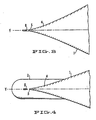
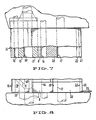
- FIG 1 through FIG. 8 illustrate an embodiment of the invention applied to very large vessel having an overall length of 920 feet (280.4 m.), a beam of 136 feet (41.45 m) at the waterline and a design speed of 30 knots.
- Vessel 1 has a conventional bulb 2 located adjacent the keel line 3 of bow 4.
- the leading edge, or bowpeak, 4 of bow 3 below the waterline 6 extends upwardly from bulb 2 to forepeak 7 above the waterline 6, with a total span of 40 feet (12.2 m.).
- foil 8 Secured to bulb 2 is foil 8 which extends upwardly therefrom, generally parallel to bowpeak 5 below the waterline, and spaced forewardly thereof, with a gap therebetween of 20 inches (50.2 cm), which is equal to about 42% of the chord distance of the foil(4 feet or 1.22 m.).
- the chord of foil 8 lies along the vertical centerline plane Y of the vessel.
- At its upper end foil 8 is secured to forepeak 7 adjacent the forepeak leading edge 9.
- the thickest point of the foil 10.5 inches (26.5 cm), occurs at 10, which is a distance from the leading edge of the foil equal to 28% of the chord length.
- foil of this invention is employed with a vessel which does not have a bulb at the bow
- the foil may extend down to and, optionally, a distance therebelow, in various configurations as exemplified in FIGURES 9-11.
- foil 8a extends from forepeak 7a of vessel 1a parallel to the bowpeak, as in the embodiment of FIG. 1, but foil 8a extends down to keel line 3a and for a short distance therebelow.
- Foil 8a is secured to bow 4a at its lower end by strut 11a at the keel line.
- Such a foil extension would be particularly useful for a vessel having structure extending below the keel line, e.g. a centerboard, keel or the like.
- a separate foil may be mounted directly in advance of such structure, either connected to and supported by that structure of by the keel, above.
- Foil 8b is similar to foil 8a of FIG.9, except that it ends at the keel line and connects to bow 4b at that point by a gently curved and streamlined connecting plate 11b.
- foil 8c is connected at both ends to the bow peak by struts 11c and extends foreward of bow peak 7c throughout the foil span.
- This embodiment may be more suitable for smaller vessels, due to its simplicity and ease of retrofit.
- Struts 11c may be provided with an internal channel for conduits connecting vessel 1c with foil 8c for utilities(e.g. compressed air and electricity) for servicing the foil for functions described below.
- the foil may be positioned vertically or, in the latter instance, a horizontal foil may be more effective.
- a foil may be attached to each hull in a similar fashion as described for a monohull vessel.
- two or more foils may be used in tandem, each with its chord disposed on the vertical centerline plane of the vessel, one in front of the other.
- a second foil having the same configuration size and span as foil 8 may be positioned forward thereof, spaced therefrom the same distance as the spacing between bowpeak 5 and foil 8.
- the second foil may be spaced from and secured to foil 8 by struts, similar to those depicted in FIG. 11.
- the leading section of the foil may be mounted to pivot on an axis extending in the span direction to form an angle with the trailing section 20 of the foil, thus, in effect, providing the foil with a variable camber. Pivoting the leading section about this axis from its normal balanced position unbalances the foil to create a turning force in the direction the leading section is pivoted, as the foil moves through the water.
- leading section 12 of foil 8 comprises rudder stock 13 which is mounted for pivoting at its upper end in casing 14 and is similarly mounted at its lower end(not shown).
- a rudder turning mechanism or machine(not shown) is provided in forepeak 7 where it engages the upper end of rudder stock 13.
- rudder 15 Foreward of rudder stock 13 and fixed thereto is rudder 15 which also forms the leading edge of foil 8.
- For turning movements rudder stock 13 is pivoted, and with it rudder 15, from the neutral position to the desired turn direction, either left or right, as shown in dotted outline at A and B.
- foil pressure regulator for providing a rudder function and for other uses, is a foil pressure regulator.
- the foil pressure regulator may be used to impart a rudder function to the bow foil of this invention in addition to its general utility for other foil applications.
- the pressure regulator acts to unbalance the pressure on the sides of the foil moving through the water, thereby imparting a turning or lifting force to the foil.
- the foil pressure regulator When utilized with an unbalanced or lifting foil(or with a balanced foil moving through the water at an angle of attack relative to its direction of movement), the foil pressure regulator is utilized to adjust the lifting or tuning force of the foil, increasing or decreasing that force as may be desired.
- the regulator also has particular application to roll stabilizer foils or fins which, conventionally are mounted at either side of the hull at or above the keel line with an adjustable angle of attack relative to the horizontal plane to provide upward or downward force.
- the foil pressure regulator may be employed to impart a portion or all of such force.
- the foil pressure regulator constitute a flow diverter which cooperates with an opening across the chord of the foil intermediate the leading and trailing edge to divert the flow of water passing along one surface of the foil through the opening and thus to the other side of the foil.
- the diverter When the diverter is operative to divert flow, its leading edge extends into the path of water flow to one side of the foil.
- the diverter When the diverter is inactivated or in neutral position, it is retracted from its extended position, preferably to a position where it partially or completely blocks or closes the opening.
- the major dimension of the opening and of the diverter extends generally in the span direction and thus, in operation, generally perpendicular to the flow across the foil.
- foil 8g is secured to bow 4g of vessel 1g by struts 11g and extends from above the waterline 6g to keel line 3g.
- Flow diverter 27 is pivotably mounted in, and acts as a butterfly valve or closure for, a rectangular opening 0 in foil 8g, as better seen in FIGURES 20 and 21.
- Diverter 27 is secured along its vertical axis to axle 25 which, in turn, is secured along the centerline 26 of foil 8g for rotation about centerline 26.
- Axle 25 extends upwardly through and beyond foil 8g, where it is connected to an actuator drive(not shown) for pivoting diverter 27 between a closed position and actuated positions on either side of foil 8g.
- the centerline of axle 25, and the centerline of diverter 27 when it is in the closed position are coincident with the chord 26 of foil 8g.
- the length of leading section 28 of diverter 27(from the axle pivot point to the leading edge) is approximately 40% of the entire chord length of diverter 27.
- Diverter 27 desirably has a neutral or symmetrical profile about its chord, with its maximum thickness at or foreward of axle 25. It is also desirable that the sides diverter 27 generally follow and maintain the camber of foil 8g, as shown, when in the neutral or inoperative position.
- the leading and trailing edges of diverter 27 desirably are more rounded or streamlined for slow speed applications and sharper for higher speeds.
- diverter 27 may be pivoted from the closed position, as shown in FIG. 20, in either direction to move leading section 28 outwardly at least partially beyond the surface of foil 8g to expose passage or opening 0, as indicated at 30.
- Leading section 28, thusly extended into the path of water flow adjacent foil 8g, will divert such flow through opening 0 at 30 to the other side of diverter 27 and of foil 8g, thereby creating a force normal to the foil chord, in the direction which diverter leading section 28 has been pivoted.
- trailing section 29 pivots outwardly at least partially beyond the opposite surface of foil 8g.
- FIG. 22 Another embodiment of the flow diverter is shown in FIG. 22 in which a trailing flap 27b with a leading edge 28b and a trailing edge 29b constitutes a trailing section of foil 8h which is pivotable on axle 25b to supplement, when pivoted outwardly of the foil, the flow diverting effect of diverter 27a which pivots on axle 25a.
- FIG. 23 Another embodiment of the flow diverter foil is shown in FIG. 23, in which the foil constitutes an aft rudder 71 mounted on a rudder stock for pivoting on a vertical axis.
- rudder 71 With flow diverter 27c in a closed position, rudder 71 may be operated like a conventional rudder.
- flow diverter 27c When rudder 71 is maintained in a stationary position, flow diverter 27c may be pivoted(by an actuator not shown) to an actuated position to impart a turning force on the rudder which, while somewhat smaller than the force obtained by turning the entire rudder, is more efficient because of the significantly lower drag and friction that it creates.
- Another important embodiment of the flow diverter foil is in a roll stabilizer fin.
- Active systems for dampening the roll of a vessel utilize fins(foils which can create lift to either side) mounted at the sides of the hull between the keel line and the waterline with their span direction extending generally outboard of the hull. These fins conventionally pivot on an axis in the span direction to change their angle of attack to create upward and downward forces in opposition to the roll direction.
- the fins may also be pivotable, however, advantageously, they may be neutral or balanced foils fixedly mounted on the hull with their chords generally horizontal(with little or no angle of attack).
- the flow diverter for these foils is of the type illustrated in FIG.19 with the major dimension of the opening and the pivot axis extending outwardly for the hull in the span direction.
- the conventional controls for roll stabilizer fins may be applied to the flow diverters in these fixed foils so that in response to the roll of the vessel the axles of the flow diverters will be pivoted to create an upward and a downward force, respectively, to counter the roll.
- the diverter may be provided with a shorter trailing section or even none at all, in this case with its pivot point at the trailing edge of the opening.
- the pivot point may be entirely at the leading edge of the opening so that there is no activator trailing section.
- a closure for the opening separate from the diverter extendible into the flow such as a sliding plate that slides into the open from a retracted position inside the foil.
- the pressure regulator may be smaller or larger in relation to the size of the foil, or closer to or further from the leading or trailing edge of the foil, but, for maximum effect, the opening is located with its trailing edge forward of the foil trailing edge a distance of at least 20% of the foil chord length adjacent the opening.
- the foil pressure regulator has a multiplier effect as compared to a rudder or wing, per se. Diversion of flow from one side to the other of the foil surface creates a deferential pressure not only across the surface of the diverter but across the foil surface, as well.
- Another important feature of this invention is the employment of the bow foil for generating and for dispensing friction reducing agents.
- a particular advantage of the bow foil for this purpose is its capability of distributing such agent in advance of the bow to the regions where these agents provide maximum benefit and in a relatively more precise and uniform manner.
- the trailing section of the foil provides an advantageous zone for release of such agents as the dynamic pressure of the water on the foil surfaces in this region are relatively low and the water flow is substantially laminar, with significantly less spray.
- a number of alternatives are available for generating, in the case of gas bubbles, and for dispensing all friction reducing agents from the bow foil.
- such agents may be prepared or stored in the vessel and piped to the foil for distribution and release or, in the case of gas bubbles, they may be generated(using supplied gas) in or at the surfaces of the foil.
- friction reducing agents are prepared or generated in a water system in bow 4.
- the water containing such agents e.g. bubbles in suspension, is piped to foil 8 and emitted at orifices at the sides and trailing edge of the trailing section of the foil.
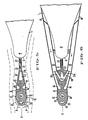
- vertical side channels 16 and trailing channel 17 are provided in the interior of foil 8 which are supplied with friction reducing agents from vessel 1 through conduits from forepeak 7 and bulb 2(not shown) connecting with these channels 16 and 17 at both the top and bottom ends of foil 8.
- conduits from forepeak 7 and bulb 2(not shown) connecting with these channels 16 and 17 at both the top and bottom ends of foil 8.
- Conduits 18 are shown in more detail in FIG. 6 together with their connections to channels 16 and channel 17.
- Supply conduits extend to vessel 1 and they connect to the interior thereof to a friction reducing agent supply system(not shown).
- Vertical slit outlets 19 are disposed along each side of trailing section 20 and they are each in communication along their length with channel 16 on their respective sides to provide outlets for releasing friction reducing agents from their respective channel 16 into the water flowing past.
- vertical slit outlet 21 is disposed along trailing edge 22 and is reinforced with stabilizing wing w. Slit 21 is in communication with channel 17 for releasing friction reducing agents from channel 17 into the water flow at the trailing edge.
- shrouds 23 of flexible material such as film or laminar fiberglass may be attached to trailing edge 22 to trail in the water flow stream to guide the released friction reducing agents to the bow peak(shown only in FIGS 5 and 6).
- gas bubbles may be generated internally in the foil or at its surfaces for example by utilizing microporous barriers such as diffuser plates.
- microporous barriers such as diffuser plates.
- Metal plates prepared by sintering powdered metal and chemically etching out the pores therein may be used.
- fiber metal mats normally utilized for filter applications, when appropriately designed and used in accordance with this invention, are uniquely suitable for production of a high volume of microbubbles at surprisingly modest pressures and energy consumption. They are thus preferred.
- Fiber metal mats or plates are prepared by compressing randomly laid fine fibers of various metals to the desired density and pore size and sintering the mat to fuse the fibers at crossover points.
- the fibers utilized in such mats are of ductile, strong, corrosion-resistant metals, including stainless steel, nickel alloys, such as Inconel 600 and Hastalloy C, and bronze.
- the diameter of the fibers employed may be between 2 and 80 microns, and preferably between 5 and 40 microns.
- the mats are desirably pressed to a density above 30% and below 70 % and are preferably in the density range between 40 and 60 percent.
- the mats or plates will have an average pore size as low as 5 microns, but more typically between 10 and 100 microns and preferably below 50 microns.
- the desired pore size may be achieved by appropriate selection of fiber diameter, the amount of fibers per unit area of the mat, and the amount of compression(and hence density and thickness of the mat).
- the thickness of the mat is desirably less than 50 millimeters and, for more efficient operation, less than 40 mm. Mats of a thickness down to about 1.5 mm may be employed where the unsupported areas of the mat are less than 1 square centimeter and preferably are 3 mm or thicker where the unsupported area of the mat is greater.
- Support structure may be provided, preferably on the inboard side of the mat, to give additional structural strength, such as a perforated plate , woven wire screens or an open honeycomb section((with the cell walls perpendicular to the mat surface), abutted against the mat inner surface and desirably glued or fused thereto.
- additional structural strength such as a perforated plate , woven wire screens or an open honeycomb section((with the cell walls perpendicular to the mat surface), abutted against the mat inner surface and desirably glued or fused thereto.
- the air permeability of such mats is desirably greater than 50 and preferably greater than 100 cubic feet per hour per inch of water of pressure differential between the sides thereof (or, expressed in metric, one-half and one cubic meter per hour per centimeter of water pressure differential, respectively), tested at standard conditions, i.e. 20 degrees centigrade, one atmosphere pressure, and with a test velocity of 2000 feet (609.6 meters) per hour.
- the desired permeability like the desired pore size, may be obtained by appropriate selection of fiber diameter and adjustment of mat thickness and density.
- Mats produced in this manner have a surprising uniformity of pore size, i.e. a narrow range of pore size distribution.
- Average pore size also referred to as diameter
- the most preferred fiber metal mat consists of 25 micron diameter bronze or stainless steel fibers compressed to a density of 45-50%(of the solid metal) with a thickness of 3 millimeters and having a average pore size of 30 microns(with a size distribution of plus or minus 8 microns). This material is available from Brunswick Corporation under the trademark Feltmetal.
- the choice of thickness and size of the diffuser plates will vary with the conditions particular application. These plates are mounted at the outside surface, or at an internal location of the foil in water communication with the outside, and provided with a pressurized gas chamber on the back(opposite) side.
- the pressurized gas flowing through the diffuser plate into the water forms bubbles, the size of which may be adjusted by varying the gas pressure, the average pore size of the diffuser plate and/or the flow rate of the water passing the diffuser plate. Gas bubbles with an average diameter below 50 micron are desirable for effective results, and an average diameter of 40 micron or less is preferred. Additional information and guidance on bubble generation may be found in the literature, including the Madavan et al. articles previously cited.
- diffuser plates 31 are provided in the interior walls of foil 8d. Compressed air is supplied to the back sides of diffuser plates 31 by means of conduits extending from the foil to a compressed air source in the vessel(not shown). Water is circulated through chambers 16d to carry the bubbles away from diffuser plates 32 and through vertical slit openings 19d into the water streaming past the foil.
- diffuser plates 32 and plate 33 are mounted in channels 16e and in channel 17e, respectively, to emit bubbles directly into the water stream exteriorly of the foil 8e.
- channels 16e and channel 17e are charged with pressurized gas to be diffused through diffuser plates 32 and 33.
- diffuser plates 34 are mounted in the walls of foil 8f, flush with its surface and in direct communication with the outside.
- plenum chamber 16f is pressurized(by a compressed air source not shown) to create gas flow through diffuser plates 34.
- air compressor 35 provides pressurized gas which is fed through conduit 36 to an elongated diffuser plate 37 mounted at the surface of foil 8a.
- Electrical generator 38 also supplies electrical energy through conduit 39 to foil 8a for purposes which will be described below.
- FIGURES 10-14 illustrate gas diffuser systems forming another important feature of this invention.
- discrete diffuser cells 40 located along the surface of foil 8b to provide a thorough distribution of bubbles in the water field in advance of the bow.
- diffuser cells 40 may be located on mounting strut 11b and on hull of vessel 1b, as shown. These cells may be flush mounted and each supplied gas under pressure by piping similarly as shown in detail with respect to the foil embodiment of FIG. 11.
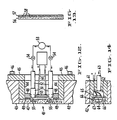
- Straight sided diffuser cell 41 and round circular diffuser cells 42 in FIG. 11 are flush mounted at the exterior surface of foil 8c.
- cell 41 is mounted in an opening through foil wall 43 with casing 44 of cell 41 engaging the sides of the wall opening.
- Casing 44 is provided with an inboard flange 45 by which it is secured to the inboard side of the foil wall be bolts 46.
- Diffuser plate 47 is attached to the outboard margins of casing 44 by welds or the like. The outboard side of diffuser plate 47 is flush with the outboard surface of foil wall 43 and covers the entire wall opening.
- Backwall 48 is engaged in casing 44 and sealed against diffuser plate 47 by an elastomeric seal 49, to form air chamber 50.
- Nozzles 52 are mounted on back wall 48 in communication with air chamber 50. Conduits 51 connect nozzles 52 with a compressed air source 53 through valves 54. Diffuser plate 47 is provided with areas of reduced thickness which permit increased flow of gas(at a given pressure) without unduly compromising the strength of the plate, in order to maintain integrity of the hull.
- An alternative diffuser plate for diffuser cell 41 is depicted in FIG. 13. Diffuser plate 56 is thinner throughout its entire cross-section and structural integrity is provided by backing plate 57 at its inboard surface which serves to reinforce diffuser plate 56 while permitting passage of gas thereto through its openings 58. This combination may replace diffuser plate 57 in cell 41, if desired.
- High frequency wave energy utilized is, in general, between one kilohertz and one megahertz, and preferably in the range of 10 to 90 kilohertz.
- Placement of the wave generator preferably an electroacoustic or electromechanical transducer, relative to the diffuser plate is not critical so long as the energy directly impinges on the plate(through an air gap) or is conducted to the plate through structure adjacent or in contact therewith.
- the wave energy also serves the important function of cleaning the diffuser plate of biological matter and other fowling that occurs in a marine environment.
- transducer 59 a piezoelectric crystal with a natural frequency of 50 kilohertz secured to metalized layer electrodes for activation, available from Vernitron Corp., is secured to the inboard surface of back wall 48 which acts as a conductor of the wave energy from the transducer to air chamber 50.
- Transducer 59 is connected through wires 60 with a high voltage piezoelectric transducer driver(not shown) capable of 320 volt(peak) to generate an output through the frequency range of 10 KHz to 100 KHz.
- Diffuser cell 42 of FIG. 14 is constructed essentially as cell 41 of FIG. 12, except that diffuser cell 42 is circular and its casing 61 has an integral back wall which bounds air chamber 62 and communicates with conduit 63 supplying gas under pressure to air chamber 62.
- Aluminium support plate 64 is mounted in air chamber 62 for supporting and conducting wave energy from piezoelectric transducer 65 secured thereto. Support plate 64 contains openings 66 therethrough for passage of gas through chamber 62 to diffuser plate 67.
- the foregoing diffuser cells are useful for either original installations or for retrofitting foil or vessels, particularly circular cells, as described having a cross-sectional area of effective diffuser surface of between 2 and 10 square inches (or around 10 to 70 square centimetres). For example two inch (5 cm) diameter circular cells may be distributed along the vessel hull and foil, as depicted, to achieve efficient and effective coverage.
- the flow rate from the various gas diffuser systems described may be adjusted for the particular speed of the vessel and other conditions, by regulating the gas pressure supplied to the back side of the plate so as to provide a flow of bubbles which, will remain adjacent the wetted surface of the vessel a substantial distance, desirably to midships.
- FIGURES 15-17 Yet another aspect of the invention is shown in FIGURES 15-17.
- Electric resistance heating strips 68 are secured to the inner surface of the leading sections 12d, 12e and 12f of foils 8d, 8e and 8f respectively, and extend along the span thereof.
- Electrical conduits (not shown) connect from a power source on the vessel to heating strips 68.
- Heating strips 68 heat the foil surfaces which, in turn, heat the water passing the foil to decrease water viscosity. This lowers the frictional resistance of the water not only on the foil surfaces but also on the wetted surface of the bow as the warmed water reaches those surfaces.
- Rudder stock 13 and rudder 15 have vertical channels 69 and 70, respectively.
- Heating media such as hot water
- rudder channel 70 may be piped to the upper end of rudder channel 70, circulated to rudder stock channel 69 at the lower end through connector pipe 71 and then removed at the upper end of channel 69 and piped back to vessel 1 for reheating.
- FIG. 18 Yet another feature of these invention relating to the use of the bow foil is illustrated in FIG. 18.
- foil 8i is provided with the capability of drawing in water at or in the vicinity of the trailing edge. Specifically, water is drawn in through slot 72 connecting with conduit 73 extending from the foil through the bottom strut into the bow of vessel 1i. Pump 74 draws the water into slot 72 and through conduit 74 and then expels the water through an extension of conduit 73 extending below keel line 3i of the bow.
Landscapes
- Physics & Mathematics (AREA)
- Fluid Mechanics (AREA)
- Chemical & Material Sciences (AREA)
- Engineering & Computer Science (AREA)
- Combustion & Propulsion (AREA)
- Mechanical Engineering (AREA)
- Ocean & Marine Engineering (AREA)
- Other Liquid Machine Or Engine Such As Wave Power Use (AREA)
- Aeration Devices For Treatment Of Activated Polluted Sludge (AREA)
- Dental Preparations (AREA)
- Adhesives Or Adhesive Processes (AREA)
- Separation Using Semi-Permeable Membranes (AREA)
Applications Claiming Priority (3)
| Application Number | Priority Date | Filing Date | Title |
|---|---|---|---|
| US1756787A | 1987-02-24 | 1987-02-24 | |
| US17567 | 1987-02-24 | ||
| WOPCT/US87/02072 | 1987-08-20 |
Publications (2)
| Publication Number | Publication Date |
|---|---|
| EP0280456A2 true EP0280456A2 (de) | 1988-08-31 |
| EP0280456A3 EP0280456A3 (de) | 1988-12-14 |
Family
ID=21783313
Family Applications (1)
| Application Number | Title | Priority Date | Filing Date |
|---|---|---|---|
| EP88301271A Withdrawn EP0280456A3 (de) | 1987-02-24 | 1988-02-16 | Bugflosse |
Country Status (7)
| Country | Link |
|---|---|
| EP (1) | EP0280456A3 (de) |
| JP (1) | JPH02500014A (de) |
| KR (1) | KR890700508A (de) |
| AU (1) | AU7966087A (de) |
| FI (1) | FI880872A7 (de) |
| NO (1) | NO880799L (de) |
| WO (1) | WO1988006547A1 (de) |
Cited By (4)
| Publication number | Priority date | Publication date | Assignee | Title |
|---|---|---|---|---|
| GR960100161A (el) * | 1996-05-17 | 1998-01-30 | "ασπιδα τμησις" της αντιστασης θαλασσας και/η αερα. | |
| WO1999001340A1 (fr) * | 1997-07-01 | 1999-01-14 | Jacques Fiocca | Dispositif de stabilisation pour bateau a voile |
| US6186085B1 (en) | 1995-12-04 | 2001-02-13 | Hiroharu Kato | Method for reducing frictional resistance of hull, frictional resistance reducing ship using such method, and method for analyzing ejected air-bubbles from ship |
| EP1992558A1 (de) * | 2007-05-15 | 2008-11-19 | Mondo Marine Eng. Srl | Kippbarer Bogenkolben und dazu passende Hülle |
Families Citing this family (5)
| Publication number | Priority date | Publication date | Assignee | Title |
|---|---|---|---|---|
| KR100476542B1 (ko) * | 2001-03-29 | 2005-03-18 | 삼성중공업 주식회사 | 선박의 선체표면 난류제어에 의한 항력 감소방법 및 장치 |
| JP5132828B1 (ja) * | 2012-06-01 | 2013-01-30 | 株式会社 ドットコム・リレーションズ | 摩擦抵抗低減船 |
| JP5688821B2 (ja) * | 2013-10-24 | 2015-03-25 | 独立行政法人海上技術安全研究所 | 船舶の噴出気体供給方法及び噴出気体制御装置 |
| JP6086244B2 (ja) | 2013-11-19 | 2017-03-01 | 住友電装株式会社 | 多接点型端子 |
| KR101707503B1 (ko) * | 2013-11-20 | 2017-02-27 | 대우조선해양 주식회사 | 분리제작형 선수 구조 |
Family Cites Families (18)
| Publication number | Priority date | Publication date | Assignee | Title |
|---|---|---|---|---|
| US1325385A (en) * | 1919-12-16 | Attachment for ships | ||
| US420670A (en) * | 1890-02-04 | anderl | ||
| US1661114A (en) * | 1917-06-16 | 1928-02-28 | Flettner Anton | Method and device for the steering of ships |
| US1822223A (en) * | 1927-10-27 | 1931-09-08 | Klinger Johann Rudolf | Construction of ships, boats and the like |
| US1755342A (en) * | 1929-08-05 | 1930-04-22 | Tissot Henri Gustave | Lifting attachment for aeroplane wings |
| GB373970A (en) * | 1930-08-01 | 1932-06-02 | Henri Lecoq | Improvements in or relating to means for reducing frictional resistance of fluids along solid walls |
| DE607506C (de) * | 1933-06-27 | 1934-12-29 | Wilke Buening | Schiffsruder |
| FR849471A (fr) * | 1938-08-01 | 1939-11-24 | Procédé et dispositif pour diminuer la résistance de l'eau dans la propulsion desnavires et autres embarcations | |
| US2366162A (en) * | 1942-08-29 | 1945-01-02 | Stevenson Jordan & Harrison In | Reduction of the skin friction of water by vibration |
| US3048137A (en) * | 1957-05-17 | 1962-08-07 | Girard L Calehuff | Discharging exhaust products from a torpedo |
| FR1312722A (fr) * | 1962-01-17 | 1962-12-21 | Dispositif pour réduire la résistance à la propulsion des navires en mouvement sur l'eau | |
| GB1063307A (en) * | 1963-11-01 | 1967-03-30 | Harrison Lackenby | Reducing the resistance to propulsion of ships |
| GB1277059A (en) * | 1968-07-30 | 1972-06-07 | Gen Electric | Improvements in or relating to the reduction of drag |
| DE2046868A1 (de) * | 1969-09-25 | 1971-04-08 | National Research Development Corp, London | Steuerungs , Stabihsierungs oder dergleichen Flachen aufweisendes EIe ment fur in stromenden Medien bewegte Korper sowie Schiff oder dergleichen Fahr zeug mit einem solchen Element |
| JPS5613271A (en) * | 1979-07-11 | 1981-02-09 | Mitsubishi Heavy Ind Ltd | Semi-submerged catamaran with pitch-restraining fins |
| US4377123A (en) * | 1980-09-08 | 1983-03-22 | Jackson Lester L | Boat stabilizer apparatus |
| DE3331719A1 (de) * | 1983-09-02 | 1985-03-21 | Thomas Paul 6056 Heusenstamm Engel | Diffusor, verfahren zu seiner herstellung und verwendung des diffusors |
| SE447891B (sv) * | 1985-04-02 | 1986-12-22 | Olov Roger Bolstad | Sett och anordning att minska friktionsmotstandet mot ett foremal som ror sig i ett fluidum |
-
1987
- 1987-08-20 JP JP62505548A patent/JPH02500014A/ja active Pending
- 1987-08-20 AU AU79660/87A patent/AU7966087A/en not_active Abandoned
- 1987-08-20 KR KR1019880701330A patent/KR890700508A/ko not_active Withdrawn
- 1987-08-20 WO PCT/US1987/002072 patent/WO1988006547A1/en not_active Ceased
-
1988
- 1988-02-16 EP EP88301271A patent/EP0280456A3/de not_active Withdrawn
- 1988-02-23 NO NO880799A patent/NO880799L/no unknown
- 1988-02-24 FI FI880872A patent/FI880872A7/fi not_active IP Right Cessation
Cited By (4)
| Publication number | Priority date | Publication date | Assignee | Title |
|---|---|---|---|---|
| US6186085B1 (en) | 1995-12-04 | 2001-02-13 | Hiroharu Kato | Method for reducing frictional resistance of hull, frictional resistance reducing ship using such method, and method for analyzing ejected air-bubbles from ship |
| GR960100161A (el) * | 1996-05-17 | 1998-01-30 | "ασπιδα τμησις" της αντιστασης θαλασσας και/η αερα. | |
| WO1999001340A1 (fr) * | 1997-07-01 | 1999-01-14 | Jacques Fiocca | Dispositif de stabilisation pour bateau a voile |
| EP1992558A1 (de) * | 2007-05-15 | 2008-11-19 | Mondo Marine Eng. Srl | Kippbarer Bogenkolben und dazu passende Hülle |
Also Published As
| Publication number | Publication date |
|---|---|
| FI880872A0 (fi) | 1988-02-24 |
| JPH02500014A (ja) | 1990-01-11 |
| NO880799L (no) | 1988-08-25 |
| FI880872A7 (fi) | 1988-08-25 |
| EP0280456A3 (de) | 1988-12-14 |
| AU7966087A (en) | 1988-09-26 |
| NO880799D0 (no) | 1988-02-23 |
| KR890700508A (ko) | 1989-04-25 |
| WO1988006547A1 (en) | 1988-09-07 |
Similar Documents
| Publication | Publication Date | Title |
|---|---|---|
| US5090352A (en) | Bow foil | |
| US5117882A (en) | Microbubble-generating and dispensing devices and methods | |
| US6145459A (en) | Friction-reducing ship and method for reducing skin friction | |
| TWI283212B (en) | Air cushion vessel | |
| CN103889836B (zh) | 用于水流管理的船头水动力导流管 | |
| US4975023A (en) | Low-resistance hydrofoil | |
| JP2009274706A (ja) | 摩擦抵抗低減船およびその運転方法 | |
| WO2010037253A1 (zh) | 引前水推进船舶 | |
| WO1988006547A1 (en) | Bow foil | |
| US6647909B1 (en) | Waveless hull | |
| JPS6035693A (ja) | プロペラ初期流入流に影響を与えるための装置 | |
| JPH0451397B2 (de) | ||
| JP3185047B2 (ja) | 船体摩擦抵抗低減方法 | |
| JP3643703B2 (ja) | 摩擦抵抗低減型船舶 | |
| EP0459076B1 (de) | Stabiler Rennkatamaran mit Tragflügeleigenschaften | |
| US12280853B2 (en) | Fluid resistance reduction apparatus for ship | |
| JPH10175588A (ja) | 船舶の摩擦抵抗低減装置 | |
| CN112109844B (zh) | 一种应用于小水线面双体船的自动吸气支柱结构 | |
| JPH10175587A (ja) | 船舶の摩擦抵抗低減装置 | |
| JPH09240572A (ja) | 水中翼船の摩擦抵抗低減装置 | |
| JP2001106173A (ja) | 摩擦抵抗低減船 | |
| JPH09226673A (ja) | 摩擦抵抗低減船 | |
| RU2860550C1 (ru) | Устройство для снижения сопротивления воде корпуса судна или автономного подводного аппарата | |
| JPH09240571A (ja) | 船舶の摩擦抵抗低減装置 | |
| JP2023132401A (ja) | 摩擦抵抗低減システム、航走体及び航走体の摩擦抵抗低減方法 |
Legal Events
| Date | Code | Title | Description |
|---|---|---|---|
| PUAI | Public reference made under article 153(3) epc to a published international application that has entered the european phase |
Free format text: ORIGINAL CODE: 0009012 |
|
| AK | Designated contracting states |
Kind code of ref document: A2 Designated state(s): BE DE ES FR GB GR IT NL SE |
|
| PUAL | Search report despatched |
Free format text: ORIGINAL CODE: 0009013 |
|
| AK | Designated contracting states |
Kind code of ref document: A3 Designated state(s): BE DE ES FR GB GR IT NL SE |
|
| 17P | Request for examination filed |
Effective date: 19890517 |
|
| 17Q | First examination report despatched |
Effective date: 19901205 |
|
| STAA | Information on the status of an ep patent application or granted ep patent |
Free format text: STATUS: THE APPLICATION IS DEEMED TO BE WITHDRAWN |
|
| 18D | Application deemed to be withdrawn |
Effective date: 19910416 |