EP0280788A1 - Filtre pour l'enrichissement isotopique en vapeur de mercure - Google Patents
Filtre pour l'enrichissement isotopique en vapeur de mercure Download PDFInfo
- Publication number
- EP0280788A1 EP0280788A1 EP87119328A EP87119328A EP0280788A1 EP 0280788 A1 EP0280788 A1 EP 0280788A1 EP 87119328 A EP87119328 A EP 87119328A EP 87119328 A EP87119328 A EP 87119328A EP 0280788 A1 EP0280788 A1 EP 0280788A1
- Authority
- EP
- European Patent Office
- Prior art keywords
- mercury
- filter
- reactor
- fill
- hydrogen
- Prior art date
- Legal status (The legal status is an assumption and is not a legal conclusion. Google has not performed a legal analysis and makes no representation as to the accuracy of the status listed.)
- Granted
Links
- QSHDDOUJBYECFT-UHFFFAOYSA-N mercury Chemical compound [Hg] QSHDDOUJBYECFT-UHFFFAOYSA-N 0.000 title claims abstract description 80
- 230000000155 isotopic effect Effects 0.000 title claims description 5
- 230000004075 alteration Effects 0.000 title description 2
- 229910052753 mercury Inorganic materials 0.000 claims abstract description 64
- 230000005855 radiation Effects 0.000 claims abstract description 23
- 239000001257 hydrogen Substances 0.000 claims abstract description 17
- 229910052739 hydrogen Inorganic materials 0.000 claims abstract description 17
- UFHFLCQGNIYNRP-UHFFFAOYSA-N Hydrogen Chemical compound [H][H] UFHFLCQGNIYNRP-UHFFFAOYSA-N 0.000 claims abstract description 13
- 238000006243 chemical reaction Methods 0.000 claims description 10
- 239000007789 gas Substances 0.000 abstract description 17
- 238000010791 quenching Methods 0.000 abstract description 12
- 230000000171 quenching effect Effects 0.000 abstract description 12
- VYPSYNLAJGMNEJ-UHFFFAOYSA-N silicon dioxide Inorganic materials O=[Si]=O VYPSYNLAJGMNEJ-UHFFFAOYSA-N 0.000 abstract description 11
- 239000010453 quartz Substances 0.000 abstract description 5
- 239000011261 inert gas Substances 0.000 abstract description 4
- 239000011248 coating agent Substances 0.000 abstract description 2
- 238000000576 coating method Methods 0.000 abstract description 2
- XKRFYHLGVUSROY-UHFFFAOYSA-N Argon Chemical compound [Ar] XKRFYHLGVUSROY-UHFFFAOYSA-N 0.000 description 10
- IJGRMHOSHXDMSA-UHFFFAOYSA-N Atomic nitrogen Chemical compound N#N IJGRMHOSHXDMSA-UHFFFAOYSA-N 0.000 description 8
- 230000005284 excitation Effects 0.000 description 8
- VEXZGXHMUGYJMC-UHFFFAOYSA-N Hydrochloric acid Chemical compound Cl VEXZGXHMUGYJMC-UHFFFAOYSA-N 0.000 description 5
- 229910052786 argon Inorganic materials 0.000 description 5
- 229910000041 hydrogen chloride Inorganic materials 0.000 description 5
- IXCSERBJSXMMFS-UHFFFAOYSA-N hydrogen chloride Substances Cl.Cl IXCSERBJSXMMFS-UHFFFAOYSA-N 0.000 description 5
- 238000006552 photochemical reaction Methods 0.000 description 5
- 230000003595 spectral effect Effects 0.000 description 5
- 238000000034 method Methods 0.000 description 4
- 229910052757 nitrogen Inorganic materials 0.000 description 4
- 230000008569 process Effects 0.000 description 4
- 230000005540 biological transmission Effects 0.000 description 3
- 150000002431 hydrogen Chemical class 0.000 description 3
- 239000000203 mixture Substances 0.000 description 3
- 238000000926 separation method Methods 0.000 description 3
- 239000000377 silicon dioxide Substances 0.000 description 3
- -1 Hydrogen Halides Chemical class 0.000 description 2
- 238000010521 absorption reaction Methods 0.000 description 2
- 239000011324 bead Substances 0.000 description 2
- 238000004891 communication Methods 0.000 description 2
- 239000012530 fluid Substances 0.000 description 2
- 230000006872 improvement Effects 0.000 description 2
- 238000005372 isotope separation Methods 0.000 description 2
- 229910000474 mercury oxide Inorganic materials 0.000 description 2
- UKWHYYKOEPRTIC-UHFFFAOYSA-N mercury(ii) oxide Chemical compound [Hg]=O UKWHYYKOEPRTIC-UHFFFAOYSA-N 0.000 description 2
- 230000001629 suppression Effects 0.000 description 2
- 125000004429 atom Chemical group 0.000 description 1
- 235000013405 beer Nutrition 0.000 description 1
- 239000006227 byproduct Substances 0.000 description 1
- 239000012159 carrier gas Substances 0.000 description 1
- 230000001419 dependent effect Effects 0.000 description 1
- 239000011521 glass Substances 0.000 description 1
- 230000005283 ground state Effects 0.000 description 1
- 125000004435 hydrogen atom Chemical group [H]* 0.000 description 1
- 230000002452 interceptive effect Effects 0.000 description 1
- 239000000463 material Substances 0.000 description 1
- 238000005259 measurement Methods 0.000 description 1
- 238000012986 modification Methods 0.000 description 1
- 230000004048 modification Effects 0.000 description 1
- 229910052754 neon Inorganic materials 0.000 description 1
- GKAOGPIIYCISHV-UHFFFAOYSA-N neon atom Chemical compound [Ne] GKAOGPIIYCISHV-UHFFFAOYSA-N 0.000 description 1
- 230000009467 reduction Effects 0.000 description 1
- 238000007789 sealing Methods 0.000 description 1
- 239000007787 solid Substances 0.000 description 1
- XLYOFNOQVPJJNP-UHFFFAOYSA-N water Substances O XLYOFNOQVPJJNP-UHFFFAOYSA-N 0.000 description 1
Images


Classifications
-
- B—PERFORMING OPERATIONS; TRANSPORTING
- B01—PHYSICAL OR CHEMICAL PROCESSES OR APPARATUS IN GENERAL
- B01D—SEPARATION
- B01D59/00—Separation of different isotopes of the same chemical element
- B01D59/34—Separation by photochemical methods
Definitions
- the present invention relates to equipment for use in a photochemical process, and more particularly to equipment for use in a photochemical process for altering the isotopic composition of mercury.
- a weakly ionized plasma of mercury and rare gases under low pressure forms the basis of the fluorescent lamp.
- Electrical energy is converted to natural mercury resonance radiation at 253.7 nm. at an efficiency of 55 to 65%.
- This radiation in fluorescent lamps, is converted to visible light by solid phosphors that are coated upon the lamp envelope.
- the efficiency of the 253.7 nm. resonance radiation emitted from excited mercury atoms in the plasma is absorbed and reemitted many times by ground state mercury atoms during its escape to the walls of the discharge tube. This trapping of resonance radiation prolongs the effective lifetime of the excited atoms and increases the opportunity for radiationless energy conversion which reduces efficiency.
- the 253.7 nm. resonance line of mercury is composed of five hyperfine components, principally the result of isotope shifting.
- the 196Hg isotope in natural mercury does not contribute substantially to the radiation because of its low concentration, nor does its emission and absorption heavily overlap with the other hyperfine components. Therefore, by increasing its concentration, an additional channel for the 253.7 nm. photons is provided which reduces the average imprisonment time and increases radiation efficiency.
- a filter for enriching the content of 196Hg in a mercury feedstock which flows throgh a reactor comprising: an enclosure, at least a portion of which is transparent to the passage of ultraviolet light; a fill of mercury vapor in said enclosure, said mercury vapor having quantities of 196Hg less than that which is found in naturaly occurring mercury.
- the present invention is directed to a novel composition of matter housed in a UV-transparent filter for use in a system to enrich the 196Hg content of mercury by a photochemical reaction process.
- the reaction is between "natural" mercury, or possibly previously 196Hg-enriched mercury, and hydrogen chloride.
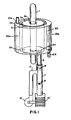
- the filter is particularly useful with a single pass reaction vessel that surrounds the filter, which filter in turn, surrounds a low pressure electric discharge lamp having a fill comprising mercury and an inert gas.
- the elements of the system, the lamp, the filter, and the reactor are formed of a material which is transparent to radiation at 253.7 nm, such as, for example, quartz or silica.
- Examples of a low pressure (e.g., about 2.5 torr) electric discharge lamp that are suitable for use in the system can be, for example, any of the known low pressure discharge lamps which transmit radiation in the range of 253.7 nm., especially those using microwave cavities for the excitation of the mercury.
- the filter of the present invention is disposed around the lamp and is formed of a pair of concentric cylindrical (or tubular) members that are sealed from the atmosphere.
- the concentric cylindrical members of the filter are preferably sealed at their ends with a pair of spaced-apart end members, so as to form a cylinder with an axial passageway that receives the low pressure discharge lamp.
- the filter contains a fill of mercury which is depleted in 196Hg so that the concentration of 196Hg is below the quantity that is usually present in naturally occurring mercury, viz. below 0.146 atomic weight percent.
- hydrogen is included in the filter as a quenching gas.
- the inclusion of the hydrogen has been found to inhibit the darkening of the interior of the filter. There may be several reasons for this.
- the hydrogen atoms formed during the quenching of excited mercury atoms may react with mercury oxide molecules that cold form Hg and H2O. The result is a reduction of the oxide back to elemental Hg. Otherwise the mercury oxide would eventually form an opaque film on the inner filter wall.
- the reactor is disposed about the filter and may take the form of a pair of concentric cylinders with inlet and outlet ports through which the mercury feedstock, HCl gas, and other carrier gases can flow.
- the exciting 196Hg radiation passes through the lamp envelope, through the filter and into the reactor to produce an isotopic-specific reaction to the 196Hg in the reaction vessel, whereby 196Hg2Cl2 is formed.
- a low pressure mercury lamp 1 comprising silica or a quartz discharge tube, equipped with microwave cavities disposed at one end thereof.
- the inner diameter of the tube is preferably approximately 5 mm.
- the discharge lamp 1 typically contains an inert gas, e.g., argon, at a pressure of approximately 2.5 torr and a mercury pressure of approximately 1 to 1.5 millitorr at about 20°C.
- argon is preferred as an inert gas in the lamp, other gases such as neon may be used also.
- the filter 3 includes a pair of coneentric cylindrical members 3a and 3b spaced from each other at a distance about 1.0 centimeters.
- the filter 3 is sealed from the atmosphere by a pair of spaced-apart end members 3c and 3d that are fused to the ends of the concentric cylindrical members 3a and 3b.
- An axial passageway is formed in the filter 3 by the inner cylindrical member 3b and is arranged to receive the lamp 1.
- a means for controlling mercury pressure in the filter comprises a tube 5, which is sealed at one end and in communication with the interior of the filter 3 through port 5a, is disposed on the lower end member 3d.
- a bead of mercury 6 is disposed at the closed end of the tube 5 and arranged so as to be in communication with the interior of the filter 3.
- a means for maintaining the mercury at a predetermined temperature is further described in the co-pending application.
- the temperature maintaining means includes a sleeve 7 disposed about the end of the tube 5 and around the bead of the mercury 6.
- a sealing ring 9 such as a conventional O-ring, is disposed between the sleeve 7 and the tube 5 to hold the sleeve 7 in place and prevent leakage of heat exchange fluid (preferably water) which passes through the sleeve 7.
- the heat exchange fluid flows through a "T" connection 11, down sleeve 7 into heater 14 and thence to pump 12 to return to "T" 11.
- Pump 12 and heater 14 maintain the temperature of the tube at a predetermined level, so as to maintain a predetermined quantity of mercury vapor in the filter.
- the reactor 20 is disposed around the filter 3 and includes a pair of spaced-apart concentric sleeves 20a and 20b.
- a conventional inlet port and outlet port 21a and 21b are disposed on the top and bottom of the reactor 20 to allow for the passage of the mercury feedstock.
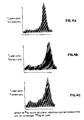
- the radiation from the low pressure mercury lamp 1 in the selected 253.7 nm area has a principal emission peak and five hyperfine peaks to the left of the principal peak.
- the emission after the light has passed through the filter 3 the hyperfine emissions (peaks to the left of the 196Hg peak) have been suppressed, thereby reducing the interfering excitation peaks which enter the reactor 20, thereby in turn, reducing the chemical reactions between the HCl and non-196Hg isotopes.
- the filter 3 is formed with at least a portion of its structure having a glass that is transparent to radiation at 253.7 nm, such as quartz, and is preferably entirely formed of quartz of silica, such that ultraviolet light can pass from the lamp 1 to the reactor vessel 3.
- the filter 3 contains the previously described fill of depleted 196Hg-mercury, as contrasted to "natural" mercury that contains 0.146 atomic weight percent 196Hg isotope. When the 196Hg concentration is reduced below the levels present in natural mercury, the hyperfine emissions of a mercury isotope other than 196Hg are reduced.
- the filter is filled with a mixture of quenching gas and mercury vapor and as previously mentioned, the filter contains the depleted 196Hg and hydrogen, the latter serving as a quenching gas.
- the use of hydrogen reduces the disposition of a dark coating on the inside of the filter, which has been observed to occur with other quenching gases.
- nitrogen has been used to act as a quenching gas.
- a nitrogen quenching gas is less then fully satisfactory.
- the mercury filter needs to absorb non-196Hg radiation which could excite non-196Hg isotopes, and the hydrogen serves as a quenching gas. Quite unexpectedly, it has been found that the hydrogen does not form stable by-products in the herein described mercury filter environment, which appears to be the case with other quenching gases previously used. When using hydrogen as a quenching gas, radiation of the mercury is converted to non-radiative energy through collisions.
- FIGURE 3B With a filter having 10 torr H2, there is a significant depression of the emission lines to the left of the principal 196Hg emission line in the curve. With a nitrogen fill, as shown in FIGURE 3C, emission lines attributable to non-196Hg isotopes occur. Such is also the case with the curve shown in FIGURE 3A which illustrates the lamp emission after passing through a filter containing only mercury.
- a fitler having a thickness of 10 mm. with a fill of H2 as a buffer gas at a pressure of 10 torr was used.
- the exicitation lamp diameter was 5 mm. and had a fill of argon and mercury and operated at a gas fill pressure of 2.5 torr at 20°C.
- the filter contained mercury that was 50% depleted in 196Hg (approximately 0.073 atomic weight percent 196Hg).
- the filter was operated at a temperature of approximately 40°C which provides substantial non-196Hg isotope emission suppression.
- the feedstock into the reactor was natural mercury which flowed at a rate of 19 milligrams per hour, together with HCl at a rate of 100 sccm (standard cubic centimeters per minute) and argon at a rate of 80 sccm.
- the mercury was enriched from the 0.146 atomic weight percent 196Hg to 1.6 atomic weight percent.
- the enrichment of 196Hg can be accomplished as disclosed in a co-pending application entitled: "High Feedstock Utilization Process for 196Hg Enrichment in a Photochemical Flow Reactor" (Attorney Docket No. 86-1-010), Serial No. , filed on even date herewith, and assigned to the same assignee as the present application.
Landscapes
- Life Sciences & Earth Sciences (AREA)
- Biophysics (AREA)
- Chemical & Material Sciences (AREA)
- Chemical Kinetics & Catalysis (AREA)
- Physical Or Chemical Processes And Apparatus (AREA)
- Discharge Lamps And Accessories Thereof (AREA)
- Organic Low-Molecular-Weight Compounds And Preparation Thereof (AREA)
Applications Claiming Priority (2)
| Application Number | Priority Date | Filing Date | Title |
|---|---|---|---|
| US06/947,216 US4800284A (en) | 1986-12-29 | 1986-12-29 | Filter for isotopic alteration of mercury vapor |
| US947216 | 1992-09-18 |
Publications (2)
| Publication Number | Publication Date |
|---|---|
| EP0280788A1 true EP0280788A1 (fr) | 1988-09-07 |
| EP0280788B1 EP0280788B1 (fr) | 1992-05-13 |
Family
ID=25485755
Family Applications (1)
| Application Number | Title | Priority Date | Filing Date |
|---|---|---|---|
| EP87119328A Expired EP0280788B1 (fr) | 1986-12-29 | 1987-12-29 | Filtre pour l'enrichissement isotopique en vapeur de mercure |
Country Status (5)
| Country | Link |
|---|---|
| US (1) | US4800284A (fr) |
| EP (1) | EP0280788B1 (fr) |
| JP (1) | JPS63240927A (fr) |
| CA (1) | CA1323327C (fr) |
| DE (1) | DE3779105D1 (fr) |
Cited By (12)
| Publication number | Priority date | Publication date | Assignee | Title |
|---|---|---|---|---|
| EP0388182A3 (fr) * | 1989-03-15 | 1990-11-14 | Gte Products Corporation | Procédé et dispositif pour mesurer la densité du mercure dans un réacteur fluidisé pour la séparation isotopique Hg-196 |
| US4981562A (en) * | 1988-12-23 | 1991-01-01 | Gte Products Corporation | Electrolytic recovery of mercury enriched in isotopic abundance |
| US5006165A (en) * | 1988-12-23 | 1991-04-09 | Gte Products Corporation | Method for mercury refinement |
| EP0388183A3 (fr) * | 1989-03-15 | 1991-04-10 | Gte Products Corporation | Procédé hybride de séparation d'isotopes |
| US5012106A (en) * | 1988-12-23 | 1991-04-30 | Gte Products Corporation | Axi-symmetrical flow reactor for 196 Hg photochemical enrichment |
| US5055693A (en) * | 1989-03-15 | 1991-10-08 | Gte Products Corporation | Nested reactor chamber and operation for Hg-196 isotope separation process |
| US5056359A (en) * | 1989-03-15 | 1991-10-15 | Gte Products Corporation | Method and apparatus to measure vapor pressure in a flow system |
| US5068533A (en) * | 1989-03-15 | 1991-11-26 | Gte Products Corporation | Manifold and method of batch measurement of Hg-196 concentration using a mass spectrometer |
| US5093086A (en) * | 1988-12-23 | 1992-03-03 | Gte Products Corporation | Packed bed reactor for photochemical 196 Hg isotope separation |
| US5100803A (en) * | 1989-03-15 | 1992-03-31 | Gte Products Corporation | On-line method of determining utilization factor in hg-196 photochemical separation process |
| US5205913A (en) * | 1988-12-23 | 1993-04-27 | Gte Products Corporation | Process of 196 Hg enrichment |
| US5215723A (en) * | 1989-03-15 | 1993-06-01 | Gte Products Corporation | Compact anhydrous HCl to aqueous HCl conversion system |
Families Citing this family (3)
| Publication number | Priority date | Publication date | Assignee | Title |
|---|---|---|---|---|
| US5187804A (en) * | 1989-05-15 | 1993-02-16 | Gte Products Corporation | Method of controlling the mercury vapor pressure in a photo-chemical lamp or vapor filter used for Hg196 enrichment |
| GB0120993D0 (en) * | 2001-08-30 | 2001-10-24 | Quay Technologies | Pulsed UV light source |
| US8269190B2 (en) | 2010-09-10 | 2012-09-18 | Severn Trent Water Purification, Inc. | Method and system for achieving optimal UV water disinfection |
Citations (2)
| Publication number | Priority date | Publication date | Assignee | Title |
|---|---|---|---|---|
| FR2204445A1 (fr) * | 1972-10-26 | 1974-05-24 | Commissariat Energie Atomique | |
| DD124144A1 (fr) * | 1975-12-22 | 1977-02-09 |
Family Cites Families (1)
| Publication number | Priority date | Publication date | Assignee | Title |
|---|---|---|---|---|
| SU837251A1 (ru) * | 1979-12-28 | 1982-03-30 | Ордена Ленина Институт Проблем Управления | Устройство управлени электроннолучевым нагревом |
-
1986
- 1986-12-29 US US06/947,216 patent/US4800284A/en not_active Expired - Fee Related
-
1987
- 1987-12-11 CA CA000554171A patent/CA1323327C/fr not_active Expired - Fee Related
- 1987-12-25 JP JP62327566A patent/JPS63240927A/ja active Pending
- 1987-12-29 EP EP87119328A patent/EP0280788B1/fr not_active Expired
- 1987-12-29 DE DE8787119328T patent/DE3779105D1/de not_active Expired - Lifetime
Patent Citations (2)
| Publication number | Priority date | Publication date | Assignee | Title |
|---|---|---|---|---|
| FR2204445A1 (fr) * | 1972-10-26 | 1974-05-24 | Commissariat Energie Atomique | |
| DD124144A1 (fr) * | 1975-12-22 | 1977-02-09 |
Non-Patent Citations (1)
| Title |
|---|
| SOVIET INVENTIONS ILLUSTRATED, Week K49, 25th January 1984, abstract no. 837251/49 K08, Derwent Publications Ltd., London, GB; & SU-A-714 697 (SENCHENKOV) 15-10-1982 * |
Cited By (12)
| Publication number | Priority date | Publication date | Assignee | Title |
|---|---|---|---|---|
| US4981562A (en) * | 1988-12-23 | 1991-01-01 | Gte Products Corporation | Electrolytic recovery of mercury enriched in isotopic abundance |
| US5006165A (en) * | 1988-12-23 | 1991-04-09 | Gte Products Corporation | Method for mercury refinement |
| US5012106A (en) * | 1988-12-23 | 1991-04-30 | Gte Products Corporation | Axi-symmetrical flow reactor for 196 Hg photochemical enrichment |
| US5093086A (en) * | 1988-12-23 | 1992-03-03 | Gte Products Corporation | Packed bed reactor for photochemical 196 Hg isotope separation |
| US5205913A (en) * | 1988-12-23 | 1993-04-27 | Gte Products Corporation | Process of 196 Hg enrichment |
| EP0388182A3 (fr) * | 1989-03-15 | 1990-11-14 | Gte Products Corporation | Procédé et dispositif pour mesurer la densité du mercure dans un réacteur fluidisé pour la séparation isotopique Hg-196 |
| EP0388183A3 (fr) * | 1989-03-15 | 1991-04-10 | Gte Products Corporation | Procédé hybride de séparation d'isotopes |
| US5055693A (en) * | 1989-03-15 | 1991-10-08 | Gte Products Corporation | Nested reactor chamber and operation for Hg-196 isotope separation process |
| US5056359A (en) * | 1989-03-15 | 1991-10-15 | Gte Products Corporation | Method and apparatus to measure vapor pressure in a flow system |
| US5068533A (en) * | 1989-03-15 | 1991-11-26 | Gte Products Corporation | Manifold and method of batch measurement of Hg-196 concentration using a mass spectrometer |
| US5100803A (en) * | 1989-03-15 | 1992-03-31 | Gte Products Corporation | On-line method of determining utilization factor in hg-196 photochemical separation process |
| US5215723A (en) * | 1989-03-15 | 1993-06-01 | Gte Products Corporation | Compact anhydrous HCl to aqueous HCl conversion system |
Also Published As
| Publication number | Publication date |
|---|---|
| DE3779105D1 (de) | 1992-06-17 |
| US4800284A (en) | 1989-01-24 |
| JPS63240927A (ja) | 1988-10-06 |
| EP0280788B1 (fr) | 1992-05-13 |
| CA1323327C (fr) | 1993-10-19 |
Similar Documents
| Publication | Publication Date | Title |
|---|---|---|
| US4800284A (en) | Filter for isotopic alteration of mercury vapor | |
| US4789784A (en) | Apparatus for isotopic alteration of mercury vapor | |
| Milligan et al. | Infrared spectroscopic evidence for the stabilization of HArn+ in solid argon at 14 K | |
| Martin et al. | Reactions of Photochemically Produced Hot Hydrogen Atoms. I. Photolysis of HI at 1849 Å | |
| Cadman et al. | Production of electronically excited atoms. II. H+ HI-> H2+ I*(2P1/2) | |
| US4839524A (en) | Filter for isotopic alteration of mercury vapor | |
| Eden et al. | New quenching rates applicable to the KrF laser | |
| Warneck | Reactions of 1 D oxygen atoms in the photolysis of carbon dioxide | |
| EP0379360A2 (fr) | Procédé de préparation de composés métalliques en fines particules | |
| US5061353A (en) | High feedstock utilization photochemical process for 196 Hg enrichment | |
| Force et al. | Laser photolysis of O3/H2 mixtures: The yield of the H+ O3→ HO2+ O reaction | |
| US4746832A (en) | Controlling the vapor pressure of a mercury lamp | |
| US5093086A (en) | Packed bed reactor for photochemical 196 Hg isotope separation | |
| Grossman et al. | Apparatus for isotopic alteration of mercury vapor | |
| US5055693A (en) | Nested reactor chamber and operation for Hg-196 isotope separation process | |
| Slanger et al. | Electronic-to-vibrational energy transfer between molecules | |
| Barth et al. | Herzberg Oxygen Bands in``Air''Afterglows and the Night Airglow | |
| US5100803A (en) | On-line method of determining utilization factor in hg-196 photochemical separation process | |
| US5012106A (en) | Axi-symmetrical flow reactor for 196 Hg photochemical enrichment | |
| EP0388182A2 (fr) | Procédé et dispositif pour mesurer la densité du mercure dans un réacteur fluidisé pour la séparation isotopique Hg-196 | |
| US5205913A (en) | Process of 196 Hg enrichment | |
| Leiga et al. | Far‐Ultraviolet Photolysis of Nitric Oxide | |
| Webster et al. | Photochemical isotope separation of mercury-196 by reaction with hydrogen halides | |
| Fortin et al. | The Ultraviolet Flash Photolysis of Ozone and the Reaction of O (1D) with H2O | |
| RU2079927C1 (ru) | Газоразрядный безэлектродный источник ультрафиолетового излучения |
Legal Events
| Date | Code | Title | Description |
|---|---|---|---|
| PUAI | Public reference made under article 153(3) epc to a published international application that has entered the european phase |
Free format text: ORIGINAL CODE: 0009012 |
|
| 17P | Request for examination filed |
Effective date: 19871229 |
|
| AK | Designated contracting states |
Kind code of ref document: A1 Designated state(s): BE DE FR GB NL |
|
| 17Q | First examination report despatched |
Effective date: 19910131 |
|
| GRAA | (expected) grant |
Free format text: ORIGINAL CODE: 0009210 |
|
| AK | Designated contracting states |
Kind code of ref document: B1 Designated state(s): BE DE FR GB NL |
|
| ET | Fr: translation filed | ||
| REF | Corresponds to: |
Ref document number: 3779105 Country of ref document: DE Date of ref document: 19920617 |
|
| PGFP | Annual fee paid to national office [announced via postgrant information from national office to epo] |
Ref country code: BE Payment date: 19921125 Year of fee payment: 6 |
|
| PGFP | Annual fee paid to national office [announced via postgrant information from national office to epo] |
Ref country code: GB Payment date: 19921216 Year of fee payment: 6 |
|
| PGFP | Annual fee paid to national office [announced via postgrant information from national office to epo] |
Ref country code: FR Payment date: 19921228 Year of fee payment: 6 |
|
| PGFP | Annual fee paid to national office [announced via postgrant information from national office to epo] |
Ref country code: NL Payment date: 19921231 Year of fee payment: 6 |
|
| PGFP | Annual fee paid to national office [announced via postgrant information from national office to epo] |
Ref country code: DE Payment date: 19930129 Year of fee payment: 6 |
|
| PLBE | No opposition filed within time limit |
Free format text: ORIGINAL CODE: 0009261 |
|
| STAA | Information on the status of an ep patent application or granted ep patent |
Free format text: STATUS: NO OPPOSITION FILED WITHIN TIME LIMIT |
|
| 26N | No opposition filed | ||
| PG25 | Lapsed in a contracting state [announced via postgrant information from national office to epo] |
Ref country code: GB Effective date: 19931229 |
|
| PG25 | Lapsed in a contracting state [announced via postgrant information from national office to epo] |
Ref country code: BE Effective date: 19931231 |
|
| BERE | Be: lapsed |
Owner name: GTE PRODUCTS CORP. Effective date: 19931231 |
|
| PG25 | Lapsed in a contracting state [announced via postgrant information from national office to epo] |
Ref country code: NL Effective date: 19940701 |
|
| NLV4 | Nl: lapsed or anulled due to non-payment of the annual fee | ||
| GBPC | Gb: european patent ceased through non-payment of renewal fee |
Effective date: 19931229 |
|
| PG25 | Lapsed in a contracting state [announced via postgrant information from national office to epo] |
Ref country code: FR Effective date: 19940831 |
|
| PG25 | Lapsed in a contracting state [announced via postgrant information from national office to epo] |
Ref country code: DE Effective date: 19940901 |
|
| REG | Reference to a national code |
Ref country code: FR Ref legal event code: ST |