EP0280977A2 - Thermoplasts modified in an impact-resistant way by using functionalized polymers, and their use in making shaped articles - Google Patents
Thermoplasts modified in an impact-resistant way by using functionalized polymers, and their use in making shaped articles Download PDFInfo
- Publication number
- EP0280977A2 EP0280977A2 EP88102521A EP88102521A EP0280977A2 EP 0280977 A2 EP0280977 A2 EP 0280977A2 EP 88102521 A EP88102521 A EP 88102521A EP 88102521 A EP88102521 A EP 88102521A EP 0280977 A2 EP0280977 A2 EP 0280977A2
- Authority
- EP
- European Patent Office
- Prior art keywords
- weight
- percent
- impact
- gewichtsprozent
- der
- Prior art date
- Legal status (The legal status is an assumption and is not a legal conclusion. Google has not performed a legal analysis and makes no representation as to the accuracy of the status listed.)
- Granted
Links
Classifications
-
- C—CHEMISTRY; METALLURGY
- C08—ORGANIC MACROMOLECULAR COMPOUNDS; THEIR PREPARATION OR CHEMICAL WORKING-UP; COMPOSITIONS BASED THEREON
- C08L—COMPOSITIONS OF MACROMOLECULAR COMPOUNDS
- C08L67/00—Compositions of polyesters obtained by reactions forming a carboxylic ester link in the main chain; Compositions of derivatives of such polymers
- C08L67/02—Polyesters derived from dicarboxylic acids and dihydroxy compounds
Definitions
- the invention relates to impact modified thermoplastic mixtures. Mixtures of this type are used for the production of moldings.
- thermoplastic polyesters can be improved by admixing rubber-elastic polymers which have been obtained by emulsion polymerizations. This is e.g. in the publications DE-A 16 94 173, DE-C 23 48 377, EP-B 22 216 or EP-A 187 313, so that the reference to these publications may suffice.
- the emulsion polymers required for this are complex, expensive and difficult to reproduce, in particular the lack of uniformity of the graft shell in different approaches can lead to fluctuations in the product quality.
- the task is to find a soft component that is simple, inexpensive and easy to reproduce and with which the thermoplastic component can be impact-modified.
- thermoplastic mixture according to claim 1 This object has been achieved by providing a thermoplastic mixture according to claim 1.
- thermoplastic mixtures according to the invention The structure of the thermoplastic mixtures according to the invention and the process used for their preparation and the necessary starting materials and auxiliaries are described below.
- thermoplastic mixtures contain components A, B and, if appropriate, C.
- Preferred thermoplastic mixtures consist of components A and B.
- the mixtures can also contain conventional additives as component C in customary amounts.
- the polymeric molding composition consists of A and B, based on the sum of the weights:
- the polymeric hard matrix consists of a polybutylene terephthalate or a polyethylene terephthalate.
- the polymeric molding composition may contain 0 to 30, preferably 0-25 parts by weight of component C, which are conventional additives.
- the molding compound consists of:
- Component A is a polybutylene terephthalate, which is obtained by a polycondensation as e.g. is described in the publication FR-A 2 177 846 or FR-A 2 186 510.
- Component A can also be a polyethylene terephthalate, e.g. in U.S. Patents 2,465,319 and 3,047,539.
- the viscosity number of a 0.5% by weight solution in dichlorobenzene / phenol (1: 1) of the above polyalkylene terephthalates at 25 ° C. should preferably be between 100 and 180 ml / g, in particular between 100 and 150 ml / g.
- Thermoplastic component B must be terminated with amino groups.
- the polymeric component B is produced, for example, by anionic polymerization of butadiene and termination with 1,5-diazabicyclo [3.1.0] hexane.
- the process is described in detail in EP-A-211 395, so that an additional description can be omitted here.
- the molecular weight of component B is in the range between 30,000 and 400,000 g / mol (weight average), preferably between 50,000 and 300,000 g / mol, in particular between 60,000 and 250,000 g / mol, determined by means of gel permeation chromatography.
- Preferred polymeric starting materials for component B are homopolybutadienes or block copolymers of butadiene with a proportion of up to 40% by weight of styrene.
- the transition between the blocks can be sharp or smeared.
- additives in the production of the molding compositions according to the invention can be mineral oils, antistatic agents, flame retardants, pigments, stabilizers and other customary additives which improve the performance properties in amounts of 0 to 30, preferably 0 to 25,% by weight, based on 100 parts by weight the sum of components A and B, are used.
- the mixtures can be prepared by any means which allow homogeneous mixing of components A and B in the melt, e.g. Rolling mills, kneaders or extruders. Both components, possibly also component C, can be mixed beforehand or metered separately.
- the production temperature is between 150 and 350 ° C, preferably between 200 and 300 ° C.
- Example 1 a two-block copolymer of 9% by weight styrene and 91% by weight butadiene with a sharp block transition and a molecular weight (GPC average) of 75000 g / mol was used as component B, in which the polybutadiene end with a 1, 3-Propylenediamine end group was modified according to EP-A-211 395 Example 3.
- GPC average molecular weight
- the polymers of component A are a commercially available polybutylene terephthalate (ULTRADUR B 4500 from BASF) in Example 1 or a commercially available polyethylene terephthalate (ULTRADUR A 1550 from BASF) in Example 2.
- the molding compositions were produced on a ZSK 30 twin-screw extruder from Werner and Pfleiderer at temperatures between 250 and 300 ° C.
- the molding compositions emerging as polymer strands were cooled in a water bath, then granulated, dried and then the impact strength was determined as notched impact strength according to DIN 53753.
Landscapes
- Chemical & Material Sciences (AREA)
- Health & Medical Sciences (AREA)
- Chemical Kinetics & Catalysis (AREA)
- Medicinal Chemistry (AREA)
- Polymers & Plastics (AREA)
- Organic Chemistry (AREA)
- Compositions Of Macromolecular Compounds (AREA)
- Other Resins Obtained By Reactions Not Involving Carbon-To-Carbon Unsaturated Bonds (AREA)
Abstract
Die Erfindung betrifft schlagzäh modifizierte Thermoplastmischung aus den Komponenten A, B und gegebenenfalls C, bestehend aus:
- A) 99 bis 60 Gewichtsprozent einer polymeren Hartmatrix aus Polybutylenterephthalat oder Polyethylentherephthalat
- B) 1 bis 40 Gewichtsprozent einer polymeren Weichkomponente aus:
b1) 100-60 Gewichtsprozent eines einpolymerisierten Monomeren aus der Gruppe der 1,4-Diene und
b2) 0-40 Gewichtsprozent eines einpolymerisierten Vinylaromaten,
sowie - C) ggf. üblichen Zusatzstoffen, in üblichen Mengen,
- A) 99 to 60 percent by weight of a polymeric hard matrix made of polybutylene terephthalate or polyethylene terephthalate
- B) 1 to 40 percent by weight of a polymeric soft component composed of:
b1) 100-60 percent by weight of a copolymerized monomer from the group of 1,4-dienes and
b2) 0-40 percent by weight of a copolymerized vinylaromatic,
such as - C) optional additives, in customary amounts,
Description
Die Erfindung betrifft schlagzäh modifizierte Thermoplastmischungen. Derartige Mischungen werden zur Herstellung von Formteilen verwendet.The invention relates to impact modified thermoplastic mixtures. Mixtures of this type are used for the production of moldings.
Die Schlagzähigkeit von thermoplastischen Polyestern kann dadurch verbessert werden, daß man kautschukelastische Polymerisate zumischt, die über Emulsionspolymerisationen erhalten wurde. Dies ist z.B. in den Druckschriften DE-A 16 94 173, DE-C 23 48 377, EP-B 22 216 oder EP-A 187 313 beschrieben, so daß der Hinweis auf diese Druckschriften genügen mag.The impact strength of thermoplastic polyesters can be improved by admixing rubber-elastic polymers which have been obtained by emulsion polymerizations. This is e.g. in the publications DE-A 16 94 173, DE-C 23 48 377, EP-B 22 216 or EP-A 187 313, so that the reference to these publications may suffice.
Die hierzu nötigen Emulsionspolymerisate sind aufwendig, teuer und nur schwer reproduzierbar herzustellen, wobei insbesondere die mangelnde Gleichmäßigkeit der Pfropfhülle in verschiedenen Ansätzen zu Schwankungen in der Produktqualität führen kann.The emulsion polymers required for this are complex, expensive and difficult to reproduce, in particular the lack of uniformity of the graft shell in different approaches can lead to fluctuations in the product quality.
Damit stellt sich die Aufgabe, eine Weichkomponente zu finden, die einfach, preisgünstig und gut reproduzierbar herzustellen ist und mit der die Thermoplastkomponente schlagzäh modifiziert werden kann.The task is to find a soft component that is simple, inexpensive and easy to reproduce and with which the thermoplastic component can be impact-modified.
Diese Aufgabe wurde durch Bereitstellung einer Thermoplastmischung gemäß Patentanspruch 1 gelöst.This object has been achieved by providing a thermoplastic mixture according to claim 1.
Nachfolgend werden der Aufbau der erfindungsgemäßen Thermoplastmischungen sowie das zu ihrer Herstellung verwendete Verfahren und die erforderlichen Ausgangsstoffe und Hilfsmittel beschrieben.The structure of the thermoplastic mixtures according to the invention and the process used for their preparation and the necessary starting materials and auxiliaries are described below.
Die Thermoplastmischungen enthalten die Komponenten A, B und gegebenenfalls C. Bevorzugte Thermoplastmischungen bestehen aus den Komponenten A und B. Die Mischungen können noch übliche Zusatzstoffe als Komponente C in üblichen Mengen enthalten.The thermoplastic mixtures contain components A, B and, if appropriate, C. Preferred thermoplastic mixtures consist of components A and B. The mixtures can also contain conventional additives as component C in customary amounts.
Die polymere Formmasse besteht, jeweils bezogen auf die Summe der Gewichte aus A und B:The polymeric molding composition consists of A and B, based on the sum of the weights:
Die polymere Hartmatrix besteht aus einem Polybutylenterephthalat oder einem Polyethylenterephthalat.The polymeric hard matrix consists of a polybutylene terephthalate or a polyethylene terephthalate.
Die polymere Weichkomponente kann einpolymerisiert enthalten die Monomeren, bezogen auf B
- b1) 100-60, bevorzugt 100-70 Gew.%,
- b2) 0-40, bevorzugt 0 bis 30 Gew.%.
- b1) 100-60, preferably 100-70% by weight,
- b2) 0-40, preferably 0 to 30% by weight.
Bezogen auf 100 Gewichtsteile der Summe der Komponenten A und B kann die polymere Formmasse 0 bis 30, bevorzugt 0-25 Gewichtsteile der Komponente C, das sind übliche Zusatzstoffe, enthalten.Based on 100 parts by weight of the sum of components A and B, the polymeric molding composition may contain 0 to 30, preferably 0-25 parts by weight of component C, which are conventional additives.
Im einzelnen besteht die Formmasse ausThe molding compound consists of:
Die Komponente A ist ein Polybutylenterephthalat, das durch eine Polykondensation, wie sie z.B. in der Druckschrift FR-A 2 177 846 oder FR-A 2 186 510 beschrieben ist, hergestellt werden kann. Die Komponente A kann auch ein Polyethylenterephthalt sein, wie sie z.B. in den US-Patenten 2 465 319 und 3 047 539 beschrieben ist. Die Viskositätszahl einer 0,5 gew.%igen Lösung in Dichlorbenzol/Phenol (1:1) der obigen Polyalkylenterephthalate bei 25°C soll bevorzugt zwischen 100 und 180 ml/g, insbesondere zwischen 100 und 150 ml/g liegen.Component A is a polybutylene terephthalate, which is obtained by a polycondensation as e.g. is described in the publication FR-A 2 177 846 or FR-A 2 186 510. Component A can also be a polyethylene terephthalate, e.g. in U.S. Patents 2,465,319 and 3,047,539. The viscosity number of a 0.5% by weight solution in dichlorobenzene / phenol (1: 1) of the above polyalkylene terephthalates at 25 ° C. should preferably be between 100 and 180 ml / g, in particular between 100 and 150 ml / g.
Sie enthält
- b1) als Ausgangsmonomer mindestens ein 1,3-Dien. Vorzugsweise wird ausschließlich Butadien verwendet. Als weitere Ausgangscomonomere können
- b2) Monovinylaromaten, vorzugsweise Styrol, eingesetzt werden.
- b1) at least one 1,3-diene as starting monomer. Butadiene is preferably used exclusively. As further starting comonomers can
- b2) Monovinylaromatics, preferably styrene, are used.
Die Thermoplastkomponente B muß mit Aminogruppen terminiert sein.Thermoplastic component B must be terminated with amino groups.
Die polymere Komponente B wird hergestellt z.B. durch anionische Polymerisation von Butadien und Abbruch mit 1,5-Diazabicyclo[3,1,0]hexan. Das Verfahren ist in der EP-A-211 395 ausführlich beschrieben, so daß eine zusätzliche Beschreibung hier entfallen kann.The polymeric component B is produced, for example, by anionic polymerization of butadiene and termination with 1,5-diazabicyclo [3.1.0] hexane. The process is described in detail in EP-A-211 395, so that an additional description can be omitted here.
Das Molekulargewicht der Komponente B liegt im Bereich zwischen 30000 und 400000 g/mol (Gewichtsmittel), vorzugsweise zwischen 50000 und 300000 g/mol, insbesondere zwischen 60000 und 250000 g/mol, bestimmt mittels Gelpermeationschromatographie.The molecular weight of component B is in the range between 30,000 and 400,000 g / mol (weight average), preferably between 50,000 and 300,000 g / mol, in particular between 60,000 and 250,000 g / mol, determined by means of gel permeation chromatography.
Bevorzugt als polymerer Ausgangsstoff für die Komponente B sind Homopolybutadiene bzw. Blockcopolymerisate des Butadiens mit einem Anteil von bis zu 40 Gew.% Styrol. Der Übergang zwischen den Blöcken kann scharf oder verschmiert sein.Preferred polymeric starting materials for component B are homopolybutadienes or block copolymers of butadiene with a proportion of up to 40% by weight of styrene. The transition between the blocks can be sharp or smeared.
Als Zusatzstoffe bei der Herstellung der erfindungsgemäßen Formmassen können, wie dem Fachmann bekannt, Mineralöle, Antistatika, Flammschutzmittel, Pigmente, Stabilisatoren und andere die Gebrauchseigenschaften verbessernde übliche Zuschläge in Mengen von 0 bis 30, bevorzugt 0 bis 25 Gew.%, bezogen auf 100 Gewichtsteile der Summe aus den Komponenten A und B, eingesetzt werden.As known to the person skilled in the art, additives in the production of the molding compositions according to the invention can be mineral oils, antistatic agents, flame retardants, pigments, stabilizers and other customary additives which improve the performance properties in amounts of 0 to 30, preferably 0 to 25,% by weight, based on 100 parts by weight the sum of components A and B, are used.
Die Herstellung der Mischungen kann durch beliebige Einrichtungen, die eine homogene Durchmischung der Komponenten A und B in der Schmelze erlauben, wie z.B. Walzwerke, Kneter oder Extruder, erfolgen. Dabei können beide Komponenten, gegebenenfalls auch die Komponente C, vorher gemischt oder getrennt dosiert werden. Die Herstellungstemperatur liegt zwischen 150 und 350°C, vorzugsweise zwischen 200 und 300°C.The mixtures can be prepared by any means which allow homogeneous mixing of components A and B in the melt, e.g. Rolling mills, kneaders or extruders. Both components, possibly also component C, can be mixed beforehand or metered separately. The production temperature is between 150 and 350 ° C, preferably between 200 and 300 ° C.
Möglich, aber weniger bevorzugt, ist auch das Mischen der Lösungen der Komponente A und B, gefolgt von einer anschließenden Entfernung des Lösungsmittels.Mixing the solutions of components A and B is also possible, but less preferred, followed by subsequent removal of the solvent.
Die nachfolgenden Beispiele und Vergleichsversuche sollen die Erfindung näher erläutern, ohne jedoch ihre Breite zu schmälern. Es wurden jeweils 10 Gew.% der Komponente B und 90 Gew.% der Komponente A verwendet.The following examples and comparative experiments are intended to explain the invention in more detail without, however, reducing its breadth. 10% by weight of component B and 90% by weight of component A were used in each case.
In den Beispielen 1 und 2 wurde als Komponente B ein Zweiblockcopolymeres aus 9 Gew.% Styrol und 91 Gew.% Butadien mit scharfem Blockübergang und einem Molekulargewicht (GPC-Mittel) von 75000 g/mol eingesetzt, bei dem das Polybutadienende mit einer 1,3-Propylendiaminendgruppe gemäß EP-A-211 395 Beispiel 3 modifiziert war.In Examples 1 and 2, a two-block copolymer of 9% by weight styrene and 91% by weight butadiene with a sharp block transition and a molecular weight (GPC average) of 75000 g / mol was used as component B, in which the polybutadiene end with a 1, 3-Propylenediamine end group was modified according to EP-A-211 395 Example 3.
In den entsprechenden Vergleichsversuchen (VV) wurden als Komponente B ein nicht funktionalisiertes Homopolybutadien mit einer Lösungsviskosität von 130 ml/g (5 gew.%ig in Toluol bei 25°C) eingesetzt.In the corresponding comparative experiments (VV), a non-functionalized homopolybutadiene with a solution viscosity of 130 ml / g (5% by weight in toluene at 25 ° C.) was used as component B.
Bei den Polymeren der Komponente A handelt es sich um ein handelsübliches Polybutylenterephthalat (ULTRADUR B 4500 der BASF) im Beispiel 1 oder ein handelsübliches Polyethylenterephthalat (ULTRADUR A 1550 der BASF ) im Beispiel 2.The polymers of component A are a commercially available polybutylene terephthalate (ULTRADUR B 4500 from BASF) in Example 1 or a commercially available polyethylene terephthalate (ULTRADUR A 1550 from BASF) in Example 2.
Die Herstellung der Formmassen erfolgte auf einem Zweischneckenextruder ZSK 30 der Fa. Werner und Pfleiderer bei Temperaturen zwischen 250 und 300°C. Die als Polymerstränge austretenden Formmassen wurden im Wasserbad abgekühlt, dann granuliert, getrocknet und anschließend die Schlagzähigkeit als Lochkerbschlagzähigkeit nach DIN 53753 bestimmt.
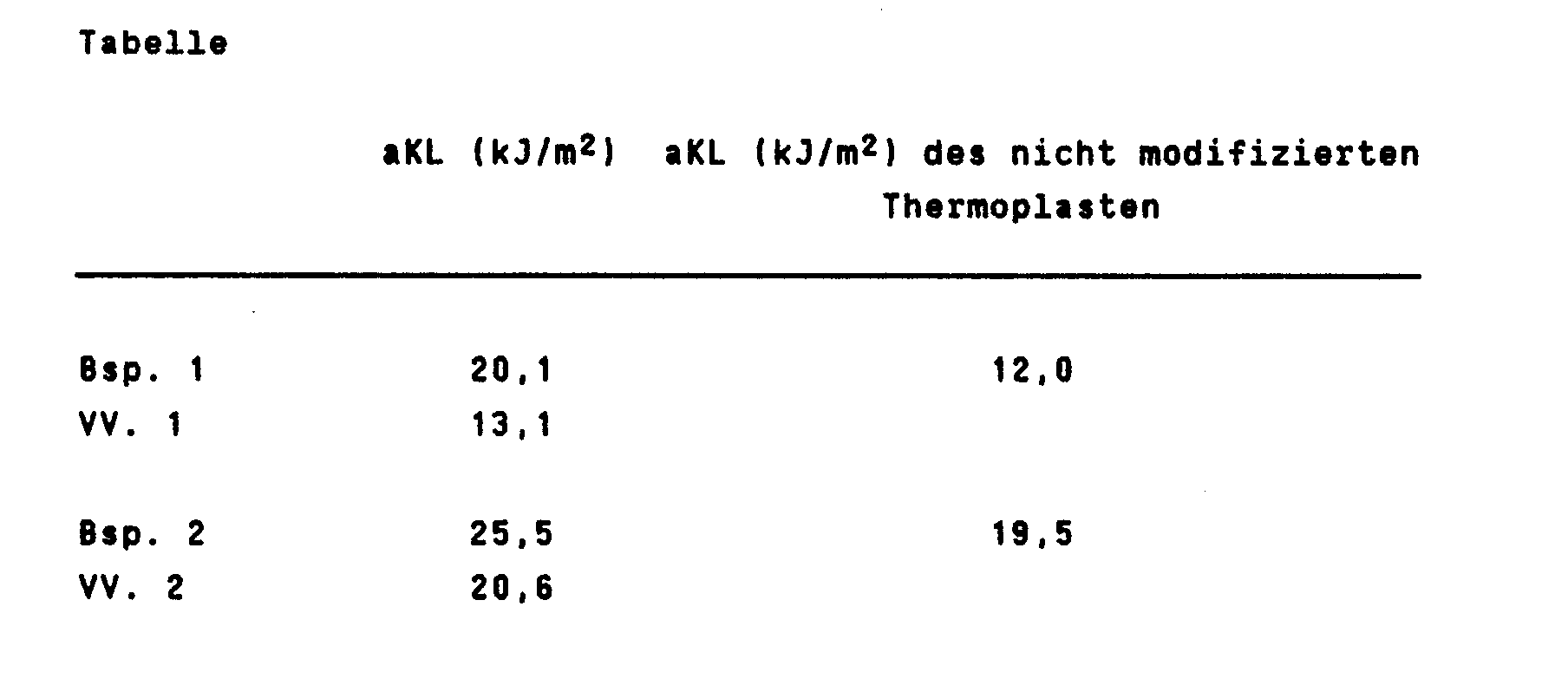
Claims (2)
A) 99 bis 60 Gewichtsprozent, bezogen auf die Summe aus A und B, einer polymeren Hartmatrix aus
a1) Polybutylenterephthalat oder
a2) Polyethylentherephthalat
B) 1 bis 40 Gewichtsprozent, bezogen auf die Summe aus A und B, einer polymeren Weichkomponente aus
b1) 100-60 Gewichtsprozent eines einpolymerisierten Monomeren aus der Gruppe der 1,4-Diene und
b2) 0-40 Gewichtsprozent eines einpolymerisierten Vinylaromaten, wobei die Gewichtsprozente jeweils bezogen sind auf die Summe aus b1 und b2
sowie
C) 0 bis 30 Gewichtsprozent, bezogen auf 100 Gewichtsteile der Summe aus den Komponenten A und B, übliche Zusatzstoffe,
dadurch gekennzeichnet, daß die Polymeren der Weichkomponente B endständig mit Aminogruppen versehen sind.1. Impact-modified thermoplastic mixtures of components A, B and optionally C, consisting of
A) 99 to 60 percent by weight, based on the sum of A and B, of a polymeric hard matrix
a1) polybutylene terephthalate or
a2) Polyethylene terephthalate
B) 1 to 40 percent by weight, based on the sum of A and B, of a polymeric soft component
b1) 100-60 percent by weight of a copolymerized monomer from the group of 1,4-dienes and
b2) 0-40 percent by weight of a copolymerized vinylaromatic, the percentages by weight being based in each case on the sum of b1 and b2
such as
C) 0 to 30 percent by weight, based on 100 parts by weight of the sum of components A and B, customary additives,
characterized in that the polymers of soft component B are terminally provided with amino groups.
Priority Applications (1)
| Application Number | Priority Date | Filing Date | Title |
|---|---|---|---|
| AT88102521T ATE81523T1 (en) | 1987-02-25 | 1988-02-20 | THERMOPLASTICS MODIFIED WITH FUNCTIONALIZED POLYMERS IMPACT RESISTANT AND THEIR USE FOR THE MANUFACTURE OF MOLDED PARTS. |
Applications Claiming Priority (2)
| Application Number | Priority Date | Filing Date | Title |
|---|---|---|---|
| DE3706017 | 1987-02-25 | ||
| DE19873706017 DE3706017A1 (en) | 1987-02-25 | 1987-02-25 | THERMOPLASTIC MODIFIED WITH FUNCTIONALIZED POLYMER IMPACT TOE AND THE USE THEREOF FOR THE PRODUCTION OF MOLDED PARTS |
Publications (3)
| Publication Number | Publication Date |
|---|---|
| EP0280977A2 true EP0280977A2 (en) | 1988-09-07 |
| EP0280977A3 EP0280977A3 (en) | 1989-08-30 |
| EP0280977B1 EP0280977B1 (en) | 1992-10-14 |
Family
ID=6321728
Family Applications (1)
| Application Number | Title | Priority Date | Filing Date |
|---|---|---|---|
| EP88102521A Expired - Lifetime EP0280977B1 (en) | 1987-02-25 | 1988-02-20 | Thermoplasts modified in an impact-resistant way by using functionalized polymers, and their use in making shaped articles |
Country Status (5)
| Country | Link |
|---|---|
| US (1) | US5115022A (en) |
| EP (1) | EP0280977B1 (en) |
| JP (1) | JPS63225652A (en) |
| AT (1) | ATE81523T1 (en) |
| DE (2) | DE3706017A1 (en) |
Cited By (1)
| Publication number | Priority date | Publication date | Assignee | Title |
|---|---|---|---|---|
| WO1994022956A1 (en) * | 1993-04-05 | 1994-10-13 | Alliedsignal Inc. | High impact polyester compositions |
Families Citing this family (2)
| Publication number | Priority date | Publication date | Assignee | Title |
|---|---|---|---|---|
| US6221279B1 (en) | 1999-06-24 | 2001-04-24 | Isotag Technology, Inc. | Pigment particles for invisible marking applications |
| JP5351415B2 (en) * | 2007-12-26 | 2013-11-27 | ウィンテックポリマー株式会社 | Polybutylene terephthalate resin composition |
Family Cites Families (10)
| Publication number | Priority date | Publication date | Assignee | Title |
|---|---|---|---|---|
| DE1694173A1 (en) * | 1967-07-22 | 1971-06-09 | Hoechst Ag | Thermoplastic polyester molding compounds |
| AT295860B (en) * | 1969-06-02 | 1972-01-25 | Sandoz Ag | Polymer mixture of polyethylene terephthalate and butadiene-styrene copolymer and process for their production |
| GB1429328A (en) * | 1973-01-02 | 1976-03-24 | Gen Electric | Thermoplastic polyester resin compositions |
| US4373067A (en) * | 1981-08-04 | 1983-02-08 | General Electric Company | Molded articles of improved impact resistance and compositions therefor |
| JPS5912928A (en) * | 1982-07-14 | 1984-01-23 | Unitika Ltd | Manufacture of heat-resistant polyester with high adhesivity to rubber |
| DE3233949A1 (en) * | 1982-09-14 | 1984-03-22 | Chemische Werke Hüls AG, 4370 Marl | USE OF A LOW-MOLECULAR 1,3-BUTADIENE POLYMERISATE CARRYING AMINO GROUPS AS A STABILIZING AGENT FOR PLASTICS |
| JPS62187759A (en) * | 1984-10-31 | 1987-08-17 | ヘキスト・セラニーズ・コーポレーション | High shock behavior novel thermoplastic polyester composition |
| DE3527909A1 (en) * | 1985-08-03 | 1987-02-12 | Basf Ag | POLYMERISATES WITH AMINO GROUPS, THEIR PRODUCTION AND USE |
| JPS6399257A (en) * | 1986-06-05 | 1988-04-30 | Asahi Chem Ind Co Ltd | Modified block copolymer composition |
| SE454771B (en) * | 1986-11-19 | 1988-05-30 | Sprinter System Ab | DEVICE FOR CLOSING A FLANGE SUPPLY, FILLED CARTRIDGE |
-
1987
- 1987-02-25 DE DE19873706017 patent/DE3706017A1/en not_active Withdrawn
-
1988
- 1988-02-20 AT AT88102521T patent/ATE81523T1/en not_active IP Right Cessation
- 1988-02-20 DE DE8888102521T patent/DE3875256D1/en not_active Expired - Lifetime
- 1988-02-20 EP EP88102521A patent/EP0280977B1/en not_active Expired - Lifetime
- 1988-02-23 JP JP63038791A patent/JPS63225652A/en active Pending
-
1990
- 1990-02-20 US US07/481,689 patent/US5115022A/en not_active Expired - Fee Related
Cited By (2)
| Publication number | Priority date | Publication date | Assignee | Title |
|---|---|---|---|---|
| WO1994022956A1 (en) * | 1993-04-05 | 1994-10-13 | Alliedsignal Inc. | High impact polyester compositions |
| US5621040A (en) * | 1993-04-05 | 1997-04-15 | Alliedsignal Inc. | High impact polyester compositions |
Also Published As
| Publication number | Publication date |
|---|---|
| ATE81523T1 (en) | 1992-10-15 |
| US5115022A (en) | 1992-05-19 |
| EP0280977A3 (en) | 1989-08-30 |
| EP0280977B1 (en) | 1992-10-14 |
| JPS63225652A (en) | 1988-09-20 |
| DE3875256D1 (en) | 1992-11-19 |
| DE3706017A1 (en) | 1988-09-08 |
Similar Documents
| Publication | Publication Date | Title |
|---|---|---|
| DE2948615A1 (en) | POLYMER MATERIALS BASED ON AROMATIC ALKENYL RESIN AND THE USE THEREOF FOR THE PRODUCTION OF MOLDED PARTS | |
| DE2418763B2 (en) | THERMOPLASTIC, IMPACT-RESISTANT AND FATIGUE-RESISTANT MOLDING COMPOSITE MADE OF A POLYPHENYLENOXYDE, A RUBBER-MODIFIED POLYSTYRENE AND AN AROMATIC POLYCARBONATE | |
| DE3035570A1 (en) | IMPACT RESISTANT THERMOPLASTIC SHAPE | |
| DE2705656A1 (en) | Graft copolymers and the process for their preparation | |
| DE3782567T2 (en) | MIXTURES BASED ON POLYCARBONATES WITH IMPROVED PHYSICAL AND CHEMICAL PROPERTIES. | |
| EP0310051B1 (en) | Thermoplastic moulding composition, its preparation and use | |
| DE1595343B2 (en) | Process for producing impact-resistant styrene acrylonitrile mixed polymers | |
| EP0280977B1 (en) | Thermoplasts modified in an impact-resistant way by using functionalized polymers, and their use in making shaped articles | |
| EP0283731B1 (en) | Thermoplasts modified in an impact-resistant way by using functionalized polymers, and their use in making shaped articles | |
| DE1570483A1 (en) | Process for the production of styrene copolymers of high toughness | |
| DE3332325A1 (en) | Thermoplastic moulding composition | |
| DE3730886A1 (en) | TRANSPARENT, IMPACT-RESISTANT THERMOPLASTIC MOLD, METHOD FOR THE PRODUCTION THEREOF AND THEIR USE | |
| DE3138401A1 (en) | Thermoplastic moulding compositions | |
| DE68919646T2 (en) | Mixtures of polyphenylene ethers and modified polyesters. | |
| DE3420307C2 (en) | Heat resistant resin composition with high impact resistance | |
| EP0292714B1 (en) | Thermoplastic moulding compositions based on polyphenylene ethers | |
| DE3130774A1 (en) | Thermoplastic moulding composition | |
| EP0149141B1 (en) | Thermoplastic moulding masses | |
| DE69419536T2 (en) | Molding compound based on polyphenylene ethers | |
| EP0149791A1 (en) | Thermoplastic moulding masses | |
| DE1932234A1 (en) | Thermoplastic resin mixture made from polyphenylene oxide with butadiene homopolymers and butadiene mixed polymers and process for their production | |
| DE3326562A1 (en) | POLYCARBONATE MIXTURES WITH IMPROVED IMPACT RESISTANCE | |
| DE1915369B2 (en) | MODIFIED STYRENE POLYMERIZES THAT MOLD BEEN TOOL | |
| DE69011696T2 (en) | Rubber modified styrene copolymer. | |
| DE3805057A1 (en) | HIGH PERFORMANCE ABS MOLDS WITH MATTER SURFACE |
Legal Events
| Date | Code | Title | Description |
|---|---|---|---|
| PUAI | Public reference made under article 153(3) epc to a published international application that has entered the european phase |
Free format text: ORIGINAL CODE: 0009012 |
|
| AK | Designated contracting states |
Kind code of ref document: A2 Designated state(s): AT BE DE FR GB IT NL |
|
| PUAL | Search report despatched |
Free format text: ORIGINAL CODE: 0009013 |
|
| AK | Designated contracting states |
Kind code of ref document: A3 Designated state(s): AT BE DE FR GB IT NL |
|
| 17P | Request for examination filed |
Effective date: 19890727 |
|
| 17Q | First examination report despatched |
Effective date: 19920129 |
|
| GRAA | (expected) grant |
Free format text: ORIGINAL CODE: 0009210 |
|
| AK | Designated contracting states |
Kind code of ref document: B1 Designated state(s): AT BE DE FR GB IT NL |
|
| REF | Corresponds to: |
Ref document number: 81523 Country of ref document: AT Date of ref document: 19921015 Kind code of ref document: T |
|
| ITF | It: translation for a ep patent filed | ||
| REF | Corresponds to: |
Ref document number: 3875256 Country of ref document: DE Date of ref document: 19921119 |
|
| GBT | Gb: translation of ep patent filed (gb section 77(6)(a)/1977) | ||
| ET | Fr: translation filed | ||
| PLBE | No opposition filed within time limit |
Free format text: ORIGINAL CODE: 0009261 |
|
| STAA | Information on the status of an ep patent application or granted ep patent |
Free format text: STATUS: NO OPPOSITION FILED WITHIN TIME LIMIT |
|
| 26N | No opposition filed | ||
| PGFP | Annual fee paid to national office [announced via postgrant information from national office to epo] |
Ref country code: FR Payment date: 19980127 Year of fee payment: 11 |
|
| PGFP | Annual fee paid to national office [announced via postgrant information from national office to epo] |
Ref country code: NL Payment date: 19980130 Year of fee payment: 11 |
|
| PGFP | Annual fee paid to national office [announced via postgrant information from national office to epo] |
Ref country code: AT Payment date: 19980204 Year of fee payment: 11 |
|
| PGFP | Annual fee paid to national office [announced via postgrant information from national office to epo] |
Ref country code: GB Payment date: 19980217 Year of fee payment: 11 Ref country code: BE Payment date: 19980217 Year of fee payment: 11 |
|
| PGFP | Annual fee paid to national office [announced via postgrant information from national office to epo] |
Ref country code: DE Payment date: 19980226 Year of fee payment: 11 |
|
| PG25 | Lapsed in a contracting state [announced via postgrant information from national office to epo] |
Ref country code: GB Free format text: LAPSE BECAUSE OF NON-PAYMENT OF DUE FEES Effective date: 19990220 Ref country code: AT Free format text: LAPSE BECAUSE OF NON-PAYMENT OF DUE FEES Effective date: 19990220 |
|
| PG25 | Lapsed in a contracting state [announced via postgrant information from national office to epo] |
Ref country code: DE Free format text: LAPSE BECAUSE OF THE APPLICANT RENOUNCES Effective date: 19990225 |
|
| PG25 | Lapsed in a contracting state [announced via postgrant information from national office to epo] |
Ref country code: BE Free format text: LAPSE BECAUSE OF NON-PAYMENT OF DUE FEES Effective date: 19990228 |
|
| BERE | Be: lapsed |
Owner name: BASF A.G. Effective date: 19990228 |
|
| PG25 | Lapsed in a contracting state [announced via postgrant information from national office to epo] |
Ref country code: NL Free format text: LAPSE BECAUSE OF NON-PAYMENT OF DUE FEES Effective date: 19990901 |
|
| GBPC | Gb: european patent ceased through non-payment of renewal fee |
Effective date: 19990220 |
|
| PG25 | Lapsed in a contracting state [announced via postgrant information from national office to epo] |
Ref country code: FR Free format text: LAPSE BECAUSE OF NON-PAYMENT OF DUE FEES Effective date: 19991029 |
|
| REG | Reference to a national code |
Ref country code: FR Ref legal event code: ST |
|
| PG25 | Lapsed in a contracting state [announced via postgrant information from national office to epo] |
Ref country code: IT Free format text: LAPSE BECAUSE OF NON-PAYMENT OF DUE FEES;WARNING: LAPSES OF ITALIAN PATENTS WITH EFFECTIVE DATE BEFORE 2007 MAY HAVE OCCURRED AT ANY TIME BEFORE 2007. THE CORRECT EFFECTIVE DATE MAY BE DIFFERENT FROM THE ONE RECORDED. Effective date: 20050220 |