EP0281012B1 - 4-Chloroxazol-Derivate, Verfahren zu ihrer Herstellung und ihre Verwendung - Google Patents
4-Chloroxazol-Derivate, Verfahren zu ihrer Herstellung und ihre Verwendung Download PDFInfo
- Publication number
- EP0281012B1 EP0281012B1 EP88102772A EP88102772A EP0281012B1 EP 0281012 B1 EP0281012 B1 EP 0281012B1 EP 88102772 A EP88102772 A EP 88102772A EP 88102772 A EP88102772 A EP 88102772A EP 0281012 B1 EP0281012 B1 EP 0281012B1
- Authority
- EP
- European Patent Office
- Prior art keywords
- denotes
- compound
- single bond
- group
- formula
- Prior art date
- Legal status (The legal status is an assumption and is not a legal conclusion. Google has not performed a legal analysis and makes no representation as to the accuracy of the status listed.)
- Expired - Lifetime
Links
- 238000000034 method Methods 0.000 title claims description 27
- AIMLUMURKMKXLV-UHFFFAOYSA-N 4-chloro-1,3-oxazole Chemical class ClC1=COC=N1 AIMLUMURKMKXLV-UHFFFAOYSA-N 0.000 title claims description 10
- 238000002360 preparation method Methods 0.000 title claims description 9
- -1 phenyloxazolyl Chemical group 0.000 claims description 47
- 150000001875 compounds Chemical class 0.000 claims description 37
- 125000001997 phenyl group Chemical group [H]C1=C([H])C([H])=C(*)C([H])=C1[H] 0.000 claims description 13
- 239000000126 substance Substances 0.000 claims description 9
- 125000000229 (C1-C4)alkoxy group Chemical group 0.000 claims description 8
- 125000004178 (C1-C4) alkyl group Chemical group 0.000 claims description 6
- 239000003960 organic solvent Substances 0.000 claims description 6
- 238000001226 reprecipitation Methods 0.000 claims description 6
- 238000001035 drying Methods 0.000 claims description 5
- 229910052736 halogen Inorganic materials 0.000 claims description 5
- 150000002367 halogens Chemical class 0.000 claims description 4
- 125000002887 hydroxy group Chemical group [H]O* 0.000 claims description 4
- 125000004076 pyridyl group Chemical group 0.000 claims description 3
- 239000011541 reaction mixture Substances 0.000 claims description 3
- 239000010410 layer Substances 0.000 description 44
- 239000002585 base Substances 0.000 description 13
- ZMXDDKWLCZADIW-UHFFFAOYSA-N N,N-Dimethylformamide Chemical compound CN(C)C=O ZMXDDKWLCZADIW-UHFFFAOYSA-N 0.000 description 10
- KWYUFKZDYYNOTN-UHFFFAOYSA-M Potassium hydroxide Chemical compound [OH-].[K+] KWYUFKZDYYNOTN-UHFFFAOYSA-M 0.000 description 10
- WYURNTSHIVDZCO-UHFFFAOYSA-N Tetrahydrofuran Chemical compound C1CCOC1 WYURNTSHIVDZCO-UHFFFAOYSA-N 0.000 description 10
- 239000000243 solution Substances 0.000 description 9
- 239000000975 dye Substances 0.000 description 8
- 239000000203 mixture Substances 0.000 description 8
- 0 *C=Nc(cc1)ccc1Cl Chemical compound *C=Nc(cc1)ccc1Cl 0.000 description 7
- 239000000049 pigment Substances 0.000 description 7
- YMWUJEATGCHHMB-UHFFFAOYSA-N Dichloromethane Chemical compound ClCCl YMWUJEATGCHHMB-UHFFFAOYSA-N 0.000 description 6
- IAZDPXIOMUYVGZ-UHFFFAOYSA-N Dimethylsulphoxide Chemical compound CS(C)=O IAZDPXIOMUYVGZ-UHFFFAOYSA-N 0.000 description 6
- OKKJLVBELUTLKV-UHFFFAOYSA-N Methanol Chemical compound OC OKKJLVBELUTLKV-UHFFFAOYSA-N 0.000 description 6
- 150000001299 aldehydes Chemical class 0.000 description 6
- 229910052782 aluminium Inorganic materials 0.000 description 6
- XAGFODPZIPBFFR-UHFFFAOYSA-N aluminium Chemical compound [Al] XAGFODPZIPBFFR-UHFFFAOYSA-N 0.000 description 6
- 239000011230 binding agent Substances 0.000 description 6
- 238000009833 condensation Methods 0.000 description 6
- 230000005494 condensation Effects 0.000 description 6
- 238000000576 coating method Methods 0.000 description 5
- 239000002904 solvent Substances 0.000 description 5
- AZQWKYJCGOJGHM-UHFFFAOYSA-N 1,4-benzoquinone Chemical compound O=C1C=CC(=O)C=C1 AZQWKYJCGOJGHM-UHFFFAOYSA-N 0.000 description 4
- PPBRXRYQALVLMV-UHFFFAOYSA-N Styrene Chemical compound C=CC1=CC=CC=C1 PPBRXRYQALVLMV-UHFFFAOYSA-N 0.000 description 4
- 239000002253 acid Substances 0.000 description 4
- 230000004888 barrier function Effects 0.000 description 4
- 239000011248 coating agent Substances 0.000 description 4
- 229920001577 copolymer Polymers 0.000 description 4
- 238000004519 manufacturing process Methods 0.000 description 4
- 229910052751 metal Inorganic materials 0.000 description 4
- 239000002184 metal Substances 0.000 description 4
- YLQBMQCUIZJEEH-UHFFFAOYSA-N tetrahydrofuran Natural products C=1C=COC=1 YLQBMQCUIZJEEH-UHFFFAOYSA-N 0.000 description 4
- XNWFRZJHXBZDAG-UHFFFAOYSA-N 2-METHOXYETHANOL Chemical compound COCCO XNWFRZJHXBZDAG-UHFFFAOYSA-N 0.000 description 3
- VEXZGXHMUGYJMC-UHFFFAOYSA-N Hydrochloric acid Chemical compound Cl VEXZGXHMUGYJMC-UHFFFAOYSA-N 0.000 description 3
- 229960001760 dimethyl sulfoxide Drugs 0.000 description 3
- 238000000921 elemental analysis Methods 0.000 description 3
- 229910000041 hydrogen chloride Inorganic materials 0.000 description 3
- IXCSERBJSXMMFS-UHFFFAOYSA-N hydrogen chloride Substances Cl.Cl IXCSERBJSXMMFS-UHFFFAOYSA-N 0.000 description 3
- 239000000463 material Substances 0.000 description 3
- IEQIEDJGQAUEQZ-UHFFFAOYSA-N phthalocyanine Chemical compound N1C(N=C2C3=CC=CC=C3C(N=C3C4=CC=CC=C4C(=N4)N3)=N2)=C(C=CC=C2)C2=C1N=C1C2=CC=CC=C2C4=N1 IEQIEDJGQAUEQZ-UHFFFAOYSA-N 0.000 description 3
- 229920000728 polyester Polymers 0.000 description 3
- 229920000139 polyethylene terephthalate Polymers 0.000 description 3
- 239000005020 polyethylene terephthalate Substances 0.000 description 3
- 239000007787 solid Substances 0.000 description 3
- ZOMLUNRKXJYKPD-UHFFFAOYSA-N 1,3,3-trimethyl-2-[2-(2-methylindol-3-ylidene)ethylidene]indole;hydrochloride Chemical compound [Cl-].C1=CC=C2C(C)(C)C(/C=C/C=3C4=CC=CC=C4NC=3C)=[N+](C)C2=C1 ZOMLUNRKXJYKPD-UHFFFAOYSA-N 0.000 description 2
- RVIMUTZYCUIECU-UHFFFAOYSA-N 4-chloro-2-methyl-1,3-oxazole Chemical class CC1=NC(Cl)=CO1 RVIMUTZYCUIECU-UHFFFAOYSA-N 0.000 description 2
- CMOKQXCDOFGUJH-UHFFFAOYSA-N 4-chloro-5-methyl-1,3-oxazole Chemical class CC=1OC=NC=1Cl CMOKQXCDOFGUJH-UHFFFAOYSA-N 0.000 description 2
- 125000004172 4-methoxyphenyl group Chemical group [H]C1=C([H])C(OC([H])([H])[H])=C([H])C([H])=C1* 0.000 description 2
- IKHGUXGNUITLKF-UHFFFAOYSA-N Acetaldehyde Chemical compound CC=O IKHGUXGNUITLKF-UHFFFAOYSA-N 0.000 description 2
- XEEYBQQBJWHFJM-UHFFFAOYSA-N Iron Chemical compound [Fe] XEEYBQQBJWHFJM-UHFFFAOYSA-N 0.000 description 2
- PXHVJJICTQNCMI-UHFFFAOYSA-N Nickel Chemical compound [Ni] PXHVJJICTQNCMI-UHFFFAOYSA-N 0.000 description 2
- SMWDFEZZVXVKRB-UHFFFAOYSA-N Quinoline Chemical compound N1=CC=CC2=CC=CC=C21 SMWDFEZZVXVKRB-UHFFFAOYSA-N 0.000 description 2
- KKEYFWRCBNTPAC-UHFFFAOYSA-N Terephthalic acid Chemical compound OC(=O)C1=CC=C(C(O)=O)C=C1 KKEYFWRCBNTPAC-UHFFFAOYSA-N 0.000 description 2
- QLDHWVVRQCGZLE-UHFFFAOYSA-N acetyl cyanide Chemical compound CC(=O)C#N QLDHWVVRQCGZLE-UHFFFAOYSA-N 0.000 description 2
- HFVAFDPGUJEFBQ-UHFFFAOYSA-M alizarin red S Chemical compound [Na+].O=C1C2=CC=CC=C2C(=O)C2=C1C=C(S([O-])(=O)=O)C(O)=C2O HFVAFDPGUJEFBQ-UHFFFAOYSA-M 0.000 description 2
- 239000003513 alkali Substances 0.000 description 2
- 238000004587 chromatography analysis Methods 0.000 description 2
- 239000008199 coating composition Substances 0.000 description 2
- 230000000052 comparative effect Effects 0.000 description 2
- 239000000470 constituent Substances 0.000 description 2
- 239000010949 copper Substances 0.000 description 2
- 125000005843 halogen group Chemical group 0.000 description 2
- 229910044991 metal oxide Inorganic materials 0.000 description 2
- 150000004706 metal oxides Chemical class 0.000 description 2
- 239000000025 natural resin Substances 0.000 description 2
- 125000003854 p-chlorophenyl group Chemical group [H]C1=C([H])C(*)=C([H])C([H])=C1Cl 0.000 description 2
- DGBWPZSGHAXYGK-UHFFFAOYSA-N perinone Chemical compound C12=NC3=CC=CC=C3N2C(=O)C2=CC=C3C4=C2C1=CC=C4C(=O)N1C2=CC=CC=C2N=C13 DGBWPZSGHAXYGK-UHFFFAOYSA-N 0.000 description 2
- QQVIHTHCMHWDBS-UHFFFAOYSA-N perisophthalic acid Natural products OC(=O)C1=CC=CC(C(O)=O)=C1 QQVIHTHCMHWDBS-UHFFFAOYSA-N 0.000 description 2
- 239000002985 plastic film Substances 0.000 description 2
- 229920006255 plastic film Polymers 0.000 description 2
- 239000000843 powder Substances 0.000 description 2
- 238000007639 printing Methods 0.000 description 2
- 239000011347 resin Substances 0.000 description 2
- 229920005989 resin Polymers 0.000 description 2
- PYWVYCXTNDRMGF-UHFFFAOYSA-N rhodamine B Chemical compound [Cl-].C=12C=CC(=[N+](CC)CC)C=C2OC2=CC(N(CC)CC)=CC=C2C=1C1=CC=CC=C1C(O)=O PYWVYCXTNDRMGF-UHFFFAOYSA-N 0.000 description 2
- 229940043267 rhodamine b Drugs 0.000 description 2
- 229920003002 synthetic resin Polymers 0.000 description 2
- 239000000057 synthetic resin Substances 0.000 description 2
- ANRHNWWPFJCPAZ-UHFFFAOYSA-M thionine Chemical compound [Cl-].C1=CC(N)=CC2=[S+]C3=CC(N)=CC=C3N=C21 ANRHNWWPFJCPAZ-UHFFFAOYSA-M 0.000 description 2
- RIOQSEWOXXDEQQ-UHFFFAOYSA-N triphenylphosphine Chemical class C1=CC=CC=C1P(C=1C=CC=CC=1)C1=CC=CC=C1 RIOQSEWOXXDEQQ-UHFFFAOYSA-N 0.000 description 2
- KJPRLNWUNMBNBZ-QPJJXVBHSA-N (E)-cinnamaldehyde Chemical compound O=C\C=C\C1=CC=CC=C1 KJPRLNWUNMBNBZ-QPJJXVBHSA-N 0.000 description 1
- 238000005160 1H NMR spectroscopy Methods 0.000 description 1
- QAMCXJOYXRSXDU-UHFFFAOYSA-N 2,4-dimethoxy-n-[2-(1,3,3-trimethylindol-1-ium-2-yl)ethenyl]aniline;chloride Chemical compound [Cl-].COC1=CC(OC)=CC=C1NC=CC1=[N+](C)C2=CC=CC=C2C1(C)C QAMCXJOYXRSXDU-UHFFFAOYSA-N 0.000 description 1
- SMZOUWXMTYCWNB-UHFFFAOYSA-N 2-(2-methoxy-5-methylphenyl)ethanamine Chemical compound COC1=CC=C(C)C=C1CCN SMZOUWXMTYCWNB-UHFFFAOYSA-N 0.000 description 1
- GXUWICFDIIONCH-UHFFFAOYSA-N 2-(bromomethyl)-1,3-oxazole Chemical class BrCC1=NC=CO1 GXUWICFDIIONCH-UHFFFAOYSA-N 0.000 description 1
- IOOMXAQUNPWDLL-UHFFFAOYSA-N 2-[6-(diethylamino)-3-(diethyliminiumyl)-3h-xanthen-9-yl]-5-sulfobenzene-1-sulfonate Chemical compound C=12C=CC(=[N+](CC)CC)C=C2OC2=CC(N(CC)CC)=CC=C2C=1C1=CC=C(S(O)(=O)=O)C=C1S([O-])(=O)=O IOOMXAQUNPWDLL-UHFFFAOYSA-N 0.000 description 1
- KKAJSJJFBSOMGS-UHFFFAOYSA-N 3,6-diamino-10-methylacridinium chloride Chemical compound [Cl-].C1=C(N)C=C2[N+](C)=C(C=C(N)C=C3)C3=CC2=C1 KKAJSJJFBSOMGS-UHFFFAOYSA-N 0.000 description 1
- JIMIZSCETMDNEU-UHFFFAOYSA-N 4-methoxybenzoyl cyanide Chemical compound COC1=CC=C(C(=O)C#N)C=C1 JIMIZSCETMDNEU-UHFFFAOYSA-N 0.000 description 1
- RGCKGOZRHPZPFP-UHFFFAOYSA-N Alizarin Natural products C1=CC=C2C(=O)C3=C(O)C(O)=CC=C3C(=O)C2=C1 RGCKGOZRHPZPFP-UHFFFAOYSA-N 0.000 description 1
- LSNNMFCWUKXFEE-UHFFFAOYSA-M Bisulfite Chemical compound OS([O-])=O LSNNMFCWUKXFEE-UHFFFAOYSA-M 0.000 description 1
- RYGMFSIKBFXOCR-UHFFFAOYSA-N Copper Chemical compound [Cu] RYGMFSIKBFXOCR-UHFFFAOYSA-N 0.000 description 1
- VGGSQFUCUMXWEO-UHFFFAOYSA-N Ethene Chemical compound C=C VGGSQFUCUMXWEO-UHFFFAOYSA-N 0.000 description 1
- FYYHWMGAXLPEAU-UHFFFAOYSA-N Magnesium Chemical compound [Mg] FYYHWMGAXLPEAU-UHFFFAOYSA-N 0.000 description 1
- CERQOIWHTDAKMF-UHFFFAOYSA-N Methacrylic acid Chemical compound CC(=C)C(O)=O CERQOIWHTDAKMF-UHFFFAOYSA-N 0.000 description 1
- ISWSIDIOOBJBQZ-UHFFFAOYSA-N Phenol Chemical compound OC1=CC=CC=C1 ISWSIDIOOBJBQZ-UHFFFAOYSA-N 0.000 description 1
- OFOBLEOULBTSOW-UHFFFAOYSA-N Propanedioic acid Natural products OC(=O)CC(O)=O OFOBLEOULBTSOW-UHFFFAOYSA-N 0.000 description 1
- NRCMAYZCPIVABH-UHFFFAOYSA-N Quinacridone Chemical compound N1C2=CC=CC=C2C(=O)C2=C1C=C1C(=O)C3=CC=CC=C3NC1=C2 NRCMAYZCPIVABH-UHFFFAOYSA-N 0.000 description 1
- 206010070834 Sensitisation Diseases 0.000 description 1
- VYPSYNLAJGMNEJ-UHFFFAOYSA-N Silicium dioxide Chemical compound O=[Si]=O VYPSYNLAJGMNEJ-UHFFFAOYSA-N 0.000 description 1
- KEAYESYHFKHZAL-UHFFFAOYSA-N Sodium Chemical compound [Na] KEAYESYHFKHZAL-UHFFFAOYSA-N 0.000 description 1
- 238000007239 Wittig reaction Methods 0.000 description 1
- HCHKCACWOHOZIP-UHFFFAOYSA-N Zinc Chemical compound [Zn] HCHKCACWOHOZIP-UHFFFAOYSA-N 0.000 description 1
- JSQFXMIMWAKJQJ-UHFFFAOYSA-N [9-(2-carboxyphenyl)-6-(ethylamino)xanthen-3-ylidene]-diethylazanium;chloride Chemical compound [Cl-].C=12C=CC(=[N+](CC)CC)C=C2OC2=CC(NCC)=CC=C2C=1C1=CC=CC=C1C(O)=O JSQFXMIMWAKJQJ-UHFFFAOYSA-N 0.000 description 1
- SGIFIWPXRWWNEO-UHFFFAOYSA-N [ClH]1ONC=C1 Chemical compound [ClH]1ONC=C1 SGIFIWPXRWWNEO-UHFFFAOYSA-N 0.000 description 1
- 150000008065 acid anhydrides Chemical class 0.000 description 1
- 239000000999 acridine dye Substances 0.000 description 1
- DPKHZNPWBDQZCN-UHFFFAOYSA-N acridine orange free base Chemical compound C1=CC(N(C)C)=CC2=NC3=CC(N(C)C)=CC=C3C=C21 DPKHZNPWBDQZCN-UHFFFAOYSA-N 0.000 description 1
- BGLGAKMTYHWWKW-UHFFFAOYSA-N acridine yellow Chemical compound [H+].[Cl-].CC1=C(N)C=C2N=C(C=C(C(C)=C3)N)C3=CC2=C1 BGLGAKMTYHWWKW-UHFFFAOYSA-N 0.000 description 1
- 150000001264 acyl cyanides Chemical class 0.000 description 1
- 239000000654 additive Substances 0.000 description 1
- 239000000853 adhesive Substances 0.000 description 1
- 230000001070 adhesive effect Effects 0.000 description 1
- 230000001476 alcoholic effect Effects 0.000 description 1
- 125000001931 aliphatic group Chemical group 0.000 description 1
- 125000003282 alkyl amino group Chemical group 0.000 description 1
- 238000004458 analytical method Methods 0.000 description 1
- 150000008064 anhydrides Chemical group 0.000 description 1
- 238000002048 anodisation reaction Methods 0.000 description 1
- PYKYMHQGRFAEBM-UHFFFAOYSA-N anthraquinone Natural products CCC(=O)c1c(O)c2C(=O)C3C(C=CC=C3O)C(=O)c2cc1CC(=O)OC PYKYMHQGRFAEBM-UHFFFAOYSA-N 0.000 description 1
- 150000004056 anthraquinones Chemical class 0.000 description 1
- 125000003118 aryl group Chemical group 0.000 description 1
- 125000000751 azo group Chemical group [*]N=N[*] 0.000 description 1
- DZBUGLKDJFMEHC-UHFFFAOYSA-N benzoquinolinylidene Natural products C1=CC=CC2=CC3=CC=CC=C3N=C21 DZBUGLKDJFMEHC-UHFFFAOYSA-N 0.000 description 1
- GJQBHOAJJGIPRH-UHFFFAOYSA-N benzoyl cyanide Chemical class N#CC(=O)C1=CC=CC=C1 GJQBHOAJJGIPRH-UHFFFAOYSA-N 0.000 description 1
- 230000015572 biosynthetic process Effects 0.000 description 1
- 229960001506 brilliant green Drugs 0.000 description 1
- HXCILVUBKWANLN-UHFFFAOYSA-N brilliant green cation Chemical compound C1=CC(N(CC)CC)=CC=C1C(C=1C=CC=CC=1)=C1C=CC(=[N+](CC)CC)C=C1 HXCILVUBKWANLN-UHFFFAOYSA-N 0.000 description 1
- DBZJJPROPLPMSN-UHFFFAOYSA-N bromoeosin Chemical compound O1C(=O)C2=CC=CC=C2C21C1=CC(Br)=C(O)C(Br)=C1OC1=C(Br)C(O)=C(Br)C=C21 DBZJJPROPLPMSN-UHFFFAOYSA-N 0.000 description 1
- JHRWWRDRBPCWTF-OLQVQODUSA-N captafol Chemical group C1C=CC[C@H]2C(=O)N(SC(Cl)(Cl)C(Cl)Cl)C(=O)[C@H]21 JHRWWRDRBPCWTF-OLQVQODUSA-N 0.000 description 1
- 150000003857 carboxamides Chemical class 0.000 description 1
- 125000003178 carboxy group Chemical group [H]OC(*)=O 0.000 description 1
- 239000000969 carrier Substances 0.000 description 1
- 239000002800 charge carrier Substances 0.000 description 1
- VYXSBFYARXAAKO-WTKGSRSZSA-N chembl402140 Chemical compound Cl.C1=2C=C(C)C(NCC)=CC=2OC2=C\C(=N/CC)C(C)=CC2=C1C1=CC=CC=C1C(=O)OCC VYXSBFYARXAAKO-WTKGSRSZSA-N 0.000 description 1
- 238000006243 chemical reaction Methods 0.000 description 1
- 239000003795 chemical substances by application Substances 0.000 description 1
- 125000002603 chloroethyl group Chemical group [H]C([*])([H])C([H])([H])Cl 0.000 description 1
- JPBGLQJDCUZXEF-UHFFFAOYSA-N chromenylium Chemical class [O+]1=CC=CC2=CC=CC=C21 JPBGLQJDCUZXEF-UHFFFAOYSA-N 0.000 description 1
- 229940117916 cinnamic aldehyde Drugs 0.000 description 1
- KJPRLNWUNMBNBZ-UHFFFAOYSA-N cinnamic aldehyde Natural products O=CC=CC1=CC=CC=C1 KJPRLNWUNMBNBZ-UHFFFAOYSA-N 0.000 description 1
- 238000004440 column chromatography Methods 0.000 description 1
- 238000006482 condensation reaction Methods 0.000 description 1
- 238000001816 cooling Methods 0.000 description 1
- 229910052802 copper Inorganic materials 0.000 description 1
- CEJANLKHJMMNQB-UHFFFAOYSA-M cryptocyanin Chemical compound [I-].C12=CC=CC=C2N(CC)C=CC1=CC=CC1=CC=[N+](CC)C2=CC=CC=C12 CEJANLKHJMMNQB-UHFFFAOYSA-M 0.000 description 1
- 239000013078 crystal Substances 0.000 description 1
- ZXJXZNDDNMQXFV-UHFFFAOYSA-M crystal violet Chemical compound [Cl-].C1=CC(N(C)C)=CC=C1[C+](C=1C=CC(=CC=1)N(C)C)C1=CC=C(N(C)C)C=C1 ZXJXZNDDNMQXFV-UHFFFAOYSA-M 0.000 description 1
- 238000002425 crystallisation Methods 0.000 description 1
- 230000008025 crystallization Effects 0.000 description 1
- 238000000354 decomposition reaction Methods 0.000 description 1
- RAABOESOVLLHRU-UHFFFAOYSA-N diazene Chemical compound N=N RAABOESOVLLHRU-UHFFFAOYSA-N 0.000 description 1
- 229910000071 diazene Inorganic materials 0.000 description 1
- 125000000664 diazo group Chemical group [N-]=[N+]=[*] 0.000 description 1
- PPSZHCXTGRHULJ-UHFFFAOYSA-N dioxazine Chemical compound O1ON=CC=C1 PPSZHCXTGRHULJ-UHFFFAOYSA-N 0.000 description 1
- JBBPTUVOZCXCSU-UHFFFAOYSA-L dipotassium;2',4',5',7'-tetrabromo-4,7-dichloro-3-oxospiro[2-benzofuran-1,9'-xanthene]-3',6'-diolate Chemical compound [K+].[K+].O1C(=O)C(C(=CC=C2Cl)Cl)=C2C21C1=CC(Br)=C([O-])C(Br)=C1OC1=C(Br)C([O-])=C(Br)C=C21 JBBPTUVOZCXCSU-UHFFFAOYSA-L 0.000 description 1
- 239000000986 disperse dye Substances 0.000 description 1
- 238000004090 dissolution Methods 0.000 description 1
- 238000004821 distillation Methods 0.000 description 1
- YQGOJNYOYNNSMM-UHFFFAOYSA-N eosin Chemical compound [Na+].OC(=O)C1=CC=CC=C1C1=C2C=C(Br)C(=O)C(Br)=C2OC2=C(Br)C(O)=C(Br)C=C21 YQGOJNYOYNNSMM-UHFFFAOYSA-N 0.000 description 1
- SEACYXSIPDVVMV-UHFFFAOYSA-L eosin Y Chemical compound [Na+].[Na+].[O-]C(=O)C1=CC=CC=C1C1=C2C=C(Br)C(=O)C(Br)=C2OC2=C(Br)C([O-])=C(Br)C=C21 SEACYXSIPDVVMV-UHFFFAOYSA-L 0.000 description 1
- IINNWAYUJNWZRM-UHFFFAOYSA-L erythrosin B Chemical compound [Na+].[Na+].[O-]C(=O)C1=CC=CC=C1C1=C2C=C(I)C(=O)C(I)=C2OC2=C(I)C([O-])=C(I)C=C21 IINNWAYUJNWZRM-UHFFFAOYSA-L 0.000 description 1
- AOCYHPQXGJBAQQ-UHFFFAOYSA-N ethyl n-sulfonylcarbamate Chemical class CCOC(=O)N=S(=O)=O AOCYHPQXGJBAQQ-UHFFFAOYSA-N 0.000 description 1
- GNBHRKFJIUUOQI-UHFFFAOYSA-N fluorescein Chemical compound O1C(=O)C2=CC=CC=C2C21C1=CC=C(O)C=C1OC1=CC(O)=CC=C21 GNBHRKFJIUUOQI-UHFFFAOYSA-N 0.000 description 1
- 238000009472 formulation Methods 0.000 description 1
- 239000007789 gas Substances 0.000 description 1
- 150000002334 glycols Chemical class 0.000 description 1
- 238000000227 grinding Methods 0.000 description 1
- 238000010438 heat treatment Methods 0.000 description 1
- RBTKNAXYKSUFRK-UHFFFAOYSA-N heliogen blue Chemical compound [Cu].[N-]1C2=C(C=CC=C3)C3=C1N=C([N-]1)C3=CC=CC=C3C1=NC([N-]1)=C(C=CC=C3)C3=C1N=C([N-]1)C3=CC=CC=C3C1=N2 RBTKNAXYKSUFRK-UHFFFAOYSA-N 0.000 description 1
- 125000000623 heterocyclic group Chemical group 0.000 description 1
- 229910052739 hydrogen Inorganic materials 0.000 description 1
- 239000001257 hydrogen Substances 0.000 description 1
- 125000004435 hydrogen atom Chemical class [H]* 0.000 description 1
- 230000007062 hydrolysis Effects 0.000 description 1
- 238000006460 hydrolysis reaction Methods 0.000 description 1
- 239000005457 ice water Substances 0.000 description 1
- 150000003949 imides Chemical class 0.000 description 1
- 238000002347 injection Methods 0.000 description 1
- 239000007924 injection Substances 0.000 description 1
- 229910052742 iron Inorganic materials 0.000 description 1
- 150000002576 ketones Chemical class 0.000 description 1
- 238000003475 lamination Methods 0.000 description 1
- 239000011777 magnesium Substances 0.000 description 1
- 229910052749 magnesium Inorganic materials 0.000 description 1
- VZCYOOQTPOCHFL-UPHRSURJSA-N maleic acid Chemical compound OC(=O)\C=C/C(O)=O VZCYOOQTPOCHFL-UPHRSURJSA-N 0.000 description 1
- 239000011976 maleic acid Substances 0.000 description 1
- FPYJFEHAWHCUMM-UHFFFAOYSA-N maleic anhydride Chemical compound O=C1OC(=O)C=C1 FPYJFEHAWHCUMM-UHFFFAOYSA-N 0.000 description 1
- 238000005259 measurement Methods 0.000 description 1
- CXKWCBBOMKCUKX-UHFFFAOYSA-M methylene blue Chemical compound [Cl-].C1=CC(N(C)C)=CC2=[S+]C3=CC(N(C)C)=CC=C3N=C21 CXKWCBBOMKCUKX-UHFFFAOYSA-M 0.000 description 1
- 229960000907 methylthioninium chloride Drugs 0.000 description 1
- 238000012986 modification Methods 0.000 description 1
- 230000004048 modification Effects 0.000 description 1
- 229910052759 nickel Inorganic materials 0.000 description 1
- 238000007645 offset printing Methods 0.000 description 1
- 230000003287 optical effect Effects 0.000 description 1
- TWNQGVIAIRXVLR-UHFFFAOYSA-N oxo(oxoalumanyloxy)alumane Chemical compound O=[Al]O[Al]=O TWNQGVIAIRXVLR-UHFFFAOYSA-N 0.000 description 1
- 125000002080 perylenyl group Chemical group C1(=CC=C2C=CC=C3C4=CC=CC5=CC=CC(C1=C23)=C45)* 0.000 description 1
- CSHWQDPOILHKBI-UHFFFAOYSA-N peryrene Natural products C1=CC(C2=CC=CC=3C2=C2C=CC=3)=C3C2=CC=CC3=C1 CSHWQDPOILHKBI-UHFFFAOYSA-N 0.000 description 1
- 150000004714 phosphonium salts Chemical class 0.000 description 1
- 108091008695 photoreceptors Proteins 0.000 description 1
- QWYZFXLSWMXLDM-UHFFFAOYSA-M pinacyanol iodide Chemical compound [I-].C1=CC2=CC=CC=C2N(CC)C1=CC=CC1=CC=C(C=CC=C2)C2=[N+]1CC QWYZFXLSWMXLDM-UHFFFAOYSA-M 0.000 description 1
- 239000004014 plasticizer Substances 0.000 description 1
- 229920001490 poly(butyl methacrylate) polymer Polymers 0.000 description 1
- 229920003229 poly(methyl methacrylate) Polymers 0.000 description 1
- 229920005668 polycarbonate resin Polymers 0.000 description 1
- 239000004431 polycarbonate resin Substances 0.000 description 1
- 229920006267 polyester film Polymers 0.000 description 1
- 229920001225 polyester resin Polymers 0.000 description 1
- 239000004645 polyester resin Substances 0.000 description 1
- 229920001721 polyimide Polymers 0.000 description 1
- 239000004926 polymethyl methacrylate Substances 0.000 description 1
- WVIICGIFSIBFOG-UHFFFAOYSA-N pyrylium Chemical class C1=CC=[O+]C=C1 WVIICGIFSIBFOG-UHFFFAOYSA-N 0.000 description 1
- VBHKTXLEJZIDJF-UHFFFAOYSA-N quinalizarin Chemical compound C1=CC(O)=C2C(=O)C3=C(O)C(O)=CC=C3C(=O)C2=C1O VBHKTXLEJZIDJF-UHFFFAOYSA-N 0.000 description 1
- AZJPTIGZZTZIDR-UHFFFAOYSA-L rose bengal Chemical compound [K+].[K+].[O-]C(=O)C1=C(Cl)C(Cl)=C(Cl)C(Cl)=C1C1=C2C=C(I)C(=O)C(I)=C2OC2=C(I)C([O-])=C(I)C=C21 AZJPTIGZZTZIDR-UHFFFAOYSA-L 0.000 description 1
- STRXNPAVPKGJQR-UHFFFAOYSA-N rose bengal A Natural products O1C(=O)C(C(=CC=C2Cl)Cl)=C2C21C1=CC(I)=C(O)C(I)=C1OC1=C(I)C(O)=C(I)C=C21 STRXNPAVPKGJQR-UHFFFAOYSA-N 0.000 description 1
- 238000007788 roughening Methods 0.000 description 1
- 150000003839 salts Chemical class 0.000 description 1
- 229920006395 saturated elastomer Polymers 0.000 description 1
- 230000008313 sensitization Effects 0.000 description 1
- 230000001235 sensitizing effect Effects 0.000 description 1
- 238000000926 separation method Methods 0.000 description 1
- 239000000741 silica gel Substances 0.000 description 1
- 229910002027 silica gel Inorganic materials 0.000 description 1
- 229920002545 silicone oil Polymers 0.000 description 1
- 229920002050 silicone resin Polymers 0.000 description 1
- 239000002356 single layer Substances 0.000 description 1
- 229910052708 sodium Inorganic materials 0.000 description 1
- 239000011734 sodium Substances 0.000 description 1
- 239000012312 sodium hydride Substances 0.000 description 1
- 229910000104 sodium hydride Inorganic materials 0.000 description 1
- AXMCIYLNKNGNOT-UHFFFAOYSA-M sodium;3-[[4-[(4-dimethylazaniumylidenecyclohexa-2,5-dien-1-ylidene)-[4-[ethyl-[(3-sulfonatophenyl)methyl]amino]phenyl]methyl]-n-ethylanilino]methyl]benzenesulfonate Chemical compound [Na+].C=1C=C(C(=C2C=CC(C=C2)=[N+](C)C)C=2C=CC(=CC=2)N(CC)CC=2C=C(C=CC=2)S([O-])(=O)=O)C=CC=1N(CC)CC1=CC=CC(S([O-])(=O)=O)=C1 AXMCIYLNKNGNOT-UHFFFAOYSA-M 0.000 description 1
- 239000011877 solvent mixture Substances 0.000 description 1
- 239000007921 spray Substances 0.000 description 1
- 239000007858 starting material Substances 0.000 description 1
- 238000000859 sublimation Methods 0.000 description 1
- 230000008022 sublimation Effects 0.000 description 1
- 125000001424 substituent group Chemical group 0.000 description 1
- 239000000758 substrate Substances 0.000 description 1
- 229940124530 sulfonamide Drugs 0.000 description 1
- 150000003456 sulfonamides Chemical class 0.000 description 1
- 239000000725 suspension Substances 0.000 description 1
- 238000003786 synthesis reaction Methods 0.000 description 1
- LMBFAGIMSUYTBN-MPZNNTNKSA-N teixobactin Chemical compound C([C@H](C(=O)N[C@@H]([C@@H](C)CC)C(=O)N[C@@H](CO)C(=O)N[C@H](CCC(N)=O)C(=O)N[C@H]([C@@H](C)CC)C(=O)N[C@@H]([C@@H](C)CC)C(=O)N[C@@H](CO)C(=O)N[C@H]1C(N[C@@H](C)C(=O)N[C@@H](C[C@@H]2NC(=N)NC2)C(=O)N[C@H](C(=O)O[C@H]1C)[C@@H](C)CC)=O)NC)C1=CC=CC=C1 LMBFAGIMSUYTBN-MPZNNTNKSA-N 0.000 description 1
- 239000001016 thiazine dye Substances 0.000 description 1
- JOUDBUYBGJYFFP-FOCLMDBBSA-N thioindigo Chemical compound S\1C2=CC=CC=C2C(=O)C/1=C1/C(=O)C2=CC=CC=C2S1 JOUDBUYBGJYFFP-FOCLMDBBSA-N 0.000 description 1
- VZCYOOQTPOCHFL-UHFFFAOYSA-N trans-butenedioic acid Natural products OC(=O)C=CC(O)=O VZCYOOQTPOCHFL-UHFFFAOYSA-N 0.000 description 1
- 239000001003 triarylmethane dye Substances 0.000 description 1
- XZZNDPSIHUTMOC-UHFFFAOYSA-N triphenyl phosphate Chemical compound C=1C=CC=CC=1OP(OC=1C=CC=CC=1)(=O)OC1=CC=CC=C1 XZZNDPSIHUTMOC-UHFFFAOYSA-N 0.000 description 1
- 229910052721 tungsten Inorganic materials 0.000 description 1
- 239000010937 tungsten Substances 0.000 description 1
- 239000007860 unsaturated condensation product Substances 0.000 description 1
- LLWJPGAKXJBKKA-UHFFFAOYSA-N victoria blue B Chemical compound [Cl-].C1=CC(N(C)C)=CC=C1C(C=1C=CC(=CC=1)N(C)C)=C(C=C1)C2=CC=CC=C2C1=[NH+]C1=CC=CC=C1 LLWJPGAKXJBKKA-UHFFFAOYSA-N 0.000 description 1
- 239000001018 xanthene dye Substances 0.000 description 1
- 229910052725 zinc Inorganic materials 0.000 description 1
- 239000011701 zinc Substances 0.000 description 1
Classifications
-
- C—CHEMISTRY; METALLURGY
- C07—ORGANIC CHEMISTRY
- C07D—HETEROCYCLIC COMPOUNDS
- C07D263/00—Heterocyclic compounds containing 1,3-oxazole or hydrogenated 1,3-oxazole rings
- C07D263/02—Heterocyclic compounds containing 1,3-oxazole or hydrogenated 1,3-oxazole rings not condensed with other rings
- C07D263/30—Heterocyclic compounds containing 1,3-oxazole or hydrogenated 1,3-oxazole rings not condensed with other rings having two or three double bonds between ring members or between ring members and non-ring members
- C07D263/34—Heterocyclic compounds containing 1,3-oxazole or hydrogenated 1,3-oxazole rings not condensed with other rings having two or three double bonds between ring members or between ring members and non-ring members with hetero atoms or with carbon atoms having three bonds to hetero atoms with at the most one bond to halogen, e.g. ester or nitrile radicals, directly attached to ring carbon atoms
-
- C—CHEMISTRY; METALLURGY
- C07—ORGANIC CHEMISTRY
- C07D—HETEROCYCLIC COMPOUNDS
- C07D413/00—Heterocyclic compounds containing two or more hetero rings, at least one ring having nitrogen and oxygen atoms as the only ring hetero atoms
- C07D413/02—Heterocyclic compounds containing two or more hetero rings, at least one ring having nitrogen and oxygen atoms as the only ring hetero atoms containing two hetero rings
- C07D413/06—Heterocyclic compounds containing two or more hetero rings, at least one ring having nitrogen and oxygen atoms as the only ring hetero atoms containing two hetero rings linked by a carbon chain containing only aliphatic carbon atoms
-
- C—CHEMISTRY; METALLURGY
- C07—ORGANIC CHEMISTRY
- C07D—HETEROCYCLIC COMPOUNDS
- C07D455/00—Heterocyclic compounds containing quinolizine ring systems, e.g. emetine alkaloids, protoberberine; Alkylenedioxy derivatives of dibenzo [a, g] quinolizines, e.g. berberine
- C07D455/03—Heterocyclic compounds containing quinolizine ring systems, e.g. emetine alkaloids, protoberberine; Alkylenedioxy derivatives of dibenzo [a, g] quinolizines, e.g. berberine containing quinolizine ring systems directly condensed with at least one six-membered carbocyclic ring, e.g. protoberberine; Alkylenedioxy derivatives of dibenzo [a, g] quinolizines, e.g. berberine
- C07D455/04—Heterocyclic compounds containing quinolizine ring systems, e.g. emetine alkaloids, protoberberine; Alkylenedioxy derivatives of dibenzo [a, g] quinolizines, e.g. berberine containing quinolizine ring systems directly condensed with at least one six-membered carbocyclic ring, e.g. protoberberine; Alkylenedioxy derivatives of dibenzo [a, g] quinolizines, e.g. berberine containing a quinolizine ring system condensed with only one six-membered carbocyclic ring, e.g. julolidine
Definitions
- the invention relates to new 4-chlorooxazole derivatives, processes for their preparation and their use.
- 4-Chloroxazole derivatives their production and use in photoconductive layers and as optical brighteners are known from EP-B-0 010 652.
- the preparation is carried out by condensation of an acyl cyanide with an aldehyde in the presence of hydrogen chloride.
- 4-chloroxazole derivatives which have unsaturated groups in the 2- or 5-position cannot be prepared in this known manner, since hydrogen chloride is also added to the double bond during the condensation reaction.
- the 4-chlorooxazole derivatives according to the general formula I according to the invention can in principle be prepared in that the unsaturated structural elements A or B together with the respective substituents R1 or R2 with a corresponding 4-chlorooxazole compound by condensation with one another in the presence of a base connects and the 4-chloroxazole derivative isolated from the reaction mixture and dried.
- the linkage is carried out by condensation of 2-methyl-4-chlorooxazoles of the formula II (process A) or of 5-methyl-4-chlorooxazoles of the formula IV (process B) with suitable derivatives (III or V) of aldehydes in a manner known from the literature for methyl heterocycles (IJFletcher, AESigrist in "Adv. Heterocyclic Chem.”, AR Katritzky, AJBowlton , eds., Academic Press, New York, 1978, vol. 23, p.171).
- the 4-chloroxazoles II and IV required as starting materials can easily be obtained by methods known from the literature, such as those listed in EP-B-0 010 652, for example by hydrogen chloride-catalyzed condensation of substituted benzoyl cyanides with acetaldehyde (for II) or by analogous ones Reaction of acetyl cyanide (pyruvic acid nitrile) with aldehydes (for IV).
- the compounds VI are obtainable in a manner known from the literature (Houben-Weyl, Methods of Organic Chemistry, Vol. V, 1b, page 383, E. Müller Hrsg., G. Thieme Verlag, 1972) from the corresponding bromomethyl-oxazoles, which in turn, e.g. are easily accessible by brominating compounds II or IV.
- the compounds of the general formula I are of particular interest as photoconductive substances, for example in electrophotographic recording materials. These consist of a conductive base and a layer structure that is insulating in the dark but becomes conductive when exposed to light.
- the structure can consist of one or more layers. In the case of a single layer, at least one photoconductive substance is dispersed in at least one binder and evaporated directly onto a conductive base.
- a multilayer structure consists of at least one charge carrier-generating and at least one charge-transporting layer.
- the generation of charge images on electrophotographic Layering is done after charging by an exposure step. Exposure initially produces electrical charge, which is transported through the layer to the surface of the layer in a further step and neutralizes any charge present there.
- the organic dyes listed in the Schultz dye tables (7th edition, 1st volume, 1931) are used for homogeneous sensitization, for example triarylmethane dyes, such as brilliant green (No. 760, p. 314), Victoria blue B (No. 822, p . 347), methyl violet (No. 783, p. 327), crystal violet (No. 785, p. 329), acid violet 6B (No. 381, p. 351); Xanthene dyes, namely rhodamines, such as rhodamine B (No. 864, p. 365), rhodamine 6G (No. 866, p. 366), rhodamine G extra (No.
- triarylmethane dyes such as brilliant green (No. 760, p. 314), Victoria blue B (No. 822, p . 347), methyl violet (No. 783, p. 327), crystal violet (No.
- Acridine dyes such as acridine yellow (No. 901, p. 383), acridine orange (No. 908, p. 387) and trypaflavin (No. 906, p. 386); Quinoline dyes such as pinacyanol (No. 924, p. 396) and cryptocyanine (No. 927, p. 397); Quinone dyes and ketone dyes such as alizarin (No. 1141, p. 449), alizarin red S (No. 1145, p. 502) and quinalizarin (No. 1148, p. 504); Cyanine dyes (polymethine dyes) such as Astrazon Yellow 3G (Color Index No. (CI) 48055) and 5 G (CI 48 065), Basic Yellow 52115 (CI 48 060), Astrazon Yellow GRL, Astrazon Orange G (CI 48 040) and R (CI 48 035), Astrazon Orange 3R (not yet classified).
- Pyrylium salts thiapyrylium salts, benzopyrylium salts can also be used.
- Sensitizing dye mixtures can also be present.
- Metal-containing or metal-free phthalocyanine pigments for example copper phthalocyanine, perinone, thioindigo, higher fused quinone, quinacridone, perylene, anthraquinone, dioxazine, azo, bisazo, trisazo, cyanine, can also be used as disperse dyes or pigments -Pigments or benzo (thio) -xanthene derivatives and mixtures thereof are used.
- phthalocyanine pigments such as the various Cu phthalocyanine modifications ( ⁇ , ⁇ , ⁇ ), bis- and trisazo pigments, perylene-3,4,9,10-tetracarboxylic anhydride and its imide derivatives, or (iso) violanthrones are particularly preferred. You can save up to 30% of the total mass of the photoconductive layer, amounts in the range from 0.1 to 10% pigment are preferably used.
- the highly insulating binder for the charge generation layer and for the charge transport layer can be the same or different.
- natural and synthetic resins are suitable as such, which can be dissolved or swelled by customary solvents or solvent mixtures during the production of the layers.
- polyester resins which are mixed polyesters made from iso- and terephthalic acid with glycols.
- Silicone resins have also proven to be suitable.
- Polycarbonate resins can be used well.
- Binders which are soluble in aqueous or alcoholic solvent systems, optionally with the addition of acid or alkali, are particularly preferred for the production of printing forms and printed circuits. Aromatic or aliphatic, easily flammable solvents are excluded for physiological and safety reasons.
- Suitable resin binders are high-molecular substances that carry alkali-solubilizing groups. Examples of these are acid anhydride, carboxyl, carboxamide, phenol, sulfonic acid, sulfonamide or sulfonimide groups. Resin binders with high acid numbers are preferably used. Copolymers with anhydride groups can be used with good success, since the lack of free acid groups means that the dark conductivity is low, despite good alkali solubility. Copolymers have proven particularly useful Styrene and maleic anhydride, sulfonyl urethanes according to DE-OS 32 10 577, and copolymers of acrylic or methacrylic acid.
- the layers contain substances that are added to the coating solution and thereby improve the surface structure and flexibility.
- these can be, for example, plasticizers, such as triphenyl phosphate, or leveling agents, such as silicone oils.
- the layer support can be in the form of a flexible tape or a plate.
- the layer support is suitable for the production of printing forms and printed circuits and consists, for example, of an aluminum, zinc, magnesium, copper, iron, nickel or a multi-metal plate.
- Metallized, for example metal-coated plastic films, such as aluminum-coated polyester films, or copper-clad polyimide films and plates are also suitable.
- the surface refinement consists of mechanical or electrochemical roughening and, if appropriate, subsequent anodization and treatment with polyvinylphosphonic acid in accordance with DE-OS 16 21 478, corresponding to US Pat. No. 4,153,461.
- an insulating intermediate layer can be present on the layer support, such as a thermally, anodically or chemically produced metal oxide layer, for example made of aluminum oxide.
- This barrier layer has the task of reducing or preventing the charge carrier injection from the electrically conductive layer support into the charge-generating layer in the dark.
- the adhesion of the following layers to the layer support is favorably influenced by the barrier layer.
- Various natural or synthetic resin binders can be used for organic barrier layers, which bind well on a metal or. Adhere to the aluminum surface and do not experience any detachment or detachment when the further layers are subsequently applied.
- the thickness of the organic barrier layer is in the range of 1 ⁇ m, that of a metal oxide layer in the order of 1o to 1o4 nm.
- the photoconductive layer can also first be applied to an intermediate carrier, from which it is subsequently or later transferred as a so-called dry resist to the layer carrier. This can be done, for example, by lamination.
- Plastic films such as those made of polyester, in particular of polyethylene terephthalate film, have proven particularly useful as intermediate carriers.
- the coatings are applied in a customary manner, for example by knife or spray application.
- the application is preferably made with a flow machine.
- the layers are dried, for example, in drying channels, the different drying levels are determined by the temperature of the individual areas, the speed of the material and the prevailing air flow.
- a solution of 4o mmol 2-methyl-4-chloro-oxazole II and 50 mmol N- (4-chlorophenyl) -R2 -azomethin III in 100 ml dimethylformamide is mixed with 160 mmol potassium hydroxide powder.
- the mixture is heated to 60 ° C. in the course of 30 minutes and held at this temperature for 2 hours.
- 400 ml of methanol are added, the mixture is cooled to -10 ° C., the solid is separated off and recrystallized from methyl glycol.
- the unsaturated condensation product corresponding to the compound Ig produced in another way, is contained therein only to 19.4%.
- the main constituent with a total of 68.1% are compounds which contain a 1,2-substituted chloroethyl unit according to 1 H-NMR analysis
- Hostapermorange GR Pigment Orange 43, C.I. 71.105
- 10 g of polybutyl methacrylate (®Plexigum P676, Röhm GmbH) in 2oo g of tetrahydrofuran and dispersed by grinding in a ball mill for 2 hours.
- polymethyl methacrylate (® Plexigum M345)
- the layer was applied with a layer weight of 6 g / m 2 to aluminum-coated polyethylene terephthalate film and dried. The dried layer was then treated with a 5% solution of the compounds according to the invention in THF and dried again.
- 5 g of the compounds according to the invention, 5 g of a copolymer of maleic acid half-ester and styrene, decomposition point 200 to 240 ° C., and 0.05 g of rhodamine B are dissolved in 90 g of tetrahydrofuran and applied to a roughened and anodized aluminum offset printing plate support such that a dry layer weight of 6 g / m2 results.
- a charge carrier-generating layer was first applied to an aluminum-vapor-coated polyethylene terephthalate film N, N ⁇ -dimethylperylene-3,4,9,10-tetracarboxylic acid diimide in a layer weight of 200 mg / m2 applied by sublimation.
- a solution of 50 parts by weight of the substances according to the invention and 50 parts by weight of a polyester (® Dynapol L2o6, Dynamit Nobel) was applied to this layer in such a way that a layer weight of this charge transport layer of 10.5 g / m 2 resulted.
- E 1/2 , E 1/4 and E 1/8 mean the exposure energies in ⁇ J / cm2 which have to be applied at a light intensity of 3 ⁇ W / cm2 in order to discharge from the original charge U o to 0.5 U o , 0.25 U o or 0.125 U o .
- the measurements of the samples according to layer recipe 1 were carried out at 485 nm, those of the samples according to layer recipe 2 + 3 with white light (halogen-tungsten lamp, edge filter at 650nm).
- U e means the residual charge remaining on the layer after 10 seconds of exposure.
- coating formulations are also examined using the compounds IX (DE-PS 1 058 836) and VIII (EP-B 0 010 652).
- IX DE-PS 1 058 836)
- VIII EP-B 0 010 652
- aftertreatment with a photoconductor-containing solution was also dispensed with for comparison.
Landscapes
- Chemical & Material Sciences (AREA)
- Organic Chemistry (AREA)
- Heterocyclic Carbon Compounds Containing A Hetero Ring Having Nitrogen And Oxygen As The Only Ring Hetero Atoms (AREA)
- Photoreceptors In Electrophotography (AREA)
- Plural Heterocyclic Compounds (AREA)
- Nitrogen Condensed Heterocyclic Rings (AREA)
Description
- Die Erfindung betrifft neue 4-Chloroxazol-Derivate, Verfahren zu ihrer Herstellung und ihre Verwendung.
- 4-Chloroxazol-Derivate, deren Herstellung und Verwendung in photoleitfähigen Schichten und als optische Aufheller sind aus EP-B- 0 010 652 bekannt. Die Herstellung erfolgt durch Kondensation eines Acylcyanids mit einem Aldehyd in Gegenwart von Chlorwasserstoff. 4-Chloroxazol-Derivate, die in 2- bzw. 5-Position ungesättigte Gruppen tragen, lassen sich jedoch auf diese bekannte Weise nicht herstellen, da während der Kondensationsreaktion auch Addition von Chlorwasserstoff an die Doppelbindung erfolgt.
- Gegenstand der Erfindung sind neue 4-Chloroxazol-Derivate der allgemeinen Formel I

worin - A
- eine Einfachbindung oder die -CH=CH- Gruppe,
- B
- eine Einfachbindung, die -CH=CH- oder -CH=CH-CH=CH- Gruppe und dann eine Einfachbindung ist, wenn A die -CH=CH- Gruppe darstellt,
- R₁
- Phenyl, das gegebenenfalls ein- oder mehrfach durch (C₁-C₄)-Alkoxy- oder Di-(C₁-C₄)-alkyl-aminoreste substituiert ist, und
- R₂
- Phenyl, Phenyloxazolyl, Pyridyl, Julolidin-9-yl, N-(C₁-C₄-Alkyl)-carbazol-3-yl, Cumarin-6-yl oder Stilben-4-yl, die gegebenenfalls ein- oder mehrfach durch (C₁-C₄)-Alkyl-, (C₁-C₄)-Alkoxy-, Halogen-(C₁-C₄)-alkoxy, Hydroxy-, Halogen-, Di-(C₁-C₄)-alkylamino- oder Dibenzylaminoreste substituiert sind,
- A
- eine Einfachbindung
- B
- die -CH=CH- Gruppe
- R₁
- Phenyl, das durch (C₁-C₄)-Alkoxyreste substituiert ist, und
- R₂
- Phenyl oder N-(C₁-C₄-Alkyl)-carbazol-3-yl die durch (C₁-C₄)-Alkoxy-, Halogen-, Hydroxy- und/oder Di-(C₁-C₄)-alkylaminoreste substituiert sind,
- A
- eine Einfachbindung,
- B
- die -CH=CH- Gruppe,
- R₁
- Methoxyphenyl und
- R₂
- p-Ethoxyphenyl, p-Dimethylaminophenyl, p-Diethylaminophenyl, o-Chlor-p-dimethylaminophenyl, o-Hydroxy-p-diethylaminophenyl oder N-Ethylcarbazol-3-yl bedeuten.
- Die erfindungsgemäßen 4-Chloroxazol-Derivate nach der allgemeinen Formel I können im Prinzip dadurch hergestellt werden,daß man die ungesättigten Strukturelemente A bzw. B zusammen mit den jeweiligen Substituenten R₁ bzw. R₂ mit einer entsprechenden 4-Chloroxazolverbindung durch Kondensation in Gegenwart einer Base miteinander verbindet und das 4-Chloroxazol-Derivat aus dem Reaktionsgemisch isoliert und trocknet.
- Gegenstand der Erfindung ist demgemäß ein Verfahren zur Herstellung einer Verbindung nach der allgemeinen Formel I, in der
- A
- eine Einfachbindung und
- B
- die -CH=CH- Gruppe
- Gegenstand der Erfindung ist auch ein Verfahren zur Herstellung einer Verbindung nach der allgemeinen Formel I, in der
- A
- die -CH=CH- Gruppe und
- B
- eine Einfachbindung
- Gegenstand der Erfindung ist schließlich auch ein Verfahren zur Herstellung einer Verbindung nach der allgemeinen Formel I, in der
- A
- eine Einfachbindung und
- B
- die -CH=CH- oder die -CH=CH-CH=CH- Gruppe
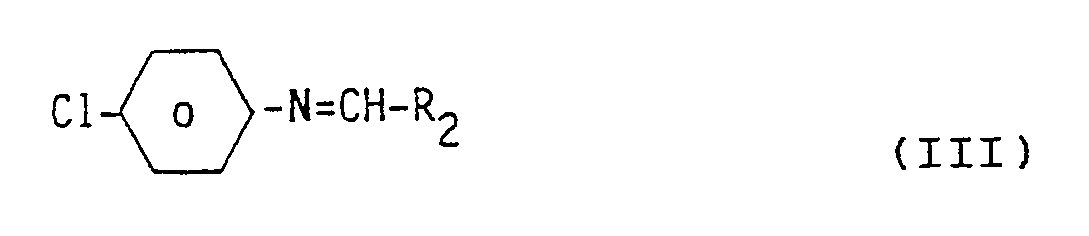
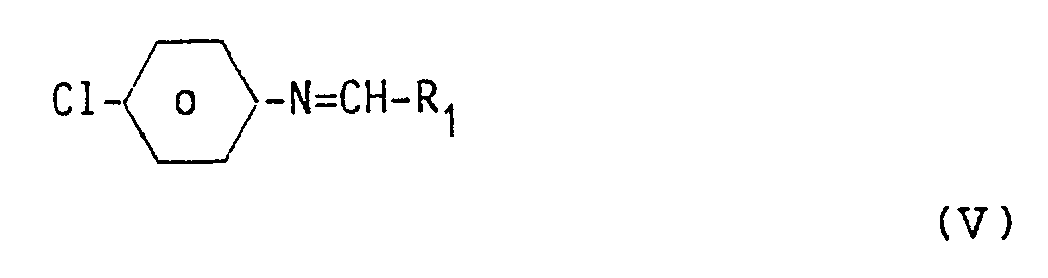
- Die Verknüpfung erfolgt durch Kondensation von 2-Methyl-4-chloroxazolen der Formel II (Verfahren A) oder von 5-Methyl-4-chloroxazolen der Formel IV (Verfahren B) mit geeigneten Derivaten (III bzw. V) von Aldehyden in für Methyl-Heterocyclen allgemein literaturbekannter Weise (I.J.Fletcher, A.E.Sigrist in "Adv. Heterocyclic Chem.", A.R. Katritzky, A.J.Bowlton, eds., Academic Press, New York, 1978, Vol. 23, p.171).
- Vorteilhaft wird auch die Kondensation von Aldehyden VII mit Triphenylphosphoniumverbindungen des 4-Chlor-oxazols VI durchgeführt unter Bedingungen, wie sie im Rahmen von Wittig-Reaktionen (Neuere Methoden der Organischen Chemie, W.Foerst Hrsg.,Verlag Chemie Weinheim, 1967, Bd. V.,S. 1) üblich sind (Verfahren C).
-

-

-

- Die als Ausgangsmaterialien benötigten 4-Chloroxazole II bzw. IV lassen sich nach literaturbekannten Verfahren, wie sie in der EP-B- 0 010 652 aufgeführt werden, leicht erhalten, beispielsweise durch Chlorwasserstoffkatalysierte Kondensation von substituierten Benzoylcyaniden mit Acetaldehyd (für II) oder durch analoge Reaktion von Acetylcyanid (Brenztraubensäurenitril) mit Aldehyden (für IV).
- Die Verbindungen VI sind in literaturbekannter Weise (Houben-Weyl, Methoden der Organischen Chemie, Bd. V, 1b, Seite 383, E.Müller Hrsg., G.Thieme Verlag, 1972) aus den entsprechenden Brommethyl-oxazolen erhältlich, die ihrerseits, z.B. durch Bromieren der Verbindungen II oder IV leicht zugänglich sind.
- Von besonderem Interesse sind die Verbindungen der allgemeinen Formel I als photoleitfähige Substanzen, beispielsweise in elektrophotographischen Aufzeichnungsmaterialien. Solche bestehen aus einer leitfähigen Unterlage und einem Schichtaufbau, der im Dunkeln isolierend ist, aber unter Belichtung leitend wird. Der Aufbau kann aus einer oder mehreren Schichten bestehen. Im Fall einer einzigen Schicht ist mindestens eine photoleitfähige Substanz in mindestens einem Bindemittel dispergiert und unmittelbar auf eine leitende Unterlage aufgedampft. Ein mehrschichtiger Aufbau besteht aus mindestens einer ladungsträgererzeugenden und mindestens einer ladungstransportierenden Schicht.
- Die Erzeugung von Ladungsbildern auf elektrophotographischen Schichten erfolgt nach der Aufladung durch einen Belichtungsschritt. Durch Belichtung wird zunächst elektrische Ladung erzeugt, die in einem weiteren Schritt durch die Schicht hindurch bis an die Schichtoberfläche transportiert wird und dort vorhandene Ladung neutralisiert. Dabei unterscheidet man Photorezeptoren, bei denen Ladungserzeugung und Ladungstransport durch die gleiche chemische Substanz bewirkt werden, von solchen, bei denen die Ladungserzeugung durch Zugabe einer zweiten Substanz, des Sensibilisators, erreicht wird. Dadurch wird die Möglichkeit gegeben, Elektrophotographie auch mit Licht einer Wellenlänge zu betreiben, das von der eigentlich photoleitfähigen Substanz nicht absorbiert wird.
- Zur homogenen Sensibilisierung werden die in den Farbstofftabellen von Schultz (7. Auflage, 1. Band, 1931) aufgeführten organischen Farbstoffe eingesetzt, zum Beispiel Triarylmethanfarbstoffe, wie Brillantgrün (Nr. 760, S. 314), Victoriablau B (Nr. 822, S. 347), Methylviolett (Nr. 783, S. 327), Kristallviolett (Nr. 785, S. 329), Säureviolett 6B (Nr. 381, S. 351); Xanthenfarbstoffe, und zwar Rhodamine, wie Rhodamin B (Nr. 864, S. 365), Rhodamin 6G (Nr. 866, S. 366), Rhodamin G extra (Nr. 865, S. 366), Sulforhodamin B (Nr. 863, S. 364) und Echtsäureeosin G (Nr. 870, S. 368) sowie Phthaleine, wie Eosin S (Nr. 883, S. 375), Eosin A (Nr. 881, S. 374), Erythrosin (Nr. 866, S. 376), Phloxin (Nr. 890, S. 378), Rose bengale (Nr. 889, S. 378) und Fluorescein (Nr. 880, S. 373); Thiazinfarbstoffe, wie Methylenblau (Nr. 1038, S. 449); Acridinfarbstoffe, wie Acridingelb (Nr. 901, S. 383), Acridinorange (Nr. 908, S. 387) und Trypaflavin (Nr. 906, S. 386); Chinolinfarbstoffe, wie Pinacyanol (Nr. 924, S. 396) und Kryptocyanin (Nr. 927, S. 397); Chinonfarbstoffe und Ketonfarbstoffe, wie Alizarin (Nr. 1141, S. 449), Alizarinrot S (Nr. 1145, S. 502) und Chinalizarin (Nr. 1148, S. 504); Cyaninfarbstoffe (Polymethinfarbstoffe), wie Astrazongelb 3G (Colour Index Nr. (C.I.) 48055) und 5 G (C.I. 48 065), Basic Yellow 52115 (C.I. 48 060), Astrazongelb GRL, Astrazonorange G (C.I. 48 040) und R (C.I. 48 035), Astrazonorange 3R (noch nicht klassifiziert).
- Pyryliumsalze, Thiapyryliumsalze, Benzopyryliumsalze können ebenfalls verwendet werden.
- Sensibilisierungsfarbstoffmischungen können ebenfalls vorliegen.
- Als dispers verteilte Farbstoffe oder Pigmente können auch metallhaltige oder metallfreie Phthalocyaninpigmente, zum Beispiel Kupferphthalocyanin, Perinon-, Thioindigo-, höher annellierte Chinon-, Chinacridon-, Perylen-, Anthrachinon-, Dioxazin-, Azo-, Bisazo-, Trisazo-, Cyanin-Pigmente oder Benzo(thio)-xanthen-Derivate sowie deren Mischungen eingesetzt werden. Davon sind besonders bevorzugt Phthalocyaninpigmente, wie die verschiedenen Cu-Phthalocyaninmodifikationen (α, β, ε), Bis- und Trisazopigmente, Perylen-3,4,9,10-tetracarbonsäureanhydrid und seine Imidderivate, oder (Iso)Violanthrone. Sie können bis zu 30 %, bezogen auf die Gesamtmasse der photoleitfähigen Schicht, vorhanden sein, bevorzugt werden Mengen im Bereich von 0,1 bis 10 % Pigment verwendet.
- Das hochisolierende Bindemittel für die ladungsträgererzeugende Schicht und für die Ladungstransportschicht kann gleich oder unterschiedlich sein. Als solche sind hinsichtlich der Flexibilität, der Filmeigenschaften und der Haftfestigkeit Natur- und Kunstharze geeignet, die sich durch gebräuchliche Lösungsmittel oder Lösungsmittelgemische bei der Herstellung der Schichten anlösen bzw. anquellen lassen. Hierzu gehören Polyesterharze, die Mischpolyester aus Iso- und Terephthalsäure mit Glykolen darstellen. Auch Silikonharze haben sich als geeignet erwiesen. Polycarbonatharze sind gut einsetzbar. Besonders bevorzugt für die Herstellung von Druckformen und gedruckten Schaltungen sind Bindemittel, die in wäßrigen oder alkoholischen Lösungsmittelsystemen, gegebenenfalls unter Säure- oder Alkalizusatz, löslich sind. Aus physiologischen und Sicherheitsgründen scheiden aromatische oder aliphatische, leicht brennbare Lösungsmittel aus. Geeignete Harzbindemittel sind hiernach hochmolekulare Substanzen, die alkalilöslich machende Gruppen tragen. Solche sind beispielsweise Säureanhydrid-, Carboxyl-, Carbonsäureamid-, Phenol-, Sulfonsäure-, Sulfonamid-oder Sulfonimid-Gruppen. Bevorzugt werden Harzbindemittel mit hohen Säurezahlen eingesetzt. Mischpolymerisate mit Anhydridgruppen können mit gutem Erfolg verwendet werden, da durch das Fehlen freier Säuregruppen die Dunkelleitfähigkeit gering ist, trotz guter Alkalilöslichkeit. Besonders bewährt haben sich Copolymerisate aus Styrol und Maleinsäureanhydrid, Sulfonylurethane gemäß DE-OS 32 10 577, und Copolymerisate der Acryl- bzw. Methacrylsäure.
- Als übliche Zusätze enthalten die Schichten Substanzen, die der Beschichtungslösung zugesetzt werden und dadurch die Oberflächenstruktur und die Flexibilität verbessern. Dies können zum Beispiel Weichmacher, wie Triphenylphosphat, oder Verlaufmittel, wie Silikonöle, sein.
- Als elektrisch leitende Schichtträger sind Materialien mit genügend elektrisch leitenden Eigenschaften geeignet,wie sie auch bisher bereits zu diesem Zweck verwendet wurden. Der Schichtträger kann in Form eines flexiblen Bandes oder einer Platte vorliegen. In bevorzugter Ausführungsform ist der Schichtträger für die Herstellung von Druckformen und gedruckten Schaltungen geeignet und besteht zum Beispiel aus einer Aluminium-, Zink-, Magnesium-, Kupfer-, Eisen-, Nickel- oder einer Mehrmetallplatte. Es kommen auch metallisierte, zum Beispiel metallbedampfte Kunststoffolien, wie aluminiumbedampfte Polyesterfolien, oder auch kupferkaschierte Polyimidfolien und -platten in Frage.
- Besonders bewährt haben sich oberflächenveredelte Schichtträger aus Aluminium. Die Oberflächenveredlung besteht in einer mechanischen oder elektrochemischen Aufrauhung und gegebenenfalls in einer anschließenden Anodisierung und Behandlung mit Polyvinylphosphonsäure gemäß DE-OS 16 21 478, entsprechend US-PS 4,153,461.
- Ganz allgemein kann eine isolierende Zwischenschicht auf dem Schichtträger vorhanden sein, wie eine thermisch, anodisch bzw. chemisch erzeugte Metalloxidschicht, zum Beispiel aus Aluminiumoxid. Diese Sperrschicht hat die Aufgabe, die Ladungsträgerinjektion vom elektrisch leitenden Schichtträger im Dunkeln in die Ladungsträger erzeugende Schicht herabzusetzen bzw. zu verhindern. Weiterhin wird durch die Sperrschicht die Haftung der folgenden Schichten auf dem Schichtträger günstig beeinflußt. Für organische Sperrschichten können verschiedene Natur-oder Kunstharzbindemittel verwendet werden, die gut auf einer Metall-bzw. Aluminiumoberfläche haften und beim nachfolgenden Anbringen der weiteren Schichten keine An- oder Ablösung erfahren. Die Dicke der organischen Sperrschicht liegt im Bereich von 1 µm, die einer Metalloxidschicht in der Größenordnung von 1o bis 1o⁴ nm.
- Zur Herstellung von beispielsweise gedruckten Schaltungen, wie sie in der Elektronik üblich sind, kann die photoleitfähige Schicht auch zunächst auf einen Zwischenträger aufgebracht werden, von dem aus sie als sogenannter Trockenresist auf den Schichtträger anschließend oder später übertragen wird. Dies kann zum Beispiel durch Laminieren erfolgen. Als Zwischenträger haben sich Kunststoffolien, wie solche aus Polyester, insbesondere aus Polyethylenterephthalatfolie, besonders bewährt.
- Die Beschichtungen bringt man in üblicher Weise auf, zum Beispiel durch Rakel- oder Sprühantrag. Vorzugsweise wird der Antrag mit einem Fließer vorgenommen. Die Trocknung der Schichten erfolgt beispielsweise in Trockenkanälen, wobei die verschiedenen Trocknungsstufen durch die Temperatur der einzelnen Bereiche, durch die Laufgeschwindigkeit des Materials und durch den herrschenden Luftdurchsatz festgelegt werden.
- Die Synthese der Verbindungen nach der allgemeinen Formel I nach den jeweiligen Verfahren A, B oder C wird im Nachfolgenden durch allgemeine Arbeitsvorschriften näher erläutert; die dargestellten Verbindungen I sind in Tabelle 1 zusammengefaßt aufgeführt.
- Eine Lösung von 4o mmol 2-Methyl-4-chlor-oxazol II und 50 mmol N-(4-Chlor-phenyl)-R₂ -azomethin III in 1oo ml Dimethylformamid wird mit 160 mmol Kaliumhydroxid-Pulver versetzt. Binnen 30 min wird auf 60°C erhitzt und 2h bei dieser Temperatur gehalten. Nach Abkühlung auf 20°C wird mit 400 ml Methanol versetzt, auf -10°C gekühlt, der Feststoff abgetrennt und aus Methylglykol umkristallisiert.
- 1-[4-Chlor-5-(4-methoxy)phenyl-oxazol-2-yl]-2-(4-dimethylamino)-phenyl-ethen, wobei in der allgemeinen Formel I
- R₁
- 4-Methoxyphenyl
- A
- Bindung
- B
- -CH=CH-
- R₂
- 4-Dimethylaminophenyl bedeuten:
- Eine Lösung von 17 mmol 5-Methyl-4-chloroxazol IV, 21 mmol N-(4-chlor-phenyl)-R₁-azomethin V und 68 mmol Kaliumhydroxid-Pulver in 40 ml Dimethylformamid wird 2h bei 20°C gerührt. Nach Zugabe von 160 ml Methanol wird auf -10°C gekühlt, der Feststoff abgetrennt und aus Methylglykol umkristallisiert.
- 1-[4-Chlor-2-(4-dimethylamino)phenyl-oxazol-5-yl]-2-(4-dimethyl-amino)-phenyl-ethen, wobei in der allgemeinen Formel I
- R₁
- 4-Dimethylaminophenyl
- A
- -CH=CH-
- B
- Bindung
- R₂
- 4-Dimethylaminophenyl bedeuten:
- 60 mmol Natriumhydrid (80 %-ige Suspension) und 100 ml Dimethylsulfoxid werden, zuletzt durch Erhitzen auf 75°C, zur Reaktion gebracht. Die abgekühlte Lösung wird mit 60 mmol fein gepulvertem Triphenylphosphoniumsalz VI versetzt und nach erfolgter Auflösung noch 50 min bei 25°C gerührt. 60 mmol Aldehyd VII werden zugetropft und die Mischung noch 2 h bei 25°C sowie 3 h bei 75°C gerührt. Der nach Hydrolyse mit 500 ml Eiswasser erhaltene Feststoff wird aus Methylglykol umkristallisiert.
- 1-[4-Chlor-5-phenyl-oxazol-2-yl]-2-[4-chlor-5-(4-methoxy)-phenyl-oxazol-2-yl]-ethen, wobei in der allgemeinen Formel I
R₁ Phenyl
A Bindung
B -CH=CH-
R₂ 4-Chlor-5-(4-methoxy)phenyl-oxazol-2-yl bedeuten:
- Nach der in der EP-B-0 010 652 gegebenen Vorschrift wird eine Lösung von 100 mmol 4-Methoxy-benzoylcyanid und 100 mmol Zimtaldehyd in 5o ml Tetrahydrofuran bei 0°C mit Chlorwasserstoff gesättigt. Nach 10-stündigem Stehen bei 0°C wird auf 200g Eis gegeben, mit Dichlormethan extrahiert und der Extrakt gewaschen und getrocknet. Durch Säulenchromatographie an Kieselgel bei Elution durch Dichlormethan läßt sich eine Chloroxazol-haltige Fraktion als Hauptbestandteil abtrennen.
Nach gaschromatographischer Analyse ist darin das ungesättigte Kondensationsprodukt, entsprechend der auf anderem Weg hergestellten Verbindung Ig, nur zu 19,4 % enthalten.
Hauptbestandteil mit zusammen 68,1 % sind Verbindungen, die nach ¹H-NMR-Analyse eine 1,2-substituierte Chlorethyl-Einheit enthalten - Trennung dieser Mischung mittels Chromatographie, Destillation oder Kristallisation erwies sich als nicht praktikabel.
- Die Ausprüfung der elektrophotographischen Eigenschaften der erfindungsgemäßen Verbindungen nach der allgemeinen Formel I erfolgte in unterschiedlichen Schichtrezepturen.
- 15.0 g Hostapermorange GR (Pigment Orange 43, C.I. 71.105) wurden in eine Lösung von 10 g Polybutylmethacrylat (® Plexigum P676, Röhm GmbH) in 2oo g Tetrahydrofuran eingetragen und durch Mahlen in einer Kugelmühle während 2 Stunden dispergiert. Nach Zusatz von 32 g Polymethylmethacrylat (® Plexigum M345) in 34o g Tetrahydrofuran wurde die Schicht mit einem Schichtgewicht von 6 g/m² auf aluminiumbedampfte Polethylenterephthalatfolie aufgetragen und getrocknet. Die getrocknete Schicht wurde dann mit einer 5 %-igen Lösung der erfindungsgemäßen Verbindungen in THF behandelt und erneut getrocknet.
- 5 g der erfindungsgemäßen Verbindungen, 5 g eines Copolymeren aus Maleinsäurehalbester und Styrol, Zersetzungspunkt 200 bis 240°C, und 0,05 g Rhodamin B werden in 90 g Tetrahydrofuran gelöst und so auf einen aufgerauhten und anodisierten Aluminium-Offsetdruckplattenträger aufgebracht, daß ein Trockenschichtgewicht von 6 g/m² resultiert.
- Auf eine aluminiumbedampfte Polyethylenterephthalatfolie wurde zunächst eine ladungsträgererzeugende Schicht aus N,Nʹ-Dimethylperylen-3,4,9,10-tetracarbonsäurediimid in einem Schichtgewicht von 200 mg/m² durch Sublimation aufgetragen. Auf diese Schicht wurde eine Lösung aus 50 Gewichtsteilen der erfindungsgemäßen Substanzen und 50 Gewichtsteilen eines Polyesters (® Dynapol L2o6, Dynamit Nobel) so aufgetragen, daß ein Schichtgewicht dieser Ladungstransportschicht von 10.5 g/m² resultierte.
- Die Resultate der elektrophotographischen Untersuchungen der gemäß den Beispielen hergestellten Schichten sind in der folgenden Tabelle 2 zusammengefaßt. Dabei bedeuten E1/2, E1/4 und E1/8 die Belichtungsenergien in µJ/cm², die bei einer Lichtintensität von 3 µW/cm² aufgebracht werden müssen, um eine Entladung von der ursprünglichen Aufladung Uo auf 0.5 Uo, 0.25 Uo bzw. 0.125 Uo zu bewirken. Die Messungen der Proben gemäß Schichtrezeptur 1 erfolgten bei 485 nm, die der Proben gemäß Schichtrezeptur 2+3 bei Weißlicht (Halogen-Wolfram-Lampe, Kantenfilter bei 650nm). Ue bedeutet die nach 10 sec Belichtung auf der Schicht verbleibende Restladung.
- Zum Vergleich werden die Beschichtungsrezepturen auch unter Verwendung der Verbindungen IX (DE-PS 1 058 836) bzw. VIII (EP-B 0 010 652 ) untersucht. Bei Beschichtungsrezeptur 1 wurde zum Vergleich auch auf die Nachbehandlung mit einer photoleiterhaltigen Lösung verzichtet.

TABELLE 2 Verb. Rez. U₀ Ue E₁/₂ E₁/₄ E₁/₈ Iac 1 -406 -63 16.4 25 Iad 1 -462 -47 11 14 32 Ie 1 -430 -67 21.6 70 If 1 - 39 -15 70.6 Ih 1 -770 -39 6.1 8 13 Ii 1 -857 -47 5.7 7 10 In 1 -734 -31 5.9 8 11 Ir 1 -857 -23 3.7 4.7 6.1 Is 1 -647 -23 3.6 5.2 8.2 Iw 1 -632 -47 9 23 67 Iy 1 -193 -51 59.5 Iz 1 -308 -59 27.5 96 ohne 1 -746 -319 75 VIII 1 -525 -75 20.4 62 IX 1 -620 - 7 5.1 7 10 Iac 2 -268 -31 20.7 51 Iad 2 -165 -15 19.7 50 99 Iaf 2 -529 -177 70.4 Ie 2 -481 -240 146 If 2 -493 - 51 16.9 47 126 Ig 2 -623 -470 Ih 2 -596 - 55 12 25 47 Ij 2 -722 -481 Il 2 -169 - 3 19.1 41 65 Io 2 -292 - 3 10.7 27 Ip 2 -730 - 94 11.7 28 Iw 2 -647 - 7 7.9 18 36 Iz 2 -406 -165 101 VIII 2 -398 - 11 10.6 30 62 IX 2 -426 - 7 8 20 39 Ik 3 -647 -181 4.7 Im 3 -556 0 1.7 3.2 5 It 3 -339 0 2.3 4.8 7.5 IX 3 -205 - 7 4.9 10.1 18.4 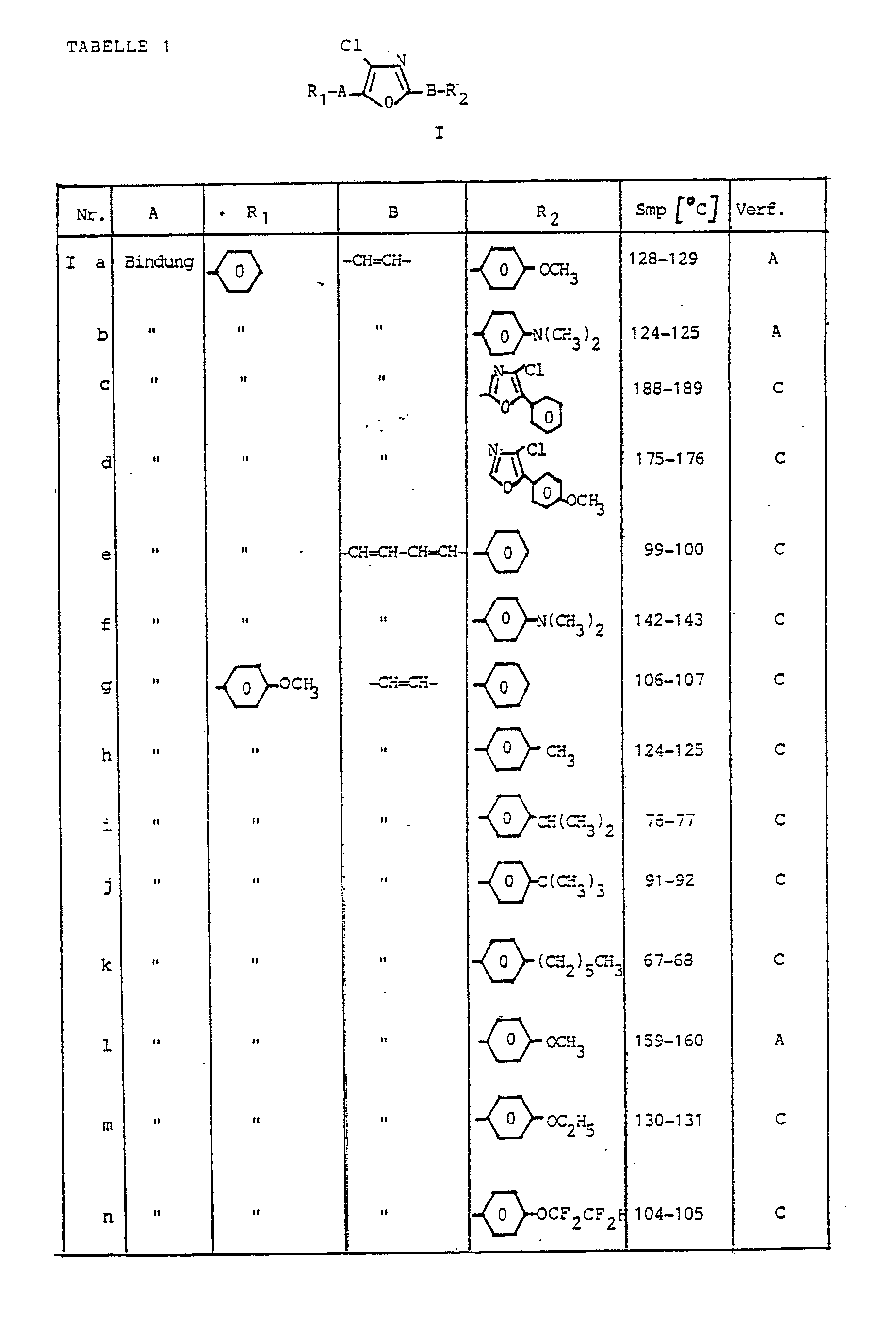


mit der für R₁ angegebenen Bedeutung mit einer Verbindung der Formel III

mit der für R₂ angegebenen Bedeutung, in einem inerten organischen Lösungsmittel in Gegenwart einer Base bei einer Temperatur im Bereich von 20 bis 80 °C kondensiert, abtrennt, trocknet und die Verbindung gegebenenfalls durch Umfällen reinigt (Verfahren A). Vorzugsweise kondensiert man bei einer Temperatur von 40 bis 60 °C, verwendet als Lösungsmittel Dimethylformamid und als Base Kaliumhydroxid.
bei dem man eine Verbindung nach der Formel IV

mit der für R₂ angegebenen Bedeutung mit einer Verbindung der Formel V

mit der für R₁ angegebenen Bedeutung in einem inerten organischen Lösungsmittel in Gegenwart einer Base bei einer Temperatur im Bereich von 0 bis 40 °C kondensiert, abtrennt, trocknet und die Verbindung gegebenenfalls durch Umfällen reinigt. Vorzugsweise kondensiert man bei einer Temperatur von 20 - 30 °C (Verfahren B).
bei dem man ein Phosphoniumsalz nach der Formel VI

mit der für R₁ angegebenen Bedeutung, mit einem Aldehyd nach der Formel VII
X - R₂ (VII)
mit der für R₂ angegebenen Bedeutung und mit X als -CHO oder -CH=CH-CHO in einem inerten organischen Lösungsmittel in Gegenwart einer Base bei Raumtemperatur zu einer Verbindung kondensiert, vom Reaktionsgemisch abtrennt, trocknet und gegebenenfalls durch Umfällen reinigt (Verfahren C). Als Lösungsmittel wird vorzugsweise Dimethylsulfoxid und als Base Dimethylsulfinylnatrium verwendet.


Claims (7)
- 4-Chloroxazol-Derivate der allgemeinen Formel I
 A eine Einfachbindung oder die -CH=CH- Gruppe,B eine Einfachbindung, die -CH=CH- oder -CH=CH-CH=CH- Gruppe und dann eine Einfachbindung ist, wenn A die -CH=CH- Gruppe darstellt,R₁ Phenyl, das gegebenenfalls ein- oder mehrfach durch (C₁-C₄)-Alkoxy- oder Di-(C₁-C₄)-alkyl-aminoreste substituiert ist, undR₂ Phenyl, Phenyloxazolyl, Pyridyl, Julolidin-9-yl, N-(C₁-C₄-Alkyl)-carbazol-3-yl, Cumarin-6-yl oder Stilben-4-yl, die gegebenenfalls ein-oder mehrfach durch (C₁-C₄)-Alkyl-, (C₁-C₄)-Alkoxy-, Halogen-(C₁-C₄)-alkoxy, Hydroxy-, Halogen-, Di-(C₁-C₄)-alkylamino- oder Dibenzylaminoreste substituiert sind,
bedeuten. - Verbindungen nach Anspruch 1,
worinA eine Einfachbindung,B die -CH=CH- Gruppe,R₁ Phenyl, das durch (C₁-C₄)-Alkoxyreste substituiert ist, undR₂ Phenyl oder N-(C₁-C₄-Alkyl)-carbazol-3-yl, die durch (C₁-C₄)-Alkoxy-, Halogen-, Hydroxy- und/ oder Di-(C₁-C₄)-alkylaminoreste substituiert sind,
bedeuten. - Verbindungen nach Anspruch 1 oder 2,
worinA eine Einfachbindung,B die -CH=CH- Gruppe,R₁ Methoxyphenyl undR₂ p-Ethoxyphenyl, p-Dimethylaminophenyl, p-Diethylaminophenyl, o-Chlor-p-dimethylaminophenyl, o-Hydroxy-p-diethylaminophenyl oder N-Ethylcarbazol-3-yl
bedeuten. - Verfahren zur Herstellung einer Verbindung nach der allgemeinen Formel I gemäß Anspruch 1, in der
A eine Einfachbindung undB die -CH=CH- Gruppe
bedeuten, bei dem man eine Verbindung nach Formel II
- Verfahren zur Herstellung einer Verbindung nach der allgemeinen Formel I gemäß Anspruch 1, in der
A die -CH=CH- Gruppe undB eine Einfachbindung
bedeuten,
bei dem man eine Verbindung nach der Formel IV
- Verfahren zur Herstellung einer Verbindung nach der allgemeinen Formel I gemäß Anspruch 1, in der
A eine Einfachbindung undB die -CH=CH- oder die -CH=CH-CH=CH- Gruppe
bedeuten,
bei dem man eine Verbindung der Formel VI
X - R₂ (VII)
mit der für R₂ angegebenen Bedeutung und mit
X als -CHO oder -CH=CH-CHO
in einem inerten organischen Lösungsmittel in Gegenwart einer Base bei Raumtemperatur kondensiert, sie vom Reaktionsgemisch abtrennt, trocknet und die Verbindung gegebenenfalls durch Umfällen reinigt. - Verwendung der Verbindungen der allgemeinen Formel I als photoleitfähige Substanzen.
Applications Claiming Priority (2)
| Application Number | Priority Date | Filing Date | Title |
|---|---|---|---|
| DE3706880 | 1987-03-04 | ||
| DE19873706880 DE3706880A1 (de) | 1987-03-04 | 1987-03-04 | 4-chloroxazol-derivate, verfahren zu ihrer herstellung und ihre verwendung |
Publications (2)
| Publication Number | Publication Date |
|---|---|
| EP0281012A1 EP0281012A1 (de) | 1988-09-07 |
| EP0281012B1 true EP0281012B1 (de) | 1991-12-11 |
Family
ID=6322217
Family Applications (1)
| Application Number | Title | Priority Date | Filing Date |
|---|---|---|---|
| EP88102772A Expired - Lifetime EP0281012B1 (de) | 1987-03-04 | 1988-02-25 | 4-Chloroxazol-Derivate, Verfahren zu ihrer Herstellung und ihre Verwendung |
Country Status (4)
| Country | Link |
|---|---|
| US (2) | US4892799A (de) |
| EP (1) | EP0281012B1 (de) |
| JP (1) | JPS63238072A (de) |
| DE (2) | DE3706880A1 (de) |
Families Citing this family (2)
| Publication number | Priority date | Publication date | Assignee | Title |
|---|---|---|---|---|
| DE10307453B4 (de) * | 2003-02-21 | 2005-07-21 | Kodak Polychrome Graphics Gmbh | Oxazol-Derivate enthaltende strahlungsempfindliche Zusammensetzungen und darauf basierende bebilderbare Elemente |
| WO2005016384A1 (ja) * | 2003-08-13 | 2005-02-24 | Bf Research Institute, Inc. | アミロイド蓄積性疾患のプローブ、アミロイド染色剤、アミロイド蓄積性疾患の治療および予防薬、ならびに神経原線維変化の診断プローブおよび染色剤 |
Family Cites Families (13)
| Publication number | Priority date | Publication date | Assignee | Title |
|---|---|---|---|---|
| US2751383A (en) * | 1951-05-02 | 1956-06-19 | Cassella Farbwerke Mainkur Ag | Fluorescent heterocyclic compounds and process for their manufacture |
| US2726246A (en) * | 1951-05-02 | 1955-12-06 | Cassella Farbwerke Mainkur Ag | Fluorescent heterocyclic compounds and process for their manufacture |
| LU35193A1 (de) * | 1956-06-04 | |||
| NL242505A (de) * | 1958-08-20 | |||
| CH484918A (de) * | 1965-10-28 | 1970-01-31 | Ciba Geigy | Verfahren zur Herstellung heterocyclischer, Aethylendoppelbindungen enthaltender Verbindungen |
| ZA6807938B (de) * | 1967-12-04 | |||
| US3819356A (en) * | 1970-01-23 | 1974-06-25 | Abbott Lab | Oxazoles and their use as herbicides |
| DE2844394A1 (de) * | 1978-10-12 | 1980-04-30 | Hoechst Ag | Neue 4-chloroxazole und verfahren zu deren herstellung |
| DE3021590A1 (de) * | 1980-06-09 | 1981-12-17 | Hoechst Ag, 6000 Frankfurt | 4-halogen-5-(halogenmethyl-phenyl)-oxazol-derivate, ein verfahren zu ihrer herstellung und sie enthaltenden strahlungsempfindliche massen |
| DE3021599A1 (de) * | 1980-06-09 | 1981-12-24 | Hoechst Ag, 6000 Frankfurt | 2-(halogenmethyl-phenyl)-4-halogenoxazol-derivate, ein verfahren zu ihrer herstellung und sie enthaltende strahlungsempfindliche massen |
| JPS5766438A (en) * | 1980-10-14 | 1982-04-22 | Copyer Co Ltd | Electrophotographic receptor |
| SU963248A1 (ru) * | 1980-12-05 | 1985-05-30 | Предприятие П/Я А-7797 | 1,4-Бис- @ 5-( @ -бромфенил)-4-бромоксазолил-2 @ -бензол в качестве люминесцентной добавки дл сцинтилл торов и способ его получени |
| DE3210577A1 (de) * | 1982-03-23 | 1983-10-06 | Hoechst Ag | Elektrophotographisches aufzeichnungsmaterial |
-
1987
- 1987-03-04 DE DE19873706880 patent/DE3706880A1/de not_active Withdrawn
-
1988
- 1988-02-25 EP EP88102772A patent/EP0281012B1/de not_active Expired - Lifetime
- 1988-02-25 DE DE8888102772T patent/DE3866729D1/de not_active Expired - Fee Related
- 1988-03-01 US US07/162,596 patent/US4892799A/en not_active Expired - Fee Related
- 1988-03-04 JP JP63049950A patent/JPS63238072A/ja active Pending
-
1989
- 1989-10-20 US US07/424,556 patent/US5025097A/en not_active Expired - Fee Related
Also Published As
| Publication number | Publication date |
|---|---|
| EP0281012A1 (de) | 1988-09-07 |
| JPS63238072A (ja) | 1988-10-04 |
| DE3866729D1 (de) | 1992-01-23 |
| US5025097A (en) | 1991-06-18 |
| US4892799A (en) | 1990-01-09 |
| DE3706880A1 (de) | 1988-09-15 |
Similar Documents
| Publication | Publication Date | Title |
|---|---|---|
| DE2935536C2 (de) | ||
| EP0084147B1 (de) | Neue Phenylhydrazone und deren Verwendung | |
| DE3730258C2 (de) | ||
| DE3443623A1 (de) | Verfahren zur herstellung von squarainzusammensetzungen | |
| EP0281012B1 (de) | 4-Chloroxazol-Derivate, Verfahren zu ihrer Herstellung und ihre Verwendung | |
| EP0592366A1 (de) | Photochrome Verbindungen, deren Herstellung und deren Verwendung | |
| DE3150266A1 (de) | Elektrophotographisch empfindliche materialien | |
| DE3810522A1 (de) | Aromatische diolefinische verbindungen, aromatische diethylverbindungen und elektrophotographische photoleiter, die eine aromatische diethylverbindung enthalten | |
| DE4000437C2 (de) | Elektrophotographisches Aufzeichnungsmaterial | |
| DE1597837A1 (de) | Elektrophotographisches Material | |
| DE2717007C2 (de) | ||
| EP0281854B1 (de) | Neue 4-Chloroxazolverbindungen, Verfahren zu ihrer Herstellung und ihre Verwendung | |
| DE1116057B (de) | Material fuer elektrophotographische Reproduktion | |
| DE2722332A1 (de) | 1,3,4-oxadiazolderivate sowie diese enthaltende elektrophotographische aufzeichnungsmaterialien | |
| EP0194469B1 (de) | Neue sulfonhaltige Styrolderivate, Verfahren zu deren Herstellung und deren Verwendung | |
| EP0206270B1 (de) | 1,3,4-Tri-(het-)aryl-isochinoline, Verfahren zu ihrer Herstellung und ihre Verwendung als photoleitfähige Verbindungen | |
| DE3630389A1 (de) | Elektrophotographisches lichtempfindliches matrial | |
| EP0579638B1 (de) | Polyketomethinfarbstoffe | |
| DE69416094T2 (de) | Elektrophotographischer Photorezeptor | |
| DE3346177A1 (de) | Neue 2,3-bis(arylethenyl)-chinoxaline, verfahren zu ihrer herstellung und ihre verwendung als photoleitfaehige verbindungen | |
| EP0318758A2 (de) | Mehrschichtiges, elektrophotographisches Aufzeichnungsmaterial | |
| DE10196853B4 (de) | Farbstoffe auf Squarain-Basis und Verfahren zur Herstellung davon | |
| DE1060712B (de) | Material fuer elektrophotographische Reproduktion | |
| EP0318759B1 (de) | Mehrschichtiges elektrophotographisches Aufzeichnungsmaterial | |
| EP0594538A2 (de) | Photochrome Acridonderivate, Verfahren zu deren Herstellung und deren Verwendung |
Legal Events
| Date | Code | Title | Description |
|---|---|---|---|
| PUAI | Public reference made under article 153(3) epc to a published international application that has entered the european phase |
Free format text: ORIGINAL CODE: 0009012 |
|
| AK | Designated contracting states |
Kind code of ref document: A1 Designated state(s): DE FR GB |
|
| 17P | Request for examination filed |
Effective date: 19890209 |
|
| 17Q | First examination report despatched |
Effective date: 19901008 |
|
| GRAA | (expected) grant |
Free format text: ORIGINAL CODE: 0009210 |
|
| AK | Designated contracting states |
Kind code of ref document: B1 Designated state(s): DE FR GB |
|
| REF | Corresponds to: |
Ref document number: 3866729 Country of ref document: DE Date of ref document: 19920123 |
|
| ET | Fr: translation filed | ||
| GBT | Gb: translation of ep patent filed (gb section 77(6)(a)/1977) | ||
| PGFP | Annual fee paid to national office [announced via postgrant information from national office to epo] |
Ref country code: DE Payment date: 19920409 Year of fee payment: 5 |
|
| PLBE | No opposition filed within time limit |
Free format text: ORIGINAL CODE: 0009261 |
|
| STAA | Information on the status of an ep patent application or granted ep patent |
Free format text: STATUS: NO OPPOSITION FILED WITHIN TIME LIMIT |
|
| 26N | No opposition filed | ||
| PGFP | Annual fee paid to national office [announced via postgrant information from national office to epo] |
Ref country code: FR Payment date: 19930118 Year of fee payment: 6 |
|
| PGFP | Annual fee paid to national office [announced via postgrant information from national office to epo] |
Ref country code: GB Payment date: 19930121 Year of fee payment: 6 |
|
| PG25 | Lapsed in a contracting state [announced via postgrant information from national office to epo] |
Ref country code: DE Effective date: 19931103 |
|
| PG25 | Lapsed in a contracting state [announced via postgrant information from national office to epo] |
Ref country code: GB Effective date: 19940225 |
|
| GBPC | Gb: european patent ceased through non-payment of renewal fee |
Effective date: 19940225 |
|
| PG25 | Lapsed in a contracting state [announced via postgrant information from national office to epo] |
Ref country code: FR Effective date: 19941031 |
|
| REG | Reference to a national code |
Ref country code: FR Ref legal event code: ST |