EP0281041A1 - Procédé et dispositif pour laver et/ou rincer des matières textiles - Google Patents
Procédé et dispositif pour laver et/ou rincer des matières textiles Download PDFInfo
- Publication number
- EP0281041A1 EP0281041A1 EP88102944A EP88102944A EP0281041A1 EP 0281041 A1 EP0281041 A1 EP 0281041A1 EP 88102944 A EP88102944 A EP 88102944A EP 88102944 A EP88102944 A EP 88102944A EP 0281041 A1 EP0281041 A1 EP 0281041A1
- Authority
- EP
- European Patent Office
- Prior art keywords
- textile
- washing
- microwaves
- rinsing
- cavity resonator
- Prior art date
- Legal status (The legal status is an assumption and is not a legal conclusion. Google has not performed a legal analysis and makes no representation as to the accuracy of the status listed.)
- Granted
Links
- 239000004753 textile Substances 0.000 title claims abstract description 167
- 238000005406 washing Methods 0.000 title claims abstract description 130
- 238000000034 method Methods 0.000 title claims abstract description 84
- 239000000463 material Substances 0.000 title claims abstract description 74
- 230000008569 process Effects 0.000 claims abstract description 49
- 239000007788 liquid Substances 0.000 claims abstract description 47
- 239000004615 ingredient Substances 0.000 claims abstract description 22
- 239000012459 cleaning agent Substances 0.000 claims abstract description 3
- 239000003599 detergent Substances 0.000 claims description 42
- 239000007791 liquid phase Substances 0.000 claims description 33
- XLYOFNOQVPJJNP-UHFFFAOYSA-N water Substances O XLYOFNOQVPJJNP-UHFFFAOYSA-N 0.000 claims description 32
- 230000009471 action Effects 0.000 claims description 28
- 239000002184 metal Substances 0.000 claims description 19
- 229910052751 metal Inorganic materials 0.000 claims description 19
- 239000004033 plastic Substances 0.000 claims description 18
- 229920003023 plastic Polymers 0.000 claims description 18
- 238000009736 wetting Methods 0.000 claims description 17
- 239000000835 fiber Substances 0.000 claims description 15
- 230000005855 radiation Effects 0.000 claims description 15
- 230000014759 maintenance of location Effects 0.000 claims description 13
- 239000012071 phase Substances 0.000 claims description 12
- 238000004140 cleaning Methods 0.000 claims description 10
- 239000004094 surface-active agent Substances 0.000 claims description 10
- 239000008346 aqueous phase Substances 0.000 claims description 9
- 239000004020 conductor Substances 0.000 claims description 9
- 230000008878 coupling Effects 0.000 claims description 7
- 238000010168 coupling process Methods 0.000 claims description 7
- 238000005859 coupling reaction Methods 0.000 claims description 7
- 238000001035 drying Methods 0.000 claims description 7
- 238000002604 ultrasonography Methods 0.000 claims description 7
- 239000000470 constituent Substances 0.000 claims description 6
- 230000001105 regulatory effect Effects 0.000 claims description 6
- 230000036961 partial effect Effects 0.000 claims description 5
- 239000000049 pigment Substances 0.000 claims description 5
- 239000012190 activator Substances 0.000 claims description 4
- 239000011521 glass Substances 0.000 claims description 4
- 238000003825 pressing Methods 0.000 claims description 4
- 238000000926 separation method Methods 0.000 claims description 4
- 102000004190 Enzymes Human genes 0.000 claims description 3
- 108090000790 Enzymes Proteins 0.000 claims description 3
- 238000009833 condensation Methods 0.000 claims description 3
- 230000005494 condensation Effects 0.000 claims description 3
- 239000000203 mixture Substances 0.000 claims description 3
- 238000009987 spinning Methods 0.000 claims description 3
- 230000015572 biosynthetic process Effects 0.000 claims description 2
- 238000009835 boiling Methods 0.000 claims description 2
- 238000013461 design Methods 0.000 claims description 2
- 229920002492 poly(sulfone) Polymers 0.000 claims description 2
- 229920000515 polycarbonate Polymers 0.000 claims description 2
- 239000004417 polycarbonate Substances 0.000 claims description 2
- -1 skins Substances 0.000 claims description 2
- 239000002689 soil Substances 0.000 claims description 2
- 239000007921 spray Substances 0.000 claims description 2
- 238000003860 storage Methods 0.000 claims description 2
- 230000001419 dependent effect Effects 0.000 claims 1
- 239000002657 fibrous material Substances 0.000 claims 1
- 239000004744 fabric Substances 0.000 description 12
- 230000003750 conditioning effect Effects 0.000 description 11
- 238000012360 testing method Methods 0.000 description 10
- 238000010438 heat treatment Methods 0.000 description 8
- 230000008901 benefit Effects 0.000 description 7
- 239000003921 oil Substances 0.000 description 5
- 241001122767 Theaceae Species 0.000 description 4
- 238000004061 bleaching Methods 0.000 description 4
- 229920000742 Cotton Polymers 0.000 description 3
- 239000007844 bleaching agent Substances 0.000 description 3
- 230000001143 conditioned effect Effects 0.000 description 3
- 238000005516 engineering process Methods 0.000 description 3
- 239000004519 grease Substances 0.000 description 3
- 210000002966 serum Anatomy 0.000 description 3
- 239000006096 absorbing agent Substances 0.000 description 2
- 230000004913 activation Effects 0.000 description 2
- 238000006073 displacement reaction Methods 0.000 description 2
- 238000009826 distribution Methods 0.000 description 2
- 239000000428 dust Substances 0.000 description 2
- 230000000694 effects Effects 0.000 description 2
- 238000002474 experimental method Methods 0.000 description 2
- 238000011049 filling Methods 0.000 description 2
- 239000013505 freshwater Substances 0.000 description 2
- 230000001678 irradiating effect Effects 0.000 description 2
- 230000000149 penetrating effect Effects 0.000 description 2
- 229920000728 polyester Polymers 0.000 description 2
- 230000009467 reduction Effects 0.000 description 2
- 239000005060 rubber Substances 0.000 description 2
- 230000035939 shock Effects 0.000 description 2
- 238000004904 shortening Methods 0.000 description 2
- 239000002002 slurry Substances 0.000 description 2
- 239000000126 substance Substances 0.000 description 2
- 239000004614 Process Aid Substances 0.000 description 1
- 101150114468 TUB1 gene Proteins 0.000 description 1
- BGRWYDHXPHLNKA-UHFFFAOYSA-N Tetraacetylethylenediamine Chemical compound CC(=O)N(C(C)=O)CCN(C(C)=O)C(C)=O BGRWYDHXPHLNKA-UHFFFAOYSA-N 0.000 description 1
- 239000011358 absorbing material Substances 0.000 description 1
- 238000010521 absorption reaction Methods 0.000 description 1
- 230000006978 adaptation Effects 0.000 description 1
- 239000000654 additive Substances 0.000 description 1
- 239000002671 adjuvant Substances 0.000 description 1
- 239000007864 aqueous solution Substances 0.000 description 1
- 238000005282 brightening Methods 0.000 description 1
- 238000006243 chemical reaction Methods 0.000 description 1
- 239000012141 concentrate Substances 0.000 description 1
- 238000011109 contamination Methods 0.000 description 1
- 238000010924 continuous production Methods 0.000 description 1
- 238000010411 cooking Methods 0.000 description 1
- 239000013078 crystal Substances 0.000 description 1
- 230000003247 decreasing effect Effects 0.000 description 1
- 238000011161 development Methods 0.000 description 1
- 238000010790 dilution Methods 0.000 description 1
- 239000012895 dilution Substances 0.000 description 1
- 238000005265 energy consumption Methods 0.000 description 1
- 238000001704 evaporation Methods 0.000 description 1
- 230000008020 evaporation Effects 0.000 description 1
- 230000001788 irregular Effects 0.000 description 1
- 238000011068 loading method Methods 0.000 description 1
- 238000004519 manufacturing process Methods 0.000 description 1
- 238000010297 mechanical methods and process Methods 0.000 description 1
- 230000005226 mechanical processes and functions Effects 0.000 description 1
- 239000008239 natural water Substances 0.000 description 1
- 230000035515 penetration Effects 0.000 description 1
- 239000011148 porous material Substances 0.000 description 1
- 230000008092 positive effect Effects 0.000 description 1
- 238000004064 recycling Methods 0.000 description 1
- 230000011514 reflex Effects 0.000 description 1
- 239000008237 rinsing water Substances 0.000 description 1
- 238000002791 soaking Methods 0.000 description 1
- 229960001922 sodium perborate Drugs 0.000 description 1
- 239000012418 sodium perborate tetrahydrate Substances 0.000 description 1
- IBDSNZLUHYKHQP-UHFFFAOYSA-N sodium;3-oxidodioxaborirane;tetrahydrate Chemical compound O.O.O.O.[Na+].[O-]B1OO1 IBDSNZLUHYKHQP-UHFFFAOYSA-N 0.000 description 1
- YKLJGMBLPUQQOI-UHFFFAOYSA-M sodium;oxidooxy(oxo)borane Chemical compound [Na+].[O-]OB=O YKLJGMBLPUQQOI-UHFFFAOYSA-M 0.000 description 1
- 239000007787 solid Substances 0.000 description 1
- 239000000243 solution Substances 0.000 description 1
- 238000005507 spraying Methods 0.000 description 1
- 239000000725 suspension Substances 0.000 description 1
- 229920002994 synthetic fiber Polymers 0.000 description 1
- 238000010257 thawing Methods 0.000 description 1
- 238000007669 thermal treatment Methods 0.000 description 1
- 238000011144 upstream manufacturing Methods 0.000 description 1
- 238000010792 warming Methods 0.000 description 1
- 210000002268 wool Anatomy 0.000 description 1
Images

Classifications
-
- D—TEXTILES; PAPER
- D06—TREATMENT OF TEXTILES OR THE LIKE; LAUNDERING; FLEXIBLE MATERIALS NOT OTHERWISE PROVIDED FOR
- D06F—LAUNDERING, DRYING, IRONING, PRESSING OR FOLDING TEXTILE ARTICLES
- D06F35/00—Washing machines, apparatus, or methods not otherwise provided for
-
- D—TEXTILES; PAPER
- D06—TREATMENT OF TEXTILES OR THE LIKE; LAUNDERING; FLEXIBLE MATERIALS NOT OTHERWISE PROVIDED FOR
- D06F—LAUNDERING, DRYING, IRONING, PRESSING OR FOLDING TEXTILE ARTICLES
- D06F35/00—Washing machines, apparatus, or methods not otherwise provided for
- D06F35/005—Methods for washing, rinsing or spin-drying
- D06F35/006—Methods for washing, rinsing or spin-drying for washing or rinsing only
-
- D—TEXTILES; PAPER
- D06—TREATMENT OF TEXTILES OR THE LIKE; LAUNDERING; FLEXIBLE MATERIALS NOT OTHERWISE PROVIDED FOR
- D06F—LAUNDERING, DRYING, IRONING, PRESSING OR FOLDING TEXTILE ARTICLES
- D06F39/00—Details of washing machines not specific to a single type of machines covered by groups D06F9/00 - D06F27/00
- D06F39/04—Heating arrangements
Definitions
- the cleaning of soiled textile goods by treatment with liquors containing aqueous detergents can be conceptually divided into the stages of washing and rinsing. Both washing and rinsing are carried out in one or more stages according to current practice.
- the devices commonly used in households and businesses today allow a wide range of adaptations to the optimal washing conditions. Aimed at are - among other things - while maintaining the quality of the washing result - the saving of energy, water and washing aids.
- the machine-controlled period for the thorough 60 ° household washing is still in the period of about 40 to 50 minutes, if pre-washing is used, this period can be considerably extended.
- the total amount of water required for washing and rinsing is a multiple of the amount of dry textile weight used.
- the invention is based on the object of providing time and material-saving work steps in the context of textile washing, by means of which substantial improvements can be achieved in the context of known textile washing processes. This applies to both the washing stage processes as well as for the stage of rinsing the dirty fleet from the washed textile.
- the application and summary of the new process measures shown according to the invention opens up the possibility of achieving substantial savings in time, energy, water and / or, if desired, detergent ingredients.
- the broadest definition of the invention relates to a process for washing and / or textile materials with aqueous liquids, if desired containing ingredients of detergents and / or cleaning agents, using elevated temperatures, the new process being characterized in that the washing and / or or rinsing processes, at least in sections, under the action of high-frequency vibrations in the microwave range - hereinafter referred to simply as "microwaves" - on the soaked textile material.
- microwaves high-frequency vibrations in the microwave range - hereinafter referred to simply as "microwaves" - on the soaked textile material.
- a soaked textile material is exposed to the action of microwaves, the total water content of which lies in the range of the natural retention capacity of the textile material for the aqueous phase or only exceeds this amount of water to a limited extent.
- the invention thus makes use of two basic principles which, in this form and in particular in their combination, have not hitherto been used for the problem of textile washing.
- the use of high-frequency electromagnetic vibrations in the upper megahertz range up to the middle gigahertz range has increasingly been put into practice in recent years.
- the well-known example for the household sector is the microwave oven, which is used for rapid, thorough heating and, if necessary, prior defrosting of pre-prepared dishes.
- the selected microwave radiation of the lower to middle gigahertz range for example the Range of about 0.1 to 300 GHz and preferably the range of about 0.1 to 30 GHz - stimulates the water molecules present in the material to be warmed up and thus causes the water-containing material to be heated from the inside.
- the possibility of penetration of the radiation into the interior of the material to be heated is greater at lower frequencies in the specified range than at the higher frequencies, see, for example, "Microwaves", Günter Nemitz, Kunststoff 1980, page 155.
- aqueous phase in decisive sections of the overall process is the limitation of the aqueous phase in decisive sections of the overall process to such amounts as are determined, for example, by the natural water retention - the retention ability - of the textile material to be treated, with amounts of liquid going slightly beyond that to a certain extent as a "serum phase" "can be tolerated. In no case, however, these amounts of liquid can be compared with the amount of water usually used in large excess, which forms the usual washing liquor.
- washing constituents dissolved in this washing liquor are brought into contact with the soiled textile phase by suitable measures, in particular by the action of temperature and / or textile mechanics, where they loosen the incrustations of dirt and stabilize the loosened dirt in the washing liquor and find details on the theory of the washing process and the washing aids used for example in Ullmann "Encyclopedia of Technical Chemistry", 4th edition, Volume 24, detergents, in particular subchapter 2, "Theory of the washing process" loc. Cit. 68 ff and subchapters 3.1 "surfactants” and 3.2 “builder” loc. Cit. Pages 81 to 96.
- the invention is based on the basic knowledge that the prerequisite discussed here does not require an aqueous washing liquor which is separate from the moist textile in order to carry out the decisive processes for removing dirt and removing the textile fibers effectively.
- surprising increases in effectiveness which manifest themselves in particular and especially in a reduction in the time required to set a given washing result, are achieved when the amount of water is essentially restricted to the amount of the textile adjusted to a moist state until Condition of the soaked textile can be recorded. It immediately lights up: If the washing ingredients normally used are no longer distributed in a large amount of water, but only the amount of water that can bind the textile is available, cleaning-promoting conditions are set in several ways.
- the concentration of detergent ingredients in the now greatly reduced amount of liquid has increased significantly, thus improving the activity of wetting surfactants, for example.
- the detergent active in this embodiment can naturally only be in the immediate vicinity of the fiber - and not far from the fiber dissolved in the bath liquid.
- Surfactants, bleaches, activators, enzymes, builders, washing alkalis and any other detergent ingredients are - as stated preferably also in increased concentration - bound to the place where they have to fulfill their task.
- the moist to soaked textile is subjected to known process elements, in particular to the textile mechanical action and / or heating, but these processes are now carried out in the absence or practically in the absence of large amounts of excess aqueous liquor on the moistened or soaked textile under sufficiently intensive conditions.
- microwaves to support the washing and / or rinsing of textile materials
- the penetrating energy attack of the microwaves in the GHz range mainly affects the water molecules in and in the immediate vicinity of the textile fiber structure.
- the water or the aqueous solution and / or slurry of washing constituents is heated up as where the effective temperature increase to intensify the washing result is desired. Excess and ultimately lost energy for heating up a large fleet is no longer required.
- the use of microwaves to facilitate, shorten and improve textile washing becomes a decisive advantage.
- microwaves in the process according to the invention can be intermittent or continuous, based on the respective process step, and thereby sweep over a process step as a whole or only affect parts of such a process step.
- Microwave radiation of the damp or soaked textile material means the heating of the irradiated material.
- the general laws for textile washing must be observed.
- Cooking laundry can generally be safely heated to correspondingly high temperatures even under the process conditions according to the invention.
- Other temperature-sensitive textile materials for example purely synthetic materials based on polyester or wool, are subject to the known restrictions with regard to washing temperatures to be used.
- the period of exposure to the elevated temperature can be shortened considerably in the process according to the invention down to the range of 1 minute and below, for example down to an exposure range of 10 seconds.
- Such a period of time is already sufficiently long for the promotion of washing processes between detergent ingredients and fiber under the process conditions according to the invention, so it has a positive effect here without any serious damage to the temperature of the textile material.
- This is an important difference from conventional washing processes, which work with comparatively long periods of time for heating up the entire fleet and the goods to be washed.
- the temperature to be set in the textile can be controlled by selecting the intensity and duration of the energy radiation.
- Intermittent irradiation with comparatively low power - for example with a maximum of 100 to 200 watts per household washing machine - allows moderate temperatures to be set if necessary.
- Such temperature control can be promoted by further measures known per se in connection with textile washing.
- the process of wetting the soiled textile with the surfactant-containing aqueous phase absorbed by the textile for example, can then also be selected for as long as desired at predetermined temperature ranges.
- cook-resistant or largely cook-resistant laundry is subjected to this section of the process, it can generally be carried out continuously or at high capacity without hesitation - for example with up to 1000 watts per washing machine load to be worked wisely.
- additional textile mechanics in the sense described above. This movement of the textile material leads to an intensification of the wetting and cleaning processes which take place between the liquid phase in the textile containing the detergent ingredients and the fiber or the dirt present on the fiber.
- washing stage of a textile wash under the conditions according to the invention in the preferred embodiment, no more than about 15 minutes and in particular no more than about 10 minutes are required in order to bring about the required sufficient reaction between the washing constituents and dirt-laden fiber.
- conditioning means the creation of such a condition in the overall system that subsequent addition of washing liquid - for example also cold water - causes the conditioned dirt to be washed out of the textile.
- This period of preparatory conditioning of the soiled textile in the sense of such a washing process is often measured in minutes and can, for example, already be completed in a period of up to about 5 minutes. Depending on the load on the machine and the intensity of the energy input, sufficient conditioning effects for the subsequent rinsing can also be set in seconds. Compared to previously known experiences in textile washing, there are completely new possibilities here.
- the amount of liquid is largely limited to the amount held in the textile.
- the amount of liquid in the periods of energy irradiation does not exceed at most about twice the maximum retention capacity of the textile material for the liquid phase.
- the amount of the liquid phase is preferably restricted in such a way that this maximum retention capacity is not exceeded by more than about 0.5 times.
- amounts of liquid are used in the range of the maximum retention capacity.
- liquid phase in all parts of the textile material to ensure the desired penetrating wetting while displacing the microdisperse residual air.
- much smaller amounts of liquid can be used, at least at the beginning of the washing phase.
- a concentrated solution or slurry of the detergent adjuvants is distributed as evenly as possible on the textile surface, for example by spraying with simultaneous textile movement.
- the liquid phase can then be added until the maximum retention capacity of the textile material is reached. From the beginning, or even subsequently, energy radiation by microwaves can be provided batchwise or continuously.
- weight ratios of dry textile weight to aqueous liquid phase in the range from about 1: 1 to 1: 3, with amounts of liquid in the range from about 1: 1 to 1: 3.5 preferably being used .
- the moisture content can not only can be shifted in the direction of increasing moisture, in particular by partial evaporation of water components by energy radiation, a decrease in the moisture content, if desired practically down to the dry textile, can also be set. In this way, other desired effects can again be achieved, for example the intensified dirt conditioning by increasing concentration of the detergent ingredients on the fiber or the dirt.
- the liquid phase containing the detergent ingredients can be applied to the dry textile; on the other hand, to simplify the most uniform possible distribution of the detergent ingredients over the entire textile material, the textile material to be wetted can first be wetted with an aqueous liquid phase, for example pure water, and then by a simple and customary one mechanical process step, for example by spinning off and / or pressing off again from a portion of the liquid phase.
- the liquid phase containing detergent ingredients is then applied to such pre-wetted material and evenly distributed there. Even with such a sequence of process steps, the intermittent use of microwave radiation and thus the temperature increase in the textile material can be advantageous. It can be seen that the combination of process measures chosen according to the invention enables a hitherto unknown degree of freedom in the control of the processes desired on the textile between fiber, dirt and detergent ingredients.
- the detergent ingredients and in particular surfactant components are used in such an amount that - based on the limited amount of the liquid phase in the textile - their concentration is higher than in conventional textile washing in an aqueous liquor - in each case based on the volume unit of the liquid phases to be compared with one another.
- the intensification of the work steps for dirt detachment and conditioning which is possible according to the invention, also makes it possible, however, to reduce the amount of detergent constituents in excess in comparison with the previously usual washing processes with aqueous liquor.
- the general laws of the textile washing process also apply to the implementation of the method according to the invention.
- Increasing the temperature leads to intensification and / or shortening of the washing process, the same applies to increasing the Concentration of detergent additives and for the use or intensification of textile mechanics.
- the process according to the invention can be carried out in the washing stage described here with mixtures of detergent ingredients in the customary sense, for example with so-called heavy-duty textile detergents.
- Detergent ingredients and items to be washed are coordinated with one another in a manner known per se. Details can be found in the cited chapter "Detergents" in Ullmann op. Cit. The individual detergent ingredients and their function are also explained in detail here.
- the textile treatment is also divided into this preliminary stage of the washing or conditioning processes for the soiling.
- a distinction can be made between a first washing process which is carried out essentially with detersive surfactants and auxiliaries suitable for them, and leads to the conditioning and subsequent detachment of grease, oil and / or pigment stains.
- a first group of problem stains can be tackled, for example bleachable stains.
- Working with peroxidic components and associated activators for example the use of sodium perborate and associated activators such as TAED, requires the use of temperature to activate the bleaching component.
- an old suggestion can be taken up for bleaching which has so far not been able to prevail in practice.
- This is the irradiation of the textile goods freed from pigment and fat or oil stains with UV light.
- the action according to the invention brings particular advantages for such a mode of operation here because the textile is not suspended in excess aqueous phase, which absorbs substantial portions of the UV light.
- the working method according to the invention of irradiating microwave energy with simultaneous limitation of the liquid phase brings the maximum of the retention capacity of the textile material to be treated compared to the liquid phase but also substantial advantages for the Soil detachment and conditioning subsequent rinsing of the textile.
- the way in which this dirt removal and / or conditioning has been carried out is irrelevant.
- the following information on this part of the teaching according to the invention deals generally with an improved, preferably multi-stage, rinsing process for textile materials.
- This rinse is carried out according to the invention in at least 1 rinse stage under the action of microwaves.
- One can proceed in such a way that the rinsing process is activated in the defined textile moisture range according to the invention by the action of microwaves, whereupon the mixture is subsequently further diluted with rinsing liquid without additional input of radiation energy.
- the decisive factor is the activation - that is, the temperature increase - in the first section of such a rinsing step, which takes place in the liquid phase in the immediate vicinity of the textile fiber. If it is then necessary to rinse in several stages, repeated activation by single jet can be used, for example of microwaves can be configured as follows: rinsing liquid is added to the soaked material until a separating, contaminated liquid phase is formed.
- This separated portion of the dirt-laden liquid phase is separated from the soaked textile material. This separation can only take place approximately until the maximum retention capacity for the liquid phase has been set, but if desired a further reduction in the liquid phase content can also take place by simple mechanical action such as spinning and / or pressing. At least in the first rinse stages, it may be expedient to dispense with such a further mechanical separation of the liquid phase and instead to expose the well-soaked textile material - preferably with simultaneous textile mechanics - to the action of microwaves. This triggers a kind of after-wash in the textile material with the liquid phase, which is diluted but still contains washing constituents, which leads to the intensive absorption of any remaining conditioned dirt in the liquid phase.
- each rinsing phase can be initiated by irradiating microwave energy with hot rinsing liquid, which can then be completed in an energy-saving manner by dilution with cold rinsing water.
- the intensive wetting of soiled textile material described at the outset is particularly suitable under the conditions according to the invention to bring about the optimal conditions for subsequent immediate cleaning by the action of ultrasound on the textile material.
- the textile conditioned according to the invention under the action of microwaves in the wet stage is taken up in an aqueous liquor and then the action of ultrasound transmitters, in particular in the range from about 20 to 100 kHz. preferably in the range from about 20 to 40 kHz. exposed. Due to the optimal wetting and apparently complete displacement of the microdisperse residual air in the textile preconditioned according to the invention, an almost sudden detachment of the dirt load from the textile material takes place under the influence of the ultrasound.
- a further embodiment of the invention which proves to be particularly advantageous for many applications, provides that the treated material is also dried with at least partial exposure to microwaves.
- the drying of textiles washed in the sense of the invention can be carried out in the same device with batch or continuous exposure to microwaves.
- the textile mechanics provided anyway in the preferred embodiment - that is, that Circulation of the material to be dried - are used, but on the other hand, alternatively or additionally, further process aids can be used. It has proven to be particularly expedient to promote the drying process with at least partial action of the microwaves by simultaneously flowing through the possibly circulated material with an air stream which carries the air laden with moisture out of the washing device.
- the air to be used does not need to be heated as such, under the influence of the microwaves the moisture evaporates in the textile, it is taken up by the air flow passing through the washing device and discharged from the cleaning chamber.
- the heating of this moisture-laden air flow in the area of the microwave radiation is ensured at the same time, so that the undesired condensation in the gas phase of the moisture content absorbed in the interior of the cleaning chamber can be prevented.
- the invention relates to devices which are suitable for carrying out the method according to the invention and are described below in their essential elements.
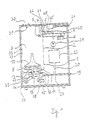
- FIG. 1 shows a cavity resonator 2 designed as a metal tub 1 which is closed on all sides and has walls which reflect microwaves towards the cavity resonator interior 3.
- An energy conductor 4 designed as a waveguide opens into the upper region of the cavity resonator 2.
- the cross section of the energy conductor 4 to form a coupling hole 5 is reduced in the region of its opening into the cavity resonator 2.
- the energy conductor 4 is connected to a microwave transmitter or generator designed as a magnetron 6, the area of which projects into the waveguide 4 has the usual distance of lambda / 4 from the inner surfaces of the waveguide 4.
- a movable closure 7 is arranged, with which the energy conductor can be sealed against the ingress of water.
- the movable closure 7 can be made of metal, plastic, rubber or the like.
- the cavity resonator 2 In its bottom area, the cavity resonator 2 has a glass plate 8 which, as a so-called base load, prevents microwaves from being returned to the magnetron when the device is in use is operated without load. Furthermore, a metal propeller 9 is arranged as a field distributor in the cavity 2 at the level of the coupling hole 5.
- the cavity resonator 2 has in its interior 3 a wing element 10, the drive shaft 11 of which is guided centrally through the bottom 12 of the cavity resonator 2.
- the passage area of the drive shaft 11 through the base 12 is sealed, for example, by a labyrinth seal 29 with appropriate shielding in a microwave and water-tight manner against the cavity resonator interior 3.
- the drive shaft 11 is fastened to a reversing gear 13, by means of which the rotational movement which can be picked up on an electric motor 14 is transmitted to the drive shaft 11.
- the cavity resonator 2 has an outlet 15 in the region of its base 12 for draining liquid from the cavity resonator interior 3.
- the opening 16 into the cavity 3 is covered by a movable closure 17 made of metal and can be shielded against the passage of microwaves.
- the outlet 15 is connected to a pump 18, by means of which liquid is sucked out of the cavity resonator interior 3 when the orifice 16 is not closed and is fed to a drain line 19 or return line 20.
- the pump 18 is designed in terms of its performance and design in such a way that it can generate a slight negative pressure in the cavity interior 3, for which purpose the cavity interior 3 is advantageously sealed off from the outside environment.
- the return line 20 opens into the inlet 21, through which the aqueous liquid required for washing and / or rinsing is fed to the cavity interior 3.
- valves for example solenoid valves, can be provided in the outlet 15 and the inlet 21 directly adjacent to the wall regions of the cavity resonator 2.
- a tub 23 and a further pump 24 are arranged in the return line 20.
- a detergent dispenser 25 with fresh water inlet 26 opens into the return line 20 or the inlet 21.
- the liquid flow within the return line 20 and to the inlet 21 can be regulated with valves 27 and 28.
- the cavity resonator 2 For the filling of the cavity resonator 2 with goods intended for washing and / or rinsing, the cavity resonator 2 has an opening 31 in its upper region, which can be closed in a microwave and water-tight manner with a door or flap 30. The treated material is also removed from the cavity resonator 2 through the opening 31.
- a temperature sensor 32 and a moisture sensor 33 are attached to the inner wall of the cavity resonator 2, which are effectively connected to the microwave generator 6 in a manner not shown here and which when the desired temperature is reached Prevent the generation of further microwaves.
- the above-described components of the device according to the invention are arranged in or on a housing 34 which is designed and can be handled similarly to known tub washing machines.
- the cavity resonator 2 is filled through the opening 31 with the items to be washed, for example textiles.
- the cavity resonator interior 3 fed through the inlet 21 aqueous washing liquid.
- This aqueous washing liquid gets onto the textiles and wets them.
- the textiles are moved by the rotating wing element 10. Unnecessary washing liquid, or one not yet taken up by the textiles, is sucked off in the outlet 15 and fed back via the return line 20 in the inlet 21 or, if desired, pumped into the outlet line 19. This process is carried out until the textiles in the cavity resonator are adequately wetted, in particular up to their maximum retention capacity, with the washing liquid.
- the liquid which may still be present in excess in the textiles and which may still be in the cavity resonator interior 3, possibly with the formation of a slight negative pressure in the cavity resonator 2, is pumped out of the latter and passed into the drain line 19 or the suds storage container 23.
- the actual washing process described further above is then started.
- the wing element 10 is also kept rotating in the washing process.
- the inlet 21 and the outlet 15 are covered with the closures 22 and 17 and the closure 7 is removed from the coupling hole 5.
- the microwave radiation that is now set in can be timed, intermittent or even, and can take place with constant or different power.
- microwave irradiation can already take place when the aqueous liquid enters the cavity interior.
- This has the advantage that water vapor forms during the wetting process, which can penetrate particularly well into the pores of the textiles.
- the individual processes of supplying and, where appropriate, removing aqueous liquid and microwave radiation can be carried out alternately several times in succession, as already described above.
- After washing and / or Rinsing treatment of the textiles can also be dried in the device according to the invention, for which purpose the cavity resonator 2 is to be provided with air supply and steam removal in the manner of conventional exhaust air or condensation dryers, which is not described in more detail in the present figures.
- washing and / or washing programs can be controlled and regulated by an automatic program (not shown here) and associated switching elements, as is customary in modern washing machines of known type.
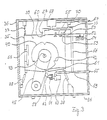
- FIGS 2 and 3 show a device according to the invention in the manner of conventional drum washing machines.
- the cavity resonator 35 is designed as a metal tub closed on all sides.
- the cavity resonator 35 is resiliently suspended in a housing 36.
- This resilient suspension consists of spring elements 37 acting externally on the cavity resonator 35 in its upper region and of shock absorbers 38 acting externally on the cavity resonator 35 in its lower region, which spring elements 37 and shock absorbers 38 are articulated to the housing 36 with their respective other ends.
- the cavity resonator interior 39 has a lying drum 40 made of plastic, which is provided in its radial side wall with sieve-like openings 41 and inner driver ribs 42.
- a drive shaft 43 is axially attached to the drum 40, which is led out of the cavity resonator through a wall of the cavity resonator 35 and ends in a further bearing in the region of an outer wall of the housing 36.
- a rotary movement that can be generated by means of an electric motor 44 is transmitted to the drive shaft 43 by means of a V-belt 45.
- Various speeds can be generated with the electric motor 44, in particular slow speeds which set the drum 40 in the usual washing rotation and faster speeds which set the drum 40 in the usual spin rotation.
- With their front area is the drum 40 is mounted in a groove 46 of a sheet metal wall 47 forming a side wall of the cavity resonator 35.
- a rubber or plastic seal 48 seals the space 49 between the housing front wall 50 and sheet metal wall 47 in a watertight manner.
- the front wall 50 of the housing is made of metal and has a door 51 in the region of the drum 40 for filling the drum 40 with items to be washed.
- the intermediate space 49 and the door 51 are sealed against the emergence of microwaves, in particular out of the housing 36, and each have a high frequency or microwave-proof shielding.
- the door 51 can have a viewing window made of glass with an inserted wire mesh for shielding the microwaves.
- a hollow conductor 52 opens into the cavity resonator interior 39 and has a coupling hole 53 in the opening region.
- microwaves can be generated in the waveguide 52 by means of a magnetron 54.
- Field distributors 55 and a base load 56 are arranged in the cavity resonator interior 39.
- an inlet 57 and an outlet 58 open into the cavity resonator interior 39.
- the coupling hole 53, the inlet 57 and the outlet 58 can be closed as described in FIG. 1 by means of movable closures 59, 60 and 61 in a microwave or watertight manner.
- the drain 58 is connected to a pump 63 by means of a line 62.
- a fluff filter 64 is arranged upstream of the pump 63 in the line 62. Liquid pumped out of the cavity resonator interior 39 can be fed from the pump 63 to a drain line 65 or a return line 66.
- the return line 66 opens into the inlet 57.
- a fresh water supply line 67 opens into the return line 66 in the area of the inlet 57.
- a detergent dispenser 68 is arranged in line 67. To regulate the liquid flows in lines 65, 66 and 67 are in the return line device 66 valves 69 and 70 provided.
- the area where the drive shaft 43 passes through the cavity resonator 35 is sealed in a microwave and water-tight manner by a bearing 72 in the manner of a labyrinth seal.
- the washing process takes place in the devices according to FIGS. 2 and 3 analogously to that described for a device according to FIG. 1. Only here, of course, instead of the wing element 10, the drum 40 moves.
- the squeezing and removal of excess water or washing liquid present in the wetted material in the sense of the method according to the invention takes place in the device according to FIGS. 2 and 3 in that the rotational speed of the drum 40 increased briefly to spin speed and the liquid is pumped out by means of the pump 63. It is not necessary here for a slight negative pressure to be generated in the cavity resonator interior 39.
- Both the drum and the wing element 10 can be set in rotation continuously or discontinuously, if desired by changing the direction of rotation.
- thermocouple 73 which extends into the interior of the drum 40, is arranged coaxially to the axis of the drive shaft 43.
- the thermocouple 73 is plastic-coated and its measuring tip 74 ends in the interior of the plastic cylinder 75 surrounding the thermocouple.
- the microwave transmitter or generator 6 or 54 has one Power between 100 watts and 1.5 kilowatts.
- the microwave generator used in each case can be regulated to different power outputs.
- the microwave generation can be constant, timed or intermittent.
- the device according to the invention is not limited to the use of a magnetron for microwave generation.
- a reflex klystron, a changing field tube, Gunn oscillators, avalanche delay diodes, microwave transistors or the like can also be used.
- the device according to FIGS. 1 to 3 can have a security element arranged on the door 51 or the flap 30, which is effectively connected to the microwave generator and / or the devices regulating the liquid inflow and / or outflow, so that by means of the security element the Microwave generation or the liquid supply is interrupted.
- the inlets 21 and 57 to the interior of the cavity resonator 2 and 35 can be designed as spray heads or nozzles.
- ultrasound generators for generating ultrasound vibrations and / or UV radiation-emitting devices can be arranged in or on the cavity resonator 2 or 35, but in particular in the cavity resonator 2 designed as a metal tub.
- FIGS. 1 to 3 Further elements, such as electrical lines and modules for an automatic washing machine, which, however, are already necessary for the operation of conventional washing machines and are familiar to the person skilled in the art, are not shown in more detail in FIGS. 1 to 3. These correspond to the elements known from the usual washing machine technology.
- the described embodiment of the device according to the invention can be modified in many ways without departing from the basic idea of the invention.
- commercial washing machines can also be operated using the method according to the invention and can be provided with appropriate cavity resonators for microwave reflection.
- a device is conceivable in which the items to be washed are introduced into a plastic drum which can be subjected to microwaves and which is arranged in a metal housing.
- an elongated drum of the rotary tube type which has a double drum section with an inner drum made of plastic, which can be exposed to microwave radiation, while the outer drum in this area and the subsequent drum areas, which are optionally designed as single drum sections, are made of metal , wherein the single-drum areas are optionally provided on the inside of the drum with microwave-absorbing material to form a reflection-free finish.
- a commercially available microwave oven of the "Siemens HF 0650" brand is used as the microwave device, which provides for a time-controlled power input in the following stages: 90 W, 180 W, 360 W or 600 W.
- the radiated energy has a frequency of 2.45 GHz.
- the washing tests are carried out with tissue samples which are soiled with standard dirt and which come from the applicant's own production.
- the soiling initial values of the soiled test fabric used are as follows: Polyester-cotton blended fabric, refined (dust / skin fat soiling) 30.0 (% remission) Cotton refined (tea soiling) 33 (% remission)
- a stock liquor which contains the liquid heavy-duty detergent in a 6-fold concentration compared to the detergent concentration used in normal textile washing.
- Polyester / cotton blended fabric (SH-PBV) soiled with dust / skin oil is treated with an amount of the base liquor which is just sufficient to soak the textile material without forming substantial amounts of an additional serum phase.
- the soaked textile is placed in a glass jar in the microwave oven and then treated as follows: 10 sec irradiation with a power input of 180 watts Removal of the textile from the stove and intensive circulation of the soaked textile sample Re-irradiate the soaked textile in the microwave oven for 10 sec Repetition of the intensive circulation of the irradiated, soaked textile sample Repetition of the previously described two-stage work cycle, however, the irradiation time is only 5 seconds each.
- the textile material pretreated in this way is then washed out with lukewarm water, dried and subjected to the determination of the remission value. Determined remission value: 71 (% remission).
- SH-PBV soiled test material is again subjected to the wetting under the action of microwaves with subsequent rinsing.
- the wetting is now carried out as follows: Power input 180 watts, irradiation time 10 sec Intensive textile mechanics by hand circulation Again power input 180 watts for 10 sec.
- Saturation of the prewashed textile goods with new concentrated wash liquor again until the saturation value of the textile goods compared to the wash liquor is reached.
- the textile goods subjected to double washing in this way are carefully rinsed out with lukewarm water and dried, and then their remission value is determined to be 79.8 (% remission).
- a piece of textile (SH-PBV) soaked through with the concentrated soapy water is wrapped in a dry terry towel.
- the package is placed in the microwave oven and irradiated in two process stages for 30 seconds each with a power input of 600 watts.
- the packet-shaped textile mass is removed from the microwave oven and opened.
- the dry covering of the terry towel shows no tangible warming up. However, the interior and especially the soaked soiled test fabric are heated up.
- the soiled test fabric has given deeply colored stains to the dry terry material.
- the textile material to be washed is once again soaked with the concentrated soapy water and again wrapped in the dry terry towel.
- the textile package is then exposed again to the irradiation of 600 watts of power for a period of 30 seconds.
- the hot rag is rinsed intensively with cold water, dried and used to determine the remission value. Measured value: 76.8 (% remission).
- Example 3 is repeated, but now, instead of a dry covering with terry cloth, the test fabric to be cleaned is covered with a wet terry cloth.
- the degree of saturation of the textile test material to be cleaned corresponds to the maximum retention capacity of this sample, the terry cloth is first completely wetted with pure water, but then squeezed out by hand and used in this form as a covering.
- Example 3 The working conditions of Example 3 are repeated.
- Example 3 Compared to the experiment in Example 3, the outer terry cloth is also heated up strongly in this experiment, whereby when the package is opened, it is shown that the temperature inside the package is obviously higher than it can be felt on the outer surface of the package.
- the pre-wetted soiled test material is washed in lukewarm water and dried.
- the remission value of the washed and dried material is 80.7.
- Test fabric containing bleachable tea stain is impregnated with a concentrated wash liquor which contains a commercially available powdered heavy-duty detergent in a concentration of 5 to 6 times that of a conventional textile wash.
- the impregnated textile material is treated in three irradiation sections, each with a power irradiation of 180 watts, first for 20 seconds and then 2 x 10 seconds. Between these periods of microwave radiation, the well-wetted textile is subjected to intensive manual circulation.
- the pre-wetted material is washed out intensively with water.
- the color of the tea dirt has declined or brightened overall.
- the following picture emerges in detail: There is an irregular brightening in such a way that the overall specimen is interspersed with punctiform areas that are almost pure white, while areas in between still show clear residues of the - although lightened - brown tea stains.
Landscapes
- Engineering & Computer Science (AREA)
- Textile Engineering (AREA)
- Treatment Of Fiber Materials (AREA)
- Detergent Compositions (AREA)
- Detail Structures Of Washing Machines And Dryers (AREA)
- Accessory Of Washing/Drying Machine, Commercial Washing/Drying Machine, Other Washing/Drying Machine (AREA)
- Main Body Construction Of Washing Machines And Laundry Dryers (AREA)
Priority Applications (1)
| Application Number | Priority Date | Filing Date | Title |
|---|---|---|---|
| AT88102944T ATE80422T1 (de) | 1987-03-06 | 1988-02-27 | Verfahren zum waschen und/oder spuelen von textilmaterialien sowie hierfuer geeignete vorrichtungen. |
Applications Claiming Priority (2)
| Application Number | Priority Date | Filing Date | Title |
|---|---|---|---|
| DE19873707147 DE3707147A1 (de) | 1987-03-06 | 1987-03-06 | Verfahren zum waschen und/oder spuelen von textilmaterialien sowie hierfuer geeignete vorrichtungen |
| DE3707147 | 1987-03-06 |
Publications (2)
| Publication Number | Publication Date |
|---|---|
| EP0281041A1 true EP0281041A1 (fr) | 1988-09-07 |
| EP0281041B1 EP0281041B1 (fr) | 1992-09-09 |
Family
ID=6322377
Family Applications (2)
| Application Number | Title | Priority Date | Filing Date |
|---|---|---|---|
| EP88102944A Expired - Lifetime EP0281041B1 (fr) | 1987-03-06 | 1988-02-27 | Procédé et dispositif pour laver et/ou rincer des matières textiles |
| EP88902125A Pending EP0356427A1 (fr) | 1987-03-06 | 1988-02-27 | Procede et dispositifs de lavage et/ou de rin age de materiaux textiles |
Family Applications After (1)
| Application Number | Title | Priority Date | Filing Date |
|---|---|---|---|
| EP88902125A Pending EP0356427A1 (fr) | 1987-03-06 | 1988-02-27 | Procede et dispositifs de lavage et/ou de rin age de materiaux textiles |
Country Status (9)
| Country | Link |
|---|---|
| EP (2) | EP0281041B1 (fr) |
| JP (1) | JPH02502429A (fr) |
| KR (1) | KR890700711A (fr) |
| AT (1) | ATE80422T1 (fr) |
| DE (2) | DE3707147A1 (fr) |
| ES (2) | ES2033957T3 (fr) |
| GR (1) | GR3006107T3 (fr) |
| WO (1) | WO1988006654A1 (fr) |
| YU (2) | YU46979B (fr) |
Cited By (4)
| Publication number | Priority date | Publication date | Assignee | Title |
|---|---|---|---|---|
| WO2002022935A1 (fr) * | 2000-09-15 | 2002-03-21 | Lindström Oy | Procede de fabrication d'un module de machine permettant le lavage industriel de textiles et module de machine |
| FR2849343A1 (fr) * | 2002-12-23 | 2004-06-25 | Aldivia | Synthese chimique comportant un traitement thermique par chauffage dielectrique intermittent, combine a un systeme de recirculation |
| WO2016040966A1 (fr) * | 2014-09-10 | 2016-03-17 | King, Denis John | Lave-linge |
| CN115016411A (zh) * | 2022-06-10 | 2022-09-06 | 苏州益盟新材料科技有限公司 | 一种用于纺织品后加工产线的给水管理调控系统 |
Families Citing this family (10)
| Publication number | Priority date | Publication date | Assignee | Title |
|---|---|---|---|---|
| DE4010705A1 (de) * | 1990-04-03 | 1991-10-10 | Licentia Gmbh | Mit ultraschallwellen kombiniertes waschverfahren und waschmaschine zur durchfuehrung des verfahrens |
| RU2194556C2 (ru) * | 1999-12-14 | 2002-12-20 | Войсковая часть 61469 | Способ дегазации материалов армейского обмундирования |
| RU2220242C2 (ru) * | 2001-11-02 | 2003-12-27 | Войсковая часть 61469 | Способ дегазации материалов армейского обмундирования в электрохимически активированных растворах при воздействии ультразвукового поля |
| KR100836329B1 (ko) * | 2006-09-20 | 2008-06-09 | 엘지전자 주식회사 | 세탁물의 세탁 방법 |
| US7674300B2 (en) | 2006-12-28 | 2010-03-09 | Kimberly-Clark Worldwide, Inc. | Process for dyeing a textile web |
| US7568251B2 (en) | 2006-12-28 | 2009-08-04 | Kimberly-Clark Worldwide, Inc. | Process for dyeing a textile web |
| US7740666B2 (en) | 2006-12-28 | 2010-06-22 | Kimberly-Clark Worldwide, Inc. | Process for dyeing a textile web |
| US8182552B2 (en) | 2006-12-28 | 2012-05-22 | Kimberly-Clark Worldwide, Inc. | Process for dyeing a textile web |
| US8632613B2 (en) | 2007-12-27 | 2014-01-21 | Kimberly-Clark Worldwide, Inc. | Process for applying one or more treatment agents to a textile web |
| DE102008025294B4 (de) | 2008-05-27 | 2012-06-21 | Rational Ag | Verfahren zum Reinigen eines Garraums |
Citations (5)
| Publication number | Priority date | Publication date | Assignee | Title |
|---|---|---|---|---|
| US3410116A (en) * | 1966-10-24 | 1968-11-12 | Melvin L. Levinson | Microwave and ultrasonic apparatus |
| DE1610307A1 (de) * | 1965-06-05 | 1971-04-01 | Zanker Kg Hermann | Waschmaschine |
| DE2628879A1 (de) * | 1975-07-02 | 1977-01-20 | Henkel & Cie Gmbh | Verfahren und vorrichtung zum waschen von textilien |
| US4356640A (en) * | 1980-07-02 | 1982-11-02 | Christian Jansson | Method of drying clothes and heating up laundry water and apparatus therefor |
| EP0159204A1 (fr) * | 1984-02-17 | 1985-10-23 | Esswein S.A. | Lave-linge dont la cuve contient de l'eau à une faible hauteur au-dessus du fond du tambour |
Family Cites Families (1)
| Publication number | Priority date | Publication date | Assignee | Title |
|---|---|---|---|---|
| US4489574A (en) | 1981-11-10 | 1984-12-25 | The Procter & Gamble Company | Apparatus for highly efficient laundering of textiles |
-
1987
- 1987-03-06 DE DE19873707147 patent/DE3707147A1/de not_active Withdrawn
-
1988
- 1988-02-27 DE DE8888102944T patent/DE3874367D1/de not_active Expired - Fee Related
- 1988-02-27 AT AT88102944T patent/ATE80422T1/de not_active IP Right Cessation
- 1988-02-27 WO PCT/EP1988/000147 patent/WO1988006654A1/fr not_active Ceased
- 1988-02-27 ES ES198888102944T patent/ES2033957T3/es not_active Expired - Lifetime
- 1988-02-27 EP EP88102944A patent/EP0281041B1/fr not_active Expired - Lifetime
- 1988-02-27 JP JP63502004A patent/JPH02502429A/ja active Pending
- 1988-02-27 EP EP88902125A patent/EP0356427A1/fr active Pending
- 1988-03-01 YU YU40788A patent/YU46979B/sh unknown
- 1988-03-04 ES ES19888800659U patent/ES1006937Y/es not_active Expired
- 1988-11-03 KR KR1019880701396A patent/KR890700711A/ko not_active Ceased
-
1989
- 1989-04-06 YU YU69189A patent/YU47091B/sh unknown
-
1992
- 1992-10-29 GR GR920402428T patent/GR3006107T3/el unknown
Patent Citations (5)
| Publication number | Priority date | Publication date | Assignee | Title |
|---|---|---|---|---|
| DE1610307A1 (de) * | 1965-06-05 | 1971-04-01 | Zanker Kg Hermann | Waschmaschine |
| US3410116A (en) * | 1966-10-24 | 1968-11-12 | Melvin L. Levinson | Microwave and ultrasonic apparatus |
| DE2628879A1 (de) * | 1975-07-02 | 1977-01-20 | Henkel & Cie Gmbh | Verfahren und vorrichtung zum waschen von textilien |
| US4356640A (en) * | 1980-07-02 | 1982-11-02 | Christian Jansson | Method of drying clothes and heating up laundry water and apparatus therefor |
| EP0159204A1 (fr) * | 1984-02-17 | 1985-10-23 | Esswein S.A. | Lave-linge dont la cuve contient de l'eau à une faible hauteur au-dessus du fond du tambour |
Cited By (12)
| Publication number | Priority date | Publication date | Assignee | Title |
|---|---|---|---|---|
| WO2002022935A1 (fr) * | 2000-09-15 | 2002-03-21 | Lindström Oy | Procede de fabrication d'un module de machine permettant le lavage industriel de textiles et module de machine |
| CZ301229B6 (cs) * | 2000-09-15 | 2009-12-16 | Lindström Oy | Zpusob vytvárení strojového modulu pro prumyslové praní textilních výrobku a strojový modul |
| HRP20030291B1 (hr) * | 2000-09-15 | 2011-06-30 | Lindstr�m Oy | Postupak za proizvodnju strojnog modula za industrijsko pranje tekstila i strojni modul |
| FR2849343A1 (fr) * | 2002-12-23 | 2004-06-25 | Aldivia | Synthese chimique comportant un traitement thermique par chauffage dielectrique intermittent, combine a un systeme de recirculation |
| US8328997B2 (en) | 2002-12-23 | 2012-12-11 | Aldivia Sa | Chemical synthesis comprising heat treatment by intermittent dielectric heating combined with a recycling system |
| US9756687B2 (en) | 2002-12-23 | 2017-09-05 | Aldivia Sas | Chemical synthesis comprising heat treatment by intermittent dielectric heating combined with a recycling system |
| WO2016040966A1 (fr) * | 2014-09-10 | 2016-03-17 | King, Denis John | Lave-linge |
| CN107250455A (zh) * | 2014-09-10 | 2017-10-13 | 丹尼斯·约翰·金 | 洗衣机 |
| US20170306545A1 (en) * | 2014-09-10 | 2017-10-26 | Denis John KING | Cleaning apparatus |
| CN107250455B (zh) * | 2014-09-10 | 2020-06-30 | 丹尼斯·约翰·金 | 洗衣机 |
| AU2014405884B2 (en) * | 2014-09-10 | 2020-10-22 | Delphius Commercial And Industrial Technologies (Pty) Ltd | Washing machine |
| CN115016411A (zh) * | 2022-06-10 | 2022-09-06 | 苏州益盟新材料科技有限公司 | 一种用于纺织品后加工产线的给水管理调控系统 |
Also Published As
| Publication number | Publication date |
|---|---|
| EP0356427A1 (fr) | 1990-03-07 |
| DE3707147A1 (de) | 1988-09-15 |
| ES1006937U (es) | 1989-01-16 |
| YU40788A (en) | 1991-02-28 |
| DE3874367D1 (de) | 1992-10-15 |
| EP0281041B1 (fr) | 1992-09-09 |
| JPH02502429A (ja) | 1990-08-09 |
| KR890700711A (ko) | 1989-04-26 |
| YU69189A (en) | 1990-10-31 |
| WO1988006654A1 (fr) | 1988-09-07 |
| ES2033957T3 (es) | 1993-04-01 |
| YU47091B (sh) | 1994-12-28 |
| YU46979B (sh) | 1994-09-09 |
| GR3006107T3 (fr) | 1993-06-21 |
| ES1006937Y (es) | 1989-07-16 |
| ATE80422T1 (de) | 1992-09-15 |
Similar Documents
| Publication | Publication Date | Title |
|---|---|---|
| DE3280450T2 (de) | Reinigungsmittel und Waschflüssigkeiten für Textilwaschverfahren. | |
| EP0281041B1 (fr) | Procédé et dispositif pour laver et/ou rincer des matières textiles | |
| EP2882896B1 (fr) | Machine à laver équipée d'un dispositif de production de gouttes d'eau, et procédé d'utilisation de cette machine | |
| DE19751028C2 (de) | Verfahren zur Durchführung eines Hygieneprogramms | |
| EP2580381B1 (fr) | Procédé pour traiter du linge dans un lave-linge à basse température et lave-linge correspondant | |
| DE19743508A1 (de) | Verfahren zum Erhitzen der Waschlauge in einer Waschmaschine | |
| DE102007028212B4 (de) | Verfahren zur Behandlung von Wäschestücken sowie hierzu geeignete Waschmaschine | |
| WO2006079429A1 (fr) | Procede pour essorer des textiles apres un processus d'impregnation | |
| DE102008062925B4 (de) | Verfahren zum Steuern einer Waschmaschine | |
| EP3428336B1 (fr) | Procédé de traitement de textiles et lave-linge | |
| EP3255195B1 (fr) | Procédé d'amélioration de la performance de lavage d'un lave-linge et lave-linge adapté | |
| EP0837172B1 (fr) | Machine à laver à tambour | |
| DE102010036565B4 (de) | Verfahren zur Enzymausgabe in einem Waschgutbehandlungsgerät | |
| DE69829052T2 (de) | Waschgang für Waschmaschine | |
| DE2045008A1 (de) | Zwei Phasen Reinigungsmitteige misch und Verfahren zur Reinigungsbe handtung von Geweben | |
| DE60005538T2 (de) | Verfahren zum waschen von wäsche und waschmaschine zum durchführen dieses verfahrens | |
| DE3134546A1 (de) | Verfahren zur reinigung von textilien, insbesondere in haushaltswaschmaschinen | |
| EP2003236B1 (fr) | Procédé de nettoyage et de recyclage de chiffons | |
| DE102012104536A1 (de) | Waschgutbehandlungsgerät mit verfahren zum verstärken der chemikalienwirkung | |
| DE3007670A1 (de) | Verfahren und vorrichtung zum reinigen von textilien | |
| EP4411051A1 (fr) | Procédé de nettoyage du linge et système de lavage correspondant | |
| EP0258816A2 (fr) | Procédé pour le lavage et le nettoyage de matières textiles | |
| AT144350B (de) | Verfahren zum Wasserabstoßendmachen von Wolle. | |
| AT231389B (de) | Verfahren zum Waschen von Wäsche | |
| RU2221095C2 (ru) | Способ очистки текстильных материалов и изделий из них |
Legal Events
| Date | Code | Title | Description |
|---|---|---|---|
| PUAI | Public reference made under article 153(3) epc to a published international application that has entered the european phase |
Free format text: ORIGINAL CODE: 0009012 |
|
| AK | Designated contracting states |
Kind code of ref document: A1 Designated state(s): ES GR |
|
| 17P | Request for examination filed |
Effective date: 19890302 |
|
| 17Q | First examination report despatched |
Effective date: 19901002 |
|
| RBV | Designated contracting states (corrected) |
Designated state(s): AT BE CH DE ES FR GB GR IT LI LU NL SE |
|
| XX | Miscellaneous (additional remarks) |
Free format text: VERBUNDEN MIT 88902125.9/0356427 (EUROPAEISCHE ANMELDENUMMER/VEROEFFENTLICHUNGSNUMMER) DURCH ENTSCHEIDUNG VOM 21.10.91. |
|
| GRAA | (expected) grant |
Free format text: ORIGINAL CODE: 0009210 |
|
| AK | Designated contracting states |
Kind code of ref document: B1 Designated state(s): AT BE CH DE ES FR GB GR IT LI LU NL SE |
|
| REF | Corresponds to: |
Ref document number: 80422 Country of ref document: AT Date of ref document: 19920915 Kind code of ref document: T |
|
| XX | Miscellaneous (additional remarks) |
Free format text: VERBUNDEN MIT 88902125.9/0356427 (EUROPAEISCHE ANMELDENUMMER/VEROEFFENTLICHUNGSNUMMER) DURCH ENTSCHEIDUNG VOM 21.10.91. |
|
| GBT | Gb: translation of ep patent filed (gb section 77(6)(a)/1977) | ||
| REF | Corresponds to: |
Ref document number: 3874367 Country of ref document: DE Date of ref document: 19921015 |
|
| ITF | It: translation for a ep patent filed | ||
| ET | Fr: translation filed | ||
| PGFP | Annual fee paid to national office [announced via postgrant information from national office to epo] |
Ref country code: CH Payment date: 19930121 Year of fee payment: 6 |
|
| PGFP | Annual fee paid to national office [announced via postgrant information from national office to epo] |
Ref country code: DE Payment date: 19930128 Year of fee payment: 6 |
|
| PGFP | Annual fee paid to national office [announced via postgrant information from national office to epo] |
Ref country code: AT Payment date: 19930203 Year of fee payment: 6 |
|
| PGFP | Annual fee paid to national office [announced via postgrant information from national office to epo] |
Ref country code: FR Payment date: 19930209 Year of fee payment: 6 |
|
| PGFP | Annual fee paid to national office [announced via postgrant information from national office to epo] |
Ref country code: SE Payment date: 19930215 Year of fee payment: 6 |
|
| PGFP | Annual fee paid to national office [announced via postgrant information from national office to epo] |
Ref country code: GB Payment date: 19930217 Year of fee payment: 6 |
|
| PGFP | Annual fee paid to national office [announced via postgrant information from national office to epo] |
Ref country code: GR Payment date: 19930225 Year of fee payment: 6 |
|
| PGFP | Annual fee paid to national office [announced via postgrant information from national office to epo] |
Ref country code: ES Payment date: 19930226 Year of fee payment: 6 |
|
| PGFP | Annual fee paid to national office [announced via postgrant information from national office to epo] |
Ref country code: NL Payment date: 19930228 Year of fee payment: 6 |
|
| PGFP | Annual fee paid to national office [announced via postgrant information from national office to epo] |
Ref country code: LU Payment date: 19930316 Year of fee payment: 6 |
|
| PGFP | Annual fee paid to national office [announced via postgrant information from national office to epo] |
Ref country code: BE Payment date: 19930330 Year of fee payment: 6 |
|
| REG | Reference to a national code |
Ref country code: ES Ref legal event code: FG2A Ref document number: 2033957 Country of ref document: ES Kind code of ref document: T3 |
|
| REG | Reference to a national code |
Ref country code: GR Ref legal event code: FG4A Free format text: 3006107 |
|
| PLBE | No opposition filed within time limit |
Free format text: ORIGINAL CODE: 0009261 |
|
| STAA | Information on the status of an ep patent application or granted ep patent |
Free format text: STATUS: NO OPPOSITION FILED WITHIN TIME LIMIT |
|
| EPTA | Lu: last paid annual fee | ||
| 26N | No opposition filed | ||
| PG25 | Lapsed in a contracting state [announced via postgrant information from national office to epo] |
Ref country code: LU Free format text: LAPSE BECAUSE OF NON-PAYMENT OF DUE FEES Effective date: 19940227 Ref country code: GB Effective date: 19940227 Ref country code: AT Effective date: 19940227 |
|
| PG25 | Lapsed in a contracting state [announced via postgrant information from national office to epo] |
Ref country code: SE Effective date: 19940228 Ref country code: LI Effective date: 19940228 Ref country code: ES Free format text: LAPSE BECAUSE OF NON-PAYMENT OF DUE FEES Effective date: 19940228 Ref country code: CH Effective date: 19940228 Ref country code: BE Effective date: 19940228 |
|
| BERE | Be: lapsed |
Owner name: HENKEL K.G.A.A. Effective date: 19940228 |
|
| PG25 | Lapsed in a contracting state [announced via postgrant information from national office to epo] |
Ref country code: GR Free format text: THE PATENT HAS BEEN ANNULLED BY A DECISION OF A NATIONAL AUTHORITY Effective date: 19940831 |
|
| PG25 | Lapsed in a contracting state [announced via postgrant information from national office to epo] |
Ref country code: NL Effective date: 19940901 |
|
| NLV4 | Nl: lapsed or anulled due to non-payment of the annual fee | ||
| GBPC | Gb: european patent ceased through non-payment of renewal fee |
Effective date: 19940227 |
|
| PG25 | Lapsed in a contracting state [announced via postgrant information from national office to epo] |
Ref country code: FR Effective date: 19941031 |
|
| REG | Reference to a national code |
Ref country code: CH Ref legal event code: PL |
|
| PG25 | Lapsed in a contracting state [announced via postgrant information from national office to epo] |
Ref country code: DE Effective date: 19941101 |
|
| REG | Reference to a national code |
Ref country code: FR Ref legal event code: ST Ref country code: GR Ref legal event code: MM2A Free format text: 3006107 |
|
| EUG | Se: european patent has lapsed |
Ref document number: 88102944.1 Effective date: 19940910 |
|
| REG | Reference to a national code |
Ref country code: ES Ref legal event code: FD2A Effective date: 19990301 |
|
| PG25 | Lapsed in a contracting state [announced via postgrant information from national office to epo] |
Ref country code: IT Free format text: LAPSE BECAUSE OF NON-PAYMENT OF DUE FEES;WARNING: LAPSES OF ITALIAN PATENTS WITH EFFECTIVE DATE BEFORE 2007 MAY HAVE OCCURRED AT ANY TIME BEFORE 2007. THE CORRECT EFFECTIVE DATE MAY BE DIFFERENT FROM THE ONE RECORDED. Effective date: 20050227 |