EP0281078A2 - Kamera mit automatischer Fokussierungsvorrichtung - Google Patents
Kamera mit automatischer Fokussierungsvorrichtung Download PDFInfo
- Publication number
- EP0281078A2 EP0281078A2 EP88103085A EP88103085A EP0281078A2 EP 0281078 A2 EP0281078 A2 EP 0281078A2 EP 88103085 A EP88103085 A EP 88103085A EP 88103085 A EP88103085 A EP 88103085A EP 0281078 A2 EP0281078 A2 EP 0281078A2
- Authority
- EP
- European Patent Office
- Prior art keywords
- lens
- pulse
- count
- pulse signal
- camera
- Prior art date
- Legal status (The legal status is an assumption and is not a legal conclusion. Google has not performed a legal analysis and makes no representation as to the accuracy of the status listed.)
- Withdrawn
Links
- 230000003287 optical effect Effects 0.000 claims abstract description 13
- 238000001514 detection method Methods 0.000 claims abstract description 9
- 238000005259 measurement Methods 0.000 claims description 17
- 230000001105 regulatory effect Effects 0.000 description 17
- 230000006835 compression Effects 0.000 description 4
- 238000007906 compression Methods 0.000 description 4
- 238000010586 diagram Methods 0.000 description 3
- 230000003111 delayed effect Effects 0.000 description 2
- 230000000694 effects Effects 0.000 description 2
- 230000002093 peripheral effect Effects 0.000 description 2
- 230000001276 controlling effect Effects 0.000 description 1
- 230000007274 generation of a signal involved in cell-cell signaling Effects 0.000 description 1
- 230000004048 modification Effects 0.000 description 1
- 238000012986 modification Methods 0.000 description 1
- 230000000630 rising effect Effects 0.000 description 1
- 239000007787 solid Substances 0.000 description 1
- 230000001360 synchronised effect Effects 0.000 description 1
Images

Classifications
-
- G—PHYSICS
- G02—OPTICS
- G02B—OPTICAL ELEMENTS, SYSTEMS OR APPARATUS
- G02B7/00—Mountings, adjusting means, or light-tight connections, for optical elements
- G02B7/28—Systems for automatic generation of focusing signals
- G02B7/36—Systems for automatic generation of focusing signals using image sharpness techniques, e.g. image processing techniques for generating autofocus signals
Definitions
- the present invention relates to a camera with an automatic focusing apparatus, which is designed to drive a photographing lens to an in-focus position by power of a motor.
- the lens positioning member is rotated by the motor power based on distance data obtained by the distance measurement device so as to set a regulating position of the photographing lens.
- the lens drive member is rotated so that the photographing lens is moved to the regulating position, thereby determining an in-focus position.
- the lens positioning member is a cylindrical member having continuous stepped teeth which have steps in the direction of the optical axis.
- the rotational angle of the lens positioning member is controlled by the distance data from the distance measurement device, so that a predetermined stepped tooth is set at a regulating position of the photographing lens. In this case, control of the rotational angle is performed by feeding back a pulse signal count as follows.
- the automatic focusing apparatus includes a signal generator capable of generating pulse signals corresponding in number to a digital value of a photographing distance stored based on the distance measurement result, in addition to the distance measurement device.
- the signal generator When the lens positioning member begins to rotate by the motor, the signal generator generates a pulse signal corresponding to a pitch of the stepped teeth of the lens positioning member.
- the pulse signal count coincides with the above-mentioned digital value, the lens positioning member is mechanically locked to stop its rotation.
- the regulating position of the photographing lens corresponding to the measured distance can be obtained in accordance with the rotational angle of the lens positioning member.
- the mechanical locking operation of the lens positioning member is performed as follows. That is, when the pulse signal count coincides with the digital value, an electromagnetic device is energized, so that a ratchet type stop pawl is actuated to be engaged with a gear of the lens positioning member. In this operation, a slight mechanical delay is inevitably generated from when the pulse signal count is detected until the ratchet gear is engaged. Therefore, a timing at which the predetermined pulse count is obtained is advanced by a time corresponding to the mechanical delay from a phase of a stepped tooth to be locked, so that a predetermined regulating position can be reliably obtained.
- a camera with an automatic focusing apparatus wherein a distance measurement signal is stored as a digital value in storage means, pulses corresponding to a distance, which are generated upon rotational movement of a lens along an optical axis through a motor, are counted by count means, and a stop pawl for stopping the lens is driven in accordance with the count value, characterized in that a pulse width corresponding to a value corresponding to a value before the digital value stored in the storage means by a predetermined number of steps is detected by detecting means, and when a pulse count corresponding to the stored digital value is detected by the count means, the stop pawl is driven to be delayed in correspondence with the detected pulse width.
- Fig. 1 is an exploded view of members constituting an apparatus of the present invention for a camera along an optical axis. These members are incorporated in a lens barrel portion of the camera as a unit, and are driven and controlled by a power supply and a controller arranged in a camera main body.
- Reference numeral 10 denotes an electromagnetic unit fixed inside the lens barrel.
- the electromagnetic unit 10 houses a first movable coil member (not shown) for controlling an exposure amount of a photographing lens, and a second movable coil member 12 on which a regulating pin 11 for regulating a lock member (to be described later) projects to be pivotal about an optical axis.
- Reference numeral 20 denotes a lens guide mounted on the front surface of the electromagnetic unit 10.
- the lens guide 20 comprises a flange portion 21 and a cylindrical portion 26.
- a printed circuit board 22 having a detection pattern for sending lens position data to the controller is provided on the flange portion 21.
- a stop pawl 24 which is biased clockwise by a tensile spring 23 is axially supported on the flange portion 21. Note that clockwise rotation of the stop pawl 24 is interfered by the lock effect of the regulating pin 11 of the electromagnetic unit 10.
- Three straight grooves 27 are formed in the peripheral surface of the cylindrical portion 26 at equal angular intervals to extend along the optical axis.
- the grooves 27 respectively receive guide pins 51 of a photographing lens 50 as a first driven member which is slidably engaged with the inner peripheral surface, so that the photographing lens 50 can reciprocate along the optical axis.
- Reference numeral 40 denotes a lens drive member as a second driven member which is pivotally engaged with the outer periphery of the cylindrical member 26 of the lens guide 20.
- the lens drive member 40 has a cylindrical member 41.
- Three cam grooves 42 formed in the cylindrical portion 41 are respectively engaged with the guide pins 51 of the photographing lens 50 to define a state for regulating a straight moving position of the photographing lens 50 together with the straight grooves 27.
- the lens drive member 40 can be pivoted clockwise from an illustrated position in Fig. 1 by a pinion 61 of a DC motor 60 through a gear portion 47 having a flange 46, and can be pivoted counterclockwise to return to the illustrated position.
- Reference numeral 30 denotes a lens positioning member as a third driven member fitted on the cylindrical portion 41 of the lens drive member 40.
- Three stepped cams 31 are formed on the end face of the lens positioning member 30 in correspondence with the guide pins 51.
- the stepped cams 31 are in contact with the guide pins 51 of the photographing lens 50, so as to set the photographing lens 50 at a predetermined focusing position.
- the lens positioning member 30 and the lens drive member 40 are integrated such that the distal end of a compression spring 33 mounted on a projection 32 of the lens positioning member 30 is engaged with a V-shaped notch 48 formed on the flange portion 46 of the lens drive member 40.
- the members 30 and 40 are simultaneously rotated by the motor 60.
- the cam grooves 42 of the lens drive member 40 are arranged to be substantially parallel to the corresponding stepped cams 31 of the lens positioning member 30, and to be slightly separated therefrom so as not to cause the guide pins 51 of the photographing lens 50 regulated by the grooved cams 42 to be in contact with the corresponding stepped cams 31.
- a contact 35 is mounted on another projection 34 of the lens positioning member 30, and is in sliding contact with an ON/OFF circuit pattern on the printed circuit board 22 of the lens guide 20 upon rotation of the lens drive member 40 so as to supply a pulse signal to the controller.
- a pawl gear 36 to be engaged with the stop pawl 24 actuated in response to a signal from the controller is also formed on the lens positioning member 30.
- the lens drive member 40 and the lens positioning member 30 are pivotally clamped between the front surface of the flange portion 21 of the lens guide 20 and a back surface of a press plate 70 mounted on the flange portion 21 through three columns 71.
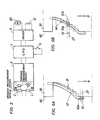
- Fig. 2 is a block diagram of a controller for a camera according to the present invention.
- Reference numeral 1 denotes a projection lens for projecting infrared light emitted from an infrared light emitting diode 1a toward an object; 2, a light receiving lens for receiving the infrared light reflected by the object; 2a, a position detection element for converting the infrared light passing through the light receiving lens 2 and converting it into a current; 3, a distance measurement circuit for sending a light emission signal to the infrared light emitting diode 1a and amplifying a distance signal output from the position detection element 2a; 4, a control circuit for calculating a distance to the object based on the distance signal, storing the calculated result as a digital value, and supplying a drive signal to a driver 5 based on the digital value; and 6, a switch simply representing a pulse signal generation means constituted by the contact 35 provided to the lens positioning member 30 and the printed circuit board 22 provided to the
- reference numeral 12 denotes the second movable coil member of the electromagnetic unit 10; and 60, the lens drive motor, which have already been explained with reference to Fig. 1.
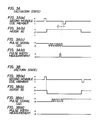
- Fig. 3A shows a photographing lens drive mode before a photographing operation
- Fig. 3B shows a mode when the photographing lens is returned after the photographing operation is completed.
- the distance measurement circuit 3 detects an object distance, and inputs distance data to the control circuit 4.
- the second movable coil member 12 is energized for the purpose of safety to apply a counterclockwise rotation torque to the regulating pin 11.
- the motor 60 is started slightly after actuation of the regulating pin 11, as shown in Fig. 3A(b), so as to simultaneously rotate the lens drive member 40 and the lens positioning member 30 clockwise.
- the photographing lens 50 is linearly moved backward, and sliding contact between the contact 35 and the printed circuit board 22 is started to supply a pulse signal (Fig. 3A(c)) along with the movement of the photographing lens 50 to the control circuit 4.
- the pulse signal is compared with the digital value (CN) of the distance data which has been already stored to the control circuit 4.
- the count means is operated to count the number of clock pulses during the period of pulse width of the pulse signal to measure the pulse signal width at the resolution of the clock pulses, and supplies the count to the control circuit 4.
- the control circuit 4 calculates the rotational speed of the lens positioning member 30 based on the input pulse signal width, and determines an operation timing of the stop pawl 24.
- the stop pawl 24 is operated by power of the second movable coil member which is rotated in a reverse direction after a predetermined delay time from generation of the pulse signal corresponding to the distance data.
- the control circuit 4 controls to increase/decrease a delay time D (Fig. 3A(a)) from when the pulse signal corresponding to the distance data (digital value) is output until the second movable coil member 12 is energized, in accordance with the rotational speed of the lens positioning member 30.
- the stop pawl 24 is operated in response to the pulse signal corresponding to the distance data regardless of the rotational speed of the lens positioning member 30 under the same conditions. For this reason, when the rotational speed of the lens positioning member 30 is higher than a preset condition, the stop pawl is locked with the pawl gear which is located after a pawl gear to be locked (in-focus position). In contrast to this, when the rotational speed of the lens positioning member 30 is lower than the preset condition, the stop pawl is locked with a pawl gear which is located before a pawl gear to be locked (in-focus position). Thus, the lens is positioned at a position out of the in-focus position.
- the present invention can eliminate this drawback.
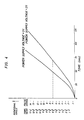
- Fig. 4 shows rotational speed characteristics of the lens positioning member 30 which are changed upon variations in power supply voltage of the motor 60.
- the pulse signal count corresponding to the distance data is "6”
- a speed when the 6th tooth of the pawl gear 36 to be locked has reached the locking position upon even a decrease in voltage from 3 V to 2 V is considerably lower than that in an initial rotation state, i.e., when the 2nd or 3rd teeth of the pawl gear 36 is to be locked.
- a delay time from when the pulse signal count is obtained until the second movable coil member 12 is actuated must be controlled to advance an operation timing of the stop pawl 24.
- the pulse signal width Tp and the delay time D are as follows:
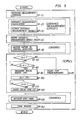
- the focusing operation sequence of this embodiment is performed in accordance with the program shown in the flow chart of Fig. 5.
- the control circuit 4 calculates a distance to an object based on a distance signal from the distance measurement circuit (F-2, F-3), and the distance measurement result is stored as a digital value N (F-4).
- the stop pawl 24 is actuated (F-13) after a predetermined delay time has passed (F-7), so as to be engaged with the predetermined pawl gear 36 to lock the lens positioning member 30.
- the predetermined stepped tooth i.e., the 1st step of each stepped cam 31 is set.
- the motor 60 is continuously rotated in the normal direction for a predetermined period of time (F-14), so that the drive member 40 is further rotated clockwise.
- the compression spring 33 attached to the lens positioning member 30 is disengaged from the notch 48, and the lens drive member 40 is solely kept rotated.
- each guide pin 51 of the photographing lens 50 which is held at a position separate from the corresponding stepped cam 31 abuts against a predetermined step of the corresponding stepped cam 31 so as to set the photographing lens 50 at a position along the optical axis corresponding to the distance data from the distance measurement device.
- the motor 60 is stopped to stop the rotation of the lens drive member 40.
- N is larger than 1
- the pulse width Tp is measured (F-9) and the delay time D of the stop pawl 24 is converted to a predetermined function (F-10).
- the second movable coil member 12 is energized after the delay time D is counted (F-12), thus actuating the stop pawl 24 (F-13).
- the stop pawl 24 is actuated at a faster timing regardless of the predetermined delay time, so that the accelerated lens positioning member 30 can be accurately stopped at a position corresponding to the distance data.
- the focusing operation of the photographing lens 50 is performed with respect to an object.
- the first movable coil member is energized to perform an exposure operation, and then, the photographing operation is completed.
- the second movable coil member 12 is energized again to move the regulating pin 11 clockwise, thereby disengaging the stop pawl 24 from the pawl gear 26.
- the motor 60 is then rotated in the reverse direction so that the lens drive member 40 is rotated counterclockwise to linearly move the photographing lens. Thereafter, when the notch 48 has reached an engaging position with the compression spring 33 of the lens positioning member 30, the lens drive member 40 is rotated counterclockwise together with the lens positioning member 30 to return the member 30 to the initial position. Thereafter, the motor 60 is stopped.
- the grooved cams 42 of the lens drive member 40 used in the focusing apparatus also have the following function.
- each grooved cam 42 is substantially parallel to the corresponding stepped cam 31 and is slightly separated therefrom.
- a start portion 42a of each cam 42 is linearly bent along a rotational direction A of the lens drive member 40.
- the motor 60 when the motor 60 is started to rotate the lens drive member 40 and the lens positioning member 30 in the rotational direction A, it does not receive a load for moving the guide pins 51, i.e., the photographing lens 50 along the optical axis, and a short in torque upon rising of the motor 60 can be compensated. Since the start portion 42a is bent, it does not separate each guide pin 51 from the corresponding stepped cam 31 too much to minimize a moving range of the photographing lens 50. In this manner, a space inside the lens barrel can be saved.
- each grooved cam 42 when the rotation of the lens positioning member 30 is stopped is indicated by alternate long and short dashed curves
- the position of the grooved cam 42 when the lens drive member 40 is slightly rotated in a rotational direction B from the above state is indicated by solid curves.
- Each guide pin 51 is sequentially moved from a position of a guide pin 51a to a position of a guide pin 51b, and is brought into contact with the predetermined stepped cam 31 to set the photographing lens 50 at an in-focus position.
- the delay time D may be determined in accordance with an average value of one or more measurement values of the advanced pulse signal widths, and the same effect as described above can be provided. This modification is included in the present invention.
- the actuation timing of the stop pawl for locking the stepped cams for regulating the in-focus position is controlled to be synchronized with an increase in rotational speed of the motor, so that the photographing lens is set at the accurate in-focus position.
Landscapes
- Physics & Mathematics (AREA)
- Engineering & Computer Science (AREA)
- Computer Vision & Pattern Recognition (AREA)
- General Physics & Mathematics (AREA)
- Optics & Photonics (AREA)
- Automatic Focus Adjustment (AREA)
- Focusing (AREA)
- Lens Barrels (AREA)
Applications Claiming Priority (2)
| Application Number | Priority Date | Filing Date | Title |
|---|---|---|---|
| JP62048556A JPS63213828A (ja) | 1987-03-02 | 1987-03-02 | 自動焦点装置付カメラ |
| JP48556/87 | 1987-03-02 |
Publications (2)
| Publication Number | Publication Date |
|---|---|
| EP0281078A2 true EP0281078A2 (de) | 1988-09-07 |
| EP0281078A3 EP0281078A3 (de) | 1990-01-10 |
Family
ID=12806654
Family Applications (1)
| Application Number | Title | Priority Date | Filing Date |
|---|---|---|---|
| EP88103085A Withdrawn EP0281078A3 (de) | 1987-03-02 | 1988-03-01 | Kamera mit automatischer Fokussierungsvorrichtung |
Country Status (3)
| Country | Link |
|---|---|
| US (1) | US4823157A (de) |
| EP (1) | EP0281078A3 (de) |
| JP (1) | JPS63213828A (de) |
Families Citing this family (1)
| Publication number | Priority date | Publication date | Assignee | Title |
|---|---|---|---|---|
| US4945370A (en) * | 1988-04-06 | 1990-07-31 | Minolta Camera Kabushiki Kaisha | Film rewinding system of camera |
Family Cites Families (8)
| Publication number | Priority date | Publication date | Assignee | Title |
|---|---|---|---|---|
| DE2928142A1 (de) * | 1979-07-12 | 1981-01-29 | Agfa Gevaert Ag | Regelschaltung fuer abgleichvorgaenge bei fotografischen geraeten |
| DE3346769A1 (de) * | 1982-12-23 | 1984-06-28 | Konishiroku Photo Industry Co., Ltd., Tokio/Tokyo | Elektromagnetisch angetriebener verschluss |
| US4509840A (en) * | 1984-02-21 | 1985-04-09 | Polaroid Corporation | Lens drive for auto focus camera |
| GB2161947B (en) * | 1984-06-08 | 1988-06-29 | Konishiroku Photo Ind | Automatic focusing camera |
| US4724455A (en) * | 1985-01-11 | 1988-02-09 | Konishiroku Photo Industry Co., Ltd. | Exposure controlling means for a variable focus type camera |
| JPS61251826A (ja) * | 1985-04-30 | 1986-11-08 | Konishiroku Photo Ind Co Ltd | カメラ |
| JPS6279432A (ja) * | 1985-10-03 | 1987-04-11 | Konishiroku Photo Ind Co Ltd | カメラの遮光装置 |
| JPS62234137A (ja) * | 1986-04-04 | 1987-10-14 | Konika Corp | カメラのパルス発生装置 |
-
1987
- 1987-03-02 JP JP62048556A patent/JPS63213828A/ja active Pending
-
1988
- 1988-03-01 US US07/162,425 patent/US4823157A/en not_active Expired - Fee Related
- 1988-03-01 EP EP88103085A patent/EP0281078A3/de not_active Withdrawn
Also Published As
| Publication number | Publication date |
|---|---|
| US4823157A (en) | 1989-04-18 |
| EP0281078A3 (de) | 1990-01-10 |
| JPS63213828A (ja) | 1988-09-06 |
Similar Documents
| Publication | Publication Date | Title |
|---|---|---|
| US4634254A (en) | Electromagnetically actuated shutter for a camera | |
| US5008605A (en) | Electric driving device capable of eliminating backlash | |
| CA1131970A (en) | Camera having too close/too far indication | |
| US4460257A (en) | Focus regulating device for camera with automatic exposure control | |
| US4740807A (en) | Focal length switching type camera | |
| US4745425A (en) | Automatic focus control apparatus | |
| EP0265934B1 (de) | Kamera | |
| US4823157A (en) | Camera with automatic focusing apparatus | |
| US4758859A (en) | Control apparatus for camera | |
| US4576460A (en) | Photographing lens position device in automatic focusing camera | |
| US4733261A (en) | Automatic focusing camera | |
| JPH0248095B2 (ja) | Jidoshotenkamera | |
| JPH01298331A (ja) | モータドライブカメラ | |
| US4238154A (en) | Camera having too close/too far indication | |
| US4540264A (en) | Photographing lens focusing device | |
| US5047796A (en) | Automatic focusing device for camera | |
| JPS61134718A (ja) | 自動焦点調節装置 | |
| US4429968A (en) | Automatic focus control device | |
| JPH085447Y2 (ja) | カメラ用レンズ駆動装置 | |
| US5144353A (en) | Optical system driving device of camera | |
| JPH0711615B2 (ja) | レンズ移動装置 | |
| JPS6273243A (ja) | カメラの自動焦点調節装置 | |
| US4699490A (en) | Diaphragm control device for cameras | |
| JPS61245145A (ja) | カメラの合焦装置 | |
| US4466724A (en) | Release control device for camera |
Legal Events
| Date | Code | Title | Description |
|---|---|---|---|
| PUAI | Public reference made under article 153(3) epc to a published international application that has entered the european phase |
Free format text: ORIGINAL CODE: 0009012 |
|
| AK | Designated contracting states |
Kind code of ref document: A2 Designated state(s): DE GB |
|
| PUAL | Search report despatched |
Free format text: ORIGINAL CODE: 0009013 |
|
| AK | Designated contracting states |
Kind code of ref document: A3 Designated state(s): DE GB |
|
| 17P | Request for examination filed |
Effective date: 19900611 |
|
| 17Q | First examination report despatched |
Effective date: 19920617 |
|
| STAA | Information on the status of an ep patent application or granted ep patent |
Free format text: STATUS: THE APPLICATION IS DEEMED TO BE WITHDRAWN |
|
| 18D | Application deemed to be withdrawn |
Effective date: 19921229 |