EP0281285A2 - Clé à cliquet démontable manuellement - Google Patents
Clé à cliquet démontable manuellement Download PDFInfo
- Publication number
- EP0281285A2 EP0281285A2 EP88301413A EP88301413A EP0281285A2 EP 0281285 A2 EP0281285 A2 EP 0281285A2 EP 88301413 A EP88301413 A EP 88301413A EP 88301413 A EP88301413 A EP 88301413A EP 0281285 A2 EP0281285 A2 EP 0281285A2
- Authority
- EP
- European Patent Office
- Prior art keywords
- core
- drive ring
- wrench
- pawl
- shaft
- Prior art date
- Legal status (The legal status is an assumption and is not a legal conclusion. Google has not performed a legal analysis and makes no representation as to the accuracy of the status listed.)
- Ceased
Links
Images




Classifications
-
- B—PERFORMING OPERATIONS; TRANSPORTING
- B25—HAND TOOLS; PORTABLE POWER-DRIVEN TOOLS; MANIPULATORS
- B25B—TOOLS OR BENCH DEVICES NOT OTHERWISE PROVIDED FOR, FOR FASTENING, CONNECTING, DISENGAGING, OR HOLDING
- B25B13/00—Spanners; Wrenches
- B25B13/46—Spanners; Wrenches of the ratchet type, for providing a free return stroke of the handle
- B25B13/461—Spanners; Wrenches of the ratchet type, for providing a free return stroke of the handle with concentric driving and driven member
- B25B13/462—Spanners; Wrenches of the ratchet type, for providing a free return stroke of the handle with concentric driving and driven member the ratchet parts engaging in a direction radial to the tool operating axis
- B25B13/465—Spanners; Wrenches of the ratchet type, for providing a free return stroke of the handle with concentric driving and driven member the ratchet parts engaging in a direction radial to the tool operating axis a pawl engaging an internally toothed ring
-
- B—PERFORMING OPERATIONS; TRANSPORTING
- B25—HAND TOOLS; PORTABLE POWER-DRIVEN TOOLS; MANIPULATORS
- B25B—TOOLS OR BENCH DEVICES NOT OTHERWISE PROVIDED FOR, FOR FASTENING, CONNECTING, DISENGAGING, OR HOLDING
- B25B23/00—Details of, or accessories for, spanners, wrenches, screwdrivers
- B25B23/0007—Connections or joints between tool parts
- B25B23/0035—Connection means between socket or screwdriver bit and tool
Definitions
- the present invention relates to improved ratchet wrench structures facilitating reversal and, additionally, convenient and rapid disassembly of the wrench head without the use of tools. More particularly, the invention is directed to a ratchet wrench in which it is necessary merely to push a spring biased release element to achieve decoupling of the driven core of the wrench from the driving ring. Another important feature of the invention is use of a low-friction spring assembly for reversibly shifting the driving mode of the ratchet wrench.
- ratchet wrenches and related tools have been described in the relevant art. Typical among such wrenches are socket wrenches used to drive any of a selectable number of sockets, the functional elements of such wrenches including a handle-carried driving ring to which is coupled a driven core.
- the wrenches are provided with various mechanical means by which the torsional drive direction of the wrench may be readily reversed. Examples of the type of wrenches referred to are described in U.S. Patents Numbers 4,280,379 and 4,512,218, and the entire disclosures of each of these patents is hereby specifically incorporated herein by reference to the extent that such disclosures are not inconsistent herewith.
- Prior art socket driving ratchet wrenches of the type described ordinarily utilize retaining spring rings as the mechanical expedient for interlocking the internal core of the wrench within the circumscribing driving ring or collar.
- retaining spring rings As the mechanical expedient for interlocking the internal core of the wrench within the circumscribing driving ring or collar.
- Such a procedure is inconvenient and time consuming, and replacement of the spring-like ring upon reassembly of the device is not ordinarily achieved without considerable difficulty. It is to the effective resolution of this problem and to providing an improved locking mechanism for retaining the core within the ratchet wrench for enabling disassembly that reassembly without the use of tools that a principal facet of the present invention is directed.
- ratchet wrenches of the general type of the present invention Another important functional structure in ratchet wrenches of the general type of the present invention is the mechanism by which tool driving reversal is effected.
- Such reversal is ordinarily achieved through the expedient of a shiftable or pivotal toothed pawl which engages and intercouples with cooperating teeth formed in a drive ring.
- Prior art arrangements include various types of mechanical linkages for effecting displacement of a pawl housed in a cavity formed in the wrench core.
- the shifting of the pawl in such assemblies has invariably been conducted against significant frictional resistance so that application of considerable force has been necessary to accomplish the reversal.
- the present invention obviates this problem by providing a low-friction, pawl-shifting assembly so that reversal of the driving mode of the wrench can be made by means of simple, even one-finger, digital manipulation.
- the present invention finds utility in a ratchet wrench of the type having a head including a handle-carried drive ring and a pawl-coupled driven body or core, the pawl being manually selectively positionable to provide two opposite driving modes for the socket which is attachable to a driving stud or boss fastened to the core itself.
- the specific illustrative examples of the wrenches shown herein include such features as a longitudinally shiftable rod for releasing a detent ball so as to facilitate disengagement of the drive sockets from the wrench, this particular feature is not, per se, a critical capability or element in the present invention.
- the invention pertains to an improved linkage for reversing the driving mode of the wrench and to a novel structure by means of which the driven core of the wrench may be simply and effectually disengaged from the driving ring or collar, and removed from the wrench itself, without the use of tools.
- Each embodiment of the present invention includes a handle-carried drive ring and a driven core in which the core can be simply and readily removed, intact, for cleaning, repair and replacement, without the use of tools.
- each wrench includes a low-friction ratchet-drive-reversing mechanism for simple one-finger operation.
- the wrench disassembly-facilitating structure includes a resilient ring-like spring band seated in a channel defined by radially communicating annular grooves in the drive ring and in the wrench core.
- a band-displacing element serves to displace or distort the band to effect a bridging of the band across the grooves defining the channel to effect a mechanical intercoupling between the core and the drive ring of the ratchet wrench.
- the band-displacing band-distorting pressure is relieved, permitting the band to assume a stable, undistorted configuration in which the band occupies a single one only of the communicating grooves in the drive ring and in the opposed core, thereby uncoupling the core and the drive ring to permit withdrawal of the core, as an intact unit, axially from the wrench.
- the drive direction of the wrench is controlled by an arcuate wire spring which intercouples a finger-manipulable pivotal drive-reversing control plate of the tool with a slidably shiftable pawl housed in the core of the wrench to provide a low-friction mechanism by which the pawl is positioned to establish a selectable drive direction of the wrench through simple one-finger arcuate displacement of the reversing control plate of the tool.
- the drive ring and the core of the wrench are formed with communicating annular grooves which define a channel in which an interlocking band seats, and that there are provided wrench structures selectively operable to control the positioning of the band between a first mode in which the band bridges the grooves to establish an interlocking engagement between the drive ring and the core, and a second mode in which the band occupies a single one only of the communcating grooves to decouple the drive ring and the core and to permit withdrawal of the core from the drive ring.
- the band in the absence of stressing and distortional forces applied to the spring band, the band is disposed to lie in a single one only of the annular grooves without entry into an opposed communicating other of the annular grooves, thereby to define a mechanical configuration in which the drive ring and the core are in an uncoupled relationship mode.
- the mechanism for controlling the spatial orientation of the interlocking spring band constitutes a simple pin or probe which abuts and bears upon the spring band to distort the band to bridge the communicating grooves defining the channel which defines the housing for the interlocking spring band.
- a related feature of the invention is that in each embodiment it is possible through the displacement of a finger-actuated shaft or probe to relieve the distorting pressure applied to the interlocking band and, thus, to permit the band to assume a position in which it occupies only one of the communicating grooves, thus effecting a disengagement between the drive ring and the core to permit axial displacement and separation of the core from the head of the wrench.
- a spring biased pin operates to distort the spring band to invade both of the opposed annular grooves in the drive ring and in the core to establish an interlocking engagement of the drive ring with the core to prevent axially displacement therebetween.
- the distorting pressure applied to the spring band by the pin is relieved by pushing a manually manipulable detent into the wrench head so as to overcome biasing forces urging the pin to deform the spring band.
- the spring band assumes an undisturbed or undistorted configuration in one groove only of a channel bridging the core and the drive ring, thereby mechanically decoupling the drive ring from the core to permit physical separation of the two.
- the pin pressure distorting the spring band is relieved by permitting the pins to retract radially into the core of the wrench. This is achieved by displacing a vertical shaft inwardly into the wrench head to align a radially inwardly depressed zone of the shaft with elements of the pin assembly so that the latter assume a position which permits the spring band to detract into the core and, thus, to decouple the core from the drive ring and to allow withdrawal of the core from the ring.
- a central axially shiftable shaft which may be pushed axially inwardly to assume, selectively, a first position in which a socket detaining ball is permitted to move radially inwardly to invade a zone of the shaft, thereby freeing the socket from the supporting boss; in a second position of further depression of the shaft inwardly into the wrench head, a second radial depression in the shaft is brought into alignment with the pin mechanism for distorting the spring band.
- the pin mechanism moves radially inwardly to permit the spring band to retract from the drive collar, thereby permitting the core to be removed axially from the collar.
- each embodiment of the present invention there is provided a resilient wire which is coupled at one end to a control ring and at an opposite end to a shiftable pawl housed within a cavity of the core, whereby arcuate shifting of the control plate or ring effects a shift in the position of the toothed pawl between either of two opposing drive modes.
- the pawl is free to slide, unrestrained, within its cavity with minimal frictional impedance to repositioning of the pawl.
- An important practical feature and advantage of the improved ratchet reversing mechanism of the present invention is that drive reversal is effectively achieved through minimal digitally applied torque impressed against a readily accessible and manipulable control plate which serves effectively, through a spring wire, to effect sliding shifting repositioning of the tooth pawl within the core cavity for sequentially reversing the drive mode of the ratchet wrench.
- a ratchet drive of the type which includes a driving ring or collar to which a handle is connected, a driven core or body being rotatably journaled within the drive collar and coupled thereto through a shiftable double-ended toothed pawl.
- the pawl is, in turn, slidable between two limiting positions whereby either of its opposed toothed ends is brought, sequentially, into meshing engagement with mating teeth carried on the inner periphery of the drive ring for establishing a torque-transmitting relationship in either of opposed rotation directions.
- Principal features of the invention relate to the pawl-shifting mechanism and to a simple mechanical system whereby the wrench core may be readily and easily removed from the tool head for cleaning, repair, or replacement.
- the present invention makes it practical and feasible for the user of the ratchet drive conveniently and quickly to remove the core of the wrench for cleaning and maintenance.
- the low-friction pawl-shifting mechanism enables the user of the wrench to reverse the drive direction of the wrench through simple application of minimal digitally-applied arcuate torque.
- two separate, positive manipulative steps must be carried out in order to convert the apparatus into a structural mode in which the core is decoupled from the drive ring so as to permit withdrawal of the core from the wrench head.
- the arrangement described obviates inadvertent decoupling or separation of the core from the ring.
- Each embodiment of the present invention includes springs which serve to bias components of the structure in a fixed or stand-by mode in which the wrench head assumes an integral functional unit.
- application of positive axially directed pressure to components of the wrench head is an essential prerequisite to effecting the withdrawal of the core from the driving ring.
- the controlling physical components for releasing the core are readily and simply manipulated without the use of tools, and solely through manual manipulation of readily accessible wrench-carried probes or shafts.
- the aims, objects, and advantages of the invention are achieved by providing,as component structural parts of a ratchet drive wrench, unique mechanical arrangements by means of which the wrench may be disassembled and reassembled for maintenance, cleaning, repair and replacement of operating components.
- the invention is characterized in that spring-biased locking pin assemblies function, in conjunction with associated cooperating mechanical elements, in a manner such that simple mechanical operation or manipulation is effective to displace the locking pin element or to permit displacement of the pin element within the wrench head and to affect forces acting upon a locking spring band to achieve disengagement between the core and the driving ring of the wrench so that the core may be easily removed from the wrench head.
- the locking pin assembly is manipulated or shifted by means of shafts or rods which project from the wrench head so as to be readily accessible, thus facilitating simple digital manipulation of the controlling elements.
- the arrangements described permit physical separation of the core from the circumscribing collar or ring. Manipulation of the release mechanisms and disengagement of the core and ring components from each other are achieved digitally or manually, without any need for tools of any type.
- Each of the several preferred embodiments of the invention has, in common with the others, internal mechanical structures by means of which a spring band which intercouples and interlocks the drive ring and the core may be readily shifted or manipulated through the application of digital pressure for effecting disengagement between the wrench core and the drive ring, thus facilitating disassembly of the wrench head for maintenance, cleaning, and repair.
- Each of the several embodiments of the invention also includes a low friction assembly in which a control plate is functionally coupled to a slidably shiftable pawl so that the pawl is readily manipulable through application of digitally effected torque to the control plate to effect a reversal of the torque-transmitting linkage so as to achieve, selectively, clockwise and counter-clockwise rotation of the driven core or body of the tool.
- the present invention finds utility, generally, in a broad class of ratchet wrenches including wrenches of the type in which the wrench-secured drive socket is releasable by displacing a wrench shaft axially inwardly of the wrench body to release a socket-securing detent ball.
- the ratchet wrench 20 is illustrated as including an elongated handle 22 having a hand-grip section 26 and terminating at its opposite end in a drive head 30.
- the drive head 30 includes a driven body or core 34 rotatably journaled in a generally cylindrical driving ring or collar 38.
- the latter is formed on its inner, generally cylindrical surface with an uninterrupted series of axially extending ratchet teeth 42 for engaging a toothed pawl 46 seated in a cavity 50 formed in the body 52 of the core 34 and opening radially outwardly of the core.
- the core 34 terminates at its lower extremity in a stud or boss 56 for attachment of interchangable tool elements such as drive sockets (not shown).
- the core body 52 is formed with an enlarged-diameter, collar-like flange or plate 60, a bounding peripheral marginal edge of which is knurled at 64 to facilitate manual or digital rotation thereof as more fully explained herebelow.
- the core 34 of the ratchet head 30 includes a shaft 70 extending axially through the core 34 and terminating at its upper end in a cap 74, the latter surmounting a compression spring 78 encircling the shaft 70 and housed in a cavity or recess 80 opening upwardly of the plate 60 and in which the cap 74 is disposed to move telescopically upon application of manual pressure downwardly on the cap 74 and the shaft 70 attached thereto, (Fig. 3).
- the lower portion of the shaft 70 is formed with a dished or cut-out zone 84 which serves as a recess for receiving a drive socket release ball 86 confined in a radially extending bore 90 in the tool-coupling stud 56 of the core assembly 34.
- the spring 78 biases the shaft assembly axially upwardly so that a lower portion of a camming face 92 of the dished zone 84 urges the socket release ball 86 radially outwardly stressingly to abut a presented wall of a socket (not shown) positioned in place on the stud 56 of the tool head 30.
- axially downward displacement of the shaft 70 against the pressure of the biasing spring 78 brings the cut-out zone 84 into radial alignment with the bore 90 in the stud 56 to permit the detent ball 86 to move radially inwardly and to free a socket from the driving boss 56, in accordance with similar structures known in the relevant art.
- the outer diameter of the core body 52 is only slightly less than the inner diameter of the drive ring 38 so that the core 52 is rotatably received and supported within the drive ring 38 with an enlarged annular flange 94 of the control plate 60 abutting a top face 96 of the drive ring 38.
- the toothed pawl 46 is slidably supported on a base or floor 100 in the core cavity 50 formed in the core body 52.
- an intercoupling, resilient, spring-like wire 104 which, in one preferred embodiment of the invention (Fig. 4) includes an arcuately curved body portion 106 disposed generally horizontally in a cavity 110 between the lower surface 112 of the control plate 60 and a top surface 116 of the principal body portion 52 of the core 34.
- the curved body 106 of the wire 104 is integrally formed with parallelly disposed probe-like ends 120 and 122 projecting in opposite directions and generally normally of a plane defined by the body portion 106 of the wire 104. As shown in Fig.
- an end 120 of the spring wire 104 projects into a socket 130 extending upwardly into the control plate 60 from a lower face 112 thereof.
- the opposite probe 122 projects downwardly into a bore 134 extending normally into the pawl 46 from a top face 136 thereof.
- two separate but coacting resilient wire assemblies are utilized.
- arcuate shifting of the control plate 60 is effective through the resilient spring-like wire 104 to impose a sliding torque upon the coupled pawl 46 to effect a shift or a lateral displacement of the pawl 46 within the pawl housing 50 so that the opposed toothed end portions 140 and 142 engage, sequentially, cooperating teeth 42 of the drive ring 38 to establish opposite drive modes of the ratchet wrench.
- face 150 of the pawl 46 opposed to the pawl teeth is chamfered or beveled 152 and 156 to reduce frictional forces between the pawl 46 and the core body 52 thereby enhancing the ease with which drive reversal is accomplished.
- the spring wire 160 is generally circular in form and includes at its ends probe-like stubs or arms 164 and 166 which extend into a cooperating bore 170 opening upwardly of the pawl 46 (Fig. 9).
- the wire 160 is formed with a loop 172 trained about and grippingly engaging a post 174 attached to and projecting downwardly from an underface 112 of the control plate 60.
- the operation of this embodiment of the spring wire is essentially the same as that of the wire assembly shown in Fig. 4.
- the drive ring 38 and the core body 52 are formed with opposed and intercommunicating annular grooves 180 and 184 which define a channel bridging and bounded by the drive ring 38 and the core 52.
- An arcuate, ribbon-like, spring band 190 confined within the channel 192 formed by the opposed grooves 180 and 184 serves as an interlock by means of which the drive ring 38 and the core 52 are intercoupled for interlocking engagement and to resist axial displacement or separation.
- the spring band 190 is biased to expand radially so that in its "free" undistorted configuration, the band 190 assumes a position in which it is totally within the groove 180 in the drive ring or collar 38, as shown in Fig. 7.
- the core body 52 and the associated control plate 60 and pawl reversing mechanism may be withdrawn axially from the driving ring 38, as shown in Fig. 7.
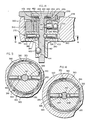
- the mechanism by which the spring band 190 is distorted to bridge the channel 192 so that at least a portion of the spring band 190 enters into the groove 184 in the core 52 is shown in Figs. 3 and 6.
- the tool head 30 is formed with a bore 200 opening at an underface 204 of the tool head (Fig. 3).
- a spring 206 is confined in the bore 200 by a digitally manipulable, telescopically shiftable plug or detent 208, and the detent 208 is formed with a cutout section 210 communicating with a passage 214 extending through the bounding wall 218 of the drive ring 38 and communicating with the channel 192 in which the spring band 190 is confined.
- a pin 222 Slidably disposed within the passage 214 is a pin 222, an inwardly directed end 224 of which abuts and bears upon the spring band 190.
- the opposite end 228 of the pin 222 abuts and bears upon a camming wall surface 232 bounding the cavity 210.
- the spring 206 bears upon the digitally shiftable plug 208, the latter in turn displacing the pin 222 inwardly toward the core 34 and into abutment with the spring band 190 to position at least a lineal section 236 of the spring band 190 within the groove 184 in the core 34 (Figs. 3 and 6).
- more remote lineal sections 240 of the spring band 190 occupy the groove 180 in the drive ring 38 so that the spring band 190 serves effectively mechanically to intercouple the drive ring 38 with the core 52 to prevent axial separation of the two.
- the ratchet drive wrench of the invention in its operational or functional mode, is shown in Fig. 3.
- Fig. 3 In order to separate, detach, or withdraw the core 52 of the wrench from the drive ring or drive collar 38, and as indicated schematically in Fig. 7, it is necessary merely to depress the plug 208 axially inwardly into the wrench head 30.
- This permits the pin 222 to move radially outwardly and away from the core 52 and permits the resiliently biased spring band 190 to move out of the groove 184 in the core 52 and seat totally within the outer groove 180 of the channel 192, thereby decoupling the core 52 from the drive ring 38 and permitting axial withdrawal of the core 52 from the ring 38, all as indicated schematically in Fig. 7.
- control plate 60 is integrally formed with a downwardly extending, open 244 pipe-like extension or tube 250 in which the shaft 70 of the socket releasing assembly is slidably and reciprocally confined.
- an interlock assembly which, in the specific embodiment of the invention illustrates, includes a ball 254 and spring 256 confined in a cavity 260 formed in the body 52 of the core 34 and communicating with a bore 264 extending radially into the pipe wall 250 of the control plate assembly.
- the spring 256 bears upon a piston-like plate 266 which is reciprocably slidable in the chamber 260 and which is connected at its radially inwardly directed face to a rod-like probe 270 which extends into the opening 264 in the wall 250 which embraces the reciprocally secured shaft 70, the probe 270 serving as a key to obviate inadvertent disassembly of the control plate 60 and its associated structure from the core 52.
- the wrench 300 includes an elongated shaft 304 attached at one end to a wrench head 310 and at its opposite end to a handle 314.
- the wrench head 310 includes an internally toothed 318 drive ring 320 and a core 330 which is rotational within the drive ring 320, a toothed pawl 340 shiftable within a cavity 344 for reversing the drive direction, the drive reversal structure and the linkage between a drive control plate 350 and the shiftable pawl 340 corresponding to structures previously-described with respect to the first embodiment of the invention.
- the second form of the invention defines a structure enabling the ready and simple withdrawal and removal of the core 330 from the drive ring 320, without the use of tools, to facilitate maintenance, cleaning, repair and replacement of component parts. It is the particular specific mechanical components and their arrangement for facilitating the ready removal of the core 330 from the wrench head 310 that distinguishes the second embodiment of the invention from the first. Referring now to Fig. 12, there is shown the structure and the arrangement of components when the wrench is in its operational mode, that is, with the core 330 locked within the drive ring 320.
- the drive ring 320 is formed with a circumscribing interior groove 360 opposed to and communicating with an outwardly opening circumscribing groove 366 formed in the body of the core 330 to define an annular channel 370 which serves as a housing for arcuate spring band 380 which serves as the mechanical interlock between the core 330 and the drive ring 320, as more fully explained herebelow.
- the spring band 380 is biased to contract radially so that, unless subjected to positive distortional forces, the spring band 380 would assume a position totally within the "inner" groove 366 formed in the core 330 so that the core 330 would be mechanically decoupled from the drive ring 320, as shown in Figs. 14 and 16, thus permitting withdrawal of the core 330 from the encircling drive ring 320.
- the spring band is shown as urged radially outwardly by means of a pair of annularly spaced, radially directed band-displacing assemblies which, in the specific embodiment of the invention illustrated, comprise a pair of push rods 388 and 390 each in abutment with and in radial alignment with a cooperating ball 394 and 396 in corresponding radially extending through bores 400 and 402 in the body of the core 330.
- the push rods 388 and 390 abut, at outwardly directed ends thereof, and stressingly engage the spring band 380.
- the push rods 388 and 390 abut the balls 394 and 396, the latter contacting, at their diametrically opposed ends of each ball a shaft 410 extending axially through the head 310, including the core 330 of the wrench and supported for reciprocal longitudinal movement therewithin.
- the reciprocal shaft 410 is formed in a lower zone thereof with a recess 414 opening radially outwardly of the shaft for receiving therewithin a socket-securing detent ball 420 when the shaft 410 is urged axially downwardly into the assembly to bring the recess 414 opposite the ball 420, all in accordance with procedures known and previously described.
- the drive reversing control plate 350 is formed with an upwardly opening cavity 430 in which a cap 434 which surmounts the shaft 410 of the head is received for telescopic reciprocal motion therewithin.
- a spring 440 Interposed within the cavity 430 and biasing the shaft 410 and the surmounting cap 434 to an upwardly extended limit is a spring 440, and beneath this spring and grippingly engaging the shaft 410 at a diametrically reduced neck portion 444 thereof is a spring clip 450.
- the shaft 410 is formed at a zone adjacent the underside of the cap 434 with a radially enlarged collar 454 joined to the neck portion 444 of the shaft 410 by a flared or frustoconical section 458.
- Fig. 12 the structure illustrated depicts the mechanism in a mode in which the spring band 380 is physically distorted in zones abutting and stressingly engaging the ball and pin assemblies 394 and 388 and 396 and 390 so that the spring band 380 bridges the channel 370 formed by the grooves 360 and 366, with portions of the band 380, which is normally confined to the inner groove 366, being urged radially outwardly so that arcuate sections of the band 380 invade the outer groove 360 of the assembly so as mechanically to interlock the core 330 within the driving ring 320 (Fig. 15).
- the shaft 410 is formed in a medial zone of its linear expanse with a pair of opposed recesses or sockets 464 and 466 which are diametrically opposed as shown in Figs. 12 and 14.
- the spring 440 is compressed and the frustoconical section 458 of the upper portion of the shaft 410 comes into physical abutment against the opposed arms 470 and 472 of the clip 450.
- the frustoconical section 458 at the top of the shaft neck 444 displaces the arms 470 and 472 of the clip 450 radially outwardly, whereupon the advance of the shaft downwardly into the core continues until the underside 476 of the shaft-surmounting disk or plate 434 bears upon the arms 470 and 472 of the clip 450.
- the shaft sockets or recesses 464 and 466 are brought into a position in which they oppose or fall in line with the spring band pin and ball 388, 394 and 390, 396 so that the radially inwardly presented portions of the balls 394 and 396 are received respectively in the sockets 464 and 466, as shown in Figs. 14 and 16.
- the spring band 380 is permitted to contract radially to assume an undistorted configuration totally within the annular groove 366 in the core 330, as shown in Fig. 16.
- the spring band 380 then no longer serves as an interlock mechanism, and the core 330 may be readily withdrawn from the drive ring 320.
- a locking assembly comprising a piston-like element 480 sleeved in a cylinder-like cavity 484 in the body of the core 330 and terminating in a radially inwardly directed key or probe 488 urged resiliently by means of a spring 492 to interlock within a port 494 formed in a pipe-like sleeve 496 depending from the control plate 350 and enveloping the shaft 410.
- a ball 498 also housed within the cavity 484, abuts the spring 492 to complete the mechanism for retaining the control plate and its depending skirt 496 locked within the core 330 of the wrench 300.
- the wrench 500 includes an elongated shaft 504 attached at one end to a wrench head 510 and at its opposite end to a handle 514.
- the wrench head 510 includes an internally-toothed 518 drive ring 520 and a core 530 which is rotational within the drive ring 520.
- a toothed 534 pawl 540 is shiftable within a cavity 544 in the core body for reversing the wrench drive direction, the drive reversal structure and the linkage between a drive control plate 550 and the shiftable pawl 540 corresponding to structures previously described.
- the wrench of Figs. 17-22 also includes a structure enabling the ready and simple withdrawal and removal of the core 530 from the drive ring 520 without the use of tools.
- Figs. 17 and 18 depict the wrench in its operational mode, with the core 530 locked within the drive ring 520.
- the drive ring 520 is formed with a circumscribing interior groove 560 opposed to and communicating with an outwardly opening circumscribing groove 566 formed in a downwardly-extending neck-like portion 568 of the drive reversing plate 550.
- the opposed, communicating grooves, 560 in the drive ring 520 and 566 in the core component 568 accommodate laterally shiftable arcuate plates 572 and 574 which function as mechanical interlocks for intercoupling the core 530 with the drive ring 520.
- the locking plates 572 and 574 are integrally formed with respective radially-inwardly directed arms 576 and 578 which terminate in hook-like ends 580 and 582.
- the arms 576 and 578 and the hooked ends 580 and 582 of the anchor-shaped interlocking devices 586 and 588 extend through radial passages 590 formed in the neck 568 so that the hook-like ends 580 and 582 encircle to embrace a shaft 610 which extends axially through the head 510 and through the core 530 for reciprocal longitudinal movement therewithin.
- a pair of springs 614 and 616 disposed to encircle the arm portions 576 and 578 of the interlock assemblies 586 and 588, and which are confined in accommodating chambers 620 and 622 opening radially outwardly of the neck 568 of the control ring 550, bias the locking mechanisms 586 and 588 outwardly to invade the groove 560 in the drive ring 520 for establishing interlocking engagement between the drive ring 520 and the core 530, as shown in Figs. 17 and 18.
- the control plate 550 is formed with an upwardly-opening cavity 630 which accommodates a cap 634 which surmounts the shaft 610.
- a spring 640 encircling the upper portion of the shaft 610 biases the cap 634 and the shaft 610 attached thereto to an upwardly-extended limit.
- the shaft 610 is formed at an upper end adjacent the cap 634 with a radially-enlarged collar 654 joined to the upper end 656 of the shaft proper 610 by a frustoconical section 658.
- the shaft 610 is formed adjacent a medial zone with a circumscribing annular recess 664. At a lower end portion of the shaft 610 the latter is formed with a recess 668 for accommodating a detent ball 670 confined in a tool-coupling stud 674 of the core 530.
- the annular groove or recess 664 in the shaft 610 assumes a position opposed to a detent or locking ball 680, the latter entering the groove 664 to effect a mechanical coupling between the shaft 610 and the core body, locking the shaft 610 in its downwardly extreme limit, with the core 530 and drive ring 520 interlock plates 572 and 574 in a core releasing mode, where upon the core 530 may be lifted from and readily separated from the enveloping drive ring 520.
- a release pin 690 reciprocably mounted in a vertically-extending slot or bore 694 is biased downwardly by a spring 698 so that a lower radially enlarged section of the pin 690 abuts and bears upon a ball 698, the latter being confined in the same channel 700 as is the detent ball 680 so that laterally-displacing forces impressed on the ball 698 are transferred in turn to the detent ball 680. Accordingly, when the shaft 610 is depressed to bring the groove 664 opposite the detent ball 680, the ball enters the groove 664 to lock the shaft 610 in its downwardly displaced disc position.
- a lower end 710 of the pin extends as a projection beyond the base or bottom of the core 530.
- the pressure of the locking pin 690 is thus removed from the detent assembly, including the balls 698 and 680 as the ball 698 enters into a space afforded by a sector 714 of the locking pin, that sector having a reduced diameter, all as indicated in Figs. 17 and 19.
- a depression of the cap 634 to effect only a partial displacement of the shaft 610 will still be effective to allow the tool locking ball 670 to recede inwardly into the shaft 610 to permit separation of the tang-carried tool from the stud end of the core.
- the core 530 will remain locked in the drive ring 520.
- the mechanism constitutes a bearing or ball 720 confined in a radially-extending bore 724 and urged by a spring 730 to abut and ride up against an inner face of the core circumscribing collar 520.
- a generally heart-shaped wire 730 the ends 734 of which extend generally downwardly and normally of a plane defined by the body of the wire and are received in a downwardly-extending cooperating bore 740 in the pawl 540.
- the drive direction reversing plate 550 is provided at its collar 568, as a downwardly-projecting extension therefrom, with a stub shaft or probe 750. The latter engages and bears against the heart-shaped wire interiorly thereof at its apex 754 as shown in Fig. 22.
- the probe depending therefrom brings stressing forces against the wire 730 and, in turn, the forces are transferred to effect a lateral shifting of the pawl 540 between first and second laterally-displaced operational modes.
- the mechanical arrangement described has the advantage of minimal friction between the moving and shifting components. Accordingly, the application of minimal frictional forces applied to the cam shifting plate 550 is adequate to effect a reversal of the driving mode of the wrench.
Landscapes
- Engineering & Computer Science (AREA)
- Mechanical Engineering (AREA)
- Details Of Spanners, Wrenches, And Screw Drivers And Accessories (AREA)
- Cleaning Implements For Floors, Carpets, Furniture, Walls, And The Like (AREA)
Applications Claiming Priority (2)
| Application Number | Priority Date | Filing Date | Title |
|---|---|---|---|
| US07/017,731 US4762033A (en) | 1987-02-24 | 1987-02-24 | Ratchet wrench with manual disassembly capability |
| US17731 | 1998-02-03 |
Publications (2)
| Publication Number | Publication Date |
|---|---|
| EP0281285A2 true EP0281285A2 (fr) | 1988-09-07 |
| EP0281285A3 EP0281285A3 (fr) | 1989-11-02 |
Family
ID=21784232
Family Applications (1)
| Application Number | Title | Priority Date | Filing Date |
|---|---|---|---|
| EP88301413A Ceased EP0281285A3 (fr) | 1987-02-24 | 1988-02-19 | Clé à cliquet démontable manuellement |
Country Status (5)
| Country | Link |
|---|---|
| US (1) | US4762033A (fr) |
| EP (1) | EP0281285A3 (fr) |
| JP (1) | JPS63245372A (fr) |
| AU (1) | AU595685B2 (fr) |
| CA (1) | CA1289781C (fr) |
Cited By (6)
| Publication number | Priority date | Publication date | Assignee | Title |
|---|---|---|---|---|
| FR2745516A1 (fr) * | 1996-03-01 | 1997-09-05 | Facom | Dispositif pour l'entrainement unidirectionnel d'un organe rotatif, et outil a cliquet muni d'un tel dispositif |
| FR2745515A1 (fr) * | 1996-03-01 | 1997-09-05 | Facom | Dispositif d'entrainement inversible, et outil a cliquet muni d'un tel dispositif |
| US5916339A (en) * | 1997-05-23 | 1999-06-29 | Facom | One-way drive mechanism and corresponding ratchet tool |
| GB2378146A (en) * | 2001-07-30 | 2003-02-05 | Sunny Huang | Ratchet wrench with a reversible action |
| ES2195669A1 (es) * | 1997-05-30 | 2003-12-01 | Facom | Mecanismo de accionamiento unidireccional, herramienta de trinquete correspondiente. |
| TWI830672B (zh) * | 2023-06-02 | 2024-01-21 | 英發企業股份有限公司 | 可快速撥轉之棘輪扳手 |
Families Citing this family (69)
| Publication number | Priority date | Publication date | Assignee | Title |
|---|---|---|---|---|
| USD340628S (en) | 1982-04-29 | 1993-10-26 | Jessie Chow | Ratchet wrench |
| US5012705A (en) * | 1990-03-16 | 1991-05-07 | National Hand Tool Corporation | Ratchet wrench with manually removable core |
| US5157994A (en) * | 1991-12-13 | 1992-10-27 | Snap-On Tools Corporation | Ratchet wrench with lost motion reversing mechanism |
| CA2112279A1 (fr) * | 1993-10-28 | 1995-04-29 | Gregory A. Zurbuchen | Cle a rochet en materiau composite et methode de fabrication connexe |
| US5495783A (en) * | 1994-07-08 | 1996-03-05 | Snap-On Incorporated | Reversible ratchet wrench with direction indicia |
| US6067881A (en) * | 1995-06-07 | 2000-05-30 | Albertson; David V. | Hand tool |
| US6276239B1 (en) | 1995-06-07 | 2001-08-21 | David V. Albertson | Hand tool |
| US5813296A (en) * | 1996-09-26 | 1998-09-29 | Snap-On Technologies, Inc. | Quick release socket mechanism |
| US5957009A (en) * | 1997-10-16 | 1999-09-28 | Mccann; Frank | Control mechanism for ratchet wrench |
| US6006631A (en) * | 1998-05-20 | 1999-12-28 | Miner; Montie H. | Through-hole quick release adapters |
| US6301866B1 (en) * | 1999-07-14 | 2001-10-16 | Black & Decker Inc. | Vegetation trimming and edging device with adjustable head orientation |
| US6230591B1 (en) | 1999-07-30 | 2001-05-15 | Hand Tool Design Corporation | Reversible ratcheting tool with improved gear wheel/pawl engagement |
| US6148695A (en) | 1999-08-03 | 2000-11-21 | Hu; Bobby | Ratchet wheel with asymmetric arcuate concave teeth or non-arcuate concave teeth and ratcheting tools with such ratchet wheel |
| US6568299B2 (en) | 1999-12-16 | 2003-05-27 | Bobby Hu | Reversible ratcheting tool with a smaller head |
| US6431031B1 (en) | 1999-12-16 | 2002-08-13 | Bobby Hu | Reversible ratcheting tool with a smaller head |
| TW418748U (en) | 2000-01-11 | 2001-01-11 | Hu Hou Fei | Ratchet wrench |
| TW408653U (en) * | 2000-02-03 | 2000-10-11 | Hu Hou Fei | Ratcheting tool |
| JP3515763B2 (ja) | 2000-03-13 | 2004-04-05 | 厚飛 胡 | 小ヘッドと改善駆動トルクを具えたリバーシブルラチェット工具 |
| US6543316B2 (en) | 2000-03-14 | 2003-04-08 | The Stanley Works | Ratchet wrench |
| CN1131131C (zh) * | 2000-03-23 | 2003-12-17 | 胡厚飞 | 一种棘轮扳手的换向块及其使用该换向块的棘轮扳手 |
| TW428513U (en) | 2000-07-21 | 2001-04-01 | Hu Hou Fei | Locating device of a direction switch and ratchet tools using the same |
| TW437521U (en) | 2000-08-22 | 2001-05-28 | Hu Hou Fei | Ratchet driven tool |
| TW444633U (en) | 2000-09-01 | 2001-07-01 | Hu Hou Fei | Ratchet tool |
| US6745647B2 (en) | 2000-11-29 | 2004-06-08 | Mei-Chen Wang | Wrench having a universal-joint ratchet wheel |
| TW489701U (en) | 2001-02-19 | 2002-06-01 | Hou-Fei Hu | A ratchet driven wrench capable of easily manufacturing and fabricating |
| US6807882B2 (en) | 2001-05-07 | 2004-10-26 | Bobby Hu | Wrench with a simplified structure |
| US6722234B2 (en) | 2001-05-14 | 2004-04-20 | Bobby Hu | Easy-to-operate and easy-to-assemble ratcheting-type wrench |
| TW483365U (en) | 2001-07-13 | 2002-04-11 | Hou-Fei Hu | High torque wrench |
| TW483377U (en) | 2001-07-13 | 2002-04-11 | Hou-Fei Hu | Micro small torque wrench with constant torque value |
| US6647832B2 (en) | 2001-07-27 | 2003-11-18 | Bobby Hu | Wrench having two rigid supporting areas for a pawl |
| US6539825B1 (en) | 2001-09-20 | 2003-04-01 | Yen-Wen Lin | Single direction ratcheting wrench with stuck prevention and ratcheting direction indication |
| TW503802U (en) | 2001-10-17 | 2002-09-21 | Hou-Fei Hu | Invertible ratchet wrench |
| US6450066B1 (en) | 2001-10-19 | 2002-09-17 | Bobby Hu | Head of a wrench handle |
| US6520051B1 (en) | 2001-12-27 | 2003-02-18 | Bobby Hu | Head of a wrench handle |
| US6769330B2 (en) | 2002-01-24 | 2004-08-03 | Hsuen Chen Chang | Ratchet wrench having a simplified pawl biasing device |
| TW506308U (en) | 2002-02-08 | 2002-10-11 | Hou-Fei Hu | Improved structure for ratchet wrench |
| USD509717S1 (en) | 2002-04-18 | 2005-09-20 | Easco Hand Tools, Inc. | Ratchet wrench body |
| USD496237S1 (en) | 2002-04-18 | 2004-09-21 | Easco Hand Tools, Inc. | Ratchet release button |
| US6945141B2 (en) | 2002-04-22 | 2005-09-20 | Bobby Hu | Reversible ratchet type wrench |
| TW567123B (en) | 2002-07-22 | 2003-12-21 | Hou-Fei Hu | Ratchet wrench capable of fast rotation |
| TWI245684B (en) | 2002-08-05 | 2005-12-21 | Yan-Wen Lin | Simple ratchet wrench |
| US6918323B2 (en) * | 2002-11-01 | 2005-07-19 | Easco Hand Tools Inc. | Reversible ratcheting tool with improved pawl |
| US20040093994A1 (en) * | 2002-11-18 | 2004-05-20 | Hsiao Ching Jih | D-shaped headed ratchet wrench structure |
| WO2004096069A1 (fr) * | 2003-04-25 | 2004-11-11 | Precimed S.A. | Agencement chirurgical detachable d'encliquetage |
| TW200424038A (en) * | 2003-05-14 | 2004-11-16 | tai-zuo Chen | Improved retaining structure for hand tool |
| US7263919B2 (en) * | 2004-09-10 | 2007-09-04 | Easco Handtools, Inc. | Ratcheting tool with vertically curved tooth arrangement |
| US7073412B1 (en) * | 2004-10-12 | 2006-07-11 | Easco Hand Tools, Inc. | Method of forming a pawl pocket for a ratcheting tool and tool thereby formed |
| US7066055B1 (en) * | 2004-12-30 | 2006-06-27 | Yi-Min Lee | Ratchet wrench that can release socket rapidly |
| US7077032B1 (en) * | 2005-02-22 | 2006-07-18 | Edmond Lee | Ratchet tool having increased driving torque |
| US7353735B2 (en) | 2005-06-02 | 2008-04-08 | The Stanley Works | Ratchet wrench |
| US20100043604A1 (en) * | 2007-12-18 | 2010-02-25 | Yi-Fu Chen | Ratchet wrench having easily assembling structure |
| USD633762S1 (en) * | 2008-05-08 | 2011-03-08 | Cooper Brands, Inc. | Rapid adjustable wrench |
| USD605008S1 (en) * | 2008-05-12 | 2009-12-01 | Ibt Holdings, Llc | Round ratchet head with round plug and round body |
| USD605009S1 (en) * | 2008-05-12 | 2009-12-01 | Ibt Holdings, Llc | Square ratchet head with round plug and round body |
| USD605007S1 (en) * | 2008-05-12 | 2009-12-01 | Ibt Holdings, Llc | Square ratchet head with square plug and square body |
| US8720309B2 (en) * | 2009-11-03 | 2014-05-13 | Yi-Fu Chen | Ratchet wrench having easily assembling structure |
| USD689752S1 (en) * | 2013-02-20 | 2013-09-17 | A&E Incorporated | Finger tip ratchet |
| JP6506283B2 (ja) * | 2013-08-06 | 2019-04-24 | ハイトーク ディビジョン ユネックス コーポレイション | ねじ山付きファスナを締め付ける装置 |
| US9475187B2 (en) | 2013-10-11 | 2016-10-25 | Snap-On Incorporated | Tool repair package and replacement system |
| USD756180S1 (en) * | 2014-04-10 | 2016-05-17 | Chao-Ming Chen | Hand tool adapter |
| TW201538283A (zh) * | 2014-04-11 | 2015-10-16 | kai-cheng Liu | 具夾掣定位裝置之扳手工具 |
| US9038506B1 (en) * | 2014-08-14 | 2015-05-26 | Miao-Chi Huang | Socket wrench with positioning device |
| USD757512S1 (en) * | 2015-07-30 | 2016-05-31 | Yi-Fu Chen | Ratchet wrench head |
| GB2550922A (en) * | 2016-05-31 | 2017-12-06 | Stanley Middle East FZE | A wrench with a ratchet mechanism |
| USD821167S1 (en) * | 2017-05-09 | 2018-06-26 | Sunex International, Inc. | Ratchet handle |
| US10556327B2 (en) * | 2017-12-11 | 2020-02-11 | Jun-Yi Lin | Hand tool assembly |
| USD863006S1 (en) | 2018-09-04 | 2019-10-15 | DAC Technologies Group Int'l Inc | Combined tool and handle for firearm maintenance |
| USD873100S1 (en) | 2018-09-11 | 2020-01-21 | DAC Technologies Group Int'l Inc. | Combined tool and handle for firearm maintenance |
| US11583939B2 (en) | 2019-06-18 | 2023-02-21 | Cricut, Inc. | Tool assembly for a crafting apparatus |
Family Cites Families (10)
| Publication number | Priority date | Publication date | Assignee | Title |
|---|---|---|---|---|
| US455133A (en) * | 1891-06-30 | Fredrick samuel turing | ||
| US837537A (en) * | 1906-06-27 | 1906-12-04 | Peter C Beyer | Ratchet-wrench. |
| US2685355A (en) * | 1949-11-18 | 1954-08-03 | Wright Tool And Forge Company | Reversible ratchet wrench mechanism |
| DE1478859A1 (de) * | 1965-08-19 | 1969-05-08 | Dowidat Werke Willi Dowidat | Umschaltbarer,insbesondere Schraubensteckschluessel |
| US3783703A (en) * | 1972-11-17 | 1974-01-08 | Jo Line Tools | Ratchet mechanism |
| US4257507A (en) * | 1978-08-15 | 1981-03-24 | Jo-Line Tools, Inc. | Torque wrench with pawl guide |
| US4259883A (en) * | 1980-01-04 | 1981-04-07 | Carlson Mark E | Drop-out socket wrench |
| WO1985002806A1 (fr) * | 1983-12-21 | 1985-07-04 | Mayer Albin F | Clef a cliquet avec outils multiples |
| US4603606A (en) * | 1984-07-09 | 1986-08-05 | Radian Tool Corporation | Unidirectional drive tool cartridge and method of manufacture |
| US4631990A (en) * | 1985-08-02 | 1986-12-30 | Hughes Matthew E | Open-ended ratchet wrench |
-
1987
- 1987-02-24 US US07/017,731 patent/US4762033A/en not_active Expired - Fee Related
-
1988
- 1988-02-19 CA CA000559305A patent/CA1289781C/fr not_active Expired - Lifetime
- 1988-02-19 EP EP88301413A patent/EP0281285A3/fr not_active Ceased
- 1988-02-23 AU AU12054/88A patent/AU595685B2/en not_active Ceased
- 1988-02-23 JP JP63038799A patent/JPS63245372A/ja active Pending
Cited By (6)
| Publication number | Priority date | Publication date | Assignee | Title |
|---|---|---|---|---|
| FR2745516A1 (fr) * | 1996-03-01 | 1997-09-05 | Facom | Dispositif pour l'entrainement unidirectionnel d'un organe rotatif, et outil a cliquet muni d'un tel dispositif |
| FR2745515A1 (fr) * | 1996-03-01 | 1997-09-05 | Facom | Dispositif d'entrainement inversible, et outil a cliquet muni d'un tel dispositif |
| US5916339A (en) * | 1997-05-23 | 1999-06-29 | Facom | One-way drive mechanism and corresponding ratchet tool |
| ES2195669A1 (es) * | 1997-05-30 | 2003-12-01 | Facom | Mecanismo de accionamiento unidireccional, herramienta de trinquete correspondiente. |
| GB2378146A (en) * | 2001-07-30 | 2003-02-05 | Sunny Huang | Ratchet wrench with a reversible action |
| TWI830672B (zh) * | 2023-06-02 | 2024-01-21 | 英發企業股份有限公司 | 可快速撥轉之棘輪扳手 |
Also Published As
| Publication number | Publication date |
|---|---|
| EP0281285A3 (fr) | 1989-11-02 |
| US4762033A (en) | 1988-08-09 |
| AU595685B2 (en) | 1990-04-05 |
| AU1205488A (en) | 1988-08-25 |
| CA1289781C (fr) | 1991-10-01 |
| JPS63245372A (ja) | 1988-10-12 |
Similar Documents
| Publication | Publication Date | Title |
|---|---|---|
| US4762033A (en) | Ratchet wrench with manual disassembly capability | |
| US4520697A (en) | Ratchet wrench | |
| US5012705A (en) | Ratchet wrench with manually removable core | |
| US4848196A (en) | Quick release and automatic positive locking mechanism for socket wrenches and extension bars for socket wrenches | |
| US5819607A (en) | Adjustable socket | |
| US5664842A (en) | Height-adjustable armrest unit for a chair | |
| JP3534769B2 (ja) | ソケットレンチのような工具の急速解放機構 | |
| EP0032423B1 (fr) | Mécanisme réversible à effet de cliquet | |
| US6431031B1 (en) | Reversible ratcheting tool with a smaller head | |
| CA2107858C (fr) | Mecanisme de depose rapide pour outils comme les cles a douilles | |
| RU2578338C2 (ru) | Переставной ручной инструмент | |
| US4211127A (en) | Ratchet wrench reversing mechanism | |
| US20090049958A1 (en) | Tools for detachably engaging tool attachments | |
| WO1999017907A1 (fr) | Cle a cliquet | |
| TWI418446B (zh) | 用於可分離式地接合工具附件之耦合機構 | |
| US4770071A (en) | Tool drive mechanism | |
| JPS5811065U (ja) | ドア固定装置 | |
| EP1330340A1 (fr) | Cle a rochet a tete excentree a degagement rapide | |
| AU2001292708A1 (en) | Quick disconnect offset head ratchet wrench | |
| US4762032A (en) | Socket release assembly for ratchet drive | |
| US20040134314A1 (en) | Radial indexing head tool with floating splined pin | |
| CA2138844C (fr) | Mecanisme de declenchement rapide destine a des outils tels que des cles a douilles | |
| US5074699A (en) | Disengaging ball joint | |
| CN216368606U (zh) | 一种便携操作滑座 | |
| EP3285964A1 (fr) | Clé à cliquet dotée d'un ensemble de libération de verrouillage |
Legal Events
| Date | Code | Title | Description |
|---|---|---|---|
| PUAI | Public reference made under article 153(3) epc to a published international application that has entered the european phase |
Free format text: ORIGINAL CODE: 0009012 |
|
| AK | Designated contracting states |
Kind code of ref document: A2 Designated state(s): DE FR GB NL SE |
|
| RTI1 | Title (correction) | ||
| PUAL | Search report despatched |
Free format text: ORIGINAL CODE: 0009013 |
|
| AK | Designated contracting states |
Kind code of ref document: A3 Designated state(s): DE FR GB NL SE |
|
| 17P | Request for examination filed |
Effective date: 19891113 |
|
| 17Q | First examination report despatched |
Effective date: 19910207 |
|
| STAA | Information on the status of an ep patent application or granted ep patent |
Free format text: STATUS: THE APPLICATION HAS BEEN REFUSED |
|
| 18R | Application refused |
Effective date: 19930430 |