EP0281332A2 - Fabrication d'un tapis - Google Patents
Fabrication d'un tapis Download PDFInfo
- Publication number
- EP0281332A2 EP0281332A2 EP88301679A EP88301679A EP0281332A2 EP 0281332 A2 EP0281332 A2 EP 0281332A2 EP 88301679 A EP88301679 A EP 88301679A EP 88301679 A EP88301679 A EP 88301679A EP 0281332 A2 EP0281332 A2 EP 0281332A2
- Authority
- EP
- European Patent Office
- Prior art keywords
- webs
- carpet
- adhesive
- installation
- cutting
- Prior art date
- Legal status (The legal status is an assumption and is not a legal conclusion. Google has not performed a legal analysis and makes no representation as to the accuracy of the status listed.)
- Withdrawn
Links
- 238000004519 manufacturing process Methods 0.000 title claims abstract description 19
- 239000000463 material Substances 0.000 claims abstract description 19
- 239000004831 Hot glue Substances 0.000 claims abstract description 11
- 239000000853 adhesive Substances 0.000 claims description 31
- 230000001070 adhesive effect Effects 0.000 claims description 31
- 238000005520 cutting process Methods 0.000 claims description 20
- 238000009434 installation Methods 0.000 claims description 17
- 238000000034 method Methods 0.000 claims description 6
- 238000001816 cooling Methods 0.000 claims description 2
- 238000003825 pressing Methods 0.000 claims description 2
- 239000010410 layer Substances 0.000 description 40
- 239000004744 fabric Substances 0.000 description 7
- 239000002759 woven fabric Substances 0.000 description 5
- 238000002844 melting Methods 0.000 description 3
- 230000008018 melting Effects 0.000 description 3
- 239000012790 adhesive layer Substances 0.000 description 2
- 239000012943 hotmelt Substances 0.000 description 2
- 239000004816 latex Substances 0.000 description 2
- 229920000126 latex Polymers 0.000 description 2
- 239000007788 liquid Substances 0.000 description 2
- 239000000203 mixture Substances 0.000 description 2
- 238000010008 shearing Methods 0.000 description 2
- 239000007921 spray Substances 0.000 description 2
- OKTJSMMVPCPJKN-UHFFFAOYSA-N Carbon Chemical compound [C] OKTJSMMVPCPJKN-UHFFFAOYSA-N 0.000 description 1
- 239000004215 Carbon black (E152) Substances 0.000 description 1
- 229910052799 carbon Inorganic materials 0.000 description 1
- 229920001577 copolymer Polymers 0.000 description 1
- 238000002425 crystallisation Methods 0.000 description 1
- 230000003111 delayed effect Effects 0.000 description 1
- 229920001971 elastomer Polymers 0.000 description 1
- 239000000945 filler Substances 0.000 description 1
- 229930195733 hydrocarbon Natural products 0.000 description 1
- 150000002430 hydrocarbons Chemical class 0.000 description 1
- 239000004745 nonwoven fabric Substances 0.000 description 1
- 239000002245 particle Substances 0.000 description 1
- 229920000098 polyolefin Polymers 0.000 description 1
- 230000000750 progressive effect Effects 0.000 description 1
- 229920002994 synthetic fiber Polymers 0.000 description 1
- 238000009966 trimming Methods 0.000 description 1
- 210000002268 wool Anatomy 0.000 description 1
Images



Classifications
-
- D—TEXTILES; PAPER
- D06—TREATMENT OF TEXTILES OR THE LIKE; LAUNDERING; FLEXIBLE MATERIALS NOT OTHERWISE PROVIDED FOR
- D06N—WALL, FLOOR, OR LIKE COVERING MATERIALS, e.g. LINOLEUM, OILCLOTH, ARTIFICIAL LEATHER, ROOFING FELT, CONSISTING OF A FIBROUS WEB COATED WITH A LAYER OF MACROMOLECULAR MATERIAL; FLEXIBLE SHEET MATERIAL NOT OTHERWISE PROVIDED FOR
- D06N3/00—Artificial leather, oilcloth or other material obtained by covering fibrous webs with macromolecular material, e.g. resins, rubber or derivatives thereof
- D06N3/0086—Artificial leather, oilcloth or other material obtained by covering fibrous webs with macromolecular material, e.g. resins, rubber or derivatives thereof characterised by the application technique
- D06N3/0088—Artificial leather, oilcloth or other material obtained by covering fibrous webs with macromolecular material, e.g. resins, rubber or derivatives thereof characterised by the application technique by directly applying the resin
- D06N3/009—Artificial leather, oilcloth or other material obtained by covering fibrous webs with macromolecular material, e.g. resins, rubber or derivatives thereof characterised by the application technique by directly applying the resin by spraying components on the web
-
- C—CHEMISTRY; METALLURGY
- C09—DYES; PAINTS; POLISHES; NATURAL RESINS; ADHESIVES; COMPOSITIONS NOT OTHERWISE PROVIDED FOR; APPLICATIONS OF MATERIALS NOT OTHERWISE PROVIDED FOR
- C09J—ADHESIVES; NON-MECHANICAL ASPECTS OF ADHESIVE PROCESSES IN GENERAL; ADHESIVE PROCESSES NOT PROVIDED FOR ELSEWHERE; USE OF MATERIALS AS ADHESIVES
- C09J5/00—Adhesive processes in general; Adhesive processes not provided for elsewhere, e.g. relating to primers
- C09J5/06—Adhesive processes in general; Adhesive processes not provided for elsewhere, e.g. relating to primers involving heating of the applied adhesive
-
- D—TEXTILES; PAPER
- D06—TREATMENT OF TEXTILES OR THE LIKE; LAUNDERING; FLEXIBLE MATERIALS NOT OTHERWISE PROVIDED FOR
- D06N—WALL, FLOOR, OR LIKE COVERING MATERIALS, e.g. LINOLEUM, OILCLOTH, ARTIFICIAL LEATHER, ROOFING FELT, CONSISTING OF A FIBROUS WEB COATED WITH A LAYER OF MACROMOLECULAR MATERIAL; FLEXIBLE SHEET MATERIAL NOT OTHERWISE PROVIDED FOR
- D06N7/00—Flexible sheet materials not otherwise provided for, e.g. textile threads, filaments, yarns or tow, glued on macromolecular material
- D06N7/0063—Floor covering on textile basis comprising a fibrous top layer being coated at the back with at least one polymer layer, e.g. carpets, rugs, synthetic turf
- D06N7/0071—Floor covering on textile basis comprising a fibrous top layer being coated at the back with at least one polymer layer, e.g. carpets, rugs, synthetic turf characterised by their backing, e.g. pre-coat, back coating, secondary backing, cushion backing
- D06N7/0078—Floor covering on textile basis comprising a fibrous top layer being coated at the back with at least one polymer layer, e.g. carpets, rugs, synthetic turf characterised by their backing, e.g. pre-coat, back coating, secondary backing, cushion backing the back coating or pre-coat being applied as a hot melt
-
- Y—GENERAL TAGGING OF NEW TECHNOLOGICAL DEVELOPMENTS; GENERAL TAGGING OF CROSS-SECTIONAL TECHNOLOGIES SPANNING OVER SEVERAL SECTIONS OF THE IPC; TECHNICAL SUBJECTS COVERED BY FORMER USPC CROSS-REFERENCE ART COLLECTIONS [XRACs] AND DIGESTS
- Y10—TECHNICAL SUBJECTS COVERED BY FORMER USPC
- Y10T—TECHNICAL SUBJECTS COVERED BY FORMER US CLASSIFICATION
- Y10T156/00—Adhesive bonding and miscellaneous chemical manufacture
- Y10T156/10—Methods of surface bonding and/or assembly therefor
- Y10T156/1052—Methods of surface bonding and/or assembly therefor with cutting, punching, tearing or severing
- Y10T156/1084—Methods of surface bonding and/or assembly therefor with cutting, punching, tearing or severing of continuous or running length bonded web
-
- Y—GENERAL TAGGING OF NEW TECHNOLOGICAL DEVELOPMENTS; GENERAL TAGGING OF CROSS-SECTIONAL TECHNOLOGIES SPANNING OVER SEVERAL SECTIONS OF THE IPC; TECHNICAL SUBJECTS COVERED BY FORMER USPC CROSS-REFERENCE ART COLLECTIONS [XRACs] AND DIGESTS
- Y10—TECHNICAL SUBJECTS COVERED BY FORMER USPC
- Y10T—TECHNICAL SUBJECTS COVERED BY FORMER US CLASSIFICATION
- Y10T428/00—Stock material or miscellaneous articles
- Y10T428/23907—Pile or nap type surface or component
- Y10T428/23979—Particular backing structure or composition
-
- Y—GENERAL TAGGING OF NEW TECHNOLOGICAL DEVELOPMENTS; GENERAL TAGGING OF CROSS-SECTIONAL TECHNOLOGIES SPANNING OVER SEVERAL SECTIONS OF THE IPC; TECHNICAL SUBJECTS COVERED BY FORMER USPC CROSS-REFERENCE ART COLLECTIONS [XRACs] AND DIGESTS
- Y10—TECHNICAL SUBJECTS COVERED BY FORMER USPC
- Y10T—TECHNICAL SUBJECTS COVERED BY FORMER US CLASSIFICATION
- Y10T428/00—Stock material or miscellaneous articles
- Y10T428/23907—Pile or nap type surface or component
- Y10T428/23986—With coating, impregnation, or bond
-
- Y—GENERAL TAGGING OF NEW TECHNOLOGICAL DEVELOPMENTS; GENERAL TAGGING OF CROSS-SECTIONAL TECHNOLOGIES SPANNING OVER SEVERAL SECTIONS OF THE IPC; TECHNICAL SUBJECTS COVERED BY FORMER USPC CROSS-REFERENCE ART COLLECTIONS [XRACs] AND DIGESTS
- Y10—TECHNICAL SUBJECTS COVERED BY FORMER USPC
- Y10T—TECHNICAL SUBJECTS COVERED BY FORMER US CLASSIFICATION
- Y10T428/00—Stock material or miscellaneous articles
- Y10T428/23907—Pile or nap type surface or component
- Y10T428/23993—Composition of pile or adhesive
Definitions
- This invention relates to carpet manufacture for the production of carpet of the kind comprising webs of tufted, looped, or other fabric or sheet material which form an upper layer, and a woven, sheet, or other base layer adhering to the upper layer.
- carpet is convenient for making into carpet tiles, since the edges do not tend to fray because the adhesive used to stick the layers together also serves to fix the fibres of both layers against any tendency to unravel or separate, particularly at the edges.
- the upper layer may include a woven fabric with tufts of wool or other material secured into it, the tufts being either cut to form an upright pile or uncut to form a loop type pile.
- a felted or needle punched felt or fabric may be used.
- the tufts may be somewhat insecurely fastened in the woven fabric, at least to the extent that the upper layer would not be sufficiently strong or stable for use on its own, though it may be inexpensive to produce.
- the base layer may be woven or non-woven fabric, or sheet material may be used in various forms.
- a liquid permeable web forming the base layer travels vertically through a zone in which adhesive is applied to one side and this base layer is then applied to the back of a layer which will form the upper layer in the finished carpet. Pressure is applied to force the adhesive through the permeable base layer to bond the layers together and to assist in fixing tufts which form the pile.
- the base layer and the upper layer are joined by a layer of latex or other material which not only serves as an adhesive but also provides a cushioning layer. Complex production equipment is however required to lay down the latex layer and to assemble the layers together.
- a carpet manufacturing method comprising providing respective webs of material to form an upper and a base layer respectively, the webs being advanced and brought together into superimposed relationship, a hot-melt adhesive being applied between the layers immediately before the webs are brought together, and the webs being subsequently pressed together and then cooled to cause them to adhere together.
- the adhesive is applied by means of one or more nozzles delivering the adhesive in a spread pattern, whereby a substantially uniform layer of the adhesive is laid down.
- the webs are supplied from respective spaced rolls, and the webs are guided together, the adhesive being applied immediately prior to bringing the webs together.
- the hot-melt adhesive is conveniently applied from a number of spaced nozzles arranged to provide a uniform pattern of adhesive on the surfaces of the layers on either of them.
- an aerated supply of adhesive is delivered to the nozzle or to each of them.
- the carpet may be conveyed to a measuring and cutting installation whereby measured lengths are cut off in succession.
- the measuring means of this installation include switch means engageable by the carpet and arranged to actuate the cutting means of the installation.
- apparatus for carpet manufacture comprising means for supplying and advancing webs of material to form an upper layer and a base layer respectively, the webs being brought together, and a device for delivering hot-melt adhesive between the layers at a zone immediately prior to the position at which the webs are brought together, and means being provided in succession, for pressing the webs together and for cooling the webs to cause them to adhere together.
- the device for delivering hot-melt adhesive comprises one or more nozzles arranged to lay down adhesive in a layer of generally uniform thickness.
- the hot-melt adhesive is preferably supplied in aerated form from a supply unit to nozzles positioned to spray the adhesive evenly between the webs.
- rolls to carry the respective materials are positioned to allow delivery of the webs one above the other in continuous form.
- the apparatus may include means for measuring and cutting successive lengths of the carpet to form carpet tiles.
- the measuring means may include switch means engageable by the carpet to control operation of the cutting means.
- the cutting means may comprise a guillotine knife arranged to cut across the width of the strip emanating from the apparatus for assembling the webs together.
- the apparatus includes a frame on which the carpet is assembled, measured, and cut in succession, to form a continuous series of carpet tiles.
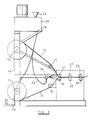
- Figures 1 and 2 show the layout of apparatus for production of carpet suitable for making into carpet tiles, which are produced successively as will be described.
- the apparatus includes a pair of supply rolls 10, 11 on which, in use, are provided respective supplies of fabric or sheet material 12, 13 in substantially continuous web form.
- the webs of material are one metre in width, though it is to be understood that the apparatus is suitable for the production of carpets of varying widths.
- the two rolls 10, 11 are mounted on a frame 14 and are positioned one above the other with a substantial space between. In certain instances it may be convenient to offset the rolls or to provide supplies from rolls mounted on separate frames.
- the webs 12, 13 shown in Figure 3 issuing from the rolls, should be accurately positioned one above the other, and are arranged to be brought together by means of upper and lower guide rollers 15, 16. The webs are brought together between first pressure rollers 17, 18. Their angles immediately prior to being brought together are large relatively to the median plane (represented by the horizontal).
- a film of adhesive as seen particularly in Figures 3 and 5.
- the adhesive is delivered from a series of nozzles 19 positioned in line across the line of advance of the webs and between them.
- the nozzles 19 are each arranged to deliver adhesive in an aerated diffuse spray pattern of highly atomised, finely and evenly distributed form. In the example illustrated, four nozzles are used. They are connected in two pairs, to supply conduits 21, 22.
- a hot-melt supply system shown in Figures 3, 4, and 5 comprising a supply tank 23 mounted at the top of the support frame 14.
- This has a filler 24, a heater to maintain the adhesive at a temperature at which it is liquid and of relatively low viscosity, an air inlet, and two outlets connected in the base of the tank and incorporating valves indicated at 25.
- An air compressor 26 is arranged to provide a supply of compressed air to the tank 23 and is fed to the two outlet valves 25, at which adhesive is also supplied.
- the adhesive becomes finely divided and atomised. It is delivered to the nozzles 19 through the conduits 21, 22 to issue from the nozzles evenly to cover the area of the two webs 12, 13 immediately before they are brought together. It is possible to adjust the nozzles, and the quantity supplied to them, in order to ensure that the correct quantity is delivered.
- the supply conduits 21, 22 are led along opposite sides so that the supply lines do not interfere with the webs 12, 13.
- rollers 27, 28 are slitting rollers for trimming the two opposite edges, and for slitting the centre of the webs.
- One slitting roller, as seen in Figure 6, is provided with three spaced slitting knives 31, 32, 33 and the other slitting roller 28 has grooves to engage with these knives.
- the rollers 29, 30 are further pressure rollers and drive rollers. Rollers 17, 18, 29, and 30 are rubber covered. Rollers 29, 30 serve to pull the webs 12, 13 off the rolls 10, 11, and to drive the assembled carpet forward through the remaining zones of the apparatus.
- This installation includes a reciprocable cutting knife 35 acting against a fixed bar 36, by means of which a shearing action to cut the carpet can take place.
- the cutting knife 35 is mounted on a carriage 37 which also carries a pressure bar 38 connected to the carriage by a spring 39.
- the arrangement is such that when the carpet is to be cut across its full width, the knife carriage is moved downwards.
- the carpet is positioned not only between the knife 35 and the bar 36, but also between the pressure bar 38 and the bar 36, as well as a further fixed bar 40.
- the pressure bar 38 first comes into contact with the carpet, thus arresting further forward motion of the carpet.
- the knife next meets the carpet and slices through it.
- the guillotine knife 35 acts against the fixed bar 36, and there is preferably a small angle between these across the width of the machine, whereby a progressive shearing action takes place.
- the speed of operation of the knife can be varied to provide a clean cut on different types of carpet being produced.
- a drive unit 42 is shown in Figures 1 and 2, by means of which the cutting installation can be controlled. Since the forward motion of the carpet is stopped in the cutting installation by this means, and since the pressure and drive rollers 29, 30 continue to advance the carpet, there is need for some lost motion. This is accommodated by the hump created by the arched plate 34.
- the carpet is advanced through the cutting installation until its end reaches the operating arm of a limit switch 41.
- the switch is connected in a circuit (not shown) which first operates carriage 37 to stop the further advance of the carpet and then to cut it as described.
- the limit switch 41 is positioned at a distance from the cutting installation and is disposed at the top surface of a conveyor 43 mounted on stands 44 connected to, or immediately adjacent to, the frame 14. As seen, the limit switch 41 is approximately half way along the length of the conveyor. As a cut end of carpet reaches the limit switch, the carpet is stopped and cut in the cutting installation as described. The conveyor is continuously driven so that as the carpet pieces which have been cut off are released by the pressure bar 38, the conveyor will advance them to the end of the conveyor, where they will fall side by side, onto a pallet 45. Stacks of cut pieces will thus accumulate on this pallet.
- a central control unit 46 At the side of the apparatus there is a central control unit 46.
- each tile may be 500 mm, so that a tile size is 500 mm by 500 mm. Such a size affords a rigid title which is less likely to move when in a position, in use.
- a woven fabric 47 forms the base layer.
- the upper layer 48 is formed by a further woven fabric into which are engaged loops 49 of a further material to make a loop-pile type carpet.
- Natural or artificial fibres can be used for any of the fabric materials and a substantial variety of types of material can be used.
- upright tufts can be produced by cutting the loops, in conventional manner.
- the alternative arrangement shown in Figure 9 includes a base layer 51 similar to that in Figure 8, and a needle punch or a felted layer 52 which replaces the fabric and loop pile. Again the film of adhesive 53 is used to secure these two layers together.
- the fabric which anchors these may not have any great strength.
- the application of the adhesive layer 50 and the base layer 47 thus serves to anchor the tufts or loops and to give high strength to the finished product.
- the application of adhesive over the whole area of the carpet renders this particularly suitable for the production of carpet tiles, as described, since there is no tendency for fibres to unravel or separate during continued use of the finished carpet.
- the apparatus can be used without the measuring and cutting installation, to produce carpet which is afterwards cut into larger pieces, as required.
- the adhesive is advantageously of the hot-melt type, and in one example is a blend of polyolefins and copolymers together with hydrocarbon tackifiers. It is a delayed setting hot-melt adhesive, the delay being due to post partial crystallisation of the polymeric structure.
- the adhesive layer is discharged from the nozzles 19 at a temperature between 180°C and 225°C. It is cooled by the air as it flies onto the material in generally non-uniform size particles, but provides substantially even coverage of the area.
- the adhesive may be applied at a temperature which is higher than the melting point of the material itself, thus giving some bonding through melting of such material, but temperature control is critical if excess melting is to be avoided.
Landscapes
- Engineering & Computer Science (AREA)
- Textile Engineering (AREA)
- Chemical & Material Sciences (AREA)
- Organic Chemistry (AREA)
- Carpets (AREA)
- Laminated Bodies (AREA)
- Floor Finish (AREA)
Applications Claiming Priority (2)
| Application Number | Priority Date | Filing Date | Title |
|---|---|---|---|
| GB8704760 | 1987-02-28 | ||
| GB878704760A GB8704760D0 (en) | 1987-02-28 | 1987-02-28 | Carpet manufacture |
Publications (2)
| Publication Number | Publication Date |
|---|---|
| EP0281332A2 true EP0281332A2 (fr) | 1988-09-07 |
| EP0281332A3 EP0281332A3 (fr) | 1989-07-12 |
Family
ID=10613130
Family Applications (1)
| Application Number | Title | Priority Date | Filing Date |
|---|---|---|---|
| EP88301679A Withdrawn EP0281332A3 (fr) | 1987-02-28 | 1988-02-26 | Fabrication d'un tapis |
Country Status (3)
| Country | Link |
|---|---|
| US (1) | US4875954A (fr) |
| EP (1) | EP0281332A3 (fr) |
| GB (1) | GB8704760D0 (fr) |
Cited By (1)
| Publication number | Priority date | Publication date | Assignee | Title |
|---|---|---|---|---|
| WO2004067832A3 (fr) * | 2003-01-30 | 2004-10-14 | Joseph Rocco Pacione | Dalle de moquette, pose, procedes de fabrication et de pose associes |
Families Citing this family (14)
| Publication number | Priority date | Publication date | Assignee | Title |
|---|---|---|---|---|
| US5560972A (en) * | 1988-07-25 | 1996-10-01 | Interface, Inc. | Latex fusion bonded pile carpets and carpet tile |
| US5240530A (en) * | 1992-02-10 | 1993-08-31 | Tennessee Valley Performance Products, Inc. | Carpet and techniques for making and recycling same |
| US5876827A (en) * | 1992-02-10 | 1999-03-02 | Polyloom Corporation Of America | Pile carpet |
| AU7407394A (en) * | 1993-08-30 | 1995-03-22 | Masland Industries, Inc. | Recycling of carpet scrap |
| US5859071A (en) * | 1996-04-15 | 1999-01-12 | Lear Corporation | Recycling of carpet scrap |
| US5800898A (en) * | 1996-11-26 | 1998-09-01 | K2, Inc. | Tufted carpet and process for preparing same |
| US5714224A (en) * | 1996-11-26 | 1998-02-03 | K2, Inc. | Tufted carpet and process for preparing same |
| AU6344098A (en) | 1997-02-28 | 1998-09-18 | Shaw Industries, Inc. | Carpet, carpet backings and methods |
| US7338698B1 (en) | 1997-02-28 | 2008-03-04 | Columbia Insurance Company | Homogeneously branched ethylene polymer carpet, carpet backing and method for making same |
| US20030211280A1 (en) | 1997-02-28 | 2003-11-13 | Shaw Industries, Inc. | Carpet, carpet backings and methods |
| US6667360B1 (en) | 1999-06-10 | 2003-12-23 | Rensselaer Polytechnic Institute | Nanoparticle-filled polymers |
| US6241168B1 (en) | 1999-06-10 | 2001-06-05 | Lear Corporation | Recycling of carpet scrap and compositions employing ultralow density polyethylene (ULDPE) |
| JP2007241887A (ja) | 2006-03-10 | 2007-09-20 | Fujitsu Component Ltd | キーボード |
| EP2136994B1 (fr) * | 2007-04-03 | 2018-08-22 | Dow Global Technologies LLC | Stratification à chaud de film (assistée par le vide) pour des applications de support de tapis |
Family Cites Families (4)
| Publication number | Priority date | Publication date | Assignee | Title |
|---|---|---|---|---|
| BE638233A (fr) * | 1962-05-31 | |||
| US3304825A (en) * | 1963-06-11 | 1967-02-21 | Weyerhaeuser Co | Triggering control for severing device |
| US4059465A (en) * | 1973-01-09 | 1977-11-22 | Edgar John B | Method of forming carpet tiles |
| US4371576A (en) * | 1981-09-22 | 1983-02-01 | Milliken Research Corporation | Hot melt adhesive bonded pile fabrics |
-
1987
- 1987-02-28 GB GB878704760A patent/GB8704760D0/en active Pending
-
1988
- 1988-02-26 EP EP88301679A patent/EP0281332A3/fr not_active Withdrawn
- 1988-02-29 US US07/160,350 patent/US4875954A/en not_active Expired - Fee Related
Cited By (1)
| Publication number | Priority date | Publication date | Assignee | Title |
|---|---|---|---|---|
| WO2004067832A3 (fr) * | 2003-01-30 | 2004-10-14 | Joseph Rocco Pacione | Dalle de moquette, pose, procedes de fabrication et de pose associes |
Also Published As
| Publication number | Publication date |
|---|---|
| EP0281332A3 (fr) | 1989-07-12 |
| US4875954A (en) | 1989-10-24 |
| GB8704760D0 (en) | 1987-04-01 |
Similar Documents
| Publication | Publication Date | Title |
|---|---|---|
| US4875954A (en) | Method and apparatus for manufacturing carpet | |
| US3957555A (en) | Method of making pile fabric having an adhesive substrate | |
| US3738884A (en) | Method for producing non-woven fibrous products | |
| US8910588B2 (en) | Polyurethane roller coating device for carpet backing | |
| US4081579A (en) | Pile composite fabric with foamed adhesive | |
| US5871613A (en) | Method and apparatus for automatically glue-bonding scrim to a fiber mat | |
| US20020071930A1 (en) | Modular floor covering edge treatment | |
| US6726976B2 (en) | Tufted pile structure having binder concentrated beneath the backstitches | |
| US3607588A (en) | Nonwoven fibrous products and methods and apparatus for producing such products | |
| US3676239A (en) | Method of producing spray spun nonwoven sheets | |
| US3819452A (en) | Apparatus for the production of spray spun nonwoven sheets | |
| US3298884A (en) | Method of manufacturing reinforced plastic foam in sheet form | |
| US4123313A (en) | Apparatus for making a composite fabric | |
| US4019938A (en) | Apparatus and process for manufacturing insulation board | |
| US3626509A (en) | Disposable mop assembly and method of forming disposable mophead therefor | |
| US3953269A (en) | Method of making composite fabric | |
| EP0016836B1 (fr) | Methode et appareil de pulverisation d'un materiau sur un support en mouvement | |
| US3041224A (en) | Method of forming foam layers on carpeting | |
| GB1573377A (en) | Process and apparatus for the continuous production of a fibrous web like pile product | |
| US4049487A (en) | Apparatus for producing honeycomb paneling | |
| US20020179238A1 (en) | Method and apparatus for edge joining of veneer strips | |
| AU1693601A (en) | Method and apparatus for edge joining of veneer strips | |
| EP1208259B1 (fr) | Traitement de couverture des bords d'un plancher modulaire | |
| US3944451A (en) | Method of and apparatus for making a plush-type cloth | |
| US6491977B1 (en) | Polyurethane coating system |
Legal Events
| Date | Code | Title | Description |
|---|---|---|---|
| PUAI | Public reference made under article 153(3) epc to a published international application that has entered the european phase |
Free format text: ORIGINAL CODE: 0009012 |
|
| AK | Designated contracting states |
Kind code of ref document: A2 Designated state(s): BE DE FR GB IT NL |
|
| PUAL | Search report despatched |
Free format text: ORIGINAL CODE: 0009013 |
|
| AK | Designated contracting states |
Kind code of ref document: A3 Designated state(s): BE DE FR GB IT NL |
|
| 17P | Request for examination filed |
Effective date: 19900108 |
|
| STAA | Information on the status of an ep patent application or granted ep patent |
Free format text: STATUS: THE APPLICATION IS DEEMED TO BE WITHDRAWN |
|
| 18D | Application deemed to be withdrawn |
Effective date: 19910903 |