EP0282021A2 - Anticorps spécifique contre les chaînes légères de la myosine du muscle du coeur, sa préparation et son utilisation dans un réactif pour la détermination des chaînes légères de la myosine du muscle du coeur - Google Patents
Anticorps spécifique contre les chaînes légères de la myosine du muscle du coeur, sa préparation et son utilisation dans un réactif pour la détermination des chaînes légères de la myosine du muscle du coeur Download PDFInfo
- Publication number
- EP0282021A2 EP0282021A2 EP88103697A EP88103697A EP0282021A2 EP 0282021 A2 EP0282021 A2 EP 0282021A2 EP 88103697 A EP88103697 A EP 88103697A EP 88103697 A EP88103697 A EP 88103697A EP 0282021 A2 EP0282021 A2 EP 0282021A2
- Authority
- EP
- European Patent Office
- Prior art keywords
- hmlc
- smlc
- reagent
- antibodies
- light chains
- Prior art date
- Legal status (The legal status is an assumption and is not a legal conclusion. Google has not performed a legal analysis and makes no representation as to the accuracy of the status listed.)
- Withdrawn
Links
Images
Classifications
-
- G—PHYSICS
- G01—MEASURING; TESTING
- G01N—INVESTIGATING OR ANALYSING MATERIALS BY DETERMINING THEIR CHEMICAL OR PHYSICAL PROPERTIES
- G01N33/00—Investigating or analysing materials by specific methods not covered by groups G01N1/00 - G01N31/00
- G01N33/48—Biological material, e.g. blood, urine; Haemocytometers
- G01N33/50—Chemical analysis of biological material, e.g. blood, urine; Testing involving biospecific ligand binding methods; Immunological testing
- G01N33/53—Immunoassay; Biospecific binding assay; Materials therefor
- G01N33/543—Immunoassay; Biospecific binding assay; Materials therefor with an insoluble carrier for immobilising immunochemicals
- G01N33/551—Immunoassay; Biospecific binding assay; Materials therefor with an insoluble carrier for immobilising immunochemicals the carrier being inorganic
- G01N33/552—Glass or silica
-
- C—CHEMISTRY; METALLURGY
- C07—ORGANIC CHEMISTRY
- C07K—PEPTIDES
- C07K16/00—Immunoglobulins [IG], e.g. monoclonal or polyclonal antibodies
- C07K16/18—Immunoglobulins [IG], e.g. monoclonal or polyclonal antibodies against material from animals or humans
-
- G—PHYSICS
- G01—MEASURING; TESTING
- G01N—INVESTIGATING OR ANALYSING MATERIALS BY DETERMINING THEIR CHEMICAL OR PHYSICAL PROPERTIES
- G01N33/00—Investigating or analysing materials by specific methods not covered by groups G01N1/00 - G01N31/00
- G01N33/48—Biological material, e.g. blood, urine; Haemocytometers
- G01N33/50—Chemical analysis of biological material, e.g. blood, urine; Testing involving biospecific ligand binding methods; Immunological testing
- G01N33/53—Immunoassay; Biospecific binding assay; Materials therefor
- G01N33/543—Immunoassay; Biospecific binding assay; Materials therefor with an insoluble carrier for immobilising immunochemicals
- G01N33/54353—Immunoassay; Biospecific binding assay; Materials therefor with an insoluble carrier for immobilising immunochemicals with ligand attached to the carrier via a chemical coupling agent
-
- Y—GENERAL TAGGING OF NEW TECHNOLOGICAL DEVELOPMENTS; GENERAL TAGGING OF CROSS-SECTIONAL TECHNOLOGIES SPANNING OVER SEVERAL SECTIONS OF THE IPC; TECHNICAL SUBJECTS COVERED BY FORMER USPC CROSS-REFERENCE ART COLLECTIONS [XRACs] AND DIGESTS
- Y10—TECHNICAL SUBJECTS COVERED BY FORMER USPC
- Y10S—TECHNICAL SUBJECTS COVERED BY FORMER USPC CROSS-REFERENCE ART COLLECTIONS [XRACs] AND DIGESTS
- Y10S436/00—Chemistry: analytical and immunological testing
- Y10S436/80—Fluorescent dyes, e.g. rhodamine
-
- Y—GENERAL TAGGING OF NEW TECHNOLOGICAL DEVELOPMENTS; GENERAL TAGGING OF CROSS-SECTIONAL TECHNOLOGIES SPANNING OVER SEVERAL SECTIONS OF THE IPC; TECHNICAL SUBJECTS COVERED BY FORMER USPC CROSS-REFERENCE ART COLLECTIONS [XRACs] AND DIGESTS
- Y10—TECHNICAL SUBJECTS COVERED BY FORMER USPC
- Y10S—TECHNICAL SUBJECTS COVERED BY FORMER USPC CROSS-REFERENCE ART COLLECTIONS [XRACs] AND DIGESTS
- Y10S436/00—Chemistry: analytical and immunological testing
- Y10S436/804—Radioisotope, e.g. radioimmunoassay
-
- Y—GENERAL TAGGING OF NEW TECHNOLOGICAL DEVELOPMENTS; GENERAL TAGGING OF CROSS-SECTIONAL TECHNOLOGIES SPANNING OVER SEVERAL SECTIONS OF THE IPC; TECHNICAL SUBJECTS COVERED BY FORMER USPC CROSS-REFERENCE ART COLLECTIONS [XRACs] AND DIGESTS
- Y10—TECHNICAL SUBJECTS COVERED BY FORMER USPC
- Y10S—TECHNICAL SUBJECTS COVERED BY FORMER USPC CROSS-REFERENCE ART COLLECTIONS [XRACs] AND DIGESTS
- Y10S436/00—Chemistry: analytical and immunological testing
- Y10S436/811—Test for named disease, body condition or organ function
-
- Y—GENERAL TAGGING OF NEW TECHNOLOGICAL DEVELOPMENTS; GENERAL TAGGING OF CROSS-SECTIONAL TECHNOLOGIES SPANNING OVER SEVERAL SECTIONS OF THE IPC; TECHNICAL SUBJECTS COVERED BY FORMER USPC CROSS-REFERENCE ART COLLECTIONS [XRACs] AND DIGESTS
- Y10—TECHNICAL SUBJECTS COVERED BY FORMER USPC
- Y10S—TECHNICAL SUBJECTS COVERED BY FORMER USPC CROSS-REFERENCE ART COLLECTIONS [XRACs] AND DIGESTS
- Y10S436/00—Chemistry: analytical and immunological testing
- Y10S436/815—Test for named compound or class of compounds
-
- Y—GENERAL TAGGING OF NEW TECHNOLOGICAL DEVELOPMENTS; GENERAL TAGGING OF CROSS-SECTIONAL TECHNOLOGIES SPANNING OVER SEVERAL SECTIONS OF THE IPC; TECHNICAL SUBJECTS COVERED BY FORMER USPC CROSS-REFERENCE ART COLLECTIONS [XRACs] AND DIGESTS
- Y10—TECHNICAL SUBJECTS COVERED BY FORMER USPC
- Y10S—TECHNICAL SUBJECTS COVERED BY FORMER USPC CROSS-REFERENCE ART COLLECTIONS [XRACs] AND DIGESTS
- Y10S530/00—Chemistry: natural resins or derivatives; peptides or proteins; lignins or reaction products thereof
- Y10S530/808—Materials and products related to genetic engineering or hybrid or fused cell technology, e.g. hybridoma, monoclonal products
- Y10S530/809—Fused cells, e.g. hybridoma
Definitions
- the invention relates to specific antibodies against cardiac muscle myosin light chains (HMLC), their production and use in an immunological reagent for the determination of HMLC.
- HMLC cardiac muscle myosin light chains
- Myosin is a protein with a molecular weight of approximately 500,000. It consists of two heavy chains with a molecular weight of approx. 200,000, two light chains I (HMLC I) with a molecular weight of approx. 26,000 and two light chains II (HMLC II) with a molecular weight of approx. 18,000. Myosin is present in the thick filaments of the heart and skeletal muscles.
- HMLC enters the blood plasma and thus represents a specific parameter that not only appears to be suitable for the diagnosis and monitoring of myocardial infarction, but which can also provide information about the extent of myocardial damage (Circulation 58 [1968] 1130, Jap. Cardiol. J. 44 [1980] 185, Am. J. Cardiol. 41 [1978] 641, Circulation 60 [Suppl. II] [1979] 139).
- HMLC Since the half-life of HMLC in plasma is very short at around 70 - 80 min, a later drop after the infarction event or a broad progression curve suggests sustained release of HMLC. In contrast to the otherwise determined "infarct enzymes" CK, CK-MB, GOT and LDH, the determination of HMLC enables a more reliable diagnosis and follow-up. In addition, more reliable statements on the assessment of unstable angina pectoris also seem to be possible, since in such cases HMLC may also be flushed out by myocardial infarctions (Am. J. Cardiol. 54 [1984] 964). However, since only small amounts of HMLC get into the blood plasma, a sensitive and specific method of determination is required. In such cases, immunological determination methods are usually particularly suitable as detection methods.
- Circulation 44 (1980) 185-186 in the immunological sandwich test one Cross reactivity of 8% was found.
- Circulation 58 (1978) 1130-1136 reports a cross-reactivity of 2.9-10% in the immunological sandwich test. The actual cross-reactivity of the antibodies is therefore much higher. For the value of 2.9% measured in the immunological sandwich test, it is (2.9) 2%, ie 8.4%.
- the object of the present invention is to overcome the disadvantages described and to provide antibodies against HMLC with a low cross-reactivity to SMLC and a method for producing such antibodies.
- the invention relates to antibodies against HMLC with a cross-reactivity to SMLC of less than 5%, preferably less than 2% and particularly preferably less than 1%.
- Such antibodies can be obtained by the method according to the invention described below.
- Another object of the invention is a method for the production of antibodies against HMLC by immunizing an animal species with human HMLC and obtaining the raw serum, characterized in that the raw serum, if necessary after pre-cleaning, is purified by negative immunosorption on an SMLC-based silica-based adsorbent becomes.
- the method according to the invention succeeds in obtaining antibodies against HMLC whose cross-reactivity against SMLC is below 5%, preferably below 2% and particularly preferably below 1%.
- the cross-reactivity was determined using HMLC or SMLC as the solid phase and a maximum of 0.1 ⁇ g antibody against HMLC per sample.
- the detection reaction was carried out using a conjugate of an antibody directed against the Fc ⁇ part of the HMLC antibody and a determinable group (e.g. POD).
- HMLC and SMLC can according to the methods familiar to those skilled in the art, such as those in Circul. Res. 19 (1985) 611 and Biochem. J. 119 (1970) 31 are isolated from heart or skeletal muscle.
- HMLC I, HMLC II or a mixture of HMLC I and II can be used as an immunogen.
- the immunization can be carried out on any animal species and according to the methods known to the expert.
- the raw serum obtained in this way can be used directly for negative immunosorption on an SMLC immunoadsorbent based on silicate.
- a preliminary cleaning is preferably carried out first, for example via ion exchange chromatography and dialysis.
- the crude serum which may have been pretreated in this way, is subjected to negative immunosorption on an SMLC immunosorbent based on silicate.
- the raw serum is applied to the column, surprisingly those antibodies against HMLC, which have a cross-reactivity below 5%, preferably below 2% and particularly preferably below 1%, are not bound, while the antibodies with higher cross-reactivity are bound.
- the column is then washed protein-free with the usual reagents (e.g. phosphate buffer pH 7.5, PBS).
- the eluate thus obtained can be used directly for the preparation of the reagents for an HMLC test.
- the eluate is preferably subjected to further purification, in particular by positive immunosorption on an HMLC immunoadsorbent.
- the silicate-based sorbents known to the person skilled in the art are suitable as carriers for the SMLC immunoadsorbent.
- the media can be present, for example, as a gel, in powdered or granulated form.
- Suitable carriers are, for example, Spherosil® (manufacturer: Rhône-Poulenc), SelectiSper® (Pierce Eurochemie) or silica gel from J. T. BakerChem.
- SMLC is covalently bound to the support by the customary methods, if appropriate via a spacer / linker.
- SMLC can then be coupled directly to the functional groups thus created on the carrier.
- a bifunctional reagent is first coupled as a spacer to the functional group and then SMLC is bound to it.
- the use of a mixture of SMLC I and SMLC II has proven to be advantageous.
- the ratio of SMLC I: SMLC II is not critical. However, a ratio of approximately 1: 1 or an excess of SMLC I is preferably used.
- Particularly suitable media are: silicates which carry aminopropyl, succinoylaminopropyl, hexamethylenediamine, diol, diazafluoroborate, p-nitrophenyl, epoxypropyl, glutaraldehyde and / or glycidoxypropyl groups.
- a spacer / linker is inserted before the coupling to the carrier material.
- Suitable are, for example, the bifunctional linkers familiar to the person skilled in the art, such as, for.
- B Glutardialdehyde, N-succinimidyl 3- (2-pyridyldithio) propionate, Ethyl 4-azidophenyl-1,4-dithiobutyrimidate x HCl, 4-fluoro-3-nitrophenyl azide, N-hydroxysuccinimidyl-4-azidobenzoate, m-maleimidobenzoyl-N-hydroxysuccinimide ester, N-succinimidyl-6 (4 ⁇ -azido-2 ⁇ -nitrophenyl-amino) hexanoate, N-succinimidyl (4-iodoacetyl) aminobenzoate or Succinimidyl-4 - (- p-maleimidophenyl) butyrate.
- the distance between the silicate support and the SMLC is not more than 20 atoms. A distance of 7 to 12 atoms has proven to be particularly advantageous.
- Another object of the invention is an immunological reagent for the determination of HMLC using HMLC antibodies with a cross-reactivity of less than 5%, preferably less than 2%, particularly preferably less than 1% compared to SMLC.
- Such a reagent can be used, for example, to carry out sandwich tests or competitive tests.
- An immobilized antibody against HMLC and a conjugate of an HMLC antibody and a determinable group is used in a sandwich test.
- either only one or both of the antibodies to be used can be produced by the method according to the invention.
- the reagent can be present both in solution and on or in a dry reagent carrier. Since it is not necessary to dilute the sample on a dry reagent carrier, shorter incubation times can be achieved.
- a preferred embodiment of the reagent contains an antibody against HMLC produced and immobilized by the method according to the invention and a conjugate of a monoclonal HMLC antibody and a determinable group. Surprisingly, it has been shown that a reagent containing such a combination gives a high sensitivity and a low sample blank value in an HMLC determination in the test.
- the monoclonal antibodies are produced by methods known to those skilled in the art after immunization with HMLC.
- the antibodies MAK 4D12 and 1B10 have proven to be particularly suitable.
- the cell lines corresponding to these monoclonal antibodies are deposited with the European Collection of Animal Cell Cultures (ECACC), Porton Down, GB, under the accession numbers ECACC 88022503 (MAK 4D12) and ECACC 88022504 (MAK 1B10).
- Another object of the invention is a method for the determination of HMLC, which is characterized in that the sample is brought together with an antibody against HMLC, which is produced according to the invention, and which is immobilized, and a conjugate of a monoclonal antibody and a determinable group.
- the order of addition is arbitrary. Possibly. after an incubation, the solid and liquid phases are separated and the identifiable group is determined in one of the two phases.
- HMLC and SMLC were according to the in Circul. Res. 19 (1965) 611 and Biochem. J. 119 (1970) 31 method described isolated from human skeletal and cardiac muscle tissue.
- HMLC I MW 26,000
- HMLC II MW 18,000
- CFA Freud's adjuvant
- 1 l of raw serum is mixed with 15 g of Aerosil (manufacturer: Degussa), stirred for 1 h at room temperature and centrifuged. The supernatant is then mixed with 1.7 mol / l ammonium sulfate and slowly stirred at room temperature for 2 h. The precipitate is then centrifuged off and homogenized in 0.2 l dialysis buffer (15 mmol / l potassium phosphate, 50 mmol / l sodium chloride, pH 7.0) and dialyzed against 4 times 10 l dialysis buffer at 4 ° C.
- the dialyzed ⁇ -globulin is purified over DE52 cellulose, eluting with dialysis buffer.
- the PAK ⁇ HMLC> solution purified according to Example 3 is ad 50 mmol / l potassium phosphate pH 7.5; 150 mmol / l sodium chloride (PBS); 0.1% azide spiked and at a concentration of approx. 15 mg / ml at room temperature through an SMLC immunoadsorbent column (preparation example 8) and washed with PBS / 0.1% azide protein-free (PBS: phosphate buffered saline ).
- Example 4 The eluate obtained according to Example 4 is applied to an HMLC immunoadsorbent under the conditions described in Example 4 (preparation analogous to Ex. 8). After washing with PBS / 0.1% azide, elution is carried out with 1 mol / l propionic acid at room temperature.
- the eluate is then dialyzed against demineralized water at 4 ° C. for 2 h and then at 4 ° C. overnight against 1 mmol / l carbonate / bicarbonate buffer (pH 9.5).
- a test system consisting of immobilized HMLC and a polyclonal antibody against sheep-Fc ⁇ ( ⁇ sheep-Fc ⁇ > -PAK) conjugated to POD was used to determine the cross-reactivity.
- Microtiter plates from Costar were used as supports. 0.1 ml of a solution of 5 ⁇ g / ml HMLC in 0.2 mol / l carbonate buffer pH 9.4 was added per cavity and incubated at 4 ° C. overnight. After washing twice with PBS, 0.2 ml of 50 mmol / l phosphate buffer pH 7.4, which contained 1% RSA and 0.9% NaCl, was added per cavity and incubated for 1 h at room temperature.
- a rabbit polyclonal antibody against Fc ⁇ (IgG) [ ⁇ sheep-Fc ⁇ > -PAK] is coupled to horseradish POD (peroxidase) according to Meth.
- POD peroxidase
- the sample is diluted with 50 mmol / l phosphate buffer pH 7.4 to 1.0 ⁇ g / ml PAH ⁇ HMLC> according to Ex. 3 and 4 or 0.1 ⁇ g / ml PAH ⁇ HMLC> according to Example 5.
- 0, 1 ml of the sample prepared in this way is added per cavity and incubated for 1 h at room temperature.
- 0.1 ml per cavity ⁇ sheep-Fc ⁇ > -PAK-POD conjugate (POD activity 0.2 U / ml) is added and incubated for 1 h at room temperature.
- a test system was used for the determination, which consisted of an immobilized ⁇ HMLC> -PAK (produced according to Example 5) and a conjugate of a ⁇ HMLC> -PAK and POD (conjugate preparation analogous to Example 6b).
- 0.1 ml / cavity Add sample (0 - 100 ng / ml HMLC or SMLC) in IP and incubate for 2 h at room temperature. Wash twice with PBS. 0.1 ml / cavity Add conjugate of ⁇ HMLC> -PAK (Example 5) and POD (preparation analogous to Example 6 b) (activity 0.1 U / ml) in IP and incubate for 2 h at room temperature. Wash twice with PBS. 0.1 ml / cavity Incubate substrate solution (ABTS® 1.9 mmol / l in 0.1 mol / l citrate buffer pH 4.4, 3.2 mmol / l sodium perborate) for 45 min at room temperature. wavelength Measurement at 405/490 nm on the ELISA reader
- Spherosil (Rhône Poulenc, XOC 005) washed with 15% nitric acid and H2O is converted into Spherosil-NH2 overnight after drying with 10% (v / v) 3 (triethoxysilyl) propylamine in DMSO at 85 ° C overnight. After the reaction, free reagent is washed out with DMSO and isopropanol and the adsorbent is dried at 50 ° C.
- Spherosil-NH2 is mixed with 10% glutardialdehyde solution pH 3.7 and heated at 55 ° C for 2 h. The suspension is then sucked off under vacuum through a glass filter. Then it is washed with 7 times the volume of Spherosil in distilled water and washed with 5 times the volume of 10 mmol / l potassium phosphate pH 8.0 / 0.1 mol / l sodium chloride.
- the Spherosil is washed several times with 0.9% NaCl solution and ethanolamine solution. Then 3 volumes of ethanolamine solution are added and incubated for 1 h at room temperature. After filtering again, it is washed again with NaCl solution.
- the immunoadsorber is then adjusted to pH 7.5 with PBS and equilibrated with PBS / sodium azide. Storage is at 4 ° C.
- test system was used for the determination, which consisted of an immobilized ⁇ HMLC> -PAK (produced according to Example 5) and a conjugate of an ⁇ HMLC> -MAK (4D12 or 1B10) and POD (conjugate preparation analogous to Example 6b).
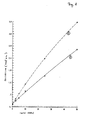
- the curve shows that a high sensitivity can be achieved with a low sample blank.
Landscapes
- Health & Medical Sciences (AREA)
- Immunology (AREA)
- Life Sciences & Earth Sciences (AREA)
- Chemical & Material Sciences (AREA)
- Engineering & Computer Science (AREA)
- Molecular Biology (AREA)
- Biomedical Technology (AREA)
- Hematology (AREA)
- Urology & Nephrology (AREA)
- Medicinal Chemistry (AREA)
- General Health & Medical Sciences (AREA)
- Biochemistry (AREA)
- Physics & Mathematics (AREA)
- Pathology (AREA)
- Microbiology (AREA)
- Analytical Chemistry (AREA)
- Cell Biology (AREA)
- Biotechnology (AREA)
- General Physics & Mathematics (AREA)
- Food Science & Technology (AREA)
- Organic Chemistry (AREA)
- Biophysics (AREA)
- Genetics & Genomics (AREA)
- Proteomics, Peptides & Aminoacids (AREA)
- Inorganic Chemistry (AREA)
- Peptides Or Proteins (AREA)
- Medicines Containing Antibodies Or Antigens For Use As Internal Diagnostic Agents (AREA)
- Preparation Of Compounds By Using Micro-Organisms (AREA)
Applications Claiming Priority (2)
| Application Number | Priority Date | Filing Date | Title |
|---|---|---|---|
| DE19873707746 DE3707746A1 (de) | 1987-03-11 | 1987-03-11 | Spezifische antikoerper gegen herzmuskelmyosin-leichtketten, ihre herstellung und verwendung in einem reagenz zur bestimmung von herzmuskelmyosin-leichtketten |
| DE3707746 | 1987-03-11 |
Publications (2)
| Publication Number | Publication Date |
|---|---|
| EP0282021A2 true EP0282021A2 (fr) | 1988-09-14 |
| EP0282021A3 EP0282021A3 (fr) | 1990-01-24 |
Family
ID=6322744
Family Applications (1)
| Application Number | Title | Priority Date | Filing Date |
|---|---|---|---|
| EP88103697A Withdrawn EP0282021A3 (fr) | 1987-03-11 | 1988-03-09 | Anticorps spécifique contre les chaínes légères de la myosine du muscle du coeur, sa préparation et son utilisation dans un réactif pour la détermination des chaínes légères de la myosine du muscle du coeur |
Country Status (3)
| Country | Link |
|---|---|
| US (1) | US4879216A (fr) |
| EP (1) | EP0282021A3 (fr) |
| DE (1) | DE3707746A1 (fr) |
Cited By (4)
| Publication number | Priority date | Publication date | Assignee | Title |
|---|---|---|---|---|
| WO1990015329A1 (fr) * | 1989-06-01 | 1990-12-13 | Rougier Inc. | Anticorps monoclonal specifique a la chaine legere de myosine ventriculaire vlc1 et immunoanalyse enzymatique servant a sa detection chez des patients cardiaques |
| DE4122886A1 (de) * | 1990-10-12 | 1992-04-16 | Georg Dr Jackowski | Diagnostischer kit fuer die diagnose und charakterisierung von brustschmerzen bei ihrem ersten auftreten |
| WO1996010078A1 (fr) * | 1994-09-28 | 1996-04-04 | Spectral Diagnostics Inc. | Anticorps monoclonal contre des chaines legeres de la myosine ventriculaire humaine |
| CN116410310A (zh) * | 2022-08-19 | 2023-07-11 | 北京普恩光德生物科技开发有限公司 | 抗cmlc-1的单克隆抗体8a3及其应用 |
Families Citing this family (2)
| Publication number | Priority date | Publication date | Assignee | Title |
|---|---|---|---|---|
| US6329501B1 (en) * | 1997-05-29 | 2001-12-11 | Auburn University | Methods and compositions for targeting compounds to muscle |
| US6248869B1 (en) | 1997-05-29 | 2001-06-19 | Medical Analysis Systems, Inc. | Troponin I forms and use of the same |
Family Cites Families (2)
| Publication number | Priority date | Publication date | Assignee | Title |
|---|---|---|---|---|
| JPH0625762B2 (ja) * | 1985-06-13 | 1994-04-06 | ヤマサ醤油株式会社 | ミオシン軽鎖の測定法 |
| US4680338A (en) * | 1985-10-17 | 1987-07-14 | Immunomedics, Inc. | Bifunctional linker |
-
1987
- 1987-03-11 DE DE19873707746 patent/DE3707746A1/de not_active Withdrawn
-
1988
- 1988-03-08 US US07/165,288 patent/US4879216A/en not_active Expired - Fee Related
- 1988-03-09 EP EP88103697A patent/EP0282021A3/fr not_active Withdrawn
Cited By (6)
| Publication number | Priority date | Publication date | Assignee | Title |
|---|---|---|---|---|
| WO1990015329A1 (fr) * | 1989-06-01 | 1990-12-13 | Rougier Inc. | Anticorps monoclonal specifique a la chaine legere de myosine ventriculaire vlc1 et immunoanalyse enzymatique servant a sa detection chez des patients cardiaques |
| DE4122886A1 (de) * | 1990-10-12 | 1992-04-16 | Georg Dr Jackowski | Diagnostischer kit fuer die diagnose und charakterisierung von brustschmerzen bei ihrem ersten auftreten |
| DE4122886C2 (de) * | 1990-10-12 | 2000-03-02 | Spectral Diagnostics Inc | Diagnostischer Kit für die Diagnose und Charakterisierung von Brustschmerzen bei ihrem ersten Auftreten |
| WO1996010078A1 (fr) * | 1994-09-28 | 1996-04-04 | Spectral Diagnostics Inc. | Anticorps monoclonal contre des chaines legeres de la myosine ventriculaire humaine |
| CN116410310A (zh) * | 2022-08-19 | 2023-07-11 | 北京普恩光德生物科技开发有限公司 | 抗cmlc-1的单克隆抗体8a3及其应用 |
| CN116410310B (zh) * | 2022-08-19 | 2023-10-27 | 北京普恩光德生物科技开发有限公司 | 抗cmlc-1的单克隆抗体8a3及其应用 |
Also Published As
| Publication number | Publication date |
|---|---|
| DE3707746A1 (de) | 1988-09-22 |
| US4879216A (en) | 1989-11-07 |
| EP0282021A3 (fr) | 1990-01-24 |
Similar Documents
| Publication | Publication Date | Title |
|---|---|---|
| DE69520383T2 (de) | Quaternäre ammonium immunogenische Konjugate und Immuntest-Reagenz | |
| DE69213240T2 (de) | Wasserlösliche reagenzien und konjugate auf polymerbasis, die vom divinylsulfon abgeleitete reste enthalten | |
| EP0269092B1 (fr) | Procédé pour la détermination d'une substance de liaison spécifique | |
| EP0397113A2 (fr) | Méthode de détection de substances capables de se lier spécifiquement dans les fluides corporels | |
| DE3209149A1 (de) | Verfahren zur gemeinsamen immunologischen bestimmung von prokollagen-peptid (typ iii) und prokollagen-peptid col 1 (typ iii) und verfahren zur herstellung von anti-prokollagen-peptid col 1 (typ iii)-serum | |
| EP0491362B1 (fr) | Utilisation de paires de peptides ayant une affinité spécifique réciproque extrêmement élevée dans le domaine du diagnostic in vitro | |
| EP0072902A1 (fr) | Procédé pour la détermination des antigènes carcinoembryonnaires (CEA) et pour la détermination appropriée de solution d'anticorps | |
| DE69737298T2 (de) | Konjugate von polysacchariden und biomolekülen | |
| DE3433652A1 (de) | Immunchemisches messverfahren fuer haptene und proteine | |
| EP0789714A1 (fr) | Reactif eliminant les interferences specifique a des classes d'anticorps | |
| EP0254929B1 (fr) | Procédé pour déterminer un analyte et les moyens convenables pour cela | |
| DE3909456A1 (de) | Verbessertes verfahren zur herstellung immobilisierter antikoerper | |
| EP0572845B1 (fr) | Méthode de mesure immunochimique d'un analyte | |
| DE3738721C2 (de) | Immobilisierte Antikörper | |
| CH659713A5 (de) | Spezifisches bindungs-testverfahren und reagenszusammensetzung zur durchfuehrung dieses verfahrens. | |
| DE19811196C2 (de) | Verwendung von Anti-Creatinin-Antikörpern oder anderen Creatinin bindenden Substanz en zur Bestimmung von Creatinin in physiologischen Flüssigkeiten und Verfahren zu ihrer Herstellung | |
| JPH0476579B2 (fr) | ||
| DE3707746A1 (de) | Spezifische antikoerper gegen herzmuskelmyosin-leichtketten, ihre herstellung und verwendung in einem reagenz zur bestimmung von herzmuskelmyosin-leichtketten | |
| EP0326074A1 (fr) | Haptènes et les conjugués haptène-protéines en dérivant | |
| DE69822446T2 (de) | Cyclosporin derivate und deren verwendung | |
| EP0322813A2 (fr) | Méthode pour la détermination d'une substance ayant une activité immunologique | |
| DE3780280T2 (de) | Enzymimmunotest. | |
| DE69822190T2 (de) | Sucrose-detektion durch enzymgebundene immunoassays (elisa) | |
| EP0925110B1 (fr) | Conjugue utile pour lier des substances | |
| AT389318B (de) | Neue hybridomzellinien, welche neue monoklonale antikoerper gegen ifn-omega produzieren, verfahren zu ihrer herstellung und die verwendung der neuen monoklonalen antikoerper zur reinigung sowie zum nachweis von ifn-omega |
Legal Events
| Date | Code | Title | Description |
|---|---|---|---|
| PUAI | Public reference made under article 153(3) epc to a published international application that has entered the european phase |
Free format text: ORIGINAL CODE: 0009012 |
|
| 17P | Request for examination filed |
Effective date: 19880309 |
|
| AK | Designated contracting states |
Kind code of ref document: A2 Designated state(s): AT BE CH DE ES FR GB GR IT LI LU NL SE |
|
| PUAL | Search report despatched |
Free format text: ORIGINAL CODE: 0009013 |
|
| RHK1 | Main classification (correction) |
Ipc: C12P 21/00 |
|
| AK | Designated contracting states |
Kind code of ref document: A3 Designated state(s): AT BE CH DE ES FR GB GR IT LI LU NL SE |
|
| 17Q | First examination report despatched |
Effective date: 19920313 |
|
| STAA | Information on the status of an ep patent application or granted ep patent |
Free format text: STATUS: THE APPLICATION IS DEEMED TO BE WITHDRAWN |
|
| 18D | Application deemed to be withdrawn |
Effective date: 19920724 |