EP0282097A1 - Seringue de contrôle de maladie à aiguille rétractable - Google Patents
Seringue de contrôle de maladie à aiguille rétractable Download PDFInfo
- Publication number
- EP0282097A1 EP0282097A1 EP88104011A EP88104011A EP0282097A1 EP 0282097 A1 EP0282097 A1 EP 0282097A1 EP 88104011 A EP88104011 A EP 88104011A EP 88104011 A EP88104011 A EP 88104011A EP 0282097 A1 EP0282097 A1 EP 0282097A1
- Authority
- EP
- European Patent Office
- Prior art keywords
- needle
- cylinder
- syringe
- piston
- distal end
- Prior art date
- Legal status (The legal status is an assumption and is not a legal conclusion. Google has not performed a legal analysis and makes no representation as to the accuracy of the status listed.)
- Granted
Links
Images


Classifications
-
- A—HUMAN NECESSITIES
- A61—MEDICAL OR VETERINARY SCIENCE; HYGIENE
- A61M—DEVICES FOR INTRODUCING MEDIA INTO, OR ONTO, THE BODY; DEVICES FOR TRANSDUCING BODY MEDIA OR FOR TAKING MEDIA FROM THE BODY; DEVICES FOR PRODUCING OR ENDING SLEEP OR STUPOR
- A61M5/00—Devices for bringing media into the body in a subcutaneous, intra-vascular or intramuscular way; Accessories therefor, e.g. filling or cleaning devices, arm rests
- A61M5/178—Syringes
-
- A—HUMAN NECESSITIES
- A61—MEDICAL OR VETERINARY SCIENCE; HYGIENE
- A61M—DEVICES FOR INTRODUCING MEDIA INTO, OR ONTO, THE BODY; DEVICES FOR TRANSDUCING BODY MEDIA OR FOR TAKING MEDIA FROM THE BODY; DEVICES FOR PRODUCING OR ENDING SLEEP OR STUPOR
- A61M5/00—Devices for bringing media into the body in a subcutaneous, intra-vascular or intramuscular way; Accessories therefor, e.g. filling or cleaning devices, arm rests
- A61M5/178—Syringes
- A61M5/31—Details
- A61M5/32—Needles; Details of needles pertaining to their connection with syringe or hub; Accessories for bringing the needle into, or holding the needle on, the body; Devices for protection of needles
- A61M5/3205—Apparatus for removing or disposing of used needles or syringes, e.g. containers; Means for protection against accidental injuries from used needles
- A61M5/321—Means for protection against accidental injuries by used needles
- A61M5/322—Retractable needles, i.e. disconnected from and withdrawn into the syringe barrel by the piston
-
- A—HUMAN NECESSITIES
- A61—MEDICAL OR VETERINARY SCIENCE; HYGIENE
- A61M—DEVICES FOR INTRODUCING MEDIA INTO, OR ONTO, THE BODY; DEVICES FOR TRANSDUCING BODY MEDIA OR FOR TAKING MEDIA FROM THE BODY; DEVICES FOR PRODUCING OR ENDING SLEEP OR STUPOR
- A61M5/00—Devices for bringing media into the body in a subcutaneous, intra-vascular or intramuscular way; Accessories therefor, e.g. filling or cleaning devices, arm rests
- A61M5/178—Syringes
- A61M5/31—Details
- A61M5/315—Pistons; Piston-rods; Guiding, blocking or restricting the movement of the rod or piston; Appliances on the rod for facilitating dosing ; Dosing mechanisms
-
- A—HUMAN NECESSITIES
- A61—MEDICAL OR VETERINARY SCIENCE; HYGIENE
- A61M—DEVICES FOR INTRODUCING MEDIA INTO, OR ONTO, THE BODY; DEVICES FOR TRANSDUCING BODY MEDIA OR FOR TAKING MEDIA FROM THE BODY; DEVICES FOR PRODUCING OR ENDING SLEEP OR STUPOR
- A61M5/00—Devices for bringing media into the body in a subcutaneous, intra-vascular or intramuscular way; Accessories therefor, e.g. filling or cleaning devices, arm rests
- A61M5/178—Syringes
- A61M5/31—Details
- A61M5/32—Needles; Details of needles pertaining to their connection with syringe or hub; Accessories for bringing the needle into, or holding the needle on, the body; Devices for protection of needles
- A61M5/3205—Apparatus for removing or disposing of used needles or syringes, e.g. containers; Means for protection against accidental injuries from used needles
- A61M5/321—Means for protection against accidental injuries by used needles
- A61M5/322—Retractable needles, i.e. disconnected from and withdrawn into the syringe barrel by the piston
- A61M5/3221—Constructional features thereof, e.g. to improve manipulation or functioning
- A61M2005/3223—Means impeding or disabling repositioning of used needles at the syringe nozzle
- A61M2005/3224—Means to disalign the needle tip and syringe nozzle
-
- A—HUMAN NECESSITIES
- A61—MEDICAL OR VETERINARY SCIENCE; HYGIENE
- A61M—DEVICES FOR INTRODUCING MEDIA INTO, OR ONTO, THE BODY; DEVICES FOR TRANSDUCING BODY MEDIA OR FOR TAKING MEDIA FROM THE BODY; DEVICES FOR PRODUCING OR ENDING SLEEP OR STUPOR
- A61M5/00—Devices for bringing media into the body in a subcutaneous, intra-vascular or intramuscular way; Accessories therefor, e.g. filling or cleaning devices, arm rests
- A61M5/178—Syringes
- A61M5/31—Details
- A61M5/32—Needles; Details of needles pertaining to their connection with syringe or hub; Accessories for bringing the needle into, or holding the needle on, the body; Devices for protection of needles
- A61M5/3205—Apparatus for removing or disposing of used needles or syringes, e.g. containers; Means for protection against accidental injuries from used needles
- A61M5/321—Means for protection against accidental injuries by used needles
- A61M5/322—Retractable needles, i.e. disconnected from and withdrawn into the syringe barrel by the piston
- A61M5/3221—Constructional features thereof, e.g. to improve manipulation or functioning
- A61M2005/3231—Proximal end of needle captured or embedded inside piston head, e.g. by friction or hooks
-
- A—HUMAN NECESSITIES
- A61—MEDICAL OR VETERINARY SCIENCE; HYGIENE
- A61M—DEVICES FOR INTRODUCING MEDIA INTO, OR ONTO, THE BODY; DEVICES FOR TRANSDUCING BODY MEDIA OR FOR TAKING MEDIA FROM THE BODY; DEVICES FOR PRODUCING OR ENDING SLEEP OR STUPOR
- A61M5/00—Devices for bringing media into the body in a subcutaneous, intra-vascular or intramuscular way; Accessories therefor, e.g. filling or cleaning devices, arm rests
- A61M5/50—Devices for bringing media into the body in a subcutaneous, intra-vascular or intramuscular way; Accessories therefor, e.g. filling or cleaning devices, arm rests having means for preventing re-use, or for indicating if defective, used, tampered with or unsterile
- A61M5/5013—Means for blocking the piston or the fluid passageway to prevent illegal refilling of a syringe
- A61M5/502—Means for blocking the piston or the fluid passageway to prevent illegal refilling of a syringe for blocking the piston
Definitions
- This invention relates to a disposable disease control syringe which is adapted to reduce the frequency of accidental and, in some cases, life threatening needle strikes while reducing instances of possible drug abuse and the spread of contagious disease by preventing reuse of the syringe by drug abusers.
- Hypodermic syringes are used for a variety of injection procedures including the delivery of medicinal drugs to a recipient.
- problems may arise as a consequence of failing to properly and adequately dispose of the syringe.
- the syringe may be used to treat a patient having a communicable disease.
- the hypodermic needle is sometimes broken before the syringe is discarded.
- Health care workers are susceptible to accidental and potentially infectious needle strikes due to the careless handling of the hypodermic needle when breaking the needle or disposing of the syringe after use.
- syringes have no means by which a used hypodermic needle may be rendered permanently irretrievable within and shielded by the syringe cylinder, so that the syringe and needle are not reuseable. That is to say, little is available to prevent the needle from being completely removed from the syringe cylinder and/or from being returned to an outwardly projecting position from the cylinder by which to execute another injection procedure. Consequently, the syringe and/or the needle, may be reused. Moreover, a greater opportunity exists to handle a used needle which has been removed from or returned to the cylinder, so as to disadvantageously contribute to an accidental needle strike and the possible spread of disease. Moreover, a greater opportunity exists to handle a needle which has been removed from or returned to the cylinder, so as to disadvantageously contribute to accidental needle strikes and the possible spread of disease.
- a disposable disease control syringe which overcomes the problems inherent in a conventional syringe by reliably reducing the frequency of accidental needle strikes among health care workers while preventing reuse of the needle by drug users.
- the syringe includes a cylinder or barrel having a substantially closed distal end and an open proximal end. A first end of a needle projects outwardly from the distal cylinder end, by which a fluid may be injected or infused in the conventional manner. A second end of the needle extends into the interior of the cylinder and terminates at a relatively large needle catch.
- the syringe also includes a piston which is adapted for reciprocal and axial movement through the syringe cylinder.
- the piston comprises the detachable connection of an elongated piston stem to a sealing and locking assembly.
- An elastomeric seal, formed at one end of the sealing and locking assembly, functions as a plunger head when the piston is moved axially through the syringe cylinder during a fluid injection procedure.
- the seal is mounted around a plurality of flexible legs which define a needle capturing receptacle therebetween.
- the elastomeric seal When the piston is moved through the syringe cylinder at the conclusion of a fluid injection procedure, the elastomeric seal is compressed against the most distal aspect of the cylinder, such that the needle capturing receptacle is advanced axially into engagement with the needle catch. The needle catch is thereby snapped into receipt by the receptacle.
- the piston stem is now withdrawn through the open proximal end of the syringe cylinder, whereby to relocate the needle from the distal end to the proximal cylinder end, such that the needle canula is fully retracted into the interior of the syringe cylinder.
- the sealing and locking assembly is permanently locked across the proximal end of the cylinder to both block the removal of the needle from the cylinder and prevent any return of the needle from the proximal end to the distal cylinder end.
- the piston stem is then detached from the piston by breaking the stem away from the sealing and locking assembly.
- a puncture resistant shield is located at the distal end of the cylinder, and the needle capturing receptacle is provided with a configuration by which to cant the needle relative to the longitudinal axis of the cylinder when the needle is relocated to the proximal cylinder end.
- the piston stem may then be driven axially and distally through the cylinder for moving the canted needle into contact with the puncture resistant shield to axially collapse, and thereby destroy, the needle within the cylinder.
- the syringe may then be discarded in a normal fashion.
- the resulting cartridge is rendered safe, such that the used needle is completely shielded by and rendered totally irretrievable within the syringe cylinder. Accordingly, the syringe cannot be reused.
- the used syringe is in a condition to permit safe disposal without requiring handling or cutting of the needle as has heretofore been necessitated as a consequence of many conventional syringe assemblies.
- FIG. 1 there is shown the syringe 1 including a generally cylindrical cylinder or barrel 2 having an open proximal end and a closed distal end.
- An anti-slip flange 4 is disposed around the distal end and a major flange 6 is disposed around the proximal end of the cylinder 2.
- a pair of internal locking tabs 7 are formed at the proximal end of cylinder 2 below the major flange 6 thereof.
- the locking tabs of syringe 1 are formed by compressing opposite sides of the cylinder 2 to form an area of reduced diameter adjacent the opening at the proximal end thereof.
- the locking tabs may be formed by any suitable means to establish an area of reduced diameter at the proximal cylinder end.
- An opening is formed in the closed distal end of syringe cylinder 2. The opening is sized to receive the canula of a hollow needle 8 therethrough during the manufacture of the syringe 1. The needle canula is retained in a tight fit within the distal hole of cylinder 2.
- Needle 8 has a sharp cutting surface formed at a distal end thereof and an enlarged, generally annular catch 10 formed at the proximal end. The cutting surface of needle 8 projects outwardly from the cylinder 2, and the needle catch 10 is located at the distal aspect of cylinder 2 to perform an important function which will be described in greater detail hereinafter.
- Piston 14 Located within and adapted for reciprocal axial movement through the cylinder 2 is a piston 14.
- Piston 14 comprises the detachable connection of an elongated stem 16 to a sealing and locking assembly 18.
- the piston stem 16 is preferably, but not necessarily, hollow to facilitate a quick and relatively detachment of the stem 16 from the sealing and locking assembly 18 (in a manner to be described in greater detail when referring to FIG. 3).
- Formed around a proximal end of the stem 16 is a flange 19.
- Stem 16 is connected at the distal end thereof to a conical locking skirt 20 which is formed of a resilient material.
- the skirt 20 may have a plurality of slots 22 formed therealong to create a series of flexible locking fingers.
- the stem 16 and locking skirt 20 are connected to one another at opposite sides of a narrow groove 24 which is formed around the periphery of stem 16 to provide the stem with an area of reduced cross-section to thereby facilitate the detachment of the stem 16 from the sealing and locking assembly 18.
- the sealing and locking assembly 18 includes a locking flange 26 which is coextensively connected to and spaced distally from the conical skirt 20 by way of a neck portion 28. Coextensively formed with and extending distally from the locking flange 26 are one or more pairs of oppositely disposed, flexible legs 30 between which is formed a hollow receptacle 32 for selectively capturing the catch 10 of the needle 8. That is to say, the needle 8, the catch 10 thereof, and the hollow needle capturing receptacle 32 are concentrically aligned with one another so that the needle catch 10 may be snapped into receipt by the receptacle 32 when piston 14 is moved to the most distal aspect of syringe cylinder 2 (best illustrated in FIG. 2).
- a tapered lip 34 Extending into the receptacle 32 from each of the flexible legs 30 is a tapered lip 34. As will be disclosed in greater detail when referring to FIG. 2, the lip portions 34 of legs 30 are snapped into engagement with the needle catch 10 whereby to permanently retain the needle catch within the receptacle 32 and prevent the withdrawal of catch 10 from receptacle 32.
- each of the legs 30 Extending laterally from each of the legs 30 is a seal retaining flange 36.
- An elastomeric seal 40 is mounted upon the legs 30 and against the locking flange 36.
- the seal retaining flange 36 engages the seal and prevents the removal thereof during a displacement of the piston 14 through cylinder 2.
- the elastomeric seal 40 includes a proximally extending base 42 which lies adjacent and is supported by the locking flange 26. Seal 40 also includes a distally extending sealing head 44 which is shaped so as to form a fluid-tight seal against the closed distal end of the cylinder 2 when the sealing and locking assembly 18 of piston 14 is moved to the most distal aspect of the syringe 1.
- a centrally disposed pocket 46 is formed through the sealing 44 of seal 40 to permit the needle catch 10 of the needle 8 to be snapped into engagement with the lips 34 of legs 30 at needle capturing receptacle 32.
- FIGs. 1-3 of the drawings The operation of the disease control syringe 1 of the present invention is now described while referring to FIGs. 1-3 of the drawings.
- the needle 8 of the syringe 1 of FIG. 1 is moved into fluid communication with a fluid drug supply (not shown).
- the syringe 1 is infused with fluid medication in a conventional manner by grasping the cylinder 2 behind the anti-slip flange 4 and pulling the stem flange 19 of piston stem 16 to withdraw the piston 14 proximally and axially through the cylinder 2.
- a conventional injection procedure may be executed by depressing the stem flange 19 driving the piston distally through the cylinder 2.
- the piston 14 is moved completely and axially through the cylinder 2 of syringe 1.
- the sealing and locking assembly 18 of piston 14 is thereupon moved to the most distal aspect of the syringe 1, whereby the sealing head 44 of elastomeric seal 40 is located flush against the closed distal end of cylinder 2.
- the syringe 1 is supported at the major flange 6 thereof and the piston 14 is depressed distally while applying an axial force against the flange 19 of piston stem 16.
- Such axial force is transmitted from the stem 16 to the elastomeric seal 40 by way of the locking flange 46 upon which seal 40 is seated.
- sealing head 44 Because of the resiliency of the seal 40, the sealing head 44 thereof is moved towards and compressed against the closed distal end of syringe cylinder 2. The compression and distal displacement of sealing head 44 correspondingly advances the flexible legs 30 of sealing and locking assembly 18 into engagement with the catch 10 of needle 8.
- the movement of the tapered lips 34 of the flexible legs 30 into engagement with the needle catch 10 causes a slight clockwise rotation and separation of the legs 30 so as to permit the catch 10 to be snapped into receipt by the needle capturing receptacle 32.
- the flexible legs 30 are automatically rotated counterclockwise to establish a positive locking feature for preventing the removal of the needle catch 10 from receptacle 32. That is, the lips 34 of legs 30 form shoulders or stops against which the needle catch 10 is seated when the catch is received within needle capturing receptacle 32. Such shoulders or stops establish a sufficiently narrow exit from cylinder 2 between opposing legs 30 to permanently prevent any removal of the needle catch 10 outwardly from the receptacle 32.
- the needle 8 (with the catch 10 thereof permanently retained within needle capturing receptacle 32) is retracted from the distal end of cylinder 2 of syringe 1 and relocated at the proximal end thereof.
- the syringe cylinder 2 is grasped above the anti-slip flange 4, and the flange 19 of piston stem 16 is withdrawn proximally (in the direction of the reference arrows) and outwardly of the cylinder 2.
- the stem 16 is moved through the open proximal end of cylinder 2, whereby the conical locking skirt 20 is correspondingly moved into engagement, and then past, the internal locking tabs 7.
- the movement of the resilient locking skirt 20 into engagement with locking tabs 7 causes a compression of the locking skirt 20 to permit the skirt to be moved past the locking tabs.
- the resilient locking skirt 20 is moved past locking tabs 7 and through the open proximal end of cylinder 2, the previously compressed locking skirt 20 is relaxed and automatically returned to its precompressed shape to prevent the return of the locking skirt to the interior cylinder 2 via the open proximal end thereof. That is to say, the relatively large diameter base of conical skirt 20 is seated upon the locking tabs 7.
- the locking tabs 7 establish a relatively narrow diameter opening at the proximal end of cylinder 2 to form a stop, whereby to block the return of locking skirt 20 and, therefore, the piston stem 16 to the interior of cylinder 2.
- the needle 8 projects from the proximal end and is located completely within the walls of the cylinder 2 of syringe 1.
- the stem 16 When the piston stem 16 is completely withdrawn from the syringe cylinder 2 and the needle 8 is relocated from the distal to the proximal cylinder end, the stem 16 may be detached from the sealing and locking assembly 18. With the locking skirt 20 and the locking flange 26 of the sealing and locking assembly 18 immovably disposed at opposite sides of the locking tabs 7 and across the proximal end of cylinder 2, a sufficient bending force is exerted upon the piston stem 16 to fracture the stem along the groove 24 formed around the periphery thereof. The piston stem 16 is then discarded.
- the locking skirt 20 and the locking flange 26 remain anchored at opposite sides of the locking tabs 7 to seal off the proximal end of cylinder 2 and thereby block access to the needle 8 at the interior of the cylinder. More particularly, the needle cannot be removed from the cylinder 2, because locking tabs 7 prevent both the movement of locking flange 26 therepast and the withdrawal of needle 8 from cylinder 2. Moreover, the syringe cylinder cannot be reused, because locking tabs 7 also prevent both the movement of conical locking skirt 20 therepast, and the return of the needle 8 to the distal end of cylinder 2.
- the needle capturing receptacle 32 is locked at its final position in cylinder 2 (with the needle catch 10 permanently retained in receptacle 32), so as to create a self-contained disposal cartridge with the needle canula shielded and rendered irretrievable therewithin.
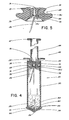
- FIGs. 4 and 5 of the drawings illustrate a disease control syringe 50 having a retractable needle and means by which to destroy the needle after use, so that the destroyed needle may be irretrievably shielded within the syringe cylinder, and the syringe can be rendered safe for handling and disposal.
- the syringe 50 including a generally cylindrical cylinder or barrel 52 having an open proximal end and a substantially closed distal end wall 54.
- a pair of internal piston stops 55 are formed below the open proximal end of cylinder 52.
- the piston stops 55 of syringe 50 are formed by compressing opposite sides of the cylinder 52 to form an area of reduced cylinder diameter.
- An opening 56 is formed through the distal end wall 54 of cylinder 52 to receive the cannula of a hollow hypodermic needle 58 during the manufacture of the syringe.
- the needle cannula is removably retained by friction within the distal hole 56 of cylinder 52.
- Needle 58 has a sharp tissue penetrating surface formed at a distal end thereof and an enlarged, generally annular needle catch 62 formed at the proximal end. In the assembled relationship (and similar to that shown previously when referring to FIG. 1), the distal tissue penetrating end of needle 58 projects outwardly from the cylinder 52, and the needle catch 62 is spaced proximally from distal end wall 54 of cylinder 52 at the distal aspect of syringe 50.
- piston 64 Located within and adapted for reciprocal, axial movement through the cylinder 52 is a piston 64 comprising an elongated, proximally oriented piston stem 66 and a distally oriented sealing and locking assembly 68.
- the sealing and locking assembly 68 of piston 64 includes an elastomeric sealing head 70 that is seated against a flat locking flange 72.
- Locking flange 72 extends transversely across the cylinder 52 at the interface of the piston stem 66 with the sealing and locking assembly 68.
- a plurality e.g. four
- the sealing head 70 of sealing and locking assembly 68 is supported by legs 74 and 74-1 for axial and reciprocal movement through the cylinder 52 with piston 64.
- a hollow receptacle 76 for selectively capturing the needle catch 62 thereof, and the receptacle 76 are coaxially aligned with one another, so that the needle catch 62 may be received within the receptacle 76 when piston 64 is moved axially to the most distal aspect of the syringe cylinder 52.
- each of the flexible legs 74 and 74-1 Projecting into receptacle 76 from each of the flexible legs 74 and 74-1 is a tapered lip 78.
- the lips 78 of legs 74 and 74-1 are snapped into engagement with the needle catch 62 to permanently retain the needle catch within receptacle 72 and prevent the detachment of needle 58 from the piston 64.
- one or more (e.g. in this case, two) of the flexible legs 74-1 which define needle capturing receptacle 76 are offset from the other legs 74. That is to say, legs 74-1 are longer than the remaining legs 74, such that the respective lips 78 of legs 74-1 are disposed distally from the lips of legs 74. Accordingly, opposing lips 78 of the legs 74 and 74-1 are aligned on an angle relative to one another.
- the advantage of the aforementioned offset configurations of legs 74 and 74-1 will soon be explained.
- Needle locating shield 80 is formed from a suitable puncture resistant material, such as metal, or the like.
- Shield 80 comprises a generally conical base 81 having a series of coaxially aligned, annular ribs 82 extending proximally therefrom.
- a central opening 83 is formed through the needle locating shield (to be aligned with the opening 56 in the distal end wall 54 of syringe cylinder 52), so that the needle 58 may be received therethrough during manufacture of the syringe 50.
- Needle locating shield 80 may be retained at the most distal aspect of syringe cylinder 52 by means of friction.
- the conical base 81 of shield 80 may be secured (e.g. cemented) to the distal end wall 54 of cylinder 52.
- the syringe 50 With needle 58 extending outwardly from the hole 56 in the distal end wall of cylinder 52, the syringe 50 is infused with a supply of fluid medication (in a manner similar to that which was previously described while referring to FIG. 1).
- a conventional injection procedure may be executed by depressing the proximal flange 67 of piston stem 66, thereby driving piston 64 axially and distally through cylinder 52.
- the sealing and locking assembly 68 of piston 64 is moved to the distal aspect of the syringe 50, whereby the elastomeric sealing head 70 of assembly 68 is located adjacent the distal end wall 54 of cylinder 52, and fluid is expulsed through needle 58.
- the needle catch 62 is moved past and snapped into engagement with the lips 78 of legs 74 and 74-1, such that catch 62 is permanently retained within needle capturing receptacle 76.
- the lips 78 form shoulders or stops against which the needle catch 62 is seated within receptacle 76 to provide a positive locking feature for preventing the removal of the catch 62 outwardly from the receptacle.
- the proximal flange 67 of piston stem 66 is grasped and the piston 64 is withdrawn proximally through and outwardly of the cylinder 62 to overcome the friction fit between needle 58 and the hole 56 at the distal end wall 54 of cylinder 52, such that needle 58 is withdrawn into the interior of cylinder 52 through the opening 83 in needle locating shield 80.
- the used needle 58 will be canted or slanted relative to the vertical when the needle catch 62 is received within needle capturing receptacle 76 and the needle is relocated from a distal to a relatively proximal position within cylinder 52.
- the needle is now misaligned with respect to both the opening 83 in shield 80 and the hole 56 in distal end wall 54.
- the piston 64 is once again moved axially and distally through the syringe cylinder 52, whereby to correspondingly advance needle 58 towards the needle locating shield 80.
- the canted alignment of needle 58 will prevent the needle from being relocated through the opening 83 and the hole 56.
- the distal tissue penetrating end of the used needle 58 will be received against the puncture resistant base 81 between a pair of successive annular ribs 82 of the needle locating shield 80.
- the ribbed surfaces of shield 80 prevent the lateral displacement of the needle 58 along the base 81 to thereby assure that the needle will remain completely surrounded by the syringe cylinder 52, while eliminating the possibility that the distal end of needle 58 might be returned to the outwardly extending position (of FIG. 1) relative to cylinder 52.
- the bent needle 58-1 cannot be removed from the cylinder 52 and the syringe 50 cannot be reused. More particularly, the needle 58-1 cannot be removed from the open proximal end of the syringe cylinder 52, because piston stops 55 prevent the movement of the locking flange 72 therepast, whereby to limit the proximal displacement of the piston 64 through the cylinder 52. What is more, access to the interior of the cylinder 52 is blocked, so that the destroyed needle 58-1 is completely shielded by the cylinder and rendered irretrievable therewithin. Accordingly, a disposal cartridge is created, so that the syringe 50 may be safely handled and discarded while avoiding an accidental needle strike and the possible spread of a contagious disease.
- a needle can be retracted and sealed within the syringe cylinder, whereby to render an emptied syringe safe from accidental needle strikes by eliminating the need for health care workers to either handle or cut the needle as has heretofor been required with conventional syringes.
- reuse of the emptied syringe for possible drug related purposes is prevented, inasmuch as the needle is permanently destroyed and/or irretrievably locked within the syringe cylinder.
- the spread of contagious disease has been caused, in the past, by either an accidental needle strike or the reuse of a contaminated syringe by a drug abuser may be avoided.
Landscapes
- Health & Medical Sciences (AREA)
- Engineering & Computer Science (AREA)
- Heart & Thoracic Surgery (AREA)
- Vascular Medicine (AREA)
- Anesthesiology (AREA)
- Biomedical Technology (AREA)
- Hematology (AREA)
- Life Sciences & Earth Sciences (AREA)
- Animal Behavior & Ethology (AREA)
- General Health & Medical Sciences (AREA)
- Public Health (AREA)
- Veterinary Medicine (AREA)
- Environmental & Geological Engineering (AREA)
- Infusion, Injection, And Reservoir Apparatuses (AREA)
Priority Applications (1)
| Application Number | Priority Date | Filing Date | Title |
|---|---|---|---|
| AT88104011T ATE80558T1 (de) | 1987-03-13 | 1988-03-14 | Krankheitsueberwachungsspritze mit zurueckschiebbarer nadel. |
Applications Claiming Priority (4)
| Application Number | Priority Date | Filing Date | Title |
|---|---|---|---|
| US25419 | 1979-03-30 | ||
| US07/025,419 US4826484A (en) | 1987-03-13 | 1987-03-13 | Disease control syringe having a retractable needle |
| US51392 | 1987-05-19 | ||
| US07/051,392 US4770655A (en) | 1987-03-13 | 1987-05-19 | Disease control syringe having a retractable needle |
Publications (2)
| Publication Number | Publication Date |
|---|---|
| EP0282097A1 true EP0282097A1 (fr) | 1988-09-14 |
| EP0282097B1 EP0282097B1 (fr) | 1992-09-16 |
Family
ID=26699711
Family Applications (1)
| Application Number | Title | Priority Date | Filing Date |
|---|---|---|---|
| EP88104011A Expired - Lifetime EP0282097B1 (fr) | 1987-03-13 | 1988-03-14 | Seringue de contrôle de maladie à aiguille rétractable |
Country Status (6)
| Country | Link |
|---|---|
| US (1) | US4770655A (fr) |
| EP (1) | EP0282097B1 (fr) |
| KR (1) | KR960009657B1 (fr) |
| AU (1) | AU598112B2 (fr) |
| DE (1) | DE3874571T2 (fr) |
| MX (1) | MX165895B (fr) |
Cited By (25)
| Publication number | Priority date | Publication date | Assignee | Title |
|---|---|---|---|---|
| EP0327061A1 (fr) * | 1988-02-01 | 1989-08-09 | The Medtech Group, Inc. | Seringue rétractable à usage unique |
| WO1989009075A1 (fr) * | 1988-03-22 | 1989-10-05 | Davsa Seventy-Fifth Pty. Ltd. | Retracteur d'aiguille hypodermique |
| EP0321903A3 (fr) * | 1987-12-21 | 1989-11-15 | Stuart M. Dolgin | Dispositif de passage d'un fluide avec moyen de protection |
| WO1990001962A1 (fr) * | 1988-08-26 | 1990-03-08 | Haak Abraham V D | Dispositif de securite pour aiguille de seringue pour injections |
| EP0364387A1 (fr) * | 1988-08-05 | 1990-04-18 | Vicente Miguel Segui Pastor | Seringue non réutilisable |
| WO1990006146A1 (fr) * | 1988-12-07 | 1990-06-14 | Gaetano Nacci | Seringue qui rend l'aiguille hypodermique automatiquement inoffensive apres son utilisation |
| EP0326983A3 (en) * | 1988-02-04 | 1990-08-08 | Vabin International S.R.L. | A disposable safety syringe with hypodermic needle |
| GB2233901A (en) * | 1989-07-11 | 1991-01-23 | Hugh Williams | Disposable hypodermic syringe with retractable needle |
| WO1991003268A1 (fr) * | 1989-08-29 | 1991-03-21 | Medilife Holding B.V. | Seringue hypodermique |
| EP0426856A4 (en) * | 1989-04-24 | 1991-09-11 | Poltavsky Meditsinsky Stomatologichesky Institut | Single-use syringe for injections |
| US5090961A (en) * | 1989-04-24 | 1992-02-25 | Poltavsky Meditsinsky Stomatologyichesky Institut | Single use syringe |
| US5125899A (en) * | 1990-02-13 | 1992-06-30 | Abar Service S.R.L. | Disposable syringe for once-only use |
| EP0495912A4 (en) * | 1989-10-13 | 1992-12-09 | Habley Medical Technology Corporation | Single use syringe |
| WO1993002726A1 (fr) * | 1991-08-01 | 1993-02-18 | University College London | Perfectionnements apportes a des seringues |
| US5318536A (en) * | 1989-07-11 | 1994-06-07 | Williams Graham H | Disposable hypodermic syringe with retractable needle |
| EP0590757A3 (fr) * | 1992-09-28 | 1995-02-15 | Chen Long Hsiung | Seringue de sécurité ayant une aiguille rétractable autodéformable. |
| EP0636381A3 (fr) * | 1993-07-26 | 1995-03-08 | P T O S R L Prodotti Tecnologi | |
| GB2287192A (en) * | 1994-01-25 | 1995-09-13 | Waymade Plc | Retractable needle assemblies for preventing re-use |
| GB2298139A (en) * | 1994-10-21 | 1996-08-28 | Lu Wen Chin | Safety syringe |
| AU686280B2 (en) * | 1995-01-20 | 1998-02-05 | Finestyle Properties Limited | Disposable syringe with a retractable needle |
| US5716341A (en) * | 1993-06-29 | 1998-02-10 | Saito; Yoshikuni | Hub for syringe, connecting structure of hub, syringe, piston, needle assembly unit, connecting structure between needle assembly unit and syringe, syringe assembly and method of assembling syringe assembly |
| EP1421963A1 (fr) * | 2002-11-22 | 2004-05-26 | Life-Shields Products, Inc. | Seringue de sécurité avec aiguille rétractable et piston mou |
| RU2229901C1 (ru) * | 2002-09-18 | 2004-06-10 | М.К.Медитеч Ко., ЛТД. | Устройство позиционирования иглодержателя безопасного шприца для подкожных инъекций |
| AU2003248445B2 (en) * | 2002-10-16 | 2005-07-07 | Life-Shield Products, Inc. | Retractable safety syringe with a soft piston |
| WO2005084734A1 (fr) * | 2004-03-09 | 2005-09-15 | Advanced Protective Injection Systems (A.P.I.S.) B.V. | Seringue d'injection |
Families Citing this family (71)
| Publication number | Priority date | Publication date | Assignee | Title |
|---|---|---|---|---|
| WO1989004681A1 (fr) * | 1987-11-18 | 1989-06-01 | Catch 522 Pty. Limited | Seringue a usage unique |
| US5047016A (en) * | 1987-12-21 | 1991-09-10 | Stuart M. Dolgin | Fluid passing apparatus with means for covering the same |
| US5171300A (en) * | 1988-02-01 | 1992-12-15 | Medtech Group, Inc. | Disposable hypodermic syringe |
| AU628814B2 (en) * | 1988-03-22 | 1992-09-24 | Davsa Seventy-Fifth Pty. Ltd. | Rteractable hypodermic needle |
| AU641123B2 (en) * | 1988-04-18 | 1993-09-16 | Nujenko Pty Ltd | Single-use syringe |
| WO1989010151A1 (fr) * | 1988-04-18 | 1989-11-02 | Nujenko Pty Ltd | Seringue a jeter |
| US5263933A (en) * | 1988-12-14 | 1993-11-23 | Patco Ventures Ltd. | Safety syringe needle device with interchangeable and retractable needle platform |
| US5122124A (en) * | 1988-12-14 | 1992-06-16 | Patco Ventures Ltd. | Safety syringe needle device with interchangeable and retractable needle platform |
| US5030208A (en) * | 1989-03-22 | 1991-07-09 | Novacek Laurel A | Safety syringe needle device with interchangeable and retractable needle platform |
| US6344031B1 (en) | 1989-03-22 | 2002-02-05 | Laurel A. Novacek | Safety syringe needle device with interchangeable and retractable needle platform |
| US5415638A (en) * | 1988-12-14 | 1995-05-16 | Inviro Medical Devices, Ltd. | Safety syringe needle device with interchangeable and retractable needle platform |
| US5858000A (en) * | 1988-12-14 | 1999-01-12 | Inviro Medical Devices Ltd. | Safety syringe needle device with interchangeable and retractable needle platform |
| US5112318A (en) * | 1990-10-03 | 1992-05-12 | Patco Ventures Ltd. | Safety syringe needle device with interchangeable and retractable needle platform |
| US5462531A (en) * | 1988-12-14 | 1995-10-31 | Inviro Medical Devices Ltd. | Safety syringe needle device with interchangeable and retractable needle platform |
| US4944723A (en) * | 1989-02-02 | 1990-07-31 | Habley Medical Technology Corporation | Universal disposable safety syringe system |
| US4932939A (en) * | 1989-03-06 | 1990-06-12 | Magre George R | Safety syringe |
| US5399170A (en) * | 1989-05-04 | 1995-03-21 | Western Medical Products Pty Limited | Syringe |
| AU652122B2 (en) * | 1989-05-04 | 1994-08-18 | Western Medical Products Pty. Limited | A syringe |
| US5000738A (en) * | 1989-05-11 | 1991-03-19 | Lavallo Frank | Protective syringe with frangible barrel |
| WO1990014119A1 (fr) * | 1989-05-16 | 1990-11-29 | Taylor David T | Seringue hypodermique retractible |
| US5188600A (en) * | 1989-06-02 | 1993-02-23 | Jullien Robert G | Syringe guard apparatus |
| US6096005A (en) | 1989-07-11 | 2000-08-01 | Mdc Investment Holdings, Inc. | Retractable needle medical devices |
| US5407431A (en) | 1989-07-11 | 1995-04-18 | Med-Design Inc. | Intravenous catheter insertion device with retractable needle |
| WO1991000747A1 (fr) * | 1989-07-12 | 1991-01-24 | Edward Robert James Kayser | Seringue hypodermique |
| WO1991007198A1 (fr) * | 1989-11-08 | 1991-05-30 | Napoleon Curie | Seringue a support d'aiguille retractable |
| US5053017A (en) * | 1990-02-28 | 1991-10-01 | Chamuel Steven R | Hypodermic needle safety clip |
| US5067942A (en) * | 1990-12-20 | 1991-11-26 | The Board Of Trustees Of The Leland Stanford Junior University | Single use hypodermic needle |
| SE9101102D0 (sv) * | 1991-04-11 | 1991-04-11 | Viggo Spectramed Ab | Needle protection device |
| US5273540A (en) * | 1991-04-26 | 1993-12-28 | Luther Medical Products | Nonreusable needle and catheter assembly |
| US5070809A (en) * | 1991-05-07 | 1991-12-10 | Fox David W | Kinetic banner display |
| US5205824A (en) * | 1991-06-13 | 1993-04-27 | Mazur Matthew S | Retractable syringe with a closed barrel |
| US5401246A (en) * | 1991-06-13 | 1995-03-28 | U.S. Medical Instruments, Inc. | Retractable syringe with a closed barrel |
| EP0582849A1 (fr) * | 1992-08-12 | 1994-02-16 | Brice Somers | Seringue |
| US5336198A (en) * | 1993-02-01 | 1994-08-09 | Innova Development Corp. | Hypodermic syringe with needle retraction feature |
| US5344403A (en) * | 1993-06-09 | 1994-09-06 | Rahnfong Lee | Simple retractable safety syringe |
| US5382235A (en) | 1993-07-07 | 1995-01-17 | R.M.S. Safety, Inc. | Device for capturing and retracting the needle cannula of a disposable syringe |
| RU2114641C1 (ru) * | 1993-10-28 | 1998-07-10 | Лок-Тек Сайринг Пти Лтд. | Шприц для подкожных инъекций с втягивающейся вовнутрь канюлей с установленной на ней иглой |
| US5403283A (en) * | 1993-10-28 | 1995-04-04 | Luther Medical Products, Inc. | Percutaneous port catheter assembly and method of use |
| US5531701A (en) * | 1994-06-06 | 1996-07-02 | Luther Medical Products, Inc. | Over-the-needle catheter |
| US5554136A (en) * | 1994-09-07 | 1996-09-10 | Luther Medical Products, Inc. | Dual lumen infusion/aspiration catheter |
| US5522807A (en) * | 1994-09-07 | 1996-06-04 | Luther Medical Products, Inc. | Dual lumen infusion/aspiration catheter |
| US5738660A (en) * | 1994-10-27 | 1998-04-14 | Luther Medical Products, Inc. | Percutaneous port catheter assembly and method of use |
| AUPN254195A0 (en) * | 1995-04-20 | 1995-05-18 | Curie, Napoleon | Syringe with retractable needle mount |
| US6090077A (en) | 1995-05-11 | 2000-07-18 | Shaw; Thomas J. | Syringe plunger assembly and barrel |
| US6045734A (en) * | 1995-05-24 | 2000-04-04 | Becton Dickinson And Company | Process of making a catheter |
| US5601534A (en) * | 1995-06-07 | 1997-02-11 | The University Of Memphis | Disposable hypodermic syringe and needle combination |
| US5591131A (en) * | 1995-08-22 | 1997-01-07 | Chen; Long-Hsiung | Safety minute dose hypodermic syringe |
| US5913848A (en) | 1996-06-06 | 1999-06-22 | Luther Medical Products, Inc. | Hard tip over-the-needle catheter and method of manufacturing the same |
| US6183464B1 (en) | 1998-06-01 | 2001-02-06 | Inviro Medical Devices Ltd. | Safety syringe with retractable needle and universal luer coupling |
| US6958055B2 (en) | 1998-09-04 | 2005-10-25 | Nmt Group Plc | Retractable needle syringe including a sheath and an intravenous adapter |
| GB2359754B (en) | 2000-03-03 | 2004-04-28 | Nmt Group Plc | Needle sheath |
| ATE317712T1 (de) | 1999-11-29 | 2006-03-15 | Mdc Invest Holdings Inc | Kombination von einer sicherheitsnadelvorrichtung und einer medizinvorrichtung |
| WO2001045776A1 (fr) * | 1999-12-07 | 2001-06-28 | Mdc Investment Holdings, Inc. | Dispositifs medicaux comprenant une aiguille de securite retractable |
| US7527607B2 (en) * | 2000-03-06 | 2009-05-05 | Mdc Investment Holdings, Inc. | Hypodermic syringe with retractable needle |
| US6524276B1 (en) * | 2000-06-05 | 2003-02-25 | Mdc Investment Holdings, Inc. | Fluid collection device having tilting retractable needle |
| IL157981A (en) | 2003-09-17 | 2014-01-30 | Elcam Medical Agricultural Cooperative Ass Ltd | Auto-injector |
| US7226434B2 (en) | 2003-10-31 | 2007-06-05 | Tyco Healthcare Group Lp | Safety shield |
| IL160891A0 (en) | 2004-03-16 | 2004-08-31 | Auto-mix needle | |
| US7905857B2 (en) | 2005-07-11 | 2011-03-15 | Covidien Ag | Needle assembly including obturator with safety reset |
| US7850650B2 (en) | 2005-07-11 | 2010-12-14 | Covidien Ag | Needle safety shield with reset |
| US7828773B2 (en) | 2005-07-11 | 2010-11-09 | Covidien Ag | Safety reset key and needle assembly |
| US20060276747A1 (en) * | 2005-06-06 | 2006-12-07 | Sherwood Services Ag | Needle assembly with removable depth stop |
| US7731692B2 (en) | 2005-07-11 | 2010-06-08 | Covidien Ag | Device for shielding a sharp tip of a cannula and method of using the same |
| US7654735B2 (en) | 2005-11-03 | 2010-02-02 | Covidien Ag | Electronic thermometer |
| US20080228172A1 (en) * | 2007-03-15 | 2008-09-18 | Petry Thomas S | Intravenous access safety device |
| US8357104B2 (en) | 2007-11-01 | 2013-01-22 | Coviden Lp | Active stylet safety shield |
| ATE482738T1 (de) | 2007-12-20 | 2010-10-15 | Tyco Healthcare | Verschlusskappeanordnung mit gefederter manschette |
| JP5836931B2 (ja) | 2010-03-26 | 2015-12-24 | テルモ株式会社 | 留置針組立体 |
| CN103143080B (zh) * | 2013-01-11 | 2016-05-11 | 英属维尔京群岛圣采科技投资有限公司 | 安全静脉留置针 |
| JP6794349B2 (ja) | 2015-05-15 | 2020-12-02 | テルモ株式会社 | カテーテル組立体 |
| USD1141122S1 (en) | 2017-09-15 | 2026-08-11 | Ethan Pedde | Volume limiter device |
Citations (2)
| Publication number | Priority date | Publication date | Assignee | Title |
|---|---|---|---|---|
| WO1984001510A1 (fr) * | 1982-10-12 | 1984-04-26 | Tulcea Sa | Seringue pre-remplie |
| US4507117A (en) * | 1983-07-11 | 1985-03-26 | Vining Herbert C | Syringe apparatus with retractable needle |
Family Cites Families (9)
| Publication number | Priority date | Publication date | Assignee | Title |
|---|---|---|---|---|
| US3320954A (en) * | 1963-12-30 | 1967-05-23 | Pharmaseal Lab | Hypodermic syringe with breakable polypropylene needle adaptor |
| US3796359A (en) * | 1971-07-07 | 1974-03-12 | P Dick | Disposable hypodermic needle destroyer |
| US4026287A (en) * | 1975-12-10 | 1977-05-31 | Irene Haller | Syringe with retractable cannula |
| US4273123A (en) * | 1979-10-01 | 1981-06-16 | Lemelson Jerome H | Syringe and needle cover |
| US4562844A (en) * | 1984-11-27 | 1986-01-07 | Jett Labs, Inc. | Multipurpose syringe |
| US4650463A (en) * | 1984-12-24 | 1987-03-17 | Leveen Harry H | Perforated tubing |
| US4634428A (en) * | 1985-08-15 | 1987-01-06 | Cuu Cwo Liang | Cover for a disposable syringe |
| US4650468A (en) * | 1986-02-26 | 1987-03-17 | Jennings Jr Baldwin P | Medical syringe |
| US4643199A (en) * | 1986-02-28 | 1987-02-17 | Jennings Jr Baldwin P | Safety blood sample apparatus |
-
1987
- 1987-05-19 US US07/051,392 patent/US4770655A/en not_active Expired - Fee Related
-
1988
- 1988-03-11 MX MX010726A patent/MX165895B/es unknown
- 1988-03-12 KR KR1019880002617A patent/KR960009657B1/ko not_active Expired - Fee Related
- 1988-03-14 DE DE8888104011T patent/DE3874571T2/de not_active Expired - Fee Related
- 1988-03-14 EP EP88104011A patent/EP0282097B1/fr not_active Expired - Lifetime
- 1988-03-14 AU AU13088/88A patent/AU598112B2/en not_active Ceased
Patent Citations (3)
| Publication number | Priority date | Publication date | Assignee | Title |
|---|---|---|---|---|
| WO1984001510A1 (fr) * | 1982-10-12 | 1984-04-26 | Tulcea Sa | Seringue pre-remplie |
| US4507117A (en) * | 1983-07-11 | 1985-03-26 | Vining Herbert C | Syringe apparatus with retractable needle |
| US4507117B1 (fr) * | 1983-07-11 | 1988-06-21 |
Cited By (34)
| Publication number | Priority date | Publication date | Assignee | Title |
|---|---|---|---|---|
| EP0321903A3 (fr) * | 1987-12-21 | 1989-11-15 | Stuart M. Dolgin | Dispositif de passage d'un fluide avec moyen de protection |
| EP0327061A1 (fr) * | 1988-02-01 | 1989-08-09 | The Medtech Group, Inc. | Seringue rétractable à usage unique |
| EP0326983A3 (en) * | 1988-02-04 | 1990-08-08 | Vabin International S.R.L. | A disposable safety syringe with hypodermic needle |
| GB2234177A (en) * | 1988-03-22 | 1991-01-30 | Davsa Seventy Fifth Pty Ltd | Hypodermic needle retractor |
| WO1989009075A1 (fr) * | 1988-03-22 | 1989-10-05 | Davsa Seventy-Fifth Pty. Ltd. | Retracteur d'aiguille hypodermique |
| GB2234177B (en) * | 1988-03-22 | 1991-11-13 | Davsa Seventy Fifth Pty Ltd | Hypodermic needle retractor |
| EP0364387A1 (fr) * | 1988-08-05 | 1990-04-18 | Vicente Miguel Segui Pastor | Seringue non réutilisable |
| US5380286A (en) * | 1988-08-23 | 1995-01-10 | Advanced Protective Injection Systems B.V. | Safety device for an injection syringe needle |
| EP0360313A1 (fr) * | 1988-08-26 | 1990-03-28 | Advanced Protective Injection Systems B.V. | Dispositif de sécurité pour une aiguille à injection |
| WO1990001962A1 (fr) * | 1988-08-26 | 1990-03-08 | Haak Abraham V D | Dispositif de securite pour aiguille de seringue pour injections |
| WO1990006146A1 (fr) * | 1988-12-07 | 1990-06-14 | Gaetano Nacci | Seringue qui rend l'aiguille hypodermique automatiquement inoffensive apres son utilisation |
| US5084029A (en) * | 1988-12-07 | 1992-01-28 | Nacci Carla | Syringe which automatically make the hypodermic needle harmless after use |
| EP0426856A4 (en) * | 1989-04-24 | 1991-09-11 | Poltavsky Meditsinsky Stomatologichesky Institut | Single-use syringe for injections |
| US5090961A (en) * | 1989-04-24 | 1992-02-25 | Poltavsky Meditsinsky Stomatologyichesky Institut | Single use syringe |
| GB2233901A (en) * | 1989-07-11 | 1991-01-23 | Hugh Williams | Disposable hypodermic syringe with retractable needle |
| US5318536A (en) * | 1989-07-11 | 1994-06-07 | Williams Graham H | Disposable hypodermic syringe with retractable needle |
| WO1991003268A1 (fr) * | 1989-08-29 | 1991-03-21 | Medilife Holding B.V. | Seringue hypodermique |
| EP0495912A4 (en) * | 1989-10-13 | 1992-12-09 | Habley Medical Technology Corporation | Single use syringe |
| US5125899A (en) * | 1990-02-13 | 1992-06-30 | Abar Service S.R.L. | Disposable syringe for once-only use |
| WO1993002726A1 (fr) * | 1991-08-01 | 1993-02-18 | University College London | Perfectionnements apportes a des seringues |
| EP0590757A3 (fr) * | 1992-09-28 | 1995-02-15 | Chen Long Hsiung | Seringue de sécurité ayant une aiguille rétractable autodéformable. |
| US5716341A (en) * | 1993-06-29 | 1998-02-10 | Saito; Yoshikuni | Hub for syringe, connecting structure of hub, syringe, piston, needle assembly unit, connecting structure between needle assembly unit and syringe, syringe assembly and method of assembling syringe assembly |
| US5879339A (en) * | 1993-06-29 | 1999-03-09 | Saito; Yoshikuni | Hub for syringe, connecting structure of hub, syringe, piston, needle assembly unit, connecting structure between needle assembly unit and syringe, syringe assembly and method of assembling syringe assembly |
| US5788672A (en) * | 1993-06-29 | 1998-08-04 | Saito; Yoshikuni | Hub for syringe, connecting structure of hub, syringe, piston, needle assembly unit, connecting structure between needle assembly unit and syringe, syringe assembly and method of assembling syringe assembly |
| EP0636381A3 (fr) * | 1993-07-26 | 1995-03-08 | P T O S R L Prodotti Tecnologi | |
| GB2287192A (en) * | 1994-01-25 | 1995-09-13 | Waymade Plc | Retractable needle assemblies for preventing re-use |
| GB2287192B (en) * | 1994-01-25 | 1998-08-26 | Waymade Plc | Non-reusable syringe |
| GB2298139B (en) * | 1994-10-21 | 1998-08-05 | Lu Wen Chin | Safety syringe with externally connectable and internally retractable self-biased needle |
| GB2298139A (en) * | 1994-10-21 | 1996-08-28 | Lu Wen Chin | Safety syringe |
| AU686280B2 (en) * | 1995-01-20 | 1998-02-05 | Finestyle Properties Limited | Disposable syringe with a retractable needle |
| RU2229901C1 (ru) * | 2002-09-18 | 2004-06-10 | М.К.Медитеч Ко., ЛТД. | Устройство позиционирования иглодержателя безопасного шприца для подкожных инъекций |
| AU2003248445B2 (en) * | 2002-10-16 | 2005-07-07 | Life-Shield Products, Inc. | Retractable safety syringe with a soft piston |
| EP1421963A1 (fr) * | 2002-11-22 | 2004-05-26 | Life-Shields Products, Inc. | Seringue de sécurité avec aiguille rétractable et piston mou |
| WO2005084734A1 (fr) * | 2004-03-09 | 2005-09-15 | Advanced Protective Injection Systems (A.P.I.S.) B.V. | Seringue d'injection |
Also Published As
| Publication number | Publication date |
|---|---|
| EP0282097B1 (fr) | 1992-09-16 |
| MX165895B (es) | 1992-12-09 |
| AU1308888A (en) | 1988-09-22 |
| KR880010788A (ko) | 1988-10-24 |
| US4770655A (en) | 1988-09-13 |
| KR960009657B1 (ko) | 1996-07-23 |
| DE3874571T2 (de) | 1993-02-04 |
| AU598112B2 (en) | 1990-06-14 |
| DE3874571D1 (de) | 1992-10-22 |
Similar Documents
| Publication | Publication Date | Title |
|---|---|---|
| EP0282097B1 (fr) | Seringue de contrôle de maladie à aiguille rétractable | |
| US4804370A (en) | Disease control syringe having a retractable needle | |
| US4826484A (en) | Disease control syringe having a retractable needle | |
| US4710170A (en) | Anti-needle strike and anti-drug abuse syringe | |
| US4944723A (en) | Universal disposable safety syringe system | |
| US4767413A (en) | Dental syringe having an automatically retractable needle | |
| US4838870A (en) | Removable needle attachment having a detachable needle | |
| CN1171646C (zh) | 一次使用的注射器组件 | |
| EP1092443B1 (fr) | Seringue à aiguille rétractable | |
| US5242400A (en) | Disposable pre-filled syringe with retractable needle | |
| US5104378A (en) | Syringe having means for retracting, canting and destroying a needle cannula | |
| EP0337252B1 (fr) | Seringue de sécurité | |
| US6517516B1 (en) | Method of making a retracting needle syringe | |
| US5533970A (en) | Retractable needle syringe | |
| US6840291B2 (en) | Attachment for a medical device | |
| US5415648A (en) | Multiple purpose syringe | |
| US5531691A (en) | Single use syringe assembly | |
| US5501670A (en) | Syringe system providing retraction of needle cannula into disposable cartridge | |
| US20060052748A1 (en) | Single use syringe having safety shield | |
| WO1990011099A1 (fr) | Seringue avec plate-forme d'aiguille interchangeable et retractible | |
| CN1024757C (zh) | 一次性注射器 | |
| AU635789C (en) | Single use syringe |
Legal Events
| Date | Code | Title | Description |
|---|---|---|---|
| PUAI | Public reference made under article 153(3) epc to a published international application that has entered the european phase |
Free format text: ORIGINAL CODE: 0009012 |
|
| AK | Designated contracting states |
Kind code of ref document: A1 Designated state(s): AT CH DE FR GB IT LI NL SE |
|
| 17P | Request for examination filed |
Effective date: 19890303 |
|
| 17Q | First examination report despatched |
Effective date: 19901115 |
|
| GRAA | (expected) grant |
Free format text: ORIGINAL CODE: 0009210 |
|
| AK | Designated contracting states |
Kind code of ref document: B1 Designated state(s): AT CH DE FR GB IT LI NL SE |
|
| PG25 | Lapsed in a contracting state [announced via postgrant information from national office to epo] |
Ref country code: IT Free format text: LAPSE BECAUSE OF FAILURE TO SUBMIT A TRANSLATION OF THE DESCRIPTION OR TO PAY THE FEE WITHIN THE PRE;WARNING: LAPSES OF ITALIAN PATENTS WITH EFFECTIVE DATE BEFORE 2007 MAY HAVE OCCURRED AT ANY TIME BEFORE 2007. THE CORRECT EFFECTIVE DATE MAY BE DIFFERENT FROM THE ONE RECORDED.SCRIBED TIME-LIMIT Effective date: 19920916 Ref country code: AT Effective date: 19920916 Ref country code: NL Effective date: 19920916 Ref country code: SE Effective date: 19920916 |
|
| REF | Corresponds to: |
Ref document number: 80558 Country of ref document: AT Date of ref document: 19921015 Kind code of ref document: T |
|
| REF | Corresponds to: |
Ref document number: 3874571 Country of ref document: DE Date of ref document: 19921022 |
|
| ET | Fr: translation filed | ||
| NLV1 | Nl: lapsed or annulled due to failure to fulfill the requirements of art. 29p and 29m of the patents act | ||
| PLBE | No opposition filed within time limit |
Free format text: ORIGINAL CODE: 0009261 |
|
| STAA | Information on the status of an ep patent application or granted ep patent |
Free format text: STATUS: NO OPPOSITION FILED WITHIN TIME LIMIT |
|
| 26N | No opposition filed | ||
| PGFP | Annual fee paid to national office [announced via postgrant information from national office to epo] |
Ref country code: GB Payment date: 19950308 Year of fee payment: 8 |
|
| PGFP | Annual fee paid to national office [announced via postgrant information from national office to epo] |
Ref country code: FR Payment date: 19950309 Year of fee payment: 8 |
|
| PGFP | Annual fee paid to national office [announced via postgrant information from national office to epo] |
Ref country code: CH Payment date: 19950315 Year of fee payment: 8 |
|
| PGFP | Annual fee paid to national office [announced via postgrant information from national office to epo] |
Ref country code: DE Payment date: 19950330 Year of fee payment: 8 |
|
| PG25 | Lapsed in a contracting state [announced via postgrant information from national office to epo] |
Ref country code: GB Effective date: 19960314 |
|
| PG25 | Lapsed in a contracting state [announced via postgrant information from national office to epo] |
Ref country code: CH Effective date: 19960331 Ref country code: LI Effective date: 19960331 |
|
| GBPC | Gb: european patent ceased through non-payment of renewal fee |
Effective date: 19960314 |
|
| REG | Reference to a national code |
Ref country code: CH Ref legal event code: PL |
|
| PG25 | Lapsed in a contracting state [announced via postgrant information from national office to epo] |
Ref country code: FR Effective date: 19961129 |
|
| PG25 | Lapsed in a contracting state [announced via postgrant information from national office to epo] |
Ref country code: DE Effective date: 19961203 |
|
| REG | Reference to a national code |
Ref country code: FR Ref legal event code: ST |