EP0282243A2 - Filaments abrasifs et leur procédé de fabrication - Google Patents
Filaments abrasifs et leur procédé de fabrication Download PDFInfo
- Publication number
- EP0282243A2 EP0282243A2 EP88301923A EP88301923A EP0282243A2 EP 0282243 A2 EP0282243 A2 EP 0282243A2 EP 88301923 A EP88301923 A EP 88301923A EP 88301923 A EP88301923 A EP 88301923A EP 0282243 A2 EP0282243 A2 EP 0282243A2
- Authority
- EP
- European Patent Office
- Prior art keywords
- filaments
- abrasive
- polyvinylidene fluoride
- point
- fluoride resin
- Prior art date
- Legal status (The legal status is an assumption and is not a legal conclusion. Google has not performed a legal analysis and makes no representation as to the accuracy of the status listed.)
- Granted
Links
- 238000004519 manufacturing process Methods 0.000 title claims description 8
- 239000002033 PVDF binder Substances 0.000 claims abstract description 88
- 229920002981 polyvinylidene fluoride Polymers 0.000 claims abstract description 88
- 229920005989 resin Polymers 0.000 claims abstract description 87
- 239000011347 resin Substances 0.000 claims abstract description 87
- 239000006061 abrasive grain Substances 0.000 claims abstract description 34
- 239000000203 mixture Substances 0.000 claims abstract description 17
- 238000002074 melt spinning Methods 0.000 claims abstract description 12
- 238000002844 melting Methods 0.000 claims description 26
- 230000008018 melting Effects 0.000 claims description 26
- 238000000034 method Methods 0.000 claims description 16
- 229920002959 polymer blend Polymers 0.000 claims description 12
- 238000005498 polishing Methods 0.000 description 16
- XLYOFNOQVPJJNP-UHFFFAOYSA-N water Substances O XLYOFNOQVPJJNP-UHFFFAOYSA-N 0.000 description 16
- 239000000523 sample Substances 0.000 description 15
- 229920001577 copolymer Polymers 0.000 description 10
- 238000002156 mixing Methods 0.000 description 8
- 239000002245 particle Substances 0.000 description 8
- BQCIDUSAKPWEOX-UHFFFAOYSA-N 1,1-Difluoroethene Chemical compound FC(F)=C BQCIDUSAKPWEOX-UHFFFAOYSA-N 0.000 description 7
- 239000002253 acid Substances 0.000 description 7
- 229920001519 homopolymer Polymers 0.000 description 7
- 230000000052 comparative effect Effects 0.000 description 6
- 238000010438 heat treatment Methods 0.000 description 6
- 238000005259 measurement Methods 0.000 description 6
- HBMJWWWQQXIZIP-UHFFFAOYSA-N silicon carbide Chemical compound [Si+]#[C-] HBMJWWWQQXIZIP-UHFFFAOYSA-N 0.000 description 6
- 229910010271 silicon carbide Inorganic materials 0.000 description 6
- 239000004952 Polyamide Substances 0.000 description 5
- 239000007822 coupling agent Substances 0.000 description 5
- 239000000178 monomer Substances 0.000 description 5
- 238000005453 pelletization Methods 0.000 description 5
- 229920002647 polyamide Polymers 0.000 description 5
- PEDCQBHIVMGVHV-UHFFFAOYSA-N Glycerine Chemical compound OCC(O)CO PEDCQBHIVMGVHV-UHFFFAOYSA-N 0.000 description 4
- 239000003082 abrasive agent Substances 0.000 description 4
- HCDGVLDPFQMKDK-UHFFFAOYSA-N hexafluoropropylene Chemical compound FC(F)=C(F)C(F)(F)F HCDGVLDPFQMKDK-UHFFFAOYSA-N 0.000 description 4
- 239000008188 pellet Substances 0.000 description 4
- 229920001707 polybutylene terephthalate Polymers 0.000 description 4
- 229920000728 polyester Polymers 0.000 description 4
- 229920000139 polyethylene terephthalate Polymers 0.000 description 4
- 239000005020 polyethylene terephthalate Substances 0.000 description 4
- 239000011369 resultant mixture Substances 0.000 description 4
- 229920003002 synthetic resin Polymers 0.000 description 4
- 239000000057 synthetic resin Substances 0.000 description 4
- OKKJLVBELUTLKV-UHFFFAOYSA-N Methanol Chemical compound OC OKKJLVBELUTLKV-UHFFFAOYSA-N 0.000 description 3
- ZMXDDKWLCZADIW-UHFFFAOYSA-N N,N-Dimethylformamide Chemical compound CN(C)C=O ZMXDDKWLCZADIW-UHFFFAOYSA-N 0.000 description 3
- 230000002378 acidificating effect Effects 0.000 description 3
- 238000001816 cooling Methods 0.000 description 3
- 229910052751 metal Inorganic materials 0.000 description 3
- 239000002184 metal Substances 0.000 description 3
- 230000000704 physical effect Effects 0.000 description 3
- -1 polyethylene terephthalate Polymers 0.000 description 3
- PYVHTIWHNXTVPF-UHFFFAOYSA-N F.F.F.F.C=C Chemical compound F.F.F.F.C=C PYVHTIWHNXTVPF-UHFFFAOYSA-N 0.000 description 2
- 229920002292 Nylon 6 Polymers 0.000 description 2
- 235000011187 glycerol Nutrition 0.000 description 2
- 239000000126 substance Substances 0.000 description 2
- WYTZZXDRDKSJID-UHFFFAOYSA-N (3-aminopropyl)triethoxysilane Chemical compound CCO[Si](OCC)(OCC)CCCN WYTZZXDRDKSJID-UHFFFAOYSA-N 0.000 description 1
- RNFJDJUURJAICM-UHFFFAOYSA-N 2,2,4,4,6,6-hexaphenoxy-1,3,5-triaza-2$l^{5},4$l^{5},6$l^{5}-triphosphacyclohexa-1,3,5-triene Chemical compound N=1P(OC=2C=CC=CC=2)(OC=2C=CC=CC=2)=NP(OC=2C=CC=CC=2)(OC=2C=CC=CC=2)=NP=1(OC=1C=CC=CC=1)OC1=CC=CC=C1 RNFJDJUURJAICM-UHFFFAOYSA-N 0.000 description 1
- OEPOKWHJYJXUGD-UHFFFAOYSA-N 2-(3-phenylmethoxyphenyl)-1,3-thiazole-4-carbaldehyde Chemical compound O=CC1=CSC(C=2C=C(OCC=3C=CC=CC=3)C=CC=2)=N1 OEPOKWHJYJXUGD-UHFFFAOYSA-N 0.000 description 1
- CHDVXKLFZBWKEN-UHFFFAOYSA-N C=C.F.F.F.Cl Chemical compound C=C.F.F.F.Cl CHDVXKLFZBWKEN-UHFFFAOYSA-N 0.000 description 1
- 239000004677 Nylon Substances 0.000 description 1
- 229920000305 Nylon 6,10 Polymers 0.000 description 1
- 229920002302 Nylon 6,6 Polymers 0.000 description 1
- 238000010521 absorption reaction Methods 0.000 description 1
- 239000000654 additive Substances 0.000 description 1
- 229910052782 aluminium Inorganic materials 0.000 description 1
- XAGFODPZIPBFFR-UHFFFAOYSA-N aluminium Chemical compound [Al] XAGFODPZIPBFFR-UHFFFAOYSA-N 0.000 description 1
- 239000003963 antioxidant agent Substances 0.000 description 1
- 230000003078 antioxidant effect Effects 0.000 description 1
- 239000002216 antistatic agent Substances 0.000 description 1
- 239000007864 aqueous solution Substances 0.000 description 1
- 230000015572 biosynthetic process Effects 0.000 description 1
- 238000009835 boiling Methods 0.000 description 1
- 239000003086 colorant Substances 0.000 description 1
- 230000000875 corresponding effect Effects 0.000 description 1
- 239000013078 crystal Substances 0.000 description 1
- 238000005520 cutting process Methods 0.000 description 1
- 230000006866 deterioration Effects 0.000 description 1
- 239000011363 dried mixture Substances 0.000 description 1
- 230000000694 effects Effects 0.000 description 1
- 239000005038 ethylene vinyl acetate Substances 0.000 description 1
- 239000003063 flame retardant Substances 0.000 description 1
- XUCNUKMRBVNAPB-UHFFFAOYSA-N fluoroethene Chemical compound FC=C XUCNUKMRBVNAPB-UHFFFAOYSA-N 0.000 description 1
- 230000004927 fusion Effects 0.000 description 1
- 239000012760 heat stabilizer Substances 0.000 description 1
- 239000000314 lubricant Substances 0.000 description 1
- 239000000155 melt Substances 0.000 description 1
- GNARHXWTMJZNTP-UHFFFAOYSA-N methoxy-[3-(oxiran-2-ylmethoxy)propyl]silane Chemical compound CO[SiH2]CCCOCC1CO1 GNARHXWTMJZNTP-UHFFFAOYSA-N 0.000 description 1
- 239000002667 nucleating agent Substances 0.000 description 1
- 229920001778 nylon Polymers 0.000 description 1
- 229920001200 poly(ethylene-vinyl acetate) Polymers 0.000 description 1
- 229920000131 polyvinylidene Polymers 0.000 description 1
- 239000000843 powder Substances 0.000 description 1
- 238000003825 pressing Methods 0.000 description 1
- 239000011342 resin composition Substances 0.000 description 1
- 239000002904 solvent Substances 0.000 description 1
- 238000009987 spinning Methods 0.000 description 1
- 239000003381 stabilizer Substances 0.000 description 1
- 238000010998 test method Methods 0.000 description 1
- 229920005992 thermoplastic resin Polymers 0.000 description 1
- 229920002554 vinyl polymer Polymers 0.000 description 1
- 239000011800 void material Substances 0.000 description 1
Images
Classifications
-
- C—CHEMISTRY; METALLURGY
- C08—ORGANIC MACROMOLECULAR COMPOUNDS; THEIR PREPARATION OR CHEMICAL WORKING-UP; COMPOSITIONS BASED THEREON
- C08J—WORKING-UP; GENERAL PROCESSES OF COMPOUNDING; AFTER-TREATMENT NOT COVERED BY SUBCLASSES C08B, C08C, C08F, C08G or C08H
- C08J5/00—Manufacture of articles or shaped materials containing macromolecular substances
-
- D—TEXTILES; PAPER
- D01—NATURAL OR MAN-MADE THREADS OR FIBRES; SPINNING
- D01F—CHEMICAL FEATURES IN THE MANUFACTURE OF ARTIFICIAL FILAMENTS, THREADS, FIBRES, BRISTLES OR RIBBONS; APPARATUS SPECIALLY ADAPTED FOR THE MANUFACTURE OF CARBON FILAMENTS
- D01F6/00—Monocomponent artificial filaments or the like of synthetic polymers; Manufacture thereof
- D01F6/02—Monocomponent artificial filaments or the like of synthetic polymers; Manufacture thereof from homopolymers obtained by reactions only involving carbon-to-carbon unsaturated bonds
- D01F6/08—Monocomponent artificial filaments or the like of synthetic polymers; Manufacture thereof from homopolymers obtained by reactions only involving carbon-to-carbon unsaturated bonds from polymers of halogenated hydrocarbons
- D01F6/12—Monocomponent artificial filaments or the like of synthetic polymers; Manufacture thereof from homopolymers obtained by reactions only involving carbon-to-carbon unsaturated bonds from polymers of halogenated hydrocarbons from polymers of fluorinated hydrocarbons
-
- D—TEXTILES; PAPER
- D01—NATURAL OR MAN-MADE THREADS OR FIBRES; SPINNING
- D01F—CHEMICAL FEATURES IN THE MANUFACTURE OF ARTIFICIAL FILAMENTS, THREADS, FIBRES, BRISTLES OR RIBBONS; APPARATUS SPECIALLY ADAPTED FOR THE MANUFACTURE OF CARBON FILAMENTS
- D01F1/00—General methods for the manufacture of artificial filaments or the like
- D01F1/02—Addition of substances to the spinning solution or to the melt
- D01F1/10—Other agents for modifying properties
Definitions
- This invention relates to abrasive filaments having good abrsiveness, durability, toughness, flexing fatigue resistance, warm water resistance, chemical resistance, and formability and processability, as well as to a process for their production.
- abrasive filaments which are made of a synthetic resin in which abrasive grains are dispersed.
- the filaments frequently are used as the bristles of a polishing brush.
- Polyamides such as nylon 6, nylon 66 and their copolymers are used primarily as the resins of such filaments but polyesters such as polyethylene terephthalate (PET), polybutylene terephthalate (PBT) and their copolymers as well as their mixtures are also employed.
- PET polyethylene terephthalate
- PBT polybutylene terephthalate
- a mixture of one or more of such synthetic resins and one or more kinds of various abrasive grains is formed into filaments.
- the filaments are then bound together to use same as an abrasive brush.
- Japanese Patent Laid-Open No.76279/1986 discloses abrasive bristles composed of nylon 610 and abrasive grains.
- Japanese Patent Laid-Open No.224268/1984 discloses abrasive monofilaments which are composed of PBT as a a main component, a small amount of a polyamide, and abrasive grains.
- Japanese Patent Publication No.1146/1985 discloses a composition with improved cutting and polishing ability, which is formed of a thermoplastic resin selected from polyamides and polyesters, a small amount of an ethylene-vinyl acetate copolymer and abrasive grains.
- the polishing work is performed while feeding warm water or an acidic warm water to the metal surface so as to eliminate resulting frictional heat and maintain the metal surface clean.
- abrasive filaments made of a polyamide as a principal component however absorb water due to the inherent water absorption property of the polyamide in the course of polishing work, so that they are caused to swell. As a result, they soften and this reduces their abrasiveness. In partciular, they are prone to deterioration with an acidic warm water so that the percentage of broken filaments (broken loss percentage) increases.
- Polyester-based abrasive filaments have better waterproofness compared with polyamide-base abrasive filaments.
- Abrasive filaments making use of PET Involve problems that their stiffness is too high to give high abrasiveness and their durability is inferior because PET is hydrolysed and becomes brittle when used for a long period of time.
- abrasive filaments making use of PBT have suitable stiffness and high abrasiveness, they have inferior flexing fatigue resistance and tend to be flattened, they are hence also inferior in durability and their performance as an abrasive is reduced very fast.
- abrasive filaments are made of a composition which comprises 95 - 70 vol.% of a polyvinylidene fluoride resin, whose inherent viscosity ( ⁇ inh ) ranges from 0.9 to 1.4, and 5 - 30 vol.% of abrasive grains.
- the invention includes a process for the production of abrasive filaments, which comprises: melt-spinning a composition of 95 - 70 vol.% of a polyvinylidene fluoride resin, whose inherent viscosity ( ⁇ inh ) ranges from 0.9 to 1.4, and 5 - 30 vol.% of abrasive grains; and stretching the resultant filaments at a draw ratio of 2.5 times - 5.5 times within a temperature range of 100 - 200°C.
- PVDF resin polyvinylidene fluoride resin
- PVDF resin a polyvinylidene fluoride homopolymer or a copolymer of a vinylidene fluoride as a principal component, or a blend composed principally of either one of the homopolymer and copolymer.
- the copolymer may be composed of at least 70 mole % of vinylidene fluoride monomer and not more than 30 mole % of a monomer copolymerizable with vinylidene fluoride monomer, for example, a vinyl halide monomer such as ethylene tetrafluoride, ethylene monochloride trifluoride, propylene hexafluoride or vinyl fluoride.
- a copolymer containing a copolymerizable monomer in an amount up to 5 mole % may be used preferably.
- the PVDF resin employed in the present invention must have an inherent viscosity ( ⁇ inh ) in the range of 0.9 - 1.4.
- the inherent viscosity ( ⁇ inh ) is a value measured at a PVDF resin concentration of 0.4 g/dl and a temperature of 30°C, using dimethylformamide as a solvent.
- a PVDF resin having an inherent viscosity ( ⁇ inh ) of 0.9 - 1.4 is used in the present invention, because such a PVDF resin is excellent in formability and processability such as extrudability, spinnability and stretchability and can provide filaments having excellent abrasiveness.
- filaments making use of such a PVDF resin are excellent in waterproofness, acid resistance, flexing fatigue resistance and the like.
- the inherent viscosity ( ⁇ inh ) must be at least 0.9 dl/g, with 1.0 dl/g - 1.3 dl/g being preferred. Any inherent viscosity smaller than 0.9 dl/g will result in brittle abrasive filaments with more voids, thereby leading to a reduction to the elongation at break. On the other hand, any inherent viscosity in excess of 1.4 dl/g will result in a reduction to the melt formability (melt extrudability and melt spinnability).
- PVDF resins usable in the present invention ranges from those having a high melting point to those having a low melting point.
- high melting-point PVDF resin as used herein means those having a melting point (T m1 ) in the range of 165°C - 185°C.
- low melting-point PVDF resin as used herein means those having a melting point (T m2 ) in the range of 125°C - 170°C.
- high melting-point PVDF resins may each be used singly as a PVDF resin whose inherent viscosity ( ⁇ inh ) ranges from 0.9 to 1.4. It is also feasible to use a polymer blend of a high melting-point PVDF resin and a low melting-point PVDF resin. The inherent viscosity ( ⁇ inh ) of such a polymer blend is also required to fall within the range of 0.9 - 1.4.
- the present invention requires the use of a high melting-point PVDF resin whose inherent viscosity ( ⁇ inh ) ranges from 0.9 to 1.4, because such a high melting-point PVDF resin can provide filaments having excellent formability, processability and abrasiveness and good repeated flexural fatigue (broken loss percentage) and containing fewer voids.
- the suitable proportion of the high melting-point PVDF resin is less than 100 wt.% but not less than 20 wt.%, preferably 99 - 50 wt.%, more preferably 80 - 50 wt.% and the appropriate proportion of the low melting-point PVDF resin is greater than 0 wt.% but not greater than 80 wt.%, preferably 50 - 1 wt.%, more preferably 50 - 20 wt.%.
- the proportion of the low melting-point PVDF resin should exceed 80 wt.%, the flexural stiffness, flex life, toughness and abrasiveness of filaments will be reduced. Any proportions greater than 80 wt.% are hence not preferred. If the content of the low melting-point PVDF resin should be 0 wt.%, neither formability nor processability will be improved. When the proportion of the low melting-point PVDF resin is within the range of 1 - 50 wt.%, most preferably, within the range of 20 - 50 wt.%, it is possible to obtain filaments having a smaller broken loss percentage, fewer voids and a high degree of abrasiveness owing to excellent formability and processability and a suitable degree of flexibility.
- any abrasive grains which have been employed in conventional filaments such as nylon or polyester filaments, are usable as abrasive grains in the present invention.
- No particular limitation is imposed on the abrasive grains useful in the practice of this invention.
- alumina-type abrasives silicon carbide abrasive, zirconia-type abrasives and natural abrasives by way of example. They may be used either singly or in combination.
- the preferable particle size of the abrasive grains may be #60 - #500, notably, #80 - #320 as measured in accordance with JIS-R6001.
- any particle size greater than #60 may result in a resin composition having reduced spinnability and in filaments having lowered toughness.
- any particle size smaller than #500 will lead to filaments having reduced abrasiveness. Such excessively large or small particle size is hence not preferred.
- the mixing proportions of the PVDF resin and abrasive grains are 95 - 70 vol.%, preferably, 90 - 80 vol.% of the PVDF resin and 5 - 30 vol.%, preferably, 10 - 20 vol.% of the abrasive grains. If the mixing proportion of the abrasive grains should exceed 30 vol.%, filament breakage, void formation and reduced external appearance will occur. If the mixing proportion of the abrasive grains should be smaller than 5 vol.%, the resulting filaments will not have sufficient abrasiveness.
- the remaining portion of the PVDF resin is then mixed with the thus-obtained pellets, followed by pelletization.
- melt-spinning by charging, as is, a powdery mixture of a PVDF resin and abrasive grains in a spinning machine. Either one of these melt-spinning methods may be used.
- the PVDF resin or the composition of the PVDF resin and abrasive grains may also contain one or more of routine additives such as heat stabilizer, antioxidant, weatherproof stabilizer, colorant, lubricant, nucleating agent, flame retardant, antistatic agent and various coupling agents, as desired.
- routine additives such as heat stabilizer, antioxidant, weatherproof stabilizer, colorant, lubricant, nucleating agent, flame retardant, antistatic agent and various coupling agents, as desired.
- the production of filaments may be performed by melt-spinning a composition of a PVDF resin and abrasive grains by means of an ordinary extruder, cooling the resulting filaments, stretching them at an elevated temperature and then thermally fixing the thus-stretched filaments.
- the stretching temperature may be 100 - 200°C, 140 - 180°c being preferred. If filaments are stretched at a stretching temperature lower than 100°C, voids be formed at the time of the stretching so that the resultant filaments tend to become brittle. On the other hand, any stretching temperature higher than 200°C will result in fusing-off of filaments or even if such fusing-off will not occur, will result in a failure in providing filaments having good toughness. To achieve the above stretching temperature, may be followed either a wet method making glycerin or the like as a heating medium or a dry method employing hot air, far-infrared rays, high-frequency heating or the like.
- the draw ratio may be 2.5 - 5.5 times, with 2.8 - 4.5 times being preferred. If the draw ratio should be smaller than 2.5 times, marks of necking will remain in filaments to be formed thereby to fail to provide filaments having a uniform diameter. If the draw ratio should exceed 5.5 times, the resulting filaments will be split off near abrasive grains so that they will become brittle and their abrasiveness will be reduced.
- the thermal fixing is performed subsequent to the stretching by holding filaments under tension at 60°C or higher, preferably 60 - 120°C, most preferably about 85°C in hot water.
- the stiffness and dimensional stability of filaments can be increased.
- 0.1 - 3 mm ⁇ is generally suitable. If the diameter of filaments should be smaller than 0.1 mm ⁇ , the abrasiveness will be reduced. Any diameter greater than 3 mm ⁇ will result in filaments having reduced formability and processability and uneven abrasiveness. Filament diameters outside the above range are hence not preferred.
- the cross-section of the filaments may have any shape such as circle, oval, triangle, rectangle, square or cylindrical.
- the present invention can provide abrasive filaments having excellent abrasiveness and durability owing to the use of a PVDF resin having the specific inherent viscosity as a synthetic resin for the abrasive filaments.
- the abrasive filaments according to this invention have a good balance of toughness, broken loss percentage (flexing fatigue resistance), warm water resistance, acid resistance, chemical resistance, formability and processability, abrasiveness, etc.
- the melting point (Tm) of each PVDF resin in the present invention is a value measured by the following method.
- DSC-7 Differential scanning calorimeter
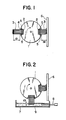
- an SUS-316 plate 6 of 160 mm long, 30 mm wide and 1.5 mm thick was vertically fixed at an interval of 35 mm (d2) from the periphery of the disk.
- the disk was rotated at 1,000 rpm and room temperature for 24 hours.
- the number of broken filaments among the 28 sample filaments was then counted to calculate a broken loss percentage.
- Each sample was measured three times. The largest and smallest values of the measurement results will be indicated.
- FIG. 2 Underneath the apparatus shown in FIG. 1 and adapted to determine broken loss percentages, was provided a box 7 made of SUS-316 and containing water of 60°C. (Incidentally, the locations of sample filaments mounted on the disk 1 are apart angularly over 90 degrees in FIG. 2 in order to show that the sample filaments abrade, smoothen and polish the plate 6 and their tip portions are then dipped into the water. Needless to say, they may be provided on both sides of the disk as depicted in FIG. 1.)
- the box 7 made of SUS-316 was provided at such a position that the sample filaments are immersed to a depth of 10 mm (d3) in water of 60°C which was heated by a pipe heater 8 (100 V ⁇ 200 W). Except for the foregoing, the disk 1 was rotated at 1,000 rpm for 24 hours in the same manner as in the measuring method for broken loss percentages.
- the SUS-316 plate 6 was weighed both before and after the polishing work. The weight difference was recorded as a polishing degree.
- the term "polishing degree” as used herein means the difference in weight between an SUS-316 plate before its polishing and the same plate after its polishing. Each sample was measured three times. The largest and smallest values of the measurement results will be indicated.
- the resultant pellets were subjected to melt-spinning at 260°C. Filaments thus formed were cooled in warm water of 50°C and then, continuously stretched 4.0 times in a glycerin bath heated at 165°C, followed by 5% relaxation heat treatment (thermal fixing) in boiling water to obtain filaments (i.e., bristles) having a diameter of 1 mm ⁇ . Although the filaments contained fine voids, they were tough filaments.
- each bristle sample was immersed in an acidic aqueous solution under conditions to be shown in Table 1 and the time was measured until the bristles was deformed or broken.
- both bristle samples were good in formability and processability such as extrudability, spinnability and stretchability and no particular differences were observed therebetween.
- the conventional nylon-made polyamide-type abrasive filaments were extremely poor in acid resistance and moreover had a high broken loss percentage (repeated flexural fatigue resistance), so that they were inferior in durability.
- the abrasive filaments according to the present invention which was made of the PVDF resin, were excellent in acid resistance, had a low broken loss percentage and moreover gave a great polishing degree, so that they exhibited superb abrasiveness.
- Filament (bristle) samples were separately produced in the same manner as in Example 1 except for the use of high melting-point vinylidene fluoride homopolymers having a melting point of 178°C and inherent viscosities varied as will be shown in Table 2. On each bristle sample, the formability and processability such as extrudability, spinnability and stretchability, repeated flexural fatigue and polishing degree were measured. Results will also be summarized in Table 2.
- the filaments of Comparative Example 2 in which a PVDF resin having an inherent viscosity as low as 0.8 was used were inferior in repeated flexural fatigue resistance.
- the filaments of Comparative Example 3 in which a PVDF resin having a high inherent viscosity was used were inferior in extrudability and spinnability.
- the filaments obtained separately in the Examples of this invention in which PVDF resins having an inherent viscosity in a range of 0.9 - 1.3 were used respectively were highly balanced in formability, durability and abrasiveness.
- Filament (bristle) samples were produced separately in the same manner as in Example 1 except that a polyvinylidene fluoride homopolymer (inherent viscosity: 1.30; melting point: 178°C) and a copolymer (inherent viscosity: 1.10; melting point: 160°C) of vinylidene fluoride (93.5 mole %) and propylene hexafluoride (6.5 mole %) were blended respectively as a high melting-point PVDF resin and a low melting-point PVDF resin in proportions to be shown in Table 3.
- a polyvinylidene fluoride homopolymer inherent viscosity: 1.30; melting point: 178°C
- a copolymer inherent viscosity: 1.10; melting point: 160°C
- blending of a low melting-point PVDF resin can improve the formability and processability.
- the broken loss percentage can also be reduced. If the proportion of such a low melting-point PVDF resin should increase to 60 - 80 parts by weight, there is a tendency that more voids would be formed and the external appearance of resultant filaments would be deteriorated. Even those containing the low melting-point PVDF resin in higher proportions still had excellent abrasiveness, acid resistance and durability when compared to conventional polyamide-base abrasive filaments.
- Filament (bristle) samples were produced separately in the same manner as in Example 1 except that a high melting-point polyvinylidene fluoride homopolymer (inherent viscosity: 1.30; melting point: 178°C) and as a low melting-point PVDF resin, a copolymer (inherent viscosity: 1.07; melting point: 166°C) of vinylidene fluoride (95 mole %) and propylene hexafluoride (5 mole %) were blended in proportions to be shown in Table 4.
- a high melting-point polyvinylidene fluoride homopolymer inherent viscosity: 1.30; melting point: 178°C
- a copolymer inherent viscosity: 1.07; melting point: 166°C
- any proportion of a low melting-point PVDF resin greater than 50 wt.% tends to result in filaments containing more voids and reduced external appearance.
- filaments according to this invention are excellent in formability, processability, durability and abrasiveness.
Landscapes
- Chemical & Material Sciences (AREA)
- Engineering & Computer Science (AREA)
- Chemical Kinetics & Catalysis (AREA)
- General Chemical & Material Sciences (AREA)
- Textile Engineering (AREA)
- Manufacturing & Machinery (AREA)
- Materials Engineering (AREA)
- Health & Medical Sciences (AREA)
- Medicinal Chemistry (AREA)
- Polymers & Plastics (AREA)
- Organic Chemistry (AREA)
- Polishing Bodies And Polishing Tools (AREA)
- Artificial Filaments (AREA)
- Compositions Of Macromolecular Compounds (AREA)
- Finish Polishing, Edge Sharpening, And Grinding By Specific Grinding Devices (AREA)
Applications Claiming Priority (4)
| Application Number | Priority Date | Filing Date | Title |
|---|---|---|---|
| JP5037487 | 1987-03-06 | ||
| JP50374/87 | 1987-03-06 | ||
| JP315193/87 | 1987-12-15 | ||
| JP62315193A JP2592627B2 (ja) | 1987-03-06 | 1987-12-15 | 研磨用糸状成形物およびその製造方法 |
Publications (3)
| Publication Number | Publication Date |
|---|---|
| EP0282243A2 true EP0282243A2 (fr) | 1988-09-14 |
| EP0282243A3 EP0282243A3 (en) | 1989-07-19 |
| EP0282243B1 EP0282243B1 (fr) | 1992-06-03 |
Family
ID=26390845
Family Applications (1)
| Application Number | Title | Priority Date | Filing Date |
|---|---|---|---|
| EP88301923A Expired - Lifetime EP0282243B1 (fr) | 1987-03-06 | 1988-03-04 | Filaments abrasifs et leur procédé de fabrication |
Country Status (5)
| Country | Link |
|---|---|
| EP (1) | EP0282243B1 (fr) |
| JP (1) | JP2592627B2 (fr) |
| KR (1) | KR910003066B1 (fr) |
| DE (1) | DE3871564T2 (fr) |
| ES (1) | ES2037212T3 (fr) |
Cited By (7)
| Publication number | Priority date | Publication date | Assignee | Title |
|---|---|---|---|---|
| US5427595A (en) * | 1992-03-19 | 1995-06-27 | Minnesota Mining And Manufacturing | Abrasive filaments comprising abrasive-filled thermoplastic elastomer, methods of making same, articles incorporating same and methods of using said articles |
| US5460883A (en) * | 1992-03-19 | 1995-10-24 | Minnesota Mining And Manufacturing Company | Composite abrasive filaments, methods of making same, articles incorporating same, and methods of using said articles |
| WO1996026980A1 (fr) * | 1995-03-01 | 1996-09-06 | Elf Atochem S.A. | Compositions de resines fluorees thermoplastiques et articles moules produits avec ces resines |
| US5679067A (en) * | 1995-04-28 | 1997-10-21 | Minnesota Mining And Manufacturing Company | Molded abrasive brush |
| US5903951A (en) * | 1995-11-16 | 1999-05-18 | Minnesota Mining And Manufacturing Company | Molded brush segment |
| EP1217105A1 (fr) * | 2000-12-19 | 2002-06-26 | Niizaki, Yuuichiro | Matériau filamentaire pour soies de brosses |
| CN113272482A (zh) * | 2018-12-17 | 2021-08-17 | 赢创运营有限公司 | 拉伸的含氟聚合物 |
Families Citing this family (1)
| Publication number | Priority date | Publication date | Assignee | Title |
|---|---|---|---|---|
| JP4303355B2 (ja) * | 1999-04-26 | 2009-07-29 | 株式会社クレハ | ポリふっ化ビニリデン系樹脂、それからなる多孔膜およびその多孔膜を用いた電池 |
Family Cites Families (4)
| Publication number | Priority date | Publication date | Assignee | Title |
|---|---|---|---|---|
| FR2546097A1 (fr) * | 1983-02-22 | 1984-11-23 | Freselle Christian | Fibre diamantee |
| DE3330511A1 (de) * | 1983-05-20 | 1984-11-22 | Diethelm Dipl.-Chem. Dr.rer.nat. 7450 Hechingen Bitzer | Modifizierte schleifkoerner, deren herstellung und verwendung |
| JPS6028510A (ja) * | 1983-07-23 | 1985-02-13 | Kureha Chem Ind Co Ltd | フツ化ビニリデン系樹脂繊維およびその製造方法 |
| JPH0632908B2 (ja) * | 1985-08-12 | 1994-05-02 | 東レ・モノフィラメント株式会社 | 研磨ブラシ用毛材 |
-
1987
- 1987-12-15 JP JP62315193A patent/JP2592627B2/ja not_active Expired - Lifetime
-
1988
- 1988-03-04 ES ES198888301923T patent/ES2037212T3/es not_active Expired - Lifetime
- 1988-03-04 DE DE8888301923T patent/DE3871564T2/de not_active Expired - Fee Related
- 1988-03-04 EP EP88301923A patent/EP0282243B1/fr not_active Expired - Lifetime
- 1988-03-05 KR KR1019880002320A patent/KR910003066B1/ko not_active Expired
Cited By (18)
| Publication number | Priority date | Publication date | Assignee | Title |
|---|---|---|---|---|
| US5737794A (en) * | 1992-03-19 | 1998-04-14 | Minnesota Mining And Manufacturing Company | Composite abrasive filaments, methods of making same, articles incorporating same, and methods of using said articles |
| US5460883A (en) * | 1992-03-19 | 1995-10-24 | Minnesota Mining And Manufacturing Company | Composite abrasive filaments, methods of making same, articles incorporating same, and methods of using said articles |
| US5491025A (en) * | 1992-03-19 | 1996-02-13 | Minnesota Mining And Manufacturing Company | Abrasive filaments comprising abrasive-filled thermoplastic elastomer |
| US5518794A (en) * | 1992-03-19 | 1996-05-21 | Minnesota Mining And Manufacturing Company | Abrasive article incorporating composite abrasive filament |
| US5427595A (en) * | 1992-03-19 | 1995-06-27 | Minnesota Mining And Manufacturing | Abrasive filaments comprising abrasive-filled thermoplastic elastomer, methods of making same, articles incorporating same and methods of using said articles |
| US5571296A (en) * | 1992-03-19 | 1996-11-05 | Minnesota Mining And Manufacturing Company | Method of making composite abrasive filaments |
| US5616411A (en) * | 1992-03-19 | 1997-04-01 | Minnesota Mining And Manufacturing Company | Composite abrasive filaments, methods of making same, articles incorporating same, and methods of using said articles |
| US5837179A (en) * | 1992-03-19 | 1998-11-17 | Minnesota Mining And Manufacturing Copmany | Method of making abrasive filaments comprising abrasive-filled thermoplastic elastomer |
| WO1996026980A1 (fr) * | 1995-03-01 | 1996-09-06 | Elf Atochem S.A. | Compositions de resines fluorees thermoplastiques et articles moules produits avec ces resines |
| US5679067A (en) * | 1995-04-28 | 1997-10-21 | Minnesota Mining And Manufacturing Company | Molded abrasive brush |
| US5915436A (en) * | 1995-04-28 | 1999-06-29 | Minnesota Mining And Manufacting Company | Molded brush |
| US6126533A (en) * | 1995-04-28 | 2000-10-03 | 3M Innovative Properties Company | Molded abrasive brush |
| US6261156B1 (en) | 1995-04-28 | 2001-07-17 | 3M Innovative Properties Company | Molded abrasive brush |
| US5903951A (en) * | 1995-11-16 | 1999-05-18 | Minnesota Mining And Manufacturing Company | Molded brush segment |
| EP1217105A1 (fr) * | 2000-12-19 | 2002-06-26 | Niizaki, Yuuichiro | Matériau filamentaire pour soies de brosses |
| US6669746B2 (en) | 2000-12-19 | 2003-12-30 | Yuuichiro Niizaki | Filamentary brush bristle material |
| KR100556145B1 (ko) * | 2000-12-19 | 2006-03-03 | 유우이치로 니이자키 | 필라멘트 브러시 강모 소재 |
| CN113272482A (zh) * | 2018-12-17 | 2021-08-17 | 赢创运营有限公司 | 拉伸的含氟聚合物 |
Also Published As
| Publication number | Publication date |
|---|---|
| JP2592627B2 (ja) | 1997-03-19 |
| DE3871564D1 (de) | 1992-07-09 |
| KR910003066B1 (ko) | 1991-05-17 |
| KR880011240A (ko) | 1988-10-27 |
| JPS642873A (en) | 1989-01-06 |
| EP0282243A3 (en) | 1989-07-19 |
| EP0282243B1 (fr) | 1992-06-03 |
| ES2037212T3 (es) | 1993-06-16 |
| DE3871564T2 (de) | 1993-01-21 |
Similar Documents
| Publication | Publication Date | Title |
|---|---|---|
| US4610925A (en) | Antistatic hairbrush filament | |
| EP0080274A2 (fr) | Procédé pour le filage au fondu d'un mélange d'un polymère constituant la fibre et un polymère incompatible et fibres filés par ce procédé | |
| EP0282243B1 (fr) | Filaments abrasifs et leur procédé de fabrication | |
| US4370375A (en) | Abrasion-resistant monofilament with molybdenum disulfide useful in the formation of papermaking belts | |
| US5238739A (en) | Abrasive filaments and production process thereof | |
| EP0064802B1 (fr) | Procédé pour le filage au fondu de polypropylène | |
| US5288554A (en) | Abrasive filaments and production process thereof | |
| US4970275A (en) | Elastomeric polymers | |
| JPH012873A (ja) | 研磨用糸状成形物およびその製造方法 | |
| JP3267854B2 (ja) | 黒原着ポリエステル繊維 | |
| JP3600928B2 (ja) | ポリ塩化ビニル系繊維及びその製造法 | |
| JP2868639B2 (ja) | 改質ナイロンモノフィラメント | |
| EP0080273A2 (fr) | Fibres frisées en polyester | |
| JPH0819569B2 (ja) | 導電性ブラシ用毛材 | |
| JP2004204413A (ja) | ポリエステルモノフィラメントおよびその製造方法 | |
| CA1233961A (fr) | Crin de polyester pour brosse a cheveux | |
| JPS60215813A (ja) | 高結節強度モノフイラメント | |
| JP2004122289A (ja) | 研磨用モノフィラメント | |
| JP3882012B2 (ja) | ポリアミドモノフィラメントおよびその製造方法並びに用途 | |
| JPH0411010A (ja) | ポリアミドモノフィラメント | |
| JP2024072962A (ja) | 研磨用モノフィラメント | |
| JP3814062B2 (ja) | ポリエステルフィラメントの製造方法 | |
| JPH0122364B2 (fr) | ||
| JPH0734322A (ja) | 制電性能に優れたポリエステル繊維及びその製造方法 | |
| KR840002346B1 (ko) | 폴리에스탤 모노필라맨트 제조방법 |
Legal Events
| Date | Code | Title | Description |
|---|---|---|---|
| PUAI | Public reference made under article 153(3) epc to a published international application that has entered the european phase |
Free format text: ORIGINAL CODE: 0009012 |
|
| 17P | Request for examination filed |
Effective date: 19880329 |
|
| AK | Designated contracting states |
Kind code of ref document: A2 Designated state(s): DE ES GB |
|
| PUAL | Search report despatched |
Free format text: ORIGINAL CODE: 0009013 |
|
| AK | Designated contracting states |
Kind code of ref document: A3 Designated state(s): DE ES GB |
|
| 17Q | First examination report despatched |
Effective date: 19901207 |
|
| GRAA | (expected) grant |
Free format text: ORIGINAL CODE: 0009210 |
|
| AK | Designated contracting states |
Kind code of ref document: B1 Designated state(s): DE ES GB |
|
| REF | Corresponds to: |
Ref document number: 3871564 Country of ref document: DE Date of ref document: 19920709 |
|
| PGFP | Annual fee paid to national office [announced via postgrant information from national office to epo] |
Ref country code: GB Payment date: 19930219 Year of fee payment: 6 |
|
| PGFP | Annual fee paid to national office [announced via postgrant information from national office to epo] |
Ref country code: ES Payment date: 19930301 Year of fee payment: 6 |
|
| PGFP | Annual fee paid to national office [announced via postgrant information from national office to epo] |
Ref country code: DE Payment date: 19930319 Year of fee payment: 6 |
|
| PLBE | No opposition filed within time limit |
Free format text: ORIGINAL CODE: 0009261 |
|
| STAA | Information on the status of an ep patent application or granted ep patent |
Free format text: STATUS: NO OPPOSITION FILED WITHIN TIME LIMIT |
|
| 26N | No opposition filed | ||
| REG | Reference to a national code |
Ref country code: ES Ref legal event code: FG2A Ref document number: 2037212 Country of ref document: ES Kind code of ref document: T3 |
|
| PG25 | Lapsed in a contracting state [announced via postgrant information from national office to epo] |
Ref country code: GB Effective date: 19940304 |
|
| PG25 | Lapsed in a contracting state [announced via postgrant information from national office to epo] |
Ref country code: ES Free format text: LAPSE BECAUSE OF NON-PAYMENT OF DUE FEES Effective date: 19940305 |
|
| GBPC | Gb: european patent ceased through non-payment of renewal fee |
Effective date: 19940304 |
|
| PG25 | Lapsed in a contracting state [announced via postgrant information from national office to epo] |
Ref country code: DE Effective date: 19941201 |
|
| REG | Reference to a national code |
Ref country code: ES Ref legal event code: FD2A Effective date: 19990301 |