EP0282729A1 - Verfahren zum Applizieren von Dekorationselementen - Google Patents
Verfahren zum Applizieren von Dekorationselementen Download PDFInfo
- Publication number
- EP0282729A1 EP0282729A1 EP88101924A EP88101924A EP0282729A1 EP 0282729 A1 EP0282729 A1 EP 0282729A1 EP 88101924 A EP88101924 A EP 88101924A EP 88101924 A EP88101924 A EP 88101924A EP 0282729 A1 EP0282729 A1 EP 0282729A1
- Authority
- EP
- European Patent Office
- Prior art keywords
- shaft
- decorative element
- application
- melt adhesive
- decorative
- Prior art date
- Legal status (The legal status is an assumption and is not a legal conclusion. Google has not performed a legal analysis and makes no representation as to the accuracy of the status listed.)
- Granted
Links
Images
Classifications
-
- C—CHEMISTRY; METALLURGY
- C09—DYES; PAINTS; POLISHES; NATURAL RESINS; ADHESIVES; COMPOSITIONS NOT OTHERWISE PROVIDED FOR; APPLICATIONS OF MATERIALS NOT OTHERWISE PROVIDED FOR
- C09J—ADHESIVES; NON-MECHANICAL ASPECTS OF ADHESIVE PROCESSES IN GENERAL; ADHESIVE PROCESSES NOT PROVIDED FOR ELSEWHERE; USE OF MATERIALS AS ADHESIVES
- C09J5/00—Adhesive processes in general; Adhesive processes not provided for elsewhere, e.g. relating to primers
- C09J5/10—Joining materials by welding overlapping edges with an insertion of plastic material
-
- B—PERFORMING OPERATIONS; TRANSPORTING
- B44—DECORATIVE ARTS
- B44C—PRODUCING DECORATIVE EFFECTS; MOSAICS; TARSIA WORK; PAPERHANGING
- B44C1/00—Processes, not specifically provided for elsewhere, for producing decorative surface effects
- B44C1/10—Applying flat materials, e.g. leaflets, pieces of fabrics
- B44C1/105—Applying flat materials, e.g. leaflets, pieces of fabrics comprising an adhesive layer
-
- A—HUMAN NECESSITIES
- A41—WEARING APPAREL
- A41D—OUTERWEAR; PROTECTIVE GARMENTS; ACCESSORIES
- A41D27/00—Details of garments or of their making
- A41D27/08—Trimmings; Ornaments
Definitions
- the invention relates to a method for applying decorative elements.
- Decorative elements are used to decorate objects such as Clothing and accessories.
- a known decorative element (DE-PS 25 20 126) is designed as a rivet and has a hot-melt adhesive layer on the underside, which can be made adhesive by heat.
- the advantage of this known decorative element over conventional decorative rivets of this type is that it can be connected to the material by simply applying it to a material and then heating it, without the need to perforate the material.
- a decorative element ie more precisely a button, is known, on the underside of which a layer of hot melt adhesive is attached.
- the hot melt adhesive layer is designed in the form of a cylindrical shaft and bonds to the tissue when heated.
- a flange formed by heat fixation can only have a diameter that corresponds to the diameter of the application side. As a result, secure attachment to a plastic or leather material is not possible.
- the decorative element is designed as an ornamental stone.
- a decorative element enables the formation of ornaments in any shape, with a simple connection of the hot-melt adhesive layer to the back of the decorative stone being ensured due to the usual grinding shape of the decorative stone.
- the shaft is cylindrical with a cylinder axis extending in the direction of application.
- a cylinder is the cheapest form of taking up a sufficient amount of hot-melt adhesive with the smallest volume, it also being possible to push it through the application material without problems.
- cylindrical shaft has a diameter corresponding approximately to the area of the application side of the decorative element ensures a good connection of the hotmelt adhesive layer to the decorative stone.
- the shaft advantageously has a length of approximately 1 to 5 mm in order to provide a sufficient adhesive layer for forming the flange.
- a decorative material used according to the inventive method is shown in the drawing and is described in more detail below.
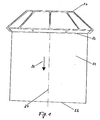
- the decorative element shown in the figures comprises a ground decorative stone 10, for example made of glass or a suitable plastic, which is connected on its rear flat application side 12 to a shaft 14 made of a hot melt adhesive.
- the material for the hot-melt adhesive is non-curing, meltable resins with additions of macromolecular substances, for example polyamides, ethyl cellulose, polyvinyl acetate and the like, and self-curing art substances in question.
- Plastics of this type can be polyester resins, epoxy resins, isocyanates and aminoplasts, optionally with the addition of catalysts.
- the material of the decorative element is not limited to glass or plastic, rather any materials, in particular metals, such as chrome-plated, copper-plated, silver-plated steel sheet and the like, and a wide variety of colored plastics can be used.
- the shaft 14 is cylindrical with a cylinder axis 24 extending in the application direction 26.
- the cylindrical shaft 14 has a diameter approximately corresponding to the area of the application side 12 of the decorative element 10.
- the length of the shaft 14 is between 1 mm and 5 mm, depending on the thickness of the application material 16.
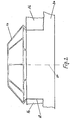
- a shaft flange 20 is formed on the underside of the application material by heating the shaft 14 and pressing with the application material 16, which securely connects the decorative element 10 to the application material.
- the flange 20 is formed in a manner known per se by applying a heating surface to the underside 22 of the shaft, as a result of which the hot-melt adhesive melts, and then pressing it with the application material 16.
- the shaft flange 20 has a substantially smaller thickness than the application material 16, in order not to impair the wearing properties, for example of clothing.
- the decorative element can be connected to the application material 16 by simply pushing through a perforation 18 in the application material 16 in the application direction 26 parallel to the longitudinal axis 24 of the cylinder and then heating the underside 22 of the shaft and pressing it.
- the shaft 14 is cylindrical. Its diameter corresponds approximately to the area of the application side 12 of the decorative element 10. However, depending on the shape and size of the decorative element, it is also conceivable that the shaft has a slightly larger or a slightly smaller diameter than the underside of the decorative element. Furthermore, its shape is not necessarily limited to a cylinder with a longitudinal axis 24 of the cylinder extending in the application direction 26, rather any desired shape of the shaft can be selected, with a good connection to the application side 12 of the decorative element 10 for the criteria, unimpeded insertion through the Perforation 18 of the application material 16 and a sufficient amount of hot melt adhesive must be taken into account.
- the process for applying decorative material is suitable for decorating any material, in particular textiles and leather of all kinds.
Landscapes
- Engineering & Computer Science (AREA)
- Textile Engineering (AREA)
- Chemical & Material Sciences (AREA)
- Organic Chemistry (AREA)
- Adornments (AREA)
- Lining Or Joining Of Plastics Or The Like (AREA)
- Adhesives Or Adhesive Processes (AREA)
- Crystals, And After-Treatments Of Crystals (AREA)
- Application Of Or Painting With Fluid Materials (AREA)
- Glass Compositions (AREA)
- Laminated Bodies (AREA)
Abstract
Description
- Die Erfindung betrifft ein Verfahren zum Applizieren von Dekorationselementen.
- Dekorationselemente dienen zur Verzierung von Gegenständen, wie z.B. Kleidungsstücken und Accessories.
- Ein bekanntes Dekorationselement (DE-PS 25 20 126) ist als Niet ausgebildet und weist auf der Unterseite eine Schmelzklebstoffschicht auf, die durch Wärmezufuhr klebfähig gemacht werden kann. Der Vorteil dieses bekannten Dekorationselements gegenüber üblichen derartigen Ziernieten besteht darin, daß es durch einfaches Aufbringen auf ein Material und durch anschließendes Erwärmen mit dem Material verbunden werden kann, ohne daß es erforderlich gewesen ist, das Material zu perforieren.
- Es hat sich jedoch gezeigt, daß bei bestimmten Materialien, wie z.B. geschichteten Materialien oder Wildleder, bei diesem bekannten Dekorationselement die Gefahr besteht, daß sich im Gebrauch die obere Materialschicht mit dem Dekorationselement von dem übrigen Material ablöst, so daß die Lebensdauer bzw. das ästhetische Aussehen der Gegenstände beeinträchtigt wird.
- Aus der US-PS 2 470 963 ist ein Dekorationselement, d.h. genauer ein Knopf, bekannt, auf dessen Unterseite eine Schmelzklebstoffschicht angebracht ist. Die Schmelzklebstoffschicht ist in Form eines zylindrischen Schaftes ausgebildet und verbindet sich beim Erwärmen mit dem Gewebe. Ein durch Wärmefixierung gebildeter Flansch kann jedoch in diesem Fall nur einen Durchmesser haben, der dem Durchmesser der Applikationsseite entspricht. Dadurch ist eine sichere Befestigung an einem Kunststoff- bzw. Ledermaterial nicht möglich.
- Es ist daher Aufgabe der vorliegenden Erfindung, ein Verfahren zum Applizieren eines Dekorationselementes der eingangs genannten Art zu liefern, womit eine sichere Verbindung mit dem Applikationsmaterial, insbesondere mit geschichteten Materalien, Leder, besonders Wildleder usw., erreicht wird.
- Diese Aufgabe wird durch das erfindungsgemäße Verfahren gelöst, bei dem ein Applikationsmaterial mit Perforierung eingesetzt wird,
ein Schaft aus Schmelzklebstoff, der auf dem Dekorationselement vorgesehen ist und sich von dem Dekorationselement in Applikationsrichtung erstreckt, durch die Perforation gesteckt wird,
dem Schaft Wärme zugeführt wird, um den Schmelzklebstoff zu erweichen,
der erweichte Schaft durch Druck zu einem Flansch auf der der Dekorationsseite gegenüberliegenden Seite des Applikationsmaterials geformt wird und der Schmelzklebstoff erkalten gelassen wird. - Mit diesem Verfahren ist es möglich, das Dekorationselement durch das Applikationsmaterial hindurchzustecken und durch anschließendes Erwärmen auf der Materialrückseite einen das Dekorationselement fest mit dem Applikationsmaterial verbindenden Flansch auszubilden.
- Gemäß einer vorteilhaften Ausgestaltung des erfindungsgemäßen Verfahrens ist das Dekorationselement als Zierstein ausgebildet. Ein derartiges Dekorationselement ermöglicht die Ausbildung von Ornamenten in jeglicher Form,wobei eine einfache Verbindung der Schmelzklebstoffschicht mit der Rückseite des Ziersteins auf Grund der üblichen Schlifform des Ziersteins gewährleistet ist.
- Dabei ist der Schaft zylindrisch mit einer sich in Applikationsrichtung erstreckenden Zylinderachse ausgebildet. Ein derartiger Zylinder ist die günstigste Form, bei kleinstem Volumen eine ausreichende Schmelzklebstoffmenge aufzunehmen, wobei ebenfalls ein problemloses Hindurchstecken durch das Applikationsmaterial möglich ist.
- Dadurch, daß der zylindrische Schaft einen etwa der Fläche der Applikationsseite des Dekorationselements entsprechenden Durchmesser aufweist, wird eine gute Verbindung der Schmelzklebstoffschicht mit dem Zierstein gewährleistet.
- Schließlich weist der Schaft in vorteilhafter Weise eine Länge von etwa 1 bis 5 mm auf, um eine ausreichende Klebstoffschicht zur Ausbildung des Flansches bereitzustellen.
- Ein gemäß dem erfindungsgemäßen Verfahren verwendetes Dekorationsmaterial ist in der Zeichnung dargestellt und wird im folgenden näher beschrieben.
- Es zeigen:
- Fig. 1 eine schematische Seitenansicht des Dekorationselements im Zustand vor der Anbringung an ein Applikationsmaterial; und
- Fig. 2 ein an ein Applikationsmaterial angebrachtes Dekorationselement.
- Das in den Figuren dargestellte Dekorationselement umfaßt einen geschliffenen Zierstein 10, z.B. aus Glas oder einem geeigneten Kunststoff, der auf seiner rückwärtigen flachen Applikationsseite 12 mit einem Schaft 14 aus einem Schmelzklebstoff verbunden ist. Als Material für den Schmelzklebstoff kommen nichthärtende, schmelzbare Harze mit Zusätzen von macromolekularen Stoffen, z.B. Polyamiden, Äthylzellulose, Polyvinylazetat u.dgl., sowie selbsthärtende Kunst stoffe infrage. Als Kunststoffe dieser Art können Polyesterharze, Epoxydharze, Isozyanate und Aminoplaste, gegebenenfalls unter Zusatz von Katalysatoren, verwendet werden.
- Auch das Material des Dekorationselements ist nicht auf Glas oder Kunststoff beschränkt, vielmehr können beliebige Materialien, insbesondere Metalle, wie verchromtes, verkupfertes, versilbertes Stahlblech und dergl., sowie die verschiedensten gefärbten Kunststoffe verwendet werden.
- Der Schaft 14 ist im dargestellten Ausführungsbeispiel zylindrisch mit einer sich in Applikationsrichtung 26 erstreckenden Zylinderachse 24 ausgebildet. Dabei weist der zylindrische Schaft 14 einen etwa der Fläche der Applikationsseite 12 des Dekorationselements 10 entsprechenden Durchmesser auf. Die Länge des Schaftes 14 liegt zwischen 1 mm und 5 mm, je nach Dicke des Applikationsmaterials 16.
- In Fig. 2 ist das Dekorationselement 10 in seinem am Applikationsmaterial 16 angebrchten Zustand dargestellt. Dabei ist auf der Unterseite des Applikationsmaterials ein Schaftflansch 20 durch Erwärmen des Schaftes 14 und Verpressen mit dem Applikationsmaterial 16 ausgebildet, der das Dekorationselement 10 sicher mit dem Applikationsmaterial verbindet. Das Ausbilden des Flansches 20 geschieht in an und für sich bekannter Weise durch Aufbringen einer Heizfläche auf die Schaftunterseite 22, wodurch der Schmelzklebstoff schmilzt, und anschließendes Verpressen mit dem Applikationsmaterial 16. Dabei weist der Schaftflansch 20 eine wesentlich geringere Dicke als das Applikationsmaterial 16 auf, um, z.B. bei Kleidungsstücken, die Trageigenschaften nicht zu beeinträchtigen.
- Wie aus Fig. 2 ersichtlich, kann das Dekorationselement durch einfaches Hindurchstecken durch eine Perforation 18 im Applikationsmaterial 16 in Applikationsrichtung 26 parallel zur Zylinderlängsachse 24 und anschließendes Erwärmen der Schaftunterseite 22 und Verpressen mit dem Applikationsmaterial 16 mit selbigem verbunden werden.
- Bei dem gezeigten Dekorationselement ist der Schaft 14 zylindrisch ausgebildet. Sein Durchmesser entspricht etwa der Fläche der Applikationsseite 12 des Dekorationselements 10. Es ist jedoch ebenfalls denkbar, je nach Form und Größe des Dekorationselements, daß der Schaft einen etwas größeren oder einen etwas kleineren Durchmesser als die Unterseite des Dekorationselements aufweist. Weiter ist seine Form nicht notwendigerweise auf einen Zylinder mit einer in Applikationsrichtung 26 verlaufenden Zylinderlängsachse 24 beschränkt, vielmehr kann jede beliebige zweckmäßige Form des Schaftes gewählt werden, wobei für die Kriterien eine gute Verbindung mit der Applikationsseite 12 des Dekorationselements 10, ein ungehindertes Hindurchstecken durch die Perforation 18 des Applikationsmaterials 16 und eine ausreichende Schmelzklebstoffmenge zu berücksichtigen sind.
- Das Verfahren zum Applizieren von Dekorationsmaterial eignet sich zum Dekorieren jeglicher Materialien, insbesondere Textilien und Leder aller Art.
Claims (1)
- Verfahren zum Applizieren von Dekorationselementen, bei dem
- ein Applikationsmaterial mit Perforierung eingesetzt wird,
- ein Schaft aus Schmelzklebstoff, der auf dem Dekorationselement vorgesehen ist und sich von dem Dekorationselement in Applikationsrichtung erstreckt, durch die Perforation gesteckt wird,
- dem Schaft Wärme zugeführt wird, um den Schmelzklebstoff zu erweichen,
- der erweichte Schaft durch Druck zu einem Flansch auf der der Dekorationsseite gegenüberliegenden Seite des Applikationsmaterials geformt wird, und
- der Schmelzklebstoff erkalten gelassen wird.
Priority Applications (1)
| Application Number | Priority Date | Filing Date | Title |
|---|---|---|---|
| AT88101924T ATE57650T1 (de) | 1987-03-05 | 1988-02-10 | Verfahren zum applizieren von dekorationselementen. |
Applications Claiming Priority (2)
| Application Number | Priority Date | Filing Date | Title |
|---|---|---|---|
| DE3707113A DE3707113C1 (de) | 1987-03-05 | 1987-03-05 | Verfahren zum Applizieren von Dekorationselementen |
| DE3707113 | 1987-03-05 |
Publications (2)
| Publication Number | Publication Date |
|---|---|
| EP0282729A1 true EP0282729A1 (de) | 1988-09-21 |
| EP0282729B1 EP0282729B1 (de) | 1990-10-24 |
Family
ID=6322362
Family Applications (1)
| Application Number | Title | Priority Date | Filing Date |
|---|---|---|---|
| EP88101924A Expired - Lifetime EP0282729B1 (de) | 1987-03-05 | 1988-02-10 | Verfahren zum Applizieren von Dekorationselementen |
Country Status (7)
| Country | Link |
|---|---|
| EP (1) | EP0282729B1 (de) |
| JP (1) | JPS63255003A (de) |
| KR (1) | KR880011303A (de) |
| AT (1) | ATE57650T1 (de) |
| DE (2) | DE3707113C1 (de) |
| ES (1) | ES2018310B3 (de) |
| GR (1) | GR3001306T3 (de) |
Citations (3)
| Publication number | Priority date | Publication date | Assignee | Title |
|---|---|---|---|---|
| GB1123797A (en) * | 1965-03-02 | 1968-08-14 | Robert Frey | Improvements in decorative bodies and decorative strip material incorporating them |
| FR2082494A5 (de) * | 1970-03-18 | 1971-12-10 | Scotto Jean Pierre | |
| DE2805136B1 (de) * | 1978-02-07 | 1979-05-23 | Bielomatik Leuze & Co | Vorrichtung zum Herstellen von Nietkoepfen an aus thermoplastischem Kunststoff bestehenden Befestigungsvorspruengen |
Family Cites Families (2)
| Publication number | Priority date | Publication date | Assignee | Title |
|---|---|---|---|---|
| US2470963A (en) * | 1943-12-21 | 1949-05-24 | Bernard A Weyl | Attachment of buttons to fabric |
| DE2520126C3 (de) * | 1975-05-06 | 1979-03-29 | D. Swarovski & Co, Glasschleiferei, Wattens, Tirol (Oesterreich) | Nietgruppen in ornamentaler Anordnung zu Zierzwecken |
-
1987
- 1987-03-05 DE DE3707113A patent/DE3707113C1/de not_active Expired
-
1988
- 1988-02-10 DE DE8888101924T patent/DE3860852D1/de not_active Expired - Lifetime
- 1988-02-10 EP EP88101924A patent/EP0282729B1/de not_active Expired - Lifetime
- 1988-02-10 AT AT88101924T patent/ATE57650T1/de not_active IP Right Cessation
- 1988-02-10 ES ES88101924T patent/ES2018310B3/es not_active Expired - Lifetime
- 1988-02-29 JP JP63047354A patent/JPS63255003A/ja active Pending
- 1988-03-04 KR KR1019880002265A patent/KR880011303A/ko not_active Withdrawn
-
1991
- 1991-01-10 GR GR91400013T patent/GR3001306T3/el unknown
Patent Citations (3)
| Publication number | Priority date | Publication date | Assignee | Title |
|---|---|---|---|---|
| GB1123797A (en) * | 1965-03-02 | 1968-08-14 | Robert Frey | Improvements in decorative bodies and decorative strip material incorporating them |
| FR2082494A5 (de) * | 1970-03-18 | 1971-12-10 | Scotto Jean Pierre | |
| DE2805136B1 (de) * | 1978-02-07 | 1979-05-23 | Bielomatik Leuze & Co | Vorrichtung zum Herstellen von Nietkoepfen an aus thermoplastischem Kunststoff bestehenden Befestigungsvorspruengen |
Also Published As
| Publication number | Publication date |
|---|---|
| KR880011303A (ko) | 1988-10-27 |
| GR3001306T3 (en) | 1992-08-31 |
| DE3707113C1 (de) | 1988-04-07 |
| DE3860852D1 (de) | 1990-11-29 |
| EP0282729B1 (de) | 1990-10-24 |
| ES2018310B3 (es) | 1991-04-01 |
| ATE57650T1 (de) | 1990-11-15 |
| JPS63255003A (ja) | 1988-10-21 |
Similar Documents
| Publication | Publication Date | Title |
|---|---|---|
| EP0346699B1 (de) | Schmucksteinverbund und Verfahren zu dessen Herstellung | |
| DE2841826C2 (de) | Verwendung eines Einsatzgliedes in Form eines Bandes zum Herstellen eines mehrschichtigen, geprägten Formgegenstandes | |
| EP3492320B2 (de) | Fixierhilfe zum einfachen fixieren von nähkleidern auf trägerteilen | |
| DE69917744T2 (de) | Zifferblatt für Uhren mit Brillanten, Auflegestücken oder anderen eingesetzen Elementen und Verfahren zur Befestigung dieser Elemente an einem solchen Zifferblatt | |
| DE2855426A1 (de) | Verfahren zur herstellung von einzelnen, eine schmelzklebstoffschicht tragenden schmucksteinen | |
| DE4104337C2 (de) | ||
| DE4002818C2 (de) | ||
| AT401352B (de) | Verfahren zum herstellen eines skis und nach diesem verfahren hergestellter ski | |
| DE112010001097T5 (de) | Ein Herstellungsverfahren für die dekorativen Reißverschlüsse | |
| DE69027334T2 (de) | Verfahren zur herstellung von motorfahrzeugtürinnenverkleidung | |
| DE3038188C2 (de) | Schmuckplättchen zur ornamentalen Verwendung | |
| DE3335168A1 (de) | Verfahren zur herstellung von flockmaterial | |
| DE1079872B (de) | Schmucksteinfassung | |
| EP0282729B1 (de) | Verfahren zum Applizieren von Dekorationselementen | |
| EP0189112B1 (de) | Verfahren zur Herstellung eines Dekormaterials | |
| DE60104001T2 (de) | Verfahren zur herstellung von einem künstlichen nagel | |
| CH369928A (de) | Schmuckstein | |
| DE3305857C2 (de) | Verfahren zum Befestigen eines Handgriffes aus Kunststoff an einem Glaskrug | |
| EP0630320A1 (de) | Klebstoff zur flächigen, insbesondere punktförmigen verbindung von zwei materialschichten | |
| EP0861769A1 (de) | Rahmenteil für ein Fahrrad und Verfahren zu seiner Herstellung | |
| DE4239336A1 (de) | Verfahren und Vorrichtung zum Beschichten von Trägermaterial | |
| DE2930251C2 (de) | ||
| DE3343583C2 (de) | ||
| DE19529318C2 (de) | Verfahren zur Herstellung dekorativer Gebrauchsgegenstände und die nach diesem Verfahren hergestellten dekorativen Gebrauchsgegenstände | |
| DE2616727C3 (de) | Nietgruppen in ornamentaler Anordnung |
Legal Events
| Date | Code | Title | Description |
|---|---|---|---|
| PUAI | Public reference made under article 153(3) epc to a published international application that has entered the european phase |
Free format text: ORIGINAL CODE: 0009012 |
|
| AK | Designated contracting states |
Kind code of ref document: A1 Designated state(s): AT BE CH DE ES FR GB GR IT LI LU NL SE |
|
| 17P | Request for examination filed |
Effective date: 19881006 |
|
| 17Q | First examination report despatched |
Effective date: 19890428 |
|
| GRAA | (expected) grant |
Free format text: ORIGINAL CODE: 0009210 |
|
| AK | Designated contracting states |
Kind code of ref document: B1 Designated state(s): AT BE CH DE ES FR GB GR IT LI LU NL SE |
|
| REF | Corresponds to: |
Ref document number: 57650 Country of ref document: AT Date of ref document: 19901115 Kind code of ref document: T |
|
| ITF | It: translation for a ep patent filed | ||
| REF | Corresponds to: |
Ref document number: 3860852 Country of ref document: DE Date of ref document: 19901129 |
|
| ET | Fr: translation filed | ||
| GBT | Gb: translation of ep patent filed (gb section 77(6)(a)/1977) | ||
| PLBE | No opposition filed within time limit |
Free format text: ORIGINAL CODE: 0009261 |
|
| STAA | Information on the status of an ep patent application or granted ep patent |
Free format text: STATUS: NO OPPOSITION FILED WITHIN TIME LIMIT |
|
| 26N | No opposition filed | ||
| PGFP | Annual fee paid to national office [announced via postgrant information from national office to epo] |
Ref country code: GB Payment date: 19920131 Year of fee payment: 5 |
|
| PGFP | Annual fee paid to national office [announced via postgrant information from national office to epo] |
Ref country code: FR Payment date: 19920214 Year of fee payment: 5 |
|
| PGFP | Annual fee paid to national office [announced via postgrant information from national office to epo] |
Ref country code: SE Payment date: 19920220 Year of fee payment: 5 Ref country code: ES Payment date: 19920220 Year of fee payment: 5 |
|
| PGFP | Annual fee paid to national office [announced via postgrant information from national office to epo] |
Ref country code: AT Payment date: 19920224 Year of fee payment: 5 |
|
| PGFP | Annual fee paid to national office [announced via postgrant information from national office to epo] |
Ref country code: LU Payment date: 19920226 Year of fee payment: 5 |
|
| PGFP | Annual fee paid to national office [announced via postgrant information from national office to epo] |
Ref country code: GR Payment date: 19920227 Year of fee payment: 5 |
|
| ITTA | It: last paid annual fee | ||
| PGFP | Annual fee paid to national office [announced via postgrant information from national office to epo] |
Ref country code: NL Payment date: 19920229 Year of fee payment: 5 |
|
| PGFP | Annual fee paid to national office [announced via postgrant information from national office to epo] |
Ref country code: BE Payment date: 19920304 Year of fee payment: 5 |
|
| PGFP | Annual fee paid to national office [announced via postgrant information from national office to epo] |
Ref country code: CH Payment date: 19920318 Year of fee payment: 5 |
|
| REG | Reference to a national code |
Ref country code: GR Ref legal event code: FG4A Free format text: 3001306 |
|
| PGFP | Annual fee paid to national office [announced via postgrant information from national office to epo] |
Ref country code: DE Payment date: 19920430 Year of fee payment: 5 |
|
| EPTA | Lu: last paid annual fee | ||
| PG25 | Lapsed in a contracting state [announced via postgrant information from national office to epo] |
Ref country code: LU Free format text: LAPSE BECAUSE OF NON-PAYMENT OF DUE FEES Effective date: 19930210 Ref country code: GB Effective date: 19930210 Ref country code: AT Effective date: 19930210 |
|
| PG25 | Lapsed in a contracting state [announced via postgrant information from national office to epo] |
Ref country code: SE Effective date: 19930211 Ref country code: ES Free format text: LAPSE BECAUSE OF NON-PAYMENT OF DUE FEES Effective date: 19930211 |
|
| PG25 | Lapsed in a contracting state [announced via postgrant information from national office to epo] |
Ref country code: LI Effective date: 19930228 Ref country code: CH Effective date: 19930228 Ref country code: BE Effective date: 19930228 |
|
| BERE | Be: lapsed |
Owner name: D. SWAROVSKI & CO. Effective date: 19930228 |
|
| PG25 | Lapsed in a contracting state [announced via postgrant information from national office to epo] |
Ref country code: GR Free format text: THE PATENT HAS BEEN ANNULLED BY A DECISION OF A NATIONAL AUTHORITY Effective date: 19930831 |
|
| PG25 | Lapsed in a contracting state [announced via postgrant information from national office to epo] |
Ref country code: NL Effective date: 19930901 |
|
| GBPC | Gb: european patent ceased through non-payment of renewal fee |
Effective date: 19930210 |
|
| NLV4 | Nl: lapsed or anulled due to non-payment of the annual fee | ||
| PG25 | Lapsed in a contracting state [announced via postgrant information from national office to epo] |
Ref country code: FR Effective date: 19931029 |
|
| REG | Reference to a national code |
Ref country code: CH Ref legal event code: PL |
|
| PG25 | Lapsed in a contracting state [announced via postgrant information from national office to epo] |
Ref country code: DE Effective date: 19931103 |
|
| REG | Reference to a national code |
Ref country code: FR Ref legal event code: ST |
|
| REG | Reference to a national code |
Ref country code: GR Ref legal event code: MM2A Free format text: 3001306 |
|
| EUG | Se: european patent has lapsed |
Ref document number: 88101924.4 Effective date: 19930912 |
|
| REG | Reference to a national code |
Ref country code: ES Ref legal event code: FD2A Effective date: 19990201 |
|
| PG25 | Lapsed in a contracting state [announced via postgrant information from national office to epo] |
Ref country code: IT Free format text: LAPSE BECAUSE OF NON-PAYMENT OF DUE FEES;WARNING: LAPSES OF ITALIAN PATENTS WITH EFFECTIVE DATE BEFORE 2007 MAY HAVE OCCURRED AT ANY TIME BEFORE 2007. THE CORRECT EFFECTIVE DATE MAY BE DIFFERENT FROM THE ONE RECORDED. Effective date: 20050210 |