EP0282805A2 - Appareil pour le traitement thermoplastique de résines synthétiques polymères - Google Patents
Appareil pour le traitement thermoplastique de résines synthétiques polymères Download PDFInfo
- Publication number
- EP0282805A2 EP0282805A2 EP88103048A EP88103048A EP0282805A2 EP 0282805 A2 EP0282805 A2 EP 0282805A2 EP 88103048 A EP88103048 A EP 88103048A EP 88103048 A EP88103048 A EP 88103048A EP 0282805 A2 EP0282805 A2 EP 0282805A2
- Authority
- EP
- European Patent Office
- Prior art keywords
- resin
- chamber
- temperature
- improved apparatus
- mold
- Prior art date
- Legal status (The legal status is an assumption and is not a legal conclusion. Google has not performed a legal analysis and makes no representation as to the accuracy of the status listed.)
- Granted
Links
- 238000012545 processing Methods 0.000 title claims abstract description 32
- 239000002952 polymeric resin Substances 0.000 title claims abstract description 14
- 229920003002 synthetic resin Polymers 0.000 title claims abstract description 14
- 229920005989 resin Polymers 0.000 claims abstract description 74
- 239000011347 resin Substances 0.000 claims abstract description 74
- 239000010409 thin film Substances 0.000 claims abstract description 13
- 229920001169 thermoplastic Polymers 0.000 claims abstract description 11
- 239000004416 thermosoftening plastic Substances 0.000 claims abstract description 11
- 239000010408 film Substances 0.000 claims description 19
- 239000000463 material Substances 0.000 claims description 15
- 238000001816 cooling Methods 0.000 claims description 11
- 238000000034 method Methods 0.000 claims description 7
- 238000001125 extrusion Methods 0.000 claims description 6
- 229920005992 thermoplastic resin Polymers 0.000 claims description 6
- 238000007493 shaping process Methods 0.000 claims description 5
- 238000000071 blow moulding Methods 0.000 claims description 4
- 238000012546 transfer Methods 0.000 claims description 4
- 238000002347 injection Methods 0.000 claims description 3
- 239000007924 injection Substances 0.000 claims description 3
- 230000008569 process Effects 0.000 claims description 3
- 230000006872 improvement Effects 0.000 claims description 2
- 239000000155 melt Substances 0.000 claims description 2
- 230000006835 compression Effects 0.000 claims 1
- 238000007906 compression Methods 0.000 claims 1
- 238000003856 thermoforming Methods 0.000 claims 1
- 238000010438 heat treatment Methods 0.000 description 8
- 229910052751 metal Inorganic materials 0.000 description 8
- 239000002184 metal Substances 0.000 description 8
- 238000009826 distribution Methods 0.000 description 5
- 238000004519 manufacturing process Methods 0.000 description 5
- PXHVJJICTQNCMI-UHFFFAOYSA-N Nickel Chemical compound [Ni] PXHVJJICTQNCMI-UHFFFAOYSA-N 0.000 description 4
- 230000015556 catabolic process Effects 0.000 description 4
- 238000000576 coating method Methods 0.000 description 4
- 229920001577 copolymer Polymers 0.000 description 4
- 238000006731 degradation reaction Methods 0.000 description 4
- 229920000642 polymer Polymers 0.000 description 4
- 239000011248 coating agent Substances 0.000 description 3
- 238000012937 correction Methods 0.000 description 3
- 238000001746 injection moulding Methods 0.000 description 3
- -1 synthetic Polymers 0.000 description 3
- VYPSYNLAJGMNEJ-UHFFFAOYSA-N Silicium dioxide Chemical compound O=[Si]=O VYPSYNLAJGMNEJ-UHFFFAOYSA-N 0.000 description 2
- PPBRXRYQALVLMV-UHFFFAOYSA-N Styrene Chemical compound C=CC1=CC=CC=C1 PPBRXRYQALVLMV-UHFFFAOYSA-N 0.000 description 2
- RTAQQCXQSZGOHL-UHFFFAOYSA-N Titanium Chemical compound [Ti] RTAQQCXQSZGOHL-UHFFFAOYSA-N 0.000 description 2
- 239000000919 ceramic Substances 0.000 description 2
- 230000008859 change Effects 0.000 description 2
- 239000004020 conductor Substances 0.000 description 2
- 238000010276 construction Methods 0.000 description 2
- 239000002826 coolant Substances 0.000 description 2
- 238000010586 diagram Methods 0.000 description 2
- 239000012530 fluid Substances 0.000 description 2
- 230000006870 function Effects 0.000 description 2
- 229910001385 heavy metal Inorganic materials 0.000 description 2
- 229910052759 nickel Inorganic materials 0.000 description 2
- 150000004767 nitrides Chemical class 0.000 description 2
- 229920000515 polycarbonate Polymers 0.000 description 2
- 239000004417 polycarbonate Substances 0.000 description 2
- 230000004044 response Effects 0.000 description 2
- 239000000126 substance Substances 0.000 description 2
- 229920002725 thermoplastic elastomer Polymers 0.000 description 2
- 239000010936 titanium Substances 0.000 description 2
- 229910052719 titanium Inorganic materials 0.000 description 2
- NVZWEEGUWXZOKI-UHFFFAOYSA-N 1-ethenyl-2-methylbenzene Chemical compound CC1=CC=CC=C1C=C NVZWEEGUWXZOKI-UHFFFAOYSA-N 0.000 description 1
- FRWYFWZENXDZMU-UHFFFAOYSA-N 2-iodoquinoline Chemical compound C1=CC=CC2=NC(I)=CC=C21 FRWYFWZENXDZMU-UHFFFAOYSA-N 0.000 description 1
- QTBSBXVTEAMEQO-UHFFFAOYSA-M Acetate Chemical compound CC([O-])=O QTBSBXVTEAMEQO-UHFFFAOYSA-M 0.000 description 1
- VEXZGXHMUGYJMC-UHFFFAOYSA-M Chloride anion Chemical compound [Cl-] VEXZGXHMUGYJMC-UHFFFAOYSA-M 0.000 description 1
- VYZAMTAEIAYCRO-UHFFFAOYSA-N Chromium Chemical compound [Cr] VYZAMTAEIAYCRO-UHFFFAOYSA-N 0.000 description 1
- RYGMFSIKBFXOCR-UHFFFAOYSA-N Copper Chemical compound [Cu] RYGMFSIKBFXOCR-UHFFFAOYSA-N 0.000 description 1
- 239000001856 Ethyl cellulose Substances 0.000 description 1
- ZZSNKZQZMQGXPY-UHFFFAOYSA-N Ethyl cellulose Chemical compound CCOCC1OC(OC)C(OCC)C(OCC)C1OC1C(O)C(O)C(OC)C(CO)O1 ZZSNKZQZMQGXPY-UHFFFAOYSA-N 0.000 description 1
- 229920000305 Nylon 6,10 Polymers 0.000 description 1
- 229920002302 Nylon 6,6 Polymers 0.000 description 1
- 239000004952 Polyamide Substances 0.000 description 1
- 239000004372 Polyvinyl alcohol Substances 0.000 description 1
- 206010037660 Pyrexia Diseases 0.000 description 1
- BQCADISMDOOEFD-UHFFFAOYSA-N Silver Chemical compound [Ag] BQCADISMDOOEFD-UHFFFAOYSA-N 0.000 description 1
- 229910000831 Steel Inorganic materials 0.000 description 1
- 229910001069 Ti alloy Inorganic materials 0.000 description 1
- WGLPBDUCMAPZCE-UHFFFAOYSA-N Trioxochromium Chemical compound O=[Cr](=O)=O WGLPBDUCMAPZCE-UHFFFAOYSA-N 0.000 description 1
- XTXRWKRVRITETP-UHFFFAOYSA-N Vinyl acetate Chemical compound CC(=O)OC=C XTXRWKRVRITETP-UHFFFAOYSA-N 0.000 description 1
- BZHJMEDXRYGGRV-UHFFFAOYSA-N Vinyl chloride Chemical compound ClC=C BZHJMEDXRYGGRV-UHFFFAOYSA-N 0.000 description 1
- 239000000654 additive Substances 0.000 description 1
- 150000001299 aldehydes Chemical class 0.000 description 1
- 150000001336 alkenes Chemical class 0.000 description 1
- 229910045601 alloy Inorganic materials 0.000 description 1
- 239000000956 alloy Substances 0.000 description 1
- 229910052782 aluminium Inorganic materials 0.000 description 1
- XAGFODPZIPBFFR-UHFFFAOYSA-N aluminium Chemical compound [Al] XAGFODPZIPBFFR-UHFFFAOYSA-N 0.000 description 1
- LTPBRCUWZOMYOC-UHFFFAOYSA-N beryllium oxide Inorganic materials O=[Be] LTPBRCUWZOMYOC-UHFFFAOYSA-N 0.000 description 1
- 230000015572 biosynthetic process Effects 0.000 description 1
- 229920002678 cellulose Polymers 0.000 description 1
- 229920003086 cellulose ether Polymers 0.000 description 1
- 229910000423 chromium oxide Inorganic materials 0.000 description 1
- 239000003086 colorant Substances 0.000 description 1
- 229910052802 copper Inorganic materials 0.000 description 1
- 239000010949 copper Substances 0.000 description 1
- 230000001351 cycling effect Effects 0.000 description 1
- 229920001198 elastomeric copolymer Polymers 0.000 description 1
- 150000002118 epoxides Chemical class 0.000 description 1
- 150000002170 ethers Chemical class 0.000 description 1
- 229920001249 ethyl cellulose Polymers 0.000 description 1
- 235000019325 ethyl cellulose Nutrition 0.000 description 1
- 238000010101 extrusion blow moulding Methods 0.000 description 1
- 239000000945 filler Substances 0.000 description 1
- 239000011888 foil Substances 0.000 description 1
- 239000012212 insulator Substances 0.000 description 1
- 229910000765 intermetallic Inorganic materials 0.000 description 1
- 238000003475 lamination Methods 0.000 description 1
- 239000007788 liquid Substances 0.000 description 1
- 238000012423 maintenance Methods 0.000 description 1
- 229910001092 metal group alloy Inorganic materials 0.000 description 1
- 229910044991 metal oxide Inorganic materials 0.000 description 1
- 150000004706 metal oxides Chemical class 0.000 description 1
- 238000002156 mixing Methods 0.000 description 1
- 239000000203 mixture Substances 0.000 description 1
- 238000000465 moulding Methods 0.000 description 1
- TWNQGVIAIRXVLR-UHFFFAOYSA-N oxo(oxoalumanyloxy)alumane Chemical compound O=[Al]O[Al]=O TWNQGVIAIRXVLR-UHFFFAOYSA-N 0.000 description 1
- 230000021715 photosynthesis, light harvesting Effects 0.000 description 1
- 229920003023 plastic Polymers 0.000 description 1
- 239000004033 plastic Substances 0.000 description 1
- 239000004014 plasticizer Substances 0.000 description 1
- 229920002037 poly(vinyl butyral) polymer Polymers 0.000 description 1
- 229920002647 polyamide Polymers 0.000 description 1
- 229920000728 polyester Polymers 0.000 description 1
- 229920000570 polyether Polymers 0.000 description 1
- 235000013824 polyphenols Nutrition 0.000 description 1
- 229920001296 polysiloxane Polymers 0.000 description 1
- 229920002635 polyurethane Polymers 0.000 description 1
- 239000004814 polyurethane Substances 0.000 description 1
- 229920002451 polyvinyl alcohol Polymers 0.000 description 1
- 230000002035 prolonged effect Effects 0.000 description 1
- 230000001681 protective effect Effects 0.000 description 1
- 230000005855 radiation Effects 0.000 description 1
- 238000001175 rotational moulding Methods 0.000 description 1
- 239000000377 silicon dioxide Substances 0.000 description 1
- 235000012239 silicon dioxide Nutrition 0.000 description 1
- 229910052709 silver Inorganic materials 0.000 description 1
- 239000004332 silver Substances 0.000 description 1
- 239000007787 solid Substances 0.000 description 1
- 238000004544 sputter deposition Methods 0.000 description 1
- 239000010959 steel Substances 0.000 description 1
- 125000000383 tetramethylene group Chemical group [H]C([H])([*:1])C([H])([H])C([H])([H])C([H])([H])[*:2] 0.000 description 1
- 239000002470 thermal conductor Substances 0.000 description 1
- 238000005382 thermal cycling Methods 0.000 description 1
- 239000004634 thermosetting polymer Substances 0.000 description 1
- 239000012780 transparent material Substances 0.000 description 1
- 238000011144 upstream manufacturing Methods 0.000 description 1
- 125000000391 vinyl group Chemical group [H]C([*])=C([H])[H] 0.000 description 1
- 229920002554 vinyl polymer Polymers 0.000 description 1
- 229920001959 vinylidene polymer Polymers 0.000 description 1
- XLYOFNOQVPJJNP-UHFFFAOYSA-N water Substances O XLYOFNOQVPJJNP-UHFFFAOYSA-N 0.000 description 1
Images


Classifications
-
- B—PERFORMING OPERATIONS; TRANSPORTING
- B29—WORKING OF PLASTICS; WORKING OF SUBSTANCES IN A PLASTIC STATE IN GENERAL
- B29C—SHAPING OR JOINING OF PLASTICS; SHAPING OF MATERIAL IN A PLASTIC STATE, NOT OTHERWISE PROVIDED FOR; AFTER-TREATMENT OF THE SHAPED PRODUCTS, e.g. REPAIRING
- B29C45/00—Injection moulding, i.e. forcing the required volume of moulding material through a nozzle into a closed mould; Apparatus therefor
- B29C45/17—Component parts, details or accessories; Auxiliary operations
- B29C45/72—Heating or cooling
- B29C45/73—Heating or cooling of the mould
-
- B—PERFORMING OPERATIONS; TRANSPORTING
- B29—WORKING OF PLASTICS; WORKING OF SUBSTANCES IN A PLASTIC STATE IN GENERAL
- B29C—SHAPING OR JOINING OF PLASTICS; SHAPING OF MATERIAL IN A PLASTIC STATE, NOT OTHERWISE PROVIDED FOR; AFTER-TREATMENT OF THE SHAPED PRODUCTS, e.g. REPAIRING
- B29C33/00—Moulds or cores; Details thereof or accessories therefor
- B29C33/02—Moulds or cores; Details thereof or accessories therefor with incorporated heating or cooling means
-
- B—PERFORMING OPERATIONS; TRANSPORTING
- B29—WORKING OF PLASTICS; WORKING OF SUBSTANCES IN A PLASTIC STATE IN GENERAL
- B29C—SHAPING OR JOINING OF PLASTICS; SHAPING OF MATERIAL IN A PLASTIC STATE, NOT OTHERWISE PROVIDED FOR; AFTER-TREATMENT OF THE SHAPED PRODUCTS, e.g. REPAIRING
- B29C48/00—Extrusion moulding, i.e. expressing the moulding material through a die or nozzle which imparts the desired form; Apparatus therefor
- B29C48/25—Component parts, details or accessories; Auxiliary operations
- B29C48/78—Thermal treatment of the extrusion moulding material or of preformed parts or layers, e.g. by heating or cooling
- B29C48/80—Thermal treatment of the extrusion moulding material or of preformed parts or layers, e.g. by heating or cooling at the plasticising zone, e.g. by heating cylinders
- B29C48/83—Heating or cooling the cylinders
- B29C48/832—Heating
-
- Y—GENERAL TAGGING OF NEW TECHNOLOGICAL DEVELOPMENTS; GENERAL TAGGING OF CROSS-SECTIONAL TECHNOLOGIES SPANNING OVER SEVERAL SECTIONS OF THE IPC; TECHNICAL SUBJECTS COVERED BY FORMER USPC CROSS-REFERENCE ART COLLECTIONS [XRACs] AND DIGESTS
- Y10—TECHNICAL SUBJECTS COVERED BY FORMER USPC
- Y10S—TECHNICAL SUBJECTS COVERED BY FORMER USPC CROSS-REFERENCE ART COLLECTIONS [XRACs] AND DIGESTS
- Y10S264/00—Plastic and nonmetallic article shaping or treating: processes
- Y10S264/46—Molding using an electrical heat
-
- Y—GENERAL TAGGING OF NEW TECHNOLOGICAL DEVELOPMENTS; GENERAL TAGGING OF CROSS-SECTIONAL TECHNOLOGIES SPANNING OVER SEVERAL SECTIONS OF THE IPC; TECHNICAL SUBJECTS COVERED BY FORMER USPC CROSS-REFERENCE ART COLLECTIONS [XRACs] AND DIGESTS
- Y10—TECHNICAL SUBJECTS COVERED BY FORMER USPC
- Y10S—TECHNICAL SUBJECTS COVERED BY FORMER USPC CROSS-REFERENCE ART COLLECTIONS [XRACs] AND DIGESTS
- Y10S425/00—Plastic article or earthenware shaping or treating: apparatus
- Y10S425/013—Electric heat
Definitions
- the invention relates to apparatus for the thermoplastic processing of thermoplastic polymeric resins and more particularly relates to such apparatus including an improved means of maintaining the thermoplasticity of the resin during processing.
- such apparatus includes resin extruders, injection molding apparatus, blow-molding apparatus, thermoplastic resin coating devices, resin laminators and like apparatus. Processing in such apparatus may include mixing, plasticizing, shaping or simply carrying the resin in a thermoplastic state from one point to another point.
- thermoplastic polymeric resins In common to all of the above-described apparatus and devices for processing thermoplastic polymeric resins are associated means for obtaining and maintaining thermoplasticity of the resin during processing, such as the shaping of the resin material into an article. Maintenance of thermoplasticity may require both heating and cooling of the resin at various times in the processing of the resin. Cooling may be needed to avoid thermal degradation of the resin. Almost all of the resin processing techniques rely at least in part on heating or cooling of the polymeric resin by thermal transfer through the agency of a metal surface, part of the processing apparatus. Heat is generally applied to an outside surface of the metal apparatus by concentrated heat sources such as band heaters, or from within the body of the metal part by heater rods or circulating, heated fluids such as air, water or other chemical liquids.
- concentrated heat sources such as band heaters, or from within the body of the metal part by heater rods or circulating, heated fluids such as air, water or other chemical liquids.
- the metal heat transferring components have to be of substantial thickness and mass to resist extreme pressures and mechanical forces.
- the large metal mass responds slowly to changes in thermal input or cooling so that precise control of narrow temperature ranges is difficult to control.
- temperature differences are desired in adjacent zones of the same apparatus, it is difficult to localize the particular and different temperatures to be maintained for appreciable periods of time.
- This shortcoming is especially troublesome for relatively complex processing techniques and apparatus, such as in the injection molding of large parts or in the co-extrusion of multiple-layered film laminations of diverse polymeric resins where the resins employed in the different layers have substantially different temperature requirements for processing.
- the improved apparatus of the invention includes as a heater means thin film heaters which may be mounted in close association with the thermoplastic polymeric resins being processed in the apparatus. Heavy metal components to achieve thermal transfer to the resin are not necessary. There can be a saving of weight, materials and labour in manufacture. With the closer juxtaposition of the heating element in the subject plastic, a closer control of resin temperature is maintainable with quicker response times to maintain a pre-determined resin temperature, even in adjacent but different zones or localities. The lower thermal mass of the heating elements is more responsive to cooling or changes from heating to cooling or cooling to heating.
- the invention comprises, in apparatus for thermoplastic strictlyally processing a thermoplastic, polymeric resin, which comprises; a housing; a resin processing chamber within the housing, defined by a chamber wall which is integral with the housing; an inlet into the chamber for the passage of resin material into the resin processing chamber; a means for removing from the processing chamber the processed resin material; means for controlling the resin temperature in the resin processing chamber the improvement which comprises; employing as the means for controlling the resin temperature a thin film resistance heater disposed on or near the surface of the chamber wall.
- the improved apparatus of the invention is useful, for example, to shape thermoplastic, polymeric resins.
- One embodiment of the improved apparatus of the invention is particularly advantageous for shaping such resins when close control of resin melt temperatures is required, for example in the extrusion of multi-layered articles of two or more different resins with diverse requirements for thermal processing.
- a second embodiment of the invention is particularly useful for situations wherein rapid thermal cycling is required. Such situations include certain molding operations.
- the improved die-head assembly of the invention comprises a plurality of die head modules 10 held together in a vertical stack by a plurality of assembly bolts on the outer perimeter of the module assembly 10, which may, as an example, pass through the bolt passage 16.
- the modules 10 is made up of a lower plate 12 and an upper plate 14 brought together at line 18 and having opposed adjacent surfaces 22, 24 which together form a resin flow channel 20.
- a resin inlet 34 carries thermoplastically softened resin into the flow channel 20 from a resin conduit 36.
- the inlet 34 may be attached to a resin source such as a resin extruder (not shown in Figure 1).
- the delivered resin is under pressure which moves it through the chamber 20.
- the channel 20 distributes the heat softened resin into an annular chamber 44 defined by an interior wall 46 of the module 10 and where the resin distributed is shaped.
- An annular seal 30 helps contain the distribution of heat-softened resin.
- apparatus such as the module 10 functions to deliver a heat-softened, thermoplastic resin via the channel 20.
- the transfer of heat to or from the resin was from the mass of the upper and lower plates 12, 14 which were relatively heavy metal plates.
- the input of heat to the plates 12, 14 may have been through the agency of band heaters attached to the outer periphery of the module 10, adding to the weight and mass of the apparatus. The precise control of resin temperature was often difficult to achieve.
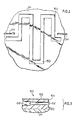
- Figure 2 is an enlarged view of a portion of the resin chamber 20 wall 24 showing thin-film resistance heaters 50 mounted on the wall 24 of the chamber 20. Interposed between the heaters 50 are thermistors 54 for sensing temperatures between the grids formed of resistance heaters 50.
- the separate heaters 50 in the form of single strips or grids may be used to zone heat the chamber 20.
- Figure 3 is an enlarged view of a part of resistance heater 50 element shown in Figure 2.
- the layer 60 is a high temperature, electrical and thermal insulator material, which will readily adhere to the wall 24, for example a film of a ceramic oxide such as silicon dioxide, aluminum oxide, chromium oxide and the like.
- an electrical resistance film 62 of a material having temperature stability sufficient to function as a resistance heater element.
- the resistance film 62 may, for example, be a film of an electrically conductive metal, metal alloy, intermetallic compound or semi-conductive metal oxide or nitride.
- a thin strip of a metal such as a foil of nickel, silver, copper, aluminum or an alloy thereof can be used to fabricate the resistance heater film 62.
- the resistance element can be a sputter coating of the above mentioned materials and particularly titanium in its nitride form.
- This film 62 is connected electrically through a connector 68 within an electrical circuit, so that when the circuit is energized, electrical current will flow through the resistance film 62, resulting in the creation of thermal energy for release from the film 62.
- Thin-film resistance heaters per se and the method of their manufacture are well known in the art; see for example the descriptions given in U.S. Patents 2,899,658; 3,071,749; 3,469,226; 3,517,436 and 4,297,670.
- the heaters may be selected to provide any desired output of BTU.
- a second electrically insulative layer 64 which may be of a material such as described in relation to the electrically insulative layer 60 but advantageously is a good thermal conductor, transparent to infra-red radiation from the resistance heater film 62.
- An example of such an advantageous material is beryllium oxide.
- a protective film 66 which is normally in contact with the resin. It is advantageously a material characterized by high wear resistance, thermal conductivity, chemical inertness, high natural lubricity and resistance to degradation at high temperatures. Representative of such film materials are coatings of titanium, titanium alloys, chrome, electroless nickel and the like.
- the electrical resistance film 62 in direct contact with the resin such as an injection mold.
- the resin such as an injection mold.
- electrically conductive material such as metal flakes
- other conductive mechanical components such as a screen in an extruder is not present.
- the thin film heaters 50 may be varied in thickness, advantageously within the range of from about 0.01 to about 1.00 mm and may be situated as needed to maintain a pre-determined temperature at a selected zone or site within the chamber 20.
- the controlled temperature of the resin flowing through the chamber 20 permits formation of a uniform resin distrib ution and subsequent shaping.
- the temperature of the resin flowing through the chamber 20 is controlled by use of the heaters 50.
- some of the distributed resin may be degraded to the point of reduced utility.
- polycarbonate of a melt extrusion grade requires a temperature of circa 527°F.-572°F. to achieve the proper melt viscosity for extrusion blow-molding. This is a relatively narrow range and if the resin is exposed to a higher temperature for any prolonged period of time, some degradation of the resin may occur.
- the heaters 50 When a plurality of individual heaters 50 are spaced apart on the chamber 20, the heaters 50 individually zone heat areas within the chamber 20 to help balance flow within the processing chamber 20. The correct balance of thermal energy input from the heaters and thermal energy dissipation from the apparatus assure temperature control of the resin without degradation.
- the zone heater elements may be individually energized and de-energized to maintain a pre-determined melt temperature in zones of the resin melt distribution chamber 20.
- Thermocouples such as thermistors 54 may be associated with each of the zone heating elements as part of a conventional energizing and de-energizing electrical circuit to aid in the desired temperature control.
- Figure 4 is a cross-sectional side elevation of a portion of the thermistor 54 shown mounted on the chamber wall 24, in Figure 2.
- the thermistor 54 produces an analog electrical representation of a sensed temperature and comprises an insulative layer 70 adhered to the wall 24.
- the layer 70 may be an electrically and thermally insulative layer of the same material described above as useful for the thin-film resistance heaters 50 insulative layer 60.
- An outer electrically insulative layer 80 may be a thermally transparent material such as that described above as useful for layer 66 of the thin-film resistance heaters 50.
- the layers 70, 80 form an envelope to enclose insulated lead conductors 72, 74 which are part of an electrical circuit which includes electrical connection with ceramic thermistor 78.
- the thermistor 54 is one selected to operate with optimum efficiency at a temperature appropriate to the temperatures desired for processing of the resin in the resin chamber 20, preferably within the range of from about 25°C. to 400°C.
- Thermistors, particularly thin-film thermistors for operation at such temperatures are well known to the art (sometimes referred to as resistance temperature detectors) as are methods of their manufacture; see for example the descriptions given in the U.S. Patents 4,317,367; 4,359,372 and 4,434,416.
- FIG. 5 is a schematic diagram of an electrical circuit which may be employed to operate a heater 50 or a plurality of heaters 50 positioned in different heat zones A, B, C of the chamber 20 and controlled by a plurality of thermistors 54.
- a plurality of thin-film resistance heaters 50 are electrically connected with an electrical power source through the agency of an electrical controller 82.
- Any conventional power module may be connected to the controller 82 which comprises a plurality of solid state relays for energizing and de-energizing the heaters 50 and/or a solenoid valve controlling coolant flow.
- the circuit power lines to the pairs of heaters 50 are energized or deenergized in response to an output signal from the controller 82 initiated by an input signal from the associated thermistor 54 to the controller 82 or by an appropriate timer.
- the thermistors sense and signal when the temperature falls below or exceeds a pre-determined and desired set point, i.e., when a temperature gradient exists between the set point and the actual temperature sensed in one of the heat zones A, B or C.
- the analog signal may be converted to a digital signal by an analog to digital converter before entry in a microprocessor component of the controller 82. Set points for a desired resin temperature may be manually entered in the microprocessor and stored in the processor memory.
- the digitized signal can be compared with the temperature set point.
- the controller 82 may be a conventional and known multi-channel digital controller, which includes a microprocessor component for proportional control, i.e., capable of varying the magnitude of the energizing current to heaters 50, proportioned to the magnitude of the temperature gradient sensed by the thermistor 54, to be changed in order to maintain the predetermined and desired temperature in any one of the zones A, B or C.
- the heaters 50 may be energized fully at any time, for times sufficient to change the aforesaid temperature gradient (time proportioning).
- a solenoid valve may be operated by the controller 82 to control a flow of coolant fluid past the zone.
- the solenoid would be controlled by the same time proportioning signal from the sensor 54, i.e., the solenoid valve may be opened fully for a period of time proportional to the temperature gradient to be reduced.
- the microprocessor can compare a stored temperature set point for the zone A, B and C and generate an output control signal for correction when a temperature gradient occurs, for correction by heating or cooling.
- the microprocessor can also be programmed to change the temperature set point in a zone downstream (for example in zone B, downstream from zone A) when the temperature in the upstream zone (zone A) has gone awry and some correction is necessary to assure that the resin melt passing from the zones A, B and C is within a critical parameter.
- the improved apparatus of the invention may be used to thermally process any conventional and known processable polymeric resins including, for example, cellulose esters and ethers such as ethyl cellulose acetate, acetobutyrate, and acetopropionate; vinyl and vinylidene polymers and copolymers such as polymers and copolymers of vinyl chloride, vinyl acetate, vinyllidene chloride, polyvinyl alcohol, polyvinyl butyral and polymers and copolymers of olefins, such as ethylene, propylene and butylene; polymers and copolymers of styrene, 2-methyl styrene and their mixtures of elastomeric copolymers; polyamides, interpolyamides such as polyhexamethylene adipamide, polycaproloctam, polyundecanamide, polyhexamethylenesebacamide; polycarbonates; poly aldehydes, polyethers; polyurethanes; polyesters
- thermoplastic resin materials may be used neat or in admixture with fillers, plasticizers, colorants, or other ordinary additives, provided they do not prevent processing.
Landscapes
- Engineering & Computer Science (AREA)
- Mechanical Engineering (AREA)
- Physics & Mathematics (AREA)
- Thermal Sciences (AREA)
- Manufacturing & Machinery (AREA)
- Extrusion Moulding Of Plastics Or The Like (AREA)
- Moulds For Moulding Plastics Or The Like (AREA)
- Casting Or Compression Moulding Of Plastics Or The Like (AREA)
- Injection Moulding Of Plastics Or The Like (AREA)
- Blow-Moulding Or Thermoforming Of Plastics Or The Like (AREA)
Applications Claiming Priority (2)
| Application Number | Priority Date | Filing Date | Title |
|---|---|---|---|
| US28647 | 1987-03-20 | ||
| US07/028,647 US4897028A (en) | 1987-03-20 | 1987-03-20 | Apparatus for thermoplastically processing synthetic polymeric resins |
Publications (3)
| Publication Number | Publication Date |
|---|---|
| EP0282805A2 true EP0282805A2 (fr) | 1988-09-21 |
| EP0282805A3 EP0282805A3 (en) | 1990-03-21 |
| EP0282805B1 EP0282805B1 (fr) | 1992-08-12 |
Family
ID=21844635
Family Applications (1)
| Application Number | Title | Priority Date | Filing Date |
|---|---|---|---|
| EP88103048A Expired - Lifetime EP0282805B1 (fr) | 1987-03-20 | 1988-03-01 | Appareil pour le traitement thermoplastique de résines synthétiques polymères |
Country Status (4)
| Country | Link |
|---|---|
| US (1) | US4897028A (fr) |
| EP (1) | EP0282805B1 (fr) |
| JP (1) | JPS63288718A (fr) |
| DE (1) | DE3873567T2 (fr) |
Cited By (5)
| Publication number | Priority date | Publication date | Assignee | Title |
|---|---|---|---|---|
| WO1990011173A1 (fr) * | 1989-03-20 | 1990-10-04 | Guillemot Gerard | Equipement chauffant electriquement a haute temperature par zone regulee pour la mise en oeuvre de produits en materiaux composites |
| EP0418577A3 (en) * | 1989-09-19 | 1991-12-18 | General Electric Company | Improved apparatus for thermoplastically shaping polymeric resins |
| GB2257388A (en) * | 1990-07-03 | 1993-01-13 | Kobe Steel Ltd | Electrically heated moulding die |
| EP0825005A1 (fr) * | 1996-08-16 | 1998-02-25 | YMOS AKTIENGESELLSCHAFT Industrieprodukte | Procédé de chauffage d'un moule |
| EP1234651A3 (fr) * | 1998-06-12 | 2003-04-23 | Husky Injection Molding Systems Ltd. | Système de moulage utilisant des films de chauffage |
Families Citing this family (7)
| Publication number | Priority date | Publication date | Assignee | Title |
|---|---|---|---|---|
| DE3832284A1 (de) * | 1988-09-22 | 1990-04-05 | Krupp Corpoplast Masch | Verfahren und vorrichtung zum thermischen umsteuern eines koerpers zwischen einer aufheiz- und einer abkuehlphase fuer das behandeln von kunststoffen |
| US5973296A (en) * | 1998-10-20 | 1999-10-26 | Watlow Electric Manufacturing Company | Thick film heater for injection mold runner nozzle |
| US7241131B1 (en) | 2000-06-19 | 2007-07-10 | Husky Injection Molding Systems Ltd. | Thick film heater apparatus |
| US6410894B1 (en) * | 2000-10-12 | 2002-06-25 | Watlow Electric Manufacturing Company | Metallic overcoat for thick film heater termination |
| US7311965B2 (en) * | 2003-07-22 | 2007-12-25 | Pedro M. Buarque de Macedo | Strong, high density foam glass tile having a small pore size |
| US20140044823A1 (en) * | 2012-08-09 | 2014-02-13 | Charles E. Pax | Heater for three-dimensional printing |
| JP6380592B1 (ja) * | 2017-03-29 | 2018-08-29 | 株式会社オートネットワーク技術研究所 | コネクタ |
Family Cites Families (17)
| Publication number | Priority date | Publication date | Assignee | Title |
|---|---|---|---|---|
| BE450416A (fr) * | 1942-04-17 | |||
| US2907070A (en) * | 1955-03-25 | 1959-10-06 | Carroll H Van Hartesveldt | Temperature control apparatus for a mold |
| US3158899A (en) * | 1960-12-22 | 1964-12-01 | Technoimpex Magyar Gepipari Ku | Apparatus for continuously producing sheets of thermosetting artificial resins |
| US3185432A (en) * | 1962-01-23 | 1965-05-25 | Armstrong Cork Co | Low-temperature, low-pressure mold |
| US3761550A (en) * | 1968-12-13 | 1973-09-25 | Phillips Petroleum Co | Internal heating of rotating parison |
| US3588987A (en) * | 1970-03-11 | 1971-06-29 | Edward Korostoff | Extrusion dies and method and apparatus for fabrication of extrusion dies |
| US3836313A (en) * | 1973-04-23 | 1974-09-17 | Beloit Corp | Flat film extrusion die |
| JPS55161626A (en) * | 1979-06-02 | 1980-12-16 | Shoji Hane | Hot nozzle containing thin film resistor heater |
| DE3015998C2 (de) * | 1980-04-25 | 1983-05-19 | Messerschmitt-Bölkow-Blohm GmbH, 8000 München | Anordnung zur Beheizung großflächiger Laminatformkörper |
| US4370115A (en) * | 1980-07-28 | 1983-01-25 | Takashi Miura | Injection molding method and device |
| JPS60116B2 (ja) * | 1980-11-20 | 1985-01-05 | 日本鋼管株式会社 | 貝類の発酵処理方法 |
| US4387165A (en) * | 1982-04-22 | 1983-06-07 | Youngblood James L | H2 S Detector having semiconductor and noncontinuous inert film deposited thereon |
| JPS58212919A (ja) * | 1982-06-07 | 1983-12-10 | Idemitsu Petrochem Co Ltd | 多層押出成形用ダイ |
| DE3301272A1 (de) * | 1983-01-17 | 1984-07-19 | Walter Fr. 3004 Isernhagen Davidsmeyer | Vorrichtung zum zufuehren von thermoplasten zu einem formwerkzeug |
| FR2552012B1 (fr) * | 1983-09-19 | 1986-12-12 | Aerospatiale | Procede de fabrication d'un moule pour realiser des pieces moulees de grandes dimensions en materiau composite, moule obtenu au moyen de ce procede et piece polymerisee obtenue au moyen de ce moule |
| GB8507073D0 (en) * | 1985-03-19 | 1985-04-24 | Ben Air Ltd | Mould |
| GB2180495B (en) * | 1985-09-14 | 1989-02-15 | Dunlop Ltd | Vacuum-forming mould for the production of trim-covered articles |
-
1987
- 1987-03-20 US US07/028,647 patent/US4897028A/en not_active Expired - Fee Related
-
1988
- 1988-03-01 EP EP88103048A patent/EP0282805B1/fr not_active Expired - Lifetime
- 1988-03-01 DE DE8888103048T patent/DE3873567T2/de not_active Expired - Fee Related
- 1988-03-17 JP JP63062091A patent/JPS63288718A/ja active Pending
Cited By (8)
| Publication number | Priority date | Publication date | Assignee | Title |
|---|---|---|---|---|
| WO1990011173A1 (fr) * | 1989-03-20 | 1990-10-04 | Guillemot Gerard | Equipement chauffant electriquement a haute temperature par zone regulee pour la mise en oeuvre de produits en materiaux composites |
| FR2646579A1 (fr) * | 1989-03-20 | 1990-11-02 | Guillemot Gerard | Equipement chauffant electriquement a haute temperature par zones regulees pour la mise en oeuvre de produits en materiaux composites |
| US5158132A (en) * | 1989-03-20 | 1992-10-27 | Gerard Guillemot | Zone-regulated high-temperature electric-heating system for the manufacture of products made from composite materials |
| EP0418577A3 (en) * | 1989-09-19 | 1991-12-18 | General Electric Company | Improved apparatus for thermoplastically shaping polymeric resins |
| GB2257388A (en) * | 1990-07-03 | 1993-01-13 | Kobe Steel Ltd | Electrically heated moulding die |
| EP0825005A1 (fr) * | 1996-08-16 | 1998-02-25 | YMOS AKTIENGESELLSCHAFT Industrieprodukte | Procédé de chauffage d'un moule |
| EP1234651A3 (fr) * | 1998-06-12 | 2003-04-23 | Husky Injection Molding Systems Ltd. | Système de moulage utilisant des films de chauffage |
| US7071449B2 (en) | 1998-06-12 | 2006-07-04 | Husky Injection Molding Systems Ltd. | Molding system with integrated film heaters and sensors |
Also Published As
| Publication number | Publication date |
|---|---|
| JPS63288718A (ja) | 1988-11-25 |
| DE3873567T2 (de) | 1993-04-08 |
| EP0282805A3 (en) | 1990-03-21 |
| DE3873567D1 (de) | 1992-09-17 |
| US4897028A (en) | 1990-01-30 |
| EP0282805B1 (fr) | 1992-08-12 |
Similar Documents
| Publication | Publication Date | Title |
|---|---|---|
| US5007818A (en) | Apparatus for thermoplastically shaping polymeric resins | |
| US4897028A (en) | Apparatus for thermoplastically processing synthetic polymeric resins | |
| US3479425A (en) | Extrusion method | |
| US3341388A (en) | Method and apparatus for the uniform extruding of thermoplastic film | |
| US3751014A (en) | Apparatus for extruding synthetic plastic resins at low temperatures | |
| DE3784268D1 (de) | Innenisolierte extruderduese. | |
| IE35929B1 (en) | Improvements relating to a multiple head extrusion device and to a process for controlling such device | |
| JPH02500011A (ja) | 電気的に加熱可能なピンポイントゲート形射出管路 | |
| EP0180571A2 (fr) | Filière d'extrusion et procédé d'extrusion avec centrage automatique | |
| GB2106283A (en) | Temperature regulation in a moulding tool | |
| JPS63502016A (ja) | モジュラー押出ヘッド | |
| US4895744A (en) | Method of making a multi-layer parison | |
| JPS54124067A (en) | Extrusion die | |
| US5019433A (en) | Multi-layer molten plastic body | |
| EP0345987B1 (fr) | Procédés de fabrication de matériaux multicouches en feuille, procédés de traitement de polymères, dispositif d'extrusion, matériaux polymères en feuilles et emballage obtenu à partir de ceux-ci | |
| JPS5828359A (ja) | 押出し成形されたプラスチツク成形条片を製造するための方法並びにこの方法を実施するための装置 | |
| IT1198425B (it) | Gruppo elettrotermico,per il riscaldamento controllato di cilindri di estrusori,di pressa ad iniezione e di trafilatrici,per materie plastiche,gomme e simili,circondato da una doppia intercapedine per la circolazione di aria | |
| CN210174168U (zh) | 一种挤出机温控系统 | |
| US5164032A (en) | Method of forming a decorative article | |
| EP0586205A1 (fr) | Matrice d'extrusion pour film à largeur variable | |
| EP0922564A1 (fr) | Procede et appareil de fabrication de stratifies | |
| US3314109A (en) | Extrusion die and feed apparatus | |
| CN213564215U (zh) | 一种用于保温xps挤塑板生产用的二阶螺杆挤出机 | |
| CN214027157U (zh) | 带有水冷控温单元的改性塑料挤出机 | |
| CN213006474U (zh) | 一种单螺杆挤塑机挤塑管 |
Legal Events
| Date | Code | Title | Description |
|---|---|---|---|
| PUAI | Public reference made under article 153(3) epc to a published international application that has entered the european phase |
Free format text: ORIGINAL CODE: 0009012 |
|
| AK | Designated contracting states |
Kind code of ref document: A2 Designated state(s): DE FR GB IT NL |
|
| PUAL | Search report despatched |
Free format text: ORIGINAL CODE: 0009013 |
|
| AK | Designated contracting states |
Kind code of ref document: A3 Designated state(s): DE FR GB IT NL |
|
| 17P | Request for examination filed |
Effective date: 19900817 |
|
| 17Q | First examination report despatched |
Effective date: 19910226 |
|
| GRAA | (expected) grant |
Free format text: ORIGINAL CODE: 0009210 |
|
| AK | Designated contracting states |
Kind code of ref document: B1 Designated state(s): DE FR GB IT NL |
|
| PG25 | Lapsed in a contracting state [announced via postgrant information from national office to epo] |
Ref country code: NL Effective date: 19920812 |
|
| REF | Corresponds to: |
Ref document number: 3873567 Country of ref document: DE Date of ref document: 19920917 |
|
| ITF | It: translation for a ep patent filed | ||
| ET | Fr: translation filed | ||
| NLV1 | Nl: lapsed or annulled due to failure to fulfill the requirements of art. 29p and 29m of the patents act | ||
| ITTA | It: last paid annual fee | ||
| PLBE | No opposition filed within time limit |
Free format text: ORIGINAL CODE: 0009261 |
|
| STAA | Information on the status of an ep patent application or granted ep patent |
Free format text: STATUS: NO OPPOSITION FILED WITHIN TIME LIMIT |
|
| 26N | No opposition filed | ||
| PGFP | Annual fee paid to national office [announced via postgrant information from national office to epo] |
Ref country code: DE Payment date: 19940224 Year of fee payment: 7 |
|
| PGFP | Annual fee paid to national office [announced via postgrant information from national office to epo] |
Ref country code: GB Payment date: 19940301 Year of fee payment: 7 |
|
| PGFP | Annual fee paid to national office [announced via postgrant information from national office to epo] |
Ref country code: FR Payment date: 19950210 Year of fee payment: 8 |
|
| PG25 | Lapsed in a contracting state [announced via postgrant information from national office to epo] |
Ref country code: GB Effective date: 19950301 |
|
| GBPC | Gb: european patent ceased through non-payment of renewal fee |
Effective date: 19950301 |
|
| PG25 | Lapsed in a contracting state [announced via postgrant information from national office to epo] |
Ref country code: DE Effective date: 19951201 |
|
| PG25 | Lapsed in a contracting state [announced via postgrant information from national office to epo] |
Ref country code: FR Effective date: 19961129 |
|
| REG | Reference to a national code |
Ref country code: FR Ref legal event code: ST |
|
| PG25 | Lapsed in a contracting state [announced via postgrant information from national office to epo] |
Ref country code: IT Free format text: LAPSE BECAUSE OF NON-PAYMENT OF DUE FEES;WARNING: LAPSES OF ITALIAN PATENTS WITH EFFECTIVE DATE BEFORE 2007 MAY HAVE OCCURRED AT ANY TIME BEFORE 2007. THE CORRECT EFFECTIVE DATE MAY BE DIFFERENT FROM THE ONE RECORDED. Effective date: 20050301 |