EP0283010A2 - Hilfseinrichtung für die Fusstherapie - Google Patents
Hilfseinrichtung für die Fusstherapie Download PDFInfo
- Publication number
- EP0283010A2 EP0283010A2 EP88104255A EP88104255A EP0283010A2 EP 0283010 A2 EP0283010 A2 EP 0283010A2 EP 88104255 A EP88104255 A EP 88104255A EP 88104255 A EP88104255 A EP 88104255A EP 0283010 A2 EP0283010 A2 EP 0283010A2
- Authority
- EP
- European Patent Office
- Prior art keywords
- aid
- sheet
- orthetic
- podotherapeutic
- pattern
- Prior art date
- Legal status (The legal status is an assumption and is not a legal conclusion. Google has not performed a legal analysis and makes no representation as to the accuracy of the status listed.)
- Withdrawn
Links
Images



Classifications
-
- A—HUMAN NECESSITIES
- A43—FOOTWEAR
- A43B—CHARACTERISTIC FEATURES OF FOOTWEAR; PARTS OF FOOTWEAR
- A43B7/00—Footwear with health or hygienic arrangements
- A43B7/14—Footwear with health or hygienic arrangements with foot-supporting parts
- A43B7/1405—Footwear with health or hygienic arrangements with foot-supporting parts with pads or holes on one or more locations, or having an anatomical or curved form
- A43B7/141—Footwear with health or hygienic arrangements with foot-supporting parts with pads or holes on one or more locations, or having an anatomical or curved form having an anatomical or curved form
-
- A—HUMAN NECESSITIES
- A43—FOOTWEAR
- A43B—CHARACTERISTIC FEATURES OF FOOTWEAR; PARTS OF FOOTWEAR
- A43B1/00—Footwear characterised by the material
- A43B1/0045—Footwear characterised by the material made at least partially of deodorant means
-
- A—HUMAN NECESSITIES
- A43—FOOTWEAR
- A43B—CHARACTERISTIC FEATURES OF FOOTWEAR; PARTS OF FOOTWEAR
- A43B1/00—Footwear characterised by the material
- A43B1/0054—Footwear characterised by the material provided with magnets, magnetic parts or magnetic substances
-
- A—HUMAN NECESSITIES
- A43—FOOTWEAR
- A43B—CHARACTERISTIC FEATURES OF FOOTWEAR; PARTS OF FOOTWEAR
- A43B7/00—Footwear with health or hygienic arrangements
- A43B7/14—Footwear with health or hygienic arrangements with foot-supporting parts
-
- A—HUMAN NECESSITIES
- A43—FOOTWEAR
- A43B—CHARACTERISTIC FEATURES OF FOOTWEAR; PARTS OF FOOTWEAR
- A43B7/00—Footwear with health or hygienic arrangements
- A43B7/14—Footwear with health or hygienic arrangements with foot-supporting parts
- A43B7/1405—Footwear with health or hygienic arrangements with foot-supporting parts with pads or holes on one or more locations, or having an anatomical or curved form
- A43B7/1415—Footwear with health or hygienic arrangements with foot-supporting parts with pads or holes on one or more locations, or having an anatomical or curved form characterised by the location under the foot
- A43B7/142—Footwear with health or hygienic arrangements with foot-supporting parts with pads or holes on one or more locations, or having an anatomical or curved form characterised by the location under the foot situated under the medial arch, i.e. under the navicular or cuneiform bones
-
- A—HUMAN NECESSITIES
- A43—FOOTWEAR
- A43B—CHARACTERISTIC FEATURES OF FOOTWEAR; PARTS OF FOOTWEAR
- A43B7/00—Footwear with health or hygienic arrangements
- A43B7/14—Footwear with health or hygienic arrangements with foot-supporting parts
- A43B7/1405—Footwear with health or hygienic arrangements with foot-supporting parts with pads or holes on one or more locations, or having an anatomical or curved form
- A43B7/1415—Footwear with health or hygienic arrangements with foot-supporting parts with pads or holes on one or more locations, or having an anatomical or curved form characterised by the location under the foot
- A43B7/1425—Footwear with health or hygienic arrangements with foot-supporting parts with pads or holes on one or more locations, or having an anatomical or curved form characterised by the location under the foot situated under the ball of the foot, i.e. the joint between the first metatarsal and first phalange
-
- A—HUMAN NECESSITIES
- A43—FOOTWEAR
- A43B—CHARACTERISTIC FEATURES OF FOOTWEAR; PARTS OF FOOTWEAR
- A43B7/00—Footwear with health or hygienic arrangements
- A43B7/14—Footwear with health or hygienic arrangements with foot-supporting parts
- A43B7/1405—Footwear with health or hygienic arrangements with foot-supporting parts with pads or holes on one or more locations, or having an anatomical or curved form
- A43B7/1415—Footwear with health or hygienic arrangements with foot-supporting parts with pads or holes on one or more locations, or having an anatomical or curved form characterised by the location under the foot
- A43B7/143—Footwear with health or hygienic arrangements with foot-supporting parts with pads or holes on one or more locations, or having an anatomical or curved form characterised by the location under the foot situated under the lateral arch, i.e. the cuboid bone
-
- A—HUMAN NECESSITIES
- A43—FOOTWEAR
- A43B—CHARACTERISTIC FEATURES OF FOOTWEAR; PARTS OF FOOTWEAR
- A43B7/00—Footwear with health or hygienic arrangements
- A43B7/14—Footwear with health or hygienic arrangements with foot-supporting parts
- A43B7/1405—Footwear with health or hygienic arrangements with foot-supporting parts with pads or holes on one or more locations, or having an anatomical or curved form
- A43B7/1415—Footwear with health or hygienic arrangements with foot-supporting parts with pads or holes on one or more locations, or having an anatomical or curved form characterised by the location under the foot
- A43B7/1435—Footwear with health or hygienic arrangements with foot-supporting parts with pads or holes on one or more locations, or having an anatomical or curved form characterised by the location under the foot situated under the joint between the fifth phalange and the fifth metatarsal bone
-
- A—HUMAN NECESSITIES
- A43—FOOTWEAR
- A43B—CHARACTERISTIC FEATURES OF FOOTWEAR; PARTS OF FOOTWEAR
- A43B7/00—Footwear with health or hygienic arrangements
- A43B7/14—Footwear with health or hygienic arrangements with foot-supporting parts
- A43B7/1405—Footwear with health or hygienic arrangements with foot-supporting parts with pads or holes on one or more locations, or having an anatomical or curved form
- A43B7/1415—Footwear with health or hygienic arrangements with foot-supporting parts with pads or holes on one or more locations, or having an anatomical or curved form characterised by the location under the foot
- A43B7/144—Footwear with health or hygienic arrangements with foot-supporting parts with pads or holes on one or more locations, or having an anatomical or curved form characterised by the location under the foot situated under the heel, i.e. the calcaneus bone
-
- A—HUMAN NECESSITIES
- A43—FOOTWEAR
- A43B—CHARACTERISTIC FEATURES OF FOOTWEAR; PARTS OF FOOTWEAR
- A43B7/00—Footwear with health or hygienic arrangements
- A43B7/14—Footwear with health or hygienic arrangements with foot-supporting parts
- A43B7/1405—Footwear with health or hygienic arrangements with foot-supporting parts with pads or holes on one or more locations, or having an anatomical or curved form
- A43B7/1415—Footwear with health or hygienic arrangements with foot-supporting parts with pads or holes on one or more locations, or having an anatomical or curved form characterised by the location under the foot
- A43B7/145—Footwear with health or hygienic arrangements with foot-supporting parts with pads or holes on one or more locations, or having an anatomical or curved form characterised by the location under the foot situated under the toes, i.e. the phalanges
Definitions
- the invention relates to podotherapeutic aid.
- podotherapeutic aids are often inadequate and sometimes even prove themselves to be harmful, since they do not meet a crossplicity of specific requirements of the individual patient.
- An object of the present invention is to provide a podotherapeutic aid, such as for example an insole or orthopaedic insert aid or an item of footwear or a band to be applied to different regions of the foot or of the leg, which constitutes a valid therapeutic means for rehabilitative treatments of functional alterations or anomalies which occur on the sole or in other parts of the foot, such as for example the dermoepithelial regions with muscle keratopathies, with osteoarticular myopathies, with bone arthropathies, with neurological osteoporosis, with vascular neuropathies, with vasculopathies and the like.
- a further object of the present invention is that said podotherapeutic aid be suitable both for rehabilitative therapy and for sports therapy to allow optimum functional conditions to athletes.
- Another object of the present invention is to provide a podotherapeutic aid which is particularly effective since it can be produced on the basis of data of an accurate and precise analysis of the foot, performed scientifically and possibly computerized so as to be individually made-to-measure.
- a podotherapeutic aid comprising an anatomical multi-layered structure including a plate-like template, adapted to constitute a diaphragm-support supporting, on its face to be directed towards the sole of the foot, an orthetic structure having portions in soft and elastically deformable material, such as latex foam or foamed polyurethane and portions of material in magnetized sheet, and at least one corrective plate at the other side.
- the configuration, the size and the thickness of the orthetic structure, and of the (or of each) corrective plate are determined by selectively operating on basic patterns (orthetic diagrams) based on a podographic analysis capable of providing information as to the length of the foot, the resting surface of the toes and of the sole, the shape of the plantar imprint, the average pressure, the position of reference points, the morphology of the regions of the metatarsus, of the heel and of the calcaneum and the biomechanical functions.
- Figure 1 illustrates the basic diagram of a podotherapeutic aid or orthetic structure comprising various areas or regions indicated respectively as region 1 which corresponds to the retrocapital rise for the metatarsal heads, as region 2 which corresponds to the rise of the medial plantar arch, as region 3 which corresponds to the rise of the base of the fifth metatarsal, as regions 4 and 5 corresponding to the resting seats of the metatarsal heads, as region 6 which corresponds to the calcanear resting region.
- the regions 1 to 6 constitute the portion of orthopaedic insole in which the region 2 can protrude outwards and the region 1 can assume a raised ellipsoidal configuration, as indicated in broken lines.
- Figure 2 illustrates the basic diagram related to corrective inserts or plates and comprising regions 7, 8, respectively at the medial and lateral metatarsal regions, regions 9, 10 respectively at the medial and lateral tarsal region, regions 11, 12, respectively at the medial and lateral heel region. If required, a corrective plate may be provided in a region 13 at the toes.
- an orthopaedic insert specific for the patient can be manufactured.
- plantar imprints of the right foot and of the left foot are obtained, which constitute both static and dynamic anatomical podograms; i.e. anatomical maps adapted to provide, as will become apparent hereinafter, a whole series of indications required for the diagnosis and the therapy of the case.
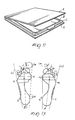
- An axonometric isopodograh comprises a plurality of sheets held or hinged together along one side thereof, as is illustrated in Figure 11, e.g. a cover A, a front sheet B covered by an elastomer layer on which the feet of a patient are placed.
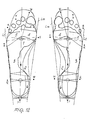
- the elastomer layer has printed on its uppper surface an isopodographic card outline so as to provide guide lines for a correct positioning of the patient's feet, thereby obtaining by chalcoserigraphy a correct footprint on an isopodographic card C arranged underneath ( Figures 12 and 13).
- a front sheet B instead of a front sheet B, use can be made of a two-layer isopodographic card the upper layer whereof is covered by pressure-sensitive carbon paper for obtaining footprints.
- the isopodographic card bears reference points such as from P to W, that are marked, e.g. traced with a point-marker pen perpendicular to the surface of the podogram and in contact with the foot in the following positions: - on the sagittal half of the five toes; - next the first and fifth metatarsal-phalangeal articulation; - next the midpoint of the medial malleolus and the lateral malleolus; - next the sagittal half of the calcanear tuberosity.
- Two tangent lines, medial Lm and lateral Ll, connecting the outermost points of the podographic image, and an intermediate bisecting line x, between which the angle of valgoid and/or varus condition of the big toe remains delimited and pointed out, are also marked.
- the complete podogram of the above specified indications allows to analyze the features listed hereinafter.
- Length of the foot measured in millimeters from the reference point P at the calcaneum to the reference point U related to the longest toe, and the size is deduced from this length.
- Resting surface of the toes and of the sole measured for example in square centimeters and compared with values considered normal according to statistical average values.
- - Footprint provides the configuration of the resting surface or sole of the foot, which may be arched, pre-arched-arched, pre-arched, normal, pre-flat, pre-flat-flat, flat plus-flat.
- Anatomical anomalies those situations on the podogram in which a distance greater than 6 mm from the normal position is detected are classified as such.
- the anomaly and its extent may be highlighted with a circumference the center whereof corresponds to the normal position and with a radius equal to the distance between said normal position and the detected point.
- the classification is performed according to the general arrangement of the anatomical reference points of the metatarsal region, in both static and dynamic conditions. Thus, for example, if the set of points is predominantly rotated towards the outside, lateral side of the foot, this is due to an inversion morphology, or to induced supination; if the opposite occurs, it means that the anomaly is caused by a eversion morphology or by the induced pronation.
- the classification is referred to the position of the anatomical reference points proximate to the malleoli and to the position of the axis of the tibio-tarsal articulation.
- the morphology is considered anomalous if the sum of the displacements is greater than one centimeter and the axis of the tibio-tarsal articulation is rotated by more than 20° with respect to the normal.
- the isopodographic card obtained by means of isopodograph can be fed into a suitably programmed computer which, by processing the input data on the isopodographic card, can print an individually tailored isopodographic diagnostic card such as that shown in Fig. 13 which may also include alfanumeric information and/or technical details, drawings, diagrams and other indications about the manufacture of an axonometric plantar or insole device.
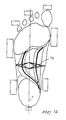
- the foot imprints on the isopodographic card are analysed and processed by the computer that makes an objective diagnosis and can provide through a printer and a plotter a perspective and axonometric diagram (see Fig. 14) for both feet.
- Each pair of such diagrams can form a homothetimeter (when printed on transparent sheets or plates) and include a number of homothetic triangles TR having their base on the central bisecting line x extending outwardly towards the lateral bisecting lines.
- the height of such triangles is proportional to the degree of homothetic of the plantar arch, e.g. positive for flat feet and negative for the arched ones.
- 14 indicates a template acting as diaphragm and provided in a plate of an elastically deformable material such as polythene or polyester or the like, advantageously transparent.
- the template 14 is adapted to support, on the face to be directed towards the sole of the foot, an orthetic structure obtained by acting selectively on the basic diagram of figure 1 and made of an elastically deformable soft material 15, such as latex foam or foamed polyurethane, suitably shaped as is shown in figures 4 and 5 and delimited by the lines 15 a ,15 b as well as by the contour of the template, on which portions of sheets of magnetized rubber, indicated respectively at 16, 17, 18, are applied. Similar portions of magnetized rubber sheets e.g. including a plurality of parallel magnetization lines, are applied directly to the template 14 and are indicated at 19 and 20 in the heel region.
- an elastically deformable soft material such as latex foam or foamed polyurethane
- sheets of magnetized rubber which may have a thickness ranging for example from 0.5 to 10 mm, can be arranged at different orientations of their magnetic lines and create a relatively weak magnetic field, which may vary from a few thousandths to a few hundred gauss.
- a magnetic field of such intensity is useful in the anti-inflammatory prophylaxis of arthroses in general, and is particularly effective in the treatment of many affections, such as for example may be hyperkeratoses of the sole of the foot, haematomas, strains, sprains, foot pains in general.
- Relatively weak magnetic fields are also a good adjuvant therapy in the vasoactivation of the sole of the foot and of the legs.
- a corrective insert plate 21 is present which can be provided monolithically obtained by using elastically deformable spongy elastomer material, but may be obtained with materials having different rigidity, such as magnetized rubber, cork or leather, according to the corrective, compensatory requirements or for the requirements of sport.
- the plate 21 has been obtained by acting selectively, after performing the computerized analysis of the patient, according to the diagram of figure 2, bearing in mind that a plate in the region 7 corrects eversion and pronation, a plate in the region 8 corrects inversion and supination, and so on.
- An orthopaedic insole such as the one described above can be externally covered for finishing with a covering layer, not illustrated in the drawings, for example made of silk or cotton fabric or leather or other suitable material.
- Figures 7 and 8 illustrate an orthopaedic insole according to a modified embodiment of the invention and obtained as a monolithic body 22 in elastically deformable soft material, such as latex foam, conveniently shaped and configured as well as provided with portions of magnetized rubber sheet 23, 24, 25, 26 arranged in predetermined regions of a map indicated with broken lines.
- Said map also comprises sections 27 a , 27 b , 27 c , at the medial and lateral metatarsal region, a section 28 at the medial plantar arch, and sections 29 a and 29 b at the heel region, which, if required, can be occupied by portions of magnetized sheet.
- Figure 9 illustrates a podotherapeutic aid constituted by a shoe 30 with insole 31 conveniently shaped and provided with portions of magnetized rubber sheet and with a band 32 adherent to the upper and including portions of magnetized rubber sheet.
- Figure 10 illustrates a band 33 in elastic fabric, adapted to embrace the foot or leg, which comprises regions 34 a , 34 b affected by magnetized rubber sheets.
- the band 33 is provided, at its ends, with portions 35 a , 35 b of tear-open tape for fixing in position.
- the plantar device 40 includes, in the order, a flat base sheet 41 made of leather or the like, a silk-screened transparent polyester sheet 42 resting on the sheet 41, a plurality of corrective inserts 43, a layer 44 of reflexogenics, aromatizers, sanitizers or the like, a layer of fabric 45, a casting 46 of a foamed material and a cover sheath 47.
- the main function of the transparent sheet 42 is to provide, by transferring a computerized axonometric technical card, indications as to the provision of notches, cushioning inserts, sensors for individually tailored orthesis, as well as to act as a reinforcing and resilient element.
- the inserts 43 can comprise pieces of leather, cork, wood, plastics material having a thickness ranging from 0,2 to 50 mm, rubber cushions inflated with air acting as sensors.
- the layer 44 can include functional substances with relaxing, refreshing, decongestive, deodorant, dermopurifying, antifatigue and antimycotic effects.
- Such functional substances provide a progressive and constant release of their properties and comprise: essential oils of mint, pine, eucalyptol, gomenol, lavender, camphor, thyme, sage, rosemary, camomile together with copolidiol 20 and captan to obtain the "slow release aromatic" effect.
- quaternary ammonium salts salicilic acid, lysozyme, interferon, undecylenic amide, undecylenic acid, usnic acid.
- the layer 44 can comprise medications and reflexogenic aromatizing agents in the following amounts: active vegetable coal 2 to 5 gr; chlorophyll 2 to 5 gr; quaternary ammonium salts 0.01 to 1 gr; salicilic acid 0.5 to 5 gr; lysozyme 0.2 gr to 1 gr; interferon 0.01 gr to 0.1 gr; undecylenic amide 1 to 5 gr; undecylenic acid 0.2 to 1 gr; usnic acid 0.2 to 1 gr; copolidiol 5 to 20 gr; captan, 1 to 10 gr; lavender essence 0.2 to 2 gr; rosemary essence 0.2 to 2 gr; menthol 0.5 to 2 gr; camphor 0.5 o 2 gr; eucalyptol 0.5 to 2 gr; thymol 0.5 to 2 gr; gomenol 0.5 to 2 gr; sage essence 0.2 to 2 gr; camomile essence 0.2 to 2 gr.
- the foam material 46 can be polyurethane, latex foam, silicon or the like, whereas the cover sheath 47 can be made of leather, cotton, silk, plastics porous material.
Landscapes
- Health & Medical Sciences (AREA)
- Epidemiology (AREA)
- General Health & Medical Sciences (AREA)
- Public Health (AREA)
- Footwear And Its Accessory, Manufacturing Method And Apparatuses (AREA)
- Socks And Pantyhose (AREA)
Applications Claiming Priority (4)
| Application Number | Priority Date | Filing Date | Title |
|---|---|---|---|
| IT1810787 | 1987-03-17 | ||
| IT8718107A IT1229613B (it) | 1987-03-17 | 1987-03-17 | Plantare assonometrico computerizzato particolarmente per la correzione delle dismorfologie del piede |
| IT8494987 | 1987-06-24 | ||
| IT84949/87A IT1218636B (it) | 1987-06-24 | 1987-06-24 | Presidio podoterapico |
Publications (2)
| Publication Number | Publication Date |
|---|---|
| EP0283010A2 true EP0283010A2 (de) | 1988-09-21 |
| EP0283010A3 EP0283010A3 (de) | 1990-09-05 |
Family
ID=26326977
Family Applications (1)
| Application Number | Title | Priority Date | Filing Date |
|---|---|---|---|
| EP19880104255 Withdrawn EP0283010A3 (de) | 1987-03-17 | 1988-03-17 | Hilfseinrichtung für die Fusstherapie |
Country Status (1)
| Country | Link |
|---|---|
| EP (1) | EP0283010A3 (de) |
Cited By (12)
| Publication number | Priority date | Publication date | Assignee | Title |
|---|---|---|---|---|
| WO1994006376A1 (fr) * | 1992-09-17 | 1994-03-31 | Alexandr Dmitrievich Garpinich | Semelle universelle |
| WO2000030483A1 (en) * | 1998-11-20 | 2000-06-02 | Amanda Turner | Improvements in footwear |
| RU2160572C2 (ru) * | 1999-02-17 | 2000-12-20 | Трушин Евгений Иванович | Супинатор для лечения и профилактики плоскостопия |
| RU2173118C2 (ru) * | 1997-12-03 | 2001-09-10 | Товарищество с ограниченной ответственностью "Медицинская фирма "ПАРИЗО" | Корректор пальцев стопы |
| RU2184508C2 (ru) * | 1997-04-24 | 2002-07-10 | Отто Бок Ортопедише Индустри Безитц унд Вервальтунгс-Коммандитгезельшафт | Упругий вкладыш стопы |
| RU2218129C2 (ru) * | 2001-10-22 | 2003-12-10 | Амбурцев Андрей Викторович | Ортопедический вкладыш в обувь |
| RU2226374C2 (ru) * | 2002-07-15 | 2004-04-10 | Федоров Александр Львович | Протезно-ортопедическая стелька |
| WO2006006815A1 (en) * | 2004-07-10 | 2006-01-19 | Ji-Woog Kim | Method and apparatus for curing body status |
| DE102006049293A1 (de) * | 2006-10-19 | 2008-04-24 | Wolfgang Triebstein | Verfahren zum individuellen Anpassen eines Schuhs und Vorrichtung hierfür |
| RU2760542C1 (ru) * | 2021-04-28 | 2021-11-26 | Общество с ограниченной ответственностью Медицинский Центр "АРТРОЛИГА" | Способ лечения и профилактики продольного плоскостопия у детей и стелька-супинатор для его осуществления (варианты) |
| RU2805250C2 (ru) * | 2018-08-01 | 2023-10-13 | (Тс)2 Гмбх | Устройство для поддержания физиологических свойств стопы при поступательном движении и в статических условиях |
| US12490808B2 (en) | 2018-08-01 | 2025-12-09 | (ts)² GmbH | Device for supporting the physiological foot characteristics during movement and in static conditions |
Family Cites Families (5)
| Publication number | Priority date | Publication date | Assignee | Title |
|---|---|---|---|---|
| US3696456A (en) * | 1971-02-22 | 1972-10-10 | Intern Nominees Bahamas Ltd | Custom shoe construction system |
| DE2821247A1 (de) * | 1978-05-16 | 1979-11-22 | Precitec Gmbh | Abtastvorrichtung zur dreidimensionalen abtastung der oberflaeche von gliedmassen, insbesondere der sohlenform eines menschlichen fusses |
| FR2513508A1 (fr) * | 1981-09-29 | 1983-04-01 | Agnes Michel | Dispositif a usage medical et paramedical pour la mesure des pressions exercees par le corps ou parties du corps sur un support quelconque |
| DE3238113A1 (de) * | 1982-10-14 | 1984-04-19 | Energy-Pak Ltd., 9427 Wolfhalden | Einlegesohle |
| DE3324303A1 (de) * | 1983-07-06 | 1985-01-17 | Nitex GmbH, 3002 Wedemark | Einlegesohle |
-
1988
- 1988-03-17 EP EP19880104255 patent/EP0283010A3/de not_active Withdrawn
Cited By (12)
| Publication number | Priority date | Publication date | Assignee | Title |
|---|---|---|---|---|
| WO1994006376A1 (fr) * | 1992-09-17 | 1994-03-31 | Alexandr Dmitrievich Garpinich | Semelle universelle |
| RU2184508C2 (ru) * | 1997-04-24 | 2002-07-10 | Отто Бок Ортопедише Индустри Безитц унд Вервальтунгс-Коммандитгезельшафт | Упругий вкладыш стопы |
| RU2173118C2 (ru) * | 1997-12-03 | 2001-09-10 | Товарищество с ограниченной ответственностью "Медицинская фирма "ПАРИЗО" | Корректор пальцев стопы |
| WO2000030483A1 (en) * | 1998-11-20 | 2000-06-02 | Amanda Turner | Improvements in footwear |
| RU2160572C2 (ru) * | 1999-02-17 | 2000-12-20 | Трушин Евгений Иванович | Супинатор для лечения и профилактики плоскостопия |
| RU2218129C2 (ru) * | 2001-10-22 | 2003-12-10 | Амбурцев Андрей Викторович | Ортопедический вкладыш в обувь |
| RU2226374C2 (ru) * | 2002-07-15 | 2004-04-10 | Федоров Александр Львович | Протезно-ортопедическая стелька |
| WO2006006815A1 (en) * | 2004-07-10 | 2006-01-19 | Ji-Woog Kim | Method and apparatus for curing body status |
| DE102006049293A1 (de) * | 2006-10-19 | 2008-04-24 | Wolfgang Triebstein | Verfahren zum individuellen Anpassen eines Schuhs und Vorrichtung hierfür |
| RU2805250C2 (ru) * | 2018-08-01 | 2023-10-13 | (Тс)2 Гмбх | Устройство для поддержания физиологических свойств стопы при поступательном движении и в статических условиях |
| US12490808B2 (en) | 2018-08-01 | 2025-12-09 | (ts)² GmbH | Device for supporting the physiological foot characteristics during movement and in static conditions |
| RU2760542C1 (ru) * | 2021-04-28 | 2021-11-26 | Общество с ограниченной ответственностью Медицинский Центр "АРТРОЛИГА" | Способ лечения и профилактики продольного плоскостопия у детей и стелька-супинатор для его осуществления (варианты) |
Also Published As
| Publication number | Publication date |
|---|---|
| EP0283010A3 (de) | 1990-09-05 |
Similar Documents
| Publication | Publication Date | Title |
|---|---|---|
| Huang et al. | The arch support insoles show benefits to people with flatfoot on stance time, cadence, plantar pressure and contact area | |
| Franco | Pes cavus and pes planus: analyses and treatment | |
| US5014706A (en) | Orthotic insole with regions of different hardness | |
| Bauman et al. | Plantar pressures and trophic ulceration | |
| US4676801A (en) | Foot orthosis and process | |
| US6481120B1 (en) | Full length insole for arthritic and/or diabetic people | |
| Baumhauer et al. | A comparison study of plantar foot pressure in a standardized shoe, total contact cast, and prefabricated pneumatic walking brace | |
| US7069665B1 (en) | Correcting foot alignment | |
| US5170572A (en) | Tripod support insole | |
| EP0283010A2 (de) | Hilfseinrichtung für die Fusstherapie | |
| US7020990B2 (en) | Orthopedic device for distributing pressure | |
| EP3130246A1 (de) | Gelenkentlastender schuhartikel | |
| Landorf et al. | Effects of metatarsal domes on plantar pressures in older people with a history of forefoot pain | |
| Li et al. | Influence of textured indoor footwear on posture stability of older women based on center-of-pressure measurements | |
| Giacomozzi et al. | Potentialities and criticalities of plantar pressure measurements in the study of foot biomechanics: devices, methodologies and applications | |
| Im Yi et al. | Comparison of the forefoot pressure-relieving effects of foot orthoses | |
| Giallonardo | Clinical evaluation of foot and ankle dysfunction | |
| CN112870647B (zh) | 一种踝关节失稳康复训练鞋垫 | |
| Wang et al. | Effectiveness and reliability of foot orthoses on impact loading and lower limb kinematics when running at preferred and nonpreferred speeds | |
| ILFELD | Pes planus: military significance and treatment with simple arch support | |
| Heydari et al. | Short-term effects of using arch supporting insoles on balance and symptoms of flexible flat foot in children | |
| Ross | The relationship of abnormal foot pronation to hallux abducto valgus—a pilot study | |
| Subotnick | The cavus foot | |
| Soni et al. | Efficacy of Core Stability Exercises and Intrinsic Foot Training on Patients With Flat Foot: A Comparative Study | |
| JPH0423544Y2 (de) |
Legal Events
| Date | Code | Title | Description |
|---|---|---|---|
| PUAI | Public reference made under article 153(3) epc to a published international application that has entered the european phase |
Free format text: ORIGINAL CODE: 0009012 |
|
| AK | Designated contracting states |
Kind code of ref document: A2 Designated state(s): AT BE CH DE ES FR GB GR IT LI NL SE |
|
| PUAL | Search report despatched |
Free format text: ORIGINAL CODE: 0009013 |
|
| AK | Designated contracting states |
Kind code of ref document: A3 Designated state(s): AT BE CH DE ES FR GB GR IT LI NL SE |
|
| STAA | Information on the status of an ep patent application or granted ep patent |
Free format text: STATUS: THE APPLICATION IS DEEMED TO BE WITHDRAWN |
|
| 18D | Application deemed to be withdrawn |
Effective date: 19910306 |