EP0283387A1 - Überwachungsgerät für die Neuromuskularreaktion eines Patienten - Google Patents
Überwachungsgerät für die Neuromuskularreaktion eines Patienten Download PDFInfo
- Publication number
- EP0283387A1 EP0283387A1 EP88400560A EP88400560A EP0283387A1 EP 0283387 A1 EP0283387 A1 EP 0283387A1 EP 88400560 A EP88400560 A EP 88400560A EP 88400560 A EP88400560 A EP 88400560A EP 0283387 A1 EP0283387 A1 EP 0283387A1
- Authority
- EP
- European Patent Office
- Prior art keywords
- patient
- handle
- hand
- sensor
- piston
- Prior art date
- Legal status (The legal status is an assumption and is not a legal conclusion. Google has not performed a legal analysis and makes no representation as to the accuracy of the status listed.)
- Withdrawn
Links
- 238000006243 chemical reaction Methods 0.000 title claims abstract description 10
- 238000012544 monitoring process Methods 0.000 title claims abstract description 7
- 230000002232 neuromuscular Effects 0.000 title claims abstract description 5
- 210000003813 thumb Anatomy 0.000 claims abstract description 18
- 210000000245 forearm Anatomy 0.000 claims abstract description 12
- 238000001514 detection method Methods 0.000 claims abstract description 6
- 230000000638 stimulation Effects 0.000 claims description 14
- 210000003811 finger Anatomy 0.000 claims description 9
- 210000000056 organ Anatomy 0.000 claims description 9
- 210000003205 muscle Anatomy 0.000 claims description 6
- 230000003071 parasitic effect Effects 0.000 claims description 6
- 230000006978 adaptation Effects 0.000 claims description 5
- 210000005036 nerve Anatomy 0.000 claims description 4
- 230000036316 preload Effects 0.000 claims description 4
- 210000004247 hand Anatomy 0.000 claims description 3
- 210000000658 ulnar nerve Anatomy 0.000 claims description 3
- 230000000295 complement effect Effects 0.000 claims 1
- 238000006073 displacement reaction Methods 0.000 claims 1
- 230000004913 activation Effects 0.000 abstract 1
- 244000045947 parasite Species 0.000 description 6
- 230000003387 muscular Effects 0.000 description 4
- GXFZCDMWGMFGFL-KKXMJGKMSA-N (+)-Tubocurarine chloride hydrochloride Chemical compound [Cl-].[Cl-].C([C@H]1[N+](C)(C)CCC=2C=C(C(=C(OC3=CC=C(C=C3)C[C@H]3C=4C=C(C(=CC=4CC[NH+]3C)OC)O3)C=21)O)OC)C1=CC=C(O)C3=C1 GXFZCDMWGMFGFL-KKXMJGKMSA-N 0.000 description 3
- 241001111317 Chondrodendron tomentosum Species 0.000 description 3
- 239000008709 Curare Substances 0.000 description 3
- 230000000694 effects Effects 0.000 description 2
- 210000003414 extremity Anatomy 0.000 description 2
- 238000012986 modification Methods 0.000 description 2
- 230000004048 modification Effects 0.000 description 2
- 230000000472 traumatic effect Effects 0.000 description 2
- 206010021118 Hypotonia Diseases 0.000 description 1
- 230000005540 biological transmission Effects 0.000 description 1
- 230000001413 cellular effect Effects 0.000 description 1
- 238000004891 communication Methods 0.000 description 1
- 238000010586 diagram Methods 0.000 description 1
- 230000007613 environmental effect Effects 0.000 description 1
- 239000004744 fabric Substances 0.000 description 1
- 238000001914 filtration Methods 0.000 description 1
- 238000002347 injection Methods 0.000 description 1
- 239000007924 injection Substances 0.000 description 1
- 238000002955 isolation Methods 0.000 description 1
- 210000004932 little finger Anatomy 0.000 description 1
- 239000000463 material Substances 0.000 description 1
- 238000005259 measurement Methods 0.000 description 1
- 230000036640 muscle relaxation Effects 0.000 description 1
- 230000002093 peripheral effect Effects 0.000 description 1
- 238000011002 quantification Methods 0.000 description 1
- 230000035945 sensitivity Effects 0.000 description 1
- 230000035939 shock Effects 0.000 description 1
- 238000007920 subcutaneous administration Methods 0.000 description 1
- 238000013519 translation Methods 0.000 description 1
- 210000000707 wrist Anatomy 0.000 description 1
Images

Classifications
-
- A—HUMAN NECESSITIES
- A61—MEDICAL OR VETERINARY SCIENCE; HYGIENE
- A61B—DIAGNOSIS; SURGERY; IDENTIFICATION
- A61B5/00—Measuring for diagnostic purposes; Identification of persons
- A61B5/103—Measuring devices for testing the shape, pattern, colour, size or movement of the body or parts thereof, for diagnostic purposes
- A61B5/11—Measuring movement of the entire body or parts thereof, e.g. head or hand tremor or mobility of a limb
- A61B5/1104—Measuring movement of the entire body or parts thereof, e.g. head or hand tremor or mobility of a limb induced by stimuli or drugs
- A61B5/1106—Measuring movement of the entire body or parts thereof, e.g. head or hand tremor or mobility of a limb induced by stimuli or drugs to assess neuromuscular blockade, e.g. to estimate depth of anaesthesia
-
- A—HUMAN NECESSITIES
- A61—MEDICAL OR VETERINARY SCIENCE; HYGIENE
- A61B—DIAGNOSIS; SURGERY; IDENTIFICATION
- A61B5/00—Measuring for diagnostic purposes; Identification of persons
- A61B5/22—Ergometry; Measuring muscular strength or the force of a muscular blow
- A61B5/224—Measuring muscular strength
- A61B5/225—Measuring muscular strength of the fingers, e.g. by monitoring hand-grip force
-
- A—HUMAN NECESSITIES
- A61—MEDICAL OR VETERINARY SCIENCE; HYGIENE
- A61N—ELECTROTHERAPY; MAGNETOTHERAPY; RADIATION THERAPY; ULTRASOUND THERAPY
- A61N1/00—Electrotherapy; Circuits therefor
- A61N1/18—Applying electric currents by contact electrodes
- A61N1/32—Applying electric currents by contact electrodes alternating or intermittent currents
- A61N1/36—Applying electric currents by contact electrodes alternating or intermittent currents for stimulation
- A61N1/36014—External stimulators, e.g. with patch electrodes
- A61N1/3603—Control systems
- A61N1/36031—Control systems using physiological parameters for adjustment
-
- A—HUMAN NECESSITIES
- A61—MEDICAL OR VETERINARY SCIENCE; HYGIENE
- A61B—DIAGNOSIS; SURGERY; IDENTIFICATION
- A61B2560/00—Constructional details of operational features of apparatus; Accessories for medical measuring apparatus
- A61B2560/04—Constructional details of apparatus
- A61B2560/0406—Constructional details of apparatus specially shaped apparatus housings
- A61B2560/0425—Ergonomically shaped housings
-
- A—HUMAN NECESSITIES
- A61—MEDICAL OR VETERINARY SCIENCE; HYGIENE
- A61B—DIAGNOSIS; SURGERY; IDENTIFICATION
- A61B5/00—Measuring for diagnostic purposes; Identification of persons
- A61B5/68—Arrangements of detecting, measuring or recording means, e.g. sensors, in relation to patient
- A61B5/6801—Arrangements of detecting, measuring or recording means, e.g. sensors, in relation to patient specially adapted to be attached to or worn on the body surface
- A61B5/6813—Specially adapted to be attached to a specific body part
- A61B5/6825—Hand
Definitions
- the invention relates to an apparatus for controlling the neuro-muscular reaction of a patient, in particular but not exclusively for the purpose of monitoring curarization and decurarization.
- the quantification of curarization can be obtained by monitoring the muscular response secondary to stimulation of the motor nerve.
- Such a device mainly comprises: - an electric stimulator itself comprising a pulse generator connected to electrodes applied to the patient at one of the crossing points of the chosen motor nerve, - a muscle response sensor to be monitored with the means for its adaptation to the patient, - an analyzer of the signal emitted by the sensor.
- the simulator and the analyzer are obviously preferably designed so that they can respectively emit different stimulations and analyze the responses to these different stimulations.
- one For electrical stimulation, one generally acts on one of its ulnar nerves and the transmission of the electrical impulse is ensured by organs for this purpose such as electrodes or subcutaneous needles which, connected to the apparatus, are arranged for example at one of the wrists of said patient.
- the senor is arranged so as to detect and measure the adduction force at the level of the last phalanx of the thumb of the limb at which the muscle is organized. stimulation.
- the device comprises means for fixing the forearm and the hand to the plate, such as straps, and the detection member associated with the plate by means of adjustment. from its position, thus making it possible to adapt the device to the dimensions of the patient's hand.
- the senor consists of a piston sliding axially in a cylindrical body clamped by the hand kept closed by straps and acting on a strain gauge.
- this embodiment also requires acting on the piston by the last phalanx of the thumb, so these two devices are accused of a lack of reliability due to the numerous parasitic movements of the last phalanx of the thumb and parasites in the patient's environment, such as the action of an electric knife or mechanical shock.
- the sensor piston is generally supported on said organ with a certain force called "preload" which is a function of different factors such as the patient's sensitivity to impulses.
- a result which the invention aims to obtain is a device which is less traumatic and which makes the organ work in its normal plan of adduction.
- Another result which the invention aims to obtain is an apparatus of the aforementioned type protected from the influence of environmental noise.
- the subject of the invention is an apparatus of the type mentioned above, comprising at least one device making it possible to maintain in a suitable position the sensor making it possible to detect the adduction movement of the thumb of one of the hands, which organ comprises a piston sliding relative to an at least substantially cylindrical body and gripped by the patient's hand in the manner of a handle, this apparatus being characterized in that the sensor piston is associated with the body at least substantially cylindrical so as to slide substantially radially to the axis of the body so, whatever the dimensions of the patient's hand, allow actuation of the piston of the sensor no longer by the last but the first phalanx of the thumb of the hand equipped with the device and in that : -
- the said body is associated with at least one stop arranged for, by cooperating with at least one of the organs that are the patient's hand and forearm, establish a reference for the position of the hand along the longitudinal axis of the handle, and -
- the device comprises at least one means for adjusting substantially along the axis of the handle,
- an apparatus 101 for controlling the neuro-muscular reaction of a patient 102 which apparatus can for example be used for the purpose of monitoring curarization and / or decurarization by means of: a stimulator 103 itself comprising a pulse generator and, connected to the generator, electrodes 105 applied to the patient 102 at one of the crossing points of the chosen motor nerve such as the ulnar nerve, a sensor 3 for the muscular response to be monitored, comprising a strain gauge with its means of adaptation to the member 4 on which the response is to be captured, - An analyzer 109 of the signal emitted by the sensor 3, which stimulator 103 and analyzer 109 comprise means allowing them to emit different stimulations and to analyze the responses to these different stimulations.
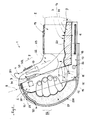
- the apparatus comprises at least one device 1 making it possible to hold the sensor 3 in a suitable position making it possible to detect the adduction movement of the thumb 4 of one of the hands 5, which sensor comprises a piston 35 sliding relative to a body 6 at least substantially cylindrical and gripped by the patient's hand in the manner of a handle.
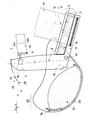
- this device is characterized in that the piston 35 of the sensor 3 is associated with the body 6 at least substantially cylindrical so as to slide substantially radially to the axis 8 of the body 6 for, whatever the dimensions of the patient's hand, allow actuation of the piston 35 of the sensor no longer by the last but by the first phalanx 10 of the thumb 4 of the hand 5 equipped with the device 1 and in that: - Said body 6 is associated with at least one stop 7 arranged to, by cooperating with at least one of the organs that are the patient's hand and forearm, establish a reference for the position of hand 5 along the longitudinal axis 8 of the handle 6, and the device comprises at least one means 9 making it possible to adjust, substantially along the axis 8 of the handle 6, the relative position of the elements that are the stop 7 and the sensor 3.
- the stop 7 cooperates at least locally with the edge 11 of the hand equipped with the device in particular in the zone 12 of the metacarpal of the little finger 13 and this in order to establish the position of this hand as previously defined.
- the stop 7 consists of a slender heel 71 whose bearing surface 14 against the patient's limb extends beyond the handle 6 and cooperates with both the edge 11 of the hand and with a fraction of the forearm located in its extension.
- the elongated heel 71 which constitutes the means for adjusting the relative position of the piston 35 and of the stop 7 substantially along the longitudinal axis 8 of the handle and, for this purpose, it is chosen to have a thickness "e" at least sufficient to, by cooperating on its face 14 with the side of the patient's forearm, allow actuation of the sensor 3 by the first phalanx of the patient's thumb.
- the longitudinal axis of the handle 6 forms with the stopper 7 an angle A substantially greater than ninety degrees and, preferably, substantially equal to one hundred and five degrees.
- said handle 6 is integral with a plate 17 which extends substantially parallel to the axis of the 'forearm.
- the device for the adaptation of the fingers of the hand around the handle, the device comprises a cushion 21 of shape capable on the one hand of largely enveloping the patient's hand by forcing it elastically and this at least at level of the fingers closed on the handle but on the other hand to constantly clear the area 22 of the adductor muscle 23 of the thumb, which cushion is combined with a support element 211 connected to the handle by a connecting means 24 ensuring the movement of the cushion 21 at least between two extreme positions 25, 26 including a position 25 in which the cushion completely releases access to the handle for its gripping by the patient and another position 26 in which it largely envelops the hand of said patient as previously defined for keep his fingers resiliently closed on the handle.
- the connecting means 24 consists of a hinge 24 whose axis is substantially orthogonal to the plane passing through the longitudinal axis 8 of the handle 6.
- the cushion 21 is made of flexible synthetic cellular material.
- the support element 211 of the cushion 21 consists of a rigid shield which externally envelops said cushion 21 so as to be able to induce an optimal elastic contact between the latter and the fingers of the patient closed on the handle 6.
- the two extreme positions 25, 26 of the shield 211 are delimited by stop members suitably positioned on the two movable elements which are the shield 211 and the assembly which constitute the handle 6 and the elongated plate 17 which is associated with it. .
- the latter of course comprises a locking means 29 which consists for example of a link 30, one end 31 of which is anchored to the top of the handle 6 and of which the other free end 32 is equipped with a removable connection element 33 with a given point 34 of the shield.
- the piston 35 for actuating the strain gauge comprises means 352 for connecting the thumb to the piston.
- this connecting means consists of a strap which makes it possible to grip the patient's thumb and to apply a preload, preferably adjustable, to the piston.
- the device directly carries the stimulation electrodes 105 or even the other elements of the device that are all or part of the stimulator and / or the analyzer taken in isolation or with at least some of their accessories such as means for viewing the signals picked up. and / or a display of the results of the analysis.
- the analyzer can be connected to an automatic curare injection device.
- this analyzer can be connected to a set 90 of peripheral devices and in particular: - a communication interface with, for example, a keyboard, a plotter, - a circuit for connection to an electric scalpel.
- the stimumator 103 can meanwhile, when this type of supply is chosen, a means of measuring the charge level of the supply battery (not shown) or even an alarm placed under its control.
- the device is also provided with: additional means 125, 126 and 127 for informing the analyzer 109 by the stimulator 103 of the moments when each of the stimulations is emitted, a means 128 which, taking into account this information and the delay between the emission of a stimulation and the reception of the corresponding reaction signal, distinguishes in the sensed signal, with a certain tolerance, the periods when possible reaction signals from other periods during which only parasitic signals are received.
- the apparatus further comprises: a means 129 which, during the periods when only parasitic signals can be picked up, measures the level of the picked up signal and, a means 130 which eliminates from the received signal only the band corresponding to the measured noise signals, which means is preferably located between the sensor 3 and the means 128 for distinguishing periods to form a continuous adjustment loop.
- the stimulator includes a means 131 for adjusting the intensity of the signal transmitted and this gradually to seek the desired level.
- the stimulator 103 comprises a means for maintaining the signal emitted not at a constant voltage but at a constant intensity and, therefore, the responses remain insensitive to variations in impedance between the electrodes 105 and the conductive paste or the patient. himself.
- the analyzer also includes a means 133 for calibrating the signal received, making it possible in particular to adapt to the width of the reading scale a reference signal specific to each case. According to a characteristic of the invention, it will be a variable gain amplifier with automatic adjustment.
Landscapes
- Health & Medical Sciences (AREA)
- Life Sciences & Earth Sciences (AREA)
- Biophysics (AREA)
- Engineering & Computer Science (AREA)
- Animal Behavior & Ethology (AREA)
- General Health & Medical Sciences (AREA)
- Biomedical Technology (AREA)
- Heart & Thoracic Surgery (AREA)
- Veterinary Medicine (AREA)
- Public Health (AREA)
- Physiology (AREA)
- Molecular Biology (AREA)
- Physics & Mathematics (AREA)
- Surgery (AREA)
- Pathology (AREA)
- Medical Informatics (AREA)
- Anesthesiology (AREA)
- Neurology (AREA)
- Chemical & Material Sciences (AREA)
- Bioinformatics & Cheminformatics (AREA)
- Medicinal Chemistry (AREA)
- Dentistry (AREA)
- Oral & Maxillofacial Surgery (AREA)
- Nuclear Medicine, Radiotherapy & Molecular Imaging (AREA)
- Radiology & Medical Imaging (AREA)
- Physical Education & Sports Medicine (AREA)
- Measurement Of The Respiration, Hearing Ability, Form, And Blood Characteristics Of Living Organisms (AREA)
Applications Claiming Priority (4)
| Application Number | Priority Date | Filing Date | Title |
|---|---|---|---|
| FR8703786 | 1987-03-13 | ||
| FR8703785 | 1987-03-13 | ||
| FR8703785A FR2612069B1 (fr) | 1987-03-13 | 1987-03-13 | Dispositif permettant de maintenir au moins un organe de detection d'une contraction musculaire |
| FR8703786A FR2612068B1 (fr) | 1987-03-13 | 1987-03-13 | Appareil de controle de la reaction neuro-musculaire d'un patient |
Publications (1)
| Publication Number | Publication Date |
|---|---|
| EP0283387A1 true EP0283387A1 (de) | 1988-09-21 |
Family
ID=26225853
Family Applications (1)
| Application Number | Title | Priority Date | Filing Date |
|---|---|---|---|
| EP88400560A Withdrawn EP0283387A1 (de) | 1987-03-13 | 1988-03-10 | Überwachungsgerät für die Neuromuskularreaktion eines Patienten |
Country Status (1)
| Country | Link |
|---|---|
| EP (1) | EP0283387A1 (de) |
Cited By (6)
| Publication number | Priority date | Publication date | Assignee | Title |
|---|---|---|---|---|
| WO1991016001A1 (en) * | 1990-04-24 | 1991-10-31 | Katholieke Universiteit Nijmegen | System for quantifying the effect of general anesthetics on a human or an animal |
| WO1997005923A1 (es) * | 1995-08-04 | 1997-02-20 | Rodiera Olive Jose Javier | Metodo y aparato para la monitorizacion y/o el control del bloqueo neuromuscular, en especial del bloqueo producido for farmacos relajantes musculares utilizados durante la anestesia |
| FR2739015A1 (fr) * | 1995-09-26 | 1997-03-28 | Prothia Sarl | Systeme de stimulation de nerf a conducteur repositionnable |
| WO2003011137A3 (de) * | 2001-07-26 | 2003-05-22 | Niels Rahe-Meyer | Vorrichtung für die untersuchung der muskelkontraktion |
| US7966074B2 (en) * | 2006-05-15 | 2011-06-21 | Samsung Electronics Co., Ltd. | Apparatus and method enhancing muscular movement |
| EP3326531A1 (de) | 2016-11-25 | 2018-05-30 | Haute École Du Paysage D' Ingénierie Et D' Architecture (Hepia) | Medizinische vorrichtung, kit und verfahren zur messung einer daumendruckkraft |
Citations (4)
| Publication number | Priority date | Publication date | Assignee | Title |
|---|---|---|---|---|
| US3898983A (en) * | 1973-10-03 | 1975-08-12 | James O Elam | Device and method for detecting the degree of muscle relaxation of a medical patient |
| US4236528A (en) * | 1978-12-28 | 1980-12-02 | Anna Stanec | Apparatus and method for the quantitative measurement of the isometric contraction of the adductor pollicis muscle |
| US4387723A (en) * | 1980-12-09 | 1983-06-14 | Wisconsin Alumni Research Foundation | Method and apparatus for determining the level of neuromuscular block in a patient |
| US4541417A (en) * | 1982-06-07 | 1985-09-17 | Krikorian Paul P | Coronary augmenter |
-
1988
- 1988-03-10 EP EP88400560A patent/EP0283387A1/de not_active Withdrawn
Patent Citations (4)
| Publication number | Priority date | Publication date | Assignee | Title |
|---|---|---|---|---|
| US3898983A (en) * | 1973-10-03 | 1975-08-12 | James O Elam | Device and method for detecting the degree of muscle relaxation of a medical patient |
| US4236528A (en) * | 1978-12-28 | 1980-12-02 | Anna Stanec | Apparatus and method for the quantitative measurement of the isometric contraction of the adductor pollicis muscle |
| US4387723A (en) * | 1980-12-09 | 1983-06-14 | Wisconsin Alumni Research Foundation | Method and apparatus for determining the level of neuromuscular block in a patient |
| US4541417A (en) * | 1982-06-07 | 1985-09-17 | Krikorian Paul P | Coronary augmenter |
Non-Patent Citations (2)
| Title |
|---|
| ANESTHESIOLOGY, vol. 29, no. 5, septembre - octobre 1968, pages 1054 - 1055, Philadelphia, US; L.F. WALTS et al.: "A means of recording force of thumb adduction" * |
| MEDICAL & BIOLOGICAL ENGINEERING & COMPUTING, vol. 23, no. 6, november 1985, pages 547-555, IFMBE, Londres, GB; H.S. BRADLOW et al.: "Microcomputer-based muscle relaxation monitor and controller for clinical use" * |
Cited By (7)
| Publication number | Priority date | Publication date | Assignee | Title |
|---|---|---|---|---|
| WO1991016001A1 (en) * | 1990-04-24 | 1991-10-31 | Katholieke Universiteit Nijmegen | System for quantifying the effect of general anesthetics on a human or an animal |
| WO1997005923A1 (es) * | 1995-08-04 | 1997-02-20 | Rodiera Olive Jose Javier | Metodo y aparato para la monitorizacion y/o el control del bloqueo neuromuscular, en especial del bloqueo producido for farmacos relajantes musculares utilizados durante la anestesia |
| FR2739015A1 (fr) * | 1995-09-26 | 1997-03-28 | Prothia Sarl | Systeme de stimulation de nerf a conducteur repositionnable |
| WO2003011137A3 (de) * | 2001-07-26 | 2003-05-22 | Niels Rahe-Meyer | Vorrichtung für die untersuchung der muskelkontraktion |
| US7966074B2 (en) * | 2006-05-15 | 2011-06-21 | Samsung Electronics Co., Ltd. | Apparatus and method enhancing muscular movement |
| EP3326531A1 (de) | 2016-11-25 | 2018-05-30 | Haute École Du Paysage D' Ingénierie Et D' Architecture (Hepia) | Medizinische vorrichtung, kit und verfahren zur messung einer daumendruckkraft |
| WO2018096077A1 (en) | 2016-11-25 | 2018-05-31 | Haute Ecole Du Paysage, D'ingénierie Et D'architecture De Genève (Hépia) | Medical device, kit and method for sensing a thumb compression force |
Similar Documents
| Publication | Publication Date | Title |
|---|---|---|
| US5247931A (en) | Diagnostic sensor clasp utilizing a slot, pivot and spring hinge mechanism | |
| US4583554A (en) | Knee ligament testing device | |
| US5012817A (en) | Dolorimeter apparatus | |
| Castro et al. | A low-cost instrumented glove for monitoring forces during object manipulation | |
| US5249366A (en) | Dimension measuring instrument | |
| US5624281A (en) | Clasp structure for biomedical electrodes | |
| US4203223A (en) | Periodontal probe | |
| JPS62155832A (ja) | 神経機能評価方法およびその装置 | |
| EP0135840A3 (de) | Perinatales Oxymeter | |
| EP0283387A1 (de) | Überwachungsgerät für die Neuromuskularreaktion eines Patienten | |
| FR2612069A1 (fr) | Dispositif permettant de maintenir au moins un organe de detection d'une contraction musculaire | |
| US5961471A (en) | Probe for a biophysical skin measurement device | |
| US4848361A (en) | Nocturnal penile tumescence and rigidity monitor with removable loops | |
| US7431702B2 (en) | Device for examination of the motor system of the human or animal body | |
| EP2659835B1 (de) | Vorrichtung zur Quantifizierung der Unabhängigkeit der Finger | |
| CH657061A5 (fr) | Dispositif indicateur de l'effort de declenchement d'une fixation de securite de ski. | |
| EP2114248B1 (de) | Verfahren zum nachweis und zur überwachung von verletzungen des vorderen kreuzbands im knie | |
| US4928707A (en) | Electronic pressure algometer apparatus | |
| EP0568148A1 (de) | Vorrichtung zur Prüfung eines Gelenks | |
| US20060129068A1 (en) | Palpometer and methods of use thereof | |
| US4768521A (en) | Pressure algometer apparatus | |
| CA1130605A (en) | Extensometer for detecting traumatized ligaments | |
| FR2612068A1 (fr) | Appareil de controle de la reaction neuro-musculaire d'un patient | |
| AU8239687A (en) | Dental instrument | |
| DE3467507D1 (en) | Muscle training device |
Legal Events
| Date | Code | Title | Description |
|---|---|---|---|
| PUAI | Public reference made under article 153(3) epc to a published international application that has entered the european phase |
Free format text: ORIGINAL CODE: 0009012 |
|
| AK | Designated contracting states |
Kind code of ref document: A1 Designated state(s): AT BE CH DE ES FR GB GR IT LI LU NL SE |
|
| 17P | Request for examination filed |
Effective date: 19890223 |
|
| 17Q | First examination report despatched |
Effective date: 19920122 |
|
| STAA | Information on the status of an ep patent application or granted ep patent |
Free format text: STATUS: THE APPLICATION IS DEEMED TO BE WITHDRAWN |
|
| 18D | Application deemed to be withdrawn |
Effective date: 19930426 |