EP0283404A2 - Dateneingabegerät mit Tastendruck - Google Patents
Dateneingabegerät mit Tastendruck Download PDFInfo
- Publication number
- EP0283404A2 EP0283404A2 EP88400662A EP88400662A EP0283404A2 EP 0283404 A2 EP0283404 A2 EP 0283404A2 EP 88400662 A EP88400662 A EP 88400662A EP 88400662 A EP88400662 A EP 88400662A EP 0283404 A2 EP0283404 A2 EP 0283404A2
- Authority
- EP
- European Patent Office
- Prior art keywords
- key
- depressed
- phantom
- keys
- depression
- Prior art date
- Legal status (The legal status is an assumption and is not a legal conclusion. Google has not performed a legal analysis and makes no representation as to the accuracy of the status listed.)
- Granted
Links
Images





Classifications
-
- G—PHYSICS
- G06—COMPUTING OR CALCULATING; COUNTING
- G06F—ELECTRIC DIGITAL DATA PROCESSING
- G06F3/00—Input arrangements for transferring data to be processed into a form capable of being handled by the computer; Output arrangements for transferring data from processing unit to output unit, e.g. interface arrangements
- G06F3/01—Input arrangements or combined input and output arrangements for interaction between user and computer
- G06F3/02—Input arrangements using manually operated switches, e.g. using keyboards or dials
-
- H—ELECTRICITY
- H03—ELECTRONIC CIRCUITRY
- H03M—CODING; DECODING; CODE CONVERSION IN GENERAL
- H03M11/00—Coding in connection with keyboards or like devices, i.e. coding of the position of operated keys
- H03M11/003—Phantom keys detection and prevention
Definitions
- the present invention relates to a key data input device, and more particularly, to a key-depression data input device such as a keyboard switch for use in a word processor, a personal computer, a terminal or other keyboard device.
- a key-depression data input device such as a keyboard switch for use in a word processor, a personal computer, a terminal or other keyboard device.
- a key depression input device is constituted by rows of Y-direction conductor lines arranged in parallel and columns of X-direction conductor lines, these rows and columns forming a matrix, and key depression switches arranged at intersections of the Y-direction and X-direction conductor lines.
- the switches are scanned to determine the states thereof, and based on the result of the scanning, the data is input by the key depression input device.
- a by-pass conduction route may be formed to cause an intersection of an X line and a Y line which is not closed to appear to be closed.
- Such an apparently closed switch is called a phantom key or phantom switch.
- a clock pulse is produced to detect the depression of keys and the repetition rate of the clock pulse is considerably shorter, under existing circumstances, than the time interval when the key is continuously depressed.
- the keyboard is designed so that a plurality of keys cannot be depressed at the same time or continuously. Namely, when it is detected that a number of keys were depressed at the same time as mentioned above, this depression of the keys is considered invalid.
- the rows and columns be scanned to detect the status of each switch, the detected information be stored in a storage, occurrences of the phantom switch condition in the switch array be determined, the status of the switches involved in the phantom switch condition be reversed, and after the termination of the phantom condition the key data be output.
- An object of the present invention is to provide an improved key-depression input device in which the order of depression-release of a releasing key is checked, only true key input errors are detected, and apparent key input errors are not detected, and the detection of key input errors is carried out in such a manner that delays in the key input operation are minimized.
- Another object of the present invention is to restrict the sounding of an alarm to only the cases wherein true key input errors occur, without slowing the speed of the key operation by the operator, and accordingly, to realize a correct and rapid key input operation.
- a prior art key-depression input device is explained with reference to Figs. 1, 2, and 3.
- the keyboard itself is represented as a matrix 1 ⁇ , which consists of electrical conduction lines arranged in columns X1 , X2 , ... X6 and rows Y1 , Y2 , ... Y6 , forming intersections therebetween.
- a key is not depressed the corresponding contact at an intersection is open, and when a key is depressed, the corresponding contact at an intersection is closed.
- the states of the switches of the key matrix 1 ⁇ are scanned and the data obtained is processed in a scanning device 21 ⁇ in collaboration with a key-on memory 22 ⁇ .
- a scanning device 21 ⁇ As the result of the processing in the scanning device 21 ⁇ , key-depression information, and where a phantom status is detected, phantom status alarm are delivered from the scanning device 21 ⁇ .
- the keyboard has column conductor lines X1 , X2 , X3 , ..., and row conductor lines Y1 , Y2 , Y3 , ..., arranged in a matrix.
- the key contacts of key switches SW11, SW12, SW21, and SW22 are arranged at the intersections of the conductor lines.
- a conduction route Y2-SW12-X1-SW11-SW21-X2 indicated by a broken line is formed so that a connection between the row line Y2 and the column line X2 is apparently detected.
- Such an apparently detected connection between the line Y2 and the line X2 represents a state in which it appears that the key SW22 at the intersection between line Y2 and line X2 has been depressed, although the key SW22 is not actually depressed.
- Such a key SW22 depressed in this manner is called a "phantom key” or "phantom switch”.
- a prior art key depression input device in connection with key Nos. 1, 2, and 3 which can cause a phantom key status is illustrated in Fig. 3. It is assumed that key Nos. 1, 2, and 3 are successively depressed at a timing t1 , t2 , and t3 , and a phantom status is formed at the timing t3 when key No. 3 is depressed. In this case, the operator may be warned of the occurrence of an error or the output of key code data corresponding to key No. 3 prevented.
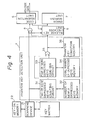
- a key depression data input device is shown in Fig. 4.
- reference numeral 1 denotes a key matrix in which key contacts are arranged in a matrix-like form
- 22 a key-on memory
- 21 a scanning device which periodically scans the key matrix and determines whether or not a key or keys have been depressed key.
- 3 denotes a phantom key detection means
- 5 is a release key checking means which whereby, when the phantom keying condition is not realized by releasing a predetermined key among the depressed keys, the check is carried out at the released key
- 6 is a code data generation means
- 7 is an error warning means.
- An embodiment of the present invention shown in Fig. 4 includes detecting means for detecting the generation of a phantom keying condition checking means for checking that a released key among the depressed keys has released the phantom keying condition code generation means for generating normal code data when the released key checked by the checking means corresponds to a key in which a normal depression has been detected.
- the device of Fig. 4 drives the detecting means, checking means, and code generation means, and further, operates the intercept means for informing the operator of the generation of an error when the released key is not been in a normal state.
- Reference numeral 31 denotes a first counting circuit for producing an output, when more than two newly detected keys are counted during one scan, 33 denotes a second counting circuit for producing an output when a total number of depressed keys is more than four, and 35 denotes an AND circuit. The number of depressed keys is counted by the first counter 31.
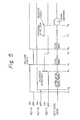
- the second counter 33 Since the total number of depressed keys is now "4", the second counter 33 also produces an output. When the outputs are produced together from counters 31 and 33, the output of an AND circuit 35 is HIGH and as a result, it is considered that the generation of a phantom key has been detected, the output of the key matrix scanning device 21 to the code generation member 6 is stopped by an AND circuit 4.
- This state is the state at time t3 in Fig. 5, whereby only a code data corresponding to the depressed key B is produced from the code generation means 6.
- the gate 4 sends a voltage variation signal to the release key checking circuit 5, and a check is made to determine which of the keys has been released.
- the output of the code generation member 6 with respect to the keys is tested, and, the order of the depression and release of the keys is checked.
- the key in question is key-C the code data of which has not been produced, and the earlier closed key-A is earlier released, showing the establishment of the normal depression-release order of key operation, a code data for key-C is produced from the code generation member 6.
- the output of AND circuit 35 is not changed.
- the code generation member 6 produces code data for the key A.
- the output of the AND circuit 35 is changed to prevent the generation of a new code.
- the release key checking member 60 checks the released key on the basis of the output of the gate 35. If it is acknowledged that key-C, the code data of which has not yet been delivered, is turned OFF, it is determined that the order of the normal depression-release has been reversed, and the release key checking circuit 5 drives the error warning circuit 7 to produce an error warning.
- FIG. 6 is a flow chart showing the operation of the device.
- a key depression is detected in step S1 and code data produced.
- step S2 it is determined whether or not a phantom key condition exists.
- the process returns to step S1 and stands by for the next key depression.
- the device detects in step S3 whether the phantom key condition has been released. The process then waits until the phantom key condition has been cancelled, and then proceeds to step S4 to check the state of the released key by determining whether or not code data has been generated.
- code data has not been generated, an error signal is produced and output in step S5.
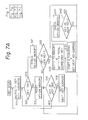
- Figure 7 is a flow chart showing in detail the operation of the device according to the present invention.
- step S11 After a key scan is carried out, a key address is initially set in step S11 and the crosspoint of each key is identified.
- step S12 it is determined whether or not the key is ON, and if not, a key-ON memory is reset in step S13.
- step S14 it is determined whether or not the key is the last key. When NO, the step proceeds to the step S15 and the next key address is set. When YES, the process returns to step S11, and the signal output at S15 is sent to step S12.
- Step S12 when YES, then in step S21 a key-ON memory is checked, and in step S22, it is determined whether the key is a newly depressed key.
- step S23 When YES, in step S23, "1" is set to the memory 1 of new key and the total number of depressed keys is set to the memory.
- step S24 a scanning is started and a next key address is set, where a scanning is commenced from No. 6 key.
- step S25 it is determined whether the key is ON, and in step S26, it is determined whether the one scanning is terminates.
- the process returns to step S24.
- step S27 the new key count memory is checked, and in step S28, it is determined whether the total number of new keys is equal to or larger than 2.
- step S29 the total key count memory is checked in step S29, and then in step S30, it is determined whether the number of the total number of keys is equal to or larger than four.
- step S31 it is determined whether a by-pass or detour flag is ON, and when NO, a by-pass flag is set in step S32.
- step S31 it is determined at step S33 whether the total number of new keys in preceding scan is larger than the total number of new keys in the present scan.
- error data is delivered in step S34 and the process returned to step S23.
- step S30 when the result is NO, the process goes to step S51 and it is determined whether the detour flag is ON. Then, in step S52, key data is sent and a key-on memory is set.
- step S51 it is determined whether or not a newly depressed key exists, i.e., the total number of newly depressed keys is equal to or larger than 1, and when NO in step S55, error data is delivered and a detour flag is made OFF. Conversely, when YES, in step S53, key data is delivered, the key-on memory is made ON, and the detour flag is made OFF.
- step S53 a newly depressed key (key data is not get delivered) is released to cancel a detour, i.e., the phantom switching condition is cancelled.
- step S53 the key for delivering the key data is released to cancel a detour or the phantom switching condition.
Landscapes
- Engineering & Computer Science (AREA)
- Theoretical Computer Science (AREA)
- General Engineering & Computer Science (AREA)
- Human Computer Interaction (AREA)
- Physics & Mathematics (AREA)
- General Physics & Mathematics (AREA)
- Input From Keyboards Or The Like (AREA)
Applications Claiming Priority (2)
| Application Number | Priority Date | Filing Date | Title |
|---|---|---|---|
| JP62065309A JPS63229513A (ja) | 1987-03-19 | 1987-03-19 | キ−入力装置 |
| JP65309/87 | 1987-03-19 |
Publications (3)
| Publication Number | Publication Date |
|---|---|
| EP0283404A2 true EP0283404A2 (de) | 1988-09-21 |
| EP0283404A3 EP0283404A3 (en) | 1990-04-04 |
| EP0283404B1 EP0283404B1 (de) | 1994-03-09 |
Family
ID=13283177
Family Applications (1)
| Application Number | Title | Priority Date | Filing Date |
|---|---|---|---|
| EP88400662A Expired - Lifetime EP0283404B1 (de) | 1987-03-19 | 1988-03-18 | Dateneingabegerät mit Tastendruck |
Country Status (5)
| Country | Link |
|---|---|
| US (1) | US4918444A (de) |
| EP (1) | EP0283404B1 (de) |
| JP (1) | JPS63229513A (de) |
| KR (1) | KR910006695B1 (de) |
| DE (1) | DE3888218T2 (de) |
Cited By (2)
| Publication number | Priority date | Publication date | Assignee | Title |
|---|---|---|---|---|
| EP0651509A1 (de) * | 1993-10-27 | 1995-05-03 | Hydrometer Gesellschaft mbH | Eingabefeld |
| EP1078822A3 (de) * | 1999-08-20 | 2004-08-25 | Robert Bosch Gmbh | Eingabetastatur |
Families Citing this family (8)
| Publication number | Priority date | Publication date | Assignee | Title |
|---|---|---|---|---|
| US5059974A (en) * | 1989-02-02 | 1991-10-22 | Acer Incorporated | Method for determining phantom switch condition |
| JPH0769762B2 (ja) * | 1991-12-04 | 1995-07-31 | 株式会社アスキー | 同時打鍵と逐次打鍵の判定方法及びその装置 |
| US5621402A (en) * | 1993-07-21 | 1997-04-15 | Advanced Micro Devices, Inc. | Keypad scanner |
| JPH07230848A (ja) * | 1994-02-18 | 1995-08-29 | Nichifu Co Ltd | 導体性線状体のコネクター |
| US5557299A (en) * | 1994-05-04 | 1996-09-17 | Kidtech, Inc. | Method and apparatus for a learning styled computer keyboard |
| DE19735278A1 (de) * | 1997-08-14 | 1999-02-18 | Rolf Wadewitz | Elektronisches Datenerfassungsverfahren und Datenverarbeitungssystem |
| US6417787B1 (en) * | 1999-08-24 | 2002-07-09 | United Microelectronics Corp. | Method and apparatus for increasing the number of keys of a key-matrix |
| US7224344B2 (en) * | 2003-08-05 | 2007-05-29 | International Business Machines Corporation | Key code filter apparatus and method |
Family Cites Families (8)
| Publication number | Priority date | Publication date | Assignee | Title |
|---|---|---|---|---|
| US4106011A (en) * | 1975-10-24 | 1978-08-08 | Tektronix, Inc. | Keyboard circuit |
| JPS5266328A (en) * | 1975-11-29 | 1977-06-01 | Casio Comput Co Ltd | Information inputting controller |
| JPS5477534A (en) * | 1977-12-02 | 1979-06-21 | Matsushita Electric Ind Co Ltd | Digital input circuit |
| US4420744A (en) * | 1981-02-12 | 1983-12-13 | Oak Industries Inc. | Keyboard crosspoint encoder having N-key rollover |
| JPS58112129A (ja) * | 1981-12-24 | 1983-07-04 | Tokyo Electric Co Ltd | ワンチツプマイクロコンピユ−タに対するキ−信号入力方式 |
| JPS6083132A (ja) * | 1983-10-14 | 1985-05-11 | Toshiba Corp | タッチスイッチ付表示装置 |
| JPS62160520A (ja) * | 1986-01-08 | 1987-07-16 | Brother Ind Ltd | マトリツクススイツチ装置 |
| JPS63149717A (ja) * | 1986-12-13 | 1988-06-22 | Fujitsu Ltd | 押下キ−の検出方式 |
-
1987
- 1987-03-19 JP JP62065309A patent/JPS63229513A/ja active Granted
-
1988
- 1988-03-18 DE DE3888218T patent/DE3888218T2/de not_active Expired - Fee Related
- 1988-03-18 US US07/169,889 patent/US4918444A/en not_active Expired - Lifetime
- 1988-03-18 EP EP88400662A patent/EP0283404B1/de not_active Expired - Lifetime
- 1988-03-18 KR KR1019880002864A patent/KR910006695B1/ko not_active Expired
Cited By (2)
| Publication number | Priority date | Publication date | Assignee | Title |
|---|---|---|---|---|
| EP0651509A1 (de) * | 1993-10-27 | 1995-05-03 | Hydrometer Gesellschaft mbH | Eingabefeld |
| EP1078822A3 (de) * | 1999-08-20 | 2004-08-25 | Robert Bosch Gmbh | Eingabetastatur |
Also Published As
| Publication number | Publication date |
|---|---|
| KR880011643A (ko) | 1988-10-29 |
| US4918444A (en) | 1990-04-17 |
| DE3888218D1 (de) | 1994-04-14 |
| KR910006695B1 (ko) | 1991-08-31 |
| EP0283404A3 (en) | 1990-04-04 |
| JPS63229513A (ja) | 1988-09-26 |
| JPH0511327B2 (de) | 1993-02-15 |
| EP0283404B1 (de) | 1994-03-09 |
| DE3888218T2 (de) | 1994-06-16 |
Similar Documents
| Publication | Publication Date | Title |
|---|---|---|
| JPS5922578Y2 (ja) | キ−ボ−ド装置 | |
| EP0011307B1 (de) | Verfahren und Vorrichtung zur Erzeugung von Zeichenkoden | |
| EP0283404B1 (de) | Dateneingabegerät mit Tastendruck | |
| JPS6259325B2 (de) | ||
| US4922248A (en) | Key output method for keyboards | |
| JPH09510584A (ja) | キャパシタンス応答スイッチとスイッチアレイ | |
| JPH0556690B2 (de) | ||
| US5072366A (en) | Data crossbar switch | |
| US4398181A (en) | Keyboard entry system | |
| US4888600A (en) | Keyboard arrangement with ghost key condition detection | |
| EP0097816B1 (de) | Automatisch anpassbare Zeitverzögerung für eine mit zeitlichgesteuertem Wiederholungsdruck von Typen versehene Tastatur | |
| US4193038A (en) | Key input apparatus | |
| US6417787B1 (en) | Method and apparatus for increasing the number of keys of a key-matrix | |
| US3660826A (en) | Noise protection and rollover lockout for keyboards | |
| US5059974A (en) | Method for determining phantom switch condition | |
| US4437094A (en) | System for controlling indicators for switches | |
| US3803592A (en) | Keyboard and digital circuit therefor | |
| US5583498A (en) | Input device | |
| US4696048A (en) | Input device | |
| JPH0426129B2 (de) | ||
| JPS609288B2 (ja) | 文字入力装置 | |
| JPS63149717A (ja) | 押下キ−の検出方式 | |
| GB2111275A (en) | Tablet input apparatus | |
| KR0133020B1 (ko) | 레이저프린터의 테스트 패턴 생성회로 | |
| US3996560A (en) | Sequencing unit |
Legal Events
| Date | Code | Title | Description |
|---|---|---|---|
| PUAI | Public reference made under article 153(3) epc to a published international application that has entered the european phase |
Free format text: ORIGINAL CODE: 0009012 |
|
| AK | Designated contracting states |
Kind code of ref document: A2 Designated state(s): DE FR GB NL |
|
| PUAL | Search report despatched |
Free format text: ORIGINAL CODE: 0009013 |
|
| AK | Designated contracting states |
Kind code of ref document: A3 Designated state(s): DE FR GB NL |
|
| 17P | Request for examination filed |
Effective date: 19900922 |
|
| 17Q | First examination report despatched |
Effective date: 19920728 |
|
| GRAA | (expected) grant |
Free format text: ORIGINAL CODE: 0009210 |
|
| AK | Designated contracting states |
Kind code of ref document: B1 Designated state(s): DE FR GB NL |
|
| REF | Corresponds to: |
Ref document number: 3888218 Country of ref document: DE Date of ref document: 19940414 |
|
| ET | Fr: translation filed | ||
| PLBE | No opposition filed within time limit |
Free format text: ORIGINAL CODE: 0009261 |
|
| STAA | Information on the status of an ep patent application or granted ep patent |
Free format text: STATUS: NO OPPOSITION FILED WITHIN TIME LIMIT |
|
| 26N | No opposition filed | ||
| REG | Reference to a national code |
Ref country code: GB Ref legal event code: IF02 |
|
| PGFP | Annual fee paid to national office [announced via postgrant information from national office to epo] |
Ref country code: FR Payment date: 20040309 Year of fee payment: 17 |
|
| PGFP | Annual fee paid to national office [announced via postgrant information from national office to epo] |
Ref country code: NL Payment date: 20040310 Year of fee payment: 17 |
|
| PGFP | Annual fee paid to national office [announced via postgrant information from national office to epo] |
Ref country code: GB Payment date: 20040317 Year of fee payment: 17 |
|
| PGFP | Annual fee paid to national office [announced via postgrant information from national office to epo] |
Ref country code: DE Payment date: 20040325 Year of fee payment: 17 |
|
| PG25 | Lapsed in a contracting state [announced via postgrant information from national office to epo] |
Ref country code: GB Free format text: LAPSE BECAUSE OF NON-PAYMENT OF DUE FEES Effective date: 20050318 |
|
| PG25 | Lapsed in a contracting state [announced via postgrant information from national office to epo] |
Ref country code: NL Free format text: LAPSE BECAUSE OF NON-PAYMENT OF DUE FEES Effective date: 20051001 Ref country code: DE Free format text: LAPSE BECAUSE OF NON-PAYMENT OF DUE FEES Effective date: 20051001 |
|
| GBPC | Gb: european patent ceased through non-payment of renewal fee |
Effective date: 20050318 |
|
| PG25 | Lapsed in a contracting state [announced via postgrant information from national office to epo] |
Ref country code: FR Free format text: LAPSE BECAUSE OF NON-PAYMENT OF DUE FEES Effective date: 20051130 |
|
| NLV4 | Nl: lapsed or anulled due to non-payment of the annual fee |
Effective date: 20051001 |
|
| REG | Reference to a national code |
Ref country code: FR Ref legal event code: ST Effective date: 20051130 |