EP0283405A1 - Matériau en feuille comportant un adhésif sur ses deux faces - Google Patents
Matériau en feuille comportant un adhésif sur ses deux faces Download PDFInfo
- Publication number
- EP0283405A1 EP0283405A1 EP88420044A EP88420044A EP0283405A1 EP 0283405 A1 EP0283405 A1 EP 0283405A1 EP 88420044 A EP88420044 A EP 88420044A EP 88420044 A EP88420044 A EP 88420044A EP 0283405 A1 EP0283405 A1 EP 0283405A1
- Authority
- EP
- European Patent Office
- Prior art keywords
- adhesive
- sheet
- faces
- face
- patterns
- Prior art date
- Legal status (The legal status is an assumption and is not a legal conclusion. Google has not performed a legal analysis and makes no representation as to the accuracy of the status listed.)
- Granted
Links
- 239000000853 adhesive Substances 0.000 title claims abstract description 51
- 230000001070 adhesive effect Effects 0.000 title claims abstract description 50
- 239000000463 material Substances 0.000 title claims abstract description 36
- 239000002655 kraft paper Substances 0.000 claims description 5
- 230000000295 complement effect Effects 0.000 claims description 2
- 239000000123 paper Substances 0.000 description 7
- 239000003292 glue Substances 0.000 description 4
- 239000011229 interlayer Substances 0.000 description 4
- 239000010410 layer Substances 0.000 description 4
- 238000004519 manufacturing process Methods 0.000 description 4
- 238000005507 spraying Methods 0.000 description 4
- 230000006866 deterioration Effects 0.000 description 3
- 239000000203 mixture Substances 0.000 description 3
- 239000008188 pellet Substances 0.000 description 3
- 238000007639 printing Methods 0.000 description 3
- 238000003860 storage Methods 0.000 description 3
- NIXOWILDQLNWCW-UHFFFAOYSA-N acrylic acid group Chemical group C(C=C)(=O)O NIXOWILDQLNWCW-UHFFFAOYSA-N 0.000 description 2
- 230000008021 deposition Effects 0.000 description 2
- 125000006850 spacer group Chemical group 0.000 description 2
- 238000005303 weighing Methods 0.000 description 2
- 239000003522 acrylic cement Substances 0.000 description 1
- 238000004026 adhesive bonding Methods 0.000 description 1
- 239000002390 adhesive tape Substances 0.000 description 1
- 239000011248 coating agent Substances 0.000 description 1
- 238000000576 coating method Methods 0.000 description 1
- 230000006378 damage Effects 0.000 description 1
- 238000010586 diagram Methods 0.000 description 1
- 239000006185 dispersion Substances 0.000 description 1
- 229920001971 elastomer Polymers 0.000 description 1
- 239000000806 elastomer Substances 0.000 description 1
- 238000012423 maintenance Methods 0.000 description 1
- 238000004806 packaging method and process Methods 0.000 description 1
- 239000012188 paraffin wax Substances 0.000 description 1
- 230000002787 reinforcement Effects 0.000 description 1
- 239000004834 spray adhesive Substances 0.000 description 1
- 238000004804 winding Methods 0.000 description 1
Images
Classifications
-
- C—CHEMISTRY; METALLURGY
- C09—DYES; PAINTS; POLISHES; NATURAL RESINS; ADHESIVES; COMPOSITIONS NOT OTHERWISE PROVIDED FOR; APPLICATIONS OF MATERIALS NOT OTHERWISE PROVIDED FOR
- C09J—ADHESIVES; NON-MECHANICAL ASPECTS OF ADHESIVE PROCESSES IN GENERAL; ADHESIVE PROCESSES NOT PROVIDED FOR ELSEWHERE; USE OF MATERIALS AS ADHESIVES
- C09J7/00—Adhesives in the form of films or foils
- C09J7/20—Adhesives in the form of films or foils characterised by their carriers
- C09J7/21—Paper; Textile fabrics
-
- C—CHEMISTRY; METALLURGY
- C09—DYES; PAINTS; POLISHES; NATURAL RESINS; ADHESIVES; COMPOSITIONS NOT OTHERWISE PROVIDED FOR; APPLICATIONS OF MATERIALS NOT OTHERWISE PROVIDED FOR
- C09J—ADHESIVES; NON-MECHANICAL ASPECTS OF ADHESIVE PROCESSES IN GENERAL; ADHESIVE PROCESSES NOT PROVIDED FOR ELSEWHERE; USE OF MATERIALS AS ADHESIVES
- C09J7/00—Adhesives in the form of films or foils
- C09J7/20—Adhesives in the form of films or foils characterised by their carriers
-
- C—CHEMISTRY; METALLURGY
- C09—DYES; PAINTS; POLISHES; NATURAL RESINS; ADHESIVES; COMPOSITIONS NOT OTHERWISE PROVIDED FOR; APPLICATIONS OF MATERIALS NOT OTHERWISE PROVIDED FOR
- C09J—ADHESIVES; NON-MECHANICAL ASPECTS OF ADHESIVE PROCESSES IN GENERAL; ADHESIVE PROCESSES NOT PROVIDED FOR ELSEWHERE; USE OF MATERIALS AS ADHESIVES
- C09J2301/00—Additional features of adhesives in the form of films or foils
- C09J2301/20—Additional features of adhesives in the form of films or foils characterized by the structural features of the adhesive itself
- C09J2301/204—Additional features of adhesives in the form of films or foils characterized by the structural features of the adhesive itself the adhesive coating being discontinuous
-
- C—CHEMISTRY; METALLURGY
- C09—DYES; PAINTS; POLISHES; NATURAL RESINS; ADHESIVES; COMPOSITIONS NOT OTHERWISE PROVIDED FOR; APPLICATIONS OF MATERIALS NOT OTHERWISE PROVIDED FOR
- C09J—ADHESIVES; NON-MECHANICAL ASPECTS OF ADHESIVE PROCESSES IN GENERAL; ADHESIVE PROCESSES NOT PROVIDED FOR ELSEWHERE; USE OF MATERIALS AS ADHESIVES
- C09J2400/00—Presence of inorganic and organic materials
- C09J2400/20—Presence of organic materials
- C09J2400/28—Presence of paper
- C09J2400/283—Presence of paper in the substrate
Definitions
- the present invention relates to a new type of sheet material, usable as an interlayer between two products or objects in order to prevent them from sliding against each other.
- It relates more particularly to a material of the aforementioned type usable during storage and / or transport operations in the form of a stack (pallets) of various articles and in particular of products packaged in the form of bags and which may have a tendency to slip. one to another.
- Self-adhesive papers are also known on their two faces which could be used as spacers, but such materials imply, during their manufacture and storage, the presence of a spacer between each of the layers. The presence of such an interlayer increases the manufacturing cost and requires additional handling and disposal of this interlayer paper when using the material.
- the invention therefore relates to a new type of sheet material which can be used in particular as an intermediate element between two product surfaces which it is desired to prevent any sliding relative to each other, said material comprising on its two faces a layer of adhesive material and being characterized in that: - the adhesive material is deposited, on each of the faces, in the form of patterns covering less than 50% of the total surface of the sheet; - the adhesive areas on one side are offset from the adhesive areas made on the other side, so that when the two faces are brought into contact with each other, said adhesive patterns can either be interpenetrate without touching each other, that is to say if two adhesive zones are in contact, they are only practically punctually so that the two layers can be separated from each other very easily.
- the adhesive material will be distributed on both sides of the sheet, either in the form of continuous parallel, longitudinal or transverse strips, the spacing between the strips of one side being slightly greater than the width of the adhesive strips of the other side either in the form of complementary patterns such as for example circular, polygonal sticky pads, the adhesive parts of one face being, as in the case of strips, arranged under the non-adhesive parts on the other side; - thanks to such an alternation of adhesive parts and non-adhesive parts on the two faces of the material, parts which, as said previously, are offset with respect to each other, it is therefore possible to roll up said sheet on itself and without having to use interleaf sheets; - As support, use any conventional material such as for example kraft paper; - Furthermore, the adhesives will be known type adhesives, for example of the "acrylic glue"type; they will be deposited by any appropriate means such as spraying, printing, coating, etc.
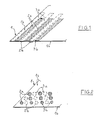
- the material according to the invention consists, in all cases, of a support sheet (1), for example paper conventional kraft, sheet coated on both sides with an adhesive composition deposited, by spraying, printing, so that the adhesive zones (2a) of the face (1a) of the sheet are separated from one another by a zone (3a) not comprising any adhesive while the other face (1b) of the sheet (1) has adhesive zones (2b) separated from each other by non-adhesive zones (3b), said adhesive zones (2b) being arranged below the areas (3a) without adhesive of the face (1a).
- a support sheet (1) for example paper conventional kraft, sheet coated on both sides with an adhesive composition deposited, by spraying, printing, so that the adhesive zones (2a) of the face (1a) of the sheet are separated from one another by a zone (3a) not comprising any adhesive while the other face (1b) of the sheet (1) has adhesive zones (2b) separated from each other by non-adhesive zones (3b), said adhesive zones (2b) being arranged below the areas (3a) without adhesive of the face
- the adhesive and non-adhesive areas are in the form of strips parallel to either the length or the width of the paper.
- the adhesive areas are in the form of pellets arranged in staggered rows.
- the adhesive surface of each side is less than half of the total surface of the sheet, so that the adhesive parts of one side are located in correspondence with the non-adhesive parts of the other side, allowing to remain a slight gap between these parts.
- the adhesive zones could be in the form illustrated in FIGS. 1 and 2, that is to say in the form of defined surfaces, it could be envisaged to produce such adhesive strips in the form of lines continuous, very narrow.
- the adhesive lines on one side could, when the material is wound on itself, overlap those on the other side since the simple practically punctual contact between these lines makes it possible to separate the two sheets. one of the other without difficulty.
- a material according to the invention is produced using as support sheet (1) kraft paper weighing 40 g / m2.
- a tacky composition consisting of a conventional acrylic dispersion of tye E1126 from the company "ROHM and HAAS" or 619 from the same company, is deposited by spraying or printing. which is conventionally used to make adhesive tapes.
- this sticky material is carried out in accordance with the invention so that on the face (1a), the adhesive is in the form of parallel strips (2a) having a width of 1 cm, separated from each other by a strip (3a) not comprising glue and having a width of 1.5 cm.
- the adhesive deposition is also carried out in the form of parallel strips (2b), having the same width as the above-mentioned strips (2a), but which are in turn arranged below the area (3a) not comprising glue from the face (1a).
- a material is therefore obtained which has an alternation of sticky and non-sticky strips on these two faces offset from one another and which can therefore be wound on itself without the need for an interlayer.
- Such a material can be successfully used as a separating sheet when palletizing bags. It has been found that this prevents any relative sliding of the different layers with respect to each other and that, moreover and above all, when the bags are used, there was no deterioration of their surface.
- a material is produced in accordance with the invention in which the sticky parts (2a, 2b) are not present the form of bands but in the form of circular pellets.
- Such circular pads will be printed using an openwork cover and spraying the glue. They have a diameter of 2 cm. and are arranged in a staggered manner so that the pellets of the face (1a) are arranged facing the central zones of those of the face (1b).
- Such a material can also be used in all cases where it is desired to ensure good mutual contact between two surfaces.
Landscapes
- Chemical & Material Sciences (AREA)
- Organic Chemistry (AREA)
- Laminated Bodies (AREA)
- Buffer Packaging (AREA)
Abstract
Description
- La présente invention a trait à un nouveau type de matériau en feuille, utilisable comme intercalaire entre deux produits ou objets afin d'éviter qu'ils ne glissent l'un contre l'autre.
- Elle a trait plus particulièrement à un matériau du type précité utilisable lors d'opérations de stockage et/ou transport sous forme d'empilement (palettes) d'articles divers et notamment de produits emballés sous forme de sacs et qui peuvent avoir tendance à glisser les uns par rapport aux autres.
- La présente invention sera décrite pour une telle application mais il est évident que cela n'est pas limitatif et qu'un tel produit pourrait également être utilisé dans d'autres domaines et en général dans tous les cas où l'on souhaite éviter le glissement d'un objet par rapport à une surface sur laquelle ledit objet est posé et ce, en gardant la possibilité de pouvoir séparer facilement l'objet de ladite surface sans détérioration des faces en contact.
- L'un des problèmes qui se posent dans le domaine du stockage et du transport des sacs de matières (ou produits similaires), est celui du maintein de l'empilement formé des sacs qui ont tendance à glisser les uns par rapport aux autres. Pour résoudre ce problème, diverses solutions ont été proposées telles que par exemple réalisation de caisses intermédiaires, renforcement des sacs, ces solutions donnat satisfaction mais étant de par leur nature très coûteuses.
- Il a été également envisagé de réaliser une pulvérisation de colle sur les surfaces extérieures de telle sorte que lorsque les sacs sont empilés, ils se collent les uns aux autres. Le problème de l'empilement se trouve ainsi résolu de manière simple et efficace, mais il y a un risque important de destrucion, de détérioration et/ou de salissure de la surface de l'emballage lorsque les sacs sont séparés les uns des autres.
- Par suite, à ce jour, la solution la plus simple et la plus économique pour résoudre ce problème de la stabilité des empilements consists à intercaler entre chaque sac un matériau en forme de feuille (papier) enduit superficiellement avec une composition de paraffine chargée d'élastomère, de telle sorte qu'il présente un coefficient de frottement suffisant par rapport aux sacs, empêchant tout glissement les uns par rapport aux autres. Un tel papier couramment désigné par l'expression "papier antigliss" est relativement délicat et coûteux à réaliser étant donné qu'il convient de réaliser un compromis tel qu'il ne se produise par un autocollage sous la charge de l'empilement ou lors de son enroulement pendant sa fabrication.
- On connait également des papiers autocollants sur leurs deux faces qui pourraient être utilisés comme intercalaires, mais de tels matériaux impliquent, lors de leur fabrication et stockage, la présence d'un intercalaire entre chacune des couches. La présence d'un tel intercalaire augmente le coût de fabrication et nécessite une manipulation supplémentaire et la mise au rebut de ce papier intercalaire lors de l'utilisation du matériau.
- Or on a trouvé et c'est ce qui fait l'objet de la présente invention, un nouveau type de matériau en feuille qui permet de surmonter ces inconvénients.
- D'une manière générale, l'invention concerne donc un nouveau type de matériau en feuille utilisable notamment comme élément intercalaire entre deux surfaces de produits dont on souhaite empêcher tout glissement l'un par rapport à l'autre, ledit matériau comportant sur ses deux faces une couche de matière adhésive et étant caractérisé en ce que :
- la matière adhésive est déposée, sur chacune des faces, sous la forme de motifs couvrant moins de 50 % de la surface totale de la feuille ;
- les zones adhésives d'une face sont décalées par rapport aux zones adhésives réalisées sur l'autre face et ce, de telle sorte que lorsque les deux faces sont mises en contact l'une avec l'autre, lesdites motifs adhésifs puissent soit s'interpénétrer sans se toucher les uns par rapport aux autres, soit si deux zones adhésives sont en contact, elles ne le sont que de manière pratiquement ponctuelle de telle sorte que les deux couches puissent être séparées l'une de l'autre très facilement. - Conformément à l'invention :
- la matière adhésive sera répartie sur les deux faces de la feuille soit sous la forme de bandes continues parallèles, longitudinales ou transversales, l'espacement entre les bandes d'une face étant légèrement supérieur à la largeur des bandes adhésives de l'autre face soit sous la forme de motifs complémentaires tels que par exemple pastilles collantes circulaires, polygonales, les parties adhésives d'une face étant, comme dans le cas de bandes, disposées sous les parties non adhésives de l'autre face ;
- grâce à une telle alternance de parties adhésives et de parties non adhésives sur les deux faces du matériau, parties qui comme dit précédemment, sont décalées les unes par rapport aux autres, il est donc possible d'enrouler ladite feuille sur elle-même et ce, sans avoir à utiliser de feuilles intercalaires ;
- comme support, on utilisera tout matériau conventionnel tel que par exemple du papier kraft ;
- par ailleurs, les adhésifs seront des adhésifs de type connu, par exemple du type "colle acrylique"; ils seront déposés par tout moyen approprié tel que pulvérisation, impression, enduction.... - L'invention et les avantages qu'elle apporte seront cependant mieux comprise grâce aux exemples de réalisation donnés ci-après à titre indicatif mais non limitatif, et qui sont illustrés par les schémas annexés qui illustrent schématiquement, en perspective, deux formes de réalisation d'un matériau conforme à l'invention.
- Si l'on se reporte à ces deux figures, dans lesquelles les mêmes éléments sont désignés par les mêmes références, le matériau conforme à l'invention se compose, dans tous les cas, d'une feuille support (1), par exemple papier kraft conventionnel, feuille revêtue sur ses deux faces d'une composition adhésive déposée, par pulvérisation, impression.. de telle sorte que les zones adhésives (2a) de la face (1a) de la feuille soient séparées les unes des autres d'une zone (3a) ne comportant pas d'adhésif alors que l'autre face (1b) de la feuille (1) présente des zones adhésives (2b) séparées les une des autres par des zones non-adhésives (3b), lesdites zones adhésives (2b) étant disposées en dessous des zones (3a) sans adhésif de la face (1a).
- Dans l'exemple illustré par la figure 1, les zones adhésives et non-adhésives se présentent sous la forme de bandes parallèles soit à la longueur ou à la largeur du papier. Dans l'exemple illustré par la figure 2, les zones adhésives se présentent sous la forme de pastilles disposées en quinconce. Dans tous les cas, la surface adhésive de chaque face est inférieure à la moitié de la surface totale de la feuille, afin que les parties adhésives d'une face soient situées en correspondance avec les parties non adhésives de l'autre face en laissant subsister un léger vide entre ces parties.
- S'il est avantageux que les zones adhésives se présentent sous la form illustrée aux figures 1 et 2, c'est-à-dire sous la forme de surfaces définies, il pourrait être envisagé de réaliser de telles bandes adhésives sous la forme de lignes continues, de très faible largeur. Dans un tel cas, les lignes adhésives d'une face pourraient, lorsque le matériau est enroulé sur lui-même, recouper celles de l'autre face étant donné que le simple contact pratiquement ponctuel entre ces lignes permet de séparer les deux feuilles l'une des l'autre sans difficulté.
- On réalise un matériau conforme à l'invention en utilisant comme feuille support (1) un papier kraft pesant 40 g/m².
- Sur les deux faces (1a) et (1b) de ce papier, on dépose, par pulvérisation ou impression une composition collante constituée d'une dispersion acrylique conventionnelle du tye E1126 de la société "ROHM and HAAS" ou 619 de la même société et qui est utilisée de manière conventionnelle pour réaliser des rubans adhésifs.
- Le dépôt de cette matière collante est réalisé conformément à l'invention de manière à ce que sur la face (1a), la colle se présente sous la forme de bandes parallèles (2a) ayant une largeur de 1 cm, séparées les unes des autres par une bande (3a) ne comportant pas de colle et ayant une largeur de 1,5 cm.
- En revanche, sur la face (1b), le dépôt de colle est réalisé également sous la forme de bandes parallèles (2b), ayant la même largeur que les bandes (2a) précitées, mais qui sont quant à elles disposées en dessous de la zone (3a) ne comportant pas de colle de la face (1a).
- On obtient donc un matériau qui présente une alternance de bandes collantes et non collantes sur ces deux faces décalées les unes par rapport aux autres et qui peut donc être enroulé sur lui-même sans qu'il soit nécessaire d'utiliser un intercalaire.
- Un tel matériau peut être utilisé avec succès comme feuille de séparation lors de la palettisation de sacs. Il a été constaté que l'on empêchait ainsi tout glissement relatif des différentes couches les unes par rapport aux autres et que, par ailleurs et surtout, lors de l'utilisation des sacs, il n'y avait pas détérioration de leur surface.
- Toujours à partir d'un papier kraft pesant 40g/m² et d'une colle acrylique similaire à celle de l'exemple précédent, on réalise un matériau conforme à l'invention dans lequel les parties collantes (2a, 2b) se présentent non sous la formede bandes mais sous la forme de pastilles circulaires. De telles pastilles circulaires seront imprimées en utilisant un cache ajouré et en pulvérisant la colle. Elles ont un diamètre de 2 cm. et sont disposées en quinconce de telle sorte que les pastilles de la face (1a) soient disposées en regard des zones centrales de celles de la face (1b).
- Un tel matériau peut également être utilisé dans tous les cas où l'on souhaite assurer un bon contact mutuel entre deux surfaces.
- Bien entendu, l'invention n'est pas limitée aux exemples de réalisation mais elle en couvre toutes les variantes réalisées dans le même esprit.
Claims (4)
- la matière adhésive est déposée, sur chacune des faces (1a, 1b) de la feuille (1), sous la forme de motifs (2a, 2b) couvrant moins de 50 % de la surface totale de la feuille ;
- les zones adhésives (2a) d'une face (1a) sont décalées par rapport aux zones adhésives (2b) réalisées sur l'autre face (1b) et ce, de telle sorte que lorsque les deux faces (1a, 1b) sont mises en contact l'une avec l'autre, lesdits motifs adhésifs (2a, 2b) puissent soit s'interpénétrer sans se toucher les uns par rapport aux autres, soit si deux zones adhésives sont en contact, elles ne le sont que de manière pratiquement ponctuelle de telle sorte que les deux couches puissent être séparées l'une de l'autre très facilement.
Applications Claiming Priority (2)
| Application Number | Priority Date | Filing Date | Title |
|---|---|---|---|
| FR8702889 | 1987-02-27 | ||
| FR8702889A FR2611588B1 (fr) | 1987-02-27 | 1987-02-27 | Materiau en feuille comportant un adhesif sur ses deux faces |
Publications (2)
| Publication Number | Publication Date |
|---|---|
| EP0283405A1 true EP0283405A1 (fr) | 1988-09-21 |
| EP0283405B1 EP0283405B1 (fr) | 1991-09-11 |
Family
ID=9348565
Family Applications (1)
| Application Number | Title | Priority Date | Filing Date |
|---|---|---|---|
| EP88420044A Expired - Lifetime EP0283405B1 (fr) | 1987-02-27 | 1988-02-16 | Matériau en feuille comportant un adhésif sur ses deux faces |
Country Status (4)
| Country | Link |
|---|---|
| EP (1) | EP0283405B1 (fr) |
| DE (1) | DE3864708D1 (fr) |
| ES (1) | ES2025318B3 (fr) |
| FR (1) | FR2611588B1 (fr) |
Cited By (6)
| Publication number | Priority date | Publication date | Assignee | Title |
|---|---|---|---|---|
| EP0539100A1 (fr) * | 1991-10-22 | 1993-04-28 | Minnesota Mining And Manufacturing Company | Adhésif double face formé de trois rubans adhésifs et méthode pour assembler des boîtes |
| WO1995014064A1 (fr) * | 1993-11-16 | 1995-05-26 | Ko-Pack Corporation | Produits adhesifs |
| NL1001375C2 (nl) * | 1995-10-09 | 1997-04-15 | Bart Van Asperen | Tweezijdig kleefband. |
| EP1386863A1 (fr) * | 2002-07-31 | 2004-02-04 | 3M Innovative Properties Company | Methode pour le stabilisation d'une pile d'objets sur un support plan |
| WO2004061233A1 (fr) * | 2002-12-20 | 2004-07-22 | Kimberly-Clark Worldwide, Inc. | Produits d'entretien en papier traite au moyen d'un additif hydrophobe |
| FR3063977A1 (fr) * | 2017-03-20 | 2018-09-21 | Parisot | Colis en forme de boite rectangulaire recevant des couches d'elements de panneaux |
Citations (4)
| Publication number | Priority date | Publication date | Assignee | Title |
|---|---|---|---|---|
| US1726744A (en) * | 1927-10-26 | 1929-09-03 | Albert J Krug | Masking tape |
| US2565509A (en) * | 1946-07-27 | 1951-08-28 | Balys C Marcin | Manufacture of tapes and sheets with adhesive coatings on opposite sides thereof |
| US3203823A (en) * | 1961-12-04 | 1965-08-31 | Orchard Paper Company | Cellulose with adhesive spots on both sides thereof in non-registering relationship as insulating material for electrical apparatus |
| CH510103A (de) * | 1969-01-13 | 1971-07-15 | Brodt Roland | Doppel-Klebeband |
-
1987
- 1987-02-27 FR FR8702889A patent/FR2611588B1/fr not_active Expired
-
1988
- 1988-02-16 ES ES88420044T patent/ES2025318B3/es not_active Expired - Lifetime
- 1988-02-16 EP EP88420044A patent/EP0283405B1/fr not_active Expired - Lifetime
- 1988-02-16 DE DE8888420044T patent/DE3864708D1/de not_active Expired - Fee Related
Patent Citations (4)
| Publication number | Priority date | Publication date | Assignee | Title |
|---|---|---|---|---|
| US1726744A (en) * | 1927-10-26 | 1929-09-03 | Albert J Krug | Masking tape |
| US2565509A (en) * | 1946-07-27 | 1951-08-28 | Balys C Marcin | Manufacture of tapes and sheets with adhesive coatings on opposite sides thereof |
| US3203823A (en) * | 1961-12-04 | 1965-08-31 | Orchard Paper Company | Cellulose with adhesive spots on both sides thereof in non-registering relationship as insulating material for electrical apparatus |
| CH510103A (de) * | 1969-01-13 | 1971-07-15 | Brodt Roland | Doppel-Klebeband |
Cited By (9)
| Publication number | Priority date | Publication date | Assignee | Title |
|---|---|---|---|---|
| EP0539100A1 (fr) * | 1991-10-22 | 1993-04-28 | Minnesota Mining And Manufacturing Company | Adhésif double face formé de trois rubans adhésifs et méthode pour assembler des boîtes |
| US5895540A (en) * | 1991-10-22 | 1999-04-20 | Minnesota Mining And Manufacturing Company | Method for unitizing containers |
| WO1995014064A1 (fr) * | 1993-11-16 | 1995-05-26 | Ko-Pack Corporation | Produits adhesifs |
| NL1001375C2 (nl) * | 1995-10-09 | 1997-04-15 | Bart Van Asperen | Tweezijdig kleefband. |
| EP1386863A1 (fr) * | 2002-07-31 | 2004-02-04 | 3M Innovative Properties Company | Methode pour le stabilisation d'une pile d'objets sur un support plan |
| WO2004011352A1 (fr) * | 2002-07-31 | 2004-02-05 | 3M Innovative Properties Company | Procede de stabilisation de piles de marchandises sur des substrats supports |
| WO2004061233A1 (fr) * | 2002-12-20 | 2004-07-22 | Kimberly-Clark Worldwide, Inc. | Produits d'entretien en papier traite au moyen d'un additif hydrophobe |
| US6896766B2 (en) | 2002-12-20 | 2005-05-24 | Kimberly-Clark Worldwide, Inc. | Paper wiping products treated with a hydrophobic additive |
| FR3063977A1 (fr) * | 2017-03-20 | 2018-09-21 | Parisot | Colis en forme de boite rectangulaire recevant des couches d'elements de panneaux |
Also Published As
| Publication number | Publication date |
|---|---|
| ES2025318B3 (es) | 1992-03-16 |
| FR2611588A1 (fr) | 1988-09-09 |
| DE3864708D1 (de) | 1991-10-17 |
| FR2611588B1 (fr) | 1989-05-19 |
| EP0283405B1 (fr) | 1991-09-11 |
Similar Documents
| Publication | Publication Date | Title |
|---|---|---|
| EP0022417B1 (fr) | Fardeau de rouleaux de matériaux compressibles, procédé de réalisation d'un tel fardeau et dispositif pour la mise en oeuvre de ce procédé | |
| EP0570578B1 (fr) | Procede de fabrication de feuilles gaufrees stratifiees, machine pour sa mise en oeuvre | |
| CH642909A5 (fr) | Feuille laminee pour l'emballage de matieres craignant l'humidite. | |
| EP0283405B1 (fr) | Matériau en feuille comportant un adhésif sur ses deux faces | |
| FR2510515A1 (fr) | Procede pour le conditionnement de panneaux d'un materiau compressible et conditionnements realises par ce procede | |
| IL155357A (en) | The loading unit | |
| CN1084133A (zh) | 成整体的双通道纸货物架 | |
| EP0454541B1 (fr) | Conditionnement d'objets tels que rouleaux d'ouate de cellulose | |
| EP0648684B1 (fr) | Dispositif de positionnement de bobine et procédé d'emballage utilisant ce dispositif | |
| FR2460264A1 (fr) | Assemblage de sacs et procede de distribution de sacs | |
| FR2532914A1 (fr) | Palette de manutention en carton | |
| US1161537A (en) | Vermin-poison manufacture. | |
| WO2005051772A2 (fr) | Plateau emboitable, flan, emballage correspondant et machine de formation d’un tel plateau | |
| CA2404797A1 (fr) | Support d'etiquettes adhesives sous forme de bande | |
| CH371043A (fr) | Emballage | |
| EP0092626B1 (fr) | Plaque de conditionnement de petits objets par pelliplacage | |
| FR2510391A1 (fr) | Accessoire d'hygiene buccale | |
| EP2813618B1 (fr) | Feuille antiderapante | |
| CN217261797U (zh) | 一种新型薄膜及包装袋 | |
| FR3162975A1 (fr) | Kit de protection et de stockage de pansement | |
| EP0847366B1 (fr) | Plaque intercalaire pour des ensembles de piles de plateaux alveoles recevant des oeufs | |
| JPH11255221A (ja) | 集束バンド | |
| FR2791039A1 (fr) | Plaque antiglisse en carton ondule | |
| FR2753996A1 (fr) | Films ou feuilles de matiere synthetique, sans effet de blocage | |
| FR3055322A1 (fr) | Module comprenant des produits isolants et procede de fabrication d'un tel module |
Legal Events
| Date | Code | Title | Description |
|---|---|---|---|
| PUAI | Public reference made under article 153(3) epc to a published international application that has entered the european phase |
Free format text: ORIGINAL CODE: 0009012 |
|
| AK | Designated contracting states |
Kind code of ref document: A1 Designated state(s): BE CH DE ES GB IT LI LU NL |
|
| 17P | Request for examination filed |
Effective date: 19881115 |
|
| 17Q | First examination report despatched |
Effective date: 19900305 |
|
| GRAA | (expected) grant |
Free format text: ORIGINAL CODE: 0009210 |
|
| RAP1 | Party data changed (applicant data changed or rights of an application transferred) |
Owner name: DELAPORTE INDUSTRIES |
|
| AK | Designated contracting states |
Kind code of ref document: B1 Designated state(s): BE CH DE ES GB IT LI LU NL |
|
| PG25 | Lapsed in a contracting state [announced via postgrant information from national office to epo] |
Ref country code: NL Effective date: 19910911 |
|
| ITF | It: translation for a ep patent filed | ||
| REF | Corresponds to: |
Ref document number: 3864708 Country of ref document: DE Date of ref document: 19911017 |
|
| GBT | Gb: translation of ep patent filed (gb section 77(6)(a)/1977) | ||
| NLV1 | Nl: lapsed or annulled due to failure to fulfill the requirements of art. 29p and 29m of the patents act | ||
| PG25 | Lapsed in a contracting state [announced via postgrant information from national office to epo] |
Ref country code: LU Free format text: LAPSE BECAUSE OF NON-PAYMENT OF DUE FEES Effective date: 19920229 Ref country code: LI Effective date: 19920229 Ref country code: CH Effective date: 19920229 |
|
| REG | Reference to a national code |
Ref country code: ES Ref legal event code: FG2A Ref document number: 2025318 Country of ref document: ES Kind code of ref document: B3 |
|
| PLBE | No opposition filed within time limit |
Free format text: ORIGINAL CODE: 0009261 |
|
| STAA | Information on the status of an ep patent application or granted ep patent |
Free format text: STATUS: NO OPPOSITION FILED WITHIN TIME LIMIT |
|
| 26N | No opposition filed | ||
| REG | Reference to a national code |
Ref country code: CH Ref legal event code: PL |
|
| PGFP | Annual fee paid to national office [announced via postgrant information from national office to epo] |
Ref country code: DE Payment date: 19940316 Year of fee payment: 7 |
|
| PG25 | Lapsed in a contracting state [announced via postgrant information from national office to epo] |
Ref country code: DE Effective date: 19951101 |
|
| REG | Reference to a national code |
Ref country code: GB Ref legal event code: IF02 |
|
| PGFP | Annual fee paid to national office [announced via postgrant information from national office to epo] |
Ref country code: ES Payment date: 20030218 Year of fee payment: 16 |
|
| PGFP | Annual fee paid to national office [announced via postgrant information from national office to epo] |
Ref country code: GB Payment date: 20030220 Year of fee payment: 16 |
|
| PGFP | Annual fee paid to national office [announced via postgrant information from national office to epo] |
Ref country code: BE Payment date: 20030305 Year of fee payment: 16 |
|
| PG25 | Lapsed in a contracting state [announced via postgrant information from national office to epo] |
Ref country code: GB Free format text: LAPSE BECAUSE OF NON-PAYMENT OF DUE FEES Effective date: 20040216 |
|
| PG25 | Lapsed in a contracting state [announced via postgrant information from national office to epo] |
Ref country code: ES Free format text: LAPSE BECAUSE OF NON-PAYMENT OF DUE FEES Effective date: 20040217 |
|
| PG25 | Lapsed in a contracting state [announced via postgrant information from national office to epo] |
Ref country code: BE Free format text: LAPSE BECAUSE OF NON-PAYMENT OF DUE FEES Effective date: 20040228 |
|
| BERE | Be: lapsed |
Owner name: *DELAPORTE INDUSTRIES Effective date: 20040228 |
|
| GBPC | Gb: european patent ceased through non-payment of renewal fee |
Effective date: 20040216 |
|
| PG25 | Lapsed in a contracting state [announced via postgrant information from national office to epo] |
Ref country code: IT Free format text: LAPSE BECAUSE OF NON-PAYMENT OF DUE FEES;WARNING: LAPSES OF ITALIAN PATENTS WITH EFFECTIVE DATE BEFORE 2007 MAY HAVE OCCURRED AT ANY TIME BEFORE 2007. THE CORRECT EFFECTIVE DATE MAY BE DIFFERENT FROM THE ONE RECORDED. Effective date: 20050216 |
|
| REG | Reference to a national code |
Ref country code: ES Ref legal event code: FD2A Effective date: 20040217 |