EP0283599A1 - Système radar pour discriminer entre les échos de première récurrence et de récurrences multiples - Google Patents
Système radar pour discriminer entre les échos de première récurrence et de récurrences multiples Download PDFInfo
- Publication number
- EP0283599A1 EP0283599A1 EP87302451A EP87302451A EP0283599A1 EP 0283599 A1 EP0283599 A1 EP 0283599A1 EP 87302451 A EP87302451 A EP 87302451A EP 87302451 A EP87302451 A EP 87302451A EP 0283599 A1 EP0283599 A1 EP 0283599A1
- Authority
- EP
- European Patent Office
- Prior art keywords
- pulse
- time around
- radar
- pulses
- echo
- Prior art date
- Legal status (The legal status is an assumption and is not a legal conclusion. Google has not performed a legal analysis and makes no representation as to the accuracy of the status listed.)
- Withdrawn
Links
- 238000002592 echocardiography Methods 0.000 title abstract description 5
- 238000012360 testing method Methods 0.000 claims description 12
- 238000013459 approach Methods 0.000 claims description 3
- 230000005540 biological transmission Effects 0.000 claims description 2
- 238000012545 processing Methods 0.000 claims description 2
- 230000000063 preceeding effect Effects 0.000 claims 3
- 238000000034 method Methods 0.000 description 5
- 230000004044 response Effects 0.000 description 3
- 238000005259 measurement Methods 0.000 description 2
- 230000009897 systematic effect Effects 0.000 description 2
- 241001203771 Eudonia echo Species 0.000 description 1
- 238000004458 analytical method Methods 0.000 description 1
- 230000001419 dependent effect Effects 0.000 description 1
- 238000001514 detection method Methods 0.000 description 1
- 238000012544 monitoring process Methods 0.000 description 1
- 230000035945 sensitivity Effects 0.000 description 1
Images
Classifications
-
- G—PHYSICS
- G01—MEASURING; TESTING
- G01S—RADIO DIRECTION-FINDING; RADIO NAVIGATION; DETERMINING DISTANCE OR VELOCITY BY USE OF RADIO WAVES; LOCATING OR PRESENCE-DETECTING BY USE OF THE REFLECTION OR RERADIATION OF RADIO WAVES; ANALOGOUS ARRANGEMENTS USING OTHER WAVES
- G01S13/00—Systems using the reflection or reradiation of radio waves, e.g. radar systems; Analogous systems using reflection or reradiation of waves whose nature or wavelength is irrelevant or unspecified
- G01S13/02—Systems using reflection of radio waves, e.g. primary radar systems; Analogous systems
- G01S13/06—Systems determining position data of a target
- G01S13/08—Systems for measuring distance only
- G01S13/10—Systems for measuring distance only using transmission of interrupted, pulse modulated waves
- G01S13/22—Systems for measuring distance only using transmission of interrupted, pulse modulated waves using irregular pulse repetition frequency
-
- G—PHYSICS
- G01—MEASURING; TESTING
- G01S—RADIO DIRECTION-FINDING; RADIO NAVIGATION; DETERMINING DISTANCE OR VELOCITY BY USE OF RADIO WAVES; LOCATING OR PRESENCE-DETECTING BY USE OF THE REFLECTION OR RERADIATION OF RADIO WAVES; ANALOGOUS ARRANGEMENTS USING OTHER WAVES
- G01S13/00—Systems using the reflection or reradiation of radio waves, e.g. radar systems; Analogous systems using reflection or reradiation of waves whose nature or wavelength is irrelevant or unspecified
- G01S13/02—Systems using reflection of radio waves, e.g. primary radar systems; Analogous systems
- G01S13/06—Systems determining position data of a target
- G01S13/08—Systems for measuring distance only
- G01S13/10—Systems for measuring distance only using transmission of interrupted, pulse modulated waves
- G01S13/20—Systems for measuring distance only using transmission of interrupted, pulse modulated waves whereby multiple time-around echoes are used or eliminated
-
- G—PHYSICS
- G01—MEASURING; TESTING
- G01S—RADIO DIRECTION-FINDING; RADIO NAVIGATION; DETERMINING DISTANCE OR VELOCITY BY USE OF RADIO WAVES; LOCATING OR PRESENCE-DETECTING BY USE OF THE REFLECTION OR RERADIATION OF RADIO WAVES; ANALOGOUS ARRANGEMENTS USING OTHER WAVES
- G01S13/00—Systems using the reflection or reradiation of radio waves, e.g. radar systems; Analogous systems using reflection or reradiation of waves whose nature or wavelength is irrelevant or unspecified
- G01S13/02—Systems using reflection of radio waves, e.g. primary radar systems; Analogous systems
- G01S13/06—Systems determining position data of a target
- G01S13/08—Systems for measuring distance only
- G01S13/10—Systems for measuring distance only using transmission of interrupted, pulse modulated waves
- G01S13/22—Systems for measuring distance only using transmission of interrupted, pulse modulated waves using irregular pulse repetition frequency
- G01S13/227—Systems for measuring distance only using transmission of interrupted, pulse modulated waves using irregular pulse repetition frequency with repetitive trains of uniform pulse sequences, each sequence having a different pulse repetition frequency
-
- G—PHYSICS
- G01—MEASURING; TESTING
- G01S—RADIO DIRECTION-FINDING; RADIO NAVIGATION; DETERMINING DISTANCE OR VELOCITY BY USE OF RADIO WAVES; LOCATING OR PRESENCE-DETECTING BY USE OF THE REFLECTION OR RERADIATION OF RADIO WAVES; ANALOGOUS ARRANGEMENTS USING OTHER WAVES
- G01S13/00—Systems using the reflection or reradiation of radio waves, e.g. radar systems; Analogous systems using reflection or reradiation of waves whose nature or wavelength is irrelevant or unspecified
- G01S13/66—Radar-tracking systems; Analogous systems
- G01S13/70—Radar-tracking systems; Analogous systems for range tracking only
Definitions
- the present invention relates to a Radar System and more particularly to such a system having means for discriminating between first and multi-time around targets.
- Defense system intended to destroy incoming hostile targets may comprise a radar location system and an attack system such as missiles or guns. It is known that the range of the attack system may be limited or the effectiveness reduced with range, consequently it maybe desirable to deal with the incoming target only when that target is within a specific range sphere. Thus the radar system used will have a pulse repetition interval determined by this range.
- Hostile targets outside the proposed range sphere may also be detected and a problem arises when a first time around targets i.e. within the range sphere and a second or subsequent time around target i.e. outside the range sphere differ in range by an amount such that the delay between the echo pulses received from the different targets is a multiple of the radar systems pulse repetition interval. In such a case echo pulses from different targets arrive at the radar receiver simultaneously.
- a known method of relieving the multiple time around target problem is to transmit pulse trains having different pulse repetition intervals.
- the delay between the different echo pulses received provides a means of distinguishing the targets.
- This method however becomes inaccurate when a high duty cycle is used particularly when the transmitted pulse length is significant compared to the pulse repetition interval.
- echo pulses received from the different pulse trains overlap and it may be impossible to distinguish which echo pulse has been received from which target.
- a radar system for discriminating between first and multi-time around targets comprising transmitting means for transmitting pulse trains of different pulse repetition interval and receiving means for receiving the resultant echo pulse trains from targets within range wherein circuit means is provided for comparing the amplitudes of echo pulses from different echo pulse trains having different pulse repetition intervals which are received by the receiving means and for providing an output signal indicative of whether the echo pulses have been received from a first or multi-time around target.
- the radar system may comprise:-
- the system includes tracking means such that the movement of multi-time around targets is appreciated and these targets are not confused as first time around targets at false target positions.
- Time-out facilities may be added to the system such that the status of multi-time around targets may be redetermined as they approach the radar site.
- the radar system may include pulse thresholding means or logic elements or have radar pulses fed in tandem to different parts of the circuit or any combination of these elements.
- a radar system to discrimate between first and multi-time around targets comprising radar transmission and receiving means which have pulse trains of at least two different pulse repetition intervals, the respective different pulse repetition ratio being arranged to ensure pulse coincidence over a predetermined number of cycles such that pulses are distinguishable in pulse thresholding means, amplitude testing means and logic elements, the radar pulses received from a target being fed in tandem to both the thresholding means providing an alarm enabling signal to the logic element when a pulse is detected, the amplitude testing means comparing the amplitude of the pulses at the different pulse repetition intervals and providing a further signal to the logic element allowing a passage of the alarm enabling signal to an alarm device indicating a first around target if the amplitudes are substantially equal and providing a signal to inhibit the alarm enabling signal when the amplitudes are different.
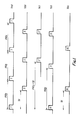
- FIG. 1(a) a train of transmitted pulses 1 is shown with a first pulse repetition interval PRI1.
- Figure 1(b) shows a train of received pulses 5 from a target with a delay Td indicative of the range to that target, the delay Td is less than the pulse repetition interval which may be considered a definition of a first time around target.
- Figure 1(c) shows a second-time around pulse train i.e. echo pulses 5 ⁇ from a target are received at the receiver from a target with delay equal to n PRI1 + Td where n is an integer, which is confused with a first time around echo pulse from a subsequent transmitted pulse 1.
- FIG 1(d) a second transmitted pulse train 11 is shown with a second different repetition interval PRI2 and figure 1(e) illustrates the resulting echo pulse train 15 although the delay Td is the same with both pulse repetition intervals PRI1 and PRI2 the received pulses 5 and 15 can be distinguished from multiple time around target echoes such as 5 ⁇ i.e. compare figures 1(c) and 1 (e) it can be seen that pulses 5 and 15 do not occur in the same time slot and thus these pulses are distinguishable by the receiver.
- Echo pulses 5 ⁇ from the second time around target with transmitted pulse of PRI1 are no longer received at the same time as echo pulses 15 from first time around targets of transmitted pulse PRI2.
- the range ambiguity is said to be resolved.
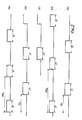
- Figures 2(a) and 2 (d) illustrate two transmitted pulse trains with pulse repetition intervals PRI3 and PRI4 as shown and a target delay Td2 but with a high duty cycle i.e. the pulse length 19 constituting a significant proportion of the pulse repetition interval PRI3 or PRI4.
- Figures 2(a-e) correspond with figures 1(a-e) however figures 2(c) and 2(e) illustrate an overlap of echo pulses 251 (2nd time around echo pulse of transmitted pulse PRI2) and 35 (1st time around echo pulse with transmitted pulse of PRI4) consequently first and mult-time around targets cannot be distinguished.
- the radar receiver is 'opened' for the duration of the pulse 25 or 351, each time a pulse from a certain delay is expected.
- the radar receiver could be opened and closed following a pattern of figure 2(b), in which case thereceiver is said to have a range gate at delay Td2. Because of the way in which the receiver operates, it is clear that if pulse trains from two targets overlap at all, even though they are not coincident, then both will appear in the same range gate.
- Transmitted technology has established a limit to peak power therefore in order to get sufficient average power for the required sensitivity, a high duty cycle is necessary. Also as the received signal power drops off rapidly with range, it is important to discriminate targets in the first few multi-time around range gates.
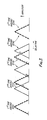
- pulse amplitudes at the two PRI's are compared. If the pulse amplitudes are sufficiently similar the target is considered first time around. If not, the target is taken to be multi-time around.
- this information is stored in a receiver memory to be used if and when the multi-time around target moves to a range where the relative amplitudes would indicate erroneously a first-time around target (i.e. close to the points A,B,C and D), the information in the receivers memory over-riding the indication of a first-time around target.
- Targets are continuously tracked by the system so that even multi-time around targets first detected at ranges corresponding to points A,B,C and D are still identified even though it may take several cycles.
- the technique is particularly appropriate to a pulse Doppler radar where the velocity of the target is effectively measured. If a target is identified as multi-time around then it can be tracked by monitoring its velocity. If a first-time around target appears with a different velocity at the same time as the tracked multi-time around target, then the former can be recognised. In other words the technique only overrides a detection for velocities very close to that of the tracked multi-time around target.
- a threshold which prescribes a coincidence gate wherein if two amplitudes are within that gate they are considered to coincide and a first time around target indicated.
- the width of the coincidence gate is actually dependent on the sum of the amplitude.
- the threshold is determined so that the probability of a genuine first-time around target being erroneously categorised as multi-time around due to noise is acceptably low.
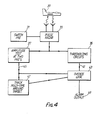
- FIG. 4 illustrates in a systematic manner a method of implementing the invention.
- Radar pulses are transmitted under control of a switch pulse repetition interval element 31 appended to a transmit/receiver means 33.
- a received echo pulse train from a target 39 is directed to conventional thresholding testing circuits 35 as found in present radar systems and to amplitude testing means 37 according to the invention.
- the threshold testing circuits 35 establish there is a response and thus that the target 39 is present, an alarm enabling signal 41 is sent to a logic element 43 when such a response a present.
- the amplitude testing means 37 analyse the received pulses at the two pulse repetition intervals identifying first and/or multi-time around targets and sending signals 45 to the logic element 43 and to a tracking device 47 determining whether the alarm enabling signal 41 from the threshold circuits 35 is passed to an alarm output device 49.
- the tracking device 47 track a multi-time around target such that even when it enters one of the "error" zones (i.e. A,B,C and D in figure 3) of the radar system it is still seen as a multi-time around target. It should be noted that there are advantages in providing "time-out" means in the tracking 47 and logic 43 devices so that the incoming target is re-assessed as it approaches and becomes increasingly dangerous.
- the receiver type used in this radar system can be of any type although as shown in figure 3 a matched filter type is preferred due to its sharp echo pulse edges.
Landscapes
- Engineering & Computer Science (AREA)
- Radar, Positioning & Navigation (AREA)
- Remote Sensing (AREA)
- Computer Networks & Wireless Communication (AREA)
- Physics & Mathematics (AREA)
- General Physics & Mathematics (AREA)
- Radar Systems Or Details Thereof (AREA)
Applications Claiming Priority (1)
| Application Number | Priority Date | Filing Date | Title |
|---|---|---|---|
| GB8605701A GB2187605B (en) | 1986-03-07 | 1986-03-07 | Radar system |
Publications (1)
| Publication Number | Publication Date |
|---|---|
| EP0283599A1 true EP0283599A1 (fr) | 1988-09-28 |
Family
ID=10594239
Family Applications (1)
| Application Number | Title | Priority Date | Filing Date |
|---|---|---|---|
| EP87302451A Withdrawn EP0283599A1 (fr) | 1986-03-07 | 1987-03-23 | Système radar pour discriminer entre les échos de première récurrence et de récurrences multiples |
Country Status (2)
| Country | Link |
|---|---|
| EP (1) | EP0283599A1 (fr) |
| GB (1) | GB2187605B (fr) |
Cited By (3)
| Publication number | Priority date | Publication date | Assignee | Title |
|---|---|---|---|---|
| WO1995000862A1 (fr) * | 1993-06-22 | 1995-01-05 | Siemens Aktiengesellschaft | Procede et dispositif de mesure de l'ecartement entre un objet et une unite d'emission et de reception d'ultrasons |
| EP1494043A3 (fr) * | 2003-07-02 | 2005-04-27 | M/A-Com, Inc. | Système radar véhiculaire à courte portée |
| CN112444797A (zh) * | 2019-08-30 | 2021-03-05 | 深圳市速腾聚创科技有限公司 | 双脉冲盲区信号处理方法、装置、雷达及存储介质 |
Families Citing this family (1)
| Publication number | Priority date | Publication date | Assignee | Title |
|---|---|---|---|---|
| GB2214026B (en) * | 1987-12-23 | 1992-04-22 | Hollandse Signaalapparaten Bv | Radar apparatus employing different kinds of pulses |
Citations (3)
| Publication number | Priority date | Publication date | Assignee | Title |
|---|---|---|---|---|
| US3765017A (en) * | 1968-06-12 | 1973-10-09 | North American Rockwell | Amti range ambiguity resolver |
| US4079376A (en) * | 1976-03-09 | 1978-03-14 | Westinghouse Electric Corporation | Target detection system in a medium PRF pulse doppler search/track radar receiver |
| EP0126032A2 (fr) * | 1983-05-04 | 1984-11-21 | SELENIA INDUSTRIE ELETTRONICHE ASSOCIATE S.p.A. | Dispositif pour l'identification et la suppression d'échos non désirés correspondant à une deuxième trace dans des systèmes radar |
-
1986
- 1986-03-07 GB GB8605701A patent/GB2187605B/en not_active Expired - Lifetime
-
1987
- 1987-03-23 EP EP87302451A patent/EP0283599A1/fr not_active Withdrawn
Patent Citations (3)
| Publication number | Priority date | Publication date | Assignee | Title |
|---|---|---|---|---|
| US3765017A (en) * | 1968-06-12 | 1973-10-09 | North American Rockwell | Amti range ambiguity resolver |
| US4079376A (en) * | 1976-03-09 | 1978-03-14 | Westinghouse Electric Corporation | Target detection system in a medium PRF pulse doppler search/track radar receiver |
| EP0126032A2 (fr) * | 1983-05-04 | 1984-11-21 | SELENIA INDUSTRIE ELETTRONICHE ASSOCIATE S.p.A. | Dispositif pour l'identification et la suppression d'échos non désirés correspondant à une deuxième trace dans des systèmes radar |
Non-Patent Citations (1)
| Title |
|---|
| M.I. SKOLNIK: "Radar Handbook", 1970, pages 19-12 - 19-18, McGraw-Hill, Inc., New York, US * |
Cited By (4)
| Publication number | Priority date | Publication date | Assignee | Title |
|---|---|---|---|---|
| WO1995000862A1 (fr) * | 1993-06-22 | 1995-01-05 | Siemens Aktiengesellschaft | Procede et dispositif de mesure de l'ecartement entre un objet et une unite d'emission et de reception d'ultrasons |
| US5671190A (en) * | 1993-06-22 | 1997-09-23 | Siemens Aktiengesellschaft | Method and device for measuring the distance of an object from an ultrasonic transmission/reception unit |
| EP1494043A3 (fr) * | 2003-07-02 | 2005-04-27 | M/A-Com, Inc. | Système radar véhiculaire à courte portée |
| CN112444797A (zh) * | 2019-08-30 | 2021-03-05 | 深圳市速腾聚创科技有限公司 | 双脉冲盲区信号处理方法、装置、雷达及存储介质 |
Also Published As
| Publication number | Publication date |
|---|---|
| GB2187605A (en) | 1987-09-09 |
| GB2187605B (en) | 1990-05-09 |
Similar Documents
| Publication | Publication Date | Title |
|---|---|---|
| US4973968A (en) | Radar system for determining first time around targets from multiple time around targets | |
| US5471214A (en) | Collision avoidance and warning system | |
| US4642648A (en) | Simple passive/active proximity warning system | |
| US5081457A (en) | Apparatus for reducing synchronous fruit in tcas surveillance systems | |
| EP1953565B1 (fr) | Radar secondaire de surveillance et procédé d'analyse de réponse du radar secondaire de surveillance | |
| EP0132400A2 (fr) | Circuit de mesure d'angle pour radar MTI | |
| US3887916A (en) | Correlator and control system for vehicular collision avoidance | |
| SE541952C2 (en) | Radar apparatus and method with interference detection | |
| DK149370B (da) | Apparat til at skelne sande maalekkosignaler fra isaer diskrete sidesloejfeforstyrrelser i en impulsdoppler-radarmodtager | |
| US4093948A (en) | Target detection in a medium pulse repetition frequency pulse doppler radar | |
| CN114325658A (zh) | 激光雷达对抗干扰方法、装置、设备及存储介质 | |
| EP0036751B1 (fr) | Détecteur d'évaluation de signal | |
| EP0267811B1 (fr) | Système radar Doppler à impulsions | |
| US3795909A (en) | Terrain-following radar system | |
| US4119966A (en) | Clutter discriminating apparatus for use with pulsed doppler radar systems and the like | |
| US3715750A (en) | Omnidirectional reflected interrogation rejector | |
| US5379043A (en) | Reply-frequency interference/jamming detector | |
| GB2187605A (en) | Radar systems | |
| US4109197A (en) | Prf detection system and method | |
| US5091729A (en) | Adaptive threshold detector | |
| US4143371A (en) | Arrangement for discriminating clutter signals from target signals in a radar system | |
| US4513287A (en) | Device for the elimination of nth trace moving echoes and interference echoes in a radar | |
| US5426434A (en) | Semiautomatic jam-accept (SAJAC) decider for mode-4 of the IFF mark XII | |
| US5367303A (en) | Parallel observer spatial evaluator | |
| EP1288879A1 (fr) | Système de détection par barrière de micro-onde |
Legal Events
| Date | Code | Title | Description |
|---|---|---|---|
| PUAI | Public reference made under article 153(3) epc to a published international application that has entered the european phase |
Free format text: ORIGINAL CODE: 0009012 |
|
| AK | Designated contracting states |
Kind code of ref document: A1 Designated state(s): AT BE CH DE ES FR GB GR IT LI LU NL SE |
|
| 17P | Request for examination filed |
Effective date: 19890215 |
|
| RAP1 | Party data changed (applicant data changed or rights of an application transferred) |
Owner name: GEC-MARCONI LIMITED |
|
| 17Q | First examination report despatched |
Effective date: 19910805 |
|
| STAA | Information on the status of an ep patent application or granted ep patent |
Free format text: STATUS: THE APPLICATION IS DEEMED TO BE WITHDRAWN |
|
| 18D | Application deemed to be withdrawn |
Effective date: 19911217 |
|
| RIN1 | Information on inventor provided before grant (corrected) |
Inventor name: HURD, DAVID LEE |