EP0283651A1 - Méthode pour la fabrication d'une couche ou d'un film de laque - Google Patents
Méthode pour la fabrication d'une couche ou d'un film de laque Download PDFInfo
- Publication number
- EP0283651A1 EP0283651A1 EP88100821A EP88100821A EP0283651A1 EP 0283651 A1 EP0283651 A1 EP 0283651A1 EP 88100821 A EP88100821 A EP 88100821A EP 88100821 A EP88100821 A EP 88100821A EP 0283651 A1 EP0283651 A1 EP 0283651A1
- Authority
- EP
- European Patent Office
- Prior art keywords
- layer
- weight
- lacquer
- plastic
- film
- Prior art date
- Legal status (The legal status is an assumption and is not a legal conclusion. Google has not performed a legal analysis and makes no representation as to the accuracy of the status listed.)
- Granted
Links
- 238000004519 manufacturing process Methods 0.000 title claims abstract description 8
- 239000011247 coating layer Substances 0.000 title claims description 3
- 239000000049 pigment Substances 0.000 claims abstract description 43
- 229920003023 plastic Polymers 0.000 claims abstract description 29
- 239000007788 liquid Substances 0.000 claims abstract description 27
- 239000004033 plastic Substances 0.000 claims abstract description 27
- 239000002985 plastic film Substances 0.000 claims abstract description 22
- 229920006255 plastic film Polymers 0.000 claims abstract description 22
- 238000000034 method Methods 0.000 claims abstract description 19
- 239000002904 solvent Substances 0.000 claims abstract description 19
- 239000003085 diluting agent Substances 0.000 claims abstract description 17
- 239000000178 monomer Substances 0.000 claims abstract description 15
- 238000001035 drying Methods 0.000 claims abstract description 13
- 239000000975 dye Substances 0.000 claims abstract description 13
- 238000010894 electron beam technology Methods 0.000 claims abstract description 13
- 238000000576 coating method Methods 0.000 claims abstract description 6
- 125000003636 chemical group Chemical group 0.000 claims abstract description 5
- 239000011248 coating agent Substances 0.000 claims abstract description 5
- 239000010410 layer Substances 0.000 claims description 108
- 239000004922 lacquer Substances 0.000 claims description 47
- 239000012790 adhesive layer Substances 0.000 claims description 15
- 229920005989 resin Polymers 0.000 claims description 15
- 239000011347 resin Substances 0.000 claims description 15
- 229920003002 synthetic resin Polymers 0.000 claims description 14
- 239000000057 synthetic resin Substances 0.000 claims description 14
- 239000007787 solid Substances 0.000 claims description 10
- 239000000126 substance Substances 0.000 claims description 10
- 239000011230 binding agent Substances 0.000 claims description 8
- 239000000203 mixture Substances 0.000 claims description 7
- 230000005855 radiation Effects 0.000 claims description 7
- 238000004804 winding Methods 0.000 claims description 6
- 229920001577 copolymer Polymers 0.000 claims description 5
- 239000006057 Non-nutritive feed additive Substances 0.000 claims description 4
- 125000002887 hydroxy group Chemical group [H]O* 0.000 claims description 4
- 229920001228 polyisocyanate Polymers 0.000 claims description 4
- 239000005056 polyisocyanate Substances 0.000 claims description 4
- BNCADMBVWNPPIZ-UHFFFAOYSA-N 2-n,2-n,4-n,4-n,6-n,6-n-hexakis(methoxymethyl)-1,3,5-triazine-2,4,6-triamine Chemical compound COCN(COC)C1=NC(N(COC)COC)=NC(N(COC)COC)=N1 BNCADMBVWNPPIZ-UHFFFAOYSA-N 0.000 claims description 2
- 239000005057 Hexamethylene diisocyanate Substances 0.000 claims description 2
- 125000003277 amino group Chemical group 0.000 claims description 2
- 150000001875 compounds Chemical class 0.000 claims description 2
- 239000000470 constituent Substances 0.000 claims description 2
- RRAMGCGOFNQTLD-UHFFFAOYSA-N hexamethylene diisocyanate Chemical compound O=C=NCCCCCCN=C=O RRAMGCGOFNQTLD-UHFFFAOYSA-N 0.000 claims description 2
- 239000000088 plastic resin Substances 0.000 claims description 2
- 229920000058 polyacrylate Polymers 0.000 claims description 2
- 229920000193 polymethacrylate Polymers 0.000 claims description 2
- 239000000463 material Substances 0.000 abstract description 9
- 239000003973 paint Substances 0.000 description 9
- -1 polybutylene terephthalate Polymers 0.000 description 4
- 239000002023 wood Substances 0.000 description 3
- 239000000020 Nitrocellulose Substances 0.000 description 2
- 239000007789 gas Substances 0.000 description 2
- 239000011261 inert gas Substances 0.000 description 2
- 239000002184 metal Substances 0.000 description 2
- 229920001220 nitrocellulos Polymers 0.000 description 2
- 239000000123 paper Substances 0.000 description 2
- 229920000098 polyolefin Polymers 0.000 description 2
- 239000000758 substrate Substances 0.000 description 2
- NIXOWILDQLNWCW-UHFFFAOYSA-M Acrylate Chemical compound [O-]C(=O)C=C NIXOWILDQLNWCW-UHFFFAOYSA-M 0.000 description 1
- 239000004925 Acrylic resin Substances 0.000 description 1
- 239000004640 Melamine resin Substances 0.000 description 1
- 229920000877 Melamine resin Polymers 0.000 description 1
- CERQOIWHTDAKMF-UHFFFAOYSA-M Methacrylate Chemical compound CC(=C)C([O-])=O CERQOIWHTDAKMF-UHFFFAOYSA-M 0.000 description 1
- 229920001730 Moisture cure polyurethane Polymers 0.000 description 1
- 239000002033 PVDF binder Substances 0.000 description 1
- 239000004698 Polyethylene Substances 0.000 description 1
- QYKIQEUNHZKYBP-UHFFFAOYSA-N Vinyl ether Chemical class C=COC=C QYKIQEUNHZKYBP-UHFFFAOYSA-N 0.000 description 1
- 230000001133 acceleration Effects 0.000 description 1
- 150000001252 acrylic acid derivatives Chemical class 0.000 description 1
- 239000002318 adhesion promoter Substances 0.000 description 1
- 239000000853 adhesive Substances 0.000 description 1
- 230000001070 adhesive effect Effects 0.000 description 1
- 239000012298 atmosphere Substances 0.000 description 1
- QVGXLLKOCUKJST-UHFFFAOYSA-N atomic oxygen Chemical compound [O] QVGXLLKOCUKJST-UHFFFAOYSA-N 0.000 description 1
- 239000011111 cardboard Substances 0.000 description 1
- 239000003086 colorant Substances 0.000 description 1
- 239000003822 epoxy resin Substances 0.000 description 1
- 229920002313 fluoropolymer Polymers 0.000 description 1
- 239000004811 fluoropolymer Substances 0.000 description 1
- LNEPOXFFQSENCJ-UHFFFAOYSA-N haloperidol Chemical compound C1CC(O)(C=2C=CC(Cl)=CC=2)CCN1CCCC(=O)C1=CC=C(F)C=C1 LNEPOXFFQSENCJ-UHFFFAOYSA-N 0.000 description 1
- 150000002576 ketones Chemical class 0.000 description 1
- VZCYOOQTPOCHFL-UPHRSURJSA-N maleic acid Chemical compound OC(=O)\C=C/C(O)=O VZCYOOQTPOCHFL-UPHRSURJSA-N 0.000 description 1
- 150000002734 metacrylic acid derivatives Chemical class 0.000 description 1
- 238000001465 metallisation Methods 0.000 description 1
- 239000012299 nitrogen atmosphere Substances 0.000 description 1
- 239000001301 oxygen Substances 0.000 description 1
- 229910052760 oxygen Inorganic materials 0.000 description 1
- 238000010422 painting Methods 0.000 description 1
- 229920001707 polybutylene terephthalate Polymers 0.000 description 1
- 229920000647 polyepoxide Polymers 0.000 description 1
- 229920000573 polyethylene Polymers 0.000 description 1
- 229920000139 polyethylene terephthalate Polymers 0.000 description 1
- 239000005020 polyethylene terephthalate Substances 0.000 description 1
- 229920000642 polymer Polymers 0.000 description 1
- 229920001343 polytetrafluoroethylene Polymers 0.000 description 1
- 239000004810 polytetrafluoroethylene Substances 0.000 description 1
- 229920002981 polyvinylidene fluoride Polymers 0.000 description 1
- 238000000926 separation method Methods 0.000 description 1
- 238000003860 storage Methods 0.000 description 1
- VZCYOOQTPOCHFL-UHFFFAOYSA-N trans-butenedioic acid Natural products OC(=O)C=CC(O)=O VZCYOOQTPOCHFL-UHFFFAOYSA-N 0.000 description 1
- 239000002966 varnish Substances 0.000 description 1
- 229920001567 vinyl ester resin Polymers 0.000 description 1
Images

Classifications
-
- B—PERFORMING OPERATIONS; TRANSPORTING
- B05—SPRAYING OR ATOMISING IN GENERAL; APPLYING FLUENT MATERIALS TO SURFACES, IN GENERAL
- B05D—PROCESSES FOR APPLYING FLUENT MATERIALS TO SURFACES, IN GENERAL
- B05D1/00—Processes for applying liquids or other fluent materials
- B05D1/28—Processes for applying liquids or other fluent materials performed by transfer from the surfaces of elements carrying the liquid or other fluent material, e.g. brushes, pads, rollers
- B05D1/286—Processes for applying liquids or other fluent materials performed by transfer from the surfaces of elements carrying the liquid or other fluent material, e.g. brushes, pads, rollers using a temporary backing to which the coating has been applied
-
- B—PERFORMING OPERATIONS; TRANSPORTING
- B05—SPRAYING OR ATOMISING IN GENERAL; APPLYING FLUENT MATERIALS TO SURFACES, IN GENERAL
- B05D—PROCESSES FOR APPLYING FLUENT MATERIALS TO SURFACES, IN GENERAL
- B05D3/00—Pretreatment of surfaces to which liquids or other fluent materials are to be applied; After-treatment of applied coatings, e.g. intermediate treating of an applied coating preparatory to subsequent applications of liquids or other fluent materials
- B05D3/06—Pretreatment of surfaces to which liquids or other fluent materials are to be applied; After-treatment of applied coatings, e.g. intermediate treating of an applied coating preparatory to subsequent applications of liquids or other fluent materials by exposure to radiation
- B05D3/068—Pretreatment of surfaces to which liquids or other fluent materials are to be applied; After-treatment of applied coatings, e.g. intermediate treating of an applied coating preparatory to subsequent applications of liquids or other fluent materials by exposure to radiation using ionising radiations (gamma, X, electrons)
Definitions
- the present invention relates to a process for the production of lacquer layers or lacquer films, wherein lacquer is first applied to a radiation-permeable plastic film, cured by radiation and separated from the plastic release film (reusable plastic film), with several layers of a specific composition being applied to produce the printed lacquer films according to the invention will.
- DE-OS 26 19 315 already discloses a method for painting flat material such as paper, cardboard, metal sheets and the like, using photopolymerizable lacquers, in which lacquer is applied in one layer to the flat material and cured by irradiation with a light source, wherein the lacquer is first applied to a film which is permeable to the curing light, is brought into contact with the flat material surface to be coated, and after the radiation has been irradiated through the film and the lacquer has hardened, the film is removed from the lacquer layer.
- the disadvantage here is that the paint is applied in a paint coater and that immediately afterwards it has to be squeezed onto the flat material to be coated between a pair of rollers with the paint side.
- the paint must therefore be processed immediately in the "wet state", so that storage of the layers is not possible.
- the varnish cannot be printed in a damp state. A possible pressure when squeezing onto the flat material, preferably paper, would change its colors.
- the aim and object of the present invention was to avoid the aforementioned disadvantages and to find an improved method and a paint film with improved properties.
- the layer produced from the liquid coatings should be easily separable from the carrier film and interim storable and should also be able to be applied to different substrates or objects, preferably to wood or wood-based materials, furniture parts made from wood-based materials, by means of adhesive or adhesion promoter.
- the lacquer is first applied to a radiation-permeable plastic film, cured by radiation and separated from the plastic release film (reusable plastic film).
- the plastic release film reusable plastic film.
- at least one of one or more synthetic resin or plastic materials is used to produce printed lacquer films on the plastic release film at temperatures between 10 ° C. to 90 ° C., preferably 20 ° C. to 60 ° C.
- non-heat-sealable top layer serving as carrier layer or carrier film after separation from the plastic releasing film
- a total thickness (measured after curing or drying) of 2 to 40 ⁇ m, preferably 5 to 15 ⁇ m, which contains free reactive chemical groups and color pigments and / or dyes and has at least one solvent and / or diluent of more than 35% by weight (based on the total weight of the top layer to be applied) and / or (at room temperature) liquid monomers and / or liquid prepolymers, prepolymers or pre-condensates, and a 10 to 95 ⁇ m, preferably 30 to 50 ⁇ m, thick, transparent or translucent lacquer layer with a color pigment content of less than 3% by weight directly over the cover layer or over an intermediate layer arranged above the cover layer , preferably without color pigments, from an electron beam (B eta rays) curable lacquer applied,
- a print layer preferably a color print layer, with a total thickness of 0.5 to is applied as an intermediate layer between the cover layer and the lacquer layer 12 microns, preferably 1.0 to 5 microns (measured after curing or drying) applied, the liquid organic chemical solvents and / or diluents and / or (at room temperature) liquid monomers and / or liquid prepolymers, pre-condensates and / or prepolymers contains.
- a 0.1 to 6 ⁇ m, preferably 0.5 to 4 ⁇ m, thick adhesive layer (measured after curing or drying), the free chemical reactive groups and consists synthetic resin, plastic and / or (at room temperature) liquid monomers and / or liquid prepolymers, prepolymers and / or pre-condensates and / or organic chemical solvents or diluents and as a further part of the top layer one or more color pigment top layers with a total thickness of 1, 9 to 30 microns, preferably 4.5 to 15 microns, applied.
- the action of electron beams is preferably carried out through the release plastic layer (ie from the opposite side of the lacquer layer).
- the layers may therefore preferably not contain any metal layers or metallizations.
- the adhesive layer consists of polyisocyanates, preferably Polyisocyanate of hexamethylene diisocyanate, and hydroxyl and / or amine group-containing resins, precondensates and / or prepolymers in liquid form, preferably hexamethoxymethyl melamine resin, and / or hydroxyl group-containing polyacrylate and / or polymethacrylate and / or vinyl chloride copolymer or contains one or more of these compounds as the main component.
- polyisocyanates preferably Polyisocyanate of hexamethylene diisocyanate, and hydroxyl and / or amine group-containing resins, precondensates and / or prepolymers in liquid form, preferably hexamethoxymethyl melamine resin, and / or hydroxyl group-containing polyacrylate and / or polymethacrylate and / or vinyl chloride copolymer or contains one or more of these compounds as the main component.
- the color pigment layer (s) which is or are applied to the adhesive layer has or have a diluent and / or solvent content, preferably an organic chemical solvent content, of 40 to 70% by weight, preferably 50 to 66% by weight .-%, and a solids content consisting of color pigments and / or dyes and synthetic resin binders, and optionally processing aids of 60 to 30 wt .-%, preferably 50 to 34 wt .-%.
- the diluent or solvent is removed after application by the action of heat to more than 30% by weight, preferably more than 50% by weight (based on 100% by weight of diluent or solvent), preferably before another layer is applied over it becomes.
- the color pigment top layer (s), which is or are applied to the adhesive layer consist of liquid monomers, precondensates and / or liquid prepolymers, preferably a mixture of liquid monomers with liquid ones Prepolymers, with a low solvent content and / or diluent content, preferably without solvents and diluents, with a total weight of 90 to 30% by weight, preferably 80 to 50% by weight, and color pigments and / or dyes, and optionally processing aids in amounts by weight of 10 to 70% by weight, preferably 20 to 50% by weight.
- the color pigment top layer or color pigment top layers consist of 10 to 70% by weight, preferably 20 to 50% by weight, color pigments and / or dyes and 90 to 30% by weight, preferably 80 to 50% by weight. %, Synthetic resin binders or their starting constituents in the form of the monomers, precondensates and / or prepolymers (calculated as solids), based on the total solids content of the color pigment top layer (s).
- the wet lacquer layer is cured via a smooth or a structured roller, preferably a matted structure roller, the structure and / or the matting being taken over by the lacquer layer.
- the plastic release film or web consists of or preferably contains fluoropolymers, polyolefin, polybutylene terephthalate and / or polyethylene terephthalate, etc., preferably polyvinylidene fluoride, polytetrafluoroethylene and / or polyethylene.
- the synthetic resin binder of the color pigment top layer preferably consists of vinyl chloride copolymers, vinyl chloride-acrylate copolymers, nitrocellulose with maleate or ketone resin, nitrocellulose with acrylate resins and / or methacrylate resins, preferably acrylate resin.
- the transparent or translucent lacquer layer consists or contains, as a plastic binder, cationically curing resins, preferably epoxy resins, vinyl ethers and / or vinyl ester polymers, copolymers and / or monomers which free-radically harden to form resins, prepolymers, precondensates, preferably monomers or prepolymers of acrylates and / or methacrylates, or Mixtures of two or more resins with one another or mixtures with one or more of these resins.
- resins preferably epoxy resins, vinyl ethers and / or vinyl ester polymers, copolymers and / or monomers which free-radically harden to form resins, prepolymers, precondensates, preferably monomers or prepolymers of acrylates and / or methacrylates, or Mixtures of two or more resins with one another or mixtures with one or more of these resins.
- Irradiation can take place in the presence of a wide variety of gases in the case of cationically curable resins, preferably air or oxygen. Irradiation with the special use of an inert gas or an inert atmosphere is not necessary and is preferably avoided. Likewise, the action of the radiation need not take place with alternating gas compositions. In the case of the radically curable resins, curing takes place by irradiation, preferably using or using inert gases, preferably in a nitrogen atmosphere.
- the radiation is beta rays or electron beams, which are accelerated by the radiation source in an electron accelerator and are preferably directed onto the substrate via linear and / or surface cathodes.
- the acceleration voltage is 150 - 500 KV, preferably 200 - 300 KV.
- the invention further relates to printed films consisting of a plurality of layers containing plastic or synthetic resin, the film being a lacquer film which consists of at least one non-heat-sealable top layer consisting of one or more synthetic resin or plastic-containing layers with a total thickness (measured after curing or Drying) of 2 to 40 ⁇ m, preferably 5 to 15 ⁇ m, which contains free reactive chemical groups and color pigments and / or dyes, a printing layer, preferably a color printing layer, arranged above the top layer, with a total thickness of 0.5 to 12 ⁇ m, preferably 1 , 0 to 5 ⁇ m (measured after curing or drying), and a 10 to 95 ⁇ m, preferably 30 to 50 ⁇ m, thick, transparent or translucent lacquer layer arranged above it with a color pigment content of less than 3% by weight, preferably without color pigments or containing a hardened with electron beams, preferably with beta rays g hardened paint, is composed.
- the printed film contains after one preferred embodiment a 0.1 to 6 microns, preferably 0.5 to 4 microns thick adhesive layer (measured after curing or drying), which contains free chemical reactive groups and synthetic resin or plastic.
- a 0.1 to 6 microns preferably 0.5 to 4 microns thick adhesive layer (measured after curing or drying), which contains free chemical reactive groups and synthetic resin or plastic.
- One or more color pigment cover layers with a total thickness of 1.9 to 30 ⁇ m, preferably 4.5 to 15 ⁇ m, are arranged thereon as a further part of the cover layer.
- the color pigment top layer or color pigment top layers consist of 10 to 70% by weight, preferably 20 to 50% by weight, color pigments and / or dyes and 90 to 30% by weight, preferably 80 to 50% by weight, Resin binders (calculated as solids), based on the total solids content of the color pigment top layer (s).
- the invention further relates to a device combination for the production of paint film webs, with the aid of which the paint is first applied to a radiation-permeable plastic film or plastic film web and cured by an irradiation device and separated from the plastic film or plastic film web (plastic release film).
- the device combination consists of a unwinding device for the plastic release film or film web, at least one printing roller pair or printing unit arranged thereafter for applying an adhesive layer, at least one printing roller pair or printing roller unit arranged thereafter for applying the cover layer, at least one, preferably a plurality of printing roller pairs or printing roller mills arranged thereafter for applying at least one printing layer, at least one coating unit arranged thereafter for applying a transparent or translucent coating layer, at least one electron emitter or an electron beam device arranged thereafter, at least one winding device for the release film and at least one winding device for the finished one Paint film or film sheet.
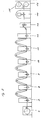
- FIG. 1 shows a cross section through the lacquer layer arranged on a release film (1).
- the plastic release film (1) is connected to the adhesive layer (2) and this to the cover layer (3).
- One or more printing layers (4) are arranged on the cover layer and are covered by the transparent or translucent lacquer layer (5).
- the plastic release film (1) passes from the unwinding device (6) for the release film to the printing unit or pair of printing rollers (7), which is used to apply the adhesive layer (2), and subsequently to the printing unit or pair of printing rollers (9), which is used to apply the cover layer (3) is intended for the release film (1) provided with the adhesive layer (2).
- a plurality of printing units or pairs of printing rollers (9 to 12) are preferably arranged, with the aid of which the printing layer or printing layers are applied to the cover layer be applied.
- the plastic film or plastic film web coated and printed in this way then reaches the electron emitter (s) or the electron irradiation device (13), is separated after the irradiation in such a way that the release film (1) leads to the winding device (15) for the release film or to the station (6 or 7) arrives while the lacquer film separated from the release film is taken up by the winding device (16) or cut into film webs of a certain length.
- a plastic release film preferably a polyolefin film, at temperatures between 20-80 ° C. and separated from the release film as a lacquer film:
Landscapes
- Health & Medical Sciences (AREA)
- General Health & Medical Sciences (AREA)
- Toxicology (AREA)
- Physics & Mathematics (AREA)
- Engineering & Computer Science (AREA)
- Plasma & Fusion (AREA)
- Laminated Bodies (AREA)
- Application Of Or Painting With Fluid Materials (AREA)
- Organic Insulating Materials (AREA)
- Manufacture Of Motors, Generators (AREA)
- Insulated Conductors (AREA)
Priority Applications (1)
| Application Number | Priority Date | Filing Date | Title |
|---|---|---|---|
| AT88100821T ATE59590T1 (de) | 1987-03-19 | 1988-01-21 | Verfahren zur herstellung von lackschichten und lackfolien. |
Applications Claiming Priority (2)
| Application Number | Priority Date | Filing Date | Title |
|---|---|---|---|
| DE19873708908 DE3708908A1 (de) | 1987-03-19 | 1987-03-19 | Verfahren zur herstellung von lackschichten und lackfolien |
| DE3708908 | 1987-03-19 |
Publications (2)
| Publication Number | Publication Date |
|---|---|
| EP0283651A1 true EP0283651A1 (fr) | 1988-09-28 |
| EP0283651B1 EP0283651B1 (fr) | 1991-01-02 |
Family
ID=6323441
Family Applications (1)
| Application Number | Title | Priority Date | Filing Date |
|---|---|---|---|
| EP88100821A Expired - Lifetime EP0283651B1 (fr) | 1987-03-19 | 1988-01-21 | Méthode pour la fabrication d'une couche ou d'un film de laque |
Country Status (4)
| Country | Link |
|---|---|
| EP (1) | EP0283651B1 (fr) |
| AT (1) | ATE59590T1 (fr) |
| DE (2) | DE3708908A1 (fr) |
| ES (1) | ES2019409B3 (fr) |
Cited By (2)
| Publication number | Priority date | Publication date | Assignee | Title |
|---|---|---|---|---|
| WO1997011922A1 (fr) * | 1995-09-27 | 1997-04-03 | Basf Coatings Aktiengesellschaft | Revetement durcissable par rayonnement |
| WO1997011787A1 (fr) * | 1995-09-27 | 1997-04-03 | Basf Coatings Ag | Film de peinture adhesif |
Families Citing this family (3)
| Publication number | Priority date | Publication date | Assignee | Title |
|---|---|---|---|---|
| DE4425792A1 (de) * | 1994-07-21 | 1996-02-01 | Manfred Keppeler | Verfahren zur Herstellung von Folien und Beschichtungen durch Sprühen |
| DE19751607B4 (de) * | 1997-11-21 | 2010-01-14 | Usp Indicator Solutions Gmbh | Schutzfolie zum Schutz und zum Rahmen von graphischen Gebilden und Verfahren zu deren Herstellung |
| DE10057107C1 (de) * | 2000-11-16 | 2002-06-20 | Rohrscheidt Friedrich Von | Verfahren zum Bedrucken, Prägen oder Herstellen eines biegeweichen Produktes und ein Transportband hierfür |
Citations (5)
| Publication number | Priority date | Publication date | Assignee | Title |
|---|---|---|---|---|
| EP0009885A1 (fr) * | 1978-09-01 | 1980-04-16 | Mobil Oil Corporation | Procédé d'application d'une couche sur un substrat |
| EP0043063A1 (fr) * | 1980-06-28 | 1982-01-06 | Letron GmbH | Procédé pour la fabrication d'une feuille-support revêtue d'une laque durcie par irradiation électronique |
| EP0121942A1 (fr) * | 1983-04-12 | 1984-10-17 | Fuji Photo Film Co., Ltd. | Méthode pour préparer un film à plusieurs couches |
| GB2142279A (en) * | 1983-06-30 | 1985-01-16 | Letraset International Ltd | Dry transfer materials |
| EP0228671A1 (fr) * | 1985-12-23 | 1987-07-15 | General Electric Company | Procédé pour la fabrication d'un substrat revêtu, à caractéristiques de surface spécifiques |
-
1987
- 1987-03-19 DE DE19873708908 patent/DE3708908A1/de not_active Withdrawn
-
1988
- 1988-01-21 DE DE8888100821T patent/DE3861335D1/de not_active Expired - Fee Related
- 1988-01-21 AT AT88100821T patent/ATE59590T1/de active
- 1988-01-21 EP EP88100821A patent/EP0283651B1/fr not_active Expired - Lifetime
- 1988-01-21 ES ES88100821T patent/ES2019409B3/es not_active Expired - Lifetime
Patent Citations (5)
| Publication number | Priority date | Publication date | Assignee | Title |
|---|---|---|---|---|
| EP0009885A1 (fr) * | 1978-09-01 | 1980-04-16 | Mobil Oil Corporation | Procédé d'application d'une couche sur un substrat |
| EP0043063A1 (fr) * | 1980-06-28 | 1982-01-06 | Letron GmbH | Procédé pour la fabrication d'une feuille-support revêtue d'une laque durcie par irradiation électronique |
| EP0121942A1 (fr) * | 1983-04-12 | 1984-10-17 | Fuji Photo Film Co., Ltd. | Méthode pour préparer un film à plusieurs couches |
| GB2142279A (en) * | 1983-06-30 | 1985-01-16 | Letraset International Ltd | Dry transfer materials |
| EP0228671A1 (fr) * | 1985-12-23 | 1987-07-15 | General Electric Company | Procédé pour la fabrication d'un substrat revêtu, à caractéristiques de surface spécifiques |
Cited By (3)
| Publication number | Priority date | Publication date | Assignee | Title |
|---|---|---|---|---|
| WO1997011922A1 (fr) * | 1995-09-27 | 1997-04-03 | Basf Coatings Aktiengesellschaft | Revetement durcissable par rayonnement |
| WO1997011787A1 (fr) * | 1995-09-27 | 1997-04-03 | Basf Coatings Ag | Film de peinture adhesif |
| US6210796B1 (en) | 1995-09-27 | 2001-04-03 | Basf Coatings Ag | Adhesive paint film |
Also Published As
| Publication number | Publication date |
|---|---|
| DE3861335D1 (de) | 1991-02-07 |
| DE3708908A1 (de) | 1988-09-29 |
| EP0283651B1 (fr) | 1991-01-02 |
| ES2019409B3 (es) | 1991-06-16 |
| ATE59590T1 (de) | 1991-01-15 |
Similar Documents
| Publication | Publication Date | Title |
|---|---|---|
| DE69431424T2 (de) | Verfahren zur Herstellung von Kunstholzhalbzeug | |
| EP0166153B1 (fr) | Panneau décoratif à propriétés de surface améliorées | |
| EP0216269B1 (fr) | Panneau décoratif ayant des propriétés de surface modifiées | |
| EP1549511B1 (fr) | Pellicule de revetement decorative en forme de feuille ou de bande et procede de fabrication | |
| DE2354874C3 (de) | Schneide- und Maskenfilm | |
| DE4421559C2 (de) | Verfahren zum Herstellen einer Beschichtung, die eine Struktur aufweist, auf einem Substrat sowie Beschichtung | |
| DE177168T1 (de) | Polyvinylidenfluorid enthaltende ueberzuege. | |
| WO1990006232A1 (fr) | Plaque stratifiee decorative et procede pour la fabrication d'une couche de recouvrement sur celle-ci | |
| DE69706022T2 (de) | Verfahren zum Härten von Beschichtungszusammensetzungen | |
| DE69800648T2 (de) | Bedruckbare Klebeschicht und Etikett | |
| DE3314610A1 (de) | Verfahren zur herstellung von farbigen melaminharzhaltigen dekorpapierfolien mit einer dreidimensionalen oberflaechenstruktur | |
| EP0283651B1 (fr) | Méthode pour la fabrication d'une couche ou d'un film de laque | |
| EP1122062B1 (fr) | Procédé pour la production d'un composite multicouche coloré et composite multicouche produit selon ce procédé | |
| DE1810608B2 (de) | Druckempfindliches Ubertragungs element und Verfahren zu seiner Her stellung | |
| DE2823654A1 (de) | Waessrige polyurethan-unterbeschichtungen | |
| DE2327386A1 (de) | Abziehfolie, verfahren zur herstellung derselben und abziehverfahren | |
| DE2721292B2 (de) | Verfahren zur Herstellung eines duroplastischen Kunstharzüberzuges mit strukturierter Oberfläche | |
| DE3110754A1 (de) | Verfahren zur herstellung eines mit durch elektronenstrahlen gehaertetem lack beschichtetem flaechenfoermigen traegermaterials mit matter oberflaeche | |
| DE2704328C2 (fr) | ||
| DE3422965A1 (de) | Verfahren zur herstellung von mit einem oberflaechenschutz versehenen schichtstoffplatten oder -folien | |
| DE4009672A1 (de) | Durchlaessiges auftragsband und darin enthaltene aufkleber | |
| EP0043063A1 (fr) | Procédé pour la fabrication d'une feuille-support revêtue d'une laque durcie par irradiation électronique | |
| DE2604475A1 (de) | Beschichtungsverfahren | |
| DE2642399C3 (de) | Selbstklebende übertragbare Lackbzw. Farbschicht | |
| EP0296395B1 (fr) | Procédé et appareil pour produire des surfaces laquées mattes |
Legal Events
| Date | Code | Title | Description |
|---|---|---|---|
| PUAI | Public reference made under article 153(3) epc to a published international application that has entered the european phase |
Free format text: ORIGINAL CODE: 0009012 |
|
| 17P | Request for examination filed |
Effective date: 19880129 |
|
| AK | Designated contracting states |
Kind code of ref document: A1 Designated state(s): AT BE CH DE ES FR GB GR IT LI LU NL SE |
|
| 17Q | First examination report despatched |
Effective date: 19891010 |
|
| GRAA | (expected) grant |
Free format text: ORIGINAL CODE: 0009210 |
|
| ITF | It: translation for a ep patent filed | ||
| AK | Designated contracting states |
Kind code of ref document: B1 Designated state(s): AT BE CH DE ES FR GB GR IT LI LU NL SE |
|
| PG25 | Lapsed in a contracting state [announced via postgrant information from national office to epo] |
Ref country code: GR Free format text: LAPSE BECAUSE OF FAILURE TO SUBMIT A TRANSLATION OF THE DESCRIPTION OR TO PAY THE FEE WITHIN THE PRESCRIBED TIME-LIMIT Effective date: 19910102 |
|
| REF | Corresponds to: |
Ref document number: 59590 Country of ref document: AT Date of ref document: 19910115 Kind code of ref document: T |
|
| REF | Corresponds to: |
Ref document number: 3861335 Country of ref document: DE Date of ref document: 19910207 |
|
| GBT | Gb: translation of ep patent filed (gb section 77(6)(a)/1977) | ||
| ET | Fr: translation filed | ||
| PLBE | No opposition filed within time limit |
Free format text: ORIGINAL CODE: 0009261 |
|
| STAA | Information on the status of an ep patent application or granted ep patent |
Free format text: STATUS: NO OPPOSITION FILED WITHIN TIME LIMIT |
|
| 26N | No opposition filed | ||
| EPTA | Lu: last paid annual fee | ||
| EAL | Se: european patent in force in sweden |
Ref document number: 88100821.3 |
|
| PGFP | Annual fee paid to national office [announced via postgrant information from national office to epo] |
Ref country code: DE Payment date: 19981119 Year of fee payment: 12 |
|
| PGFP | Annual fee paid to national office [announced via postgrant information from national office to epo] |
Ref country code: FR Payment date: 19981223 Year of fee payment: 12 |
|
| PGFP | Annual fee paid to national office [announced via postgrant information from national office to epo] |
Ref country code: BE Payment date: 19981224 Year of fee payment: 12 |
|
| PGFP | Annual fee paid to national office [announced via postgrant information from national office to epo] |
Ref country code: CH Payment date: 19981231 Year of fee payment: 12 |
|
| PGFP | Annual fee paid to national office [announced via postgrant information from national office to epo] |
Ref country code: ES Payment date: 19990107 Year of fee payment: 12 |
|
| PGFP | Annual fee paid to national office [announced via postgrant information from national office to epo] |
Ref country code: AT Payment date: 19990112 Year of fee payment: 12 |
|
| PGFP | Annual fee paid to national office [announced via postgrant information from national office to epo] |
Ref country code: SE Payment date: 19990120 Year of fee payment: 12 |
|
| PGFP | Annual fee paid to national office [announced via postgrant information from national office to epo] |
Ref country code: GB Payment date: 19990121 Year of fee payment: 12 |
|
| PGFP | Annual fee paid to national office [announced via postgrant information from national office to epo] |
Ref country code: LU Payment date: 19990126 Year of fee payment: 12 |
|
| PGFP | Annual fee paid to national office [announced via postgrant information from national office to epo] |
Ref country code: NL Payment date: 19990131 Year of fee payment: 12 |
|
| PG25 | Lapsed in a contracting state [announced via postgrant information from national office to epo] |
Ref country code: LU Free format text: LAPSE BECAUSE OF NON-PAYMENT OF DUE FEES Effective date: 20000121 Ref country code: GB Free format text: LAPSE BECAUSE OF NON-PAYMENT OF DUE FEES Effective date: 20000121 Ref country code: AT Free format text: LAPSE BECAUSE OF NON-PAYMENT OF DUE FEES Effective date: 20000121 |
|
| PG25 | Lapsed in a contracting state [announced via postgrant information from national office to epo] |
Ref country code: SE Free format text: LAPSE BECAUSE OF NON-PAYMENT OF DUE FEES Effective date: 20000122 Ref country code: ES Free format text: LAPSE BECAUSE OF NON-PAYMENT OF DUE FEES Effective date: 20000122 |
|
| PG25 | Lapsed in a contracting state [announced via postgrant information from national office to epo] |
Ref country code: LI Free format text: LAPSE BECAUSE OF NON-PAYMENT OF DUE FEES Effective date: 20000131 Ref country code: CH Free format text: LAPSE BECAUSE OF NON-PAYMENT OF DUE FEES Effective date: 20000131 Ref country code: BE Free format text: LAPSE BECAUSE OF NON-PAYMENT OF DUE FEES Effective date: 20000131 |
|
| BERE | Be: lapsed |
Owner name: ALKOR G.M.B.H. KUNSTSTOFFE Effective date: 20000131 |
|
| PG25 | Lapsed in a contracting state [announced via postgrant information from national office to epo] |
Ref country code: NL Free format text: LAPSE BECAUSE OF NON-PAYMENT OF DUE FEES Effective date: 20000801 |
|
| EUG | Se: european patent has lapsed |
Ref document number: 88100821.3 |
|
| GBPC | Gb: european patent ceased through non-payment of renewal fee |
Effective date: 20000121 |
|
| REG | Reference to a national code |
Ref country code: CH Ref legal event code: PL |
|
| PG25 | Lapsed in a contracting state [announced via postgrant information from national office to epo] |
Ref country code: FR Free format text: LAPSE BECAUSE OF NON-PAYMENT OF DUE FEES Effective date: 20000929 |
|
| NLV4 | Nl: lapsed or anulled due to non-payment of the annual fee |
Effective date: 20000801 |
|
| PG25 | Lapsed in a contracting state [announced via postgrant information from national office to epo] |
Ref country code: DE Free format text: LAPSE BECAUSE OF NON-PAYMENT OF DUE FEES Effective date: 20001101 |
|
| REG | Reference to a national code |
Ref country code: FR Ref legal event code: ST |
|
| REG | Reference to a national code |
Ref country code: ES Ref legal event code: FD2A Effective date: 20010910 |
|
| PG25 | Lapsed in a contracting state [announced via postgrant information from national office to epo] |
Ref country code: IT Free format text: LAPSE BECAUSE OF NON-PAYMENT OF DUE FEES;WARNING: LAPSES OF ITALIAN PATENTS WITH EFFECTIVE DATE BEFORE 2007 MAY HAVE OCCURRED AT ANY TIME BEFORE 2007. THE CORRECT EFFECTIVE DATE MAY BE DIFFERENT FROM THE ONE RECORDED. Effective date: 20050121 |