EP0283700A2 - Procédé et appareil de traitement de produits et/ou de micro-organismes par des impulsions électriques - Google Patents
Procédé et appareil de traitement de produits et/ou de micro-organismes par des impulsions électriques Download PDFInfo
- Publication number
- EP0283700A2 EP0283700A2 EP88101980A EP88101980A EP0283700A2 EP 0283700 A2 EP0283700 A2 EP 0283700A2 EP 88101980 A EP88101980 A EP 88101980A EP 88101980 A EP88101980 A EP 88101980A EP 0283700 A2 EP0283700 A2 EP 0283700A2
- Authority
- EP
- European Patent Office
- Prior art keywords
- discharge
- capacitor
- time constant
- value
- voltage
- Prior art date
- Legal status (The legal status is an assumption and is not a legal conclusion. Google has not performed a legal analysis and makes no representation as to the accuracy of the status listed.)
- Granted
Links
- 244000005700 microbiome Species 0.000 title claims abstract description 8
- 238000000034 method Methods 0.000 title claims description 29
- 150000001875 compounds Chemical class 0.000 title 1
- 239000003990 capacitor Substances 0.000 claims abstract description 64
- 239000000126 substance Substances 0.000 claims abstract description 16
- 230000000694 effects Effects 0.000 claims abstract description 6
- 238000003860 storage Methods 0.000 claims description 4
- 238000007599 discharging Methods 0.000 claims 1
- XLYOFNOQVPJJNP-UHFFFAOYSA-N water Substances O XLYOFNOQVPJJNP-UHFFFAOYSA-N 0.000 abstract description 2
- VNWKTOKETHGBQD-UHFFFAOYSA-N methane Chemical compound C VNWKTOKETHGBQD-UHFFFAOYSA-N 0.000 description 6
- 238000005457 optimization Methods 0.000 description 4
- 239000000758 substrate Substances 0.000 description 3
- 238000009826 distribution Methods 0.000 description 2
- 239000003792 electrolyte Substances 0.000 description 2
- 238000000605 extraction Methods 0.000 description 2
- 235000013305 food Nutrition 0.000 description 2
- 238000004519 manufacturing process Methods 0.000 description 2
- 230000001681 protective effect Effects 0.000 description 2
- 241000894006 Bacteria Species 0.000 description 1
- 241000158147 Sator Species 0.000 description 1
- 244000052616 bacterial pathogen Species 0.000 description 1
- 230000015556 catabolic process Effects 0.000 description 1
- 238000006243 chemical reaction Methods 0.000 description 1
- 238000010586 diagram Methods 0.000 description 1
- 235000020188 drinking water Nutrition 0.000 description 1
- 239000003651 drinking water Substances 0.000 description 1
- 230000002289 effect on microbe Effects 0.000 description 1
- 230000005684 electric field Effects 0.000 description 1
- 230000005284 excitation Effects 0.000 description 1
- 235000013622 meat product Nutrition 0.000 description 1
- 230000004060 metabolic process Effects 0.000 description 1
- 238000004321 preservation Methods 0.000 description 1
- 102000004169 proteins and genes Human genes 0.000 description 1
- 108090000623 proteins and genes Proteins 0.000 description 1
- 230000000630 rising effect Effects 0.000 description 1
- 238000000926 separation method Methods 0.000 description 1
- 230000004936 stimulating effect Effects 0.000 description 1
- 230000001960 triggered effect Effects 0.000 description 1
- 239000002351 wastewater Substances 0.000 description 1
- 238000004065 wastewater treatment Methods 0.000 description 1
Images



Classifications
-
- A—HUMAN NECESSITIES
- A23—FOODS OR FOODSTUFFS; TREATMENT THEREOF, NOT COVERED BY OTHER CLASSES
- A23B—PRESERVATION OF FOODS, FOODSTUFFS OR NON-ALCOHOLIC BEVERAGES; CHEMICAL RIPENING OF FRUIT OR VEGETABLES
- A23B2/00—Preservation of foods or foodstuffs, in general
- A23B2/60—Preservation of foods or foodstuffs, in general by treatment with electric currents without heating effect
-
- C—CHEMISTRY; METALLURGY
- C02—TREATMENT OF WATER, WASTE WATER, SEWAGE, OR SLUDGE
- C02F—TREATMENT OF WATER, WASTE WATER, SEWAGE, OR SLUDGE
- C02F1/00—Treatment of water, waste water, or sewage
- C02F1/48—Treatment of water, waste water, or sewage with magnetic or electric fields
-
- C—CHEMISTRY; METALLURGY
- C12—BIOCHEMISTRY; BEER; SPIRITS; WINE; VINEGAR; MICROBIOLOGY; ENZYMOLOGY; MUTATION OR GENETIC ENGINEERING
- C12N—MICROORGANISMS OR ENZYMES; COMPOSITIONS THEREOF; PROPAGATING, PRESERVING, OR MAINTAINING MICROORGANISMS; MUTATION OR GENETIC ENGINEERING; CULTURE MEDIA
- C12N13/00—Treatment of microorganisms or enzymes with electrical or wave energy, e.g. magnetism, sonic waves
-
- C—CHEMISTRY; METALLURGY
- C02—TREATMENT OF WATER, WASTE WATER, SEWAGE, OR SLUDGE
- C02F—TREATMENT OF WATER, WASTE WATER, SEWAGE, OR SLUDGE
- C02F2209/00—Controlling or monitoring parameters in water treatment
-
- C—CHEMISTRY; METALLURGY
- C02—TREATMENT OF WATER, WASTE WATER, SEWAGE, OR SLUDGE
- C02F—TREATMENT OF WATER, WASTE WATER, SEWAGE, OR SLUDGE
- C02F2303/00—Specific treatment goals
- C02F2303/04—Disinfection
Definitions
- the invention relates to a method according to the preamble of claim 1 and a device for carrying out the method according to the preamble of claim 7.
- an electro pulse method is known which is suitable for the treatment of organic and inorganic substances in many cases.
- Special areas of application of this electro-pulse method are in the extraction of individual phases from disperse systems, which is of particular importance for the breakdown of food, for example in sugar extraction, the separation of the phases (protein, fat, water) etc.) of meat products etc.
- bacteria microorganisms
- electrical impulses This is of great importance, for example, for the preservation of food or drinking water or wastewater treatment.
- chemical reactions can be triggered by electrical impulses of the type described therein and that molecular chains of organic and inorganic substances can also be grown in this way.
- the (post-published) DE-OS 35 38 194 describes a stimulating effect on the metabolism of the microorganisms, which is very interesting, for example, in the production of methane gas.
- the substances / microorganisms present in an electrolyte or the substances themselves forming an electrolyte are exposed to short electrical fields which arise from the discharge of one or more capacitors along a discharge path formed by at least two electrodes. It was found to be important here that the electrical pulses have steep rising edges, for the manufacture of which, for example, a circuit according to DE-PS 12 33 958 is suitable.
- the capacitor is discharged via a controlled switch, namely a thyratron. It is particularly advantageous here if the substances to be treated are circulated at the same time, as is described, for example, in DE-OS 31 16 623.
- This task is solved procedurally by determining an optimal value of the target time constant for the discharge, at which the desired effect of the electrical impulses on the treated substances occurs or at which the corresponding parameter is maximum, that the capacity and / or Set impedance to the target time constant, and that the time constant is kept independent of the system impedance.
- a control process is therefore carried out in which the capacitance of the storage capacitor (or the storage capacitors) is readjusted to a value at which the desired discharge time constant is set taking into account the instantaneous impedance of the system.
- the readjustment of the time constant takes place via the connection of series resistors.
- the parameter to be maximized for example the amount of methane gas generated per unit of time or the ratio of killed to non-killed germs - at the system output and changes the time constant until the parameter reaches its maximum value.
- the value that is then present is characteristic of the substrate currently being treated and is stored as the target time constant and is used as the basis for the subsequent adjustment processes.
- the optimization is advantageously carried out according to self-learning methods (trial and error), small changes in the target time constant being attempted more frequently than large changes (random distribution).
- the time constant obtained in this way is used to compare the time constant actually occurring with a current pulse and to form a correction value from the difference, on the basis of which the capacitance of the capacitor and / or the capacitor Series resistor is changed before the next capacitor discharge takes place.
- This method of operation allows the capacitors or the resistors to be switched in the de-energized state, which is considerably easier than continuous control.
- the average of the instantaneous time constant is formed over a certain number of pulses and this average is used as the basis for the further parameter determinations.
- a balancing device which is connected at least during the discharge process to the discharge circuit for scanning the discharge profile, has means for comparing the discharge process with a predetermined value and means for matching the discharge process to the predetermined value.
- a reactor 10 is provided, through the inlet 15 of which a substance to be treated, for example waste water, is passed in a labyrinth path (see arrows) between electrodes 11, 12, 11 ⁇ , 12 ⁇ to an outlet 16 can be pumped. In the vicinity of the outlet 16 there is a downwardly projecting outlet 17.
- a gas line 18 with a gas valve 19 is provided on the ceiling of the reactor 10. The electrodes 11, 12, 11 ⁇ , 12 ⁇ are guided through insulating walls through the wall of the reactor 10.
- the electrodes 11, 12 are connected to a capacitor Co via a changeover switch 22 or its first switching position.
- the capacitor Co is connected to a power supply unit 21, via which it can be charged to a defined voltage with direct current.
- the changeover switch 22 is controlled by a pulse controller 20, which determines the times at which pulses are emitted.
- the changeover switch 22 in FIG. 1 is designed as a mechanical switch, but in practice it is advantageously designed as an electrically controllable switch (ignitron, thyristor etc.) corresponding to the high voltages used here. In the system shown in Fig. 1, only a single capacitor is provided, but it is from before partly to couple several pairs of electrodes in the route with different capacitors to allow different voltages to act.
- the impedance of the system is determined primarily by the area of the electrodes 11, 12, their spacing A1 and A2 from one another and by the conductivity of the pumped medium. Conductivity generally has a complex value.
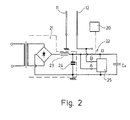
- the discharge capacitor Co has been shown as a fixed, unchangeable capacitor, the impedance of the system is also not adjustable. According to the present invention, however, an arrangement as described in FIG. 2 is chosen instead of the fixed capacitor. From this representation it can be seen that a matching device 25 is provided in parallel to the capacitor Co, one input A of which is connected to the output of the power supply unit 21, which in the present case is stabilized via a choke 23 and a filter capacitor 24, and the other input of which one electrode 12 is connected. The operation of the adjustment device 25 is described below with reference to FIG. 3 in a first embodiment.
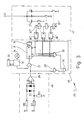
- the input A of the adjustment circuit 25 leads to a voltage divider R1, R2, whose division ratio is 1 / e.
- the divided voltage is fed to the inverting input of an operational amplifier 26.
- the second input B of the adjustment circuit 25 is connected to the non-inverting input of the operational amplifier 26 via a protective resistor R5 which has no voltage-changing influence due to the input resistance of the downstream operational amplifier 26.
- diodes D1 and D2 are connected in opposite directions, so that the voltage difference at the input of the operational amplifier 26 can not exceed the diode forward voltage.
- a voltage divider circuit (equal division ratio for both inputs) can of course be provided in front of the inputs A and B, so that the very high capacitor voltages can be reduced to the usual low levels.
- the output of the comparator circuit 45 thus formed is led to the input of a measuring circuit 46.
- the measuring circuit 46 comprises an AND gate 27 at its input, one input of which is connected to the output of the operational amplifier 26 and the other input of which is connected to a clock oscillator 34 via an adjustable divider.
- the divider 32 is connected to a setpoint adjuster 33, via which the division ratio of the divider 32 can be set.
- the output of the AND gate 27 is fed to the counter input Up of a binary counter 31.
- the counter outputs 1 to n of the counter 31 are routed to the inputs of an OR gate 30, the output of which is routed to a further AND gate 29.
- a second input of the AND gate 29 is connected to the output of the operational amplifier 26 via an inverter 28.
- the output of the AND gate 29 is at the input of a delay element 35, which emits a pulse after a certain period of time after a positive voltage jump has been applied to its output. This pulse is fed to the reset input R of the counter 31.
- the count outputs 1 to n of the binary counter 31 are also each guided to a D flip-flop 36 1 -36 n , the C inputs of which are all on the output of the AND gate 29.
- the outputs Q of the D flip-flops are led to the excitation coils of relay 371-37 n , which have make contacts, the one hand with (a virtual) ground, the other are connected to the first poles of capacitors.
- the other poles of the capacitors are brought together and led out of the balancing device 25 as common connections D.
- the capacitors are connected in parallel to the capacitor Co.
- the capacitance values of the capacitors are now selected so that the lowest digit 1 of the counter 31 connects a capacitor with the capacitance C in parallel to the capacitor Co, while the most significant digit n of the counter 31 corresponds to a capacitor with the value 2 n ⁇ C.
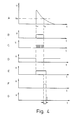
- Figure 4A shows the course of the voltage U of a discharge pulse over time t.
- This pulse curve is present at input B of the adjustment device 25.
- the charging voltage that is to say the output voltage of the power supply unit 21
- the output of the operational amplifier 26 jumps to its maximum (positive) output voltage, as shown in FIG. 4B.
- the output at the operational amplifier 26 drops to its zero value or its negative value.
- the AND gate 27 allows the pulses generated by the clock oscillator 34 and divided down by the divider 32 into the counting input of the counter 31. This is shown in FIG. 4C.
- the output of the AND gate 29 jumps to a positive value, since at this time the output of the inverter 28 jumps to a positive value and the output of the OR Gate 30 is still at a positive value.
- This positive output value which is shown in Fig. 4F, on the one hand reaches the C inputs of the D flip-flops 36 1 -36 n , so that these have the pending values at the outputs 1 to n of the counter 31 via their D inputs take over.
- the voltage jump of the AND gate 29 triggers the delay circuit 35, which emits an output pulse of a defined length after a delay time t v , as shown in FIG. 4G.
- the output pulse of the delay circuit 35 resets the counter 31 so that the next measuring process can begin.
- the adopted in the D flip-flops 361-36 n output values of the counter 31 cause the capacitors to be switched on or off according to the counted value.
- the time constant is measured directly and “translated” into a time-proportional capacitance value.
- the capacitor Co is designed so that the time constant defined by it is smaller than the desired time constant. If the first voltage pulse is measured when the system is started up, a number of counting pulses, which can be defined via the divider 32, runs into the counter 31, so that after the end of the first voltage pulse some capacitors run parallel to the condenser sator Co are connected.
- the desired value can be preset using the partial ratio of the divider 32 or the setpoint adjuster 33.
- the balancing device 125 is connected in series with the capacitor Co.
- the compensation circuit 47 is designed as a series connection of resistors R, 2 ⁇ R, 2 n ⁇ R. These resistors can be included in the series connection or short-circuited via the relay 371-37 n .
- the decay constant of the discharge circuit changes depending on the change in resistance.
- the measuring circuit 46 is modified from the previously described form in that the outputs 1 to n of the counter 31 are additionally routed to a digital comparator 38, the other inputs of which are routed to a limit value adjuster 39.
- the comparator 38 compares the values counted in the counter 31 with the value set in the limit value adjuster 39 and then emits a signal to a warning lamp 40 when the set value is exceeded.
- a warning signal can be given when the compensation circuit 47 has reached its limit, for example, that is to say all the resistors are in series or all the resistors are short-circuited.
- the divider 32 is set via a microprocessor 41, which is programmable via an input unit 42.
- the microprocessor 41 At an input of the microprocessor 41 are the outputs of a transducer 43 which converts the output signals of a sensor 44 into digital words.
- the sensor 44 is designed and mounted in the reactor 10 in such a way that it measures the parameter that needs to be optimized. If, for example, the reactor 10 is used to generate methane (biogas), the sensor 44 can be a flow sensor that measures the volume flow flowing in the gas line 18. The optimization process takes place in such a way that the microprocessor 41 first saves a measured value of the sensor 44 and then sets the counter 32 to a randomly selected value.
- the microprocessor 41 After a certain period of time, which is determined by the operating speed of the system, the microprocessor 41 again samples the measured value at the sensor 44 and compares it with the previously obtained measured value. If the new measured value has changed compared to the previous measured value in the sense of an optimization, the next change attempt for the division ratio will keep the new measured value as the basis, which will be changed (slightly). If the measured value obtained first was "better", the microprocessor 41 starts from this first measured value. In this way, an optimization can be achieved, which is particularly quick (in a few steps) if the randomly selected values are distributed according to a Gaussian distribution around the optimal value found so far, in that small changes are more frequent than large changes ( Principle of evolution).
- a modified adjustment device 225 is provided which is also connected (as in FIG. 2) in parallel to the capacitor Co, but has no further inputs.
- the voltage across the capacitor Co is passed through a diode D4 to a capacitor CT, with a corresponding polarity of the power supply unit 21 being required here.
- the same voltage minus the forward voltage of the diode D4
- the capacitor CT Discharges the capacitor Co, then the point D is at a lower potential than the corresponding connection point of the capacitor CT, so that the diode D4 blocks.
- a high-resistance resistor R3 is connected, through which the capacitor CT can discharge very slowly, which is necessary in order to be able to take effect a possible change in the mains voltage.
- the capacitor CT is again connected to the voltage divider R1, R2, the output voltage of which sits on the inverting input of the operational amplifier 26.
- the same potential point D is passed through a protective resistor R5 to a high pass consisting of capacitor CH and resistor R4.
- the output of the high pass is led to the cathode of a diode D3, the anode of which lies on the non-inverting input of the operational amplifier 26. If the capacitor is charged once, the maximum voltage (corresponding to the power supply output voltage) on the capacitor CT is maintained even during the discharge (with appropriate dimensioning of the resistor R3), so that the threshold voltage U s described at the inverting input of the operational amplifier 26 lies.
- the drop in voltage across the capacitor Co is, however, communicated via the high-pass filter CH / R4 and the diode D3 to the non-inverting input of the operational amplifier 26, so that the pulse shape of the capacitor discharge curve shown in FIG.
Landscapes
- Engineering & Computer Science (AREA)
- Life Sciences & Earth Sciences (AREA)
- Chemical & Material Sciences (AREA)
- Organic Chemistry (AREA)
- Wood Science & Technology (AREA)
- Zoology (AREA)
- Genetics & Genomics (AREA)
- Bioinformatics & Cheminformatics (AREA)
- Health & Medical Sciences (AREA)
- Biotechnology (AREA)
- General Engineering & Computer Science (AREA)
- Environmental & Geological Engineering (AREA)
- Hydrology & Water Resources (AREA)
- Biomedical Technology (AREA)
- Polymers & Plastics (AREA)
- Food Science & Technology (AREA)
- Microbiology (AREA)
- Biochemistry (AREA)
- Water Supply & Treatment (AREA)
- General Health & Medical Sciences (AREA)
- Physical Or Chemical Processes And Apparatus (AREA)
- Apparatus Associated With Microorganisms And Enzymes (AREA)
- Food Preservation Except Freezing, Refrigeration, And Drying (AREA)
- Immobilizing And Processing Of Enzymes And Microorganisms (AREA)
- Water Treatment By Electricity Or Magnetism (AREA)
- Measuring Or Testing Involving Enzymes Or Micro-Organisms (AREA)
- Treatments Of Macromolecular Shaped Articles (AREA)
- Investigating Or Analyzing Materials By The Use Of Electric Means (AREA)
Priority Applications (1)
| Application Number | Priority Date | Filing Date | Title |
|---|---|---|---|
| AT88101980T ATE88498T1 (de) | 1987-03-18 | 1988-02-11 | Verfahren und vorrichtung zur behandlung von stoffen und/oder mikro-organismen mit elektroimpulsen. |
Applications Claiming Priority (2)
| Application Number | Priority Date | Filing Date | Title |
|---|---|---|---|
| DE3708775 | 1987-03-18 | ||
| DE19873708775 DE3708775A1 (de) | 1987-03-18 | 1987-03-18 | Verfahren und vorrichtung zur behandlung von stoffen und/oder mikro-organismen mit elektroimpulsen |
Publications (3)
| Publication Number | Publication Date |
|---|---|
| EP0283700A2 true EP0283700A2 (fr) | 1988-09-28 |
| EP0283700A3 EP0283700A3 (en) | 1989-08-09 |
| EP0283700B1 EP0283700B1 (fr) | 1993-04-21 |
Family
ID=6323359
Family Applications (1)
| Application Number | Title | Priority Date | Filing Date |
|---|---|---|---|
| EP88101980A Expired - Lifetime EP0283700B1 (fr) | 1987-03-18 | 1988-02-11 | Procédé et appareil de traitement de produits et/ou de micro-organismes par des impulsions électriques |
Country Status (6)
| Country | Link |
|---|---|
| EP (1) | EP0283700B1 (fr) |
| AT (1) | ATE88498T1 (fr) |
| AU (1) | AU1123588A (fr) |
| DE (2) | DE3708775A1 (fr) |
| NO (1) | NO880437L (fr) |
| NZ (1) | NZ223394A (fr) |
Cited By (5)
| Publication number | Priority date | Publication date | Assignee | Title |
|---|---|---|---|---|
| US7732175B2 (en) | 2004-06-14 | 2010-06-08 | Lonza Cologne Ag | Method and circuit arrangement for treating biomaterial |
| FR2943892A1 (fr) * | 2009-04-07 | 2010-10-08 | Commissariat Energie Atomique | Procede de permeabilisation membranaire de cellules biologiques par l'utilisation d'un champ electrique pulse. |
| US8173416B2 (en) | 2001-04-23 | 2012-05-08 | Lonza Cologne Gmbh | Circuit arrangement for injecting nucleic acids and other biologically active molecules into the nucleus of higher eucaryotic cells using electrical current |
| EP3861863A1 (fr) * | 2020-02-07 | 2021-08-11 | Bühler AG | Dispositif à réglage de conductivité pour le traitement de cellules |
| US12559709B2 (en) | 2020-02-07 | 2026-02-24 | Bühler AG | Modified treatment chamber for treating cells |
Families Citing this family (2)
| Publication number | Priority date | Publication date | Assignee | Title |
|---|---|---|---|---|
| DE102008033049B4 (de) * | 2008-07-14 | 2011-07-07 | Harrendorf, Heinz, Dipl.-Ing., 30539 | Biogasanlage zur anaeroben und einer elektrodynamischen Behandlung von Substraten mittels eines kaskadierten Biogasreaktors |
| DE102018201480A1 (de) | 2018-01-31 | 2019-08-01 | Elea Vertriebs- Und Vermarktungsgesellschaft Mbh | Verfahren und System zur Prozessüberwachung der Behandlung von Medien, insbesondere HACCP-konformes Verfahren beziehungsweise System zur Haltbarmachung von Lebensmitteln |
Family Cites Families (4)
| Publication number | Priority date | Publication date | Assignee | Title |
|---|---|---|---|---|
| US3095359A (en) * | 1959-11-16 | 1963-06-25 | New England Inst For Medical R | High-frequency treatment of matter |
| BE755310A (fr) * | 1969-08-26 | 1971-02-01 | Mueszeripari Muevek Lab | Procede et dispositif pour traiter des liquides a l'aide de champs electriques |
| DE2558750C3 (de) * | 1975-12-24 | 1980-04-03 | Kernforschungsanlage Juelich Gmbh, 5170 Juelich | Herstellung einer Masse von in einer physiologischen Lösung suspendierten, eine Zellwand aufweisenden lebenden Zellen von Lebewesen |
| JPS60105495A (ja) * | 1983-11-11 | 1985-06-10 | Shinryo Air Conditioning Co Ltd | 微生物の生反応促進方法 |
-
1987
- 1987-03-18 DE DE19873708775 patent/DE3708775A1/de not_active Withdrawn
-
1988
- 1988-02-01 NO NO880437A patent/NO880437L/no unknown
- 1988-02-02 NZ NZ223394A patent/NZ223394A/en unknown
- 1988-02-03 AU AU11235/88A patent/AU1123588A/en not_active Abandoned
- 1988-02-11 AT AT88101980T patent/ATE88498T1/de active
- 1988-02-11 DE DE8888101980T patent/DE3880354D1/de not_active Expired - Fee Related
- 1988-02-11 EP EP88101980A patent/EP0283700B1/fr not_active Expired - Lifetime
Cited By (11)
| Publication number | Priority date | Publication date | Assignee | Title |
|---|---|---|---|---|
| US8173416B2 (en) | 2001-04-23 | 2012-05-08 | Lonza Cologne Gmbh | Circuit arrangement for injecting nucleic acids and other biologically active molecules into the nucleus of higher eucaryotic cells using electrical current |
| US7732175B2 (en) | 2004-06-14 | 2010-06-08 | Lonza Cologne Ag | Method and circuit arrangement for treating biomaterial |
| US8058042B2 (en) | 2004-06-14 | 2011-11-15 | Lonza Cologne Gmbh | Method and circuit arrangement for treating biomaterial |
| FR2943892A1 (fr) * | 2009-04-07 | 2010-10-08 | Commissariat Energie Atomique | Procede de permeabilisation membranaire de cellules biologiques par l'utilisation d'un champ electrique pulse. |
| WO2010115875A1 (fr) * | 2009-04-07 | 2010-10-14 | Commissariat à l'énergie atomique et aux énergies alternatives | Procede de permeabilisation membranaire de cellules biologiques par l'utilisation d'un champ electrique pulse |
| EP3861863A1 (fr) * | 2020-02-07 | 2021-08-11 | Bühler AG | Dispositif à réglage de conductivité pour le traitement de cellules |
| WO2021156372A1 (fr) * | 2020-02-07 | 2021-08-12 | Bühler AG | Dispositif à réglage de conductivité pour traiter des cellules |
| CN115023145A (zh) * | 2020-02-07 | 2022-09-06 | 布勒股份公司 | 用于处理细胞的电导率调节装置 |
| AU2021217182B2 (en) * | 2020-02-07 | 2023-11-23 | Bühler AG | Conductivity-adjusted device for treating cells |
| CN115023145B (zh) * | 2020-02-07 | 2024-07-23 | 布勒股份公司 | 用于处理细胞的电导率调节装置 |
| US12559709B2 (en) | 2020-02-07 | 2026-02-24 | Bühler AG | Modified treatment chamber for treating cells |
Also Published As
| Publication number | Publication date |
|---|---|
| DE3708775A1 (de) | 1988-09-29 |
| EP0283700A3 (en) | 1989-08-09 |
| NZ223394A (en) | 1990-11-27 |
| ATE88498T1 (de) | 1993-05-15 |
| NO880437D0 (no) | 1988-02-01 |
| DE3880354D1 (de) | 1993-05-27 |
| AU1123588A (en) | 1988-09-22 |
| NO880437L (no) | 1988-09-19 |
| EP0283700B1 (fr) | 1993-04-21 |
Similar Documents
| Publication | Publication Date | Title |
|---|---|---|
| DE69400966T2 (de) | Verfahren und Vorrichtung zur Verbesserung der Wasserqualität | |
| EP0148380B1 (fr) | Procédé de traitement par des impulsions électriques et dispositif de traitement des matières | |
| DE2314398B2 (de) | Einrichtung zur Erzeugung von Ozon | |
| DE60100765T2 (de) | Verfahren und Vorrichtung zum Konservieren von Nahrungsmitteln in einem gepulsten elektrischen Feld | |
| DE1557099A1 (de) | Verfahren und Vorrichtung zur Regelung der Arbeitsspannung eines elektrostatischen Staubabscheiders | |
| DE2824326A1 (de) | Stromversorgung fuer elektrische bearbeitung | |
| EP0283700B1 (fr) | Procédé et appareil de traitement de produits et/ou de micro-organismes par des impulsions électriques | |
| DE2362924C2 (de) | Funkenerosives Bearbeitungsverfahren | |
| DE3805813C2 (fr) | ||
| DE3538194A1 (de) | Verfahren zur stoffwechsel- und/oder wachstumssteigernden behandlung von mikroorganismen sowie vorrichtung zur durchfuehrung des verfahrens | |
| DE3439140C2 (fr) | ||
| DE2641580C2 (de) | Verfahren und Einrichtung zum Einstellen der Frequenz eines piezoelektrischen Schwingquarzes | |
| DE3346744A1 (de) | Schaltungsanordnung zum ueberpruefen der lage von elektroden | |
| DE919961C (de) | Elektromedizinischer Reizstromtherapieapparat | |
| DE2824086A1 (de) | Generator zum erzeugen von impulsen fuer die elektrisch abtragende metallbearbeitung | |
| DE10009643A1 (de) | Vorrichtung und Verfahren zum Behandeln von Verunreinigungen enthaltendem Wasser | |
| DE2261979A1 (de) | Elektronische schaltung mit batteriespannungs-ueberwachung | |
| DE3153067T (de) | Verfahren und Vorrichtung zum Abtöten von Organismen in einem Wirtsmaterial | |
| DE4101076A1 (de) | Verfahren und vorrichtung zur behandlung mehrphasiger stoffe | |
| CH658507A5 (en) | Electrode boiler | |
| AT390883B (de) | Verfahren zum dampfsterilisieren oder desinfizieren von poroesen guetern | |
| EP0377411A2 (fr) | Procédé et dispositif de déminéralisation de l'eau douce par électrolyse | |
| DE4041598C1 (fr) | ||
| DE2037767A1 (de) | Röntgendiagnostikapparat für kurze Belichtungszeiten | |
| DE2438881C2 (de) | Elektroabscheider |
Legal Events
| Date | Code | Title | Description |
|---|---|---|---|
| PUAI | Public reference made under article 153(3) epc to a published international application that has entered the european phase |
Free format text: ORIGINAL CODE: 0009012 |
|
| AK | Designated contracting states |
Kind code of ref document: A2 Designated state(s): AT BE CH DE ES FR GB GR IT LI LU NL SE |
|
| PUAL | Search report despatched |
Free format text: ORIGINAL CODE: 0009013 |
|
| AK | Designated contracting states |
Kind code of ref document: A3 Designated state(s): AT BE CH DE ES FR GB GR IT LI LU NL SE |
|
| 17P | Request for examination filed |
Effective date: 19890819 |
|
| 17Q | First examination report despatched |
Effective date: 19920703 |
|
| GRAA | (expected) grant |
Free format text: ORIGINAL CODE: 0009210 |
|
| AK | Designated contracting states |
Kind code of ref document: B1 Designated state(s): AT BE CH DE ES FR GB GR IT LI LU NL SE |
|
| PG25 | Lapsed in a contracting state [announced via postgrant information from national office to epo] |
Ref country code: SE Effective date: 19930421 Ref country code: NL Effective date: 19930421 Ref country code: IT Free format text: LAPSE BECAUSE OF FAILURE TO SUBMIT A TRANSLATION OF THE DESCRIPTION OR TO PAY THE FEE WITHIN THE PRE;WARNING: LAPSES OF ITALIAN PATENTS WITH EFFECTIVE DATE BEFORE 2007 MAY HAVE OCCURRED AT ANY TIME BEFORE 2007. THE CORRECT EFFECTIVE DATE MAY BE DIFFERENT FROM THE ONE RECORDED.SCRIBED TIME-LIMIT Effective date: 19930421 Ref country code: GR Free format text: LAPSE BECAUSE OF FAILURE TO SUBMIT A TRANSLATION OF THE DESCRIPTION OR TO PAY THE FEE WITHIN THE PRESCRIBED TIME-LIMIT Effective date: 19930421 Ref country code: GB Effective date: 19930421 Ref country code: ES Free format text: THE PATENT HAS BEEN ANNULLED BY A DECISION OF A NATIONAL AUTHORITY Effective date: 19930421 Ref country code: BE Effective date: 19930421 |
|
| REF | Corresponds to: |
Ref document number: 88498 Country of ref document: AT Date of ref document: 19930515 Kind code of ref document: T |
|
| REF | Corresponds to: |
Ref document number: 3880354 Country of ref document: DE Date of ref document: 19930527 |
|
| ET | Fr: translation filed | ||
| NLV1 | Nl: lapsed or annulled due to failure to fulfill the requirements of art. 29p and 29m of the patents act | ||
| GBV | Gb: ep patent (uk) treated as always having been void in accordance with gb section 77(7)/1977 [no translation filed] |
Effective date: 19930421 |
|
| PG25 | Lapsed in a contracting state [announced via postgrant information from national office to epo] |
Ref country code: AT Effective date: 19940211 |
|
| PLBE | No opposition filed within time limit |
Free format text: ORIGINAL CODE: 0009261 |
|
| STAA | Information on the status of an ep patent application or granted ep patent |
Free format text: STATUS: NO OPPOSITION FILED WITHIN TIME LIMIT |
|
| PG25 | Lapsed in a contracting state [announced via postgrant information from national office to epo] |
Ref country code: LU Free format text: LAPSE BECAUSE OF NON-PAYMENT OF DUE FEES Effective date: 19940228 Ref country code: LI Effective date: 19940228 Ref country code: CH Effective date: 19940228 |
|
| 26N | No opposition filed | ||
| PG25 | Lapsed in a contracting state [announced via postgrant information from national office to epo] |
Ref country code: FR Effective date: 19941031 |
|
| REG | Reference to a national code |
Ref country code: CH Ref legal event code: PL |
|
| PG25 | Lapsed in a contracting state [announced via postgrant information from national office to epo] |
Ref country code: DE Effective date: 19941101 |
|
| REG | Reference to a national code |
Ref country code: CH Ref legal event code: AUV Free format text: DAS OBENGENANNTE PATENT, IST MANGELS BEZAHLUNG DER 7. JAHRESGEBUEHR, GELOESCHT WORDEN. |
|
| REG | Reference to a national code |
Ref country code: FR Ref legal event code: ST |