EP0283743B1 - Dispositif de reconnaissance de formes - Google Patents
Dispositif de reconnaissance de formes Download PDFInfo
- Publication number
- EP0283743B1 EP0283743B1 EP88102646A EP88102646A EP0283743B1 EP 0283743 B1 EP0283743 B1 EP 0283743B1 EP 88102646 A EP88102646 A EP 88102646A EP 88102646 A EP88102646 A EP 88102646A EP 0283743 B1 EP0283743 B1 EP 0283743B1
- Authority
- EP
- European Patent Office
- Prior art keywords
- data
- pattern
- memory
- feature data
- input signal
- Prior art date
- Legal status (The legal status is an assumption and is not a legal conclusion. Google has not performed a legal analysis and makes no representation as to the accuracy of the status listed.)
- Expired - Lifetime
Links
- 238000003909 pattern recognition Methods 0.000 title claims description 11
- 230000015654 memory Effects 0.000 claims description 36
- 238000005070 sampling Methods 0.000 claims description 10
- 238000001228 spectrum Methods 0.000 claims description 6
- 238000012952 Resampling Methods 0.000 claims 4
- 238000001914 filtration Methods 0.000 claims 2
- 238000001514 detection method Methods 0.000 description 14
- 238000010586 diagram Methods 0.000 description 9
- 238000000034 method Methods 0.000 description 7
- 230000006870 function Effects 0.000 description 5
- 230000003247 decreasing effect Effects 0.000 description 3
- 239000000284 extract Substances 0.000 description 3
- 238000010606 normalization Methods 0.000 description 3
- 238000012545 processing Methods 0.000 description 3
- 238000012546 transfer Methods 0.000 description 3
- 238000006243 chemical reaction Methods 0.000 description 2
- 238000013479 data entry Methods 0.000 description 1
- 230000001419 dependent effect Effects 0.000 description 1
- 230000004044 response Effects 0.000 description 1
- 230000003595 spectral effect Effects 0.000 description 1
- 238000012549 training Methods 0.000 description 1
Images





Classifications
-
- B—PERFORMING OPERATIONS; TRANSPORTING
- B66—HOISTING; LIFTING; HAULING
- B66C—CRANES; LOAD-ENGAGING ELEMENTS OR DEVICES FOR CRANES, CAPSTANS, WINCHES, OR TACKLES
- B66C15/00—Safety gear
- B66C15/04—Safety gear for preventing collisions, e.g. between cranes or trolleys operating on the same track
-
- G—PHYSICS
- G10—MUSICAL INSTRUMENTS; ACOUSTICS
- G10L—SPEECH ANALYSIS TECHNIQUES OR SPEECH SYNTHESIS; SPEECH RECOGNITION; SPEECH OR VOICE PROCESSING TECHNIQUES; SPEECH OR AUDIO CODING OR DECODING
- G10L25/00—Speech or voice analysis techniques not restricted to a single one of groups G10L15/00 - G10L21/00
- G10L25/78—Detection of presence or absence of voice signals
- G10L25/87—Detection of discrete points within a voice signal
-
- G—PHYSICS
- G10—MUSICAL INSTRUMENTS; ACOUSTICS
- G10L—SPEECH ANALYSIS TECHNIQUES OR SPEECH SYNTHESIS; SPEECH RECOGNITION; SPEECH OR VOICE PROCESSING TECHNIQUES; SPEECH OR AUDIO CODING OR DECODING
- G10L15/00—Speech recognition
- G10L15/08—Speech classification or search
- G10L15/10—Speech classification or search using distance or distortion measures between unknown speech and reference templates
Definitions
- the present invention relates to a pattern recognition apparatus for recognizing an input signal and, more particularly, to a pattern recognition apparatus suitable for implementation as an integrated circuit.
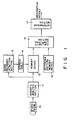
- Fig. 1 is a block diagram showing a conventional arrangement of a speech recognition apparatus as one type of pattern recognition apparatuses.
- a voice signal input by a voice signal input means such as microphone 10 is supplied to acoustic analysis section 11.
- voice features such as frequency spectra are analyzed in units of predetermined frame lengths (normally, several ms to several tens of ms), and feature data is time-serially extracted.
- a word boundary i.e., start and end points of an effective voice are detected by word boundary detection section 13.
- the start and end points of the effective word detected by section 13 are supplied to address table 14 of memory device 12.
- Based on an output address from the address table 14, a data string in a specific voiced period or in a word boundaries is fetched from memory device 12 as recognition data, and is supplied to similarity computing section 15.
- Reference pattern memory device 16 stores a large number of reference pattern data. Similarity computing section 15 performs similarity computation between these reference pattern data and the data strings fetched from memory device 12. The computation result is supplied to determining section 17, and voice data corresponding to the reference pattern having the maximum similarity is output as a recognition result.
- a word period duration when the reference pattern data is stored in memory device 16 does not often coincide with an input word period duration to be recognized. For this reason, when data to be recognized is fetched from memory device 12, the fetched data is time-serially normalized in correspondence with the duration of the reference pattern data, and then, the similarity computation must be performed.
- time normalization is used because people do not time their pronunciations of a word consistently.
- the system extracts 16 evenly spaced samples from the stored speech data. The spacing is calculated by dividing the number of input samples by 16 and then using the quotient as an index increment. If the number of samples is not a multiple of 16, then the index increment is increased by one during the first skips, where r is the remainder resulting from this division.
- time normalization After time normalization has been completed a 128-byte array pattern of 16 samples by 8 bands is left.
- This normalized input is then either stored in a template area or it is compared with each template in the vocabulary to find the closest match; in other words, the recognizer is supplied with a single arbitrary representation of the word to be recognized, so that word boundary detection errors may arise.
- prior art document US-A-3 943 295 discloses an apparatus and method for recognizing words from among continuous speech; this known apparatus comprises a plurality of modules, one module for each of the vocabulary words of the system. Each module comprises a sequential logic circuitry in conjunction with count storage registers and comparators. In such continuous speech processing a parallel processing is, of course, needed, since a continuous speech should be cut before performing processing operations.
- the present invention provides a pattern recognition apparatus as specified in claim 1 or 8.
- the second memory section which can be accessed by only the recognition computing section is prepared, and data to be recognized fetched by the data fetch section is time-serially normalized and stored in the second memory section.
- the feature data obtained from the input signal is stored in the first memory section. Therefore, the first memory section can be accessed independently of the recognition computation.
- Fig. 2 is a view for explaining functions of an embodiment of a speech recognition apparatus to which the present invention is applied.
- an analog voice signal input from microphone 20 is supplied to acoustic analysis section 21.
- Acoustic analysis section 21 extracts digital feature data from the input voice signal using a combination of a filter bank including a serially connected rectifier, an analog band-pass filter and a low-pass filter and an analog-to-digital (A/D) converter for converting the output from the filter bank into digital data.
- a word boundary of a input speech period is detected from the extracted feature data by word boundary detection section 22 and is stored in first memory device 23.
- Energy components of input voice data are extracted by acoustic analysis section 21 using a broad-band band-pass filter.
- a position where the energy components first exceed the threshold value is determined as a start point or a start frame.
- a position where the energy components are first decreased below the threshold value is determined as an end point or an end frame of a word.
- high and low threshold values are determined, and when energy components reach the high threshold value from the low threshold value within a predetermined period of time, the frame corresponding to the low threshold value is determined as a start frame of a word.
- the feature data of input voice data obtained by detecting the word boundary is normally time-serially sampled at a given sampling frequency. Assuming that the number of samples is given by N frames, N changes depending on the word boundary.
- the N frame data is normalized along with the time base to obtain M frame data having a fixed duration.
- the feature data stored in first memory device 23 is re-sampled by re-sampling section 24, and is normalized along the time base. Then, the normalized data is transferred to second memory device 25 and is stored therein.
- the data string stored in second memory device 25 is fetched as data to be recognized, and is supplied to similarity computing section 26.
- the similarity computation can be executed by a known method disclosed in such as U.S. Patent No. 4,624,011.
- Reference pattern memory device 27 stores a large number of reference pattern data. Similarity computing section 26 performs the similarity computation between these reference pattern data and the data string fetched from second memory device 25. The computation result or similarity data is supplied to determining section 28, and a word number corresponding to the reference pattern having the maximum similarity is determined. The determined number is output as a recognition result.
- second memory device 25 separate from the first memory device for storing data to be recognized is accessed to read out data for similarity computation. Therefore, no complicated address computation is required, and data can be fetched only by sequentially addressing second memory device 25.
- similarity computing section 26 accesses data to be recognized, only a read control signal and an address count-up signal are required. For this reason, the arrangement of a control circuit can be simplified, and the number of hardware components for an integrated circuit can be reduced.
- the re-sampled data stored in second memory device 25 requires a capacity 1/10 or less the feature data stored in first memory device 23. For this reason, only one first memory device 23 need to be prepared even when a plurality of similarity computing sections are required in the case wherein word boundary detection is performed based on a plurality of algorithms in order to detect a plurality of word boundaries or wherein a plurality of periods are detected to obtain a plurality of candidates based on a specific algorithm.
- the area of second memory device 25 is 0.1 and that of similarity computing section 26 is 0.3 when the area of first memory device 23 is assumed to be 1. Therefore, even when a plurality of similarity computing sections must be prepared on the chip, only one first memory device 23 which occupies a large area need be prepared, thus advantageously reducing a chip area.
- Fig. 3 is a block diagram showing an arrangement of the apparatus of this embodiment for realizing the functions shown in Fig. 2.
- Acoustic analysis section 21 may be constituted by an analog processor for analyzing frequency components, energy components, and so forth in a voice signal input through microphone 20.
- Analog processor 21 incorporates a filter bank 21A and A/D converter 21B, and extracts predetermined acoustic features from the input voice signal upon instruction from CPU 30 through bus B.
- Reference numeral 31 denotes a digital processor which incorporates first memory device 23, recognition computing section 32, and external interface section (I/F) 33.
- Recognition computing section 32 incorporates similarity computing section 26, second memory device 25, and reference pattern memory device 27. Of the functions shown in Fig. 2, those corresponding to word boundary detecting section 22, re-sampling section 24, and determining section 28 are realized by CPU 30.
- Filter bank 21A in acoustic analysis section 21 comprises 7-channel band-pass filters.
- the band-pass filter rectifiers and low-pass filters has characteristics shown in Figs. 4 and 5.
- the rectifier rectifies outputs of the band-pass filter and delivers the rectified signal to the succeeding low-pass filter which allows a signal of less than 50 Hz to pass therethrough.
- Frequency components included in a human voice are extracted using 6-channel (CH1 to CH6) band-pass filters, as shown in Fig. 4, and the extracted data is used for the similarity computation as input voice feature data.
- the 7th band-pass filter passes a signal having a main frequency range, e.g., 50 Hz to 5,000 Hz included in the human voice.
- An output extracted by the 7th- channel (CH7) band-pass filter is used for detecting energy components of input voice data at word boundary detection section 22 shown in Fig. 2.
- the 1st- to 7th-channel filter outputs extracted by filter bank 21A are supplied to A/D converter 21B, and are subjected to non-linear conversion such as log-conversion. Thereafter, the resultant data is output as 8-bit digital feature data for each channel.
- 1-byte dummy data is added to 7-channel 8-bit feature data (8 (bit) ⁇ 7 (channel)), and the resultant 8-byte data is treated as one-frame data.
- Each frame data output from acoustic analysis section 21 is sampled by CPU 30 every 20 ms, and is sequentially stored in first memory device 23 through bus B.
- Fig. 6 shows the 8-byte data format for one frame.
- Such frame data is stored in first memory device 23 having a memory capacity corresponding to a maximum of 100 frames, as shown in Fig. 7.
- Storage data shown in Fig. 7 represents a state after word boundary detection.
- the first frame serves as voice start data point
- the 80th frame serves as voice end data.
- First memory device 23 has a ring structure, and the address order of the start and end points is often reversed.
- the 69th frame indicated by * is followed by the 70th frame indicated by **. For this reason, theoretically, data of start to end frames can be treated as continuous data.
- the number of frames of the feature data stored in first memory device 23 varies depending on a duration of voice data.
- the frame data included in one word period in first memory device 23 is read out in a predetermined cycle (sampling frequency) under the control of CPU 30, and is sequentially stored in 60-byte second memory device 25 from the first frame.
- 6-byte data (CH1 to CH6 data) is stored in second memory device 25 as feature data for the similarity computation.
- Memory device 25 always stores 60-byte data, and performs normalization along the time base.
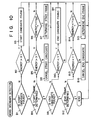
- CPU 30 causes first memory device 23 in digital processor 31 to store feature data obtained by analog processor 21, in step A1 shown in Fig. 9.
- CPU 30 also performs word boundary detection control using energy data of CH7 shown in Fig. 5, in step A2.
- CPU 30 compares the output level of the CH7 band-pass filter with a predetermined value, and detects a word boundary defined by start and end points obtained when the output level exceeds or is decreased below the predetermined value.
- YES is obtained in step A3
- re-sampling control is performed in step A4.
- CPU 30 transfers re-sampled data to second memory device 25.
- CPU 30 supplies a computation start instruction to recognition computing section 32 of digital processor 31.
- Recognition computing section 32 performs a similarity computation for all the voice patterns, e.g., syllable patterns stored in reference pattern memory device 27 using similarity computing section 26, in step A5.
- section 32 supplies a read request signal to CPU 30 in step A6 so as to request CPU 30 to read out the similarity computation results.
- CPU 30 fetches similarity computation results for all the words, CPU 30 sends out the word number having the maximum similarity to an external host system through external interface section 33.
- step B1 it is checked in step B1 if a start candidate is already found. If NO in step B1, the flow advances to step B2 to check if a voice detection (energy) level from the band-pass filter CH7 having characteristics shown in Fig. 5 is larger than predetermined value X. If YES in step B2, the flow advances to step B3, and a flag indicating that the start candidate is found is set.
- step B15 If the end is determined in step B15, YES is obtained in step B12, and the flow is ended.
- the flow advances to step C5, and value i is incremented by +1.
- the incremented value is written in an i register. It is checked in step C6 if i is smaller than 10. If YES in step C6, the flow returns to step C4, and feature of next frame is stored in second memory device 25. Similarly, the frame data is sequentially stored in second memory device 25.
- i 10 NO is obtained in step C6, and re-sampling is ended.
- Fig. 12 is a flow chart showing the content of sorting step A6 in Fig. 9 in detail.
- step D1 0 is set as a maximum similarity for a word to be recognized, and number "1" of the reference word pattern is set.
- Computing section 26 executes similarity computation of pattern data read out from second memory device 25 and reference pattern memory device 27 under the control of CPU 30.
- step D2 CPU 30 fetches the resultant similarities.
- the computed similarity is compared with preset maximum value in step D3. If the computed similarity is larger than a reset maximum value, NO is obtained in step D3, and the flow advances to step D4.
- the similarity larger than the preset maximum value is fetched as the latest maximum value, and the corresponding word number is stored in CPU 30, as a recognition result.
- step D5 a word number is incremented by +1, and it is then checked in step D6 if the operations in steps D2 to D5 are completed for all the reference words. Therefore, when the operation shown in Fig. 12 is completed for all the words, the word number providing the maximum similarity is output as recognition results from I/F 33.
- CPU 30 serves as both a control circuit for controlling the entire operation, and determining section 28 in Fig. 2.
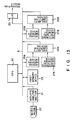
- Fig. 13 is a block diagram showing an arrangement of an apparatus according to a second embodiment of the present invention.
- Reference numeral 21 denotes an analog processor, incorporating a filter bank and an A/D converter, for analyzing a voice signal input by a voice signal input means such as microphone 20.
- Reference numeral 30 denotes a CPU; 23, a first memory device; 26A and 26B, similarity computing sections; 25A and 25B, second memory devices; 27A and 27B, reference pattern memory devices; and 33, an external interface section.
- CPU 30 selects a plurality of (in this case, two) start and end points when a word boundary period is detected from feature data stored in first memory device 23, and re-samples and transfers the data to second memory devices 25A and 25B. After the transfer operation is completed, CPU 30 supplies a recognition computation start instruction to similarity computing sections 26A and 26B, and then stands by until a computation for one word is completed. The similarity computation for one word is normally completed in about 3 ms. However, since the instruction execution speed of CPU 30 is fast, i.e., 2 ⁇ s, the similarity computations are parallelly performed in two similarity computing sections 26A and 26B, and all the data can be processed without losing a computation result.
- reference pattern memory devices 27A and 27B store the identical content, the maximum one of a plurality of similarity computation results obtained for a plurality of word boundaries is determined to be a similarity for a word. Therefore, a word boundary detection error is eliminated, and a high recognition accuracy is obtained.
- reference pattern memory devices 27A and 27B store different contents
- reference pattern data number is doubled as compared to a case wherein only one reference pattern memory device is provided, and a similarity of an input voice signal having a large number of vocabulary can be obtained at a speed twice that of the apparatus shown in Fig. 3.
- the similarity computation is performed in two similarity computing sections 26A and 26B.
- Three or more similarity computing sections can be prepared to obtain higher recognition efficiency or to obtain a similarity at high speed.
- Fig. 14 is a block diagram showing an arrangement of an apparatus according to a third embodiment of the present invention.
- one reference pattern memory device 27 is provided, and is commonly used by different similarity computing sections.
- input voices having a larger number of vocabulary cannot be recognized at high speed.
- word boundary detection precision can be improved with a small number of hardware components, and a high recognition efficiency can be obtained.
- a pattern recognition apparatus which can provide a high recognition efficiency and can be constituted with a smaller number of hardware components can be provided.
Landscapes
- Engineering & Computer Science (AREA)
- Computational Linguistics (AREA)
- Health & Medical Sciences (AREA)
- Audiology, Speech & Language Pathology (AREA)
- Human Computer Interaction (AREA)
- Physics & Mathematics (AREA)
- Acoustics & Sound (AREA)
- Multimedia (AREA)
- Signal Processing (AREA)
- Mechanical Engineering (AREA)
- Image Analysis (AREA)
- Image Processing (AREA)
- Control Of Position, Course, Altitude, Or Attitude Of Moving Bodies (AREA)
Claims (15)
- Appareil de reconnaissance de motif comprenant :
un moyen (21) pour extraire des données de caractéristique de motif représentant une caractéristique de motif d'un signal d'entrée incluant des durées indiquant des périodes de signal efficace ;
un premier moyen de mémoire (23) pour stocker les données de caractéristique de motif extraites ;
un moyen (24, 30) pour ré-échantillonner des données de caractéristique de motif défini incluses dans les données de caractéristique de motif stockées dans ledit premier moyen de mémoire (23), ledit moyen de ré-échantillonnage (24, 30) incluant un moyen pour définir une pluralité de durées indiquant une pluralité de différentes périodes de signal efficace des données de caractéristique de motif stockées dans ledit premier moyen de mémoire (23) ;
un second moyen de mémoire (25) comportant une pluralité d'unités de mémoire (25A, 25B) pour stocker les données de caractéristique de motif défini lues par ledit moyen de ré-échantillonnage (24, 30) ;
un moyen (27) pour stocker des données de motif de référence ;
un moyen de calcul de similarité (26) incluant des sections de calcul de similarité (26A, 26B) correspondant en nombre à ladite pluralité d'unités de mémoire (25A, 25B), chacune desdites sections de calcul calculant des similarités entre les données de caractéristique de motif défini lues dans ledit second moyen de mémoire (25) et lesdites données de motif de référence lues dans ledit moyen de stockage de données de motif de référence ; et
un moyen (28) pour déterminer la caractéristique de motif du signal d'entrée sur la base des similarités calculées. - Appareil selon la revendication 1 caractérisé en ce que :
ledit moyen d'extraction de données de caractéristique de motif (21) inclut un premier moyen de filtre (21A) pour extraire des données de spectre de fréquence du signal d'entrée et un second moyen de filtre (21A) pour extraire des données de niveau d'énergie du signal d'entrée ;
ledit premier moyen de mémoire (23) stocke les données de spectre de fréquence en provenance dudit premier moyen de filtre (21A) ; et
ledit moyen de ré-échantillonnage (24, 30) inclut un moyen pour déterminer les différentes périodes de signal efficace conformément aux données de niveau d'énergie en provenance dudit second moyen de filtre (21A). - Appareil selon la revendication 2, caractérisé en ce que :
le signal d'entrée est un signal vocal ;
les données de motif de référence représentent une pluralité de motifs vocaux de référence ; et
ledit moyen de détermination de motif inclut un moyen pour déterminer le signal vocal d'entrée sur la base des similarités calculées. - Appareil selon la revendication 1, caractérisé en ce que ledit moyen d'extraction de données de caractéristique de motif (21) inclut :
une batterie de filtres (21A) pour filtrer, en utilisant une pluralité de canaux de fréquence, ledit signal d'entrée échantillonné obtenu en échantillonnant le signal d'entrée selon le cycle de cadre prédéterminé ; et
un moyen (21B) pour convertir de la forme analogique à la forme numérique la sortie en provenance de ladite batterie de filtres (21A) et pour former des données de cadre. - Appareil selon la revendication 1, caractérisé en ce que le premier moyen de mémoire (23) présente une structure en anneau.
- Appareil selon la revendication 1, caractérisé en ce que les données de motif de référence sont émises en sortie depuis une pluralité de mémoires de motifs de référence (27A, 27B) prévues en correspondance avec ladite pluralité de sections de calcul de similarité (26A, 26B).
- Appareil selon la revendication 1, caractérisé en ce que les données de motif de référence sont émises en sortie depuis une unique mémoire de motifs de référence (27) de façon commune pour ladite pluralité d'unités de mémoire.
- Appareil de reconnaissance de motif pour déterminer un motif d'un signal d'entrée, ledit appareil comprenant :
un moyen d'extraction (21) pour extraire des données de caractéristique de motif représentatives du motif à partir du signal d'entrée ;
un premier moyen de mémoire (23) couplé de façon opérationnelle au moyen d'extraction (21) pour stocker les données de caractéristique de motif extraites ;
un moyen de sélection de candidat (30) couplé de façon opérationnelle au premier moyen de mémoire (23) pour sélectionner une pluralité de données de caractéristique de motif candidates correspondant à une pluralité de durées des données de caractéristique de motif extraites, chacune des données de caractéristique de motif candidate étant ré-échantillonnée de manière à présenter une unique durée sélectionnée ;
un second moyen de mémoire (25) couplé de façon opérationnelle au moyen de sélection de candidat (30) pour stocker la pluralité de données de caractéristique de motif candidates et de données de motif de référence ;
un moyen de calcul de similarité (26) coupé de façon opérationnelle au second moyen de mémoire (25) pour calculer les similarités entre les données de caractéristique de motif candidates et les données de motif de référence ; et
un moyen de détermination couplé de façon opérationnelle au moyen de calcul de similarité (26) pour déterminer le motif du signal d'entrée sur la base de la similarité calculée. - Appareil selon la revendication 8, caractérisé en ce que :
le signal d'entrée inclut des données de spectre de fréquence et des données de niveau d'énergie ;
ledit moyen d'extraction (21) inclut un premier moyen de filtre (21A) pour extraire les données de spectre de fréquence et un second moyen de filtre (21A) pour extraire les données de niveau d'énergie ;
ledit premier moyen de mémoire (23) stocke les données de spectre de fréquence ; et
ledit moyen de sélection de candidat inclut un moyen pour déterminer les durées pour les données de caractéristique de motif candidates en relation avec les données de niveau d'énergie. - Appareil selon la revendication 9, caractérisé en ce que :
le signal d'entrée comprend un signal vocal comportant un motif vocal ;
les données de motif de référence représentent une pluralité de motifs vocaux de référence ; et
ledit moyen de détermination inclut un moyen pour faire correspondre le motif vocal à l'un sélectionné des motifs vocaux de référence sur la base de la similarité calculée. - Appareil selon la revendication 8, caractérisé en ce que ledit moyen d'extraction (21) inclut :
une batterie de filtres (21A) incluant une pluralité de canaux de fréquence pour filtrer et échantillonner le signal d'entrée lors d'un cycle de cadre prédéterminé afin de générer un signal d'entrée filtré ; et
un moyen de conversion de la forme analogique à la forme numérique (21B) couplé de façon opérationnelle à la batterie de filtres (21A) pour numériser le signal d'entrée filtré afin de former des données de cadre. - Appareil selon la revendication 8, caractérisé en ce que ledit premier moyen de mémoire (23) comporte une structure en anneau.
- Appareil selon la revendication 8, caractérisé en ce que :
ledit second moyen de mémoire (25) inclut une pluralité d'unités de mémoire (25A, 25B), chacune des unités de mémoire (25A, 25B) stockant des données de cadre sélectionnées des données de caractéristique de motif candidates ; et
ledit moyen de calcul de similarité (26) inclut une pluralité de sections de calcul de similarité (26A, 26B) couplées de façon opérationnelle à certaines respectives et correspondantes desdites unités de mémoire (25A, 25B), chacune desdites sections de calcul de similarité (26A, 26B) calculant une similarité entre les données de cadre des données de caractéristique de motif candidates d'une unité de mémoire correspondante et les données de motif de référence. - Appareil selon la revendication 13, caractérisé en ce que le second moyen de mémoire (25) inclut une pluralité de mémoires de motifs de référence (27A, 27B) couplées de façon opérationnelle à certaines respectives et correspondantes desdites sections de calcul de similarité (26A, 26B), chacune desdites sections de calcul de similarité (26A, 26B) calculant une similarité entre les données de cadre des données de caractéristique candidates d'une unité de mémoire correspondante (25A, 25B) et les données de motif de référence d'une mémoire de motifs de référence correspondante.
- Appareil selon la revendication 13, caractérisé en ce que ledit second moyen de mémoire (25) inclut en outre une unique mémoire de motifs de référence (27) couplée de façon opérationnelle auxdites unités de mémoire pour stocker les données de motif de référence et pour communiquer les données de motif de référence aux unités de mémoire.
Applications Claiming Priority (2)
| Application Number | Priority Date | Filing Date | Title |
|---|---|---|---|
| JP62037787A JPH067343B2 (ja) | 1987-02-23 | 1987-02-23 | パタ−ン識別装置 |
| JP37787/87 | 1987-02-23 |
Publications (2)
| Publication Number | Publication Date |
|---|---|
| EP0283743A1 EP0283743A1 (fr) | 1988-09-28 |
| EP0283743B1 true EP0283743B1 (fr) | 1993-07-21 |
Family
ID=12507197
Family Applications (1)
| Application Number | Title | Priority Date | Filing Date |
|---|---|---|---|
| EP88102646A Expired - Lifetime EP0283743B1 (fr) | 1987-02-23 | 1988-02-23 | Dispositif de reconnaissance de formes |
Country Status (4)
| Country | Link |
|---|---|
| EP (1) | EP0283743B1 (fr) |
| JP (1) | JPH067343B2 (fr) |
| KR (2) | KR890013577A (fr) |
| DE (1) | DE3882400T2 (fr) |
Families Citing this family (7)
| Publication number | Priority date | Publication date | Assignee | Title |
|---|---|---|---|---|
| CN1013525B (zh) * | 1988-11-16 | 1991-08-14 | 中国科学院声学研究所 | 认人与不认人实时语音识别的方法和装置 |
| US5210820A (en) * | 1990-05-02 | 1993-05-11 | Broadcast Data Systems Limited Partnership | Signal recognition system and method |
| US6471420B1 (en) | 1994-05-13 | 2002-10-29 | Matsushita Electric Industrial Co., Ltd. | Voice selection apparatus voice response apparatus, and game apparatus using word tables from which selected words are output as voice selections |
| DE4417557A1 (de) * | 1994-05-19 | 1995-11-23 | Daimler Benz Aerospace Ag | Verfahren zur Erkennung von Sprachsignalen und Anordnung zum Durchführen des Verfahrens |
| KR100396748B1 (ko) * | 1996-12-23 | 2003-11-28 | 엘지전자 주식회사 | 유음구간추출처리장치및방법 |
| KR102343620B1 (ko) * | 2019-12-03 | 2021-12-24 | 세메스 주식회사 | 캐리어 이송 장치를 구비하는 캐리어 이송 시스템 |
| KR102516414B1 (ko) * | 2020-10-07 | 2023-03-31 | 유기석 | 외부 선택 개폐형 마스크 |
Family Cites Families (5)
| Publication number | Priority date | Publication date | Assignee | Title |
|---|---|---|---|---|
| US3710323A (en) * | 1971-12-13 | 1973-01-09 | Ibm | Pattern-size normalizing for recognition apparatus |
| US3943295A (en) * | 1974-07-17 | 1976-03-09 | Threshold Technology, Inc. | Apparatus and method for recognizing words from among continuous speech |
| DE3008830A1 (de) * | 1980-03-07 | 1981-10-01 | Siemens AG, 1000 Berlin und 8000 München | Verfahren zum betrieb eines spracherkennungsgeraetes |
| JPS59131999A (ja) * | 1983-01-19 | 1984-07-28 | 松下電器産業株式会社 | 音声認識装置 |
| JPS59223499A (ja) * | 1983-06-02 | 1984-12-15 | 松下電器産業株式会社 | 音素認識装置 |
-
1987
- 1987-02-23 JP JP62037787A patent/JPH067343B2/ja not_active Expired - Fee Related
-
1988
- 1988-02-22 KR KR1019880001822A patent/KR890013577A/ko active Granted
- 1988-02-22 KR KR1019880001822A patent/KR910001117B1/ko not_active Expired
- 1988-02-23 EP EP88102646A patent/EP0283743B1/fr not_active Expired - Lifetime
- 1988-02-23 DE DE88102646T patent/DE3882400T2/de not_active Expired - Fee Related
Also Published As
| Publication number | Publication date |
|---|---|
| KR890013577A (ko) | 1989-09-25 |
| DE3882400T2 (de) | 1993-11-11 |
| KR880011006A (ko) | 1988-10-25 |
| JPH067343B2 (ja) | 1994-01-26 |
| JPS63205698A (ja) | 1988-08-25 |
| KR910001117B1 (ko) | 1991-02-23 |
| EP0283743A1 (fr) | 1988-09-28 |
| DE3882400D1 (de) | 1993-08-26 |
Similar Documents
| Publication | Publication Date | Title |
|---|---|---|
| US5027407A (en) | Pattern recognition apparatus using a plurality of candidates | |
| EP0286035B1 (fr) | Dispositif de reconnaissance de la parole utilisant l'identification des phonèmes | |
| US4489435A (en) | Method and apparatus for continuous word string recognition | |
| US4489434A (en) | Speech recognition method and apparatus | |
| US4481593A (en) | Continuous speech recognition | |
| US5353377A (en) | Speech recognition system having an interface to a host computer bus for direct access to the host memory | |
| US4038503A (en) | Speech recognition apparatus | |
| EP0085543B1 (fr) | Dispositif pour la reconnaissance de la parole | |
| US5457770A (en) | Speaker independent speech recognition system and method using neural network and/or DP matching technique | |
| EP0112717B1 (fr) | Dispositif pour la reconnaissance de la parole continue | |
| US5355432A (en) | Speech recognition system | |
| US5386492A (en) | Speech recognition system utilizing vocabulary model preselection | |
| US4426551A (en) | Speech recognition method and device | |
| EP0283743A1 (fr) | Dispositif de reconnaissance de formes | |
| EP0399452A2 (fr) | Procédé et dispositif pour la reconnaissance de mots parlés inconnus par extraction de caractéristiques et comparaison avec des mots de référence | |
| KR100366057B1 (ko) | 인간 청각 모델을 이용한 효율적인 음성인식 장치 | |
| US5295190A (en) | Method and apparatus for speech recognition using both low-order and high-order parameter analyzation | |
| EP0092612B1 (fr) | Dispositif d'analyse de la parole | |
| EP0042590B1 (fr) | Dispositif d'extraction de phonèmes | |
| US4720864A (en) | Speech recognition apparatus | |
| US5347612A (en) | Voice recognition system and method involving registered voice patterns formed from superposition of a plurality of other voice patterns | |
| Ackenhusen et al. | Microprocessor implementation of an LPC-based isolated word recognizer | |
| EP0420825A2 (fr) | Procédé et dispositif pour la reconnaissance de mots isolés, en particulier dans des vocabulaires très étendus | |
| JPS60254100A (ja) | 音声認識方式 | |
| EP0275327B1 (fr) | Reconnaissance de la parole |
Legal Events
| Date | Code | Title | Description |
|---|---|---|---|
| PUAI | Public reference made under article 153(3) epc to a published international application that has entered the european phase |
Free format text: ORIGINAL CODE: 0009012 |
|
| 17P | Request for examination filed |
Effective date: 19880318 |
|
| AK | Designated contracting states |
Kind code of ref document: A1 Designated state(s): DE FR GB |
|
| 17Q | First examination report despatched |
Effective date: 19901025 |
|
| GRAA | (expected) grant |
Free format text: ORIGINAL CODE: 0009210 |
|
| AK | Designated contracting states |
Kind code of ref document: B1 Designated state(s): DE FR GB |
|
| REF | Corresponds to: |
Ref document number: 3882400 Country of ref document: DE Date of ref document: 19930826 |
|
| ET | Fr: translation filed | ||
| PLBE | No opposition filed within time limit |
Free format text: ORIGINAL CODE: 0009261 |
|
| STAA | Information on the status of an ep patent application or granted ep patent |
Free format text: STATUS: NO OPPOSITION FILED WITHIN TIME LIMIT |
|
| 26N | No opposition filed | ||
| PGFP | Annual fee paid to national office [announced via postgrant information from national office to epo] |
Ref country code: FR Payment date: 19970211 Year of fee payment: 10 |
|
| PGFP | Annual fee paid to national office [announced via postgrant information from national office to epo] |
Ref country code: GB Payment date: 19970214 Year of fee payment: 10 |
|
| PGFP | Annual fee paid to national office [announced via postgrant information from national office to epo] |
Ref country code: DE Payment date: 19970228 Year of fee payment: 10 |
|
| PG25 | Lapsed in a contracting state [announced via postgrant information from national office to epo] |
Ref country code: GB Free format text: LAPSE BECAUSE OF NON-PAYMENT OF DUE FEES Effective date: 19980223 |
|
| PG25 | Lapsed in a contracting state [announced via postgrant information from national office to epo] |
Ref country code: FR Free format text: THE PATENT HAS BEEN ANNULLED BY A DECISION OF A NATIONAL AUTHORITY Effective date: 19980228 |
|
| GBPC | Gb: european patent ceased through non-payment of renewal fee |
Effective date: 19980223 |
|
| PG25 | Lapsed in a contracting state [announced via postgrant information from national office to epo] |
Ref country code: DE Free format text: LAPSE BECAUSE OF NON-PAYMENT OF DUE FEES Effective date: 19981103 |
|
| REG | Reference to a national code |
Ref country code: FR Ref legal event code: ST |