EP0283774B1 - Fluorierte Alkylamidosulfonate, deren Herstellung, deren Verwendung als Flammschutzmittel und sie enthaltende Polycarbonatformmassen - Google Patents
Fluorierte Alkylamidosulfonate, deren Herstellung, deren Verwendung als Flammschutzmittel und sie enthaltende Polycarbonatformmassen Download PDFInfo
- Publication number
- EP0283774B1 EP0283774B1 EP88103120A EP88103120A EP0283774B1 EP 0283774 B1 EP0283774 B1 EP 0283774B1 EP 88103120 A EP88103120 A EP 88103120A EP 88103120 A EP88103120 A EP 88103120A EP 0283774 B1 EP0283774 B1 EP 0283774B1
- Authority
- EP
- European Patent Office
- Prior art keywords
- fluorinated
- alkyl radical
- formula
- atoms
- equivalent
- Prior art date
- Legal status (The legal status is an assumption and is not a legal conclusion. Google has not performed a legal analysis and makes no representation as to the accuracy of the status listed.)
- Expired - Lifetime
Links
- 229920000515 polycarbonate Polymers 0.000 title claims description 19
- 239000004417 polycarbonate Substances 0.000 title claims description 19
- 238000000465 moulding Methods 0.000 title claims description 11
- 238000002360 preparation method Methods 0.000 title claims description 4
- 238000000034 method Methods 0.000 claims description 19
- 239000003513 alkali Substances 0.000 claims description 17
- 125000001153 fluoro group Chemical group F* 0.000 claims description 13
- 150000001768 cations Chemical class 0.000 claims description 9
- 239000001257 hydrogen Substances 0.000 claims description 9
- 229910052739 hydrogen Inorganic materials 0.000 claims description 9
- 125000004432 carbon atom Chemical group C* 0.000 claims description 8
- 239000003063 flame retardant Substances 0.000 claims description 5
- 239000007864 aqueous solution Substances 0.000 claims description 3
- 239000000463 material Substances 0.000 claims description 3
- AXCZMVOFGPJBDE-UHFFFAOYSA-L calcium dihydroxide Chemical class [OH-].[OH-].[Ca+2] AXCZMVOFGPJBDE-UHFFFAOYSA-L 0.000 claims description 2
- 125000004435 hydrogen atom Chemical group [H]* 0.000 claims 4
- KEAYESYHFKHZAL-UHFFFAOYSA-N Sodium Chemical compound [Na] KEAYESYHFKHZAL-UHFFFAOYSA-N 0.000 claims 1
- 235000011116 calcium hydroxide Nutrition 0.000 claims 1
- 159000000007 calcium salts Chemical class 0.000 claims 1
- 235000011118 potassium hydroxide Nutrition 0.000 claims 1
- 235000011121 sodium hydroxide Nutrition 0.000 claims 1
- 125000000217 alkyl group Chemical group 0.000 description 23
- -1 sulfonic acid chlorides Chemical class 0.000 description 23
- 238000002844 melting Methods 0.000 description 10
- 230000008018 melting Effects 0.000 description 10
- XLYOFNOQVPJJNP-UHFFFAOYSA-N water Substances O XLYOFNOQVPJJNP-UHFFFAOYSA-N 0.000 description 10
- 239000000203 mixture Substances 0.000 description 9
- XTHPWXDJESJLNJ-UHFFFAOYSA-N sulfurochloridic acid Chemical class OS(Cl)(=O)=O XTHPWXDJESJLNJ-UHFFFAOYSA-N 0.000 description 9
- HEMHJVSKTPXQMS-UHFFFAOYSA-M sodium hydroxide Inorganic materials [OH-].[Na+] HEMHJVSKTPXQMS-UHFFFAOYSA-M 0.000 description 8
- 150000003871 sulfonates Chemical class 0.000 description 7
- YMWUJEATGCHHMB-UHFFFAOYSA-N Dichloromethane Chemical compound ClCCl YMWUJEATGCHHMB-UHFFFAOYSA-N 0.000 description 6
- ZLMJMSJWJFRBEC-UHFFFAOYSA-N Potassium Chemical compound [K] ZLMJMSJWJFRBEC-UHFFFAOYSA-N 0.000 description 6
- IISBACLAFKSPIT-UHFFFAOYSA-N bisphenol A Chemical compound C=1C=C(O)C=CC=1C(C)(C)C1=CC=C(O)C=C1 IISBACLAFKSPIT-UHFFFAOYSA-N 0.000 description 6
- 239000000047 product Substances 0.000 description 6
- DGAQECJNVWCQMB-PUAWFVPOSA-M Ilexoside XXIX Chemical compound C[C@@H]1CC[C@@]2(CC[C@@]3(C(=CC[C@H]4[C@]3(CC[C@@H]5[C@@]4(CC[C@@H](C5(C)C)OS(=O)(=O)[O-])C)C)[C@@H]2[C@]1(C)O)C)C(=O)O[C@H]6[C@@H]([C@H]([C@@H]([C@H](O6)CO)O)O)O.[Na+] DGAQECJNVWCQMB-PUAWFVPOSA-M 0.000 description 5
- 238000006243 chemical reaction Methods 0.000 description 5
- 150000001875 compounds Chemical class 0.000 description 5
- 239000011591 potassium Substances 0.000 description 5
- KWYUFKZDYYNOTN-UHFFFAOYSA-M potassium hydroxide Inorganic materials [OH-].[K+] KWYUFKZDYYNOTN-UHFFFAOYSA-M 0.000 description 5
- UFHFLCQGNIYNRP-UHFFFAOYSA-N Hydrogen Chemical compound [H][H] UFHFLCQGNIYNRP-UHFFFAOYSA-N 0.000 description 4
- 229910052784 alkaline earth metal Inorganic materials 0.000 description 4
- 150000002431 hydrogen Chemical class 0.000 description 4
- 229910052700 potassium Inorganic materials 0.000 description 4
- 238000007127 saponification reaction Methods 0.000 description 4
- 239000011734 sodium Substances 0.000 description 4
- 239000000243 solution Substances 0.000 description 4
- 125000004206 2,2,2-trifluoroethyl group Chemical group [H]C([H])(*)C(F)(F)F 0.000 description 3
- 229910052757 nitrogen Inorganic materials 0.000 description 3
- 229920006395 saturated elastomer Polymers 0.000 description 3
- 229910052708 sodium Inorganic materials 0.000 description 3
- 150000003460 sulfonic acids Chemical class 0.000 description 3
- RNFJDJUURJAICM-UHFFFAOYSA-N 2,2,4,4,6,6-hexaphenoxy-1,3,5-triaza-2$l^{5},4$l^{5},6$l^{5}-triphosphacyclohexa-1,3,5-triene Chemical compound N=1P(OC=2C=CC=CC=2)(OC=2C=CC=CC=2)=NP(OC=2C=CC=CC=2)(OC=2C=CC=CC=2)=NP=1(OC=1C=CC=CC=1)OC1=CC=CC=C1 RNFJDJUURJAICM-UHFFFAOYSA-N 0.000 description 2
- VPWNQTHUCYMVMZ-UHFFFAOYSA-N 4,4'-sulfonyldiphenol Chemical class C1=CC(O)=CC=C1S(=O)(=O)C1=CC=C(O)C=C1 VPWNQTHUCYMVMZ-UHFFFAOYSA-N 0.000 description 2
- 125000004203 4-hydroxyphenyl group Chemical group [H]OC1=C([H])C([H])=C(*)C([H])=C1[H] 0.000 description 2
- IJGRMHOSHXDMSA-UHFFFAOYSA-N Atomic nitrogen Chemical compound N#N IJGRMHOSHXDMSA-UHFFFAOYSA-N 0.000 description 2
- 229930185605 Bisphenol Natural products 0.000 description 2
- VEXZGXHMUGYJMC-UHFFFAOYSA-M Chloride anion Chemical compound [Cl-] VEXZGXHMUGYJMC-UHFFFAOYSA-M 0.000 description 2
- VEXZGXHMUGYJMC-UHFFFAOYSA-N Hydrochloric acid Chemical compound Cl VEXZGXHMUGYJMC-UHFFFAOYSA-N 0.000 description 2
- QIGBRXMKCJKVMJ-UHFFFAOYSA-N Hydroquinone Chemical compound OC1=CC=C(O)C=C1 QIGBRXMKCJKVMJ-UHFFFAOYSA-N 0.000 description 2
- QAOWNCQODCNURD-UHFFFAOYSA-N Sulfuric acid Chemical compound OS(O)(=O)=O QAOWNCQODCNURD-UHFFFAOYSA-N 0.000 description 2
- 239000000654 additive Substances 0.000 description 2
- 150000001412 amines Chemical class 0.000 description 2
- 238000003776 cleavage reaction Methods 0.000 description 2
- 238000002485 combustion reaction Methods 0.000 description 2
- 239000008187 granular material Substances 0.000 description 2
- 125000004464 hydroxyphenyl group Chemical group 0.000 description 2
- 238000001746 injection moulding Methods 0.000 description 2
- VNWKTOKETHGBQD-UHFFFAOYSA-N methane Chemical compound C VNWKTOKETHGBQD-UHFFFAOYSA-N 0.000 description 2
- 125000002496 methyl group Chemical group [H]C([H])([H])* 0.000 description 2
- 125000004433 nitrogen atom Chemical group N* 0.000 description 2
- 239000003960 organic solvent Substances 0.000 description 2
- 239000002245 particle Substances 0.000 description 2
- 239000002244 precipitate Substances 0.000 description 2
- GHMLBKRAJCXXBS-UHFFFAOYSA-N resorcinol Chemical compound OC1=CC=CC(O)=C1 GHMLBKRAJCXXBS-UHFFFAOYSA-N 0.000 description 2
- 230000007017 scission Effects 0.000 description 2
- 125000001424 substituent group Chemical group 0.000 description 2
- 238000005406 washing Methods 0.000 description 2
- 125000004178 (C1-C4) alkyl group Chemical group 0.000 description 1
- YZLPKMCITUCCJP-UHFFFAOYSA-N 2,2,2-trifluoroethyl n-methylsulfamate Chemical compound CNS(=O)(=O)OCC(F)(F)F YZLPKMCITUCCJP-UHFFFAOYSA-N 0.000 description 1
- VEORPZCZECFIRK-UHFFFAOYSA-N 3,3',5,5'-tetrabromobisphenol A Chemical compound C=1C(Br)=C(O)C(Br)=CC=1C(C)(C)C1=CC(Br)=C(O)C(Br)=C1 VEORPZCZECFIRK-UHFFFAOYSA-N 0.000 description 1
- HVXRCAWUNAOCTA-UHFFFAOYSA-N 4-(6-methylheptyl)phenol Chemical compound CC(C)CCCCCC1=CC=C(O)C=C1 HVXRCAWUNAOCTA-UHFFFAOYSA-N 0.000 description 1
- RIBPTGQSXYJRBQ-UHFFFAOYSA-N 4-[2,5-di(propan-2-yl)phenyl]phenol Chemical compound CC(C)C1=CC=C(C(C)C)C(C=2C=CC(O)=CC=2)=C1 RIBPTGQSXYJRBQ-UHFFFAOYSA-N 0.000 description 1
- ODJUOZPKKHIEOZ-UHFFFAOYSA-N 4-[2-(4-hydroxy-3,5-dimethylphenyl)propan-2-yl]-2,6-dimethylphenol Chemical compound CC1=C(O)C(C)=CC(C(C)(C)C=2C=C(C)C(O)=C(C)C=2)=C1 ODJUOZPKKHIEOZ-UHFFFAOYSA-N 0.000 description 1
- QHPQWRBYOIRBIT-UHFFFAOYSA-N 4-tert-butylphenol Chemical compound CC(C)(C)C1=CC=C(O)C=C1 QHPQWRBYOIRBIT-UHFFFAOYSA-N 0.000 description 1
- SDDLEVPIDBLVHC-UHFFFAOYSA-N Bisphenol Z Chemical compound C1=CC(O)=CC=C1C1(C=2C=CC(O)=CC=2)CCCCC1 SDDLEVPIDBLVHC-UHFFFAOYSA-N 0.000 description 1
- ZAYNHQIKSPOFJB-UHFFFAOYSA-N CC(C(F)(F)F)OS(=O)(=O)N Chemical compound CC(C(F)(F)F)OS(=O)(=O)N ZAYNHQIKSPOFJB-UHFFFAOYSA-N 0.000 description 1
- BHPQYMZQTOCNFJ-UHFFFAOYSA-N Calcium cation Chemical compound [Ca+2] BHPQYMZQTOCNFJ-UHFFFAOYSA-N 0.000 description 1
- 239000004609 Impact Modifier Substances 0.000 description 1
- 235000009781 Myrtillocactus geometrizans Nutrition 0.000 description 1
- 240000009125 Myrtillocactus geometrizans Species 0.000 description 1
- ISWSIDIOOBJBQZ-UHFFFAOYSA-N Phenol Chemical compound OC1=CC=CC=C1 ISWSIDIOOBJBQZ-UHFFFAOYSA-N 0.000 description 1
- YGYAWVDWMABLBF-UHFFFAOYSA-N Phosgene Chemical compound ClC(Cl)=O YGYAWVDWMABLBF-UHFFFAOYSA-N 0.000 description 1
- 239000012963 UV stabilizer Substances 0.000 description 1
- 239000002253 acid Substances 0.000 description 1
- 150000007513 acids Chemical class 0.000 description 1
- 150000001298 alcohols Chemical class 0.000 description 1
- 150000001335 aliphatic alkanes Chemical class 0.000 description 1
- 150000001342 alkaline earth metals Chemical class 0.000 description 1
- 125000003118 aryl group Chemical group 0.000 description 1
- 150000005840 aryl radicals Chemical class 0.000 description 1
- 230000015572 biosynthetic process Effects 0.000 description 1
- VCCBEIPGXKNHFW-UHFFFAOYSA-N biphenyl-4,4'-diol Chemical group C1=CC(O)=CC=C1C1=CC=C(O)C=C1 VCCBEIPGXKNHFW-UHFFFAOYSA-N 0.000 description 1
- 239000006227 byproduct Substances 0.000 description 1
- 239000000920 calcium hydroxide Substances 0.000 description 1
- 229910001861 calcium hydroxide Inorganic materials 0.000 description 1
- 229910001424 calcium ion Inorganic materials 0.000 description 1
- BVKZGUZCCUSVTD-UHFFFAOYSA-N carbonic acid Chemical compound OC(O)=O BVKZGUZCCUSVTD-UHFFFAOYSA-N 0.000 description 1
- 125000001309 chloro group Chemical group Cl* 0.000 description 1
- 238000013329 compounding Methods 0.000 description 1
- 238000001816 cooling Methods 0.000 description 1
- 239000013078 crystal Substances 0.000 description 1
- 150000001924 cycloalkanes Chemical class 0.000 description 1
- 238000000354 decomposition reaction Methods 0.000 description 1
- 150000005690 diesters Chemical class 0.000 description 1
- 239000003814 drug Substances 0.000 description 1
- 238000001035 drying Methods 0.000 description 1
- 239000000975 dye Substances 0.000 description 1
- 230000000694 effects Effects 0.000 description 1
- 238000000921 elemental analysis Methods 0.000 description 1
- 150000002170 ethers Chemical class 0.000 description 1
- 125000001495 ethyl group Chemical group [H]C([H])([H])C([H])([H])* 0.000 description 1
- 239000000706 filtrate Substances 0.000 description 1
- 125000005843 halogen group Chemical group 0.000 description 1
- 230000007062 hydrolysis Effects 0.000 description 1
- 238000006460 hydrolysis reaction Methods 0.000 description 1
- 150000004679 hydroxides Chemical class 0.000 description 1
- 125000002887 hydroxy group Chemical group [H]O* 0.000 description 1
- 238000002329 infrared spectrum Methods 0.000 description 1
- 239000000543 intermediate Substances 0.000 description 1
- 150000002576 ketones Chemical class 0.000 description 1
- 230000002045 lasting effect Effects 0.000 description 1
- 238000004519 manufacturing process Methods 0.000 description 1
- 238000001819 mass spectrum Methods 0.000 description 1
- 229910052751 metal Inorganic materials 0.000 description 1
- 239000002184 metal Substances 0.000 description 1
- 239000006082 mold release agent Substances 0.000 description 1
- 239000012452 mother liquor Substances 0.000 description 1
- 239000003345 natural gas Substances 0.000 description 1
- 150000002989 phenols Chemical class 0.000 description 1
- 238000006068 polycondensation reaction Methods 0.000 description 1
- XAEFZNCEHLXOMS-UHFFFAOYSA-M potassium benzoate Chemical compound [K+].[O-]C(=O)C1=CC=CC=C1 XAEFZNCEHLXOMS-UHFFFAOYSA-M 0.000 description 1
- 229910001414 potassium ion Inorganic materials 0.000 description 1
- 159000000001 potassium salts Chemical class 0.000 description 1
- RLTHFZNSXVICIJ-UHFFFAOYSA-M potassium;n-(1,1,1-trifluoropropan-2-yl)sulfamate Chemical compound [K+].FC(F)(F)C(C)NS([O-])(=O)=O RLTHFZNSXVICIJ-UHFFFAOYSA-M 0.000 description 1
- 125000001436 propyl group Chemical group [H]C([*])([H])C([H])([H])C([H])([H])[H] 0.000 description 1
- 239000011814 protection agent Substances 0.000 description 1
- 239000000376 reactant Substances 0.000 description 1
- 239000011541 reaction mixture Substances 0.000 description 1
- 150000003839 salts Chemical class 0.000 description 1
- 229910001415 sodium ion Inorganic materials 0.000 description 1
- HHROKNYTXZNUDV-UHFFFAOYSA-M sodium;n-(1,1,1-trifluoropropan-2-yl)sulfamate Chemical compound [Na+].FC(F)(F)C(C)NS([O-])(=O)=O HHROKNYTXZNUDV-UHFFFAOYSA-M 0.000 description 1
- FYCBXPSZQOLFNC-UHFFFAOYSA-M sodium;n-ethyl-n-(2,2,2-trifluoroethyl)sulfamate Chemical compound [Na+].CCN(S([O-])(=O)=O)CC(F)(F)F FYCBXPSZQOLFNC-UHFFFAOYSA-M 0.000 description 1
- UOCKBAHLURQPIH-UHFFFAOYSA-M sodium;n-methyl-n-(2,2,2-trifluoroethyl)sulfamate Chemical compound [Na+].[O-]S(=O)(=O)N(C)CC(F)(F)F UOCKBAHLURQPIH-UHFFFAOYSA-M 0.000 description 1
- 238000003756 stirring Methods 0.000 description 1
- 150000003457 sulfones Chemical class 0.000 description 1
- 150000003462 sulfoxides Chemical class 0.000 description 1
- YBBRCQOCSYXUOC-UHFFFAOYSA-N sulfuryl dichloride Chemical compound ClS(Cl)(=O)=O YBBRCQOCSYXUOC-UHFFFAOYSA-N 0.000 description 1
- 125000004205 trifluoroethyl group Chemical group [H]C([H])(*)C(F)(F)F 0.000 description 1
- 125000002023 trifluoromethyl group Chemical group FC(F)(F)* 0.000 description 1
- 125000000725 trifluoropropyl group Chemical group [H]C([H])(*)C([H])([H])C(F)(F)F 0.000 description 1
- 239000002351 wastewater Substances 0.000 description 1
Classifications
-
- C—CHEMISTRY; METALLURGY
- C08—ORGANIC MACROMOLECULAR COMPOUNDS; THEIR PREPARATION OR CHEMICAL WORKING-UP; COMPOSITIONS BASED THEREON
- C08K—Use of inorganic or non-macromolecular organic substances as compounding ingredients
- C08K5/00—Use of organic ingredients
- C08K5/36—Sulfur-, selenium-, or tellurium-containing compounds
- C08K5/43—Compounds containing sulfur bound to nitrogen
Definitions
- the present invention relates to new fluorinated alkylamido sulfonates, a process for their preparation from the corresponding fluorinated alkylamido sulfochlorides, their use as flame retardants and polycarbonate molding compositions containing them.
- Alkylamido sulfonic acid chlorides free of fluorine substituents in the alkyl radicals are known and can be obtained from amines by reaction with sulfuryl chloride (see Houben-Weyl, Methods of Organic Chemistry, Vol. XI / 2, pp. 693-695). If these are treated with a little alkali, the corresponding alkylamido sulfonic acids free of fluorine substituents in the alkyl radicals can be obtained. With larger amounts and / or more highly concentrated alkali, the corresponding alkylamido sulfonic acid salt free of fluorine substituents in the alkyl radicals is formed at most in traces.
- alkylamido sulfonic acids which do not contain any fluorine substituents in the alkyl radicals cannot be transferred to alkylamido sulfochlorides with fluorine substituents in the alkyl radicals, since such fluorine substituents reduce the basicity of the nitrogen atom and make the NS bond more easily split by alkalis is to be expected.
- R-CO groups are best compared to fluorinated alkyl groups with regard to their effect on the basicity of the nitrogen atom.
- R 1 is alkyl or fluorinated alkyl
- alkyl radicals with 1 to 12 C atoms, which can optionally be substituted with 1 to 8 F atoms.
- alkyl and fluorinated alkyl radicals are preferably saturated, straight-chain or branched and contain 1 to 6 C atoms and optionally 1 to 6 F atoms.
- R F can be, for example, fluorinated alkyl radicals with 1 to 12 C atoms and 1 to 8 F atoms.
- fluorinated alkyl radicals are preferably straight-chain or branched and contain 1 to 6 C atoms and 1 to 6 F atoms.
- M e can be, for example, one equivalent of a metal cation, for example one equivalent of alkali or alkaline earth metal cations.
- R 1 is preferably hydrogen or a saturated, straight-chain or branched alkyl radical having 1 to 4 carbon atoms and free of fluorine atoms.
- R 1 particularly preferably denotes hydrogen, methyl, ethyl or propyl.
- R F is preferably a saturated, straight-chain or branched, fluorinated alkyl radical having 1 to 4 C atoms and 1 to 4 F atoms.
- R F particularly preferably contains a terminal CF 3 group and no further substituents on the alkyl chain, trifluoromethyl, trifluoroethyl, trifluoropropyl, trifluoroisopropyl and trifluorobutyl being very particularly preferred.
- M e preferably represents one equivalent of sodium, potassium or calcium ions.
- alkyl amido sulfonates of the formula (I) are: and the corresponding potassium salts.
- fluorinated alkylamido sulfonic acid chlorides of the formula (II) to be used in the process according to the invention, those in which R 1 and R F have the meanings given above as exemplary, preferred and particularly preferred can be used, for example, preferably and particularly preferably.
- Fluorinated alkylamido sulfonic acid chlorides of the formula (II) can be obtained, for example, according to the procedure described in DE-OS 3 429 048.
- Suitable temperatures for the saponification according to the invention are, for example, those in the range from -20 to + 100 ° C. Temperatures in the range from -10 to + 80 ° C. are preferred, those in the range 0 to + 50 ° C. being particularly preferred.
- the process according to the invention can also be carried out at reduced or elevated pressure, but the usual procedure is under normal pressure.
- the saponification reaction according to the invention can be carried out with different amounts of alkali. Since two equivalents of alkali are required stoichiometrically for the saponification of one mole of fluorinated alkylamido sulfochloride of the formula (11), at least 2 equivalents of alkali are preferably used per mole of fluorinated alkylamido sulfochloride of the formula (11). Larger excesses of alkali generally do no harm, but do incur costs.
- the use of 2 to 4, very particularly preferably the use of 2.05 to 3 equivalents of alkali per mole of fluorinated alkylamido sulfochloride of the formula (11) is therefore particularly preferred.
- Suitable alkalis are, for example, the hydroxides of the alkali and alkaline earth metals, in particular sodium, potassium and calcium hydroxide.
- the saponification reaction according to the invention is carried out in the presence of water.
- the amount of water can be varied within wide limits, for example in the range from 0.4 to 5 kg, based on one mole of fluorinated alkylamido sulfochloride of the formula (11) to be saponified.
- the alkali is used in the form of an aqueous solution, the concentration of which is chosen so that the desired amounts of alkali and water are present.
- inert organic solvents such as alcohols, may also be available. However, this can lead to the fact that it is no longer possible to work in a homogeneous phase and / or additional work is involved in working up the reaction mixture and disposing of the reaction waste water. It is therefore preferred to have no or only small amounts of organic solvents.
- the reactants in the simplest case aqueous alkali and the respective compound of the formula (11), can be combined in any order.
- the procedure can be such that the compound of the formula (II) is added dropwise to an aqueous alkali solution, stirring, if appropriate after the addition has ended, for 2 to 60 minutes at the reaction temperature, and the product of the formula (I) is then isolated.
- the mixture present after the reaction can be worked up in a simple manner.
- the crude aqueous solution can be concentrated to such an extent that the product of the formula (I) precipitates and the chloride of the alkali used, which is formed as a by-product, remains in solution.
- the product of the formula (I) is generally obtained in analytically pure form by washing with a little water and drying. Further fractions of the product of the formula (I) can be obtained from the mother liquor by further concentration and analogous working up.
- those compounds of the formula (I) are preferred, particularly preferred and very particularly preferred which have been characterized above in accordance with the description of the new fluorinated alkylaminosulfonates of the formula (I).
- Polycarbonate molding compositions according to the invention can contain fluorinated alkylamido sulfonates of the formula (I) for example in amounts of 0.05 to 1% by weight, preferably in amounts of 0.1 to 0.5% by weight, based on the weight of polycarbonate + flame retardants.
- polycarbonate molding compositions according to the invention can contain customary additives in conventional amounts, for example thermal, hydrolysis and / or UV stabilizers, impact modifiers and / or mold release agents.
- polycarbonate component of the polycarbonate molding compositions according to the invention for example, known aromatic polycarbonates are suitable. as can be obtained, for example, from polycondensation of diphenols with phosgene or diesters of carbonic acid.
- the diphenols can be unsubstituted dihydroxydiarylalkanes, but also those whose aryl radicals are substituted, for example by C 1 -C 4 alkyl groups, for example methyl groups, and / or by halogen atoms, for example chlorine atoms, each in o- and / or m position to the hydroxyl group.
- diphenols are suitable: hydroquinone, resorcinol, 4,4'-dihydroxydiphenyl, bis (hydroxyphenyl) alkanes such as C i - to C 8 -alkylene and C 2 - to C 8 -alkylidene-bisphenols, bis - (Hydroxyphenyl) cycloalkanes such as C s - to C 15 -cycloalkylene or C s - to C 15 -cycloalkylidene bisphenols, bis- (hydroxy-phenol) sulfides, ethers, ketones, sulfoxides or sulfones.
- a a '-Bis- (hydroxy-phenyl) -diisopropylbenzene and the corresponding ring-alkylated and / or ring-halogenated compounds.
- Polycarbonates based on bis- (4-hydroxyphenyl) propane-2,2 (bisphenol A), bis- (4-hydroxy-3,5-dichlorophenyl) propane-2,2 (tetrachlorobisphenol) are preferred A), bis (4-hydroxy-3,5-dibromophenyl) propane-2,2 (tetrabromobisphenol A), bis (4-hydroxy-3,5-dimethyl-phenyl) propane-2,2 (Tetramethylbisphenol A), bis (4-hydroxyphenyl) cyclohexane-1,1 (bisphenol Z) and those based on trinuclear bisphenols such as a, a'-bis (4-hydroxyphenyl) -p-diisopropylbenzene .
- Other suitable diphenols are described in U.S. Patents 2,970,131, 2,991,273, 2,999,835, 2,999,846, 3,028,365, 3,062,791, 3,148,172, 3,271,367, and 3,275,601.
- Branched polycarbonates are also suitable as the basis for polycarbonate molding compositions according to the invention.
- the polycarbonates can have, for example, weight average molecular weights M w in the range from 10,000 to 100,000 (determined by measuring the relative viscosity in methylene chloride at 25 ° C.). This weight average molecular weight is preferably in the range from 15,000 to 40,000.
- suitable molecular weight regulators are monofunctional phenols, such as phenol, p-tert-butylphenol and / or p-isooctylphenol.
- Polycarbonate molding compositions according to the invention can be prepared, for example, by compounding polycarbonate with 0.05 to 1% by weight of fluorinated alkylamido sulfonates of the formula (I) and, if appropriate, other additives on an extruder at 250 to 300 ° C.
- the polycarbonate molding compositions according to the invention are distinguished by the fact that the combustion test according to Underwriters' Laboratories Inc., Bulletin 94, gives a classification in the class VO (for details see Examples 11 and 12).
- Classification to UL 94 VO requires that none of the samples burn for longer than 10 seconds after each exposure to the test flame, that there is no total flame time of more than 50 seconds when the flame is applied twice to each sample set, and that none of the samples are complete burns down to the retaining clip attached to the top of the sample, none of the samples ignite the dressing with burning drops or particles, and the samples do not smolder for more than 30 seconds after the test flame is removed.
- UL 94 classifications refer to samples that are less flame retardant and self-extinguishing (UL 94 V1) and emit flaming drops or particles (UL 94 V2).
- Example 11 The whole was extruded into a strand at 300 ° C. and then granulated. Test specimens with the dimensions 127 x 12.7 x 3.2 mm (according to the UL 94 test) were formed from the granules on an injection molding machine at 280 ° C., on which the UL 94 test was carried out. The classification was UL 94 VO (3.2 mm).
Landscapes
- Chemical & Material Sciences (AREA)
- Health & Medical Sciences (AREA)
- Chemical Kinetics & Catalysis (AREA)
- Medicinal Chemistry (AREA)
- Polymers & Plastics (AREA)
- Organic Chemistry (AREA)
- Compositions Of Macromolecular Compounds (AREA)
- Organic Low-Molecular-Weight Compounds And Preparation Thereof (AREA)
- Fireproofing Substances (AREA)
Description
- Die vorliegende Erfindung betrifft neue fluorierte Alkylamidosulfonate, ein Verfahren zu deren Herstellung aus den entsprechenden, fluorierten Alkylamidosulfochloriden, deren Verwendung als Flammschutzmittel und diese enthaltende Polycarbonatformmassen.
- Von Fluor-Substituenten in den Alkylresten freie Alkylamidosulfonsäurechloride sind bekannt und können aus Aminen durch Umsetzung mit Sulfurylchlorid erhalten werden (siehe Houben-Weyl, Methoden der Organischen Chemie, Bd. XI/2, S. 693 - 695). Werden diese mit wenig Alkali behandelt, so kann man die entsprechenden, von Fluor-Substituenten in den Alkylresten freien Alkylamidosulfonsäuren erhalten. Mit größeren Mengen und/oder höher konzentriertem Alkali wird das entsprechende von Fluor-Substituenten in den Alkylresten freie Alkylamidosulfonsäuresalz allenfalls in Spuren gebildet. Solche Bedingungen führen ganz überwiegend bis ausschließlich zur Spaltung der N-S-Bindung, damit zur Bildung von Alkylammoniumsulfaten und/oder Aminen, Salzsäure, Schwefelsäure und/oder den Salzen der letztgennanten Säuren (siehe Houben-Weyl, a.a.O., S. 682 - 684).
- Das Verhalten von Alkylamidosulfonsäuren, die in den Alkylresten keine Fluor-Substituenten enthalten, ist nicht auf Alkylamidosulfochloride mit Fluor-Substituenten in den Alkylresten zu übertragen, da derartige Fluor-Substituenten die Basizität des Stickstoffatoms vermindern und eine noch leichtere Spaltbarkeit der N-S-Bindung durch Alkalien zu erwarten ist. Hinsichtlich ihrer Auswirkung auf die Basizität des Stickstoffatoms sind in diesem Falle am ehesten R-CO-Gruppen mit fluorierten Alkylgruppen zu vergleichen. Werden Alkylamidosulfochloride mit R-CO-Substituenten am Stickstoff mit Alkalien behandelt, so findet ein vollständiger Zerfall des Moleküls unter Spaltung der N-S-Bindung statt (siehe Houben-Weyl, a.a.O., S. 683/684).
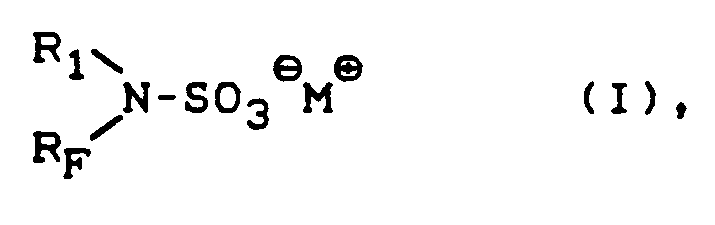
- Es wurden nun neue fluorierte Alkylamidosulfonate der Formel (I) gefunden,

- R1 für Wasserstoff, Alkyl oder fluoriertes Alkyl,
- R, für fluoriertes Alkyl und
- Me für ein Äquivalent eines Kations steht.
- Sofern es sich bei R1 um Alkyl oder fluoriertes Alkyl handelt, können beispielsweise Alkylreste mit 1 bis 12 C-Atomen vorliegen, die gegebenenfalls mit 1 bis 8 F-Atomen substituiert sein können. Vorzugsweise sind derartige Alkyl- und fluorierte Alkylreste gesättigt, geradkettig oder verzweigt und enthalten 1 bis 6 C-Atome und gegebenenfalls 1 bis 6 F-Atome.
- Bei RF kann es sich beispielsweise um fluorierte Alkylreste mit 1 bis 12 C-Atomen und 1 bis 8 F-Atomen handeln. Vorzugsweise sind derartige fluorierte Alkylreste geradkettige oder verzweigt und enthalten 1 bis 6 C-Atome und 1 bis 6 F-Atome.
- Bei Me kann es sich beispielsweise um ein Äquivalent eines Metallkations handeln, beispielsweise um ein Äquivalent Alkali- oder Erdalkalimetallkationen.
- Vorzugsweise bedeutet R1 Wasserstoff oder einen gesättigten, geradkettigen oder verzweigten, von Fluoratomen freien Alkylrest mit 1 bis 4 C-Atomen. Besonders bevorzugt bedeutet R1 Wasserstoff, Methyl, Ethyl oder Propyl.
- Vorzugsweise bedeutet RF einen gesättigten, geradkettigen oder verzweigten, fluorierten Alkylrest mit 1 bis 4 C-Atomen und 1 bis 4 F-Atomen. Besonders bevorzugt enthält RF eine endständige CF3-Gruppe und keine weiteren Substituenten an der Alkylkette, wobei Trifluormethyl, Trifluorethyl, Trifluorpropyl, Trifluorisopropyl und Trifluorbutyl ganz besonders bevorzugt sind.
- Vorzugsweise steht Me für ein Äquivalent Natrium-, Kalium- oder Calciumionen.
- Besonders bevorzugte Alkylamidosulfonate der Formel (I) sind:


- Besonders bevorzugt ist

- Es wurde weiterhin ein Verfahren zur Herstellung von fluorierten Alkylamidosulfonaten der Formel (I)

- R1 für Wasserstoff, Alkyl oder fluoriertes Alkyl,
- RF für fluoriertes Alkyl und
- Me für eine Äquivalent eines Kations steht.
- R1 und RF die bei Formel (I) angegebenen Bedeutungen haben,
- Von den in das erfindungsgemäße Verfahren einzusetzenden fluorierten Alkylamidosulfonsäurechloriden der Formel (II) können beispielsweise, bevorzugt und besonders bevorzugt solche verwendet werden, bei denen R1 und RF die weiter oben als beispielhaft, bevorzugt und besonders bevorzugt angegebenen Bedeutungen haben. Fluorierte Alkylamidosulfonsäurechloride der Formel (II) können beispielsweise gemäß der in der DE-OS 3 429 048 beschriebenen Arbeitsweise erhalten werden.
- Als Temperaturen für die erfindungsgemäße Verseifung kommen beispielsweise solche im Bereich von -20 bis +100°C in Frage. Bevorzugt sind Temperaturen im Bereich von -10 bis +80°C, besonders bevorzugt solche im Bereich 0 bis + 50 ° C.
- Prinzipiell kann das erfindungsgemäße Verfahren auch bei erniedrigtem oder erhöhtem Druck durchgeführt werden, üblicherweise arbeitet man jedoch bei Normaldruck.
- Die erfindungsgemäße Verseifungsreaktion kann mit verschiedenen Mengen an Alkali durchgeführt werden. Da stöchiometrisch für die Verseifung eines Mols fluoriertes Alkylamidosulfochlorid der Formel (11) 2 Äquivalente Alkali erforderlich sind, setzt man vorzugsweise mindestens 2 Äquivalente Alkali pro Mol fluoriertes Alkylamidosulfochlorid der Formel (11) ein. Größere Überschüsse an Alkali schaden im allgemeinen nicht, verursachen jedoch Kosten. Besonders bevorzugt ist deshalb der Einsatz von 2 bis 4, ganz besonders bevorzugt der Einsatz von 2,05 bis 3 Äquivalenten Alkali pro Mol fluoriertes Alkylamidosulfochlorid der Formel (11).
- Geeignete Alkalien sind beispielsweise die Hydroxide der Alkali- und Erdalkalimetalle, insbesondere Natrium-, Kalium- und Calciumhydroxid.
- Die erfindungsgemäße Verseifungsreaktion wird in Gegenwart von Wasser durchgeführt. Die Wassermenge kann in weiten Grenzen variiert werden, beispielsweise im Bereich von 0,4 bis 5 kg, bezogen auf ein Mol zu verseifendes fluoriertes Alkylamidosulfochlorid der Formel (11). Im einfachsten Fall setzt man das Alkali in Form einer wäßrigen Lösung ein, deren Konzentration man so wählt, daß die gewünschten Mengen Alkali und Wasser vorliegen. Zusätzlich zu Wasser können auch inerte organische Lösungsmittel verhanden sein, beispielsweise Alkohole. Diese können jedoch dazu führen, daß nicht mehr in homogener Phase gearbeitet werden kann und/oder bei der Aufarbeitung des Reaktionsgemisches und der Entsorgung der Reaktionsabwässer zusätzlicher Aufwand entsteht. Bevorzugt sind deshalb keine oder nur geringe Mengen organischer Lösungsmittel vorhanden.
- Das Zusammenfügen der Reaktanden, im einfachsten Fall wäßriges Alkali und die jeweilige Verbindung der Formel (11), kann in beliebiger Reihenfolge stattfinden. Beispielsweise kann man so verfahren, daß man die Verbindung der Formel (II) zu vorgelegter wäßriger Alkalilösung zutropft, gegebenenfalls nach Beendigung der Zugabe 2 bis 60 Minuten bei Reaktionstemperatur nachrührt und dann das Produkt der Formel (I) isoliert.
- Die Aufarbeitung des nach der Reaktion vorliegenden Gemisches kann auf einfache Weise erfolgen. Man kann beispielsweise die wäßrige Rohlösung soweit einengen, daß das Produkt der Formel (I) ausfällt und das als Nebenprodukt gebildete Chlorid des eingesetzten Alkalis noch in Lösung bleibt. Nach der Abtrennung des so ausgefällten Materials erhält man im allgemeinen durch Nachwaschen mit wenig Wasser und Trocknen das Produkt der Formel (I) in analysenreiner Form. Aus der Mutterlauge kann man durch weiteres Einengen und analoge Aufarbeitung weitere Fraktionen des Produktes der Formel (I) erhalten.
- Mit dem erfindungsgemäßen Verfahren gelingt es im allgemeinen, fluorierte Alkylamidosulfonate in Ausbeuten von über 70 %, häufig in Ausbeuten von über 90 %, herzustellen, insbesondere wenn man mindestens 2 Produktfraktionen aus der rohen wäßrigen Reaktionslösung durch die zuvor beschriebenen Maßnahmen abtrennt. Dies ist im Hinblick auf den eingangs geschilderten Stand der Technik außerordentlich überraschend.
- Die neuen fluorierten Alkylamidosulfonate der Formel (I) können z.B. als Zwischenprodukte zur Herstellung von Pflanzenschutzmitteln, Pharmazeutika und Farbstoffen verwendet werden. Die vorliegende Erfindung betrifft weiterhin die Verwendung von fluorierten Alkylamidosulfonaten der Formel (I)

- R1 für Wasserstoff, Alkyl oder fluoriertes Alkyl,
- RF für fluoriertes Alkyl und
- Me für ein Äquivalent eines Kations stehen,
- Für diese Verwendung sind diejenigen Verbindungen der Formel (I) bevorzugt, besonders bevorzugt und ganz besonders bevorzugt, die weiter oben der Beschreibung der neuen fluorierten Alkylaminosulfonate der Formel (I) entsprechend charakterisiert wurden.
- Erfindungsgemäße Polycarbonatformmassen können fluorierte Alkylamidosulfonate der Formel (I) beispielsweise in Mengen von 0,05 bis 1 Gew.-%, vorzugsweise in Mengen von 0,1 bis 0,5 Gew.-%, bezogen auf das Gewicht von Polycarbonat + Flammschutzmitteln enthalten. Außerdem können erfindungsgemäße Polycarbonatformmassen übliche Additive in üblichen Mengen enthalten, beispielsweise Thermo-, Hydrolyse- und/oder UV-Stabilisatoren, Schlagzähmodifikatoren und/oder Entformungsmittel.
- Als Polycarbonatbestandteil der erfindungsgemäßen Polycarbonatformassen kommen beispielsweise an sich bekannte aromatische Polycarbonate in Frage. wie sie z.B. durch Polykondensation von Diphenolen mit Phosgen oder Diestern der Kohlensäure erhältlich sind. Bei den Diphenolen kann es sich um unsubstituierte Dihydroxydiarylalkane handeln, aber auch um solche, deren Arylreste substituierte sind, beispielswesie durch C1-C4-Alkylgruppen, z.B. Methylgruppen, und/oder durch Halogenatome, beispielsweise Chloratome, jeweils in o- und/oder m-Stellung zur Hydroxylgruppe.
- Insbesondere kommen folgende Diphenole in Frage: Hydrochinon, Resorcin, 4,4'-Dihydroxydiphenyl, Bis-(hydroxy-phenyl)-alkane wie Ci - bis C8-Alkylen- und C2- bis C8-Alkyliden-bisphenole, Bis-(hydroxyphenyl)-cycloalkane wie Cs- bis C15-Cycloalkylen- oder Cs - bis C15-Cycloalkylidenbisphenole, Bis-(hydroxy-phenol)-sulfide, -ether, -ketone, -sulfoxide oder -sulfone. Ferner a,a' -Bis-(hydroxy-phenyl)-diisopro- pylbenzol und die entsprechenden kernalkylierten und/oder kernhalogenierten Verbindungen.
- Bevorzugt sind Polycarbonate auf der Basis von Bis-(4-hydroxy-phenyl)-propan-2,2 (Bisphenol A), Bis-(4-hydroxy-3,5-dichlor-phenyl)-propan-2,2 (Tetrachlorbisphenol A), Bis-(4-hydroxy-3,5-dibrom-phenyl)-propan-2,2 (Tetrabrombisphenol A), Bis-(4-hydroxy-3,5-dimethyl-phenyl)-propan-2,2 (Tetramethylbisphenol A), Bis-(4-hydroxy-phenyl)-cyclohexan-1,1 (Bisphenol Z) und solche auf der Basis von Dreikernbisphenolen wie a,a'-Bis-(4-hydroxy-phenyl)-p-diisopropylbenzol. Weitere geeignete Diphenole sind in den US-Patenten 2 970 131, 2 991 273, 2 999 835, 2 999 846, 3 028 365, 3 062 791, 3 148 172, 3 271 367 und 3 275 601 beschrieben.
- Auch verzweigte Polycarbonate sind als Basis für erfindungsgemäße Polycarbonatformmassen geeignet.
- Die Polycarbonate können beispielsweise Gewichtsmittel-Molekulargewichte Mw im Bereich 10 000 bis 100 000 aufweisen (ermittelt durch Messung der relativen Viskosität in Methylenchlorid bei 25°C). Vorzugsweise liegt dieses Gewichtsmittel-Molekulargewicht im Bereich 15 000 bis 40 000. Als Molekulargewichtsregler kommen beispielsweise monofunktionelle Phenole, wie Phenol, p-tert.-Butylphenol und/oder p-Isooctylphenol in Frage.
- Erfindungsgemäße Polycarbonatformmassen kann man beispielsweise durch Compoundierung von Polycarbonat mit 0,05 bis 1 Gew.-% fluorierten Alkylamidosulfonaten der Formel (I) und gegebenenfalls weiteren Additiven auf einem Extruder bei 250 bis 300 ° C herstellen.
- Die erfindungsgemäßen Polycarbonatformmassen zeichnen sich dadurch aus, daß der Verbrennungstest gemäß Underwriters' Laboratories Inc., Bulletin 94, eine Einordnung in die Klasse VO ergibt (Einzelheiten siehe Beispiele 11 und 12).
- Die folgenden Beispiele erläutern die vorliegende Erfindung ohne sie in irgendeiner Weise zu Beschränken.
- Der Nachweis der gemäß den Beispielen 1 bis 10 hergestellen Produkte erfolgte durch Elementaranalyse und durch ihre IR- und Massenspektren. Letztere wurden nach der FAB-Technik (fast-atomic-bombardement) aufgenommen.
- Zu 20 g Natriumhydroxid wurden in 350 ml Wasser gelöst und bei Raumtemperatur unter Kühlung mit Wasser in 15 Minuten 35,8 g (0,2 Mol) 2,2,2-Trifluormethylamidosulfochlorid zugetropft. Anschließend wurde 15 Minuten bei 40 °C nachgerührt und dann die Lösung im Wasserstrahlvakuum auf ein Fünftel des ursprünglichen Volumens eingeengt. Der ausgefallene Niederschlag wurde abgesaugt, mit wenig Wasser gewaschen und getrocknet. Es wurden 30,4 g (75,6 % der Theorie) Natrium-N-(2,2,2-trifluorethyl)-aminosul- fonat in Form farbloser Kristalle und mit einem Schmelzpunkt von über 250 ° C erhalten.
- Aus dem Filtrat, das mit der Waschphase vereinigt wurde, wurden durch weiteres Einengen, Absaugen, Nachwaschen mit Wasser und Trocknen weitere 6,1 g (15,1 % der Theorie) Natrium-N-(2,2,2-trifluorethyl)-amidosulfonat erhalten.
- Die Gesamtausbeute betrug also 36,5 g (90,7 % der Theorie).
- Es wurde verfahren wie in Beispiel 1, jedoch wurde die entsprechende Menge 2,2,2-Trifluor-1-methyl- ethyl-amidosulfonat eingesetzt. Die Gesamtausbeute an Natrium-N-(2,2,2-trifluor-1-methyl-ethyl)-amidosulfo- nat mit einem Schmelzpunkt von über 250 °C betrug 80,2% der Theorie.
- Es wurde verfahren wie in Beispiel 1, jedoch wurde die entsprechende Menge 3,3,3-Trifluorpropylamidosulfochlorid eingesetzt und Natrium-N-(3,3,3-trifluorpropyl)-amidosulfonat mit einem Schmelzpunkt von über 250 ° C in einer Gesamtausbeute von 93,6 % der Theorie erhalten.
- Es wurde verfahren wie in Beispiel 1, jedoch wurde die entsprechende Menge 2,2,2-Trifluorethyl-N-methyl-amidosulfonat eingesetzt und Natrium-N-(2,2,2-trifluorethyl)-N-methyl-amidosulfonat mit einem Schmelzpunkt von über 250 ° C in einer Gesamtausbeute von 97,8 % der Theorie erhalten.
- Es wurde verfahren wie in Beispiel 1, jedoch wurde die entsprechende Menge 2,2,2-Trifluorethyl-N-ethyl-amidosulfochlorid eingesetzt und Natrium-N-(2,2,2-trifluorethyl)-N-ethyl-amidosulfonat mit einem Schmelzpunkt von über 250 ° C in einer Gesamtausbeute von 78,1 % der Theorie erhalten.
- Es wurde jeweils verfahren wie in den Beispielen 1 bis 5, jedoch wurde anstelle von 20 g Natriumhydroxid jeweils 27,5 g Kaliumhydroxid eingesetzt. Es wurden erhalten:
- Kalium-N-(2,2,2-trifluorethyl)-amidosulfonat mit einem Schmelzpunkt von 245 °C (Zersetzung) in einer Gesamtausbeute von 96,8 % der Theorie.
- Kalium-N-(2,2,2-trifluor-1-methyl-ethyl)-amidosulfonat mit einem Schmelzpunkt von über 250 °C in einer Gesamtausbeute von 78,4 % der Theorie.
- Kalium-N-(3,3,3-trifluorpropyl)-amidosulfonat mit einem Schmelzpunkt von über 250 °C in einer Gesamtausbeute von 96,3 % der Theorie.
- Kalium-N-(2,2,2-trifluorethyl)-N-methyl-amidosulfonat mit einem Schmelzpunkt von über 250 °C in einer Gesamtausbeute von 89,1 % der Theorie.
- Kalium-N-(2,2,2-trifluorethyl)-N-ethyl-amidosulfonat mit einem Schmelzpunkt von über 250 °C in einer Gesamtausbeute von 84,8 % der Theorie.
- Gemäß dem UL 94-Test (Underwriters' Laboratories, Inc., Bulletin 94) wurden Polycarbonatproben zu Stäben der Abmessungen 127 x 12,7 x 3,2 mm geformt. Die Stäbe wurden vertikal so montiert, daß die Unterseite der Probenkörper sich 305 mm über einem Streifen Verbandstoff befanden. Jeder Probestab wurde einzeln mittels zwei aufeinanderfolgender Zündvorgänge von 10 Sekunden Dauer gezündet, die Brenneigenschaften nach jedem Zündvorgang wurde beobachtet und danach die Probe bewertet. Zum Entzünden der Probe wurde ein Bunsenbrenner mit einer 10 mm hohen blauen Flamme von Erdgas mit einem Wärmeinhalt von 3,73 x 10⁴ KJ/m3 benutzt.
- Für eine Klassifizierung in die Klasse UL 94 VO ist es erforderlich, daß keine der Proben länger als 10 Sekunden nach jeder Einwirkung der Testflamme brennt, keine Gesamt-Flammzeit von mehr als 50 Sekunden bei der zweimaligen Flammeinwirkung auf jeden Probensatz auftritt, keine der Proben vollständig bis hinaus zu der am oberen Ende der Probe befestigten Halteklammer abbrennt, keine der Proben den Verbandstoff durch brennende Tropfen oder Teilchen entzündet, und die Proben nicht länger als 30 Sekunden nach Entfernen der Testflamme glimmen.
- Andere UL 94-Klassifizierungen bezeichnen Proben, die weniger flammwidrig und selbstverlöschend sind (UL 94 V1) und flammende Tropfen oder Teilchen abgeben (UL 94 V2).
- 9000 g Bisphenol A-Homopolycarbonat der relativen Viskosität 1,29, gemessen in Methylenchlorid bei 25 °C, wurden bei 300 ° C über einen Extruder zu einem Strang extrudiert und anschließend granuliert. Aus dem Granulat wurden auf einer Spritzgußmaschine bei 280 ° C Prüfkörper mit den Maßen 127 x 12,7 x 3,2 mm (gemäß UL 94-Test) geformt, an denen der zuvor beschriebene UL 94-Test vorgenommen wurde. Es ergab sich die Klassifizierung UL 94 V2 (3,2 mm).
-

gefunden, das dadurch gekennzeichnet ist, daß man fluorierte Alkylamidosulfochloride der Formel (II)

wäßrig-alkalisch verseift.
als Flammschutzmittel für Polycarbonatformmassen.
Claims (10)




dadurch gekennzeichnet, daß man fluorierte Alkylamidosulfochloride der Formel (II)

wäßrig-alkalisch verseift.

als Flammschutzmittel für Polycarbonatformmassen.

enthalten.
Applications Claiming Priority (2)
| Application Number | Priority Date | Filing Date | Title |
|---|---|---|---|
| DE19873708316 DE3708316A1 (de) | 1987-03-14 | 1987-03-14 | Fluorierte alkylamidosulfonate, deren herstellung, deren verwendung als flammschutzmittel und sie enthaltende polycarbonatformmassen |
| DE3708316 | 1987-03-14 |
Publications (3)
| Publication Number | Publication Date |
|---|---|
| EP0283774A2 EP0283774A2 (de) | 1988-09-28 |
| EP0283774A3 EP0283774A3 (en) | 1989-12-27 |
| EP0283774B1 true EP0283774B1 (de) | 1992-05-06 |
Family
ID=6323074
Family Applications (1)
| Application Number | Title | Priority Date | Filing Date |
|---|---|---|---|
| EP88103120A Expired - Lifetime EP0283774B1 (de) | 1987-03-14 | 1988-03-02 | Fluorierte Alkylamidosulfonate, deren Herstellung, deren Verwendung als Flammschutzmittel und sie enthaltende Polycarbonatformmassen |
Country Status (4)
| Country | Link |
|---|---|
| US (1) | US4826634A (de) |
| EP (1) | EP0283774B1 (de) |
| JP (1) | JPS63238055A (de) |
| DE (2) | DE3708316A1 (de) |
Families Citing this family (7)
| Publication number | Priority date | Publication date | Assignee | Title |
|---|---|---|---|---|
| US6518347B1 (en) | 2000-12-27 | 2003-02-11 | 3M Innovative Properties Company | Flame retardant carbonate polymers and use thereof |
| US8258341B2 (en) | 2009-07-10 | 2012-09-04 | E.I. Du Pont De Nemours And Company | Polyfluorosulfonamido amine and intermediate |
| US9168408B2 (en) * | 2010-03-25 | 2015-10-27 | The Chemours Company Fc, Llc | Surfactant composition from polyfluoroalkylsulfonamido alkyl amines |
| US8779196B2 (en) * | 2010-03-25 | 2014-07-15 | E I Du Pont De Nemours And Company | Polyfluoroalkylsulfonamido alkyl halide intermediate |
| US8729138B2 (en) * | 2010-03-25 | 2014-05-20 | E I Du Pont De Nemours And Company | Mixture of polyfluoroalkylsulfonamido alkyl amines |
| PL3764451T3 (pl) | 2018-03-27 | 2023-02-20 | Daikin Industries, Ltd. | Roztwór elektrolitu, urządzenie elektrochemiczne, litowo-jonowa bateria akumulatorowa oraz moduł |
| PL3761435T3 (pl) | 2018-03-27 | 2023-02-06 | Daikin Industries, Ltd. | Roztwór elektrolitu, urządzenie elektrochemiczne, litowo-jonowa bateria akumulatorowa, moduł oraz związek |
Family Cites Families (3)
| Publication number | Priority date | Publication date | Assignee | Title |
|---|---|---|---|---|
| DE2506726C2 (de) * | 1975-02-18 | 1982-06-16 | Bayer Ag, 5090 Leverkusen | Verwendung von Perfluoralkansulfonamiden und/oder Ammoniumsalzen von Perfluoralkansulfonsäuren und/oder Cyclimmoniumsalzen von Perfluoralkansulfonsäuren als Entformungsmittel |
| DE2628195C2 (de) * | 1976-06-23 | 1978-06-08 | Basf Ag, 6700 Ludwigshafen | Verfahren zur Herstellung von Amidosulfonsäuren |
| DE3429048A1 (de) * | 1984-08-07 | 1986-02-20 | Bayer Ag, 5090 Leverkusen | Fluorierte alkylamidosulfochloride |
-
1987
- 1987-03-14 DE DE19873708316 patent/DE3708316A1/de not_active Withdrawn
-
1988
- 1988-02-23 US US07/159,145 patent/US4826634A/en not_active Expired - Fee Related
- 1988-03-02 DE DE8888103120T patent/DE3870688D1/de not_active Expired - Lifetime
- 1988-03-02 EP EP88103120A patent/EP0283774B1/de not_active Expired - Lifetime
- 1988-03-09 JP JP63053846A patent/JPS63238055A/ja active Pending
Also Published As
| Publication number | Publication date |
|---|---|
| US4826634A (en) | 1989-05-02 |
| EP0283774A2 (de) | 1988-09-28 |
| DE3870688D1 (de) | 1992-06-11 |
| EP0283774A3 (en) | 1989-12-27 |
| DE3708316A1 (de) | 1988-09-22 |
| JPS63238055A (ja) | 1988-10-04 |
Similar Documents
| Publication | Publication Date | Title |
|---|---|---|
| DE2500092C3 (de) | Verzweigte, hochmolekulare, thermoplastische und lösliche Polycarbonate | |
| EP0122535A2 (de) | Verfahren zur Herstellung von Polydiorganosiloxanen mit Hydroxyaryloxy-Endgruppen | |
| DE2506726A1 (de) | Verwendung von perfluoralkansulfonamiden und/oder ammoniumsalzen von perfluoralkansulfonsaeuren und/oder cyclimmoniumsalzen von perfluoralkansulfonsaeuren als entformungsmittel | |
| EP0140120B1 (de) | Neue Flammschutzmittel, ihre Hersteelung und ihre Verwendung zur Flammfestausrüstung von Polycarbonaten | |
| EP0283774A2 (de) | Fluorierte Alkylamidosulfonate, deren Herstellung, deren Verwendung als Flammschutzmittel und sie enthaltende Polycarbonatformmassen | |
| EP0024331B1 (de) | Verfahren zur Herstellung von flammwidrigen Polycarbonaten | |
| EP0001823A2 (de) | Verwendung von Borsäureestern zum Stabilisieren von phosphitfreien Polycarbonaten und die erhaltenen stabilisierten Polycarbonatformmassen | |
| EP0043997A2 (de) | Flammverzögerungsmittel für Polycarbonate | |
| EP0138173B1 (de) | Neue Flammschutzmittel, ihre Herstellung und ihre Verwendung zur Flammfestausrüstung von Polycarbonaten | |
| DE2113347C2 (de) | Tetraphenol, Verfahren zu seiner Herstellung und Verwendung zur Herstellung von verzweigten Polycarbonaten | |
| EP0000753B1 (de) | Verfahren zur Herstellung von Polycarbonaten und die erhaltenen Polycarbonate | |
| DE1249261B (de) | Verfahren zur Herstellung von Indanyl-N-methylcarbaminsäureestern | |
| EP0129148B1 (de) | Neue Flammschutzmittel, ihre Herstellung und ihre Verwendung zur Flammfestausrüstung in Polycarbonat | |
| EP0099990A1 (de) | Verfahren zur Herstellung von Polycarbonaten mit N-Alkyl-perfluoralkylsulfonamid-Endgruppen | |
| DE69706933T2 (de) | Verfahren zur Reinigung von 1,1,1-Tris(4-Hydroxyphenyl)alkanen | |
| EP0137309B1 (de) | Mehrcyclische Kohlensäureester und neue Copolymere erhältlich aus diesen mehrcyclischen Kohlensäureestern und monocyclischen Carbonaten | |
| EP0069066B1 (de) | Resorcinole und deren Herstellung | |
| EP0000043B1 (de) | Bisphosphinsäureanhydride und Verfahren zu ihrer Herstellung | |
| DE69305319T2 (de) | Heterocyclische bis(4-Hydroxyphenyl)cycloalkane und daraus hergestellte Polycarbonate | |
| DE3035394A1 (de) | Verfahren zur herstellung von pyrazol | |
| DE2132040C3 (de) | Chlorierte und/oder bromierte Cyclopentadien-Addukte des Styrols und deren Verwendung als flammhemmende Mittel | |
| DE2344387A1 (de) | Die verwendung von bis-(alkylsulfonyl)vinylbenzolen als uv-absorptionsmittel in polymeren | |
| DE112024001978T5 (de) | Polycarbonat-harzzusammensetzung und formartikel hieraus | |
| DE1643226A1 (de) | Photochrome Verbindungen und ihre Herstellung | |
| EP0071125A1 (de) | Nichthalogenierte flammwidrige Polycarbonate |
Legal Events
| Date | Code | Title | Description |
|---|---|---|---|
| PUAI | Public reference made under article 153(3) epc to a published international application that has entered the european phase |
Free format text: ORIGINAL CODE: 0009012 |
|
| 17P | Request for examination filed |
Effective date: 19880302 |
|
| AK | Designated contracting states |
Kind code of ref document: A2 Designated state(s): DE FR GB IT NL |
|
| PUAL | Search report despatched |
Free format text: ORIGINAL CODE: 0009013 |
|
| AK | Designated contracting states |
Kind code of ref document: A3 Designated state(s): DE FR GB IT NL |
|
| 17Q | First examination report despatched |
Effective date: 19910827 |
|
| GRAA | (expected) grant |
Free format text: ORIGINAL CODE: 0009210 |
|
| AK | Designated contracting states |
Kind code of ref document: B1 Designated state(s): DE FR GB IT NL |
|
| PG25 | Lapsed in a contracting state [announced via postgrant information from national office to epo] |
Ref country code: IT Free format text: LAPSE BECAUSE OF FAILURE TO SUBMIT A TRANSLATION OF THE DESCRIPTION OR TO PAY THE FEE WITHIN THE PRE;WARNING: LAPSES OF ITALIAN PATENTS WITH EFFECTIVE DATE BEFORE 2007 MAY HAVE OCCURRED AT ANY TIME BEFORE 2007. THE CORRECT EFFECTIVE DATE MAY BE DIFFERENT FROM THE ONE RECORDED.SCRIBED TIME-LIMIT Effective date: 19920506 Ref country code: GB Effective date: 19920506 Ref country code: FR Effective date: 19920506 Ref country code: NL Effective date: 19920506 |
|
| REF | Corresponds to: |
Ref document number: 3870688 Country of ref document: DE Date of ref document: 19920611 |
|
| EN | Fr: translation not filed | ||
| NLV1 | Nl: lapsed or annulled due to failure to fulfill the requirements of art. 29p and 29m of the patents act | ||
| GBV | Gb: ep patent (uk) treated as always having been void in accordance with gb section 77(7)/1977 [no translation filed] | ||
| PLBE | No opposition filed within time limit |
Free format text: ORIGINAL CODE: 0009261 |
|
| STAA | Information on the status of an ep patent application or granted ep patent |
Free format text: STATUS: NO OPPOSITION FILED WITHIN TIME LIMIT |
|
| 26N | No opposition filed | ||
| PG25 | Lapsed in a contracting state [announced via postgrant information from national office to epo] |
Ref country code: DE Effective date: 19931201 |